Tag Archive for: fitness

On The Fitness Road Again!

How My Fitness Journey Took A Detour, And How One Powerful Documentary Is Going To Help Me Get Back On Track.
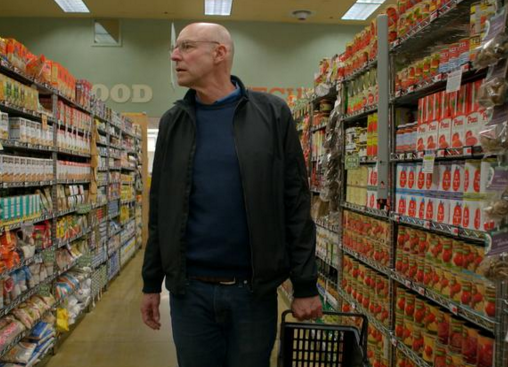
Michael Pollan's PBS documentary and book have inspired RoseMarie to renew her fitness quest.

Nutritionist Michael Pollan’s PBS documentary and book have inspired RoseMarie to renew her fitness quest.

So, to let all of you who were following my fitness journey here last summer know, I was doing great…and then I wasn’t. I don’t know exactly when I lost momentum or let complacency set in or thought I could let some old bad habits wiggle back into my life here and there without bad effect. But here I am again a year later feeling like a stuffed sausage in too-tight jeans and nowhere near fitting into that favorite dress of mine again. Somehow I’ve managed to gain back half the weight I lost.

But I’m not throwing in the towel or losing the tape measure or chucking the scale. I’ve got three-plus months to get back to where I was last fall, and I vow to continue this time until I reach my goal. My plan is to continue my exercise program, finally conquer my habit of staying up late and getting up early, stick to a healthy and sensible diet, and make all of this a permanent, everyday part of my life going forward. I’ll report periodically on how I’m doing and share with you any insights or good tips I’ve found on my renewed journey to fitness.

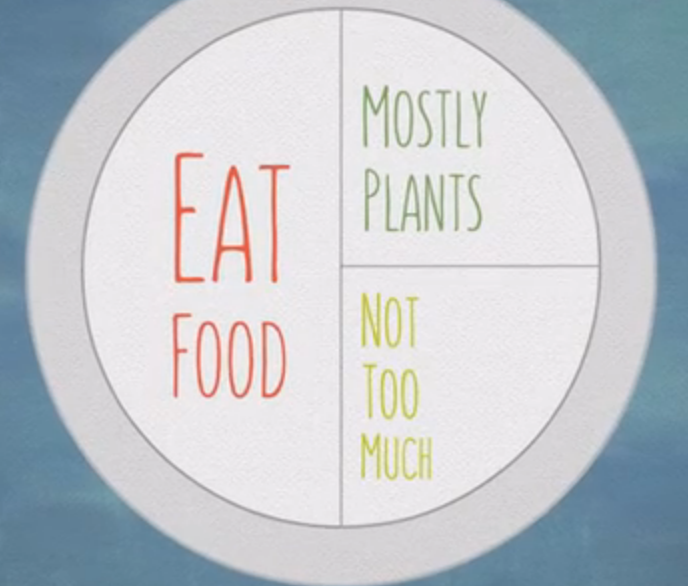
My big piece of advice for you today is to check out In Defense of Food, the excellent two-hour PBS documentary about nutrition produced by Michael Pollan, America’s most personable, passionate, and brilliant nutrition activist, journalist, and award-winning author. At the heart of the documentary, which is based on his best-selling book of the same name and which first aired on PBS last December, is Pollan’s seven-word maxim to help Americans figure out how to eat to be healthy: “Eat food. Not too much. Mostly plants.”

During my fitness program last summer, I had actually incorporated some of his philosophy into my new eating regimen. I became very vigilant about portion control, and I started eating less meat and white food (e.g., bread, cheese, etc.) and more fruit and veggies. But after watching Pollan’s riveting documentary, I have a whole new view on what “food” is.

When Pollan says to “Eat food”, he’s talking about 100% real food, not quasi-food or “edible food-like substances”. Believe it or not, probably most of the food in your local supermarket falls into the latter category. Anything artificial or with additives does not qualify as real or pure food. When Pollan says “the quieter the food, the healthier the food”, he’s talking about the “health” claims that cry out from the packaging, most of which are horribly misleading or worse, untrue. As much as the government tries to regulate what can be said on packaging, the manufacturers find clever ways around the rules. To follow this part of the maxim, always read the labels and buy food that’s free of packaging, which will make it easier to follow the third part of the maxim: “Mostly plants”. Eat lots of fruits and vegetables and consider meats “special occasion” food. For the freshest produce with the least amount of packaging, shop at your local farmers’ markets.

And to follow the middle part of the maxim, “Not too much”, Pollan suggests eating your fruits and vegetables first during a meal, and use smaller plates and glasses. And of course, be mindful of your portion sizes—think palm-full, not plate-full.

Enjoy Mr. Pollan’s documentary…and wish me luck!

Pollan's seven word rule for selecting and consuming food. Makes sense.
Pollan’s seven word rule for selecting and consuming food. Makes sense.
 

My Fitness Journey Continues: Part Eight

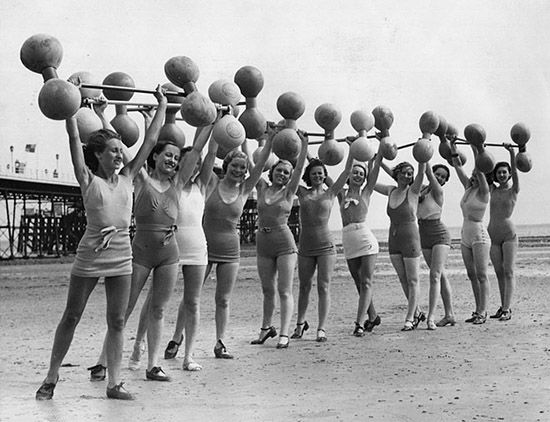
Correspondent Rose Marie Cleese reports on her fitness journey, noting that regular exercise makes a big difference in how you feel. Credit: Pinterest

Correspondent Rose Marie Cleese reports on her fitness journey, noting that regular exercise makes a big, big difference in how you feel.
Credit: Pinterest

The Journey That Began With A Single Step Isn’t Over Yet!

Although this will be the last official installment of my personal fitness journey series that began on May 1st, it’s definitely not the end of the journey. I have many more pounds to lose before I sleep and promises to myself to continue to keep. I’ll be posting an update some time in the next three months, at which time I hope I can tell you that I’ve met all of my goals, including losing that last 20 pounds and tipping the scales at 130 pounds. I’ve already lost 20 pounds so I’m halfway there.

Even though I haven’t yet reached my desired weight, I’ve added a number of habits to my life that have made me a healthier, happier person with a body that’s so much better prepared to hit the slopes (hopefully in the next couple of weeks) than the one that floundered on them last March. I tried on my ski clothes last week and they fit comfortably rather than my feeling like a stuffed sausage. People who haven’t seen me in a few months are noticing my weight loss and telling me how good I look. Most importantly, I feel so much healthier…and bouncier.

So what am I taking away from these past seven months? The number one lesson I’ve learned is how important regular exercise is. My twice-weekly aerobics classes and my once-a-week stretching classes and weight classes have had a considerable effect on me. I don’t get out of breath exerting myself anymore, my balance has improved 100%, and my arms and legs actually look and feel toned. I’ve rarely missed my classes because I feel so energized at the end of them. This is one habit that has become solidly entrenched. In the near future I’d like to add some yoga to my exercise regimen and I’ve put a Fitbit on my Christmas wish list.

Regarding my weight loss, I’m happy that I haven’t gained back any of the weight I’ve lost (even over the Thanksgiving holiday!), but I do need to get back on track in the coming months. I plan on being more religious about mindful eating, portion control, food choices (less “white” food, more fruits and vegetables), not eating late meals, and saying “no” at least a couple of times a day when I’m tempted to snack or eat something that’s unhealthy. I’ll continue the daily food diary that I’ve been faithfully keeping the last seven months, and I’ll continue to weigh in once a week and also check my measurements once a month. If I find that the pounds are refusing to come off, I may participate for a couple of months in one of the several diet plans out there that are the top choices of the medical establishment.

As I write this article at 3 AM, I have to admit that I have failed miserably at getting enough sleep and am beginning to wonder if a night owl can ever be an early bird. I’ll let you know in my update in a few months if I’ve found an answer to this perennial problem of mine. Suggestions welcome!

Speaking of suggestions, I want to thank all of you out there who have sent me your thoughts, insights, and encouraging words over the past seven months. It really does make it easier when you’ve got some cheerleaders urging you on. In the meantime, there are some snowy slopes out there that are calling my name, and I can’t wait to make some tracks on them. Stay fit…stay tuned…and have a great winter!

Editor’s Note: SeniorsSkiing.com salutes our correspondent Rose Marie Cleese for sharing her journey with our readers over the last few months.  Her project took courage and fortitude.  Please join us in acknowledging her efforts and her willingness to tell us about her experience.

My Fitness Journey Continues: Part Six

The Battle Of The Bulge Rages On! (Thankfully, Reserve Forces Are On Their Way.)

Getting back into shape is a combination of courage, knowledge and just doing. SeniorsSkiing.com Correspondent has all three working for her.

Getting back into shape is a combination of courage, knowledge and just doing it.

As I enter the sixth month of my personal (and public!) journey to fitness, I continue to make slow, steady progress toward my goal of being in great shape for the slopes come the first snowfall (and it IS supposed to snow in the Sierra this winter). Faithfully attending my four weekly exercise classes? Check. Doing weights three times a week? Check. Continuing to lose up to an inch in my measurements each month? Check. Drinking more water? Check. Getting more sleep? Check. Getting on the scale once a week? Check. Losing weight? Not so much. Since I started this journey, I’ve lost a total of 14 pounds, but I still have 26 pounds to go. So three pounds a month instead of two pounds a week is a bit disappointing. But the good news is that I haven’t gained anything back, and I have established a few good eating habits, such as snacking on edamame instead of salami and crackers. But I need to crank it up!

So it was quite fortuitous for me when a special issue of the highly respected University of California, Berkeley, Wellness Letter arrived in my mailbox a few weeks ago. The entire Special Fall Issue 2015 is devoted to body weight and all its attendant issues. It includes an overview article that looks at our nation’s battle with obesity, and sidebars on BMI (body mass index), why it’s so hard to keep the weight off that one’s lost, and a brief analysis of recent diet studies.

Watching what you eat is the key to weight loss. Ix-nay on the donuts.

Watching what you eat is the key to weight loss. Ix-nay on the donuts.

But the article that really caught my eye was “18 Keys to Healthy Weight Loss: Tried-and-true advice that can help tip the scales in your favor.” I did a quick check and found that I was adhering to nine of them, which was encouraging, but I plan to add a few more to accelerate my weight loss. Some of the pointers are well-known, such as eating a healthy diet that’s tilted toward vegetables, fruits, whole grains, fish, and lean meats and away from sugary foods and saturated and trans fats, and being a conscious eater (eating smaller portions, eating more slowly, and keeping a food diary). But there were several less-intuitive but scientifically proven pieces of advice that I’m going to add to my arsenal of weapons to help me win my battle of the bulge. For instance, “Key #7: Go for volume (low-energy-dense foods)” recommends

Exercise is only part of the picture. Diet plays the most important role in weight loss.

Exercise is only part of the picture. Diet plays the most important role in weight loss.

eating foods with lower calories relative to their weight and volume, in other words, foods that have high water and high fiber content such as fruits and vegetables and broth-based soups rather than low-moisture, denser, high-fat foods such as crackers, cheese, cookies, etc. Case in point: a cup of grapes is the equivalent of 1/4-cup of raisins. In short, think “watery” foods! “Key #10: Limit variety at meals” points out that “you’re likely to eat less if you have less variety, since foods similar in taste and texture dull the palate (a phenomenon called sensation-specific satiety).” It offers a good suggestion for buffets and parties, just in time for the upcoming holiday season: when facing a whole array of appetizers, choose just the two or three that most appeal to you and limit yourself to one trip to the table. It will keep your appetite from accelerating.

Accompanying the article are several useful sidebars that help you calculate your daily calorie count, outline which kind of diet will work best for you (surprisingly, genetics and individual proclivities play a major part in what will actually result in the best outcome for you), offer a critical look at diet supplements, and discuss the part exercise plays in losing weight.

The editors of the newsletter had just posted this particular article on their website, so you can read it in its fascinating entirety! Just click here.

To calculate your BMI, go to to this NIH site.

Editor Note:  SeniorsSkiing.com salutes Correspondent Rose Marie Cleese for chronicling her journey back to fitness.  She continues to be an inspiration to those of us who wonder about our conditioning as we age.  Keep going, RMC.  We’re all rooting for you!


My Fitness Journey Continues: Part Three

How and what we eat is the second half of being fit.

Well, they never said it would be easy. Although the exercise part of my journey to fitness is going well (I’ve lost another inch in my upper body measurements), the changing of my diet is going a bit more slowly (I’ve lost only two pounds this month). The good news is that I’m going in the right direction, weight-wise, and I’ve also read that you gain heavier muscle mass as you get into better shape, which means my body composition is better than the scale would indicate.

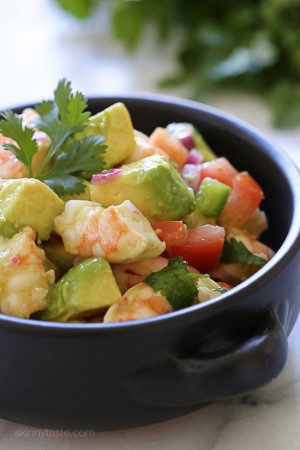
In this Zesty Lime, Shrimp and Avocado Salad recipe, healthy avocados play a starring role! (Credit: skinnytaste.com)

In this Zesty Lime, Shrimp and Avocado Salad recipe, healthy avocados play a starring role! (Credit: skinnytaste.com)

Regarding food management, we’ve probably all followed some popular diet (or several) over the course of our lifetime, with varying degrees of success. We’ve likely lost some or a lot of weight in a matter of weeks or a few months. But as we all know, within a year or two, we’ve put the weight back on. The problem is that diets with extreme components are not sustainable (or even healthy) over the long term. The key is to instill lifelong healthy eating habits that we can live with (both literally and figuratively!).

Long-popular diet plans (such as the South Beach Diet, the Atkins Diet, Weight Watchers, etc.) and even the more extreme ones (e.g., the Cabbage Soup Diet, the Fast Food Diet) can be good “jump-starters” but over the long haul, the only way to keep the weight off is to develop good eating habits. I’m finding out changing decades-old habits is not something you can do overnight. I’ve made a few changes, such as eliminating a roll or piece of bread with dinner and saying “no” to myself a few times a day when I feel compelled to grab a nibble of something, but I plan on doing a better job of practicing what I preach in the coming months, so hopefully I’ll have great news to report in this area by fall.

And what do I preach? My jump-starter, as mentioned in an earlier article, is Weight Watchers, which I plan to continue for another three months. What’s been good about the program this first three months is that it’s gotten me in the habit of recording everything I eat and drink every day. Over the next three months I plan to do a better job of staying within my allotted daily points.

When it comes to lifelong habits, I’m working on developing the following behaviors:

  • Drink several glasses of water a day (in lieu of diet soda; a study cited in the University of California, Berkeley Wellness Letter showed that people over 65 who drank diet soda every day had gained two more inches in their waist over a nine-year period than those who hadn’t imbibed). Often, when we feel hungry, we’re actually thirsty. A glass of water can subdue hunger pangs, plus it helps keep your body hydrated, which becomes more challenging as we age. Nancy Brest, who’s been a fitness instructor at The Ritz-Carlton Lake Tahoe for five years and works with the U.S. snowboard team, adheres to drinking daily in ounces half your body weight, so if you’re 160 pounds your daily allotment would be 80 ounces.
  • Eat a few small meals a day rather than one or two large ones, and nearly every article I’ve ever read on nutrition and diet has stressed how important it is not to skip breakfast. Save bigger meals for earlier in the day; I try not to eat any meals later than 7 PM.
  • Practice “mindful eating.” In a nutshell, it’s all about chewing slowly and consciously tasting your food. It’s about savoring every mouthful as opposed to shoveling it in. Take twice as long to eat a meal than you usually take. Google “mindful eating” and you’ll find many articles if you want to delve deeper into developing this habit.
  • And finally, you don’t have to eat plain steamed vegetables on a plate to eat healthily. One way to make the transition from bad habits to good ones is substitution: e.g., putting Greek yogurt on your potato instead of butter. And one of the best sites around to find incredibly delicious and savory recipes of your favorite dishes that have been made more healthy is skinnytaste.com. Be sure to check it out, especially the black bean burgers (better than beef ones!).

One final surprising diet tip: the feature article in the latest issue of UC-Berkeley’s Wellness Letter is packed with incredible facts on the health benefits of avocados. Don’t be put off by the calories. There are so many other health benefits packed into the little fruits that outweigh the calorie count. The story won’t be available online for a couple of months, but in the meantime, here are a few avocado facts you can check out on the website now, just click this link.

Bon appetit!

My Fitness Journey Continues: Part Two

This Month’s Main Event: Sound Advice From A Medical Expert.

In Part Two I’m going to focus on fitness and heart health, the latter particularly important to me as a favorite nephew of mine who’s only 49 suddenly ended up in the hospital two days ago having a stent put in due to a 100 percent blocked artery. I may have company soon on my fitness journey! My primary doctor, internist Anne Chang, who’s the medical director of women’s health primary care at UCSF, one of the world’s leading hospitals, took time out of her busy schedule earlier this week to call me and answer some questions I e-mailed her recently about health and exercise. Read on.

Dr. Anne Chang, UCSF's women's health primary care medical director, offers sage advice. Credit: UCSF

Dr. Anne Chang, UCSF’s women’s health primary care medical director, offers sage advice.
Credit: UCSF

Rose Marie: How important is it for people over 50 to check with their doctor before they embark on a fitness program? And why? Dr. Anne Chang: Probably most of the time, it’s wise for seniors to check with their doctors before starting a fitness program, primarily to check the cardiac risk factor. Are they having symptoms? Does it take effort to lift a bag of groceries or climb two flights of stairs? Things to watch for are shortness of breath, lightheadedness, chest pains, or palpitations. On their doctor visit, the doctor needs to take a good history of their health. Seniors who want to continue skiing or get back into it should proceed with caution or perhaps reconsider the sport if they have any back issues or problems—such as arthritis—in their hips, knees, or ankles.

RM: I had a couple of bone density tests when I was in my 50s. Should I have another one? AC: Yes, you should. The guidelines for these tests have been refined quite a bit since your previous tests. Now the recommendation for women with no documented risk factors is to get their first bone density test at age 65; depending on what that test shows, the recommendation for their next test is anywhere from two to five years later. For men the recommended age for their first bone density test is 70, with the same subsequent test recommendations. You probably didn’t need to have those tests when you were younger, but you should have another one now. [I’m scheduling it next week!]

RM: What, in your mind, are the three most important things for a 50-plus individual to do before he or she begins a fitness program? AC: The first thing is to talk to your doctor. Second, based on how fit you are, make sure that the fitness program fits your activity level going in. If you’ve been really sedentary, you don’t want to start off, for example, in one of those more aggressive fitness programs. Finally, choose a fitness program that fits your particular needs and goals. [Note: for skiers and boarders, those would be exercise programs that focus on cardio, muscle stretching, strength, and balance.]

RM: There have been a lot of conflicting recommendations out there regarding how much and what type of exercise someone needs to do weekly as a minimum to reach a healthy level of fitness. What do you say? AC: I go by the American Heart Association’s recommendation of 30 minutes of aerobic exercise daily, such as fast walking.

When asked about which is more important on one’s road to fitness, diet or exercise, Dr. Chang said they are equally important. “Doing one without the other won’t bring you the results you want.” When asked about electronic measuring devices, such as FitBit or iPhone apps, Dr. Chang said, “Anything like that is good because it engages your attention.” When she said that, it struck me that those devices are to your physical fitness what nutrition labeling on food is to your diet! Speaking of diet, that will be my topic of discussion next month, and hopefully I will have made greater strides with that half of my fitness plan. As the good doctor said…!

Correspondent Rose Marie Cleese goes to the Senior Center in Golden Gate Park for free exercise classes. Credit: SFP&R

Correspondent Rose Marie Cleese goes to the Senior Center in Golden Gate Park for free exercise classes.
Credit: SFRecPark

Speaking of my fitness plan: here’s the straight skinny as of today. I have a long way to go before “skinny”—I’ve lost only two pounds since I posted Part One of my journey to fitness four weeks ago—but I’m undaunted. At least I’m going in the right direction and haven’t backslid. The exercise part of my plan is going really well; I’m continuing my mix of four exercise classes a week, and I’ve missed only one during this 11-week session. I’ve lost an inch all around since I last measured (the usual three measurements plus my stomach and thighs) two months ago. Several people have commented, unsolicited, about my looking thinner. Plus I’m able once again to wear a pair of black jeans that have been in the drawer for quite some time.

A parting exercise tip: you know how hard it is to remember when you’re supposed to inhale and exhale when exercising? I’ve come up with a easy way to remember! Think of the “3 ex’s”: example: exertion means exhale. You’re welcome…and again, I welcome any and all comments and suggestions.

Editor Note: You go girl!  Keep it up, Rose Marie!

How Much To Exercise And Why Bother

Is There A “Right” Amount Of Exercise Time?

Most readers of SeniorsSkiing.com are active, engaged folks who enjoy snow sports in the winter and lots of different non-snow activities in the summer.  And, most of us like to keep active, because it makes us feel good.  That’s important as we become more experienced in years.

You might wonder if the amount and intensity of the exercise you are doing is enough or too little or too much.  For what purpose, you ask.  If you want to lose weight, keep fit and nimble, then you already know the answer: If what you are doing now in the gym or on the roads or golf course gives you that bounce in your step, it’s working.  But if your goal is longevity—pushing back that time horizon—then there are some specific numbers you should pay attention to.

NYT

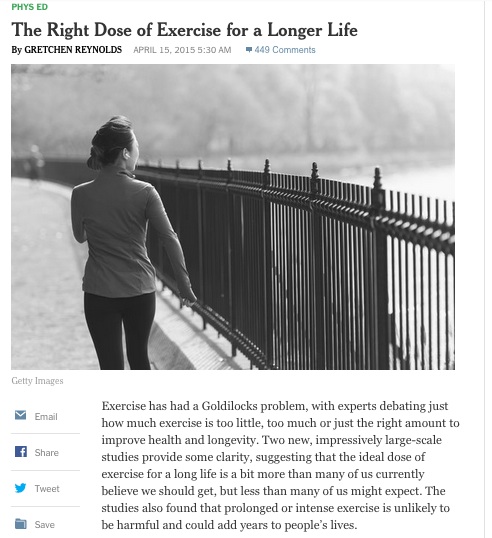
An April 15 New York Times article by Gretchen Reynolds reports on two different studies that now give a prescription for the amount and intensity of exercise that is linked to increased longevity.  We learned that “broad guidelines from governmental and health organizations call for 150 minutes of moderate exercise a week to build and maintain health and fitness.” For those who exercise more—450 minutes a week—then longevity goes up almost 40 percent over non-exercisers.  And, if 20 to 30 minutes of that activity switches gears from moderate to intense, the longevity number goes up even more. If that’s your goal, then those are your guidelines.

In reading readers’ comments accompanying the article, there are many who just think feeling good is a good enough reason to hit the slopes, roads, trails, links and by-ways.  What are the right numbers for you?  And why bother?  Let us know.

My Fitness Journey Begins: Part One

My six-month plan to go from being a couch potato to a mogul masher.

I had a revelation and a wake-up call on the slopes of Heavenly Mountain Resort this winter while skiing a few runs with the resort’s director of skier services. I had not taken my own advice regarding pre-skiing conditioning or done anything to lose the pounds that have piled on in the last decade or so. And even though I had been able to squeeze into my ski pants and didn’t seem to be affected by the 7,000-foot mid-mountain elevation, I felt like a lumbering whale as I went down the slopes. When I got into gunk, I really had to struggle to work my way out of it. I just didn’t have any strength.

Correspondent Rose Marie Cleese BEFORE she started her fitness program. Credit: Rose Marie Cleese

Correspondent Rose Marie Cleese BEFORE she started her fitness program.
Credit: Rose Marie Cleese

But having my ski gene reactivated and sitting amid all that alpine splendor at lunch, I realized how much I love this invigorating sport and all that comes with it. I decided then and there that one of the things on my bucket list (which I still haven’t put together) is going to be skiing down a slope somewhere at age 90!

So I’m going public with my fitness plan; if that doesn’t keep me on track, I don’t know what will! Plus I’m hoping that my personal journey to fitness will encourage other seniors to make the effort to get in the shape they need to be in to return to the slopes and be able to ski safely and with great satisfaction. And I hope that we’ll learn from each other as I share my progress over the next six or seven months. Comments and suggestions are encouraged! My monthly progress reports will be interspersed with bold-faced suggestions to help readers take action.

So, first things first. Before folks at our age jump into a fitness and diet regimen, it’s vital to have the blessing of one’s doctor. I had a complete physical a few months ago, and my doctor was encouraging me to move more, eat less and more healthy. I’m planning to include a few comments from her in a future progress report. Check with your doctor before you begin any fitness and/or diet program.

Since I can’t afford a personal trainer and have a big DIY streak in me, I’m planning to do a mix of things that I think I can stick with, keeping in mind the elements of fitness and health in general and for skiers and boarders specifically. Ignoring any one of these will not get me where I need to be next November. But at its simplest, it all gets down to exercise and diet.

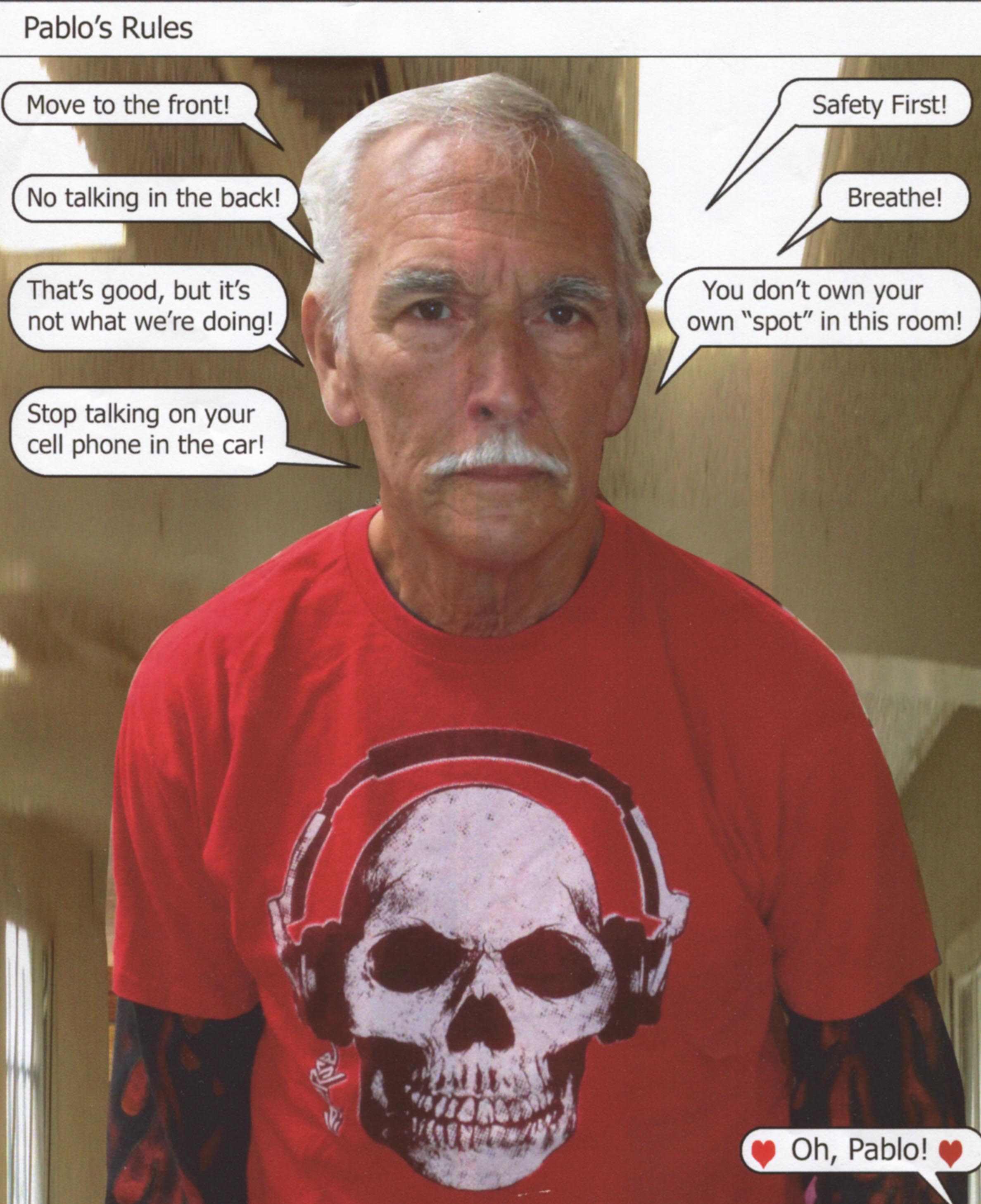
No nonsense aerobics instructor Pablo Molina keeps his classes hopping. He'll be 73 in June, just a few months older than Rose Marie

No-nonsense aerobics instructor Pablo Molina keeps his classes hopping. He’ll be 73 in June, just a few months older than Rose Marie. Credit: San Francisco Recreation and Parks Department

First, I plan to move a lot more. In March, I started several once-a-week classes at the local San Francisco Park and Rec Senior Center located in Golden Gate Park two blocks from my flat: a low-impact and a medium-impact aerobics class, a stretching and strengthening class, and a weights class. And they’re all free. Look for free fitness classes or programs for seniors; they’re more common than you’d think. These classes have shown me in no uncertain terms what I have to work on most: building up my core strength and regaining my balance!

Cardiovascular-wise, I’m finding that, after just six weeks, I’m hardly out of breath now when I walk up the hill to my flat after class. My exercise goal is this: by the end of the summer, to be able to do all the floor core-building exercises and the aerobics exercises that involve balance without batting an eyelash. It’s a pretty pathetic sight to see right now!

My other big move toward fitness and good health was joining Weight Watchers. I’ve known many people over the years who have sworn by it and were also able to maintain a healthy weight once they quit. Choose a dietary program that you can stick to. I signed up for Weight Watchers’ online program in mid-April for three months and after figuring out how to navigate around the website, I’m finding that I’ve become a lot more conscious of my food consumption. Since Weight Watchers’ integrates activity into the point system, I’m also seeing quantitatively the connection between exercise and what and how much one eats. When I started, I weighed 170 pounds and today my weight is 166 pounds. My goal is to reach 140 pounds by the end of my three months with Weight Watchers’, next maintain that weight for a couple of months, and then get down to 130 pounds before the flakes fly.

And finally, I want to concentrate on getting adequate sleep. I’m still working on that one, inveterate night owl and all-nighter puller that I am. I am, however, making sure I get a good night’s sleep when I have an exercise class the next morning. It’s a start!

One more caveat before I sign off: set realistic goals. I expect that I will hone this fitness plan in the coming months, possibly adding some yoga classes, hiking the trails in the wealth of parklands that surround me, and adding more fruits and vegetables to my larder. All I have to do, whenever I waver, is picture being at the top of some fabulous snow-covered mountain, and everything seems possible. Wish me luck!

[Editor’s Note: SeniorsSkiing.com salutes Rose Marie for publicly chronicling her personal journey back to fitness  She is an inspiration to us and we hope to those seniors in our readership or friends of our readership who would benefit from getting back into shape.  Please support her with advice and comments as she travels down that challenging road.]