

Tag Archive for: john Jerome

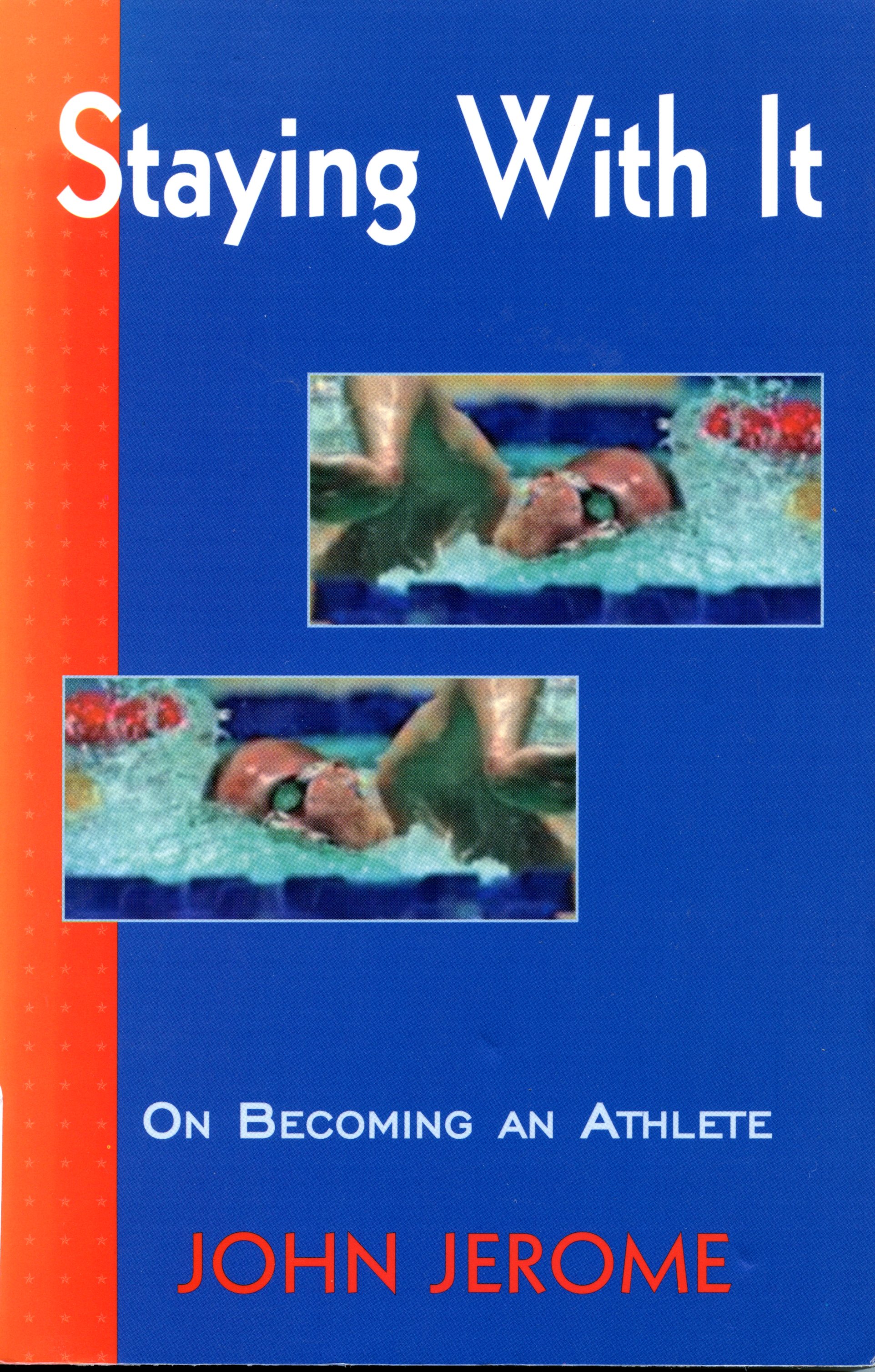
Book Review: Staying With It

An Aging Athlete Becomes Enlightened

[Editor Note: We are reprising this article from Nov. 2015 because it contains important themes of persistence and adaptability. And the book Staying With It was written by one of our favorite authors, the venerable John Jerome, a former editor of SKIING magazine.]
StayingWIth__501

What happens when a 50-year-old writer decides to fight aging by becoming an athlete? Will physical awakening, sharpening, perfecting hold off the loss of function, range, performance? When former SKIING Magazine editor John Jerome found himself at the doorway to old age, he decided to do something about it. That something was his four-year voyage into athleticism to see if he could counter the effects of aging with muscle power, insight, and, as it turns out, mindfulness.

He tells his story in Staying With It, (Breakaway Books, 1992), a journey of trial, error and learning told in his usual reflective—and discursive— style. We recently re-discovered Jerome’s writing while paging through old, bound copies of SKIING magazine. When we learned he decided to become a competitive, masters-level swimmer at age 50, we wanted to explore his journey for our own edification as well as for our readers’.

At the beginning, he says, “Aging is very rude, making no attempt at diplomacy, at softening its message. It just starts slamming doors in your face, yanking things out of reach.” Jerome said he “was interested in giving up any capacity as slowly as possible…understanding and acknowledging the process.” His goal was “the maintenance of full function beyond the years of youthful vigor.”

To do that, he starts an experiment, swimming first as a fitness replacement for running and then training hard as a competitor. He discovers the Training Effect, body’s response to increased physical demands that gets cells to respond and do more. “To age,” he says, “is to begin asking the cells to do less.” The only antidote he says he could find was “movement—exercise and stretching.”

Jerome tells us about his training regimen, his lessons in exercise physiology, his trips to swim camps where he meets fellow enthusiasts, his many swim meets and consults with scientists. When he talks of perfecting his swimming stroke, he finds that simple physical task opens the door to complex mental aspects. He discovers “pre-verbal” tempo, right-brain control of the action, what we now call “flow”. “Learning to operate in your right brain is another part of the athlete’s job I had never considered before.” You know it, of course, when you ski cross-country “in the groove”, or swing through giant slalom turns without, well, without thinking. One way to induce that, he says, is to relax. “The athlete has to maintain a small amount of relaxation…The right brain knows this. Sometimes you have to wait, to ease up, to feel around in your capacities for just the right touch to make the motion work.”

Because his training program was largely self-directed and John was a self-admitted type-A personality, he eventually drove himself too hard, over-training and catching “Olympic Flu”, the syndrome that leads finely tuned athletes into exhaustion and even depression. After resting, he turned to a sport physiologist who used software and underwater video to analyze his stroke. Result: return to racing more enlightened. But, he says, “I wish I hadn’t started so late. I wish there were more time. I keep hurrying, and I’d really rather not do that.”

Of his experiment, he says, “I may not have stopped aging in its track…but I have certainly stopped the loss of intensity.” And, “the more I trained, the better the rest of my work goes, the sharper, and clearer and more efficient.”

John Jerome has written several books on fitness as well as other topics. Staying With It is available from Amazon.com.

Mystery Glimpse: Shiny Gizmo

Whatizzit?

This beautifully designed object comes from the Vermont Ski and Snowboard Museum. What’s it for? Have you used one? When was that, by the way? Let us know.  Scroll down to add your COMMENTS below.

Credit: Vermont Ski And Snowboard Museum

Last Week

Once again, it is clear there are some sharp-eyed ski historians out there in reader-land.  There were lots of very astute comments.

This photo comes from a SKIING Magazine Oct 1969 story by John Jerome.  His article reports on the revival of New Hampshire’s legendary Inferno Race on Mt. Washington’s Tuckerman Ravine in the spring of 1969, the event pictured here. Unfortunately, the article didn’t report the name of the racer in the picture.
According to Jerome, the last previous Inferno race was in 1939 when Toni Matt scared himself silly by schussing the headwall. Numerous debates have ensued about whether his run was a mistake or intentional. Regardless, Toni found himself deeply rooted in ski history lore.

Thirty years later, in 1969, the race was held as a “loosely controlled Giant Slalom”, hence the gate you see in the picture. [Dave Irons, you got that right!]  The idea was to prevent anyone from doing a Toni on the headwall which, by the way, has a 55 degree pitch.  The weather was miserable, temp rising from 13 degrees to mid 20s at race time with a wind blowing at 75.  For the record, here were the winners:  Veteran’s Category—George Macomber, Junior Category—Duncan Cullman of Franconia, NH.  But, Jerome reports, the bravest of all was 55 year old Adams Carter who, in honor of his participation in the three original Infernos in the 30s, foreran the course.


Rediscovering John Jerome: Looking Closely At Everyday Things

Leafing Through An Old Magazine Reminds Us Of A Great Writer

Back in the early 70s, as assistant editor at SKIING Magazine, then located at One Park Avenue in New York, we would occasionally watch a typescript from John Jerome arrive in the mail and work its way through the editorial process. After reading a couple of paragraphs, it became clear that these words were not the usual ski article patter. John was a skilled observer, first requirement of an essayist extraordinaire, and was able to tell stories and administer advice about simple things in a way that revealed a writer was at work.

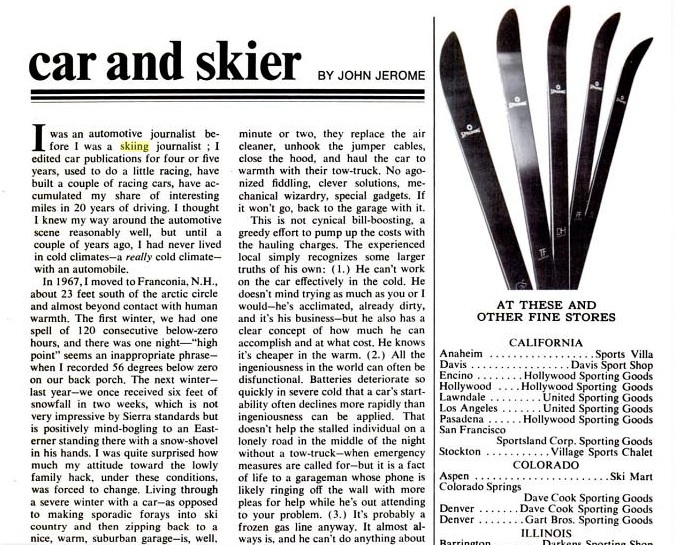
CarSkier


John Jerome was a polymath; he started in automotive journalism (he was editor at Car and Driver), became a skiing savant (he was editor at SKIING), re-located from the “city, working for magazines, wrestling with words and paper in tall buildings under fluorescent lights” to New England. There, as a freelance, he wrote books and many articles about running, building stone walls, becoming an aging athlete, mountains, the value of stretching, and, yes, skiing. And the halo of subjects around skiing, like cars and winter. Here’s an excerpt we just re-discovered by glancing through a November, 1969, SKIING article, “Car and Skier”. He’s talking about one of the two main problems of winter driving he learned by living in cold-winter New Hampshire, getting unstuck:

“Getting unstuck, or not getting stuck, is a much more diffuse problem, against which logical, ordered stops are not so effective. I hate and despise snow tires, but I put ‘em on, and they saved me a lot of grief. My prejudice was based on their noisiness and feel at highway speeds; what I didn’t realize is that a large part of the process of not getting stuck is a kind of metaphorical shifting of gears that takes place when you are a severe-winter resident. You simply slow down. When winter closes in, you bank your metabolism and your frustrations, and settle down into a calm and bumping 25-mile-per hour way of life. It does wonders for keeping you out of snow banks, and it also overcomes a lot of prejudices about snow tires. You can spot winter tourists by how fast they drive more quickly than by their plates. So can the cops.”

The first problem of winter driving, if you’re wondering, is getting started.  Solution: Bring car battery into house at night.

JohnJerome

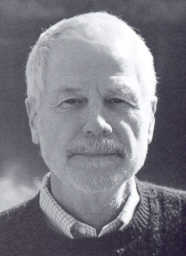
John Jerome, prolific writer, observer, athlete, contemplator of things.

Good writers see connections between things in the world that others either don’t see, or don’t see until the writer points them out. John Jerome was good at that. Here—in this excerpt from his book Stone Work— he makes a link between the rhythm of placing stones on a wall and making linked turns in skiing. On finishing the placement of a stone—the last step of the cycle: start, the move, the finish—he says:

“Sometimes, there is more difficulty in finishing moves than in starting them. I first ran across this principle in downhill skiing, where great instructional emphasis is placed on completing one turn in order to get the next one started right. This didn’t make a whole lot of sense to me: you have to stop turning in one direction if you’re going to start turning in the other, don’t you? I flailed and flummoxed my way through a lot of awkward moments before the significance of the advice sank in. Finishing is a positive act. A ski turn carried to its logical physical conclusion ends with an edge-set that make a stable platform from which to start the next turn. ‘Finished’ means your weight is in the right place, your body and skis prepared for whatever comes next. Without it, you’re in trouble. You have no ‘timing’.’

John Jerome was contemplative writer who wrote in a way that made you feel you were talking with a very interesting friend over a very good drink.

His books are still available on Amazon.com. Have you read Truck, Staying With It, or Staying Supple?