Tag Archive for: Pico Mountain

Women Played Integral Role at One of Nation’s Oldest Ski Areas

[Please consider supporting SeniorsSkiing.com with a donation. We appreciate your help. Click here.]

Janet Davis Mead, June Aker, Verlene Belden All Kept Pico Going And Growing, Despite Obstacles and Challenges.

Janet and Brad Mead started Pico in 1937.

Vermont’s Pico Mountain survived a war, two owners’ deaths, and a neighbor called Killington to become one of the 30 oldest continually operating ski areas in the country.

It’s a feat that was largely driven by women in its first 30 years, a time when the ski industry was known to be “a man’s world.”

Women also played major roles in Pico operations since that time, continuing the strong family influence that began with co-founder Janet Davis Mead.

A feisty woman given to exaggeration, Janet Davis told Brad Mead she had skied at the Lake Placid Club, so he invited her to go skiing.

“I had to follow him down what looked to me then like Mount Everest. I made it, but without poles,” she would write years later, explaining she had thrown them in the bushes, not knowing what they were for.

Her bravado paid off; they married and researched building a ski area.

Envisioning a year-round resort with mountainside homes, aerial tram, swimming pools, ice rinks, and tennis courts, the Meads leased Pico Mountain and opened Thanksgiving Day 1937 on Little Pico with a 1,200-foot rope tow and a rough-cut, 2.5-mile Sunset Schuss skiers could ‘skin up’ to the summit.

The Meads hired Swiss racer Karl Acker to run the ski school, added two tows, widened Sunset Schuss — renowned for downhill racing and the Pico Derby — and installed the first U.S. Constam T-Bar to the top of Little Pico.

After Brad died in a boating accident in 1942, Janet carried on with support from skiers, the Otter Ski Club, and Otter Patrol. When workers including Acker left for World War II, she kept Pico open despite hardships of rationing and shortages that caused many areas to close. Using her marketing skills, charisma, and tenacity, she gave special rates to schoolchildren and servicemen who visited on furlough weekends.

Karl and June Acker took over from Janet and continued to expand the resort.

Having survived wartime, Janet bought the mountain (1947) as Acker returned to teach and help operate Pico. (He coached daughter Andrea Mead, first American to win two Golds in the 1952 Olympics, bringing acclaim to Pico’s strong racing tradition.) As the first woman to own and run a U.S. ski area still operating, Janet survived four lean snow years, weak finances, and growing competition by lowering ticket rates and offering summer rides on chairs hung on the T- Bar (1950). With the ski boom on and her children not interested in running Pico, she sold to Karl and June Acker in 1954.

Karl added trails, a T-Bar, and a J-Bar. “The lack of access to funding caused him to do too much of the work himself; the long hours and the stress of the new J-Bar which he couldn’t get to work quite right contributed to his fatal heart attack” in May 1958, June told me in 2007.

“The three banks that had lent us money to purchase Pico had insisted on a life insurance policy on Karl. Because I was a woman they needed to know I could repay the loan if he died,” June said of becoming Pico’s owner at age 30.

She added trails, replaced a lift, and obtained financing for Pico’s first chairlift, a Stadeli double that went halfway to the top ($110,000 in 1962).

“Pico needed lift service to the summit to compete and survive.  Being a woman contributed to the banks’ reluctance to provide more loans,” June said, of her decision to sell to Bruce and Verlene Belden (1964) in hopes they would carry on a family-oriented mountain.

Bruce had helped build Mount Snow (1955-1964), while Verlene ran their 30-guest ski lodge and raised four children. With former guests investing, they became majority owners with Verlene as office manager. Her business acumen coupled with their strong family orientation and expansion of the mountain enabled Pico to survive the trying 1970s when all but five major Vermont ski areas changed owners, and most surface lift areas closed. Vermont had 81 areas in 1966 but just 39 by 1988.

When they retired in 1987, Pico had a reputation as the “friendly mountain” with strong racing and instruction programs and new base village engendering a loyal following.

Women played significant roles in achieving that reputation. “They taught youngsters to ski and race and were instrumental in the Pico Ski Club. They also ran various departments from ski shop to ski school, tickets to childcare. They contributed to the skier loyalty that saw kids who grew up at Pico return as instructors or coaches and bring their own families to the mountain,” noted former GM Frank Heald.

Current Pico Director of Operations Rich McCoy added, “Pico staff make people feel at home and welcome. That’s a legacy that women through their leadership roles have contributed to throughout Pico’s long history and still do today.”

Sunset Schuss: Had to skin up in the old days.

Short Swings!

I know that some people don’t get attached to ideas, things or each other. But it must be rare.

I was 10 when skiing entered my life, and I’ve been playing in mountains and snow ever since. At first, Mount Snow in Southern Vermont was the center of my winter universe. Then it was that state’s Stowe and Killington


In the early 70s my new bride and I visited Alta for the first time. It’s the classic ski resort at the top of Little Cottonwood Canyon, just outside of Salt Lake City. We were there for a week. There’s hardly a season since that I haven’t returned.

There are other great areas, some with bigger terrain, more sophisticated lifts, and other bells and whistles. I’ve skied many of them and hope to ski many more.

Alta keeps pulling me back.

The obvious reasons are accessibility, snow, and terrain. 

But there are more subtle things that are part of Alta’s draw. There is a unique Alta culture that understands and appreciates its rich history, its remarkable beauty, and, for those who know and love it, it’s essence.

Over the years I’ve skied most of the area, but some places were out of my reach and, at this age, will remain that way.

Utah’s license plate reads “Greatest Snow on Earth.” Of its 14 resorts, Alta consistently receives the most. The 2010-11 season delivered 724″. Last season snow depths totalled 626″.  This season, to date, Alta has more than 355″.  Click here for its annual totals.

Most people drive up Little Cottonwood Canyon for the day. Unfortunately, as the Salt Lake Valley population grows, that 8 mile drive can take a long time. It took me 90 minutes a few weeks ago. Powder days require a very early start.

In the 47 years of skiing Alta, I’ve stayed at each of its five lodges. The Alta Lodge and The Rustler are favorites. The old Snowpine Lodge was Spartan-like. I have yet to try its posh replacement. Goldminer’s Daughter and Alta Peruvian each have their own charm.

If you’re an Alta regular, you’ll understand. If you’ve never been or haven’t been in a while, it’s time to go. Like everything else, Alta is destined to change. But because it is Alta, when it does, it will only add to the magic.

Masterfit Buyers Guide

The new Masterfit Buyer’s Guide provides comprehensive guidance on the best choices in 2019-20 skis, boots, bindings, poles, insoles, and kid’s gear. The free, 105-page guide is chock full of  valuable information explaining what to buy and how to buy it. It was put together by an all-star team of reviewers and writers who, for years, worked for the nation’s top ski magazines. My strong recommendation: make the Masterfit Buyer’s Guide a “favorite” on your computer (click here for the link). It will be useful the next time you’re considering a purchase. And while you’re there, check out the SeniorsSkiing.com ad on Page 106.

Is Apple iWatch Anti-Skiing?

A few iWatch obsessives I know say the device’s “Workouts” function shows “Snowsports” and “Snowboarding,” but not “Skiing.” Can anyone out there disprove it or explain why?


New Name for Ski and Snowboard Expos

The Denver and Boston Ski and Snowboard Expos have been renamed Snowbound. This year’s Denver event is scheduled for November 6-8; Boston’s is scheduled for November 19-22.

Pico Hosts Blind Skiers

This weekend, more than 30 athletes who are blind or have visual impairments will learn to ski with Vermont Adaptive Ski and Sports during the 13th anniversary of the United States Association of Blind Athletes (USABA) Winter Ski Festival at Pico Mountain. Click here for more info.

Skiing History’s New Issue Now Available

The January-February 2020 issue of Skiing History is online. If you’re a member of the International Skiing History Association (ISHA), a hard copy is on its way to your mail box. If you’d like a free digital copy, click on the ISHA advertisement on the SeniorsSkiing.com home page.  

Mikaela Shiffrin’s Father Dies in Roof Fall

Jeff Shiffrin, father of the World Cup athlet died earlier this week when he fell from the roof of his home in Edwards, CO, near Vail. The 65-year old anesthesiologist was shoveling snow when he fell. He had raced on the Dartmouth Ski Team. 

75-Year Old Uphill Skier Profiled in New York Times

Sharon Crawford, 75, a multisport athlete from Frisco, Colorado, is an uphill skier. he Times profiled her participation in the Breckenridge Ascent Series, which, took her from Breckenridge’s 9,600′ base up 1,500′ vertical on a black diamond. The fastest racer completed the course in 32 minutes. Crawford clocked in at 1 hour 2 minutes. Click here for complete story.

Fantastic Gift For Young Mothers To Be

Mountain Marsupial 4-in-1 Jacket

Mountain Marsupial is a 4-in-1 jacket that can be worn while baby carrying in the front, on the back, and while pregnant. It caught my eye last week at the SIA/OR Snow Show. The jacket lists for $239. If you’re looking for an attractive, functional gift for a pregnant someone or a recent Mom, click here.


Short Swings!

Earlier this week a request to support SeniorsSkiing.com showed up in your email. We really need your donations. This is our fifth publishing year and only the second time we’ve made the request.

When we started, Mike and I decided that this labor of love should be free. What we’ve learned is that publishing weekly throughout the season requires a lot of effort and a considerable amount of money. Our editorial contributors are just that…contributors. Advertisers cover some expenses, but as our free publication grows, so do a variety of back office costs. That’s why we’re asking for your help.

To put it in context, some years ago I noticed a lot of older skiers on the hill. That was before I came to understand that one in five skiers and boarders in the U.S. are 52 and older. It was the same wherever I went, especially mid-week. Lift conversations informed me that older skiers had similar interests. As for areas, they wanted to know more than just the best places to huck cliffs. Their interests in equipment were different from those of younger skiers. Many had concerns about medical conditions and forms of recovery. They were curious about contemporaries doing interesting things.

That was the seed. Getting it planted and nourishing it into existence became a collaboration, first with my old college buddy Mike Maginn, and then with the members of our Advisory Council and with our contributors.

To our knowledge, there’s no other ongoing source of information serving the older skier/boarder/snowshoer community. SeniorsSkiing.com exists to advance your interests by publishing relevant and useful information, encouraging an engaged online community, and advocating on your behalf.

When we started our total number of subscribers could be counted on two hands. By the end of this season, SeniorsSkiing.com will have registered between 250,000 and 300,000 page views. Most of you are located in the U.S. and Canada, but there are many from the EU, the UK, Australia, and New Zealand. A few of you are located in Latin America, China, and Japan.

Wherever you are, if you enjoy reading SeniorsSkiing.com and having access to our special features such as the annual listing of North American areas and resorts where seniors ski free and the annual report on the best skis for older skiers, among others, please consider making a donation. In return, we’ll send you a gift and enter your name into a drawing for a pair of retro, bamboo, Panda Poles. To donate, click here.

New York Times Skiing Op-ED

A Feb 2 Opinion piece titled “Why Can’t Rich People Save Winter?” in The New York Times is generating buzz in the ski world. Written by Porter Fox, author and former editor at Powder Magazine, the article suggests that if wealthy skiers coordinate their money and influence, it might change climate and environmental policies. To be fair, most of the article describes industry initiaitives, including those announced last week during the annual Snow Show trade meeting in Denver. The piece states that there are 50 billionaires with homes in Aspen (a link shows who they are). Reader comments range from critical to skeptical.

R.I.P. Peter Keelty

Peter Keelty, skier extrordinaire.

Peter Keelty was one of the country’s finest skiing stylists and technicians. When SeniorsSkiing.com got underway, he called and invited me to meet him at Alta. I had no idea of who he was, but I could tell he was intelligent and passionate about the sport. We skied together three or four times. I learned that he and Jackson Hogen were the founders of Realskiers.com, that he had grown up in northern Vermont, and that, as Jackson confirmed this week, he was devoted to improving technique in others. The last time we met he brought a pair of Anton skis for my use. As I recall they were relatively short and the binding system made me feel like I was skiing on a stepladder. His goal was to get me way up on my edges; a place where I didn’t feel comfortable. Last season I noticed he had made a few comments on the site. Earlier this week, Peter Keelty joined other great skiers and contributors to the sport on the Endless Slope in the Sky. He was 76.

Utah Powder

Ski Utah just announced that the Wasatch resorts received 5’ in four days. The email said the dump resulted in a shortage of snorkels.

Pico Peak Hosts Blind and Visually Impaired Skiers

More than 35 blind or visually impaired athletes will learn to ski or learn to race this weekend with Vermont Adaptive Ski and Sports at the 12th anniversary of the United States Association of Blind Athletes (USABA) Winter Ski Festival at Pico Mountain.

Epic Adds  Two

Sun Valley (ID) and Snowbasin (UT) will be on the 2019-20 Epic Pass. The number of days at each depends on the Epic Pass purchased. Visit https://www.epicpass.com for more.

Picture Perfect Colorado

Colorado Ski Country USA took the creative approach of announcing the best place to take a scenic photograph at each of it’s member resorts. They include Arapahoe Basin, Aspen Snowmass, Aspen Highlands, Aspen Mountain, Buttermilk, Snowmass, Cooper, Copper Mountain, Echo Mountain, Eldora, Granby Ranch, Howelsen Hill, Kendall Mountain, Loveland, Monarch, Powderhorn, Purgatory, Silverton, Steamboat, Sunlight, Telluride, Winter Park, and Wolf Creek. Click here  for specifics.

Join Us in the Alps

Join us the week of March 10 when we ski in the Aosta Valley with guides from AlpskitourEach day, we’ll go to a different resort in Italy, Switzerland and France. The all-inclusive price — $4,500 to $5,500 per person– depends on where you fly to and whether you stay in a 3 or 5 star hotel. Orsden is a sponsor and giving a parka to each participant. If interested, email me: jon@seniorsskiing.com.

Short Swings!

SeniorsSkiing.com Needs You!

…especially if you’re willing to write articles that would be of interest to our readers.

Articles can cover prepping for the season (exercising, nutrition, personal accounts, etc.); thoughts on equipment, gear, clothing; technique; profiles of older skiers (well-known or not), destinations, planned trips, nostalgia, ski/board/snowshoe history, skiing with kids and grandkids, etc.

We prefer articles no longer than 500 words and like them to be accompanied by pictures.

Articles don’t need to be Pulitzer Prize ready. We edit as needed.

If you’re not ready to draft something but have an idea you think might interest readers, feel free to send it along.

Sorry that we’re not in a position to pay. But there are other perks: the opportunity to receive products for review, occasional skiing privileges (some areas will comp your lift ticket if you’re on assignment), and the personal pleasure of contributing to an online magazine read by thousands of skiers/boarders/snowshoers worldwide.

If interested, drop an email to jon@seniorsskiing.com or mike@seniorsskiing.com.

GOOD NEWS FROM NOAA?

Good News: NOAA predicts wetter-than-average conditions across most of the northern US, extending from northern Rockies to eastern Great Lakes, and western and northern Alaska.

Less Than Good News: NOAA’s caveat reads Snow forecasts are generally not predictable more than a week in advance because they depend upon the strength and track of winter storms.

CYBER BULLYING A FEMALE SKI MOUNTAINEER

Caroline Gleich is a professional ski mountaineer and adventurer based in Salt Lake City. An advocate for social and environmental justice, she works on issues such as climate change, clean air and cyber harassment. She is committed to inspire people to experience and protect the out-of-doors. Caroline is the first woman to ski all 90 lines documented by Anrdrew McLean in The Chuting Gallery, the back-country steep-skiing guide to Utah’s Wasatch range. Unfortunately, those and other accomplishments have been accompanied by cyber-bullying and harassment. REI produced this thoughtful video about her. It’s well worth watching.

IS SKIING THE FOUNTAIN OF YOUTH?

Salomon produced a nice video of a late 40s American skier who traveled to northern Japan to learn about the relationship between skiing and longevity. He spent time with a father and son who summited Everest together when the dad was 80. The son is a microbiologist specializing in aging. He concludes that skiing adds years to life. (We know it adds life to years.) Among the reasons: proper technique = less impact on joints. He believes there’s a relationship between lower body strength and longevity.

IDAHO

Grandkids in 5th and/or 6th Grade ski free or at steep discounts at all 18 of Idaho‘s ski resorts. Idaho residency not required. More info at skiidaho.us/programs/passport. There’s a $15 processing fee.

UTAH

If your plans take you to Utah mid-November, consider attending the BMW IBSF Bobsled and Skeleton World Cup, Friday/Saturday November 17/18 at Utah Olympic Park in Park City. Bobsled and Skeleton athletes from 20+ countries will participate in Women’s Skeleton, Men’s Skeleton, Women’s Bobsled, and 4-Man Bobsled.  Admission for spectators is free. While there, don’t miss the Alf Engen Ski Museum. It’s a real treat!

VERMONT

Members of the Hermitage Club, the private ski resort at Haystack Mountain, are being assessed a one-time $10,000 fee. The fee is needed to cover cash flow problems related to state permitting delays, poor weather in the 2015-2016 winter season and a slow membership drive.

Killington is installing several new solar projects. They are expected to generate more than 3,300,000 kWh of annually for the resort and sister property, Pico Mountain.

R.I.P.

Morrie Shepard died Thursday, Oct. 12. He instructed at Aspen, before joining Vail in 1962 where he was its first ski school director. His other titles while at Vail; building inspector, fire chief, building coordinator; professional funster. He was born July 2, 1925.

OTHER

All Adventure Camp Blankets are the first modular three-part blanket system. Each of the lightweight components can be used to stay warm and/or protected in variety of situations from camping to sitting on the beach. The manufacturer, Kammok, is raising funds via Kickstarter. Their home-made video explains the system.


Short Swings!

Something Old. Something New.

I just read two books about trails.

The old one is American Skiing, published in 1939. It’s author, Otto Schniebs, was one of the Arlberg Technique pioneers in New England and contributed to the development of several areas.  He founded the American Ski School of Boston and coached at Dartmouth College and later at St. Lawrence University.

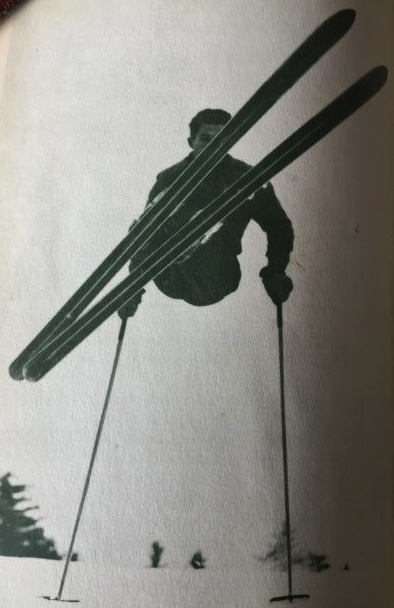
When was the last time you saw someone do this?

The first chapter, “Adventure on Skis in the Colorado Rockies,” is a colorful account of a Spring visit to the Elk Mountains between Aspen and Crested Butte. This was ’39 and Aspen didn’t start as a ski area until ’46; Crested Butte in ’62. Schniebs and his companions encounter a variety of terrain, snow and avalanches. The text is fun to read and is richly illustrated with photos. Throughout are page references to technique, which is covered in the next section, where he uses motion picture stills to explain a full range of ski moves ranging from those for beginners to achieving jump turns, and somersaults!

This is followed by ruminations about organizing ski areas, building trails and slopes, a single sentence on mechanical lifts, longer sections on ski patrol, developing instructors, ski schools, and equipment.

The book has many photos, including a fold-out panorama of the northern Adirondacks (Whiteface to Mt. Marcy to Redfield in Winter), a classic shot of Dick Durrance, skiers in Tuckerman’s Ravine, etc.

I’ve had my copy since 1962. Google shows first edition copies for less than $50.

The new book is On Trails: An Exploration, by Robert Moor. This New York Times Bestseller is a wonderful read. The information — it does not cover ski trials — is fascinating and presented with graceful and engaging prose. We accompany the author as he explores a multitude of ancient and modern trails. His observations take us into the realms of natural and human history, economics, philosophy, and literature. Who knew that studies of how ants travel have been digitized and the results used to inform flows in factories and warehouses? The trail and road walkers he encounters range from amusing to weird. I highly recommend On Trails. The pages turn on their own.

New Zealand

Mt Hutt has a 120″ base, and plans to remain open through October 15. The 6800’+ resort is one of the highest in New Zealand.

Vermont

Listed below are the deadlines for lowest season pass prices in Vermont. Note the threshold ages for skiing free (some may require a small processing fee).

  • Bolton Valley: September 25 Ski Free: 75
  • Bromley Mountain: October 15
  • Burke Mountain: October 9
  • Jay Peak Resort: October 9
  • Killington Resort: October 12 Ski Free: 80
  • Mad River Glen: October 15 Ski Free: 70
  • Magic Mountain: October 15
  • Middlebury Snow Bowl: November 30 Ski Free: 70
  • Mount Snow Resort: October 18
  • Okemo Mountain Resort: October 9
  • Pico Mountain: October 12 Ski Free: 80
  • Smugglers’ Notch Resort: October 31
  • Stowe Mountain Resort: October 8
  • Stratton Mountain Resort: October 9
  • Sugarbush Resort: September 13; Boomer Pass (Age 65-89) Price: $139; includes midweek, non-holiday skiing at Lincoln Peak and Mt. Ellen. Ski Free: 90

Other

Take five minutes and give yourself a treat. The Man at the End of the World is a beautiful video about an older couple living in Tierra del Fuego, Chile. If you enjoy the clip, click “like’ in the lower right corner to help it score well in a video competition.