Tag Archive for: ski technique

Question For You: Flat Light Tactics

[Please consider supporting SeniorsSkiing.com with a donation. We appreciate your help. Click here.]

Is Flat Light The Bane Of Your Skiing Experience? Or Just One Of Those Things?

Head for the lodge after this one? Think so. Credit: Jan Brunvand

No contrast, lack of depth perception, no tell-tale marks on the snow, flat light adds another dimension to deal with. Not welcome to many. Tolerable to some.

We’ve had a couple of our more spectacular falls in flat light conditions. Too fast, unexpected terrain. And boom. The lasting result is that whenever we see that gray-white shroud, we tighten up, and more likely than not, head for the bottom and home.

There’s an excellent article by correspondent Marc Liebman on Coping With Flat light in our archives. Check it out here.  But what is your way of approaching flat light conditions? Do you have a specific brand of goggles you swear by? What about technique? Changes in how you approach the trail? Let us know.  Perhaps you can help up break through our reluctance to head out on flat light.

Question For You: How Do You Manage Flat Light? Tell us how you do it. Or if you just avoid it.

Write a comment in Leave A Reply below.

Technique Tips For The Senior Skier

Sharpen Your Skills To Get The Most Out Of Your Skiing.

[Editor Note: UK-based Bob Trueman is a long-time ski coach and instructor who will contribute occasional articles on technique for the older skier. He is the author of Ski In Control where he describes the skills needed to master “any piste”. He will soon be publishing a series of YouTube videos to demonstrate control skills.  SeniorsSkiing.com welcomes him to our pages.]

What’s the best way to keep getting the most fun out of skiing as we get older? As a coach, I suggest that it’s the exercise of skill. This doesn’t preclude the great company, good food, and all the rest. Nor does it demand big, physical challenges. It’s a mind-set change.

Look around any piste, and everyone finds some way of negotiating it, but very often not nicely. Some folk don’t care how they ski, only what or where they ski. My clients do care, and it’s exercising precision skill that my pupils get the most out of.

Let’s define skill:

Skill is the learned ability to bring about pre-determined goals with maximal certainty, often with minimal effort. This has implications – “learned” = not instinctive: “pre-determined” = goal oriented; “maximal certainty” = demonstrated skill. It never fails to satisfy and is little related to physical strength or capacity.

Here are some ideas.

Unloaded tips, weight back = bad.

Look at the slope with a keener eye. Does the slope go exactly where the piste goes? Often it

Weight forward, tips loaded = good.

doesn’t; often it is canted. If you were to pour a bucket of red ink onto the slope, it may well go somewhat across the piste. You may see this and recognize that left and right arcs will not be symmetrical; they’ll be quick one way and slow and drawn-out the other. The skillful skier will be ready for this, and change rhythm. There’s satisfaction in that.

View the slope and decide if you will control your speed by applying some skid by pivoting your ski. If you do, be aware that the line you take down the slope will be nearer to a straight line—it won’t be straight, but it’ll be straighter. Take satisfaction out of knowing that and ski the line you predicted. How close did you get? That’s an exercise of skill.

Or choose to descend by having the ski carve. You still want to control your speed of descent but with a higher linear speed. So you can choose before you set off what radius of arcs you’ll do and how many arcs you’ll do. You will control your path down the mountain by the line you draw down it.   That’s another exercise of skill, and very satisfying.

Anyone can ski a gentle slope fast, only skillful skiers can descend a steep one slowly. What do you need to do to achieve that? You can do it by drawing a straight line diagonally across it until you have no room left and then do an “Oh-s**t” turn.   Or you can execute more arcs, tighter arcs, taking a more direct line of descent.   This requires greater skill as well as pre-planning and determination.

So what would you need to DO to achieve these skills? Here’s a tip – THE TIPS! Concentrate your mind on the inside edge of your outer ski’s tip. Think of it as a wood carver would think of his chisel/gouge – you’re going to carve it into the snow, have it cut in. Mother Earth will then see to it that it gets pushed round ‘sharpish’.

You’ll need to load that edge more. So you’ll need to flex your ankle more, and probably faster. If you tuck your tummy in and lean forward, you’ll load it. You’ll unload if you do the opposite. It helps to keep your hands low and wide. That helps. And keep looking down the slope to where you intend to go, not where you’re going.

Just doing one of these elements, and especially if you know you pre-planned it, is an exercise of skill that you can take pride in and enjoy the memory of on that next visit to the restaurant. Do a bit of boasting!


Technique: The One Team Concept

No Matter What You Are Sliding On, Basic Athletic Principles Apply.

When I was a boy, my dad knew a woman who was a former USGA Senior Amateur Champion from South Carolina named Carol Cudone.  She constantly reminded my dad to finish his golf swing with his “belly button to the ball.” Ultimately she was trying to get my dad not to hit his shot off the back foot.  Or swing in a static position.

When I played a lot of tennis back in the day, I always was reminded by my coaches to finish the stroke on the front foot with my center of mass facing the completed shot.  Again, not off the back foot.

Mikaela Shiffrin says that skiing is not static either.  It is a continuous movement of working the ski from tip to tail in the turn with the center of mass always moving towards the next turn.  Three separate sports with a common theme of moving the body in an efficient manner in order to complete a shot, stroke, or turn. The common movement pattern is getting the center of mass in a position to execute a turn in the direction that you wish to go and to make a shot in the direction that will be successful.  Fluid movement and not static at all.

Recently, there was a commentary in the winter issue of 32 Degrees, the official publication of the Professional Ski Instructors of America, about the “One Team Concept”.  The magazine was doing a series of interviews about “Interski”,  a global summit of international ski instructors with the goal of sharing knowledge and technique.
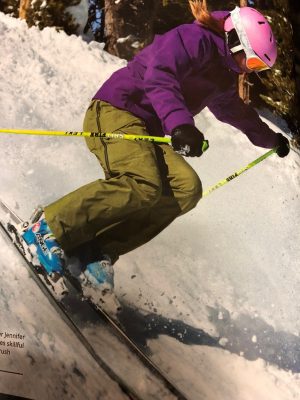
Forward, not on the back heel. Credit: “32 Degrees”

The United States team is always very popular at these events, and, in recent years, the concept of “One Team” has been a focus. “One Team” is all about representatives of alpine, cross country, telemark, and snowboarding all coming together to discuss the value and similarity of teaching techniques as they relate to how people learn and how to teach different personality types.

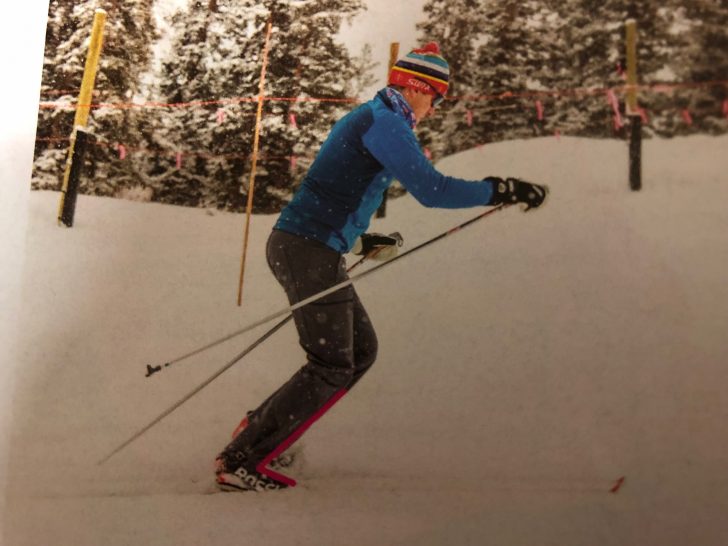
“One Team” also explored how similar movements in different disciplines of sliding on snow create efficiency and effectiveness.  As in the movements of golf and tennis, these four disciplines of snow sports have similar movement patterns.  Not only is the center of mass moving towards the new turn a common goal, but there is also the important role of a flexed ankle.  As you can see from the alpine photo, the flexed ankle manages the pressure of an alpine ski turn against the terrain.  So many people refer to bending the knees but the primary joint critical in the execution of a ski turn is the ankle.
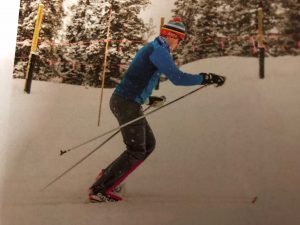
 

Note forward ankle bend. Credit: “32 Degrees”

If you look at the cross country photo, the key to balanced forward movement in traditional cross country technique requires a flexible ankle to not only initiate the stride, but to keep the center of mass where it should be—forward— and not static-centered which hampers the glide process.  The same technique is required for successful telemark turns with a soft ankle utilized to maintain balance and forward movement.

Finally, in the adaptive world, there is a lot of talk about the outriggers being used as legs on an upright skier.  As the adaptive skier moves his center of mass towards the new turn, the outrigger extends on the initiation of the new turn and the other collapses on the inside of the turn. This is much like the flexed soft ankle of the uphill ski in an alpine turn.
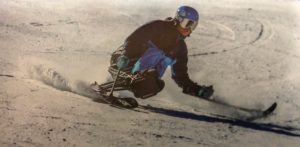
As the adaptive skier moves his center of mass towards the new turn, the outrigger extends on the initiation of the new turn and the other collapses on the inside of the turn much like the flexed soft ankle of the uphill ski in an alpine turn. Credit: “32 Degrees”

Alpine, cross country, adaptive, telemark, and snowboarding all have a common balance and ankle platform that really creates a “one team” concept both in the actual instructional technique but also in the philosophy of a united front in teaching and learning techniques.  No matter what you are sliding on, the basic athletic principles apply.  Have you ever pressed your outside foot down and your inside foot up in a bicycle turn to the left?  The same principles apply there as well with the center of mass headed towards the turn along with the long leg, short leg, flexed technique.

As Mikaela says, nothing is static.  A good athlete is fluid and utilizes good body balance, movement, and flexion to execute that shot or turn.  Think about it the next time you do something other than skiing and definitely think about that center of mass movement across the skis towards the next ski turn with your ankles flexed.


Remember this?

He isn’t falling.  He’s demonstrating a ski technique from the 70s practiced by jet-setting ski racers.  What is it called?

SkiTechnique357

Qu’est-ce que c’est?