


Tag Archive for: Yellowstone Expeditions

Yellowstone’s Winter Magic

SOURCE: YELLOWSTONE EXPEDITIONS

In 1991, while guiding a small group in Yellowstone National Park, I tried to describe walking outside as the sun rose one February morning near Old Faithful:

Morning light pours over the hills, reflecting off the frost in a blinding cloud of diamonds. Elk and bison shake snow off their backs, stirring after a long night’s chill. Duck and geese stretch and preen. Billows of geyser steam hover and settle, creating dense, lacy patterns on bowed pine branches. Yellowstone tastes of winter magic.”

Summer and Winter

To me, Yellowstone isn’t a great treat in summer. Yes, the combination of animal and geothermal activity is unique – but this year there were close to three million visitors, June to August. That’s too many vehicles and frowning faces jammed along narrow roads.

Winter is totally different. First, there’s almost no traffic (no bears either, although they may peep out of their dens in January). The only road that’s kept plowed runs east from Mammoth in the northwest to Cooke City, where it dead ends. All other roads are snow-covered and accessible by snowmobile, snowcoach (enclosed and heated tracked vehicles), or on skis or snowshoes.

Yellowstone’s winter is created for superlatives. No other place in the world has such an inspiring combination of wildlife and wild geology. It’s rich in history; has spectacular mountain scenery; and the park’s 2.2 million acres are yours without crowds or pollution.

Getting There

Yellowstone is located in the northwest corner of Wyoming, with little extensions north into Montana and west into Idaho.

To enter the park, you can travel north from Jackson Hole; west from Cody, Wyoming; or east from West Yellowstone, Montana. My favorite (fourth) route is east from Bozeman to Livingston; south through the Paradise Valley; pass through the sleepy town of Gardiner; and drive up to Mammoth Hot Springs, where you can overnight at the venerable Mammoth Hot Springs Hotel, with elk grazing outside the ground floor windows.

Using Mammoth as a base, you can drive toward Cooke City, with a lot of photos stops for wildlife in the Lamar Valley, and then backtrack.

Heading South

From Mammoth you can get to Old Faithful by snowcoach or snowmobile, sight-seeing, skiing, and snowshoeing along the way. Norris Geyser Basin and the jaw-dropping Canyon of the Yellowstone River, with ice-laden and thunderous falls, are natural stops.

The center of the park is a volcanic crater, 40 miles across, with the world’s greatest concentration of geothermal features: geysers and fumaroles, mud pots and hot pools. One of my favorite Yellowstone memories is a morning ski on a snow-covered wooden boardwalk, watching a bison standing above a steam vent, basking in the warm air billowing around his belly.

Snowpack around Mammoth can be thin, but Old Faithful has reliable conditions and all kinds of good trails. You’re guaranteed to see lots of elk and bison, maybe coyotes, possibly wolves.
SOURCE: YELLOWSTONE NATIONAL PARK LODGES

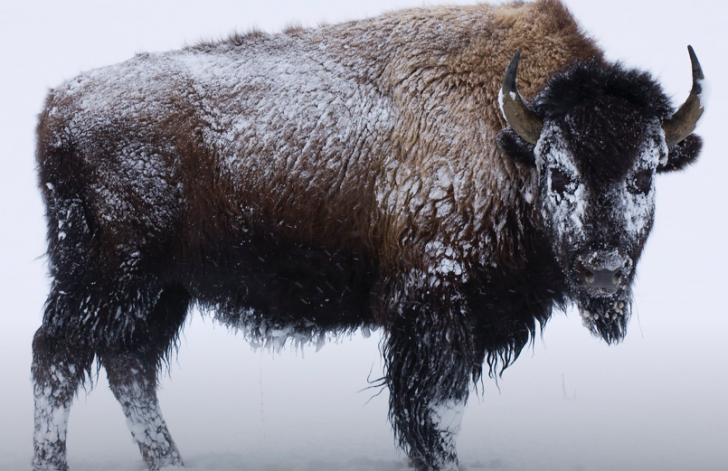
In winter, bison are relatively indifferent to humans, since they’re intent on scarce forage and surviving sometimes bitter cold, but it’s not something to count on. I’ve skied within feet of a bison, on a narrow trail with a cliff to one side and sheer drop on the other. We came around a corner and there they were. We carefully didn’t make eye contact with the cows and calves that plodded toward us, and I could hear muttered prayers from the other skiers (my teeth were chattering too hard to enunciate).

Of all the times I’ve visited Old Faithful, the most indelible and endearing memory isn’t a glorious streamside tour, two feet of light fresh snow, or being mock-charged by a bull elk. It’s the smiles on three kids’ faces as one cold morning they dropped tablets of food coloring in glasses of hot water, ran outside the Snow Lodge, and threw them in the air! It was a cold morning, and the droplets turned into rainbows of frozen mist – blue, red, green – that slowly drifted in the breeze and disappeared. So a half-dozen of us adults did the same thing.

Now, that’s magic.

Resources

The Mammoth Hotel and the Old Faithful Snow Lodge provide Yellowstone’s only winter accommodations and dining other than yurt village/guide service Yellowstone Expeditions (https://yellowstoneexpeditions.com/). They typically open for the season mid-December 20th through early March.

You can book accommodations by contacting Yellowstone National Park Lodges (https://www.yellowstonenationalparklodges.com/). For a snowcoach tour, I’d recommend Yellowstone Alpen Guides in West Yellowstone (https://seeyellowstone.com/), especially if you want skiing or snowshoeing.

Make More Tracks: Yellowstone Expeditions

A Rustic Retreat In Remoteness.

Yurts and heated tent cabins accommodations in remote corner of Yellowstone.

When skiers talk about great backcountry, they often cite the Tenth Mountain and Braun systems in Colorado; Sierra Club huts in California; Skoki Lodge, Assiniboine and Shadow Lake in the Canadian Rockies. I’d like to add a new destination, near Canyon in Yellowstone National Park. (Check an atlas, find Yellowstone in the northwest corner of Wyoming; Canyon is in the north central part of the Park.)

Actually, Yellowstone Expeditions is in its 38th season. And to be honest, they use yurts and tent cabins, not log huts or lodges. But “great” is perfectly appropriate, whether it’s skiing or snowshoeing, staff, dining, or the amazing landscape of the world’s first national park (1872).

Yellowstone isn’t exactly a winter secret, but skiers visit the Canyon area only when they’re passing by in enclosed heated snowcoaches or on snowmobiles, mainly because there’s no lodging within 35 miles except Yellowstone Expeditions.

The company was founded by Arden Bailey, who in summer works as a geologist who once specialized in radioactive waste disposal. (There’s a theory Arden is such a bright guy that no one in his vicinity needs a headlamp.)

The high point of my winter used to be running winter trips in the U.S. and Canadian Rockies, so it was a joyous thing to be a guidee around Canyon. Most of the time I skied with Erica Hutchings, a Renaissance woman who’s been office manager, snowcoach driver, PSIA-certified instructor, and super-guide. Come summer, she’s been a river ranger in Grand Teton National Park.

Who Are Those Guys?

Dining room and kitchen yurts glow at sunset.

All the guides are a hoot. They’re also naturalists, dishwashers, and talented cooks, working crazy hours with all kinds of clients, and carrying it off with humor and panache and quick wits. What a work ethic!

Arden’s talents include amazing stories and still more unbelievable jokes. This sense of humor seems to inspire guests, who tend to be crazy-diverse in their professions and interests anyway. Our group on one visit included a doctor from New Mexico, a writer from New York, and the owner of a trucking firm in Texas. I learned something about publishing fiction, summer weather around Houston, anatomy, movies, Superfund sites, national politics, and succession tree species after the Yellowstone fires of 1988.

A typical four-, five- or eight-day trip begins with a snow van ride from West Yellowstone to Canyon with skiing near the rim of the Yellowstone toward the end of the day. We enjoyed a novel experience along the Gibbon River—a herd of maybe 200 slow-moving bison. We couldn’t pass them for almost two hours. It was a photographer’s dream, including the chance to take pictures of fuming snowmobilers who revved engines but still didn’t intimidate the beasties.

And There’s Skiing

Here’s why people come to Yellowstone.

You can visit the park for its beauty, for wildlife, for geysers. I did it that time for long tours, powder, and downhills. It’d been a long time since I’d really skied hard in the backcountry. It’s easy to forget how few miles a small group can REALLY go in eight hours when you’re breaking trail through two feet of fresh snow.

The Yurt Camp is based at 8,000 feet, so it gets and holds 200-250 inches of snow, usually the light stuff Montanans call “cold smoke.” It’s in a spectacular area, minutes from the deep canyon of the Yellowstone. Terrain runs from long-open-steep to wooded-gentle.

I’ve always been a so-so unenthusiastic telemarker, never quite found that ideal combination of grace, strength, and technique. After that trip, I’m a certified Wannabe.

It stood to reason that 205 cm light touring gear would do the trick for touring, even for low-angle telemarking. This might have worked if the heels of my boots hadn’t kept jamming with snow. It’s demoralizing to start a turn, come round just far enough that skis are pointed down the fall line, and find the only part of the boot/binding system meeting its obligations is the toe.

Humility is a great teacher.

Yeah yeah, I know, “It’s the equipment.” But the next day I used mid-length general touring gear with a 3/4 metal edge with backcountry boots and bindings. Spectacular improvement! Even carrying a full pack, those skied floated and came around on request.

Actually, we could have skipped hills almost entirely. There’s a huge variety of trails—groomed, ski-set, or just marked—taking off right from camp, including gentle tours to places like Inspiration Point and Cascade Lake.

Wilderness luxury

Guests stay in warm, comfortable hut tents, a moments walk from the kitchen and new dining yurts. Here’s the thing you sweat for and dream of on skis or snowshoes: getting home at twilight and trying the new cedar sauna before dinner. Or better yet, a backwoods (indoor) shower—rapture!

Among my favorite moments were the intermittent thunder of the Yellowstone’s Lower Falls (much higher than Niagara); walking around Washburn Hot Springs (it’s a map-and-compass trip in); watching a park ranger skate at dusk beside the Grand Canyon of the Yellowstone, just after a grooming machine came through; learning the differences between fisher and coyote tracks; digging a snow pit for evaluating avalanche potential; and the pleasure of a heated outhouse.

Now, that’s livin’!

More Detail

Packages include delish meals, lodging, snowcoach, sleeping bags and sheets, and guiding. The season runs December 17-March 7th. Four-day/three night visits run $1,260 per person, double occupancy. The camp holds 10-12 guests. Check out the dynamite web site by clicking here or call 800-728-9333.

Late afternoon along the thermal waters of Alum Creek