Tag Archive for: Yvette Cardozo

Summit At Snoqualmie COVID Rules: Expect This At Your Local Area

Here’s An Example Of What You Can Expect When You Make Your First Visit To Your Favorite Local Resort.

This comes from The Summit at Snosqualmie. The video below introduces the program. Thanks to SeniorsSkiing.com correspondent Yvette Cardozo for passing it along.

https://youtu.be/2yJm5pT_OiE

Face Coverings Required. Keep your mask on – both inside and outside – while at your home mountain.
 

Stay Home If You’re Not Feeling 100%  Don’t be the reason we lose the season! If you’re not feeling 100% STAY HOME and If you start to show symptoms of illness LEAVE right away.

Keep Your Distance 6  feet apart, roughly a ski/board length. Be considerate and leave some space between our staff and your fellow snow sports enthusiasts.
 
Use Your Vehicle As Base Camp. Get ready in your rig this season. We will have reduced occupancy in all facilities. When tailgating remember to practice physical distancing and wear your face mask.
Arrive Together Ride Together. Help reduce the likelihood of transmission, please stay with your group while at the mountain.
 
Be Wise Sanitize. Use our sanitization stations and wash your hands often. Additional sanitization stations will be available at each mountain area.
Singles Won’t Mingle. Singles will ride solo or on the outside on quad chairs. Please help us load chairs as efficiently as possible so you can spend more time on the slopes.
 
We’re Cashless. All major cards and forms of mobile payment accepted. You can also link your credit card to a season pass, or use our physical or digital gift cards.
Buy Online In Advance Limited Availability. All tickets, products and services will be sold online this season. Plan ahead and visit our website to book everything in advance.
 
No Brown Bagging. Seating inside is for restaurant patrons only. No outside food, beverages, containers, utensils, or cups inside our lodges please.
Reduced Visitation. Season pass and lift ticket sales will be limited in order to reduce the number of people on the mountain and in our facilities, especially on peak days.
 
Avoid Busier Days/Times. To ski or ride with fewer people head to the mountain evenings, afternoons, or midweek. You can also save money by visiting during off-peak times.
We’re In This Together. Be patient & respectful of your fellow skiers/riders and our employees. This isn’t easy for any of us, but we’re stoked to make the most of this winter with you!
SEASON PASS SALES PAUSED Season Pass sales are currently paused. When season pass sales resume, quantities and types will be limited. Prior to resuming sales we will provide an update with more information. Thank you for your patience.

Ski Canada And Covid

Ski resorts are still trying to figure out what the next season will look like.

We heard from a few Canadian ski area representatives and whatever finally happens, next year your favorite resort won’t look like what you remember from the past.

 Many resorts opened for a revised summer season that several called “a great dress rehearsal” for next winter.

Downtown Banff. Bike rental on Banff Ave. which was closed to traffic this summer for social distancing. Credit: SkiBig3

It involved limits to daily lift ticket totals, spaced tables in restaurants (and a lot of outdoor eating), social distancing in lift lines and yes, restrictions on lifts themselves.

 But the final details for winter, everyone said, are still being determined.

Not so, though, for Air Canada.

Tony Celio of Air Canada had a very specific list:

  • Touch-free checkins, mandatory masks on board, hand sanitizing stations throughout the airports, health questions and temperature checks (top temp is 99.5).
  • In the boarding area, no lining up to board. Everyone stays seated until their group number is called, then boarding is back to front, window to isle.
  • On board, free packs containing hand sanitizer, wipes, mask, gloves, bottle of water, snack and headset are given to each passenger. Crews wear masks and gloves. Everything is sanitized between flights with hospital grade disinfectant and HEPA filters are being used for the cabin air.

Air Canada has this video on its website:

As for resorts, they are not expecting massive crowds since they assume their international visitor counts will be down.

Tamara Melanson of SilverStar said hotel guests have been naturally spaced out because there is a mandatory 24 hour gap between check out and the next check in so rooms can be deep cleaned.

But specifics for winter, she and others admitted, are all still being worked out, though Melanson could speak to what they’re doing about lift lines and lifts now.

Interestingly, this is the busiest year they’ve ever had for cyclists going up the mountain but still, they are limiting tickets to keep people socially spread and keeping people in a single stretched out line to board.

In summer, they have only the six-pack lift and gondola open. And for now, it’s one person (or group of friends) to a gondola and a max of two strangers to a lift. She figures seating on the resort’s quads and the six pack in winter will be similar.

Andre Quenneville, general manager of Mt. Norquay added that some resorts are experimenting with spraying lifts with disinfectant.

Jen Kyles of SkiCan which represents resorts across Canada said,  “People will need more patience.” For instance, they will need to make prior reservations for rentals which will then have timed entries to keep folks spaced. Many resorts, she said, are thinking of shifting dining into their conference facilities where the rooms are larger. And buffets will be gone.

Top of lift, Norquay, this summer. Credit: Mt. Norquay

Resorts like Mt. Norquay and Panorama Mountain Resort, not exactly known for crushing crowds, don’t expect to have problems with spacing on-slope.

Meanwhile this summer, Banff has closed its main downtown corridor to provide more space for people on foot. Restaurants have 50 percent occupancy indoors but also have spaced dining on the street. And while masks are encouraged, they are not required, though that may change.

Quenneville of Norquay said he feels confident his resort will be open for winter and expects the US-Canada border will be open by then. And Steve Paccagnan, CEO of Panorama, referring to shuttles from the Calgary airport, said they would be offering private travel for those who want it along with buses with “safe practices,” meaning spacing people out.

In the end, everyone agrees, it will be a lot of trial and error.

Apres Ski: Artisanal Cocktails At Silver Star

Smoky Cocktail Better Than A Beer And Chips?

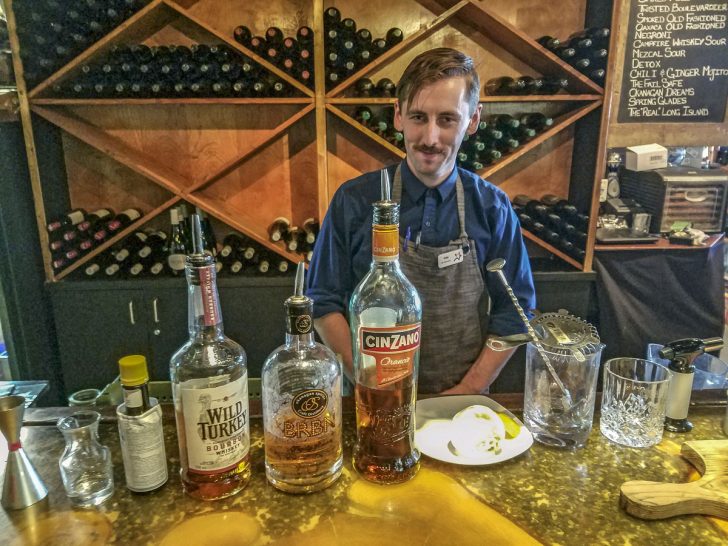
Bar Supervisor Tom Falland creating his signature Smoked Old Fashioned drink at the Den Bar and Bistro in Silver Star Mountain, BC. Credit: Yvette Cardozo

The food and beverage manager over at the Den calls it classic cocktails “with a twist.”

And, indeed, these are not your usual Old Fashioneds or mojitos in the Den & Bar Bistro at Silver Star Mountain in British Columbia, Canada.

Downstairs in the basement, below Coffee+ cafe, along Silver Star’s main street, the Den is doing its own thing with alcohol.

Manager Mark Lehmann has turned his bar supervisor, Tom Falland, loose.

What resulted, among others, was the Smoked Old Fashioned. Yes, it’s a show. Yes, it’s delish. 

“Sometimes less is more,” Lehmann said. “I think gone are the days of sweet hyper-colored drinks, saturated with artificial flavors and so much sugar. In the Den, we have taken to infusing our own tinctures and flavorings using all natural ingredients to develop a unique taste and profile. We have also found in doing so we are using some older style spirits that have been collecting dust for an age. Aperitifs are heavily used in our lineup, as are spirits like Campari, Aperol and gin.”

So, of course, I wanted to watch Tom make his Smoked Old Fashioned.

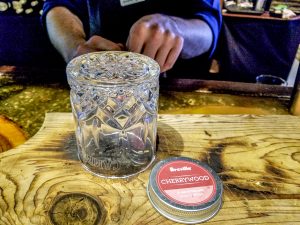
Infusing the glass with wood chip smoke while making the Smoked Old Fashioned. Credit: Yvette Cardozo

Originally, they used a smoker, trapping smoke in a huge beaker, then pouring it into the drink. But the smoker is now broken, so Tom torches wood chips.  Honestly, a better show.

First, he lined up his ingredients along the bar: a couple of bourbons, vermouth, bitters, a ball of ice in a glass, orange rind, cherry wood chips, and a beaker with a strainer.

Then, he torched the wood chips on a cutting board, and, when the smoke got going, set an upside down glass over the smoke. This lets the smoke flavor adhere to the sides of the glass.

Next he mixed the alcohols, bitters and sugar syrup. All this was shaken with ice cubes. He put the ice ball into the smoke infused glass, then poured the alcohol mix (minus the cubes) over the ice ball in the glass, finally adding a slice of orange rind. The ice ball, rather than cubes, keeps the drink cold without melting and diluting it, he explained.

 The result is a smooth taste that rolls gently around your tongue. There’s a hint of whiskey, a hint of orange, and the barest hint of smoke.

Ok, if this isn’t smoky enough, Tom has his Campfire Sour. It’s made with two bourbons and a single malt Scotch whiskey Laphroaig, then topped with frothed egg whites, a slice of dehydrated lemon and two charred cinnamon sticks. All this is to make it look like a campfire. The cinnamon plays the charred logs.

Be warned, though, Laphroaig is a very special taste. It’s a single malt whisky from Scotland infused with enough peat smoke flavor to bring tears to your eyes. I once hiked a multi-day coastal trail in Canada and after a week, everything I owned including my skin smelled of campfire smoke. This drink is that campfire smoke on steroids.

My favorite drink at the Den, honestly, was Tom’s Chili & Ginger Mojito. This is more than your usual by-the-pool mojito. It has the lime taste, to be sure, but there’s also ginger and, to wake you up, red chillies. A mojito with a kick. Perfect after a day of skiing and before you tuck into the Den’s BBQ ribs. 

Enjoying drinks at Den Bar and Bistro, Silver Star, BC. Credit: Den Bar and Bistro.


Canadian Cuisine? Sun Peaks, BC, Has Poutine Plus

Poutine Is A Huge Comfort Food. Add That To A Mighty Bloody Mary And You Have Dinner At A Cozy BC Resort.

Yes, poutine is one of those things that requires an excuse to eat.

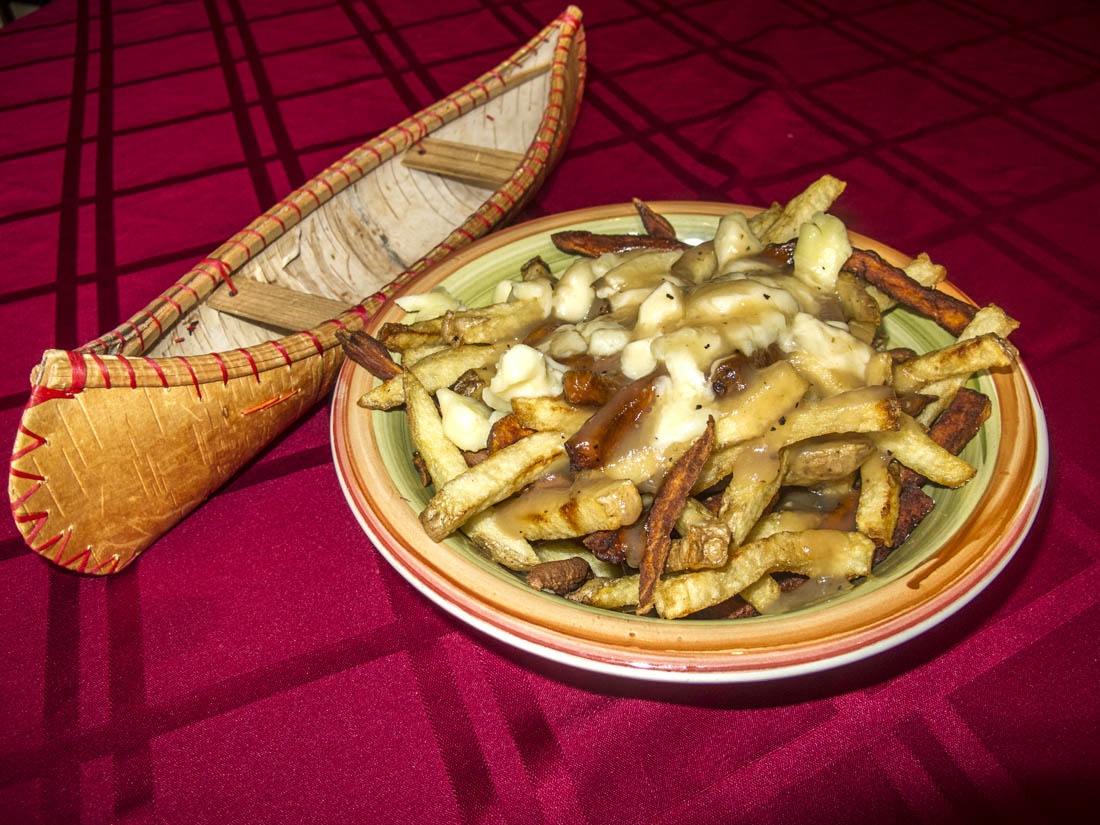
Poutine, a Frency Canadian comfort food dish. French fries are covered in tasty gravy and cheese curds. Next to the dish is a model of an historic birch bark canoe. Served in the Voyageur Bistro at Sun Peaks Resort, BC, Canada

We’re talking the massively popular comfort food that is Canada’s answer to Mac and Cheese. There isn’t an easy way to rationalize a dish that includes french fries, gravy, and cheese curds.

Unless, maybe, you’ve been skiing all day.

Bear in mind, poutine comes from Quebec, a scarf-culture place that has yet to embrace the idea of full face covering against the cold, a place where minus 30 degree temperatures in winter are a way of life. You NEED fuel in those conditions. Or anyplace else with that kind of weather.

So, enter Voyageur Bistro at Sun Peaks Resort in British Columbia, Canada. It’s a tiny cafe with hardly a dozen tables but if  you’re looking to bolster your inner heat lamp when it’s freezing outside, you can hardly do better.

A former river rafting guide, owner Kevin Tessier started adding authentic Voyageur cuisine to his tours. It was all based on what folks ate during fur trading days (bison, berries, cedar plank salmon, lots of maple syrup). His meals were wildly popular, and this whole concept found a home in his restaurant, which he co-owns with his wife Diane Larsen.

There’s Elk Wellington, Bison Burgers and, in the past, a Mac and Cheese that included Tenderloin Steak.

As for poutine, one often-cited tale is that of Fernand Lachance, from Warwick, Quebec, which claims poutine was invented there in 1957. Lachance is said to have exclaimed, ” Ça va faire une maudite poutine” (“It will make a damn mess” in French slang), hence the name. The sauce was allegedly added later to keep the fries warm longer. Over time, the dish’s popularity spread across the province and later throughout Canada.

Well, of course, then, I had to try Kevin and Diane’s poutine, which is made with real (they stressed that point) locally made cheese curds and fries, topped with their own special gravy which includes drippings from beef, pork and turkey. The secret ingredient is apple cider vinaigrette.

The final extra yummy product—mind you, I had skied 25,000 vertical feet that day and was truly READY—was a mouth wateringly hearty dish, rich with a hint of sweet from vinaigrette and interspersed with chewy, tangy cheese.

I was forking my way through when a local sat down on the bar stool next to me.

“Caesar,” he said, ordering from Diane, the bar keep.

 I started to pay attention when the drink took its final form and immediately ordered one for myself.

Canada’s classic Caesar drink. This is an upscale version made with salmon infused vodka, the usual tabasco, and Worcestershire sauces and Clamato juice.Cheese curds, salmon and pickled vegetables are included. Served in the Voyageur Bistro at Sun Peaks Resort, BC, Canada

A Caesar is basically a bloody Mary with an attitude but Voyageur’s Caesar is something very special: first into a tall glass rimmed with celery salt, the barman put the ice, then two shots of smoked salmon-infused vodka (“We don’t skimp,” Diane added about the vodka they make themselves), followed by squirts of tabasco sauce, Worcestershire sauce, a touch of horseradish and finally Clamato juice. This is topped with a skewer of assorted pickled or roasted vegetables, a chunk of First Nations-caught sockeye salmon, sometimes a chunk of cheese curd and maybe bison or elk sausage.

Yes, this was dinner.

Something New: A Limo To The Snow

Other Things To Do In Winter (Part 3): Ride The Snow In Style.

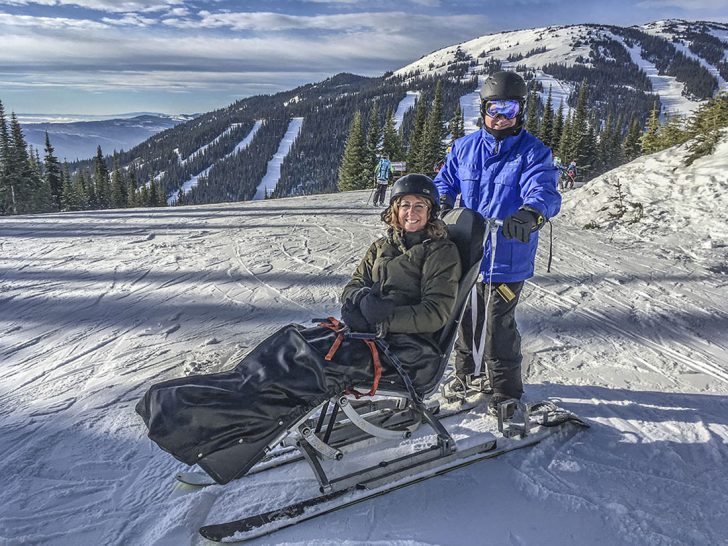
Snow Limo takes a non-skier not only up the mountain but also down a ski trail. Credit: Sun Peaks Snow Limo Tours.

There IS a way to experience skiing, even if you don’t ski. Or close to it, since you will be coming down an actual ski slope, keeping up with skiers.

Only thing is you will be sitting down.

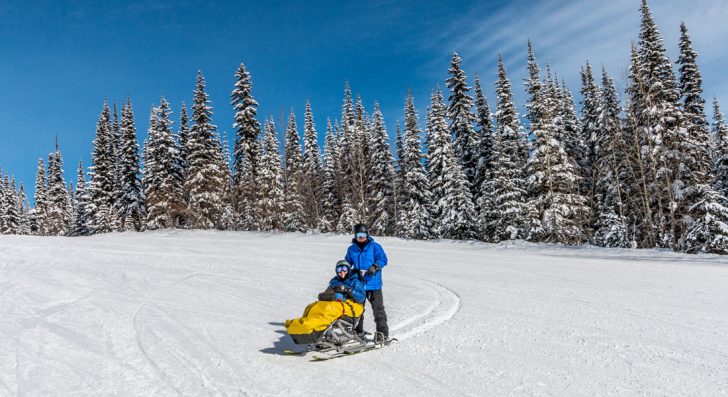
The device that enables this experience is called a Snow Limo. It looks kind of like a dog sled basket, complete with guide behind. The guide, who is on skis, controls the sled’s speed and direction. You just sit there and enjoy the ride.

It’s really popular with parents (think non-skiing moms) who want to watch their kids actually ski, not just skid to a stop at the village.

Various folks have estimated that perhaps as many as 15 percent of ski resort visitors don’t ski. Perhaps they never learned, they think they’re now too old, or have injuries that have prevented them from getting on-slope.

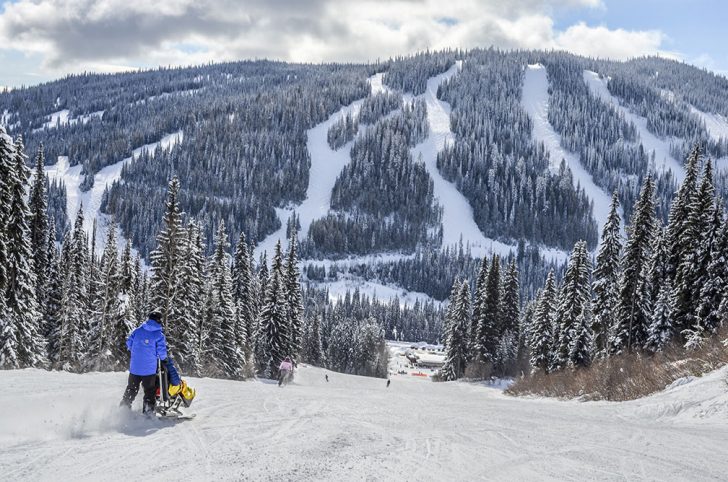
Riding down the ski slopes of Sun Peaks Resort in a Snow Limo is especially popular with parents who want to see their kids skiing. Credit: Sun Peaks Resort

The original sled, then called “Sno-Limo,” was created more than a decade ago by Paul Auger, of Whistler, and his brother Guy. They wanted to get their 83-year-old mother onto the ski trails to see her grandkids ski. The two, with their father, Bill, designed basically a cross between a dog sled basket and an adaptive ski sled with a way to tether a skiing “chauffeur” behind to guide the sled.

It took them four years of tinkering, but they eventually designed something that is easy to steer, easy to stop and easy to load onto a chair lift. Not unlike a dog sled, there is an emergency brake and the guides each carry a cell phone for emergencies.

Thanks to a broken ankle, I wasn’t skiing this trip, so it seemed like the perfect time to try this out.

So, what is it like?

I climbed in and company owner Mike Pfeil guided me to the lift. As the chair came around, he lifted the back end of the sled, and we slid onto the chair. At the other end, we simply glided down the ramp.

And then we were off, wind in my face.

It was exciting as we leaned into curves and sped alongside the skiers. It seems even faster than you expect since you are so close to the ground. My biggest problem was trying not to lean into turns. You are supposed to let the guide do all the leaning and steering.

Mike has three flavors of ride: a gentle 30 minute ride down the green Five Mile run, more adventurous blue intermediate runs for an hour and a special two-hour package for the even more adventurous where the guide will take the passenger down more narrow runs. His guides don’t go on black expert runs, though.

The ride is also a good way for a non-skier to do the mid-week resort fondue dinner at the Sunburst Bar & Eatery. You take the chair lift up at twilight and enjoy a three course fondue meal, complete with Swiss music. Then you ride down in the snow limo, equipped with lights for night. And if the night is clear, you’ve got starlight to accompany you.

Just about any age can do this. Mike says the oldest person was a woman who was 97. The youngest he will take is five.

For more on Snow Limo At Sun Peaks Resort, click here. 

A guide controls the speed and direction and the sled loads onto the ski lift for the ride up. Credit: Sun Peaks Resort

Dog-Sledding Is Another Snow Activity: Don’t Say Mush!

Other Things To Do In Winter For Seniors (Part 2): On You Huskies.

Dog Sled rides with Mountain Man Adventures. Credit: Sun Peaks Resort.

Ok, nobody says mush. Nobody, outside of maybe movies, has EVER said mush, though the folks who drive sleds are often called mushers. Mostly, people who run dogsleds just say, “Go!”

And the dogs aren’t those black and white Siberian Huskies people expect. Your average sled dog is something mushers call Alaskan huskies. They are lean and small with long legs and bred to run. In the case of Chris Schwanke’s pups at Mountain Man Adventures at Sun Peaks Resort, BC, a combo of greyhound or German short hair pointer and … well, who knows what.

“People see some of the dogs with their tails tucked between their legs and think they’re unhappy but that’s what greyhounds do,” said Chris. “So that’s how you tell them apart … the greyhound mixes tuck their tails. The others curl their tails up.”

While these dogs are not an official breed, over the years, the “Alaskan husky” has been recognized by anyone who runs dog teams.

At the end of a tour, guests get to pet the adult dogs and puppies. Credit: Yvette Cardozo

My friend, Nancy Slye and I arrived and first got to pet the dogs and say hello. Chris encourages this. He wants his dogs to be friendly.

Then we loaded into sleds, normally two people in a sled with a guide on back. The ride is 10 km (a bit over six miles) and lasts about 90 minutes.

And we were off—through the woods on narrow trails crowded with trees, along an open lake, across a snow covered golf course, then back into the woods. It can be a semi-wild ride, as snow-caked trees whiz by from doggie level, hardly two feet off the ground.

But what made this trip different from those I’ve done in the past was the chance to run the sled ourselves. Yow!

You stand on the runners behind the sled, which are wider set than you expect if you are a skier. And, guide Destiny said, you just say “go” to start, “easy” to slow and “whoa” to stop.

“Bend your knees a bit and stay flexible,” she added.

It’s kind of like skiing. Or riding a snowmobile. Or a dirt bike. It’s go with the flow.

And, before we knew it, we were back at the start, among the dog kennels and other pups.

Now came more fun. As a treat after a run, the dogs get chunks of meat and fat to fuel them and keep them warm. You toss the chunk in the air and the dog jumps, mouth wide open, teeth flashing in the sunlight. It makes for a killer photograph.

Finally, to wrap up, we went into the puppy pen, where five-month-old Pirate, Sailor, and Captain were waiting to have their ears scratched. It’s not only fun, it helps socialize the dogs from an early age.

Guests are given a chance to drive the sled during the tour. Most sled dogs are NOT Siberian Huskies but, a crossbreed called Alaskan Husky. Credit: Yvette Cardozo

Ice Fishing Time Coming Up

Other Things To Do In Winter For Seniors.

Ice fishing on Heffley Lake near Sun Peaks Resort with Elevated Fishing Adventures. Here, the guide and guest try their hand at outdoors holes. Credit: Yvette Cardozo

Some folks fish for sport. Some for relaxation. Some to “just get away.”

I fish to eat. If I can’t eventually put it in a fry pan, I’m not really interested.

So enter Elevated Fishing Adventures, near Sun Peaks Resort in British Columbia, Canada, where you get all three. Especially the eating part.

“Probably half the people who come out with us cook their fish that night,” said owner/guide Campbell Bryk.

Owner/guide Campbell Bryk picked my friend, Nancy Slye, and me up at 7 am and we drove out to nearby Heffley Lake, which at this point in the year, was covered with 20 inches of ice.

The lake is stocked with rainbow trout, a mild fish that makes great eating. The red glow is sunlight coming through the red canvas tent. Credit: Yvette Cardozo

A few hundred yards out, Campbell set up his fishing tent, got a portable heater going and re-drilled three of his fishing holes. Then he baited our hooks with natural looking lures that not only wriggle, they glow in the dark water below the ice.

This is really popular with families that have kids. “As soon as  you see fish down there, you can get kids to sit for hours,” Campbell said.

And anybody …really ANYbody…can catch a fish, he insisted, describing one morning where a mom was breast feeding her infant with one hand and hooking fish with the other.

“Her three-year-old caught a 24-inch fish,” he added.

The BC government each year stocks Heffley with 5,000 rainbow trout, a fish that Campbell claims, “Anybody can cook and virtually everybody likes because it’s so mild tasting.”

The best fishing, he explained, is just before Christmas. The most any group has caught in a day is 36, though folks are limited to keeping only five per person. And the largest fish anyone’s ever caught was 30 inches, big enough to feed six people.

The lake has both wild and stocked fish. The wild ones are dark red and green, the stocked ones are shiny but they both taste the same, so we were told

As for us, we were pushing the end of the season. And the fish were nowhere to be found. Have any groups ever come up completely dry?

Only two out of 50 trips. Campbell invited them to come back the next day, free of charge.

Okay, we were running out of time.

And then, with maybe 15 minutes before we had to pack up, something nibbled Nancy’s line. She set the hook and reeled it in. It was cute. It was tiny. It was too small to keep.

So we went back to fishing and now, with merely five minutes to go, Nancy got another one (I was busy taking pictures). Again she hooked it. Again she reeled. Again it came up.

And this time it was over a foot long, one of the stocked fish, holding a good pound of edible meat. A keeper. Campbell filleted the fish and delivered it to us later that day.

As for the cooking part, we removed what tiny bones remained, cut the fish so it lay flat, tossed it into a frying pan with lots of butter, garlic, a bit of salt and a splash of lime juice.

Even I, someone who joyfully eats but doesn’t necessarily cook fish, did a yummy job.

Next year, Campbell said, he will have a permit to fish on Paul Lake, which is stocked with landlocked sockeye salmon, called Kokanee in these parts. He’ll be making salmon sashimi for those who want it and cooking lunch.

Nancy and I WILL be back.

Click for more about Elevated Ice Fishing at Sun Peaks Resort.

After cleaning, there is about a pound of rainbow trout, perfect for two for dinner. Credit: Yvette Cardozo

Ridin’ With The Cats

What’s It Like To Groom Trails At Night?

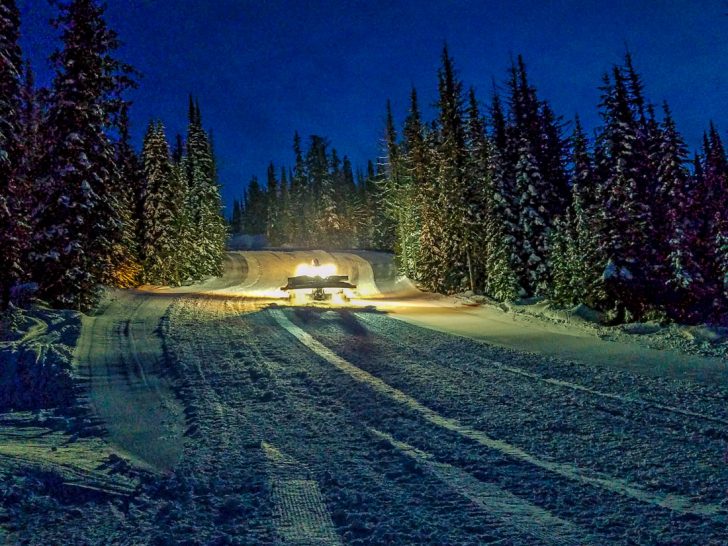
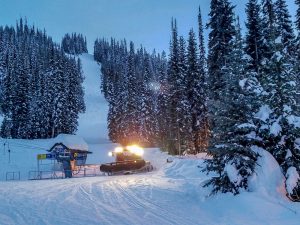
Snow cat groomer making the ski run smooth for skiers the next day. Sun Peaks Resort, BC.

They come out at night and do their job. You can see their lights progressing across the ski slope and occasionally hear their roar. And the next morning, they’ve left this delicious set of corduroy tracks across the ski hill.

I’d always wanted to go on-slope with a snowcat groomer. And so, at Sun Peaks Resort in British Columbia, Canada, I did. And it’s a tour anyone can sign up for.

Snow cat groomer makes its way down a ski slope at Sun Peaks Resort, BC.

It’s astonishing how much damage skiers can do to a run in a single day. If the snow is soft, bumps form, and the middle gets dug out because that’s where folks prefer to ski.

Enter the snowcat groomers. These are powerful cabs—Piston Bully 400s with 320 hp diesel engines— atop tank treads with a blade on front and a tiller on the back. The blade knocks down bumps and that nasty looking tiller, which rotates at over 1,000 rpm, can turn even ice into something resembling powder, which is then smoothed flat into that hero corduroy.

Of Sun Peaks’ 24 operators, two are women.

“Honestly, the women do a better job. They are more detail oriented,” admitted my guide for the night, Leo.

It takes three years for a groomer to really learn how to do this well, he added.

It was one of the women running the winch cat that night. Picture eight tons of growling machine attached by a line to a tree to keep from sliding downslope uncontrollably. This is how the really steep runs get groomed. Back in the day, these runs got so bumped and carved out, they were barely skiable.

It takes three years to become an expert groomer. Sun Peaks, BC.

Rob Gayman, grooming manager at Mt. Hood Meadows resort in Oregon, once described operating a winch cat this way: “It’s somewhat like dropping off a cliff. At the top break-over as the machine teeters above the brink, your heart starts to palpitate, and your natural survival instinct pushes you back into your seat.

“As the machine creeps forward and the operator adjusts the winch tension, the cat tilts forward into the darkness. The cat’s lights don’t shine down low enough; you can’t see what lies below. It tilts more and more. You start to fall forward out of your seat. Now you’re standing on the floor; surely this can’t be right? But then the cat finishes its forward tilt and the ground below you comes back into sight. It wasn’t a cliff after all. Snow rolls and tumbles down in front of the cat as the operator blades and tills his way downhill.”

For me, as dusk fell, the whole scene took on a surreal feel. Our headlights shining on the ridges of snow, leaving them glowing with weird shadows, along with the blinding headlights of an oncoming behemoth.

On an average night, more than a third of Sun Peaks Resort’s ski runs will be groomed. But among those, will be every green (beginner) trail.

And if you are lucky, your favorite black run will have been groomed early, then covered with ankle deep powder overnight, making for a run that feels, well, like skiing a glacier.

There are two women groomers at Sun Peak, BC, said to be more detail-oriented than the men.

Here’s A Special Gift Idea: Eat A Tree

If You’re Looking For Novel Gifts For Snow Country Lovers, Yummies Made From Fir Trees Are Worth A Look.

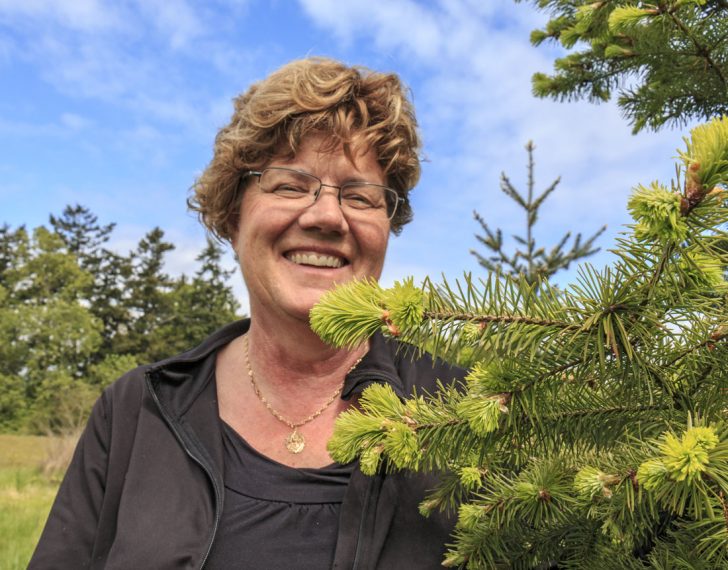
Laura Waters at her shop, Snowdon House outside Victoria, BC, Canada on Vancouver Island, where she sells edibles made from new growth on douglas fir trees. These include vinegars, jams, dried seasonings and more.
Credit: Yvette Cardozo

Of course, this is a Christmas story. What else when you are talking about eating Christmas trees?

It’s just the growing tips that you eat, actually. And the pine flavor is, well, way better than you expect if you are more used to sniffing pine sap from your fingers when handling fresh cut boughs.

When Laura Waters planted Douglas firs on her four acres of land in 2009, she intended to sell them for Christmas trees.

“But it takes six years for them to grow and then, all you wind up with is stumps,” she said one late spring day as we inspected the bright green growing tips of her trees.

“I was out there, hot and bothered, mowing to keep the grass down between the trees and I had a pot of strawberries on the stove in the kitchen. I cut a branch and out of curiosity, tossed it in.”

The same way that vinegar adds an essence of sweet/tang to fruit compote, the fir tips added … something. And it was a sweet and tangy something good. That experiment became Laura’s first strawberry fir vinegar.

A bit of research revealed that First Nations people in the area used to make tea from the fir tips. It was not only tasty, it provided more vitamin C than citrus fruit.

“When Capt. James Cook was on the BC coast, everyone had scurvy and the local natives told them to make tea out of the Doug fir tips. That took care of the scurvy,” Laura added.

There are lots of way to take the essence of fir trees and make edibles. Laura Waters has literally “botted” trees.  
Credit: Yvette Cardozo

Laura’s first vinegar led to carbonated drinks, which led to fir seasoned bread, brie toppers, a drinkable vinegar that you add to evening cocktails, dried seasoning blends and more. She sells all this in her shop, Snowdon House, in North Saanich, a suburb of Victoria on Vancouver Island. While I was there, a group of visitors arrived. They had come up from Seattle by ferry and taken a cab out to the shop.

Along with the visitors, I tasted the fir essence drink, a bottled non alcoholic drink that was amazingly refreshing. It had a piney back woods flavor that hit the top of my tongue, along with citrus and floral notes. I learned I could pretty much make my own with Laura’s fir vinegar, so I bought a bottle to add to tonic (with a bit of vodka) at home.

We also nibbled our way through her Fir and Fire Brie Topper, which is actually a sweet, piney red and green chili jam that offsets the stringent brie flavor really well. Plus I bought a packet of dried seasoning blend (parsley, lemon peel, Doug fir, dried spinach, ground juniper berries) with which I plan to make a party dip.

There’s a bread mix (with an added blend of Doug fir tips and juniper berries) that results in fresh bread with a pine accent. Laura also makes gift papers by hand and sells outside products such as organic hot chocolate mix wrapped in her hand made gift papers, plus there’s racks of her handmade gift cards. And fresh eggs she sells when her crowd of chickens are in a producing mind.

In addition, she has created a collection of recipes and holds cooking classes. The one she did the day before I visited featured chicken thighs marinated in apricot and bay leaf vinegar, cooked in the vinegar, then wrapped in flat bread with mayo and her apricot/mango topper (yes, she makes toppers that don’t involve fir tips).

If this isn’t enough, on her drawing board are plans to dehydrate the tips for a tea and she was experimenting when I visited with pickling fir tips to make into capers. And then, there was also the Doug fir flavor to be whipped into butter for popcorn topper.

Plus the B&B she opened this year.

Meanwhile, her shop is open Tuesday through Saturday 10am – 5pm.

Yes, Laura Waters is a very busy woman.

Snowdon House Gourmet Gifts

Master’s Week At Big White: Senior Focused Lessons And Activities

Big White Found The Right Formula To Attract Seniors For A Special Week Just For Them.

Ski lift with view of condos. Credit: Big White Ski Resort.

Like so many things of yesteryear, ski weeks are making a comeback.

And not surprisingly, they’re aimed at the same folks who went ski trips back during the ski week heyday in the 1970s and early ‘80s—the Boomers.

The original ski week hit when the baby boomers were yesterday’s millennials. They had money, they were skiing, they wanted a fun social experience.

Then boomers started having families and taking an entire week no longer worked. So short, specific clinics (racing, bumps, women’s) that lasted only a long weekend, took over.

But why have ski weeks returned?

Women in Big White Ski Resort Masters ski program show off their green hair helmet decorations. The program runs a week with lessons in the morning and social programs at night. Kelowna, BC.
Credit: Yvette Cardozo

Because the kids have grown up, the money is available and so is the option of taking a week. Plus, it’s, well, your own age group. No trying to keep up with someone 30 years younger.

“It started as 50 Plus in 2011,” said Katie Balkwill, regional sales manager for Big White Ski Resort. “We ran it that way with very small numbers until 2013. Then we changed the name to Seniors Ski Club—and no one came the following week.

“So we changed the name to Masters Monday and had 30 participants the next week. We average 45 people every Monday for most of the season now.

“It truly is all in a name.”

As for Masters Week, it has grown steadily from 23 participants the first year (19 of whom have returned) to 59, then 109, then last year, 229 split between into two weeks, and after the second session, a third was added for the end of the season.

 And so, I signed up. We would ski together each morning and have a variety of social programs in the afternoons or evenings.

Since we had all filled out forms suggesting our ski level, we separated into skill groups the first morning ranging from novice to expert. After a bit of shuffling, we were set for the week.

Instructor at Big White ski resort shows an exaggerated proper stance for skiing.
Credit: Yvette Cardozo

Our group, Level 4 of 6, was perfecting its stance, getting more aggressive on our turns, and playing a bit in the year’s epic powder.

Anthony, our instructor, tailored exercises to each of the five in our class.

For Sandy, it was ski down holding poles horizontally in her hands which, Anthony said, helps you lead the turn with your lower body. Her upper body was turning into the hill, which throws you off balance.

For Norm, it was a “prayer stance” holding his hands together in front of his chest. This balances you and helps you lead with your legs, rather than your upper body.

For me, it was making sure I looked downhill when turning, not to the side—again, helping with balance.

And for all of us, there was a maddening exercise where we dragged our downhill pole along the snow, which truly is not intuitive. This gets you onto your downhill ski throughout the turn, Anthony insisted.

And, well, it did.

It snowed every day but on two mornings, fog settled in.

We all gulped, shrugged, and took off for lessons on how to deal with a whiteout.

We headed for the Black Forest chair whose medium width trails were lined with trees heavily frosted in Christmas card snow.

Ski along the trees, Andrew said. And sure enough, there magically was definition in the snow at our feet.

Don’t look at your skis, he added. Yes, it’s scary to peer into the white void, but find something ahead—another skier, a line of trees, a pole, a lift, and keep your eyes on that.

It absolutely helps avoid vertigo and, of course, falls.

I had truly hoped that last day we could find some steep cruisers along one of the outlying chairs and some untracked powder but the fog and near blizzard conditions squelched that.

Instead, I took the lessons home where, yes, it all made a huge difference.

Information

Big White Ski Resort’s Masters Week is actually five days, Monday through Friday. There are on-slope lessons each morning, then social activities in afternoon or evenings.

For 2018, Big White is planning at least two Masters ski week programs, Jan. 29 – Feb. 2 and Feb. 26 – Mar. 2, plus possibly a third at the end of the season.

Price for the week (lessons, clinics and most social activities) will be $278 Canadian. Canadian dollars have run about .75 per US dollar for a few years meaning $278 CDN works out to about $208 US.

There are also Masters Monday classes, held each Monday morning, for people who don’t want to commit to an entire week.

Early morning view of Big White Ski Resort village ski runout on a sunny day. Credit: Yvette Cardozo


Something Different For The Grandkids: Idaho Elk Feed

When It’s Time For A Diversion Excursion, Visit The Elk Herd.

Sleigh pulled by Percheron horses takes people out to help feed elk in Donnelly, ID, near McCall. Light snowfall speckles the scene. The Points family has been feeding wild elk on their land to help them survive winter for three generations.
Credit: Yvette Cardozo

Yes, Idaho has some delicious skiing. Yes, some people want to do something else. In winter. In the snow.

And so, in the McCall area, there’s the elk feeding trip.

Back in 1983, Lyle Points’ pop, Vernon, started to worry about the elk on his land. These were wild animals. And in harsh winters, they were doing badly.

“No elk is going to starve on my place,” he declared.

Why not give them a bit of help?

Hungry elk come in to eat from hay bales on a sled which takes people out to watch the elk feeding.
Credit: Yvette Cardozo

So he started dragging bags of hay out, sometimes breaking trail through five feet of snow, to give the elk a bit more food when food was REALLY hard to find.

Thus started a family legacy which has now stretched to three generations.

These days, the public helps. For $20 (less for kids) you climb into a sleigh, sit on bales of hay and go out to the nearby woods where the herd of Rocky Mountain Elk are patiently waiting.

They, meaning the elk, not Lyle, have worked out a system. They actually take turns, some coming to nibble the hay from right under your rump, others sitting a few yards away until the next sleigh comes along.

Sometimes, it’s three sleigh loads a day. Sometimes only one. Sometimes none. But they still don’t go hungry because, as Lyle explained, “This is just the appetizer. Later, I will go out with more bales, cut them into chunks and drop them in a line.”

Like crumbs on the floor.

This winter was the snowiest, the coldest, the harshest in 30 years. Food was even harder to find than normal. And there are the wolves.

“I figure giving the elk some extra food is an extra bit of help to survive,” Lyle explained.

As it is, the herd is down to 180 elk from previous years when it could sometimes reach 300.

And so, my friends and I climbed into Lyle’s sleigh, pulled by his two handsome, coal black Percheron horses and headed for the nearby woods.

We all sat on fresh bales of hay and it didn’t take long for the elk to come over.

It’s the cows (females) and young males with tiny antlers that nudge in. There ARE bulls, some with seven point antlers (yes, that’s a LARGE rack). But the bulls just sit there, keeping watch.

Okay, it is truly a bit strange to have a large wild animal nibble eagerly at something your rump is resting on. You can actually feel them chew. And certainly hear them as they crunch.

There’s a temptation to reach out and pet their furry heads, maybe stroke the small antlers of “teenage” males. But don’t.

Lyle has rules. You don’t touch. You don’t get up. You certainly don’t feed them if you brought snacks for the kids.

Meanwhile, during the ride, Lyle talked about elk, about how they eat and digest in their four-part stomach, what they eat on their own (any plant they can find), how many bales he takes out a day (16 – 20) and how his family got into the elk feeding thing because, well, they couldn’t bear so see such beautiful animals suffer.

We were out there for more than an hour. Plenty of time for everyone to take a LOT of pictures and videos.

Click here for the website.  Or call 208-325-8783. It’s $20 for adults, less for children. This is strictly winter. You ride out on a sleigh, sitting on hay bales. Grandkids LOVE it.

Visitors sit on hay bales while elk come in to feed on the hay. Kids know Lyle’s rule: Don’t touch.
Credit: Yvette Cardozo

Retail Drop In: Three Shops Make Recommendations For Seniors

[Editor Note: It’s buying season, and we know from our reader surveys that many senior snow enthusiasts are looking for new gear and clothing.  We decided to do an experiment and drop into three different ski shops in three different parts of the country to ask, “What’s hot for seniors?”  That means, what stands out this year for seniors that’s comfortable, safe, and convenient?  Here’s what we found shop owners recommending. Thanks to our participating shops for talking with our correspondents Harriet Wallis, Yvette Cardozo, and Mike Maginn.]

FROM THE ROCKIES: Two Innovative Boots Rock The Scene With Features Seniors Want.

Correspondent Harriet Wallis visited Lift House Ski Shop near Big Cottonwood Canyon in Salt Lake City.

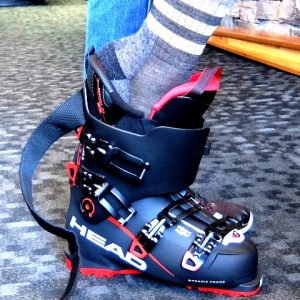
Head's Easy On boot. Credit: Harriet Wallis

Head’s Easy On Boot. Credit: Harriet Wallis

Look ma, no hands!
Head made a slight change in the inner cuff of the Head Vector 110. Skiers can easily slip into the boot—no contortions or yanking needed. You can even push your foot in while standing.

“I skied the boot and had good control even though it’s softer than a race boot,” said Luke Larsen, a ski racer and owner of SLC’s Lift House. Price: about $499.


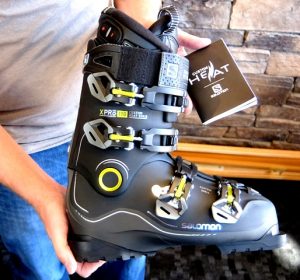
Salomon Boot With Heat. Credit: Harriet Wallis

Salomon Boot With Heat. Credit: Harriet Wallis

Toast your tootsies.

At last, integrated boot heaters make their debut in Salomon Custom Heat. Until now, boot heaters had to be retrofitted into boots, and the bulky battery packs clipped onto the shell.

“This makes the heated boot less expensive than buying boot and buying heaters separately,” said Larsen.

Price: Boot with integrated heat about $749.


FROM NEW ENGLAND: Bindings, Heaters And Snowshoe Bindings

Correspondent and co-publisher Mike Maginn spoke with shop owner Matt Thibeault and manager Chris Woods at Sports Stop Wenham on Boston’s North Shore.

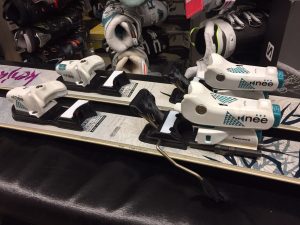
The Knee binding releases at the heel as well as the toe. Credit: Mike Maginn

The Knee binding releases at the heel as well as the toe. Credit: Mike Maginn

“Seniors Are Searching Out This Binding.”

Matt said the Knee binding is being sought by seniors. “It is designed to release laterally at the toe and the heel,” an important safety feature for many seniors. “The binding doesn’t sacrifice performance either,” said Matt, “but you do have to designate a right and left ski.” The Knee binding retails for about $379.


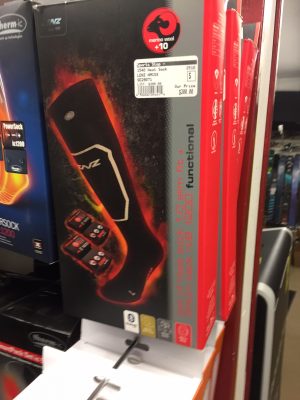
The world needs a Bluetooth-controlled heated ski sock. No? Credit: Mike Maginn

The world needs a Bluetooth-controlled heated ski sock. No? Credit: Mike Maginn

Heated Socks Are Getting Smart.

We know that heated socks are, mmm, cool, but when Matt and Chris showed us two different approaches to keeping toesies warm, we were impressed.  Lenz has a battery-powered, heated sock that, get this, is Bluetooth-controlled by a Smartphone app.  Turn the temp up or down by flicking the screen. Knee high, these socks are $300.

Therm-Ic Supermax Set has a different approach with an thin insert that slips into your boot sole and a connection to a battery pack with three heat settings.  It’s a real plus for seniors with circulation issues.  Retail price is about $220.


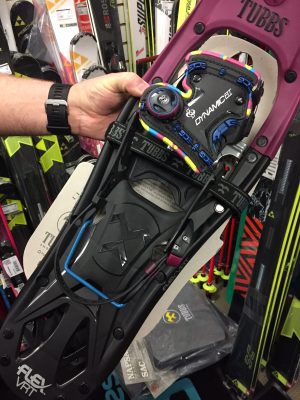
Boa closure system: Turn the dial, tighten up. Credit: Mike Maginn

Boa closure system: Turn the dial, tighten up. Credit: Mike Maginn

Finally, An Easy On-Off Snowshoe Binding.

We are so happy that snowshoe binding designers have come up with this one.  The new Boa system binding is much easier to use than the old tug-the-ties models.  You just put your foot in the toe and turn the Boa binding knob. To get out, you twist it the other way.  This example is on a Tubbs snowshoe model.  At last. Various models, starting at $189.


FROM THE PACIFIC NORTHWEST: Pin Tail Skis For Seniors And More Heat

Correspondent Yvette Cardozo talked to Kevin Dreher, ski shop manager at Gerk’s, a ski chain in western Washington.

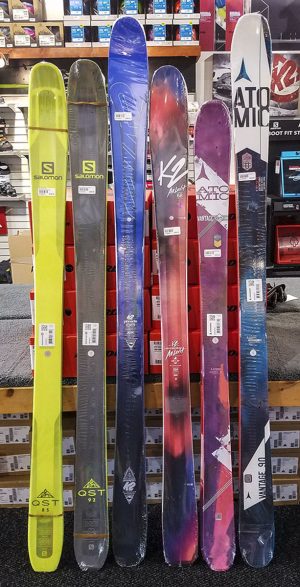
Examples of tapered tail skis. Wide shovels, slightly narrow waists but tails that don't flare out as much as classic shaped skis do. Credit: Yvette Cardozo

Examples of tapered tail skis. Wide shovels, slightly narrow waists but tails that don’t flare out as much as classic shaped skis do. Credit: Yvette Cardozo

Compromise Ski Shape

A lot of older skiers grew up skiing on skinny skis with their feet close together (picture Stein Erickson), Dreher said.

For some, learning to break that habit has been hard.  Still, modern tech in the form of shaped skis has made the sport so much easier.

So enter the compromise, the pin tail shape ski.

It still has a wide shovel and a more narrow waist but the tail tapers, so it’s not quite so wide, not so much an hourglass shape.

This, said Dreher, does two things: allows a skier to keep his/her feet closer together and also, if they are tired, to slightly skid the turn. But it also has all the easy skiing benefits of shaped ski tech.

It’s not brand new technology but seems to be getting more popular lately, perhaps as a segment of the ski population has gotten older.

Dreher mentioned two brands in his shop that have tapered tails, Salomon and Atomic. Salomon’s QST 85 and 92 run $400 and $500 respectively. The more expensive ski is aimed at a more aggressive skier.

Atomic’s Vantage also has two models, the 85 and 95, again $400 and $500 retail.

[Editor Note: These skis are on SeniorsSkiing.com /realskiers.com’s list of ski recommended for seniors.]


Better shop now for this. They sell out pretty quickly.

Better shop now for this. They sell out pretty quickly.

And More Heaters

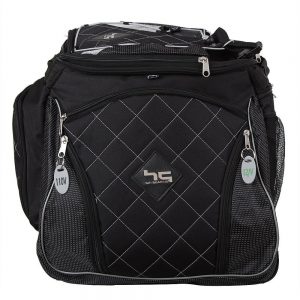
Then, we get to my favorite: the heated (yes, heated) boot bag.

Don’t you just love driving hours to the hill and then trying to wrench stone cold boots on?  Now, there’s a boot bag with a cord that works on either AC (house) current or DC (your car).

One version of this bag is made by “Hot Gear,” but appears to be sold as Zip Fit through Amazon.com for about $200. Another version, Transpack, is sold for about $180 through Amazon and REI.

But honestly, you can also get those disposable foot warmer packs and do as the patrollers do, put them ON TOP of your toes instead of under them. Take it from one with chronically cold toes, that works.