Ladies, Don’t Wear Black Underpants On Super Cold Days…

…And Other (Unusual) Tips On How Everyone Can Stay Warm.

Yup, it’s cold outside. Credit: Harriet Wallis

We all have our tricks to stay warm when the temperature plunges. Here are a few you might not have thought of.

Cheapo Hand Warmers

Cheapos worn under your ski gloves might work.

I’ve used the shake-’em-up hand warmer packets and tried every kind of liner. Splurge $1 and buy the stretchy little gloves that you can find everywhere: grocery stores, drug stores, big box stores. The knit fabric is the best for keeping my hands warm. Most are black, but choose a colorful pair. You’ll have a better chance of seeing them should you drop them on the locker room floor.

Hot Buns

If you buy those little gloves, then you won’t need the hand warmer packets in your gloves. Instead, put them between your base layers, especially if your ski pants gap in the back. The packets stay in place between base layers and they keep your lower back warm.

Potato Ears

Before the days of microwave ovens, my mother stuck a nail into each potato before baking. The nail conducted heat into the potato, and it sped up cooking. The same concept applies to earrings on cold days. A post through your ear conducts the cold into your body. Skip the fashion statement. Stay warmer.

[Editor Note: Eyeglass frames can also be cold conductors. Try skiing with prescription goggles or contacts, or go native and take off your specs.]

Two (Or Three) Sock Day

Wear one pair to the mountain, then change your socks before you put on your boots. Feet exude moisture even if you swear your feet don’t sweat. If it’s a really bitter day, change your socks at lunchtime too. It makes a big difference. I dare you to try it.

Some Assembly Required

About that black underwear. On really cold days, it’s a project to get assembled: Tuck this in, pull this up, pull that down over.

My base layers are black, and so are some of my undies. More than once I’ve toddled out of the ladies room wondering why I’m hobbled. Duh. Too many black layers. My underpants are still way down there. Retreat and reassemble. Don’t wear black undies on cold days. Go for your brightly colored ones. They’re easy to see as you put yourself together.

To read more from Harriet click here for her stories on SkiUtah.

Safe Driving: Wrap Tires With Chains

How Many Readers Carry Chains And Actually Know How To Mount Them?

Back in the old days, many of us had knobby snow tires even studded ones mounted on a separate set of rims stashed in the corner of the garage, ready for mounting.  Tire designs and compounds changed over the years.  Snow tires still exist, but all season tires are the norm. If you have a car/SUV that has four-wheel drive, you are good to go for most winter conditions.

Last year, in Box in the Back, I listed what you should carry for emergencies when you headed into the mountains.  What Else Should You Have In Your Car provides suggestions on what to do/not to do if you are forced to stop for a long period, either by an accident or road closure.

The best time and place to learn how to put on tire chains is in your driveway on a nice day. Worst: roadside in a snowstorm.

What wasn’t covered was chains with which I have a love-hate relationship.  They’re clunky, a pain in the rear to install on the side of the road.  If one section comes loose, it can beat the crap out of a fender, wrap around an axle, or rip out a suspension component.

While most of us prefer not to install chains, there are parts of the country where the local gendarmes have the right to insist you use them even on a four-wheel drive vehicle equipped with mud and snow tires.  No chains, no going any farther.

Some states require chains on snow-covered roads. You have no choice, so you better know how to use them.

Point one.  If chains are required, getting told to put them on is not the time to turn around, drive back to the last town you passed, and buy a set.  They should have been bought before you left the house and kept handy, i.e. where you can get to them without having to pull everything out of the trunk.

Research chains types to pick the ones that are the best fit for your vehicle and your needs.  Click here for a really helpful link that offers instructions on selecting the right chains.

Point two.  A chain “inspection/installation” station is not the place to learn how to put your chains on because it is cold, snowy, and often dark.  Don’t rely on some helpful soul to rescue you.  Putting chains on slush, cinder, sandy wheels is a dirty job, so be prepared.  Practice putting them at home before you leave. Put them on and take them off several times so you know the drill.  One enterprising soul I know has the instructions downloaded on his iPad as a reminder.  While it is a helpful reminder, a video is not a substitute for actual experience.

Point three.  While you don’t need a separate pair of overalls and boots, carry a small rubber mat you can kneel on and a pair of heavy rubber gloves you can slide over a pair of ski glove inserts.  Leather work gloves also work. This will keep your fingers from getting cold and numb or cut.  Practice with the gloves on.

You make be like me and hate chains, but don’t leave them behind because, one day, you’ll need them or possibly lose a day or so of skiing.

FAQ: Why Do I Have To (Constantly) Re-Enter My Email?

We Get This Question From Time To Time. Here’s What Happens And How To Solve This Problem.

If you are being asked to re-enter your email to confirm your subscription to SeniorsSkiing.com, you might be a bit annoyed.  We don’t blame you, but there is an explanation.

You are accessing SeniorsSkiing.com through a device that is different from the one you originally signed up on. Subscribing to SeniorsSkiing.com puts a “cookie” on your device.  If you use a different device, no cookie, so you are viewed as a non-subscriber. If you re-enter name and password, you’ll be okay with the new device.

You have disabled cookies or cleared browser history on your device. Even iPads can accept or disable cookies. Turn cookies back on, and you’ll not have to re-enter again, or leave it disabled and realize you have to re-enter each time.  Your call. 

You are trying to access our Subscriber-Only Content.  Instead of building a firewall that requires usernames and passwords, we elected a much simpler way of getting to our exclusive content: Just confirm your name and email.  You will have to do that each time you want to get to that information, which, by the way, is under the Community tab at the top.

You have upgraded or changed settings in your operating system or browser.

Those are the usual conditions that prompt the re-entry pop-up. If you are still having trouble, please contact us at info@seniorsskiing.com.  Hang in there!

This Week In SeniorsSkiing.com (Jan. 4)

Holy Ticket Shock, Favorite Article of 2018, Belleayre, Ski Test Series, Flyin’ Mystery, Encore For Layering Basics, Sir Arnold Lunn.

There is a reason SeniorsSkiing.com tries to promote reasonable pricing for seniors who have been supporting the sport for decades.

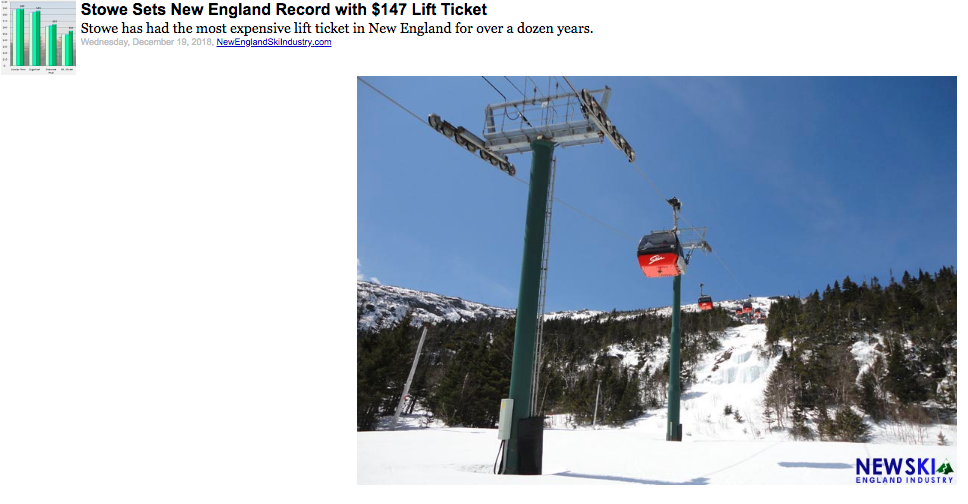
News like the following is evidence that the voice of seniors is needed to get a lot louder in the corporate halls of the ski industry. The headline is from New England Ski Industry.com.

In case you can’t read it the graphic, it says “Stowe Sets New England Record With $147 Lift Ticket.” Read the whole story by clicking here. All of this is designed to push consumers to purchasing Epic season passes which may or may not be a good deal, depending on how often you ski and where you go.

This week’s Short Swings has an excellent summary of the lift ticket/season pass situation in a Ski History article by none other than John Fry, long time snow sports journalist and member of the US Ski and Snowboard Hall of Fame. If you’re a relatively infrequent skier—say five or six times a season—you’re going to be paying the highest ever ticket prices. If you are a frequent senior skier, you’re not going to get the big discounts you used to get at big resorts. Clearly, the multi-resort season pass is focused on the sport’s “best customers”, those who ski frequently and who often head to destination areas, but who represent only about 28% of the total skiers. Pareto Principle, 80-20 rule. Does this strategy make sense?

Favorite Article Of 2018: Free Skiing For Seniors

That is why many of our readers favor “mom and pop” areas, the archetypical ski resort that has low-key facilities, moderate terrain, and reasonable prices. In fact, many of these areas offer free or almost free skiing for seniors. And that is also why our annual listing of resorts that offer free or almost free skiing was the most read article of the year.

If you haven’t seen our directory of 145 ski resorts in the US and Canada that offers free or almost free skiing to seniors, click on the third menu box that reads Free Skiing For Seniors. You may be asked to re-enter your name and email address to access subscriber-only content.

This Week

We have a new resort review for Belleayre Mountain, a two-hour drive from the NY metropolitan area from Bob Nesoff, a veteran snow sport and travel journalist. Did you know Belleayre has a brand new gondola to whisk skiers up the slopes? A gondola in the Catskills!

Janet Franz reports on the basics of layering, based on a presentation by North Face’s Stan Kosmider at the recent Northeast Winter Weather Summit. There are nuances about what is worth wearing and why that we didn’t know. If you’re wearing the same old waffle long underwear that you’ve worn for years, you’ll want to think about how to re-dress.

Our Mystery Glimpse this week is a family affair. Should be quick recognition for those who live and play in a certain part of the country. ‘Nuff said. Check out the clue and read about last week’s amazing snowboard Olympic champ, Shannon Dunn-Downing.

Correspondent and long-ago SKI magazine associate editor Marc Liebman brings an introduction to his new ski test series that offers a history of how it was done ‘way back in the 70s. Remember, that was a time when the number of products proliferated, and readers needed a way to sort through and make decisions. Both Ski and SKIING magazines pioneered ski testing. Marc presents a capsule history.

Finally, Jan Brunvand offers a delightful selection from Sir Arnold Lunn’s The Mountains Of Youth (1925) from the early days of “ski-ing”. Lunn was the British athlete who set the rules for downhill racing, advancing the sport and attracting untold numbers of new skiers.


January is Learn To Ski and Snowboard Month.  Bring a friend and get some discounts. Find out where and how by clicking here.

Happy New Year! Don’t wait, go out there and enjoy the winter. Tell your friends about us.

Remember there are more of us every day and we aren’t going away!


Short Swings!

John Fry

John Fry is an important thinker in the world of skiing. For many years he was editor-in-chief of SKI Magazine, and he was founding editor of Snow Country Magazine. He created Nastar and invented the Nations Cup of alpine ski racing by which the relative strengths of the world’s national ski teams are ranked annually. He was inducted into the U.S. National Ski Hall of Fame in 1995. More recently, he authored the award-winning Story of Modern Skiing. John is the current Chairman of the International Skiing History Association, which publishes Skiing History Magazine.

The current issue of Skiing History features his article, The Impact of Soaring Season Pass Sales on Ski and Snowboard Participation RatesIf you are interested in the quickly evolving economics of skiing in the US, this article is not to be missed. 

Among his many observations: 

  • Last season, ski area visits were down to the same level of 1987. 
  • Twenty-eight percent of all skiers/boarders account for 70 percent of all visits.
  • Last season, the average U.S. window lift ticket price was $122.30, thirty times the average price of a weekend ticket ($4.18) in 1965. Before you say “Of course!,” consider that over the same 53 years, window lift ticket prices grew ten times faster than disposable income, which multiplied only 2.75 times. 
  • He talks about the decline of recent college grads entering the sport. Historically, they were a significant factor. Today, they’re struggling to pay student loans. 
  • He cites NSAA (National Ski Areas Association) research showing that 4 out of 5 newcomers exposed to skiing/boarding decide not to continue. 
  • And he discusses the bundled pass offerings from IKON, Epic, and others and asks if, despite their sales success, they serve the best interests of the sport.

Fry concludes,  “The ski industry is not synonymous with the sport… The cross-country ski and freestyle crazes of the 1970s, and later snowboarding, which attracted hundreds of thousands of new participants, were not ski industry marketing programs designed to increase participation. They arose out of the sport’s heart, and in some cases the “industry” didn’t initially respond well to them. 

“In the long run, the ski industry exists because of the sport, and not the other way around.” 

Join Us in the Alps

Join us the week of March 10 when we ski in the Aosta Valley with guides from AlpskitourEach day, we’ll go to a different resort in Italy, Switzerland and France. The all-inclusive price — $4500 to $5500 per person– depends on where you fly to and whether you stay in a 3 or 5 star hotel. Orsden is a sponsor and giving a parka to each participant. If interested, email me: jon@seniorsskiing.com.

Another Terrific Ski Cake

Iris and Victor with their 45th wedding anniversay cake

Iris and Victor Yipp of Oak Park, Illinois, sent in this photo of their 45thwedding anniversary cake from October 2016. Their note says “We wish we could ski as well as the skiers on the cake!” It is a beauty!!! Belated congrats. If you have a photo of a cake depicting skiers, boarders, snowshoers, or other snowsport fun, please send it along.

Free X-C at Cross Country Ski HQ in Roscommon, MI

Next week (Monday, 1/7 – Friday, 1/11) is Silver Streak Week at Cross Country Ski Headquarters in Roscommon, Michigan. If you are 60+, you’ll ski free and have the opportunity to demo new boots and skis at the demo center. Trails there are meticulously groomed, and few things are as pleasant as enjoying something yummy in front of the huge fieldstone fireplace.

Short Ski Videos Worth Watching

Most things Salomon makes are first-rate. Clothing looks good and wears well. Skis are exceptional. Even their videos. This one, titled “Higher Truths,” follows a few skiers on an unclimbed Tibetan peak. It’s the intermingling of the journey with Buddhist thinking that I find appealing. The video is a little over 11 minutes. 

Many of you have had the pleasure of skiing Alta. I’ve been a regular there since 1973. This 2 ½ minute video showing a cat grooming at night is consistent with Alta’s lovely, low-key vibe. 

Your Suggestions, Please

If you have topics you’d like explored in Short Swings!,  please let me know. Alternatively, if you’d like to express your own interests on these paperless pages, we’re always open to article ideas and article submissions. They could be about your personal experience, your ski club activities, interesting skiers you know, etc., etc.  Click here for submission guidelines. 

SeniorsSkiing.com Fundraiser

In a few weeks, we’ll start our second annual fundraising campaign. The newly minted SeniorsSkiing cotton twill baseball cap is yours for a donation. It’s the best fitting cap I’ve worn…even makes me look good!

SeniorsSkiing Guide: Belleayre, A World Away…

…But Close Enough To Enjoy The Day.


The new Belleayre Gondola whisks skiers to the summit in comfort. This is part of the continuing upgrading of facilities at the mountain. Credit: Belleayre Mtn.

Folks living in and around major urban centers, with the exception of places such as Denver and Salt Lake City, often find it difficult to plan a ski day within an easy drive. And while the population is graying, more seniors are skiing that ever before. So the hunt for ski areas within easy driving distance becomes a chore.

Belleayre Mountain in Highmount, NY, off New York Throughway Exit 19 and about 40 minutes west of Kingston on a straight run along Rt. 28, neatly fills that bill. About an hour from Albany and two hours more or less from the New York City/North Jersey Metro area, the resort makes a day trip a reality for urbanites.

While there’s no danger of Belleayre ever becoming an Olympic ski venue, its trails offer enough of a challenge for expert and novice skiers alike.

The Catskills resort is owned by New York State’s Olympic Regional Development Authority, a public benefit corporation originally formed to manage the facilities at the 1980 Lake Placid games. Not too long ago in a move to cut expenses, New York dispensed with the Belleayre Gold Lifetime card that granted seniors over 70 the opportunity to ski for free. There was also a Silver Sliders Card for those with little color but silver in their hair, that also offered older skiers courtesies. But according to mountain spokesmen that program was discontinued because of a lack of participation.

Holders of the Gold Card often arrived at Belleayre on midweek days and more often than not were practically the only ones on the slope. Looking at the Gold and Silver cards, it’s difficult to understand why they would have been discontinued for lack of participation. The cost to the state of granting such privilege was microcosmic. 

In view of the fact that they did not detract from the mountain’s bottom line, they could have carried on infinitum. But powers beyond the mountain—read that to say “Albany”—decided that those over 70 years of age should pay to ski. The savings hardly filled the budget gap for Gov. Cuomo.

Onondaga trail looks ready for action. Nice blue! Credit: Belleayre Mtn.

There are discounted program that are currently offered. A septuagenarian will pay only $20 for a daily lift ticket. That’s not bad. If you fall into the 65 to 69 age category, your ski tab is $52 mid week and $60 weekend at the ticket window. If you buy online, that mid week price drops to $32. Belleayre also offers a variety of differently priced passes. A Season Ski3 combo pass good for Belleayre, Gore and Whiteface now costs $999 for those from 65 to 69. A Belleayre only pass was listed as $459 for 70 plus. Season passes would have been way cheaper if purchased in August.

All of that being said, Belleayre is one of the more attractive ski destinations in the Lower Northeast. It’s easy to get to and drive time is more than reasonable. The runs offer enough excitement for expert skiers with a variety of Black Diamonds running from the summit to the lodge. 

The blues are a terrific variety that give skiers an opportunity to condition their legs and move on to a more challenging blue before hitting the steep moguls and runs on the black diamond trails. Green trails are often used to loosen up before hitting  blues or blacks and are both easy enough for true novices and interesting enough for older skiers who simply want to put on skis and enjoy a day on the slopes.

Even on holidays and weekends when the caravans of buses head to the mountain from New York City, North Jersey, Albany and every school district in-between, the lift lines move along at a rapid pace giving you the opportunity to spend more time on the mountain and less time getting there.

The mix of skiers and snowboarders, young and not so young gives Belleayre a great panache. Respect for each other is paramount and it’s not uncommon to see a senior skier stopping to help or offer advice and suggestions to a younger skier who seems to be struggling down hill.

The mountain’s ski/snowboard school offers instructors capable of working with any age group to truly imparting the love of skiing.

For a trail map, click here.

For web cam, click here.

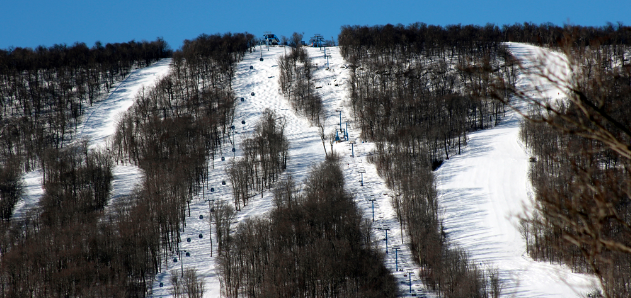
Two hours from New York/New Jersey is Belleayre. That’s doable for a mid-week run where you will find lots of room on the slopes. Credit: Belleayre Mtn.

70s Ski Testing: A New Series

This is the first in a series about Ski Magazine’s 1970s ski testing program called Ski Performance Prediction or SKIpp.  Its methodology combined engineering analysis as well as a structured series of on the snow maneuvers designed to bring out the best and worst of a ski under a variety of conditions.

Part one of the series Determining How Skis Worked is an overview of the engineering analysis.  The second part discusses the on-snow testing that we did and the third is about the politics of ski testing along with a lesson learned.

Ski (and boot and binding testing) programs came about because skiers were faced with a plethora of choices backed by marketing hype that was confusing at best and to some, downright misleading.  Both SKIING and Ski Magazine decided to jump into the fray and help their readers.  Ski’s approach was significantly different than Skiing.  Given several glasses of smoky, single malt scotch, I might be persuaded to cover the quicksand of boot and binding testing in the 70s.

On the Snow Testing is a very brief overview of the on the snow part of the program.  Typically, we were at a mountain for about twenty-five days and tested 200+ skis.  Not bad work if you can get it, but it wasn’t all fun.  It was work!

Ski testing unleashed a set of business issues that challenged the leadership of Ski Magazine.  Most of the discussions were well above my pay grade as a lowly associate editor.  However, on more than one occasion, I was called into a meeting with the high-mucky mucks and asked why manufacturer A’s didn’t get high marks.  In Politics of Ski Testing, there’s enough to give you an idea of what the discussions were like.

In the end, the SKIpp and the engineering teams at most of the manufacturers found common ground, and we helped each other out.  It was the marketing people that created all the problems because the cries from the ski shops were giving them migraines.

The shaped ski as we know it today wasn’t on the horizon.  The material science and engineering software that creates them was in its infancy and ski design was as much black art as it was engineering.  We got a glimpse of the future one year when we tested twenty odd short skis – 170 – 180 centimeters – and were pleasantly surprised by the results.  The market was ready and when engineering and materials science caught up, voilà, you have the shaped ski.

Weird Weather: Rethinking Ski Clothes For A Fickle Climate

Let’s Review The Basics Of Layering To Deal With Changing Weather.

Sun, fog, snow all in one day. How do you dress for that? Credit: Janet Franz

Here in New England, temperatures swing high and low a lot lately, with 50-degree-plus spikes and heavy rains interposing snow squalls and blizzards. This winter seems hell-bent on convincing the last climate change denier that something weird is going on. Accurately assessing atmospheric conditions for a day on the slopes can challenge even the most seasoned skiers.

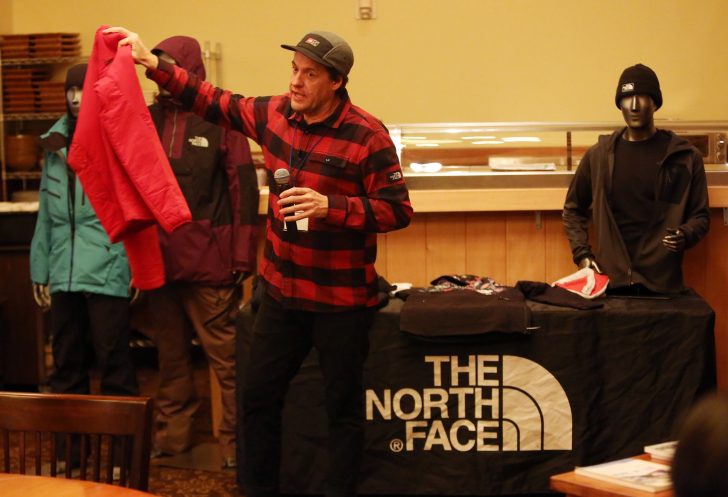
Stan Kosmider, field representative for The North Face, presented on “How to Dress for Cold Temperatures” at the Northeast Weather Summit at Stratton Mountain Resort in December. Credit: Martin Griff

Stan Kosmider, field representative for The North Face, talked with winter sports enthusiasts recently about packing for a multi-day cold weather adventure. “It could be a bluebird day, but the next day it’s pouring rain and icy,” he said. “So pack everything you own and plan on layers. You can remove or add clothes so that you never feel too hot or too cold.”

Three main layers provide for moisture management, heat retention and exterior protection.

Base: The most crucial layer for temperature and moisture control is the first one—your underwear. Skin sweats even when the air is cold, and if the perspiration soaks in to your long johns, the wet clothes will suck the heat out of your body, making you cold.

“The base layer gets moisture off your body and into the atmosphere,” explained Kosmider. This prevents excessive sweating, which can cause additional heat loss, especially when you slow down or stop to rest.

Look for under garments made of lightweight, breathable, wicking fabrics such as a synthetic (usually polyester) fiber, silk or ultra-fine merino wool. Avoid cotton, which absorbs and retains moisture, keeping the skin beneath it clammy and cold. A comfortably snug fit everywhere is essential, because to wick sweat efficiently, your next-to-skin layer must actually touch your skin.

Insulating: The middle layer’s job is to capture and retain body heat that radiates from your body, Kosmider explained. The more efficiently this layer traps heat, the warmer you will feel. Insulated jackets and sweaters come in a range of weights and synthetic and natural insulation choices abound. Down sweaters offer wind resistance but lose insulating efficiency when damp. Synthetic insulations mimic down’s efficiency, with better water resistance. Polyester fleece (not cotton fleece) is a great choice because it stays warm even when damp and dries fast. Fleece fabrics come in a range of plushness and thickness. Microfleece is thin and does a great job of wicking moisture away from the body.

For maximum temperature regulation, insulating clothing should fit close to the body, “snug, not baggy, and you should not have to size down,” Kosmider said. “The fabric should be thick enough to layer and be breathable,” so avoid thick fleece (more than 300 weight) or heavy wool sweaters. Fabrics with insulation-filled bubbles or ripples trap heat well.

Outer: The exterior layer, generally a shell jacket and pants, must do three things: block the wind, keep out rain and snow and allow sweat vapor to escape. Shells range from pricey mountaineering coats to simple wind-resistant jackets, but “even a $600 shell is worthless if you don’t have the right clothes underneath it,” said Kosmider.

Shell insulation types include down (again, warm but not waterproof), synthetic down (such as Primaloft, made from recycled plastic). “Down has the highest weight to warmth ratio, but when it gets wet it’s not warm. So, in this environment, it’s not reliable, and synthetic insulators are a better choice,” Kosmider explained. Shells with zippers and vents allow you to cool off without stripping down.

Shells may be waterproof/breathable for full-on squall conditions with high activity (they wick sweat but keep rain out) or water resistant/breathable for drizzly, breezy conditions and high activity. Avoid waterproof/non-breathable coats unless you plan to stand around in the rain (they keep precipitation out and trap sweat within). Kosmider recommends shells treated with a durable water repellent finish such as Gore-Tex – a rubberized, waterproof, breathable coating that allows water molecules to hold their shape, bead up and rolls off the surface.

Head, Face, Fingers and Toes

It’s not a myth that body heat escapes through the head, hands and feet. If you’re skiing or snowboarding, you should be wearing a helmet, which will keep your head warm. Look for a helmet with vents to let the heat out on warm days. For very cold days, don a skull cap or balaclava made of wicking fabric, because heads sweat, too. Liner socks and liner gloves keep feet and hands dry. Pack extra liners for extra sweaty days. A neck gaiter or face mask keeps the wind off cheeks and nose. Buffs serve the same purpose and work well as a headband to cover up “helmet hair” apres ski.

Product care

Ski clothes can be costly, but well cared for garments will last for many years, and layers will work best if cared for properly. Tiny pores in water-repellent fabrics become clogged with dirt and oils from skin, requiring periodic washing to remove debris and revive their breathability. Gore-Tex makes a special detergent for its products, but any liquid detergent without dyes, scents or fabric softeners will work. Dry garments in the dryer—without fabric softener— to reactivate the waterproof coating.

Down garments should also go into the dryer, without fabric softener. Use low heat, and place tennis balls or toddler’s shoes in the pockets to thrash the garments around so they will fluff up.

You can’t control the weather, but if you bring all your layering choices with you to the slopes, you can easily adapt as conditions change.


 

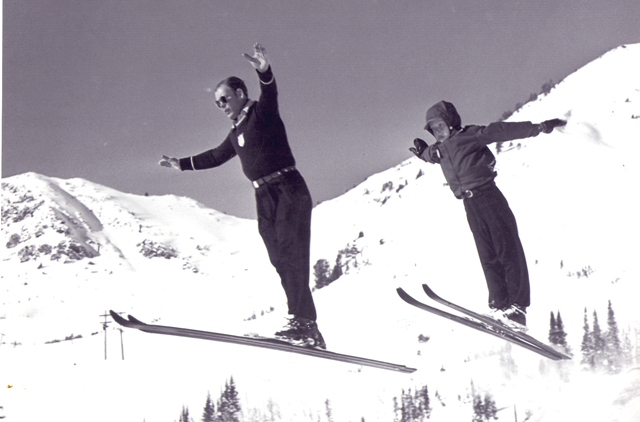
Mystery Glimpse: Who’s Flyin’?

Airborne Family Members.

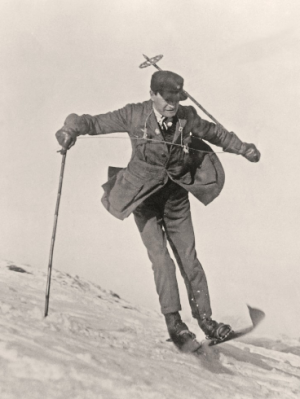
Who is airborne? Can you guess where?  Hint: We can’t tell you the name of the museum that contributed this picture. Know why?

Last Week

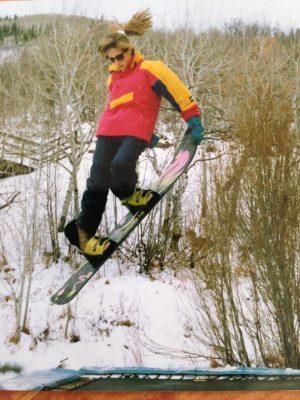
Only one reader got this one.  The enthusiastic boarder is Shannon Dunn-Downing, the first U.S. woman to win an Olympic snowboard medal with a halfpipe bronze in 1998.

Shannon was the first woman to land several difficult halfpipe tricks in competition, including a frontside 540 in 1991, backside 540 in 1994, Mctwist in 1994, frontside 720 in 1995, and frontside rodeo 720 in 2001. She is also noted for working behind the scenes on the development women’s products for companies such as Burton Snowboards and Velvet Goggles.

In the mid-2000s, Shannon retired from professional snowboarding to focus on raising her family. She lives in Southern California and tries to surf whenever she can.

In 2016, the Colorado Snowsports Hall of Fame and Museum produced a tribute video to Shannon, highlighting her early days and Olympic success.  Check it out below.