Pandemic Skiing In Australia

Impossible Or Just Tricky?

Resort skiing in Australia is in the Australian Alps straddling the border between our most populous states, New South Wales and Victoria, with capitals in Sydney and Melbourne.

The season officially opens in early June and closes early October.

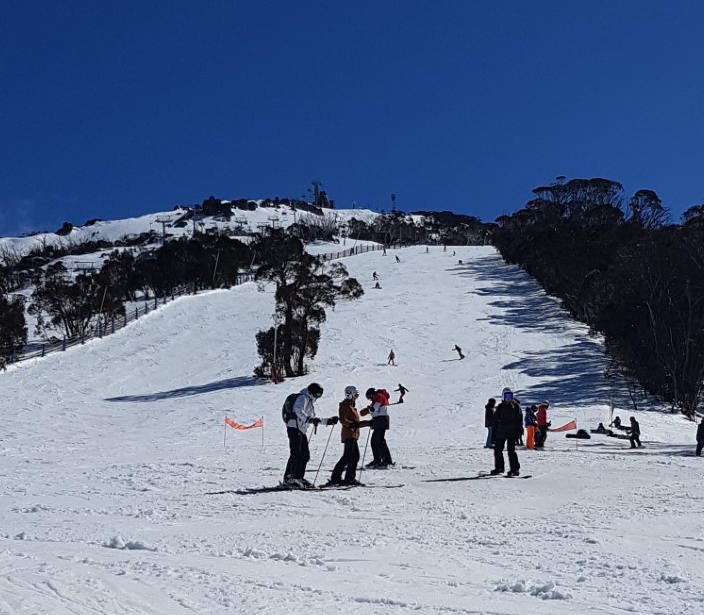
Thredbo Supertrail mid-August. Credit: John Harris

NSW’s biggest resorts—Perisher (acquired by Vail Resorts in 2015) and Thredbo (Mountain Collective and Ikon links)—lie in Kosciuszko National Park in the Snowy Mountains. They cater mainly to Sydney’s five million people a six hour drive away.

Victoria has three resorts. Mt Hotham and Falls Creek were also recently acquired by Vail Resorts. Mt Buller is the other. They cater to 5.6 million folk, most of whom live in Melbourne.

This year’s opening was delayed for several weeks in NSW. The National Park closed for the long opening weekend amid all the concerns and regulations surrounding the pandemic back then. Tricky!

June saw a rush on sales of backcountry equipment amid fears the resorts wouldn’t open at all. Gear was in short supply with importation restrictions. Tricky!
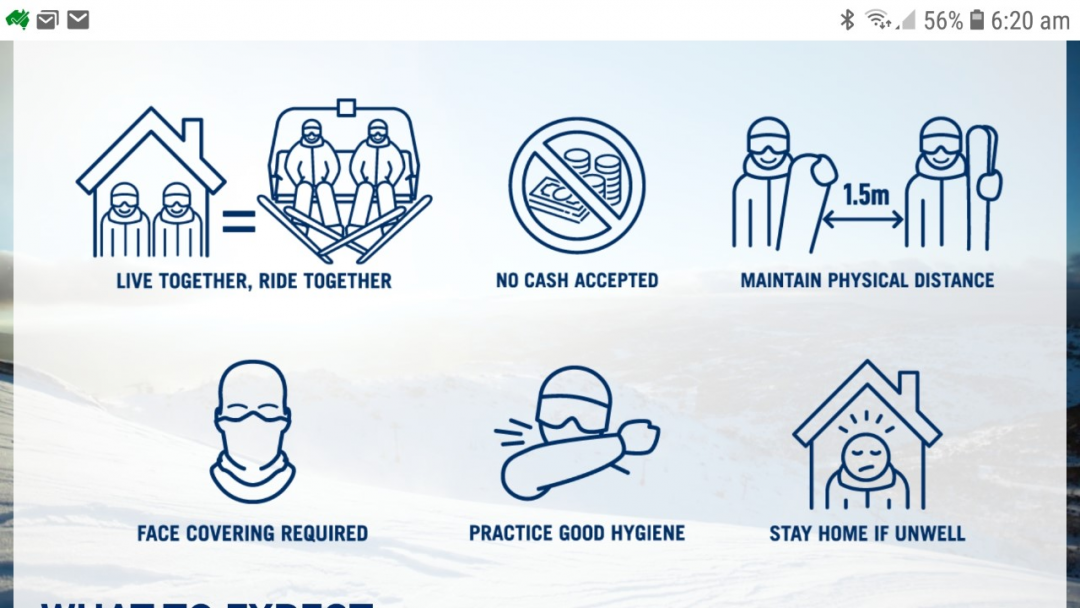
Perisher’s restrictions. Credit: John Harris

In early July, just when seasoned skiers expect skiing conditions to be okay, a second wave of coronavirus hit Melbourne, and Victoria went to lockdown. Victoria’s ski resorts closed and remained  closed for the season. State borders shut then so snow sports became limited to NSW and Canberra and impossible for residents from all other states. Nearly 17 million Australians had no access to the resorts this year. Impossible for them!

Perisher and Thredbo in New South Wales opened later in June.

Perisher offered Epic Australia season passes but for the first few weeks everyone including pass holders had to prebook days online to ski . One staffie I spoke to only managed to find three days available during this time due to the limited tickets. The website crashed often with the traffic. He checked every morning, hoping more tickets would come online. Thredbo was similar. Tricky!

My favourite lunch spot at Perisher only available to hotel guests in 2020. Credit: John Harris

Skiers who had booked resort accommodation had no guarantee of getting lift tickets. Communication with Perisher was only possible online. Emailed inquiries yielded an automatic reply promising a reply within days. Tricky!

There were no group ski lessons and no assistance by staff getting on chairlifts. Some restaurants were restricted to hotel guests. It was suggested that skiers bring food and drink in case venues were full. Tricky!

Despite the restrictions, the skiers came. Sydney had a few covid cases and locals were worried they’d bring it down. A trace of virus was detected in Perisher’s sewage and face masks became mandatory in the resort, inside and out. They still are. Tricky!

Thredbo is linked to Mountain Collective and Ikon groups and is an all year resort. Its restrictions were similar to Perisher. This year the resort did not offer season passes, saying they usually had a large proportion of skiers with season passes, and it wouldn’t have been workable. 70 years plus day passes were just $A25 but available days hard to find. Masks were not worn outside. Tricky!

Thredbo closed a week after this picture was taken. Credit: John Harris

Thredbo’s Supertrail closed a week after I took the photo above due to snow melt. As runs became fewer, Thredbo credited the accounts of people who had pre-purchased tickets with a proportion of the cost. The resort closed prematurely two weeks ago.(Editor Note: mid-September). Commendable!

Perisher plans to stay open till the end of the school holidays on October 9. Its rules are unchanged. I have been very impressed with how professionally both resorts have handled difficult and changing circumstances and how co-operative the public has been. Hopefully, your North American winter will run smoothly with fewer changes needed and good powder.

 I visited Perisher on Sunday to see how things were going. Here’s what I found.

Demand remains high at Perisher with a full car park. Credit: John Harris

Most patrons were wearing face covering and happy laughter was everywhere.

Masks were everywhere in the Perisher lodge. Credit: John Harris

Okay, this senior’s tally wasn’t too impressive in the pandemic, one day at Perisher so far, one at Thredbo. But what a wonderful sport. Age hardly matters. You get pulled up the hill, and gravity takes you down. People of widely different ages can relate to each other and be friends. And so much laughter.

2020 skiing down under was tricky but for many of us not impossible.

La Nina Is Here

She Is Bringing Snow For Some. Find Out Who.

La Nina is has been lurking around the west coast of South America since August. That frosty little senorita brings cooler temperatures to the mid- and eastern Pacific waters which in turn impacts atmospheric circulation, which affects the shape of the Jet Stream across North America.  And that determines precipitation and temperatures across the entire continent, essentially shaping the severity of winter storms.

The Jet Stream is impacted by La Nina. Credit: Climate Prediction Center

The National Weather Service’s Climate Prediction Center foresees that the La Nina will hang around for the entire ski season into Spring 2021.

La Nina raises the potential for more hurricanes, which we are currently experiencing. As of this writing, we’re up to 28 named storms since the start of the hurricane season.

Classic La Nina weather patterns feature a wave-like jet stream flow across North America, which causes colder and stormier than average conditions across the northern tier and warmer and less stormier conditions across the south.  

That’s good snow news for Alaska, western Canada and the northern Rockies, northern California, Wyoming, and the Northwest. It’s probably drier and warmer for New Mexico, Arizona, and Southern California.  Utah and Colorado, and the Northeast as well as parts of the Midwest are in the uncertain zone. 

For an interesting discussion of the different impacts of El Nino and La Nina conditions, click here for seasonal correlations for resorts from Australia to South and North America.

Secret formula at The Farmer’s Almanac has different outcomes. Credit: Farmer’s Almanac

Compare the Climate Predication Center’s forecast with the 2020-21 prediction from the Farmer’s Almanac.  The venerable publication uses its own formula and data for weather prediction, and, as you can see, this year’s future picture is different than what we are hearing from NOAA.

Take your pick.

Sharing a Ski House During a Pandemic

How Does Everyone Stay Safe In Close Quarters?

Has your ski club thought about managing a shared ski house? Credit: Camilla Stahlschmidt

In the Internet era, we keep hearing about the “new sharing economy” with tech companies like AirBnB, Uber, Zipcar all capitalizing on otherwise under-used assets like spare bedrooms and cars. But in the ski community we’ve been ahead of the curve for years with ski clubs maximizing occupancy of ski houses, families sharing use of second homes, and even college buddies teaming up to buy a ski house together. The sharing economy is not a new concept to skiers and snowboarders who were the original couch surfers!

Despite all this experience in sharing places to stay near the mountains, the pandemic adds a new dimension. Ski resorts, hotels and inns are fretting over plans for opening, but what does it mean for all the private sharers? Do we pile in together as usual or stay in smaller “pods” to limit exposure even though that might mean fewer ski days and less social interaction?

Health experts are still learning about the Novel Coronavirus and how it is transmitted but for now it seems safe to say that you don’t want to be inside sharing air with people who may be spreading the virus. It’s much, much safer to be outside and at least six feet apart. The data also shows that older people and people with pre-existing conditions are more likely to suffer a severe case of COVID-19 if they are infected so our 50+ demographic has to be extra careful.

With that in mind it may be worth doing some additional thinking about your accommodation plans before the snow flies. If you are sharing a house with others, are they all already in your “pod” or are you potentially exposing yourself to a new group—and all the people they may have interacted with in recent weeks?

Some houses have separate apartments or cabins which would be ideal for spreading groups out while still allowing for outside social time while skiing, snowboarding, or trying other winter sports, and of course for après.

Ski clubs may want to consider spacing people out, reducing use of communal gathering spaces or even following the school model and splitting members up into smaller cohorts with each cohort going at a different time. Maybe even sorting by age and giving older members the option to visit at child-free times?

One option to help with organization, minimize risk, and avoid confusion in shared spaces is Google Calendar. Another, specifically targeted at ski clubs and private houses is Resercal.com (disclosure: the author of this article created this product). There are many other online booking systems that can help you organize your season depending on what you need. Many are aimed solely at hotel/inn managers or for rentals-only so look carefully for the features that best fit your situation.

Consider leaving a buffer in the schedule between uses for cleaning. That should reduce the chance of virus being transmitted by air or on surfaces.

You might also want to think about making your shared ski house work-from-home compatible. With many people working remotely, it may be possible to spread family, friend, or club member use over more dates than in past seasons. For example a family with kids could visit for a whole week, remote-working, and “distance-learning” from the ski house, instead of just staying on weekends. Spread out over the season, a few longer visits in smaller pods might add up to a similar number of ski days for all involved.

What are your thoughts and plans? How are you or your group preparing for this unusual season?


Question For You 11: How Will You Share a Ski House In COVID Time?

How Will Your Ski Club/Family/Partner Ski House Shares Be Different This Year?

Will you hail, hail the gang’s all here this year?

We wondered how many of our readers are involved in sharing private accommodations near ski areas. And, if you do, are you making special arrangements for 2020-21 due to COVID-19 like scheduling use? 

This question came up because our website designer recently created Resercal.com, an online scheduling service to make it easier to share a ski house or other vacation home. 

If you had a shared house during the summer, what issues came up? What will be the most difficult aspects of sharing a ski house in the upcoming season? And what any changes are you making this season to your sharing plans due to the pandemic?

Make More Tracks: What Has Covid Wrought For Nordic Skiing?

XC Skiing And Snowshoeing Are Perfect Forms Of Recreation For The Pandemic.

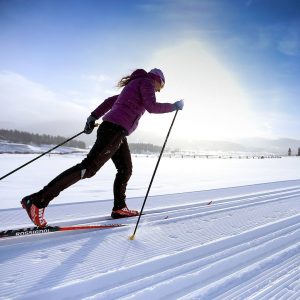
Based on activity with walking and bicycling last spring, many people in the snowsports business are anticipating a surge in XC skiing and snowshoeing this winter. If alpine ski areas are restricted in ways that lead to excessive waiting such as the amount of time waiting to acquire lift access reservations via the Internet, waiting to get on the lift, waiting to get lunch in the lodge, waiting to go to the restroom, etc., we predict there may be a resulting influx of alpine skiers to XC skiing and snowshoeing. And, perhaps we’ll see:

  • People who have tried XC skiing in the past but not continued (lapsed skiers) may be motivated to try it again.
  • People who have never gone XC skiing or snowshoeing may be encouraged to try it for the first time—because of associated wellness benefits.
  • And people who already enjoy XC skiing or snowshoeing will go more often this winter.

We do not know if there will be similar restrictions at XC ski areas, but it is expected that people will go XC skiing and snowshoeing with or without restrictions at commercial XC ski areas, which charge a fee for groomed trail access.

A Forbes Magazine article cited that “the younger generation doesn’t ski and some of them think skiing is ecologically destructive and too bourgeois; under forties people feel that it is all artificial snow that requires paying a fortune for gear, clothes, and lessons.” I’m not sure what statistics the Forbes article is drawing on, but COVID surveys conducted by Spot seen in content posted on SeekingAlpha.com revealed “33% of skiers said there is a reduced likelihood of skiing in the upcoming season; 30% fewer season passes have been sold, 24% said they’ll be skiing less frequently, and less travel is expected due to limited resort amenities and services.”

We’ve become accustomed to all the protocols that will be in place at XC ski areas (distancing, contact-less transactions, masks in crowded areas, etc.). All the ski areas both alpine and XC are taking a wait-and-see attitude, hoping that availability of a COVID therapeutic or vaccination will change everything. The predictions are that many of the mitigation efforts will be necessary with or without vaccinations across the population as it will take months for the vaccination to bring on normalcy. Most ski area operators have already set their operational plans to open despite the pandemic and skiers will hear about them as the season approaches.

Product suppliers and dealers are salivating about hoped-for increases in product sales, but some of them are certainly somewhat apprehensive (considering that about 27 million jobs have been lost) about the level of consumer enthusiasm to purchase new gear this year.

Touring is Nordic is XC. Credit: Dynafit

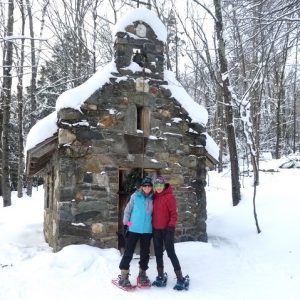
With all of this anticipation, one thing is clear: the reality is that XC skiing and snowshoeing are perfect forms of recreation for the pandemic. Both XC skiing and snowshoeing are exactly what the doctor ordered, that is, healthy benefits such as physical fitness, psychological wellness, and a door to a deep emotional connection with nature. The feeling of passing through the snow covered forest at a slow pace provides a wellness indoctrination that is unavailable from other activities.

It would be beneficial for the people who are newcomers or returning lapsed skiers to get exposed to the advancements in XC skiing such as equipment that makes the sport easier and better. I’ve heard from people who are talking about finding the good in all of the challenges that we have faced since March 2020. More seniors who love the outdoors and winters will be discovering XC skiing and snowshoeing because it will be a great boost and alternative for all those folks. Let’s Make More Tracks!

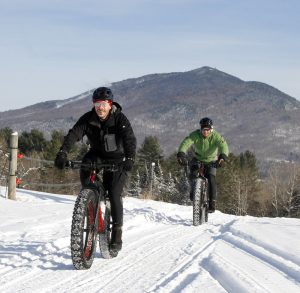
Click Here For SeniorsSkiing.com’s Make More Tracks: A Resource Guide To XC, Snowshoeing, Fatbiking.

Five Life Lessons From Surfing with Dolphins

Nature has many lessons to teach us about living. Especially now, when COVID limits where we go and what we do. 

A few years ago I was surfing at Huntington Beach, California. It was 2016, and I was 73. 

All I hoped for was a few hours of good surfing. The fresh salt air awakened memories of when I first surfed there in 1964. 

Lesson 1: The phenomenon of sounds and smells often brings a flurry of memories.  Nature has a way of stimulating them. 

As I entered the water, a growing swell caught my attention. It was rapidly transforming into a substantial wave. I jumped on my board and paddled fast to dive under the incoming break. 

Lesson 2: Nature is always in a state of change.  Sometimes it’s rapid; sometimes glacial. Most of us resist change.  Though conditioned to expectations and routines, whatever our age, we have the ability to grow. 

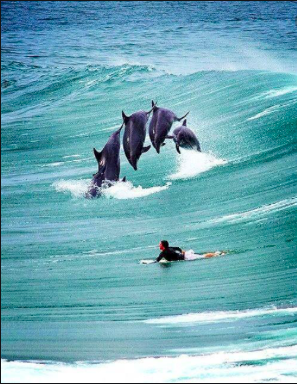
Paddling past the forming swells brought me near a pod of dolphins. They were watching, their heads high out of the water. My senses told me they wanted to play 

Lesson 3:. Trust in our senses and heart-felt feelings opens us to new life experiences.

I paddled faster and dove under the incoming break. One of the dolphins followed, cutting into the building wave. Suddenly, a curl of water arched into a beautiful tube; a portal into timelessness. 

Lesson 4: Time seems to accelerate as we age. Being in nature makes us more  present and aware.  I experience this when surfing,  floating in deep powder or running the rapids. Even simple changes in less exotic daily routines make us more present and can slow things down. 

Pressing forward on the board sped me toward the opening of the tunnel. Behind me the wave collapsed, pushing a spay and blowing me out and up over the backside. 

Farther out two dolphins cut across the face of the incoming wave. One made a swift cut upwards, spinning high, turning and diving back to the sea. Show off, I thought. Dolphins often like to perform and play in waves with surfers. They knew I was impressed. 

Lesson 5: We become much more alive when we are aware of and sensitive to our surroundings and those in them. 

Experience tells me that most of us want more years in our lives. Regardless of who we are or what we can do, being more present and aware provides us with more life in our years