
Is A Hip Replacement In Your Future?
Here Are Some Tips From A Two-Hip Skier.

Here’s Harriet. Two new knees, two new hips. When it comes to joint replacement, she knows what she is talking about. Credit: Courtesy of Alta
Your decision to replace any body part is a serious decision. Unlike a purchase from a retail store, you cannot return an implant!
But when your “original equipment” wears out, it’s time to have it replaced. Overall, we’re living longer, we’re living healthier, and we want to enjoy life—and ski.
As background, I have two artificial hips, two artificial knees, and I skied 78 days during this last winter before resorts closed because of the Covid virus. Artificial hips and knees work really well.
Here are some tips if you’re considering new hips.
Choose your surgeon carefully. Your future depends on it. Pay the cost of visits to several surgeons. Those visits will help you choose the right one for you.
1. Ask hip questions
Here’s the list of questions I asked each surgeon. I printed a sheet for each surgeon and I wrote down their answers so I’d remember what each one said. Unexpectedly, their answers were quite different. Print out these question and bring them with you to each visit.
- Do I need a hip replacement?
- How many hips do you replace a week? A year?
- Do you do the surgery or does someone else do it?
- Do you do anterior or traditional cut? Why?
- GPS guided? Robotic? Manual?
- What kind of anesthesia? Why?
- What brand of implant do you use?
- Metal or ceramic?
- Glue? What kind? Why?
- Bone density. What if my bones aren’t good when you get in there?
- Do you resurface instead of replace? Why?
- How long in hospital?
- Will I need help when discharged?
- What kind of PT do you recommend?
- Can I ski?
- Why should I choose you?
2. Do a visual check
Are the surgeon’s shoes clean and polished? How’s the hair? It’s a quick measure of how well the surgeon values him/herself. Neat and clean is a good sign. Think twice if s/he’s scruffy.
3. Find out if he’s/she’s athletic.
A surgeon who is physically active will understand your need to keep your active lifestyle and ski. If she or he’s a golfer, plays tennis, bikes, water skis or is active in some sport, she or he’ll identify with your need to keep your body in motion.
Personal note, funny story:
I met with a noted—but fat—surgeon, and I asked: “Do you ski?”
He replied, “No, but I own a house at the resort!” And he said I should give up skiing. I eliminated him from my pool of possible surgeons.
Get your X-rays on a disc
Be prepared. Take the disc of X-rays with you each time you visit a surgeon so they don’t have to take new X-rays. Surgeons might be in different networks and therefore not have access to your X-rays. Or, even if they’re in the same network, the computer system might be down that day.
Before surgery, plan ahead for PT
Visit some physical therapy studios, ask about their rehab for hip replacement, and decide where you want to work out. Do that homework before surgery.
Personal note: When I came home, I did the prescribed home exercises exactly as I should. But the exercises got easy and I stopped making progress. I was glad I’d checked out PT studios and switched to one with electronic equipment, gym-type equipment and a heartier workout. Recovery came quickly.
After surgery
Expect to start moving right away. Expect to be walking the day after surgery, and expect to have in-hospital physical therapy.
Personal note: I was in the hospital for a couple days and I progressed quickly. The PT studio stairs became too easy, so the PT therapist took me to the hospital stairwell for greater challenge and practice. On a nice day, we went outside and walked around the entire building.
Shoes and boots
Your new metal hip might like more cushy shoes or a different pitch than you’re used to. Buy your shoes and boots at a store such as REI that lets you wear them, see if you like them, and bring them back if they’re not right.
Personal note: With two metal hips and two metal knees, my body is fussy about what’s on my feet. I now buy all my footwear at REI so I can test drive them for a while in real life, not just in the store.
Look forward to a new hip. Work hard at PT. And I’ll look for you on the slopes.
To read Harriet’s five-part series on knee replacement, click these links.
- https://seniorsskiing.com/life-knee-replacement-part1/
- https://seniorsskiing.com/knee-replacement-isnt-sissies-part-2/
- https://seniorsskiing.com/knee-replacement-interviewing-docs-part-3/
- https://seniorsskiing.com/knee-replacement-chose-surgeon-part-4/
- https://seniorsskiing.com/knee-replacement-now-part-5/


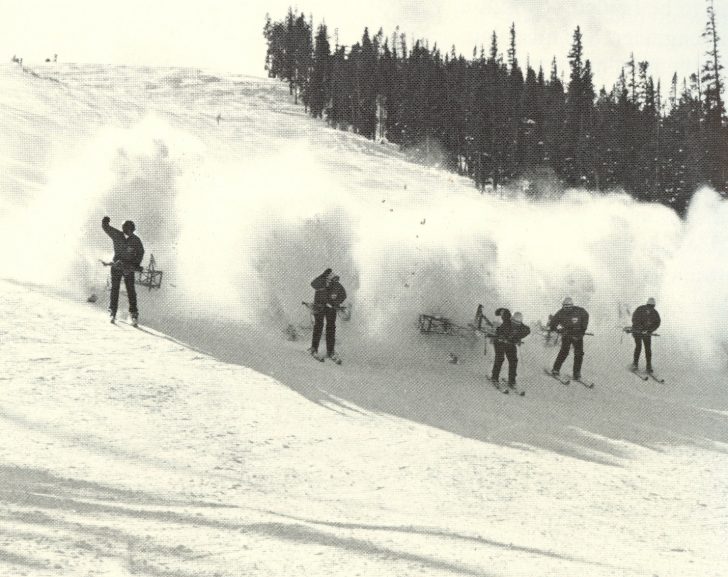


 Indeed, this is Alf and Alan Engen doing some father and son ski jumping at Alta circa 1952. Alf was an early ski jumper who mastered Alpine skiing and helped start the ski school at Alta. He and his two brothers helped popularize skiing in the West, especially Utah and Idaho. Alf’s son, Alan, carries on the family tradition today at Alta.


 feet, hands and head comfy when out in the elements. Their socks, gloves, and hats are made from bison down, the fluff on the undersides of the 2000 lb animals. The company purchases 75% of the available supply, mixes it with silk, wool, yak, and cashmere and produces unique products that last long and make a good impression when given to the ones you love. In explaining it’s premium pricing, the company’s website states, “Nothing is more expensive than gear that doesn’t work.” SeniorsSkiing.com subscribers get a 10% break by entering “SeniorsSkiing” in the discount code window during the check-out process. I wore Buffalo Wool Company socks last winter when resting between ski trips at our place in the high desert near Capitol Reef National Park in Utah. What a luxury! The company has a “no questions asked” return policy in the unlikely event you or the person receiving the gift chooses to send it back. The American Field Bison Boot Sock ($54.00 less 10%) and the Pro-Gear Technical Boot Bison/Silk Sock ($45.00, less 10%) are particularly good options.
 Wild West Jerky