


Fast Freddie
Blind Skier Inspired All Who Knew Him.
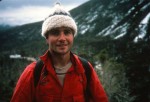
Fast Fred Siget on the left with Pat McCloskey, center, and friend at a long ago National Blind Skiing Championships.
The first time I skied with Fred Siget was in Snowshoe, WV, with Larry Walsh of the Pittsburgh Post Gazette. This was my maiden voyage guiding a visually impaired skier. I had Fred, the first blind skier in our area, in front of me. Right turn, left turn, right turn, stay, stay. All of a sudden the only tree around popped up right in front of us as I yelled “Crash,” and Fred sat down as he ran into it. I felt so bad, but Fred dusted himself off with a smile and said, “Pat, don’t worry about it at all. This will be one of many.” And we continued down the slope. This began a 40-year friendship with the one and only Fast Freddie Siget.
Fred lost his vision as a result of an accident with a high pressure hose when he was a volunteer fireman. As devastating as this injury was, he was undaunted. He became the first visually impaired computer programmer for Koppers Corporation. He continued dancing, and he learned to ski with guys like Larry Walsh, Jim Conley, Lynne (Kravetz) Hartnett, Shorty Leco and Micky Hutchko.
Fred always had ideas on how to make things easier for blind skiers and how to improve guiding techniques. He had a transmitter rig where the guide used a microphone and Freddie had an ear piece which made calling out commands easier and more understandable.
Once I used the transmitter while standing on top of a slope, calling commands to Fred as he skied by himself down to the chairlift. With his “Blind Skier” jacket on, people were shocked viewing his run. In the bar afterwards, we had some fun with Herman Dupre the owner of Seven Springs Mountain Resort. I put the microphone on and guided Fred over in front of Herman and told him to tell Herman how much he admired his red flannel shirt. Herman was stunned and later remarked to me laughing that he was starting to “get hot thinking about all the free passes I gave to Fred and now he is telling me how much he likes my shirt!” Hilarious.
Fred was always anxious to help new guides. He put himself at risk during the training but always felt that it was worth it not only to train guides that could assist him, but to help the other visually impaired skiers who were beginning to show up at BOLD (Blind Outdoor Leisure Development) outings at Seven Springs.
Perhaps the most compelling thing about Fred was his kindness and appreciation for his fellow skiers and guides. He always remembered your birthday and when he called me, he sang, “Happy Birthday to you, Happy Birthday to you, get plastered, you bastard, Happy Birthday to you.”
He was popular for his skiing for sure, but as a person, you could not get a better guy who was always interested in others and never talked much about himself.
We lost Fred this fall at 94 years of age. He had an amazing life, and we will miss him. Fred never let his accident slow him down. He always said that he did more as a visually impaired individual than he ever did before losing his sight. He took a perceived bad thing and turned it into opportunity. Shouldn’t we all learn from that lesson?

