


Tag Archive for: Dave Irons

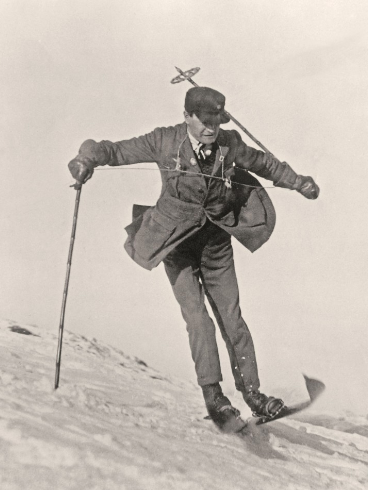
My One Morning Career As A Ski Instructor

A Ski Patrolman Rises To The Challenge.

Dave had to teach a group of local women, and he never even had a lesson himself.

Before I ever had a ski lesson, I had become a ski patrol director, certified (the highest level) by both the National Ski Patrol and the Professional Ski Patrol Association. One morning while working at a small ski area (240 feet of vertical), I was called into the base lodge by the woman who scheduled the ski school programs. This tiny area actually within the city limits ran a number of programs mid week, mostly for housewives, and this morning they had a couple of no shows among their instructor corps.

After numerous phone calls to no avail, it was decided that I would have to teach one of the classes. I asked what level they were as skiers and was told level B, or it might have been C. Neither told me anything. I didn’t know an A from an E. I later learned that A were true beginners, never-evers. Fortunately, these ladies could ski enough to get down the hill. On this second week of their once-a-week program, they got the pro patrolman.

In front of the lodge the ski school director introduced me to the four ladies before he headed off to also teach a class. Having no idea what to say, I simply stated, “I hope you ladies have a good sense of humor. We’re all going to learn together today. Not only have I never taught a lesson, I have never even had one!” One of the ladies laughed while the other three gave me strange looks.

I took them up the lift and watched as they skied down to the top of a broad low intermediate slope. I explained that I needed to see what they had worked on the previous week so I skied part way down and asked them to demonstrate as best they could the turns they had worked on last week.

As each one stopped by me, I complimented them on what they had just done. As they were just breaking into parallel, I decided we would work on a combination of up unweighting and pole plant. I demonstrated the way I thought a real ski instructor might, planting the pole and rising up to ski around it. It seemed to make sense to them so we worked our way back to the lift.   We spent the rest of the time skiing around the area, and I made it a point to ride the lift with each one so we could talk about their progress. I also took them on a longer flatter run which circumscribed the area so they could let the skis run and feel how much easier it was to turn with a little speed. Mostly I listened and passed out tips and compliments.

When the lesson ended, I thanked the ladies for their patience and told them I hoped they had as much fun as I had. Later I talked with Shirley who had recruited me for the lesson, and she told me that two of the ladies asked if they could have me the next week. Unfortunately, that was the end of my career as a ski instructor. The following week, they got Bruce Fenn, one of the PSIA gurus who had been in on the beginning of that organization, and knew everything there was to know about teaching skiing. Thanks to Bruce, and his clinics, that small ski area had close to a 100 percent pass rate on PSIA certification exams. And skiing with him and the instructors at those final form clinics were the closest I came to ski instruction at that time.
Incidents & Accidents: 7

Safety Is Up To All Of Us.

[Editor Note: Dave Irons contributed this article on skiing safety which first appeared in the Lewiston Sun Journal. Dave is a veteran ski journalist and ski patroller.  SeniorsSkiing.com is collecting stories from readers about incidents and accidents that they have experienced. We intend to review these for patterns and themes and use that data to influence the safety policies of resorts and other stakeholders. ]

Each ski season the issue of safety comes up. Some years it’s a fatality at one of our ski areas. It might be a famous person, like Sonny Bono who died while tree skiing at Heavenly Valley on the California/Nevada line.  One year it was a couple of teenagers who left the trail at Sunday River and had to be rescued at night.  Whatever the trigger we all need to be reminded at times of the need for safety while skiing.  I remember years ago when I walked into Tom Reynolds classroom at UMF.  On the board was the saying, “If it is to be, it’s up to me”.
That pretty much describes safety on the ski slopes.  How often have we heard someone say about a particular situation, “There oughta be a law!”?   You might be surprised to know that there are some laws when it comes to skier safety.  Mostly we are not restricted in our skiing, but there are certain activities that are limited, most not by law but by ski area policy. One example is skiing too fast in an area posted, “SLOW SKIING”.  Skiing fast in an area set aside for beginners or approaching lifts can bring about a warning from the ski patrol. It will usually be nothing but a warning. Some ski patrols will mark the lift ticket either with a marker or by punching a hole in the ticket.  Stopped by a second patroller who spots the mark will result in loss of ticket.

But that’s not law.  When are skiers likely to be subject to law?  Unlike on the highway, there are no radar guns on the ski slopes, but if there is a collision and injury, the law can be involved.  The Colorado Skier Safety Law states clearly, “The person higher on the hill has the responsibility to avoid people below and if something happens that skier or boarder is at fault”.  Notice that there is no mention of the ski area being responsible.  As a ski patrolman, I used to sum it up this way, “If you are good enough to overtake another skier, you should be good enough to avoid them.”

We often hear, “He cut me off” from skiers who hit someone while passing them.  I would make the point that the skier downhill from us cannot be expected to look up the hill before making a turn, especially if that downhill skier is a lower level skier.  The better skier has to be aware that he is sharing the slopes with skiers of all ability levels. And we should all know the Colorado law.  It may not be the law in Maine, but we can be sure it will cited by an attorney representing a skier who has been hit from above.    

This should be all we need to know about avoiding collisions on the hill. Add the common sense parts of the Skiers’ Code Of Responsibility such as slowing down and looking up hill when entering a trail intersection, looking uphill before entering a trail and always stopping on the edge of the trail.

The next area is skiing closed trails and out of bounds. I can tell from years of experience that no ski patroller wants to close a trail.  If it’s closed it’s because the ski patrol judged it to be unsafe.  Also, no ski patroller wants to have to explain to management why they closed a trail if it was skiable.  I would also point out that if any of those skiers who patrolled for me felt uncomfortable on a run, you probably don’t want to ski it, and the average skier certainly doesn’t belong on it. Trails are closed for our safety. Stick to the runs that are open. And to those that are within your ability. 

Out of bounds is another issue.  This is not to be confused with skiing in glades within the area, but this skiing also calls for special precautions.  Sonny Bono lost his life within bounds, but he was skiing alone in the trees. We don’t know if he died instantly or if he might have lived had rescuers reached him quickly. His body was found the next morning. Never ski in the trees alone. It should be a group of three or more, one to stay with the injured skier while another goes for help.  Cellphones help, but if you don’t know where you are on the mountain it can still be a long time before rescue. 

Leaving the ski area boundaries is taking an extreme risk, not only to the skier, but to those who will be involved in the rescue.  If you survive a problem even if it’s no more than getting lost and having to be led out, this can involve the law. In these cases it’s not uncommon for a number of services to be involved such as warden services and police. For this you could receive a bill, and it could be quite large. Just figure the hourly pay for dozens of searchers for a full night, along with the equipment. Do you know what it costs an hour to keep a helicopter in the air? The next time you consider skiing out of bounds remember this sign at the top of Killington, “The mountains will be just as cold and lonely tonight as they were 200 years ago”. 

Mystery Glimpse: Racer R.

This Is A Challenge. Hints Below.

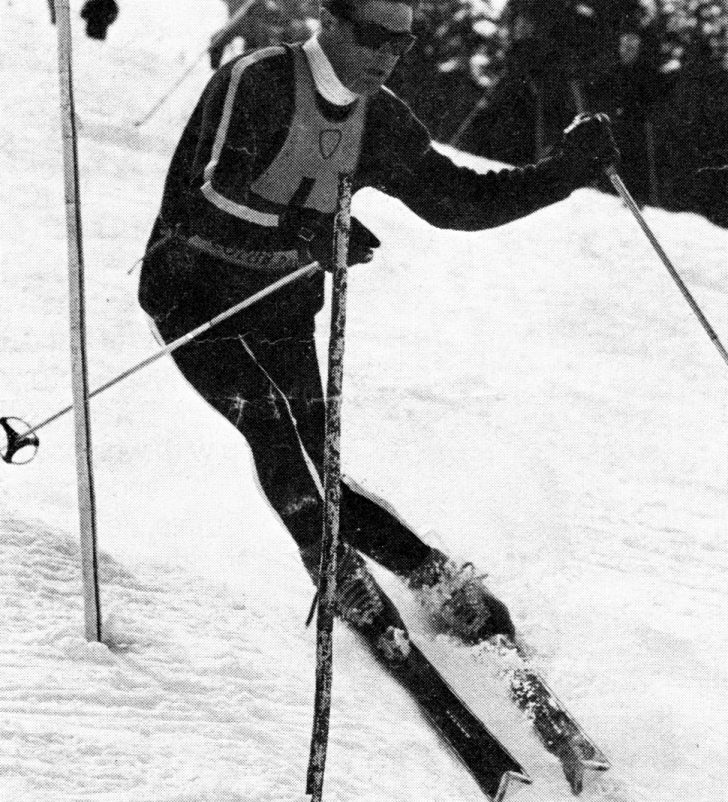
He was on Bob Beattie’s 1964 US Ski Team. He later worked for Head Ski and Lange Boots. Do you know who he is? Put your guess in the comment box below.

Last Week

Thanks to ski correspondent Dave Irons for supplying last week’s picture and this description:

“John and Joe Luc Roy Jr. got it right away.  Pleasant Mountain in Bridgton (now Shawnee Peak) is Maine’s oldest continuously operated ski area starting with rope tows in 1938.  In 1951 they built Maine’s first T-bar which is in the picture. The T-bar is long gone, but you can still ski the lift line, a narrow run lined by trees. The base lodge has expanded and is more than triple the original size. The lake in the picture is the real give away. Moose Pond is 13 miles long and provides the area with unlimited water for snowmaking, something many areas envy. 

Sorry Marilyn, although my association with Sunday River is well known, we skied Pleasant Mountain in the fifties before Sunday River opened in 1959. We switched to Sunday River because as we were living in South Paris it was an easier drive, and Pleasant Mountain had become known for lift lines.  That’s no longer the case, with two top to bottom triples, a quad and another triple for beginners.  For more on the area, my book, Shawnee Peak at Pleasant Mountain is available on Amazon, and at Shawnee Peak. How’s that for a shameless plug?  I’ll try to answer any questions about the area.”