


Tag Archive for: Karen Lorentz

The Big K’s Ambassador Program

Ambassadors Help Create A Congenial Climate At Killington.

Here are the 2019-20 Killington Ambassadors saying hello. Volunteers commit to 21 days of service during the season. Credit: Killington Mountain Resort

As a huge ski area with several base areas and mountain peaks, finding one’s way around Killington can be a challenge. That’s where the green-jacketed Ambassadors come in, often saving the day by showing guests how to get where they want to go—or in some cases—avoid a too difficult or too flat a trail.

This year the COVID-19 pandemic has made the Ambassadors duties extra special as so much has changed—from getting a lift ticket to the necessity of wearing masks.

Ambassadors are dedicated volunteers who enjoy skiing or snowboarding so much that they commit to 21 days wearing the green to help guests have fun. Ambassador Program Manager Pete Duffy notes, “They are passionate about the mountain, the sport, and they want to help people.”

Hard to miss the Ambassadors in the green jackets. Credit: Karen Lorentz

To do that, Ambassadors attend morning briefings before the lifts open so they are up to date on conditions, lifts operating, and anything else pertinent to that day. They answer questions as they greet people mornings at the base areas and later help them find their way back to starting points at the end of the day.

Throughout the day, they ski around assigned mountain areas and answer questions just as their bright green jackets invite.

They also help reunite parties that get separated. Seeing a small boy reunited with his parents was “priceless,” Roger Halye said of a best memory.

Another joy Ambassadors cite is assisting with marriage proposals—whether it’s writing a “will you marry me” on the snow under a lift or taking a photo of a proposal at the peak.

They also assist other departments as needed. The sweet perk is skiing until it’s time to help the ski patrol with the end-of-the-day sweep or man various end-of-day stations. Duffy notes, they do all these tasks in all kinds of weather, including extreme cold, wind, snow, and rain.

In a normal season, Ambassadors also give free Meet the Mountains Tours, offer tips on events, take photos of people, greet bus groups, and staff the hotel and events, all of which went by the boards due to state COVID-19 related guidelines this year.

They ARE smiling. Green jacket Ambassadors Mike Cahill, Pete Duffy, Susan Cummins, Keith Murphy guard new ticket booth. Credit: Karen Lorentz

Recently I had the great fun of being shown around by Ambassadors Susan Cummins and Mike “Mickey” Cahill. Cummins prides herself on being “a friendly face willing to help and guide.” Like others, she also praises the social aspects of being an Ambassador, noting, “Through the program, I have generated some wonderful friendships; some so close they have come to my family events like weddings and holidays.”

Retired State Trooper Mike Cahill briefly dips his mask at the new automated ticket kiosk. Credit: Karen Lorentz

Noting he loves skiing Killington and helping people enjoy the mountain. Cahill said becoming an Ambassador helped him fill a void in his life after he retired from being a New York state trooper at the mandatory age of 60. “I enjoy the camaraderie within the group of outstanding people who share the same goals,” he added.

Bobby G has given tours for 20-plus years and counts many special moments, including people who return year after year for another tour, which leads to great friendships. One friendship has taken him to England several times. Another repeat guest is a clinical psychologist, causing Giordano to “sometimes wonder if it’s just the friendship or if I’m a ‘research subject’ that needs to be carefully watched.”

When fierce winds were buffeting a petite beginner who kept falling, Noreen McGill used her own body to shield her from the gusts, and together they managed to slip and side step to the shelter of trees. There McGill applauded the woman’s tenacity and thanked her for “sharing her struggle and strength” with her.

Riding a lift, Ambassador Louise Young met a guest from Toms River, NJ.  “I mentioned Toms River made the news years ago (1998) by winning the Little League World Series. Turns out he was one of the coaches!!”

Joe Schorle had a guest ask him “what he could do about boots causing his feet to hurt. I started to recommend a shop for adjustment but then looked down and realized his boots were on the wrong feet!”

Marc Pileggi recalled a “most unusual thing that happened was having to call a transport for a group of 12 who decided to go to the top of Ramshead at 3:45 with no ability to ski down.”

Questions People Ask

“How do you get to the main lodge? They usually mean the lodge where they started from,” notes Louise Young.

“What’s the easiest black diamond trail?”

When he’s stationed at the top of Killington Peak on a cloud-free day, people ask Robert Ide to identify the other visible ski areas.  The mountain they wish to have identified most is Mt. Washington, he said.

Questions Anthony Russo hears include: “Can you take our photo (asked prior to COVID)?” “Where’s the restrooms?” “What time does the lift close (usually asked at 4 p.m.)?  Where are the beginner slopes? Where is a good place to eat? Can you recommend other things to do besides skiing? Is there an easier way down from here?”

In late March and April, Phil Lipari is often asked, “Why does the mountain close at 4:00 when there is still a lot of day light? In January and February, why there is no night skiing?”

“What do you do with all the man-made snow in the summer?” Noreen McGill overheard a woman ask an Ambassador. “We store it in all the silos on the farms,” elicited an “Oh” as she contentedly walked away.

Pete Duffy said he was greeting people when a woman holding a glass bowl asked where she could leave her pet turtle while she skied. Since pets were not allowed inside a lodge, he never did find out what she did with it.

 

Okemo Mountain Resort: A Mom And Pop Success Story

The Muellers Saw The Potential And Took The Risk.

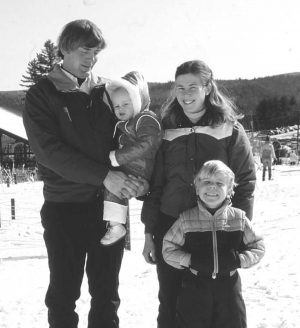
The young Mueller family in their first season at Okemo. Credit: Okemo Resort

When Tim and Diane Mueller purchased Okemo Mountain  in August 1982, it was a ski area with six Pomalifts and three double chairlifts. Under their mom-and-pop hands-on leadership, it became a year-round destination resort with summer activities and programs as well as a vastly expanded two-mile wide ski area with 667 acres of terrain, 46 miles of trails, 98 percent snowmaking, 121 trails and glades, a 2,200 foot vertical, and 20 lifts.

Attorney George Nostrand characterized the purchase as  “a struggle and a monumental risk. They had limited funding and if it failed, they would have lost everything they owned. I told Tim that I wouldn’t have had the stomach to take this kind of risk. He said to me, ‘Well, George, that’s the difference between an entrepreneur and a lawyer.’”

Referring to a Sno-Engineering 1981-82 Master Plan which concluded Okemo could become “a major destination resort,” with $8 million in improvements, mountain expansion and additional condominium complexes, Tim cited “the potential” as worth taking that risk.

“We assumed we would be successful because that is part of being an entrepreneur, but never in our wildest dreams did we foresee Okemo becoming what it did. Tim thought going from 90,000 skier visits to 200,000 annually would be doable, and that was our idea of being successful. We never thought we would reach 600,000 or operate three resorts — that was not a goal then,” Diane said.

Hospitality and Service Orientation

The Classic Red Poma Lift in 1956 which the Muellers replaced. Credit: Okemo Resort

With their background operating and expanding a beach resort on St. Thomas — and a Vermont home construction business prior to that — they had “a lot of energy and experience. There were good employees here with experience so it wasn’t as if we were wildly entering some field blindly,” Tim noted.

Still their first season was a struggle. With no time to research a chairlift, they focused on sprucing up with paint, new signs (saving money because Diane did them), and fixing the lifts as fast as possible when they broke down.

With natural snow not falling until mid January, the Muellers relied on snowmaking and had six trails by Christmas with two from the top, contributing to loyal skier appreciation and a “we can do it” attitude among staff.

They also focused on service. Diane cited their beach resort experience as giving them “a jump on the ski industry” in terms of offering quality service. The emphasis on Okemo and its employees providing top notch service was part of Okemo’s core values that enabled the ski area to grow to such a success, she added.

Their hands-on management style was impressive as they worked alongside their staff and management team . They listened to staff suggestions and were able to delegate responsibilities, which eventually allowed them to add Mount Sunapee (NH) in 1998 and Crested Butte (CO) in 2004.

Expansion and Success

Sunburst Six as it approaches the summit. Credit: Okemo Resort

With employee input as to where the replacement chair for the main Pomalift should go, the Northstar Triple was installed in 1983 (later a quad and then a sixpack). The development of the Clock Tower reception area and base village followed in 1984, creating excitement and a growing confidence in the mountain and the Muellers.

Hands-on resort operators Tim and Diane Mueller shown at the 2005 start of the Spring House at Jackson Gore. Credit: Karen Lorentz

The continuing addition of chairlifts, snowmaking, and new trails was impressive. The expansion to Solitude Peak in 1987 provided the Muellers’ first new lift-and-trail complex on 225 acres and was enhanced by a lodge and trailside units.

The development of convenient trailside condominium complexes — on private land the founders had purchased and on land the Muellers acquired — enabled profits to be invested into mountain improvements, including lodges, halfpipe and terrain parks, another new trail-and-lift complex at South Face (1994), a novice area at lower Solitude (1995), and the Jackson Gore complex (2004-06).

The offering of children’s daycare and ski instruction programs combined with an early welcoming of snowboarding in 1987 enhanced the area’s appeal as family friendly and an avant garde ski and snowboard school further propelled its growing popularity. By 2009, Okemo ranked in the top two in Vermont and the East and top 13 in the nation by skier visits!

When Vail Resorts acquired Okemo Mountain Resort September 27, 2018 it may have been the end of the Mueller era at Okemo, but thanks to their success, it was also the beginning of an Epic era that pays homage to their legacy of creating a great family-oriented resort.


Women Played Integral Role at One of Nation’s Oldest Ski Areas

[Please consider supporting SeniorsSkiing.com with a donation. We appreciate your help. Click here.]

Janet Davis Mead, June Aker, Verlene Belden All Kept Pico Going And Growing, Despite Obstacles and Challenges.

Janet and Brad Mead started Pico in 1937.

Vermont’s Pico Mountain survived a war, two owners’ deaths, and a neighbor called Killington to become one of the 30 oldest continually operating ski areas in the country.

It’s a feat that was largely driven by women in its first 30 years, a time when the ski industry was known to be “a man’s world.”

Women also played major roles in Pico operations since that time, continuing the strong family influence that began with co-founder Janet Davis Mead.

A feisty woman given to exaggeration, Janet Davis told Brad Mead she had skied at the Lake Placid Club, so he invited her to go skiing.

“I had to follow him down what looked to me then like Mount Everest. I made it, but without poles,” she would write years later, explaining she had thrown them in the bushes, not knowing what they were for.

Her bravado paid off; they married and researched building a ski area.

Envisioning a year-round resort with mountainside homes, aerial tram, swimming pools, ice rinks, and tennis courts, the Meads leased Pico Mountain and opened Thanksgiving Day 1937 on Little Pico with a 1,200-foot rope tow and a rough-cut, 2.5-mile Sunset Schuss skiers could ‘skin up’ to the summit.

The Meads hired Swiss racer Karl Acker to run the ski school, added two tows, widened Sunset Schuss — renowned for downhill racing and the Pico Derby — and installed the first U.S. Constam T-Bar to the top of Little Pico.

After Brad died in a boating accident in 1942, Janet carried on with support from skiers, the Otter Ski Club, and Otter Patrol. When workers including Acker left for World War II, she kept Pico open despite hardships of rationing and shortages that caused many areas to close. Using her marketing skills, charisma, and tenacity, she gave special rates to schoolchildren and servicemen who visited on furlough weekends.

Karl and June Acker took over from Janet and continued to expand the resort.

Having survived wartime, Janet bought the mountain (1947) as Acker returned to teach and help operate Pico. (He coached daughter Andrea Mead, first American to win two Golds in the 1952 Olympics, bringing acclaim to Pico’s strong racing tradition.) As the first woman to own and run a U.S. ski area still operating, Janet survived four lean snow years, weak finances, and growing competition by lowering ticket rates and offering summer rides on chairs hung on the T- Bar (1950). With the ski boom on and her children not interested in running Pico, she sold to Karl and June Acker in 1954.

Karl added trails, a T-Bar, and a J-Bar. “The lack of access to funding caused him to do too much of the work himself; the long hours and the stress of the new J-Bar which he couldn’t get to work quite right contributed to his fatal heart attack” in May 1958, June told me in 2007.

“The three banks that had lent us money to purchase Pico had insisted on a life insurance policy on Karl. Because I was a woman they needed to know I could repay the loan if he died,” June said of becoming Pico’s owner at age 30.

She added trails, replaced a lift, and obtained financing for Pico’s first chairlift, a Stadeli double that went halfway to the top ($110,000 in 1962).

“Pico needed lift service to the summit to compete and survive.  Being a woman contributed to the banks’ reluctance to provide more loans,” June said, of her decision to sell to Bruce and Verlene Belden (1964) in hopes they would carry on a family-oriented mountain.

Bruce had helped build Mount Snow (1955-1964), while Verlene ran their 30-guest ski lodge and raised four children. With former guests investing, they became majority owners with Verlene as office manager. Her business acumen coupled with their strong family orientation and expansion of the mountain enabled Pico to survive the trying 1970s when all but five major Vermont ski areas changed owners, and most surface lift areas closed. Vermont had 81 areas in 1966 but just 39 by 1988.

When they retired in 1987, Pico had a reputation as the “friendly mountain” with strong racing and instruction programs and new base village engendering a loyal following.

Women played significant roles in achieving that reputation. “They taught youngsters to ski and race and were instrumental in the Pico Ski Club. They also ran various departments from ski shop to ski school, tickets to childcare. They contributed to the skier loyalty that saw kids who grew up at Pico return as instructors or coaches and bring their own families to the mountain,” noted former GM Frank Heald.

Current Pico Director of Operations Rich McCoy added, “Pico staff make people feel at home and welcome. That’s a legacy that women through their leadership roles have contributed to throughout Pico’s long history and still do today.”

Sunset Schuss: Had to skin up in the old days.

Haystack MT Hermitage ski area

Private Ski Area: A Warm Visit to the Hermitage Club on a Frigid Day

What’s It Like To Visit A Members-Only Resort? Find Out How You Can Do It.

Well-tended trails, bubble chair and low traffic trails are benefits of Hermitage, a private ski resort in VT.
Credit: Hermitage

On March 12 — zero degrees, wind whipping — my ski companion who had never ridden a bubble covered, heated-seats six-pack commented, “This lift is a spoiler.” Anita doesn’t do well in the cold, but thanks to the Barnstormer these two seniors skied for two hours before heading in for Mimosas and lunch in the Hermitage Clubhouse at Haystack Mountain, VT.

No, we didn’t pay the $85,000 joining fee and $8,500 annual dues to ski what she called “best conditions I’ve skied this winter.”

We were guests of Hermitage. Anyone can enjoy this delightful private ski area as a guest of a member of the Hermitage Club. You also have access by booking a room at one of the Hermitage properties in the Deerfield Valley area — White House Inn, Wilmington; Inn at Sawmill Farm or Hermitage Inn, in West Dover; Snow Goose Inn, Dover; Brook Bound Inn or Vermont House in Wilmington.

There’s a limit of one ski-guest package a year so think about snow conditions and check out these lodgings.  Consider a two-four day ski-and-stay for a unique experience — un-crowded slopes, no lift lines, and VIP treatment. (You can also be a guest by considering membership.)

Delightful Day, Warm Experience

Base lodge at Hermitage features great food, comfortable and space.
Credit: Peter Hines

As we arrived, I was directed to guest parking from whence a shuttle van ferried us up to the Clubhouse. We booted up in a carpeted guest area with cubbies for our boot bags, picked up our skis from the rack, and boarded the Barnstormer.

This Doppelmayr express lift accesses the summit in six protected-from-the-wind minutes. By the way, even though a sticker says, “open the bubble before the station”, you don’t have to lift a finger — bubble and footrest go up automatically at the unload platform! Talk about senior heaven!

We found packed powder on Upper and Flying Dutchman and side trails, Ventura Highway (a green roller coaster), and my blue favorite of the day Last Chance.

While the Witches Triple, which accesses some wide steeps, was running, I didn’t revisit my favorite trails there because we needed the warm Barnstormer lift — our experiment of not pulling down the bubble didn’t last too long — viva la difference!

Hermitage Club inhabits the Haystack Mt. as seen across the Deerfield Valley, VT.
Credit: Hermitage

We sampled a fabulous brunch spread of lunch and breakfast items — waffles, omelets, raw bar, salads, meats, potatoes, etcetera. We topped fresh berries with real whipped cream for a great dessert — yum.

After another run we skied the Tunnels Trail to the learning area below the lodge. What fun to see little kids safely learning on wide trails away from the schussboomers!

“The vast majority of our members are families with children; they love skiing, and they love skiing together. They are comfortable that their kids are safe on the mountain and appreciate the sense of community and a feeling of going to a second home,” explained Brendan McGrail, director of communications for The Hermitage Club.

With 46 trails, 194 skiable acres, 5 chairlifts, handle tow, separate beginner-area, 1,400-foot vertical, magnificent Clubhouse, valet service and more, it’s easy to see why families love this special area, and, if you have the swag, it’s worth checking out! Learn more at hermitageclub.com and bring the grandkids!

Club house, aka Base Lodge, at night. Note corduroy.
Credit: Hermitage

Book Review: Chris Diamond’s Journey In The Ski Resort Business

SKI, INC.—Chasing The Dream All Career Long.

For anyone who came up through skiing in the 1960s and 1970s, a new book chronicling the career of Chris Diamond, a ski resort management legend, SKI INC. provides the quintessential insider’s look at what chasing the dream of working in the ski business was really like.

From being an assistant to the president of Killington in 1972, Chris Diamond went on to Mount Snow, which Killington had acquired in 1977, as VP and GM, then president. From 1994 to 1996 he served as the vice president for business development and president of the Vermont resorts for S-K-I Ltd., Killington and Mount Snow’s corporate parent.

He became president of Steamboat under Les Otten’s American Skiing Company (ASC) in 1999, where he continued under owner Intrawest until retiring in June 2015.

Having worked for the first three largest ski conglomerates — S-K-I Ltd, ASC, and Intrawest — it occurred to Diamond that he had had an unusual experience, which caused him to write SKI INC. My journey through four decades in the ski-resort business, from the founding entrepreneurs to mega companies.

His comments as to the challenges, mistakes, and bright spots provide a fascinating backstory for those of us who experienced skiing’s amazing history — like Mount Snow’s “clickety clack” chairlifts dripping grease — while his look at some of skiing’s key personalities, resorts, and organizations is as enlightening as it is entertaining.

This is the first book of its kind and is notable for Diamond’s insights as to what has and has not worked as well as his prognostications for the future.

Mt Snow 1950s scene with pool and sundeck above, a clever innovation for a ski resort.

Regarding his Vermont years, Diamond writes: “Looking back at these early experiences at Killington and Mount Snow, there is one clear regret I have relative to their status today as regional resorts versus ‘what might have been.’ While the outside perception of the ski business insists that the core financial driver is real estate, nothing could be further from the truth. Well-run resorts make money on operations. That said, real estate is very important for destination ski resorts in that it can support or enable the strategic vision.”

Explaining that skier demands have changed since the 1970s, Diamond bemoans the lack of modern base villages at Mount Snow and Killington, opining the resorts are at a competitive disadvantage that has caused their skier visits to be off former records. “No other major area in the country has seen that happen,” he said in an interview, expressing regret that “windows of opportunity to reset the base areas” at the resorts were missed.

Chris Diamond has some clear opinions about where the ski business is going.

While Diamond praises ASC founder Les Otten for his many contributions to skiing, he laments the spending spree that cost Otten his company and made Diamond’s job at Steamboat a nightmare of sorts. He explains Steamboat’s revival under new owner Intrawest, providing a look at what was then North America’s largest ski conglomerate until the bottom fell out of real estate.

Having known the players at Vail Resorts, Diamond also offers an analysis of their success, including ramifications of the Epic Pass and his view “it’s just a matter of time” before Vail enters the Northeastern market.

SKI INC. is great reading for anyone interested in how the ski industry has gotten to where it is today and its future; available through skidiamondconsulting.com and at Amazon.com.