Tag Archive for: Mystery Glimpse

This Week In SeniorsSkiing.com (Oct. 25)

Get Thee To The Ski/Snowboard Shows!

Arms of bargains at the Consumer ski/board shows!

The consumer ski shows are on! The Denver Ski and Snowboard Expo is on today!

The ski shows are a special time for all stakeholders. The resort industry gets a chance to strut its stuff, announcing new trails, lifts, amenities, and bargain price passes. Resort staff are there to answer questions, convivalize with familiar customers, gossip, and generally accentuate the positive about new and old features at the resort.

Some shows have clothing and gear retailers on site, lots of discounts in a bargain basement atmosphere. And clothing and gear manufacturers are showing their latest.

And then there’s the hodge-podge of other exhibitors who have miscellaneous products related to snow sports. Easy chair made of old skis? Check. Ski club? Check. Artisanal ski manufacturer? Yes. And publications and media companies, non-profits (museums, adaptive skiing groups), tour companies, discount ticket vendors, and many others.

For the consumer, it’s a time not unlike the coming of Labor Day is to a high school student. There’s a shift that’s been coming for a while, away from the remnants of summer activities, and toward winter, which is just around the calendar corner. Or which has already arrived in many places.

Get excited, pick up those Hersey Kisses, lollipops and free pens, trail maps, and ski magazines; every exhibitor has something to hand out. Put those in that big plastic bag and spend your evenings checking out and anticipating.

The shows are part of the rhythm of snow sports. Enjoy the official start of the season.

You can get a $3 discount if you get tickets through SeniorsSkiing.com by clicking on the banner ad in the top right of the home screen.

For a schedule of consumer ski/snowboard shows around the country, click here. Thanks to Mary Jo Tarallo of SunAndSnowAdventures.com for sharing her article.

This Week

The role of ski patrolman on monitoring out-of-control skiers and boarders has been an open question since SeniorsSkiing.com and readers have started questioning who is responsible for lifting tickets.

So, we asked Meegan Moszynski, Executive Director of the National Ski Patrol, for clarity. Click here for her response. Your thoughts?

How does a typhoon in the western Pacific ocean impact weather in the US and Canada? As with most things related to the weather, all phenomena are connected. The Skiing Weatherman Herb Stevens explains “The Typhoon Rule” which is one of the few reliable long range (two weeks) predictors of weather. Interesting stuff. Click here.

Correspondent Pat McCloskey explains how familiarity with terrain and trails can lead to confidence. Even gnarly, challenging terrain. If you could do it before, you can most likely do it again. Here’s his story.

Where?

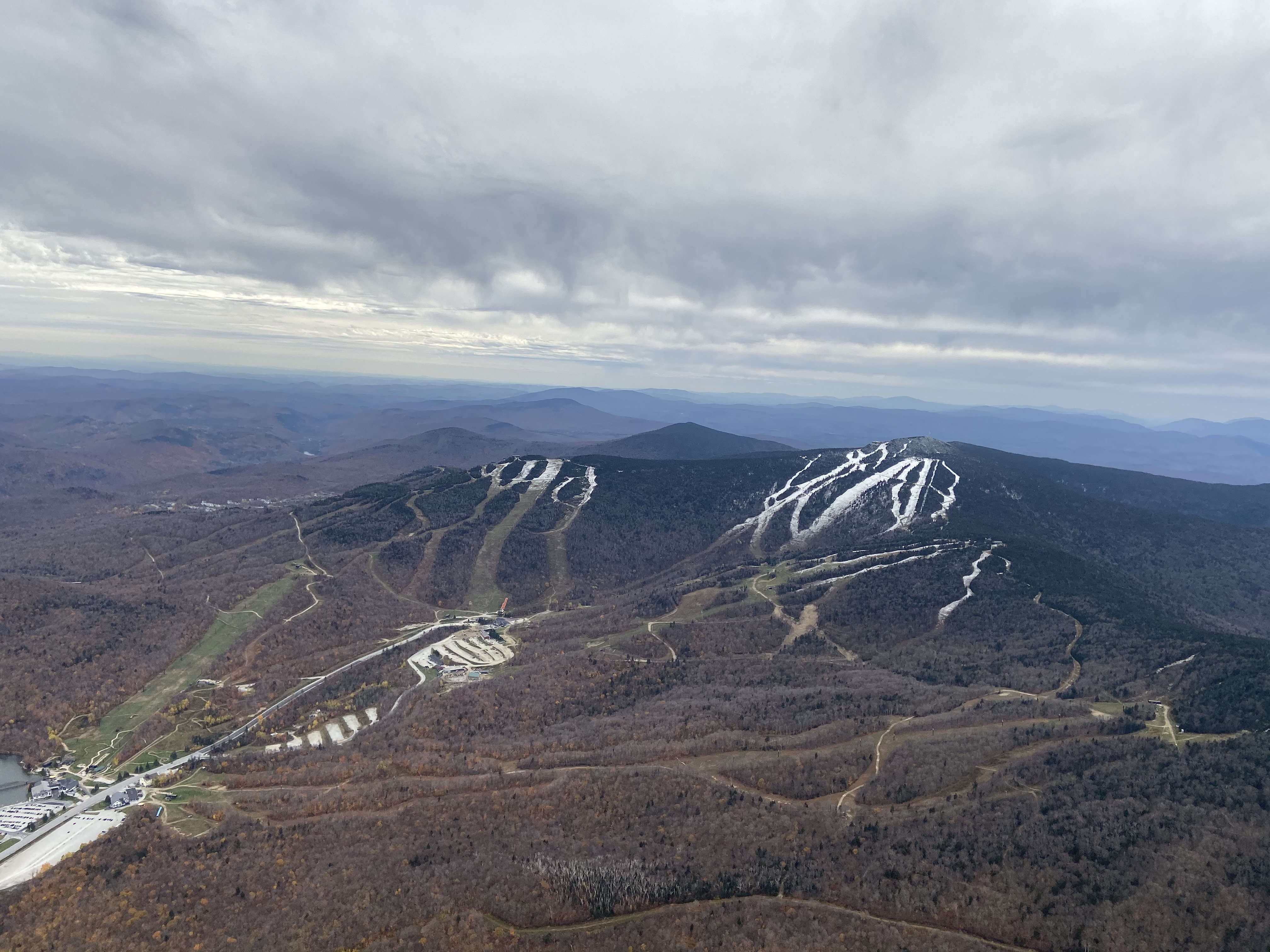
Our Mystery Glimpse this week shows us an aerial view taken just this week of a notable resort dusted with beautiful covering of October snow. Tell us where it is. You’ll also learn where that apres-ski disco from last week is located. Here’s the picture.

Thanks again for reading SeniorsSkiing.com. Tell your friends! Remember, there are more of us every day and we aren’t going away.

Mystery Glimpse: October Snow

This Week

Here’s a photo taken on Oct. 20th this year, right after a wicked Nor’Easter hit the East Coast. Obviously, the top of this resort got a dose of white. But, where is it? What resort? Why is this especially good news for the operators?

This one should be easy for lots of SeniorsSkiing.com readers. Thanks to a friendly pilot for passing this along.

Last Week: Dancing, Where?

Some excellent guesses. There’s probably a good story behind each one, harkening back to the days of disco lights, beer, and bands. Ah yes, memories.

You might say one ski resort bar/dance floor looks like all other ski resort bar/dance floors. This one, however, is unique.

Nu Gnu, Vail, CO, circa late 1960s/

This is the Nu Gnu which opened during the late 1960s as one of Vail Village’s first rock ‘n’ roll bars and one of Vail’s original iconic libation locations. In 1967, Paul Ross Johnston moved to Vail and founded the Nu Gnu. Paul, former mayor of Vail and owner of the Christiania Lodge, manned the door every night with a handlebar mustache and a fishnet shirt or a feather boa and a painted head, explains the Vail Daily. The Nu Gnu was a perfect apres-ski night spot.

Thanks to the Colorado Snowsports Museum for the picture and Dana Mathios, Curator and Director of Collections, for the description. Consider supporting our precious ski and snow sports museums as they are the only stewards of the winter sports history.

Rock and roll is here to stay!

Mystery Glimpse: Bang, Bang

The First Glimpse Challenge This Season Is Not What You Think.

When, Where, What, How, Who?

This Mystery Glimpse photo comes from the archives of the Alf Engen Ski Museum in Park City, UT. Take a virtual tour of the museum’s collection by clicking here.

The Mystery Glimpse feature posts a photo from one of the ski industry’s wonderful museums. Often these museums are located at or near ski resorts. They preserve and maintain unique assortments of ski history memorabilia, artifacts, documents, publications, and photographs. We are very grateful that so many ski museums are sharing photographs with our readers.

Do you know what’s going on in the picture? Take a guess in the Comment Box below. We’ll reveal the story behind the photo next week.

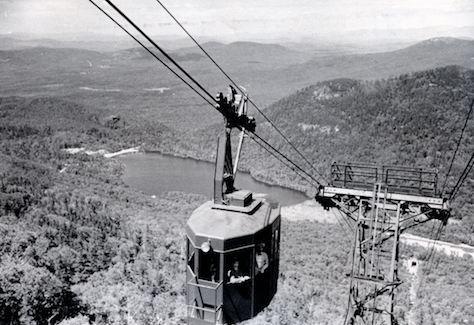
Mystery Glimpse: Cablin’

Where? When? What’s Special?

Credit: Arthur Griffin, New England Ski Museum Collection

Thanks to the New England Ski Museum for this picture of a unique moment in skiing history. The NESM has recently opened a new branch on North Conway, NH.

Last Week

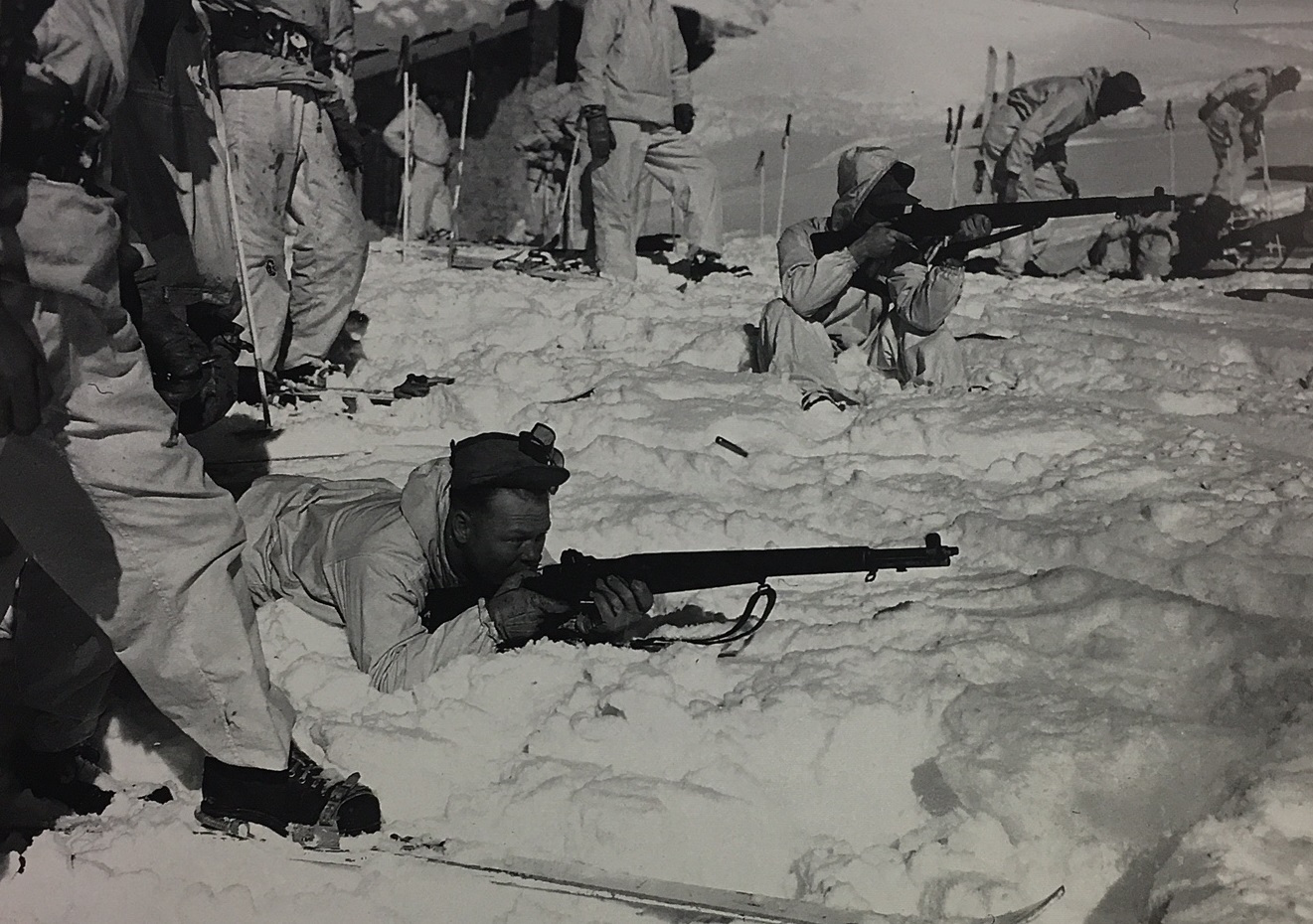
This is a “10th Mountain Whisk”, designated by government purveyors as “Brush, Mountain”. It is a stiff brush particularly useful to 10th Mountain Division troops camped on snow. It is used to brush snow and frost from clothing and equipment and to keep the tent floor clean. This brush is not a readily available 10th artifact. Since these were used not only to clean off snow, but as fire starters, they are rare.

An extra special thanks to the Colorado Snowsports Museum for offering this curiosity. We had only one guess from a reader which was actually pretty close.

Mystery Glimpse: A Rare Artifact

What Is This? Who Used It? Why Is It A Rare Artifact Of Ski History?

Thanks to the Colorado Snowsports Museum for this photo from its collection.

Last Week

Credit: New England Ski Museum archive

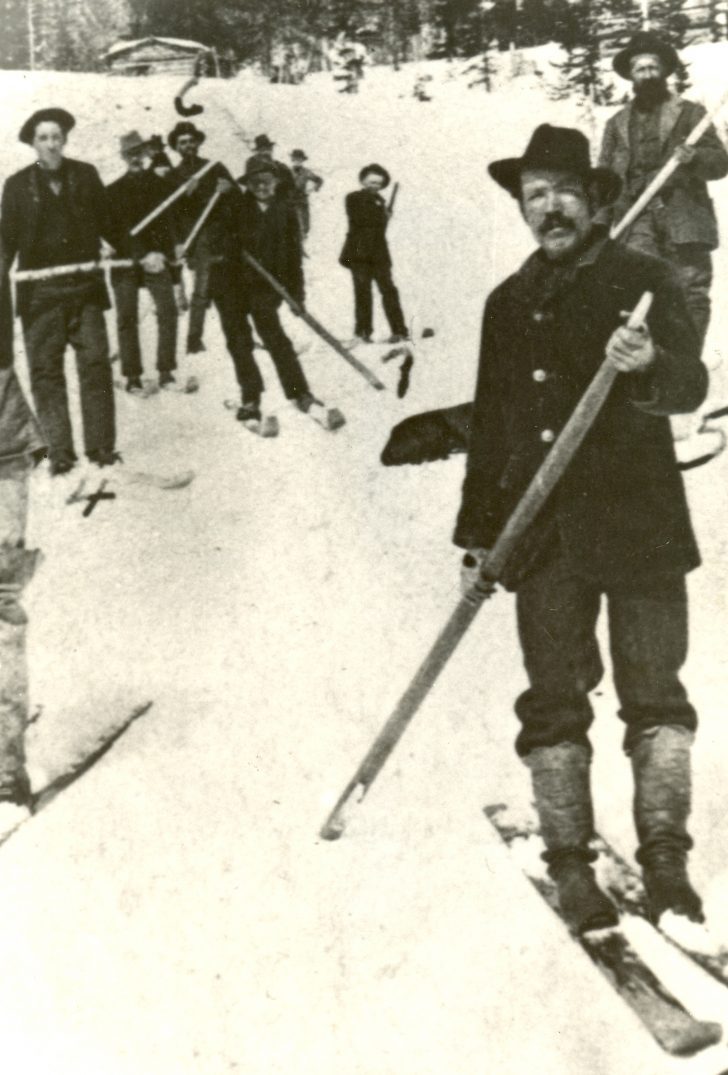
This is Betty Welch Whitney, born in Haverhill, MA, graduated from Smith College in 1923, and first went on a ski trip with the AMC in 1928. She remained an AMC member for life, and became a ski fashion and equipment buyer for Filene’s in 1936. With her husband H.H. “Bill” Whitney, she purchased the Moody Farm in Jackson, NH and with him operated Whitneys’ as the first ski area to combine food, lodging and a ski hill serviced by a tow.

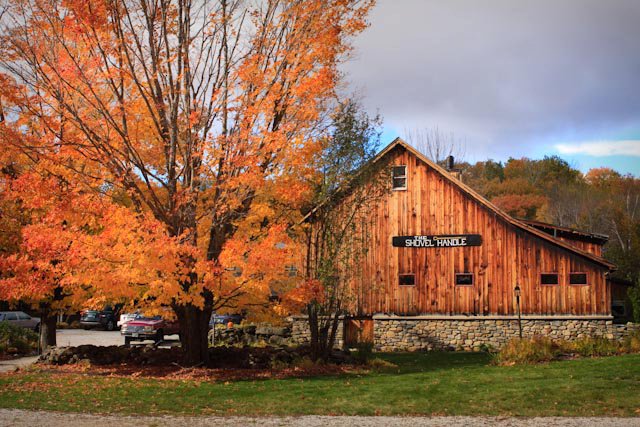
They improved the existing the rope tow lift a year later by attaching 72 shovel handles to the cable, making it easier for skiers to hold on. The lift was henceforth known as the Shovel Handle, and it helped make Whitneys’ one of the more popular early ski areas in New England. Whitney’s Inn is still in business and offers a traditional New England get-away experience with four-season activities.

Thanks to the New England Ski Museum, now with locations in Franconia and North Conway, NH, for offering this photo for our Mystery Glimpse series.

Here’s the Shovel Handle pub at the current Whitney Inn, Jackson, NH.

Image result for historic ski area Whitney Inn

Mystery Glimpse: Ski Legend Of The Rockies

That’s A Big Hint.

He sure looks like a rugged dude.  Considering what he did for a living, you shouldn’t be surprised to learn he was a thorough outdoorsman.  Do you know who this is? Where he hung out? What he did for a living? Our bet is a lot of our readers know who this is.

Last Week

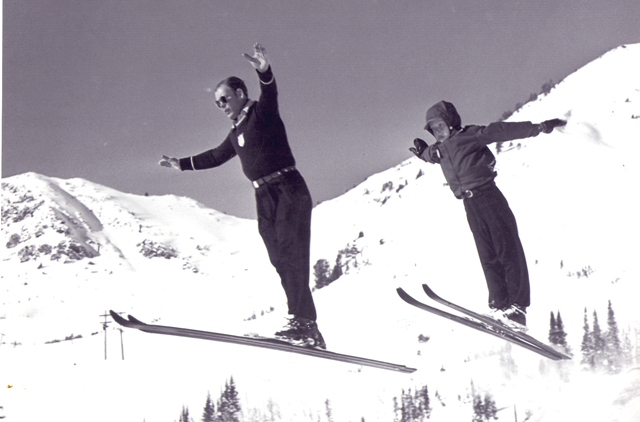
Two jumpers? Looks like a long time ago.

This photo comes from the archives of the Tread of Pioneers Museum in Steamboat Springs, CO.  The scene is Hot Sulphur Springs, CO, and the date is 1913.

The following description is from Katie Adams, curator at the Tread of Pioneers Museum.  We thank her for this explanation.

“Carl Howelson, “The Flying Norseman,” who introduced skiing and ski jumping to the West, emigrated to the US from Norway in 1905 and settled in Colorado.  When in Denver, he met new friends who shared an interest in ski jumping and cross-country skiing. Some of those friends, specifically Angell Schmidt and James Presthus, traveled with Howelsen and helped organize some of the first ski clubs and the first Winter Carnival event in Hot Sulphur Springs. The purpose was to gain appreciation and enthusiasm for skiing, and Howelsen knew the best way to do that was to amaze the crowd. He had experience with this as a performer for Barnum & Bailey Circus. He convinced the best ski jumpers he could find to come to Hot Sulphur Springs, to Inspiration Point in Denver, and to Steamboat Springs to dazzle the crowds. As part of putting on the show, jumpers would perform dual or twin jumps, two people jumping at one time. This picture is one of those crowd-pleasing dual jumps, and it probably (but I can’t confirm for certainty) is Carl Howelsen and James Presthus. So, the short answer to why two men jumping: for the razzle and dazzle.”

A great source referenced for this article: “The Flying Norseman” by Carl’s son Leif Hovelsen. The Tread of Pioneers Museum in Steamboat Springs is a center for the history of not only Steamboat, but also the Rockies, Colorado, and the West.  In addition to skiing, many different aspects of pioneer life and culture are preserved and displayed.

When we researched the background for this photo, we came across a more modern attempt to ski as a duo.  Here’s a report on the World Record first-ever tandem ski jump.  We’re not sure why people do this, probably for a bit of “dazzle” like Carl, but when it comes to challenges, there’s always room for one more.


Mystery Glimpse: Jumpin’ Big

[Editor Note: As the new year begins, SeniorsSkiing.com is again asking our readers to contribute to support our online magazine. Yes, we have grown in the number of subscribers and advertisers. But our expenses have also grown. You can help us defray some of these expenses by helping us out with a donation.  This year, we have a mix of premiums for different level of donations, including stickers, sew-on patches, our new SeniorsSkiing.com ball cap. All donors will be entered into a drawing for a pair of bamboo Polar Poles to be drawn in late March.  You can donate by clicking here.]

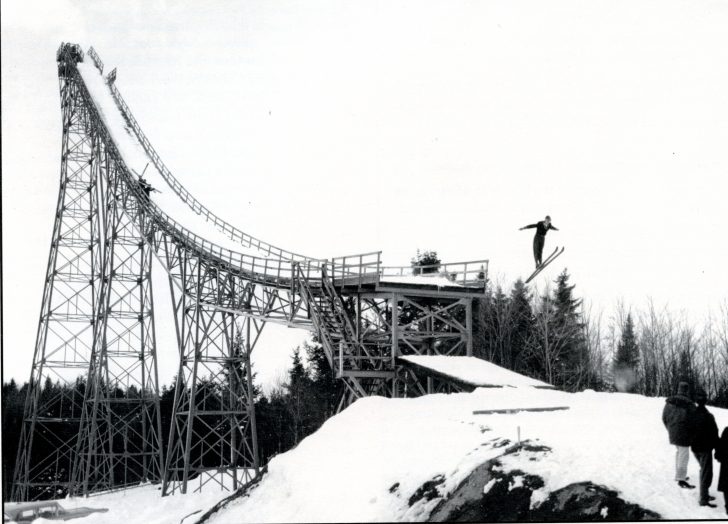
Hint: It’s Functional Again!

Wow. That’s a ski jump. A BIG jump. Know where? Significance? How about what folks called it? Thanks to the New England Ski Museum for this picture.

Credit: Dick Smith, New England Ski Museum

Last Week

Grab that twirling rope! Credit: Ski Museum of Maine

Nice guesses out there. However, the photo shows the very first rope tow in Maine. According to the Ski Museum of Maine which contributed this pic, this is Jockey Cap in Fryeburg circa 1936. Back then, ten young business men in Fryeburg got together and formed a corporation, with each member putting in $25.00. So at a cost of $250.00, plus contributions of considerable labor from the corporation members and many of the townsmen, the Ski Tow, under the direction of Henry McIntire, was built. It is said to the the first actual ski hill in Maine.

In those days, the ski train was often the only way to get from Portland to Fryeburg. Here’s an ad for a day trip on the train for $.98. And you can rent your gear on the train. The train continued over the state line to North Conway as well. Sounds like a long day, but what fun it must have been on the ride up and back.

The focus of the Ski Museum of Maine is to educate the public about the significant role the State of Maine has had in the development of skiing.

Mystery Glimpse: Tow Line

[Editor Note: As the new year begins, SeniorsSkiing.com is again asking our readers to contribute to support our online magazine. Yes, we have grown in the number of subscribers and advertisers. But our expenses have also grown. You can help us defray some of these expenses by helping us out with a donation.  This year, we have a mix of premiums for different level of donations, including stickers, sew-on patches, our new SeniorsSkiing.com ball cap. All donors will be entered into a drawing for a pair of bamboo Polar Poles to be drawn in late March.  You can donate by clicking here.]

A First But Where?

This one might be a bigger challenge than normal. Hint: New England. Where is this? What is the significance of this lift?

Last Week

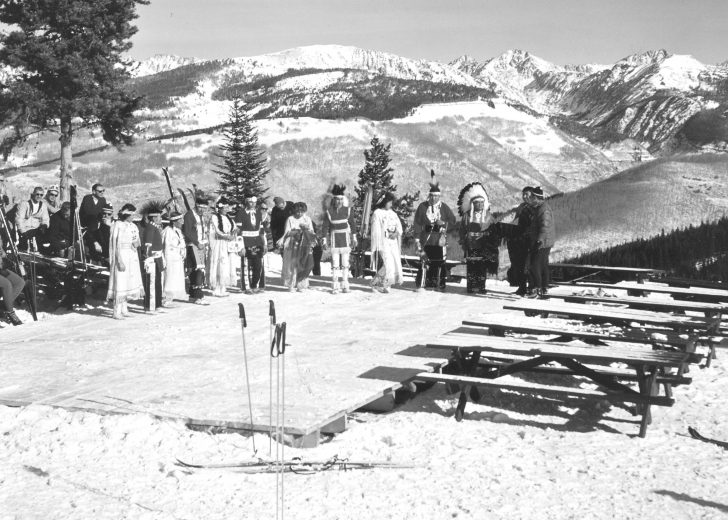
Snow dance prayer ceremony at Vail’s inaugural season, 1962. Credit: Colorado Snowsports Museum

In December 1962, Vail co-founder Pete Seibert was worried about the snowfall for the resort’s inaugural ski season. Long before settlers came to the Gore Creek Valley, Southern Ute Indians inhabited the area as a summer home. Because Pete knew this, he reached out to the area’s oldest known residents for help and invited members of the tribe to perform a snow dance prayer to bring snow. Eddie Box Jr. and Sr. were present at the 1962 ceremony. Eddie Box Jr. and his wife Betty performed such ceremonies since the 1962 event, one being in 2012. Wouldn’t you know, both years saw a lot of snow.

And thanks again to the Colorado Snowsports Museum for this amazing, historic photograph.

Mystery Glimpse: Divine Intervention

Special Times On The Mountain Top

Here’s another challenging picture from the Colorado Snowsports Museum. Something is going on, obviously, on this mountain. What’s happening? Who arranged it and for what purpose? When? Take your best guess down in the Comments box below.

Last Week

Alta, 1952. Credit: Ray Atkeson

This magnificent photo was taken in 1952 at the Alta ski area. It is part of the Alf Engen Ski Museum’s Ray Atkeson collection. Ray Atkeson (1907-1990) was a photographer best known for his landscape pictures of the American West. Many of Atkeson’s alpine photos were taken before chairlifts were even invented, which meant carrying heavy camera equipment through deep snow and mountain terrain.


Ray Atkeson, Alta. Credit: Alf Engen Ski Museum

Needless to say, Atkeson was an intrepid professional, committed to capturing the beauty and majesty of the world around him and sharing it with others. Best said by his wife Doris, Ray’s “greatest joy was sharing the beauty of these places with people who would never go there.”

For more on Atkeson, click here. Many thanks to the Alf Engen Ski Museum, Park City, UT., for contributing this photograph.


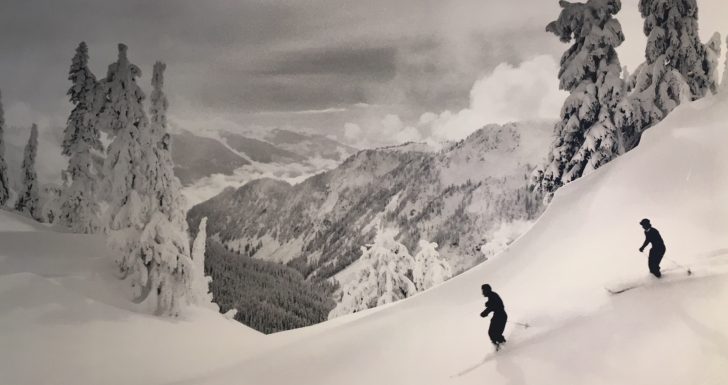
Mystery Glimpse: Trackless World Of Snow

Alpine Universe

Now here’s an amazing picture from the Alf Engen Museum, Park City, UT.  What are we looking at? What’s the place? And, more importantly, who took the picture?  No, not Ansel Adams, but close.

Last Week

Yes, indeed, the Very Special Guest was Princess Elizabeth who visited the Mittersill Alpine Resort near Cannon Mt., NH, in 1951, probably in connection with her trip to Canada that year.

Why would the future Queen of the Realm stay at a then-remote ski resort in Northern New Hampshire?

We infer that she was visiting a member of the Hapsburg royal family, Mittersill’s founder Baron Hubert von Pantz, a wealthy Austrian sportsman and hotelier. His Tyrolean-themed Mittersill Club in Austria—a mecca for royalty from all over Europe—came to a sudden end in 1938 when the Nazis invaded.  He resettled in New Hampshire and in 1945 opened the Mittersill Alpine Resort, which consisted of an Inn and number of unique, mountain-themed cottages, reflecting the Austrian style.

From the Mittersill Inn.

We visited the Mittersill Alpine Resort last February, checked out some of the original chalets, and found a collection of unusual illustrations posted on the walls of the Inn.  These charming pictures reflect another time, a Tyrol where horses and sleighs carried sports people dressed in “ski costume” around the mountains. We asked the Inn’s staff what the history of these magnificent pictures was but no one knew. We strongly suspect the Baron brought them with him from his club in Austria.


And here’s a poster from the Mittersill Mountain Club’s early days.  Cozy, eh?


Mystery Glimpse: This Isn’t Easy

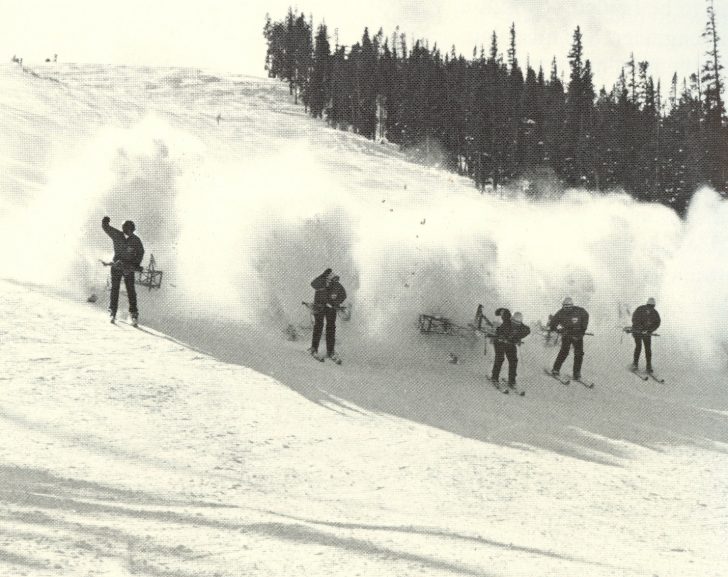
Bombing Down

What is going on here? Party? Race? One thing we will tell you is that this looks like (and was) a very tricky maneuver on skis. One resort made these famous.  Name it? The inventor?  Thanks again to the Colorado Snowsports Museum at Vail.

Last Week

Indeed, this is Alf and Alan Engen doing some father and son ski jumping at Alta circa 1952. Alf was an early ski jumper who mastered Alpine skiing and helped start the ski school at Alta. He and his two brothers helped popularize skiing in the West, especially Utah and Idaho. Alf’s son, Alan, carries on the family tradition today at Alta.

The Alf Engen Museum at Park City contributed this photo.

The photo came from the Museum’s Ray Atkeson collection. Atkeson (1907-1990) was a photographer best known for his landscape pictures, particularly in the American West. His black and white ski photos are considered some of the finest ever captured.

The museum contains more than 300 trophies, medals, uniforms, scrapbooks, skis, boots, photos, films and other collectables that span some 70 years in the career of the Engen family. The museum’s educational component gives school children a skiing-based foundation to study subjects such as the water cycle, physics and Utah’s colorful history.

Alf Engen. Check those pole baskets.

The Museum recently added a fully functional virtual ski experience designed and built by Utah-based company Unrivaled. The ride takes you through an amazing downhill ski experience and even gives the authentic feeling of skiing by adding wind and even snow to the overall downhill experience.


Mystery Glimpse: Who’s Flyin’?

Airborne Family Members.

Who is airborne? Can you guess where?  Hint: We can’t tell you the name of the museum that contributed this picture. Know why?

Last Week

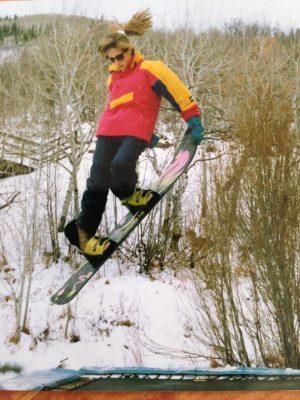
Only one reader got this one.  The enthusiastic boarder is Shannon Dunn-Downing, the first U.S. woman to win an Olympic snowboard medal with a halfpipe bronze in 1998.

Shannon was the first woman to land several difficult halfpipe tricks in competition, including a frontside 540 in 1991, backside 540 in 1994, Mctwist in 1994, frontside 720 in 1995, and frontside rodeo 720 in 2001. She is also noted for working behind the scenes on the development women’s products for companies such as Burton Snowboards and Velvet Goggles.

In the mid-2000s, Shannon retired from professional snowboarding to focus on raising her family. She lives in Southern California and tries to surf whenever she can.

In 2016, the Colorado Snowsports Hall of Fame and Museum produced a tribute video to Shannon, highlighting her early days and Olympic success.  Check it out below.


Mystery Glimpse: Woman Snow Boarder Winner

Who Is She? What Makes Her Special?

Credit: Colorado Snowsports Museum

A competitor, a snowboarder (obviously), a woman.  See if you can put these clues together. Once again, thanks to the Colorado Snowsport Museum in Vail, CO., for this contribution.  Put your guess in comments below.

Last Week

Credit: Colorado Snowsports Museum

This artifact is a United States Forest Service avalanche control gun sight. It was used by Dick Stillman in 1955 at Berthoud Pass. During World War II, Dick served in the 10th Mountain Division, trained at Camp Hale, and saw action in Italy. After service, he started a 30-year career with the Forest Service as part of the U.S. Department of Agriculture. He established and maintained the High Alpine Avalanche Research Station at Berthoud Pass, Colorado from 1950 to 1963. At that time, the station was the highest in the world conducting avalanche research at 11,315 feet


Mystery Glimpse: What’s This Thingy?

Hint: It’s Government Issue.

Credit: Colorado Snowsports Museum

Thanks again to the Colorado Snowsports Museum in Vail, CO, for contributing this photo to our series. A special shout-out to curator Dana Mathios for picking some interesting relics and for providing answers to the “glimpse”.

The collection at the Colorado Snowsports Museum tells the story of the explosive rise of skiing in the Colorado Rockies, preserving a legacy for future generations.

Last Week

Tread Of Pioneers Museum in Steamboat Springs, CO, provided this picture of racer and celebrity Buddy Werner in happy times. On the left is Vanda, his wife, on the right is Skeeter Werner, his sister. As so many of you commented, Buddy was raised in Steamboat, raced in the late 50s and 60s, make the ’56, ’60, and ’64 Olympic teams, and, in 1959, managed to be the first non-Austrian or Swiss to ever win the famed and formidable Hahnenkamm downhill race in Kitzbuhel. Only one other American has ever won that race since, and that was Daron Rahlves in 2003.

Buddy at Innsbruck.

After the 1964 race season, Werner retired from ski racing at age 28. Later that year, he and others were filming ski scenes for Willy Bogner’s first of many movies, Ski Fazcination, when he and German racer Barbi Henneberger were buried in an avalanche at St. Moritz. Bogner was eventually tried and convicted of negligent homicide and served a suspended sentence. The entire ski world was stunned.

Buddy Werner was posthumously inducted into the National Ski Hall of Fame, now the US Ski and Snowboard Hall of Fame, later that year.

Buddy Werner, American ski racer, 1936-1964. Credit: Tread Of Pioneers Museum

Mystery Glimpse: Flying Racer

Who Is The Airborne Skier? What’s His Story? Do You Know His Hometown?

This week, we made the Mystery Glimpse a little more challenging.  Name this high flyer.  Tell us about him and (hint) how he met his unfortunate and untimely end.

Okay that’s hard. Here’s another one of this celebrated personage.

These photos come from the collection of the Tread Of Pioneers Museum, Steamboat Springs, CO. The museum is a not-for-profit historical institution that promotes an understanding and appreciation of the history of the Steamboat Springs area by collecting, preserving, exhibiting, interpreting, and sharing that history and heritage with audiences of all ages and interests. Check out its collection of historic skiing photos.

Last Week

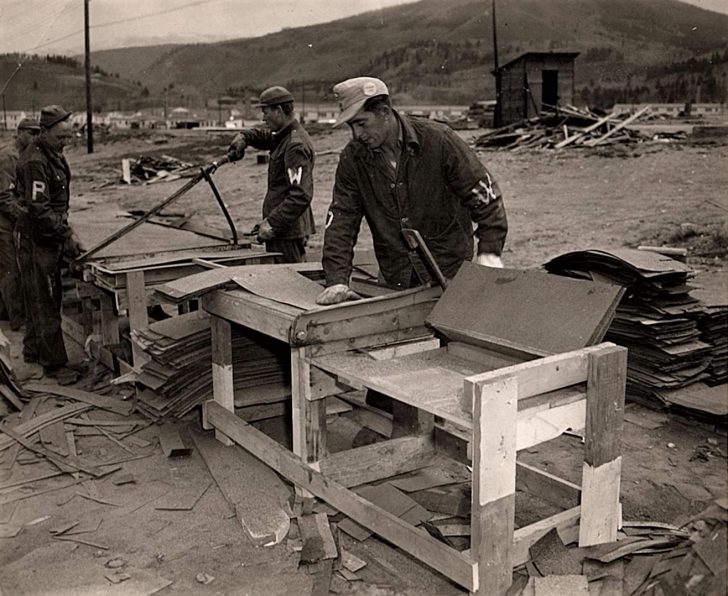
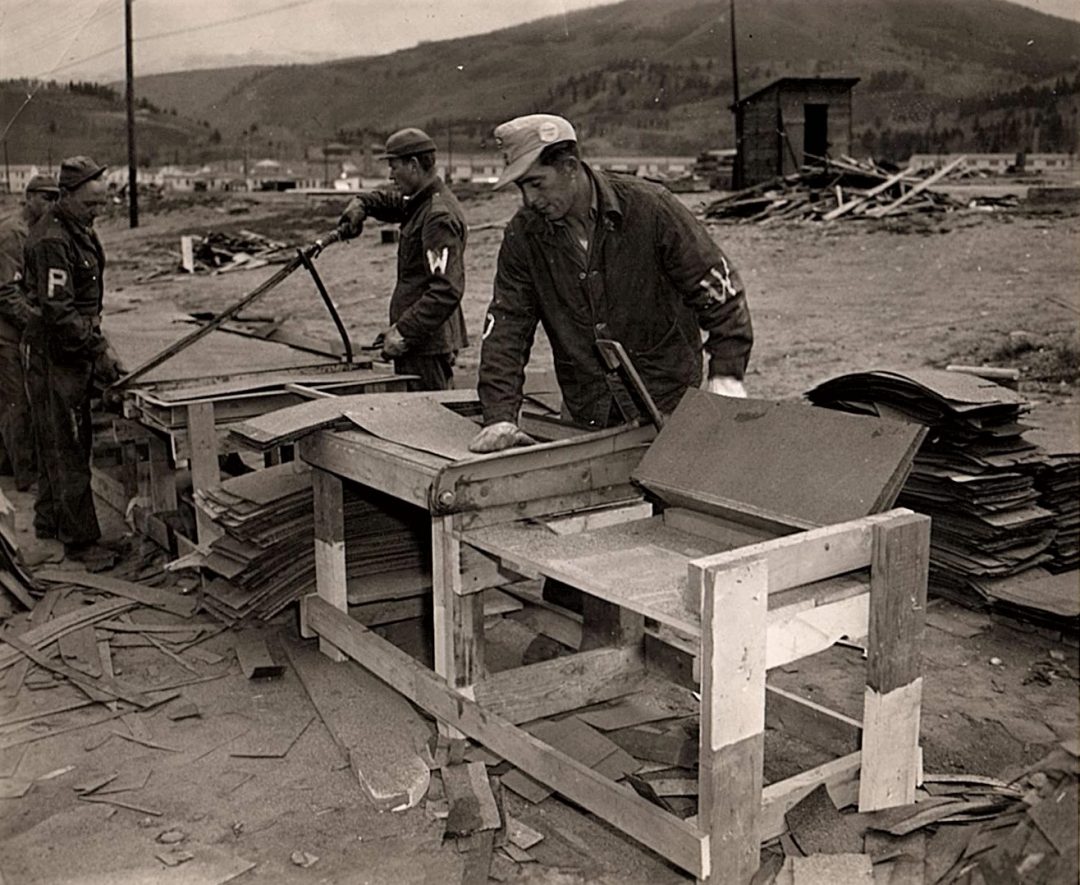
German POWs making shingles at Camp Hale, CO, circa 1943-46. Credit: Colorado SnowSports

We had at least one correct comment on who these soldiers were, as well as some very close guesses.

Those hard-working chaps were German POWs held at Camp Hale, CO. Did you know that from 1943 through 1946, Colorado had 48 Prisoner of War Camps? Out of the many camps, the Army placed several hundred German prisoners of war at Camp Hale, the 10th Mountain Division training facility. Though communication between prisoners and soldiers was officially forbidden, the German prisoners regularly talked with the German sympathizers in the 620th Engineer General Service Company, which arrived at the camp on December 5, 1943. The 200 soldiers who made up this unit were not actually engineers. Like several other army units, the 620th was made up of suspected Nazi sympathizers (mostly Germans) and other opponents of the war.  They got along quite well with the POWs, exchanging greetings and illegal gifts. The images show POWs making shingles and stacking lumber at Camp Hale.

Thanks again to the Colorado Snowsports Museum, Vail, CO, for contributing the photograph from its archives.  You can virtually visit the museum by clicking here. 

Mystery Glimpse: Who’s Diligently At Work?

They’re Lucky To Be In The Mountains And Not Where They Were.

This should be relatively easy.  Who are these chaps? What are they doing? Where are they doing it? When? Look closely. There are clues you can see.

Thanks, again, to the Colorado Snowsports Museum and Hall of Fame for contributing this picture. The museum’s website has some well-researched articles on the history of snow sports of all kinds in the Rocky Mountains and Colorado. Click here for more. SeniorsSkiing.com thanks Dana Mathios, Director of Collections, for working with us on this series.

Last Week

We thought this would be more difficult. Clearly, there are some fans of Queen Maud of Norway out there. The photo is the young Queen, right, skiing with her sister, Princess Victoria, in 1907. The Vesterheim Norwegian-American Museum contributed this photo. Apparently, this pose was an attempt by English-born Maud to look more “Norwegian”.

Queen Maud was daughter of Britain’s Edward VII, was raised in England, and married a Danish prince. Clearly, inter-marriage of royals was a way to ensure longevity for blue bloods. During her first years in Norway, she and her spouse were photographed in Norwegian folk costumes, and enjoying winter sports such as skiing, to give them a Norwegian appearance in the eyes of the public. Hence, this picture.

In 1877, Norwegian Americans began collecting and preserving objects at Luther College in Decorah, Iowa, documenting their chapter of the immigrant story, making them pioneers in the preservation of cultural diversity in America. That early collection

Maud of Wales in 1906

has grown into one of the most comprehensive museums in the United States dedicated to a single immigrant group—Vesterheim Norwegian-American Museum, now an independent not-for-profit organization accredited by the American Alliance of Museums (AAM).


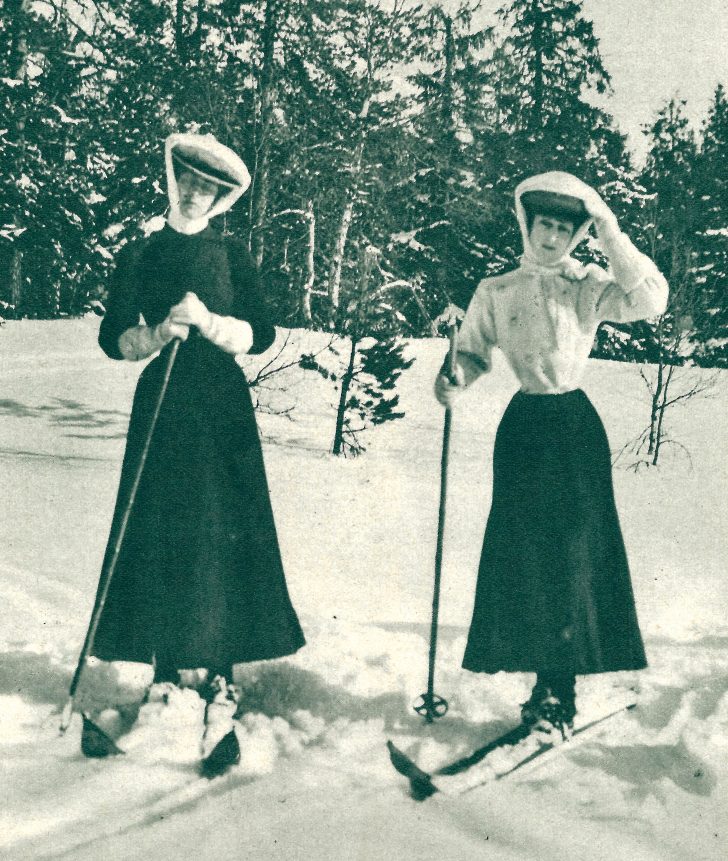
Mystery Glimpse: Who’s Skiing In Skirts?

It Looks Royally Uncomfortable.

Here’s a picture from long ago. The woman on the right is the mystery lady. Who is she? You can probably guess the era from the skiing “costumes”. Probably foreign. Last hint: Think Scandinavia.

This week’s picture was contributed by Vesterheim, the National Norwegian-American Museum & Heritage Center, in Decorah, IA.  The center has over 33,000 artifacts, 12 historic buildings, a Folk Art School, and a library and archives. This treasure showcases the most extensive collection of Norwegian-American artifacts in the world.

Vesterheim’s exhibitions explore the diversity of American immigration through the lens of the Norwegian-American experience and highlight the best in historic and contemporary Norwegian folk and fine arts. USA Today named Vesterheim one of “ten great places in the nation to admire American folk art.”

Last Week

This is the famous Engen Bell, a fixture in Utah ski history and an official “treasure” of the state.

The bell was used for many years on an old locomotive from the Denver & Rio Grande Railroad. It is estimated the bell was made in the mid-1800s, but no official records are available to verify its exact age. Rio Grande Railroad officials stated that the bell made hundreds of trips through Utah in the late 1800s and early 1900s.

In 1955 the bell was acquired by Martha M. Engen as a gift from the railroad. She gave it her son Alf for use at his Alf Engen Ski School at Alta, Utah. For 24 years, the bell was used every day to toll the start of the morning and afternoon ski school sessions. It became a landmark at Alta; everyone listened for the bell to sound. When Alf Engen retired as the ski school director, it was deemed appropriate to also retire the bell in his honor. The bell rang for the last time in 1989, when Alta celebrated its 50th anniversary as a ski area. Alf gave the bell to his son, Alan, who commissioned a solid oak stand and brass plates identifying it as “The Engen Bell,” in honor of his dad and his grandmother, Martha.

Look closely. There’s the bell on the old steam engine.

In 1995, the old bell was selected as one of the “100 Treasures of Utah” and was put on display at the Utah Winter Sports Park as a featured attraction of the 1996 Utah Centennial celebration. The reasons for being named a Utah treasure are twofold: First, the bell holds historical value due to the time period in which it was used by the Rio Grande Railroad. Secondly, it is the only ski school bell ever used at Alta, and as far as can be determined, is the only bell used by any ski school in Utah’s history. The only other Intermountain Region ski school to use a bell for announcing the start of classes was at Sun Valley, in the late 1930s and early 1940s.

The bell is on display at the Alf Engen Ski Museum located in Park City, Utah.

Mystery Glimpse: Ding Dong Bell

Yes, It’s A Big Bell.


What’s the significance of this old bell? Do you know where it came from? What it was used for? Who used it? Your guesses below most welcome.

This week’s Mystery Glimpse was contributed by the Alf Engen Ski Museum, Park City, UT.  The museum was established in 1989 with the mission to preserve the rich history of skiing in the Intermountain Region. Browse their online collection of photos and videos of legendary pioneers, champions and significant contributors to the sport of skiing in the Intermountain Region. This library includes numerous vintage photos and video clips.

Last Week’s Glimpse

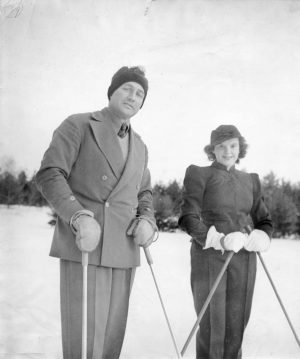
Nope, not Gary Cooper. Yes, Judy Garland. This is Otto Schniebs, shown here with the young movie star, who settled in Waltham, MA,  after immigrating from Germany in the late 20s.  He set up one of the first ski schools in America there and was soon discovered by AMC members as a talented ski instructor who had vast ski teaching experience in his native country.

Before moving on to become a ski coach at Dartmouth, Otto Schniebs introduced formal ski instruction to the region. With John McGrillis, he wrote the first instructional book on skiing in 1931. He was the director of the first ski school for instructors organized by the US Eastern Amateur Ski Association.

“For the first time learning to ski became easy in this country,” noted AMC ski leader William Fowler.  Schniebs coined the well-known phrase, “Skiing is more than a sport; it’s a way of life.”

Otto Schniebs was inducted into the US Ski and Snowboard Hall of Fame in 1967.

Everyone knows Judy Garland.

Many thanks to the New England Ski Museum for sending along this Mystery Glimpse picture.


Mystery Glimpse: Two Stars On The Snow

Who Are These Folks?

Hint: It’s New England. Another Hint: You’ve undoubtedly seen one of these folks in action.

This week’s Mystery Glimpse photo comes from the archives of the New England Ski Museum with headquarters in Franconia, NH, and a new branch location in North Conway, NH.

The New England Ski Museum collects, conserves, and exhibits elements of ski history for research, education and inspiration. They have have operated the Museum at Franconia Notch State Park since December, 1982, and welcome thousands of visitors each year. You can access detailed descriptions of the museum’s permanent and annual exhibits by clicking here.

Last Week’s Mystery Glimpse

Who, What, Where, When?

Only one guess on this one. That’s surprising because the story behind this picture is embedded in Vail lore.

On April 1, 1964, when Vail was still brand new, a 14-year-old boy named Marty Koether got lost on the slopes—and ended up becoming a permanent part of Vail history.

Koether, who accidentally skied into a yet-to-be developed Game Creek Bowl, spent a long, cold night in a tree well near the bottom of the present-day location of the Game Creek lift before climbing out the next morning and being discovered by ski patrol.

The incident was chronicled in Skiing Magazine and became part of the mountain’s folklore. The winding, green trail in Game Creek Bowl “Lost Boy” is named after Koether and his disappearance.

A salute to the  Colorado Snowsports Museum and Hall of Fame.    A special thanks to museum curator Dana Mathias who provided this story.

Do you remember this incident?

BowlerSkier_489

This Week In SeniorsSkiing.com (Nov. 2)

ReaderReport, Free Senior Ski Listing, Mystery Glimpse Returns, Sample Song From Ray Conrad, Fifth Anniversary Bash Coming Up.

Last week, we put out a call to our readers to submit stories, photos, and videos about their own snow sport experiences.  Memories, history, adventures, recommendations, you name it. In response, reader Alyce Perez sent in pictures of her skiing at Mt. Snow in October, the first time in her 41 years of skiing that she skied before Halloween.  Thanks, Alyce. Check out her smiling after a run here.

Now for the rest of you, let’s hear your tales. Just drop us a note or pictures to info@seniorsskiing.com, and we’ll follow up. Friends and family will be impressed.

Free Skiing For Seniors 2018-19

After weeks of checking and re-checking our listing of resorts where seniors can ski for free (or almost free) is ready for publication.  This year, we have identified 138 resorts in the US and Canada which offer free or very small fee tickets and passes to seniors.

We believe we are the only snow sports publication with this list which we have developed with the National Ski Areas Association and have been compiling for our readers for the past four years.

If you are a subscriber, you can access our 2018-19 list of where to ski for free (or almost free) by clicking the Subscriber-Only Content box in the menu bar or click on COMMUNITY in the blue menu and then clicking on Subscriber-Only Content.

Or by clicking here Note that you may be asked to re-enter your name and email address again to confirm your free subscription.

If you know of any resorts we left out or included in error, please let us know at info@seniorsskiing.com.

The Mystery Glimpse Feature Returns

A popular new feature, Mystery Glimpse presents a photo from skiing’s past and asks

readers to identify what, who, or where the picture was taken.

This week, our Mystery Glimpse is from the Colorado SnowSports Museum and Hall of Fame in Vail. Take a look and see if you can identify what is happening.


Ski Songs From The Sixties From Ray Conrad Available

Ski Songs From Ray Conrad.

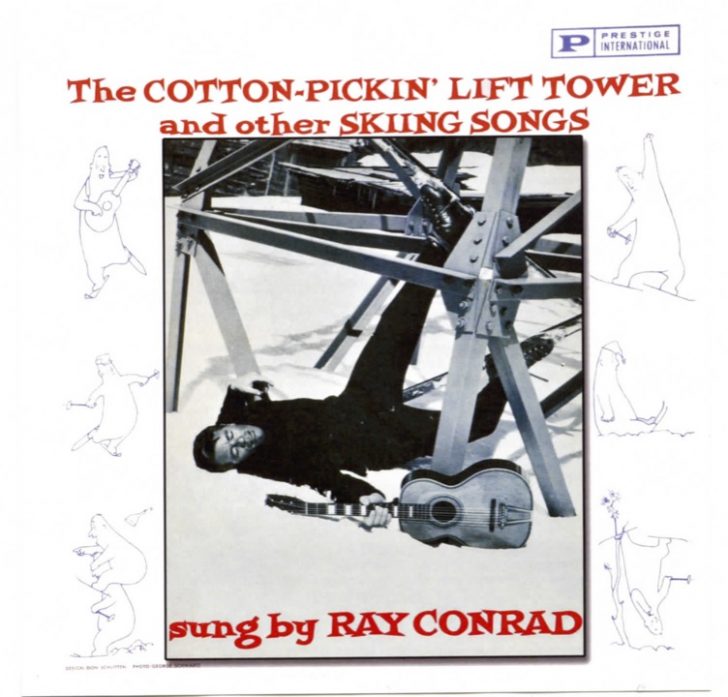
Last year, we had some fun republishing Ray Conrad’s album, The Cotton-Pickin’ Lift Tower and Other Ski Songs, a collection of his classics from the golden age of folk music and singing skiers.

You can check out the album which is for sale on CDBaby and listen to some samples by clicking here. SeniorsSkiing.com splits the proceeds with 91 year old Ray who is thrilled that new people are listening to his funny and sometime sentimental music about the world of skiing.

Depending on the device you are using, you may be able to listen to “A Skier’s Daydream” from the album here. Click on the arrow and turn your sound up.

Party Time Approaches

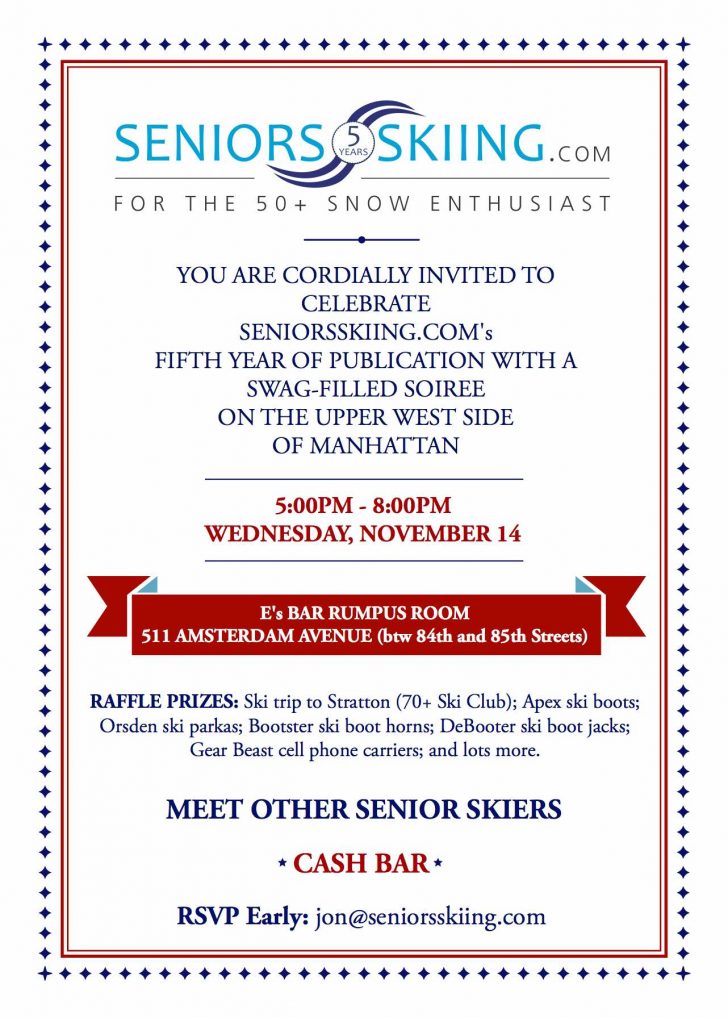
We’re getting ready for our Fifth Anniversary Bash in NY coming up soon. Here are the details.

And remember, dear readers, there are more of us every day, and we aren’t going away.

Mystery Glimpse Returns: What’s Happening?

Guess What’s Going On, Submit Under Comments Below.

Our popular Mystery Glimpse feature is returning after a summer respite. The basic idea is that we publish a photo of a person, place, or thing, and you guess who, where, or what. Most of these photos have been submitted to SeniorsSkiing.com by some very excellent ski museums around the country. We will be highlighting each museum with the week’s new Mystery Glimpse. In the next edition, we’ll reveal the story behind the picture and present a new puzzle.

This week, we have a news photo from the Colorado Snowsports Museum and Hall of Fame located in Vail Village, CO.  Its collection of priceless artifacts tells the story of the birth, rise, and explosive growth of skiing in Colorado. Click here to support the museum’s mission.

What’s going on here?

If you think you know, submit your guess in comments below.

Who, What, Where, When?

You can access our archive of Mystery Glimpse articles by clicking here.


Mystery Glimpse: He Was The First

This Well-Dressed Athlete Was The First Of Many.

Thanks to the Colorado Ski And Snowboard Museum for sending this picture along. We’re reaching deep here, dear readers, and if you can get this one, we will be really impressed.  Who is he and what did he do that gave him a place in ski history?

Last Week

This is a glimpse of the famous Winter Park ski train that has recently shut down after 69 years of service.  Ski trains were very popular with skiers from metropolitan areas on both coasts and the Rockies during the 30s and 40s.  But, with roads and interstates, the trains became unprofitable. According to the Colorado Ski and Snowboard Museum, the ski train that brought Denver citizens to the mountains was one of the few that survived.
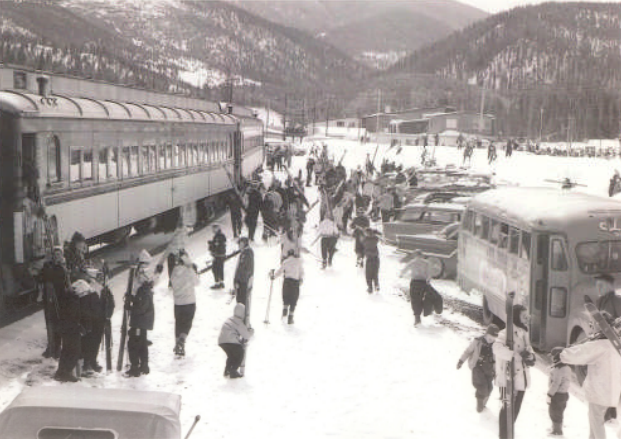
You can only now imagine how convenient and almost luxurious it must have been to take a train to a station near a ski area and get picked up by a bus or horse-drawn sleigh to be taken to a mountain hotel or base lodge. Must have been some fun times on those trains going back and forth.

Anyone remember taking a ski train to and from the mountains?  What was it like?

To read more about the history of the Winter Park ski train, click here.

Visit A Ski Museum

SeniorsSkiing.com salutes the many ski museums who have contributed to the Mystery Glimpse series this season. Our readers should be aware that these often very small museum carry the stories and pictures of the past years of snow sports, going back to the early renderings of hunters and warriors on skis and ski-like gear. If you have a ski history museum near you, visit and support their efforts.

Colorado Ski and Snowboard Museum

Vermont Ski and Snowboard Museum

Ski Museum of Maine

New England Ski Museum

National Ski and Snowboard Hall of Fame

Alf Engen Ski Museum

Museum of Sierra Ski History

We very much appreciate the contributions these ski museums made to SeniorsSkiing.com’s Mystery Glimpse.  It was our way of keeping ski history and heroes alive and in front of an audience who appreciates the value of nostalgia. Next season, we hope to expand our list of contributors.


Mystery Glimpse: Choo-Choo!

Where Are We And What’s Happening?

Thanks to the Colorado Ski & Snowboard Museum for providing this picture from ski history.  The CS&SM is in the process of undergoing a $2.4 million renovation. The first of several exhibits, “Climb To Glory”, featuring the story of the 10th Mountain Division is now open. Other exhibits will be open at the end of April this year.  The museum is located in Vail Village, CO.

Last Week

This is another ski history legend.  Nic Fiore was an influential ski instructor and director of the ski school at Yosemite’s Badger Pass for 50 years. His friendly smile and charming French-Canadian accent attracted skiers who came to Badger Pass every year to learn from and ski with Nic.
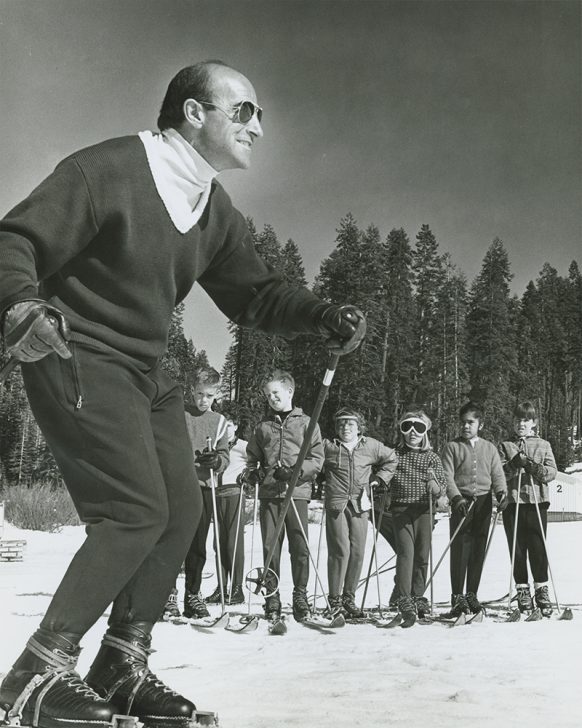
He was an early member of the California Ski Instructors Association in the late 40s. At the time, he was concerned about the quality and consistency of ski instruction, becoming a voice for a national ski instruction organization. When the Professional Ski Instructors of America was founded in 1961, Nic remained committed to high standards for instructor certification.

Nic Fiore was an active skier well into his 80s. He continued to hit the slopes nearly every day and teach an occasional ski lesson into the 2003-04 season. Nic passed away at 88 in 2009.

Here’s Nic on the lift at Badger Pass. Note his enthusiasm and magnetic personality.

https://vimeo.com/3111117

Thanks again to the Museum of  Sierra Ski History for sending Nic’s photo.  The MSSH is located at the Gateway Museum at Lake Tahoe, CA.

Mystery Glimpse: Who, Where, And What?

Here’s A Classic-Looking Skier In A Classic Pose.

Looks like an instructor demonstrating to a kids’ class. Check the straps around his boots, and you will get a hint about the era depicted here. Don’t you love that turtleneck? No, parka, hmmm. Looks a little like California-stylin’.  That’s enough of a hint for this one. Who is he, where did he hang out, and what’s his claim to fame?

Thanks to the Museum Of Sierra Ski History and 1960 Winter Olympics for contributing this.

Last Week

Mystery Glimpse has stumped the collective hive mind for the first time.  No, not Stein Eriksen’s older brother, but good guess.

The handsome, young skier is Dick Buek, an extreme skier before there was extreme skiing.  Here’s John Jerome, the noted ski writer, talking about Dick back in the January, 1970 issue of SKIING magazine.

“To Dick Buek, the human body was a device with a certain potential, and the only sensible course for the intelligence which guided that body was to find out what that potential was….Collecting Dick Buek stories is an exercise in the suppression of disbelief.  Shussing Exhibition the first time he saw it. Winning a ski jump the first time—maybe the only time—he ever went down an in-run. Sky-diving with a parachute he found in a scrap heap. Diving off cliffs in Acapulco to win a bet for gas money. Piloting a light plane over a slalom course around lift towers at Squaw Valley, beneath  the cables. And so on. The stories are legend.”

He won the 1952 National Downhill Championship. Then, severe injuries from a near fatal motorcycle accident left him in really tough shape. Despite his knee and shoulder being held together by pins and plates, his leg only able to extend to 60 degrees, he entered and managed to win the Downhill at the 1954 Nationals at Aspen. He was passed over for the 1954 FIS World Championships because he was “a basket case.”

Dick Buek, 1929-1957

There are other stories, like watching Stein Eriksen do his famous flip at Sun Valley and immediately trying it himself, crashing spectacularly, catching a ski in the face, getting up, skiing down the rest of the run on one ski, handing the broken one to Ed Scott (Scott Poles) and telling him to fix it. Reports were he was trying a double flip.

Dick was a daredevil stunt pilot and managed to crash twice into Lake Tahoe, the first time when he was towing water skiers. In the second crash, he was actually giving a flying lesson to a friend, the wings froze up, and the plane went straight down.  He was just short of his 28th birthday.

He was inducted into the National Ski Hall of Fame in 1974.

You can read more about Dick Buek here.


Mystery Glimpse: Straight Down

Who Is This And What Is He Best Known For?

Let’s see if you can identify this skier who blazed some very impressive trails back in the 40s and 50s.

Hint: He was also a pilot.


Last Week

We are frequently impressed by the deep knowledge our readers have on the personalities and history of snow sports.  This week, we were blown away by the several contributors who absolutely nailed the story behind this famous picture.  Well done, readers.

Here’s the story: In 1206 AD, a Norwegian king died and left his baby son, Hakon Hakonsson, as heir to the throne. To protect the infant from enemies, two skiers carried him through treacherous winter terrain to safety in Lillehammer. Their rescue is commemorated every year in the 54=kilometer Birkebeiner race, named for the birch bark gaiter they wore to protect their legs.

Thanks again to the New England Ski Museum for the painting and caption. Congratulations to NESM for opening its new facility in North Conway, NH.