Tag Archive for: Mystery Glimpse

Mystery Glimpse: What’s The Story?

Dire Straits Require Heroic Acts.

Credit: New England Ski Museum

This week, a historic event for Mystery Glimpse.  Can you identify the characters involved in the above picture? What’s going on? Where are they headed? Why? And yes, they are skiing.

Thanks to the New England Ski Museum, Franconia, NH, for hosting this jewel. Congratulations to NESM for opening its new branch in North Conway!

Last Week

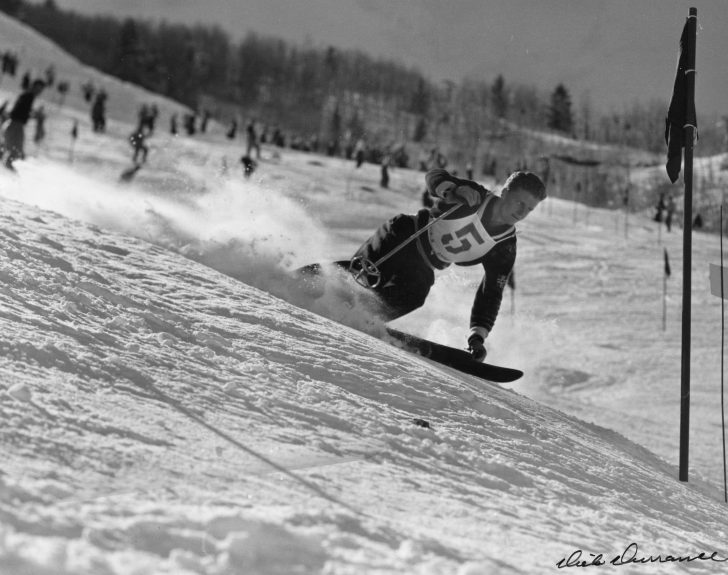
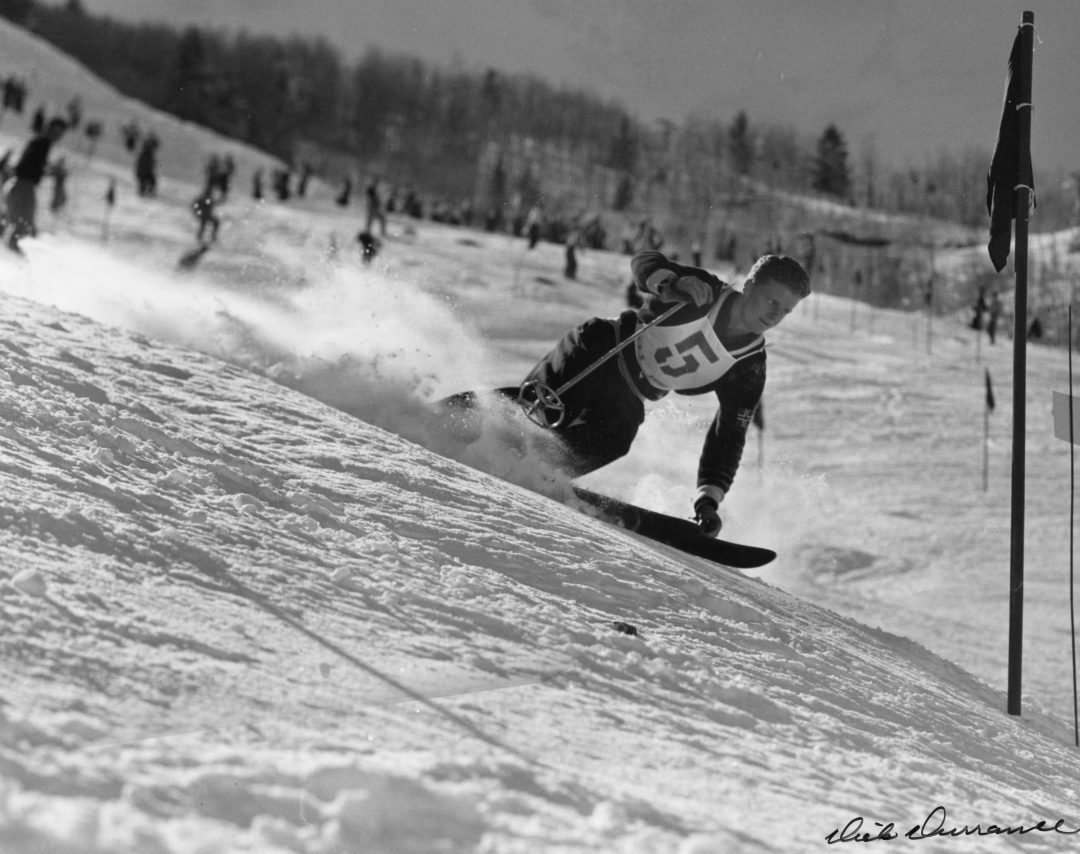
Who, where, 1950.

Yes, Stein Eriksen is the racer and the event is the FIS World Championships at Aspen in 1950. This was the first FIS event held outside Europe when Aspen was open for only four seasons. Italy’s Zeno Colo missed sweeping all three events by losing the slalom by 0.03 seconds. Stein Eriksen placed third in the slalom.


Mystery Glimpse: Who And Where?

Hint: 1950

Can you spot who this is dashing through the poles? Might be easy. But where and what event and what’s the significance? That’s the challenge. Note your replies in Comments, just scroll down.

Thanks to the Colorado Ski and Snowboard Museum for contributing this photo.

Who, where, 1950. Credit: Colorado Ski and Snowboard Museum

Last Week

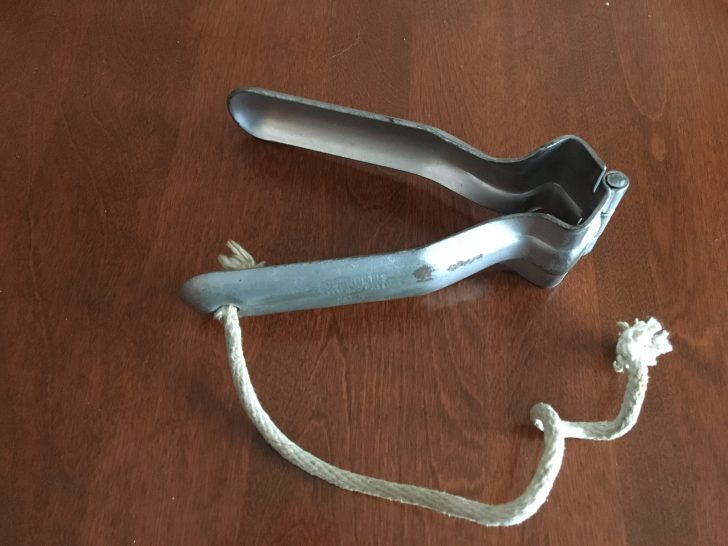
Credit: John Emery

Yes, a rope tow gripper. We’ve never used one, we just grabbed the twirling rope. But, many readers certainly have. It is significant that memories of using this device—from the 60s!—are so clear to our respondents.  John Emery, a reader who submitted this picture, says, “There used to be a heavy belt which the clamp was attached to via the short rope. It had a pouch that the clamp fit into when not in use. You would grab the tow rope with one hand and close the two halves of the clamp over the tow rope. The clamp was attached to the belt, and you would just lean back and enjoy the ride—one-handed even.”

Using this device took a bit of concentration.  From what we’ve read in the Comments section, it was getting it off at the top that was tricky.  It is a long way from a rope tow gripper to quadruple, high-speed chairs, and an impressive number of our readers have seen the transition from one to the other.


Mystery Glimpse: Hold On

You Have To Be A Certain Age To Have Used This.

Credit: John Emery

Thanks to reader John Emery, 65, from Meridian, ID, who skis as regularly as possible at Bogus Basin.  He sent in this memory from yesteryear.  Do you know what it was used for? By the way, John has been skiing since age 4 when he started back in Connecticut. There’s a bit of a nuanced hint in that last sentence.  Scroll down and write your guess in COMMENTS below.

If you have any “guess who/what this is”, let us know.  We are running these archival pictures in partnership with some outstanding ski museums sprinkled across the US and Canada.  However, if readers have a puzzler, we’ll consider it.

Last Week

Medals. Whose?

Yes, these are Bode Miller’s medals at the New England Ski Museum in Franconia, NH, at the base of the Cannon Mountain tram. Incidentally the new branch of the New England Ski Museum opens in North Conway this Saturday, Feb. 24, with a ribbon cutting.

These five medals represent Bode’s victories in the Olympics at Salt Lake City (2002) and Vancouver (2010).  Bode also won three other medals at the Olympics, presumably they are in a vault somewhere. (Source: Wikipedia)

  • Sochi 2014, bronze (super combined), bronze (super-G)
  • Vancouver 2010, gold (combined), silver (super-G), bronze (downhill),
  • Torino 2006, gold (giant slalom)
  • Salt Lake City 2002, silver (giant slalom, combined)

Bode can well be said to be the most successful American male Alpine ski racer of all time with eight Olympic and five World Cup medals over a 17 year career.

Despite his somewhat controversial start at NBC offering color commentary for the Alpine events at Pyeong Chang, we think Bode adds a level of expertise that is rare. He’s also into ski fashion and horse racing.  Interesting lifestyle for an ex-ski racer.

Mystery Glimpse: Tennis, Anyone?

She Also Skis Pretty Well.  Any Guesses?

This should be a challenge. No hints this time. Please write your response in COMMENTS below. Wild guesses welcome on this one.

Many thanks to the United States Ski & Snowboard Hall of Fame, Ishpeming, MI for providing this picture.

Credit: US Ski & Snowboard Hall of Fame

Last Week

Some funny responses to this one from last week.

These three stuffed creatures are the official mascots of the 2002 Salt Lake City Olympics.

Powder (rabbit), Coal (bear), and Copper (coyote) represent three resources which are abundant in Utah. They also symbolize the Olympic motto: Citius, Altius, Fortius, which is Latin for “Faster, Higher, Stronger.”

Not sure why a “Higher” is symbolized by a bear, or “Stronger” by a coyote.  We get the “Faster” for the rabbit.  Anyway…

Thanks again to the Alf Engen Ski Museum, Park City, UT. for the contribution.

Mystery Glimpse: Stuffed Animals Are…What?

Okay, Here’s A Tougher One.

Clearly there are some knowledgable snow sports enthusiasts out there.  Based on your responses from the last few Mystery Glimpse photos, you not only knew the right answers, you added details about the people and the pictures. So this week, we’re posing a little more difficult puzzle.

Who are these stuffed creatures and what do they represent? If you know, respond in COMMENTS below the picture.

Credit: Alf Engen Ski Museum, Park City, UT

Last Week

This is the infamous Jet Turn or Avalement which made a brief flash in the early 70s. We learned it is also called the Slow Dog Noodle by at least a few responders.

Former SKI Magazine editor, founder of Snow Country and creator of NASTAR John Fry commented on this maneuver:

“Avalement is not a turn, and Killy despised it. It was a technique term invented by Georges Joubert, derived from the French ‘avaler’ to swallow. The skier swallows bumps and irregularities in the terrain by collapsing and extending legs. At one point in the process, the skier looks like he or she is sitting back. It was more suited to hotdogging than to effective technique in slalom or gs.

For more on Joubert and Killy, read my book, The Story of Modern Skiing.”

We believe the skier is Tom Leroy, a forerunner of freestyle and the first person to do a double forward somersault back in the 6os.


Mystery Glimpse: Who’s This Unhappy Fella?

Our Next Mystery Photo Is Someone Who Became A Ski Celebrity.

If you think you know who you think this guy is, write your guess in COMMENTS below, just scoll down. We’ll reveal the answer next week.

Credit: SKIING Magazine

Last Week’s Mystery Glimpse 

This is Olympian Picabo Street as a young racer.  Thanks to the Alf Engen Ski Museum in Ogden, UT, for picking this out of its archives for us.

Picabo Street is an American former World Cup alpine ski racer and Olympic gold medalist. She won the super G at the 1998 Winter Olympics in Nagano and the downhill at the 1996 World Championships, along with three other Olympic and World Championship medals.  She was also a heart throb for a lot of men and boys who followed her during her competition. [Wikipedia]

We remember a news clip from coverage of one of her Olympic races. It said that in the midst of a medal run, she gave herself some encouragement by saying,”Come on, come on, come on.” That mantra stuck with us as a useful way to kick oneself into another gear whenever circumstances seem to warrant. She became an inspiration to hundreds of young women ski racers. Thanks, Picabo.