Tag Archive for: North Shore Nordic Association

Question For You: Groomed Or Au Naturel?

What Is Your Preference? 

Appleton Farms, Ipswich, MA. Trails are groomed by a volunteer group. Credit: SeniorsSkiing.com

We live across a little country road from a 900-acre conservation property. For years, we’d walk across the road, stumble over the stone wall bordering the street, and plod our way about 20 feet through tree-falls and heavy brush to a trail where we’d put on our xc skis. And then we’d break trail around our favorite loop, eventually meeting up with trails already made by skiers who made it out earlier than us.  Then we’d follow those.

In recent years, North Shore Nordic, a local, volunteer-run non-profit, regularly runs a trail-maker snow mobile around the property, creating perfect, groomed grooves for classic skiing and a corduroy path for xc skaters.  Now, we have the best of both worlds.  To get to the groomed track, we break trail from a remote corner of the property to the main area. We like the groomed trails.  But then, there are the walkers who are enjoying the beautiful snow-filled fields by walking on—and disturbing—the groom. So, hmmm.

And, here’s our question for you:

Do you favor going to a cross country ski area with groomed trails or on a local trail that is not maintained? Do you have a place that is cross country skiing close to home? Is it au naturel or groomed?

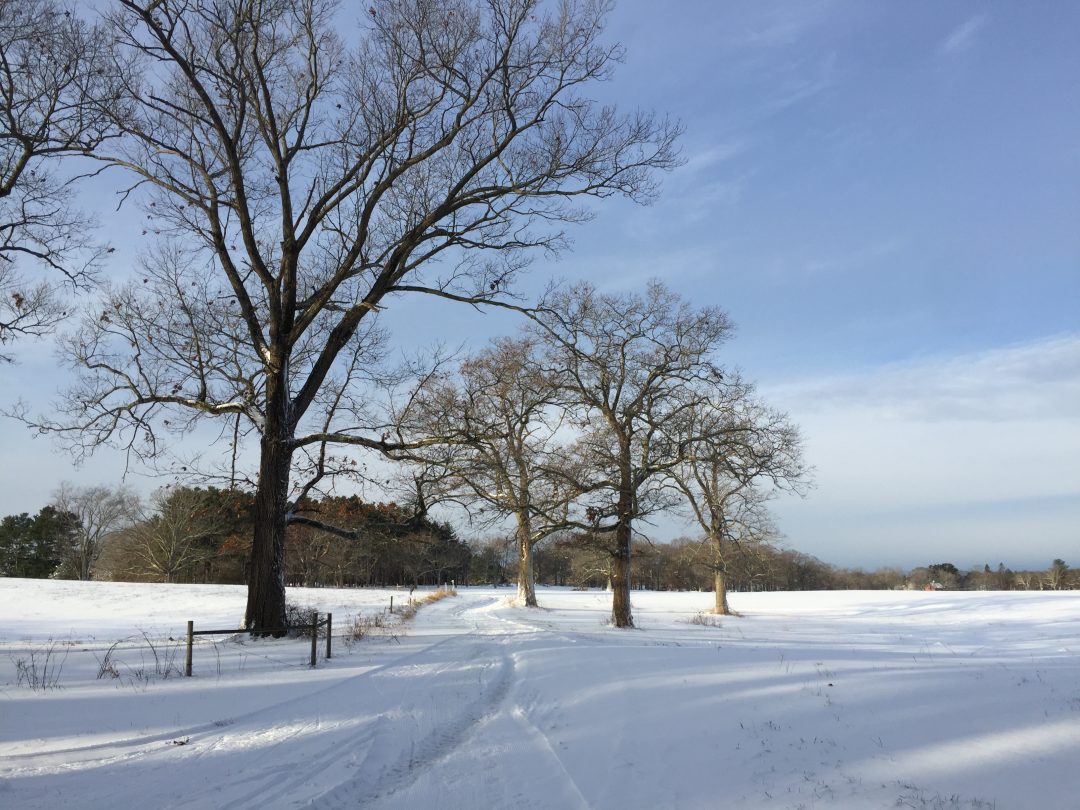
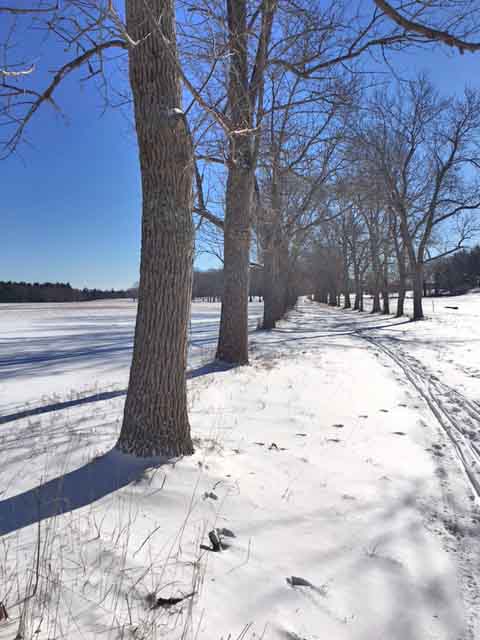
“Au naturel” trail across Appleton Farms field. Credit: SeniorsSkiing.com

This Week In SeniorsSkiing.com (Dec. 13)

Nordic Volunteers, Poutine For Calories, Exoskeleton Helps Legs, More Incidents & Accidents, Southern Skiing, Mystery Team, Weather Report.

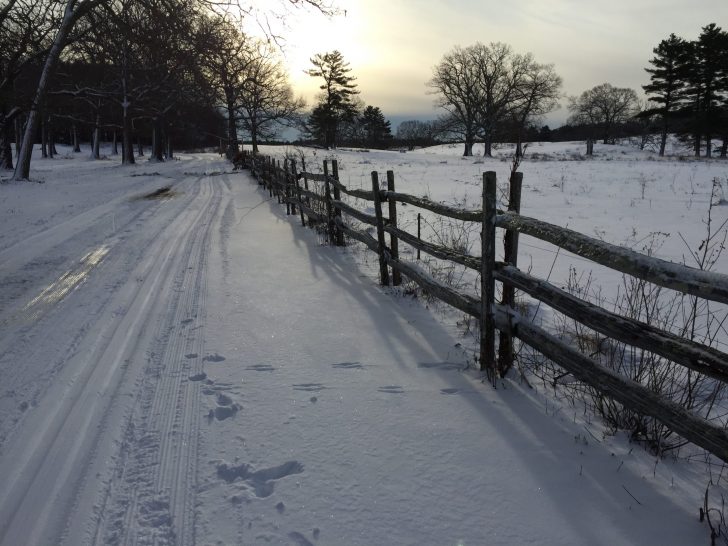
Early morning finds a groomed trail ready to go. Credit: MDM

This co-publisher of SeniorsSkiing.com loves to cross-country ski. Since we live directly across the street from a 900-acre tract of conservation land, owned and managed by the Trustees of Reservations, we head over the stone wall whenever there is decent coverage.

In former days, we bushwhacked our own trail through the woods until we connected with the network of tracks made by the early birds. (There are always earlier early bird tracks.) And we followed the early bird trail loops until we decided to bushwhack again back to home base.  Fun, but kind of tough for a seventy-five year old, especially at the beginning of the season and deep-ish snow.

NSNA Crew grooms all night for a wonderful trail in the morning. Credit: NSNA

Enter the North Shore Nordic Association. This is an all-volunteer, non-profit, community-based group which forms alliances with large landowners, most of whom are also non-profit organizations or municipalities, to maintain and groom existing hiking and biking trails for cross-country skiing, snowshoeing, and snow skating. For the past four years, NSNA has bought and maintained a collection of equipment through donations from local people and businesses.  Every time it snows, the groomers are out there, usually right after the snow stops falling, often in the middle of the night or early morning.
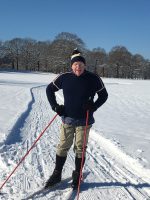
Your retro-attired co-publisher at the Farms. Credit: AAM

The grooming machines create two ski tracks, one a broad corduroy for skating and two pairs of grooved classic tracks on each side. There are many benefits to having these ready and waiting for a senior skier. It is obviously easier to ski, for both beginners and, well, everyone. The packed snow also lasts longer. The machines also loosen up hard pack to extend whatever snow is down.

The NSNA uses social media to alert folks about conditions every day. The group also maintains trail maps on a Smartphone app.  When we encountered a grooming crew on the trail one morning, the young man took our picture and immediately posted it on the group’s Facebook page.

All this is free for the skier. Enthusiasts and occasional visitors can donate to the NSNA to keep the machines turning. The group is well-run, organized, and community-focused. In the long term, they hope to create a racing league, offer lessons, and run a rental program.

The Point: If you don’t live near a cross-country ski area or resort where trails are groomed and maintained and rental equipment is available, consider forming a group like NSNA. All it takes are people who love to cross-country ski or snowshoe, some willing land organizations or town governments, and some energy to get all this organized.

Trail Masters Update

We have mailed out over 150 Trail Master patches to readers who responded to our Spring Survey as having skied more days than their age.  Most were sent to US and Canadian readers, but there were also numerous addresses in Sweden, Finland, England, and Australia.  Please note because some addresses were not completely filled out in our survey form, we were not able to send patches to all qualified readers.

This Week

Poutine, a Frency Canadian comfort food dish. Credit:Yvette Cardoao

SeniorsSkiing.com Northwest correspondent Yvette Cardozo  reports on a Canadian cuisine specialty at Silver Star Resort in BC. Ever have Poutaine? It’s a hearty meal designed to replace calories lost to a heavy day of skiing.  There’s more.  Ever had a Caesar? Not a salad.  Find out here.

We have a contributor review of the skiing assist aid Againer Exoskeleton.  This device can actually extend your skiing career by supporting your legs and back. Consider our reviewer’s experience here.

What’s the highest mountain on the East coast of the US? If you said Mt. Washington, you’d be wrong.  Mt. Washington tops off at 6,288 feet, but Mt. Mitchell reaches up 6,684. Where is Mt. Mitchell? North Carolina. Surprise.  Co-publisher Jon Weisberg reveals more secrets about Southern geography and skiing in his book review of Southern Snow: The New Guide To Winter Sports From Maryland To The Southern Appalachians. Read more here.

Correspondent Jan Brunvand reports an Incident & Accident that he actually filmed taking place.  His on-scene photos and report are astonishing.  As readers know, we are collecting a portfolio of collisions to see if there are comment threads.  With that information, we hope to influence ski industry practices and policies on managing unruly and dangerous skiers.
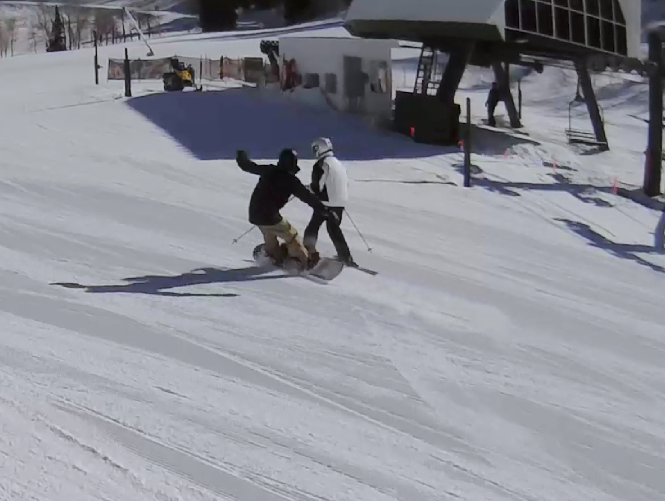
Correspondent Jan Brunvand captured an incident in action.

Last week’s Mystery Glimpse photo was Rip McManus in action. We provide a capsule profile of Rip and his impactful but all too short career in the skiing world.  This week’s Mystery presents a jumping team from long ago from Alan Engen’s collection of historic ski photos.

Finally,  Herb Stevens, the Skiing Weatherman, gives us a round up of regional forecasts as well as a tutorial on what a “trough” is. Here’s his story.

Thanks for reading SeniorsSkiing.com.  Tell your friends and remember, there are more of us every day and we aren’t going away.

Feb 1941. Ski Jumper. Can you name them? Credit: Alan Engen Collection




SeniorsSkiing Guide: History All Around At Appleton Farms

Boston’s North Shore Has A Peaceful Place For Senior Nordic Skiing Or Snowshoeing.

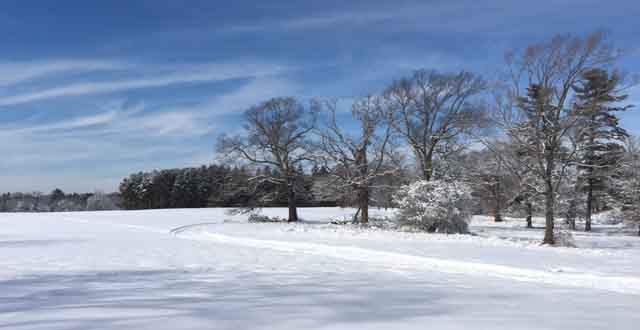
Skiing in open fields under a bluebird sky at Appleton Farms, Ipswich, MA is about as good as it gets. Credit: SeniorsSkiing

Skiing in open fields under a bluebird sky at Appleton Farms, Ipswich, MA is about as good as it gets.
Credit: SeniorsSkiing

We cross the road and climb over the stone wall into a grove of trees, walking a few yards to a trail. Stepping into our skis, we take a look around; we are in the woods, frosty air, untracked trail ahead. No one around but us. Off we go to our favorite loop around The Farms, a very special place to ski, snowshoe or walk.

History and Setting

In 1638, Charles I gave Samuel Appleton a grant of land on Boston’s North Shore. Since then, Appleton Farms has continuously been a bona fide, 1,000-acre farm, first run by the Appleton family and now under the care of the Trustees of Reservations, a land conservancy in Massachusetts. Appleton straddles the border between Ipswich and Hamilton, MA., in the heart of equestrian estate country. When it snows, the open fields and pastures and windy trails welcome snow sports enthusiasts. For cross-country skiers and snowshoers, Appleton is a trip through beautiful vistas and historical artifacts of a 377-year-old property what has remained more or less intact since colonial days.

Terrain

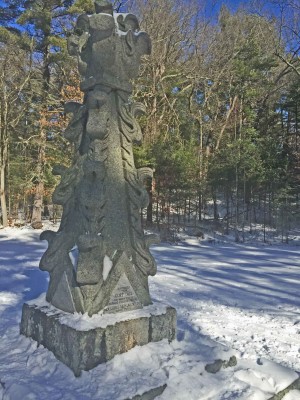
A pinnacle from Gore Hall, former library at Harvard. The Appleton family had close ties. Credit: SeniorsSkiing

A pinnacle from Gore Hall, former library at Harvard. The Appleton family had close ties.
Credit: SeniorsSkiing

There are two sections to the farms: The working farm itself with big fields and tractor roads, and the Grass Rides, a spoke-and-hub networks of trails arranged around one of the four pinnacles from Gore Hall, the former library at Harvard University.  The three others are scattered in strategic points around the property. It’s fun finding them.

Generations of Appletons created a country estate with long allées—parallel rows of linden trees—that were used for carriage and horse riding. They make perfect ski trails. On the farm side is the Great Pasture, a 133-acre field that is reportedly the largest piece of open land left in Massachusetts, historic farm buildings and the restored main house, plus a dairy that sells milk and cheese from the farm’s herd and much more. Skiing through these big, open fields on a bluebird day is what keeps bringing people back to the sport; it’s quite a restorative experience. The Grass Rides network wanders through marsh and hillside settings where birds and wildlife abound.

This year, North Shore Nordic Association, a new community group, is using a snowmobile groomer to create trail loops around the property. A groomed track really helps with traction and glide, taking away need to break trail.

Why Seniors?

Seniors will find the relatively flat terrain at the Farms easy to ski or snowshoe. On a weekday, you will find the trails to yourself. Indulge your photography hobby or bring a lunch in your backpack and enjoy the quiet. If you’d like slightly more challenging terrain, the Grass Rides has some ups and downs, but nothing that is too aggressive. The Farms restricts visits to humans only, while the Grass Rides is a popular place for dog walking, even in the winter. Doggies tend to disrupt ski tracks, so get to the Grass Rides early if you go. Access to the trails is easy. Just park and put on your skis, no walking. Visit if you’re passing through, in town for a wedding, heading to or from ski areas in New Hampshire or Maine or just looking for something different.

Appleton's famous Allees, formerly carriage paths, make perfect ski trails. Credit: SeniorsSkiing

Appleton’s famous Allees, formerly carriage paths, make perfect ski trails.
Credit: SeniorsSkiing

Bottom Line:

If you are member of the Trustees of Reservations, access to Appleton’s is free. Non-members pay $5 per car at the solar powered kiosks in the parking areas.

If you are coming from away, you can find lodging in Ipswich and Hamilton where there are archetypical country inns. The Trustees also maintain an inn at the Crane Estate, down by the beach. Skiing on the beach in the winter is another story for another time.

Trail Map