Tag Archive for: #OuiSkiQuebec

Learn About Layering: It Will Be Cold

Some Lessons About How To Dress For Frigid.

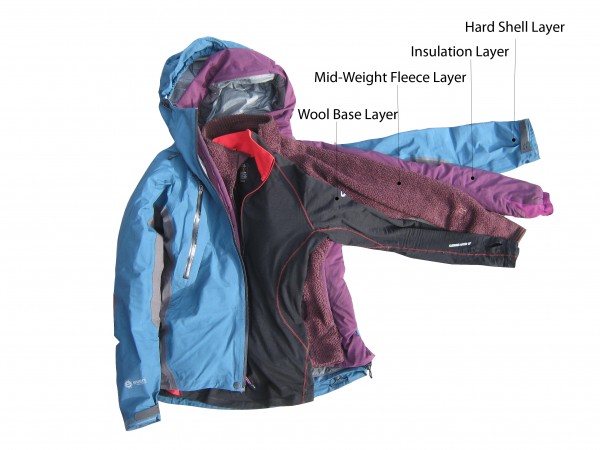
Four layer system for cold weather. Of course, there are pants. Credit: Outdoor Gear Lab

Four layer system for cold weather. Of course, there are pants.
Credit: Outdoor Gear Lab

Last February, we spent a wonderful long weekend in Quebec, visiting the lovely city’s Winter Carnavale and skiing at some fabulous ski resorts (Mte. Ste. Anne, Le Massif de Charlevoix) and dining in a little village of Baie-Saint-Paul.  Delightful.  If you  ever want a Euro-type ski experience close to home, Quebec is the place.  The only cloud was that on those days, it was thrillingly cold, ranging from around at least -20 F up to 0 F.  So we layered up.  We noticed that while we initially kept more or less warm, we soon found ourselves working up a mighty sweat under all those layers.  We had clearly over-dressed, and we paid for it by becoming uncomfortably chilly after a few runs.

So, we decided to learn about layering.  Sure, we know about “cotton kills” and “wet wool is warm” (thank you, Navy basic training), but we weren’t up on the newest thinking.  We consulted the following sources, and, after reviewing the advice from experts, realized we had made some mistakes in our enthusiasm for warmth.

How layering is supposed to work. Credit: BassMegeve

How layering is supposed to work.
Credit: BassMegeve

As you are well aware, it’s all about layers.  Consider this:

Base Layer–This is what used to be called long underwear.  The new performance materials are designed to manage your sweat level, wicking it away from your skin. Thin wool underwear is still a classic.  We all understand that the days of waffle weave are gone.  Check.

Mid Layer–Over your underwear, you will place a classic fleece, a thin wool sweater or one of those puffy, lightweight, squishable puffy jackets, depending on how cold it is and your activity.  The point here is insulation, that is, creating an air space that will create a barrier to cold air.

Insulating Layer–You thought the Mid Layer was insulating, you say?  Yes, if it is moderately cold.  When you get to cold, cold, you are going to need some more.  This could be a light-weight jacket (the squishy kind mentioned above), a fleece jacket or a perhaps a thin vest, depending.

Outer Shell–A “hard” Outer Shell is your wet protection.  A water-resistant top, like Gore-Tex, sheds moisture and keeps you dry while allowing the moisture inside to escape.  A “soft” Outer Shell is basically a wind jacket that can also serve as a rain/snow buffer in more moderate temperatures.

Head Gear and Accessories–You have to let your head breath. Most of your body temperature will exit through your head, so you have to let some of it out.  We all seem to get by with just wearing a helmet in moderate condictions,  When it goes really cold, a thin nylon skull cap underneath your helmet might make a lot of sense. You will need a neck-up gaiter, face mask or a Balacalva to protect your throat and face.

That said, where did we go wrong in our frosty day in Quebec?

  1. We had on too any layers.  Base, double insulating layers, vest, “hard” outer shell with down liner, which was yet another layer.
  2. We had too much head gear on.  Helmet, fleece skull cap, Balaclava, neck-up gaiter, scarf.
  3. We didn’t take the time to change or have dry replacement clothes to unlayer.

All lessons learned.  Ever happen to you?

Here are some links to expert advice about layering.

REI Expert Advice On Layering

Outdoor Gear Lab Layering How-Tos

EVO Dressing For Backcountry

Sierra Trading Post Layering Guide

Here’s a video from Sierra Trading Post you might find interesting.

More Ice Canoe Racing On The St. Lawrence

Looking Back At A Cool, Cold Sport In Quebec.

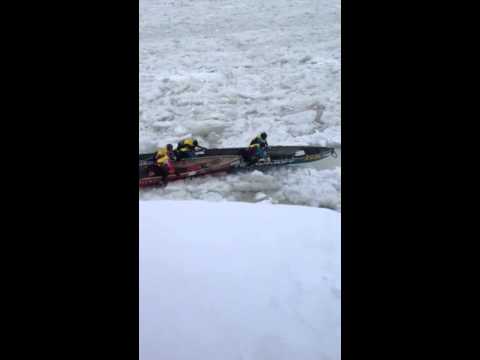
In February, we traveled to Quebec to visit the Winter Carnavale and the legendary ski resorts on the St. Lawrence, Mount Saint Anne and Le Massif de Charlevoix.  The city was alive with thousands of people celebrating the brilliant cold and the many events of the Carnavale.  One of these was the most extraordinary athletic event we’ve ever witnessed:  The Ice Canoe Race on the St. Lawrence River.  As we watched from the shore, about a dozen or more crews hustled and pushed specially built canoes over and around ice floes.  Triangular course went from one side of the river to the other; the “professional teams” had to make two complete circuits.  Click here for a clip from our eyewitness account.

Now we have more expansive coverage, thanks to our good friends at QuebecRegion.  Have a look; it is clearly an impressive experience for participants and observers alike.  Recall this video when you are complaining about the heat and humidity of next August.

For more information on the Quebec Region’s many attractions for active seniors, please click here.

Le Massif de Charlevoix: Views, Trails, and Chic

Where else can you ski into a major river (almost) and take a ski train to a charming village?

About an hour north of Quebec City, we find Le Massif de Charlevoix, a magnificent and major North American ski area that offers several exceptional features:

Skiing into the river? Looks that way at Le Massif de Charlevoix Credit: SkiZone

Skiing into the river? Looks that way at Le Massif de Charlevoix
Credit: SkiZone

  • Most people arrive and park at the top of the mountain, making their first run down without an inaugural lift up.
  • Runs are varied and long from very pleasant groomers (which we like best) to mogul fields, glades and double diamonds. There is even an off-trail sector of 99 acres for back-country adventurers. Le Massif de Charlevoix has the highest vertical drop (2,526 ft.) in Eastern Canada and east of the Rockies, so trails basically keep going and going. (The longest one is 3.2 miles.) But stopping to take in the view is worth it because…
  • …A couple of hundred yards from the bottom is the St. Lawrence River. The impression you get as you head down the piste is that you are heading straight into the water. It’s an illusion that is quite captivating and photogenic.
  • Not only does Le Massif de Charlevoix host a piste de luge—sled run—that is 7.5 km long, it also has the only TRIPLE black diamond trail we’ve ever seen. It’s called La Charlevoix, it’s “extremely steep”, and it’s designed as a downhill course for FIS approved races. We looked at it respectfully from afar.


  • Light rail train stops at Hotel le Ferme in Baie-Ste-Paul Credit: PhotoGT

    Light rail train stops at Hotel le Ferme in Baie-Ste-Paul
    Credit: PhotoGT

    You take your last run down, and, at the very bottom of the piste, you and your skis, gear and boots can take a transit gondola to a light rail station where a train will take you about 30 minutes along the shore of the St. Lawrence to the little town of Baie-Saint-Paul, the hometown of the world famous Cirque du Soleil. The beer on the little train was most welcome, served by une serveuse très charmant. Again, the views of the river were breathtaking; we were glued to the window until we arrived at…

  • Hotel La Ferme in Baie-Saint-Paul, a new, very chic, stylish, design-winning hotel built as the first phase of a multi-phase project that will “responsibly” develop the area. With the hotel in town as a four-season destination for visitors, plans are also in process to develop ski-in, ski-out condos at the base of the Le Massif de Charlevoix within five years.
  • The quaint and historic village of Baie-Saint-Paul is an artist colony with galleries, shops and chef-owner gourmet restaurants that capitalize on fresh, local agriculture. Our discovery was Au P’tit Resto Suisse where the fondu and raclette brought us to a magical place.

    Au Ptit Resto Suisse serves gourmet racelette. Credit: Tourisme-Charlevoix

    Au Ptit Resto Suisse serves gourmet racelette.
    Credit: Tourisme-Charlevoix

So, senior snow enthusiasts, we’ve discovered something new for us in the north. The Charlevoix region is not only a winter destination for skiers, cross-country, snow-shoers and back-country explorers, but from what we’ve seen, there are many outdoor adventures for other times. A short drive from the northeast or the mid-west, this is an experience waiting to happen.

For more information on the development at Le Massif visit LeMassifVision2020.com

Au Quebec Pays des Merveilles d’Hiver

Au Quebec Pays des Merveilles d’Hiver

Messieurs et Mesdammes, nous aimons le Quebec en hiver! With apologies to Madame Haydu, my high school French teacher, our recent journée au Quebec was trés intéressant, and nous were heureuse to tell you toût de l’historie.

Eçoutez, Senior Skiers, if you are looking for a winter vacation in snow country that is different, even exotic, consider heading north to Quebec. There you will find some incredibly beautiful multi-snow sport resorts, world-class hotels and scenery that is honestly like nothing you’ve ever seen before. All so close, all so exotique. But before we tell you about our skiing adventures, we want to report on Quebec’s winter jewel: le Carnavale de Quebec.

Mascot Bonhomme makes us feel welcome at his Palais. Credit: Tourisme Quebec

Mascot Bonhomme makes us feel welcome at his Palais.
Credit: Tourisme Quebec

If you are reading this, you are most likely a friend of winter. Let us tell you straight up that les Quebecois are amants (lovers) of winter. Frankly, when you live up there, you have to be. Visiting Quebec City during Carnavale is a lesson in celebrating a glorious winter culture built on welcoming the magnificent cold and all it brings.

We met Bonhomme, the puffy white snowman mascot of Carnavale, at an evening parade which featured dramatically lit creatures of the North—narwhales and wolves—floats with scenes of Quebec history, musicians, clowns, acrobats, motorcycles, all in the brilliant cold air. It seemed the entire city lined the parade route with rosy-cheeked children riding on parents’ shoulders, many enthusiastic bleatings of plastic horns, and a warm feeling of camaraderie.

Musicians' hut at le Monde de Bonhomme at Quebec's Winter Carnavale. Credit: SeniorsSkiing

Musicians’ hut at le Monde de Bonhomme at Quebec’s Winter Carnavale.
Credit: SeniorsSkiing

Downtown, we also visited la Palais de Bonhomme, a really large, ornate, multi-room structure built of crystal clear blocks of ice, with themed rooms and ice furniture. We walked over to the Plains of Abraham where we found an extraordinary outdoor exhibition of snow slides, kid’s activities, sleigh rides, ice sculptures, musicians in heated booths, and squeaky snow underfoot.

The pièce de résistance, though, was the canoe racing on the St. Lawrence River, choked as you would imagine this time of year with jagged ice floes and big bergy bits, and with the occasional stretch of open water. Teams of fiveIceboat hardy athletes dressed in wet suits and spiked shoes push, pull, heave, lift and row bateaux about 20-25 feet long through, around and over all this. The idea was to head around three buoys, two placed on the Quebec side of the river and the third on the far side, at least two miles across. Amateur teams went around the buoys once; the pros had to make the circuit twice. Now that’s an extreme sport.

Quebec is an easy car ride from anywhere in the Northeast and even from the Midwest; major airlines fly into Jean Lesage International. It’s probably the most European city in North America. Restaurants and cafes line le Vieux Quebec, and there are many art boutiques and craft shops though out the city. Just being in Quebec in winter is exhilarating; the locals know how to live in winter, and they start by loving it.

Coming next: Skiing the Charlevoix Region.

The Art of Cross-Country Skiing: The Basics

Cross country (XC) skiing is a terrific way to enjoy the great outdoors in winter. Is it great for older people that want to stay active? You betcha!

From Roger Lohr, founder and editor at XCSkiResorts.com and prolific writer on cross country skiing

The pleasures of XC skiing can be a wonderful change of pace for winter activities.  Whether you seek the solitude of solo skiing or are spending some quality time with family and friends, it’s relatively inexpensive, accessible and aesthetically pleasing. It’s also a great rhythmic, aerobic activity, enabling you to burn up hundreds of calories per hour without straining joints such as ankles and knees. You’ll get a low-impact workout while enjoying the outdoors, and the scenery sure beats the view at your local health club. Here are some tips:

Boundary Country Trekking x-c skiers in northern MN enjoy some hot chocolate. Credit: Roger Lohr

Boundary Country Trekking x-c skiers in northern MN enjoy some hot chocolate.
Credit: Roger Lohr

Where do you plan to ski? The terrain and location helps determine your equipment choices. XC skiing allows you to choose from a variety of locations. parks, golf courses, hiking trails, or XC ski areas are all good choices. Commercial XC ski areas charge a fee for access, but they offer maintained trails and tracks, signage, and you can get help if you run into trouble out on the trails.

You can rent equipment at your local ski shop or at the ski area. This is often recommended for first-time skiers, and some ski shops will apply the price of rentals toward purchasing new equipment.

Buying used equipment at a ski swap may be a mistake. Be aware that at garage sales and some swaps, you may wind up with gear that is outdated or inappropriate for you. Buy a package deal that offers a discount when you buy skis, boots, bindings, and poles together.

In-track XC skis are used with a traditional kick-and-glide motion on maintained track systems set by special grooming machines. They have minimal sidecut so the skis will stay in the tracks. Sidecut refers to the narrowness of the middle part of the skis in relation to the wider tip and tail.

Off-track XC skis are often used to navigate ungroomed trails and terrain in parks, open fields, and on golf courses. They are wider than in-track XC skis and provide more flotation and stability in fresh snow. Wider and metal-edged backcountry skis are for the more adventurous skier, who experience variable snow conditions.

Some XC skis have waxable bases, on which you put “kick wax” for grip. Other skis have waxless bases, where a pattern in the middle third of the ski base, such as small plastic ridges or scales, provides the grip. Waxless skis have been designed to run beautifully in just about any kind of snow. Your decision will center on whether you want optimal performance by waxing or optimal convenience with waxless skis.

Have the ski bindings professionally installed on the skis. Be aware that the bindings come in different integrated systems so they must be matched to the type

Quebec's Charlevoix region is a wonderful destination for cross-country skiing.  Credit: Tourisme Quebec

Quebec’s Charlevoix region is a wonderful destination for cross-country skiing.
Credit: Tourisme Quebec

of boots that you select. Your boots should feel just like running shoes so try on the boots wearing the socks that you plan to wear when skiing. Consider foot beds or fitted insoles if you have problems with your feet. Because of these various sizing methods, it’s important to try on boots before buying them. The fit should be snug and your heel should remain in place. You should be able to wiggle your toes.

XC ski poles are used to help forward thrust. Skiers plant their poles behind on an angle. If this is your first set of XC gear, any reasonably light pole will be fine. Select poles that fit comfortably under your armpits when you stand on the ground.

Now get going – XC skiing is relatively easy to learn, but first-timers should take a lesson from a qualified instructor at a commercial XC ski area to greatly enhance the experience. As your confidence on the skinny skis grows, you’ll have a life time of nature outdoors, fitness and fun.

Quebec Winter Carnival: Canoe Racing On The Frozen St. Lawrence

A New Extreme Sport Emerges For Those Who Really Love The Cold

Hearty, are we?  Well, these lads surely are.  These garcons are one of a dozen or so teams, some of them professionals, who are canoe racing on the St. Lawrence during Quebec’s Winter Carnival.  The amateurs included a women’s team, mixed men and women teams and a few folks who just wanted to have some fun.  You might wonder why this is a good idea for a sport.  Don’t bother.  It’s about The Extreme.  And learning to love the magnificent cold.  This was taken on Feb 8, 2015 when the temps were -20 C and the wind was blowing at least 25 knots.  What’s the wind chill? Anyone?  Anyone?

Quebec’s Winter Carnavale was the site of the North American Snowsports Journalist Association Annual Meeting.  More to come on Ice Hotels, ski trains and memorable “versants” (ski areas) just outside Quebec.