Tag Archive for: PSIA

A Day With Kathy Brennan, New CEO, PSIA-East

Kathy Brennan, new CEO, PSIA-East, at Seven Springs, PA

I recently skied with Kathy Brennan, the new CEO of PSIA -E (Professional Ski Instructors of America- Eastern Division).  Kathy has an impressive background in the snow sports industry and is currently on staff at Waterville Valley, New Hampshire. She has been touring areas in her division which extends from Maine to North Carolina.

An accomplished skier and excellent teacher, Kathy did something at the beginning of our session suggesting how she‘ll function in her new role:  She asked everyone for feedback on how to make PSIA better, any suggestions or comments on the organization and, in short, what she could do to improve the organization’s mission of being an education platform.

She received numerous comments and suggestions. I asked what PSIA was doing to retain older instructors. She said we never stop learning even after seniors are long past their certification exams.

She also explained that she’s dedicated to assuring that PSIA partners effectively with areas, suppliers, patrol, race programs, and the industry, in general. Educational programs can be utilized by any member, especially seniors who want to stay in the game and improve their skiing and teaching abilities. In her words, PSIA has changed from a “pin chasing” entity to an organization dedicated to providing programs for skiers and boarders of all ages. She’s meeting with area management to educate them on the value of the organization and how its current direction will lead to better instructor education, better lesson quality, and greater customer satisfaction. This approach also will help areas retain good quality certified instructors.

Our conversations were held on chairlifts. On the snow, she gave us – skiers, tele-skiers, and snowboarders – a clinic. Her emphasis, common to the three approaches: balance,rotary movement, edging, and pressure control.

I’m retired from ski teaching but maintain my membership in PSIA with the goal of learning something new every year.

Kathy’s goal is to unite the entities in the ski industry and to make them aware of the value of what PSIA brings to the table. From my time with her at Seven Springs, I’m confident she’ll have great success.

Short Swings!


This is our final issue of 2020. We’re not saddened to see the year go. Whatever your holiday of choice, please enjoy it safely. And celebrate the arrival of the New Year. It’s time to turn the page on so many things. Here’s wishing you a great season and many bright and promising days ahead!

What Do Vaccines and Ski Areas Have in Common?

Vaccine development and ski areas have something loosely in common: the public-private partnership. This may be a stretch, but hear me out.

Several Covid vaccines, like many other drugs and technologies, were developed with some level of government participation. In the case of  Pfizer’s, the government guaranteed to purchase $1+ billion of product long before it was approved. For decades, technology transfer programs have helped medical and other technologies — discovered, invented, and/or developed with public funds — get picked-up and commercialized by the private sector.

What does that have to do with skiing? At least 122 ski areas lease property from the Forest Service. Among the more prominent are Vail, Aspen, Snowbird and Mammoth.

Next time you’re making turns on leased -government land, consider the public-private partnership helping you enjoy the sport and, hopefully, protecting you from Covid.

Six Word Challenge

Tom Irving, 82, is a volunteer instructor for the Two Top Mountain Adaptive Sports Foundation. He says  teaching in the program is “the best decision I ever made.” He mostly teaches disabled veterans 3-4 days a week at Whitetail Resort (PA). Tom’s scheduled PSIA clinic was cancelled, as were two group ski trips he had booked. And he has high hpes for the vaccine. All of which leads to his six-word summation: Missed one. Cancelled two. Future’s Bright.

Corky Miller, 75, loves skiing Buena Vista (230’ vert) near Bemidji (MN), which explains his six-worder: Local fast hill, ski all day!

Brian Frias is a California skier. As part of the Masterfit organization he has developed a keen eye for the sport. Looking at the bright side of Covid, he offers this one: Long lines lead to empty slopes.

Please keep sending your six-word entries. A few winners will receive the Bootster Shoe Horn for Ski Boots. Please post your entry to Comments or send to jon@seniorsskiing.com.

A Completely New Approach to Prescription Goggles

SnowVision Rx goggles integrate prescription with inner lens

SnowVision makes a unique goggle with your prescription integrated into the inner lens. Unlike conventional Rx inserts, in which the insert is a separate component subject to fogging and often limiting vision range, this goggle maintains the eye-to-lens distance, resulting in fog-free wider range-of-vision. I’ll be reporting on my experience with the SnowVision goggle in an upcoming issue. But from everything I know about it, the goggle is a breakthrough, especially for older skiers. For more, click here or on the SnowVision advertisement.

Wolf Creek Has 10 Feet!

Wolf Creek Ski Area in Southwest Colorado keeps on getting the goods. As of this writing, the area has received more than 129″.

Alta/MIT Study: Silence Reduces Risk of Infection

The more and louder we speak, the greater infected individuals transmit the virus. A team of MIT students scientifically analyzed how and where residents and guests of Alta have the greatest probability of catching Covid. They determined that people in loud indoor dining areas have a 60% chance of catching the virus – even with tables 6 feet apart. Analyzing space, air circulation and time spent in public buses transporting people to/from the resort, they learned that if no one spoke, the busses could carry 60 masked passengers vs the 20 masked and socially distanced passengers Utah Transit Authority has mandated for this season.

New Chapter in Skiing Haves vs Have Nots

Luxury seating in the VIP gondola

The Eiger Express, a new tri-cable gondola system was launched earlier this month on Switzerland’s famed Jungfrau. It “…combines all the advantages of the aerial gondola and the funicular,” being able to run across long expanses with fewer support towers – only 7 for a length of more than four miles! A ride that used to take more than an hour is now reduced to 15 minutes. Among other Eiger Express features is the Platinum Club which includes a VIP lounge, where members can await their own VIP Gondola car. The car holds 8 people and features leather chairs and a champagne bar. Couple’s membership is a mere 18,000 CHF ($21,000+) a year. Numerous US resorts already have VIP clubs and passes. How long before they, too, get their own gondola car?

Redford Sells Sundance

Butch Cassidy and the Sundance Kid

Movie star and environmental activist Robert Redford sold Utah’s Sundance Mountain Resort to two high-end real hotel development companies. The new owners plan to add a high-speed lift and new trails. Sundance is a jewel long in need of infrastructure improvement. I’m looking forward to seeing what the new owners do. Redford started the resort in 1969 after purchasing the small Timp Haven area and renaming it Sundance after Butch Cassidy and the Sundance Kid, in which he and Paul Newman co-starred.

Saddleback Re-Opens

Saddleback covered in snow

Saddleback Mountain (ME) reopened earlier this week after being dark for the past 5 years. Arctaris Impact Fund purchased the mountain less than a year ago and has invested $18 million.

Two Short Videos

Mount Cain is an old-fashioned powder magnet on Vancouver Island (BC). Average snowfall is 38′. Vertical drop: 1,499′. Two T-Bars and one rope tow. May be on the small side, but as you’ll see in this 15 minute video, it is well-loved and skis big.

Ski Rio in the Sangre de Cristo Mountains of northern New Mexico has been closed since 2000. This eight minute video shows its abandoned state and the turns still possible for those who choose to climb.


“I Felt Like I Skied One Run, Not Eight”

[Editor Note: SeniorsSkiing.com is asking our readers to contribute to support our online magazine. Yes, we have grown in the number of subscribers and advertisers. But our expenses have also grown. You can help us defray some of these expenses by helping us out with a donation.]

Support SeniorsSkiing.com by clicking here.

______________________________________________________

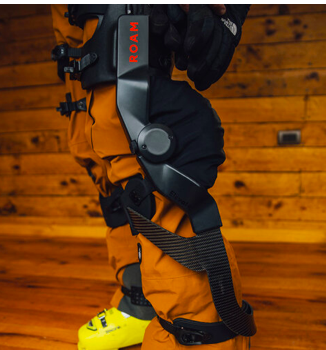
Roam Elevate is a computer-driven exoskeleton that anticipates turns and adjusts knee and quad support to aid the skier’s natural motion. It helps people ski stronger and longer by offloading up to 30% of the user’s body weight from the skier’s quads and by reducing painful knee joint compression.

Elevate can be rented at several Western ski resorts and will be available for sale next season.

To get a better understanding of how Elevate works on the hill, we asked Rick Hovey to give it a test drive.

Rick Hovey and his signature turns.

Rick is 65 and is a longtime resident of Park City. A Level II PSIA instructor, he skis 100+ days a year. Last season, despite a diagnosis of chondromaiacia patella (arthritic knees), he skied one million vertical feet. 

Rick has put off recommended partial knee surgery, opting instead for Physical Therapy. He has given up teaching and reduced his time on the hill.

He tried the Roam Elevate a few weeks ago and submitted this report.

Clay, the Roam Robotics rep, showed me how to use the straps to attach the exoskeletons to my boots and then to my lower and upper legs.  It was simple.  

The product uses a slim backpack that contains a lightweight laptop, battery and compressor. Two connectors per side come out of the pack to attach to each exoskeleton. One connection is an air hose; the other is a connection to the computer.

While walking, the apparatus felt light and unencumbering, even if the exposed carbon fiber and wires made me feel a bit like RoboCop

We clicked into our skis as Clay explained the available settings. The controller is mounted on the shoulder strap and easy to use with gloved hands.  There are levels of assist and speed adjustments to suit your style and desired terrain. The speed adjustment sets how fast the computer tells the compressor to release the assistance pressure. In general, the idea is to quicken the speed adjustment for short radius turns or where unweighting is needed quickly. 

As soon as we pushed off I lost the sense I had an exoskeleton on and that it was assisting the load on my legs. It felt completely natural and improved my sense of stability.

There is a noticeable vibration from the compressor in the pack, which Clay says to think of it as a massage for your back (bonus!). The vibration became less noticeable after one lap.

A few runs later, we played around with different settings. I really liked the high assist and slow speed setting for the easy cruisers with long radius turns. I felt stronger and forgot about protecting my arthritic knee and I experienced more complete turns with less effort. It also gave me the confidence to lay down deeper carves than I would without the device.

We then changed the settings and tried linked, short radius turns on steeper groomers. I was impressed with how well this worked with no encumbrance of the inside ski hanging-up because the pressure was released right when needed. I used this same setting on a long bump run and was equally impressed. 

Roam Elevate backpack and control device

The apparatus always seemed to agree with what I was doing, while enhancing my skiing in a controlled and predictable way. 

I should mention the “chop.” Rough snow was on the edges of the groomed runs, just enough to rattle the bones if going fast… this is where I would normally take the first exit to Smoothsville. The Roam Elevate seemed to absorb the bumpiness; no jarring of the knee joints or loss of control. It was like a good suspension on a mountain bike.

After numerous fun and various runs, Clay and I did a final, fast top-to-bottom cruiser. At the bottom, I told Clay my legs and knees felt like I just skied one run, not eight! 

I would recommend the Roam Elevate to any skier who has knee and/or leg strength issues. And, if it helps you avoid surgery and extends your skiing life, the value could be great.

The Roam website is taking first-come, first-served reservations for a slimmed down, next generation product for $3500 (includes a 30% discount). To learn more, click on the Roam Elevate ad on the home page.

Againer Helps You Ski Stronger and Longer

How many of you remember the days when you got to the mountain early, skied all day, and quit when the lot was empty? I didn’t fully appreciate it then and look back on those times with nostalgia. Youth is wasted on the young.

But what if we could be out there a bit longer and ski a bit stronger? There’s a device that helps do just that.

It’s called the Againer, and for more than a decade, European skiers have used it to reduce pressure on their knees and backs and to increase their leg muscle performance. Now, for the first time, the Againer is available in the U.S. and Canada via a unique demo/purchase program. More on that later.

Againer attaches easily to boots and legs and employs a shock absorbing system that provides an overall boost to the skiing experience.

An Expert’s Point of View

I won’t be able to try it until January when I’m back on the hill. But I have a copy of a letter about the Againer written by Mark Spieler, a ski pro for 45 years, a PSIA Alpine Examiner, and Ski School Director of Disabled Sports Eastern Sierra, a nonprofit adaptive ski school in Mammoth Lakes, California. 

He characterizes the Againer as “…a device to help people save energy while skiing” and states that before trying it he was skeptical. Spieler explains that he tested it “through hard, fast and dynanic skiing.” He was “impressed by the constant lifting action at the top of the femurs…”

“The gas powered strut placed on the outside of each leg consistently helps the skier move up and forward through the turn initiation. The lift the Againer provides is surprisingly powerful! I found the product to be quite comfortable and easy to use on the hill. The switch to disengage the gas strut when riding the chair is simple and effective.

“I am convinced that over the course of hundreds of turns a day, the energy savings the Againer can provide a skier will make a significant difference in a skier’s ability to conserve energy and help the skier with better technique, as well! “

Spieler goes on to say that the Againer is “perfectly suited to assist any skier who has any type of fatigue challenges while skiing,” whether due to advancing age or because of a disability.

According to Murray Jacobson, Againer’s U.S. Sales Manager, the Againer’s performance is most noticeable during turns and when skiing powder.

How To Demo and Buy

Jacobsen sells the units directly to skiers and to adaptive skiing programs. He makes the units available on a 2-week demo basis for $250. If the user wants to buy, the demo fee is applied to the $1300 purchase price. He is available by phone to explain set up and usage and to answer questions. The Againer carries a two-year warranty.

To reach him, call 909-557-3000 or email againerus@gmail.com. To visit the Againer website, click on the Againer ad on the SeniorsSkiing.com Home Page. Yes,  this is an advertiser, and YES, this device looks and sounds like it will help a lot of our readers.

Reviews of Againer will be forthcoming as the season progresses and as I and others experience it. 

I don’t expect to be making turns continuously for seven hours, but I do look forward to adding some octane to my aging tank.

Becoming A Ski Instructor At An Advanced Age

Consider A Second Career For Fun, Fitness, Fulfillment.

Mick O’Gara, PSIA Alpine Examiner Emeritus, leads the crew, at Waterville Valley, NH. Credit: Tamsin Venn

Many SeniorsSkiing.com readers are seriously committed to skiing, and many have the experience, time and skills to actually teach skiing.

Here are ten good reasons you should consider working as a ski instructor.

  1. Plenty of other advanced age ski instructors are doing the same thing. You are in good company.
  2. You are needed, especially on weekends and over vacation weeks, February in particular. It’s often all-instructors-on-slope at these times. In down times, which can be frustrating, free skiing with like-minded instructors is a great chance to have fun and parse technique on the lift.
  3. Contagious youthful energy. We old folks get to mix with high school students who have skied at the area since they were Mitey-Mites, those taking a winter off from college or to reset career priorities, and foreign students here for a winter in the U.S.

    How many silly ski instructors does it take to change a ski’s load capacity?
    Credit: Tamsin Venn

  4. Camaraderie. You will find your fellow instructors are a great group of folks, supportive, funny, professional, many life long skiers, who love skiing and are dedicated to teaching.
  5. Training. Ski areas provide on-snow instruction for newbies so no need to fear you’ll be sent out to cluelessly teach beginners. Trainers offer regular clinics throughout the season for newbies and veterans alike. You are encouraged to go through PSIA-AASI (Professional Ski Instructors of America/American Assn. of Snowboard Instructors) certifications, and resort trainers offer instruction for that as well.
  6. PSIA is a great organization to join with many clinics and division events throughout the season. It offers Level I, II, and III certifications not only in Alpine and Snowboard teaching, but in Adaptive, Adaptive Snowboard, Cross Country, and Telemark. Level III is very challenging. If you meet an instructor and he or she says Level III, give them cuts in line. PSIA is good for goal setting. You have access to a slew of great trainers, examiners, plus educational material, manuals for teaching different levels of skiers, videos, newsletters, and magazines. You also receive pro discounts of 40 percent or more from major ski gear companies. (You can never have enough Patagonia Nano Puff jackets.)
  7. Perks? Parties. Plus season pass. Locker, so you don’t have to schlep your gear to the mountain every day. Uniform, probably cooler than your own ski jacket. Discounts on gear and burgers. Free skiing at other mountains with letter of intro from your ski school director.
  8. One of the best bosses you may have ever had (at least, that was true in my case).
  9. Incredible sense of accomplishment when a lesson goes well.
  10. It’s easy to get started. Go to jobs page at a ski area that interests you—or more importantly where you have a place to stay—and follow instructions for hiring. Good luck.

    Tamsin says: “I wish I could still do this.” Not required for instructor certification though.
    Credit: Tamsin Venn