

Learning From Injury
Correspondent Ends Her Season In “Routine” Fall, Provides Us With Lessons Learned.
[Editor Note: We’ve heard correspondent Yvette Cardozo’s story numerous times, especially the part about immediate post-incident denial. Perhaps there is some biological reaction, perhaps a form of shock, that masks the pain of more serious injury. In any case, her advice is well worth heeding.]

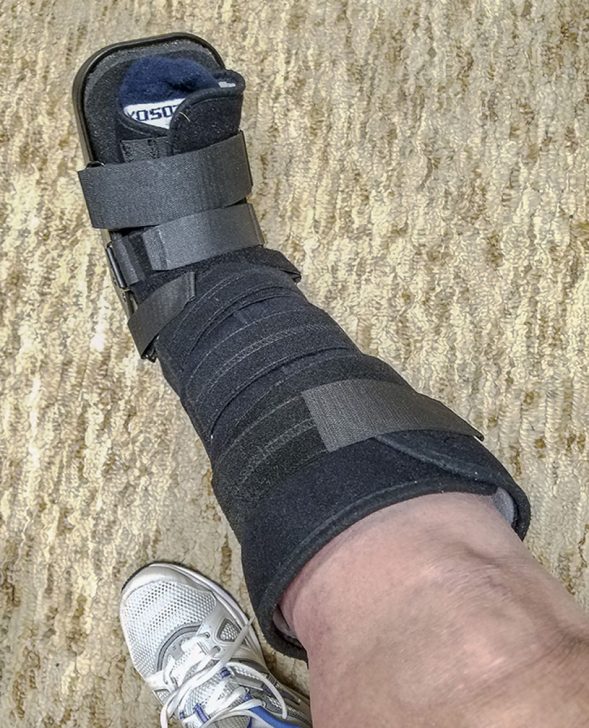
Igor, the medical boot, keeps the broken ankle stable.
Credit: Yvette Cardozo
I don’t remember exactly how it happened. It was the bottom of the last run. I was tired. The snow had devolved into slick slush, and it was snowing and foggy. I caught an edge and before I knew it, I was on my back, one ski released, the other leg bent awkwardly. A few more turns on the trail, and I would have been within sight of the lodge.
A ski cliche if there ever was one.
My ski buddy came up and got my left ski off. I was sure that was an injury down there and knew enough not to try and stand. So we called the patrol. They came, strapped me into a toboggan and down we went.
Me, head first, on my back. If I could have gotten to my cell phone, I would have videoed the trip down. The view was like being in a soupy blender.
At the lodge, we got my boots off and decided the injury was to my right ankle—probably a bad sprain. I went home, actually driving myself. And went to a business event in downtown Seattle that night. Driving. In the rain. I still thought it was just a sprain.
Two days later, I gave up and went to a doctor. Indeed, it was not a sprain. It was a break. He called it a distal fracture. All these years skiing, all these crashes and I had never broken anything before. And this was an ankle. I didn’t know that was even possible with modern ski boot tech. Ankle breaks are the stuff of 1950’s ski lodge pictures —a guy in front of the fireplace with his leg in a cast, resting on a pillow.
But, I had just left a message for my boot fitter days before, saying my boots were getting loose. He came back into town and said, “Yup”. And also, yup, you certainly can break an ankle today skiing. He’s got three pins and a plate in his ankle to prove it.
The good news is I’m not in a cast, not on crutches, didn’t need surgery. I’m just wearing a medical boot (I’ve named it Igor) for six weeks. The bad news— my ski season was over three days after it began.
Yeah, at age 73 I don’t bounce like I used to. And yeah, I’m grateful it wasn’t a knee. Ankles heal. Knees are another matter.
I canceled one ski trip but am doing another where I will be writing about all kinds of non-ski activities as a non-skier and trying out something called a “snow limo” that gets non-skiers up on the hill, and also down, via a run at Sun Peaks Resort in British Columbia, Canada.
So there are a few lessons learned:
1. Don’t get sloppy about your gear. If you think your boots need re-fitting or your bindings need a check or your skis need tuning, do it NOW.
2. If you just want to do “one more run” and you are tired, DON’T.
3. Don’t assume you know what the injury is. If it’s swollen and getting black and blue, it may very well be a break. SEE A DOCTOR.
4. And don’t grind your teeth too much or overthink this. Get back into the gym or on your bike or walking or whatever when you can and get back into shape.

Snow Limo: Non skiers get up the mountain and down a ski trail.
Credit: Sun Peaks Snow Limo Tours.

