
Tag Archive for: Zermatt

The Top Resorts in Europe – World Famous and Not
Lots of snow and sunshine days, gorgeous views, varied terrain, modern lifts and multiple choices for dinner, nightlife and shopping.  All are the hallmarks of what makes a winter resort great anywhere in the world, including in Europe. These are the top-rated resorts in France, Italy, Switzerland elsewhere in Europe are based on a mix of all those things, plus transfer time from and back to the nearest airport.  Plus the low cost of weekly ski passes – as low as $50/day – adds to the appeal.

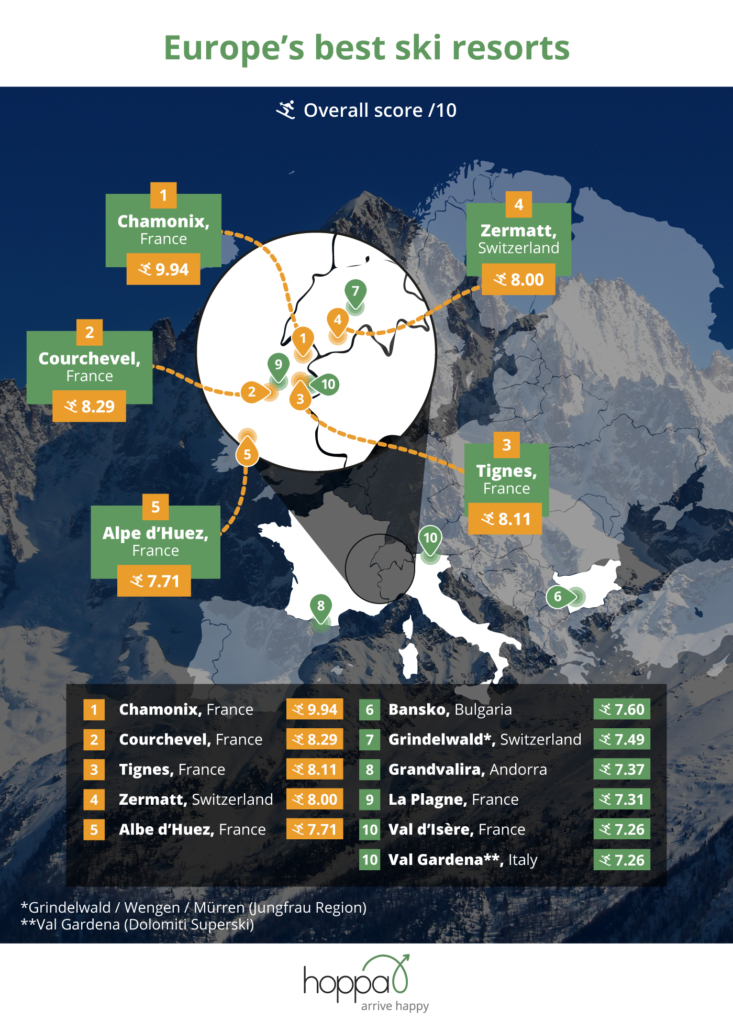
Research by the Europe-based air transfer company hoppa rates Chamonix, Courchevel and Tignes the top three, and includes lesser known Bansko, in Bulgaria, and Grandvalira, in Andorra, as up-and-coming super-affordable hidden gems less crowded than the larger and more famous destinations on the list.

So here are some factoids to help you decide where to go next –

Chamonix  – Nestled at the foot of Mont Blanc in the French Alps, Chamonix tops the ranking with an overall score of 9.94. Famous as the birthplace of modern alpine skiing and host of the first-ever Winter Olympics, it remains one of the world’s most iconic resorts.

Ski passes average $85/day for a weekly pass, annual snowfall reaches 470cm, and no other resort in the list offers as many restaurants or nightlife options.

Courchevel – Contributing to Courchevel’s high score is its average annual snowfall of 399cm, its high number of nightlife listings and restaurants and its high number of Google searches. Courchevel is a great place for a luxury stay. Along with stunning scenery and desirable hotels, and more than a dozen Michelin-starred restaurants in the area, including Le Sarkara, Le 1947 à Cheval Blanc, and Baumaniere 1850.

Ski passes also average $85/day for a weekly pass.

Tignes – This resort completes an all-French top three with a score of 8.29 out of 10. Contributing to its high score is its high snowfall of almost 700cm per year, an affordable ski pass of just around $50/day for a weekly pass, and its high number of nightlife listings.

Due to Tignes’ high average snowfall – around 669cm a season – it is considered a safe resort to book. That means you don’t have to worry about whether or not it will have snow.

Val Gardena (Dolomiti Superski) in Italy and Val d’Isere, also in France, are also on the top ten list – and both are destinations this season for the 70+ Ski Club.

Bansko ski passes are the least expensive on the list – around $50/day  – which is one third of the price of Zermatt in Switzerland, the most expensive ski resort in in Europe, and also on this top ten list. Bansko has a ten-mile cruiser known as the “Ski Road”.  Closest airport is Sophia.

Grandvalira is the largest ski resort the Pyrenees, with more than 150 miles of trails, 70 lifts and six base areas. Is part of the group that also includes Pal Arinsal and Ordino Arcalis. You can ski all three on one pass for around $75 for a weekly pass.

Other resorts on this top ten list include Grindelwald/Wengen/Murren in Switzerland’s Jungfrau Region and two more areas in France, both smaller and lesser known than their big sisters, La Plagne and Alpe d’Huez.

Surpisingly, no resorts in Austria or Germany made this list.

Not world-class Innsbruck, with its world-famous Hahmenkamm run, or even Gurgl, where I learned to ski after college in the 60s, trading English lessons for ski lessons, and site of the recent World Cup races in which Mikaela Shiffrin cemented her winning legacy as G.O.A.T.  Not Garmish-Partenkirchen in Germany’s highest mountain range, site of the1936 Winter Olympics, where some inns on the main street have been serving guests since the 1600s.  So it goes.

You can read the full research here: https://www.hoppa.com/en/discover/infographics/european-ski-index

What is your favorite ski resort in Europe? Where do you want to go next?

See you on the slopes.
big old tree

Short Swings!

In case you haven’t noticed, ageism hasn’t gone away. The only difference is that over the years we’ve become the object of this form of cultural disdain.

That’s why I thought it would be good to pay respect to some really old timers.

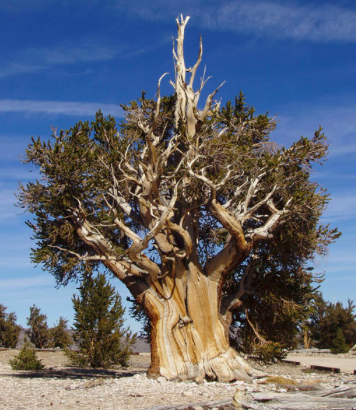
Last month, we hiked to a grove of Bristlecone Pines, the oldest trees on the planet. The ones we visited have been around for about 3,500 years. They’re in Great Basin National Park, at the eastern edge of Nevada. One bristlecone, in California’s White Mountains, is almost 5,000+ years old!

The hike required some effort on rocky but well-marked 10,000’+ terrain. 

Gnarled. Tortured. Grotesque. They’re good words to describe Bristlecones. Many look dead except for the greenery coming from some twisted branches. These trees are ancient and thrive in the harshest and rockiest conditions. They deserve respect.

Pando at Fish Lake, Utah

Not far from where I spend summers near Capitol Reef National Park, is the Pando, a massive Aspen tree clone reported to be one of the largest organisms on Earth. Aspen trunks spring up from underground runners. An entire grove has the same genetic markers. In the Spring, when one develops leaves, they all develop leaves. In the Fall, the entire grove turns color simultaneously. Observe an aspen forest when the leaves are changing and you’ll witness one entire section changing its leaf color one day; another section changing a few days later. I mention the Pando near Fish Lake, Utah, because researchers have identified its root system as 80,000 years old! Unfortunately, they also tell us human activity is leading to its demise.

What does this have to do with senior skiers?

Many of you, responding to the Spring survey question asking what pissed you off most during last season, indicated two major irritants: 1) loss of discounts and high ticket and food prices and 2) rude, out-of-control skiers and boarders. (We’ll have more on the survey in upcoming issues.)

Your responses reflect a shift in the US ski industry’s business model which is systematically eliminating discount benefits many came to expect. That could be viewed as disregarding the interests of Boomer skiers. They also reflect a general lack of regard from other skiers/boarders. It’s surprising how many of you wrote that you or someone you know was hit by a young, out-of-control person.

We older skiers and boarders have been around a while. Maybe not as long as Bristlecones and the Pando, but we, as they, deserve respect.

Ski Pass Developments

  • $60 Squaw Valley Alpine Meadows  Season Pass for Military Vets : The resort will issue up to 6000 passes to active duty, reserve, veteran, and retired members of the military. Click here for details. Congratulations, Squaw Valley Alpine Meadows!!!!!
  • $99  Angel Fire Season Pass for all US K-12 teachers: Price increases to $199 when the season starts. Bravo Angel Fire!!!!!

  • New $199 INDY Pass: 68 Days at 34 Resorts: A new, multi-resort ski pass, called Indy Pass, is now on sale for the 2019-2020 season. It provides two lift tickets each – 68 total days – at 34 independently owned resorts for just $199.
  • A-Basin Joins IKON and Mountain Collective: Arapahoe Basin, which last season decided to drop out of the Epic Pass, has joined both the IKON and Mountain Collective passes. It’s a terrific area and these are terrific decisions.
  • IKON Adds Zermatt: IKON also added Zermatt in Switzerland with either seven or five days (no blackouts) depending on the IKON product owned. It is IKON’s first Euro resort.

China is World’s Largest Beginner Ski Market

A new report shows that as of 2018 there were 742 ski areas in China. The number includes indoor areas. Last season China had 21.1million skier visits. Between 2017 and 2018, thirty-nine new facilities were built. Three percent of the total are identified as destination resorts with a vertical of 1000’ or more. The longest vertical is slightly more than 2900’. The report concludes that China is the world’s largest beginner ski market.

12-Story Indoor Area To Open in Meadowlands (NJ)

Big SNOW America at American Dream is the Meadowlands (NJ) indoor ski and snowboard park. It is scheduled to open October 25. The 12-story, 180,000 square foot structure will be operated by Mountain Creek, also in New Jersey.

102 Year Old Skier Publishes Autobiography

George Jedenoff, 101 1/2 and still skiing!

George Jedenoff, now 102, has just published his autobiography. George celebrated his 100 birthday skiing at Snowbird. He returns annually to Little Cottonwood Canyon to ski Alta. The book, titled My Centenarian Odyssey, recounts fleeing the Russian Revolution as an infant with his parents, graduating Stanford University with honors, serving in WW II, entering the steel industry, and eventually becoming president of Kaiser Steel. It can be accessed through Apple Books (and through Windows systems) at no charge.


Videos Worth Watching

For a quick hot day chuckle, watch this vintage short about rollerskating, amusingly narrated by Warren Miller.

Or try this trailer for the Timeless, the new Warren Miller feature.


Reporting From the Italian Alps

Italy’s Aosta Valley: Gateway to great skiing

Italy’s Aosta Valley is rich with history; even richer with places to ski. The Romans used the valley as a route to Gaul. In the intervening centuries, more than 100 castles were built. Starting in the early 1930’s, the Italians, the Swiss and the French started building ski lifts. They haven’t stopped.

The valley provides easy access to some of the world’s greatest ski resorts. At one end is Courmayer on Mont Blanc. Drive up a side canyon and you’re in Cervinia, on your way by lift and ski to Zermatt. Another short drive, and you’re at Monterosa.

We’re in centrally located Saint Vincent, a scenic and charming walking town, where every day we journey through scenic alpine villages to a different resort. 

Centrally located Saint Vincent

It’s only the second week of March, and Saint Vincent is beginning to bloom. We’re staying in the aptly named Hotel Bijou, a gem of a hotel overlooking the town’s central plaza. The main street is lined with colorful three and four story buildings housing attractive stores and restaurants specializing in Aosta’s regional cuisine. Just a few blocks in either direction are an elaborate mineral bath complex reached by funicular and a sizeable casino.

After a full day of skiing, we don’t have energy for either.

We’re here with the owners of Alpskitour, a local guide service and SeniorsSkiing.com advertiser. Mauro Cevolo has taught and coached skiing in Italy, Austria, France, New Zealand and the US (Mammoth). Andrea Jory teaches mostly at Cervinia and Champoluc. He was on Italy’s national bobsled team and competed in the 1980 Lake Placid Olympics. Both are magnificent skiers and highly enjoyable companions. They’re intimately familiar with the many resorts in and around the Aosta Valley, including the best places to ski and where to stop for a gourmet lunch in an authentic surrounding.

The author with world speed ski champ, Simone Origone and Andrea Jory, Alpskitour

Wherever  you go with them they’re warmly greeted. At lunch the other day, they bumped into Simone Origone who for 12+ years held the record for the world’s fastest man on skis (about 157 mph!).

An important benefit of staying in Saint Vincent over one of the resorts is the ability to decide, last minute, where to ski. The other day, when high winds had forced many of the resorts to shut down, we drove to the city of Aosta, boarded a gondola and climbed the mountain into magnificent mid-winter conditions at the Pila resort. Accustomed to Rocky Mountain resorts, Pila was a big surprise…emphasis on big. But it is small, relative to where we’d be going over the coming days.

La Thuile in Aosta Valley

The next day we drove past high-perched castles, ancient stone villages, and up a series of hairpin turns to reach Espace San Bernardo. We started at La Thuile, and after a gondola and a chair entered a landscape of endless peaks and glaciers. Following several long runs and more lifts, we crossed into France and descended to La Rosiere, another sizeable resort. After a few hours of skiing, we rode two long Pomas, crossed back into Italy and skied to Maison Carrel, where we lunched on regional cuisine in a modernized 19thCentury stone barn. I had cabbage soup topped with a thick layer of Fontina cheese, one of many Aosta Valley products exported across the globe.

Combined, La Thuile and La Rosiere have 39 lifts servicing something like 7800 acres of terrain, mid-sized for the Alps. Nonetheless, it’s size is slightly less than Whistler Blackcomb, North America’s largest.

Monterosa’s Champoluc-Frachey

The story gets better. Yesterday we drove to Monterosa’s Champoluc-Frachey and skied two of its three massive valleys. We started on a super-steep, rail funicular and throughout the day used cable cars, gondolas, and a variety of open and bubble chairlifts. This place is humongous. Looking up into remote snow fields were tiny specks skiing gondola-accessed backcountry. We stayed on trail, at one point dropping down a long and steep sun-drenched trail…my kind of skiing.

The West won this season’s snow lottery. Last year, that prize went to the Alps. Coverage is adequate at the moment and skiing is a lot of fun. If it were deep powder, I’d be able to enjoy a handful of runs before calling it a day. We’re probably skiing 15,000 – 20,000 vertical.

Today is a self-imposed rest day. We’ll visit some of Saint Vincent’s treasures and drive into the city of Aosta to see its Roman ruins. Tomorrow we’ll be back on another mountain. Which one is a decision Mauro and Andrea will make in the morning. One thing I know: it will be big, beautiful, and interesting. That’s what defines skiing in and around the Aosta Valley.

More on this fantastic ski experience next week.  

Dreaming of Skiing the Alps? Follow Warren Miller’s Advice: Don’t Delay.

Warren Miller has been gone for less than a year, and his wisdom about not postponing your next ski adventure has been on my mind.

There’s one experience in particular that beckons. It is based in the beautiful ancient village of Saint Vincent in the Aosta Valley in the western Alps, close to Mont Blanc, Zermatt, and Monte Rosa.

Organized by Alpskitour, clients stay in their choice of five- and three-star hotels. The village serves as hub, and every day, they join their guide and a few other people to explore trails and slopes on the highest peaks in the Alps, crisscrossing between Italy, France and Switzerland.

The groups are mostly European-based intermediate and advanced skiers, with the occasional American, Canadian, New Zealander, or Australian. The guide and group ski together for five days, always riding different lifts and exploring new terrain.

They stop at quaint mountain refugios for lunch. Forget burgers and fries. This is on-mountain dining in beautiful settings.

The landscape is incredible. Dramatic peaks. Trails snaking through magnificent rock formations. Slopes that descend through scenic hamlets.

The dreamlike experience is what I remember from the Warren Miller films of my youth and from ski trips to the Alps in the 60s and 70s.

Then, wrapped up in family and career, I skied closer to home, exploring Colorado, Utah, New Mexico, Wyoming, Idaho, Montana, and British Columbia.

The skiing has been great, but the dream of the Alps was always there.  My wife and I booked with Alpskitour for mid-March, 2019. We’re looking forward to returning to the roots of modern skiing, enjoying its history and culture; its  exceptional beauty, and hospitality.

Alpskitour has been advertising with SeniorsSkiing.com since last season. Their website explains the group’s unique concept and is filled with wonderful images of what to expect. I’ve been emailing with Gerry Walsh, a Brit who has booked with Alpskitour for several family ski holidays. He wrote glowingly about the guides, the hotels, the scenery, and the outstanding hospitality.

I know that the exchange rate isn’t optimal. We could wait until it is. And the flight to Milan will be a few hours longer than if I were traveling in the U.S. And committing this early has some risk regarding snow levels.

But forecasters tell us this will be an El Nino year with higher moisture and warmer temperatures and southerly snowfall.  And wherever you go, lodging and skiing tend to add up.

I’ll ski a few weeks in the West this season. Might even catch some warm corn days in New England. But come March, we’ll be in the Aosta Valley with Alpskitour.

Warren Miller had it right. Don’t put it off. If you love skiing, try something different. This will be my 65th consecutive ski season. We’ll be celebrating in the Alps.

That Old Ski Poster on the Wall

Vintage ski posters are a fixture in many ski chalets and lodges.

Since the late 1990s, their values at auction have increased. To learn more about their history and their values, we interviewed Nicholas D. Lowry, President and Principal Auctioneer of Swann Auction Galleries, and Director of its Vintage Posters Department . Swann is the world’s largest auctioneer of Works on Paper and New York’s oldest specialty auction house.

JW: Please provide a short overview of the ski poster’s origins, when they were in commercial use, and in which countries.

NL: By all accounts the earliest ski posters were printed in the 1890s. They were printed to drive tourism by train to the French mountains. They began to appear with some regularity in the first decade of the 20th century. Two of the most famous—and therefore most valuable— were Francisco Tamagno‘s image of a couple ski jumping, and Jules Abel Faivre‘s image of a female skier using a single pole. Posters promoting the new sport also began appearing in Switzerland. Some promoted competitions and purveyors of outdoor equipment and clothing.

The first American ski poster featured an image of a female skier. It was produced in1896 to advertise the Christmas issue of Truth magazine.

What is considered when determining their value?

The main factors in determining ski poster value are location advertised; artist; image; date; and condition. A poster from the early days of a prominent Swiss resort such as Gstaad or St. Moritz will command more than one touting a lesser known village. The image also is important. Many people are drawn to depictions of early ski equipment and ski wear.

Among the most famous artist’s names that aficionados and collectors appreciate are Roger Broders, a masterful French Art Deco poster designer; Sascha Maurer, who did a lot of work for the New Haven Railway, and prominent Swiss poster designers, Emil Cardinaux and Martin Peikert.

How would you characterize price trends of vintage ski posters?

The market for ski posters took off in the late 1990s and early 2000s when collectors, including Mason Beekley, recognizing this undervalued segment of the poster market, began to acquire them at auction. Prices attracted attention to the genre; they haven’t subsided.

What should people look for if interested in collecting vintage ski posters? How can readers determine if they have a valuable ski poster?

Our experience at Swann is that most collectors buy works to hang in their chalets or mountain homes. They focus on geographic location. For example, it’s unlikely that someone in Zermatt will be collecting posters advertising Sun Valley.

I would caution potential buyers to consider their source when acquiring a vintage ski poster. Many resorts offer decorative reproductions of famous images. The best bet is to find an accredited poster dealer, so you can have confidence in the authenticity of your purchase.

How can readers learn about upcoming Swann ski poster auctions?

Swann Galleries has been offering a selection of ski posters from around the world in our annual Winter Poster Auction since 1998. We hold at least four auctions of vintage posters each year. Our catalogues are online at www.swanngalleries.com.