Waterville Valley Pioneer Tom Corcoran Dies At 85

Tom Corcoran, an Olympic skier and developer of Waterville Valley Resort, has died at 85 at this home in Seabrook Island, SC.

Read the story of how he created a mountain resort from scratch and brought the Kennedys to visit by clicking here.

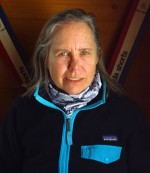
Two-time Olympian Tom Corcoran was an all-around athlete who put Waterville Valley on the map.
Credit: Waterville Valley Resort.

Five Tips For Sierra Summer Skiing

[Editor Note: This article by Correspondent Rose Marie Cleese first appeared in Liftopia’s The Blog.  We thank Liftopia for allowing us to pass it along to the readers of SeniorsSkiing.com.]

Even though summer has officially arrived and temperatures are reaching triple-digits across the country, are you still nostalgic about winter and wish you had gotten in a couple more days of skiing or boarding?

You’re in luck. Ski season is alive and well in the Sierra, at Squaw Valley near Lake Tahoe for at least two more weekends and at Mammoth Mountain off State Route 395 east of Yosemite daily into August.

See California lift tickets.

Summertime, when the vibe is chill and the air is hot…

So how different is it to ski and board in the summer? When’s the last time you spotted a marmot basking in the sun next to a ski tower? Or had a flurry of ladybugs alight on your table while lunching on the lodge deck. Everyone on the slopes is happy and laid back because we all know we shouldn’t be able to be doing this at this point on the calendar. Below are 5 tips if you’re headed to the slopes this summer.

1. Enjoy the soft, easy-to-ski corn snow.

Corn refers to the snow during the time window when it has become soft and forgiving, but not too wet and slushy.

At Squaw Valley, after you leave the green, grassy terrain around the base of the mountain, it’s a bit of a shock to find yourself a few minutes later on the snow-covered slopes of Squaw Valley’s upper mountain, currently boasting a snow depth of up to 131 inches (that’s nearly 11 feet, folks!).

Now, over the long 4th of July weekend, July 1–4, and on Saturdays thereafter “as long as we can provide a safe skiable surface,” says Squaw Valley spokesperson Sam Kieckhefer, you can enjoy a full four hours of skiing on corn snow, from 8:30 AM to 12:30 PM.

The surfaces of most runs are easily skiable corn snow, kept nice and crisp due to the deep snowpack. The only places you’ll find full-blown heavy slush are on the wide, flat runs that feed into the Gold Coast Lodge area. Last weekend, the temperature on the upper mountain was 60 degrees and the resort had four lifts running: Gold Coast, Big Blue, Siberia and Shirley. Skiers could also traverse and hike up to ski the runs on Headwall.

2. Check out Squaw Valley’s poolside party at High Camp.

PHOTO CREDIT: Katie Cleese Photography

After you shed your skis, be sure to check out the lively scene at Squaw Valley’s pool and hot tub at its High Camp location, open from 11 AM to 4 PM. For the price of admission ($15), you get a locker, towel, and access to an 8,200-foot-elevation alpine party, complete with a poolside dj spinning house music and scantily clad 20-somethings cavorting and splashing around the big pool wearing ski goggles.

Catch the shuttle back to the Resort at Squaw Creek where you’ll have the options of sunbathing by its more mellow pool sipping a margarita, soaking in a hot tub, playing a round of golf, hiking, or playing a game of tetherball, corn hole, or giant chess. The best of summer and winter all in a single day.

See Squaw Valley lift tickets.

3. Defy winter and ski well into summer at Mammoth Mountain.

PHOTO CREDIT: Mammoth Mountain

On the eastern side of the Sierra, Mammoth Mountain, the queen of ski resorts staying open past April, is experiencing three to four times the number of skiers and boarders they usually get this time of year, according to Mammoth Mountain’s communication manager, Lauren Burke. “We’re committed to daily operations into August,” she says. “In the last 50 years, we’ve stayed open into July some 15 times. Our longest season on record was 1994–95 when we closed on August 14th.”

Hours of operation at Mammoth are 7:30 AM to 2 PM, with 6 lifts, 57 trails and 2 terrain parks available midweek, and 7 to 8 lifts and 70 trails available on weekends. Currently, Mammoth has 45 inches at its base and 180 inches, or 15 feet, at its 11,000-foot-high summit.

For Bay Area skiers, the quickest way to reach Mammoth right now by car is via I-80 through Reno and south on SR 395. The faster route via Highway 120 over Tioga Pass, which closed for the winter season last November 16th, is still closed with no projected opening date. In the last 80-plus years, the latest Tioga Pass opening was July 1st, so it looks like that record is soon to be toast!

See Mammoth Mountain lift tickets.

4. Garb up or garb down… Whatever you prefer, just don’t forget the sunscreen!

PHOTO CREDIT: Katie Cleese Photography

If you NEVER fall, wear whatever or how little you want. We saw a pair of skiers in flowing Batman and Superman capes, a boarder wearing a Speedo®, plus a plethora of cut-offs, tank tops, no tops (guys only!), and streamlined helmets. So wearing apparel is whatever strikes your fancy, but there are a few “musts” when you hit those corn-fed slopes:

Before you go out, cover every bit of exposed skin with a high-SPF waterproof sunscreen (including ears, napes of necks, hands if you’re going gloveless, etc.) and reapply as needed. The summer sun is intense at these high elevations, plus you’ll be skiing in mostly sunny weather. Also be sure to entirely cover your lips well with a good lip sunscreen.

Wear goggles or make sure that your sunglasses are completely protecting your eyeballs. Never, never, never head out to the slopes without one or the other. Snow blindness (when you burn your cornea from overexposure to the sun’s UV rays) is incredibly painful and can take a couple of days to recover from.

5. Stay hydrated.

PHOTO CREDIT: Katie Cleese Photography

Drink lots of water throughout the day or you’ll find yourself getting parched pretty quickly. Squaw Valley had water stations set up both outside and inside the Gold Coast Lodge, with plastic water cups stacked up behind the water fountains. Save the alcohol imbibing for après ski!

Provided that the winter snows come on schedule next December, it’s nice to know that all those happy campers up at Squaw’s High Camp last weekend have to wait only five months to ski and board again—but it certainly won’t be as much fun as skiing in workout pants!

Rose Marie Cleese is a correspondent for SeniorsSkiing.com, an e-magazine devoted to wintersports enthusiasts aged 50 and up.


This Week In SeniorsSkiing.com (June 23)

Trail Masters Are Announced, Kayak Angling, Nostalgia For Blandford, Mid-June Ski Run At Alta.

This guy is taking a mid-June run down Alta. Walk up, ski down.

Yes, it is hot out there.  The head dome is hovering over the Southwest, and yet, there are places where people are still skiing.  We’ve received a report that people are skiing off the top of Mt. Washington, NH, walking up the mountain at Alta, and, of course, Mt Hood is opening for summer skiing, as is Les Deux Alpes in France. New Zealand and South American ski fields are open, too. When will folks have had enough?  Probably not till after July 4.  We hope correspondent Rose Marie Cleese gets us to Mammoth Mt, CA, to report on skiing on the fourth in the Sierra.

This week, we are announcing the Trail Masters who reported “skiing their age” this past season. Our most senior Trail Master is Fredi Jakob, a vibrant 83 year old who skied 83 days this season, mostly at Alta. Read our report and check out the list here.

As a reminder, we are also publishing once again our explanation of why some of you have to re-enter your email when accessing our online magazine. We are doing this to hopefully pre-empt the occasional angry email we get on this subject. The situation is easy to rectify, and it is most probably a click or two on the reader’s device.


WhyKnotFishing guide Matt Zimmerman teaches how-to kayak and fish in Marblehead Harbor.
Credit: Tamsin Venn

Correspondent Tamsin Venn reports on a potential new sport for active seniors to engage in.  She went kayak angling, or fishing from a kayak recently and tells you about the adventure she had in Marblehead Harbor.  Tamsin, by the way, knows a lot about kayaking as she is the publisher of American Coastal Kayaker magazine, but this is the first time she’s been kayak angling.  Looks like fun.

Also, Harriet Wallis writes about a nostalgic trip to Blandford ski area in Springfield, MA. Even though the area is closing, her memories of growing up on the slopes with a bunch of friends and families are vivid and persist.  We are starting to realize that it is the small- to medium-sized mountains that form the deepest relationships with people. There’s an emotional attachment that is hard to find in destination resorts.  Maybe that’s just us.

Finally, someone figured out how to get up Alta and take a run the other week and took a video of it. Walk up, ski down, you get what you pay for.  On to summer, guys.

Next time, more Cycling Series stories, a Fitness Focus that will keep those tight hamstrings limber, and more fun and games.  If you haven’t purchased your season ticket for next season, you may have missed out on the most generous discounts. Keep watching the website of your go-to mountain.

See ya, and remember, there are more of us every day, and we aren’t going away.


Short Swings!

I’ve spent the past several days in downtown Chicago.

Maybe it’s the nice weather or the pleasure of being in a big city after an extended post-season stay at our desert place, but Chicago is wonderful. The architecture is impressive, as was the tour boat through downtown explaining the broad variety of design. While I was working, my wife took a Frank Lloyd Wright tour in Oak Park. This is the 100 anniversary of his death, and there’s a lot of the Wright stuff going on. She had a glowing report. The food here is something else. I don’t watch chefs on TV, but, apparently, every star has staked turf in Chicago. One BBQ place, Isabelle’s in Wicker Town, was memorable. Lou Malnati’s deep dish pizza was out of this world. Steak at Gene & Georgetti was very good, but not on our return list. Millennium Park is filled with treats including the 110-ton polished stainless steel “Cloud Gate” sculpture by Anish Kapoor; “Crown Fountain,” comprising two 50-foot glass blocks with LED composite images of Chicagoans spouting water from their mouths, and an outdoor concert stage and serpentine bridge designed by Frank Gehry. My kinda town!

THE SEASON

Nationally, skier days were up to 54.7 million from 52.8 million in 2015-16, a 3.7 percent increase. Visits varied by region with strong rebounds in the Northeast, Southeast and Pacific Northwest. Declines were seen in the Pacific Southwest, Rocky Mountains and Midwest. Those declines notwithstanding, visits at Colorado Ski Country USA‘s 22-member areas (Vail not included) totaled 7.3 million, estimated to be the state’s second best on record. Ski Utah reported 4.6 million skier days, up 2.85 percent from the previous record during the 2015-16. And Ski Vermont reported 3.9 million visits.

MEANWHILE, IN NEW ZEALAND

It’s the first run of the first day of ski season at Coronet Peak, Queenstown, NZ.
Credit: Coronet Peak

Coronet Peak, the closest ski field to Queenstown, NZ, opened on June 17 as planned with the Magic Carpet lifts, Meadows Express and Coronet Express Chair lift, and the tubing park, all open.

Coronet Peak Ski Area Manager Nigel Kerr said, “This is a really good start to the season. We had a big turn out for that first ride and it has been building up throughout the day.”

Coronet Peak welcomed more than 1000 people by lunchtime on Day One.

ESSENTIAL KNOWLEDGE

The New York Times publishes short videos each day that allow the viewer to mouse around the image at will. It’s an interesting use of technology. Today, the first day of summer, the Times 360 video shows how to make an igloo.

DISCOUNTS

25% off Panda ski, trekking, and camera poles.

SUPER DUPER SENIOR SKIER GEORGE JEDENOFF TURNS 100

100 and still skiing, George Jedenoff.
Credit: Ski Utah

George Jedenoff, a resident of California has been traveling to Utah to ski Little Cottonwood Canyon (Alta and Snowbird) every year since 1960. George learned how to ski at Alta when he was 43 and claims it was the best decision he has ever made. He is a remarkable man who draws his true happiness from the slopes and has become an inspiration to the Utah ski community. His official birthday is July 17.  Happy Birthday, George and thanks for the inspiration.


2016-17 Trail Masters

Congratulations to the 2016-17 Trail Masters!

Trail Masters are those senior skiers whose number of days skied last season matched or exceeded their ages. Seventy-seven qualified, compared to 42 in 2015-16, the first year Trail Masters were recorded.

At the top of the list is our oldest Trail Master, Fredi Jakob, who skied 83 days at age 83. Fredi’s home resort is Alta. He has been skiing 66 years. Next is Jack Nixon, 82, who skied 110 days, whose most frequently skied resort is Crested Butte.  Jack was also in second place last year.

Several people made the list both years. Among them is David Orlinsky, a ski buddy of the past few seasons. We’re both 73, and when we skied Copper Mountain in January, he was always waiting at the end of the run. Glad to see “Speedy” clocked 85 days.

The average age of all Trail Masters is 66. Their average number of days skied last season is 83.5, and their average number of years skiing is 48.5.

Each of the ten oldest Trail Masters will be mailed a DeBooter, that outstanding ski boot jack that lets your remove boots quickly and painlessly! Every older skier should own one.

Skiing one’s age is a terrific accomplishment. For all of us it will be easier to accomplish next season than the season that follows.

CLICK HERE TO SEE THE COMPLETE LIST OF TRAIL MASTERS

Why Do I Have To Re-Enter My Name And Password?

We Explain Why This Annoyance Happens And What You Can Do About It.

Editor Note: We get emails from time to time about how frustrated some of our readers are in having to re-enter their name and password when they visit our online magazine.  Sometimes those emails are in ALL CAPS, sometimes they use naughty words. Trust us, there is an explanation, and not everyone who subscribes has this problem. We’ve published this before and will continue to do so. It’s an easy fix.

If you are being asked to re-enter your email to confirm your subscription to SeniorsSkiing.com, you might be a bit annoyed.  We don’t blame you, but there is an explanation.
  • You are accessing SeniorsSkiing.com through a device that is different from the one you originally signed up on. Subscribing to SeniorsSkiing.com puts a “cookie” on your device.  If you use a different device, no cookie, so you are viewed as a non-subscriber. If you re-enter name and password, you’ll be okay with the new device.
  • You have disabled cookies or cleared browser history on your device. Turn cookies back on, and you’ll not have to re-enter again, or leave it disabled and realize you have to re-enter each time.  Your call.
  • You are trying to access our Subscriber-Only Content.  Instead of building a firewall that requires usernames and passwords, we elected a much simpler way of getting to our exclusive content: Just confirm your name and email.  You will have to do that each time you want to get to that information, which, by the way, is under the Community tab at the top.

Kayak Angling: A New Sport To Consider

Summer Is The Time To Try On A New Sport.

WhyKnotFishing guide Joe Gugino teaches how to kayak and fish in Marblehead Harbor.
Credit: Tamsin Venn

As a publisher of a sea kayaking magazine in the off season, I have witnessed the huge growth in the popularity of kayak fishing. It has been an opportunity for avid fisher people to get into the sport without the expense of a motorboat and launching and mooring fees, plus a chance to slide into some spots where only the kayak can go.

Fishing here in New England is big when the stripers move in around May and June. So in late May, I head over to the Little Harbor Boathouse in Marblehead, MA, to take part in a Guided Hobie Kayak Fishing Excursion. It would be a three-hour fishing program with use of a Hobie Kayak, fishing gear, and know-how from three very friendly and experienced guides: Jesse Minoski, Joe Gugino, and Mike Marquis. Perfect for a beginner like me. My first lesson was actually how to cast a line. Fortunately, my teacher Joe Gugino is a former fourth grade teacher. And even more fortunately, I was already used to a kayak wobble in unsteady seas so I felt secure in my balance with my hands free to fish. For skiers, that sense of balance comes naturally in a kayak, since we are so used to weight shifts.

The rocky shoreline around Marblehead is ideal striped bass territory, Hobie Team member Minoski says, and the Little Harbor Boathouse’s “hidden gem” location means you don’t have to go more than a half mile from the launch to fish and duck out of the wind behind Crowninshield and Gerry’s Islands.

Maryellen Auger, owner of Little Harbor Boathouse, has a Hobie Revolution 11 waiting for me. It’s an ideal boat size for women, she notes. Sleek and lively, the Revolution uses a pedal system to propel forward (a paddle is attached by bungee chord on the side if you need it). She points out the pedal system can be ideal for older people who may have developed shoulder issues over the years.

The kayak comes in three lengths, 11, 13 and 16 feet, increasing in speed with the hull length. A molded-in rod holder, multiple hatches, lots of on-deck storage, and a “hyper adjustable” Vantage CT seat with webbing, that is so comfortable you could sit out there all day and cast a line, are some of the pluses.

I “power-pedal” my way out through Little Harbor behind Crowninshield and catch up with six eager clients and three helpful guides.

I’m not so lucky in catching a fish, but I can tell you how wonderful it is to sit out on the ocean in a comfy seat on a fresh spring day, casting a line, enjoying the beautiful surroundings, camaraderie, and communing with a species that obviously knows the most of any of us about the water dynamics below. All and all, I had a very good time and highly recommend it, especially for someone new to kayak angling.

For more info, www.littleharborboathouse.com

For ongoing fishing guiding service on Boston’s North Shore—the blue fish come out in July—with 2017 Hobie Fishing Team Members Joe Gugino and Jesse Minoski: www.whyknotfishing.com

In the off season, Tamsin Venn publishes Atlantic Coastal Kayaker Magazine. www.atlanticcoastalkayaker.com

Fond Memories Of Blandford Ski Area

Memories Live On Even If The Area Closes.

Blandford has three chairlifts. When I learned to ski, it had seven rope tows but only one chairlift. Credit: Harriet Wallis

Nothing can replace this family-based ski area in southern Massachusetts. But Blandford is now on the brink of being closed or sold. It has offered what mega resorts cannot offer.

If kids got tired of skiing, they’d go off trail with their friends and build snow caves and ski jumps. When my son broke the tip off a ski, we knew exactly how it happened. When my daughter needed a break, she discovered she could mooch cookies from skiers in the lodge.

It was all part of the ski experience. Something that doesn’t happen at the big resorts.

Adults had their fun too. In spring, we’d take a picnic lunch and a bottle of wine to the picnic tables at the summit.

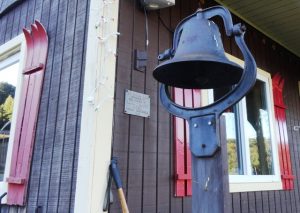
The ski school bell rang when it was time for lessons. Credit: Harriet Wallis.

If it rained we put on garbage bags and did “worm turns” rolling on the soggy snow. One rainy day when no one was riding the T-bar, a group of us slalomed the T-bar line. The Ts were moving targets coming up, and we skied around them going down. Naughty but fun.

Après ski was a food fest. Families brought crockpots and plugged them in on the deck letting dinner simmer while they skied. Oh the glorious smells! At the end of the day, everybody shared.

We skied there every Saturday and Sunday during the 1960s and early 70s when my kids were growing up.

There were family races—our first race experience with gates and awards. My daughter didn’t yet understand the race concept. She stopped to chat with each gate keeper.

The Blandford race team won many competitions even though they trained mostly on dry land because early season snow was too skimpy. The kids honed their muscles and reflexes by quick stepping through an array of tires and other dry land exercises.

The race coach also gave ski tuning demonstrations, a skill I continue to use today.

And he demonstrated ski binding release. He careened down the hill in Olympic form, carving hard lefts and hard rights. Then he would stop, lift each foot and shake his skis off! If you ski technically correct, your binding don’t have to be cranked down, he said.

The ski patrollers found ways to busy themselves as there were few accidents. One day, a patroller watched a youngster cut the chairlift line, slithering through the long line up to the very front. Just before the child got onto the chair, the watchful patroller sent him to the back of the line. The child never cut the line again.

One spring, the patrollers decided to tap the many maple trees and make syrup. Their first morning duty was to gather the makeshift syrup buckets — #10 size cans – and carry them to the patrol’s dispatch shack at the summit. There the dispatcher kept the golden liquid stirred on the pot belly stove. The patrol bottled the syrup and invited everyone for après ski “syrup on snow.”

Then there were parties. In summer, we enjoyed the camaraderie of work parties, pitching in to help with lodge and slope maintenance. That was always followed by a corn husking contest and a giant BBQ.

In winter, there were celebrations with a caldron of gluehwein simmering over a fire, torchlight parades with real torches, and then dinner and dancing. Kids danced. Adults danced. Everybody danced. Everybody danced with everybody.

Small ski areas are the heart and soul of skiing. It’s sad that this could be the end of iconic Blandford Ski Area that’s been in operation since 1936.

To read more from Harriet click here for her stories on SkiUtah.


June Skiing At Alta: The Never-Ending Season Goes On

Where Is Everyone? There’s Pow At Alta.

Thanks to Snowbrains for passing this along.  June 13, 2017 run at Alta.

This Week in SeniorsSkiing.com (June 9)

New Survey. Two Skiing Octogenarians. Simple Planks Strengthen Core. Cycling Into Seattle’s Past.

Gatehouse Web Design asked us to ask you to complete a survey. The company built the SeniorsSkiing.com website. It has also created a number of private online calendars to help property sharers view availability, and schedule and track use. User interest in features such as expense sharing and departure checklists led Gatehouse to develop a web app designed  to help anyone sharing a recreational property reduce the stress and time property sharing issues can cause.
Examples of people who might use the app are:
  • Owners who let family and friends use their ski house and who would be interested a private scheduling calendar and maybe asking users to contribute a below market rent or or simply cover that week’s cleaning bill.
  • Co-owners such as siblings or cousins who have inherited a place and need any easier way to fairly schedule use and share expenses.
  • Co-renters who pool resources to rent a ski house and who need a central location to organize the calendar and communication.
  • Ski clubs or associations interested in an easier way for members to pay dues and schedule their visits.
Survey results will help guide development of the app by identifying the most critical issues faced by vacation property sharers: https://goo.gl/forms/q0CBg5c695mtUJyA2

Paul in his tutu. He skis every day, but not always in a tutu. Sometimes he tows a kite from his helmet.
Credit: Harriet Wallis

This week Harriet Wallis profiles two octogenarian skiers based in Utah. The older of the two, 89 year old Paul Jacobsen, likes to show off his springtime stuff skiing in a tutu. He hasn’t missed a day at Brighton for 25 seasons!

Mike tells us about planks and how this simple exercise is so effective at strengthening the core — essential for tightening your middle and getting more out of your ski day.
Finally, John Nelson takes us on a bike tour of Old Seattle. He states, “Using a bike and a little imagination, it’s fun to explore your city in different way.” It’s a terrific idea, and a particularly good read.

We’re publishing bi-weekly this summer. Our next issue will be available June 22. In the meanwhile, if you have ideas, comments, etc., drop us an email.

SeniorsSkiing.com 3″ x 3″ stickers are  in limited supply. Send a stamped, self-addressed envelope to SeniorsSkiing.com, Box 416, Hamilton, MA. 01936, and they’ll be heading your way.


Quick note to World: Readers keep signing up — even with snow melted and bull wheels no longer turning. There are more of us every day. We are not going away.

Short Swings!

Is The US Ski Industry Becoming A Duopoly? If So, Will It Mean Higher Or Lower Priced Passes For Seniors?

Denver-based KSL Capital Partners recently joined privately owned Aspen Skiing Co to acquire Intrawest’s six resorts and four in southern California owned by Mammoth Resorts.

It’s the newest 800-pound ski resort gorilla. The other is Vail Resorts.

Two gorillas. Twenty-two major resorts across the continent.

A recent report in the Denver Post suggests the possibility they may be flirting with federal anti-trust regulations, something that occurred in the late 90’s when Vail was forced to sell Arapahoe Basin.

Vail is reported to have sold 650,000 Epic Passes last season; a 20% increase in sales over 2015-16. Word is, the new KSL/Aspen/Intrawest/Mammoth coalition will develop a pass to rival Vail’s Epic.

The Denver Post article states that a market dominated by cheap season passes could pinch independent resort owners relying on day-ticket sales.

With the exception of a few local versions, Epic Pass has no senior discount, something SeniorsSkiing.com readers find irksome, as indicated in recent reader surveys.

A duopoly means two giants in competition for market share. Will they compete on price and/or extra services? Wouldn’t it be great if they competed for the senior market with a senior discount?

New Zealand

Mt Hutt (6800′ altitude) in Canterbury, opens Friday, marking the start of the South Island ski season. Located about 90 minutes from Christchurch, Mt Hutt is the first South Island ski field to open this season. It just received 12″ and extended cold has allowed snow making operations to create a base of 12″-20″. Mt Hutt typically gets about 13′ during season.


Senior Skier Profiles: Two Kings Of The Hill

These Octogenarians Are High Spirited Role Models.

Some skiers slow down as they get older. But Bud Temple (84) and Paul Jacobsen (89) pick up steam. Each has skied for more than 70 years. They each learned on primitive equipment in a city park.

Meet Bud Temple

Bud’s been skiing for 70 years.
Credit: Harriet Wallis

Bud launched into skiing in an unusual way. While a student at the University of Utah, he took a ski course offered by Bill Lash, a founder of PSIA (Professional Ski Instructors of America). Bud excelled, and he earned a ski teaching certificate—one of the very earliest. But then he was drafted.

No problem. He entered the U.S. Army with two unusual documents: his ski teaching certificate and a personal letter from Bill Lash to the Commandant at Camp Carson where special troops were trained.

After basic training when assignments were made, Bud presented his two documents to the assignment officials.

“The Army didn’t know what to do with me,” Bud said. “They’d never seen such documents.”

So the officials left the room, called the Commandant, and returned saying: “The Commandant is expecting you.”

Bud taught special troops how to ski, and he also taught survival, mountaineering, and climbing to special forces in all branches of the military.

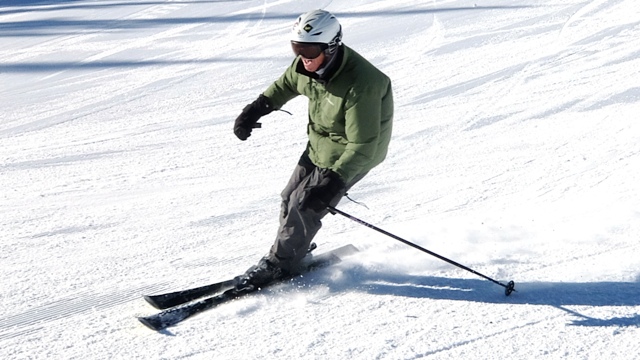
Bud showing a some form.
Credit: Harriet Wallis

And then he continued to teach and coach. He coached World Cup alpine champion Tamara McKinney, created a ski school at a small mountain that didn’t have a ski school, and taught internationally at eight resorts.

Last year, Bud was clocked at 48 mph.

On land, Bud hobbles because of chronic leg problems. But skis give flight to this retired mining and metals professional. He swoops smoothly down the slopes.

Bud’s advice for older skiers:

“Accept that you’re not as agile as you once were. Slow down,” says speedster Bud. Then he adds: “I guess I should take my own advice!”

Meet Paul Jacobsen

So has Paul.
Credit: Harriet Wallis

Paul holds a 25 year record for skiing every day of the season at Brighton. He’s known as First Chair Paul because he’s always first in line when the lifts open.

Agile and mobile at 89, this retired architect skis daily. Then, for après ski, he goes to most of the University of Utah’s home football and basketball games

Skiing has always meant freedom for him. As a kid he skied for the first time when someone brought a simple pair of slats to the sledding hill. He was hooked.

As a teen he worked in his dad’s grocery store, and he drove to the wholesale produce market daily to buy fresh produce for the store. When his job was done, he was free to ski.

For years, Paul skied with a Japanese fish kite flying from his helmet. But it blew away this winter, and everyone misses seeing it. When skiers dress silly in spring, he wears a tutu.

Paul’s advice for older skiers:

“Enjoy what you’re doing,” says Paul. “Don’t be a couch potato.”

Paul in his tutu. He skis every day, but not always in a tutu. Sometimes he tows a kite from his helmet.
Credit: Harriet Wallis

Fitness Focus: Plank, Plank, Plank

This Pose Is Considered The Simplest, Most Effective Core Strengthener.

Pretty basic, but effective. It’s easy to do it incorrectly so study up.
Credit: Yoga Lily

“Plank, plank, plank,” says Jan, the exercise instructor at the head of our class.  After an hour of kick boxing, we start the floor exercises to end the session.  We get into plank position as she intones, “Plank, plank, plank”. The seconds roll by.

High plank or Phalakasana pose. The most glorious of simple exercises, body weight held in place by core strength.  Arms, wrists, shoulders, lower back, abs, gluts, all working to hold the position.

The proper plank position can be found by putting your hands under your shoulders, extending up to a full, high plank on your toes, body a straight line from heels to back of head, eyes focused about a foot ahead of you, chin tucked. Basically, it’s like the top of a push-up, making sure your body is straight and not sagging or arched. While you’re up there, you can flex your feet, bend one knee in, then the other. Put one foot’s toes on the heel of the other foot, then switch. If you hold yourself still, you can feel your muscles adjusting and keeping you balanced.

High plank can be modified by resting on your knees versus your toes. That might be a good place to start if you haven’t done core exercises in a while.

If your wrists are sensitive, you can support yourself on a pair of dumb bells or yoga blocks. If you have hand or wrist issues, like carpal tunnel or rotator cuff, you’ll have to get some advice from a physical therapist or yoga instructor to help mitigate those conditions.

You can also move from high plank to low plank, moving down to resting on your forearms, arms extending in front of you, one arm at a time.  Then, back to high plank.  And then down to low plank. Do this slowly while mindfully keeping your body in a straight line position.  Man, that’s a work out.

The benefits are impressive; you get toned up in the middle, and you will find yourself using those newly strengthened core muscles to support your back when lifting, twisting, even walking.  We’ve found that lower back problems can be addressed with a strong core.  Your posture will improve, too. Your mileage may vary, but plank and other exercises focused on the core can definitely help that lower back.

The experts say you should shoot for 30 seconds as a beginner to get into this.  Eventually, if you can hold plank for two minutes, you’re doing very well.

You can find more advice from experts on how to safely and properly do plank here.  Jen Reviews has a number of pointers and caveats on doing this exercise.  More advice from the Yoga Outlet here.   Jen Reviews sums up the major benefit of planking:

Planks are a very versatile exercise that target a lot of the most important muscle groups in the body. The core muscle groups are responsible in some way for helping us carry ourselves through almost every action we’ll perform in a day, so making sure your core strength is in check is absolutely vital for someone who wants to leave a healthy lifestyle.

Plank pose is also one of the Sunrise Salutation series of connected poses that cycles through all your muscles, flexing, and strengthening all of you.  We’ll talk about the Sunrise Salutation in another Fitness Focus because it is a really awesome way to start the day.

You can incorporate plank as well as last week’s squat exercise along with others in a regime of strengthening, stretching and flexing that will keep you feeling good.

As with all new activities, please consult your doctor, physical therapist or exercise professional if you have any issues that might cause concern.


Cycling Series: Around Old Seattle

Biking With A Mission: Hit The Historic Parts Of Town.

Editor Note: You can download a cue sheet for this “Forgotten Seattle Bike Tour” by clicking here which will take you to correspondent John Nelson’s blog. 

Start the ride at Occidental Park, once a salt marsh. Historic bike rides bring a new dimension to a city. Credit: John Nelson

It turns out the bicycle is a great time machine.

I recently devised a tour to take in some of Seattle’s most famous historic sites. You can do it too, no matter where you live. Using a bike and a little imagination, it’s fun to explore your city in different way.

Come along on my 23-mile tour back to the 1800s, and let’s see what was happening here in Seattle.

Pioneer Square

Our journey begins in Occidental Park. Today it’s a vibrant brick-covered gathering place, but when the first settlers came to Seattle, it was a salt marsh.

As we travel three blocks north toward Yesler Way, notice how wobbly the ground is. You can thank the workers of Yesler’s Mill, who started filling much of this ground with sawdust as the city was being built. Streets throughout this part of town are uneven and unstable, as fill material was added over the years, including the refuse from a major fire in 1889.

Shoreline to Denny Hill

Heading north along Western, imagine we’re traveling on the shoreline of Seattle. Back in the 1850s, this was the waterfront—none of those piers 300 yards to the west were here.

As we pass Spring Street, take a moment to look up the hill to the east. Nine springs provided water to the early settlers in the city, and Spring Street is named for the biggest of these. To appreciate this spot, let’s take a long drink from our water bottles, and continue north toward what is now Pike Place Market.

From the market, it’s time to do some climbing, although today, our climb is much shorter than it would have been in the 1800s. Denny Hill once stood between Pike and Cedar Streets, now called Belltown.

Starting in 1897, the hill was shaved off in what is known as the Denny Regrade. Over the next 33 years, giant hoses, dynamite and steam shovels were used to remove the top 120 feet of the hill in the name of growth and development.

Lake and Forest

For now we’re done with historic downtown Seattle. Our journey takes us south and east, toward Lake Washington. But we’re not done with regrades—our tour takes us along Jackson and Dearborn streets, both of which were regraded to help the city grow bigger.

The regraded streets are nice for biking today, but back in the 1800s they were quite hilly. Jackson at one time had a 15 percent grade. In the early 1900s, the city’s busy earth-movers shaved down Jackson and Dearborn, using the dirt to fill in much of what is now the SoDo neighborhood of Seattle.

Hopping onto the Mountain to the Sound Greenway, we travel through a tunnel to Lake Washington and down to the lake shore.

Heading south along Lake Washington Boulevard, we travel to Seward Park, one of the few places we can still see old-growth trees in the city.

Along the Duwamish

Leaving Seward Park, we ride west over Beacon Hill to a pioneer farming location, Georgetown. It’s an arty, hipster hangout now, but back in the 1800s, Georgetown was on the edge of the tidal flat and had rich alluvial soil deposited by the Duwamish River.

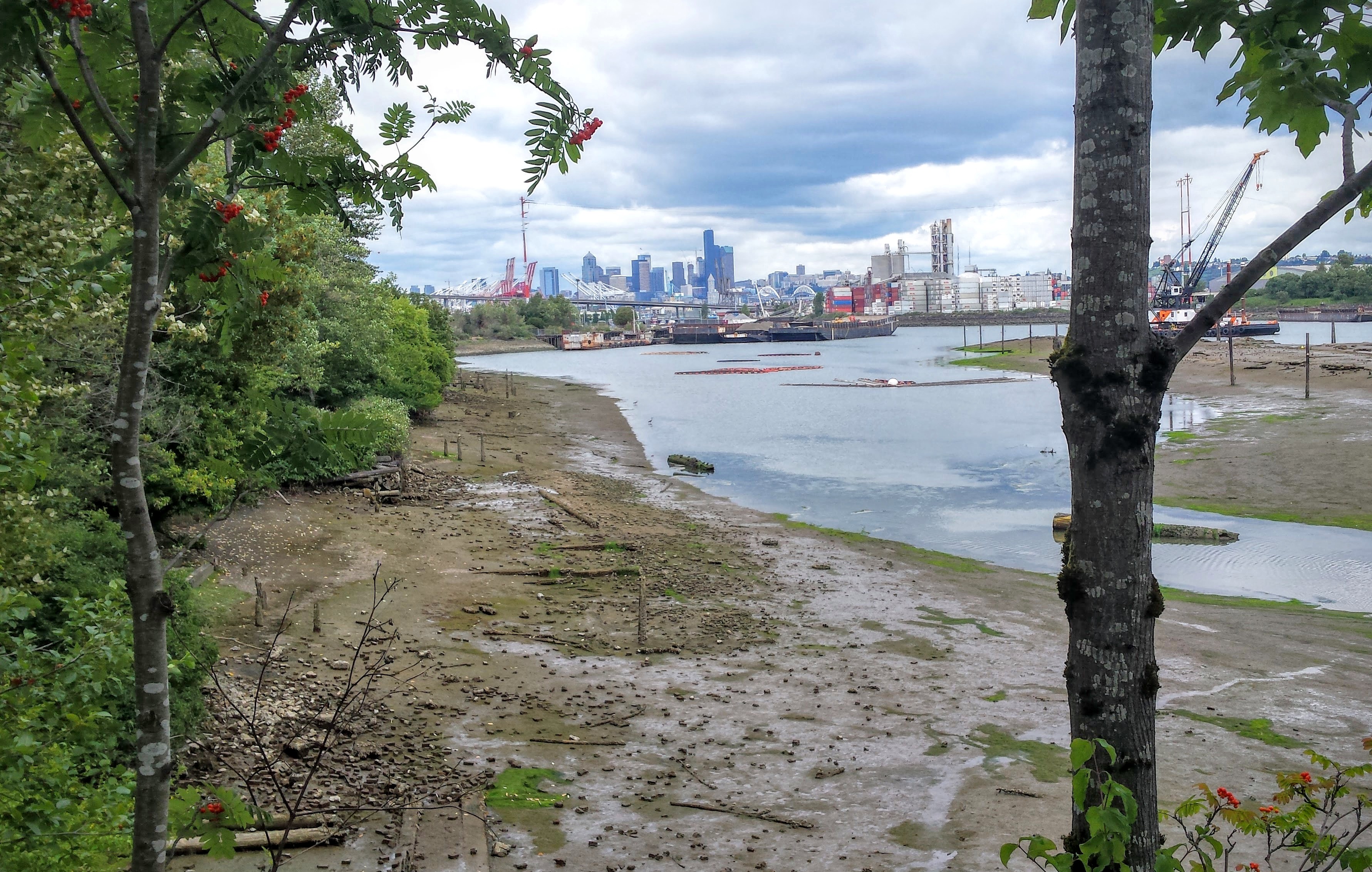
Duwamish River, looking to downtown Seattle, used to meander through the salt marsh.
Credit: John Nelson

Today, the Duwamish River is a major industrial waterway, engineered to handle huge ships. Little remains of the old river that once wound among the mud flats.

But we can see a hint of the past at Terminal 107 Park, the site of a former Duwamish Indian village. Step off your bike and take a walk along a gravel path to the shore of the river.

As we peek at the earth along the riverbank, we may find evidence of a middena place where shells and refuse were discarded by native people.

The home stretch

From here, we’ll be riding back through the stadium district to our starting point. Hopping on the West Seattle Bridge Trail, we pedal into SoDo and take in the former tidal flat. If this was 1850, we’d be under water now, or at least stuck in the mud.

Hear that crowd roar? It’s the sound of modern times as we pass Safeco Field (Seattle Mariners) or CenturyLink Field (Seattle Seahawks, Seattle Sounders) back into Pioneer Square.

Shells are visible in the embankment of Terminal 107 Park in what is called a midden, where Native people discarded refuse.
Credit: John Nelson

_____

John Nelson is a freelance outdoors writer based in Seattle. Follow his blog at skizer.org.

This Week In SeniorsSkiing.com (June 2)

We’re Starting Our Summer Schedule!

From Memorial Day to Labor Day, SeniorsSkiing.com will be publishing on a bi-weekly basis.  We’ll still be continuing our Cycling Series, our new Fitness Focus, articles about hiking, profiles of senior skiers, and interesting places our readers and correspondents are visiting.  And, we’ll be publishing our list of 78 Trailmasters, super senior skiers who skied their age and more last season.

So, see you next week with more stories.  As for now, there’s this:

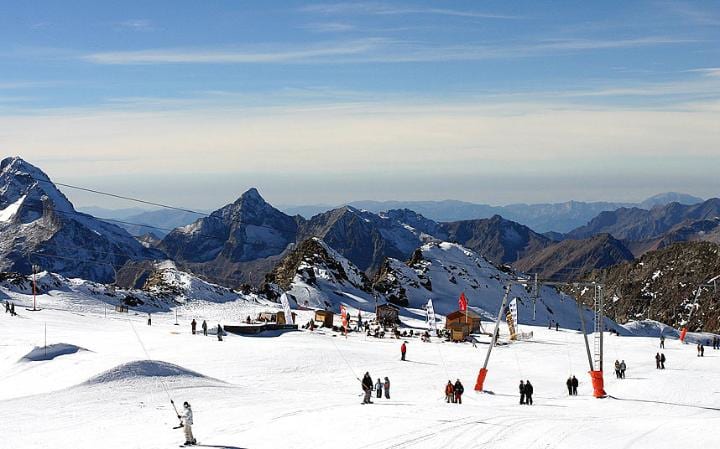
Where To Ski In Summer: Best Glaciers For Skiing [From The Telegraph (UK)]

Les Deux Alpes has skiing all summer.

Click here to link to the Telegraph article.