Ötzi the Ice Man: Three Millennia Older Than Mel Brooks


Reconstruction: Alfons & Adrie Kennis © South Tyrol Museum Archaeology/Ochsenreiter

He may not be the world’s oldest skier, but at more than 5000 years, he is the world’s oldest and best-preserved wet mummy. Given his advancing years, Ötzi is in particularly good shape. 

Named for where he was found in 1991 by two hikers on the Italian-Austrian border, Ötzi now resides in the South Tyrol Museum of Archaeology in the lovely small Northern Italian city of Bolzano. If you find yourself in the general vicinity, I strongly recommend paying him a visit.

© South Tyrol Museum of Archaeology

One of the many effects of global warming is the discovery of ancient things thawing their way out of the ice: thousand year old skis in Oppland County, Norway; a 500-year-old girl with perfectly preserved hands found in the Andes; an almost intact wooly mammoth found in Russia’s Arctic Lyakhovsky Islands. To learn more watch this brief “Secrets of the Ice” video.

But Ötzi stands apart, for his age, his superb condition, and the extensive science applied to understanding who he was. His genome has been mapped, his stomach contents carefully analyzed, and his belongings extensively interpreted. 

He is thought to have been a traveling shaman dispensing medical treatments. Evidence for that is in the form of fungi with antibiotic properties found in a sack. He also had dots and lines tattooed on either side of his lower spine at known acupuncture pain relief sites. Interestingly, even today, similarly located tattoos are found on people from primitive cultures.

Ötzi also had no hand callouses and underdeveloped upper body musculature, suggesting he was not engaged in agriculture or other physically demanding activities. Indeed, his animal skin clothing was finely put together and his axe decorative and showing little wear, possible signs of status and respect.

But respected or not, Ötzi was murdered. A 21st Century police detective examining the evidence concluded he was murdered a day or two following a violent fight. A cut on one of his hands suggests he had defended himself during the recent altercation. An arrowhead found in his body had severed an artery and caused his death. Detective work showed it was shot from a distance of about 100’. Because he was found with all his belongings, the possibility of theft has been ruled out.

© South Tyrol Museum of Archaeology/Ochsenreitr

Visitors to the museum view Ötzi’s gnarled flesh and twisted frame through a window in the freezer room where he’s on display. 

A reconstruction based on everything known about him stands in an adjacent gallery, created with the help of police forensics. 

Some of you may remember that long before Ötzi came out of the ice, Mel Brooks was considered to be the world’s oldest man. He and Carl Reiner drew upon his longevity in their classic comedy routine.

The South Tyrol Museum isn’t large, but it is one of the most fascinating places I’ve seen. If you’re planning a trip to the Dolomites, it’s a place you’ll want to visit along the way.
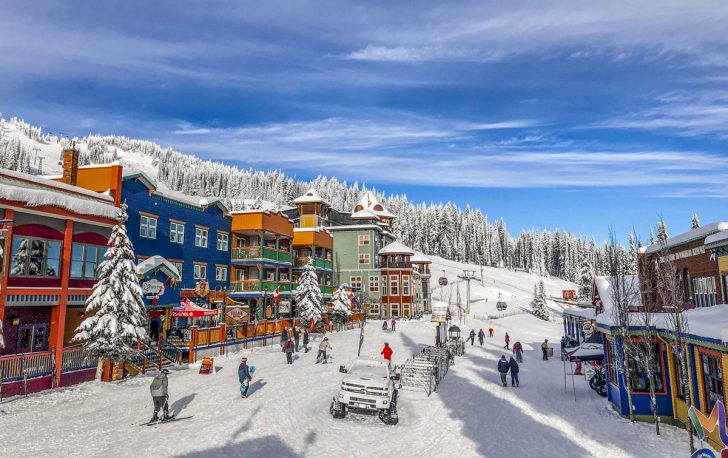
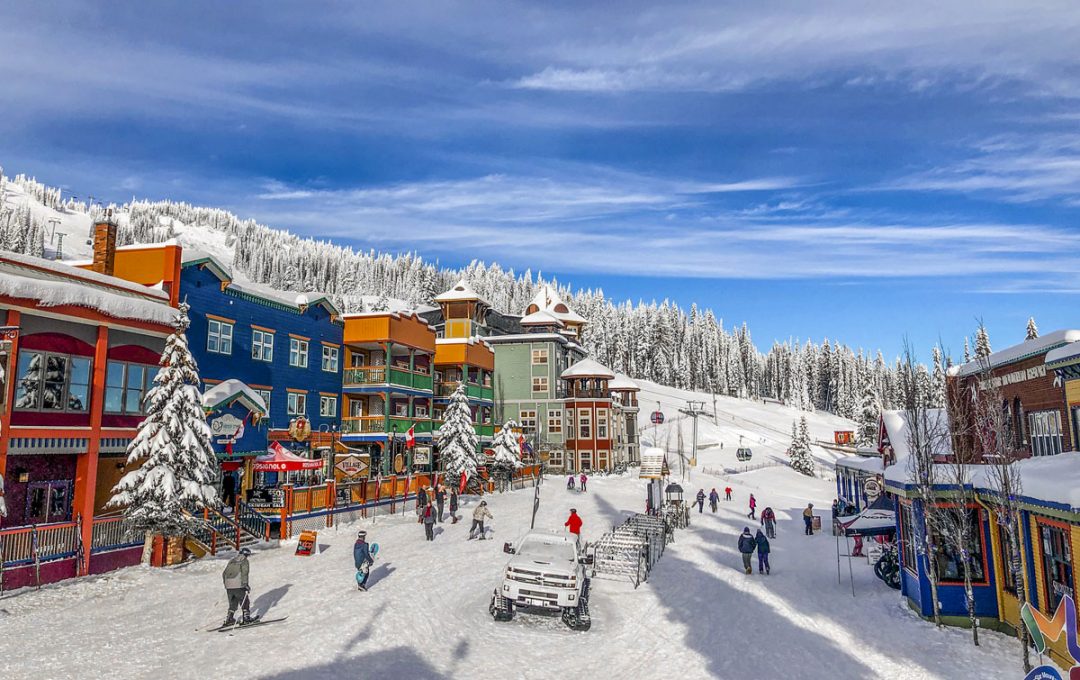
Silver Star Mountain village

SeniorsSkiing Guide: Silver Star Update

Silver Star’s village with its gondola in view. Credit: Silver Star Mountain.

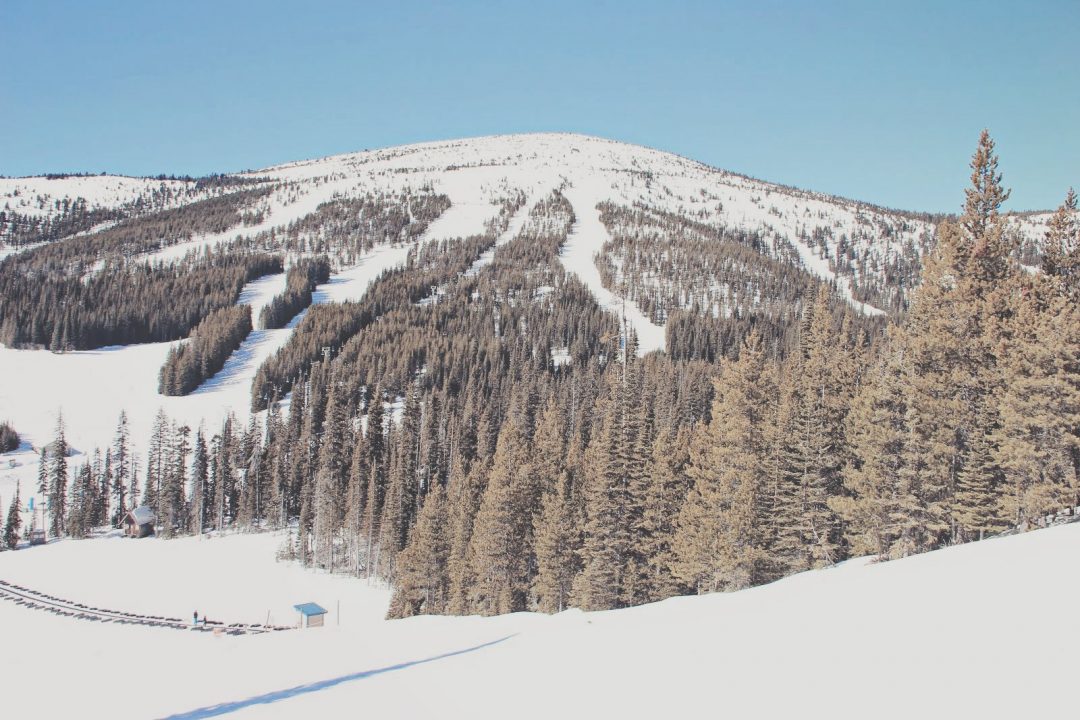
I hadn’t been to Silver Star Mountain in probably two decades. I remembered a mellow, family resort with an Old West theme and very easy runs.

Boy, has Silver Star in British Columbia, Canada’s interior grown up.

Yes, the main street still has a bit of Old West, 1900s mining town vibe. But that’s where the original Silver Star ends.

There’s now a backside with decidedly expert runs. And a brand new gondola that had its first winter this season. It provides quicker access from the main village to Alpine Meadows, Vance Creek and Powder Gulch. And also gives improved access for beginners, and warm access to the upper XC Trails for nordic skiers so they don’t have to ride open lifts.

What many folks don’t realize is how large this place is. It’s BC’s third largest ski area with 3,282 skiable acres, four mountain faces and 132 runs. This includes the back side with 1,900 acres of steep and deep. Mid mountain is a mile high (5,280 feet) with plenty of ski in-ski out lodging.

As for that Nordic terrain, the 55 km of groomed trails that link to another 50 km at nearby Sovereign Lake make it the largest Nordic network in Canada. And this January, USA Today ranked the SilverStar/Sovereign Lake trail network in the Top Ten Cross-country ski destinations in North America, the only Canadian Resort to make the list. 

Nordic skiiing at Silver Star Mountain, which has the biggest Nordic network in North America. Credit: Silver Star Mountain.

For Seniors

* A two-day Masters Clinic,

* Masters’ Mondays

* A yearly Over the Hill Downhill race where folks dig out their ancient skis and old one piece ski suits.

* A run named Over The Hill.

Fast Facts:

* Silver Star’s ski season runs late November to early April.

*  Nine on-mountain hotels with 5,600 pillows and a seriously vibrant collection of building colors that can include yellow, blue, green, bronze and bright red in sections of the same building. Yes, it all stands out, positively glistening against the snow.

Fat tire biking on snow at Silver Star Mountain. Credit:Silver Star Mountain.

* Sixteen places to eat including two on-mountain and a cabin reached via sleigh, along with a grocery store in the main village. Do NOT miss the Red Antler’s world class chili which, for some inexplicable reason, is called “meat and potatoes soup.” It’s chock full of meat, not too many beans, and set in a thick, spicy base. And for a good show, there’s the Smoked Old Fashioned drink at the Den Bar & Bistro. Watching the bar guy torch wood chips and infuse the mellow whisky drink with smoke is a night’s entertainment by itself.

* Total vertical drop of 2,500 feet with 15% beginner, 40% intermediate, 35% difficult and, yes, 10% extreme. Ten lifts with total capacity of 14,000 skiers per hour.

* Annual snowfall of 275 inches, average daytime temperature of 23 degrees.

* Non-ski activities include snowshoeing, fat cycling snowy trails on bikes with super wide tires, ice skating on the local pond, Tube Town with lift access to inner tube runs and riding a fenced track on Arctic Cat FireCat F120 mini snowmobiles for the 12 and under set.         

To Get There:

Silver star is an hour’s drive north from Kelowna International Airport and the ski area runs shuttles to the resort. The nearest town is Vernon, 20 minutes down the road.

Bottom Line:

Daily pass (for 65+): $82 – $94 Canadian + 5% GST

Season Pass: Senior (65-80) $509 – $579, Young @ Heart (81+) $289.50 Canadian + 5% GST

Great cruiser runs. Great signage. Easily accessed terrain.

Many condo rooms at Snowbird Lodge include generously sized hot tubs.

YouTube: https://www.youtube.com/user/silverstarmymountain

Click Here For Silver Star Trail Map

Click Here For Silver Star Web Cam

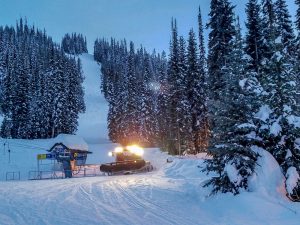
Main village of Silver Star Mountain at night in British Columbia. Credit: Yvette Cardozo

How BC Resorts Show Love For Senior Skiers

Big White, Sun Peaks, Silver Star Create Programs For Seniors.

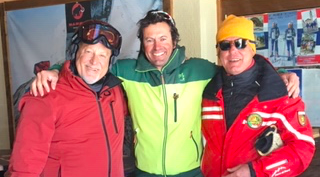
A few of Silver Star Mountain’s many senior skiers. All in fantastic shape, all very good skiers.
Credit: Yvette Cardozo

Ok, one thing most senior skiers—those folks in their 60s, 70s, 80s and even beyond— do a lot is ski.

They love snow, they love winter, they love all things ski.

In fact, nearly two thirds of all season passes bought at Silver Star Mountain in Canada’s British Columbia go to seniors—32 percent to “regular” seniors 65-80, and another 30 percent to the “Young @ Heart” skiers who are 81+.

The other commonality: They’re fit. They exercise regularly. They never really were couch potatoes. And most of them have been skiing since they learned to walk. 

Curious, I corralled a bunch of them at Silver Star to ask some questions.

Well, not all of  them.

“Um, where’s the guy you said is 83?” I asked.

“Oh he took off. He’s heading for the backside.”

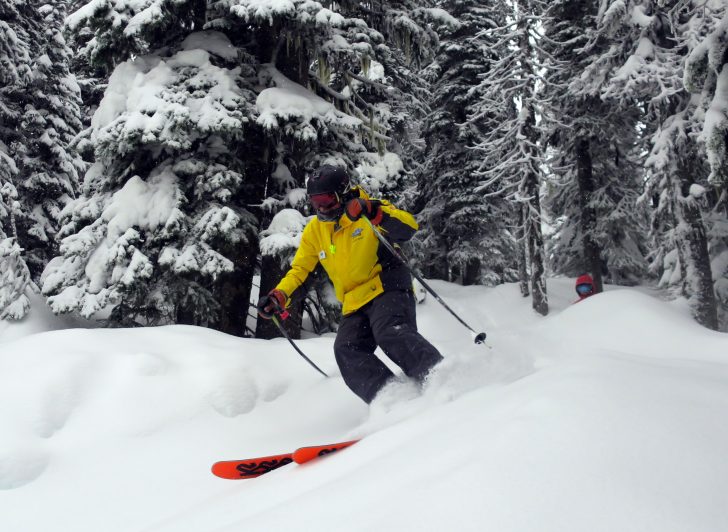
Sure enough, Mike had decided the lure of back country powder overrode sitting to talk with somebody about senior skiers.

When you talk about senior skiers, whether it’s at Silver Star, a bit north at Sun Peaks or my regular Tuesday group outside Seattle, you’re not talking about somebody manning a bench in the lodge watching grandchildren.

The group at Silver Star that morning seemed to be all exski patrol, exinstructors, ex racers. And, well, not all of them were ex-. A couple showed up in their instructor jackets.

And, yes, this group was virtually all guys.

One of Silver Star’s veteran skiers. Credit: Ernie Sollid.

But that’s just Silver Star. Over at Sun Peaks, the senior group is more a mixed bag. In fact, the husbands of the Polar Bears (all women) got so jealous they talked about forming their own guys only group, the Grizzlies. And there’s the Antiques, a mixed group of Kamloops local men and women who also ski at Sun Peaks and socialize together regularly.

Here’s the point: The ski areas have bought into all of this and are creating events and special programs for seniors.

Silver Star has a fun race called the Annual Over The Hill Downhill and actually includes training camps, qualifiers and, of course, the actual race, usually in February.

The idea, said Chantelle Deacon of the area’s media relations, is to dress in your oldest, most archaic ski clothes and gear.

“You see people in super tight onepieces. Some unearth these old straight skis with really pointy tips.”

There’s also a run called Over The Hill.

And there’s a senior clinic called Master Academy aimed at folks 50+,  a two-day clinic with skiers split into intermediate, advanced and expert.

Plus, there’s Masters’ Monday, weekly co-ed programs January through March run by instructors but aimed more at fun skiing than lessons.

Big White, also in British Columbia, has three separate Masters Weeks that echo ski weeks of yore and combine lessons in the morning with social events in evenings.

Ok, there have been some concessions by these skiers.

John Wilson, the latest “old man” to join the group. A relative baby at 69. Crdit: Yvette Cardozo

Steve Hubbard, one of the younger Silver Star guys at 67 confessed, “I used to terrorize the bumps. Now they terrorize us.”

You think maybe a bit before you do something, you take fewer chances, someone else chipped in.

“One of the things keeping a lot of us in the game is knee and hip replacements and at least one back fusion. Knees and hips are almost routine and Art has fused ankles,” someone else added.

But that hasn’t stopped them.

Ernie Sollid, 77, sent me a picture of his back Xray, the slightly terrifying one that shows lumbar 3+4+5 bolted together. He also sent along a screen shot of his stats for this Feb. 1, showing he hit 46 mph, skied a total of 25.5 miles with 22,145 vertical feet. All this over four hours.

“I usually quit after lunch,” he added.

But not everyone is held together with bolts and pins.

Sigi White, 81, at Sun Peaks, whose idea of keeping in shape is back country touring because she says downhill skiing isn’t taxing enough, has managed to escape injury.

“I ski anything on the mountain,” she said, adding “I’m not fond of bumps. I prefer powder.

“I want to save my knees.”

For More Information

Silver Star Mountain Resort

Sun Peaks Resort

Big White’s Masters Weeks

Reporting From the Italian Alps

Italy’s Aosta Valley: Gateway to great skiing

Italy’s Aosta Valley is rich with history; even richer with places to ski. The Romans used the valley as a route to Gaul. In the intervening centuries, more than 100 castles were built. Starting in the early 1930’s, the Italians, the Swiss and the French started building ski lifts. They haven’t stopped.

The valley provides easy access to some of the world’s greatest ski resorts. At one end is Courmayer on Mont Blanc. Drive up a side canyon and you’re in Cervinia, on your way by lift and ski to Zermatt. Another short drive, and you’re at Monterosa.

We’re in centrally located Saint Vincent, a scenic and charming walking town, where every day we journey through scenic alpine villages to a different resort. 

Centrally located Saint Vincent

It’s only the second week of March, and Saint Vincent is beginning to bloom. We’re staying in the aptly named Hotel Bijou, a gem of a hotel overlooking the town’s central plaza. The main street is lined with colorful three and four story buildings housing attractive stores and restaurants specializing in Aosta’s regional cuisine. Just a few blocks in either direction are an elaborate mineral bath complex reached by funicular and a sizeable casino.

After a full day of skiing, we don’t have energy for either.

We’re here with the owners of Alpskitour, a local guide service and SeniorsSkiing.com advertiser. Mauro Cevolo has taught and coached skiing in Italy, Austria, France, New Zealand and the US (Mammoth). Andrea Jory teaches mostly at Cervinia and Champoluc. He was on Italy’s national bobsled team and competed in the 1980 Lake Placid Olympics. Both are magnificent skiers and highly enjoyable companions. They’re intimately familiar with the many resorts in and around the Aosta Valley, including the best places to ski and where to stop for a gourmet lunch in an authentic surrounding.

The author with world speed ski champ, Simone Origone and Andrea Jory, Alpskitour

Wherever  you go with them they’re warmly greeted. At lunch the other day, they bumped into Simone Origone who for 12+ years held the record for the world’s fastest man on skis (about 157 mph!).

An important benefit of staying in Saint Vincent over one of the resorts is the ability to decide, last minute, where to ski. The other day, when high winds had forced many of the resorts to shut down, we drove to the city of Aosta, boarded a gondola and climbed the mountain into magnificent mid-winter conditions at the Pila resort. Accustomed to Rocky Mountain resorts, Pila was a big surprise…emphasis on big. But it is small, relative to where we’d be going over the coming days.

La Thuile in Aosta Valley

The next day we drove past high-perched castles, ancient stone villages, and up a series of hairpin turns to reach Espace San Bernardo. We started at La Thuile, and after a gondola and a chair entered a landscape of endless peaks and glaciers. Following several long runs and more lifts, we crossed into France and descended to La Rosiere, another sizeable resort. After a few hours of skiing, we rode two long Pomas, crossed back into Italy and skied to Maison Carrel, where we lunched on regional cuisine in a modernized 19thCentury stone barn. I had cabbage soup topped with a thick layer of Fontina cheese, one of many Aosta Valley products exported across the globe.

Combined, La Thuile and La Rosiere have 39 lifts servicing something like 7800 acres of terrain, mid-sized for the Alps. Nonetheless, it’s size is slightly less than Whistler Blackcomb, North America’s largest.

Monterosa’s Champoluc-Frachey

The story gets better. Yesterday we drove to Monterosa’s Champoluc-Frachey and skied two of its three massive valleys. We started on a super-steep, rail funicular and throughout the day used cable cars, gondolas, and a variety of open and bubble chairlifts. This place is humongous. Looking up into remote snow fields were tiny specks skiing gondola-accessed backcountry. We stayed on trail, at one point dropping down a long and steep sun-drenched trail…my kind of skiing.

The West won this season’s snow lottery. Last year, that prize went to the Alps. Coverage is adequate at the moment and skiing is a lot of fun. If it were deep powder, I’d be able to enjoy a handful of runs before calling it a day. We’re probably skiing 15,000 – 20,000 vertical.

Today is a self-imposed rest day. We’ll visit some of Saint Vincent’s treasures and drive into the city of Aosta to see its Roman ruins. Tomorrow we’ll be back on another mountain. Which one is a decision Mauro and Andrea will make in the morning. One thing I know: it will be big, beautiful, and interesting. That’s what defines skiing in and around the Aosta Valley.

More on this fantastic ski experience next week.  

SeniorsSkiing Guide: Japan’s Hakuba Valley

A Senior’s Introduction To Some Of The Best Skiing In Japan.

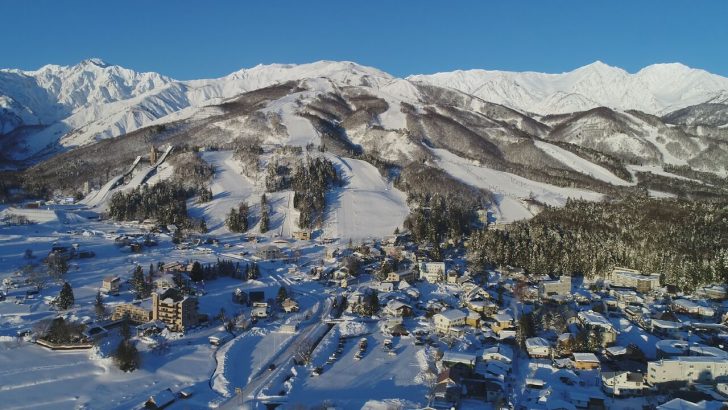
Happo One is the largest resort in the Hakuba Valley with four base areas serving the mountain. Credit: Hakuba.com

The Hakuba Valley sits three hours west of downtown Tokyo and boasts some of the best skiing in all of Asia. Host to the 1998 Winter Olympics, Hakuba offers a unique combination of diverse terrain spread out over 11 resorts, 12 meters of annual snowfall, world class facilities, and amazing Japanese cultural experiences: think sushi, hot springs, and thousand year old temples. The entire valley has been added to the 2018/19 Epic Pass allowing pass holders five days of free riding across all of the resorts.

Access

From downtown Tokyo you will take the famous Japanese bullet train one and a half hours to Nagano Station where you will need to transfer to a bus for the last one hour of the journey. The entire is just 3 hours and costs ¥10,000. ($85.00)

Two Outstanding Resorts In The Valley

Happo-One

The largest and most central resort in the valley is Happo-One (pronounced On Ay), spreading across 220 hectares. The highest run is 2,696 m and spreads to four base areas providing everything advanced skiers could want: steep runs, high vertical drops, and powder runs. There are opportunities for beginners as well but this resort is best suited for intermediate and advanced skiers.

Adult Lift Ticket: ¥5,200 ($46.00)

Senior Lift Ticket: ¥4,700 ($41.00)

Cortina

Cortina has become synonymous with powder skiing for Hakuba enthusiasts. The resort receives the highest and driest snowfall in the valley and usually gets nearly twice as much snow as neighboring resorts. The snow patrol at Cortina are quite relaxed, and off-piste skiing is not an issue.

Adult Lift Ticket 1 Day ¥4,000 ($35.00)

Senior Lift Ticket 1 Day ¥3,200 ($28.00)

Alternatively, visitors can buy the Hakuba All Valley Pass which gives pass holders access to all 11 resorts.

Lessons

The Evergreen Outdoor Center is the largest international ski school in Hakuba and offers English language lessons with certified instructors on Happo-One.

Gear

You can get all your rental gear at Central Snow Sports. They have several locations throughout Hakuba and have very knowledgeable and friendly English speaking staff.

Basic Ski Rental Package: Approximately ¥4,000 per day ($35.00)

Where to stay?

Happo Village has everything you need for a comfortable stay in Hakuba: proximity to the resorts, best restaurants, hot springs, and public transportation.

Marillen Hotel

Only in Japan: Marillen is an Austrian-themed hotel in the heart of the Hakuba Valley. Credit: Hakuba.com

The Austrian-themed Marillen Hotel sits on the Nakiyama slope and is one of the few true ski-in-ski out hotels in the Hakuba Valley. The Austrian theme stretches  to the food with schnitzel and pretzels served while a fire roars and live musical acts perform in the après bar. Nakiyama even offers night skiing if you find the energy for a few extra runs after dinner.

Onsen

Soaking in a Japanese hot spring after a long day on the slopes is a terrific way to relax. Be advised,  it’s customary to bathe in the nude. It may feel daunting to walk into a public onsen at first but the experience is well worth any initial awkwardness. There are multiple onsens within Happo-Village, and they cost approximately ¥600 ($5.50) per visit.

Off the Slopes

Join a day tour and soak in the rich Japanese culture and visit the world famous snow monkeys. This full day tour takes you from Hakuba to Nagano City where you’ll stop at Zenkoji, an eighth century Buddhist temple. Many believe the first Buddhist sculpture ever brought to Japan remains within this sacred building. After touring the temple, you’ll be taken to the snow monkey park where you’ll be able to see the only monkeys in the world known to bathe in hot springs.

For more information, click here for the Hakuba Valley site.

The Cortina resort offers lots of snow and powder opportunities. Credit: Hakuba.com


Chile 2018 Ski Season Wrap Up

Finding Good Days In A Disappointing Snow Season In The Southern Hemisphere.

The 2018 season started on time in June, after a serious drought, but sputtered out before it ever really got going. The Chilean Central Zone ended with a 54 percent precipitation deficit, despite ENSO-neutral conditions. For a ski area in Chile not to get to the Sept 18 National holidays is shameful. Which is not to say there were no good days, just that they were few and far between.

Being relatively free to select those good days, I can share a couple of snaps that are deceivingly good.

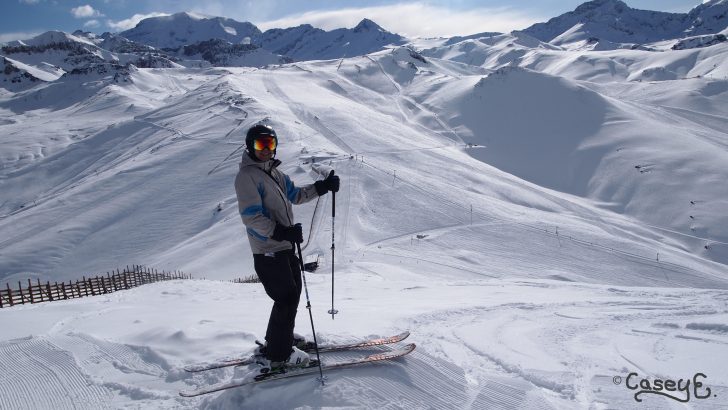
The Las Vegas lift out of the La Parva village on a cold day in July. Helps to know where the rocks aren’t.

La Parva. Credit: Casey Earle

The conditions were not sufficiently good to ski other Central Zone ski areas, where I am not so intimately familiar with their thin base rock gardens.  So in September we headed 560 miles to the south where Mother Nature was more accommodating.

The Hotel Puyehue. Credit: Casey Earle

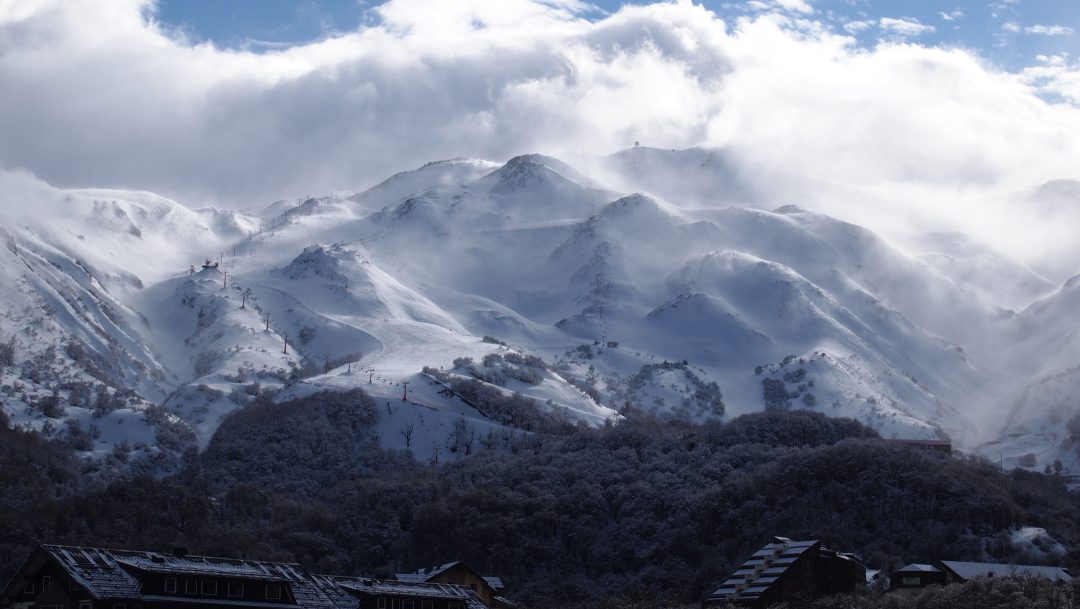
Our first lodging was the venerable and grandiose “Termas Puyehue Wellness & SPA Resort”, formerly the Gran Hotel Puyehue, founded in 1907. Back then, guests arrived by steam boat across the Lago Puyehue to enjoy its charming hot springs. The hotel is very well located at the entrance to the Parque Nacional Puyehue, established in 1941, and the lovely Antillanca ski area, tucked up in a volcanic cirque 18 km away. This is reached at the end of a good dirt road that winds through temperate rainforest and lagoons. The snowpack was 6-10 feet, from the mid station up, as it had rained hard at the base.

Here it can rain six feet a year, so when that falls as snow, it adds up, and 10-15 ft bases are not uncommon.

I seized an unusually brilliant sunny day and headed up. Nary a rock to be seen, and superb spring snow.

Heading down back off the crater towards the ski area, with the Puyehue Lake in the distance.

La Parva. Credit: Casey Earle

After the traditional September 18 mega-BBQ at a friend’s place in Puerto Varas, on the Llanquihue Lake, we drove back north 200 miles to Corralco ski area, on the Lonquimay Volcano.

This time we chose a cozy cabin in Malalcahuello, a nearby up-and-coming mountain town nestled in a group of volcanos. Monkey puzzle trees greet you as you wind up through the forest to the barren eastern bowl of the volcano.

Again, no rocks here, even at the end of September.

Credit: Casey Earle

While the American ski team trained on the far right side of the ski area, those venturing into the bowl to the south got fresh tracks

Corralco closed at the end of October, by far the latest closing for any ski area in Chile this year.

If you liked this 2018 summary, and want to drill down to the nearly daily detail of how it panned out, try reading a bit of my 276-entry collaborative thread on the Teton Gravity Research website. Click here for my Ski Chile comments.

Ice Fishing Time Coming Up

Other Things To Do In Winter For Seniors.

Ice fishing on Heffley Lake near Sun Peaks Resort with Elevated Fishing Adventures. Here, the guide and guest try their hand at outdoors holes. Credit: Yvette Cardozo

Some folks fish for sport. Some for relaxation. Some to “just get away.”

I fish to eat. If I can’t eventually put it in a fry pan, I’m not really interested.

So enter Elevated Fishing Adventures, near Sun Peaks Resort in British Columbia, Canada, where you get all three. Especially the eating part.

“Probably half the people who come out with us cook their fish that night,” said owner/guide Campbell Bryk.

Owner/guide Campbell Bryk picked my friend, Nancy Slye, and me up at 7 am and we drove out to nearby Heffley Lake, which at this point in the year, was covered with 20 inches of ice.

The lake is stocked with rainbow trout, a mild fish that makes great eating. The red glow is sunlight coming through the red canvas tent. Credit: Yvette Cardozo

A few hundred yards out, Campbell set up his fishing tent, got a portable heater going and re-drilled three of his fishing holes. Then he baited our hooks with natural looking lures that not only wriggle, they glow in the dark water below the ice.

This is really popular with families that have kids. “As soon as  you see fish down there, you can get kids to sit for hours,” Campbell said.

And anybody …really ANYbody…can catch a fish, he insisted, describing one morning where a mom was breast feeding her infant with one hand and hooking fish with the other.

“Her three-year-old caught a 24-inch fish,” he added.

The BC government each year stocks Heffley with 5,000 rainbow trout, a fish that Campbell claims, “Anybody can cook and virtually everybody likes because it’s so mild tasting.”

The best fishing, he explained, is just before Christmas. The most any group has caught in a day is 36, though folks are limited to keeping only five per person. And the largest fish anyone’s ever caught was 30 inches, big enough to feed six people.

The lake has both wild and stocked fish. The wild ones are dark red and green, the stocked ones are shiny but they both taste the same, so we were told

As for us, we were pushing the end of the season. And the fish were nowhere to be found. Have any groups ever come up completely dry?

Only two out of 50 trips. Campbell invited them to come back the next day, free of charge.

Okay, we were running out of time.

And then, with maybe 15 minutes before we had to pack up, something nibbled Nancy’s line. She set the hook and reeled it in. It was cute. It was tiny. It was too small to keep.

So we went back to fishing and now, with merely five minutes to go, Nancy got another one (I was busy taking pictures). Again she hooked it. Again she reeled. Again it came up.

And this time it was over a foot long, one of the stocked fish, holding a good pound of edible meat. A keeper. Campbell filleted the fish and delivered it to us later that day.

As for the cooking part, we removed what tiny bones remained, cut the fish so it lay flat, tossed it into a frying pan with lots of butter, garlic, a bit of salt and a splash of lime juice.

Even I, someone who joyfully eats but doesn’t necessarily cook fish, did a yummy job.

Next year, Campbell said, he will have a permit to fish on Paul Lake, which is stocked with landlocked sockeye salmon, called Kokanee in these parts. He’ll be making salmon sashimi for those who want it and cooking lunch.

Nancy and I WILL be back.

Click for more about Elevated Ice Fishing at Sun Peaks Resort.

After cleaning, there is about a pound of rainbow trout, perfect for two for dinner. Credit: Yvette Cardozo

Dreaming of Skiing the Alps? Follow Warren Miller’s Advice: Don’t Delay.

Warren Miller has been gone for less than a year, and his wisdom about not postponing your next ski adventure has been on my mind.

There’s one experience in particular that beckons. It is based in the beautiful ancient village of Saint Vincent in the Aosta Valley in the western Alps, close to Mont Blanc, Zermatt, and Monte Rosa.

Organized by Alpskitour, clients stay in their choice of five- and three-star hotels. The village serves as hub, and every day, they join their guide and a few other people to explore trails and slopes on the highest peaks in the Alps, crisscrossing between Italy, France and Switzerland.

The groups are mostly European-based intermediate and advanced skiers, with the occasional American, Canadian, New Zealander, or Australian. The guide and group ski together for five days, always riding different lifts and exploring new terrain.

They stop at quaint mountain refugios for lunch. Forget burgers and fries. This is on-mountain dining in beautiful settings.

The landscape is incredible. Dramatic peaks. Trails snaking through magnificent rock formations. Slopes that descend through scenic hamlets.

The dreamlike experience is what I remember from the Warren Miller films of my youth and from ski trips to the Alps in the 60s and 70s.

Then, wrapped up in family and career, I skied closer to home, exploring Colorado, Utah, New Mexico, Wyoming, Idaho, Montana, and British Columbia.

The skiing has been great, but the dream of the Alps was always there.  My wife and I booked with Alpskitour for mid-March, 2019. We’re looking forward to returning to the roots of modern skiing, enjoying its history and culture; its  exceptional beauty, and hospitality.

Alpskitour has been advertising with SeniorsSkiing.com since last season. Their website explains the group’s unique concept and is filled with wonderful images of what to expect. I’ve been emailing with Gerry Walsh, a Brit who has booked with Alpskitour for several family ski holidays. He wrote glowingly about the guides, the hotels, the scenery, and the outstanding hospitality.

I know that the exchange rate isn’t optimal. We could wait until it is. And the flight to Milan will be a few hours longer than if I were traveling in the U.S. And committing this early has some risk regarding snow levels.

But forecasters tell us this will be an El Nino year with higher moisture and warmer temperatures and southerly snowfall.  And wherever you go, lodging and skiing tend to add up.

I’ll ski a few weeks in the West this season. Might even catch some warm corn days in New England. But come March, we’ll be in the Aosta Valley with Alpskitour.

Warren Miller had it right. Don’t put it off. If you love skiing, try something different. This will be my 65th consecutive ski season. We’ll be celebrating in the Alps.

SeniorsSkiing Guide: Portillo, Chile

Ride The “Va et Vient” Lift Up The Steeps, Ski With Ski Teams, Enjoy The Vistas Of Remote Mountains. There Is Only One Portillo.

Editor Note:  Casey Earle has written several articles for SeniorsSkiing.com, introducing Norte Americanos to skiing in the Southern Hemisphere. Also click here for advice for neophytes . Portillo hosts international ski teams in training during the summer months, and it boasts amazing runs, unique lifts, and a curious sense of remoteness with luxury amenities. Here’s his Resort Review.

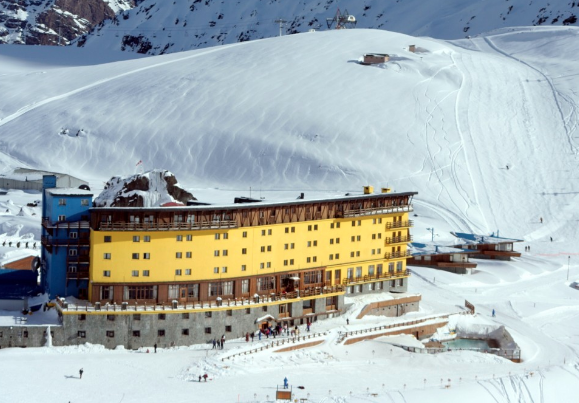
Filled with amenities Hotel Portillo is the only place to stay at the resort. Credit: ChileSki.com

Portillo should be on every skiers bucket list. It’s a beguiling combination of big mountains, a sense of remoteness, old world charm, and wild skiing. Known for intense suntans from its brutal sun, young whippersnappers pumping adrenaline to the limits, a heated pool with a lake view to make even jaded travelers swoon, fine formal dining, and great après ski, you can´t go wrong.

Riding the Roca Jack “Va et Vient” with the US Ski Team. Credit: Casey Earle

Located near the Chile-Argentina border two hours north east of Santiago, 14 miles from the Western Hemisphere’s highest mountain (the Aconcagua at 23,000ft), the area is accessed by the only paved highway to Argentina for over 400 miles. Founded in 1949, the ski area was bought in 1961 by two Americans, Bob Purcell and Dick Aldrich and is still run by the Purcell family. The original hotel has been preserved and remodeled to modern standards.

The area has five chairlifts, four pomas, and four “Va et Vient”. While most are short lifts, several will provide you with about 1,000 vertical feet on the aprons of 14,000 ft mountains, or in combination, more. The “Va et Vient” are specially designed for steep slopes, with only one tower at the bottom, and two bull wheels suspended from the rock above, giving the lift a triangular form. Four or five people load up to the platters hanging from a crossbar, and when ready, the lift starts up and whisks them up the mountain. One can release before or after the lift stops at the top, but be careful getting off on the steep slope, you do not want to fall there!

While there are several good groomed runs, notably Juncalillo and Plateau, much of Portillo’s attraction comes from skiing those steep, ungroomed runs. Famous challenges for skiers are the Garganta (throat), the Lake Run, and the Roca Jack. The most ambitious hike over two hours up takes you to the “Super C”, a lengthy couloir for extreme skiers only. Also, some great heli skiing for intermediate and advanced skiers can be had on the surrounding mountains. All the while, you will be surrounded by a united nations of skiers, and some of the world’s top racers in training.

Taking on the Lake run. Credit: Casey Earle

The only lodging available within 90 minutes of Portillo is the Hotel Portillo. With a variety of options from US$1,150 to $3,950 for a week, meals included, there is something for everyone. A range of activities are available, including a gym, game room, and a full court for sports such as basketball. For lunch, there is no better venue than Tio Bobs, at the top of the Plateau chair, where you can gaze down at the Laguna del Inca and up at the surrounding Andes, while feasting on BBQ’s, fish, salads, and of course a potent Chilean pisco sour!

For more information, click here. For a trail map, click here. 


Worse case scenario, you can always just kick back in the pool, get a massage, or hang out in the bar. Credit: SkiPortillo.com

Trail map gives an orientation to Portillo. Click here for more detail.

More Ski Chile: What To Expect From A Chilean Ski Trip

Some Adjustments Necessary To Ski The Legendary Mountains Of Chile.

For many, a typical Chilean ski trip will seem a bit like traveling back in time to the USA 30 or 40 years ago. Some of the lifts date back even further than that! While the ski areas around Santiago are progressively upgrading their infrastructure, snow making, grooming, and security, the ones further south remain, in a word, funky.

Most Chileans do not speak English, but those in ski schools, tourism, and management positions generally do. If you have no Spanish, you should still get by just fine, as people are mostly helpful and warm. The Chilean peso converts at 630 to the dollar.

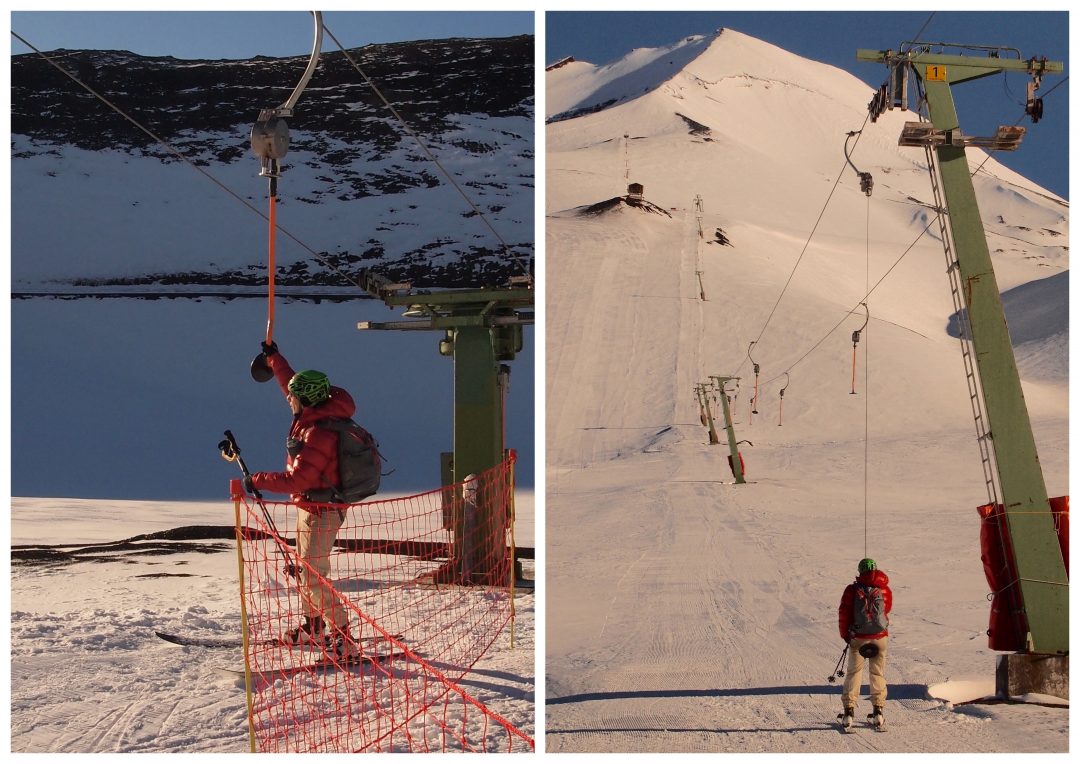
Expect a lot of surface lifts, mainly t-bars and platters, but also the infamous “va et vient” lifts at Portillo (more on that later). On the plus side, these lifts are usually fast, run in windy weather (which is frequent), and you can bail out easily enough if they stop for whatever reason. Some of the chairlifts are second hand from Europe or the USA, and only one high speed quad exists, in Valle Nevado. Lifts open at 9:00 and close at 17:00, with most skiers coming out at around 11:00. Lunch runs from 12:00 to 15:00.

A lonely ride at Corralco. Remember those Poma lifts? Credit: Casey Earle

Don´t expect to get good snow conditions information from the ski area websites, often it is outdated, wrong, or simply non-existent. Portillo is very reliable, but for other ski areas you may have to resort to analyzing webcams or scouring their Facebook pages.

The weather and snow conditions in the Central zone are generally very good. With few but furious snow storms, and occasional extremely light, dry snowfalls, most days will be sunny, fine-packed powder skiing. Off-piste is often limitless, with the southern exposures accumulating triple the amount of the northern ones. With both the sun beating down, and the storm winds roaring in from the north, only in exceptional years can the true north faces be skied, and thus almost all runs are south facing. The season normally runs from mid-June to the end of September.

Casey grabs some pow at La Parva. Credit: Casey Earle

You have to go at least 400 km south from Santiago to the next ski area, Nevados de Chillan, the beginning of the southern climate zone. Here the storms are more frequent and wetter, and the mountains are lower, with skiing starting near or at the tree line. Most people consider skiing in this area more towards spring, when the weather improves. Packed base data is often referred to in meters, reaching up to 5 meters in places. The season in the south often starts late June, and extends into October, with backcountry excursions (on the volcanoes) going into November.

Nevados de Chillan on a windy day. Credit: Casey Earle.

Large hotels are few, at best one per area. La Parva has no hotels, large or small. Aside from Portillo, most people go for the day, or lodge in cabins, small hotels, hostels, or property rentals near the ski areas. Airbnb, Booking.com and other websites have a wide variety of lodging available. In general, what you see is what you get. Chilean food is quite palatable for American tastes, with lots of familiar (and some very unfamiliar) dishes, all accompanied by great local wine and beer.

Lift ticket pricing is based on high and low season, and age group. Avoid the two middle weeks of July, which is the kids winter holiday, as it is quite expensive and crowded. “High season” prices go from July to early/mid August in general, then just weekends, except for Sept 17-19 (National Independence holidays). Seniors start at 65, with about a 20-30% discount on normal adult prices, which run around US$70 in high season and $50 in low. La Parva has a class of seniors from 60-65, and then “super-seniors” as 66+, which only pays US$18 anytime!

Next up is a review of Portillo!

Ski Chile: An Introduction For Neophytes

Chase The Snow To Summer’s Skiing Headquarters In The Southern Hemisphere.

Come May, you have probably set your skis into hibernation and begun patiently waiting for the snow to fly next fall. But you really don´t have to wait!  Southern America’s greatest mountain range starts getting snowed on in May, and by June the ski areas are normally in full swing.

In Chile the resorts are sprinkled just east of the Pan Am highway along the 700 mile stretch from Santiago south, at roughly the equivalent latitude of central California. With an 80 year tradition of skiing, you will find a whole new world of winter adventure, lasting into October on good years.

Santiago and the Andean foothills, after a rare low altitude snowfall. Credit: Casey Earle

Visitors will be happy to know that within a two hour drive of the airport in the capital, Santiago, there are four good ski areas, and upwards of 70 percent of winter days are sunny. Closest are the Three Valleys, which hang above Santiago on the western slopes of the Andes. At night, you can see the snocats grooming trails from this metropolis of seven million!

The La Parva, Valle Nevado, and El Colorado ski areas are interconnected, and it is possible to enjoy a total of 40 lifts and dozens of groomed runs, with multiple options for lodging and dining. Skiing here starts at 8,000 to 9,000 feet, reaching up to 12,000 feet, and is entirely above the treeline. The sunsets are extraordinary.

Casey looks out from El Colorado ski area towards the upper Valle Nevado and La Parva lifts. The 18,000 foot El Plomo mountain looms in the background. Credit: Casey Earle.

Two hours north of Santiago is the world-renowned Portillo hotel and ski area, smack in the middle of some of the highest mountains in the Western Hemisphere. The hotel sits looking north over the mysterious and beautiful Laguna del Inca lake and boasts a long tradition of great service and entertainment. Here you can rub shoulders with racers and ski fanatics from all around the globe.

Portillo and the Plateau chairlift (spot it!), with the Laguna del Inca. Credit: Casey Earle.

Further south, the ski area infrastructure and access may leave a bit to be desired, but I love it nonetheless. All of the ski areas are situated on volcanoes which have varying levels of activity. They are also surrounded by gorgeous temperate rainforests, lakes, rivers, and hot springs. The main ski areas are Nevados de Chillan, Corralco, Villarrica, and Antillanca. The first three have adjacent towns within a 30 minute drive with plenty of lodging and other touristic services. All but Villarrica have a good hotel at the ski area base.

Villarrica ski area, note the smoking volcano. Credit: Casey Earle.

My recommendation for potential visitors is to contact one of the tour companies operating in Chile, or book directly with one of the on-hill hotels such as Portillo. You will have one of the best and most unusual ski trips of your life. Most of the tour operators

Las Araucarias ski area, west side Volcan Llaima. Credit: Casey Earle

in Chile are mainly for younger, adventurous skiers, such as Casa Tours or Powder Quest. However, for the +50 crowd, I can recommend DreamSki Adventures which offers group guided resort based tours in Chile and Argentina for the 45-70+ skier. Their guides are seasoned ski instructors trained in the CSIA (Canadian Ski Instructor Alliance) and offer a high degree of customer service on and off the snow.

Come on down!

For the latest in conditions in Chile from Casey Earle, click here.

Here are the resorts mentioned.

Ridin’ With The Cats

What’s It Like To Groom Trails At Night?

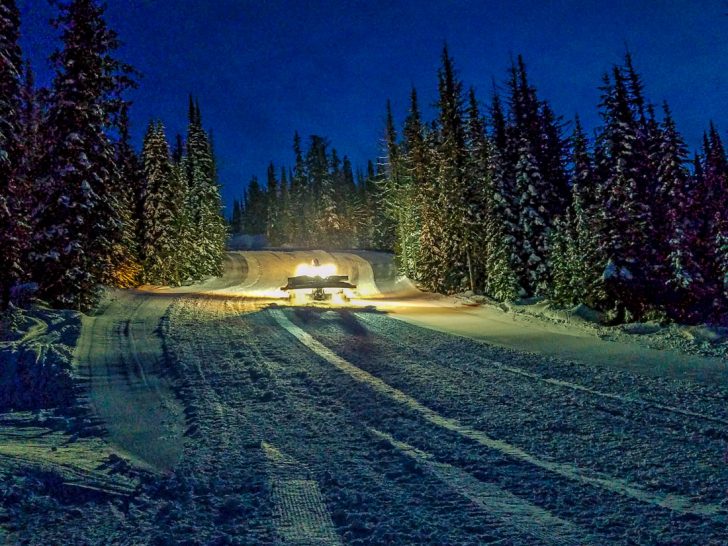
Snow cat groomer making the ski run smooth for skiers the next day. Sun Peaks Resort, BC.

They come out at night and do their job. You can see their lights progressing across the ski slope and occasionally hear their roar. And the next morning, they’ve left this delicious set of corduroy tracks across the ski hill.

I’d always wanted to go on-slope with a snowcat groomer. And so, at Sun Peaks Resort in British Columbia, Canada, I did. And it’s a tour anyone can sign up for.

Snow cat groomer makes its way down a ski slope at Sun Peaks Resort, BC.

It’s astonishing how much damage skiers can do to a run in a single day. If the snow is soft, bumps form, and the middle gets dug out because that’s where folks prefer to ski.

Enter the snowcat groomers. These are powerful cabs—Piston Bully 400s with 320 hp diesel engines— atop tank treads with a blade on front and a tiller on the back. The blade knocks down bumps and that nasty looking tiller, which rotates at over 1,000 rpm, can turn even ice into something resembling powder, which is then smoothed flat into that hero corduroy.

Of Sun Peaks’ 24 operators, two are women.

“Honestly, the women do a better job. They are more detail oriented,” admitted my guide for the night, Leo.

It takes three years for a groomer to really learn how to do this well, he added.

It was one of the women running the winch cat that night. Picture eight tons of growling machine attached by a line to a tree to keep from sliding downslope uncontrollably. This is how the really steep runs get groomed. Back in the day, these runs got so bumped and carved out, they were barely skiable.

It takes three years to become an expert groomer. Sun Peaks, BC.

Rob Gayman, grooming manager at Mt. Hood Meadows resort in Oregon, once described operating a winch cat this way: “It’s somewhat like dropping off a cliff. At the top break-over as the machine teeters above the brink, your heart starts to palpitate, and your natural survival instinct pushes you back into your seat.

“As the machine creeps forward and the operator adjusts the winch tension, the cat tilts forward into the darkness. The cat’s lights don’t shine down low enough; you can’t see what lies below. It tilts more and more. You start to fall forward out of your seat. Now you’re standing on the floor; surely this can’t be right? But then the cat finishes its forward tilt and the ground below you comes back into sight. It wasn’t a cliff after all. Snow rolls and tumbles down in front of the cat as the operator blades and tills his way downhill.”

For me, as dusk fell, the whole scene took on a surreal feel. Our headlights shining on the ridges of snow, leaving them glowing with weird shadows, along with the blinding headlights of an oncoming behemoth.

On an average night, more than a third of Sun Peaks Resort’s ski runs will be groomed. But among those, will be every green (beginner) trail.

And if you are lucky, your favorite black run will have been groomed early, then covered with ankle deep powder overnight, making for a run that feels, well, like skiing a glacier.

There are two women groomers at Sun Peak, BC, said to be more detail-oriented than the men.

The Archetype Senior Skier? This Guy Sure Looks The Part

74 Year Old Long Time Ski Host Books 120 Ski Days A Year At Big White. Jealous?

Ski Host Carlan Silha is fit and fortunate to ski so many days at 74.
Credit: John Nelson

It might seem strange that an American from the Spokane area knows this sprawling British Columbia ski resort better than just about anyone.

Carlan Silha has been serving as a snow host at Big White for 20 years, longer than anyone at the resort. The lanky 74-year-old still skis like a 24-year-old, kicking his heels when he takes a jump and issuing a frequent “Woo-hoo!” as he turns in powder.

The story of how Silha got to Big White starts in 1992, when he was a Boeing executive working in Europe. He and his wife Lin were looking for a condo at a ski resort, and a friend suggested Big White.

“We ended up buying because it was a great price,” Silha said. “Then we got here, and realized we really liked it.”

Silha eventually retired, moved from Seattle to the Spokane area, and then began spending every winter at Big White, where he became a snow host, showing visitors the ropes. Now he logs 120 ski days a year and relishes every minute.

“Let’s ski the Rat Trees,” Silha said as he showed around another visitor recently. The trees are so named because regulars have been hanging toy rats from a particular tree deep in the forest near Big White’s Powder Chair.

If you were Carlan, you’d have a big grin, too.
Credit: John Nelson

Silha then shot off, cranking precise turns through the trees in four inches of new snow. “Woo-hoo!” he shouted for perhaps the millionth time of doing this.

“Being outdoors keeps you young,” he said.

During summers, the Silhas spend their time fishing and camping, using Spokane as home base. They like to travel around the West, and Silha keeps fit by hiking and biking.

In winter, they hang out with ski friends who own condos at Big White, a large collection that includes Australians, Brits, Kiwis and, of course, Canadians. The snow host job—showing visitors around Big White’s 7,355 acres—keeps him busy and provides its own rewards.

“The main attraction is meeting people from all over the world,” he said. “And it makes you feel good to show people this mountain.”

Oz And EnZed: Skiing The Antipodes

Ski And Snowboard Show Impresario Bernie Weichsel Reports On The Down Under Scene.

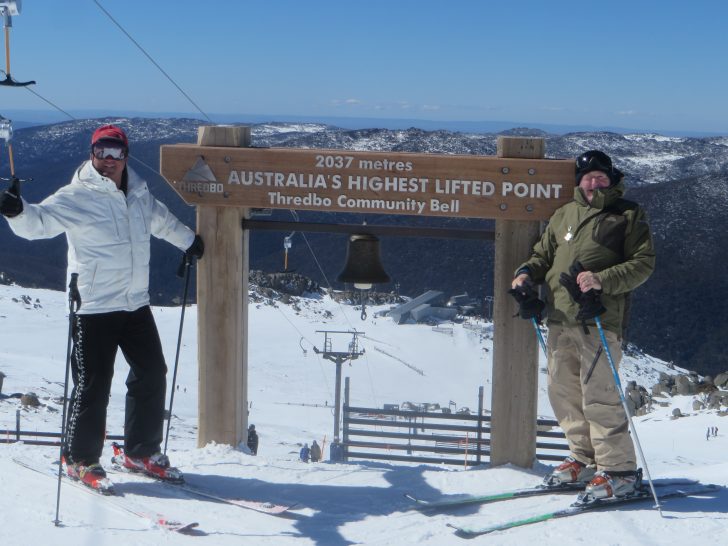
Bernie (r) at Thredbo’s highest lift.
Credit: Bernie Weichsel

For most of us in the international ski community, whether here in the US and Canada, or within the Alpine countries of Europe, there is good news to be found in Australia and, to a lesser degree, New Zealand. Over the past three weeks, I had the opportunity to visit a number of ski areas in New Zealand’s South Island and in Australia’s states of Victoria and New South Walks. I skied at the four areas around Queenstown and Wanaka (The Remarkables, Coronet Peak, Cardrona and Treble Cone and in Victoria (Mt Buller and Falls Creek) and New South Wales (Skiing at Perisher, Thredbo, and the unique Charlottes Pass. I am glad to report in both countries skiing, and, in contrast to the US at least, snowboarding, too, seemed to not only being doing well, but to be thriving.

Skiing The Remarkables, Queenstown, NZ. Anyone notice any hobbits?
Credit: Bernie Weichsel

New Zealand areas’ growth seemed to be coming from visitors from Asia. There were loads of Chinese and Koreans, plus a lot of athletes from Northern Hemisphere countries taking advantage of the snow to prepare for the upcoming Olympics, including Lyndsey Vonn among other US athletes.

But it was in Australia where the growth in the local market was most evident. All the resorts I visited were crowed with families and students, and it wasn’t even vacation time. Resort management all said that they were witnessing growing interest and participation in SnowSports which might be the only SnowSports market in the world where that can be said!

One effort that is propelling growth is a program called Inter-School, a regional wide, multi-discipline, competitive program with local races that lead to regional events and ends in a National Championship. The regional event I saw at Mt Buller—the Victorian State Championships—had 6,000 participants, in many cases, with their parents on hand for a whole week. I am not aware of a similar program in our country. I presume the best analogy is an NCAA program but for High Schools. We all know how school programs for soccer, football, etc. dominate American youths’ time and keeps them—and their families—away from the slopes. Maybe the Australians have found something for us to think about!

All the resorts had decent facilities—from lifts, snow-making and day lodges—and pretty good grooming. New Zealand, for us spoiled North Americans, is a bit of a challenge since there is virtually no on-snow lodging. Most of the lodging is in Queenstown and Wanaka, where it almost never snows;  to get to the skiing you must drive with chains always at the ready in your “boot”—or take a bus.

Weather is also a consideration in New Zealand since all the skiing is above timberline, leading  to some serious white-outs when the clouds hang low, which is often.  But the snow quality is good, the runs decently long— think Northern New England. When it is clear, you can see some of the most stunning scenery anywhere.

Australia, on the other hand, has lodging right on the mountains making it possible to ski in, ski-out. However, the mountains are not as high as New Zealands’ and are wider rather than high, that is, many runs over a number of hills.  That is, except for Thredbo which has a vertical of about 2,000 ft. What really intrigued me was how popular skiing was given that in Australia, there were many road-blocks one has to overcome to get the mountains.  You have to pay an entry fee to enter the Park; all the ski resorts are in state or national parks, you have to pay to park and again pay for a snow taxi to take you to your lodging—not in all resorts but the majority.  And lodging isn’t cheap. The resorts, though, have copied—or might have pioneered—the idea of expensive day tickets versus reasonable priced season pass.

Usually, so I was told, New Zealand gets the better snow.  But, during my visit, it was the opposite: I had basically spring skiing in New Zealand and super mid-winter conditions in Australia—packed powder and blue-bird days. And recently Australia’s resorts have had some of the biggest snow dumps in almost two decades!

One oddity worth noting. The small area near Perisher, Charlottes Pass, might be —I can’t think of any other resort that can only be accessed—in and out—by Sno-Cat . It’s a 30-minute ride each way. Nice, but small skiing, once you get there,  and it’s pretty private and worth the effort.

A unique arrangement: No lifts at Charlotte Pass, just a 30-minute Sno-Cat Ride each way to the slopes.
Credit: Bernie Weichsel

Meanwhile In Australia…

We Have Hurricanes And Wildfires.  Oz Has Big Snow.  Sound Like A Theme?

Early September 2017, Perisher Ski Resort.
Credit: Perisher

The news from Down Under is that the snows are prodigious, the depths of which haven’t been seen in 17 years.

The snowpack in Australian snow fields is up to 97 inches, eight feet, which sounds awfully similar to the monster snow this year in the North American west.

So while we contemplate extraordinary weather conditions from wild hurricanes and fires, it appears Oz and NZ are also having extraordinary weather.

Here’s a video from Threadbo, one of Australia’s most popular resorts.  Looks like they are having fun.

And thanks to Snowbrains.com for the head’s up.

Suzie In The Selkirks

Run After Run Of Perfect Powder For Five Straight Days. Snowcat Skiing At Its Best.

Correspondent Suzie Winthrop found fresh powder every day. Can you see the smile on her face?
Credit: Steve Shannon

Do you dream of skiing in untracked powder?  Of course! We all do!  And most of us get one or two runs at resorts that offer “fresh tracks” early in the morning before the snow cats groom the trails. But soon you’re plowing through broken snow and by noon those freshies are a distant memory.
Snowcat skiing is a unique, albeit pricey experience with fresh powder every day.
Credit: Selkirk Snowcat

How about skiing run after run of perfect powder for five straight days? Run after run of power up to your knees, day after day. Impossible, you say. Well, this past March a group of us found Nirvana in the Selkirk Mountains of British Columbia.

It snowed every night.  In the morning, our tracks from the previous day were nowhere to be seen. We accessed the terrain by snowcats which accommodated 12 skiers plus two guides.  The powerful machines were cozy, comfortable and allowed for good conversation as we chugged up the mountains.  The pace was just right; we had time to catch our breath between the ten or eleven runs we took each day.  Fifteen to eighteen thousand vertical feet of downhill per day was more than enough to send us back to the comfortable lodge exhausted and happy.  After a soak in the hot tub, a drink at the bar, a delicious homestyle dinner and a few rounds of “Grunge” at the pool table, it was time to call it a night. After all, we would be awakened at 6:30 a.m., stagger in to our 7:00 yoga/stretch class before enjoying our hearty breakfast and then head out to yet another day of perfect powder skiing.

Selkirk Snowcat Skiing is located in Meadow Creek in the SE corner of British Columbia, 60 miles north of Nelson.  We flew to Spokane, rented vans and drove to Nelson where we spent the night at the Hume Hotel (“Antique, Chic, Boutique”).  While in Nelson, we checked out Whitewater Ski Resort which offers a Super Senior ticket (75+ ski free) and looked like a great place to get your ski legs.

[Editor Note: Rates for 2017-18 range from $2,000-$6,000 per guest. If you’re interested, better check for availability.  Repeat visitors book early.]

Master’s Week At Big White: Senior Focused Lessons And Activities

Big White Found The Right Formula To Attract Seniors For A Special Week Just For Them.

Ski lift with view of condos. Credit: Big White Ski Resort.

Like so many things of yesteryear, ski weeks are making a comeback.

And not surprisingly, they’re aimed at the same folks who went ski trips back during the ski week heyday in the 1970s and early ‘80s—the Boomers.

The original ski week hit when the baby boomers were yesterday’s millennials. They had money, they were skiing, they wanted a fun social experience.

Then boomers started having families and taking an entire week no longer worked. So short, specific clinics (racing, bumps, women’s) that lasted only a long weekend, took over.

But why have ski weeks returned?

Women in Big White Ski Resort Masters ski program show off their green hair helmet decorations. The program runs a week with lessons in the morning and social programs at night. Kelowna, BC.
Credit: Yvette Cardozo

Because the kids have grown up, the money is available and so is the option of taking a week. Plus, it’s, well, your own age group. No trying to keep up with someone 30 years younger.

“It started as 50 Plus in 2011,” said Katie Balkwill, regional sales manager for Big White Ski Resort. “We ran it that way with very small numbers until 2013. Then we changed the name to Seniors Ski Club—and no one came the following week.

“So we changed the name to Masters Monday and had 30 participants the next week. We average 45 people every Monday for most of the season now.

“It truly is all in a name.”

As for Masters Week, it has grown steadily from 23 participants the first year (19 of whom have returned) to 59, then 109, then last year, 229 split between into two weeks, and after the second session, a third was added for the end of the season.

 And so, I signed up. We would ski together each morning and have a variety of social programs in the afternoons or evenings.

Since we had all filled out forms suggesting our ski level, we separated into skill groups the first morning ranging from novice to expert. After a bit of shuffling, we were set for the week.

Instructor at Big White ski resort shows an exaggerated proper stance for skiing.
Credit: Yvette Cardozo

Our group, Level 4 of 6, was perfecting its stance, getting more aggressive on our turns, and playing a bit in the year’s epic powder.

Anthony, our instructor, tailored exercises to each of the five in our class.

For Sandy, it was ski down holding poles horizontally in her hands which, Anthony said, helps you lead the turn with your lower body. Her upper body was turning into the hill, which throws you off balance.

For Norm, it was a “prayer stance” holding his hands together in front of his chest. This balances you and helps you lead with your legs, rather than your upper body.

For me, it was making sure I looked downhill when turning, not to the side—again, helping with balance.

And for all of us, there was a maddening exercise where we dragged our downhill pole along the snow, which truly is not intuitive. This gets you onto your downhill ski throughout the turn, Anthony insisted.

And, well, it did.

It snowed every day but on two mornings, fog settled in.

We all gulped, shrugged, and took off for lessons on how to deal with a whiteout.

We headed for the Black Forest chair whose medium width trails were lined with trees heavily frosted in Christmas card snow.

Ski along the trees, Andrew said. And sure enough, there magically was definition in the snow at our feet.

Don’t look at your skis, he added. Yes, it’s scary to peer into the white void, but find something ahead—another skier, a line of trees, a pole, a lift, and keep your eyes on that.

It absolutely helps avoid vertigo and, of course, falls.

I had truly hoped that last day we could find some steep cruisers along one of the outlying chairs and some untracked powder but the fog and near blizzard conditions squelched that.

Instead, I took the lessons home where, yes, it all made a huge difference.

Information

Big White Ski Resort’s Masters Week is actually five days, Monday through Friday. There are on-slope lessons each morning, then social activities in afternoon or evenings.

For 2018, Big White is planning at least two Masters ski week programs, Jan. 29 – Feb. 2 and Feb. 26 – Mar. 2, plus possibly a third at the end of the season.

Price for the week (lessons, clinics and most social activities) will be $278 Canadian. Canadian dollars have run about .75 per US dollar for a few years meaning $278 CDN works out to about $208 US.

There are also Masters Monday classes, held each Monday morning, for people who don’t want to commit to an entire week.

Early morning view of Big White Ski Resort village ski runout on a sunny day. Credit: Yvette Cardozo

Master’s Week At Big White: The Social Side For Seniors

There’s More Than Ski Clinics For Seniors That Make Big White’s Master’s Week Unique.

Sleigh ride at Big White Ski Resort. One of many non ski winter activities.
Credit: Big White Ski Resort

[Editor Note: Correspondent Yvette Cardozo also reported on Big White’s Master’s Week focusing on the ski instruction elements.  Here, she shows us the social side which really looks like a lot of fun.]

The social part of the Big White Ski Resort Masters Week is what made the experience different.

Those of a certain age who skied in the ‘70s and ‘80s will remember the original ski weeks. Some were run like summer camp and at least one (Gray Rocks in Quebec) came off like a cruise ship.

Jolly time at Masters Week apres ski party at Big White Ski Resort. The Masters program is aimed at skiers of all levels over the age of 50.
Credit: Yvette Cardozo

You skied together, you ate together, you made long term friends.

And now, the old fashioned ski week is back and aimed squarely at the folks who made it a success decades ago—the Boomers.

Okay, the ski weeks I remember from yesterday had us on the slope ALL day with a brief break for lunch. My knees are long past that.

 Instead, the Big White Ski Resort (Kelowna, BC) Master’s Week has on-slope work in the morning, then social stuff in the afternoons or evenings. There is also a Masters Monday, aimed more at locals but also including folks who don’t want to commit for an entire week.

And this certainly has hit a chord with people

The first day of my week, when we were joined by the Monday only groups, the resort was expecting perhaps 130 for lunch. Nearly 200 came (many signing up just that morning). There was quite a scramble for food, but nobody went hungry.

Dizzy of Dizzy’s boot fitting shop at Big White ski resort shows off an early 1970s ski boot that boasted fantastic ski technology that, sadly, was ahead of the boot’s ability to support it. The boots famously would come apart during skiing.
Credit: Yvette Cardozo

This reflected what has been happening with the five-day ski weeks, which grew from 23 people a few years ago to 229 last year spread across two sessions before adding a third session at the end of the season.

Each day after class, there was something—a clinic, apres ski, a sleigh ride.

One night, we met for beer and pizza at Dizzy’s Ski & Board Shop where Lindsay Bennett (aka Dizzy) talked about ski gear.

Along shelves in the shop sat hundreds of old boots, some from the 1940s, each representing a tech breakthrough. His fav is an early 1970s orange Scott boot that was truly revolutionary … and fell apart when the plastic couldn’t keep up with tech.

 Boots are, Dizzy said, the single most important piece of equipment you can own. A decent boot will last for 200 days of skiing. And custom foot beds are perhaps the most important thing you can have in a boot, he added.

No one knows that better than me. Slower than most to catch on, I spent a decade trying to figure out how to turn at all. Then someone noticed my board flat feet. I splurged on custom footbeds, headed for a lift and in the space of 30 seconds went from struggling novice to solid intermediate. I had been making the right moves all along but my feet weren’t connecting with the boots.

 A few tips—get ski socks. They’re a blend that keeps you warm without being too bulky. Don’t pull the liner out of your boot each night. Electric boot dryers will do a better job. And park your boots up high for the night (where air in your room is warmer).

 I went into the shop the next day and an added thin innersole and heel lifts helped my aging boots fit snug again with the added benefit of tipping me forward just a bit more.

The next night, my friend Kay and I went on the dinner sleigh ride, riding in a large sled pulled by two beautiful Clydesdale horses through a magic scene of snowy trees and swirling flakes. Dinner was both gourmet and rustic—chicken cassoulet and bison ribs. We bonded with our seat mates, who produced bottles of good red wine and topped it all off with mini cheesecakes.

 Our final gathering was apres ski at an Irish pub with good munchies, great beer and wonderful memories.

Information

Big White Ski Resort’s Masters Week is actually five days, Monday through Friday. There are on-slope lessons each morning, then social activities in afternoon or evenings.

For 2018, Big White is planning at least two Masters ski week programs, Jan. 29 – Feb. 2 and Feb. 26 – Mar. 2, plus possibly a third at the end of the season.

Price for the week (lessons, clinics and most social activities) will be $278 Canadian. Canadian dollars have run about .75 per US dollar for a few years meaning $278 Cdn works out to about $208 US.

There are also Masters Monday classes, held each Monday morning, for people who don’t want to commit to an entire week.

Big White ski resort base village.
Credit: Big White Ski Resort

SeniorsSkiing Guide: Big White, Big Senior-Friendly

Big Choice Of Intermediate Runs, “Master” Lessons, Bring Seniors Back Each Year.

The Alpine T-Bar serves low-angle intermediate terrain near the 7,606-foot summit of Big White. Credit: John Nelson

It’s hard to find a resort better suited to older skiers than the popular British Columbia destination of Big White.

Located in Okanagan region of B.C. near the bustling, fast-growing city of Kelowna, Big White is indeed big, with a sprawling village that boasts the most ski-in, ski-out lodging in Canada.

A skier turns amid the snow ghosts near the top of the Alpine T-Bar at Big White.
Credit: John Nelson

The resort’s rolling terrain of predominantly intermediate runs is especially popular with older skiers. In its lesson programs, Big White offers discounted “Masters Mondays” classes, and two popular “Masters’ Weeks” designed to teach older skiers how to keep shredding.

“Our retention rate is over 60 percent,” says Ollie McEvoy, one of the masters instructors. “If they take a lesson from us, they’ll come back.” The many skiers who take part in the masters’ week programs return every year after making personal connections, McEvoy says.

“They end up making friends for life,” he says.

For U.S. residents, Canadian resorts are particularly attractive this year, with a favorable exchange rate of more than 30 percent. Add to that a discount on senior tickets at more than 16 percent and U.S. skiers make out very well at one of Western Canada’s favorite resorts.

Ski instructor Ollie McEvoy helps run the masters programs at Big White. Credit: Big White Ski Resort

Snow, Terrain and More

  • Location: Big White is about 33 miles southeast of Kelowna, a city of more than 100,000 in the Okanagan Valley of British Columbia. Kelowna has an international airport with daily flights from Seattle, as well as major cities in Canada.
  • Snowfall: “It’s the snow” is the marketing slogan for Big White. Located far inland from Canada’s west coast, Big White’s snow is colder and drier than rival Whistler-Blackcomb, and it receives about 300 inches a year.
  • Terrain, lifts: Intermediate skiers love the rolling terrain of Big White, where all 15 lifts have a green run down. About 72 percent of the terrain is rated easy or intermediate; 28 percent is rated expert and extreme. Five of the chairlifts are high-speed on more than 2,700 acres of skiable terrain.
  • Vertical: 2,656 feet from Big White summit (7,606 feet) to the base of the Gem Lake Express lift (4,950 feet).

Lot To Lift Access

  • Parking: Day-trippers can park at the Gem Lake base or at the Happy Valley Lodge. This is one resort where you should consider staying on mountain because of the vibrant and affordable ski-in, ski-out village scene.
  • Public transportation: Big White offers a shuttle service from the airport to the mountain village, so skiers flying into Kelowna do not need to book a rental car if they are staying on the mountain. In addition, an inter-resort shuttle operates between Whistler, Big White and Sun Peaks for skiers who want to try three of Canada’s biggest resorts.
  • Accommodations: Big White is built for skiers who want to stay on the mountain. Thousands of ski-in rooms are available in all price ranges, with many package deals that include lift tickets and meals.

Culture

  • The vibe: Friendly, with a pronounced Aussie accent. The resort, owned by an Australian family, attracts a large number of Aussie workers and vacationers, giving it a “no-worries, mate” feel.
  • Dining: The resort has 18 on-mountain restaurants in various price ranges. Among the very best is the Kettle Valley Steakhouse and Wine Bar at the Happy Valley base area, serving excellent upscale entrees with a long list of tasty, British Columbia wines.
  • Mountain life: Beyond the lift-skiing, Big White offers many other activities, including Nordic skiing, outdoor ice skating, tubing, snowshoeing and sleigh rides.

Bottom line

  • Big White is a major resort that does very well by older skiers, with vast intermediate terrain and popular masters instructional programs.
  • The strong U.S. dollar makes this Canadian resort particularly attractive for deal-hunters.
  • Excellent snow quality keeps the lifts spinning well into April.

Trail Map Click Here

http://www.bigwhite.com/explore-big-white/mountain-info/maps-brochures

Webcam Click Here

_____

John Nelson is a freelance outdoors writer based in Seattle. Follow his blog at skizer.org.

Big White’s vibrant village has the most ski-in, ski-out lodging in Canada. Credit: Big White Ski Resort


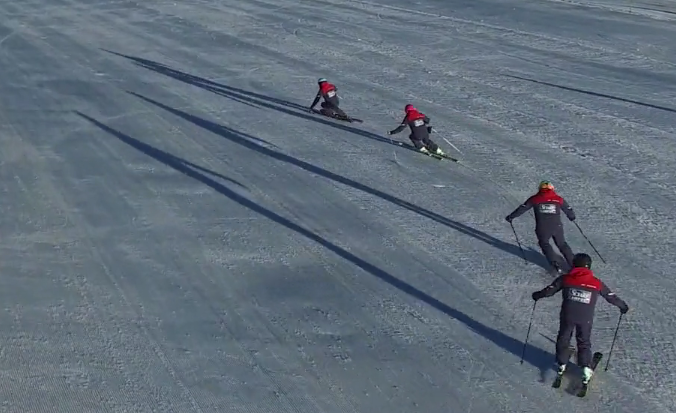
Follow The Leader At L2A

Synchronized Cruising In The French Alps Captured By Drone.

That's cruising we like. Thanks to Nite Fly for the video clip.

That’s cruising we like. Thanks to Nite Fly for the video clip.

This reminds us of the coordinated swimming events we see in the Olympic Games, minus the gel in the hair.  Well, kind of. A group of skiers cruises down and around the slopes at Les 2 Alpes (aka L2A), an amazing resort which actually has a short summer season we reported on this August.  Click here to find out what our correspondent Val E. says about this second oldest in France that has some of the longest ski runs in the world.   And seniors over 72 ski free.  Yes!  If you are considering a ski trip—and who wouldn’t with the Euro so low—check out L2A.

Videos Show Skiing in Alaska, China, Iran, Central Asia

Arc’teryx And The North Face on YouTube With Top Cinematography And Music That Doesn’t Blow Your Eardrums.

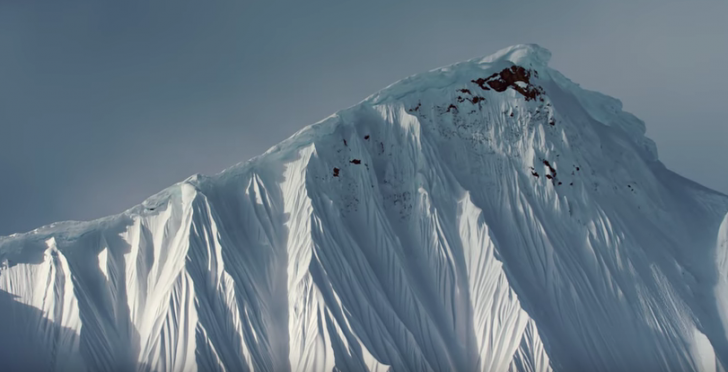
From the North Face-produced series on skiing the Tsirku Glacier in Alaska. Amazing shots.

From the North Face-produced series on skiing the Tsirku Glacier in Alaska. Amazing shots.

In 1990 China had zero ski resorts. Today there are 568, including Jackson Hole, a residential and ski community a few hours north of Beijing.

Iran is a land where, for many, skiing offers escape from state control.

Skiing in China, Iran, Japan and Iceland is featured in a series of short videos produced by Arc’teryx, the Canadian outdoor clothing and sporting goods company.

Each video is thoughtful in its look at the country visited. China: A Skier’s Journey contrasts the rapid development of resorts reliant on snow guns with the indigenous people of the remote Altai Mountains, banned from cutting living trees to make skis used to navigate their snow-laden landscape, as their ancestors have for millenia. We watch the ski making process using stumpage and see images of ancient pictographs depicting hunters on skis.

The videos use artistic cinematography and background music, that unlike many other ski films, is gentle on the ears.


Another outdoor clothing and gear company, The North Face, also has a selection of interesting ski videos. The company’s three-part Tsirku series takes us to the exceptional terrain where Alaska, British Colombia, and the Yukon meet.

We’re introduced to this extreme backcountry first from the air and then through a series of exceptional powder shots. By Episode 3, we’re at a steep corrugated ridge, cornice topped and deep with powder. The descent is beautifully shot and well worth the visit to YouTube. Like the Arc’teryx series, The North Face has opted for mercifully pleasant musical accompaniment.

https://www.youtube.com/watch?v=rPYwCgOHsbk


Resort Review: L2A, France—”Two Alps, Two Seasons”

Les Deux Alpes, France: Seniors 72+ Ski Free.

The "two Alps" in the name do not refer to the two facing mountain-sides that comprise the resort, but rather to two adjacent areas of the original mountain pasture on the north-south plateau on which the resort was built. These pasture areas (or 'alps') are part of the two villages of Mont-de-Lans and Vénosc that lie in the deep valleys, respectively, to the north and south. Credit: L2A Promotion

The “two Alps” in the name do not refer to the two facing mountain-sides that comprise the resort, but rather to two adjacent areas of the original mountain pasture on the north-south plateau on which the resort was built. These pasture areas (or ‘alps’) are part of the two villages of Mont-de-Lans and Vénosc that lie in the deep valleys, respectively, to the north and south.
Credit: L2A Promotion

Editor’s Note: This Resort Review was written by Val E., a reader who has an interesting background in the ski industry. Val used to work as a ski slalom course supervisor, snowboard technician, ski/snowboard clothing consultant, ski engineer, ski/snowboard writer and photographer in the U.S. and in Europe. He traveled to 25 countries, found snow in 11 of them, and he still searching. Val currently lives in Washington DC Metropolitan Area.

Les Deux Alpes (“le døz-alp”, aka L2A) is a big ski resort located 44 miles east of Grenoble. The name means “two alps”. It is the second oldest French ski resort which has the largest skiable glacier in Europe where people can ski from November to April and from June to August. Les 2 Alpes is one of the few places to offer summer skiing in the Alps. The Les 2 Alpes summer ski season is quite short, so check conditions and lift availability here.

Terrain

The resort has 102 runs, five of which are free. To get to the top of the hill you need to take one gondola, then another, et voila—you are at… the bottom of the glacier. You can go to the highest point (12,000 ft) by a t-bar or an underground railway—the

Here are some summer skiers doing the upper L2A. BTW, seniors 72+ ski free. Credit: L2A Promotion

Here are some summer skiers doing the upper L2A. BTW, seniors 72+ ski free.
Credit: L2A Promotion

latter is convenient if you want to relax between the runs. Some people call L2A “reverse mountain” because the slopes on the top are relatively easy, while the ones in the middle and at the bottom are steeper. With a total 7500 ft vertical drop and 10-km in length, it has one of the longest ski runs in the world. A lack of snow is rare, but the army of 214 snow cannons is ready for action. A six-day pass may cost you 220€ in winter and 197€ in summer. Skiers from 65 to 71 years old can get 10 percent off; anybody older than 72 can ski for free!

Getting There

If you want fewer stops on your flight to Europe, fly to Geneva, Switzerland, then drive south 140 miles. Some people prefer to travel through French cities: Paris (400 mi), Lyon (100 mi) or Grenoble (75 mi). To minimize driving from Paris you can take a high speed train to Grenoble— three hours, and then take a bus—one hour. Traveling through Italy is another option—the drive from Milan is 210 miles.

Lodging

L2A village is relatively compact and walk-friendly. You can rent an apartment or chalet or stay at a hotel from budget to four-star. Those who want to save money and are ready to commute by a chairlift may prefer to stay at one of two villages: Venosc or Mont-de-Lans. Larger hotels provide transportation to the slopes, but otherwise you can take a free bus circulating around the village. Lodging is located below 5500 ft, so sleeping should not be a problem, while skiing above 10,000 ft may require some adaptation. Because of that, staying there for at least five-seven days could be a good idea.

Food and Culture

French people are passionate about food, and you will notice that in L2A. Six restaurants rated by Michelin in 2016 are proof of that. There are plenty of places to eat and drink on the slopes and in the village. Responsible skiers may try hot red wine right on the slopes. To avoid lines at the restaurants and enjoy less crowded slopes, don’t plan your lunch between 12 pm and 1:30 pm. As in many European places do not expect free water at the restaurants, free soda refills, or many free public restrooms, especially on the hill. The English language should be enough to communicate, though the locals would be pleased to hear simple phrases like “Bon Jour” and “Merci”.

TIP: Check the Ice Cave on the glacier, buy wine and cheese in the grocery stores, and visit Grenoble—a charming historic city.

Bottom Line

If you have free time, some money, and a desire to enjoy skiing and French culture, go to L2A in winter, spring or even summer.

Here’s a short animated video showing the “nouvelle piste” blue route down from the top.  It’s 10-km long!  

L2A is the highest resort in the Alps. The summer ski season attracts camps, racers, and snow-starved skiers. Credit: L2A Promotion

L2A is the highest resort in the Alps. The summer ski season attracts camps, racers, and snow-starved skiers.
Credit: L2A Promotion

Whakapapa Ice: Happening Now

North America Swelters, NZ Freezes.

New Zealand's Whakapapa has lots of ice.

New Zealand’s Whakapapa has lots of ice.

In case you missed it during this hottest summer of all time, the ski season is in full swing down under.  Here’s a clip from Whakapapa Ski Field, New Zealand’s largest winter resort.  Located on the North Island, Whakapapa is on the north side of Mount Ruapehu.  You really have to give the crew credit for keeping the lifts open in what appears to be a mess of icy frost.


Rock-Carvings

Vandals Destroy World’s Oldest Skier Image

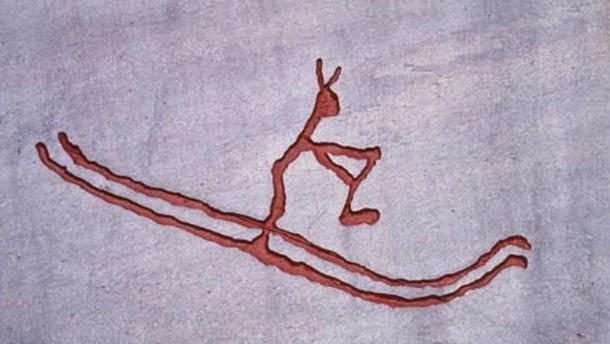
Picture Used as Lillehammer Games Logo.

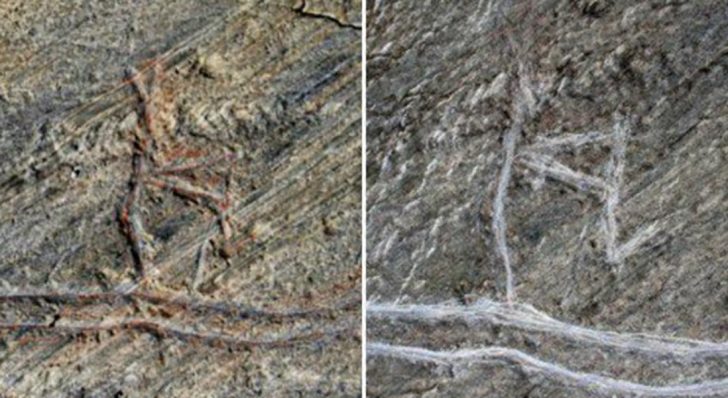
5,000 year old Tromso rock art skier before and after

5,000 year old Tromso rock art skier before and after

The world’s oldest known image of a person on skis — a 5,000 year old petroglyph on the Norwegian island of Tro — has been destroyed by vandals. The image was used as the logo for the 1994 Lillehammer Winter Olympics.

Image used for Lillehammer Olympics

Image used for Lillehammer Olympics


This is a tragedy for those interested in skiing history. It also is a tragedy for Norway, which considers the picture among it’s national treasures.

The vandals were young people who claim they were trying to improve the visibility of the faint petroglyph.

I live in an area with an abundance of ancient rock art. A short walk from my home takes me to a major panel made by people from the Fremont Culture, who were here about 1,000 years ago. There are pictographs (painted images) and petroglyphs (pecked and carved images). Over the past century, visitors have carved names and dates. Archaeologists consider these more recent markings “historic.” Over the past few years, the site has degraded as vandals have defaced the 1,000 year old images, scratched in their own graffiti, and used charcoal from the site to leave drawings, names, and stupid sentiments.

Ancient rock art is rare. Many people do not understand its importance as a connection to prehistory. Nor do they understand that it should be left alone.

Some educational programs encourage people to “Respect and Protect” ancient rock art. I recently met with personnel from the Bureau of Land Management to discuss ways to protect the panel near my home.

For a cultural treasure so important to the Norwegians, what measures were in place to prevent young idiots from to destroying this iconic ancient skier?

Resort Review: Mt. Baldy BC Has A $19 Senior Season Pass! Seriously.

A Small Area Enchants Seniors, Offering Bargain Skiing In Big Powder.

Mt. Baldy is small but powdery and friendly. Credit: Mt. Baldy

Mt. Baldy is small but powdery, friendly and inexpensive.
Credit: Mt. Baldy

Editor Note: This review was written by Jim Barber, a long time skier and ski business veteran.  He lives near Mt. Baldy and loves his retirement home in BC.  Here’s his story:  “My wife and I started our life together in the ski shop business at Hunter Mountain N.Y. in the seventies. We helped Lloyd Lambert set up the Hunter Mt Ski museum and the first 70 plus ski club.  We have no kids by choice so we have had plenty of time and money to ski all over North America. We moved to Washington state and got married in the late seventies. I worked for Weyerhaeuser in forestry research and my wife Marian taught Special Ed in a juvenile  institution. We knew we wanted to semi retire to a ski hill and the rest is history. Today our two homes are 40 miles apart in two different countries.”

Mt. Baldy Ski Resort is in British Columbia’s southern Okanagan, just over forty miles from Washington State and the Canadian border. We found it fifteen years ago while on a skifari to find out were wanted to spend our senior skiing years. We found it at Mt. Baldy, the last ski area we thought we would end up at after skiing at many ski mountains across North America.  We moved here from upstate New York’s Hunter Mountain.

 Mt. Baldy started in late 60s as a Cat skiing site. Soon, a t-bar was added and Mt. Baldy started to grow. It has the highest base elevation—5,800 feet—with all natural BC powder.  No snow making is needed here! Cat skiing without the cat!  One thing that sold us on Baldy was the number of seniors that own cabins and ski here. When we first started skiing here, there was a 90-year-old snow boarder. Need I say more?

We have two near by towns—Oliver and Osoyoos—with ample lodging and restaurants. There are countless vineyards in this region boasting BC wines. Oliver’s motto is “Wine Capital of BC.” If you love golf, you can ski in the morning and golf in the afternoon. On the mountain, there are cabins to rent and the Honky Tonk Hotel. There’s a ski rental shop and a great ski school. The lodge has a full cafeteria and upstairs is the infamous Baldy Bar and restaurant, staffed by top chefs from the wineries.  Baldy is a little out of the way, but if you are on a ski trip through the great Northwest, stop by a ski resort were everyone will show you their secret powder stashes, and you are valued and respected for being a senior skier/snowboarder.

 There is no rush at Baldy and no lift lines. No high speed lifts, because you need the time on the lift to rest and meet the locals. Eventually, everyone at Baldy becomes a local. Baldy is what skiing used to be and still should be.  That’s why workers from other resorts ski at Baldy on their days off.

Snow and Terrain:  This small area—there are only two major lifts—boasts of boundless powder, a meteorological fact of life in southern BC. There were 13 meters of natural snow on Mt. Baldy in the 2015-16 season. The mountain has 500 acres of skiable terrain with a total of 22 runs with something for every skill level. The Eagle Chair base is at 5,650-ft. above ski level, the highest base altitude of any resort in Canada. There’s also a terrain park.

Culture: Super friendly, lots of seniors, instant friendships and acceptance.  Less glitzy areas like Mt. Baldy breed great skiing relationships. Lots of slope-side accommodations make easy access. New owners have big plans for the helping Mt. Baldy achieve its potential.

Bottom Line:  We saved the best for last. Seniors ski for $19 a day, and guess what?  You can by a Season Pass for the same price.  Yup.  $19. That’s. A. Bargain. The season starts on Dec 1, 2016 and goes until mid-late April.

Trail Map: Click here for Mt. Baldy trail map.

Here’s a 2010 video of First Tracks on Mt. Baldy on a powder day.  Check the music and the skier whooping it up.