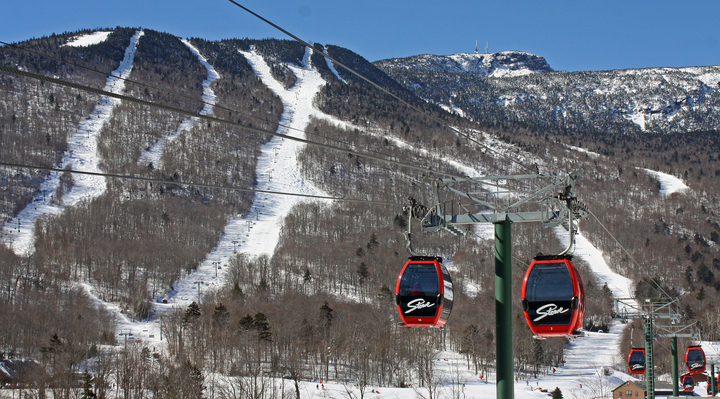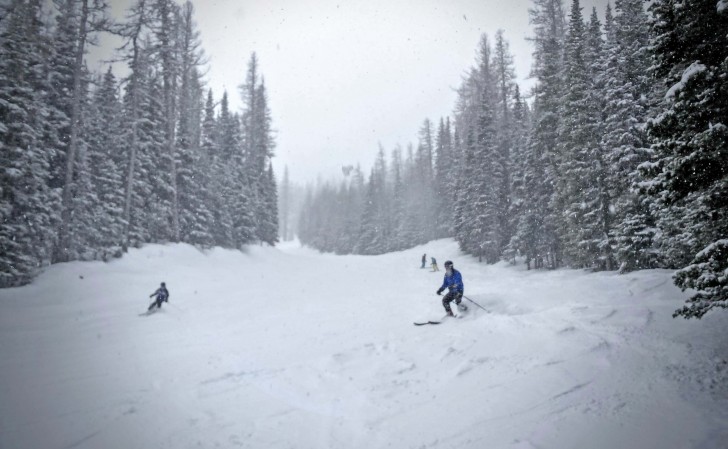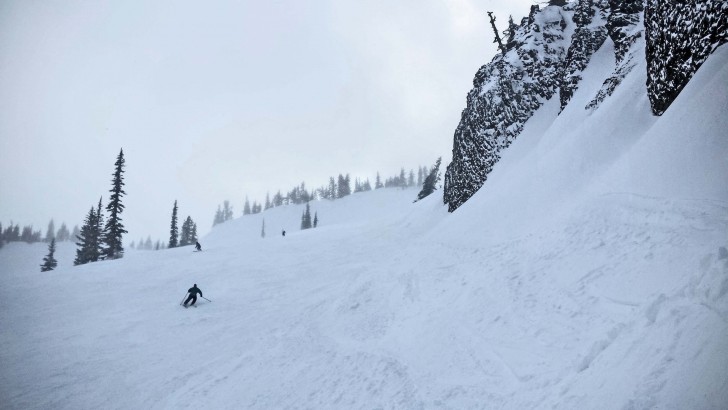
SeniorsSkiing Guide: At Steamboat Let Mountain Masters Be Your Guide

Popular Program For Seniors Offers Guided Skiing All Day. For Free.

Mountain Master Guide Steve Cozette (red jacket) herds his charges down Two O’Clock.
Credit: Tamsin Venn

On one of those perfect bluebird Colorado days, I rode up the Gondola at Steamboat (www.Steamboat.com) with a group of women from the Indianapolis Ski Club (www.indyskiclub.org), who thought I was one of them. All us skiers look alike in our goggles and helmets.

They were spending a week here and were on their way to join Mountain Masters, a program at Steamboat for skiers and riders 50 years and over that meets daily at 9 a.m. and 12:30 p.m. right outside Thunderhead Lodge at the top of the Gondola. Mountain Masters replaced the long-standing Over the Hill Gang when Steamboat wished to consolidate senior programs.

Mountain Masters is the only program of its kind in the U.S. that offers free all-day, guided skiing for seniors, according to one guide. You just need to sign a waiver, then head out and join a group: The “mellows” ski intermediate groomed runs, the middle group, the groomed blues and blacks, and the top group, bumps and powder. My new friends, Janet and Marilyn, with whom I buddied up, had been skiing groomed blue all week and wanted to up their game with someone leading the way.

Guide Steve Cozette briefs his charges before a run.
Credit: Tamsin Venn

For fledgling Steamboaters, Mountain Masters takes the guesswork out of where to ski on this mountain with 168 trails and 16 lifts spread over nearly 3,000 acres. But the program is also very popular with locals and many vacationers actually return to Steamboat because of it.

Take Anne Keddie from Dundee, Scotland. Each year, she and her husband spend four weeks at Steamboat, in part because of the program. He snowboards on the gnarly tree runs like Closets and Shadows, while she likes to rip down the groomed blacks.

Why is this so wildly popular?

As one participant said, no one wants to ski alone. Whether you’ve skied the mountain before or haven’t, it’s nice to have someone lead you to the uncrowded spots according to the day’s traffic, plus follow the grooming and sun across the mountain.

And the anecdotes and tips are fun and useful. Don’t try to outrun a moose you see on the trail (“Moose Don’t Shoo”). A bear hibernates off the Hurricane trail. Here’s where the champagne powder is stashed. Get up speed for the connector ahead. Use the Burgess Creek lift when Storm Peak Express is too crowded. Head for the Pony Express first thing in the morning to rip the groomed blacks, or else sunny Sunshine Peak. The north facing Norther keeps good snow on its bumps. Cyclone is the easiest black on the mountain. Four Points has the best food. For luck, touch the shoulder of Buddy Werner’s bust before jetting down Buddy’s Run. That is all invaluable for the first time and regular Steamboat skier alike.

Steve Cozette is our guide today, a very personable, experienced, and knowledgeable skier. He leads our large group with the assurance of a cowboy taking his herd to pasture.

No reservations needed. Just show up. You should be able to comfortably ski blue runs. Group size varies from one or two people to eight or more. Rest breaks for hot chocolate and stops to enjoy the scenery, or to perhaps hear a little local history, are all part of the experience.

Mountain Stats

Base: 6,900 feet

Mt. Werner Elevation: 10,568 feet
Vertical Rise: 3,668 feet

Permitted Acres: 2,965 acres
Trails: 165 named trails
Trail Classification: 14% Beginner 42% Intermediate 44% Advanced
Total Lifts: 16

Annual Snowfall: 349
Snowmaking: 375 acres

Trail Map: Click Here

Web Cams: Click Here

Indie Ski Club members get ready to ski Mountain Masters: left to right:
Anne Kelvin, Laryn Peterson, Marilyn Rader, Janet Zusman, Sue Johnson
Credit: Tamsin Venn

 

Ski Idaho – Snowmobile To Hot Springs

Idaho has the most usable hot springs in the entire US: 130 springs out of the state’s 340 are “soakable.”

Yes, it’s warm down there underground. The state apparently sits above a massive hot spot that fuels not only this but the springs and geysers of Yellowstone National Park.

So, locals have their pick from rustic pools that are run like swimming holes of the 1950s to private (sneak in spots) to elaborate places that have been visited for well over a century.

In winter, many rent a snowmobile and thrash their way around … something that could be risky if you don’t know where you’re going or how to get there.

Snowmobiling to Burgdorf Hot Springs near McCall, ID. Photo: Mark Schneider.

A new option is the guided snowmobile trek out of Brundage Mountain ski resort through Brundage Snowmobile Adventures ($295 per person per day).

My friends and I met our guide, climbed aboard 800 cc Skidoos and took off.

That machine could climb a wall. It took a bit to figure it out, but soon enough, we were motoring along, cutting into a forest thick with pine, fir and Tamarack.

It was snowing lightly, giving the landscape an ethereal glow. We traveling through a Christmas card during the snowiest winter in 30 years.

The trail took us up foothills, where we stopped at an overlook, then down, finally, to an old pioneer trail. I got my machine up to 50mph on an open stretch, but kept wondering what would happen if I got bounced off.

Thirty-five miles after leaving Brundage, we turned into Burgdorf Hot Springs.

This place is a legend, owned by a local family and operating since 1865. It’s rustic, but has amenities. You can rent a cabin overnight for $40 per person, and there’s a simple cafe for food.

In winter,  Burgdorf Hot Springs looks like a Hallmark scene. Rustic cabins sit picturesquely scattered around the rolling property and in the middle is the spring … a large, rectangular pool with gravel bottom and two smaller, VERY hot pools.

Inside the main building, caretaker Caroline Huntley chatted about the springs’ history… how Fred Burgdorf built a simple hotel in the l800s and people would come by horseback to stay and soak.

In summer, you arrive by car, but in winter, the only way in is by snowmobile.

We removed our travel duds and hit the water.

Main pool at Burgdorf Hot Springs during a light snowfall.

The main pool is a soothing 100 degrees. The two small pools at the end hit 108 degrees or so; good for maybe five minutes while peering through icicles at the snowy landscape.

Lose as a noodle, we climbed back into our snowmobile suits, took off and returned to Brundage.

As one last adventure on the final stretch of road, four skiers and a snowboarder came freefalling down the mountainside, cutting between trees through powder and entered the road before us.

We waved as we sped past. A few minutes later we were back at the resort’s main lodge.


SeniorsSkiing Guide: Brundage Cuteness

Central Idaho Resort Has A “Come As You Are” Vibe.

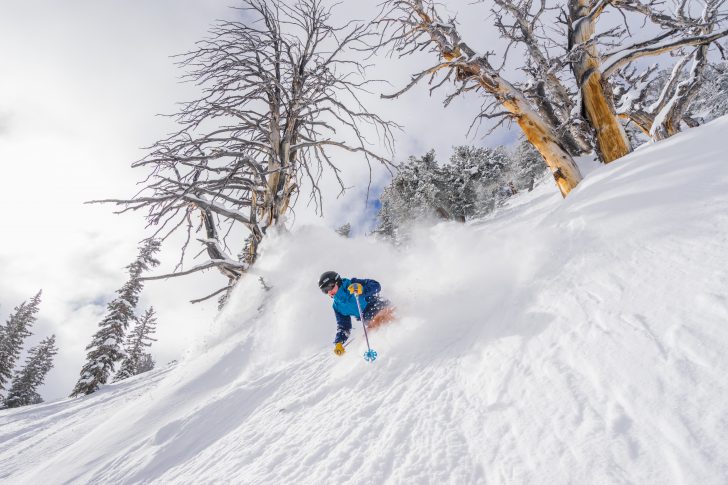
Skiing fresh powder at Brundage Mountain. Credit: Brundage Mountain.

Brundage Mountain in McCall, ID, is one of those places that truly “skis bigger” than it is.

“You get to the parking lot and say, ‘How cute,’ but when you go up the chair, you start to see just how much terrain there is,” says Communication Director April Whitney.

Okay, 1,500 acres isn’t huge. But there’s plenty to ski including some nice, yummy cruising and great upper intermediate trails with a bit of pitch and challenge that are also often groomed.

The crowd limiting factor here is the parking lot, and even then, a super busy holiday crowd is maybe 3,000 people though the mountain could hold three times that many. As a result, people grouse about “long lines” if the wait hits 10 minutes.

Snow, Terrain and More

Ski patroller helps put finishing touches on snow train in preparation for Winter Carnival in McCall.
Credit: Yvette Cardozo

Location: In McCall, Idaho, 107 miles north of Boise in west central Idaho.

Snowfall: 300 – 350 inches average but it can hit 440 on a good year. Locals claim it’s the best snow in Idaho because it sits where the two main weather cycles, southern and northern, meet. The snow here is a bit colder and drier. In the far west, day old snow becomes concrete as it picks up moisture. “Our powder has the moisture sucked out of it, and it’s actually drier the second day,” said Whitney.

Terrain, lifts: 46 named runs – 20 percent beginner, 50 percent intermediate, 30 percent expert across 1500 skiable acres. One high speed quad, four triple chairs. Best cruising is to the far right looking up the mountain. The gnarly stuff is more to the far, far left including another 420 acres of lift accessed back country. Locals who can ski well say the real magic is what’s between the named runs—”wild” powder with unofficial names like Mexico, Switzerland, Naughty Girl. The season typically runs early December to mid April though after that, Brundage is open weekends until the snow is gone.

Vertical: Vertical drop of 1,921 feet from a top at 7,803 feet to the base at 5882 feet.

Lot to lift access: What you see from the base is what there is. It’s an easy walk to the lodge and lift. There are, however, stairs—four levels worth and no elevator for handicap access. However, if the mountain is called in advance, there is a way to get handicapped people to the lodge upper level and the ski slope.

Public transportation: Brundage Mountain Resort has partnered with Mountain Community Transit to provide a free shuttle service to Brundage Mountain Ski Area. The shuttle will start at the Brundage Adventure Center (BAC) with a stop at Lardo’s Restaurant ten minutes after the BAC stop. Transportation to and from the mountain is FREE for everyone.

Accommodations: Nothing on mountain. Plenty of lodging in nearby McCall.

Culture

The vibe: This is definitely a “come as you are” mountain. The important thing is folks here LOVE skiing. And you can find anything in the way of duds, from hunting bibs and camo rain gear to, um, Carhart. It’s not exactly a Sun Valley, Bogner kind of place. You won’t get a sideways glance at your gear as long as you can link your turns. Preferably well. And there’s a good kids’ center for the grandkids.

Dining: An assortment of simple eateries from sit down Smoky’s Bar and Grill to the Main Street Market & Eatery cafeteria to an adults-only bar plus the weekend-only mid-mountain Bear’s Den.

Mountain life: People come to live and play in McCall for its outdoor activities. In winter, it’s snow, snow and more snow. As someone elsewhere once said, “We do not come to look, we come to SKI!” Or snowshoe, or cross country, or snow hike, or fat tire bike or downhill tube or whatever else you can think of outdoors in winter.

Trail Map click here

Webcam click here

View from the top of Brundage Mountain. Credit: Yvette Cardozo

SeniorsSkiing Guide: Schweitzer Mountain Resort

Northern Idaho’s “Little Secret” Steps Up Dining Amenities.

Much of the skiing at Schweitzer Mountain has great views of Lake Pend Oreille and the surrounding mountains.
Credit: John Nelson

Pat Rotchford, 76, sat in The Nest, the new top-of-the-mountain restaurant at Schweitzer Mountain Resort, looking very happy.

He was drinking red wine by the fireplace with his friend, Debbie Stanley, eating prime rib sliders and Vietnamese spring rolls—not your typical mountain fare.

Pat Rotchford and Debbie Stanley enjoy a glass of wine in The Nest inside the new Sky House lodge at Schweitzer.
Credit: John Nelson

“Everything we’ve had here has been excellent,” said Rotchford, who has been skiing for 70 years, many of those at Schweitzer.

Sufficiently refreshed, Rotchford and Stanley geared up and hit the slopes for more afternoon skiing at this exceptional mountain in North Idaho.

Schweitzer has always been a mountain with great terrain and few skiers (“It’s our little secret,” Stanley says). Now, with the just-opened Sky House lodge on Schweitzer’s summit, the resort has taken a step up to match the amenities of great resorts around the country.

The beautiful $3.8 million, 9,000-square-foot facility houses two restaurants with 360 degree views of the Selkirk and Cabinet Mountains and Lake Pend Oreille. Besides the upscale bar-restaurant Nest, the Red Hawk Cafe offers hearty, cafeteria-style mountain fare.

Executive chef Pete Tobin designed the menu at the Sky House lodge at Schweitzer Mountain.
Credit: John Nelson

The Nest has a creative menu of small plates, none more expensive than $13, designed by executive chef Pete Tobin.

“It gives people a chance to have a quick bite and then head back to the slopes,” Tobin said.

Snow, terrain and more

  • Location: Schweitzer is about 15 miles from the resort town of Sandpoint on the shores of Lake Pend Oreille. Coeur d’Alene, Idaho, is about 45 minutes away, and Spokane, Wash., with its international airport, is about 90 minutes drive. For those traveling by train, Amtrak stops in Sandpoint.
  • Snowfall: 300 inches fall annually, keeping the slopes covered from December to April most years.
  • Terrain, lifts: With 2,900 acres of terrain on its front and back sides, Schweitzer is the biggest resort in North Idaho and the state of Washington next door. One high-speed six-pack and two high-speed quads do most of the people-moving, along with one triple and three double chairlifts. About 50 percent of the terrain is rated beginning or intermediate; 50 percent is advanced or expert. Outside the resort’s boundaries, advanced side-country skiing abounds.
  • Vertical: 2,400 feet from a summit (6,400 feet) to the back-side base. The main village is at 4,700 feet.

Lot to lift access

  • Parking: Schweitzer has two large parking lots on the mountain with unloading zones and also has a large parking lot on the valley floor served by a shuttle bus.
  • Public transportation: Several companies offer service from Sandpoint to the resort.
  • Accommodations: The Selkirk Lodge and White Pine Lodge are excellent choices at the village base; on-mountain condominiums also are available, as well as lodging in all price-ranges in nearby Sandpoint.

Culture

  • The vibe: With its empty slopes on the weekdays, Schweitzer feels like a well-kept secret; friendly locals from Sandpoint, Coeur d’Alene and Spokane are happy to show you the ropes.
  • Dining: Besides the Sky House restaurants, the resort offers a back-side lodge called The Outback Inn and a large base lodge restaurant. In the village, there are several restaurants, including Pucci’s Pub, the place to go for a post-shred beer.
  • Mountain life: Beyond the lift-skiing, Schweitzer has cat skiing, snowmobiling, tubing and excellent Nordic trails.

Bottom line

  • The new Sky House summit lodge, which will remain open this summer for weddings and special events, helps elevate Schweitzer to a top-tier resort.
  • Affordable package deals, ample snowfall and empty midweek skiing make Schweitzer an enticing destination for a multiday vacation. Single day senior tickets are $69.30 online.
  • Vast terrain gives skiers a lot to explore at one of the Northwest’s best resorts.

Webcam Click Here

Trail Maps Click Here

The upper-mountain Lakeview Triple delivers skiers to mostly advanced terrain.
Credit: John Nelson


SeniorsSkiing Guide: Rocking And Rolling For Seniors At Park City

The Largest Ski Area In The US Has Something For Everyone.

Park City Mountain Resort connects to The Canyons, making the largest ski area in US.
Credit: Park City Mountain Resort

The choice of skiing at Park City, UT, just got more mind boggling. Last year, Vail Ski Resorts linked Park City and The Canyons via the Quicksilver gondola on Pine Cone Ridge. Voila: a ski area of 7,300 acres with 41 lifts, and 324 runs, currently the largest ski area in the U.S.—six miles across as the raven flies. That means a lot of choice for us seniors on the endless white folds of the Wasatch Range.

Plus, at only 7,000 feet at the base, the altitude is easier to adjust to than some higher Western ski resorts.

Park City is lower in altitude than other Wasatch resorts, making it easier to adapt for low-landers.
Credit: Park City Mountain Resort

Park City trends toward broad slopes while The Canyons to narrower tree-lined trails. Many trails present drops off into tree skiing at various pitches. Big bowls with double black diamond labels offer fabulous powder skiing. Gulches and gulleys lead to further adventure. Currently Park City is having the snowiest January in about nine years, eight feet and counting.

The new eight-passenger Quicksilver Gondola has changed the game here. Adventurers can start at the Orange Bubble Express at The Canyons, say, ride the Red Pine Gondola to Timberline to Iron Mountain Express to Quicksilver Gondola. By the time they’ve skied over to Park City, they may want to take the free bus back.

By contrast, Park City skiers take the Crescent Express to reach The Canyons, and so have access via one lift to entertaining steep pitches they once had to hike to.

In 2015, Vail Resorts invested $50 million in upgrades at Park City. It transformed the sluggish Motherlode Express (good on a powder day) to a high-speed quad. It turned King Con, popular for rip groomers, into a six-pack. It also created two new trails at the Quicksilver Gondola mid-station, built Miner’s Camp Restaurant there, added seating to on-mountain restaurants, and invested in snowmaking.

In Park City, the sports vibe is strong. Park City and Deer Valley hosted the 2002 Winter Olympics and the resorts have been drawing the youthful and ambitious ever since. Visit Utah Olympic Park to catch more Olympic fever, and visit the Alf Engen Ski History Museum. Admission is free.

Skiing does get crowded, and some say the best time to ski is during the Sundance Film Festival in January when everyone is indoors watching movies or on Sundays when many are in church. A new app, EpicMix Time, lets you track lift line wait times.  At key lift junctures, an LED board gives you that same traffic information.

The best way to ski Park City is to buy the Epic Pass, which lets you ski all Vail resorts. But the early season savings end in the fall. The best bet is to buy senior (65-plus) tickets online seven days in advance.

The White Pine Touring Nordic Center with 20 km of groomed XC track at the Pro Shop in the Hotel Park City is well worth the visit to stretch your limbs. On community appreciation day, many older fit speed demons constantly lapped us on skate skis. This center truly appreciates their seniors and offers free passes for those 65 and older.

The Facts

7, 300 acres

Base elevation 6,800 feet; summit 10,026 feet

330 trails, 41 lifts

Average annual snowfall: 355 inches

8 percent beginner, 48 percent intermediate, 44 percent expert

Web Cam Click Here

Trail Map Click Here

Night time is for dining, shopping, visiting and relaxing.
Credit: Park City Mountain Resort


SeniorsSkiing Guide: Sun Peaks, BC, Senior-Easy Big Mountain

When You’re No. 2, The Saying Goes, You Try Harder.

Skiers and snowboarders rise above the clouds on the Crystal Chair at Sun Peaks. Credit: John Nelson

That’s true of Sun Peaks Resort, Canada’s second largest ski area behind behemoth Whistler-Blackcomb 200-plus miles away in the coastal mountains.

This excellent resort near the British Columbia city of Kamloops offers three mountains to ski, a well-designed, bustling village and even a fair bit of off-piste, side country powder to hike. Add to that a sunnier climate, lighter snow and lower prices and Sun Peaks looks better and better compared to its rival to the west.

You’ll find bargains here as well. Seniors 65 and older receive a 20 percent discount on ticket prices at Sun Peaks, and that’s on top of the favorable exchange on the strong U.S. dollar.

A snowboarder shreds fresh snow on the Crystal Chair at Sun Peaks. Credit: John Nelson

Snow, terrain and more

  • Location: Sun Peaks is about 35 miles from Kamloops, a city of 85,000 in what’s known as “Thompson Country” of B.C.’s inland mountains. It is the closest inland resort to the Vancouver metro area (about five hours away by car), and the Kamloops airport gets several daily flights from major Canadian cities.
  • Snowfall: The mountains here receive far less snow than the coastal range, but Sun Peaks still gets more than 230 inches a year. Snowmaking helps keep some of the lower slopes covered.
  • Terrain, lifts: The three mountains at Sun Peaks serve predominantly intermediate terrain on its whopping 4,270 acres. About 68 percent of the resort is rated beginning or intermediate, and 32 percent is rated expert. The Gil’s Zone side-country area offers expert skiers the chance to find untracked lines after a short hike off the top of the Crystal and Burfield lifts.
  • Vertical: 2,893 feet from a village base at 4,117 feet. The hikable summit of Tod Mountain (7,060 feet) adds few hundred vertical for those willing to sweat for their freshies.

Lot to lift access

  • Parking: Parking is scattered in several lots near the bases of each mountain; in addition, accommodations generally offer heated parking garages.
  • Public transportation: A bus service operates on weekends from Kamloops. In addition, an airport shuttle runs from Kamloops to Sun Peaks, and an inter-resort shuttle operates between Whistler, Big White and Sun Peaks.
  • Accommodations: The village at Sun Peaks is well designed; you can ski among the shops, condos and hotels to the lifts. Several ski and stay deals are offered by the resort.

Culture

  • The vibe: This is the friendly interior of B.C., so you won’t find any of the Whistler-Blackcomb snobbery here. As with many resorts in Canada, a strong Australian presence is apparent nearly everywhere you go among workers and vacationers.
  • Dining: 22 dining spots are scattered around the resort and village. Several restaurants deliver great meals, including the excellent Voyageur Bistro and the rocking Bottoms Bar and Grill.
  • Mountain life: Winter activities abound, with Nordic skiing, snowmobiling, snowshoeing and skating. Of the interior B.C. resorts, Sun Peaks has the best four-season set-up, with a golf course and excellent mountain biking during the summer.

Bottom line

  • Sun Peaks has a robust village scene that delivers a resort experience at the fraction of the cost of skiing at Whistler-Blackcomb..
  • Canada’s second largest ski area has ample terrain to explore over the course of a ski stay.
  • With 2,000 hours a year of sunshine, your chances of getting a goggle tan are pretty good.

Trail Map click here

Webcam click here

A well-designed village offers dining, shopping and accommodations at the base of Sun Peaks. Credit: John Nelson

_____

John Nelson is a freelance outdoors writer based in Seattle. Follow his blog at skizer.org.


BrettonWoods

SeniorsSkiing Guide: Easy Going At Bretton Woods

Seniors (65-79) Ski For $25 Mid-Week At This Classic NH Gem.

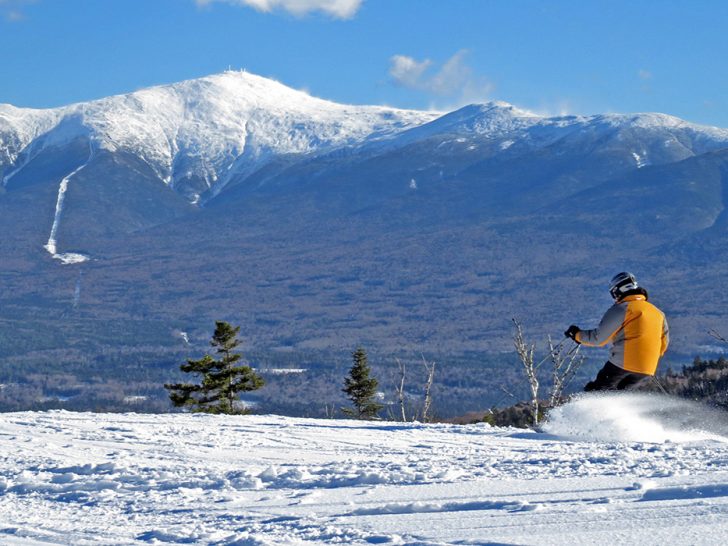
Majestic Mt. Washington is across the valley from Bretton Woods.
Credit: Bretton Woods

Down Cascade, up to Rosebrook Summit, down Upper Swoop, down Cascade, across to Diamond Ridge, down Deception Bowl, up the Bethlehem Express, down Big Ben, up Zephyr High Speed Quad, down Granny’s Grit.

The skiing at Bretton Woods, NH, was so smooth and our trips so fast, that you didn’t have time to think what joint might be aching that day. We were skiing with a group of 50-plusses and one 80-plus, all fabulous skiers with years of experience behind them. The grooming at Bretton Woods yields the best type of New England skiing with manicured slopes, wide open avenues, very hard pack with enough surface snow to grip. We blazed all over the mountain, happily racking up the vertical, on our apps or psyche. Most of the intermediate slopes were open and provided plenty of fun on Rosebrook and West Mountains.

Beautiful, broad skiing avenues make for nice cruising at Bretton Woods.
Credit: Bretton Woods

The overall experience here is a friendly mountain that’s fun to ski. There’s plenty of skiing available for an older person without putting too much pressure on hips and knees. For tree skiers, the glades are fairly open in keeping with the resort’s easy-going nature. In 2012, Bretton Woods added a T-Bar servicing Mount Stickney with 30 acres of more challenging glades. There is plenty of tough terrain on this hill once nick-named Medicare Mountain.

Four high-speed quads keep you going, and on crowded days the lift personnel keep the lines moving in a fair and congenial way.

What that allows you to do is just relax and rip. Plus all trails lead ultimately to the base lodge, minimizing separation anxiety from your ski companions.

Some say Bretton Woods, NH’s largest ski area, is more protected from the weather than other areas. You can always look across at storm clouds unfurling off Mt. Washington (the Northeast’s highest summit at 6,288 feet) and be happy that at least you’re not up there.

Across the street is the giant Omni Mt. Washington Hotel, like an ocean liner cruising across the White Mountains. Plan a visit, if only to stroll through the wide halls under 23-foot ceilings and take in the views of Mt. Washington from the Rosebrook Lounge sipping a cool Chardonnay.

To walk the hotel’s halls and verandas is to stroll through White Mountain history at its most hospitable. Built in 1902, the hotel most notably hosted the 1944 United National Monetary and Financial Conference to build the bones of a post-World War II economy. Walk into the room off the main lobby where the final treaty was signed.

Meanwhile, stretch your downhill muscles on the 62 miles of impeccably groomed X-C trails. They are also open to snowshoeing and fat tire bike riding.

Bottom Line

Seniors 80 years and up ski free any day, and those 65-79 ski for $25 midweek/non-holiday.

Hot Chocolate: $3

Wiser Woods Program

Open to skiers and riders age 50+. This is group ski program under the guidance of an instructor who will coach you down the mountain.  Includes morning refreshments at Slopeside, receive 10% off retail, 10% off demo equipment.

Runs Jan. 3-March 14, Tuesdays 9-12. Meet on Slopeside Level of Base Lodge. $125 per person for the season, $199 per couple.

Mountain Stats

Vertical Drop:  1,500 feet
Trails and Glades: 97
Skiable Acreage:  464
Snowmaking:  92% of Trails
Average Annual Snowfall:  200+ inches

Webcam click here

Trail Maps click here

Bretton Woods boasts a network of well-groomed Nordic trails.
Credit: Bretton Woods

028 Silver Lake Area_Deer Valley

SeniorsSkiing Guide: Deer Valley—Service And Senior-Friendliness

14 Things Seniors Love About Deer Valley.  Read on.

Silver Lake Area at DV.
Credit: Deer Valley

Monday morning, 9 a.m. Deer Valley Resort, UT. Members of the Park City Mountain Sports Club are buckling their boots. Their goal? Be safe, have fun.

Typically, about 20-25 members, mostly retirees who scoff at Florida’s balmy temperatures, gather in groups of blue, double blue, or black to ski the smooth and the steep at this quintessential Utah resort tucked into the trees behind the town of Park City.

Ahhh. Fresh morning tracks.
Credit: Deer Valley

They meet at 10 a.m. at the “beach” outside Silver Lake Lodge, ski two hours, then break for lunch at the Empire Canyon Grill, “best food on the mountain,” they say. Some ski after lunch, others head home. But no worries, next day is Tipsy and Taco Tuesday at Park City. Each day, they ski a different area, alternating between Deer Valley, Park City, and the Canyons, according to a standard schedule that includes an après ski party every Sunday. It’s only $25 to join.

Most buy the Epic Pass that provides skiing to all Vail Resorts—which owns Park City. But some buy a season pass at Deer Valley for the relaxing pace.

Deer Valley is known for its service to skiers and much of what it created for coddling those with deep parka pockets serves us seniors well.

Here are 14 things for seniors to love about Deer Valley:

1) Wide intermediate slopes groomed to perfection like a prized Appaloosa. Meanwhile, for your inner college-era zeitgeist, the area has some serious deep and steep in places such as the Mayflower and Lady Morgan Bowls.

2) Fresh tracks to yourself, since most skiers stick to the tamed slopes. A forester on staff keeps the glades clear for well-spaced tree skiing.

3) A lot of variety. Plus all six peaks have a beginner or intermediate run down so you can ski as a family with varying abilities.

4) No snowboarders allowed. (Ditto drones).

5) Attentive staff. With a one to seven ratio of helpers to customers, the area treats you like royalty.

6) At drop off, ski valets rush to take your skis off the car.

7) Hosts stand at trail map boards to offer suggestions on where to go.

8) Good food! The Natural Salad Buffet, grill items, carved roasts, deli sandwiches, paninis, soups, chilies, and chocolate chip cookies nearly as big as a Frisbee, plus the new Bald Mountain Pho at the Silver Lake Lodge. That’s just for starters. Where most eat to ski, here you ski to eat.

9) Short vertical drops—average 1200 feet so you don’t lose too much steam before hopping back on a fast moving lifts (12 high speed quads) for a well-deserved rest.

10) Free mountain host tours in the morning and afternoon to ski with others.

11) An elevator.

12) Lift ticket sales limited to 7,500 daily so short waiting lines, roomy trails and mountain restaurant seating.

13) Watch the grandkids learn to ski right outside the window of the Snow Park Lodge, while you sip a latte, maybe spiked with something.

14) Free overnight ski storage, so you don’t have to schlep your boards back and forth every day. Worried about skis getting stolen? You can drop them off for storage for any length of time.

Prices 2016-17:

Full day senior pass, 65 and older: $89

Season Pass, 65 and older $1,255; midweek only $1,140; 72 and older, $1,140

The Facts:

2,026 acres

Base elevation 6,570 feet; Summit 9,570 feet

101 runs, 21 lifts

Longest vertical, 1,380 feet off Little Baldy

Average snowfall: 300 inches

27 percent beginner, 41 percent intermediate, 32 percent advanced terrain

Trail Map: Click here

Web Cam: Click here


Solitude Mountain Resort: Perfection at the Top of a Canyon

The Nearby Area for Local and Destination Skiers Who Know.

Solitude Mountain Resort

Like most great places, Utah’s Solitude Mountain Resort, combines the obvious with the subtle. Its 1200 acres are laced with a variety of groomers ranging from gentle to intense. In between are the woods and hidden openings where those who seek the untracked may find just what they’re looking for. It may require some effort to get there, but once you arrive…what a pleasure!

Overall, it is one of the most scenic areas in the state. Dense with trees and punctuated by cliffs, it sits near the top of Big Cottonwood Canyon, 15 miles of spectacular amphitheaters, steep slopes and manageable hairpin turns. It is adjacent to Brighton Ski Resort, and the two areas offer a joint pass for a slight premium.

Like other Wasatch Mountain resorts, it is comprised of several canyons, the most dramatic of which is Honeycomb, with skiable walls that provide almost endless opportunity for fun. Intermediates can enjoy moderate challenge along the floor of the canyon. On a clear day, every skier is exposed to the kind of natural beauty found in a national park.

We skied there the day after Christmas, and, for Solitude, it was crowded. That doesn’t mean Park City, Snowbird, or Deer Valley crowded. A few slopes had too many skiers and boarders, but lift lines were virtually nonexistent.

Powder at Solitude

That, unfortunately, could not be said for the cafeteria line at the Roundhouse, the lower, mid-mountain eatery renovated following a fire last Spring. There’s is no doubt that the resort, now owned by Deer Valley, will figure it out. And, I know from experience, that on less crowded days, skiers can get a tasty meal in a few minutes. Food choices include the conventional (hamburgers, sandwiches, fries), the less conventional (homemade chicken pot pie), and the exotic (dals, naans, paneers, and other Himalayan choices).

Solitude is ideal for senior skiers. There’s terrain for everyone. Those visiting with families and/or grandchildren, will find nice lodging options at the Village at Solitude and a good selection of eateries. Solitude Mountain Spa has a full range of treatments.

Day tickets for those 65+ are $25 below rack rate. I checked their website for two weeks out, and the cost dropped to $32.99. The restrooms I visited were not fancy, but they were clean. That says a lot about management’s attention to details, especially on a very busy day.

I know a number of local serious skiers whose season ticket choice is Solitude. They like committing to an easily accessible place and having it to themselves. It is a beautiful, well-run resort with an endless variety of appealing terrain. If you want nightlife, go to Park City or stay in Salt Lake City. If you want fantastic and varied skiing, good accommodations, first-rate food, and not too many people, this is your place.

SeniorsSkiing Guide: Mt Hood Meadows

Free Skiing For 75-Plus.  Nice.

A skier hits the slopes of Powder Keg at Mt. Hood Meadows.
Credit: John Nelson

This resort on the southeastern flank of a 11,249-foot volcano has a lot to recommend it: great terrain, great proximity to the hipster-haven of Portland, OR., and ample snowfall from regular winter storms.

If you’re 75 and older, you’ll have another reason to love Meadows: It’s free.

Jeanne Farwig, a ski instructor at Mt. Hood Meadows for 44 years, is honored in a ceremony last season by Chris Kastner, Meadows ski school director.
Credit: Mt. Hood Meadows

“It reminds me of the Matterhorn—it’s just so majestic,” says Jeanne Farwig, a Mt. Hood Meadows ski instructor. “There’s something for everyone here.”

Farwig, 84, is entering her 44th season of teaching on the mountain. Her passion for Meadows remains as strong as her desire to pass on her slope knowledge.

“I love working with older skiers,” she says. “I especially like working with people who have given up skiing and are taking it up again.”

And the free skiing isn’t bad either.

“Now my boyfriend has a free pass,” she says.

Snow, terrain and more

  • Location: Hood Meadows is about 60 miles from downtown Portland via U.S. Highway 26, and 35 miles from the Columbia River Gorge outdoors mecca of Hood River.
  • Snowfall: 440 inches of snow pile up every year from Pacific storms that pummel the mountain.
  • Terrain, lifts: With the pointy summit of Mount Hood looming above, Meadows feels wild, with runs that take advantage of the many ridges and canyons falling off the side of Oregon’s tallest peak. About 35 percent of the mountain’s 2,150 skiable acres is rated advanced, 65 percent is rated intermediate or beginner. Six of the resort’s 11 chairlifts are high-speed quads that do most of the people-moving on the mountain.
  • Vertical: Nearly 2,800 feet from the base at Hood River Meadows (4,528 feet) to a lift-served high point of 7,305 feet. On nice days, hikers can gain an additional 1,700 feet of vertical by climbing to the top of the double-diamond Super Bowl run.

Lot to lift access

  • The roadways from the Portland metro area can be clogged on weekends, so plan on skiing during the week if possible. Parking at Meadows requires a $5-per-day pass from the Forest Service, which you can purchase from a parking lot attendant. A large loading zone is available to dump gear near the lodge.
  • Public transportation: Several companies offer shuttles to Mt. Hood Meadows from downtown Portland.
  • Accommodations: Nearby Timberline Lodge is a national treasure if you manage to score a room. Cooper Spur ski area and the town of Government Camp have lodging, and Hood River is just 45 minutes away.

Culture

  • The vibe: A mixture of hard-cores who love the Meadows’ extreme terrain and friendly locals who enjoy cruising its many groomers.
  • Dining: You’ll find most food in the main base area’s two lodges; on slope, check out two cafes, one at the base of the Hood River Express and the other at the top of Mt. Hood Express.

Bottom line

  • You’ll ski for free if you’re 75 and older. Seniors (65-74) pay $54; regular adult passes are $79.
  • Weather can close the mountain’s upper lifts limiting skiers to lower slopes during storms.
  • A big-mountain feel to the dramatic upper slopes.

Trail Map: Click Here

Webcam: Click Here

Skiers ski the run Discovery near the top of the Shooting Star Express at Mt. Hood Meadows. Credit: John Nelson


SeniorsSkiing Guide: Mt. Bachelor, OR

New Lift Opening On Dec 16 Makes Mt. Bachelor Sixth Largest In US.

The powdery slopes of Mt. Bachelor await skiers at the top of the new Cloudchaser Express lift. Credit: Jon Tapper

The season seems to go on forever at Central Oregon’s Mt. Bachelor, where Pacific storms dump huge annual totals, and the upper-elevation slopes hold onto the snow.

From November to late May, Mt. Bachelor keeps the lifts spinning for an ardent group of skiing faithful.

Among them are some dedicated seniors.

John Flynn, 66, of Sunriver, Ore., logged 190 ski days last season, and he’s busy skiing nearly every day this year.

“I just love it there,” says Flynn. “You pull into the parking lot, andyou’re in paradise.”

A view of Mt. Bachelor from the West Village parking lot.
Credit: John Nelson

Art Vinall, a Bend artist, is another senior keeping his slope dreams alive. At age 98, he’s still shredding at Mt. Bachelor.

“It’s a darn good mountain, and they usually have great snow. I learned to ski in the East, where it’s always so icy. This is so much better,” he says.

Mt. Bachelor is growing larger this year with the opening in mid-December of the new Cloudchaser Express lift on the mountain’s southeast side. The resort now has more than 4,300 acres of lift-served terrain, making it the sixth largest ski area in the U.S.

Snow, terrain and more

  • Location: Bachelor is about 22 miles from booming mountain town of Bend, Ore., on the Cascade Lakes Scenic Byway.
  • Snowfall: The volcanic slopes of Mt. Bachelor receive 460 inches a year, and with a base area elevation of 6,350 feet, the snow hangs around well into spring.
  • Terrain, lifts: About 50 percent of the mountain is rated intermediate or easy; 50 percent is rated most difficult or extreme. Most of Bachelor’s lower slopes are rated intermediate, making it “a great family resort,” says Stirling Cobb, marketing and communications manager. Seven of the resort’s 11 chairlifts are high-speed quads, handling large crowds easily on big days.
  • Vertical: 3,365 feet from Mt. Bachelor summit (9,065 feet) to the base of the Northwest Express lift (5,700 feet).
  • Nordic: Bachelor offers 56 kilometers of trails, with high-quality upper-elevation snow in a wilderness setting.

Lot to lift access

  • Parking: Three sprawling parking lots serve the Mt. Bachelor complex. The main lot is at the West Village and offers a gear drop-off zone. Close-up, permit parking costs $20 per day.
  • Public transportation: Bachelor Shuttle operates regular bus service between Bend and the resort.
  • Accommodations: No accommodations at the base; stay in the happening town of Bend, with an amazing selection of lodging, dining and shopping.

Culture

  • The vibe: Outdoorsy Oregon meets upscale resort. Nearby Bend is a popular tourist destination and is known as “Beer City, USA” for its love of craft brews.
  • Dining: Beyond the base day lodges, consider eating at the mid-mountain Pine Marten Lodge. It’s in a beautiful location just above treeline and houses a sit-down cafe, Scapolo’s (Italian for “Bachelor”).

Bottom line

  • You’ll pay for all that lift-capacity and vertical: Adult passes are $92. Seniors (65-69) are $76, and Senior Plus (those 70 and older) are $52.
  • Bachelor has it covered from every angle. It’s a high-end resort with lots of well-groomed, family-friendly runs, but also offers challenging steeps on the upper mountain.
  • This may be the best resort anywhere for spring skiing, where you can grab some turns in the morning and choose another activity (name it: mountain biking, kayaking, golfing, fly-fishing, beer-drinking) in the afternoon.

Trail Map Click Here

Webcam Click Here

A skate-skier glides on the trails at Dutchman Flat near Mt. Bachelor.
Credit: John Nelson

SeniorsSkiing Guide: Revelstoke, BC, Big Boy Mountain

Seniors Can Find Big Bargains At This Big Boy Resort.

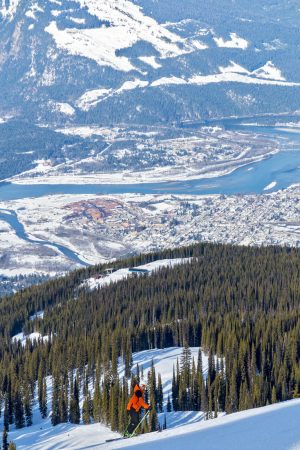
View of Revelstoke town, the valley, Columbia River and Monashees Mountains from the top of Revelstoke ski slope.

View of Revelstoke town, the valley, Columbia River and Monashees Mountains from the top of Revelstoke ski slope.

It’s hard to realize that today’s Revelstoke Mountain Resort only dates back to late 2007 and now has the greatest vertical drop in North America (at 5,620 feet, 400 feet more than Whistler, locals like to point out). And while it has only a third the skiable acres of Whistler, there are dreams of eventually having 10,000 acres, which would be more than twice Whistler.

Yes, this is a Big Boy mountain.

People come here for the powder, for the cliffs, for the STEEP. Ski run categories (beginner, intermediate, expert) are relative to each mountain. The greens (beginner) here would be blues (intermediate) most anywhere else. And the blacks, well, you do need to be able to ski. But it’s not like there’s NO milder terrain. You just have to look for it. And the cruising is fabulous.

Snow, Terrain And More

Location: Revelstoke Mountain Resort is in Revelstoke, British Columbia, Canada, just off the Trans Canada Highway (Canada Hwy. 1). If you fly into Kelowna, BC, you can grab a seat on one of the four daily Revelstoke shuttles. The drive is 2.5 hours.

Snowfall: On a usual year, the mountain gets 40 feet of dry, powder snow.

Terrain, lifts: 65 runs and named areas, 3 skier lifts, 3,100 acres of skiable terrain. Much of this mountain is serious expert terrain though there are easier runs lower down on the mountain and the Burn Down run on the backside is a true intermediate cruiser.

Vertical: Revelstoke has a vertical drop of 5,620 feet, base 1,680 feet, top 7,300 feet (about 400 more than Whistler)

Lot To Lift Access

There is a large parking lot in front of the hotel, a minute’s walk from the snow. However, people staying at the hotel have only to take the elevator down to the slope exit. Town shuttles—Revelstoke Resort Express—run under the care of an independent local operator. It’s $3 one way, $5 RT.

Culture

The Vibe: Revelstoke Mountain Resort has one large hotel at the base of the slope, somewhat like Alyeska in Alaska. The vibe here is electric…it’s locals on skis (on slope) launching glider wings to fly downhill and the sound of helicopters out your window, landing next to the hotel parking lot late each afternoon with heliskiers. It’s noisy crowds cramming into Rockfort Wok Bar and Grill for 35 cent Monday wing night. It’s hot tubs filled with 30 and 40-something Aussies there for a boys’ powder week. And it’s also the old ski town down the road with its quirky apres-ski bars, its restaurants, its old ski town feel.  Click here for dining and shopping options.

Bottom Line

Thanks to a weak Canadian dollar, which has hovered around .75 of the US dollar for several years, you almost can’t afford not to ski Canada. Ordering tickets online, one day senior rates mid season (month of February) run about $36 to $45 US. A five day pass runs about $167 – $182 US. Hover over the Canadian rates, and US rates show up.

Meanwhile, in town, rates become outrageous. For instance, at Powder Springs Inn the rooms (per room, double occupancy), start at what works out to about $165 US and include lift tickets for each person, free passes to the town aquatic center and free shuttle to the ski area .

Trail Map Click Here
Webcams Click Here

Base village at Revelstoke ski resort. Credit: Ian Houghton/ Revelstoke

Base village at Revelstoke ski resort.
Credit: Ian Houghton/ Revelstoke

SeniorsSkiing Guide: Alpental—Accessible And Challenging

A Short Ride From Seattle, Alpental Super Seniors Ski For $12.

A skier rides the upper-elevation Edelweiss Chair at Alpental. Credit: John Nelson

A skier rides the upper-elevation Edelweiss Chair at Alpental.
Credit: John Nelson

It was a rare sunny winter day in Seattle, and I was stuck working in my office. I kept looking out the window, thinking, “I wish I was skiing.”

Why not? Daydreaming wasn’t getting the work done, so I bolted out of the city, and an hour later, I was on the slopes of Alpental.

Sometimes, access is everything. This challenging resort offers an easy way to fill a yearning to turn. What’s more, senior skiers who seek Alpental’s steeps will get some enticing price breaks.

On the day I visited, Alpental provided a great excuse to play hooky. Recent storms had left its empty midweek terrain soft, with powder pockets just waiting to be found.

Snow, terrain and more

  • Location: Alpental (the German word for “alpine valley”) is one of four areas at Snoqualmie Pass, all owned by the same company. It is about 50 miles east of Seattle just off Interstate 90, the main east-west route in Washington state.
  • Snowfall: More than 400 inches fall annually at Snoqualmie Pass, with considerably more pounding the higher peaks at Alpental.
  • Terrain, lifts: Alpental has some of the most challenging terrain in the Pacific Northwest. The lower mountain is primarily intermediate skiing, served by a high-speed quad (Armstrong Express) and two double chairs; the cliff-strewn upper mountain is for advanced skiers only and served by a double chair (Edelweiss). The experts-only back bowls of Alpental are accessed through gates off the Edelweiss chair.
  • Vertical: 2,280 feet from base (3,140”) to top of Edelweiss (5,420”).
  • Olympics connection: 1984 giant slalom gold medalist Debbie Armstrong grew up skiing at Alpental; the lift Armstrong Express and run Debbie’s Gold are named for her.

Lot to lift access

  • Weekends are crowded during high season and are best avoided. Once you park, skiers must take a short walk across a covered wooden bridge to the base of the ski area. Weekdays are much easier; I arrived in early afternoon and parked 30 yards from the bridge.
  • Shuttle service: Seattle Ski Shuttle delivers skiers from various locations in the Seattle metro area; a free intermountain shuttle operates between the four ski areas at Snoqualmie Pass.
  • Accommodations: Plentiful along I-90; the ski area is just 50 minutes from downtown Seattle.

Culture

  • The vibe: Alpental has a big-mountain feel on a fairly small footprint. Consequently, it feels like a club for people who love its challenging terrain. Lifties are friendly and helpful.
  • Dining: The day lodge at the base area has cafeteria-style food and adult beverages.

Bottom line

  • The senior skier will find some great deals here. Regular adult passes (ages 16-61) are $66; seniors aged 62-69 pay $48. If you’re a “super senior” (70 and older) your ticket is only $12.
  • The upper-elevation Edelweiss Chairlift takes advanced skiers into dramatic, cliff-strewn terrain; the double-diamond, peak-to-base run International is one of the best drops you’ll ever ski.
  • Access is everything: You’re on the slopes an hour after leaving Seattle.

Trail Map Click Here

Webcam Click Here

Skiers negotiate the cliff area of Rollen on the Edelweiss Chair at Alpental. Credit: John Nelson

Skiers negotiate the cliff area of Rollen on the Edelweiss Chair at Alpental.
Credit: John Nelson


SeniorsSkiing Guide: Stevens Pass—Low, Low Prices For Seniors

It Is Hard To Beat These Lift Ticket Prices For 70+.

Clearing skies over Cowboy Mountain at Stevens Pass. Credit: John Nelson

Clearing skies over Cowboy Mountain at Stevens Pass.
Credit: John Nelson

I learned how to ski at Stevens Pass, so whenever I return, it feels a little like a trip back in time.

The lifts are updated, of course, but I can’t help reminiscing about those days more than a half-century ago as I learned how to make a parallel turn on the rugged slopes. For many skiers of a certain age who grew up in Seattle, Stevens Pass served the same purpose.

Skiers enjoy the soft snow on Hog Heaven, an intermediate run on the frontside of Stevens Pass. Credit: John Nelson

Skiers enjoy the soft snow on Hog Heaven, an intermediate run on the frontside of Stevens Pass.
Credit: John Nelson

On this trip, I arrived to a classic late-winter storm that brought 10 inches overnight. Instead of the narrow wooden skis of my youth, it was a day for rockered powder planks. As the morning progressed, the skies cleared, revealing Stevens’ dramatic scenery.

If I can hang on for a few more years, Stevens will offer another reason to return: exceptionally low pricing for 70-and-older skiers.

Snow, Terrain and More

  • Location: The ski area is 75 miles east of Seattle on U.S. Highway 2, a major east-west route through Washington state. It takes about 1½ hours to drive to the ski area on good roads.
  • Snowfall: More than 450 inches fall annually on Stevens’ 1,200 acres. The pass is often in the stormtrack for Pacific systems that hit Washington, with major dumps a common occurrence.
  • Terrain: The “frontside” is dominated by two peaks rising from a base of 4,061 feet: Cowboy Mountain (5,845’) and Big Chief Mountain (5,600’). The “backside” is called Mill Valley and drops from the top of Big Chief Mountain into a south-facing basin that bottoms out at 3,821 feet. About 35 percent is rated advanced, with 65 percent rated beginner and intermediate. A large and popular terrain park is located on the Brooks Chair, keeping the boarding tricksters in one location.
  • Lifts, lights: Stevens is designed to handle large crowds. Three high-speed quads ferry passengers, along with four triple chairs and and three doubles. Much of the frontside terrain is lighted for Stevens’ popular night-skiing.

Lot to lift access

  • Parking is a problem on busy weekends and holidays. Arrive early. On weekdays, it’s much better, but you still may need to park some distance from the base area. A passenger and gear unloading zone is available near the lodges.
  • Bus and shuttle services bring passengers from Seattle to the sometimes-busy area.
  • Accommodations: Stevens is an easy day trip from Seattle. The best option for overnight lodging is Leavenworth, Wash., a tourist hub 37 miles to the east.

Culture

  • The vibe: Stevens is a big resort, but it’s much less tony than rival Crystal Mountain. A fun-loving party scene occurs during night-skiing.
  • Dining: The base area has three lodges with busy bars and restaurants and the best coffee (T-Bar Market) of any ski area in the Northwest.

Bottom line

  • If you’re 70 and older, your ski day is a bargain: Just $15. Regular adult passes (ages 16-69) are $69 during peak days and $64 for off-peak days.
  • Grooming is exceptional on the area’s lower slopes. Upper-elevation lifts take skiers into a challenging world of powder and steeps.
  • The south-facing Mill Valley side offers sunny-day exposure in an open bowl.

Trail Map Click Here

Stevens Pass Webcam Click Here

Sunny side of the mountain: South-facing Mill Valley. Credit: John Nelson

Sunny side of the mountain: South-facing Mill Valley.
Credit: John Nelson


SeniorsSkiing Guide: Sugar Bowl And Royal Gorge—A Winning Combination!

Do a little downhill, then a little cross-country at these history-rich neighbors near Donner Summit.

Pow-ing down to the Sugar Bowl village. Always lots of snow for playing. Credit: Sugar Bowl

Pow-ing down to the Sugar Bowl village. Always lots of snow for playing.
Credit: Sugar Bowl

Sugar Bowl, the venerable ski resort that sits majestically atop Donner Summit, is as steeped in history as it is endowed with famously steep runs. In December, 1939, the Tahoe region saw the beginnings of its first major ski area when a small village with a Tyrolean-style lodge opened its doors and the one-person Disney chair (California’s first chairlift and named after one of the area’s early investors, the Walt Disney) started carrying ski enthusiasts up the mountain. The operation was the brainchild of the Austrian ski racer, Hannes Schroll, who had been heading up the Yosemite Ski School at Badger Pass, but was drawn to this cluster of Donner Summit peaks and its location in the path of the Sierra Nevada’s most prodigious snowfalls.

In the 77 years since, the privately held Sugar Bowl has managed to retain its old-world charm, pristine mountain atmosphere, and overriding commitment to a quality ski and board experience, thanks to the members of the Sugar Bowl Corporation, some of whom are fourth- and fifth-generation descendants of the original founders. The members’ surnames are a “who’s who” of prominent San Francisco and Bay Area families, many of whom have owned cabins in and around the village for decades.

Correspondent Rose Marie Cleese practices her balance at Royal George's practice track. Credit: Dave Eastwood, director Royal Gorge x-c ski school

Correspondent Rose Marie Cleese practices her balance at Royal George’s practice track.
Credit: Dave Eastwood, director Royal Gorge x-c ski school

In 1953, Sugar Bowl launched its gondola, the West Coast’s first aerial tramway, that carried skiers from the highway to the village, touted as “America’s only snowbound village”—which today still exudes its original early-days-of-skiing ambience, and where Schroll’s Tyrolean lodge, extensively updated and enlarged, still stands as the village’s focal point. In 1983, the gondola was replaced with a faster gondola with more cars, and in 1998, Sugar Bowl opened Judah Lodge, a day lodge and parking lot half a mile east of the gondola parking area and situated at the base of Mt. Judah. In 2012, Sugar Bowl entered into an agreement with the Tahoe Donner Land Trust to lease and operate Royal Gorge, the largest nordic ski area in North America. Begun by Jon Slouber in 1971, Royal Gorge has more than 200 kilometers of set-track trails spread out over some 6,000 acres of spectacular high-mountain terrain. Although there are cross-country trails linking the two resorts, unless you’re an advanced nordic skier, some climbing and side-stepping is involved; it’s easier to drive between the two.

Senior X-C skiers gliding along with Royal Gorge behind their right shoulders. Credit: Snow Bowl/Royal Gorge

Senior X-C skiers gliding along with Royal Gorge behind their right shoulders.
Credit: Sugar Bowl/Royal Gorge

I first skied at Sugar Bowl back in the late 1960s when the gondola was called “The Magic Carpet” (wonder if Walt had a hand in giving it that name!) and triple and quad and high-speed chairs were not even dreamed of. Returning recently after an absence of many years, I was thrilled to see that Sugar Bowl is sweeter than ever, succeeding in transporting me back to the past while at the same time very carefully and thoughtfully bringing the historic resort into the 21st century.

Snow and Terrain (Sugar Bowl)

  • Snow, snow, and more snow! Sugar Bowl has the highest average annual snowfall—500”—of any Northern California ski resort. (Remember the Donner Party famously snowed in during the winter of 1846–47? They were trapped at the bottom of the summit just a few miles east of Sugar Bowl.) Powder hounds have a better chance of finding the fluffy stuff here than at most other wintersports resorts in the region. Location, location, location!
  • Vertical/Elevation: Sugar Bowl’s 1,500-foot vertical offers more skiing and boarding than that vertical rise would suggest. The resort’s runs snake down to a 6,883′ base at the village from the tops of four peaks: Crow’s Nest Peak (elev. 7,954′), Mt. Disney (7,953′), Mt. Lincoln (8,383′), and Mt. Judah (8,238′).
  • Terrain: 1,650 skiable acres; 103 trails; 17% beginner, 45% intermediate, and 38% advanced.
  • Lifts: 5 high-speed quads; fixed grip lifts: 3 quads, 1 triple, and 2 doubles; 1 surface lift.
  • A trail runs through it: The 2,650-mile-long Pacific Crest Trail that goes from Mexico to Canada passes through Sugar Bowl, crossing several runs on Mount Judah before it drops over Sugar Bowl’s ridge near a ski run at the top of Mt. Lincoln.

Snow and Terrain (Royal Gorge)

  • Snowfall: Awesome.
  • Terrain: 200-plus kilometers of groomed terrain spread across 6,000 acres.
  • Trails: 34% beginner, 42% intermediate, and 24% advanced; extensive network of “snowshoers only” trails; several “dogs allowed” cross-country trails between Sugar Bowl and Royal Gorge in the Lake Van Norden area.

Lot-to-Lift Access (Sugar Bowl)

  • If you’re heading for the lifts at the village base, go three miles up Highway 40 from the I-80 Norden/Soda Springs exit and park at Sugar Bowl’s Village Gondola parking lot. If you’re staying at the Lodge, you can park in the covered garage. Once parked, head to the gondola for the seven-minute ride to the village. If you’re heading for Judah Lodge and the Mt. Judah runs, continue one-half mile past the Gondola lot, and park at the main lot for Judah Lodge.

Lot-to-Trails Access (Royal Gorge)

  • Take the Norden/Soda Springs exit off I-80 and proceed up Highway 40 approximately 1/2 mile, turn right at the Soda Springs Station, then right on Pahatsi to reach the parking lot in front of Royal Gorge Summit Station.

Culture

  • The ambience at Sugar Bowl is unlike that of any other resort in Northern California: dripping with history (walls in the Lodge are covered with old photos going back to when Hollywood stars would bend elbows at the Lodge’s famous bar, as well as original European ski resort posters from the 1930s)…a relaxed atmosphere (no cars, no crowds, short lift lines)…and an incredibly polite and genuinely friendly staff—from the lift operators to the wait staff in the Lodge.

Amenities (Sugar Bowl)

  • Dining: The legendary Belt Room Bar in the Lodge, which was recently remodeled for the first time in decades, offers casual dining, a full bar and is open daily from 11 AM to 10 PM; the Lodge’s comfortable Dining Room serves dinner nightly, featuring French-inspired California cuisine and beautiful views of the mountain. The Nob Hill Café serves breakfast and lunch fare on weekends and holidays and the Sierra Vista Bar & Grill in Mt. Judah Lodge is open daily from 7 AM to 4 PM and serves breakfast and lunch items.
  • Lodging: The beautifully refurbished rooms in the Lodge look out onto the slopes and the Disney Express chair. Guests at the Lodge are given a locker for their equipment. From Sundays through Thursdays except holiday periods, several rooms are available for $199 a night.
  • Working out and kicking back: The new Sporthaus adjacent to the Lodge offers Lodge guests a lap pool, hot tubs, spa, sauna, yoga studio, and a roomful of cardio and weight training equipment.

Amenities (Royal Gorge)

  • The café in the Summit Lodge serves breakfast and lunch delectables and draws discerning café goers from miles around—everything is fresh, all-natural, homemade, and delicious. Trailside, Royal Gorge has one café and nine warming huts for when skinny ski skiers need to cool their heels.

Bottom Line

  • Sugar Bowl: Seniors get a little break on daily lift ticket prices: seniors 65–74, $84; super seniors 75+, $60; afternoon (12:30–4 PM) ticket prices: seniors 65–74, $72; super seniors 75+, $51. (The regular adult all-day lift ticket price is $103.) Online ticket prices: seniors 65-74, $71; super seniors, 75+ $51.
  • Royal Gorge: Senior nordic skiers fare a little better on trail passes—skiers 75 years of age and older ski free! All-day: seniors 65–74, $28; super seniors 75+, free; half day: seniors 65–74, $22; super seniors 75+, free. (The regular adult all-day trail pass is $33.) The adult rental package (skis, poles, boots) is $28. Royal Gorge has a terrific ski school with two pairs of practice tracks. When it comes to getting proficient on cross-country skis, ski school director Dave Eastwood has two words for you—timing and balance, and one image—be a tall Norwegian. He almost broke me of looking down at my skis!

Sugar Bowl trail map click here

Royal Gorge trail map click here

Sugar Bowl web cam click here

Royal Gorge web cam click here 

Yes, the West Coast and Royal Gorge have had lots of snow. Snow shoeing in fluffly snow is great exercise and outdoor adventure. Credit: Snow Bowl/Royal Gorge

Yes, the West Coast and Royal Gorge have had lots of snow. Snow shoeing in fluffly snow is great exercise and outdoor adventure.
Credit: Sugar Bowl/Royal Gorge

SeniorsSkiing Guide: Waterville Valley Resort Is Super Senior-Friendly

The Silver Streaks Make Senior Skiing Unique: What A Great Idea.

Magnificent views provide a backdrop for senior friendly skiing at Waterville Valley Resort. Credit: Waterville Valley Resort

Magnificent views provide a backdrop for senior friendly skiing at Waterville Valley Resort.
Credit: Waterville Valley Resort

When it comes to picking a spot to ski, seniors are after two things: Other seniors to ski with and a price that’s less than a bundle. That is why my husband and I have come to enjoy skiing at Waterville Valley Resort in New Hampshire.

Skiing began here in the 1930s with the building of Civilian Conservation Corps trails on Mount Tecumseh and Snow’s Mountain. Fast forward to 1966 when Olympic skier Tom Corcoran, fresh from Aspen, opened this self contained family resort in a scenic cul-de-sac along the Mad River circled by the White Mountain’s 4,000-foot peaks.

Waterville Valley has great intermediate and challenging terrain, designed by a world champion skier, Corcoran. You’ll find humdingers like True Grit and Lower Bobby’s Run mixed with fun intermediate cruisers with stunning views of the Tripyramids and Osceola. I like Upper Bobby’s to Old T (Tecumseh), or Periphery to Lower Tippy; and the popular Oblivion. High Country puts you up top with more intermediate runs and a peek at Mt. Washington to the northeast. Stop for lunch at the cozy Schwendi Hutte. All trails lead to the base area; you can always find the person you got separated from.

Lot to Lift Access

  • The parking areas can be a schlep, so best to drop off gear, then park. A shuttle picks you up from farther lots.  But, members of Silver Streaks, the Waterville Valley Resort community of senior skiers, get to park close in Lot 1.
  • Visitors staying in the valley can park the car and relax. The valley is very walkable, and a free shuttle connects you to the mountain. The village is really a small town complete with lodging, dining, shops, condos, schools and services of all kinds.
  • Freedom pass (includes White Mountain Athletic Club) comes with your hotel stay at any of five lodges. For seniors, it means more folks to meet and chat with.

Snow and Terrain

  • Waterville Valley Resort has 220 skiable acres with snowmaking ability on every trail. The ski area peaks at 4,004 feet, with a vertical drop of 2,020 feet, 50 trails, and 11 lifts.
  • Novice: 14%, Intermediate: 64%, Advanced: 22%

Senior Program Is Fantastic

Silver Streaks is the longest running senior skiing program in the country. Because of its super senior-friendliness, Waterville Valley Resort has been awarded SeniorsSkiing.com’s Super Friendly Award for two years in a row.  Silver Streaks is open to skiers 50 years and over. It meets Monday-Thursday mornings in the base lodge on non-holiday days for for coffee and pastries and a warm-up run with resort staff.  Other benefits of belonging to Silver Streaks include:

  • Reserved parking area in Lot 1
  • Complimentary Snowsports clinics for seniors only
  • Aprés ski party every Wednesday
  • Banquets and other special events
  • Reduced price NASTAR every Wednesday

Nordic Streaks meets Wednesdays, non-holiday, 10 a.m. at the Adventure Center in Town Square for two hours of Nordic skiing with professional guides. Waterville has a 70+ km trail system groomed for both skate and classic. Streakers then enjoy lunch at the Center, with complimentary coffee and pastries.   Membership rates for Silver Streaks (2016-17): Alpine , $80; Nordic Streaks, $50 (Lift passes not included)

Bottom Line

Senior Rates: Daily Lift Ticket: (65 plus) $57; (80 plus) free. Season Pass: (65-79) $499; Super Senior (80 plus): $25. You can get a season “Value Pass” for $399 (65-79), if you don’t mind a few blackout dates during school vacations. If you buy online, you can get a mid-week lift ticket for as little as $26 midweek. And, if you buy your season pass now, you get free skiing for the rest of the season. Click here for more.

Trail Map Click Here

Web Cam Click Here

Can't beat some of these blue beauties at Waterville Valley Resort. Credit: Waterville Valley Resort

Can’t beat some of these blue beauties at Waterville Valley Resort.
Credit: Waterville Valley Resort

SeniorsSkiing Guide: Italy’s Dolomiti Superski

­Winter wonderland in one of the largest ski areas in the world.

Although I was born and raised in Italy, I did not do much skiing until I moved to Colorado for college. So I jumped at the occasion to join some old friends for a week of skiing in the Dolomites—a portion of the Italian Alps characterized by their stunning rocky outcrops, sufficiently beautiful to be listed as a UNESCO World Heritage site.

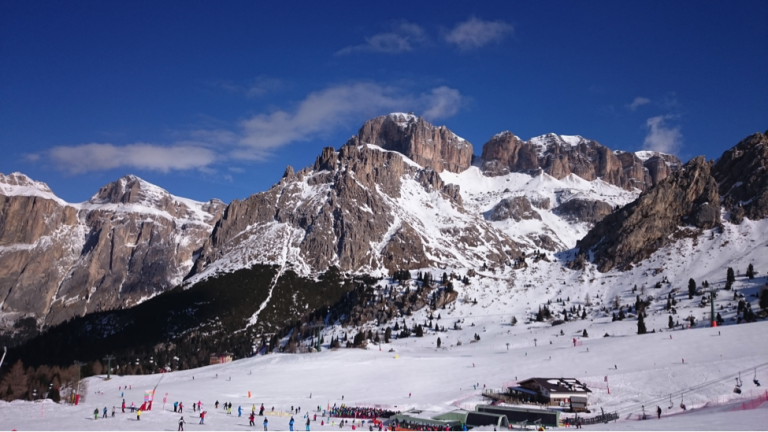
A view of Sella Massif from the south. Credit: Paola Gaudiano

A view of Sella Massif from the south.
Credit: Paolo Gaudiano


Dolomiti Superski
is a resort encompassing some 12 connected ski areas totaling 1,200 Km (750 miles) of trails served by 460 lifts. While a few of the areas require a bus for the connection, you can literally ski all day without ever doing the same trail twice, while experiencing a wide variety of terrains and stunning views.

Terrain

The area is accessible to all levels, but in general is aimed toward families, and as such there is a preponderance of easy and medium slopes. I was pleasantly surprised by the large number of older skiers—for once, I did not feel like a rarity because of my gray hair.

As with most European areas, the vast majority of the terrain is groomed, and if you like moguls or off-piste this place is not ideal. On the flip side, when the snow is abundant (which this year it was not), if you find places to go off-trail safely, you will likely find lots of untouched powder even a few days after the last snow.

The main attraction of this area is Sella Ronda, a 40 Km loop around the Sella massif, spanning four valleys and offering a variety of stunning views. The loop is great for intermediate skiers, and it’s possible to head off for side detours for more advanced skiing.

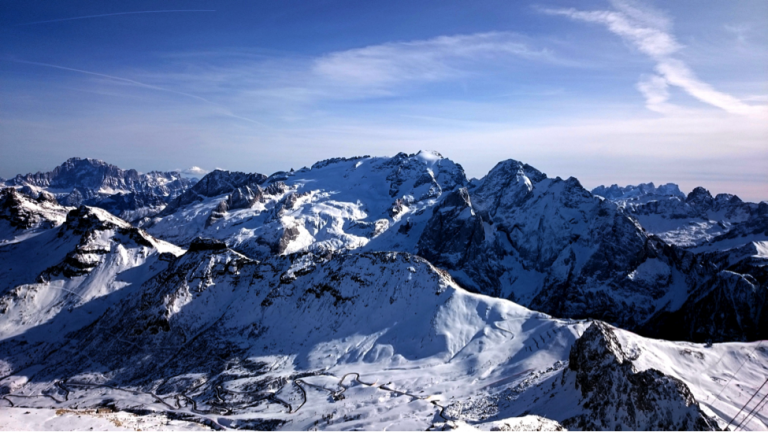
Marmolada and its glaciers. Credit: Paolo Gaudiano

Marmolada and its glaciers.
Credit: Paolo Gaudiano

Getting there

I flew into Munich, which gave me the best combination of price and relative convenience. Depending on which town you choose, it is somewhere between three and four hours from Munich, about two-three hours from Innsbruck, two-three hours from Verona and three-four hours from Milan. You can also take a train and bus combination if you want to avoid driving, but travel times will be longer.

Lodging

The entire area is dotted with small towns and hundreds of hotels. Most of them offer mezza pensione, which includes breakfast and dinner. Our group was based at Hotel Alpi, a three-star hotel in Campitello Di Fassa that cost €85/night for a single, or €130/night for two. The food, service and amenities were excellent. There are many stores nearby and a Ski Bus that connects all the towns, making it really easy to get around.

Food and Culture

As with most of Italy, part of the experience is the food. One of my favorite things about skiing in Italy is that there are lots of restaurants on the slopes that serve great food and are relatively inexpensive. On the downside, most of these places do not allow bringing and eating your own food. I brought sandwiches every day, and sometimes I just had to find a bench somewhere to eat.

Bottom Line

Skiing in Italy is much cheaper than most of the US. I paid €240 for a 5-day pass giving access to all the areas. Coupled with the inexpensive food and lodging, you’ll pay the same if not less than flying to Utah from the East coast.

Discounts are offered for skiers over 65 (roughly 10 percent off).

Trail Map Click Here

A view from Paolo's hotel room, showing the dolomite rock the region is named for. Credit: Paolo Gaudiano

A view from Paolo’s hotel room, showing the dolomite rock the region is named for.
Credit: Paolo Gaudiano

SeniorsSkiing Guide: White Pass, WA, Free For 73+!

Kudos To Senior-Friendly Ski Resort Three Hours From Seattle.

A skier heads off the top of Great White Express at White Pass. Credit: John Nelson

A skier heads off the top of Great White Express at White Pass.
Credit: John Nelson

As I got ready for a day of skiing at White Pass, I ran into a gregarious septuagenarian with a big smile on his face.

“It should be a great day,” he said to me happily as we crossed paths.

Fresh snow had fallen on the empty weekday slopes. And if you happen to be of a certain age like my lodge acquaintance (73 and older), your day at White Pass just got better: You ski for free.

West Ridge at the top of Paradise Basin leads skiers into gladed off-piste powder runs. Credit: John Nelson

West Ridge at the top of Paradise Basin leads skiers into gladed off-piste powder runs.
Credit: John Nelson

Besides that benefit, White Pass has many other great qualities: Beautiful scenery, vast terrain, reasonable pricing and ample lodging options nearby.

During my visit, two inches new had fallen on top of meticulously groomed slopes, yielding buttery smooth turns and fresh tracks all day long.

Snow, terrain and more

  • Location: The ski area is on the White Pass Scenic Byway section of U.S. Highway 12, one of the major east-west routes in Washington state. The byway has fantastic views of 14,410-foot Mount Rainier to the north and is a jumping off point to explore the volcanoes Mount St. Helens and Mount Adams to the south. It takes about three hours to drive to White Pass from Seattle.
  • Snowfall: More than 350 inches fall annually, and snowmaking keeps the mountain covered when Mother Nature doesn’t cooperate.
  • Terrain: White Pass feels like two mountains on its 1,500 acres. The “frontside” has the area’s only steeps and also has a variety of intermediate runs. The “backside,” known as Paradise Basin, offers intermediate skiing on its higher-elevation slopes. About 20 percent is rated advanced; 80 percent is beginner and intermediate.
  • Vertical: 2,000 feet from base (4,500”) to the top of Paradise Basin (6,500”).
  • Lifts: Two high-speed quads (Great White Express on the frontside) and (Couloir Express in Paradise Basin) do most of the people-moving at White Pass; the ski area has four additional chairlifts.
  • Views: On clear days, Mount Rainier is the big dog on the skyline to the north; the Goat Rocks Wilderness and Mount Adams to the south are also visible.
  • Olympics connection: Medal-winners Phil and Steve Mahre grew up skiing at White Pass and still drop in now and again.

Lot to lift access

  • Weekends and holidays can be busy, but for the most part, parking is easy. A passenger unloading zone is available next to the day lodge and regular shuttles ferry skiers from distant parking. On weekdays, parking is a breeze; I pulled in 10 minutes before opening and parked right next to the lodge.
  • Accommodations: Options are plentiful along U.S. 12, including the on-mountain White Pass Village Inn. The tourist-friendly towns of Packwood and Naches are short drives from the ski area, and Yakima, a center for many of Washington’s wineries, is about an hour’s drive to the east.

Culture

  • The vibe: Everyone seems to know everyone at White Pass, and visitors are welcomed. I met some friendly retirees who treated me like an old friend as the day progressed.
  • Dining: The best option is the cozy High Camp Lodge in Paradise Basin, with a variety of menu options, exceptional craft brews and wine. The day lodge has cafeteria food and the Sitzmark Lounge.

Bottom line

  • If you’re 73 and older, it’s $5 for your initial ticket; after that, reloads are free. Adult tickets (ages 16-72) are $63 (reloads are $58).
  • Grooming is exceptional on the ski area’s many intermediate runs, and when it’s clear, you’ll have commanding views of Mount Rainier.
  • The upper-elevation Paradise Basin offers rolling groomers and gladed off-piste powder.

Trail Map Click Here

Webcam Click Here

The Great White Express on the frontside of White Pass accesses the area's steepest terrain. Credit: John Nelson

The Great White Express on the frontside of White Pass accesses the area’s steepest terrain.
Credit: John Nelson


SeniorsSkiing Guide: Winter Park, CO—Almost Denver

Close to Denver, This Venerable and Varied Ski Resort Can Get Crowded On Weekends.

Lots of folks lining up at Winter Park. Holiday weekend was busy. Credit: Susan Winthrop

Lots of folks lining up at Winter Park. Holiday weekend was busy.
Credit: Susan Winthrop

One of the oldest ski areas in Colorado, Winter Park is only 67 miles from Denver (about a 90 minute drive). It has excellent terrain for all levels of skiers and snowboarders. I was there with my daughter and her 12 year old twins who couldn’t wait to ski Mary Jane—one of the four mountains included in the area. We were there over a holiday week-end, and we can attest to what a popular ski area this is.

Susie and grandkids point out high points on WP trail map. Credit: Susie Winthrop

Susie and grandkids point out high points on WP trail map.
Credit: Susie Winthrop

Conditions were excellent with a few inches of new powder and a huge base. As I’d come from New England, I was looking for some ice but found none. It was Martin Luther King holiday weekend—late January—and the crowds (15,000 people) were there, but we still discovered powder stashes in the trees. Plenty of full-on moguls fields kept the kids happy and when my old knees started to protest, I found some lovely blue trails which deposited me at the same lift as my more ambitious (and far younger) family members.

In spite of the throngs milling around the base and the hour-long lift line at the bottom, once we were on the slopes we quickly found our way to mostly unoccupied lifts and never had to wait again.

Snow and Terrain

With 3,081 acres of skiable terrain and 24 lifts, Winter Park had something for everyone. The average snowfall of 320 inches is impressive. The elevation of 11,220 feet is exhausting for those who come from sea-level. It was overcast and a bit windy when we were there so I can’t comment on the views or on the Parson Bowl, an area which was closed due to poor visibility. But there’s more the WP than the front slope.  Click here for a description of the “Seven Territories”, something for everyone.

Lot to Lift Access

On a busy weekend, you would have to get to the area by 7:30 a.m. to get a good parking spot in one of the designated lots. Those who slept in had a long trek uphill after parking alongside the access road. Once in the village, you can grab a red wagon provided by the ski area to tote your gear or your kids to the ticket office, the cafeteria, the restrooms or to Starbucks. At the end of the day, you might want someone to put you in a cart and pull you back to your car.

Ski Meisters

Ski Meisters whooping it up at Winter Park provides year-round activities for active seniors. Credit: Susie Winthrop

Ski Meisters whooping it up at Winter Park provides year-round activities for active seniors.
Credit: Susie Winthrop

If I lived nearby and skied here often, I would definitely join the Ski Meisters club. It’s a friendly, fun loving, hard skiing group of 55-plus seniors who enjoy discounted tickets, lockers and gorgeous jackets. They ski together at Winter Park on Sundays, Wednesdays and Thursdays when the crowds dwindle. They enjoy eating lunch together upstairs in the Stow Asis Lounge and often get together for after ski fun. They also cycle, bike, hike and take trips together to other ski areas. Currently there are 400 members, and there’s a wait list to get in. But I’m sure it would be worth the wait.

Culture

The “Guest Services” at Winter Park are friendly hosts in yellow jackets helping everyone to navigate the base area. It wasn’t immediately clear which line was the ticket line and which one was for the lift, but there was always some nice person to set us straight. I spent time at the end of the day at the tea room which turned out to have a small but popular bar. The people there were also very friendly!

Bottom Line

Day pass for senior (65+): $114; online, seven days in advance can be as little as $83. Senior pass (70+) in 2015-16 was $509.

Trail Map Click Here

Web Cams Click Here

SeniorsSkiing Guide: Fixed Income Skiing on a Liberated Schedule at Sunday River, ME

Big, Big Four-Season Resort In Maine Has Activity-Filled Social Scene For Seniors.

Terrain for everyone at Sunday River and lots of room for blue cruising. Credit: Sunday River

Terrain for everyone at Sunday River and lots of room for blue cruising, greening or double-black diamonds.
Credit: Sunday River

For seniors on a fixed income and liberated schedule, a top place to ski in the East is Sunday River, ME. That is for three main reasons. First, it is huge. When you look up from the South Ridge base lodge, you see wide slopes slung over rolling peaks, in every direction, a three-mile span from White Cap to Jordan Bowl Peaks.

Started in 1959 with one T-bar, Sunday River had a huge growth spurt when Les Otten bought the small family area and put his vision for expansion into high gear.

Today, that translates into 135 trails and glades and 15 lifts (five high speed), slung over eight interconnected peaks. That’s a lot of opportunity for seniors to select the “just right” terrain. Each peak has an easy way down. You can knock yourself out on the double black White Heat or stroll down the Three Mile Trail with Agony and Ecstasy in between.

Second, owner Boyne Resorts has done a great job modernizing lifts and focusing on snowmaking and grooming, keeping trails in good shape, even in low-snow years.
Finally, everyone who works here is very friendly, so you have nice people looking after you.

Bethel, a short drive from the mountain, is a classic New England village. Main Street has several shops and cozy restaurants. The rambling turn-of-the-century Bethel Inn Resort has a 35-km XC groomed trail network right on the edge of town. Nearby Carter’s XC Center has 55 km.

These guys meet every morning, ski, and hang out. The Prime Time Ski Club is Credit: Scott Andrews

These guys meet every morning, ski, and hang out.
The Prime Time Ski Club is informal and provides a lot of opportunities for socializing.
Credit: Scott Andrews

One great asset here for seniors is the 100+ member Prime Time Ski Club (motto “You’ll never ski alone!”) for those over 50. Meet up any weekday morning at North Peak Lodge 10-10:30, top of the Chondola (get there early before the cinnamon buns are gone!) and have a fun group of people to ski with. Break off into groups (no larger than eight) usually based on terrain, ability, and social interactions, and then ski!

Many members also gather in the Mahoosic room at South Ridge in the morning and lunch there around noon. Après ski activities include wine tastings, game night, potlucks or special restaurant dinners, trips to local mountains, and an annual western trip, plus off-season activities. New Members: $25. Renewal (pre-season): $15.

Many members ski midweek and take advantage of discounts offered at area restaurants. Check out Terri Messer’s weekly column on the club in the Bethel Citizen for what’s happening.

Bottom Line

Senior Pricing: Daily lift ticket, 65 and older, $59; $53 online advance purchase.

Senior (65-79) season passes (includes Sunday River, Sugarloaf, and Loon): New England Gold Pass: $869 (Super Senior, 80-plus: $30); Silver Pass (13 blackout dates) $705; Bronze Pass (midweek non-holiday, all ages) $529 .

GO50 Week: Mid-January with lift ticket and lodging deals for five nights, a clinic, après-ski social events, and a Sock Hop.  Kudos to Sunday River for celebrating its 50-plus skiers with a full week of fun events including a “Retro Race” on vintage equipment.

Bethel Nordic Center at the Bethel Inn Resort: All Day Trail Pass: Seniors (63 plus): $16; half day, $13. Season Pass (63 plus): $125. Ask about the daily ski-swim-sauna package at the inn’s Health Club.

Trail Map Click Here


SeniorsSkiing Guide: SnowBasin

Great Skiing. Terrific Views. America’s Fanciest Loos.

The Needles Lodge and Gondola at SnowBasin on a bluebird day. Credit: Jon Weisberg

The Needles Lodge and Gondola at SnowBasin on a bluebird day.
Credit: Jon Weisberg

SnowBasin is the expansive, exceptionally beautiful Utah area that most out-of-staters never get to ski. They’re attracted to the bigger name resorts just 45 minutes east of the airport. Head north, add 10 minutes, and you’re at MAGNIFICENT, SnowBasin—site of the 2002 Olympic Downhill events.

At the top, looking over its 3,300 acres, the cliffs and outcroppings suggest Europe. The vertical is 2,950 feet.

From this reviewer’s perspective, it ranks high for older skiers.

Snow and Terrain

  • There is much here for every ability: trails, bowls, glades. On powder or post-powder days, freshies await.
  • Lifts are fast and modern, including two gondolas and a short tram serving a vast black diamond area.
  • Ample snowmaking assures good coverage while nature sleeps. Elevation can be an issue. Its base is 6400 feet. Alta’s is 8530 feet, meaning more snow. But when conditions are good, Snow Basin is great.
  • Visibility is another issue. When it’s not bright and bluebird, its vast, treeless spaces produce unusually flat light; disorienting to anyone with compromised visual acuity.

Lot-to-Lift

  • Easy to reach lodge and lifts: The resort runs a frequent shuttle service delivering skiers a short distance from base lodge and lifts.
  • Parking is well organized: lots of personnel guiding you to your spot.
  • A fleet of large plastic garden carts is available to transport equipment and grandkids.

Day Lodges

Taking a break at Snow Basin

Taking a break at SnowBasin

These are not your typical lodges. They’re every bit as luxurious as Four Seasons hotels. Finishings. Furnishings. Flooring. You name it. No expense was spared, either at the base (Earl’s Lodge) or on the mountain (John Paul Lodge and Needles Lodge), where the luxe interiors and glass enclosed patios have spectacular views.

Food is several steps up from most resorts. House-made soups can stand up to most big city eateries. Look for Snow Basin’s Dining Discovery Series with sustainable farm-to-table selections. More on that on the resort website under “Events”.

Loo Review

Clean, classy luxury in every lodge! Men’s Rooms have a foyer with upholstered furniture, a washroom with gold-plated fixtures, and fully-enclosed commodes. Every place you go has shelving and hooks for gloves, helmets, and parkas.

Culture and Practicalities

From parking attendant to ticket window to liftee, there’s a culture of friendliness and helpfulness. Some areas don’t seem to care or have personnel who don’t even bother to sweep snow from chair. Snow Basin has trained its people to make the interaction truly enjoyable.

Unfortunately, there’s no onsite lodging. Condo rentals are available at nearby Pineview Reservoir. Many hotel/motel/other options are available in the city of Ogden, 20 – 25 minutes away.

Best to get there by auto although inexpensive public busses run three times a day between Ogden and the resort.

Bottom Line

Click here for more SnowBasin information

Trail Map Click Here 

Webcams

SeniorsSkiing Guide: Trapp Family Lodge Nordic Skiing Has Trails for Seniors

The Trapp Family Lodge is a one of a few of our favorite things. Credit: Trapp Family Lodge

The Trapp Family Lodge, near Stowe, VT,  is a one of a few of our favorite things.
Credit: Trapp Family Lodge

The Hills Are Alive With The Sound Of Senior Skiers.

In 1968 Johannes von Trapp opened the first commercial Nordic Center in the U.S. on his family’s farm overlooking the Worcester Range in Stowe, Vt. The Trapp Family Lodge continues as a diamond of Nordic skiing with 100 kilometers of trails on more than 2,500 acres in one of the most scenic spots in Vermont.

Snow and Terrain

Grooming and trail maintenance are impeccable, and it is wonderful to see beginners shuffling around wearing parkas and goggles versus lightly-fleeced skaters zooming by. Snowshoers are welcome off track.

The center’s high elevation captures snow, and it has recently added snowmaking in the stadium area to redistribute as needed. Good for seniors, the center has a lot of variety. Many like to visit the Slayton Pasture Cabin, a gradual three-mile climb, warm up by the open fire with hot chocolate, then shoot back down, about three hours round trip. A nice close-in loop is Sugar Road to the Telemark Trail, but the Haul Road, Slayton Pasture Trail, and Skater’s Waltz all provide varied journeys over rolling terrain, allowing the mind and skis to wander in equal measure.

You can get those four-pin bindings and leather boots out and wax up your wooden skis for the TFL's antique ski race. Credit: Trapp Family Lodge

You can get those four-pin bindings and leather boots out and wax up your wooden skis for the TFL’s antique ski race.
Credit: Trapp Family Lodge

The best backcountry skiing is accessed by climbing to the Slayton Pasture Cabin, then climbing the trail to “Round Top,” says Ryan Kukar of Trapp Family Lodge. “Bear right at the top and then drop in off the ridge towards Hare Line trail. Skiing through the woods this way is great and allows skiers to bisect some of the other Nordic ski trails.” Several backcountry zones have been trimmed to open up the lines for us seniors whose reactions may be slower. Rental backcountry gear available at the Nordic Shop include the Rossignol Soul 7 skis, with Dynafit boots and bindings, skins required.

Dining, Lodge and Culture

For many, the draw to the Trapp Family Lodge is the von Trapps’ compelling family history, brought to life in The Sound of Music. Pilgrimage would not be too strong a word.

The lodge has 96 rooms, guest houses, and villas. The food is outstanding. The lodge’s gardens, greenhouses, laying hens, and livestock, have long been providing fresh and tasty fare to guests (marked by a crown on the menu).

Pour syrup from the majestic sugar maples onto your breakfast French Toast. Add to the tasting list an Austrian style Trapp Lager made right on the premises and the new von Trapp Weiss Beer (a white beer made with coriander). The wine cellar isn’t bad either and available for regular wine tasting sessions.

The lodge is cozy; get a good night’s sleep under Tyrolean eaves and feather pillows, comforters, with a window view over the mountains. Classical music wafts out of the lobby.

As an overnight guest, you have access to the ski trails, the Fitness Center with indoor pool, massage therapy, sauna, and hot tub. Grandchildren will appreciate the daily Mountain Kids Club.

After a day on the trails, there’s nothing better than to head to the Lounge in the lodge, order a von Trapp ale and maybe a house-made Bratwurst and Tagessuppe, and watch the winter twilight set in.

Bottom Line

For seniors: Day pass, 65 and over: $20.

Trail Map Click Here

Edelweiss, edelweiss must be along here somewhere. Tracking along on groomed trails is another one of our favorite things. Credit: Trapp Family Lodge

Edelweiss, edelweiss must be along here somewhere.
Tracking along on groomed trails is another one of our favorite things.
Credit: Trapp Family Lodge


SeniorsSkiing Guide: Stowe Mountain Resort—Easy Ways Down

Legendary Ski Trails As Well As Amazing Blue Runs.

Stowe in the morning. Skiing starts at 7:30 am. Credit: Stowe Mountain Resorts

Stowe in the morning. Skiing starts at 7:30 am.
Credit: Stowe Mountain Resorts

Visibility was poor as I slid onto the Forerunner Quad to reach the summit of Stowe Mountain Resort, braced by Mt. Mansfield, highest peak in Vermont at 4,395 feet. Somewhere below in the gray swirl were the legendary front four—the Goat, Starr, National, Liftline—the gnarliest and most iconic ski trails in the East, double black diamonds all.

But apprehension vanished after the first few turns on the Lord.

Lifts and Terrain

Easy intermediate cruisers like the Lord and Ridgeview provide smooth sailing down from the top of the quad (elevation 3,615 feet), new in 2012. Even the seven-turn Nose Dive (nee Barnes, circa 1930s) is sheer joy on a good day. The average 2,200 vertical feet of those top-to-bottom cruisers allows you to slide into the rhythm.

Volunteer Stowe Host Peter Lawler has been skiing at the mountain for 70 years. Credit: Tamsin Venn

Volunteer Stowe Host Peter Lawlor has been skiing at the mountain for 70 years.
Credit: Tamsin Venn

The management has gotten much better at taking care of trails and making snow, says Peter Lawlor, 83, a volunteer Stowe Host from Shelburne, Vt., skiing Stowe for 70 years. Lawlor very kindly took a few runs with me, providing company and hair-raising tales of the brave young racers on ice-slicked courses he had witnessed in decades past, including a youthful Andrea Meade Lawrence.

Hop over to the eight-person Gondola, and you’ve got more senior-friendly cruisers on the meandering Perry Merrill and the Gondolier, plus swank dining at the summit in the Cliff House Restaurant. After lunch, move over to the sunny slopes at Spruce Peak. The Sensation Quad lands you at the top of Spruce Peak for a fast cruise down Sterling or Main Street.

Lodges and Dining

Anchoring the trails here is the self contained pedestrian Spruce Peak Village, a game changer for the resort, full of senior-friendly amenities.

The Spruce Camp Base Lodge has vast amounts of space; the soaring Great Room Grill means never having to say, “Are you leaving? Can we have your table?” Heated snow free walkways, spacious ski racks, the Easy Over gondola that takes you from the Mansfield parking area over to Spruce Peak all mean minimal schlepping.

The Stowe Mountain Lodge, the slope-side condo hotel straight out of Architectural Digest, rolls out your skis on trolleys and heats your boots.

Need a lift blanket? Chairs heading up on a frosty day at Stowe. Credit: Stowe Mountain Resort

Need a lift blanket? Chairs heading up on a frosty day at Stowe.
Credit: Stowe Mountain Resort

The pedestrian village also has an ice skating rink, performing arts center, Stowe Mountain Club with special privileges, and kids Adventure Center (soon to open).

The Evolution Stowe Card provides hands free lift access and lets you reload your daily lift ticket online for savings.

Use the newly installed GPS Ride Systems app on the free shuttle bus that runs from the village to the mountain —stay inside until the bus comes.

For Seniors: Lifts open at 7:30 am weekends and holidays. Ski when slopes are uncrowded, freshly groomed, and the light is good.

Free Stowe Host-guided mountain tours meet at 10:30 on weekends and holidays in Spruce Plaza outside Spruce Camp Base Lodge.

WoW, Women of Winter, meet regularly to ski together to ski off the Forerunner Quad.

Bottom Line

Senior pricing: Senior Daily Lift Pass, 65 and older: $82 (Online)

Super Senior Daily Lift Pass, 70 and older: With purchase of Super Senior ByPass, online direct-to-lift ticket, $42 per day.

Stowe Statistics

Vertical: 2,360 feet, Trails: 116, Trail Acreage: 468, Lifts: 13, Snowmaking coverage: 83 percent, Beginner: 16 percent, Intermediate: 55 percent, Expert: 29 percent

Trail Map click here

Web Cam click here

Stowe's Mt. Mansfield has some legendary trails in front: Goat, Starr, National. Credit: Stowe Mountain Resort

Stowe’s Mt. Mansfield has some legendary trails in front: Goat, Starr, National.
Credit: Stowe Mountain Resort

SeniorsSkiing Guide: Mission Ridge On A Snowy Day

Day Trip-able Area From Seattle Offers Senior Bargains and “Uncrowds.”

Skiers enjoy the soft snow on Chair 3 at Mission Ridge on a snowy day. Credit: John Nelson

Skiers enjoy the soft snow on Chair 3 at Mission Ridge on a snowy day.
Credit: John Nelson

“My wife and I are retiring and moving here this year,” the skier from the Seattle area said as we rode the chairlift at Mission Ridge. “We love it here.”

I could see the attraction of this gem on the eastern slope of the Cascade Mountains. Mission has bargain pricing, and beautiful, uncrowded terrain far from the busy ski areas nearer to Seattle.

During my visit, a major blizzard dumped all day, turning the open slopes of Mission into a playground of powder. With a sparse midweek crowd, I skied untracked lines all day in what felt like my own, private ski area.

The best of the best was Bomber Bowl, where swirling storm winds dumped more soft powder amid the gladed slopes.

Snow, terrain and more

  • Location: Mission is located just 12 miles from Wenatchee, Wash., an agricultural hub on the Columbia River known as the apple capital of Washington state. The bustling town also has a growing number of wineries to attract visitors, along with ample dining and lodging options. It takes about three hours to drive to Mission from Seattle.
  • Snowfall: This is the “dry” side of the Cascades, so less snow falls here than on the western slopes of the mountains. It also means more sunny skies. Ample snowmaking keeps the mountain slopes covered during early season and lean snow years.
  • Terrain: About 2,000 acres of rolling terrain drops off the top of the ridge, with a great deal more of easily accessed side country. About 30 percent of the terrain is rated advanced; 70 percent is beginner and intermediate. Gladed tree skiing and bowls are situated off a high ridge with dramatic cliffs, giving the area an appealing, open feeling.
  • Vertical: 2,250 feet from base (4,570) to ridge-top (6,820).
  • Lifts: Four chairlifts serve the basin; one is a high-speed quad taking skiers from mid-mountain to the top of Mission Ridge.
  • Views: 14,410-foot Mount Rainier and the Cascade Range are visible from the top. The ski area faces the Columbia Plateau to the east.
  • History and legend: In 1944, a B-24 Liberator heavy bomber crashed on the ridge during a training flight. A piece of the wing is on display at Bomber Bowl, one of the signature runs at Mission Ridge. Legend has it that if you touch the wing, you’ll bring fresh powder to the ski area; consequently, riders stop by often to work the mountain mojo.
Touch the bomber wing at Mission Ridge and legend has it you'll bring a new storm. Credit: John Nelson

Touch the bomber wing at Mission Ridge and legend has it you’ll bring a new storm.
Credit: John Nelson

Lot to lift access

  • Mission has two main parking lots. Drivers may drop-off passengers and gear near the lodge and ticket kiosk. On weekends during the height of the season, the lots can fill up early.
  • An inexpensive bus service operates from Wenatchee. A regional airport serves the town, as does Amtrak.
  • Accommodations are plentiful in Wenatchee. A little farther away (about a one-hour drive) is the tourist hub of Leavenworth, Wash., with many more hotels and restaurants.

Culture

  • The vibe: Small-town friendly. Locals will talk with pride about their ski area, but you’re also likely to run into refugees from Seattle who come here to escape the west-side crowds.
  • Dining: The Hampton Lodge at the base of the mountain offers a cafeteria and restaurant/pub. On the mountain is Midway Lodge, a cozy dining and drinking hut.

Bottom line

  • Adult tickets are $55; seniors 70 and older pay just $15. Season passes for 70+ seniors are just $125.
  • Lots of uncrowded, gladed skiing in an area that averages more than 300 sunny days a year. Touch the bomber wing for luck (and you might bring a new storm).
  • Parking is limited on weekends in high season; midweek is empty.

Trail Map click here

Mission Ridge Webcam click here

Skiers drop under the cliffs on Bomber Bowl, one of Mission Ridge's signature runs. Credit: John Nelson

Skiers drop under the cliffs on Bomber Bowl, one of Mission Ridge’s signature runs.
Credit: John Nelson


SeniorsSkiing Guide: Mt. Baker, Snow Catcher

Hey Seniors, Low Ticket Prices In The Northwest!

With Mount Shuksan looming behind, a snowboarder shreds soft snow at Mt. Baker Ski Area. Credit: John Nelson

With Mount Shuksan looming behind, a snowboarder shreds soft snow at Mt. Baker Ski Area.

Mt. Baker is a storm factory.

This North Cascades ski area holds the world record for snowfall in a season—an incredible 95 feet dumped here in 1998-99!

I arrived in mid-January to a modest three inches new, but that was on top of a foot that had fallen the previous day. The snow was soft; the scenery stunning.

The Canyon, one of Mt. Baker's signature runs, takes skiers and boarders into a narrow drop between mountain walls. Credit: John Nelson

The Canyon, one of Mt. Baker’s signature runs, takes skiers and boarders into a narrow drop between mountain walls.

I immediately took a few runs down The Canyon, one of Baker’s signature drops. Skiing between these towering mountain walls is a rush.

But best of all was Pan Face, a wide-open powder shot into a lovely mountain basin. Empty slopes meant fresh lines all day.

To top it all off, Mt. Baker is an incredible bargain for senior skiers, with some of the lowest ticket prices in the Northwest.

Snow, terrain, and more

  • Location: Baker is 52 miles from Bellingham, Wash., on State Route 542. It is the northernmost ski area in Washington and is closer to the Vancouver, British Columbia, metropolitan area (about a two-hour drive) than it is to Seattle (two and a half hours).
  • Snowfall: Pacific winter storms seem converge on Mt. Baker; it averages 640 inches annually, far more than any ski area in the state.
  • Terrain: About 1,000 acres are lift-served with 31 percent rated as advanced and 69 percent rated as beginner and intermediate. The Mt. Baker backcountry is enormous with huge, avalanche-prone big-mountain drops. You’ll need a partner, transceiver, shovel and probe to go out of bounds.
  • Vertical: 1,589 feet (the base is 3,500 feet; chairlift access to 5,089 feet).
  • Lifts: Eight chairlifts (none high-speed) operate out of two base areas: White Salmon (open every day) and Heather Meadows (open weekends and holidays only).
  • Views: If you’re lucky enough to visit between storms, you’ll have a commanding view of 9,131-foot Mount Shuksan to the north, a stunning, glaciated wall of rock and ice. Mount Baker (the volcano) stands at 10,781 feet to the south and is visible from certain locations of the ski area.

Lot to lift access

  • Parking on a weekday at Mt. Baker is a breeze; I arrived 10 minutes before opening and parked in the front row next to the ticket window at White Salmon Lodge. Weekend parking is busier and skiers might find closer lift access at the Heather Meadows base.
  • Bus service operates daily out of Bellingham.
  • Closest lodging options (motels and condominiums) are in Glacier, Wash., a foothills town about a half-hour from Mt. Baker. Bellingham (population 82,000 and counting) is a lovely port city about 75 minutes away with top-notch dining and accommodation options.

Culture

  • The Vibe: Old-school friendly. Everywhere I went, I was talked up by locals who were happy to share their knowledge and pride in Mt. Baker.
  • Dining: Lodges operate out of the two base areas, but the best option is the cozy Raven Hut, a mid-mountain lodge at the base of Chairs 4, 5 and 6.

Bottom line

  • Baker is a true bargain. Weekend and holiday tickets are $58 for adults; seniors 60-69 pay $50, and those 70 and older pay $39. Weekdays are even cheaper: $53 for adults; seniors 60-69 pay $41.
  • Big powder dumps are common, and locals are happy to share their advice.
  • Snowboarders love Mt. Baker for its rough features and natural half-pipe; out-of-bounds, big-mountain terrain attracts hard-cores.

Trail Map Click Here

The open, powdery slopes of Pan Face drop into the Heather Meadows side of Mt. Baker Ski Area. Credit: John Nelson

The open, powdery slopes of Pan Face drop into the Heather Meadows side of Mt. Baker Ski Area.
Credit: John Nelson