Tag Archive for: senior fitness

Keeping Tight: Maintain Muscle Mass As You Age

Four strategies make fitness simple

When it comes to fitness, the old saw about “use it or lose it” is not only true, for certain age groups, it is a challenge of sorts.  Why?  Because, according to Dr. Frank Lipman, founder of the Eleven Eleven Wellness Center,  New York, muscle decline starts at age 40 and actually accelerates every decade you grow older.  By the mid-70s, there is potential for losing half your muscle mass, he says.  That is, if you are sedentary and inactive.

On the other hand, if you are reading this, chances are you are an active and engaged sportsperson and have been for a good chunk of your life.  Nevertheless, if you want to maintain your muscle fitness as you age and slow muscle-mass loss, there are some important strategies Dr. Lipman recommends.  You may be doing some of these things already; if you aren’t, consider how you might adopt some new practices.

1.  Press and pant.  Dr. Lipman says exercise is the prime strategy.  Resistance training and aerobics are the cornerstone exercises

Light weights are good for bone density and muscle mass preservation. Credit: SeniorsSkiing.com

Light weights are good for bone density and muscle mass preservation.
Credit: SeniorsSkiing.com

to pursue.  Our personal preference is year-round group exercise classes at a good gym, fitness club or YMCA.  Regularly scheduled group classes give you a specific time to show up, and keep you motivated.  You can also learn a lot about muscles and the impact of exercise from an excellent class instructor.  Skilled instructors will vary their workouts, and when you take a couple of classes a week, you get into a habit.  And then there’s the camaraderie of working with a group of like-minded, supportive classmates from week to week. Of course, your personal doctor can give you advice about what kind of exercise is best for you.

2.  Ramp up protein.  Forget the low-fat diet.  Raising your protein consumption is the best weapon in slowing muscle deterioration, according to Dr. Lipman.

“Take your body weight, divide it in half, subtract 10. The resulting number will give you the approximate amount of protein you should be eating every day. So, for example, if you weigh 160 lbs, then half of that is 80, minus 10 = 70 grams of protein spread over the course a day’s worth of meals…If you have renal issues, you should work with your doctor to determine an appropriate daily protein intake for your specific needs.”

3.  Make it high-quality protein.  Dr. Lipman advocates grass-fed beef or organic chicken.  Also organic white beans, black beans,

High-quality protein comes from grass-fed cows. Credit: Mike Maginn

High-quality protein comes from grass-fed cows.
Credit: Mike Maginn

chickpeas, lentils and leafy greens.  He also suggests adding Whey Protein from grass-fed cows.

4.  Add the right supplements.  According to Dr. Lipman,

“the supplements that have shown promise in preserving and supporting muscle mass, topping the list are Omega-3 f

atty acids; Vitamin D; L carnitine; Glutamine and B12/folic acid.”

What are you doing to remain fit?  Are you on a high protein diet?  How’s that working for you?

This article was adapted from www.drfranklipman.com.  Check with your doctor before starting any fitness or diet program.

This Week In SeniorsSkiing.com (June 26)

Is Fitness On Your Mind These Days?, Harriet’s Hip Advice, Exercise Hacks Book Review, Questions For You.

Ski Tuck in June? Sure, say three Vermonters. See below for link to story in Powder Magazine. Credit: Connor Nash from Powder Magazine

The summer solstice has come and gone.  On solstice day, a northeastern Siberian town located above the Arctic Circle, recorded 100.4 degrees, the highest temperature ever recorded in the Arctic since records have been kept.

In the East, an early summer heat wave continues, putting a damper on vigorous outdoor activities for seniors.

Or not.

Around our rural neighborhood, we’ve noticed several senior road cyclists riding solo in the heat of the day, temperature in the mid-90s, humidity up there, their gray hairs sticking out of their helmets giving them away.  Senior runners are out there, too. Wise to keep pumping? Witless for pushing the limit?

At our age, most readers engage as best they can in vigorous physical activity, snow sports in winter, other activities in non-snow months. The virus, however, is cramping our habits. Gyms are closed or opening under major constrictions; team sports are out, bike clubs are social-distancing and mask-wearing, and pools are off limits.

As a result, we know for a fact that some seniors are exercising with new behaviors perhaps unwisely, too much, in the heat, perhaps with existing injuries. We know because we are one. Too much aggressive yoga led to pulled muscles, shutting down our physical activities for weeks now.

It’s hard to ignore that our lives have changed in these times of the virus. What we need to understand is that new fitness habits have to be thought through so that our enthusiasm for that endorphin rush doesn’t compromise our bodies.

This Week.

In this week’s edition, we have a series of articles on fitness.  SeniorsSkiing.com correspondent Harriet Wallis offers her advice on critical decisions prior to having a hip replacement.  Harriet should know; she has two new hips and two new knees.

We have also been sent a cool book on fitness for seniors.  K. Aleisha Fetters’ Fitness Hacks For Over 50 offers 300 ways to build easy fitness moves into everyday activities. It’s a very clever idea to get us to think of different ways to keep our bodies in motion.

The results of our Next Season Survey are in. Click here to review the highlights. Thanks so much for your participation. We had a 21% response rate which is very high for a publication like ours and evidence of the engagement of our readers.

We have some additional Questions For You this month, focusing on cross-country skiing and how frequently SeniorsSkiing.com should publish next season.  Please offer your thoughts.

And despite the oncoming of summer, three Vermonters found a way to ski left-over snow at Tuckerman Ravine in the White Mountains.  Click here for a link to this story from Powder Magazine about three lucky skiers who saw an opportunity ski the Ravine in late June.

Be safe, stay well. Remember there are more of us every day and we aren’t going away.


Fitness Focus: Plank, Plank, Plank

This Pose Is Considered The Simplest, Most Effective Core Strengthener.

Pretty basic, but effective. It’s easy to do it incorrectly so study up.
Credit: Yoga Lily

“Plank, plank, plank,” says Jan, the exercise instructor at the head of our class.  After an hour of kick boxing, we start the floor exercises to end the session.  We get into plank position as she intones, “Plank, plank, plank”. The seconds roll by.

High plank or Phalakasana pose. The most glorious of simple exercises, body weight held in place by core strength.  Arms, wrists, shoulders, lower back, abs, gluts, all working to hold the position.

The proper plank position can be found by putting your hands under your shoulders, extending up to a full, high plank on your toes, body a straight line from heels to back of head, eyes focused about a foot ahead of you, chin tucked. Basically, it’s like the top of a push-up, making sure your body is straight and not sagging or arched. While you’re up there, you can flex your feet, bend one knee in, then the other. Put one foot’s toes on the heel of the other foot, then switch. If you hold yourself still, you can feel your muscles adjusting and keeping you balanced.

High plank can be modified by resting on your knees versus your toes. That might be a good place to start if you haven’t done core exercises in a while.

If your wrists are sensitive, you can support yourself on a pair of dumb bells or yoga blocks. If you have hand or wrist issues, like carpal tunnel or rotator cuff, you’ll have to get some advice from a physical therapist or yoga instructor to help mitigate those conditions.

You can also move from high plank to low plank, moving down to resting on your forearms, arms extending in front of you, one arm at a time.  Then, back to high plank.  And then down to low plank. Do this slowly while mindfully keeping your body in a straight line position.  Man, that’s a work out.

The benefits are impressive; you get toned up in the middle, and you will find yourself using those newly strengthened core muscles to support your back when lifting, twisting, even walking.  We’ve found that lower back problems can be addressed with a strong core.  Your posture will improve, too. Your mileage may vary, but plank and other exercises focused on the core can definitely help that lower back.

The experts say you should shoot for 30 seconds as a beginner to get into this.  Eventually, if you can hold plank for two minutes, you’re doing very well.

You can find more advice from experts on how to safely and properly do plank here.  Jen Reviews has a number of pointers and caveats on doing this exercise.  More advice from the Yoga Outlet here.   Jen Reviews sums up the major benefit of planking:

Planks are a very versatile exercise that target a lot of the most important muscle groups in the body. The core muscle groups are responsible in some way for helping us carry ourselves through almost every action we’ll perform in a day, so making sure your core strength is in check is absolutely vital for someone who wants to leave a healthy lifestyle.

Plank pose is also one of the Sunrise Salutation series of connected poses that cycles through all your muscles, flexing, and strengthening all of you.  We’ll talk about the Sunrise Salutation in another Fitness Focus because it is a really awesome way to start the day.

You can incorporate plank as well as last week’s squat exercise along with others in a regime of strengthening, stretching and flexing that will keep you feeling good.

As with all new activities, please consult your doctor, physical therapist or exercise professional if you have any issues that might cause concern.


Tender Exercise Relieves Ski Day Stiffness

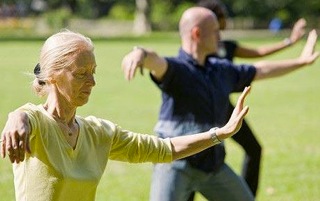
Simple Tai Chi for Senior Skiers.

[Editor Note: SeniorsSkiing.com welcomes Tommy Kirchhoff, a long-time ski instructor and a certified Tai Chi master. He has been teaching senior exercises for 12 years. Tai Chi is an ancient martial art that has evolved to slow-moving poses that is practiced all over the world.]

Credit: Telegraph UK

Credit: Telegraph UK

I learned something valuable recently: my health and my body are one in the same.

I have been a professional skier for almost 30 years and have skied more deep powder days than most people can imagine. By senior year at university, I had skied over 10,000 hours. By the end of last year, I must have skied 35,000 hours or more. But this winter I’ve only skied about 20 days.

Not because I didn’t want to. I wasn’t injured or sick, and there was no impediment other than my will to stay healthy. I know that skiing can be rough on the body. For me, the day after skiing comes with aches and stiffness. Then it takes several days to repair the damage and return to a higher state of health. But I can always fix it.

Maybe it was Christmas. My two sons came to visit, and we skied six or seven days straight. I put them on a plane back home, and I fell ill—sudden sinus infection, a backache that screamed for the chiropractor, and overall lethargy.

And so began the repair.

Tai Chi is my body’s auto mechanic. I’ve been practicing it for almost 13 years. The gentle movements alleviate stiffness and bring order to physical chaos.

Here’s why:

  • Gentle stretching—Tai Chi is full-body stretching, but nothing extreme. Being upright and on your feet allows all the joints to separate ever so softly and minutely.
  • Continuous movement—When you see photos of Tai Chi it looks like static postures, similar to yoga; but continuous movement is a principle of Tai Chi, and a true mode of self-healing.
  • Tongue position—Okay, this sounds strange, but when you press your tongue up into your hard palate, the body’s reaction is to relax. Less stress means more health.
  • Deep breathing—Your body craves oxygen, and the slow, controlled, and deep breathing of Tai Chi feeds your cells ample oxygen for reparation.

If you want to experience the healing magic of Tai Chi without any classes or experience, go online to investigate ChiGong (often spelled QiGong, but pronounced “chee-gong”). ChiGong is the mother of Tai Chi. It is more like simple, repetitive calisthenics than the choreographed dance of Tai Chi, but it includes all the same healing principles.

Stretching vs Dynamic Warm-Ups

Are you tuning or terrifying your body?

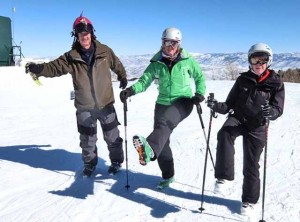
Correspondent Harriet Wallis bribed son Cal, daughter Alison, and best ski buddy Laurie to demonstrate warm ups at the top of a Deer Valley lift. Credit: Harriet Wallis

Correspondent Harriet Wallis bribed son Craig, daughter Alison, and best ski buddy Laurie to demonstrate warm ups at the top of a Deer Valley lift.
Credit: Harriet Wallis

Some experts say stretching before exercise helps performance and lessens injuries. Others say stretching can cause damage.

So what should you do?

“Skiers who stretch at the top of a lift are crazy!” says Jo Garuccio, a PSIA Examiner, Snowbird ski instructor and Triathlon World Champion. “They’ve been on a cold lift and then they’re going to stretch? That’s absolutely nuts!” she exclaims.

Really good warm ups in ski boots include swinging arms, swinging legs and marching in place, Garuccio says. Get the blood flowing.

Recent studies concur. Static stretching done cold without a warm up hurts the performance of weight lifters and competitive athletes.

Okay. Case closed. Warm up at the top of the lift before you even think about doing something else.

But when I Googled “dynamic stretching” and also “dynamic warm ups” I found – ironically – that the images were virtually the same for both. So it seems it’s your responsibility to ask your body: “Am I getting juices going, or am I straining cold muscles?”

On a humorous personal note, my best ski buddy would stand at the top of the lift and wiggle this way and that. I don’t know if she was warming up or stretching. Nevertheless, she was glued in place until she finished her routine. If it was a powder day I was frantic. “Hurry up. We’re wasting fresh snow,” I’d grumble. She finally learned that fresh powder trumps wiggles.

[Editor Note: Our recent poll revealed 60 percent of our respondents did some kind of stretching, 40 percent didn’t.  Here is an LA Times article on stretching that amplifies Harriet’s point about getting the blood flowing through an “active warm-up”, i.e., moving around a lot.  Short duration, static stretches are just an add on to the moving around part.  But experts certainly haven’t reached consensus.  For a collection of short, light stretches, look here.]


Wheelie__510

Time To Get Moving: Now

Five Ways To Start Your Fitness Program.

Motion helps muscles, joints, ligaments limber up for snow season.

Motion helps muscles, joints, ligaments limber up for snow season.

No more procastination.  You have from six weeks to three months, depending on where you live, to get ready for snow season.  If you are a year-round sports activist, then good on you.  If you are a part-timer, weekend warrior, you probably have to start getting more diverse muscles toned up.  If you are as not as active as you could be, reflect on your habits.  You will be safer and feel better when you head out to slopes or trails if you are physically toned.  It is a huge mistake to go from zero to a ski run or cross-country trail without being physically prepared, especially if you are one of those people who distinctly remember the Beatles on their first Ed Sullivan Show appearance.

Here are five ways to begin, especially if you’ve been off your program for whatever reason this summer.

1. Walk.  Simple.  Morning, lunchtime, or evening.  Walk fast, swing your arms, work up a sweat, carry light weights (2 pounds) or walk with ski poles (Nordic walking burns more calories), use a pedometer, keep a record of how far and how many steps.  After a week or so of daily walking,  the “training effect” will kick in, and you will feel looser, more steady and, guess what, you’ll be outside in the beautiful Autumn weather.  Here are some guidelines for getting started.

2. Stretch. Loss of elasticity of connective tissue, an effect of the aging process, can be nasty.  Muscles tighten up, and back and joint problems ensue.  Stretching makes a difference. Learn to stretch your hamstrings, quads, hip flexors, and lower back.  There are many resources you can access for how-to.  Here is a good starter from the NIH. There’s always yoga. This is really, really important: If you aren’t using it, you’re losing it.

3. Gym Class. Going to a class led by a trainer provides structure, discipline and challenge.  An hour-long class will probably keep you in more motion than the same time spent alone in your basement.  In a good gym class, you will also learn about the muscles you are exercising, how to stretch them and gradually build up strength and flexibility all over your body, not just your favorite parts.  Probably most important, you will learn proper form so you get the most out of your efforts and help prevent injuries.  SeniorsSkiing.com’s Harriet Wallis wrote about Silver Sneakers, a national program sponsored by insurance company targeting seniors. There’s probably one near you.

4. Focus on four essentials.  No gym nearby? If you do head down to your basement or studio for exercises, here are four to get you going:  Lunges for legs, lower back, hips, Plank for core and probably one of the two top exercises of all, Pushups for core, upper body and arms, and the other top exercise, and Squats, a fundamental leg and back strengthener.  You must learn to do these correctly; form counts for everything.  Doing a zillion reps without proper form is not that effective and could get you hurt.

5. Get an app or two. There are many apps you can get for your smartphone that can be your training buddy.  This link has a few of many. Point is you will able to get feedback on how you are doing and see progress using a cool app. And in a strange way, the app builds an expectation. Just like the GPS voice in your car, you can have a relationship with your app.

As usual, see your doctor before trying any of this, or if you start a program, and it doesn’t feel good.  Remember this is meant to be a starter kit.  Stay tuned for more advanced fitness activities.

Now, don’t hesitate, get going. What’s your advice?

My Fitness Journey Continues: Part Five

From High-Tech to Low-Tech, Great Gear For Getting Fit

The best fitness gear you can get requires no expense! It’s at the end of your legs: your own two feet. Walking (or jogging or running) as much as you can in any given week will burn calories and keep you cardiovascularly fit. Being on the move is considered one of the key factors in staying healthy and living longer (as well as enhancing one’s stability, litheness, and mind function).

The pioneering body device is Fitbit. Other devices have grown up around it. Credit: Fitbit

The pioneering body device is Fitbit. Other devices have grown up around it.
Credit: Fitbit

But in the digital, tech-centric world we all live in today, even our simple walking regimens can be enhanced by a bit of 21st-century gear, the most popular being Fitbit. The dandy little waterproof device straps on your wrist and keeps track of exactly how much you’re actually walking any given day. The basic device ($80 on Amazon) monitors the number of steps you take and lets you set personal goals you can track. It also monitors your sleep so you know how long and even how peacefully you’ve slept. For a bit more moolah, there are more sophisticated trackers available, like the Apple Watch,  that do such amazing things as alert you when you’ve been idle for a certain length of time, and track your heart rate, skin temperature, and blood oxygenation.


Can you do that? Weights are critical to seniors' fitness. Credit: GymRat

Can you do that? Weights are critical to seniors’ fitness.
Credit: GymRat

The most essential low-tech fitness gear for seniors? Without question, weights. Every official health organization recommends that seniors, whatever their age, incorporate regular strength training into their weekly regimen. In Part Two of this series, the UCSF medical director I was interviewing recommended I get a bone scan since I hadn’t had one since my 50s. The new scan showed that I had osteopenia, meaning lower-than-normal bone mass, now widely considered to be a natural aging process, and one that, in many instances, can be dealt with naturally without drugs. I was told to make sure I was getting enough calcium and to do regular weight-bearing activities. In addition to my weekly half-hour weight class, I now do a half-hour of weights two more times a week. Start out with a weight that’s comfortable (but not too!), then once your round of reps becomes too comfortable, go up a weight. I’m currently using three-pound weights, but I’m about to switch to my five-pound weights. You can find many different weight exercises for seniors online, so it’s easy to create your own program; just be sure you’re getting all the muscle groups.

An update on my own personal fitness journey: I continue to make slow yet steady progress to decrease my weight and measurements and increase my core strength, balance, cardiovascular capability, and stamina. I rarely miss any of my four weekly exercise classes (aerobics, stretching, and weights), which I’ve become a little addicted to. I see a marked improvement in my balance (I can grab an ankle and bring it up behind me for a quad stretch without teetering at all, but I still can’t do burpees, which the 78-year-old woman next to me does without batting an eyelash!). I’ve quit Weight Watcher’s, but I continue to keep a food diary and I’ve cut out some bad eating habits that I miss not at all (such as potato chips with sandwiches). I make it a point to say no to myself dietarily several times a day. When I started this fitness series on May 1st, I weighed 166 pounds; today I weighed in at 156 pounds. At this rate, it would take me another year to reach my target weight of 130 pounds, so I plan on making some major changes in my diet regimen in the coming three months. Stay tuned!

A Dietary P.S.—

How sweet it isn’t! I religiously check the nutrition facts on labels for the daily value percentages, but I didn’t even notice all these years that there is NO percentage listed for sugar until my daughter watched the excellent documentary, Fed Up, and informed me of this fact (thanks, sugar lobby!). I discovered that one Margarita accounts for my entire daily allowance! So if you’re interested in keeping track yourself, know that the American Heart Association recommends 37.5 grams of sugar per day for men and 25 grams per day for women (keep in mind that many unprocessed foods contain sugar naturally); also, before you sugar up, consider the harm sugar can do to aging teeth.

Check out this site if you’d like to know more about sugar and how much is good for you.

Editor Note:  We congratulate Rose Marie for her perseverance.  She has made progress and shared her lessons along the way.  Thank you, Rose Marie, we are all impressed by your commitment to self-improvement. Also note that mention of products was not paid for or supported in any way.

My Fitness Journey Continues: Part Two

This Month’s Main Event: Sound Advice From A Medical Expert.

In Part Two I’m going to focus on fitness and heart health, the latter particularly important to me as a favorite nephew of mine who’s only 49 suddenly ended up in the hospital two days ago having a stent put in due to a 100 percent blocked artery. I may have company soon on my fitness journey! My primary doctor, internist Anne Chang, who’s the medical director of women’s health primary care at UCSF, one of the world’s leading hospitals, took time out of her busy schedule earlier this week to call me and answer some questions I e-mailed her recently about health and exercise. Read on.

Dr. Anne Chang, UCSF's women's health primary care medical director, offers sage advice. Credit: UCSF

Dr. Anne Chang, UCSF’s women’s health primary care medical director, offers sage advice.
Credit: UCSF

Rose Marie: How important is it for people over 50 to check with their doctor before they embark on a fitness program? And why? Dr. Anne Chang: Probably most of the time, it’s wise for seniors to check with their doctors before starting a fitness program, primarily to check the cardiac risk factor. Are they having symptoms? Does it take effort to lift a bag of groceries or climb two flights of stairs? Things to watch for are shortness of breath, lightheadedness, chest pains, or palpitations. On their doctor visit, the doctor needs to take a good history of their health. Seniors who want to continue skiing or get back into it should proceed with caution or perhaps reconsider the sport if they have any back issues or problems—such as arthritis—in their hips, knees, or ankles.

RM: I had a couple of bone density tests when I was in my 50s. Should I have another one? AC: Yes, you should. The guidelines for these tests have been refined quite a bit since your previous tests. Now the recommendation for women with no documented risk factors is to get their first bone density test at age 65; depending on what that test shows, the recommendation for their next test is anywhere from two to five years later. For men the recommended age for their first bone density test is 70, with the same subsequent test recommendations. You probably didn’t need to have those tests when you were younger, but you should have another one now. [I’m scheduling it next week!]

RM: What, in your mind, are the three most important things for a 50-plus individual to do before he or she begins a fitness program? AC: The first thing is to talk to your doctor. Second, based on how fit you are, make sure that the fitness program fits your activity level going in. If you’ve been really sedentary, you don’t want to start off, for example, in one of those more aggressive fitness programs. Finally, choose a fitness program that fits your particular needs and goals. [Note: for skiers and boarders, those would be exercise programs that focus on cardio, muscle stretching, strength, and balance.]

RM: There have been a lot of conflicting recommendations out there regarding how much and what type of exercise someone needs to do weekly as a minimum to reach a healthy level of fitness. What do you say? AC: I go by the American Heart Association’s recommendation of 30 minutes of aerobic exercise daily, such as fast walking.

When asked about which is more important on one’s road to fitness, diet or exercise, Dr. Chang said they are equally important. “Doing one without the other won’t bring you the results you want.” When asked about electronic measuring devices, such as FitBit or iPhone apps, Dr. Chang said, “Anything like that is good because it engages your attention.” When she said that, it struck me that those devices are to your physical fitness what nutrition labeling on food is to your diet! Speaking of diet, that will be my topic of discussion next month, and hopefully I will have made greater strides with that half of my fitness plan. As the good doctor said…!

Correspondent Rose Marie Cleese goes to the Senior Center in Golden Gate Park for free exercise classes. Credit: SFP&R

Correspondent Rose Marie Cleese goes to the Senior Center in Golden Gate Park for free exercise classes.
Credit: SFRecPark

Speaking of my fitness plan: here’s the straight skinny as of today. I have a long way to go before “skinny”—I’ve lost only two pounds since I posted Part One of my journey to fitness four weeks ago—but I’m undaunted. At least I’m going in the right direction and haven’t backslid. The exercise part of my plan is going really well; I’m continuing my mix of four exercise classes a week, and I’ve missed only one during this 11-week session. I’ve lost an inch all around since I last measured (the usual three measurements plus my stomach and thighs) two months ago. Several people have commented, unsolicited, about my looking thinner. Plus I’m able once again to wear a pair of black jeans that have been in the drawer for quite some time.

A parting exercise tip: you know how hard it is to remember when you’re supposed to inhale and exhale when exercising? I’ve come up with a easy way to remember! Think of the “3 ex’s”: example: exertion means exhale. You’re welcome…and again, I welcome any and all comments and suggestions.

Editor Note: You go girl!  Keep it up, Rose Marie!

Move It! Get Fit Your Way With Silver Sneakers

Nationwide Health Insurance Program Supports Senior Fitness.

Tune yourself up for ski season and beyond. Get started by checking your health insurance plan to see if it includes Silver Sneakers. It’s a nationwide program sponsored by many health insurance plans, and it encourages older adults to get fit in whatever way they want to.

Correspondent Harriet Wallis loves her Silver Sneakers aerobics class. Credit: Harriet Wallis

Correspondent Harriet Wallis loves her Silver Sneakers aerobics class.
Credit: Harriet Wallis

Silver Sneakers gives you access to gyms where you can walk on the treadmill, swim laps, stretch with yoga, lift weights and work out with certified instructors. You may also enjoy community-based programs that include everything from line dancing to boot camp. There are 12,000 Silver Sneaker facilities across the country. Find one near you and get going.

For me, I enjoy an aerobics class designed for seniors. It gets the heart rate up and the joints moving – but the class does it gently. My classmates and I are a heap of replacement parts. We’re full of metal hips, knees and shoulders. The instructor understands, and when she introduces a new move that’s too hard for some of us, we make adaptations. Nobody laughs. We’re all there for the fun of it and to keep our bodies moving.

But we “mambo” and we “grapevine.” We huff and we puff. We feel like prima donnas because we face a mirror and we can see ourselves. But we’re all wearing T-shirts, not tutus!

Silver Sneakers allows you to choose the exercise programs you like. Credit: Harriet Wallis

Silver Sneakers allows you to choose the exercise programs you like.
Credit: Harriet Wallis

Classes also offer the benefit of socializing with others of like age before and after class. Just for fun, our class goes to lunch once a month. The recent lunch reminder email said:  “We go right after class with sweat and no make-up. So far we have never been turned away looking and smelling of exercise.”

Many seniors fear trying something new because their heads fill up with negative thoughts such as: Will the class be too hard? What should I wear? Will I fit in? Skip those thoughts.

Find a Silver Sneakers program near you. Put on your sneakers and get going. Now.