Tag Archive for: seth masia

More On Taking A Lesson With COVID

Things Are Different. More Ideas For Successful Lessons.

Protect yourself and others. Be prepared. Credit: Marketwatch

Correspondent Keller Minton’s article last week on taking a lesson in COVID times was praised by a ski world notable. Seth Masia, president of the International Ski History Association, long time ski journalist, active ski instructor at Aspen/Snowmass, and member of SeniorsSkiing.com’ Board of Advisors, wrote to us with some additional comments.  Here are his observations:

Based on early-season experience at Snowmass, here are some points to bear in mind:

Stay warm! Indoor facilities may be limited, which limits opportunities to warm up over a hot chocolate. You may be out in the cold all day, so dress appropriately. Take measures to keep boots and gloves warm. This factor alone is reason enough to wear a mask, or a proper double-layer neck gaiter.

Lunch may be a problem. Many on-mountain restaurants sell take-out only, and some require you to order food in advance with a smart-phone app. Your instructor should be able to help set up lunch. Time indoors is limited, and you may wind up eating outdoors, on a patio or in a tent.

A mask may fog your goggles or sunglasses. In general you can ski with the mask down, but need to wear it on the lift or when the class stops to talk on the hill. When you mask up, consider lifting your goggles to prevent fogging. Invest in a no-fog cloth for sunglasses and prescription lenses.

Lift capacity may be limited. In a group lesson, where you’ll mix with strangers, you may be asked to ride lifts alone, or limited to two passengers on a triple or four-pack lift. This goes double for gondolas and trams.

Consider a private lesson, which opens the possibility of skiing as a family. This simplifies lift loading because members of a household can ride together. Some resorts that limit the number of people on the hill may give ticket-sales priority to private-lesson clients.

Prove you are negative. Some jurisdictions require proof of a negative COVID test for entry or overnight stays. Be prepared.

Go all online. Expect to make all reservations online, for rental gear, lessons, lodging and parking. Call centers are universally overloaded. 

Seth Masia teaches in the Aspen/Snowmass ski school, and is based at Snowmass. See his website skiyoungernow.com


John Fry (1930-2020)

Journalist, Historian, Innovator, Hall of Fame Member Passes On.

[This article first appeared in Ski History Magazine. We thank the International Ski History Association for permission to reprint this memory of a ski industry legend.)

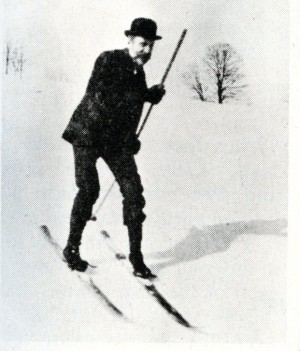
John Fry. Credit: SKI Magazine

John Fry, the dean of North American ski journalists, died suddenly but peacefully on January 24, two days after celebrating his 90th birthday

Fry was in apparent good health. According to his wife, Marlies Fry, he suffered a probable stroke while floating quietly in shallow water off a beach on Vieques Island, Puerto Rico.

Over a 60-year career devoted to ski journalism, Fry served on the staffs of the magazines SKI LIFE, SKI, Snow Country and Skiing Heritage (now Skiing History). He was editor-in-chief of SKI, founding editor of Snow Country, and served as president and then chairman of the International Skiing History Association.

“John’s love of skiing, combined with his talent for in-depth reporting and crystal writing style, set the standard for ski journalism not only in English but world-wide,” said Seth Masia, who went to work for Fry in 1974 and is today president of the International Skiing History Association. “Those of us who had the good fortune to work for him loved his wit, warmth and mentorship. He was the heart and soul of each magazine he edited and was more productive and inspiring than ever during his final years with us.”

Kathleen James, editor of Skiing History, had this to say: “In 1994, John Fry gave me my first big-time magazine job as an associate editor at Snow Country. Over the years, working for him there and later at Skiing History, he taught me how to hold every issue of every magazine to the very highest standards: to examine story ideas with a critical eye, ask authors the right questions, and artfully present the finished article on the page. At the age of 90, his comments on stories, his suggestions, and his headlines — succinct, funny, compelling — were always the very best. He was my mentor, my friend and a second father who always pushed me to be better. To my occasional frustration and eternal gratitude, he was (almost) always right.”

Fry edited America’s Ski Book, revised edition (1973), co-authored with Phil and Steve Mahre their autobiography No Hill Too Fast (1985), and authored the award-winning book The Story of Modern Skiing (2006) and a work of Canadian history, A Mind at Sea: Henry Fry and the glorious era of Quebec-built giant sailing ships (2016).

In addition to his writing, as editor-in-chief at SKI Fry created the Nations Cup of alpine skiing, ranking the worlds’ national ski teams based on World Cup points; and NASTAR (National Standard Racing), the nationwide recreational alpine racing series now owned and operated by the U.S. Ski and Snowboard Association.

Born January 22, 1930 in Montreal, Canada, Fry first donned skis at age six. After a few years he was able to ride the world’s first rope tow, which had been built at Shawbridge, Quebec in 1932.  For high school, he attended Lower Canada College (class of 1947), and was a member of its championship ski team. At McGill University he raced for the Red Birds Ski Club and earned a bachelor of arts degree in 1951.

Fry emigrated to New York City in 1957 to join the daily trade paper American Metal Market, where, in 1960, he was named managing editor. Meanwhile, he freelanced as contributing editor of Ski Life, a national magazine launched in 1959, soon to be merged with SKI Magazine. In 1963 he joined the staff of SKI as executive editor, and editor of its sister publication Ski Business. In 1964 he was named editor-in-chief of SKI, and in 1969 became editorial director of SKI and Golf Magazines. After the Times Mirror Company acquired the titles in 1972, he served as editorial director of Outdoor LifeSKI and GOLF, with circulations ranging from 350,000 to 1.8 million. During this period, he created two new publications: Action Vacations and Cross-Country Ski. In 1965 he married Marlies Strillinger.

In the summer of 1987, the New York Times Co. retained Fry to create a new magazine, Snow Country. When the magazine debuted in January 1988, he became the full-time editor-in-chief. Snow Country attained a circulation of 450,000.

In 1996, the New York Times Sports/Leisure Group appointed Fry as editor of new magazine development. In this role he launched Golf Course Living Magazine. He retired from the New York Times Co. in 1999 and returned to SKI as a contributing editor. He remained an active contributor at Skiing History magazine until his death. 

Fry was elected to the U.S. Ski and Snowboard Hall of Fame (1995), to the Laurentian Ski Hall of Fame (2016), and to the Canadian Ski Hall of Fame (2018). A founding member of the International Skiing History Association, he first served as its president in 2001, and from 2014 until his death was the association’s chairman. He also served as a director at the environmental organizations Riverkeeper (1992-2000), Pinchot Institute for Conservation (1994-1999), and Beaver Dam Sanctuary (1995 until his death). In 1997 he was honored by the International Ski Federation (FIS) with its Journalism Award.

Fry is survived by his wife of 55 years, Marlies; their daughter Nicole Fry; his children by Ann Lyons, the sculptor Leslie Fry and William Fry; and grandchildren Sarah and Emily Fry.

A memorial will be planned later.

Ask An Expert: Getting Up From A Fall

How To Get Up From A Fall

A question from reader Jeffrey Dunning:

What are good exercises to help skiers get up after a fall? Getting up with both ski boots attached to skis is a lot harder than when I was young.

For an expert opinion, we turned to Seth Masia, founder of the skiyoungernow.com instructional approach, offered at the Aspen/Snowmass Ski School.

Unless the slope is pretty steep — in which case your hips are already well above your skis — you have to be pretty spry to get up after a fall with both skis still attached. The drill is ALWAYS to pivot on your hip until both skis are below you and oriented across the fall line, so you can stand up into a traverse position. Then lean forward, putting one hand on the snow in front of your knees and the other hand on the snow behind your shoulder. The hands are now positioned to prevent sliding either forward or back. Push yourself erect by “walking” on your hands. If you don’t have the strength for this, take off the uphill ski. Now you can “walk” your hands until you can get the uphill knee onto the snow. From kneeling on the uphill knee, you should be able to stand up while using the poles for balance. Once again, you need a triangle — one pole in the snow ahead, one pole behind, to keep from sliding in either direction. 

Note: This technique requires upper body strength. Check with a PT or gym trainers to learn more.

Have a question about technique, gear, destinations, travel, or any other aspect of winter sports? Send it to mike@seniorsskiing.com, and we’ll do our best to find an expert to respond.

New Feature: Ask An Expert

Ask An Expert is the new SeniorsSkiing.com feature that answers your snow sport questions with responses from experts. Send in your questions, and we’ll find the experts to answer them. The feature will appear as frequently as we have your questions.

We start the series this week with this question from reader, Terry Kureth:

While skiing with a friend not long ago, we were talking about the recommended techniques for skiing moguls. My friend said he had heard that it is advantageous to loosen the top buckle of one’s boots in order to more easily assume a deeper knee bend needed to be a better mogul skier. Any thoughts?

For an expert opinion, we turned to Seth Masia, founder of the skiyoungernow.com instructional approach, offered at the Aspen/Snowmass Ski School.

I’ve occasionally recommended loosening the top buckle but only when it’s clear that the boot is too stiff to begin with. No one can ski efficiently unless there’s some way to articulate the ankle — knee flex without ankle flex just results in back-seat skiing, not a recipe for safe skiing anywhere and certainly not in moguls. By the way, a boot that’s even half a size too big is likely to be too stiff.

In teaching seniors to ski in bumps, I emphasize hand discipline and speed control. The hands MUST be forward and the pole plant ready early. This enables keeping the shovel of the skis in the snow, and turning — hence speed control. When the shovels come off the snow, the only way to turn is to swivel, and that puts a torque on knees and hips — not a good technique for those of us above a certain age.

Have a question about technique, gear, destinations, travel, or any other aspect of winter sports? Send it to mike@seniorsskiing.com, and we’ll do our best to find an expert to respond.

Nine Ski Tips Every Senior Skier Needs To Know

Subscribers Can Download A New eBook For Free.

For Baby Boomer skiers, low impact and low torque are the keys to more runs per day and more pleasurable skiing in general.

With the exception of the occasional kamikaze, older skiers want to remain in control on all types of terrain. And they want have a good time and look good when skiing with spouses, kids, and grandkids.

Boomers learned the sport when teaching techniques and equipment required considerable athleticism. They learned to react quickly with joint jarring rotational and up and down movements and excessive exertion when correcting for changes in balance and preventing falls.

Recognizing that old techniques can damage older bodies, even those in good shape, Seth Masia, longtime PSIA instructor in the Vail Ski School (and a member of the SeniorsSkiing.com Advisory Counsel), developed an instructional approach to help aging skiers change their ways. He teaches the technique in the three-day Ski Younger Now workshops offered throughout the season.

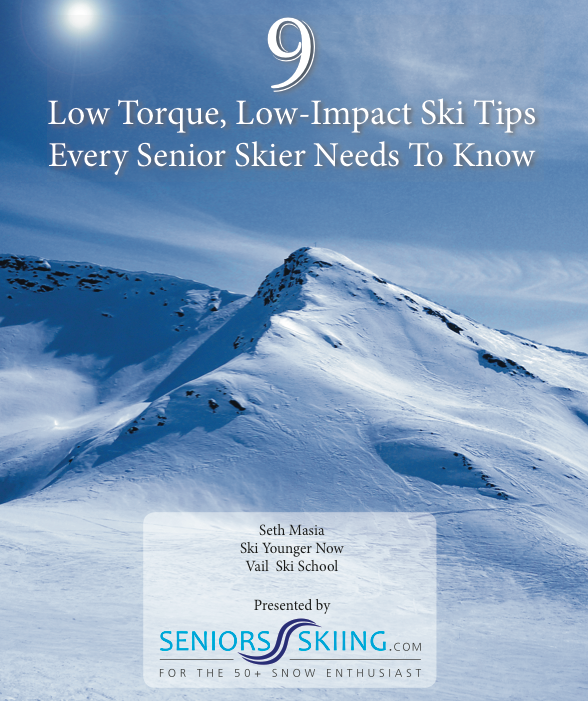
The technique is presented in a new, free, illustrated eBook developed with SeniorsSkiing.com. “9 Low Torque, Low Impact Ski Tips Every Senior Skier Needs to Know,” is available for subscribers.  To download the book, go to Community in the top navigation bar, click on Subscriber-Only Content, confirm your email address, then find the eBook, click on it. You will be downloading a PDF file.

Masia studied how older bodies, without risk of injury, could navigate a variety of terrains gracefully and more slowly. His new instructional approach takes into account skiers with artificial hip and knees.

He uses a straightforward retraining progression that reduces rotational stress on the knees and lower back. The approach shows skiers how to utilize gravity, terrain, and ski shape to do the work when initiating turns. Similar principles work for controlling speed.

When successfully implemented, each turn is a continuous and predictable arc, requiring less effort and minimizing stress and potential sprains.

The first day of each Ski Younger Now workshop focuses on the nine simple steps explained in the eBook. They start with the “Patience Turn,” which allows the ski’s shape to start each turn with virtually no muscular input. Other steps include a) changing the timing and location of planting a pole to have greater control on steeps and in bumps, b) carving, buttering, or smearing skis to produce a variety of turns, c) an explanation of how to apply pressure on different parts of the inside of the boot to produce different types of turns, and d) the influence of terrain on rhythm and turn shape.

This brief and well-illustrated instructional gem will give senior skiers a new way to enjoy runs with slower, gentler, and more stylish turns. Most important, the tips should result in fewer strains and sprains.

Short Swings!

A Weekly Round-Up Of Industry News.

historic7_CALIFORNIA

11th annual Alpenglow Sports Winter Film Series will be held at Squaw Valley’s Olympic Village Lodge, November 17.

Squaw Valley Alpine Meadows promoted Tom Feiten to VP, Marketing and Business Development, overseeing marketing and sales. Before joining the resort in 2011, he helped Teton Gravity Research revitalize the Teton Gravity Research annual film tour. He also worked eight years as Director of Strategic Finance for Booth Creek Ski Holdings in Vail, CO.

COLORADO

Arapahoe Basin will open for the season on Friday, October 21.

Ski Younger Now, instructed by Seth Masia at Vail Ski and Snowboard School, is a great program for older skiers. This season there will be four monthly midweek clinics (Tuesday thru Thursday, December 13-15, January 17-19, February 14-16, March 14-16) and one over the Martin Luther King Jr Day weekend (January 14-16). More at skiyoungernow.com or call Seth at 303.594.1657.

Colorado Cross Country Ski Association (CCCSA) announced the lineup (classic and skate skiing) for the inaugural 2017 Colorado Nordic Race Series taking place at four iconic Colorado destinations between January and March 2017.

GetSkiTickets.com announced it now offers discounts on ski lodging as well as lift tickets for resorts across North-America.

MICHIGAN

Boyne Resorts appointed Ian Arthur Chief Marketing Officer, a new position on the company’s executive team. He joins Boyne Resorts with 30+ years of marketing and related experience. Much of his career success has been achieved in the resort and travel industries. 

NEW HAMPSHIRE

Omni Mount Washington Resort, Bretton Woods, NH was named one of the Top 25 Resorts in New England in Condé Nast Traveler’s 2016 Readers’ Choice Awards. The awards recognize the best travel destinations from around the world.

UTAH

Ski Utah published its fifth annual Ski Utah Magazine, including, among other features, a comprehensive guide of all of Utah’s 14 ski resorts. Highlighted is an article about the Ski Utah Interconnect Tour, a great opportunity to ski six Utah resorts in the central Wasatch Mountains in one day. Online at: http://bit.ly/SkiUtahMagazine2016-17.

Deer Valley Resort has a new offering: Guests can hit the slopes with Olympic athletes such as Heidi Voelker, Shannon Bahrke, Kris “Fuzz” Feddersen, Kaylin Richardson, and Trace Worthington.

POWDR, owner of “experiential businesses” (e.g. Copper Mountain, Killington/Pico, Mt Bachelor, Boreal, others) announced it has rebranded. www.POWDR.com.

VERMONT

Okemo is offering its transferrable “3 & Easy” multi-pack that includes three days of lift access, valid any day of the season, with no restrictions. Lift access can be redeemed one day at a time or all on the same day. $204 for seniors (ages 65-60); $186 for super seniors (age 70+). Special offer available until October 31.

OTHER

SeniorsSkiing.com co-publisher was interviewed on Rudy Maxa’s World with The Careys, a nationally-broadcast radio program. Podcast of interview: http://rudymaxa.com/podcasts/2016-2/

Vail Resorts announced that it has added three days at Whistler Backcomb to its Epic Pass and Epic Local Pass.

Picking Your Next Skis: The Essentials

Picking your next skis is not as simple as it used to be.

Picking your next skis is not as simple as it used to be.

When buying skis, choose a ski based on matching width and turn radius to the kind of snow you like.

Hard snow: select a ski with a narrow waist – 76mm or narrower.

Soft groomers (or general western front-of-mountain skiing): select a moderate waist – 75 to 85mm.

Resort powder (with firm surface underneath): select a mid-fat waist – 85 to 90mm.

Deep snow (with unpredictable base beneath): select a fat waist – more than 90mm. If you’re big and heavy or carry a heavy pack, go even bigger – 100mm+.

The remaining decisions are length and shape. Most men skiing at resorts can get along nicely on a 165cm ski; most women on 155cm. If you’re stronger than average, go a bit longer, but it won’t buy you a lot of additional stability. If you’re much lighter than average, go a bit shorter. It will pay off in improved agility.

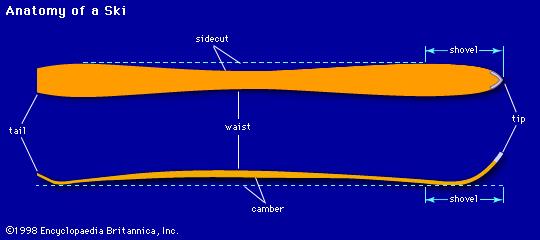
Shape means sidecut. A deeper sidecut with a shorter radius carves a shorter turn. In general, this helps best on groomers. It won’t help in bumps, where you want the tail to release to avoid hanging up at the end of the turn. A good mid-fat has a shape close to 115-80-105, which gives a theoretical radius of about 14 meters and a bearing surface — the ski’s ability to “float” on soft snow — of 1350 cm2. Furthermore, the mid-fat’s agility — its ability to bend easily into a turn — is vastly improved because it has a short turn radius.

Each dimension can be varied in different ski types. Know your preferences. Credit: Brittanica

Each dimension can be varied in different ski types. Know your preferences.
Credit: Brittanica

What shape should you buy? Start with a “generic” 115-80-105mm shape at your length, then select a wider waist if you’re going to ski a lot of soft snow, or a narrower one if you’re going to ski a lot of hard snow. If you’re an expert who loves to carve, go for a shorter radius. If you want to be able to slide the tail a bit in bumps and tight woods (or if you have to skid a bit when you teach intermediates) opt for a slightly narrower tail.

Seth Masia, former technical editor of SKI magazine, heads the Ski Younger Now program at Vail Village. Ski Younger Now is a retraining program for older skiers, and skiers returning to the sport after recovering from an injury. It teaches low-impact, low-torque techniques to enable efficient skiing in all kinds of terrain.

The workshops are scheduled for December 15-17, 2015; January 12-14, 2016; February 16-18; and March 8-10. To schedule or learn more, email sethmasia@gmail.com or call Vail Village Private Lesson Desk (800) 475-4543 and ask for Seth Masia.

Ski Younger Now: Retraining Program At Vail

Ski Younger Now is a retraining program for older skiers, and skiers returning to the sport after recovering from an injury. Developed by veteran instructor, Seth Masia (Seth is on the SeniorsSkiing.com Advisory Board), Ski Younger Now teaches low-impact, low-torque techniques to enable efficient skiing in all kinds of terrain.

Veteran Instructor and SeniorsSkiing.com Advisory Board Member Seth Masia re-teaches seniors to ski at Vail.

Veteran Instructor and SeniorsSkiing.com Advisory Board Member Seth Masia re-teaches seniors to ski at Vail.

The approach works for anyone recovering from an injury and for those getting back on hill after a long absence.

The program is available as a three-day workshop through the Vail Village Ski School (see dates/contact info below). Seth specializes in the 60+ crowd, including grandparents seeking the skills and confidence to ski with the kids. Seth helps them with those skills, including some they can pass on to the youngsters.

His clientele often face similar physical challenges: slowed reactions, weaker muscles, fragile joints. His goal—and theirs—is that retraining will give them another ten or twenty years on the hill.

He gets people skiing smoothly, using ski shape instead of muscle to start turns, guide skis and control speed. One area of focus is reducing torque on knees, hips and lower back. He does this by emphasizing edging as facilitated by shaped skis.

He starts his “retrainees” with the “patience turn.”  It’s simply an exercise of flattening shaped skis on the snow, allowing the tip to find the fall line. The process requires a slight upper body motion in the correct direction. Some of us simply move our hands in the direction of the new pole plant. It works!

He teaches simple lateral motions that flatten and edge the ski and remove both steering torque and body unweighting from the act of skiing. It saves muscle energy and leads to a longer, more relaxed day. These skills and other useful exercises don’t produce heavy breathing, even at higher elevations.

The workshops are scheduled for December 15-17, 2015; January 12-14, 2016; February 16-18; and March 8-10.

 To schedule or learn more, email sethmasia@gmail.com or call Vail Village Private Lesson Desk (800) 475-4543 and ask for Seth Masia.