Tag Archive for: ski legends

This Old Moriarty Hat

Who owns a hat for 50 years?  Well, if it’s a Moriarty hat, perhaps you understand why.

Getting ready to shovel the driveway one cold morning last winter, I reached to the top shelf of the hall closet for a hat.  My fingers felt the double-thick headband of my old Moriarty hat tucked up out of sight.  I pulled it over my ears and went a-shoveling.  Working the shovel in knee-deep in snow, a thought occurred to me.  Wait a minute.  I bought that hat from Mrs. Moriarty’s shop on the Stowe Mountain Road in 1964.  That made it fifty years old.  My hat was fifty.  It has been with me in trunks, suitcases, boxes and dresser drawers in moves from New York to California to Japan back to California and then to Massachusetts.  Been with me at Mammoth Mountain, cross-country in Appleton Farms, MA, going to class in Syracuse, sailing the Gulf of Maine, walking to work from North Station in downtown Boston.  Fifty years is a long time to own a hat.  Of course, I had other hats, but my Moriarty kept popping into my hand from time to time from the top shelf.  How did this happen?

It's quite the hat. Back in the 60s and 70s, Moriarty hats were iconic.  The Preppy Handbook lampooned them as an essential part of the spoiled college kid outfit.  Almost everyone I skied with at Song Mountain, Tully, NY, had one.  The three points on the top were like a rooster’s cockscomb, distinctive and bold.  You wore your hat down tight over your ears with your goggles wrapped around your head.  No helmets in those days.  It was a “look” that even the most tentative skiers could exhibit.

Mrs. Moriarty founded a cottage industry around weaving those hats.  Soon outpaced by the volume of orders, Mrs. M. enlisted an army of fifty weavers in Stowe village, producing as many as 40,000 in 1965.  At its height, the Moriarty hat was as ubiquitous a symbol of skiing as Head skis and Marker turntable bindings.  An ad in SKI was bold enough to say, “The people of Vermont make great maple syrup, great cheddar cheese and the best ski hats in the world.”  As I said, icon status.

You can buy a vintage Moriarty hat on eBay or from the Vermont Ski and Snowboard Museum that somehow has a stock of left over inventory from the later days of the company.  The Moriarty family got out of the business in the 80s.

Mrs. Moriarty was told by skiers that "they skied better" with her hat on. Credit: SKI January, 1965

Mrs. Moriarty was told by skiers that “they skied better” with her hat on.
Credit: SKI January, 1965

Don’t ask why I never sent my hat off to the Salvation Army.  Despite the odd moth hole, it has simply always been part of my kit along with a handful of books, a banjo, a lighter from my Navy destroyer, and other small remainders of the past.  Things that travel through life with you have value.  When you pick them up again after many years, memories start to emerge in layers.  Even after many years.  Even a ski hat.  That’s why I love my Moriarty hat.

Do you still have one?

For more information, check out Retro-Skiing.com as well as Ivy-Style.com.
Stein Eriksen: Secret Tales Of His Life

The Ski Industry Remembers His Humor And Tenderness.

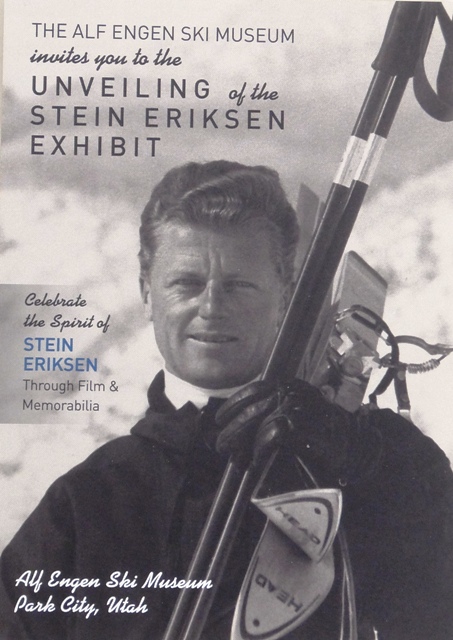
Iconic Stein Eriksen was famous for his stylish and graceful ski turns. Generation of skiers tried to mimic him. “Stein made the turns we all wish we could make,” said Tom Kelly, vice president of communications for the United States Ski and Snowboard Association. “Everyone who met him came away with a life-long experience.” He passed away in December, 2015.

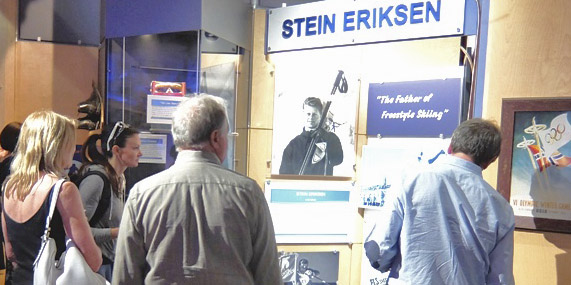
The Alf Engen Ski Museum in Park City opened the Stein Eriksen exhibit this month. Credit: Harriet Wallis

The Alf Engen Ski Museum in Park City opened the Stein Eriksen exhibit this month.
Credit: Harriet Wallis

Stein was honored by ski industry leaders on Wednesday at the unveiling of the Stein Eriksen exhibit at the Alf Engen Ski Museum in Park City, Utah. And they told secret tales of his life.

Stein was dedicated to his family and to the community, said Bob Wheaton, president and CEO of Deer Valley Resort. “If you needed a hand, Stein was right there.” And he had a whacky sense of humor.

We were at a party that was a bit stale, Wheaton said. Stein went to the food table, scooped up a dollop of whipped cream and put it on his nose. Then he went around the room meeting people – with the glop of white on his nose.

Wheaton recalls more of Stein’s humor. He would often introduce himself saying, “Hi. I’m Stein. It’s so nice for You to meet Me!”

Russ Olsen, CEO of the five-star Stein Eriksen Lodge, recalled Stein. “I skied with Stein once. Actually, I rode up the lift with him.” We got off the lift, he took off, and I never saw him again the whole day. He could ski anything at 90 miles per hour, without a hat, and when it was 40 below.

And he really could ski anything. With his athleticism to spun and flip, he became a father of freestyle skiing.

Stein's skis and and racing bibs from the 1954 Olympics are on exhibit. Credit: Harriet Wallis

Stein’s skis and and racing bibs from the 1954 Olympics are on exhibit.
Credit: Harriet Wallis

Stein enjoyed the meeting the guests at the Stein Eriksen Lodge, which was also his home. He would go from table to table in the dining room and personally welcome the guests. He loved doing that. Solemnly, near the end of his life, Stein had hopes of returning to the Lodge and told Olsen to let guests know he would be back.

The exhibit includes a video of Stein skiing and his skis and bibs from the 1954 Winter Olympics where he earned three medals. His trophies and medals are on exhibit in the lobby of the Stein Eriksen Lodge.

………………………………..

About the Alf Engen Ski Museum. It’s an interactive museum where you can take a selfie in a bobsled, try your luck in a slalom race game, learn about snow and avalanches, see ancient skis and glimpse ski pioneers. The museum is free, and there are free self guided tours of the Olympic Park.

The Olympic Park was the 2002 Winter Olympics venue for ski jumping and it continues as a premier training facility. During the summer there are youth camps and you can watch kids learn the sport. They soar off the actual Olympic jumps and land in a pool of bubbling water to soften the impact.

In addition, for a fee, there are freestyle shows, bobsled rides, extreme summer tubing, an alpine slide, a zip line, and a ropes and adventure course and so much more.

The Olympic Park and the Alf Engen Ski Museum are “must sees” when you’re in Park City.

Stein was a graceful athlete throughout his life and the father of Freestyle Skiing. Credit: Harriet Wallis

Stein was a graceful athlete throughout his life and the father of Freestyle Skiing.
Credit: Harriet Wallis

Straight Down: Cody Townsend and Gravity

Now This Should Tighten You Up.

Cody Townsend, professional free skier and athlete, takes on the most improbable ski run we’ve ever seen.  The scene is a near vertical chute in Alaska’s Tordrillo Mountains, more like a elevator shaft than a ski run.  This scene is a clip from Red Bull’s documentary, “Days of My Youth.”  We are certain that the legendary Dick Buek, winner of the 1952 Olympics downhill and probably the original extreme skier, would approve.   This stunt is reminiscent of Dick’s daredevil runs; he was the first person to schuss Exhibition at Sun Valley, something that French skiing pioneer Emile Allais said could never be done.  And, of course, there’s another legend Toni Matt whose run down the Headwall at Tuckerman’s Ravine to win the 1939 Inferno Race still echoes through the White Mountains.  All of these guys like to go straight down.  Fearless.

Cody, you’re following some pretty impressive skiing heroes.  Be careful out there.  Or is that not the point?


Snowbird’s Pipeline Conquered By Junior Bounous at 80 (Taken March 8, 2014)

DSC04514

Snowbird’s Pipeline (the top to bottom ravine in center of picture) : One of North America’s toughest ski routes, descends from Twin peaks above Snowbird. First skied by Junior Bounous in the early 70s. He skied it again during his 80th year. Junior is an inspiration to senior skiers everywhere.
&nbsp