Tag Archive for: SKI magazine

This Old Moriarty Hat

Who owns a hat for 50 years?  Well, if it’s a Moriarty hat, perhaps you understand why.

Getting ready to shovel the driveway one cold morning last winter, I reached to the top shelf of the hall closet for a hat.  My fingers felt the double-thick headband of my old Moriarty hat tucked up out of sight.  I pulled it over my ears and went a-shoveling.  Working the shovel in knee-deep in snow, a thought occurred to me.  Wait a minute.  I bought that hat from Mrs. Moriarty’s shop on the Stowe Mountain Road in 1964.  That made it fifty years old.  My hat was fifty.  It has been with me in trunks, suitcases, boxes and dresser drawers in moves from New York to California to Japan back to California and then to Massachusetts.  Been with me at Mammoth Mountain, cross-country in Appleton Farms, MA, going to class in Syracuse, sailing the Gulf of Maine, walking to work from North Station in downtown Boston.  Fifty years is a long time to own a hat.  Of course, I had other hats, but my Moriarty kept popping into my hand from time to time from the top shelf.  How did this happen?

It's quite the hat. Back in the 60s and 70s, Moriarty hats were iconic.  The Preppy Handbook lampooned them as an essential part of the spoiled college kid outfit.  Almost everyone I skied with at Song Mountain, Tully, NY, had one.  The three points on the top were like a rooster’s cockscomb, distinctive and bold.  You wore your hat down tight over your ears with your goggles wrapped around your head.  No helmets in those days.  It was a “look” that even the most tentative skiers could exhibit.

Mrs. Moriarty founded a cottage industry around weaving those hats.  Soon outpaced by the volume of orders, Mrs. M. enlisted an army of fifty weavers in Stowe village, producing as many as 40,000 in 1965.  At its height, the Moriarty hat was as ubiquitous a symbol of skiing as Head skis and Marker turntable bindings.  An ad in SKI was bold enough to say, “The people of Vermont make great maple syrup, great cheddar cheese and the best ski hats in the world.”  As I said, icon status.

You can buy a vintage Moriarty hat on eBay or from the Vermont Ski and Snowboard Museum that somehow has a stock of left over inventory from the later days of the company.  The Moriarty family got out of the business in the 80s.

Mrs. Moriarty was told by skiers that "they skied better" with her hat on. Credit: SKI January, 1965

Mrs. Moriarty was told by skiers that “they skied better” with her hat on.
Credit: SKI January, 1965

Don’t ask why I never sent my hat off to the Salvation Army.  Despite the odd moth hole, it has simply always been part of my kit along with a handful of books, a banjo, a lighter from my Navy destroyer, and other small remainders of the past.  Things that travel through life with you have value.  When you pick them up again after many years, memories start to emerge in layers.  Even after many years.  Even a ski hat.  That’s why I love my Moriarty hat.

Do you still have one?

For more information, check out Retro-Skiing.com as well as Ivy-Style.com.

70s Ski Testing: On The Snow

Step 2: Go Out, Do It.

One of the joys of working at Ski Magazine was that I was paid to test skis!!!  Ski manufacturers shipped skis to our lab for testing and when it was completed, the skis were covered with self-adhesive shelf-paper and numbered so the testers couldn’t identify the ski. 

Mother Nature dictated our location and we didn’t want to test at the same area Skiing used.  One year we started at Mount Hood but weather and poor snow forced a move to Mammoth before we settled on Park City the following year.

Areas were picked that could give testers access to a lift that served terrain suitable to our needs.  To create a hard, icy surface, the area allowed us to spread ammonium nitrate on the snow to create a hard frozen granular.

For racing skis, we set up a NASTAR type course with thirty gates and applied ammonium nitrate to make it rock hard.  Racing skis were tested just like the others before we pulled them aside for the days when we would ring them out on a racecourse.

Our contract testers – six men and four women – and me were all certified instructors with either coaching and/or racing experience.  John Perryman and his wife Joan were expert skiers and were part of the test team.  We wanted strong skiers who could ski consistently and could handle a ski without changing their technique. 

To get it right, it wasn’t about blasting down the mountain on one ski after another.  SKIpp demanded a disciplined methodology.  Each year, we reviewed the on-snow maneuvers designed to replicate how beginners through experts skied.

Because some brands were putting their name under clear P-Tex, testers were not allowed to pick up the ski prior to skiing on them.  To help ensure that each ski was tested the same way, the methodology was designed to minimize the tendency of a tester to adapt his/her technique to the ski.  Testers were limited to two runs per ski. 

 The tester came to the tent to score the test ski and write his or her comments before taking another ski.  Each day we tested ten skis because we learned beyond that it became hard to differentiate each ski’s performance.

The best skis didn’t generate many memorable comments although one tester wrote “On the icy snow, this ski tracks like a train on rails and in the soft stuff, it will derail you.”  Another wrote, “A two-by-four with an upturned end would be better than this ski.”

In the evening, skis were prepped for the next day and the day’s data tabulated.  Even though it was preliminary, we were pleasantly surprised at how well the on snow results compared to the lab’s prediction.

Testing ten skis took us to lunch.  For the afternoon, the testers could pick a ski from that day or prior days to enjoy.  It was tough, demanding skiing, but somebody had to do it!

70s Ski Testing: A New Series

This is the first in a series about Ski Magazine’s 1970s ski testing program called Ski Performance Prediction or SKIpp.  Its methodology combined engineering analysis as well as a structured series of on the snow maneuvers designed to bring out the best and worst of a ski under a variety of conditions.

Part one of the series Determining How Skis Worked is an overview of the engineering analysis.  The second part discusses the on-snow testing that we did and the third is about the politics of ski testing along with a lesson learned.

Ski (and boot and binding testing) programs came about because skiers were faced with a plethora of choices backed by marketing hype that was confusing at best and to some, downright misleading.  Both SKIING and Ski Magazine decided to jump into the fray and help their readers.  Ski’s approach was significantly different than Skiing.  Given several glasses of smoky, single malt scotch, I might be persuaded to cover the quicksand of boot and binding testing in the 70s.

On the Snow Testing is a very brief overview of the on the snow part of the program.  Typically, we were at a mountain for about twenty-five days and tested 200+ skis.  Not bad work if you can get it, but it wasn’t all fun.  It was work!

Ski testing unleashed a set of business issues that challenged the leadership of Ski Magazine.  Most of the discussions were well above my pay grade as a lowly associate editor.  However, on more than one occasion, I was called into a meeting with the high-mucky mucks and asked why manufacturer A’s didn’t get high marks.  In Politics of Ski Testing, there’s enough to give you an idea of what the discussions were like.

In the end, the SKIpp and the engineering teams at most of the manufacturers found common ground, and we helped each other out.  It was the marketing people that created all the problems because the cries from the ski shops were giving them migraines.

The shaped ski as we know it today wasn’t on the horizon.  The material science and engineering software that creates them was in its infancy and ski design was as much black art as it was engineering.  We got a glimpse of the future one year when we tested twenty odd short skis – 170 – 180 centimeters – and were pleasantly surprised by the results.  The market was ready and when engineering and materials science caught up, voilà, you have the shaped ski.

Guest Ski Tester

SKI Magazine Ski Testers Meet The Sundance Kid.

Gene Hackman and Robert Redford in “Downhill Racer” (1969). This heart throb really loved to ski.

Back in the early ‘70s, SKI Magazine (remember it?) developed a program called SKIpp that stood for “ski performance prediction” developed by the late John Perryman. He was a talented engineer who spent years in aerospace and worked with Howard Head at Head Ski Company. SKIpp had two parts, the laboratory analysis that predicted how the ski would perform and on-snow testing. Each year we tested 200+ skis.

John did the analysis and I ran the on-snow testing. Our testers were a mix of male and female skiers, primarily ski instructors with some racing experience. In March, 1974, we were at Park City which let us set up our testing tent near the base of the Shaft lift. Every morning, we tested ten pairs of skis. After lunch, each tester picked his favorite ski from the day or prior days and headed for the lifts.

One bright sunny morning, my lovely wife Betty was collecting test forms in the tent along with Joan, John’s wife, when one of the testers who was, at the time, the ski school director of Sundance Ski Area, walked into the tent and asked a simple question. “Would we allow Robert Redford ski on some our skis?”

We had skis that weren’t on sale yet, some that wouldn’t make it to the market, some that should never been sold to skiers, and Redford hadn’t signed the liability waiver. All of this went out the tent flap when Redford walked into the tent.

I tried to be my best cool, calm and collected Naval Aviator self, but the look on our wives’ faces was priceless – eyes and mouth wide open. Both were speechless that, if you knew them, was rare. His presence attracted the other three female testers who were nonchalantly trying to swap skis or ask Betty, John, or me a question just so they could get in the tent with Redford.

John looked at me, I looked John, and we shrugged. While our wives stared at the famous movie star, I managed to ask, “Can you ski 200 centimeter skis?”

“Yes.”

“What size boot do you wear?”

He gave me a size that I don’t remember. This was back in the days when boot sole shapes weren’t standardized, and we were using Market Rotomat rental bindings that took some fiddling to adjust. None of the easy-to-adjust bindings that we see today existed.

To this day, Betty will tell you she talked to him for a few minutes but has no idea what she said or was she coherent. What we do remember was that Redford was as good-looking in person as he was on the screen.

Oh, and one more thing. By the time he returned the skis, the word was out that Redford was around and a larger than usual crowd had gathered around the tent. None of us were smart enough to get him to autograph the test card he graciously filled out. Oh well!!!

brief history

A Brief History of Why There Aren’t More Innovative Ski Boots

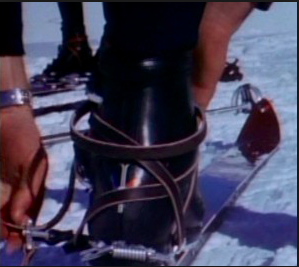
As a SeniorsSkiing.com reader, you may remember how much plastic inserts increased the lateral stiffness of your boots. Back in those days, if you were really cool, your boots were further stiffened when wrapped with a six-foot long thong.

Photo: Dick Barrymore

Then the plastic boot shell arrived, along with innovative designs from Rosemount, Scott and Hanson.

Hanson

Rosemount

Scott


The plastic boot made long skis easier to control and turn but hasn’t evolved much over the past fifty years. Liners made from foam, air, cork and other materials, coupled with adjustments for cant and forward lean, made them more comfortable. Standardized soles improved binding function.

What has changed the sport are shaped skis. They are lighter, easier to turn, and just as, if not more stable, than the 200+ centimeter skis of yesteryear.

The molded plastic boot was designed to optimize the amount of leverage a skier could apply to a long ski. Initiating a turn required unweighting the ski, rolling the knees and pressing forward to pressure the ski tips. A job for a stiff boot.

To turn a shaped ski, the skier rolls his knees back and forth across the fall line. The technique requires less forward pressure because of the skis’ greater side cut.


Back to boot design.

Most, if not all the boots on the market today are based on designs so old they’d qualify for a subscribsciption to SeniorsSkiing.com. Each boot size requires a separate mold and most boots come in nine sizes making a set of molds a million dollar investment. With manufacturing runs in the thousands, the amount the maker can recoup per boot is limited. ROI is one holdback to new boot design.

The second is flex. In the mid-70s, when I was running the ski equipment test programs for SKI Magazine, we thought measuring boot flex patterns and creating an objective way to measure ski boot performance would be relatively simple. It wasn’t.

Boot flex is determined by the:

  1. Mold design;
  2. Material from which the boot is made;
  3. Air temperature;
  4. Tightness of buckles;
  5. Fit;
  6. Foot volume; and
  7. Co-efficient of friction between the skier’s socks and the liner!

In an attempt to fill the “metrics void,” boot makers created flex indexes and measurements. Each boot maker has its own formula, so comparing one index to another is an apples-oranges affair. The only real way to test/compare ski boots is to ski on them. Even then, “normalizing” the test is difficult because each skier:

  1. Has a different foot;
  2. Doesn’t weigh the same;
  3. Skis differently;
  4. Has different leg strengths;
  5. Buckles them differently; and
  6. On and on, ad infinitum.

So now you know why new boot designs are few and far between.

Next week: How Apex is Rethinking Ski Boot Design

Short Swings!

We are seeking your financial support for SeniorsSkiing.com.

Currently, a handful of advertisers help us fund the project. What their fees don’t cover, our bank accounts do.

There are many expenses including technicians, designers, and other expenses associated with delivering SeniorsSkiing.com free each week and developing and publishing Subscriber-Only content. Next month, you will see a new section devoted to discounts on products related to your outdoor lifestyle. We plan to expand that over time.

Also, we’d like to start paying contributors and fund research that would inform resorts about ways to better cater to older skiers.

You can help by making a modest donation. We have considered charging an annual subscription fee, but prefer not to.

Some of you will ask if a donation to SeniorsSkiing.com is tax deductible. While we do not make a profit, we are not a non-profit, so (in the U.S., at least) gifts are not tax deductible.

We’ve tried to make it easy to give. Click here to reach a page with credit card options (or click Community on menu bar, wait for dropdown box to appear, and click Support SeniorsSkiing.com). Readers giving $15 or more will receive the new LIV2SKI patch and stickers, as well as the Old Man in the Mountain stickers.

For the next few weeks, a short request will be posted with each article.

We enjoy bringing you SeniorsSkiing.com weekly and, based on comments and other feedback, know that you enjoy receiving it.

Thank you!

Alpine Racing Suits

Spyder Wind Tunnel Test

The US Alpine Team in PyeongChang is wearing highly technical suits designed and made by Spyder. Each utilizes a combination of materials, placed and fitted for the specific needs of each racer. Apparently, no two suits are the same. Used for one race only, they then become hand-me-downs for junior development programs.


Paralympics

The 2018 Paralympics will happen March 9-18. Recently I met Nick Manley, an exceptional individual with multiple neurological issues. He told me that not too long ago he could get around only with a walker — an advancement from his time confined to a wheelchair. When we met at Copper Mountain, it was impossible to tell that he had experienced limited movement. He told me that his recovery was due largely to skiing. “Skiing saved my life,” is what I recall him saying. He sent this video summary of the 2017 Huntsman Cup event at Park City Mountain Resort. It gave me a new level of understanding about the grit and joyful will of adaptive ski racers. Thank you, Nick!

Electric Vehicle Charging Stations

Noticing more Tesla autos in ski area parking lots? Some areas are installing electric vehicle (EV) charging stations. Here are a few I know about: Brighton and Snowbird in Utah; Crystal Mountain, Snoqualmie Pass, and Stevens Pass in Washington, Heavenly and Squaw in California/Nevada; Sunday River in Maine, and Jay Peak in Vermont. Know of others? Please include in Comments, and we’ll keep the list growing.

Colorado

Southwest Colorado got a 24 hour dump. Silverton received 24″, Wolf Creek, 22″, and Purgatory, 15″.  I-70 areas including Aspen and Vail reported a foot.

Montana

Montana’s resorts are getting lots of snow. Top gainer is Whitefish with a 10’+ base. Direct flights to Whitefish and Bozeman are available from Los Angeles, San Francisco, Chicago, Seattle, Portland, Salt Lake City, Denver, Minneapolis, and Las Vegas. Visit the state’s tourism website for up to the minute snow reports.

Utah

Brian Head, in Southern Utah received 10″ and is expecting more. Eagle Point also benefited from the storm. Its web site indicates the area is thinking about reopening for President’s Weekend.

Skiing History Magazine

The newest issue has several articles about past Olympic greats. SeniorsSkiing.com subscribers are entitled to a free digital subscription to this gem of a publication. For details click Community/Subscriber Only Content/Skiing History Magazine. While there, you also can sign up for a free subscription to the paper edition of Ski Magazine.

How to Carve Video

This video addresses three common mistakes when carving on skis. It is well presented and may help you make better, more controlled turns in a variety of conditions.

 Spirited Gift Item

G.Griffin Wine & Spirits in Rye, N.Y.  custom engraves liquor and wine bottles like the bourbon bottle pictured. Check with proprietor Doug Kooluris (914-967-4980) regarding pricing, quantities and shipping.

Short Swings!

I’ve always believed in working with a competent car mechanic.

The same applies to a well-trained bootfitter. Many older skiers experience boot issues, and a good fitter can help overcome them. Masterfit is in the business of training people to fit ski boots. Their instructors include pedorthists, professionals with specialized training to modify footwear and employ supportive devices to address conditions which affect the feet and lower limbs. Graduates of Masterfit University populate ski shops around the nation and abroad. They can be located at bootfitters.com, which lists elite ski shops specializing in bootfitting.

Recently, in Masterfit’s typically low-key manner, the organization trained 275 REI employees in the skill of fitting ski boots. Most of them work in REI stores throughout the West, but employees from REI’s Soho (NYC), Framingham (Mass.) and Minneapolis stores also participated. Clearly, REI is upping its game when it comes to professional boot fitting. It will help them provide more complete service to REI members (Is there anyone reading this who is not an REI member?).

I remember being in a chain sporting goods store in midtown Manhattan several years ago where a salesperson with ZERO experience fitting boots was “helping” a customer with ZERO ski experience purchase ski boots. My tongue still hurts from biting so hard.

With this new development, boot shoppers can go to REI, seek out one of the people who went through Masterfit training, and proceed to get fitted with confidence.

Southern Utah Redux

Bear’s Ears. Courtesy: Chicago Tribune

Reader Alan Cort commented on last week’s piece about Patagonia‘s position against the administration’s reduction of Bear’s Ears and Grand Staircase-Escalante National Monuments:

In regards to Bear’s Ears, also a shout out to Black Diamond, maker of a lot of really good outdoor equipment.  The following is from their latest customer email: Nearly 60% of our country’s climbing areas lie on federal public lands. We repeat, over HALF of our nation’s beautiful, wild crags are on public lands. That’s just one reason why we, at Black Diamond, believe that public lands should stay in public hands, and also why we strongly support the designation of Bears Ears as a National Monument.  Think how many ski areas, especially in the West, operate on federal public lands; ones that I’m sure every SeniorSkiing reader has a special attachment to.

Thanks for making that point, Alan.

One of the issues in southern Utah, where these monuments are located, is that county commissioners and state officials are opposed to Federal land ownership. They think they can manage these vast areas more effectively. Among other goals, they want to create a handful of jobs by opening these beautiful wilderness resources to the extraction industries (A uranium mining company is reported to have pressured the White House to reduce Bears Ears.) Last weekend, we visited Goblin Valley State Park, a wonderful area filled with human scale hoodoos. The State of Utah manages the park. Trails are ill-defined, people can walk wherever they choose, signage is virtually non-existent. By comparison, we hiked Arches National Park the day before, where all systems and operations were efficient and well run. The Utah locals seeking control of Federal lands are amateurs who don’t accept the idea that their backyards belong to all citizens.

CALIFORNIA

Santa-costumed skiers and boarders will participate in Mountain High’s annual Santa Sunday this weekend. The event raises funds for Protect Our Winters (POW), the climate change advocacy group for the snow sports community. Registration requires minimum $20 donation to POW. Receipt can be exchanged for a day ticket. Visit Santa Sunday for details.

COLORADO

Aspen Highlands opens Saturday with limited terrain. Pray for snow!!!!

MAINE

Maine resorts received 21″ of natural. Time to head north!

New York

Many upgrades at Whiteface and Gore (lodge expansions, upgraded snowmaking/grooming, etc.).

Lake Placid hosts World Cup Luge this weekend, FIS 2018 Freestyle World Cup aerials competition (Jan. 19-20), Empire State Winter Games (Feb. 1-4), USCSA Ski & Snowboard Championships (March 4-10), Lake Placid Nordic Festival and Loppet (March 18), and ECAC Hockey Men’s D1 Championships (March 16-17).

If you’re in the neighborhood the weekends of Jan 19 and 26, drop by The Sagamore Resort‘s (Bolton Landing) and hoist one at its Glacier Ice Bar & Lounge, featuring nine tons of carved ice.

The Saranac Lake Winter Carnival is Feb. 2-11 and features a massive Ice Palace. The palace tradition dates to 1898. They feature tunnels and mazes and are decorated with flags, ice furniture and sculpture.

New this year is the Adirondack Snowshoe Fest ,Feb. 24 -25 in Saranac Lake. Races are scheduled for all levels. Lots of surrounding entertainment to take off the chill.

QUEBEC

Mt Tremblant reports recent snowfall and perfect snowmaking temps resulting in opening of all 4 sides of the mountain by end of weekend. 60 runs to be available! If you’re planning to visit over the holidays, don’t miss La Famille Grelot (December 23 -31), a feisty family of singing, dancing and acrobatic elves in the pedestrian village.

UTAH

Salt Lake City is promoting itself as an “apres cultural mecca” while skiing the state’s nearby iconic resorts. There’s theater, dance, classical music, jazz, professional sports, and art and natural history museums. More at Ski City USA.

VERMONT

Some resorts received as much as 24″ of fresh this week. Current trail conditions and weather alerts at SkiVermont.com; resort information, deals and events at Resort Finder.

OTHER


R.I.P. Bruce Brown, the documentarian who brought us The Endless Summer and On Any Sunday died earlier this week in Santa Barbara. He was 80. For many of our generation, his surfing films and motorcycle films stirred a fantasy of the possible.


Free, Last Minute, Online Gifts for Senior Skiers

These magazine subscriptions are available free to SeniorsSkiing.com subscribers:

  • One year (six issues) subscription to SKI Magazine (U.S. residents only).
  • One-year (six issues) digital subscription to SKIING HISTORY Magazine.

To register, click the Subscriber-Only Content at the top of the SeniorsSkiing.com Home Page.

  • For SKI Magazine, go to bottom of form and click on: Click Here For Free One Year Subscription to SKI Magazine and follow directions.
  • For SKIING HISTORY go to bottom of form and click on Click Here for Your Free Subscription to SKIING HISTORY Magazine, scroll to Digital Membership, select 1 Year-Digital Only, add to cart, enter coupon code SENIORSKI17, checkout, then set up your account.


 

SKI and SKIING HISTORY Magazines Available Free to SeniorsSkiing.com Subscribers

We’re pleased to announce that subscribers to SeniorsSkiing.com are eligible to receive a free subscription to the print version of SKI Magazine.

SKI is the venerable publication that has been catering to snow sports enthusiasts for decades. It covers the full range of the sport from equipment and technique to personalities and destinations. It is published six times a year and has a cover price value of about $29.


As announced a few weeks ago, SeniorsSkiing.com subscribers are eligible for a free digital subscription to SKIING HISTORY Magazine, which, with membership in International Skiing History Association, is a $49 value.


To register to receive your free SKI Magazine subscription and/or your free SKIING HISTORY Magazine subscription, click the Subscriber-Only Content at the top of the SeniorsSkiing.com Home Page.

  • For SKI Magazine, go to bottom of  form and click on: Click Here For Free One Year Subscription to SKI Magazine and follow directions.
  • For SKIING HISTORY go to bottom of form and click on Click Here for Your Free Subscription to SKIING HISTORY Magazine, scroll to Digital Membership, select 1 Year-Digital Only, add to cart, enter coupon code SENIORSKI17, checkout, then set up your account. P.S. Once you’ve subscribed, you’ll have access to the archives to 2009.

Novice Skier Loses It On The Slopes

An Urban Legend From The World Of Skiing.

Editor’s Note: Jan Harold Brunvand is a frequent contributor to SeniorsSkiing.com. An avid skier, he is a retired American folklorist, researcher, writer, public speaker, and professor emeritus of English at the University of Utah. Jan is best known for popularizing the concept of the urban legend, a form of modern folklore or story telling. Urban Legends are “too good to be true” stories that travel by word of mouth, by print or the internet and are attributed to an FOAF: friend of a friend. “Urban Legends,” Brunvand says, “have a persistent hold on the imagination because they have an element of suspense or humor, they are plausible and they have a moral.”  We asked him if there are any skiing urban legends, and he submitted the following. 

In all my years of collecting and researching urban legends I’ve encountered only one story that involves skiing, but it’s a doozy.

I first heard it at Snowbird during the winter of 1979-80, but it’s probably older.

A young woman from California after taking a couple of lessons on the bunny slopes felt ready to try a run from the top of the mountain. But as she got off the tram, Mother Nature called, and she didn’t see any restroom or lodge up there.

So she skied behind a clump of trees, jabbed her poles into the snow, and began to unzip. Just as she pulled down her ski pants and thermal underwear, she began to slide down the slope. In an instant, she was swooshing down the mountain backward, her pants around her ankles, trying to stop, until she collided with a tree.

She was rescued by the ski patrol who brought her to the base for medical care. As she was leaving the patrol first aid room, her arm in a sling, a man wearing an instructor’s parka was carried in, his leg in a splint.

“What happened?” she asked him. “I mean, you’re an instructor!”

“You’re not going to believe this,” he explained, “but I was riding the lift when I saw this woman roaring down the run backwards with her pants down; I leaned over for a better look, and fell off the lift. So, what happened to you?”

***************************************

I have an inch-thick file of letters, clippings, and notes re-telling different versions of this story. Typical of folklore, there are countless variations in detail while always preserving the core yarn of the hapless novice skier. She may be an Iowan at Aspen, an Oklahoman at Vail, an Atlantan at Squaw Valley, A Chicagoan at Alta, a Missourian at Sun Valley, an Ohioan at an Upstate New York resort, etc. etc. etc.

The same story is also told about skiers from Canada, England, and New Zealand on ski holidays either at home or abroad. In a version from Australia the injured lady who has been skiing in the Snowy Mountains is flying home to Sydney when she finds herself seated next to a young man with his leg in a cast. “What happened to you . . . ?”

For years a photocopied version circulated bearing the title “How’d You Break Your Arm?” Now you can find it on the Internet. It’s also a favorite story for after-dinner speakers.

The December 1983 issue of Ski magazine quoted the story from a Montreal newspaper with the variation that the half-dressed snow bunny was skiing frontwards, and she crashed “under a fully loaded chairlift.” This publication as well as one from a Swedish magazine had a cartoon illustration.

I have two questions for SeniorsSkiing.com readers: First, what version of The Ski Accident have you heard? And second, aren’t there some other urban legends about our favorite winter pastime?


Short Swings!

Snow Has Arrived Around The West.

Utah first snow. Ski Utah

Half-Price Subscription to realskiers.com: Jackson Hogen, publisher of realskiers.com, publishes short essays related to the the sport. The current one, about older skiers, is titled “Not Dead Yet.” You can sign up for the essays and receive them free. I recommend getting a paid subscription where, among other things, you’ll find intelligent and comprehensive ski reviews (including the best skis for senior skiers). Subscribers also are entitled to one-on-one consulting with Jackson. That comes in handy when considering your next equipment purchase. Youngsters pay $19.95 for a year’s subscription. SeniorsSkiing.com subscribers pay $9.95. To sign up, visit realskiers.com. Scroll down to/click on “Subscribe Today!” Then click “Sign Up” in the “Annual Membership” box. Complete the form and enter SS17 in the field under “Coupon Code.”

COLORADO

Area developments for 2017-18 follow: 

  • Arapahoe Basin: 371 acres of difficult/extreme terrain to be accessible by hiking; 4 person lift to be added next summer.
  • Aspen Snowmass: Snowmass celebrates 50thAnniversary with $6.50 lift tickets (opening day 1967 lift ticket price) on December 15, plus other activities throughout season. Aspen to host Olympic qualifying events when the U.S. Grand Prix stops in Snowmass January 10–14, 2018. Breathtaker mountain coaster opens at Snowmass in December. 
  • Cooper: Celebrates 75thAnniversary New Year’s Eve.
  • Copper Mountain: Hosts Olympic qualifying events December 6-10. New Kokomo Express Lift and Koko’s Hut serves beginner terrain in West Village. Rocky Mountain Coaster opens this Fall.
  • Eldora: New six-person high speed detachable Alpenglow Express lift ready for action.
  • Loveland Ski Area: Celebrates 80thyear of operations; adds snowcat skiing in Dry Gulch.
  • Purgatory: Expanded terrain with new intermediate and expert trails on the back- and front-sides; adding new gladed skiing; installed a mountain coaster.
  • Silverton: will celebrate 50+” powder days with area-provided snorkels.
  • Steamboat recently opened its Outlaw Mountain Coaster, the longest in North America.
  • Telluride celebrates its 45th anniversary.

 MASSACHUSETTS

BOSTON: 36thANNUAL SKI & SNOWBOARD EXPO kicks off season, NOV. 9-12, at SEAPORT WORLD TRADE CENTER. ADMISSION:$15 adults; Under 12 free. Paid admission includes one-year subscription to SKI magazine and a $10 Gift Card from GetSkiTickets.com.  Purchase tickets online at www.skisnowexpo.com/boston-expo or at door.

MICHIGAN 

Ishpeming: Eight skiing athletes/others to be inducted to U.S. Ski and Snowboard Hall of Fame next April . They include freestyle icon “Airborne” Eddie Ferguson, freestyle’s somersault king Herman Goellner cross-country coach Marty Hall, ski mountaineers twin brothers Mike and Steve Marolt, and (posthumously)130 mph alpine speed skiing world record holder, Steve McKinnney. Ceremonies to be held at Squaw Valley.

MONTANA

 Big Sky reported snow above 6500′. National long-range forecasts for the 2017-18 winter season predict average temperatures and above-average precipitation in the Rocky Mountain West.

PENNSYLVANIA

 “First-Time Ski/Snowboard Program” gives beginner ticket, lesson and rentals for $59. Click here for more.

TEXAS/FLORIDA

NOAA reports that Harvey delivered 49.32″ of rain and Irma, 16″. At 30°F, 1″ of rain falls as 13″ of snow. The snow amount could be as much as 50″ dry powder under certain conditions. Using the 30°F/1″rain =13″ snow formula, the amount of rain from Harvey would produce 641.16″ snow; the amount from Irma would equal 208″.

Dick Brooks with Hurricane Harvey debris in Houston

Dick Brooks is a SeniorsSkiing subscriber who lives in Houston and Durango, Colorado where his home resort is Purgatory. He reports that his home was dry and that he and wife, Claire, have volunteered by preparing food for those impacted and by carrying damaged items to the curb. Dick sent this photo of nearby damage.


UTAH

Deer Valley, which Ski Magazine readers just named the #1 resort in North America, will host the 2018 Visa Freestyle International, January 10-12. The event determines the freestylers who will represent the US at the South Korean Winter Olympics in February. The event is held at night under lights. The steep slope is covered in bumps. It can get chilly, but it’s a terrific thing to see.

Opening dates for Utah resorts:

  • Alta Ski Area: November 22
  • Brian Head Resort: November 17
  • Brighton Resort: Early As Possible
  • Cherry Peak Resort: December 18
  • Deer Valley Resort: December 2
  • Eagle Point Resort: December 21
  • Nordic Valley Resort: December 9
  • Park City Mountain: November 17
  • Snowbasin Resort: November 22
  • Snowbird Resort: November 22
  • Solitude Mountain: December 2
  • Sundance Mountain Resort: December 8

VERMONT 

OOPS. Ski Vermont recently announced that Parker Riehle, e group’s head, would leave that post to lead National Ski Areas Association. Citing personal reasons, he decided not to take the new position. Long time NSAA president, MIchael Berry, will remain in post until a new replacement is identified and transitioned.

Snowmaking and grooming improvements will improve the experience this season at Bolton Valley, Burke Mountain, Mount Snow, Okemo Mountain, Stratton Mountain, Sugarbush, and Suicide Six.

Okemo Ultimate season passholders now qualify for $49 lift tickets at Stratton Mountain Resort during the 2017/2018 season. Limited to one per day, non-holiday periods only, this special offer is non-transferable, and can only be used by the passholder. Stratton Summit passholders receive this same benefit at Okemo.