Tag Archive for: ski nostalgia

My Skiing in College

Our First Ski Date Didn’t Go Well.

[Please consider supporting SeniorsSkiing.com with a donation. We appreciate your help. Click here.]

Growing up Norwegian-American in Lansing, MI, I was introduced early to skiing and became fairly proficient by my teens. When I entered college in 1951, I was ready to improve. I joined the Ski Cub at Michigan State College (not University then), and I took part eagerly in their activities.

I hoped to qualify for the racing team, but guys with Norwegian names like Snilsberg and Iverson were way beyond me. Besides, I was still using those heavy U.S. Army war surplus skis my brother Tor and I acquired through our Boy Scout troop. Schussing was OK; turning was challenging

At spring break 1954 I joined the MSC club trip to Aspen. We went five in a car, split the gas costs, drove day and night, lived cheaply, and managed to get in a week at Aspen and a day at A Basin.

The length of the runs, the snow, and the scenery blew my mind. My memory may be faulty, but I think we paid $21 for a week lift pass.

I can’t remember where we stayed, but I know we had facilities to make breakfast and pack lunch. We ate dinner at the Red Onion where the “Skier Special” fit our budgets. In this photo, I’m the middle one wearing the striped Norwegian cardigan.

For 1955 spring break, Tor and I organized our own Aspen trek. We enlisted three other guys and drove Tor’s 1950 Chevy. I took this shot of the others when we crossed into Colorado. Tor is on the right wearing a cap. I think we paid about $5 a night each for bunks in a small cabin next to a boarding house where we could use the kitchen and bathroom. Again, dinners were at the Red Onion.

We had a big dump of powder during this trip. Our technique was to ski straight down until we fell, then get up and start over. 

Back at college, which became MSU in June, I met my future wife in a summer class. To impress her, I mentioned that I had been twice to Aspen. She asked, “What’s Aspen?” Then Judy tried to wow me by mentioning that she had gone by train in 1954 with other Spartan boosters to watch Michigan State play in the Rose Bowl.  I think I was dumb enough to ask, “Who won?”   (For the record, MSC beat UCLA 28-20.)

Judy had never skied. So in January 1956 I took her to northern Michigan to try it. The last thing her mother said as we left was “Don’t break your leg!”  Naturally, she broke her leg, and worse, I was responsible for the accident.

Her rental skis with cable bindings and a bear-trap front clip kept falling off. Instead of doing the right thing and having the shop adjust them, I found a length of leather lacing and tied them on. Bad idea!


 Judy was game enough later on to come to the Lansing Ski Club on crutches and pose with me on skis. And she stuck with the idea of marrying me. I had a Fulbright to Norway, so off we went in June on an ocean liner to Oslo for a year of studies, travel, meeting my relatives, and, of course, skiing.

To be continued  . . 

This Old Moriarty Hat

Who owns a hat for 50 years?  Well, if it’s a Moriarty hat, perhaps you understand why.

Getting ready to shovel the driveway one cold morning last winter, I reached to the top shelf of the hall closet for a hat.  My fingers felt the double-thick headband of my old Moriarty hat tucked up out of sight.  I pulled it over my ears and went a-shoveling.  Working the shovel in knee-deep in snow, a thought occurred to me.  Wait a minute.  I bought that hat from Mrs. Moriarty’s shop on the Stowe Mountain Road in 1964.  That made it fifty years old.  My hat was fifty.  It has been with me in trunks, suitcases, boxes and dresser drawers in moves from New York to California to Japan back to California and then to Massachusetts.  Been with me at Mammoth Mountain, cross-country in Appleton Farms, MA, going to class in Syracuse, sailing the Gulf of Maine, walking to work from North Station in downtown Boston.  Fifty years is a long time to own a hat.  Of course, I had other hats, but my Moriarty kept popping into my hand from time to time from the top shelf.  How did this happen?

It's quite the hat. Back in the 60s and 70s, Moriarty hats were iconic.  The Preppy Handbook lampooned them as an essential part of the spoiled college kid outfit.  Almost everyone I skied with at Song Mountain, Tully, NY, had one.  The three points on the top were like a rooster’s cockscomb, distinctive and bold.  You wore your hat down tight over your ears with your goggles wrapped around your head.  No helmets in those days.  It was a “look” that even the most tentative skiers could exhibit.

Mrs. Moriarty founded a cottage industry around weaving those hats.  Soon outpaced by the volume of orders, Mrs. M. enlisted an army of fifty weavers in Stowe village, producing as many as 40,000 in 1965.  At its height, the Moriarty hat was as ubiquitous a symbol of skiing as Head skis and Marker turntable bindings.  An ad in SKI was bold enough to say, “The people of Vermont make great maple syrup, great cheddar cheese and the best ski hats in the world.”  As I said, icon status.

You can buy a vintage Moriarty hat on eBay or from the Vermont Ski and Snowboard Museum that somehow has a stock of left over inventory from the later days of the company.  The Moriarty family got out of the business in the 80s.

Mrs. Moriarty was told by skiers that "they skied better" with her hat on. Credit: SKI January, 1965

Mrs. Moriarty was told by skiers that “they skied better” with her hat on.
Credit: SKI January, 1965

Don’t ask why I never sent my hat off to the Salvation Army.  Despite the odd moth hole, it has simply always been part of my kit along with a handful of books, a banjo, a lighter from my Navy destroyer, and other small remainders of the past.  Things that travel through life with you have value.  When you pick them up again after many years, memories start to emerge in layers.  Even after many years.  Even a ski hat.  That’s why I love my Moriarty hat.

Do you still have one?

For more information, check out Retro-Skiing.com as well as Ivy-Style.com.

Guest Ski Tester

SKI Magazine Ski Testers Meet The Sundance Kid.

Gene Hackman and Robert Redford in “Downhill Racer” (1969). This heart throb really loved to ski.

Back in the early ‘70s, SKI Magazine (remember it?) developed a program called SKIpp that stood for “ski performance prediction” developed by the late John Perryman. He was a talented engineer who spent years in aerospace and worked with Howard Head at Head Ski Company. SKIpp had two parts, the laboratory analysis that predicted how the ski would perform and on-snow testing. Each year we tested 200+ skis.

John did the analysis and I ran the on-snow testing. Our testers were a mix of male and female skiers, primarily ski instructors with some racing experience. In March, 1974, we were at Park City which let us set up our testing tent near the base of the Shaft lift. Every morning, we tested ten pairs of skis. After lunch, each tester picked his favorite ski from the day or prior days and headed for the lifts.

One bright sunny morning, my lovely wife Betty was collecting test forms in the tent along with Joan, John’s wife, when one of the testers who was, at the time, the ski school director of Sundance Ski Area, walked into the tent and asked a simple question. “Would we allow Robert Redford ski on some our skis?”

We had skis that weren’t on sale yet, some that wouldn’t make it to the market, some that should never been sold to skiers, and Redford hadn’t signed the liability waiver. All of this went out the tent flap when Redford walked into the tent.

I tried to be my best cool, calm and collected Naval Aviator self, but the look on our wives’ faces was priceless – eyes and mouth wide open. Both were speechless that, if you knew them, was rare. His presence attracted the other three female testers who were nonchalantly trying to swap skis or ask Betty, John, or me a question just so they could get in the tent with Redford.

John looked at me, I looked John, and we shrugged. While our wives stared at the famous movie star, I managed to ask, “Can you ski 200 centimeter skis?”

“Yes.”

“What size boot do you wear?”

He gave me a size that I don’t remember. This was back in the days when boot sole shapes weren’t standardized, and we were using Market Rotomat rental bindings that took some fiddling to adjust. None of the easy-to-adjust bindings that we see today existed.

To this day, Betty will tell you she talked to him for a few minutes but has no idea what she said or was she coherent. What we do remember was that Redford was as good-looking in person as he was on the screen.

Oh, and one more thing. By the time he returned the skis, the word was out that Redford was around and a larger than usual crowd had gathered around the tent. None of us were smart enough to get him to autograph the test card he graciously filled out. Oh well!!!

Fond Memories Of Blandford Ski Area

Memories Live On Even If The Area Closes.

Blandford has three chairlifts. When I learned to ski, it had seven rope tows but only one chairlift. Credit: Harriet Wallis

Nothing can replace this family-based ski area in southern Massachusetts. But Blandford is now on the brink of being closed or sold. It has offered what mega resorts cannot offer.

If kids got tired of skiing, they’d go off trail with their friends and build snow caves and ski jumps. When my son broke the tip off a ski, we knew exactly how it happened. When my daughter needed a break, she discovered she could mooch cookies from skiers in the lodge.

It was all part of the ski experience. Something that doesn’t happen at the big resorts.

Adults had their fun too. In spring, we’d take a picnic lunch and a bottle of wine to the picnic tables at the summit.

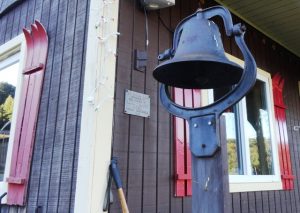
The ski school bell rang when it was time for lessons. Credit: Harriet Wallis.

If it rained we put on garbage bags and did “worm turns” rolling on the soggy snow. One rainy day when no one was riding the T-bar, a group of us slalomed the T-bar line. The Ts were moving targets coming up, and we skied around them going down. Naughty but fun.

Après ski was a food fest. Families brought crockpots and plugged them in on the deck letting dinner simmer while they skied. Oh the glorious smells! At the end of the day, everybody shared.

We skied there every Saturday and Sunday during the 1960s and early 70s when my kids were growing up.

There were family races—our first race experience with gates and awards. My daughter didn’t yet understand the race concept. She stopped to chat with each gate keeper.

The Blandford race team won many competitions even though they trained mostly on dry land because early season snow was too skimpy. The kids honed their muscles and reflexes by quick stepping through an array of tires and other dry land exercises.

The race coach also gave ski tuning demonstrations, a skill I continue to use today.

And he demonstrated ski binding release. He careened down the hill in Olympic form, carving hard lefts and hard rights. Then he would stop, lift each foot and shake his skis off! If you ski technically correct, your binding don’t have to be cranked down, he said.

The ski patrollers found ways to busy themselves as there were few accidents. One day, a patroller watched a youngster cut the chairlift line, slithering through the long line up to the very front. Just before the child got onto the chair, the watchful patroller sent him to the back of the line. The child never cut the line again.

One spring, the patrollers decided to tap the many maple trees and make syrup. Their first morning duty was to gather the makeshift syrup buckets — #10 size cans – and carry them to the patrol’s dispatch shack at the summit. There the dispatcher kept the golden liquid stirred on the pot belly stove. The patrol bottled the syrup and invited everyone for après ski “syrup on snow.”

Then there were parties. In summer, we enjoyed the camaraderie of work parties, pitching in to help with lodge and slope maintenance. That was always followed by a corn husking contest and a giant BBQ.

In winter, there were celebrations with a caldron of gluehwein simmering over a fire, torchlight parades with real torches, and then dinner and dancing. Kids danced. Adults danced. Everybody danced. Everybody danced with everybody.

Small ski areas are the heart and soul of skiing. It’s sad that this could be the end of iconic Blandford Ski Area that’s been in operation since 1936.

To read more from Harriet click here for her stories on SkiUtah.


Ski Industry Remembers: Scenes From 60 Years Ago

A Blizzard Of Memories From Ski Industry Association Video.

SnowSports Industries America (SIA) is the ski trade association of suppliers to consumers.  Think equipment manufacturers, clothing designers and providers, retailers, reps and media, everyone who gets the skier, boarder, X-Cer, backcountry adventurers and snowshoer out on the snow. SIA puts on global trade shows, publishes extraordinary research on market trends, advocates for the industry with government regulators and provides a platform for networking and  Founded in May, 1954 as the National Ski Equipment and Apparel Association, the organization is proudly celebrating its 60th year. Here’s a tribute SIA produced with scenes from the by-gone snow sports of the 50s and 60s to present day.  It’s an anniversary present from SIA to snow sport enthusiasts everywhere.


When Going Up Was Half The Fun

Early New England Tows We Still Miss.

Susan, second left, with her family in the late 50s.  Note chic attire.  Dad has spats; Susan's in a loden coat and white jeans.

Susan, second left, with her family in the late 50s. Note chic attire. Dad has spats; Susan’s in a loden coat and white jeans.

I’ve been skiing for 65 years, grown and raised in Concord MA.  I made my first turns on Punkatasset Hill, a no-lift neighborhood ski hill. That’s where I side-stepped to the top to pack the snow before picking my way down through the labyrinth of slalom poles my dad had set for me and many other local kids.  In the late 1920s, the Norwegian National Team used the jump at the short, steep hill for practice.

When I was seven or eight, Dad took me to Suicide Six in Woodstock, VT, where going up meant tackling a big, ferocious rope tow. Standing in line, I prayed that no one tall would step in behind me; I hoped that the person in front would hold on tight, lift the rope off the snow and stay in the track. Garnering all my courage, I’d try to grab the rope quickly, one hand in front and the other wrapped behind my back – ski poles dangling from each wrist. When I first caught hold of the tow, clutching hard with my leading hand, my arm felt as if it had been jerked out of its socket. If no one was in front of me, I was dragged along the snow, squatting in order to keep my body over my skis. If, as I had

Rope Tow at Woodstock, VT. Credit: New England Ski Museum

Rope Tow at Woodstock, VT. Credit: New England Ski Museum

dreaded, a taller person loaded on the tow behind me, I was lifted off the track into the air, hanging from the rope all the way to the top. When a skier in front lifted the weight of the monstrous rope for me, I was happy until that person unloaded and dropped the rope to ski off, leaving me again dragging along the track, hands soaking in my leather mittens and determined to make it to the top.

But the worst menace of all were the teenage boys. I quivered when one of them was up front for I knew what they did for fun. When dismounting, those boys deliberately snapped the tow as hard as they could, sending rippling waves of rope down the track. Yanked up and down, I was soon dislodged. Skiing down the hill covered in snow and disgrace, I slid to the bottom to get in line and start the ascent all over again.

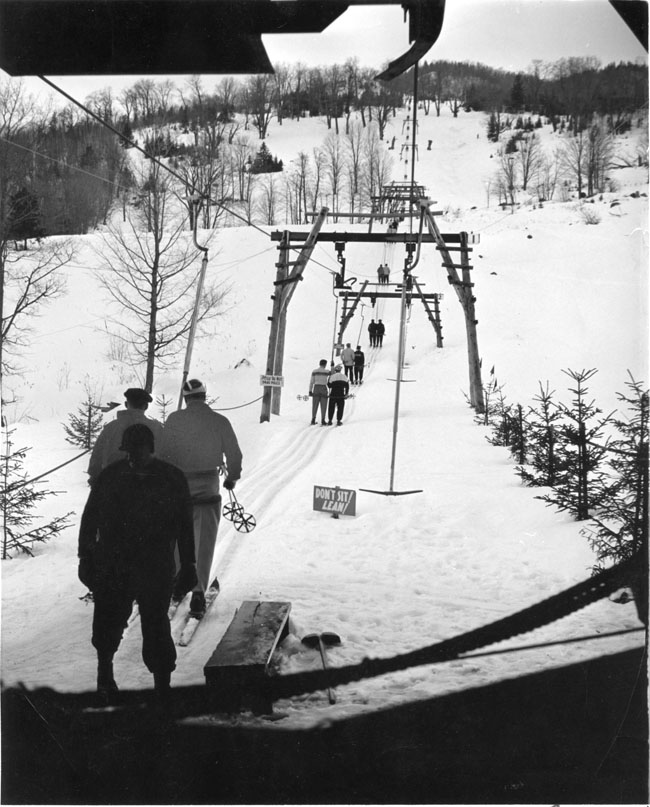
I miss the old T-bar which took me to the top of Cannon Mountain in Franconia, NH. It was magically quiet gliding up through the hoar-frosted evergreens with the sun shimmering off the clear ice which encased the very tops of the

T-Bar at Black Mountain, NH.  Credit: New England Ski Museum

T-Bar at Black Mountain, NH.
Credit: New England Ski Museum

trees. Of course, it was uncomfortable when my side of the T-bar was in the middle of my back with my father riding beside me, struggling to help me, leaning down to hold his side of the bar behind his knees. What a relief when I was old enough to ride the lift with kids my own height or go up on my own holding the T-bar out in front of me, making “S turns” in and out of the track. I danced the whole way to the top.

And then there was Burke, in the “Northeast Kingdom” of Vermont that had a Poma lift running from the bottom to the very top of the Mountain. Here, I bumped off the growing mounds of snow which got larger with every run until I catapulted right to the top of the spring, hurled high into the air – boing, boing, boing.  Going up was half the fun.

For more about Suicide Six’s 75th Anniversary.

For more about Gunstock’s old Rope Tow, another favorite.


Susan Winthrop is a long-time skier with memories of the sport extending back more than seven decades.  A contributor to SeniorsSkiing.com, she currently lives in Ipswich, MA, enthusiastically skiing in and around New England whenever she can.

Suicide Six also had a Poma lift Credit: New England Ski Museum

Suicide Six also had a Poma lift
Credit: New England Ski Museum


Special Thanks to the New England Ski Museum, Franconia, NH.