Tag Archive for: Tamsin Venn

This Issue: March 18, 2022

In Short Swings!, Jon pairs French philosopher Simone de Beauvoir’s thoughts about aging with giving the finger to some disrespectful kids at Park City.

Skiing Weatherman, Herb Stevens, previews what to expect in ski country over the coming weeks.

Wendy Clinch of TheSkiDiva discusses what the women on her forum are saying about the state of on-hill safety.

Tamsin Venn profiles Deer Valley and the pleasures it delivers for senior skiers.

You probably didn’t know about Alta’s role in the development of a national approach to ski-teaching. Alan Engen, who headed Alta’s Ski School, shares that important chapter in American skiing history.

Jonathan Wiesel, President, Nordic Group International, encourages readers to propose that local golf courses start cross-country ski operations. He establishes a strong case and provides information resources to help make the pitch.

Finally, Mike Roth illustrates a verrrry long fall he took years ago in the French Alps; Test Your Skiing Knowledge poses a new puzzler and announces the winner of the last one, and LUV2SKI presents a few new reader-submitted license plates for your pleasure.

Enjoy the issue. The entire site, including our archive of more than 1,700 articles is accessible at any time. The next editorial package will be distributed Friday, April 1.

Make lots of happy turns, and, remember, Senior Skiers Rock!

Email jon@senorsskiing.com to request the new Senior Skiers ROCK! helmet sticker.


Sunday River

Look Back: Sunday River

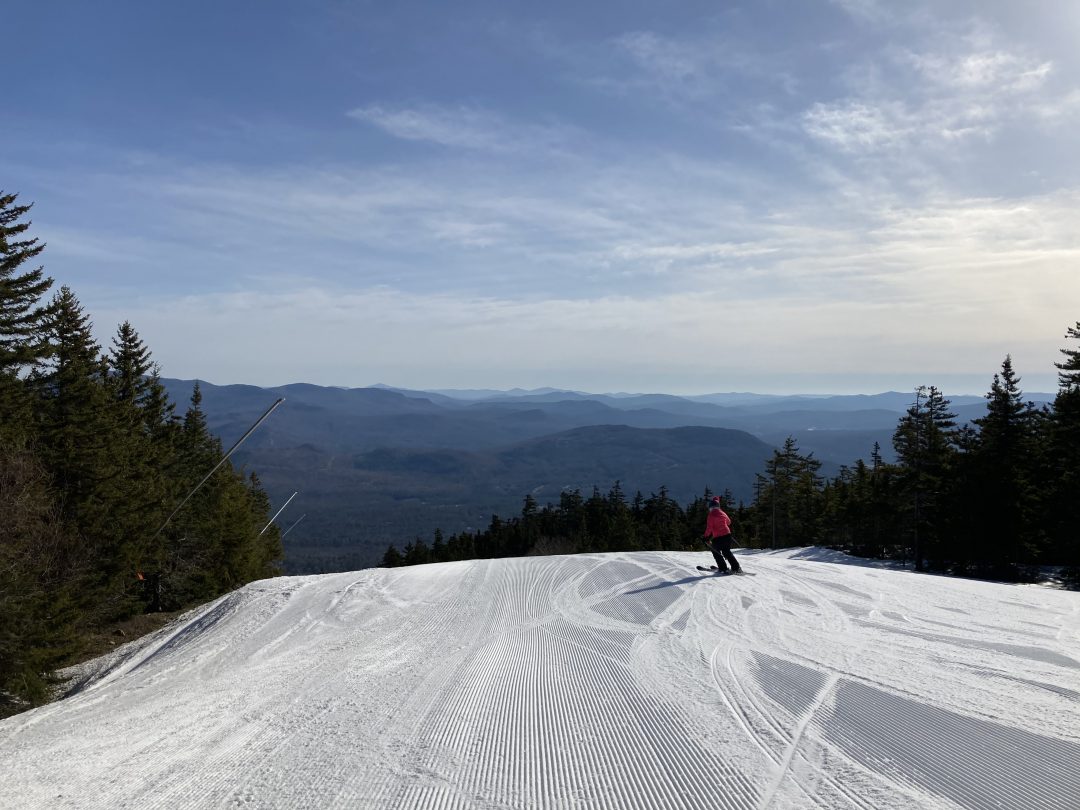
Smooth sailing on Risky Business. Photo by Tamsin Venn.

For the record, early morning skiing was just the best at Sunday River, Maine.

We skied this reliable, late-season spot over Easter weekend with two gorgeous sunny days, happy the travel restrictions into Maine had eased for us at last. Better late than never.

Everyone wore masks. Photo by Tamsin Venn.

Count SR’s season-long commitment to snowmaking (90 percent coverage) as the insurance that makes the late season possible, especially with paltry late-season snowfall. Also, a three-mile-long ridge of eight peaks gives skiers and boarders varied snow conditions at different exposures. You can always find something holding up well. Big vert lets you stay on upper slopes in afternoon to avoid lower-elevation slush. Good grooming helps put things right the next day in New England’s freeze and thaw cycle: 8 a.m. crispy corduroy.

All good.

The crowds were the biggest challenge. At the popular Barker Chair, social distancing was a little ragged, but everyone was wearing masks. People in the lift line were polite, waiting their turn, and no grumbling heard for riding alone. Slopes were busy, but most people knew what they were doing, including the rug rats, probably mostly passholders. (Note to senior self – the later in the season, the safer you are.) The one exception was the young, helmetless dude on the snowboard straight-lining White Heat.

There were a few surprises. We agreed to meet for Easter lunch at the sunny deck at North Peak Lodge, but only the bar was open. So we drank instead and ate chocolate bunnies. One closed trail we wanted to ski suddenly opened. The top of White Heat is nothing but a granite ledge with snow on top of it (you don’t realize that mid-winter). The schlep across a dry parking lot is not so bad.

I checked in with the millennials with me on what they liked at Sunday River and what they hope will be carried over into next year.

On the way over to the next peak. Photo by Tamsin Venn

Increased RFID use and access? Already there. Food trucks? Already had them. Outdoor dining? Great, unless it’s a blizzard. They can’t wait to get back to booting up in the lodge and more places to eat. They plan to renew their Ikon passes.

As for changes going forward, Sunday River says while plans for next year aren’t finalized, it will likely continue to encourage online advanced ticket sales, offer online food ordering at certain eateries, and hopes to expand takeout options.

Kelly Pawlak, President of the National Ski Areas Assn., noted successes that will likely be carried over into next year at most ski areas. Those include advanced ticket sales (ski areas like to know how many skiers will show up); reconfigured indoor spaces that open up space within lodges; increased use of ticket kiosks; outdoor living fixtures like fire pits, chairs, food trucks, outside food windows; and for employees, daily wellness checks, staying home if sick, plus sick pay for seasonal workers.

Summary of the 20-21 ski season? Like many, with the skis now hung up, I was very grateful there was one to begin with, and Sunday River made for a very rewarding finale.

Spring Comes to Wildcat

Long And Winding Runs. Great Views.

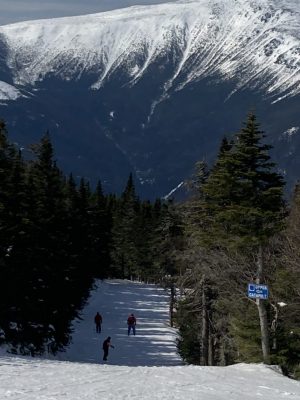
Getting ready for spring skiing at Tuckerman. Credit: Tamsin Venn

It was serendipity to arrive at Wildcat in the northern Presidential Mountains of New Hampshire the first week in March and find spring skiing. Many of us missed that part of the ski season last year in the pandemic shut-downs.

Due to its north facing slopes and deep snowpack, Wildcat usually is the last ski area to close in New Hampshire. This year it’s April 18.

While there, temps shot up to 66 degrees. Wildcat is not always so hospitable. It sits across the street from weather magnet Mt. Washington, tallest peak in the Northeast at 6,288 feet, and highest recorded wind speed 231 mph.

Away we go down Upper Catapult. Credit: Tamsin Venn

This year we were on the lookout for non-crowded midweek slopes, a friendly local atmosphere, and no state travel restrictions for us. Wildcat fit the bill.

The L-shaped parking area minimizes the schlep to the main lodge. Boot up from your tail gate, tiptoe across the icy parking lot, hike past four new, neon-colored porta-potties, get your RFID card zapped, and hop onto the Wildcat Express Quad. Seven minutes later, in one of the swiftest trips in skidom, you have reached the summit.

For several hours I lapped the Express Quad, zipping up-down-up, alternating from the left to the right flank on long, winding trails of 2,100 vertical feet. The trails draw you down as the head and shoulders of Mt. Washington rise. It’s like being in a movie… with good lighting.

Snow was corn, sweet, smooth. My left-foot steering was working as well as my right, always a good sign. Around 11, soft conditions required maneuvering into skied-off slots to save on thigh burn. Clearly early-morning skiing is best for spring skiing, even at a north facing mountain. But when I left early afternoonish, the parking lot was jammed. Spring fever had hit.

Although it has a reputation as an expert’s mountain, Wildcat has beginner terrain (20 percent)—Pole Cat is a 2.5 mile beginner trail, longest in New Hampshire—(see video article in this issue)— intermediate terrain (47 percent)—Lynx is a sweet roller with fun intermediate pitches—and expert terrain (33 percent)— famed black bump runs under the lift line. Midweek, you’ve got your turns to yourself and stress-free trail junctions.

The “cans” are display only. Credit: Tamsin Venn

Looking across to the top of Mt. Washington and thinking of spring skiing Tuckerman Ravine, you will always be grateful for the Express Quad that whips you to the area top at 4,028 feet. No hiking required. On wind holds, the Tomcat Triple gives you the bottom three-quarters.

When Vail Resorts bought Wildcat two years ago to add to its Epic mix, it took many by surprise. Wildcat is loved for its no-frills amenities and boot-scarred lodge, not exactly a Vail kind of place.

But a modern mega-resort corporation can’t erase the memories. My neighbor asked me:

“Does Wildcat still have those cold gondolas? When skiing there circa 1950s, the cable jammed [and] we near froze in the can in the hour it took to get them moving.  When people did emerge at the top, all the men ran for the bushes!  Anyway, it was exciting to ski there.”

It still is.


Click here for Wildcat Trail Map

Click Here for Wildcat Tickets

Click Here for Uphill Access

Click Here for Mountain Cams


Loon Mountain Resort Update

Lodges Closed. Back To Basics.

[Please consider supporting SeniorsSkiing.com with a donation. We appreciate your help. Click here.]

Sunny day at Tote Road Quad.

Kudos to Loon Mountain Resort, N.H., for managing COVID restrictions so well.

Our family bubble all agreed the best thing Loon had done was shut down all the lodges to indoor food service. That simplified one’s strategizing. Grab ‘n Go food windows and indoor order options provided al fresco sustenance with outdoor seating. Canvas tents were pop-up dining halls. Quick stop locations on the mountain provided places to duck in with little ones to get out of the wind. Space heaters are placed in certain areas when weather permits. Rest rooms were available at all lodges even if closed (outdoor access) and one fancy trailer near the gondola.

We parked our rolling base lodge in the Main Lot with an easy-ish schlep to either the Gondola or Kancamagus Express Quad, booted and masked up. Lunch break was pleasant with hot soup, the heater run sparingly, and radio dial set to NH public radio. Loon does not allow open-fire grills in the parking lot.

Contactless pickup boxes, PUBs, are where you can pick up a RFID card bought online or scan a QR code to reload. Ikon pass holders need to reserve, but because of popularity can cancel, even day of (blizzard anyone?).

Ghost lines leave plenty of room. Credit: Tamsin Venn

Loon set up intervening ghost lift lines for social distancing (a few jerks zoomed down these). One employee did mask patrol. A lift attendant kept necessary order. Social distancing worked less well in the gondola line without the natural six-foot ski separation. Plexiglass barriers inside the gondola building separated the snaking queue. Some in our pod refused to ride the gondola. Nowhere was there pushback on riding a lift alone.


PUBs replace ticket windows.

Masks are required in the parking lot, lift lines, when loading and unloading. This routine broke down in the parking lots.

Nearby Plymouth State College is on a hybrid schedule so you get many college skiers all the time, not just January break, which lends a convivial air. Everyone seemed grateful to be outside skiing and letting off steam.

We deferred our Ikon passes because of New England travel restrictions. Loon is the only New Hampshire Ikon resort. Massachusetts residents, as are we, are allowed into New Hampshire but have to ten-day quarantine or produce a negative COVID test on return.


Snowy day in the Lincoln Woods. Credit: Tamsin Venn

Loon’s senior 65-79 pass averages $65 midweek, non-holiday through mid-March, free passes for those ages 80 and up and as a courtesy you don’t need to reserve. (Bretton Woods senior midweek pass is $39, FYI).

On the last day, we went XC skiing in the popular Lincoln Woods owned by the U.S. Forest Service The snow had newly fallen, the woods quiet. You follow a trail on either the east or west side of the snow-clad Pemigewasset River with snowshoers and dog walkers. 

In all, the experience felt pared down. You got out of your car, went to lifts, skied and rode, went big-ish then went home. That is a good thing. What will we do with the many usual options when we return to normal? And the snow conditions were outstanding.

Loon Trail Map

Loon Web Cam 

Uphill Access Policy 

Tips To Better Smartphone Photos

Don’t Lug Your DSLR. Smartphones Can Do It.

It’s steeper than it looks. Credit: Tamsin Venn

Do you want to take better photos with your Smartphone? Transform your friends into Alpine or Nordic heroes?

Mark Phillips is a professional photographer.

Mark D. Phillips, a former AP photographer, is used to lugging around SLRs and long telephoto lenses for photographing ski racing. Increasingly, for sheer convenience, he uses an Smartphone to get good high quality shots. Here are some pros and cons of using the Smartphone and tips for how to take better photos, according to Phillips.

  • The Smartphone quality level is about half of your standard SLR so you sacrifice quality. But if you are doing photos mostly on the internet and sharing with friends and family, the clarity will be fine.
  • The phone works best as a wide angle lens. You can take that a step further and turn on the fun panorama feature. Use anchor points on either end to bring the image together.
  • One drawback is not having the use of a telephoto lens (true on the earlier models). Stay tuned for new phones which will have new zippy telephoto features.
  • To compensate for the Smartphone’s lack of depth of field, try to connect the elements of the photo: the skier with a line of trees or throw in a pop of color to give a sense of depth.
  • Use the rule of thirds. Put your subject in a third of the camera, and use the rest as a complement.
  • Mix up the camera angle. Hold the Smartphone down at your knees and get an interesting low shot. No need to bend way down or get on our knees.
  • Fill as much of the screen as you can.
  • The Smartphone has good light values for night photos, but again you are going to lose the depth of field. Use lines for composition to give more of a sense of depth.

Sugarloaf inversion taken by Smartphone. Credit: Tamsin Venn

  • Photoshop tools in the Smartphone rival any of the other tools available for playing with photos. Change the exposure, the highlights, lighten up the shadows and bring some details back into the blacks, or add warmth to take the blue out of the snow. Or, turn the photo into a moody black and white.
  • Most people email their photos to their computer, but if you have a lot you may want to use a cable. (If you turn on the “send to cloud” feature, they will show up on your computer.) Work with the largest file size you have, the more data you have when you resize the better the image.
  • Shoot video with the slow motion feature, then scroll through the images one shot at a time to find the best single action photo.
  • Finally, if you want to shoot your ski tips hanging over the top of Corbet’s Couloir at Jackson Hole, just accept that the Smartphone is going to erase the steepness factor. Then drop in.

Got any tips for taking better Smartphone photos? Share them in the Leave A Reply section below.

Moody day at Deer Valley has been edited with built-in editing tools. Credit: Tamsin Venn

Get Smart About Back Country Skiing

It’s Socially Distanced For Sure. And Could Be Dangerous.

If you go under the rope, you have to know what you are doing. Credit: Tamsin Venn

The number of skiers and split boarders heading into the backcountry is skyrocketing as we search for ways to avoid ski areas’ confusing restrictions on lift capacity and parking plus social distance. Sales of skis, boots, skins, probes, and shovels are up (137 percent in the past three years). Trailheads are packed.

Those in the search and rescue fields are understandably concerned about our—and their—well being.

In-person avalanche safety courses, the norm, are full with waiting lists. The good news is that there is a ton of great online free education content out there. That could be a good entry point for those of us wanting to give skinning and skiing a try, now that gear, clothing, and navigation technology have improved so much.

BRASS Foundation offers a 90-minute intro webinair from certified avalanche safety instructors. It includes a harrowing 13-minute video Off Piste about two up-and-coming U.S. Ski Team members Ronnie Berlack, 21, and Bryce Astle, 20, killed in an avalanche in Soelden, Austria, when caught in a massive slide in January 2015. Ronnie’s Dad Steve Berlack spearheaded BRASS to raise awareness about what he felt was a preventable accident with the right knowledge.

The Utah Avalanche Center created Know Before You Go (KBYG), a free hour-long online course with five simple modules: Get the Gear, Get the Training, Get the Forecast, and while out in the snow, Get the Picture, Get Out of Harm’s Way. UAC Director Mark Staples says once out there you are your own avalanche forecaster and first aid provider. “You gotta take the classes,” he says.

The legacy of heli-skiing operations in the Canadian Rockies has generated much online guidance. Matthew Smith, a Whistler ski patroller and flight paramedic, stresses four things to do to prep: Take an avalanche safety course. Take a wilderness first aid course for your specific activity from a professional with real-world paramedic experience. Learn technical knowledge such as weather and gear. Practice Leave No Trace.

Avalanche Canada posts weather and avalanche reports and offers a free intro online tutorial. AC is partially funded by federal funds. Prime minister Justin Trudeau’s younger brother Michel Trudeau died in an avalanche in 1998 in British Columbia.

Meanwhile, the Canadian Avalanche Assn. supports guides with professional training and info exchange but also offers recreational courses for non-guides.

Across the U.S., find help from two dozen regional avalanche forecast centers that provide “geo-targeted” reports on snow conditions through local authorities and U.S. Forest experts.

Recognizing the rise in backcountry sales, Nick Sargent, president and CEO of Snowsports Industries America (SIA) points out that SIA now provides a “one-stop shop” of resources for backcountry safety.

The American Avalanche Institute offers an avalanche fundamentals course (cost $30) covering all the basics.

Mark Smiley’s Mountain Sense has produced “A Comprehensive Guide to Avalanche Safety” (cost $249) available online. Smiley is a Certified Mountain Guide with the Swiss-based IFMGA (International Federation of Mountain Guides Associations).

“Take the risks but get the training,” sums up patroller Matt Smith.


Alpine Backcountry Touring Primer In Bolton Valley

Three Things to Do And Not To Do While Alpine Backcountry Touring.

Backcountry skiing is different, requires planning and gear. Credit: Bolton Valley

For those who have never tried Alpine Touring, Bolton Valley near Burlington, Vt., offers an intro to backcountry skiing every Saturday morning out of the spacious Sports Center near the main lifts.

That is due to a recent change in Bolton Valley ownership. Three years ago former owner Ralph DesLauriers, his son Evan, and local partners bought back the well-loved ski resort.

Alex describes the required gear. Credit: Tamsin Venn

An avid backcountry enthusiast, Ralph’s other son Adam developed a unique backcountry and split boarding program to fully enjoy the 1,200 acres of terrain here. Ralph’s daughter Lindsay who is president of the organization is another fan.

In Alpine Touring, you skin up the mountain with your heels free on lightweight, Alpine-like equipment then lock in and ski down. It’s called “earning your turns.”

We were lucky to have as our guide Medevac helicopter pilot Alek Jadkowski who was patient and clear with us newbies. Indoors we learned how to secure the toe, adjust the heel lifts for uphill climbing, then lock into downhill mode, and put on skins. We followed Alek uphill to nearby Holden’s Hollow Glades and soon were all whooping it up between the trees in thigh-deep snow having caught our fearless leader’s joyous enthusiasm.

Here are three things Alek recommends when starting out in this fast growing sport.

What Not To Do:

1) Don’t ski alone. It’s possible to injure yourself so you can’t even call for help; you need someone else to do that.

2) Don’t get lost. It doesn’t necessarily require a map or compass. You can use GPS or a map on your phone; how you keep track of your location is up to you. Carry a phone battery booster; take into account you may be out of cell service range.

3) Don’t drop your skins in the snow. They will lose their grip and with it your uphill power. Fold them carefully when removing them. Stash them in your pack.

What To Do:

1) Wear a helmet. Travel uphill with a lightweight beanie but downhill protect your head from possible tree contact. Wear goggles to protect your eyes from tree branches.

2) Know what weather to expect and dress for it. You get hot and sweaty climbing uphill and chilled when you stop to switch gear and ski down. Layer your clothing, carry a backpack so you can shed layers and put them back on. Slow your climb if overheating. Drink plenty of water.

3) Do have fun. Go and ski something you are going to enjoy; find the level that suits you; do something that makes you happy.

Where: Bolton Valley Resort and Mt. Mansfied State Forest. 100 km trail and glade network

Learn: Intro clinic every Saturday, (9:30 to noon). Cost $60 includes two hours of guided skiing but not rental gear. Private guiding and lessons also offered.

Fees: NBU (Nordic/Backcountry/Uphill) day pass $13 for seniors (65 plus). Senior Season pass $149; age 75 plus $79.

Gear: State-of-the-art rentals of Dynafit Alpine Touring ski equipment, $60 a day.

Gimme Shelter: BV has added a warming tent in its backcountry glades.

Getting ready to go Alpine Backcountry with friends. Credit: Tamsin Venn


Trapp Family Lodge: Some Favorite Nordic Things

[Editor Note: SeniorsSkiing.com is asking our readers to contribute to support our online magazine. Yes, we have grown in the number of subscribers and advertisers. But our expenses have also grown. You can help us defray some of these expenses by helping us out with a donation.]

Support SeniorsSkiing.com by clicking here.

______________________________________________________

A Ski Tour At The Legendary Resort Winds Up With Craft Beer.

Northern VT mountain-scape on the way to the Slayton Pasture Cabin. Credit: Tamsin Venn

One of our favorite things to do at the Trapp Family Lodge in Stowe, VT, is to ski up to Slayton Pasture Cabin, a three-mile steady climb.

The rewards are a screaming yippee-inducing downhill and a cozy cabin with a roaring fire, friendly fellow skiers, and hot chocolate, soup, and sandwiches.

The pasture is named after the farming family that once owned this hill-top acreage, a corner of the gorgeous 2,600 acres of rolling hills and meadows owned by the Trapp Family Lodge.

On a recent crisp mid-February day with new snowfall, nature presented a perfect Vermont day, sun shining through the trees, and impeccably groomed tracks. Every senior who likes to Nordic ski should do this trip.

Sam von Trapp, scion of the famous singing family, leads the tour up to Slayton Pasture Cabin. Credit: Tamsin Venn

Our guide was Sam von Trapp, son of Johannes, youngest of the singing family’s siblings. Sam exudes enthusiasm—for the trails, his family’s business, land, guests, Nordic guides, and epic ski races. He actually waited for us to catch up, then told entertaining stories while we caught our breath.

It was Johannes armed with a masters’ degree from the Yale Forestry School and, with the aide of a Norwegian XC director from Oslo who cut the lovely rolling loops through the woods and fields, created the first commercial Nordic center in the country in 1968.

We reached the cabin via Yerrick’s Yodel to the newly named Hissy Fit trail to Chris’ Run. The sign that marks the half way point to the cabin has been removed for motivational reasons. The official record time from the Outdoor Center to the cabin is 17 minutes 11 seconds, according to von Trapp.

On the way down, follow Haul Road, Chute Bypass, Triple Bypass, cross Luce Hill Road, to Luce Trail, to Lager Lane, and you have arrived. At the Bierhall!

Here the spacious setting offers Austrian fare for lunch and dinner. Dishes like the chicken schnitzel and the Johannesburger, made from the Trapps’ own grass-fed beef await. We sampled the new Berliner Weissbier “test batch,” just out of the brewery. It’s going to market later this month.

Sam and Johannes at the brewery. Beer and XC skiing make a natural combo. Credit: Tamsin Venn

Ever the visionary, Johannes started the brewery in 2010, when the craft beer movement was gaining froth. The goal was to brew crisp, clean craft lagers like the ones the family tasted on trips back to Austria. First opened in a retro-fitted bakery on the property, the brand new 36,000-square-foot brewery that you see today followed, so positive was the response.

A shuttle will take you back to the Outdoor Center. Just ask the host at the Bierhall to request the ride. If you still have some energy left snowshoe the red trail up to the Stone Chapel that Werner von Trapp built. Snowshoeing is increasingly popular here with dedicated trails, another favorite thing.

The facts: 100 km of XC, snowshoe, and backcountry trails on more than 2,500 acres. 36 miles are groomed,

Passes: Senior day $20. Senior Ski Season (65 plus) $185. Senior couples $300.

If you energy to spare, snow shoe over to the Stone Chapel, built by Werner von Trapp. Credit: Tamsin Venn


Deer Valley: Win-Win For Two Generations

Convincing Reasons Why Two Generations Love Deer Valley.

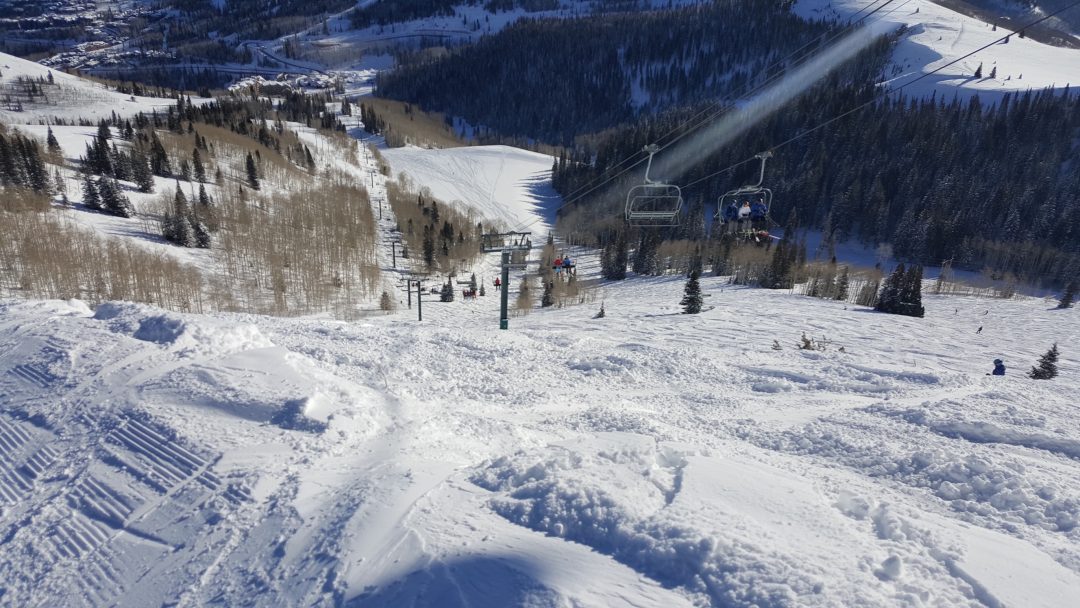
Blue skies, top of the world at Deer Valley. Credit: Tamsin Venn

We recently returned from our annual January family trip to Utah, with our 20-somethings joining us. Utah is currently experiencing record snowfall with more than 300 inches and more on the way. Aside from snow, here are reasons why two generations love Deer Valley, ranked consistently as one of the top ten resorts in the country.

  • Utah powder gets dried out and fluffed up on its way over from the Pacific Ocean, so it’s easy turning for both old and young knees.
  • Free valets greet you and put your skis in ski racks, more energy for powder skiing.
  • Free overnight boot and ski check, less schlepping, even more energy saved for skiing.
  • The number of feet you have to walk from a base lodge door to a lift might be written into the area’s mission statement. See previous energy statements.
  • Truly varied and sophisticated food, always with a few extra special ingredients for the piece de resistance, fosters lingering, providing rare commodity of uninterrupted family time. WiFi is available.
  • The Rossignol High Performance Test Center located next to the Empire Canyon Lodge gives you two hours of free ski trials, as many as you want. Match your boards to conditions and try out new Rossignol technology. Both old and young stretch comfort zones in moguls and powder.
  • At the posted trail maps, very upbeat, green-uniformed hosts tell “guests” where they are and where to go. You never have to be lost on the area’s six mountains, six bowls, and 2,000 acres

Young, really young, and seniors love the DV. Credit: Tamsin Venn

  • Stein’s Way, a black diamond off Bald Mountain’s right shoulder, overlooks Jordanelle Reservoir and is a popular first run groomer with the senior set. And the 20-year-olds, who will do a couple of warm-up runs on Stein’s then switch to the more gnarly Mayflower Bowl.
  • The less expensive IKON base pass gives you five days at DV, plenty of time to play out the equation between willing spirit but flagging body. If you still have vacay time, the IKON base pass lets you ski five days at Alta/Snowbird, five at Brighton and unlimited at Solitude. Blackout dates apply.
  • No snowboarders. Yup, even the 20-something-year-olds who ski with us do not like the sound of a thundering snowboarder coming up from behind. That rule does preclude skiing with some of our favorite people.
  • The sharing economy. Our AirBnB in Park City was roomy and tucked away, but just steps from a stop on the free town bus system. Millennials support public transportation.
  • Ski instructors are everywhere leading their charges, often in semi private lessons. Eavesdrop to pick up a few pointers on powder days.
  • Limited ticket sales —7,500 a day—ensure quick moving lift lines, enhanced by 21 chairlifts (12 are high speed detachable quads,) and one gondola.
  • A well protected, well staffed learning area with magic carpets helps make DV one of the best places for the little guys, generation 3 TK.

Why go anywhere else?

Lift Ticket Rates: Senior (65 plus) Daily Lift Ticket Rates start at $120 when prepaid online. Senior Season Pass: $1,236. IKON pass no longer available for 2019-20:  Check prices here. https://www.deervalley.com/plan-your-trip/tickets-and-passes

Find Out More: Click Here For the Deer Valley website

Trail Map: Click here

Web Cams: Click Here

So far this season, the snow has been abundant.
Credit: Tamsin Venn


Snowbasin Goes Epic

Uncrowded, Beautiful Views, Variety Of Terrain, No Hotels.

Most of the trails at Snowbasin wind up at the Needles Gondola. Credit: Tamsin Venn

Older skiers would really like Snowbasin outside Ogden, UT. You have nearly 3,000 acres in which to avoid other skiers and 3,000 vertical feet to get some rhythm going. A remotish location keeps lines short midweek. Lifts whisk you up to the top of six scenic, craggy peaks: two high-speed gondolas, three high-speed chairlifts. You can dine on really good food at a choice of three swank lodges, all glass and timber, wall-to-wall carpeting, stone fireplaces, and chandeliers. Locals think about skiing elsewhere, but why bother?

“You ski on a Tuesday here, even on the biggest powder day, and you’re looking for somebody to ride the lift with,” says new General Manager Davy Ratchford, quoted in Powder Magazine.

The layout is easy to follow. Most of the 106 tree-dotted trails end up at the base of the Needles Gondola. The mostly intermediate and expert trails include a fun variety: wide groomed boulevards, low angle chutes to dip into, hikes to cirques and chutes close to lifts, such as the popular Lone Tree. Typically the area gets 300 inches of snow a year.

Stop at the top to view four states: Utah, Wyoming, Colorado, Nevada. At the Strawberry Gondola, take the longest Elk Ridge trail at 3.5 miles. Flat light can be a problem up top on weather days, but low visibility markers lead you back to the base area.

Snowbasin hosted the downhill at the 2002 Olympics. You can hurl down the course if you like. Credit: Tamsin Venn

Snowbasin hosted the men’s and women’s downhill in the 2002 Olympics. Take the 15-passenger tram up to Allen Peak (9,465 feet), stare in awe over the precipice looking down at Ogden’s grid and Great Salt Lake. Then heart in throat, hurl yourself down The Grizzly, start of the men’s downhill. The less ambitious can take the tram back down to the newly widened and graded Mt. Ogden Bowl Road, a lower-angled return.

Snowbasin is not new. About 50 minutes north of Salt Lake City, it opened in 1939, and is one of the oldest continually operating ski resorts in the U.S. Utah native Earl Holding (of Sun Valley) bought it in 1984, made a large investment in lifts and snowmaking over the years, then pulled out all the stops for the 2002 Winter Olympics.

Snowbasin has no lodging. In nearby Huntsville, the newly opened Compass Rose Lodge, run by skiers Jeff and Bonnie Hyde has 15 bedrooms and its own observatory to take advantage of nearby North Fork dark-sky park. Grab a beer and burger at the No Name Saloon, oldest bar in Utah.

Or stay in Ogden, 30 minutes away, once a key stop on the transcontinental railroad. It has historic hotels like The Roosevelt, many ethnic restaurants, craft beer breweries like Roosters Brewing Company, and Social Axe where you can throw axes with your friends for fun. UTA public buses run up Ogden Canyon to Snowbasin and nearby Powder Mountain.

The Facts

Snowbasin has gone Epic. The 2019-20 Epic Pass provides seven days of skiing each at Snowbasin and Sun Valley, no blackout dates, and 50 percent off lift tickets once days are used.

Day pass senior at window (65-74) $89. 75 plus is $45. Midweek season pass (all ages) $439. 75 plus is $49. Snowbasin will close this year on April 21.

Click here for Snowbasin Trail Map.

Click here for Snowbasin Webcam.

Not too crowded big mountain skiing at Snowbasin. Credit: Tamsin Venn


Magic Mountain

SeniorsSkiing Guide: Magic–Where Skiing Has A Soul

Magic Mt. Has $29 Tickets On Thursdays!

Magic is right-sized for seniors and families.

We are zipping down Wizard, a 1.6-mile-long intermediate trail that hugs the West Side, in seven inches of new snow with lots of woohoos and yippees. At many areas, this trail would be flattened by now. Not so at Magic Mountain in South Londonderry, Vt.

Groomers will leave the snow to powder hounds until the weekend. They will, however, smooth trails out on the more easy going East Side to keep everyone happy.

Is Robert Frost hanging around Magic Mt? Credit: Tamsin Venn

Natural snow makes some of the East’s most interesting, fun, and challenging trails and glades all the more sweet. Add a trail mainly to yourself midweek, friendly locals, and reasonable prices – Throwback Thursdays lift tickets cost only $29 – and it’s like skiing back in the old days.

When Swiss instructor Hans Thorner started Magic in 1960, he picked Glebe Mountain for a reason: exciting, wooded terrain that reminded him of his home in the Alps. Back in the 60s and 70s, Magic Mountain had a huge following. Thorner sold it in 1985. After, the vagaries of skiers, investment, real estate, and weather meant customers drifted away because they could not count on it to be open,  and it has had its ups and downs since then.

President Geoff Hatheway and his band of 16 investors (Ski Magic) are changing all that. They have launched an ambitious five-year plan to make Magic appeal both to die-hard skiers, families, and the 18- 19– year-old set. The group is investing in snowmaking (now at 60 percent) and lifts. Notably they are putting in new lifts to provide mid-mountain skiing and more lift capacity to the summit.

Hatheway typifies the die-hard Magic loyalist. He skied here in 1998 and his kids went through the racing and free skiing programs. Like others he appreciated the family friendly alternative to nearby Stratton Mountain.

“Here’s what you won’t find at Magic, a high speed lift and trails groomed Soup to Nuts,” says Hatheway frankly.

Magic President Geoff Hatheway likes early runs on snowy days. Credit: Tamsin Venn

What you will most like find are other senior buddies either on the lift or in the Black Line Tavern, a popular locals’ watering hole. Throwback Thursdays extend to food and drink specials here, the bands are live, and no one is in a hurry.

Magic is open Thursday to Sunday, plus holidays, and on any day it snows 6 inches or more. It has a daily sales ticket limit of 1,500 to keep lift line wait times short and glades uncrowded.

Mountain Facts

Vertical Drop 1,500 feet

205 skiable acres

29 trails, 11 gladed runs

3 Chair Lifts, 3 Surface Lifts

Tickets

Seniors (70+) day $54; season pass $499

Buy online in advance and pay as little as $44.99

Throwback Thursdays $29 (except holidays and powder days of 6” or more) with purchase of Throwback Card ($149)

Magic Mountain Trail Map Click Here

Magic Mountain Webcam Click Here

There it is. An accessible mountain that has something for every senior. Credit: Magic Mt.

Coasting Most Of The Way

Senior Cyclists Love Gravity And Vice Versa.

Franconia Falls offer a cooling off spot. Bring your bathing suit! Credit: Tamsin Venn

Pedaling up and down hills on a mountain bike has its rewards, but we prefer trails that have an emphasis on the downhill. We suggest three great places in the White Mountains of New Hampshire at or near ski areas to do just that. Important: We use suspension mountain bikes that absorb the bouncing over roots and rocks.

The Lincoln Woods Trail off the Kancamagus Highway (Route 112) just west of Lincoln, N.H., is one good trip. You cross the suspension bridge over the East Branch of the Pemigewasset River and follow it on a gradual climb 2.8-mile bed of an old logging railroad (https://www.fs.usda.gov/recarea/whitemountain/recarea/?recid=74669). At the next bridge, you turn left up the trail to Franconia Falls, which is spectacular with a natural water slide. Go ahead, jump in and cool off. The return trip is a screaming downhill all the way back to the parking lot. You dodge some of the old ties and rails still visible. Total trip 6.5 miles up and back.

Another good coaster is The Franconia Notch Recreation Path (https://www.traillink.com/trail/franconia-notch-recreation-path/). The asphalt path runs the length of the Franconia Notch State Park, following the Pemigewasset River for nine miles, ending at the Flume Gorge, then merging onto Route 3 for the last five miles back into Lincoln. The first leg is a bit of a climb up to Cannon Mountain, then the path drops, tempting you to whiz down the hills after you’ve crawled your way up, but there is a 20 mph speed limit (!)

The path passes Echo Lake, the Cannon Mountain Aerial Tram, The Old Man of the Mountain Historic Site, where you can use a brilliant visual gizmo to recreate the old stone face above you (the Old Man tumbled down in 2003). You also pass Lafayette campground (ice cream anyone?), The Basin (icy water cool down?), and finally the Flume Gorge. Bring a lock for your bikes. This trip is eminently doable thanks to Rodgers Ski & Sport (http://rodgersskiandsport.com/) which will shuttle you from its store in Lincoln to the path’s start for $10 a person.

Remember the Old Man? Here’s a unique tool to bring him back, sort of. Credit: Tamsin Venn

Next day, we zipped south to Waterville Valley Resort via I-93. The extensive well-maintained cross-country ski trail system is a blast for biking. You cut through the woods and explore a variety of trails for all abilities through the National Forest. Everything from meandering dirt fire roads to gnarly single-track is available, plus lift access to biking trails on Snow’s Mountain, the first ski trails in Waterville Valley. (http://www.waterville.com/adventure-center/).

Our favorite run is to take the Snow’s Mountain Chair ($9 single ride and $21 all day pass) and zoom down the wide Livermore Road back into town, crossing babbling brooks and wood bridges, in an Eden-like setting. We branch off onto Swan’s Way, a single track, which leads you back to the Town Center. More scenic is to follow the Connector past the Mad River. Then relax outside with live music and cold drinks, even if you didn’t necessarily break a sweat.

Trail junctures post YOU ARE HERE maps (a good printed map is also available), graded beginner, intermediate, expert in XC ratings, so you always know where you’re going.

Do you have a coasting trip you could recommend? We’re open to suggestions.

At the top of Snow Mountain Chair at Waterville Valley. Credit: Tamsin Venn.

There’s Silver In Them Thar Hills!

Park City: Visit Silver Mining Museum Sites On Skis.

California-Comstock mine shaft entrance
is on the tour. Credit: Tamsin Venn

Led by Utah’s Park City Mountain Resort guides, the new Silver to Slopes tour skis you to various relics of the mining history scattered throughout beautiful scenery. More than 1,000 miles of tunnels lie beneath the slopes here.

We ride up the McConkey Express with our amiable guide Jim Brown. He notes the tunnels buried beneath the lift once served to drain water from mining operations. Yikes.

“There are some things that can go wrong when you are skiing Park City, Utah, but falling down a mine shaft is not one of them,” says Jim reassuringly. (They are all capped. EPA tests the tailings every summer.)

Brown, an effortless skier and keen historian, has brought along a briefcase of old photos to further illustrate the tour. He is one of those transplants (from Florida) who skied Park City on vacay and never left. Ditto our sweep, Debrinne Ferguson from Los Gatos, Calif.,

In 1963, United Park City Mines, the last active operation in Park City, opened Treasure Mountain Resort on the 3,700 acres it owned. Relying on mining engineering know-how, it put up J-bars, a gondola, and even a Skier’s Subway. The segue from silver mining to ski mecca is evident all around you.

First stop is the Silver King Mine’s Head Frame Building, at the base of the Bonanza Express, closed in only 1953. Miners started digging the 1,450-foot-deep shaft in 1890. The only female mine owner, socialite Susanna Bransford, alias the Silver Queen, made her fortune here. You can ski her nearby namesake trail.

Next stop the King Con Mine Ore Bin sitting to one side of Claimjumper. The Silver King Consolidated Mine, not to be confused with Silver King Mine, built the 1,800-foot deep Bogan Shaft here. The nearby King Con lift serves an intermediate’s paradise and is named for the mining company, not the giant gorilla, as many think.

We ride the Silverlode Express past the Quicksilver Gondola, which has linked Park City to The Canyons as part of Vail Resort’s recent $57 million upgrade. At the new Miner’s Camp restaurant here, The Pickaxe Pub displays authentic ore picks, in keeping with the general theme.

Next we ride McConkey’s Express to access the Georgeanna trail that follows the ridge past one of the best views on the mountain: Mt. Timpanogos (11,753 feet), Heber Valley, the town of Park City, the Uinta Mountains, and the top of Deer Valley’s Lady Morgan chairlift.

Mid-Mountain Lodge was once a boarding house for miners (1897) and relocated from the bottom of the mountain to save it from demolition.
Credit: Tamsin Venn

We stop at Mid Mountain Lodge, once a boarding house for Silver King miners (1897), next used by the U.S. Ski Team (1973-75), now a popular lunch spot. Scheduled for demolition, a group of locals had it hauled up the mountain to this spot in 1987. Hurray for recycling.

At the bottom of Thaynes lift is the famous California-Comstock Mine and 1,700 feet below via the Thaynes Shaft is the West End Tunnel where skiers used to ride the Skier Subway to access the Thaynes lift in the early days of Treasure Mountain. The ride took about 25 minutes. Most skiers did it once for the novelty, once for the kids, and that was it, notes Brown. Here’s a video of what has to have been the most unusual lift in ski country.

https://www.youtube.com/watch?v=K1aUSYfvehE

The two-hour tour takes place on intermediate trails and departs daily from the Eagle statue in Park City Mountain Village at 10 a.m. and from the Bonanza Summit trail map at 1 p.m. Just show up. The tour also helps you get oriented at this mega resort. Donate to preservation efforts at  Friends of Ski Mining History.

For more information, ParkCityMountain.com

The Pickaxe Pub with display of vintage tools is a good place to wrap up the tour.
Credit: Tamsin Venn


Becoming A Ski Instructor At An Advanced Age

Consider A Second Career For Fun, Fitness, Fulfillment.

Mick O’Gara, PSIA Alpine Examiner Emeritus, leads the crew, at Waterville Valley, NH. Credit: Tamsin Venn

Many SeniorsSkiing.com readers are seriously committed to skiing, and many have the experience, time and skills to actually teach skiing.

Here are ten good reasons you should consider working as a ski instructor.

  1. Plenty of other advanced age ski instructors are doing the same thing. You are in good company.
  2. You are needed, especially on weekends and over vacation weeks, February in particular. It’s often all-instructors-on-slope at these times. In down times, which can be frustrating, free skiing with like-minded instructors is a great chance to have fun and parse technique on the lift.
  3. Contagious youthful energy. We old folks get to mix with high school students who have skied at the area since they were Mitey-Mites, those taking a winter off from college or to reset career priorities, and foreign students here for a winter in the U.S.

    How many silly ski instructors does it take to change a ski’s load capacity?
    Credit: Tamsin Venn

  4. Camaraderie. You will find your fellow instructors are a great group of folks, supportive, funny, professional, many life long skiers, who love skiing and are dedicated to teaching.
  5. Training. Ski areas provide on-snow instruction for newbies so no need to fear you’ll be sent out to cluelessly teach beginners. Trainers offer regular clinics throughout the season for newbies and veterans alike. You are encouraged to go through PSIA-AASI (Professional Ski Instructors of America/American Assn. of Snowboard Instructors) certifications, and resort trainers offer instruction for that as well.
  6. PSIA is a great organization to join with many clinics and division events throughout the season. It offers Level I, II, and III certifications not only in Alpine and Snowboard teaching, but in Adaptive, Adaptive Snowboard, Cross Country, and Telemark. Level III is very challenging. If you meet an instructor and he or she says Level III, give them cuts in line. PSIA is good for goal setting. You have access to a slew of great trainers, examiners, plus educational material, manuals for teaching different levels of skiers, videos, newsletters, and magazines. You also receive pro discounts of 40 percent or more from major ski gear companies. (You can never have enough Patagonia Nano Puff jackets.)
  7. Perks? Parties. Plus season pass. Locker, so you don’t have to schlep your gear to the mountain every day. Uniform, probably cooler than your own ski jacket. Discounts on gear and burgers. Free skiing at other mountains with letter of intro from your ski school director.
  8. One of the best bosses you may have ever had (at least, that was true in my case).
  9. Incredible sense of accomplishment when a lesson goes well.
  10. It’s easy to get started. Go to jobs page at a ski area that interests you—or more importantly where you have a place to stay—and follow instructions for hiring. Good luck.

    Tamsin says: “I wish I could still do this.” Not required for instructor certification though.
    Credit: Tamsin Venn


Kayak Angling: A New Sport To Consider

Summer Is The Time To Try On A New Sport.

WhyKnotFishing guide Joe Gugino teaches how to kayak and fish in Marblehead Harbor.
Credit: Tamsin Venn

As a publisher of a sea kayaking magazine in the off season, I have witnessed the huge growth in the popularity of kayak fishing. It has been an opportunity for avid fisher people to get into the sport without the expense of a motorboat and launching and mooring fees, plus a chance to slide into some spots where only the kayak can go.

Fishing here in New England is big when the stripers move in around May and June. So in late May, I head over to the Little Harbor Boathouse in Marblehead, MA, to take part in a Guided Hobie Kayak Fishing Excursion. It would be a three-hour fishing program with use of a Hobie Kayak, fishing gear, and know-how from three very friendly and experienced guides: Jesse Minoski, Joe Gugino, and Mike Marquis. Perfect for a beginner like me. My first lesson was actually how to cast a line. Fortunately, my teacher Joe Gugino is a former fourth grade teacher. And even more fortunately, I was already used to a kayak wobble in unsteady seas so I felt secure in my balance with my hands free to fish. For skiers, that sense of balance comes naturally in a kayak, since we are so used to weight shifts.

The rocky shoreline around Marblehead is ideal striped bass territory, Hobie Team member Minoski says, and the Little Harbor Boathouse’s “hidden gem” location means you don’t have to go more than a half mile from the launch to fish and duck out of the wind behind Crowninshield and Gerry’s Islands.

Maryellen Auger, owner of Little Harbor Boathouse, has a Hobie Revolution 11 waiting for me. It’s an ideal boat size for women, she notes. Sleek and lively, the Revolution uses a pedal system to propel forward (a paddle is attached by bungee chord on the side if you need it). She points out the pedal system can be ideal for older people who may have developed shoulder issues over the years.

The kayak comes in three lengths, 11, 13 and 16 feet, increasing in speed with the hull length. A molded-in rod holder, multiple hatches, lots of on-deck storage, and a “hyper adjustable” Vantage CT seat with webbing, that is so comfortable you could sit out there all day and cast a line, are some of the pluses.

I “power-pedal” my way out through Little Harbor behind Crowninshield and catch up with six eager clients and three helpful guides.

I’m not so lucky in catching a fish, but I can tell you how wonderful it is to sit out on the ocean in a comfy seat on a fresh spring day, casting a line, enjoying the beautiful surroundings, camaraderie, and communing with a species that obviously knows the most of any of us about the water dynamics below. All and all, I had a very good time and highly recommend it, especially for someone new to kayak angling.

For more info, www.littleharborboathouse.com

For ongoing fishing guiding service on Boston’s North Shore—the blue fish come out in July—with 2017 Hobie Fishing Team Members Joe Gugino and Jesse Minoski: www.whyknotfishing.com

In the off season, Tamsin Venn publishes Atlantic Coastal Kayaker Magazine. www.atlanticcoastalkayaker.com

SeniorsSkiing Guide: Burke Mtn, VT—Basic And Friendly

A Swanky New Hotel On The Mountain Is A Magnet For Those Who Love The Basics.

New hotel offers ski-out access to uncrowded trails.
Credit: Burke Mountain

“Burke is what skiing used to be. It’s back to the basics. We’re just happy here,” says Barb Mader who with husband, Don, ski 80 days a year at this laid-back mountain high in the Northeast Kingdom of Vermont. They stretch the season at Jay Peak, a 45-minute drive to the north.

Barb and Don Mader ski Burke 80 days a season. Barb came back to skiing after a 33 year hiatus.
Credit: Tamsin Venn

Burke Mountain is a place, she notes, where skier etiquette prevails, trails are uncrowded, the ski patrol is laid back, the views are inspirational, everyone is friendly and congregates après-ski at Mid Burke for live music. It’s a place where her three grandchildren learned to ski in the Explorers Program and, “All are great skiers now,” says Barb.

Groomed intermediate cruisers like Willoughby and Dipper are popular as is the winding Deer Run, and the rolling East Bowl. Power Line and The Ledges provide expert skiing, Sherburne Express beginner terrain. Plus Burke has some of the best glade skiing in Vermont—with wide spacing on Caveman and Marshland.

Unfortunately, Burke Mountain has had a rocky few years. The resort, until recently called QBurke, for owner Ariel Quiros, is now under federal receivership. An encouraging step, the managers opened the swanky, on-mountain 116-room Burke Hotel and Conference Center last September. It welcomed the first skiers this winter. It’s a real gem, with easy in and out access, nice units overlooking the slopes or the scenic Willoughby gap, an outdoor heated pool and hot tub, locker room, a ski tuning room for the young racers, and four eateries including the popular Bear Den. Burke’s loyalists hope the resort will find a new owner soon.

Barb Mader, 73, started skiing in the late 1960s, joining the racing Eastern Veterans league. She raced at different areas, lured by the $8 race fee plus a rest-of-day lift ticket. She competed in the famous Burke Mountain Stampede, with a group start of eight to ten racers taking off down Deer Run, onto Dipper, and straight down to Mid Lodge, trying to just to stay in the game, and “getting annihilated” by the Burke Mountain Academy kids. A great party followed at Mid Lodge.

Barb stopped skiing in the 1970s and started again in 2003, despite one replaced shoulder. A year later she and Don, 78, bought a condo at Burke, in one of the mountain’s financial downturns, demonstrating it is never too late to take up an old sport again.

Recently, the Maders have enjoyed the offseason on what some call the best mountain biking network in the country. Kingdom Trails has more than 100 miles of trails, through the woods and across the pastures, by the good graces of more than 50 landowners and businesses.

Burke’s Nordic Center has access to many miles of Kingdom Trails.
Credit: Tamsin Venn

The Facts:

Lift tickets:

Senior (65 plus) $47

Silver Streakers (55 plus): $35 Tuesdays & Thursdays (non-holiday) Judge Pass (70 plus), season pass at Jay Peak and Burke: $279 (if bought by July), no blackout dates.

X-C: Burke Nordic Center, $15; ask about a senior rate.

Vertical: 2,011 feet

Average snowfall: 217 inches

Snowmaking: 70 percent

6 lifts

36 trails and 14 glades

178 skiable acres

Trail Map: Click here


BrettonWoods

SeniorsSkiing Guide: Easy Going At Bretton Woods

Seniors (65-79) Ski For $25 Mid-Week At This Classic NH Gem.

Majestic Mt. Washington is across the valley from Bretton Woods.
Credit: Bretton Woods

Down Cascade, up to Rosebrook Summit, down Upper Swoop, down Cascade, across to Diamond Ridge, down Deception Bowl, up the Bethlehem Express, down Big Ben, up Zephyr High Speed Quad, down Granny’s Grit.

The skiing at Bretton Woods, NH, was so smooth and our trips so fast, that you didn’t have time to think what joint might be aching that day. We were skiing with a group of 50-plusses and one 80-plus, all fabulous skiers with years of experience behind them. The grooming at Bretton Woods yields the best type of New England skiing with manicured slopes, wide open avenues, very hard pack with enough surface snow to grip. We blazed all over the mountain, happily racking up the vertical, on our apps or psyche. Most of the intermediate slopes were open and provided plenty of fun on Rosebrook and West Mountains.

Beautiful, broad skiing avenues make for nice cruising at Bretton Woods.
Credit: Bretton Woods

The overall experience here is a friendly mountain that’s fun to ski. There’s plenty of skiing available for an older person without putting too much pressure on hips and knees. For tree skiers, the glades are fairly open in keeping with the resort’s easy-going nature. In 2012, Bretton Woods added a T-Bar servicing Mount Stickney with 30 acres of more challenging glades. There is plenty of tough terrain on this hill once nick-named Medicare Mountain.

Four high-speed quads keep you going, and on crowded days the lift personnel keep the lines moving in a fair and congenial way.

What that allows you to do is just relax and rip. Plus all trails lead ultimately to the base lodge, minimizing separation anxiety from your ski companions.

Some say Bretton Woods, NH’s largest ski area, is more protected from the weather than other areas. You can always look across at storm clouds unfurling off Mt. Washington (the Northeast’s highest summit at 6,288 feet) and be happy that at least you’re not up there.

Across the street is the giant Omni Mt. Washington Hotel, like an ocean liner cruising across the White Mountains. Plan a visit, if only to stroll through the wide halls under 23-foot ceilings and take in the views of Mt. Washington from the Rosebrook Lounge sipping a cool Chardonnay.

To walk the hotel’s halls and verandas is to stroll through White Mountain history at its most hospitable. Built in 1902, the hotel most notably hosted the 1944 United National Monetary and Financial Conference to build the bones of a post-World War II economy. Walk into the room off the main lobby where the final treaty was signed.

Meanwhile, stretch your downhill muscles on the 62 miles of impeccably groomed X-C trails. They are also open to snowshoeing and fat tire bike riding.

Bottom Line

Seniors 80 years and up ski free any day, and those 65-79 ski for $25 midweek/non-holiday.

Hot Chocolate: $3

Wiser Woods Program

Open to skiers and riders age 50+. This is group ski program under the guidance of an instructor who will coach you down the mountain.  Includes morning refreshments at Slopeside, receive 10% off retail, 10% off demo equipment.

Runs Jan. 3-March 14, Tuesdays 9-12. Meet on Slopeside Level of Base Lodge. $125 per person for the season, $199 per couple.

Mountain Stats

Vertical Drop:  1,500 feet
Trails and Glades: 97
Skiable Acreage:  464
Snowmaking:  92% of Trails
Average Annual Snowfall:  200+ inches

Webcam click here

Trail Maps click here

Bretton Woods boasts a network of well-groomed Nordic trails.
Credit: Bretton Woods

The Ski Trains Return!

Car Free Means Care Free for Seniors.

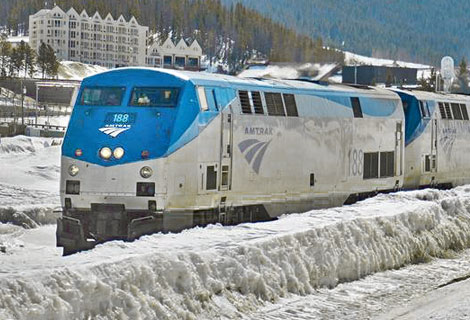
The newly Revived Winter Park Express. All Aboard! Credit: Amtrak

The newly revived Winter Park Express. All Aboard!
Credit: Amtrak

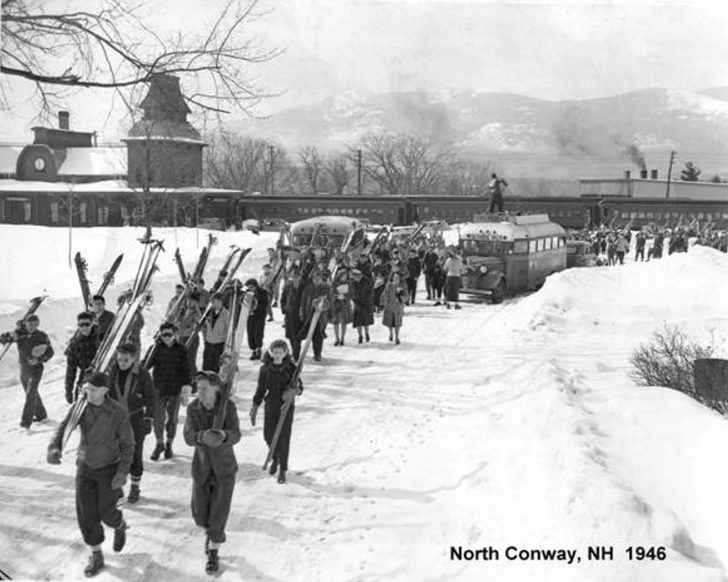
Remember ski trains? Back in the day, trains were the way to get away from the city and into the mountains.

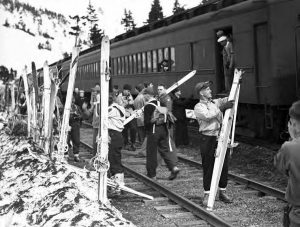
Skiers unloading in Grandview, circa 1946.

Skiers unloading in Grandview, circa 1946.

Denver skiers were thrilled last March when the ski train resumed service from Denver to Winter Park, CO, to help celebrate the ski area’s 75th birthday. Officials had ended the service in 2009 due to expense and liability. But regular weekend service resumes for the 2016-17 season Jan. 7. www.amtrak.com/winterparkexpress.

Adios to I-70 and the dreaded “red snake” down from the mountains, slick roads, zero visibility, death grip on the steering wheel, leaving you wondering whether it’s OK to use the runaway truck lane yourself.

Ski trains make a lot of sense for us seniors. Go ahead relax, get up and walk around, visit the dining car, arrive rested not rattled, and perhaps meet some fellow comrades to ski with. Then, on the way home, knock down a Mountain Stream Ale, no need to keep your wits about you. Plus, Amtrak offers seniors 62 years of age and older a 15 percent discount.

Here are some other “ski trains” to help you get right to the lifts car-free:

* Salt Lake City skiers have to be the most spoiled skiers in skidom with major resorts like Alta, Snowbird, and Park City a 45-minute drive from downtown via car or bus. But why not take the train? The UTA Front Runner rail service takes skiers from downtown Salt Lake’s North Temple Station to Ogden in less than an hour for skiing at Snowbasin or Powder Mountain. www.rideuta.com

* Lake Tahoe skiers and riders in California can ride the Polar Express that goes from Emeryville/San Francisco Amtrak station to Truckee in about five hours later to nearby Northstar. The scenic ride through the snow-swept Sierra Nevadas sure beats I-80 closures due to snow. No need to “seek an alternate route.” www.amtrak.com

* Leave your car at home and take the Downeaster to Portland, ME from Boston. From there a shuttle from the Bethel Inn Resort will meet you at the train station and whisk you off to Bethel and skiing at Sunday River.

* Wachusett Mountain in Princeton, Mass., encourages you to “Ski the T.” New this year Boston skiers and snowboarders can take the commuter rail (ski racks included) from Boston’s North Station to the new “Wachusett Station” only ten minutes from the mountain. On weekends, a ski shuttle will meet you there. www.wachusett.com.

* In the Adirondacks in upstate New York, the Gore Mountain Ski Train connects Saratoga Springs to North Creek and a free shuttle bus takes skiers from the North Creek Station to Gore Mountain’s Base Lodge Friday-Sunday. That service started a few years ago after a 50-year hiatus. Does anyone remember riding this train back then?

* Amtrak’s Vermonter hauls skiers and riders to Brattleboro where they can hop on the free local MOOver shuttles to the Mt. Snow base lodge or various local inns. It’s easy – just tell the driver where you need to go and the driver will be sure you connect with the right bus.

* Amtrak’s Ethan Allen Express takes car-free seniors from Penn Station to Rutland, VT. The Killington Express Shuttle will pick you up at the depot and take you your final half hour to Killington.

Riding the rails has a long tradition in skidom, and the appeal is still strong.

Thanks to www.liftopia.com for some of these route suggestions.

[Editor note:  Thanks to the Canadian Ski Instructor Alumni Association for passing long this “lost footage” of real ski trains from 1939. From the Governor Francis P. Murphy Estate.]

Ski train unloads in North Conway, NH, circa 1946. Credit: Dick Smith

Ski train unloads in North Conway, NH, circa 1946.
Credit: Dick Smith


This Week In SeniorsSkiing.com (July 8)

Murder Mystery, Departure Of A Legend, Cycling With A Legend, Kayaking The Legendary Maine Island Trail.

Svenwiik

Sven Wiik, cross-country pioneer, passed away this week at 95.

Hope you had a pleasant and safe Independence Day in the US, and a “nice” Canada Day, too.  This short week has us exploring some summer themes and remembering a departed skiing hero.

First, we’ve just discovered an old-fashioned murder mystery by Wendy Clinch, our friend The Ski Diva.  Double Black is all about murder in ski country, quirky characters and page-turning cliff-hangers.  What more could you ask for in summer reading?

We also pay respects to Sven Wiik, a legendary cross-country skiing pioneer who as one of the early promoters of the sport in North America.  He passed away this week in Steamboat Springs, CO, where his Scandinavian Lodge was a long-time presence on the mountain.  He was 95.

Tamsin Venn, the publisher of The Atlantic Coast Kayaker, offers a snapshot of the Maine Island Trail, a pathway through the off-shore and coastal islands that threads its way from Casco Bay to Eastport.  If you have any interest at all in kayaking, it is worth checking out.

The coast of Maine has hundreds of beautiful islands that can be visited by kayak. MITA can tell you where and how to do it. Credit: Tamsin Venn

The coast of Maine has hundreds of beautiful islands that can be visited by kayak. MITA can tell you where and how to do it.
Credit: Tamsin Venn

Finally, our Cycling Series continues with report from Pat McCloskey about riding with Scot Nicol, the founder of Ibis bikes and an early mountain bike pioneer.  We know many of our readers spend time on bikes over the summer.  Pat has been wonderful about pointing out some interesting rides around the country.  Stay tuned for more.

Promotive Discounts Are Still Available

Our recent poll (in the right side bar, scroll down if you can’t see it) asks about our Promotive discount.  We are surprised to see that only about 25 percent of our readers have taken advantage of this free discount opportunity.  When you subscribed to Seniorsskiing.com, you should have received some information about signing up.  You get access to big discounts from top-brands, gear and clothing.  Probably the easiest way to get Promotive instructions is to, gulp, unsubscribe and then sign up again. You will get information about registering on Promotive with your confirmation email. It’s free, folks.  Try that and see what happens.

Thanks so much for your continued interest in SeniorsSkiing.com.  Remember, there are more of us every day, and we aren’t going away.


SeniorsSkiing Guide: Fixed Income Skiing on a Liberated Schedule at Sunday River, ME

Big, Big Four-Season Resort In Maine Has Activity-Filled Social Scene For Seniors.

Terrain for everyone at Sunday River and lots of room for blue cruising. Credit: Sunday River

Terrain for everyone at Sunday River and lots of room for blue cruising, greening or double-black diamonds.
Credit: Sunday River

For seniors on a fixed income and liberated schedule, a top place to ski in the East is Sunday River, ME. That is for three main reasons. First, it is huge. When you look up from the South Ridge base lodge, you see wide slopes slung over rolling peaks, in every direction, a three-mile span from White Cap to Jordan Bowl Peaks.

Started in 1959 with one T-bar, Sunday River had a huge growth spurt when Les Otten bought the small family area and put his vision for expansion into high gear.

Today, that translates into 135 trails and glades and 15 lifts (five high speed), slung over eight interconnected peaks. That’s a lot of opportunity for seniors to select the “just right” terrain. Each peak has an easy way down. You can knock yourself out on the double black White Heat or stroll down the Three Mile Trail with Agony and Ecstasy in between.

Second, owner Boyne Resorts has done a great job modernizing lifts and focusing on snowmaking and grooming, keeping trails in good shape, even in low-snow years.
Finally, everyone who works here is very friendly, so you have nice people looking after you.

Bethel, a short drive from the mountain, is a classic New England village. Main Street has several shops and cozy restaurants. The rambling turn-of-the-century Bethel Inn Resort has a 35-km XC groomed trail network right on the edge of town. Nearby Carter’s XC Center has 55 km.

These guys meet every morning, ski, and hang out. The Prime Time Ski Club is Credit: Scott Andrews

These guys meet every morning, ski, and hang out.
The Prime Time Ski Club is informal and provides a lot of opportunities for socializing.
Credit: Scott Andrews

One great asset here for seniors is the 100+ member Prime Time Ski Club (motto “You’ll never ski alone!”) for those over 50. Meet up any weekday morning at North Peak Lodge 10-10:30, top of the Chondola (get there early before the cinnamon buns are gone!) and have a fun group of people to ski with. Break off into groups (no larger than eight) usually based on terrain, ability, and social interactions, and then ski!

Many members also gather in the Mahoosic room at South Ridge in the morning and lunch there around noon. Après ski activities include wine tastings, game night, potlucks or special restaurant dinners, trips to local mountains, and an annual western trip, plus off-season activities. New Members: $25. Renewal (pre-season): $15.

Many members ski midweek and take advantage of discounts offered at area restaurants. Check out Terri Messer’s weekly column on the club in the Bethel Citizen for what’s happening.

Bottom Line

Senior Pricing: Daily lift ticket, 65 and older, $59; $53 online advance purchase.

Senior (65-79) season passes (includes Sunday River, Sugarloaf, and Loon): New England Gold Pass: $869 (Super Senior, 80-plus: $30); Silver Pass (13 blackout dates) $705; Bronze Pass (midweek non-holiday, all ages) $529 .

GO50 Week: Mid-January with lift ticket and lodging deals for five nights, a clinic, après-ski social events, and a Sock Hop.  Kudos to Sunday River for celebrating its 50-plus skiers with a full week of fun events including a “Retro Race” on vintage equipment.

Bethel Nordic Center at the Bethel Inn Resort: All Day Trail Pass: Seniors (63 plus): $16; half day, $13. Season Pass (63 plus): $125. Ask about the daily ski-swim-sauna package at the inn’s Health Club.

Trail Map Click Here


SeniorsSkiing Guide: Trapp Family Lodge Nordic Skiing Has Trails for Seniors

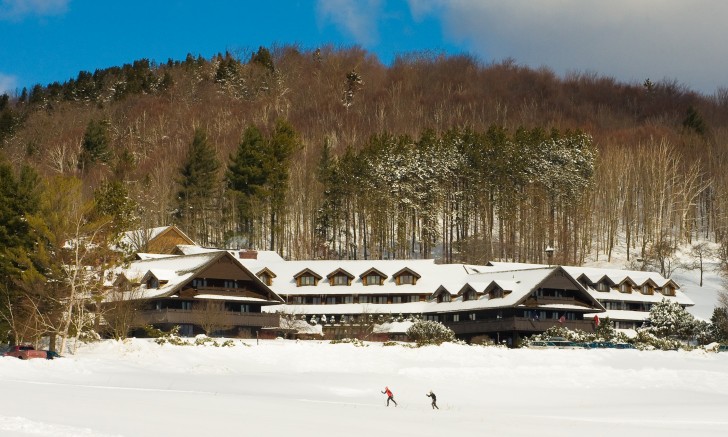
The Trapp Family Lodge is a one of a few of our favorite things. Credit: Trapp Family Lodge

The Trapp Family Lodge, near Stowe, VT,  is a one of a few of our favorite things.
Credit: Trapp Family Lodge

The Hills Are Alive With The Sound Of Senior Skiers.

In 1968 Johannes von Trapp opened the first commercial Nordic Center in the U.S. on his family’s farm overlooking the Worcester Range in Stowe, Vt. The Trapp Family Lodge continues as a diamond of Nordic skiing with 100 kilometers of trails on more than 2,500 acres in one of the most scenic spots in Vermont.

Snow and Terrain

Grooming and trail maintenance are impeccable, and it is wonderful to see beginners shuffling around wearing parkas and goggles versus lightly-fleeced skaters zooming by. Snowshoers are welcome off track.

The center’s high elevation captures snow, and it has recently added snowmaking in the stadium area to redistribute as needed. Good for seniors, the center has a lot of variety. Many like to visit the Slayton Pasture Cabin, a gradual three-mile climb, warm up by the open fire with hot chocolate, then shoot back down, about three hours round trip. A nice close-in loop is Sugar Road to the Telemark Trail, but the Haul Road, Slayton Pasture Trail, and Skater’s Waltz all provide varied journeys over rolling terrain, allowing the mind and skis to wander in equal measure.

You can get those four-pin bindings and leather boots out and wax up your wooden skis for the TFL's antique ski race. Credit: Trapp Family Lodge

You can get those four-pin bindings and leather boots out and wax up your wooden skis for the TFL’s antique ski race.
Credit: Trapp Family Lodge

The best backcountry skiing is accessed by climbing to the Slayton Pasture Cabin, then climbing the trail to “Round Top,” says Ryan Kukar of Trapp Family Lodge. “Bear right at the top and then drop in off the ridge towards Hare Line trail. Skiing through the woods this way is great and allows skiers to bisect some of the other Nordic ski trails.” Several backcountry zones have been trimmed to open up the lines for us seniors whose reactions may be slower. Rental backcountry gear available at the Nordic Shop include the Rossignol Soul 7 skis, with Dynafit boots and bindings, skins required.

Dining, Lodge and Culture

For many, the draw to the Trapp Family Lodge is the von Trapps’ compelling family history, brought to life in The Sound of Music. Pilgrimage would not be too strong a word.

The lodge has 96 rooms, guest houses, and villas. The food is outstanding. The lodge’s gardens, greenhouses, laying hens, and livestock, have long been providing fresh and tasty fare to guests (marked by a crown on the menu).

Pour syrup from the majestic sugar maples onto your breakfast French Toast. Add to the tasting list an Austrian style Trapp Lager made right on the premises and the new von Trapp Weiss Beer (a white beer made with coriander). The wine cellar isn’t bad either and available for regular wine tasting sessions.

The lodge is cozy; get a good night’s sleep under Tyrolean eaves and feather pillows, comforters, with a window view over the mountains. Classical music wafts out of the lobby.

As an overnight guest, you have access to the ski trails, the Fitness Center with indoor pool, massage therapy, sauna, and hot tub. Grandchildren will appreciate the daily Mountain Kids Club.

After a day on the trails, there’s nothing better than to head to the Lounge in the lodge, order a von Trapp ale and maybe a house-made Bratwurst and Tagessuppe, and watch the winter twilight set in.

Bottom Line

For seniors: Day pass, 65 and over: $20.

Trail Map Click Here

Edelweiss, edelweiss must be along here somewhere. Tracking along on groomed trails is another one of our favorite things. Credit: Trapp Family Lodge

Edelweiss, edelweiss must be along here somewhere.
Tracking along on groomed trails is another one of our favorite things.
Credit: Trapp Family Lodge


SeniorsSkiing Guide: Stowe Mountain Resort—Easy Ways Down

Legendary Ski Trails As Well As Amazing Blue Runs.

Stowe in the morning. Skiing starts at 7:30 am. Credit: Stowe Mountain Resorts

Stowe in the morning. Skiing starts at 7:30 am.
Credit: Stowe Mountain Resorts

Visibility was poor as I slid onto the Forerunner Quad to reach the summit of Stowe Mountain Resort, braced by Mt. Mansfield, highest peak in Vermont at 4,395 feet. Somewhere below in the gray swirl were the legendary front four—the Goat, Starr, National, Liftline—the gnarliest and most iconic ski trails in the East, double black diamonds all.

But apprehension vanished after the first few turns on the Lord.

Lifts and Terrain

Easy intermediate cruisers like the Lord and Ridgeview provide smooth sailing down from the top of the quad (elevation 3,615 feet), new in 2012. Even the seven-turn Nose Dive (nee Barnes, circa 1930s) is sheer joy on a good day. The average 2,200 vertical feet of those top-to-bottom cruisers allows you to slide into the rhythm.

Volunteer Stowe Host Peter Lawler has been skiing at the mountain for 70 years. Credit: Tamsin Venn

Volunteer Stowe Host Peter Lawlor has been skiing at the mountain for 70 years.
Credit: Tamsin Venn

The management has gotten much better at taking care of trails and making snow, says Peter Lawlor, 83, a volunteer Stowe Host from Shelburne, Vt., skiing Stowe for 70 years. Lawlor very kindly took a few runs with me, providing company and hair-raising tales of the brave young racers on ice-slicked courses he had witnessed in decades past, including a youthful Andrea Meade Lawrence.

Hop over to the eight-person Gondola, and you’ve got more senior-friendly cruisers on the meandering Perry Merrill and the Gondolier, plus swank dining at the summit in the Cliff House Restaurant. After lunch, move over to the sunny slopes at Spruce Peak. The Sensation Quad lands you at the top of Spruce Peak for a fast cruise down Sterling or Main Street.

Lodges and Dining

Anchoring the trails here is the self contained pedestrian Spruce Peak Village, a game changer for the resort, full of senior-friendly amenities.

The Spruce Camp Base Lodge has vast amounts of space; the soaring Great Room Grill means never having to say, “Are you leaving? Can we have your table?” Heated snow free walkways, spacious ski racks, the Easy Over gondola that takes you from the Mansfield parking area over to Spruce Peak all mean minimal schlepping.

The Stowe Mountain Lodge, the slope-side condo hotel straight out of Architectural Digest, rolls out your skis on trolleys and heats your boots.

Need a lift blanket? Chairs heading up on a frosty day at Stowe. Credit: Stowe Mountain Resort

Need a lift blanket? Chairs heading up on a frosty day at Stowe.
Credit: Stowe Mountain Resort

The pedestrian village also has an ice skating rink, performing arts center, Stowe Mountain Club with special privileges, and kids Adventure Center (soon to open).

The Evolution Stowe Card provides hands free lift access and lets you reload your daily lift ticket online for savings.

Use the newly installed GPS Ride Systems app on the free shuttle bus that runs from the village to the mountain —stay inside until the bus comes.

For Seniors: Lifts open at 7:30 am weekends and holidays. Ski when slopes are uncrowded, freshly groomed, and the light is good.

Free Stowe Host-guided mountain tours meet at 10:30 on weekends and holidays in Spruce Plaza outside Spruce Camp Base Lodge.

WoW, Women of Winter, meet regularly to ski together to ski off the Forerunner Quad.

Bottom Line

Senior pricing: Senior Daily Lift Pass, 65 and older: $82 (Online)

Super Senior Daily Lift Pass, 70 and older: With purchase of Super Senior ByPass, online direct-to-lift ticket, $42 per day.

Stowe Statistics

Vertical: 2,360 feet, Trails: 116, Trail Acreage: 468, Lifts: 13, Snowmaking coverage: 83 percent, Beginner: 16 percent, Intermediate: 55 percent, Expert: 29 percent

Trail Map click here

Web Cam click here

Stowe's Mt. Mansfield has some legendary trails in front: Goat, Starr, National. Credit: Stowe Mountain Resort

Stowe’s Mt. Mansfield has some legendary trails in front: Goat, Starr, National.
Credit: Stowe Mountain Resort

Skiing In The Rain: Yes You Can

Don’t Stay Home: Precip Can Be Hip.

Rain comes with early season skiing. Lilly Venn braves the drops at Bretton Woods and gets to see the moody views towards the Presidential Range. Credit: Tamsin Venn

Rain comes with early season skiing. Lilly Venn braves the drops at Bretton Woods and gets to see the moody views towards the Presidential Range.
Credit: Tamsin Venn

For seniors who like to zig without the worry of another skier’s zag, one of the best times to hit uncrowded slopes is in the rain. Sometimes that is what these early season ski days bring us. It’s not exactly the bluebird day most of us hope for, but before you turn on the TV for a Netflix binge, consider these advantages.

  • The temperature is above freezing and the snow is soft and pliable, even like spring corn skiing.
  • Not only are the slopes close to empty, ditto the base lodge where you can find ample space and a good window view. Hang your wet stuff out to dry over several chairs.
  • You have the dryers in the bathroom pretty much to yourself.
  • It’s warm out, so although you may get damp, you don’t get cold.
  • Ski outerwear is designed to combat the elements, rain included. However, if you have a GoreTex raincoat handy and possibly a sou’wester, not a bad idea. Bring a spare set of mittens or gloves, maybe two spares.
  • Visibility sucks. Your goggles have huge droplets on them. But you’ve got few skiers to avoid, and your speed is curtailed by soft snow so clear vision is not critical. Bring a bandana to wipe off the goggles.
  • Your bum gets wet sitting on the chairlift. Often the main information desk or cafeteria will give out garbage bags or plastic ponchos.
  • Mountain weather is fickle. Wait five minutes and the rain may stop, allowing you a rain-free run. The views can be stunning with low level clouds and fog shrouds lifting off the mountains, like a moody Chinese water color.
  • One item you should be aware of: Lift attendants may stay in their shacks so you may have to load yourself onto the chairlift, but at least there’s no waiting time.
  • You can even sing along to your iPod in the rain, loudly, and few will hear you. No need to stay inside on those early season rainy days.

Does anyone have skiing-in-the-rain pictures or stories to share?

Editor Note: Skiers who are also sailors think rain is just another way to enjoy your sport.  And remember the old expression, “There is no bad weather, just bad clothing.”  

Ski Lessons Improve Senior Skiers’ Technique

It’s Never Too Late to Take A Lesson.

William Smith, age 91, started skiing at Mt. Cranmore, N.H., after WW II. His wife even took lessons from ski legend Hannes Schneider. She quit skiing when she was 73, but Smith continued. He was skiing with his son that morning when I rode the lift with them at Waterville Valley Resort, N.H. Father Smith taught his kids and grandkids to ski, but he doesn’t want to take lessons himself.

Senior Skiers take lessons at Waterville Valley Resort. Good technique means more enjoyable skiing. Credit: Steve Bryan
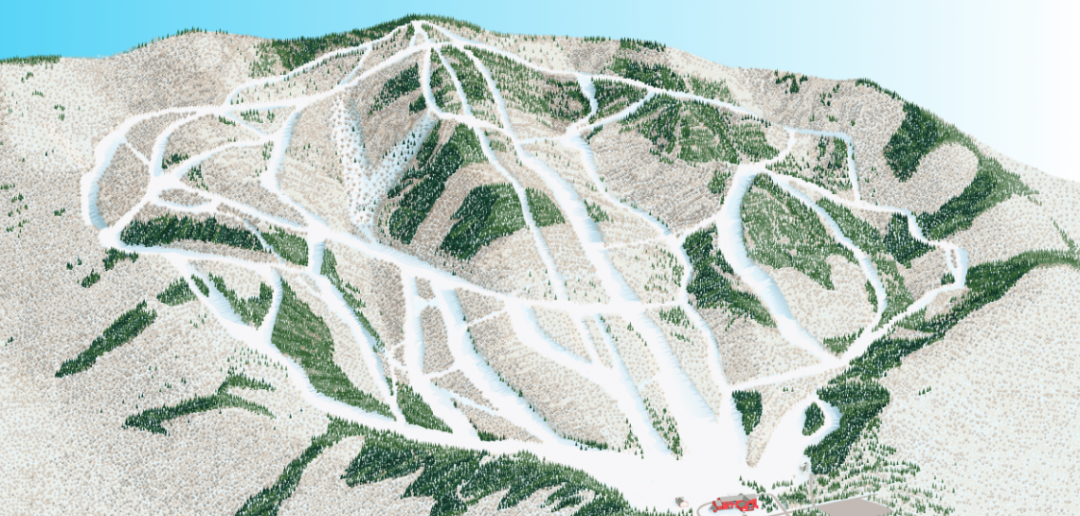
Senior Skiers take lessons at Waterville Valley Resort. Good technique means more enjoyable skiing.
Credit: Steve Bryan

“I’m skiing as well as I’m going to. My legs aren’t holding up as well.” I then watched him push off down the slope swiftly in well balanced short parallel turns. So much for weak knees.

Like Smith, many seniors are skeptical of what they call teaching old dogs new tricks, unless they plan to do something very different, like ski powder in Utah for the first time.  However, a senior ski lesson can actually lead to more enjoyment.

“Most senior skiers like the medium to long radius turns and cruising the mountain and enjoying it,” says Peter Weber, Snowsports Director at Waterville Valley Resort for 15 years. But that is no reason not to ramp up your technique.

“Whether you’re 7 or 77, technique trumps all. The better you are technically, the easier everything gets,” Weber says.

In teaching seniors, an instructor would most focus on pacing—how fast you ski, how many time outs for trailside chats vs. pushing top to bottom runs, and the need for biobreaks.

Fitness level in general is key, adds Weber. “Skiing anything above a moderate level is an athletic endeavor,” he says.

Like other resorts with comprehensive snow sports schools, Waterville Valley Resort matches you to the right instructor, so you don’t end up in a class with a bunch of young hot shots. Weber also recommends a private lesson as well as taking several group lessons.

Mark Hanabury, an instructor at Waterville Valley, says, “I think it’s more important for seniors than anyone else to take lessons.” He feels seniors will be safer and will enjoy skiing more if they embrace the new techniques including a wider stance and shorter, wider shaped skis.

“Skiing has evolved so much,” he says.

He knows first hand. Last year,  he took his dad Dick Hanabury, age 83, to ski Snowbasin, Utah, after convention in Las Vegas.

“He’s been an avid skier all his life and skied on long Head Standard skis when he was younger. I told him he had to retool his techniques to ski safely at his age. I drilled it into his head,” says Hanabury.

“My dad’s outside ski was getting hung up. He was used to stepping onto the outside ski, but his balance wouldn’t allow that. So, a fellow instructor told him to slide the ski forward and free it up. That allowed him to keep both skis on the snow so it was no longer a balance issue,” says Hanabury.

“My son Mark is keen on knowing the latest technique, so he’s done a good job for helping me to keep up as far as turning techniques,” says Dick Hanabury.

“I used that technique, letting the skis do the work, not throwing your body into the turn but just weighting the skis properly and making sure the outside ski in the turn is well weighted, that’s about the best way I can explain it,” he adds.

“If you’re in good condition, I would recommend skiing at any age. I play tennis a couple of times a week, exercise daily, so I’m ready when the time comes,” says Dick Hanabury.

No matter if seniors are updating old technique or learning for the first time, “I feel it is never too late to learn. Skiing is a dynamic sport and seniors enjoy learning just as much as younger folks. This enables them to ski longer and enjoy more terrain with family and friends,” says Mark Hanabury.

Many ski areas have created programs for those interested in new movement patterns associated with shaped skis or improving techniques. They list these programs on the resort website under the snowsports school tab.