

How Wheaties Affected The 1936 Olympics
Publishers Note: It is with great sadness that we learned of the recent passing of one of our most popular contributors, Harriet Wallis. This is one of her many articles we are republishing this season.
The Breakfast of Champions Kept Champion Ski Jumper Alf Engen From Competing.

Wheaties Ad 1936, Courtesy of Alan Engen
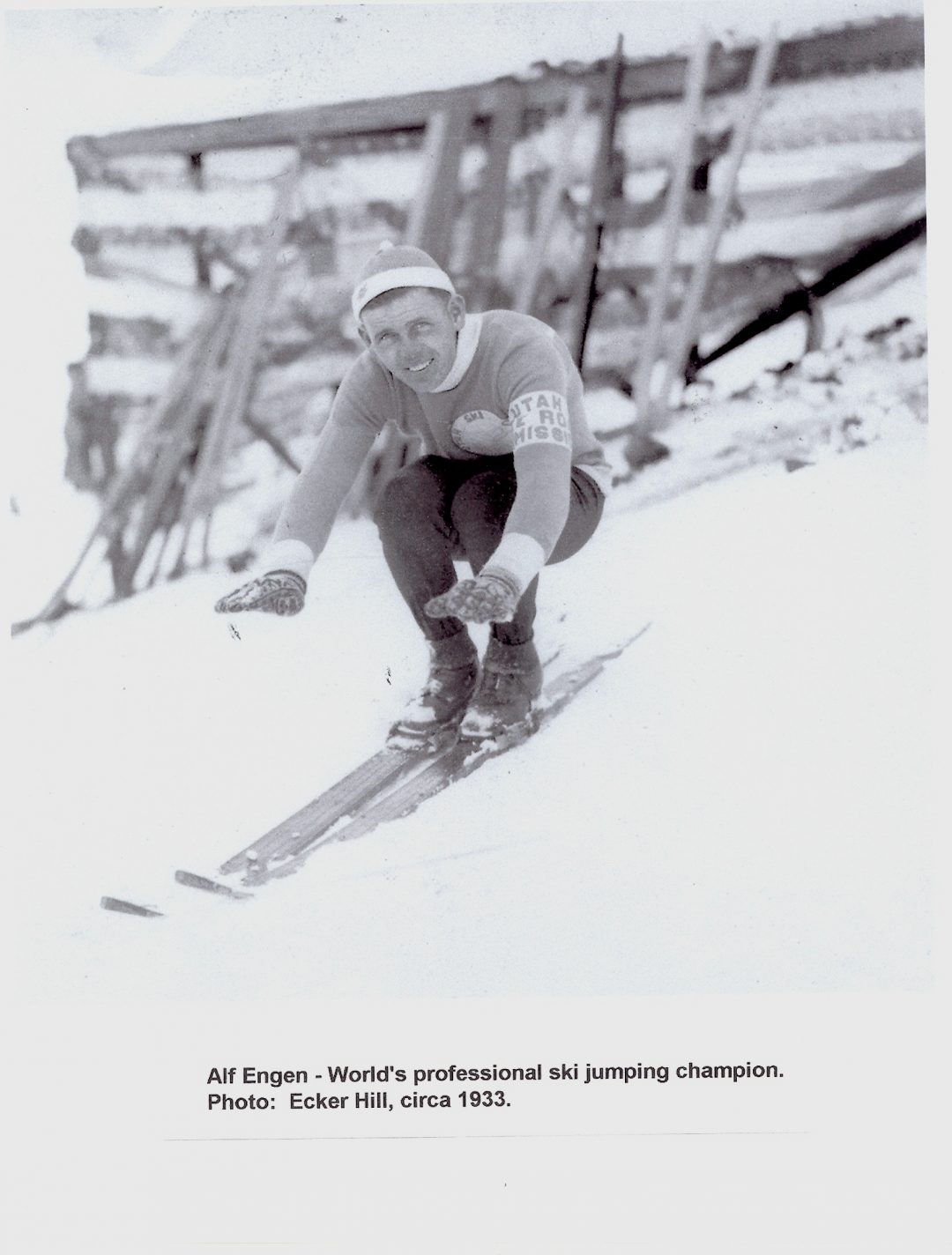
Legendary extreme athlete Alf Engen, known as the greatest all-around skier ever, was a champion soccer player, skier and ski jumper. During the 1930s, he set ski jumping world records. He helped design and establish more than 30 ski areas in the western United States. And he’s fondly remembered for pioneering deep powder skiing techniques and for his ski school at Alta.
But world champion Alf Engen was banned from competing in the 1936 Olympics because of a Wheaties breakfast cereal box.
It was just the fourth time that countries faced off against each other in wintertime Olympics. Competition included just four sports: bobsleigh, ice hockey, skating, and skiing. Twenty eight countries sent their best athletes to the IV Olympic Winter Games.
As background, Engen came from Norway to the United States in the 1920s, and he played professional soccer. By the 1930s, he was acclaimed for his ski jumping feats, he joined a ski jumping team, and he soon won 16 national ski jumping titles. And his jumps set world records. He also won national titles in all four ski disciplines: ski jumping, cross country, downhill, and slalom skiing.

Alf circa 1933, Courtesy of Alan Engen
Also in the 1930s, radio was the mass media communication method of the era. There was no television. People used their imaginations to create pictures from the words they heard.
But another form of mass media was taking hold: cereal boxes. Until then, breakfast cereal had to be cooked, but when food manufacturers invented cereal that could be eaten right from the box, they faced a marketing dilemma. How could they convince families to switch from cooked cereal to this newfangled ready-to-eat cereal? A cereal box sitting on the breakfast table with pictures of all-star athletes would be the marketing device. And unlike radio, the images were right there on the box.
Four athletes appeared on the Wheaties box—Bob Kessler, basketball star; Mike Karakas, champion hockey player with the Chicago Blackhawks; women’s speed skating champion Kit Klein; and famed skier Alf Engen.
Meanwhile, Engen became an American citizen. In 1935, at the U. S. Olympic Ski Jumping Finals held at classic Ecker Hill, he out-jumped everyone. He was immediately named as a member of the U.S. Winter Olympic Ski Jumping Team which would compete in the 1936 Winter Games in Garmisch-Partenkirchen, Germany.
But just before he was scheduled to leave, Avery Brundage, president of the International Olympic Committee and a zealous supporter of amateurism, ousted Engen from the team because his picture had appeared on the Wheaties box. He declared that Engen’s image on the cereal box made him a professional, not an amateur athlete.
“Engen said he didn’t remember getting any money from the cereal company, ‘Just a lot of Wheaties. I think I gave everyone in Salt Lake City free Wheaties.'”

Alf with trophies, courtesy of Alan Engen
Ironically, shortly after the Olympics, Engen jumped against—and he beat—both the gold and silver medalists from the Olympic Games, Norwegian gold medalist Birger Ruud and Swedish silver medalist Sven Eriksson.
The remarkable skiing Engen family is the only family to have four family member in the U.S. Ski and Snowboard Hall of Fame: Alf, his two brothers Sverre and Corey, and his son Alan.
Alan lives on in his father’s tradition. He’s a champion skier and athlete as well as an accomplished scholar, author, and historian. He carries on the Engen tradition of serving the skiing community.
Alan dreamed of displaying hundreds of Alf’s ski trophies and memorabilia for the public. The dream grew into the $10.5 million Alf Engen Ski Museum at the Olympic Park in Park City, Utah. Visitors can also learn about avalanches, sit in a real bobsled, try their knack at interactive ski jumping, and more. The museum was funded entirely by private donations, including donations from Utah’s famed and philanthropic Quinney and Eccles families. Visit and enjoy the museum when you’re in Utah.

Alf in flight, circa 1936, courtesy Alan Engen
She's a senior-age skier based in Salt Lake City and she enjoys nearly a gazillion ski days each winter. She also enjoys two stainless steel knees.
Harriet loves to be outdoors, so during other seasons she swims, bicycles and kayaks. She also single handedly rips up her yard, converting it to an arid and low water landscape with indigenous plants that she propagates. Skiing is a lot easier!
- How Wheaties Affected The 1936 Olympics - March 19, 2026
- Five Things You Should Know When a Skier Crashes - January 8, 2026
- Three Holiday Gifts Senior Skiers Wish For - December 18, 2025



I got a sad chuckle from the following paragraph that I would have loved to discuss with Ms. Wallis prior to her passing: “But just before he was scheduled to leave, Avery Brundage, president of the International Olympic Committee and a zealous supporter of amateurism, ousted Engen from the team because his picture had appeared on the Wheaties box.” Mr. Brundage would have been far more accurately described as a zealous supporter of Naziism, not selective amateurism, and did his pals in Berlin a favor by disqualifying a Norwegian-American sure to win gold in the ’36 Winter Olympics against the hand-picked German athletes of Propaganda Minister Joseph Goebbels. (Germans eventually won gold in the alpine events but Scandinavians still dominated in Nordic. Engen would likely have won medals in both disciplines). Brundage was similarly responsible for the similar treatment of Jewish-American sprinter Marty Glickman at the summer games that year as a favor to Hitler, who had already endured the humiliation of African American Jesse Owens’ dominating Olympic performances at the giant Berlin stadium. White-washing history is a favor to no one, and rehabilitating the abhorrent reputation of Brundage is a mistake, no matter the stature of the well-meaning journalist doing the reporting.
Charlie, Thank you. People should be aware of what a horrible person Avery Brudage was. Thank you for publishing this. I can verify that all you say is true including excluding Marty Glickman from the 1936 Olympics – colloquially known as the Hitler Olympics.
Thank you Mr Sanders for the brief history lesson on Mr. Brundages prejudices and activities. Knowing Harriet, I’m sure she would have been appalled she had known when writing this article about Alf.
Having watched Harriet’s research and writing process for the last several years, I know that she always did her research. The emphasis of this story was Alf Engen, not Avery Brundage. Harriet certainly did her research on Alf. I think she can be forgiven for not diving deeper into Brundage.
Having watched Harriet’s research and writing process for the last several years, I know that Harriet did her research before putting pen to paper. The emphasis of this story was Alf Engen, not Avery Brundage, and Harriet certainly did her research on Alf. I think she can be forgiven for not diving deeper into Brundage.