Tag Archive for: 50+

How Wheaties Affected The 1936 Olympics

Publishers Note: It is with great sadness that we learned of the recent passing of one of our most popular contributors, Harriet Wallis. This is one of her many articles we are republishing this season.

The Breakfast of Champions Kept Champion Ski Jumper Alf Engen From Competing.

Wheaties Ad 1936, Courtesy of Alan Engen

Legendary extreme athlete Alf Engen, known as the greatest all-around skier ever, was a champion soccer player, skier and ski jumper. During the 1930s, he set ski jumping world records. He helped design and establish more than 30 ski areas in the western United States. And he’s fondly remembered for pioneering deep powder skiing techniques and for his ski school at Alta.

But world champion Alf Engen was banned from competing in the 1936 Olympics because of a Wheaties breakfast cereal box.

It was just the fourth time that countries faced off against each other in wintertime Olympics. Competition included just four sports: bobsleigh, ice hockey, skating, and skiing. Twenty eight countries sent their best athletes to the IV Olympic Winter Games.

As background, Engen came from Norway to the United States in the 1920s, and he played professional soccer. By the 1930s, he was acclaimed for his ski jumping feats, he joined a ski jumping team, and he soon won 16 national ski jumping titles. And his jumps set world records. He also won national titles in all four ski disciplines: ski jumping, cross country, downhill, and slalom skiing.

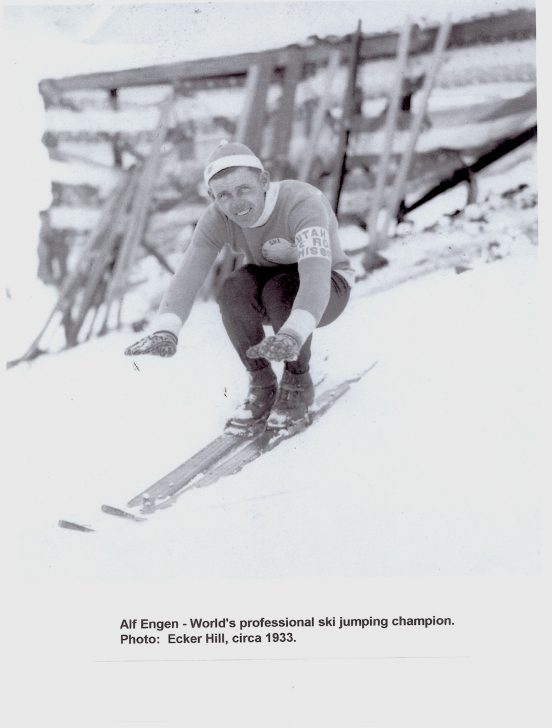
Alf circa 1933, Courtesy of Alan Engen

Also in the 1930s, radio was the mass media communication method of the era. There was no television. People used their imaginations to create pictures from the words they heard.

But another form of mass media was taking hold: cereal boxes. Until then, breakfast cereal had to be cooked, but when food manufacturers invented cereal that could be eaten right from the box, they faced a marketing dilemma. How could they convince families to switch from cooked cereal to this newfangled ready-to-eat cereal? A cereal box sitting on the breakfast table with pictures of all-star athletes would be the marketing device. And unlike radio, the images were right there on the box.

Four athletes appeared on the Wheaties box—Bob Kessler, basketball star; Mike Karakas, champion hockey player with the Chicago Blackhawks; women’s speed skating champion Kit Klein; and famed skier Alf Engen.

Meanwhile, Engen became an American citizen. In 1935, at the U. S. Olympic Ski Jumping Finals held at classic Ecker Hill, he out-jumped everyone. He was immediately named as a member of the U.S. Winter Olympic Ski Jumping Team which would compete in the 1936 Winter Games in Garmisch-Partenkirchen, Germany.

But just before he was scheduled to leave, Avery Brundage, president of the International Olympic Committee and a zealous supporter of amateurism, ousted Engen from the team because his picture had appeared on the Wheaties box. He declared that Engen’s image on the cereal box made him a professional, not an amateur athlete.

“Engen said he didn’t remember getting any money from the cereal company, ‘Just a lot of Wheaties. I think I gave everyone in Salt Lake City free Wheaties.'”

Alf with trophies, courtesy of Alan Engen

Ironically, shortly after the Olympics, Engen jumped against—and he beat—both the gold and silver medalists from the Olympic Games, Norwegian gold medalist Birger Ruud and Swedish silver medalist Sven Eriksson.

The remarkable skiing Engen family is the only family to have four family member in the U.S. Ski and Snowboard Hall of Fame: Alf, his two brothers Sverre and Corey, and his son Alan.

Alan lives on in his father’s tradition. He’s a champion skier and athlete as well as an accomplished scholar, author, and historian. He carries on the Engen tradition of serving the skiing community.

Alan dreamed of displaying hundreds of Alf’s ski trophies and memorabilia for the public. The dream grew into the $10.5 million Alf Engen Ski Museum at the Olympic Park in Park City, Utah. Visitors can also learn about avalanches, sit in a real bobsled, try their knack at interactive ski jumping, and more. The museum was funded entirely by private donations, including donations from Utah’s famed and philanthropic Quinney and Eccles families. Visit and enjoy the museum when you’re in Utah.

Alf in flight, circa 1936, courtesy Alan Engen
Three Holiday Gifts Senior Skiers Wish For

Publishers Note: It is with great sadness that we learned of the recent passing of one of our most popular contributors, Harriet Wallis. This is one of her many wonderful articles we are republishing this season.

When It Comes To Holiday Gifts, Sometimes Our Adult Children Don’t Have A Clue What We Would Like To Have. Here Are Some Hints To Pass Along. Or, Just Send A Link To This Story!

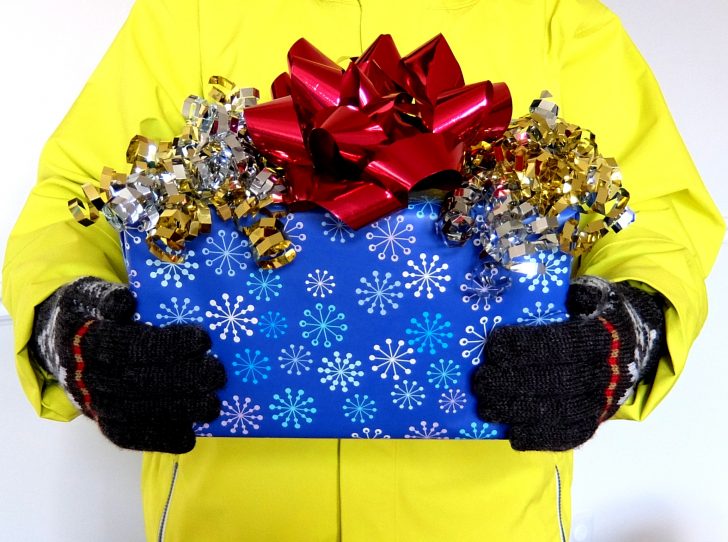
A surprise awaits and it’s not fruitcake. Credit: Harriet Wallis

Idea #1. A private lesson: A gift of confidence and fun.

You know you’d love to have the undivided, one-on-one attention of a skilled instructor to refresh your skills or move the needle a little bit further on your skiing. Ask for a private coaching session.

“Private lessons help build confidence,” said Leslie Blank, snowsports school director at Brighton. “Private lessons will let you move at your own pace. Or, you can get a little out of the comfort zone and try something new.”

Even good skiers get stuck in ruts, said Tim Wolfgram, director of Snowsports Services at Solitude. A private lesson can help you try new movements so you can have more fun.

Idea #2. A professional photo: Ski action or family portrait.

Ask your adult kids to put down their selfie sticks. Instead, ask for a professional photo of you skiing. Or, get the whole clan together for an on-slope family portrait.

Let a pro capture the photo memory.
Credit: Dobber Price, Peak Photo at Alta

Many resorts have on-mountain photographers who will take great photos of you with no fee and no obligation. But it’s a good idea to call ahead and coordinate the location and time with the photographer.

Here’s a tip. “Wear bright colors. It’s better than dark colors,” said Dobber Price, owner of Peak Photo at Alta, which is now in its 28th year of ski photography. And ski action photos, whether on a gentle slope or steep terrain, will capture your inner pro.

Idea #3. Ski tuning: So you can slide and turn more easily.

Ask to have your skis tuned. Many shops will inspect your skis and give a no-cost assessment of what needs to be done. Often, they just need to be waxed. Sometimes, if they haven’t been tuned or waxed for a long time, they might need more work. “It’s all about safety and the quality of turns,” said Brett Pergrossi, rental manager at Snowbird.

Tuned and waxed skis will slide and turn more easily. “You might slide right past your buddies on the flats,” said Brayden Morgan, head of rentals at Alta Ski Shop. “And, you won’t be as tired because you won’t use as much energy,” he said.

Many resorts offer gift certificates. But tell your kids to be sure the certificate can be used for the service they choose for you. They can buy it, wrap it, and give it. The holiday is solved. And you’ll have a treat coming.

P.S. Now aren’t these gifts better than fruitcake?

Stored Skis

Putting Away Your Skis And Stuff

It Pays To Spend A Little Extra Effort On Your Gear. Here’s How.

[Editor Note: Don Burch’s article on storing your gear is published each year around this time.  We are reprising it to help remind you that a little care for your stuff goes a long way.]

Hopefully your ski equipment has taken good care of you all winter, now it’s time for you to return the favor. Some simple steps now can save you the frustration of rusty edges, musty clothing and mouse invaded boots.

Are your skis still in the bag by the furnace where you left them after your last ski day? Hmmmm.
Credit: Mike Maginn

Skis: At the end of ski season, the bottom of your skis will be dirty. This will especially be the case if you did a lot of spring skiing. With today’s black bases it may not be that noticeable. Back in the day when a lot of bases were white the grime was obvious. Before having your skis waxed and sharpened, you want to clean the bases with a gentle cleaner. If you wax dirty skis, you’re just going to embed dirt into the wax.

I wet my skis bases with a garden hose, spray on Simple Green, wipe them down with a rag and then thoroughly rinse everything off. While you’re at it, thoroughly rinse off the top of your skis and bindings. I don’t recommend using cleansers on the top of your skis as these can interfere with the lubricants in your bindings.

Some people use commercially available ski base cleaners or Dawn dishwashing soap. Cleaning ski bases will dry them out so it’s imperative that you have them waxed afterwards and don’t let them sit all summer without a wax cover.

Racers and others who are demanding about their equipment will clean their bases using the hot scrape method. This involves hot waxing the skis and scraping the wax off before it cools. This process literally pulls the dirt off the ski. The process is repeated until the warm wax scrapes off clean. I have done this method, and it works, but it is time consuming.

A good edge sharpening and hot wax will not only have your skis ready for next season and will prevent the edges from rusting.

Boots: It’s essential that your boots and liners be totally dry before storing them. I use a boot dryer after every day skiing and before storage. If you don’t have one, I highly recommend that you take the boot liners out in order to get the boots thoroughly dry. I know it’s a pain to get the liners in and out. Warming your boots and thereby making the plastic softer will make it much easier to deal with the liners.

Store your boots in a place where mice cannot get at them. A friend of mine stored his in a shed and in the fall found them chewed on and full of things you’d wouldn’t want put your foot into.

Poles: These get the same attention as they did all winter, none.

Parkas and Ski Pants: At the end of the season, I wash my parka and ski pants in the washing machine with Nikwax TX.Direct® Wash-In. This is a product that cleans and restores water repellency and breathability, and I’ve been happy with the results. I’m not an expert on clothes washing so please go online to learn more and read the washing instructions listed on the label inside your garment.

Anyone else have any equipment maintenance tips for the off-season?

Sunday River

Look Back: Sunday River

Smooth sailing on Risky Business. Photo by Tamsin Venn.

For the record, early morning skiing was just the best at Sunday River, Maine.

We skied this reliable, late-season spot over Easter weekend with two gorgeous sunny days, happy the travel restrictions into Maine had eased for us at last. Better late than never.

Everyone wore masks. Photo by Tamsin Venn.

Count SR’s season-long commitment to snowmaking (90 percent coverage) as the insurance that makes the late season possible, especially with paltry late-season snowfall. Also, a three-mile-long ridge of eight peaks gives skiers and boarders varied snow conditions at different exposures. You can always find something holding up well. Big vert lets you stay on upper slopes in afternoon to avoid lower-elevation slush. Good grooming helps put things right the next day in New England’s freeze and thaw cycle: 8 a.m. crispy corduroy.

All good.

The crowds were the biggest challenge. At the popular Barker Chair, social distancing was a little ragged, but everyone was wearing masks. People in the lift line were polite, waiting their turn, and no grumbling heard for riding alone. Slopes were busy, but most people knew what they were doing, including the rug rats, probably mostly passholders. (Note to senior self – the later in the season, the safer you are.) The one exception was the young, helmetless dude on the snowboard straight-lining White Heat.

There were a few surprises. We agreed to meet for Easter lunch at the sunny deck at North Peak Lodge, but only the bar was open. So we drank instead and ate chocolate bunnies. One closed trail we wanted to ski suddenly opened. The top of White Heat is nothing but a granite ledge with snow on top of it (you don’t realize that mid-winter). The schlep across a dry parking lot is not so bad.

I checked in with the millennials with me on what they liked at Sunday River and what they hope will be carried over into next year.

On the way over to the next peak. Photo by Tamsin Venn

Increased RFID use and access? Already there. Food trucks? Already had them. Outdoor dining? Great, unless it’s a blizzard. They can’t wait to get back to booting up in the lodge and more places to eat. They plan to renew their Ikon passes.

As for changes going forward, Sunday River says while plans for next year aren’t finalized, it will likely continue to encourage online advanced ticket sales, offer online food ordering at certain eateries, and hopes to expand takeout options.

Kelly Pawlak, President of the National Ski Areas Assn., noted successes that will likely be carried over into next year at most ski areas. Those include advanced ticket sales (ski areas like to know how many skiers will show up); reconfigured indoor spaces that open up space within lodges; increased use of ticket kiosks; outdoor living fixtures like fire pits, chairs, food trucks, outside food windows; and for employees, daily wellness checks, staying home if sick, plus sick pay for seasonal workers.

Summary of the 20-21 ski season? Like many, with the skis now hung up, I was very grateful there was one to begin with, and Sunday River made for a very rewarding finale.

seniorski1

The Year in Review

El Nino, Stay South. La Nina, Go North.

If you haven’t already done so, it’s close to the time when the skis and snowboards get tucked away for summer hibernation.  Between Covid-19 restrictions, National Forest leases, and Old Man Winter calling it quits prematurely in much of North America, forces have conspired to end the season for the majority of winter sports enthusiasts.  This is my final posting of the season, so I thought I might take a look back at the season that was.

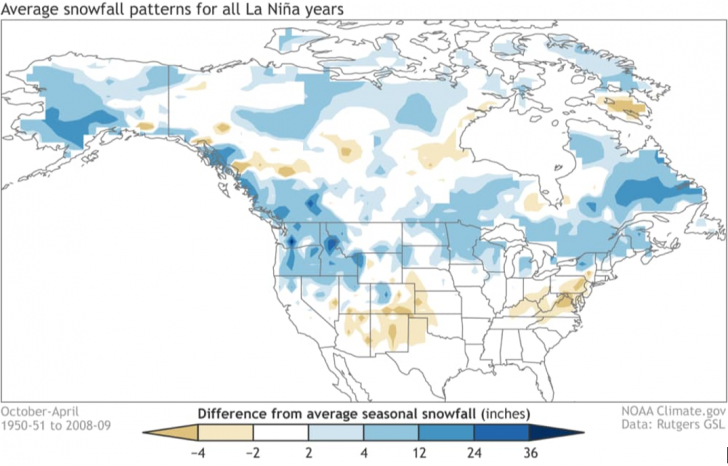
Just as is the case when putting together a winter forecast, a review of the season has to be framed by the state of the Pacific Ocean.  That is, were we in the midst of an El Nino, a La Nina, or neutral conditions with respect to the water temperatures in the equatorial regions of the Pacific?  The answer is La Nina, because those waters were colder than the long term normal throughout the season.  In the summer and fall, I am often asked by friends where the best skiing will be in the coming season.  When an El Nino is present, I always tell them to favor the central and southern resorts if they are headed west.  Conversely, if it is going to be a La Nina winter, I advise that they stay north of I-70.  Why? Well, here is a map of the average winter snowfall for all La Nina years.

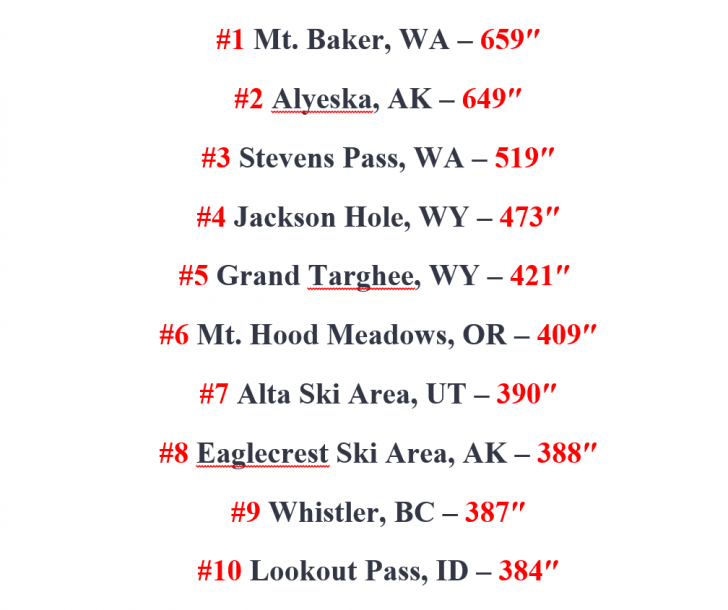
It is clear to see that when La Nina conditions are present, the jackpot for snow is typically found in the northern Rockies and Pacific Northwest, including far western Canada.  Although the correlation is weaker the farther east you go, due to the extra distance from the warm/cold pools in the Pacific, you can see that generally speaking the Upper Midwest and the northern resorts of New York and New England do pretty well.  How did this season work out?  Here’s the Top 10 resorts in terms of snowfall, through March 15th (the latest I could find).

No surprise that all ten are in the West.  Only occasionally does a Jay Peak or Sugarloaf push their way onto this list and after a paltry amount of snow in March, there will be no New England “contendahs” this year.  Now, notice where 9 of the Top 10 are located…north of Interstate 70!  Alta is the only exception, and they are only slightly south of that line of demarcation.  Also, Alta’s normal snowfall is close to 550 inches, and I doubt that they will get that extra 200 inches to reach normal snowfall between mid-March and when the lifts stop turning at the top of Cottonwood Canyon.  Moral of the story – if it’s a La Nina, stay north of I-70.  If it’s El Nino, head to the central and southern resorts.

Elsewhere, the Upper Midwest bucked the La Nina trend with a below normal snowfall season at most resorts. In a more typical La Nina fashion when a southeastern upper ridge brings spells of warmth, the season was more of a struggle at times in the mid-Atlantic and Southeast but these regions had several runs of stellar conditions if your timing was right.  The Northeast enjoyed a solid season, with a “Fabulous February,” and then the flakes stopped flying in March.

For those of you who might think on a broader scale, I leave you another way to measure how this season worked out with respect to snowfall.  It’s a graph of seasonal snow extent (in square kilometers) from December 1st through February 28th, which constitutes “meteorological winter.”

This winter was better than 5 of the last 6 and 7 of the past 10 and the data trend over the past 50-plus years is positive, contrary to what some folks want you to believe.  The models that focus on El Nino/La Nina are hinting that we may be in La Nina again next winter, something to consider as you start to put together your travel plans.  Thank you very much for reading my column the past several months.  Right now, though, “That’s a wrap!”


Skiing Weatherman: West Still Strong, East Hanging In

Some Powder. Trail Counts Good.

The weather pattern that dominated the month of March in the eastern half of the country has continued right into April…unfortunately.  I communicated with a resort manager in Vermont last week and found out that the mountain, which has a high base elevation…had received exactly one inch of snow last month.  One %#$$@*& inch!  A good number of areas pulled the plug after offering skiing during the Easter weekend as the lack of snow and late month rain beat down the base depths to the point where skiing and riding couldn’t be extended any further.

Going forward, I wish I could tell you that some late snow was on the way to sustain the sliding for several more weeks, but that is simply not the case.  The strong ridge at the jet stream level that took shape a couple of weeks ago over northeastern Canada is still there, and a piece of that ridge has extended into the northeastern U.S. the past week, leading to temperatures that continued the shrinking of the snow supply.  While it will be turning cooler in the East relative to normal for the last two weeks of this month, it looks like “too little, too late.” Lastly, base depths never got overly deep during the heart of winter, then the snow drought hit in March, and right now, we are left with a dwindling supply on the slopes.  So, in the East, get it while you can.  Grab the rock skis, bring the sunscreen and the tailgate gear and have a go at it.  This weekend there will be about 20 resorts to choose from in the East and trail counts are still pretty healthy.

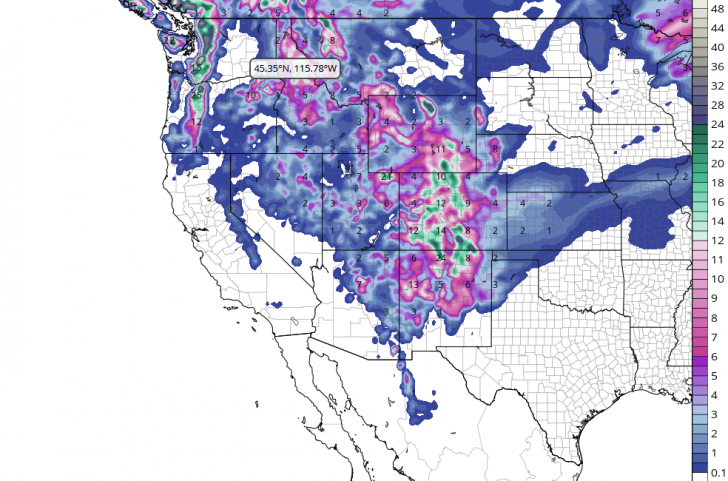
In the West, the spring skiing season is also underway with the resorts sitting on much more in the way of “money in the bank.”  That is, ample snowfall through the season has built up the base depths to an extent that skiing and riding can easily continue for several more weeks.  Keep in mind that a good number of resorts will be closing, or have already closed, because their deals with the National Forest Service say they must, regardless of how much snow is still on the hill.  But overall, the season still has plenty of legs throughout the West.  In this region, there is actually hope for a little more in the way of snow.  Here’s a map of the snowfall for the next couple of weeks.

It’s not a ton of snow, but if you time it right you might be able to squeeze in a few more powder turns before calling it quits for the season.  British Columbia has been the big winner in terms of snowfall this season, which is to be expected during a La Nina winter, and they are in line for a dump or two, or more, in the coming weeks.  Unfortunately, a Covid resurgence has caused many of the resorts in that province to close for the season.

The turns are out there if you really want them, but you might have to work a little harder to make them.

REGIONAL HIGHLIGHTS:

Pac NW/B.C.:

Late week snow will set up one more weekend of winter surfaces.

Central and southern Sierra:

Perfect spring skiing weather coming up for the next week.  Sunny, mild days and overnight lows below freezing to preserve and set up the snow.

Rockies:

Mild days, chilly nights, and any precip in the next week will be light.

Midwest:

Lutsen, Minnesota appears to be the only resort still operating.  Light rain and snow most days next week.

Northeast:

Warm pattern turns cooler late next week and beyond.  Better hustle to get those turns in.

Mid-Atlantic/Southeast:

The party is over.


This Week In SeniorsSkiing.com (March 26)

Spring Is Here, Quitting Time? Corn or Mashed? Beech Top-to-Bottom, Diggins World Cup, Ski Art III, Skiing Weatherman.

Spring: Time for renewal. Time for change. New directions.

“It was such a spring day as breathes into a [person] an ineffable yearning, a painful sweetness, a longing that makes [them] stand motionless, looking at the leaves or grass, and fling out [their] arms to embrace [they] know not what.” John Galsworthy, The Forsyte Saga.

The slightly updated quote [pronouns]  brings us to where we are on the calendar: Spring has descended and the “ineffable yearning” is happening as we speak.  The sap is running in the sugar bush, maple syrup is boiling (and boiling), and it becomes impossible to ignore the change in the air.

Sign of spring: Tuckerman Ravine, 1938. Credit: Mt. Washington

Especially, this year. We made it through in one way or another, and we “fling out [our] arms to embrace [we] know not what.” We are in that special place called the interim, between the way things were and the way things will be.  We know how it was this year—creative adaptations to restrictions and constraints for those who were determined to book time on the snow—but we can only hope the future season will approach normalcy.  We can hope, but we don’t know; no one does. Such is the nature of the interim.

However, we know that Vail is doing some bet hedging. The ski resort empire has dropped the price of its Epic pass by 20 percent for 2021-22.  That’s $200 off the Epic and about $150 off the local Epic, both sharply undercutting the rival Ikon pass. Season pass sales last summer helped Vail buffer the losses to revenue from the epidemic, and cutting prices dramatically will help ensure more of the same for the upcoming season. Presumably, people who buy passes intend to use them, unless they can’t because of virus restrictions.  We don’t know for sure but we can bet a number of last season’s pass buyers—Epic and Ikon—regretted buying a pass when the industry shut down and/or tried to get credit or their money back. Will those who grumbled and who didn’t get the value they expected last season step up to buy a discounted pass when the future is still behind a veil of uncertainty?

Regardless, the season pass is the future. Clearly, Vail has strategically pushed the market in that direction. Forget about buying a walk-up lift ticket, unless you intend to ski just one or two times in a season.  Let’s hope this upcoming season finds all those tricky dependent variables clicking into place: people buying, restrictions removed, and snow piling up. At least that’s what we ineffably yearn for.

By the way, the Epic Northeast Midweek Pass for seniors 65-plus has dropped to $271.  In the west, the Tahoe Value Pass is $359 for seniors. Pretty tempting.

Good luck, Vail.

——————————————————————————————

Attention Donors: We will start sending premiums from our recent fundraiser this week and next.  Please be on the lookout for our mailing to you.  And please be patient as the mails aren’t what they used to be.

Holiday Break: SeniorsSkiing.com is taking a break for the Easter/Passover holiday.  We wish everyone a peaceful and restoring holiday, hopefully with friends and family. Be safe.

Update on Co-Publisher Jon Weisberg: Jon had been hospitalized since mid-February and is finally in rehab. He is on the mend and is looking forward to getting back in shape. Thanks for all your concern.

——————————————————————————————

This Week

Our Question For You this week asks if when you will call it a season.  What’s your criteria? How has this decision been affected by the restrictions/constraints imposed by resorts to keep employees and visitors safe? Click here.

Correspondent Marc Liebman opines on corn snow—when it’s good and not so good—and mashed potatoes. He asks if you know the difference and what to do when faced with both conditions.  Click here.

Diggins says experience is teaching her about her capabilities and how to win. Credit: Cross Country Skier

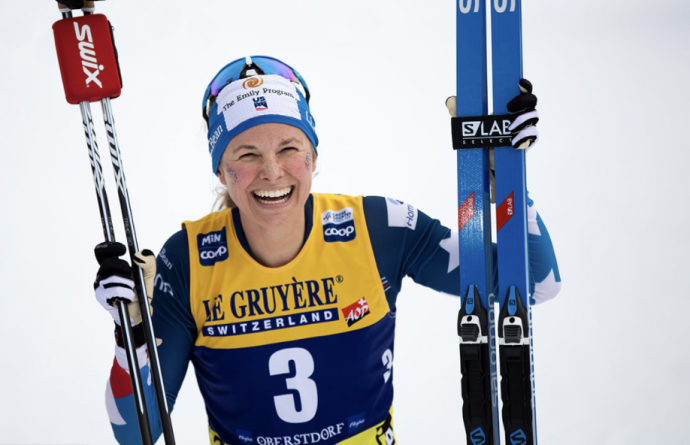
Cross-country editor and XCSkiResorts.com publisher Roger Lohr reports on Jesse Diggins World Cup victory in this year’s XC FIS competition. She’s the first American woman to win a World Cup title in history, and the first American to win gold since Bill Koch’s victory in 1982.  International competition at the World Cup level is intense, and her victory is a huge achievement for the US team and for women in sports.  Click here.

An almost unworldy mood at the start of a run.

Once again, correspondent/videographer Don Burch has produced a wonderful, expressive video in his Ski Art series. Some of these images would be great prints to mount in your den.  Click here.

Our Vicarious Vacation series continues with a run down Beech Mountain, NC, top to bottom.  You’ve seen the Alps and the Rockies in this series. Now, it’s time for a more prosaic example of Southern Skiing at a mecca for skiers in the mid-Atlantic. Click here.

Dawn at Round Vally from the grooming team. Credit: Mountain Trails

Correspondent Pat McCloskey takes us to Round Valley, UT, where he fat bikes around a network of trails maintained by a community foundation.  Pat took a break from his ski-week vacation at Park City to visit the nearby center for all kinds of winter and summer outdoor sports. Round Valley has trails for fat biking, xc, snowshoeing, and winter hiking/running, with enough space for everyone to stretch out. Pat notes the locals and local seniors are fit and take advantage of the snow, 300 days of sunshine, and the beautiful surroundings.  Click here.

Finally, the Skiing Weatherman Herb Stevens reports the pattern that continues to dominate the weather this time of year: The West is wild, the East is winding down, although there might be a chance for another dose of snow in the Northeast this week. This pattern of wild West, wimpy East seems to have hung in over the past several seasons.  Click here.

Thanks for reading SeniorsSkiing.com.  Tell your friends, and, remember, there are more of us every day. and we aren’t going away.


Skiing Weatherman: West Strong, Last Call East

Bluebird Days. Light Snow.

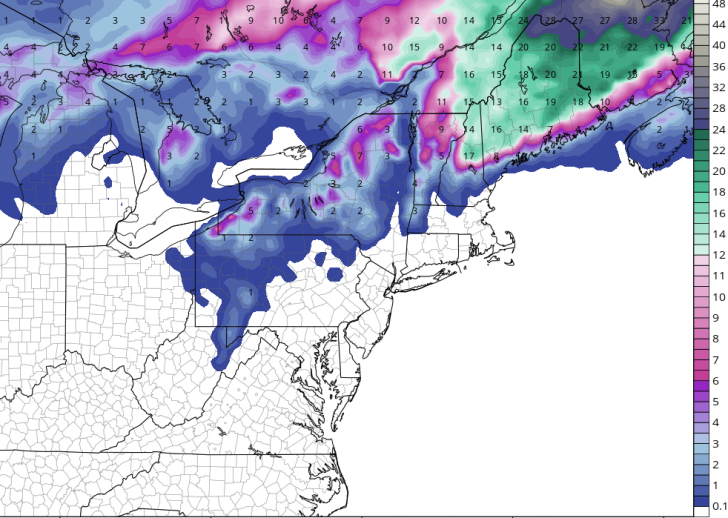
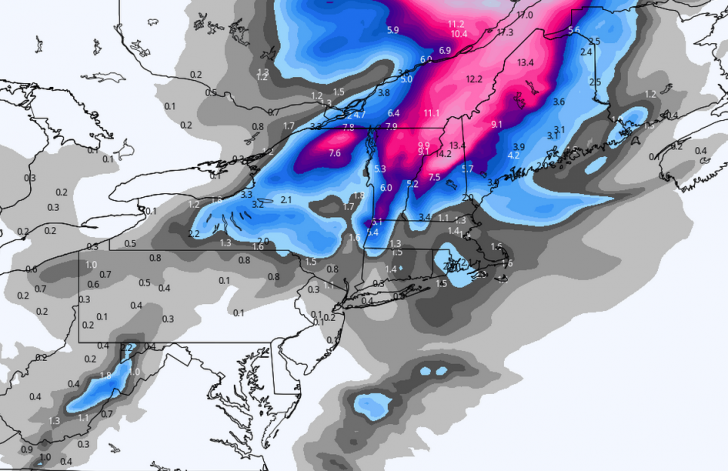
The weather pattern hasn’t changed much in the past week as the jet stream set-up has continued to feature a cold trough over the western half of the country and a milder to warm ridge over the eastern half.  It has been another snowy week in the West, although amounts of fresh snow have been a little less than the prior week.  In the Midwest, Southeast, and Northeast it has been a warm week, and both base snow and trail counts have taken a hit.  Changes in the pattern are underway, however, as low pressure centers that get ejected out of the western trough head northeast and mount an attack on the ridge.  The ridge is formidable though, and it won’t back down without a fight.  It will take three surface storms to knock down the ridge enough to cool the atmosphere sufficiently for snow to fall instead of rain.  That third storm will impact the Northeast later this weekend and into next week and could possible represent the final opportunity for significant snowfall, as the pattern will shift to a warmer regime right after Easter.  Here is a look at a snowfall forecast through Tuesday morning.

You’ll notice that New Hampshire and Maine look like the big winners.  That is because one low pressure center will move through Ontario as it weakens with a secondary low center taking shape over Cape Cod before it moves through the Gulf of Maine, strengthening as it does.  That track will most benefit the White Mountains and the resorts of Maine.  After picking up very little snow in the past three weeks, and with Easter weekend on the horizon, a healthy shot of snow would help sustain quality skiing and riding through the holiday.  Some light snow will accompany the passage of another trough and cold front on Good Friday and that will help refresh the surfaces, as well.

In the West, the persistent trough will produce its final shot of snow late this week (especially in CO and WY) setting the stage for a wonderful weekend with bluebird skies dominating as the trough swings out of the region and into the center of the country.  A new trough will arrive next week, however, bringing early week snow to the Northwest and midweek powder to the full length of the Rockies.  Here is a snowfall forecast through Friday for the West.

The amounts you see are pretty much split between the end of this week and the week of the 29th.

Many of the resorts in the Midwest have closed, but the larger areas are still open.  Some light snow amounts will fall across the northern Great Lakes later this weekend.  In the Southeast, about a half dozen resorts are still operating, thanks to high base elevations and aggressive snowmaking through the season.  That snow can’t hold on much longer against the strength of Old Sol, though.

REGIONAL HIGHLIGHTS:

Pac NW/B.C.:

Beautiful weekend on the slopes.  Light to moderate fresh snow early next week keeps the powder party going.

Central and Southern Sierra:

Great spring skiing this weekend. Back door cold front turns it a little colder next week, but no significant snow in sight.

Rockies:

Sunny weekend on the slopes.  New trough delivers light to moderate snow from MT to NM first half of next week. Light snow next weekend in northern resorts.

Midwest:

Light snow across the far north this weekend.  Mild start/colder finish next week with another round of light snow.

Northeast:

Spring conditions rule after mild, damp week.  Opportunity for meaningful snow late this weekend/early next week in northern NY and northern New England.  Another round of light snow late week.

Mid-Atlantic/Southeast:

Great spring skiing Saturday (3/27).  Colder air mass arrives later Sunday.  Spring skiing continues next week. Call resort before you drive, though.


Skiing Weatherman: Season Rolls On in West, New Snow Scarce in East

Fresh Snow in the Wasatch. Spring Conditions Reign East.

This week’s message is quite simple: If you want fresh snow, head west.  If you enjoy spring skiing, the upper Midwest and East will sport those conditions much of the time through the end of the month.  That said, I do expect the East to turn a little colder early in April, but the jet stream may remain benign enough to make it tough to support a storm with fresh snow for the Easter weekend.

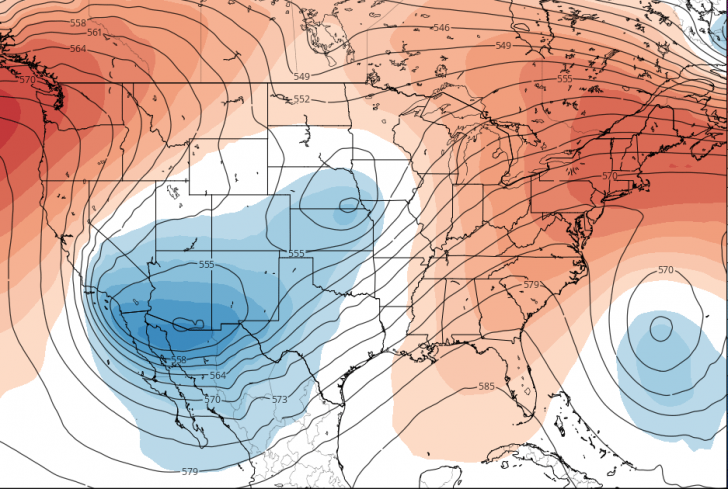
As usual, I will point to jet stream features to explain my forecast.  The jet stream is the hand that moves the high and low pressure systems at the surface around like chess pieces.  Here is a look at the jet stream for Wednesday of next week.

The orange humps that you see in the Pacific Northwest and over the eastern third of the country are ridges, where milder than normal air is located at roughly 15,000 feet above sea level.  Ridges produce warming at the surface, as well as a lack of storminess.  The blue features that look a bit like buckets are troughs, where colder than normal air pools and supports low pressure surface storms that produce snow.  The two lobes of the western troughs will produce snow this weekend into next week from the Sierra into the southern Rockies, and it looks the resorts of the Southwest and Colorado will enjoy another solid dose of powder after the dumping of last weekend.   The Pac Northwest has been the bullseye for much of the heavy hitters this season, but that ridge you see in that region will lead to a relatively quiet week.  No worries – base depths in this part of the country, as well in adjacent Canada, are VERY healthy and can withstand a mild spell with ease.

Now, I do think that the trough will consolidate and attempt to move into the East in about 10 days, but any time a trough runs into the back end of a ridge, the trough tends to weaken in terms of circulation and cold air, and be deflected by the ridge.  Here is a look at the jet stream for Monday morning of the 29th with the ridge moving offshore and the trough trying to force its way into the East.

The trough will tend to lift out to the northeast from where it will be on the 29th, rather than bodily move toward the coast, so although we could see a late snow event around the 29th/30th, I don’t believe that it will be a major snowfall. The upper Midwest will stand a better shot at meaningful snow from this system.  As we head through that week and toward Easter weekend, I do think that it will turn cooler in the East, but at this point, I would have to rate a fresh snowfall of significance leading into the holiday a long shot.

If you want fresh snow? Go west.  Sliding in the Midwest or East?  Grab some sunscreen.

REGIONAL HIGHLIGHTS:

Pac NW/B.C.:

Snow falls this weekend into early next week.  Upper ridge develops and leads to dry spell after that.

Central and southern Sierra:

Cold air keeps snow dry this weekend; some light snow early next week with slow warming later in the week as ridge expands down the coast.

Rockies:

Light snow this weekend and again early next week central and north.  Moderate to heavy snow Wasatch and southern resorts from a multi-day storm starting this weekend.

Midwest:

A mild spell settles in this weekend, turning cooler later next week.  Turning colder late next week with improving prospects for snow.

Northeast:

New snow prior to the weekend in the Catskills and Berkshires.  Seasonable temps and dry this weekend. Spring snow conditions rule region-wide next week.

Mid-Atlantic/Southeast:

Nice spring skiing this weekend then mild next week as ridge calls the shots.  Days limited for skiing this season.


Spring Comes to Wildcat

Long And Winding Runs. Great Views.

Getting ready for spring skiing at Tuckerman. Credit: Tamsin Venn

It was serendipity to arrive at Wildcat in the northern Presidential Mountains of New Hampshire the first week in March and find spring skiing. Many of us missed that part of the ski season last year in the pandemic shut-downs.

Due to its north facing slopes and deep snowpack, Wildcat usually is the last ski area to close in New Hampshire. This year it’s April 18.

While there, temps shot up to 66 degrees. Wildcat is not always so hospitable. It sits across the street from weather magnet Mt. Washington, tallest peak in the Northeast at 6,288 feet, and highest recorded wind speed 231 mph.

Away we go down Upper Catapult. Credit: Tamsin Venn

This year we were on the lookout for non-crowded midweek slopes, a friendly local atmosphere, and no state travel restrictions for us. Wildcat fit the bill.

The L-shaped parking area minimizes the schlep to the main lodge. Boot up from your tail gate, tiptoe across the icy parking lot, hike past four new, neon-colored porta-potties, get your RFID card zapped, and hop onto the Wildcat Express Quad. Seven minutes later, in one of the swiftest trips in skidom, you have reached the summit.

For several hours I lapped the Express Quad, zipping up-down-up, alternating from the left to the right flank on long, winding trails of 2,100 vertical feet. The trails draw you down as the head and shoulders of Mt. Washington rise. It’s like being in a movie… with good lighting.

Snow was corn, sweet, smooth. My left-foot steering was working as well as my right, always a good sign. Around 11, soft conditions required maneuvering into skied-off slots to save on thigh burn. Clearly early-morning skiing is best for spring skiing, even at a north facing mountain. But when I left early afternoonish, the parking lot was jammed. Spring fever had hit.

Although it has a reputation as an expert’s mountain, Wildcat has beginner terrain (20 percent)—Pole Cat is a 2.5 mile beginner trail, longest in New Hampshire—(see video article in this issue)— intermediate terrain (47 percent)—Lynx is a sweet roller with fun intermediate pitches—and expert terrain (33 percent)— famed black bump runs under the lift line. Midweek, you’ve got your turns to yourself and stress-free trail junctions.

The “cans” are display only. Credit: Tamsin Venn

Looking across to the top of Mt. Washington and thinking of spring skiing Tuckerman Ravine, you will always be grateful for the Express Quad that whips you to the area top at 4,028 feet. No hiking required. On wind holds, the Tomcat Triple gives you the bottom three-quarters.

When Vail Resorts bought Wildcat two years ago to add to its Epic mix, it took many by surprise. Wildcat is loved for its no-frills amenities and boot-scarred lodge, not exactly a Vail kind of place.

But a modern mega-resort corporation can’t erase the memories. My neighbor asked me:

“Does Wildcat still have those cold gondolas? When skiing there circa 1950s, the cable jammed [and] we near froze in the can in the hour it took to get them moving.  When people did emerge at the top, all the men ran for the bushes!  Anyway, it was exciting to ski there.”

It still is.


Click here for Wildcat Trail Map

Click Here for Wildcat Tickets

Click Here for Uphill Access

Click Here for Mountain Cams


This Week In SeniorsSkiing.com (March 5)

Looking Ahead, First Timers Tips For Europe, Personal Risk Test, Midwest Nordic Centers, DV/PCR Visits, Brunvand’s Journey, L2A Top-Bottom, Tune Up Kit, Okemo Founders, Harriet’s First Time, Emily And March.

Outdoor author Patrick McManus said: “God invented March in case eternity proved to be too brief.”

March, the elongated month, stretching from the cold of February to the sunshine of April.  March, do you know what you are doing to us?  You are driving us crazy. First, snow, then, nothing, then warm rain, then snow. March is the transition month, the signal that the year is changing, moving from one state of being to the next.

Behind is the COVID year with all its unusualness.  Ahead is the change. It appears the virus and all the aberrations it brings MAY be receding, and, like the month of March, may be transitioning, too. One can certainly hope.

And if the virus morphs to a more benign level of threat, be prepared for a really big change, an explosion of demand for all things forbidden in the last year. People are rabid to get back to whatever degree of normalcy makes sense.

Example: In Ipswich, the picturesque little town down the road, a new bakery shop announced it would be opening in an historic building near the town green. The “soft opening” would be on Friday last week, testing their equipment, procedures, recipes, etc.  The local news carried the announcement. People were lined up for coffee, bread, pastries well before the doors would open for the first time, standing out in the chilly morning, lined up way up the hill for something different. Lots and lots of people who wanted a taste not only of pain au chocolat, but “normalcy”. Call it by the familiar cliche: Pent Up Demand.

We believe that if normalcy or a facsimile comes in the fall, then now is the time to think about your plans for next season. What have you always wanted to do that you feel you must do in the upcoming year? Time is marching on, dear readers. Think big and broadly about next season’s adventures.

Season pass, sure, but no big deal.  Trip out West, yes, definitely. But, if you want to put a real exclamation point on your COVID year, consider a ski trip to Europe.

Kirchburg: €€ and just down the road from Kitzbuehel

If you’ve always wanted to ski in Europe, now is the time to think about where and how. You can go on a group trip with our advertisers—the 70+ Ski Club, AlpSkiTour, or Inspired Italy—or  or you can venture forth yourself. If you’ve never been, you are presented with a dizzying array of questions: How do all those interconnected areas work? Will I need a guide? What’s crowded and when? What resorts are expensive? Touristy? Weather?

You can start your research with Bob Trueman’s article this week.  A long time ski coach, Bob is UK-based and knows the resorts in Continental Europe quite well. He offers some tips for first timers as well as sharing some of his favorite spots.

Time to spin some plans.  Or fantasies. Regardless, March is the time to shift out of our status quo.  Let’s hope.

________________________________________

Thank you, dear readers, for your generous support of SeniorsSkiing.com.  We are humbled and gratified by your response. We plan to start mailing out premiums at the end of March or beginning of April. Please be patient.

________________________________________

This Week

Jan, Judy, Erk, 1962.

Our Question For You asks what side of the risk spectrum you would place yourself? Are you a fast-and-furious hucker? A sedate blue carver? It will be interesting to see where are readers are along the continuum between those poles. Click here.

Finally, we focus on the Midwest.  Reader have rightly criticized us for not promoting Midwestern skiing.  Here’s an attempt to correct that: a compilation of the top Nordic resorts in the Midwest, part of our ongoing Make More Tracks series. Click here.

Contributor Pat McCloskey reports on a recent trip to Deer Valley and Park City. He tells us the true skinny of what it’s like to ski at big destination resorts this crazy winter. Click here.

Jan Brunvand continues his narrative of his ski life, this time, describing what happened when he returned from his Fulbright in Norway in the mid-50s. Click here.

How are your quads? Do you think you can make a non-stop run from the top of Les Deux Alpes down to the village (about one mile vertical)? Here is a video of someone who did.  Click here.

Or is this you?

Correspondent Karen Lorentz offers another profile of entrepreneurial ski resort founders, this time, the Mueller family, who bought Okemo in the early 80s and built it up, expanded, and attracted many new visitors. Click here.

The ever practical Marc Liebman shows us what is in his ski tune up kit.  He takes ski tuning very seriously. Do you? Should you? Click here.

Long time correspondent Harriet Wallis offers a memory of how she learned skiing.  Trust us, she’s just as fiesty now. Click here.

Skiing Weatherman Herb Stevens sees a storm coming to the Northeast soon. March madness, indeed.  Find out when. Click here.

Finally, our Snow In Literature series brings you a poem from Emily Dickinson about her visiting friend, you guessed it, the month of March.  Click here.

Tell your friends about SeniorsSkiing.com. Remember, there are more of us every day, and we aren’t going away.

Sunburst Six as it approaches the summit. Credit: Okemo Resort


seniorski5

Skiing Weatherman: Pattern Is Relatively Quiet

Fresh Snow in Cali. Mild Temps Next Week.

Last week’s installment touched upon the fight we usually see in March between lingering cold to the north and advancing spring warmth from the south.  The fight usually takes the form of storminess, where it only a matter of whether there is enough cold air in the mix to produce snow instead of that other stuff.  And yet here we are in the first week of March with something resembling a mini snow drought over the eastern half of the country.  There hasn’t been a significant widespread snowfall in a couple of weeks and aside from northern New York and northern New England, where there have been one or two light snowfalls across in recent days, surfaces have morphed into “machine groomed” or, when temps rise above freezing, “loose granular.”  Fear not, though.  I hoped that a storm late this week would turn the corner and hit the Northeast, but a cold northwesterly flow has suppressed that idea well to the south.  By no means has the East seen its last snowfall, but the next sizable one will come after a turn to milder weather during the week of the 8th.  Here is a forecast for the jet stream level on the 11th that illustrates the cause of the warm-up.

If you follow the lines around the burnt orange center in a clockwise fashion, you can see that the air mass that flows into locations east of the Mississippi originates over the Southwest, where temperatures are running above normal.  At the same time stamp, the following surface map shows a high pressure center off the coast of New England.

Following the lines clockwise around the blue “H” indicates a broad, low level mild southwesterly flow reaching the Great Lakes to New England.  So, look for a shift to softer, spring-like surfaces in these areas next week.

The flip side of these ridges at the surface and aloft are the upper troughs and surface low centers that will be moving through the West next week.  The air flow is around troughs is counter clockwise, and if you look at the first map and picture the western trough sliding down the coast from Washington to southern California, you can see that a broad onshore flow of moisture will immediately precede the arrival of the center of circulation, which is a great recipe for fresh snow in the Cascades and Sierra ranges.  The highest totals will come from central and southern Sierra resorts, where the core of the trough will pass overhead midweek. Farther north it will be offshore.  Later next week, the weakening trough will swing through the southern Rockies, where lighter snow will fall but refresh surfaces.

Back to the East.  The pattern is progressive, so the warming will be transient.  Here is a jet stream forecast for the 15th that shows a cold trough returning to the Midwest and East.

That setup will help preserve snow and produce fresh snow at times and there are signs that the colder pattern will dominate the second half of the month.  More on that next week.

REGIONAL HIGHLIGHTS:

Pac NW/B.C.:

After a heavy late week dump in B.C., lighter snows fall this weekend in the Cascades.  Periodic light snows during the week of the 8th.

Central and southern Sierra:

Fresh snow as well as wind this weekend for Tahoe.  Snowy much of the week of the 8th for all Cali resorts.

Rockies:

Turning colder next week with light to moderate snows across the north.  Weakening upper trough brings light midweek snows in southern Rockies.

Midwest:

Seasonably cold weekend and milder next week.  Best shot at snow later next week across far northern Minnesota and Michigan.

Northeast:

Cold weekend with temps moderating by midweek.  Transition back to colder pattern gets underway next weekend with potential messy storm.

Mid-Atlantic/Southeast:

Midwinter temps this weekend; spring skiing develops next week.  Colder air returns week of the 15th.


Question For You: Risk Rating

Are You A Hucker, Ripper, Park Rat, Or Just A “Sick” Planker?

This you?

Sorry for the jargon.  This week, we’d like to explore on which end of the risk spectrum our readers reside. We have a sense that some readers have slowed down, taken down the speed a notch or two, search for corduroy on on sunny days, and switched to Blues and Greens. On the other hand, we know for a fact that some readers regularly race, seek double Blacks, huck off jumps, go outside the ropes, and generally find fire in their skis.

Question For You: So which are you?  Use this scale to rate yourself:

       1 is risk lover, jumper, fast, ski whatever, go-go-go, chute flyer.

       5 is graceful carver of the wide, groomed Blues and Greens, nice, rhythmical arcs, slow-ish, and in control.

Since this is an unscientific and statistically insignificant survey, make up your own criteria for 2-3-4 on the rating scale.

It will be interesting to see how our readership sees itself.

Or is this you?


Moving To Indiana Then Idaho

Part Four: Jan and Judy Find Lots Of Places To Ski.

We returned from Norway in 1957 and headed to Indiana University. We skied Caberfae near Cadillac, MI, a couple of times, but otherwise, our four years at IU were devoted to my studies and having Bloomington’s New Year’s Baby in January 1960. Where and when would we ever start little Erik on skis?

When I graduated in June 1961 we had a second child on the way, and I had a job offer from the University of Florida. Then came a call from Moscow, Idaho. The chair of the Humanities Department wanted to expand offerings in American Studies, and he had contacted the well-known IU program to see whether any newly-minted folklorist was interested.

This was the only job I ever took without a site visit and a personal interview. Everything was done by telephone and letters. The offer came as a telegram. It worked out perfectly: Moscow was a pleasant small town, the university was solid, my colleagues were smart and friendly, and—best of all—there was a nice little ski area just north of town.

The North-South Ski Bowl had a couple of rope tows and a log warming house. Here is a photo of Judy and me with toddler Erik ready to ski. His baby sister Amy, was with a sitter. Yes, I’m still wearing that old Norwegian sweater.

Jan, Judy, Erk, 1962.

Besides our local area, we visited other ski resorts in our region. We skied Mt. Spokane a couple of times, and returning from a meeting in Seattle I skied Snoqualmie Pass. When I gave a lecture for an extension course in Boise I brought my skis and had a day at Brundage Mountain near McCall, a place Judy and I also skied together. By then we had replaced the front clip on our Norwegian skis with first-generation “safety bindings.”

In early 1962 I was surprised by orders to join the US Army and fulfill my ROTC obligation. Even this led to some  skiing.

On my way to join my class at Ft. Gordon, Georgia, I visited my parents in Lansing. My dad suggested that we go skiing. But was there time to drive up north? Not a problem. A new little area called Mt. Brighton was on I-96 down towards Detroit. In my dad’s garage I found some gear that fit, and thus I had what turned out to be my last ski day in my home state. Hard to believe that little old Mt. Brighton is now part of the Vail empire.

I was assigned to Fort Monmouth, New Jersey, for a year. Judy and the two kids joined me, and we found a local ski club that met in a neighborhood bar. Their meetings were the last time either of us were carded to buy drinks. We never took a ski trip with the club, but we did get to some eastern ski areas on our own.

Judy’s aunt lived in upstate New York, so we could leave the kids with her and go skiing. Here’s Judy in 1963 at the now-defunct Petersburg Pass. It’s not clear whether she was planning to ski an expert or a novice trail.

Judy checks trail map at Petersburg Pass, 1963

Back in Idaho a major new area opened in the mountains above Sandpoint: Schweitzer Basin, now Schweitzer Mountain. We skied it in January 1964 when Judy was pregnant with our second daughter, Dana, born in Moscow in June. The views from the mountain looking past the frosted trees to Lake Pend Oreille were stunning.

Lake Pend Oreille from Schweitzer.

In spring 1965 opportunity knocked in the form of an offer from the Edwardsville campus of  Southern Illinois University. I felt I should not pass up a chance for a promotion to Associate Professor and time off for folklore fieldwork. So back we went to the Midwest with our three little kids, hoping that eventually we would be able to teach them skiing.

To be continued . . .

Don’t Tell Me To Stay Home

How I Was Reinvented As An Athlete.

Riding the rope. Harriet’s daughter Alison, 5, in leather boots and wooden skis on Jiminy Peak’s rope tow. Credit: Harriet Wallis

I learned to ski on a dare. Actually, it was a threat.

When my husband announced he was going to learn to ski, I gulped. I thought skiing was something crazy people in the other side of the world did, but not here in Connecticut.

“You’re going to do what?” I asked. “How are you going to learn to ski?”

“I read a learn-to-ski book, and I’m going to do it,” he said.

I was still processing that concept when he added, “And you can babysit the kids.”

I was being told to stay home and take care of the kids while he was going off to learn some stupid sport. That was the last straw.

“Whatever this ski-thing is, we’re all going to learn to ski,” I insisted. “You, me, and the kids.”

It was the early 70s and equipment was changing rapidly. Plastic boots were making a hit, and leather boots were cheap at ski swaps. We outfitted all four of us – boots, boot carriers, wooden skis, poles, and a few jackets – for under $100. Lessons got us started, and we spent many Saturdays practicing wedge turns from Jiminy Peak’s free rope tow. The sport was beginning to stick.

As for me, I didn’t know I was athletic until I learned to ski. I was in my 30s with two children. Back in high school gym class, I was always the last one picked when they chose teams. I wasn’t even chosen. I was the last one standing there and the gym teacher would say: “Harriet, go over to that team.”  I just wasn’t very good at team sports: volleyball, basketball, or softball. But when I learned to ski, I was reinvented as an athlete.

And that has stuck too.

This Week In SeniorsSkiing.com (Feb. 26)

Cross Country Bubble, Skiing Styles History, Aspen Top-Bottom Run, Gelati Apres-Ski, Norway Skiing, Yellowstone Yurt Resort, Goggle Fog, Weather Ahead.

Dawn, Appleton Farms, Ipswich, MA. Credit: NSNA

Across the street in Appleton Farms, we notice many disparate groups of xc skiers, snowshoers, dog walkers, and hikers have been descending in growing numbers whenever there is a decent covering of snow, a frequent occurrence this February.  The stalwart North Shore Nordic Association, a non-profit group of volunteers, grooms miles of trails at night and reports snow conditions in their daily online update.  Cars overflow the parking lots provided by the Trustees of Reservations, spilling over to the tiny country roads around the farm. When the snow falls, snow lovers come out to the country.

The numbers are many, many more than we’ve ever seen at Appleton’s, a sprawling 900-acre tract of conservation land on Boston’s North Shore. The good news is that cross-country skiing and snowshoeing have arrived. You can tell from the technique of many of the skiers, the heavyweight parkas and snow pants, and the way they hold their poles that some of the many are truly neophytes. A good thing! New people into the sport!

It took a pandemic, months of being shut-in with limited activity, Alpine ski resort restrictions, and some decent snowfall all over the country to bring cross-country and snowshoeing into the spotlight.

According to the Cross Country Ski Areas Association, sales of cross country skis, boots, and bindings are up more than 30 percent compared to sales through mid-February last season. Snowshoe sales are also up 30 percent. Some retailers noted that sales have doubled or more. And some retailers are sold out and report they can’t get additional products from suppliers. Fat bikes didn’t see a jump in sales, though. That’s probably because of a lack of inventory after last summer’s biking boom.

We view this as a very positive development for winter sports. We know our readers want to get out in the snow, the cold is not an obstacle, and that the exercise and fresh air make all the difference after being cooped up and distanced.  If you have been reluctant to discover or re-discover these other snow sports, now’s a good time to give it a go. Take those old skinny skis down to the ski shop and have them checked out. Look at the articles in SeniorsSkiing.com’s Make More Tracks Resource Guide. Find a place near you. Golf course, cross country resort or ski area, (see XCSkiResorts.com), city park, baseball field. Take it slow and flat at first, bring your lunch in a backpack with a couple of cans of Heineken. Sit down in the sun and enjoy the feeling. Get some instruction. And tell your friends you’ve just had a terrific day outside on the snow.

________________________________________

Thank you to you, dear readers, for your amazing support during our February Fundraiser.  The response has been overwhelming, and we are sincerely touched.  The premiums and stickers will be going out by the end of March. If you want to make a donation, please click here.

________________________________________

This Week

Judy in powder on her new skis and outfit.

Correspondent Jan Brunvand continues the saga of his skiing life with a look back at his Fulbright year in Norway in the mid-50s.  Newly married, Jan and Judy seem to have immersed themselves in all kinds of Nordic adventures in and around the Oslo area. Click here for Part Three of his ongoing story.

Dining room and kitchen yurts glow at sunset.

When this virus finally clears out, you might be interested in a real outdoor adventure in a beautiful setting.  Correspondent Jonathan Wiesel describes his magical stay at Yellowstone Expeditions, a rustic, remote, yet comfortable camp-resort tucked away in the National Park. Sleep in a yurt, ski among the wild life, dine in a tent. Yellowstone Expeditions is definitely a Make More Tracks resort to check out.  Click here.

Our Question For You this week comes from a reader who believes that COVID has brought new problems to keeping goggles clear. Offer your advice and solutions to his question: “What do I do about face mask-induced foggy goggles?” Click here.

The Traveling Australian, Dave Chambers, reflects back on the tail end of a three-week ski trip to the French, Swiss, and Italian Alps.  His story isn’t so much about skiing, but rather the joy of decompressing in the beautiful city of Milano, and being obsessed by the abundance of Gelati, the elixir of the weary alpine skier. Catch the flavor here.

Gelati in the presence of Il Duomo di Milano. Perfect. Credit: Dave Chambers.

Ski coach and frequent contributor Bob Trueman explains the history of ski styles and the role international competition between France and Austria played in creating, and, in his opinion, branding defined ways of skiing and teaching skiing. Where did that counter-rotation idea come from? Those ankles welded together? The French turn? You’d be surprised how some mistaken observations and assumptions created a rigid orthodoxy around technique. Click here.

We found another “top-to-bottom” video taken by a skier, this time taking us from the tippy top of Aspen Mountain all way down to the Silver Queen gondola. Since you probably aren’t heading to Aspen this season, (if you are, lucky you), this will serve as a nano-vacation. Enjoy the non-stop run, and, since it’s vicarious, your quads will love you for it. Click here.

Finally, The Skiing Weatherman Herb Stevens pipes in with a view of next week’s weather. As you will see, like the stock market, conditions will be going up and down. Click here.

Thanks again for supporting SeniorsSkiing.com. Please tell your friends and remember, there are more of us every day, and we aren’t going away.

Groomed trails ready for the day. Appleton Farms, Ipswich, MA. Credit: NSNA


Skiing Weatherman: Transition Month Trials

Late Season Powder. Rain And Snow.

Although astronomical spring begins with the vernal equinox later in March, “meteorological spring” begins on the first day of March.  That’s when the questions start to arise about how long the season is likely to extend.  Those questions are more common for resorts over the eastern half of the country, where injections of milder Pacific air have been present at times in the past week, and they will continue to come east at times during the first two weeks of the new month.  Surfaces have become more variable, especially on sunny days when trails with full exposure to the sun start to soften up and moisten by midday, thanks to the increasing seasonal output of Old Sol.

Transitional months are the most difficult for forecasters as the battle between warm and cold expands both in area and magnitude.  It is still mid-winter cold in Canada, but the South is steadily warming up in spite of what we witnessed in Texas a week or two ago.  The contrast in air masses can lead to some blockbuster late season snows but if the low center happens to cut up over the Great Lakes rather than run up the eastern seaboard, some of the early spring warmth from the South can rush northward and deal a nasty body shot to snow conditions.  However, back in 2014-2015, three Nor’easters came up the coast and the Northeast got three significant dumps of snow.  While it is great to see a late season parade of storms like that, more often than not, the air mass fight leads to more variety in terms of temps and precip types.  For the next couple of weeks, the pattern will be quite changeable over the eastern half of the country.  With colder air a little harder to find, elevation will play a big role in the snow vs. rain equation.

Overall, the pattern currently does not look like as productive in terms of significant storm threats as what unfolded during February.  The best shot at a meaningful snowfall would appear to be at the end of the first week of the new month.  Here is a surface map for Friday the 5th that shows a storm impacting the central and northern Appalachians.


The track is hugging the coast, which would allow enough mild air to spread into the mountains to start the precip as rain.  However, as the low tracks northeastward, the rain would change back to snow and a sizable “backside” accumulation could be in the cards, as suggested by this snowfall map for the 5th and 6th.


Longer term, I tend to think that the pattern will deliver enough cold air to keep the season going.  March in La Nina years tends to favor a continuation of winter across the North and for now I am going to lean on that analog.

In the West, weather worries are minimal, as transient upper level troughs will swing through the region at times and those systems will produce some late season powder days and sustain outstanding conditions.

REGIONAL HIGHLIGHTS:

Pac NW/B.C.:

The hits just keep on coming.  After very heavy snow to end the weak, weaker systems sustain the snowy pattern next week; quieter in OR.

Central and southern Sierra:

Windy weekend for Tahoe and SoCal resorts. Quiet week coming up, best shot at snow next weekend.

Rockies:

Light snow this weekend; ridging leads to quiet week thereafter.  Next shot at snow next weekend.

Midwest:

Seasonable weather overall for next week.  Passing weak systems produce light snow in northern Great Lakes.

Northeast:

Light mixed precip this weekend. Elevation matters!  Early week cold shot, then milder.  Potential for sizable late week storm.

Mid-Atlantic/Southeast:

Damp weekend; colder with high elevation snow Monday.  Snow potential mid to late week-north.  Challenging upcoming week of weather in southern Appalachians.


Make More Tracks: Yellowstone Expeditions

A Rustic Retreat In Remoteness.

Yurts and heated tent cabins accommodations in remote corner of Yellowstone.

When skiers talk about great backcountry, they often cite the Tenth Mountain and Braun systems in Colorado; Sierra Club huts in California; Skoki Lodge, Assiniboine and Shadow Lake in the Canadian Rockies. I’d like to add a new destination, near Canyon in Yellowstone National Park. (Check an atlas, find Yellowstone in the northwest corner of Wyoming; Canyon is in the north central part of the Park.)

Actually, Yellowstone Expeditions is in its 38th season. And to be honest, they use yurts and tent cabins, not log huts or lodges. But “great” is perfectly appropriate, whether it’s skiing or snowshoeing, staff, dining, or the amazing landscape of the world’s first national park (1872).

Yellowstone isn’t exactly a winter secret, but skiers visit the Canyon area only when they’re passing by in enclosed heated snowcoaches or on snowmobiles, mainly because there’s no lodging within 35 miles except Yellowstone Expeditions.

The company was founded by Arden Bailey, who in summer works as a geologist who once specialized in radioactive waste disposal. (There’s a theory Arden is such a bright guy that no one in his vicinity needs a headlamp.)

The high point of my winter used to be running winter trips in the U.S. and Canadian Rockies, so it was a joyous thing to be a guidee around Canyon. Most of the time I skied with Erica Hutchings, a Renaissance woman who’s been office manager, snowcoach driver, PSIA-certified instructor, and super-guide. Come summer, she’s been a river ranger in Grand Teton National Park.

Who Are Those Guys?

Dining room and kitchen yurts glow at sunset.

All the guides are a hoot. They’re also naturalists, dishwashers, and talented cooks, working crazy hours with all kinds of clients, and carrying it off with humor and panache and quick wits. What a work ethic!

Arden’s talents include amazing stories and still more unbelievable jokes. This sense of humor seems to inspire guests, who tend to be crazy-diverse in their professions and interests anyway. Our group on one visit included a doctor from New Mexico, a writer from New York, and the owner of a trucking firm in Texas. I learned something about publishing fiction, summer weather around Houston, anatomy, movies, Superfund sites, national politics, and succession tree species after the Yellowstone fires of 1988.

A typical four-, five- or eight-day trip begins with a snow van ride from West Yellowstone to Canyon with skiing near the rim of the Yellowstone toward the end of the day. We enjoyed a novel experience along the Gibbon River—a herd of maybe 200 slow-moving bison. We couldn’t pass them for almost two hours. It was a photographer’s dream, including the chance to take pictures of fuming snowmobilers who revved engines but still didn’t intimidate the beasties.

And There’s Skiing

Here’s why people come to Yellowstone.

You can visit the park for its beauty, for wildlife, for geysers. I did it that time for long tours, powder, and downhills. It’d been a long time since I’d really skied hard in the backcountry. It’s easy to forget how few miles a small group can REALLY go in eight hours when you’re breaking trail through two feet of fresh snow.

The Yurt Camp is based at 8,000 feet, so it gets and holds 200-250 inches of snow, usually the light stuff Montanans call “cold smoke.” It’s in a spectacular area, minutes from the deep canyon of the Yellowstone. Terrain runs from long-open-steep to wooded-gentle.

I’ve always been a so-so unenthusiastic telemarker, never quite found that ideal combination of grace, strength, and technique. After that trip, I’m a certified Wannabe.

It stood to reason that 205 cm light touring gear would do the trick for touring, even for low-angle telemarking. This might have worked if the heels of my boots hadn’t kept jamming with snow. It’s demoralizing to start a turn, come round just far enough that skis are pointed down the fall line, and find the only part of the boot/binding system meeting its obligations is the toe.

Humility is a great teacher.

Yeah yeah, I know, “It’s the equipment.” But the next day I used mid-length general touring gear with a 3/4 metal edge with backcountry boots and bindings. Spectacular improvement! Even carrying a full pack, those skied floated and came around on request.

Actually, we could have skipped hills almost entirely. There’s a huge variety of trails—groomed, ski-set, or just marked—taking off right from camp, including gentle tours to places like Inspiration Point and Cascade Lake.

Wilderness luxury

Guests stay in warm, comfortable hut tents, a moments walk from the kitchen and new dining yurts. Here’s the thing you sweat for and dream of on skis or snowshoes: getting home at twilight and trying the new cedar sauna before dinner. Or better yet, a backwoods (indoor) shower—rapture!

Among my favorite moments were the intermittent thunder of the Yellowstone’s Lower Falls (much higher than Niagara); walking around Washburn Hot Springs (it’s a map-and-compass trip in); watching a park ranger skate at dusk beside the Grand Canyon of the Yellowstone, just after a grooming machine came through; learning the differences between fisher and coyote tracks; digging a snow pit for evaluating avalanche potential; and the pleasure of a heated outhouse.

Now, that’s livin’!

More Detail

Packages include delish meals, lodging, snowcoach, sleeping bags and sheets, and guiding. The season runs December 17-March 7th. Four-day/three night visits run $1,260 per person, double occupancy. The camp holds 10-12 guests. Check out the dynamite web site by clicking here or call 800-728-9333.

Late afternoon along the thermal waters of Alum Creek


This Week In SeniorsSkiing.com (Feb.19)

Why Support SeniorsSkiing.com, Ski Test Process, Flat Light Nemesis, Women Behind Pico, Sustainable XC Resorts, Snow In Literature, Skiing Weatherman.

Fresh snow. Credit: AA Maginn

If you are of a certain age, you’ve probably figured out by now that people in business, sports, and marketing, who design, sell and market products and services, who have hiring responsibilities, and, generally, who are under 40, view aging as a liability. You get that attitude from ads which extol youth, age-ism in the workplace, and people who view us a draw on the economy.

And yet, the AARP says Americans 50 and older represent 35 percent of the population but control 83 percent of all household wealth (2018). And we are responsible for 56 cents for every dollar of consumer spending. So, we’re not nothing.

We get it. The old view of aging is that people get old, look like dried apples, consume medical care, juggle doctor appointments, and go away to rocking chairs on porches watching birds at the bird feeder and occasionally babysit.  That’s the old view, and, unfortunately, the view that many, many un-old people have of aging.

Of course, we know that’s totally misguided. Readers of SeniorsSkiing are those who recognize what’s possible later in life. We are out there, actively living, doing what’s meaningful, and chasing goals and dreams. That’s the view we have; the demographics below our senior level haven’t figured that out yet.  But they will when they mature.

Our surveys have shown that even though our reader’s average age is about 69 years old, our self-image age is in the 40s. That’s the point. We don’t feel or act old. No stereotyping here. We just keep going.

That is what makes SeniorsSkiing unique. We are the only publication we know of that focuses on seniors who love the winter outdoors and all the sports and activities that includes.

And, we’ve found a wonderful audience that resonates with the idea of being active, engaged, and connected.

Consider supporting SeniorsSkiing. We are on your side. Click here.

[Editor Note: Co-Publisher Jon Weisberg is facing a medical challenge this week. You can wish him well by taking a run for him. Short Swings will be on hiatus for a while.]

________________________________

This Week

Nipika is totally off the grid.

Correspondent Marc Liebman recalls how he and John Perryman created a more objective set of procedures for ski testing back in the 70s. Controlling ski tester bias is the big variable. Click here.

Co-Publisher Jon Weisberg found an unusual accessory for the original Model T Ford. Various parts could turn the car into a snow mobile. It was marketed as a way to save money on horses. Click here.

Our Question For You this week shifts to a practical question: How do you manage flat light? It’s been our personal nemesis when we encounter it. We’ve had several articles about flat light, but this time, we want to hear what you do. Do you goggle up with special lenses? Do you head for the lodge? Is it a big deal for you, as it is for us, or is it just one of those things? Click here.

Karl and June Acker took over from Janet and continued to expand the Pico resort.

Correspondent Karen Lorentz sends a report on the women who shaped the history of Pico Mountain Resort, VT. Several determined women owners actually led the development of the resort—one of America’s oldest—with their partners. An impressive story about impressive people. Click here.

XCSkiResorts.com publisher Roger Lohr has an interesting Make More Tracks story about how xc ski resorts are saving money and protecting the environment by adopting a variety of clean-energy sources. Click here.

The Skiing Weatherman brings us a view of the next week in Snow Land. What’s ahead? Click here.

And here’s the next in our next Snow In Literature series, Robert Frost’s On A Tree Fallen Across The Road. There’s a message here about how to deal with obstacles. “Seize the earth by the pole” is a start. Click here.

Thanks for reading SeniorsSkiing.com. Tell your friends, and remember there are more of us every day, and we aren’t going away.


Skiing Weatherman: Pattern Quiets Down a Bit

Warmer end to February. March Snow Looks Good.

This has been an absolutely wild weather week across the country, with more heavy snow in the West, the worst run of cold and snow in the southern Plains since 1899, and two significant storms in the East, although the first one generated a fair amount of sleet earlier this week.

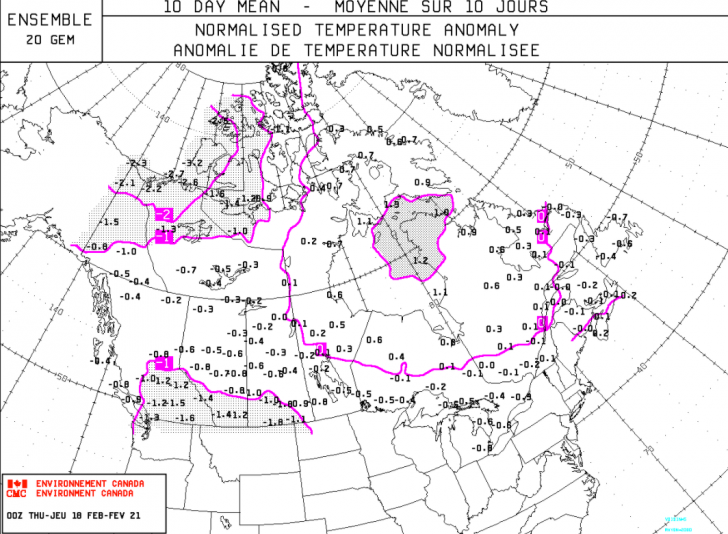
As I discussed last week, in the wake of this week’s arctic plunge, the pattern is changing to one with more Pacific air involved, so we are headed toward an end to February that won’t be as cold as much of the month has been.  In terms of the jet stream flow, we will continue to see troughs track across the country and those systems will present us with our shots at fresh snow.  The troughs won’t have quite as much cold air to work with, though, so snow levels could become a minor issue and rain/snow lines will work into the equation with storms in the Midwest and East in the next couple of weeks.  The historic push of arctic air actually drained a good percentage of the available cold air out of Canada.  Yes, it is still plenty cold to the north, but it will take a couple of weeks to build the deep cold that can help sustain the season with a southward push during the month of March.  Here’s a map that I haven’t shown before.  It is a forecast of the standard deviations of temperatures for the next ten days over Canada.


Notice that the values, whether positive or negative, are overwhelmingly close to neutral.  Ten days ago, most of the southern third of Canada, centered over Manitoba and Saskatchewan, had negative values of 5 and 6 standard deviations, consistent with an air mass that was 30+ degrees below normal. That is the air mass that plowed all the way down to south Texas in the past week.  Those values will be dropping in the near term, as it is still the heart of winter to the north.  The question then becomes whether that air will get involved in the pattern over the U.S. in March, when higher sun angles, rising normal temps, and longer days can start to take their toll on surface conditions and base depths.  Right now the prospect for a turn to colder weather looks promising for early March.  Not harsh cold, but a little below normal.  Again, the final week of this month will be milder over the East, while cold persists in the West, but this map of 5,000 foot temperature anomalies for March 5th shows cold air over the East and an ample supply sitting over Canada for reinforcements.  The five thousand foot level is a proxy for surface temps.


So, although the pattern will moderate for the East in the short term, it won’t last long and the prospects for March look good at this point, although a typical La Nina upper ridge could bring the southeastern season to a premature end.  

REGIONAL HIGHLIGHTS:

Pac NW/B.C.:

Snowy pattern carries on. Snow levels rise a bit early next week before settling back down.

Central and southern Sierra:

Light weekend snow, milder during the week of the 22nd.  Pattern cools down and snow opportunities return next weekend.

 Rockies:

Pacific flow brings light to moderate snow every day or two Wasatch and Tetons northward.   Northwest trajectory brings occasional light snow events central and snow is more scarce until late next week farther south.

Midwest:

A little milder than normal and with a few light snow events in the next week in MN, WI, and northern MI.  A great time to hit the slopes, very comfortable.

Northeast:

Not as cold as past few weeks. Weaker Clipper systems bring light mountain snow every few days.  Lower elevation resorts see light mixed precip with surfaces softening/moistening somewhat.

Mid-Atlantic/Southeast:

Light mountain snow 22nd, then milder.  Spring surface develops in all but the highest resorts next week.


FreeSkier

Why I Don’t Read Ski Test Reports

[Please consider supporting SeniorsSkiing.com with a donation. We appreciate your help. Click here.]

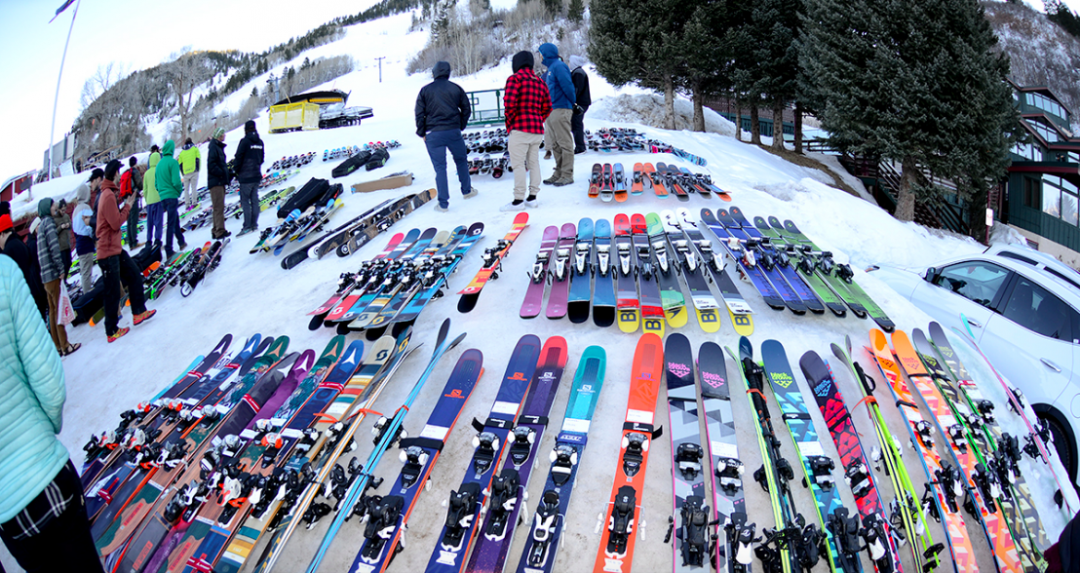
Unlike this ski test, the author masks the ski’s identity. Credit: FreeSkier

Seven Ways To Make Ski Tests More Objective.

Way back in the late 20th Century, while running the SKIpp Testing program for SKI Magazine, John Perryman and I learned the most difficult problem to solve and the biggest variable was the ski tester. In conversations with almost every manufacturer, they said the same thing. So the goal of SKIpp (way back in the 1970s before engineering modeling software was available), was objectivity and processes that minimized tester bias. John created a bench test and then tested the ski on the snow so we could compare the results.

Amazingly, we were successful. We were invited as “consultants” by several manufacturers, to compare SKIpp’s results with theirs. Again, SKIpp was very accurate, more so than some manufacturers would admit.

Most ski testers are really good skiers and as such, they unconsciously adapt their technique to the ski, terrain and conditions and the brand’s design philosophy. This makes objective comparisons very difficult. In the SKipp program on-snow methodology, seven steps were incorporated to reduce the human variable.

One, we did blind testing. The tops and tip logos of each ski were covered with shelf paper before numbering each pair. The tester was not allowed to pick up the ski until he/she “tested” the ski to minimize identification.

Two, we skied the same trail every day that gave us about 1,000 feet of vertical and a chair lift that made yo-yoing possible. The ski area spread fertilizer on a long marked off segment to simulate frozen granular and give us a consistent snow surface to reduce the “snow condition variable.”

Three, each skier filled out a test card which graded a list of mandatory maneuvers/turns. At the beginning of the year’s session, we conducted a clinic on the required maneuvers and how the ski should react.

Four, each tester was allowed only two runs on the ski before grading. We wanted first impressions and found that after two runs, most testers adapted to the ski’s idiosyncrasies.

Ski tester range from racers to intermediates. Controlling tester bias is key.

Five, the testers’ skills ranged from certified ski instructors who either had been racers or coaches to intermediate skiers. Our youngest testers were in their mid-20s (we did have a few teenagers one year) to older skiers in their 50s.

Six, the “racing” models were skied down a 20 gate GS course that had been “fertilized” so the surface was rock hard.

Seven, only 10 skis were tested each day. After 10, the testers had a hard time determining the differences.

We let the testers pick which skis they wanted to ski in the afternoon. Again, the choice and why was recorded. Only then did we allow the ski to be identified. Results were tabulated each evening by hand because Excel, laptops, etc. didn’t exist in the 1970s.

Even with all these precautions, most of us could, after a few weeks of on the snow testing, tell one brand from another. To this day, I can tell a Rossignol from a Dynastar from an Atomic from a Head or K2.

So, when I read the current ski reports filled with jargon such as “edge gripping power” or “discover the amazing effect of (name of manufacturer) new Energy Management Circuit,” my reaction is %$^@*&, and I stop reading. Whatever credibility just evaporated. I’ve been there and writing facts about the ski’s performance instead of hype is, well, boring. But, experience tells me that the reports are more believable. So now you know why I don’t read ski test reports and prefer to “on snow test” them myself.


Question For You: Flat Light Tactics

[Please consider supporting SeniorsSkiing.com with a donation. We appreciate your help. Click here.]

Is Flat Light The Bane Of Your Skiing Experience? Or Just One Of Those Things?

Head for the lodge after this one? Think so. Credit: Jan Brunvand

No contrast, lack of depth perception, no tell-tale marks on the snow, flat light adds another dimension to deal with. Not welcome to many. Tolerable to some.

We’ve had a couple of our more spectacular falls in flat light conditions. Too fast, unexpected terrain. And boom. The lasting result is that whenever we see that gray-white shroud, we tighten up, and more likely than not, head for the bottom and home.

There’s an excellent article by correspondent Marc Liebman on Coping With Flat light in our archives. Check it out here.  But what is your way of approaching flat light conditions? Do you have a specific brand of goggles you swear by? What about technique? Changes in how you approach the trail? Let us know.  Perhaps you can help up break through our reluctance to head out on flat light.

Question For You: How Do You Manage Flat Light? Tell us how you do it. Or if you just avoid it.

Write a comment in Leave A Reply below.

Women Played Integral Role at One of Nation’s Oldest Ski Areas

[Please consider supporting SeniorsSkiing.com with a donation. We appreciate your help. Click here.]

Janet Davis Mead, June Aker, Verlene Belden All Kept Pico Going And Growing, Despite Obstacles and Challenges.

Janet and Brad Mead started Pico in 1937.

Vermont’s Pico Mountain survived a war, two owners’ deaths, and a neighbor called Killington to become one of the 30 oldest continually operating ski areas in the country.

It’s a feat that was largely driven by women in its first 30 years, a time when the ski industry was known to be “a man’s world.”

Women also played major roles in Pico operations since that time, continuing the strong family influence that began with co-founder Janet Davis Mead.

A feisty woman given to exaggeration, Janet Davis told Brad Mead she had skied at the Lake Placid Club, so he invited her to go skiing.

“I had to follow him down what looked to me then like Mount Everest. I made it, but without poles,” she would write years later, explaining she had thrown them in the bushes, not knowing what they were for.

Her bravado paid off; they married and researched building a ski area.

Envisioning a year-round resort with mountainside homes, aerial tram, swimming pools, ice rinks, and tennis courts, the Meads leased Pico Mountain and opened Thanksgiving Day 1937 on Little Pico with a 1,200-foot rope tow and a rough-cut, 2.5-mile Sunset Schuss skiers could ‘skin up’ to the summit.

The Meads hired Swiss racer Karl Acker to run the ski school, added two tows, widened Sunset Schuss — renowned for downhill racing and the Pico Derby — and installed the first U.S. Constam T-Bar to the top of Little Pico.

After Brad died in a boating accident in 1942, Janet carried on with support from skiers, the Otter Ski Club, and Otter Patrol. When workers including Acker left for World War II, she kept Pico open despite hardships of rationing and shortages that caused many areas to close. Using her marketing skills, charisma, and tenacity, she gave special rates to schoolchildren and servicemen who visited on furlough weekends.

Karl and June Acker took over from Janet and continued to expand the resort.

Having survived wartime, Janet bought the mountain (1947) as Acker returned to teach and help operate Pico. (He coached daughter Andrea Mead, first American to win two Golds in the 1952 Olympics, bringing acclaim to Pico’s strong racing tradition.) As the first woman to own and run a U.S. ski area still operating, Janet survived four lean snow years, weak finances, and growing competition by lowering ticket rates and offering summer rides on chairs hung on the T- Bar (1950). With the ski boom on and her children not interested in running Pico, she sold to Karl and June Acker in 1954.

Karl added trails, a T-Bar, and a J-Bar. “The lack of access to funding caused him to do too much of the work himself; the long hours and the stress of the new J-Bar which he couldn’t get to work quite right contributed to his fatal heart attack” in May 1958, June told me in 2007.

“The three banks that had lent us money to purchase Pico had insisted on a life insurance policy on Karl. Because I was a woman they needed to know I could repay the loan if he died,” June said of becoming Pico’s owner at age 30.

She added trails, replaced a lift, and obtained financing for Pico’s first chairlift, a Stadeli double that went halfway to the top ($110,000 in 1962).

“Pico needed lift service to the summit to compete and survive.  Being a woman contributed to the banks’ reluctance to provide more loans,” June said, of her decision to sell to Bruce and Verlene Belden (1964) in hopes they would carry on a family-oriented mountain.

Bruce had helped build Mount Snow (1955-1964), while Verlene ran their 30-guest ski lodge and raised four children. With former guests investing, they became majority owners with Verlene as office manager. Her business acumen coupled with their strong family orientation and expansion of the mountain enabled Pico to survive the trying 1970s when all but five major Vermont ski areas changed owners, and most surface lift areas closed. Vermont had 81 areas in 1966 but just 39 by 1988.

When they retired in 1987, Pico had a reputation as the “friendly mountain” with strong racing and instruction programs and new base village engendering a loyal following.

Women played significant roles in achieving that reputation. “They taught youngsters to ski and race and were instrumental in the Pico Ski Club. They also ran various departments from ski shop to ski school, tickets to childcare. They contributed to the skier loyalty that saw kids who grew up at Pico return as instructors or coaches and bring their own families to the mountain,” noted former GM Frank Heald.

Current Pico Director of Operations Rich McCoy added, “Pico staff make people feel at home and welcome. That’s a legacy that women through their leadership roles have contributed to throughout Pico’s long history and still do today.”

Sunset Schuss: Had to skin up in the old days.

Make More Tracks: Sustainable XC Ski Resorts

[Please consider supporting SeniorsSkiing.com with a donation. We appreciate your help. Click here.]

[Editor Note: This article first appeared in XCSkiResorts.com.]

Craftsbury has a solar array, one element in a system that provides heat.

Many cross country (XC) ski areas operate in an environmentally-friendly manner, and some of these operators, who are exemplars using the most sustainable practices, are models of sustainability in the effort to combat climate change. The operators at these resorts practice what they preach such as: using renewable energy, protecting scenic values and wildlife habitats, practicing water/energy conservation, reducing waste and reusing products, designing and building facilities in an environmentally-sensitive manner, managing forest and vegetation properly, handling potentially hazardous waste properly, and educating clientele and staff about environmental awareness.

These sustainable practices are not typically million dollar investments, but they are meaningful accomplishments, and the information about many of their practices can be shared with hundreds of other XC ski areas across the US and Canada.

Devil’s Thumb has geo-thermal heating.

At Devil’s Thumb Ranch Resort & Spa in Tabernash, Colorado, a geothermal heating system is used throughout the resort. The system consists of glycol-filled pipes that have been installed in the Ranch’s on-site lake. Heat is transferred to the glycol from the water, and then heated to 105 degrees by compressors in each building. The resort has also installed EPA-approved specially designed chimneys that minimize emissions from wood burning fireplaces and used recycled asphalt for paving. “We continue to make a concerted effort to work with local suppliers and businesses and reduce our carbon footprint at every level,” said General Manager Sean Damery.

The White Grass Ski Touring Center in Canaan, WV has been awarded the WV Environmental Council’s Green Entrepreneurs Award. The facility is heated with wood and uses about $6.66 worth of electricity a day. Environmental education is a key element at White Grass as there are regular outings in the WV Highlands Conservancy and the Canaan Valley National Wildlife Refuge, which they helped to establish.

In the northeast US, the Great Glen Trails Outdoor Center in Gorham, NH upgraded an old micro-hydro 10 kw system, which now supplies 80 percent of electric needs. They’ve also got a wood pellet heating system in the lodge and have converted more vans that tour up to the top of Mt. Washington to propane gas and installed an electric vehicle charging station, too. The new Glen House Hotel has a geothermal closed loop system and high insulation for high building efficiency. The LED lighting is throughout the hotel indoors and the outside lighting is “Dark Sky Compliant” at night. One of the coolest things at the Glen House is the regenerative elevator system that feeds energy back to the building’s electric grid.

Craftsbury Outdoor Center in VT has incorporated sustainability in its mission statement to be carbon neutral. At Craftsbury Outdoor Center everything is net metered with 32kW on the solar trackers and 3,000 square feet of panels on the roof, supplying the Activity Center with close to 70kW. Between the two, that provides 63 percent of operation’s electricity and there is also solar thermal to provide  summertime domestic hot water, which is supplemented with heat pumps.

Craftsbury has incorporated massive amounts of insulation into all of the new buildings, and locally sourced many of the wood products used in the building construction. The roof of the Activity Center is at R72 and the walls are R46. It also has composting toilets, a heat pump, and locally-sourced wood for paneling and recycled steel beams for support were incorporated in the construction. High efficiency wood gasifying boilers provides all of the heating and domestic hot water demands during the cooler months. They’re tied into the 10 million BTUs of thermal storage in the form of 20,000 gallons of water. This storage system allows them to cogenerate with the snowmaking generator, providing electricity for the pumps and guns, and catching waste heat off the engine.

Sleepy Hollow owners Dan and Sandy pose in front of one of 10 solar arrays at the resort.

Sleepy Hollow Inn Ski & Bike Center in Huntington, VT added 10 kwH of solar this summer and now has 50 kwH of solar net metering from its solar panel arrays to provide for electric needs that include power for a snowmaking system used to guarantee snow early in the season. A solar hot water system heats 50 percent of the hot water use at the inn, and the lights on the ski trail have been converted to LED lights. Sleepy Hollow Proprietor Eli Enman commented, “By April, we’re expecting to see that close to 100 percent of our total electricity would’ve been powered by solar energy and that includes our all-electric snowmaking system water and air pumps.”


Nipika is totally off the grid.

A sustainable Canadian resort that practices what it preaches is Nipika Mountain Resort in BC, which is off the public power grid. It uses solar panels to supply energy needs. The resort’s furniture was built on site with wood from trees that were killed by the Mountain Pine Beetle.

Boundary Country Trekking on the Gunflint Trail in MN offsets the carbon produced on the Banadad Trail (such as snowmobile grooming) by investing in reforestation in the area. This is a planting estimated at 75,000 trees. Boundary Country Trekking is one of the few XC ski operations that have a sustainability statement and a comprehensive implementation plan. Another Minnesota XC ski area, Maplelag Resort in Callaway, is an active tree farm where it has planted thousands of trees and has created more than 20 ponds to benefit wildlife there.

For people who seek beautiful destinations to cross country ski and want to patronize businesses that fight climate change, the resorts in this select group are the places to visit.

Snow In Literature: On A Tree Fallen Across The Road

[Please consider supporting SeniorsSkiing.com with a donation. We appreciate your help. Click here.]

(To hear us talk)

By Robert Frost

The tree the tempest with a crash of wood
Throws down in front of us is not bar
Our passage to our journey’s end for good,
But just to ask us who we think we are

Insisting always on our own way so.
She likes to halt us in our runner tracks,
And make us get down in a foot of snow
Debating what to do without an ax.

And yet she knows obstruction is in vain:
We will not be put off the final goal
We have it hidden in us to attain,
Not though we have to seize earth by the pole

And, tired of aimless circling in one place,
Steer straight off after something into space.