Tag Archive for: Alf Engen

How Wheaties Affected The 1936 Olympics

Publishers Note: It is with great sadness that we learned of the recent passing of one of our most popular contributors, Harriet Wallis. This is one of her many articles we are republishing this season.

The Breakfast of Champions Kept Champion Ski Jumper Alf Engen From Competing.

Wheaties Ad 1936, Courtesy of Alan Engen

Legendary extreme athlete Alf Engen, known as the greatest all-around skier ever, was a champion soccer player, skier and ski jumper. During the 1930s, he set ski jumping world records. He helped design and establish more than 30 ski areas in the western United States. And he’s fondly remembered for pioneering deep powder skiing techniques and for his ski school at Alta.

But world champion Alf Engen was banned from competing in the 1936 Olympics because of a Wheaties breakfast cereal box.

It was just the fourth time that countries faced off against each other in wintertime Olympics. Competition included just four sports: bobsleigh, ice hockey, skating, and skiing. Twenty eight countries sent their best athletes to the IV Olympic Winter Games.

As background, Engen came from Norway to the United States in the 1920s, and he played professional soccer. By the 1930s, he was acclaimed for his ski jumping feats, he joined a ski jumping team, and he soon won 16 national ski jumping titles. And his jumps set world records. He also won national titles in all four ski disciplines: ski jumping, cross country, downhill, and slalom skiing.

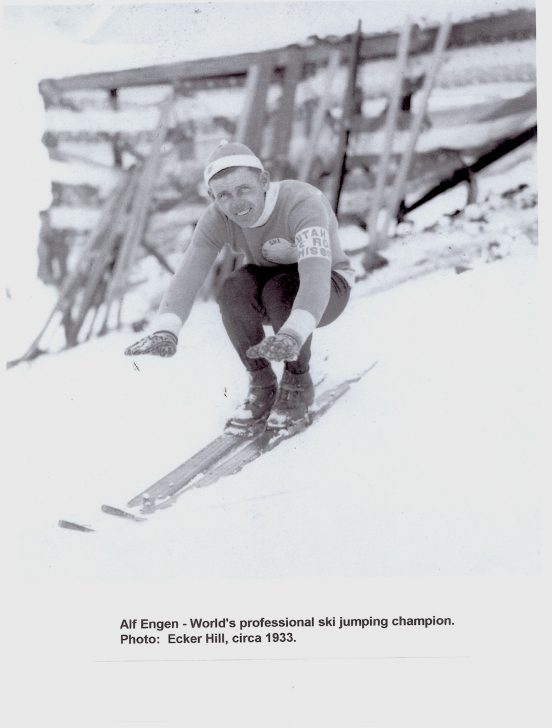
Alf circa 1933, Courtesy of Alan Engen

Also in the 1930s, radio was the mass media communication method of the era. There was no television. People used their imaginations to create pictures from the words they heard.

But another form of mass media was taking hold: cereal boxes. Until then, breakfast cereal had to be cooked, but when food manufacturers invented cereal that could be eaten right from the box, they faced a marketing dilemma. How could they convince families to switch from cooked cereal to this newfangled ready-to-eat cereal? A cereal box sitting on the breakfast table with pictures of all-star athletes would be the marketing device. And unlike radio, the images were right there on the box.

Four athletes appeared on the Wheaties box—Bob Kessler, basketball star; Mike Karakas, champion hockey player with the Chicago Blackhawks; women’s speed skating champion Kit Klein; and famed skier Alf Engen.

Meanwhile, Engen became an American citizen. In 1935, at the U. S. Olympic Ski Jumping Finals held at classic Ecker Hill, he out-jumped everyone. He was immediately named as a member of the U.S. Winter Olympic Ski Jumping Team which would compete in the 1936 Winter Games in Garmisch-Partenkirchen, Germany.

But just before he was scheduled to leave, Avery Brundage, president of the International Olympic Committee and a zealous supporter of amateurism, ousted Engen from the team because his picture had appeared on the Wheaties box. He declared that Engen’s image on the cereal box made him a professional, not an amateur athlete.

“Engen said he didn’t remember getting any money from the cereal company, ‘Just a lot of Wheaties. I think I gave everyone in Salt Lake City free Wheaties.'”

Alf with trophies, courtesy of Alan Engen

Ironically, shortly after the Olympics, Engen jumped against—and he beat—both the gold and silver medalists from the Olympic Games, Norwegian gold medalist Birger Ruud and Swedish silver medalist Sven Eriksson.

The remarkable skiing Engen family is the only family to have four family member in the U.S. Ski and Snowboard Hall of Fame: Alf, his two brothers Sverre and Corey, and his son Alan.

Alan lives on in his father’s tradition. He’s a champion skier and athlete as well as an accomplished scholar, author, and historian. He carries on the Engen tradition of serving the skiing community.

Alan dreamed of displaying hundreds of Alf’s ski trophies and memorabilia for the public. The dream grew into the $10.5 million Alf Engen Ski Museum at the Olympic Park in Park City, Utah. Visitors can also learn about avalanches, sit in a real bobsled, try their knack at interactive ski jumping, and more. The museum was funded entirely by private donations, including donations from Utah’s famed and philanthropic Quinney and Eccles families. Visit and enjoy the museum when you’re in Utah.

Alf in flight, circa 1936, courtesy Alan Engen

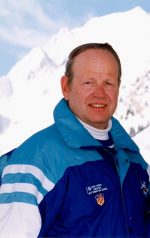
Your Next (or Last) Ski Lesson Can Be Traced Back to Alta

Your Support Helps!

Help us keep SeniorsSkiing.com free. Please support SeniorsSkiing.com with a donation.

DONATE

The origins of the Professional Ski Instructors of America’s (PSIA) harmonized approach to ski instruction in the United States can be traced back to Alta.

When skiing was first taking hold as a participation sport around the Intermountain region in the mid- to late-1930s, ski instruction was informal; limited to tips provided by anyone who had been on a pair of skis more than once.

By the early 1940s, many people were taking up the sport, and it became evident there needed to be some form of training, control, and certification for people teaching others how to ski.

During the 1946-47 season, the Intermountain Ski Association (ISA) took the first steps to form a unified approach to ski teaching in the Intermountain region. One of the organizers was my uncle, Sverre Engen, at the time, head of Alta’s ski school.

During the 1946-47 season, the Intermountain Ski Association (ISA) took the first steps to form a unified approach to ski teaching in the Intermountain region.                                                                                  Source: Alan Engen Collection

Two years later ISA conducted the first Intermountain region instructor examination at Alta.  According to Bill Lash, former Alta ski instructor and founder of the Professional Ski Instructors Association (PSIA), “Alf and Corey Engen ran the program.  The test was given in three grades: master instructor, instructor, and apprentice instructor.  The cost of the exam was $10.00 and the renewal fee was $2.50 per year.  In 1950, instructor pins were given out.  There were two pins and classes of certification: apprentice and instructor.” My father was Alf, who headed the Alta Ski School from 1948 to 1989 and for whom the Alta Ski School in named.

Early December,1950, another certification examination was conducted at Alta. This time, under the direction of Friedl Lang, a noted ski instructor who had been certified by the U.S. Eastern Ski Instructors Association. Lang had taught skiing in North Conway, New Hampshire for Hannes Schneider, father of the Arlberg Technique. He brought special insights to the new ski instructor certification process.

At the same time, the Intermountain Ski Instructors Association (ISIA) was created to oversee certifying instructors.

1958 National Ski Association Certification Meeting at Alta                                                  Source: Alan Engen Collection

Throughout the 1950s, Alta hosted numerous Intermountain Ski Instructor Association examinations. And in 1958, coordinated by the Alf Engen Ski School, Alta hosted the first National Ski Association “on-snow certification conference” to establish national certification standards. A significant outcome of this gathering was Outline of Ski Teaching, by Bill Lash. The first complete ski-instructors manual, it was distributed nationwide and became the basis of the American Skiing Technique. A few years later, in 1961, representatives of the National Ski Association met and agreed to formalize teaching the American Skiing Technique under a new umbrella: the Professional Ski Instructors of America.

So, wherever you take your next ski lesson at an area in the United States, if the instructor is PSIA-certified, she may not know it, but Alta played a role in bringing professional, harmonized instruction to the sport.

Short Swings!

Each season, at this time, we pass the fund-raising hat. Your contributions, modest and generous, help keep SeniorsSkiing.com arriving to your inbox free of charge.

Please click here to access our fundraising page. We’re requesting a minimum contribution of $14, or $1 per issue. Readers contributing $50 or more will receive Licensed To Ski, the original 28” x 22” poster of clever ski-themed license plates from around the US. All readers who make a gift of $14 or more will be mailed the new “Senior Skiers Rock!” stickers for use on helmet, skis, car, locker, wherever you choose to express support for and pride in older skiers.

SeniorsSkiing.com started in 2014 to provide an information source for 50+ skiers and snowboarders. After a few seasons, it became evident that the site also serves as a virtual community, connecting older snowsports enthusiasts around the globe.

To date, we’ve published almost 1,700 original articles about issues relevant to the older participant, resorts, people, equipment, technique, injury and recovery, etc.

Keeping the lights on carries a price tag: maintaining the site’s platform and its subscriber mailing lists; employing parttime services of webmaster, graphics people, etc.

Your gifts, along with revenue from a handful of advertisers, allow this shoestring operation to collect and distribute, free, original content written specifically to your interests.

Over the next four issues, reminders of the fundraiser will be posted with each article. Please take a minute now by clicking here and making a contribution.

Thank you for subscribing and for your support!

SeniorsSkiing Featured on The Storm Skiing Podcast

For the past few years, Stuart Winchester, of The Storm Skiing Journal and Podcast has been interviewing ski industry insiders and thought leaders. He takes an informed approach with the 90-minute podcasts, that many followers listen to while driving to the mountain. In the current Storm Skiing Podcast, Stuart and I discuss SeniorsSkiing.com and the role and influence of older skiers in the US. Click here to tune in to this just-published interview and the 70+ others in The Storm Skiing Podcast archive.

Update: Stevens Pass Passholders vs. Vail Resorts

A few weeks ago we reported that 20,000 Stevens Pass (WA) pass holders had signed a petition asking owner Vail Resorts to refund 60% of their pass cost because only 40% of the area is open. As of this writing, the number of signatories had grown to almost 45,000. The ski area, now with a newly installed manager, has opened far more terrain, and Vail Resorts is offering discounts on next season’s Stevens Pass and Epic season passes.

Vail Introduces “Phone Free” Zones

Credit: John LaConte/Vail Daily

In an effort to reduce lift line delays due to skiers distracted by their cell phones, the resort has started “Phone Free Zones.” Not a bad idea, especially if they extend it to the chair ride, itself. A few days ago, I was riding a four-seater at Alta while the guy next to me gave a Zoom lecture on economics. Interesting info. Wrong venue.

Klaus Obermeyer Is 102

Happy 102 Klaus!!

Aspen legend, Klaus Obermeyer, celebrated his 102nd birthday last week. An early instructor at the resort, he went on to develop such skiing staples as the quilted down parka, the first nylon windshirt, the dual-liner ski boot and the 2-prong ski brake. Klaus once told me that as he aged, he found it easier to ski than to walk. Happy Birthday, Klaus!!!

Alan Engen Reflects on His Father, Alf

Alf (l) and Alan Engen in 1989, when Alf was 80. Source: Ski Utah

Ski Utah podcaster, Tom Kelly recently interviewed Alan Engen about his father, Alf, and his own experience as a member of one of the nation’s most prominent skiing families. Listen to it by clicking here.

South Korean Chair Rolls Back

https://www.youtube.com/watch?v=-9LNcmi6H9g

No serious injuries occurred recently when a chair at South Korea’s Bear’s Town Ski Resort lost control and rolled backward. Passengers jumped to safety before the chairs piled up in the terminal.

Fan Mail

Jim Cobb, manufacturer of The Bootster ski boot shoehorn, received this note last week from a SeniorsSkiing.com reader: I tried a friend’s Bootster and had to get my own because it works so well!   I have very limited range of motion in my left big toe joint due to bone spurs, so it is VERY difficult getting my ski boot on.  The Bootster makes it so much easier!

Mikaela Outskis T-Rex

More from the world of bizarre Beijing Olympics promo videos. Readers in the US may already be seeing this on their screens.

BABY OLYMPICS

How can we not fall for this three-minute video of toddlers in Olympic garb competing for Gold? (Be sure to click “Watch on You Tube.)

An Interesting Ski Video

Those of you who follow Short Swings! are aware of my general criticism of me-too ski videos. This one, featuring Sam Cohen and Michelle Parker, takes a different and more interesting approach. It documents a ski mountaineering expedition into a remote region of the North Cascades. The two adventurers carry gear for several days in North Cascades National Park, eventually taking the steep climb to a thrilling ski descent. 12 minutes of really interesting scenery, climbing and skiing.

Beijing Winter Olympics

The games start today. As you already know, a lot will be different: virtually all ski and board events will be on manmade snow; there won’t be big, international crowds, and a lot of attention will be on non-sporting activities. But, like every other Olympics, this one will be exciting to follow. I can’t wait for the men’s and women’s downhill. The course has some heart-stopping drops and jumps. Enjoy the Games!!!!

Junior Bounous

Meet 96-Year-Old Ski Legend: Junior Bounous

Ski industry icon Junior Bounous, 96, is a mover and shaker whose passion is to keep people skiing throughout their lives. In a nutshell, he tells seniors: Just “keep moving.”

Junior’s career spans nearly eight decades with a list of accomplishments and awards longer than both my arms: Intermountain cross country and national gelande jumping champion, national race course setter, ski patroller, founding member of Professional Ski Instructors of America, father of today’s American Ski Teaching System, an advisor to ski manufacturers, a ski trail designer for resorts, and the director of skiing in California and Utah including Sundance and Snowbird. In 1996, he was inducted into the National Ski Hall of Fame.

Snowbird’s Pipeline

Junior takes his own “keep moving” advice. To celebrate his 80th birthday he skied Snowbird’s treacherous Pipeline chute, a couloir lined with jagged rocks and with no room for error.

And he keeps on moving. On a bright spring day in 2021, he heli-skied from the 11,489’ Twin Peak summit, the highest point in the Little Cottonwood Canyon range, making him — at 95 years and 244 days — the Guinness World Records’ oldest heli-skier. Getting out of the helicopter was difficult because his knees don’t bend as well as they used to.  “The skiing was the easy part,” he said.

Follow the legend

A role model for seniors, Junior continues to ski for the joy of it.

A few days ago my senior ski friend Beth Tait was skiing at Alta when she saw a yellow helmet. Junior always wears a yellow helmet. As she got closer, she saw it really was Junior. He was talking with skiers around him, and she joined in. Later, Beth followed him, trying to ski as smoothly and fluidly as the 96-year-old.  “Junior is an incredibly athletic skier not to mention his heartwarming personality,” she said.

From barrel staves and manure piles to Alta and Snowbird

Junior was the youngest of six children in an Italian farming family in Provo, Utah. His first ski experience was on the farm at age 8 when he attached barrel staves to his feet and skied down a slope trying to miss the manure piles at the bottom.

Alf Engen (l) and Junior Bounous Source: J.Willard Marriott Digital Library

Fast forward to 1948, when, at age 22, he became one of the first certified instructors in Utah, and he began a long-lasting relationship with his cherished mentor, Alf Engen. For the next 10 years, Bounous was Engen’s primary assistant in Alta’s Alf Engen Ski School known worldwide for teaching students how to ski powder. His skiing and teaching careers kept accelerating.

When Snowbird was on the drawing board, founder Dick Bass recruited Junior to lay out the trails, and when it opened in 1971, he became its Ski School Director inspiring generations of skiers.

Junior’s top tips for Seniors

It’s a bird, it’s a plane, it’s Junior in the air in 1957. Photo credit: Harriet Wallis

Balance and coordination are major factors for senior skiers. “Older people have trouble with their eyes and ears, but you can extend the life of both senses if you practice,” he said.

He advises cross training. “Stay active. Do not confine yourself to just skiing. Play golf, ride a bike, take a walk. Do whatever you enjoy – but do it. It will help you get out of the bathtub, get out of the car, and go up the stairs.”

He also recommends improving balance by skiing slightly different terrain and snow conditions. Don’t get stuck skiing only on bluebird days or just on your favorite trails. “It boils down to just doing it. Stay active in as many ways as possible,” he said.

Take Junior’s advice: Just do it.

However, “Many older people drop out because they no longer have anyone to ski with. They’re physically capable, but they’ve lost the social fun of skiing. Find somebody to ski with,” he said.

Help Us Compile SeniorSkiing.com’s list of senior ski groups

To help seniors find someone to ski with, SeniorsSkiing is starting a list of senior ski groups around the country. If you know of a senior ski group, please use Leave a Reply at the end of this story. Include as much information as possible about the group.

Mystery Glimpse: This Isn’t Easy

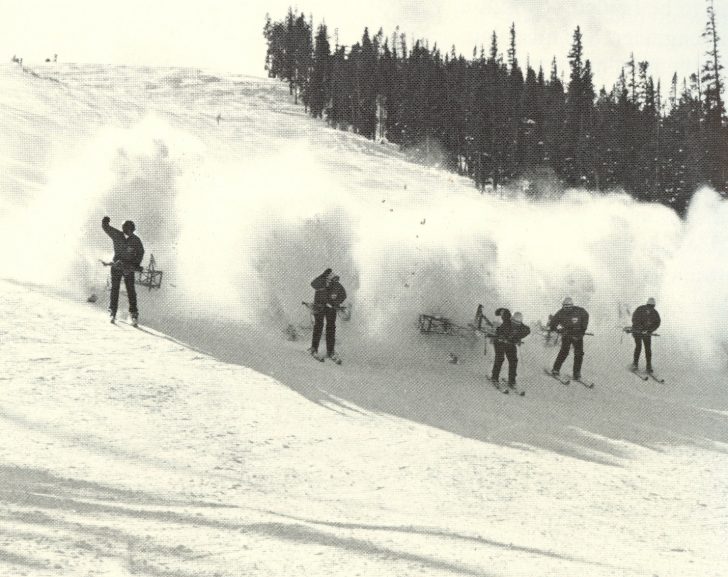
Bombing Down

What is going on here? Party? Race? One thing we will tell you is that this looks like (and was) a very tricky maneuver on skis. One resort made these famous.  Name it? The inventor?  Thanks again to the Colorado Snowsports Museum at Vail.

Last Week

Indeed, this is Alf and Alan Engen doing some father and son ski jumping at Alta circa 1952. Alf was an early ski jumper who mastered Alpine skiing and helped start the ski school at Alta. He and his two brothers helped popularize skiing in the West, especially Utah and Idaho. Alf’s son, Alan, carries on the family tradition today at Alta.

The Alf Engen Museum at Park City contributed this photo.

The photo came from the Museum’s Ray Atkeson collection. Atkeson (1907-1990) was a photographer best known for his landscape pictures, particularly in the American West. His black and white ski photos are considered some of the finest ever captured.

The museum contains more than 300 trophies, medals, uniforms, scrapbooks, skis, boots, photos, films and other collectables that span some 70 years in the career of the Engen family. The museum’s educational component gives school children a skiing-based foundation to study subjects such as the water cycle, physics and Utah’s colorful history.

Alf Engen. Check those pole baskets.

The Museum recently added a fully functional virtual ski experience designed and built by Utah-based company Unrivaled. The ride takes you through an amazing downhill ski experience and even gives the authentic feeling of skiing by adding wind and even snow to the overall downhill experience.


How Wheaties Affected The 1936 Olympics

The Breakfast of Champions Kept Champion Ski Jumper Alf Engen From Competing.

Wheaties Ad 1936, Courtesy of Alan Engen

Legendary extreme athlete Alf Engen, known as the greatest all-around skier ever, was a champion soccer player, skier and ski jumper. During the 1930s, he set ski jumping world records. He helped design and establish more than 30 ski areas in the western United States. And he’s fondly remembered for pioneering deep powder skiing techniques and for his ski school at Alta.

But world champion Alf Engen was banned from competing in the 1936 Olympics because of a Wheaties breakfast cereal box.

It was just the fourth time that countries faced off against each other in wintertime Olympics. Competition included just four sports: bobsleigh, ice hockey, skating, and skiing. Twenty eight countries sent their best athletes to the IV Olympic Winter Games.

As background, Engen came from Norway to the United States in the 1920s, and he played professional soccer. By the 1930s, he was acclaimed for his ski jumping feats, he joined a ski jumping team, and he soon won 16 national ski jumping titles. And his jumps set world records. He also won national titles in all four ski disciplines: ski jumping, cross country, downhill, and slalom skiing.

Alf circa 1933, Courtesy of Alan Engen

Also in the 1930s, radio was the mass media communication method of the era. There was no television. People used their imaginations to create pictures from the words they heard.

But another form of mass media was taking hold: cereal boxes. Until then, breakfast cereal had to be cooked, but when food manufacturers invented cereal that could be eaten right from the box, they faced a marketing dilemma. How could they convince families to switch from cooked cereal to this newfangled ready-to-eat cereal? A cereal box sitting on the breakfast table with pictures of all-star athletes would be the marketing device. And unlike radio, the images were right there on the box.

Four athletes appeared on the Wheaties box—Bob Kessler, basketball star; Mike Karakas, champion hockey player with the Chicago Blackhawks; women’s speed skating champion Kit Klein; and famed skier Alf Engen.

Meanwhile, Engen became an American citizen. In 1935, at the U. S. Olympic Ski Jumping Finals held at classic Ecker Hill, he out-jumped everyone. He was immediately named as a member of the U.S. Winter Olympic Ski Jumping Team which would compete in the 1936 Winter Games in Garmisch-Partenkirchen, Germany.

But just before he was scheduled to leave, Avery Brundage, president of the International Olympic Committee and a zealous supporter of amateurism, ousted Engen from the team because his picture had appeared on the Wheaties box. He declared that Engen’s image on the cereal box made him a professional, not an amateur athlete.

“Engen said he didn’t remember getting any money from the cereal company, ‘Just a lot of Wheaties. I think I gave everyone in Salt Lake City free Wheaties.'”

Alf with trophies, courtesy of Alan Engen

Ironically, shortly after the Olympics, Engen jumped against—and he beat—both the gold and silver medalists from the Olympic Games, Norwegian gold medalist Birger Ruud and Swedish silver medalist Sven Eriksson.

The remarkable skiing Engen family is the only family to have four family member in the U.S. Ski and Snowboard Hall of Fame: Alf, his two brothers Sverre and Corey, and his son Alan.

Alan lives on in his father’s tradition. He’s a champion skier and athlete as well as an accomplished scholar, author, and historian. He carries on the Engen tradition of serving the skiing community.

Alan dreamed of displaying hundreds of Alf’s ski trophies and memorabilia for the public. The dream grew into the $10.5 million Alf Engen Ski Museum at the Olympic Park in Park City, Utah. Visitors can also learn about avalanches, sit in a real bobsled, try their knack at interactive ski jumping, and more. The museum was funded entirely by private donations, including donations from Utah’s famed and philanthropic Quinney and Eccles families. Visit and enjoy the museum when you’re in Utah.

To read more from Harriet, click here for her stories on SkiUtah.

Alf in flight, circa 1936, courtesy Alan Engen


SnowSports Leader: Alan K. Engen

When Alan Engen was born, Dr. Wherritt put wooden tongue depressors—like miniature skis—on the bottom of his little feet and handed the newborn to his legendary father, Alf Engen.

“I think I can safely say that I came pretty close to being born on skis,” says Alan. He learned to ski when he was two.

Thus began a lifetime of ski achievements. He competed at nine, earned a place on the United States Ski Team in the 1960s, and won the United States Ski Association Intermountain Masters Alpine title six times. He served Alta for 50 years as an instructor, the ski school director, and then the Director of Skiing.

Alf Engen and Alan Engen jumping at Alta, circa 1949.

Alan and Alf—both world class ski jumpers —put on jumping exhibitions to demonstrate “Summer Snow,” a cornstarch-like substance. Father and son schlepped the product to the Los Angeles Fair Grounds for exhibitions on a 130 foot jump. In the grand finale the twosome jumped through a flaming hoop. After the demo, they shoveled the “snow” into gunny sacks and hauled it away.

Alan has dedicated more than six decades to skiing (click here to watch a video about Alan’s career) and is a member of the U.S. National Ski and Snowboard Hall of Fame. The Engens are the only family to have four Hall of Fame members: his father, Alf; two uncles, Sverre and Corey; and Alan.

Importantly for the entire skiing community, Alan is an accomplished scholar, author, and historian. His dream to showcase hundreds of Alf’s ski trophies and memorabilia in a small museum grew instead into the $10.5 million Alf Engen Ski Museum at Olympic Park in Park City, Utah. It was funded entirely by private donations (including Utah’s famed Quinney and Eccles families).

Alan with wife, Barbara.

Alan also is an active contributor to SeniorsSkiing.com where he serves on the online publication’s Advisory Council.

His advice to senior skiers: Use new boots, bindings and skis because the technology will help you enjoy skiing more.

This article is adapted from the original which first appeared in SkiUtah.com.

Buddy Up: Senior Ski Clubs Have More Fun

Alan Engen Recounts How Alta’s Wild Old Bunch has been meeting on the mountain since 1969.

With the baby boomers now reaching retirement age, there is a growing population of senior age skiers on the slopes, some of whom are even active in competitive skiing activities.

As a result, senior ski programs are becoming a significant part of many ski area activities in the Intermountain Region.  For example, at Snowbird, Junior Bounous has his “Silver Wings” program.  I used to have an Alta seniors program called “Silver Meisters.”  In addition, various “seniors” ski clubs abound such as The Over the Hill Gang, The One Ski in the Grave Ski Club, The 70 plus Ski Club, and a special group here in Utah called the Wild Old Bunch.

WOB clowning around at Alta circa 1970. Credit: WildOldBunch.com

WOB clowning around at Alta circa 1970.
Credit: WildOldBunch.com

In 1969, several senior ski buddies started the Wild Old Bunch by getting together on a weekly basis to enjoy Alta’s famous deep snow conditions.  The founders were Art Wilder, Foley Richards, Johnny Bell, and Rush Spedden.

Shortly after, Rush Spedden made a home movie of the group skiing powder.  Spedden named the film “The Wild Old Bunch.”  This title gained immediate favor with Wilder, Richards, and Bell.  It was decided by unanimous decree to

adopt the name on a permanent basis. Foley Richards created a patch for identification purposes which, in turn, became the groups logo.  The smile face is well-known around local ski circles and quickly sends a message as to what the group is all about—namely enjoying the pleasure of winter skiing and the companionship that goes with it.

By 1973, the group had grown to about a dozen or so regulars and, by the end of the 1970s, it had about 130 active skiers from ages 50 on up.  Because most of the membership consists of men and women retirees from the hectic pace of the corporate world, they have time to ski whenever they wish throughout the week.  Rush Spedden solemnly told me the club’s rules when I was given my special membership WOB patch.  He said, “The only rule is…there are no rules.”

Throughout the winter ski season at Alta, the Wild Old Bunch can be found congregating at Alta’s ALF’S mid-

WOB is one of the many ongoing senior ski clubs that endure across the country.

WOB is one of the many ongoing senior ski clubs that endure across the country.

mountain restaurant at 11:00 a.m. several times a week.  One of the articles written about the WOB said, “There, they swap jokes, agree to disagree, boost a few toddies and welcome other skiers.”

The driving inspiration binding this group was Rush Spedden who passed away at age 97 in late 2013.  He served as the WOB primary spokesperson for many years.  He was not only an outstanding skier; he was a noted engineer/scientist, teacher and historian in Utah.  Rush Spedden’s generous donation to the Alf Engen Ski Museum Foundation made it possible to add a special pair of handmade skis from the Alaska gold rush days of the mid- 1800s to the permanent exhibit in the Alf Engen Ski Museum near Park City.

Intermountain ski history certainly includes the wonderful contributions of senior groups such as the Wild Old Bunch, and they deserve special mention as ambassadors for the joys of skiing at any age.

Alan Engen is a SeniorsSkiing Advisory Council member and recognized ski historian and author.