Skiing Off Piste: Lessons Learned The Hard Way

He’s Skied New Hampshire’s 48; He’s Pick Up Insightful Tips About The Backcountry.

Editor Note: Ben White skied the 48 4000 feet plus mountains in New Hampshire in a single year as a teenager. We thought the readers of SeniorsSkiing.com would benefit from some of his hard core lessons.

Ben White currently runs White Cloud Adventures in Utah.

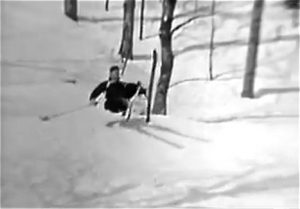
As a young whipper-snapper, I had the incredible privilege and opportunity to ski each one of the New Hampshire 48 in a single ski season before I graduated high school. Like any seventeen year old, I had plenty of my own ideas about how the world worked and how to ski in the backcountry, only to learn the hard way that there were better options.

Bring A Really Good Headlamp

Standing in a light drizzle on top of Bondcliff with Alan and Cathy getting ready to ski and hike out nine miles to Lincoln Woods while the sun set was a great learning moment. Instead of complaining about the rain, I knew that I simply had to do the next thing: Toss on a layer to stay dry and get a head lamp out. Being in high school, I brought along whatever means of light I had. In this case, a mountain biking head lamp my aunt gave me for my birthday a year prior. It was a small, lightweight bulb and housing with a long power cord to a robust battery back, and the special clip to attach it to a helmet that was left at home. Holding the light steady in one hand would make using ski poles and blocking branches funny. So, since it would not attach to my helmet, I held light with my teeth the entire time. After skating out the last four miles of the Lincoln Woods trail, I was soaked, tired, and had a really sore jaw. I have since considered it critical to have a well-functioning headlamp with me at all times when skiing in the backcountry, even for an hour at lunch.

It Is Not All Powder

The main motivation to skiing in the backcountry were visions of untouched powder for miles. Without people or groomers, the snow would have to be untouched, except by animals, and therefore soft everywhere. I can distinctly remember that 46 out of The 48 were not powder skiing. Part of the joy of skiing in the backcountry has been the challenge of putting all of the puzzle pieces together, especially the weather and snow conditions forecasting. My goal was to ski The 48, though, not ski powder every day. When Alan and I skied Middle and North Tripyramid, in the White Mountains, we made turns, but they were on some of the most bulletproof snow I can ever remember skiing. Count on it.

Skiing In The Backcountry Is A Team Sport, Especially In New England

The idea that the backcountry is a place to find solace and fresh tracks away from people is in the right direction, but not on the right track. The backcountry is largely free of unknown skiers clogging up lift lines and skiing recklessly, but learning to ski in the backcountry is very much a team sport. At any point in time, team members can contribute to the success of the group as a whole. This teamwork starts with pre-trip planning, encompasses breaking trail and pulling water bottles out of backpacks, and ends with a short discussion about how the day went when the ski boots are off at the car. Everybody brings a different perspective to the table, and somebody just starting to venture out into the backcountry can ask some very thought-provoking questions of a more seasoned backcountry skier. It pays to listen.

Layering: Every Body is Different

Winter is cold and the threat of frost-bite and hypothermia is very real. Just like any other day of skiing, I would put on a certain amount of fleece before I buckled my boots, then head off for some smiles. Hiking uphill with skis on generates a lot more heat than taking a chairlift and, in turn, sweat. After figuring out that I was so slow moving due to heat management problems, a single 39 year old woman I met on the trail, who was way out of my league, told me that I needed to wear less clothing. After some trial and error, I have found that nothing but a polyester t-shirt, shorts, and shell ski pants is all that I ever want to wear while on the skin track. My friends all wear something else, because they run at different temperatures than I do. Gloves are important to layer as well.

There are more lessons, too. Stay tuned for advice and tips in coming months.

If you have a question about getting started in backcountry skiing or if you want to share your experience, just comment in the box below.
This Week In SeniorsSkiing.com (Oct. 4)

What Pisses You Off.

Last spring, we asked a provocative question in our annual SeniorsSkiing.com Subscriber Survey. We asked, “Thinking back on the 2018-19 season, tell us what pissed you off the most about the following…” Then we listed “On the slopes”, “In the lodge”, “Tickets and passes,” “Restaurant”, “Other skiers”. We also asked what delighted skiers the most, but let’s look at the opposite first. Based on the language in the responses, it is certainly where the passion lies.

We were surprised that so many respondents made comments like the following sample of many more:

Rude and dangerous skiers and boarders
Inconsiderate skiers and snowboarders
Lack of ski etiquette
Out of control skiers
Dangerous skiers
Beginners on advanced trails
Careless riding and skiing
Skiing too fast and too close to other skiers
Not skiing in control
Some are dangerously fast and reckless
Skiing and riding too fast
A few jerks skiing dangerously
Not following safe skiing rules
Risk takers who don’t turn on groomers
Straight-lining on easy slopes
Complete disregard for slower skiers

Respondents also mentioned high lift and pass prices, lousy cafeteria food, long walks from parking lots, and other grievances. However, the out-of-control skier situation is the most disturbing. Why? Because you probably thought that the Ski Patrol would be enforcing the Skier’s Code of Responsibility. Or that the resort’s Ski Ambassadors would be chiding characters acting dangerously. As we have learned from your comments, that apparently isn’t happening much.

Let’s be clear. There is a difference between skiing fast in control and skiing fast out of control. We know many of our readers like the former, but, as we have seen, many are intimidated by the latter.

As a result, SeniorsSkiing.com believes we have shone a light on a key area of ski resort management that needs improvement. The chain of consequences that dangerous, out-of-control skiers brings is significant: the risk of injury from collisions, turning off beginners, seniors returning to skiing, or the occasional skier who spends several hundred dollars for a once-a-season ski weekend, and creating anxiety in grandparents who fear for their grandchildren.

This week, we hear from SeniorsSkiing.com correspondent Roger Lohr about his own close encounter with an out-of-control skier and his thoughts about what to do about the situation.

Let’s hear from you. What can be done to slow down the jerks who can potentially ruin a senior skier’s season? What can we do to influence the industry?

Also This Week

SeniorsSkiing.com correspondent Don Burch offers a clever “Analogy Test”, that challenges your skiing knowledge and your ability to figure out analogies. Be advised, this is not a creme puff test; pay attention.

Herb “The Skiing Weatherman” Stevens follows up last week’s debut article as a SeniorsSkiing.com correspondent with a clear explanation of how the Northwest got whammed with a mega storm at the end of September.

Finally, we are reprising the third in a series of articles on shaping up for the season. This final set of exercises raises the challenge level. Remember, the key to fitness is a consistent routine. Dashing around the gym once a week, pumping as much iron as you can ain’t gonna do it.

Next week look for our first Mystery Glimpse feature of the new season. If you have story ideas or would like to comment, please scroll to the bottom of the page and enter your thoughts in the comment box.

We hope you’re getting ready to go to the ski shows. We know we are. See the discount for SeniorsSkiing.com subscribers at the top banner ad or click below.

Remember to please tell your friends about SeniorsSkiing.com. As usual, there are more of us every day, and we aren’t going away.

Short Swings!

What about that Big Dump last week in the West!!!!!!

If you’re like me — waiting for the first signs of Winter — the season is now on its way.

These areas plan to open in October:

  • Wolf Creek, CO – 13th October
  • Killington, VT – 19th October
  • Sunday River, ME – 19th October
  • Arapahoe Basin, CO – 20th October
  • Loveland, CO – 20th October
  • Wild Mountain Ski and Snowboard Area, MN – 20th October
  • Mt. Rose Ski Tahoe, NV – 20th October
  • Mount Snow, VT – 20th October
  • Wildcat Mountain, NH – 27th October

SeniorsSkiing.com is now publishing every Friday.

Two big issues for senior skiers surfaced in recent reader surveys. 

  • One is your interest in finding contemporaries with whom you can ski. 

  • The other is being hit by reckless and out-of-control skiers and boarders.

To address finding skiing buddies, I’ve asked a digital-cartographer friend and avid skier to help us identify a meeting place that could apply to all ski areas. The idea is to set a time (e.g. 10AM) when members of the SeniorsSkiing.com community could show up at a specific location and, displaying a SeniorsSkiing.com sticker, meet other readers with whom to take some runs. 

Courtesy: University of Utah J. Willard Marriott Library Ski Archive

What are the unresolved issues? 1) Identifying a location that would apply to all areas. If in the lodge, should it be a table closest to the end of the cafeteria line? Near the main entrance? Etc. If you have any ideas of how to do this – without involving area management – please send an email or post in Comments.  2) Supplying readers with the identifying SeniorsSkiing.com sticker. That’s the easy part: Email me your name and address, and we’ll send you a supply. My email address is jon@SeniorsSkiing.com.

As for the reckless/out-of-control skier problem, take a look at the reader comments in Mike’s This Week message. It’s not a trivial matter. Many readers report on slope hit-and-runs. Many more report near misses. Getting hit when you’re in your 60s, 70s, or 80s has more life-altering consequences than when you’re younger.

Something needs to be done. We’ve approached National Ski Patrol to inquire about their policies and to see if they would be open to exploring a collaborative effort to improve the situation. We’ll report what we learn. In the meanwhile, if you have suggestions to remedy this dangerous epidemic of unsafe skiing, please email them to the same address as above.

Finally, if you like SeniorsSkiing.com, please help spread the word by introducing your skiing friends to the site.  

Despite Serious Neurological Disorder, He Continues to Ski

Nick Manely in France

Nick Manely, a SeniorsSkiing.com reader and avid skier has been managing a Functional Neurological Disorder for several years. He’s based in Colorado where he coaches at Eldora Mountain and works at Larson’s Ski Shop in Denver. In September, Nick presented about his condition and skiing to a group if physicians and researchers at The International Congress of Parkinson’s Disease and Movement Disorders in Nice, France.

Vermont Adaptive Ski and Sports Seeks Volunteer Instructors

Vermont Adaptive Ski and Sports is the state’s largest year-round disabled sports nonprofit. The group looking for energetic winter volunteer-instructors. Volunteers will be trained to help teach and lead the organization’s winter programs that include Alpine and Nordic skiing, snowboarding, snowshoeing, indoor rock climbing, veterans retreats, and wellness programs. For more information or to sign up to volunteer, complete the application at www.vermontadaptive.org/get-involved.
 

Economical Resource for Small to Plus Size Parkas and Pants

Many Senior Skiers have difficulty finding properly fitting ski clothing. One old friend, quite petite, is always checking ski shops for good-looking things. Sometimes she has to settle for children’s items. Another friend is at the other end of the size spectrum. She, too, has difficulty finding quality skiwear in her size. I know they’re not alone. That’s why I’m delighted that NW Sales Connection has become a SeniorsSkiing.com advertiser. The company offers a wide range of skiwear in a wide range of sizes. Their initial ad focuses on women, but the site covers women, men, and children. The cost of ski clothing on the site tops out at $139.99, and everything is marked down. There is a 30-day return policy (longer over the Holidays). Please click on the NW Sales Connection ad and welcome this valuable resource to the SeniorsSkiing.com community. As an additional incentive to SeniorsSkiing.com readers, NW Sales Connection is giving a 10% discount for purchases made between now and October 15. Enter “welcome seniors” in the discount code box during check out.

The Easier Way To Get Your Boots On

This is the surefire solution to getting feet into boots, even when your boots are cold. It’s the compact, never-fail, Bootster, a clever little device utilizing a slippery material that helps feet slide effortlessly into ski boots. Several things make this a particularly nice product: Bootster reduces the effort of getting boots on. And, it fits into your parka pocket, so you can take it with you and use it to get your boots back on after lunch. At $25, it’s highly affordable and makes for a thoughtful gift for the older skiers on your list. To learn more click here or on the Bootster ad on the home page.

Solar Powered Task Light

We receive lots of offers to review products and to try things that companies would like brought to the attention of our readers. Most are irrelevant or unworthy. But this one got my attention. It’s a light weight utility light powered by choice of solar or by your computer’s USB port. The flexible, yellow silicone arm wraps around almost anything to position the light where you want it. It has four settings, three to adjust the light intensity and one to make it flash. I envision this as a nifty addition to camping gear or just to keep in the car or at home. Mpowerd, the company that makes this and other similar products, works with non-profits to send lights to people living without access to electricity. Luci®  Core, MSRP $14.95. Available from most outdoor retailers or directly from https://mpowerd.com

Remember Ski Ballet?

Skis of Glory is a brief video recapping that highly visual and entertaining era.

Subscribers Only: The Best 2020 Skis for Senior Skiers


Each year, SeniorsSkiing.com collaborates with Realskiers.com to inform its readers about skis that allow older skiers to turn more easily and to ski longer without tiring. Women’s skis – sometimes engineered for female size and physique – are included. 

To find the list on the site, a) click “Community” on the menu bar, b) click “Subscriber Only Content” in the dropdown box, and c) click on “Ski Recomendations for Seniors 2020.”

The skis were identified during Realskiers.com’s annual national ski evaluation process.

Most of the selected skis have relatively soft flex, which helps them engage the snow with minimal exertion. Regardless of one’s physical condition, using skis with these characteristics allows older skiers to turn more easily and to ski longer without tiring. 

The recommended skis are grouped into five categories, each based on the ski’s width, which helps determine the terrain where its performance is optimized. 

SeniorsSkiing.com recommends that when purchasing new skis, older skiers should start by choosing the most suitable category and work with a quality ski shop where they can demo before purchasing.

The characteristics of each of the five categories follow:

Frontside (“Carving” skis) 

  • Encompasses broadest range of skier abilities from entry-level to experienced
  • For use on groomed terrain. Wider models are usable off-trail 
  • Ski width: 75MM-84MM

All-Mountain East 

  • Works equally well on- and off-trail 
  • Good “re-entry” ski for those who haven’t skied in a few years 
  • Ski width: 85MM-94MM

All-Mountain West 

  • For use in the West by high performance skiers
  • Adapted for off-trail use but can be skied on-trail by skilled skiers
  • Ski width: 95MM-100MM      

Big Mountain 

  • A more maneuverable powder ski
  • Inadvisable for regular on-trail use
  • Ski width: 101MM-113MM

Powder 

  • Specialty ski for use in Deep Powder only 
  • Ski width: >113MM

Detailed reviews are available at Realskiers.com. The site provides free access to equipment reviews and other information. In depth information and personal guidance from the publisher is available to SeniorsSkiing.com subscribers at a discounted annual rate of $9.95. To sign up, visit Realskiers.com. Scroll down to/click on “Subscribe Today!” Then click “Sign Up” in the “Annual Membership” box. Complete the form and enter SS20 in the field under “Coupon Code.” 

Blind-Sided And Body-Slammed

Is It Time To Address Ski Slope Collisions? How?

[Editor Note: This summer, we published a little play about the speeding, out of control skier and what the ski patrol can do about it. You can read it here. Bottom line: It’s not their job, at least, that’s the party line. They are there to maintain the lines, help injured people, sweep the slopes. They are not trained nor prepared to confront unruly or out of line customers who are not complying with the Skier’s Code of Responsibility. What to do? Here’s SeniorsSkiing.com XC editor and publisher of XCSkiResorts.com publisher Roger Lohr’s story about his collision and consequences.]

This year, I was one of the many skiers and riders who got blind-sided and body-slammed by someone on the slopes. After seeing me bounce into the snow a couple of times and violently twist my lower body, the “guy in orange” who plowed into me said nothing and skied away. No apology, no asking if I needed help.

I got up slowly after the collision and immediately thought about how effective my new MIPS helmet worked. Just afterward, I felt shooting pain in my lower back.

Out of the corner of my eye I saw the guy in orange about 40 yards away. He had stopped and was looking across the terrain at me while I was taking stock of my bruises and sprains associated with the collision. Then he took off.

I stopped in at the patrollers’ cabin and saw six guys sitting at a table. I requested some kind of heat compress or rub for my pain and was told that they are not allowed to distribute anything like that.

This incident was in fact, the third collision that I’ve had in recent years. What can the industry do to deal with the increasing number of slope collisions?

Can we blame lack of skill in the kind of collision I experienced? It might have been a miscalculation of his line, his ability to change course, his maintenance of too much speed, inattention, an obstruction, etc.

The collision occurred near the bottom of the slope, so was there a chance that I cut him off? Would more patrollers on the slopes talking to people about control, speed, where they stop, and so on, make a difference?

I often ride the chair with patrollers but I don’t remember the last time I heard from a patroller out on the slopes. I can’t say that I’ve seen many of them speaking with skiers and riders about unsafe situations. Would a broad skier/rider education campaign about speed and skiing in control make a difference for safety purposes and curtail the collisions?

As I’ve aged I’ve become much more cautious keeping an eye on the slopes around me. In my collision situation, I was heading to the lift line and did not look up the slope for five seconds on a day when there were very few people skiing. I paid for those seconds with medical bills and three weeks of pain.

The statistics on ski area collisions are mounting and this past spring’s SeniorsSkiing.com reader survey showed a serious concern among site visitors about these incidents. And we all know parents who have freaked out watching their child get steamrolled and mangled on the slopes.  It is not only older skiers who have cause to worry about collisions.

What happened after I was hit was significant. The speedster took off, offering no help and no curiosity as to whether I was injured.

There are seven points in the Skier’s Responsibility Code about staying in control, avoiding others, stopping in places that do not obstruct, and the like. There is no suggestion in the code that there is any responsibility to help a victim or check that the subject who’s been hit is able to ski away after the incident. Yeah, you’d think it was common courtesy for the slammer to apologize and see if aid is required but in my experience and other incidents that I’ve heard about, this is not the case; this is not standard protocol.

I understand the ski area operators’ perspective: no one wants a “patroller policeman” yelling at guests, but can we develop a more robust educational campaign to curtail slope collisions and incorporate a new tenet for courtesy when such incidents occur? Can we amend the Skier’s Responsibility Code to include helping people who are hit?

Analogy Test

SeniorsSkiing.com Analogy Test

[Editor Note: Thanks to SeniorsSkiing.com Correspondent Don Burch for this challenging test. Good luck, you’ll need it. Answers at the end.]


Jet Stream

The Skiing Weatherman: Monster Storm Smacks Early

Snow At The End Of Summer Dazzles The Northwest.

How is it that a storm can produce a four foot snowfall before the first week of the new season is over!?  That is exactly what happened last weekend as portions of Montana got absolutely buried.  Parts of Idaho, Washington, California, Oregon, Wyoming, and Colorado also saw snow, which undoubtedly got skiers in those states really fired up, as well.

How does a storm of that magnitude happen in September?  Well, first, you need a dynamic jet stream pattern, with plenty of amplitude in the troughs and ridges strung out across the hemisphere.  Here is the jet stream map from Saturday morning.

Jet Stream Last Saturday

Notice the strong ridge in the Gulf of Alaska.  That feature is consistent with the warm pool of water discussed in last week’s article.  The ridge’s clockwise circulation helps to tap colder air from the high latitudes of the northwest corner of the continent, and that cold air flows directly into the trough as it strengthens over the Northwest on the map. 

The trough is where rising air is found, and the stronger the trough, the more effective it is at drawing cold air southward.  Rising air cools, and in this fashion, strong troughs can actually “manufacture” their own cold air, which helps fight off the more seasonable air found away from the center of the circulation.  Everything has to be just about perfect to create the cold for a snow producer like last weekend’s storm, and it pretty much was a perfect setup.  Here is a look at the anomalies of air found in the mid-levels at the same time stamp. 

Temperature Anomaly: Deviations From Normal

You can see that the deviations from normal were on the order of 8 to as much as 18 degrees below normal (Centigrade) when the trough was at its strongest, plenty cold enough to support early season snow, even in the relatively lower elevations.   Not surprisingly, if you follow the bulge of the coldest air southward from the core that is located in southern Canada, it points right at Browning and Cut Bank, Montana, two spots that saw some of the deepest snow. In order to produce four feet of snow, you need plenty of moisture, and the broad fetch off the Pacific delivered the goods. 

While the storm was a record breaker in many locations, you might be surprised to know that autumn snowfall in North America has shown an increasing trend in recent years, as this chart clearly shows.

Autumn Snowfalls Since 1997

Early season snow across Canada and the northern U.S. helps refrigerate autumn air masses before they spread out and move further south, so I interpret this snowfall as a positive sign for the early stages of the upcoming season.  If you are looking for the next early season dump, keep your eyes open for the next trough to dig into the Northwest/northern Rockies.  

Shape Up 3: Challenge Yourself

Five Basic Exercises Ramped Up To High Intensity Levels.

[Editor note: This is the third and final in our series of preparation exercises for senior skiers from Rick Silverman, physical therapist and certified strength and conditioning specialist. We started with basic hip and leg exercises (Oct 25), raised the intensity of those (Nov. 7) and now present a more challenging level of those same exercises.  As you can see, these are clearly a step up in intensity. Use these to extend your exercise program.  If you haven’t been limbering up so far this season, don’t start here.  Seriously.  These are challenging.  As always, if you have any issues, complications or questions, consult your medical advisor before beginning.]

 Quad Squat Jump

Last time, we introduced the Static Quad Wall Sit.  In this one, we get dynamic. Use a small exercise ball or a light weight. Squat down, jump up.  Repeat.  Try doing this for 20 seconds on, 10 seconds off for two minutes.

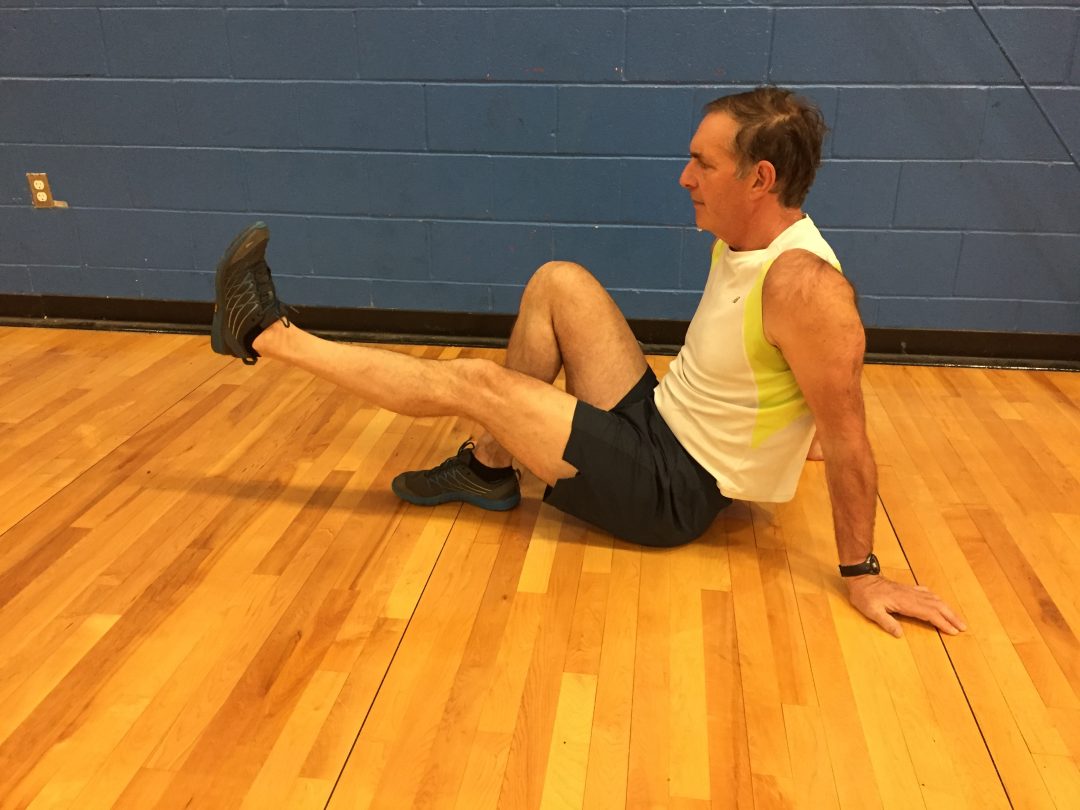
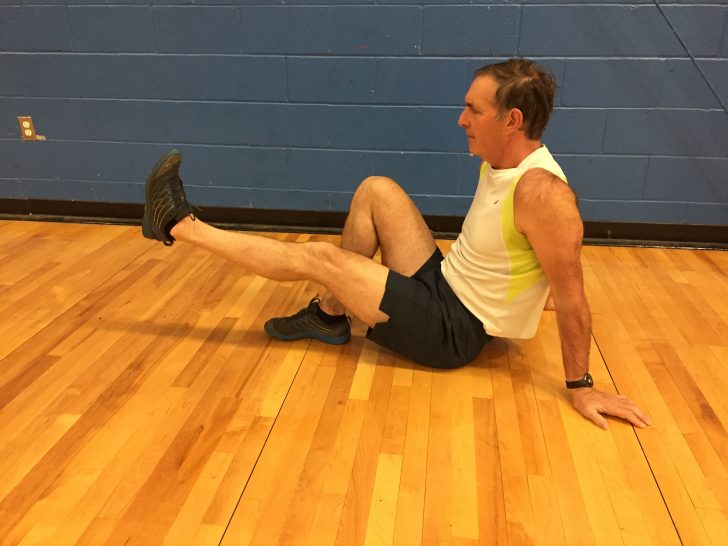
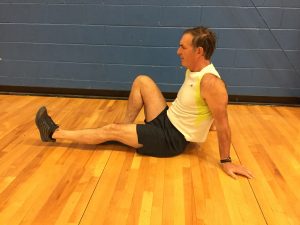
Leg Raise Sitting Up

The key is straight leg and toe pointing up.  Support yourself on your hands.  A variation is to point your toe inward on the way up and outward on the way down.  And vice versa.  Don’t let your heel touch.

legraise_situp_1legraise_situp_2


Dynamic Lunges

Rick has been a Telemark skier for 25 years.  He said this move imitates the same leg motion used in making Tele turns.

Hamstring Bridge

Keep the ball rolling in and out.  Use a chair with rollers.  Watch your lower back on this one.

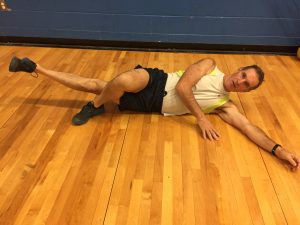
Inner Thigh Lift

In previous articles, we showed you how to work your glutes and outer hip flexors.  Here’s one to use for the inner thigh.  You might want to rotate through all three exercises in your work out.

hipflexor_inner


A huge thanks to Rick Silverman for showing us how to ramp up for the snow sports season.  If you don’t have a regular exercise work out habit, consider starting with our first series of exercises here.  But, please, don’t start the season without some physical preparation.