This Week In SeniorsSkiing.com (Jan.10)

Where The Snow Is In The East, A Ski Learning Tool, Grandparents Teach Munchkins, Weather Coming, Apres Fire-ish Cocktail.

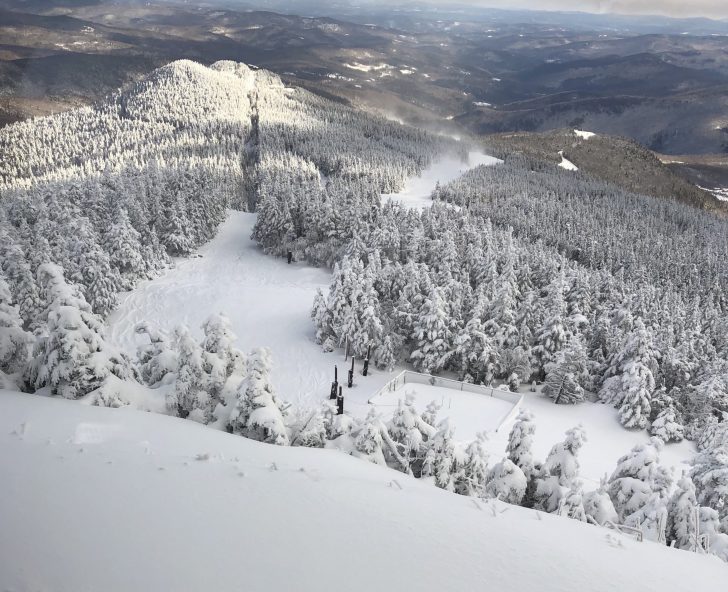
Lots of snow in view from Peak Lodge, Killington (4,236 feet). Credit: Roger Lohr

Sounds as if the West is off to an incredible season. Snow packs in Colorado and Utah are already over normal amounts, the Northwest and Western Canada is getting more new snow.  So there’s lots of visitor activity.  A quick scan shows most Colorado resorts have 100 percent of their lifts spinning.  A number of our skier friends here in New England are leaving for the West this week or next.

Meanwhile, in the East, the season is emerging.  The higher altitude resorts in New Hampshire, Maine, and Vermont are making or collecting snow very nicely; lower level areas are, as of this writing, making the most of machine grooming.  Obviously, tall mountain resorts have an advantage in quixotic winters like the one we experiencing here. How much advantage?

Temperature cools with elevation. In fact, for every 1,000 feet in altitude, the temperature drops 5.4 degrees F (9.8 degrees C for 1,000 meters). For example, the top of Mt. Mansfield in Vermont is 4, 395 feet (1,340 meters), and Mt. Sunapee in mid New Hampshire is 2,726 feet (831 meters). That’s a difference of 1,669 feet (508 meters), for a more than nine degree difference in temperature between the two at the top.  The base can be another 1,500 or more feet under that. As of this writing, Stowe has 80 percent of its trails open, Mt. Sunapee has 56 percent.  Ideal snow-making temperature is 28 degrees F (-2-2 C). Clearly, marginally cold days like those we’ve been experiencing in New England are going to favor high resorts.

Last August, we surveyed the usual forecasters for their views of the 2019-2020 winter.  For the most part, the consensus was a frosty and snowy West and a “mixed, wet and wild” East. The Boston Globe published NOAA’s winter outlook in October which seems to be squaring with what we are seeing. These predictions point to warmer than average temps in the East. It appears that prediction is coming to pass. So far, lower altitude resorts are impacted more than the higher ones.

The point: The resorts at lower elevations have to, no, must do a fantastic job at snowmaking whenever it gets cold enough. If it gets cold enough.  It is a key survival objective, and the path to a successful season and future.  No wonder we’ve been seeing major investments in snowmaking in New England in the past few years.

This Week

How do you learn to improve? We’ve had our own experiences in physical skill learning, from taking horse riding lessons to playing music (more physical than most non-musicians realize). What we have found is that two factors make a huge difference in efficiency of learning.  The first is clear intellectual understanding of the concepts involved.  What do we mean by edging, for example? Boot pressure? A clear mental model of what has to happen and how comes first.  Then, we need to practice and get feedback, the second major factor.  Feedback from both others and our own senses.  In his story on the Intention/Attention Feedback Loop, ski coach Bob Trueman explains how these concepts are included in a simple model for improvement.

We reprise Harriet Wallis’ story on advice for grandparents who want to teach their grandchildren. Check out her “non-obvious” tips for getting your munchkins on the snow.

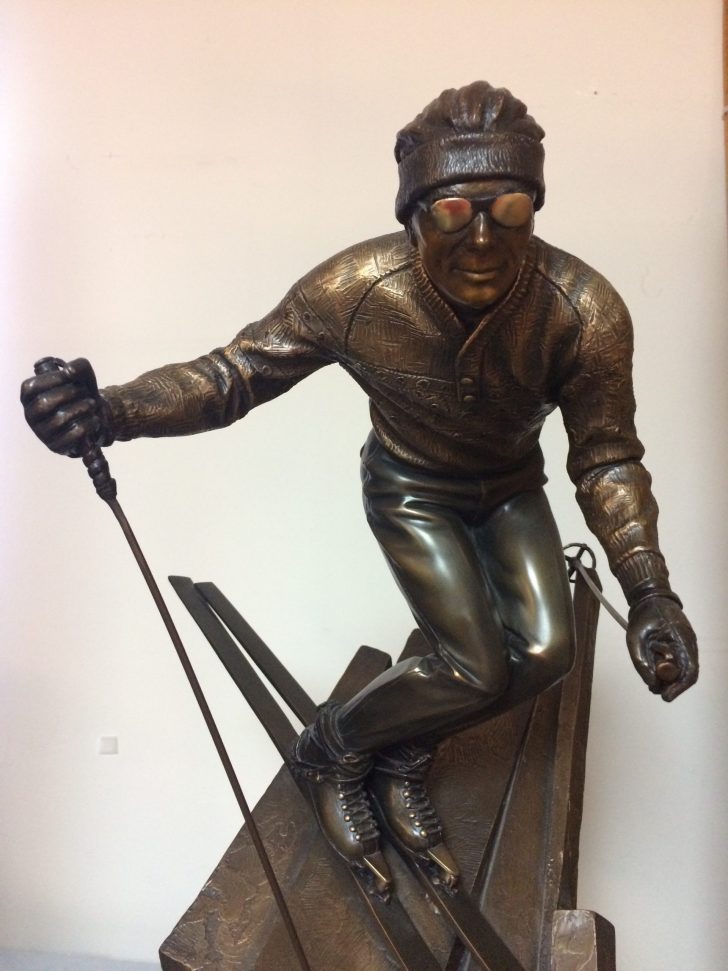
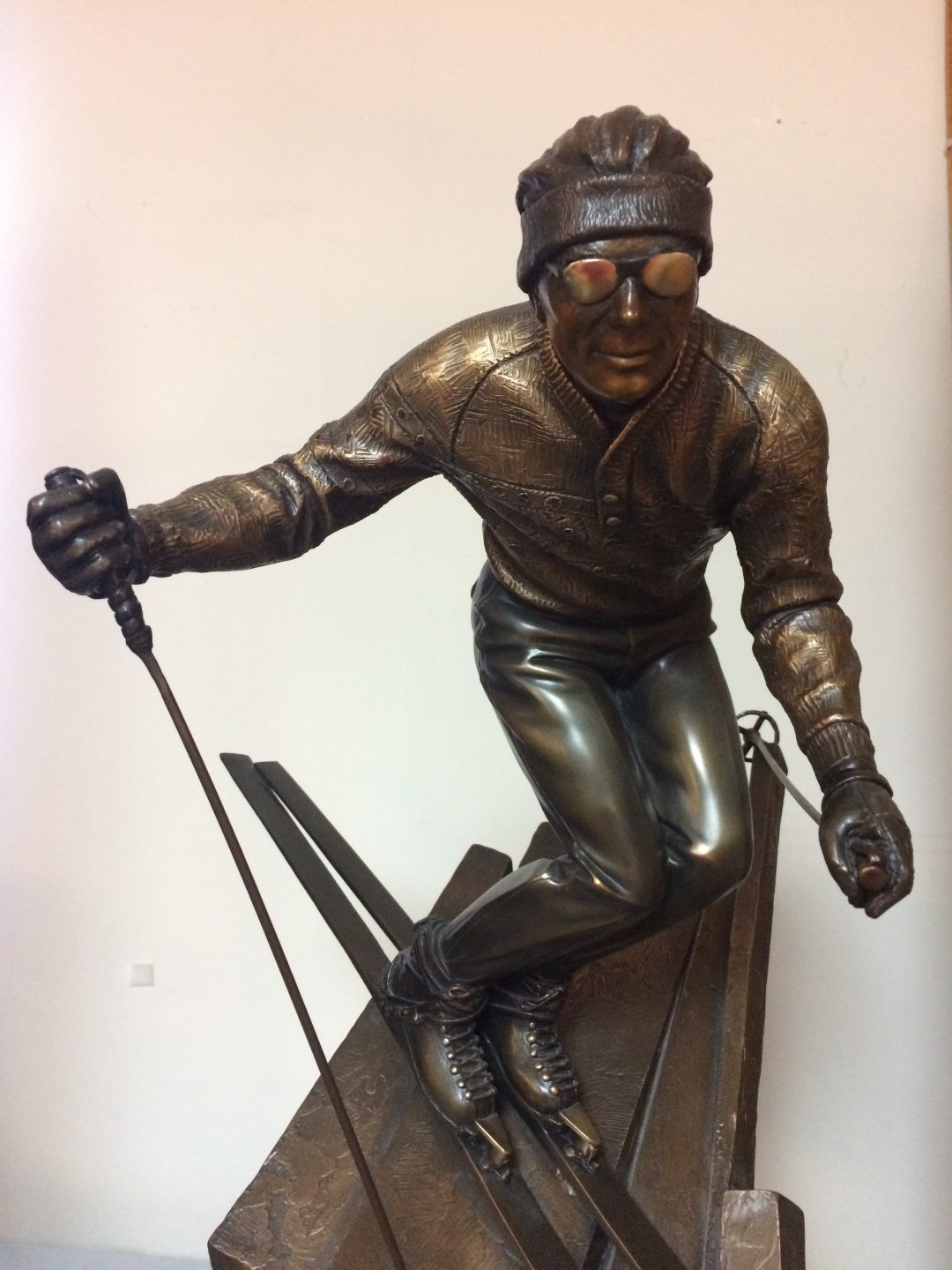
This week’s Mystery Glimpse shows two racers, one a junior, the other a senior veteran. Guess who’s who. Thanks to the Thread of Pioneers Museum, Steamboat Springs, for the pic.  We reveal the story behind last week’s picture of the bronze sculpture from the Colorado Snowsports Museum and why it is a significant embodiment of ski history.

Yes, apres-ski can be interesting, too. Here’s a story from Yvette Cardozo about a fiery, smokey cocktail from a clever bartender, hanging out in Den Bar and Bistro in Silver Star, BC. Creative, artisanal libations might be perfect for the end of a perfect day.

Along those lines, below you can find “Two Cubes And A Slug of VO” from Ray Conrad’s album The Cotton-Pickin’ Lift Tower, a 60s collection of skiing songs available through SeniorsSkiing.com.  Click here to purchase and download the whole album.

Finally, Herb Stevens, the Skiing Weatherman, sums up the next week’s weather across North America.

Thanks again for reading SeniorsSkiing.com. Please tell your friends.  Remember, there are more of us every day and we aren’t going away.


Short Swings!

I don’t know how it happened, but between last season and this one I lost my custom foot beds. They were made about 15 years ago when I purchased my first Surefoot customized boots and, like the boots, they were pricey. Those beds stayed with me over the course of three or four subsequent boots. Then they were gone.   

Foot beds can improve ski performance by stabilizing the feet in a way that helps maximize the ski boot’s primary role: transferring energy from body to skis. That, admittedly, is a gross oversimplification. There are master boot fitters with medical-grade knowledge of foot anatomy, especially as it relates to skiing. I plan to solicit an article or two from one of these experts about the intricacies of creating an effective foot bed.

Brannock Device

But this week I needed new foot beds and visited the Dale Boot store in Salt Lake City to have them made. The whole process took about 20 minutes. The fitter started by measuring my feet with an old-fashioned Brannock, the same device that fascinated me as a kid in my grandfather’s shoe store in Schenectady, NY.  Next, I placed my feet in a Masterfit machine that took an impression of the contours of my foot soles. He then placed Masterfit foot beds in the machine where they took on the shape of the bottoms of my feet. That was followed by cooling the beds with cold packs and trimming some excess material before placing them in the boots. 

Patrick, the boot fitter, clearly knows his stuff and approaches his job with the same quiet pride I’ve noticed among other boot fitters. Boot fitting is a craft in which many of its practitioners appropriately treat it as a profession. He attends educational workshops including Masterfit University and related courses. He mentioned the pleasure he gets sharing war stories about helping all kinds of people with and without foot problems to get the most out of their boots.

Quality ski and boot shops provide boot fitting as a service built into the boot’s cost.  Getting foot beds customized (typically a $100 – $200 add-on) or purchasing boots with the help of a professional boot fitter is clearly a smart step to greater comfort and performance. A resource for well-trained boot fitters is America’s Best Bootfitters.com.

A few months ago, Jackson Hogen of RealSkiers.com, suggested rewarding the work of these pros with a gratuity. Given the critical service provided by fitters like Patrick, I could not agree more. 

Fire Claims Aussie Ski Resort; Others Threatened

Australia’s devastating fires destroyed Selwyn Snow Resort, the country’s most northerly ski area. The New South Wales resort employed 60 during the season.  Falls Creek and Mt. Hotham  in Victoria are being evacuated. 

Bait and Switch at Northstar?

Two older skiers are suing Vail Resorts for breach of contract and fraud. The essence of their complaint is that Vail, which owns, Northstar Resort (CA), sold non-refundable season passes before announcing a parking fee. According to the claimants, the cost of parking will add thousands of dollars to their cost of skiing at Northstar. Each is seeking free parking and $200,000+ in damages.

Good News For Taos Skiers

Taos Air is now servicing the Carlsbad-San Diego and Hawthorne-Los Angeles airports, starting at $125, one way. The service is available Thursdays, Saturdays, Sundays, and holiday Mondays through March 29. The airline started last season with daily direct flights to Taos from Dallas Love Field and Austin-Bergstrom International. The airstrip is 30 minutes from Taos Ski Valley.

Tree Well Safety

Courtesy Ski California

Suffocating in deep snow is a concern for many Western skiers. Evergreen branches capture snow, cusing deep pits to form around the tree’s base. Skiers falling into these “tree wells” are subject to breathing in powder snow. The problem is exacerbated by landing head-down or injury. It’s extremely difficult to get out, even with help from others. I had the experience years ago catskiing in the Canadian Selkirks. Fortunately, the well wasn’t too deep and the person I was with got me out quickly. Fifteen tree well deaths have occurred in California since 2001, the most in the nation. Tree well safety advice is available from Ski California, the state’s ski area trade group. Click here for more.

Winter PrideFest Jan 30 – Feb 2

Winter PrideFest, the multi-event weekend celebrating diversity and inclusivity of the LGBTQ+ community and its allies, will hold its third annual gathering January 30 – February 2 in Bend, OR and Mt. Bachelor. Activities include  skiing, snowboarding, snowshoeing, ice skating, panel discussions, and evening social functions. For information or to register, click here.

Senior Deals at Belleayre

Belleayre, the venerable Catskills ski area north of New York City has great deals for senior skiers during the second week of January, February and March. Skiers and boarders who are 65 or older get a lift ticket for $10, when they go with anyone with a paid lift ticket, and they can purchase coffee for $1 and breakfast sandwiches for $2.

Happy 80th Harriet!

Harriet Wallis, a prolific contributor to this publication, celebrated her 80th birthday at Alta earlier this week. What a silly helmet cover!!!

Alta Old Timer Celebrated in New Video

Lloyd Johnson moved to Utah for work in 1973, having never skied before. One Sunday, after an Alta church service, a friend convinced him to give skiing a shot. Now, at age 87 and almost five decades later, Lloyd is still making beautiful tele-turns at Alta,  His kids and grandkids follow his tracks. This short video tells his story, one that reflects the lives and loves of many dedicated skiers.


The Skiing Weatherman: Changeable East, Snowy West and Mid-West

The West Continues To Luck Out, Cold Coming East By Month End.

Despite a wildly changeable run of weather in the East recently, I managed to get two days of wonderful winter turns in early this week. It snowed on Monday at Sugarbush as I skied packed powder with my son. Wednesday at Killington surfaces were just about perfect packed powder early on and then an arctic cold front arrived. It brought fresh snow: three inches in 30 minutes! An absolute whiteout that gave me a chance to focus on my toes with each turn, a method I was taught decades ago to deal with low visibility. It still works!

Changeable weather will continue to rule short term in the East while much of the West continues snowy, but that imbalance will be changing in the near future. The past couple of weeks, the jet stream maps across the continent have featured a trough centered over the West and a ridge over the East. The trough has produced tons of snow, particularly in the Northwest and coastal ranges of British Columbia.

As this week comes to a close, another storm will cut southeast from the Gulf of Alaska and dump on B.C. as well as the WA and OR Cascades. Lighter snows will reach down to Tahoe as well as the northern and central Rockies. Over the eastern half of the country, a low will cut northeastward through the Great Lakes and into Ontario and Quebec.  That’s great news for the resorts of Michigan, where significant snow will result. Further east, the northern track forced by the strength of the southeast ridge means another mild, wet event this weekend before colder air returns Monday. The “cutter” track is consistent with the current warm state of the MJO, as discussed last week.

Changes are coming, though, and by the final week of the month, the changes will be dramatic across the country. A pool of very cold air has been building in central and western Canada and due to the density of that air mass, it will start to spread southward and eastward. Here is a look at a forecast for the 5,000 foot temperature anomalies for ten days from now that I agree with.

The 5,000 foot level is a forecasting proxy for surface temps, and you can see that a large mass of colder than normal air will cover much of the eastern half of the country by 19th or so. Meanwhile, the West will turn a little warmer than normal, but not until after some of the arctic air descends through the Rockies later next week. At the jet stream level, the setup will flip, and we will find a trough in the East and a flat ridge out west.  Here is a reasonable jet stream forecast for the same time.

Now, any change in air masses and jet stream features of this magnitude will come with a stormy transition, so there is reason for optimism for eastern snow, at least north of the Mason Dixon line, from late next week onward. Once the new pattern settles in, I expect it to dominate through the bulk of rest of the winter, due to the anticipated influence of the warm water pool in the northeast Pacific Ocean.

Here are the regional details.

Northwest U.S./Western Canada: Another heavy snowfall is coming this weekend, light snow in AB.

Periodic lighter snows will continue next week as arctic air presses southward.

Cascades and Sierra: Snowy weekend with heavy amounts in OR, tapering down further south in CA.

Lighter snow continues next week as it turns windy and colder.

Rockies: Northern Rockies catch light snow this weekend but as several upper level short wavelength disturbances move through the first half of next week, persistent light to moderate snow will provide daily “refills”. Each successive trough will draw arctic air further south, reaching the Tetons by mid-week. Light snow in central Rockies first half of next week.

Midwest: Messy weekend storm lower Lakes, snowy in northern Lakes, narrow ice storm in the middle.

Some light snow northern Lakes from a Clipper or two next week.

Northeast/QB: Another cutter brings wet and icy weather to the northern mountains of NY/New England this weekend, snow up in Quebec. Renewed snowmaking and light Clipper snow next week, with bigger storm threat late. Pattern will look much better a week from now.


Out Of Control

Int/Att Loop: A Technique Improvement Tool

After So Many Years, Can You Improve? Here’s A Way.

Time to improve? You can do it with the Int/Att Feedback Loop. Read on.

First, do you want to improve your skiing?  If you don’t care that much, read no further.  If instead you still have a hankering for greater skill and more satisfaction, then the good news is “Yes, you can”.

The “Int/Att Loop”© gives you the tools to do it.

But improvement doesn’t come by doing what you’ve already been doing for years.  If you always do what you’ve always done, you’ll always get what you always got.  If your choice is to become more skillful, then your choice is to change.  To change, you need to:

  • Know what to change—should you do something different, or something differently?
  • How to change it
  • Have a set of tools to do it with.

You will also need one other commodity—persistence.  The great joy that comes from going on such a journey is that it’s an adventure that delivers huge satisfaction.

What is the Int/Att Loop©?

Back in the 70’s and 80’s two of Britain’s top coaches uncovered how humans learn to do physical things.   Through considerable research, they identified a process that is simple to understand and use. 

This process is not how to ski, nor how to have a skiing vacation, it is how to effect the kind of performance changes you desire.  It has to to do with two completely separate nervous systems we have:

  • the Efferent system
  • the Afferent system.

Let’s say, you make a decision to do something.  This is your INTENTION.  The message from your brain to your muscles is carried by the Efferent system.  But your brain needs to gather information from your senses to know that the instruction was carried out and what the effect was.

That information sent back to the brain via the Afferent nerves. Now, you are paying ATTENTION to those sensors.  With that information, your brain can modify the next actionable decision to slowly bring your performance to where you want it to be.

Intention/Attention forms a feedback loop.

It is explained much more fully in many of the instructional videos you can find via www.bobski.com.

Your Action Plan For Better Skiing.

So, how do you use this dual nervous system concept?

Say you’re on a gentle bit of piste.  You intend to work on some aspect of technique.  You will only ski in very short sections—no more than 100 yards at a time.  Here’s how it goes  

  1. Choose a task – something simple such as “link two arcs together seamlessly”.
  2. Decide on one very small element of behavior—something simple such as “flex my ankle ALL the time”.  That message will be sent by your Efferent system.
  3. This is important: You must then decide beforehand which of your senses you will pay heed to that will constitute a message back to your brain via the Afferent nerves.  Most likely, in this case, it will be a feeling of constant pressure between your shin and the front of your boot.  But for some other task it might be what you hear or see.
  4. If you were working with a coach, you would stop after the very short distance and report to her what you felt.  Not how you felt.  Not what you “thought”.  This is not about thinking.

What you are attempting to do is to develop within yourself the ability at all times to be aware of what you sense, within the context of a simple and very powerful, plan.

This works.  Watching someone else ski doesn’t work.   “Getting the miles in” doesn’t either.   If you find this interesting and have specific questions, don’t hesitate to send me them at bobski@bobski.com 

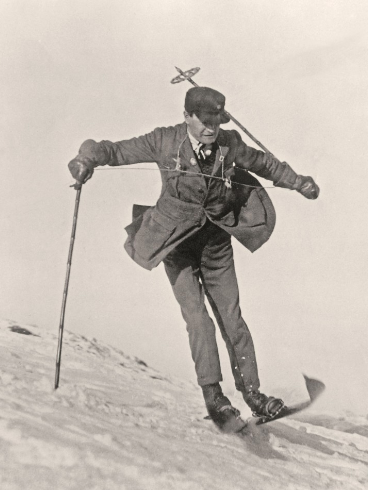
Mystery Glimpse: Two Racers

One Very Young, The Other A Successful Competitor.

Many thanks to the Tread Of Pioneers Museum, Steamboat Springs, for this photo. Visit their online collection by clicking here.

Last Week

This is George Lundeen’s bronze statue, The End of An Era,  circa 1960. Why is it significant? Here’s what Dana Mathios, Curator and Director of Collections, Colorado Snowsports Museum, has to say:

This sculpture depicts a sport poised at a turning point on the edge of change. Soon, metal and synthetics would become standard in ski construction in place of wood that had been in use for more than 4,000 years. Pioneering skiers used a single wooden pole. By the early 1900s, two poles were in fashion. The shafts were often made from bamboo until superior poles of a light metal alloy were developed. Higher, plastic ski boots featuring buckles marked the passing of lace-up leather boots.

Also depicted in the sculpture is an early version of a safety binding designed to release the toe of the boot in a fall. A leather thong anchored the heel to the ski. More advanced safety bindings that released both the toe and the heel of the boot followed.

Early in the development of Colorado’s ski industry, the Pikes Peak region offered a number of small ski areas. Nearby slopes at The Broadmoor Hotel and others on Pikes Peak at Glen Cove, Elk Park, and Holiday Hills were popular. The region also included Tenderfoot Hill at Cripple Creek and the Edlowe ski jumping hill at Divide. In time, large corporate-managed ski areas further to the West replaced the small, locally owned ski facilities in the region.

Many thanks to  curator Dana Mathios and the Colorado Snowsports Museum for their many contributions to SeniorsSkiing.com’s Mystery Glimpse feature. Visit the museum’s website to browse its collection and do consider making an audition.

Should You Teach Your Munchkins To Ski?

[Editor Note: From time to time, SeniorsSkiing.com re-publishes an article from its archive.  Here’s one from Harriet Wallis about teaching your grandkids to ski from way back in 2014. Comments welcome.]

Five Non-Obvious Tips For Making Learning Fun For All.

Because you love to ski or ride, you probably hope that your grandkids will also share your passion for the snow.  Here are some ideas to get things off to a good start if you plan to teach them yourself.

How about those smiles? Credit: Harriet Wallis

How about those smiles?
Credit: Harriet Wallis

Look for deals. Some resorts offer free or low cost tickets for youngsters. A cheapo ticket can take the financial pressure off you, especially if the day’s weather is iffy, or if your grandkids are in town only for a short, gotta-teach-them-to-ski-right-now visit.

Start on flat ground. “A child will not miraculously assume a balanced stance on the beginner hill,” says Jo Garuccio, a Snowbird, UT, instructor and PSIA trainer and examiner. “Children should have some prerequisite sliding time at the bottom of the slope.

“It’s imperative that the child stand and slide independently on a flat surface before giving the child a downhill experience,” she says. “Initially, the terrain should be flat enough so that the child can go straight, lose momentum and stop.”

My friend Larry Green did just that with his granddaughter. He gave little Yoella her first sliding experience on virtually flat snow. “She loved it, and she egged me to pull her up that slight slope again—and again— and again—so that she could slide down. I even used my old snow skates to make it easy for me to maneuver with her. But I’m exhausted,” he said. “That three-year-old totally wore me out!”

Cool kids. Pediatric journals say that children heat and cool differently than adults.  Their bodies cool off faster than adults because they have proportionately more outer skin surface in relation to their body size.  So even though you have them bundled up—and you might be comfy—when kids say they’re cold, it’s time for a hot cocoa in the lodge.

Edgie-Wedgie keeps ski tips from wandering Credit: Amazon

Edgie-Wedgie keeps ski tips from wandering
Credit: Amazon

Gizmos. The snow sports industry offers a variety of devices such as harnesses, leashes and Edgie Wedgie tip clamps. “But aids are not a substitute for skill,” says Garrucio. “Don’t take your child on to high level terrain with tip clamps or leashes. Stay on easy green or very light blue slopes.”

Stifle your own expectations. Be sure to make it fun for the kids, says Mary Whittke, retired ski school director of Brighton Resort, UT. Even if your grandchild is super coordinated and athletic, put your own expectations aside. Kids don’t instantly morph into Olympic champions just because you love the sport. Give them little tips, but back off from the overkill of teaching, teaching, teaching. Help them have fun on the snow.

There’s a warning that comes with teaching your grandkids to ski or ride. Kids catch on and progress so rapidly that they’ll ski and ride compatibly with you for only 15 minutes of their lives. After that, they leave you behind. But maybe that’s okay.

Would you teach your grandkids to ski or ride?  What’s your advice?

Apres Ski: Artisanal Cocktails At Silver Star

Smoky Cocktail Better Than A Beer And Chips?

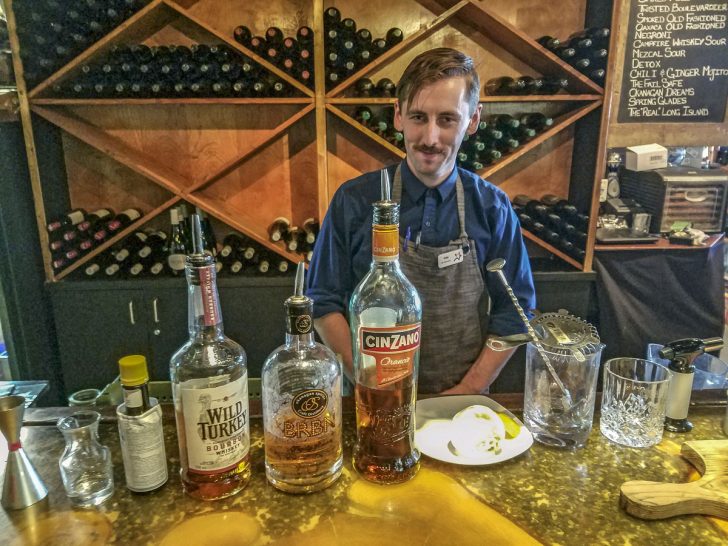
Bar Supervisor Tom Falland creating his signature Smoked Old Fashioned drink at the Den Bar and Bistro in Silver Star Mountain, BC. Credit: Yvette Cardozo

The food and beverage manager over at the Den calls it classic cocktails “with a twist.”

And, indeed, these are not your usual Old Fashioneds or mojitos in the Den & Bar Bistro at Silver Star Mountain in British Columbia, Canada.

Downstairs in the basement, below Coffee+ cafe, along Silver Star’s main street, the Den is doing its own thing with alcohol.

Manager Mark Lehmann has turned his bar supervisor, Tom Falland, loose.

What resulted, among others, was the Smoked Old Fashioned. Yes, it’s a show. Yes, it’s delish. 

“Sometimes less is more,” Lehmann said. “I think gone are the days of sweet hyper-colored drinks, saturated with artificial flavors and so much sugar. In the Den, we have taken to infusing our own tinctures and flavorings using all natural ingredients to develop a unique taste and profile. We have also found in doing so we are using some older style spirits that have been collecting dust for an age. Aperitifs are heavily used in our lineup, as are spirits like Campari, Aperol and gin.”

So, of course, I wanted to watch Tom make his Smoked Old Fashioned.

Infusing the glass with wood chip smoke while making the Smoked Old Fashioned. Credit: Yvette Cardozo

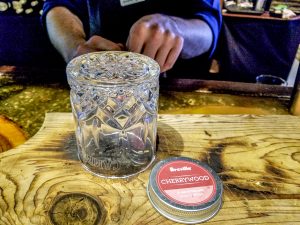
Originally, they used a smoker, trapping smoke in a huge beaker, then pouring it into the drink. But the smoker is now broken, so Tom torches wood chips.  Honestly, a better show.

First, he lined up his ingredients along the bar: a couple of bourbons, vermouth, bitters, a ball of ice in a glass, orange rind, cherry wood chips, and a beaker with a strainer.

Then, he torched the wood chips on a cutting board, and, when the smoke got going, set an upside down glass over the smoke. This lets the smoke flavor adhere to the sides of the glass.

Next he mixed the alcohols, bitters and sugar syrup. All this was shaken with ice cubes. He put the ice ball into the smoke infused glass, then poured the alcohol mix (minus the cubes) over the ice ball in the glass, finally adding a slice of orange rind. The ice ball, rather than cubes, keeps the drink cold without melting and diluting it, he explained.

 The result is a smooth taste that rolls gently around your tongue. There’s a hint of whiskey, a hint of orange, and the barest hint of smoke.

Ok, if this isn’t smoky enough, Tom has his Campfire Sour. It’s made with two bourbons and a single malt Scotch whiskey Laphroaig, then topped with frothed egg whites, a slice of dehydrated lemon and two charred cinnamon sticks. All this is to make it look like a campfire. The cinnamon plays the charred logs.

Be warned, though, Laphroaig is a very special taste. It’s a single malt whisky from Scotland infused with enough peat smoke flavor to bring tears to your eyes. I once hiked a multi-day coastal trail in Canada and after a week, everything I owned including my skin smelled of campfire smoke. This drink is that campfire smoke on steroids.

My favorite drink at the Den, honestly, was Tom’s Chili & Ginger Mojito. This is more than your usual by-the-pool mojito. It has the lime taste, to be sure, but there’s also ginger and, to wake you up, red chillies. A mojito with a kick. Perfect after a day of skiing and before you tuck into the Den’s BBQ ribs. 

Enjoying drinks at Den Bar and Bistro, Silver Star, BC. Credit: Den Bar and Bistro.


This Week In SeniorsSkiing.com (Jan. 3)

The Top 10 SeniorsSkiing.com Articles Of 2019.

Here are our readers favorite articles from the past year, deducted by looking at the number of comments, clicks, and the help of Google Analytics. It is certainly a diverse collection of pieces, ranging from our very popular Mystery Glimpse feature fueled by historic photographs from ski museums around the country, to a variety of advice stories, our directory of senior-friendly ski resorts, and, emerging this year, a series of articles about on-slope collisions, a major source of concern to readers.

All links will bring you to the original article.  These are listed in reverse rank order.

Enjoy all of them. Share with friends.  Thanks for all your support in 2019.

10. Mystery Glimpse: Who’s This Unhappy Fella? This popular feature asks readers to guess the person, place, or thing in a photo, usually submitted by a ski museum. This one features a candid shot of a very famous racer.

9. First Ever List of 145 US/Canadian Resorts Where Seniors Ski Free. Or almost free.  SeniorsSkiing.com has an exclusive listing of these resorts. Very popular and located in Subscriber-Only content.

8. Coping With Flat Light. Advice on dealing with bad visibility, so vexing that it can ruin a day’s outing.

7. Season Ending: The Last Perfect Turn. A lyrical view of the end of what was a record-breaking season in many places. From last spring.

6. Ask The Expert: Ski Boot Advice. Basic advice from MasterFit’s Steve Cohen on how a 65 year old can buy his/her first ski boot.

5. Incidents & Accidents 1. As our Spring Survey revealed, out of control skiers is the number one aspect of skiing that upsets our readers. This is the first of our ongoing series of reader reports about collisions and accidents on ski slopes.  We are collecting this portfolio of these to see if we can identify a common thread to use in influencing

4. Putting Away Your Skis And Stuff. Practical advice for caring for your gear at the end of the season.

3. My Knee Replacement Story. A full recounting of the process, from initial onset of painful symptoms to rehab.

2. Gone In a Flash.   Advice on not taking any season for granted, especially poignant when you are physically barred from participating.

1. Blind-Sided & Body-Slammed. A personal account of a bad collision and its consequences started our reader-written series of Incidents & Accidents. This was the inaugural story from SeniorsSkiing.com correspondent Roger Lohr that created a huge amount of attention.  This issue is serious and important to continue to understand.  We hope that eventually the data we collect will be useful in influencing ski patrol and area management safety practices.

This Week.

Our Mystery Glimpse looks at a statute that has meaning for a special museum.  The location and back story of the Fountain Mountain is revealed.

Harriet Wallis reminds us that five simple words can mean a world of difference to people skiing alone.

Start at the top at Snowshoe Mountain Resort, WV, Credit: Snowshoe Mountain

As we learned last month, the mid-Atlantic states have high mountains, higher, in fact, than New England.  So, here’s a resort review from Snowshoe Mountain Resort in West Virginia. It’s an “upside down” resort with lodge and parking at the top.

Herb Stevens, the Skiing Weatherman, explains how a weather pattern that evolves over the Indian Ocean and gradually moves east can impact temperatures in North America. Regional forecasts for the week also included.  Fascinating stuff.

We are happy to answer our reader’s technical questions.  This week, a reader asks about whether old bindings can be used on new skis. Find out what realskier’s Jackson Hogen says.

Our Incidents & Accidents feature this week is by an individual who was severely injured in a collision at Steamboat Springs, but was never able to successfully track down the person who hit him. Lots of lessons learned here.

Thanks again for reading SeniorsSkiing.com. We are looking forward to a wonderful 2020. Please tell your friends about us, and, remember, there are more of us every day, and we aren’t going away.


Short Swings!


This misguided soul gave up on New Year’s resolutions many years ago when I accepted that I could correct my errant ways on an as-needed basis or in response to my wife’s frequent course corrections.

But it’s the start of a New Year, and I’d like to share a few ski-related resolutions that I plan to keep.

  1. Ski more days this season than last. Last season delivered some terrific skiing experiences in Utah, Colorado and the Alps, but when totaled up, there were too few of them. This season, I want to ski at least half my age.
  2. Ski more frequently with others. Historically, much of my slope time has been solo. But I enjoy the camaraderie of skiing with others. This season, I plan to make more of an effort.
  3. Follow the snow. There are times when I find myself in a self-imposed rut, skiing the same runs in the same sequence. Several seasons ago, I decided to spend each day following the best snow and found it liberating.
  4. Spend more relaxing ski days with my wife. She likes to be out on bluebird days when we cruise and enjoy leisurely lunches. It’s both relazing and non-taxing.
  5. Try telemarking again. Years ago I took a telemark lesson at Alta and thoroughly enjoyed it. Approached correctly, it’s not a knee-stressor. Definitely want to try it again.
  6. Advocate for skier safety. Accident prevention and reporting are part of the dark underside of the ski industry. Areas pay lip service to the safety issue but resist efforts to be transparent. As so many of you have reported, patrol does little to slow or control reckless skiers and boarders. Our new Incidents and Accidents feature is a step toward greater transparency. This year, Mike and I plan to do more.

Wishing you a Healthy, Snowy, and Safe 2020!


Knee Issues? Roam’s Elevate Changes Everything!

Roam’s Elevate Ski Exoskeleton is a breakthrough product that supports knees and quads and allows older skiers to ski longer and without pain. Unlike other knee assist devices, Elevate utilizes a small computer that senses body position and other factors as it signals the soft exoskeleton around the knees. This short video explains all. The company has demo locations at resorts in California, Utah, Idaho and Montana where you can give Elevate a 2-hour try for $25. Reservations required. Click here for more info.

Remarkable Avalanche Article

Last Sunday The New York Times Magazine published “What I Learned in Avalanche School.” Authored by novelist Heidi Julavits, it explores the limitations and possibilities of how we make decisions. While the context is backcountry skiing, the ideas apply to life. Superbly written! Be sure to visit the Reader Comments, as well. Click here.

Last Season’s Ski Insurance Payouts

Generali Global Assistance sells Ski and Mountain Travel Insurance. Last season, sickness, injury or death accounted for 62% of claims and weather for 27%. The average cost of ski trips protected by the company was $2,463.

Sprinter Van Service Between Boston and Ski Areas

GoSherpa provides home-to-slope transportation from Boston to 27 New England ski resorts. The vans are spiffy, the costs are reasonable, and they pick you up from and deliver you home to home! Visit the GoSherpa website for details.

“Ski For Light” Seeking Volunteers

Ski For Light is the all-volunteer, non-profit that organizes an annual cross-country skiing week for the blind and visually-impaired. The group has openings for volunteer guides for this year’s ski week, Feb 8-16 in Casper WY. Interested in volunteering? Contact Bob Civiak at civiak@gmail.com or call 603-715-0817. Click here for details on the 2020 Ski For Light International Week.

 

Indy Pass Adds Maine Area

Mt. Abram in Greenwood, Maine has joined the national Indy Pass. The 60-year-old family-owned area has 4 lifts and 1,150’ vertical. Indy Pass offers two days at each of 47 ski areas, 40 of  which provide pass holders with unrestricted, season-long access. Current cost is $239. For details visit indyskipass.com.

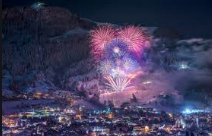
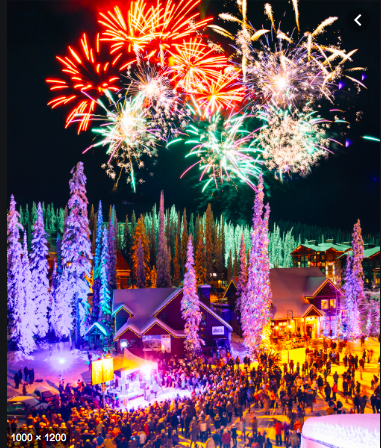
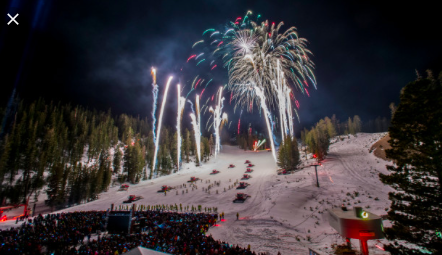
New Year’s Fireworks

Since many of us didn’t celebrate at a ski resort, here’s what it looked like at a variety of places. 

ASPEN

ALTA, UT

KITZBUHEL, AUSTRIA

JACKSON HOLE, WY

THE CANYONS AT PARK CITY, UT

MOUNT SUNAPEE, NH

TAOS, NM

BIG WHITE, BC

BRISTOL MOUNTAIN, NY

MAMMOTH MOUNTAIN, CA


Skiing Weatherman: Global Pattern Bringing Warmth Then Cold Mid-Month

Happy New Year To All Of My Fellow Senior Sliders!

In the two weeks since my last post, the western slopes of the U.S. and Canada have been the unquestioned winners in terms of fresh snow. Just prior to Christmas, the trail counts from British Columbia south to the Sangre de Cristos of New Mexico were on the lean side, but a persistent parade of moist troughs started marching ashore from the Pacific. Those systems produced an overall snowy pattern that jacked up those trail counts dramatically. There are a few resorts here and there that got slighted by Mother Nature, but by and large, it is hard to make a bad choice out west.

While troughs produced the goods on one side of the country, flat ridging at the jet stream level have made fresh snow rather scarce in the Midwest and East. Fresh shots of cold air have been more of a glancing blow, but resorts in the northern Great Lakes eastward through the mountains of northern New York and New England have maintained their trail counts for the most part through the holiday period.

So, where are we headed from here? Well, a pattern that can best be described as changeable will unfold during the first half of January. As such, I think that there will be opportunities for resorts all across the country to enjoy some fresh snow. I still believe that we will eventually see a western ridge/eastern trough couplet become more favored, but there are too many conflicting signals coming from the Pacific for the jet stream to settle into that set up just yet.

The factor that seems to have the most impact on our weather right now is the MJO, or Madden Julian Oscillation. The MJO is all about convection that forms in the Indian Ocean and tracks eastward into the southwest Pacific. Madden and Julian divided the track into eight sectors and noticed that there were significant correlations with weather over North America, with a lag of 7-10 days, depending on where the thunderstorms were clustered.   Right now, the convection is fired up north/northwest of Australia, as you can see in this infrared satellite picture.

If you follow the green line in the chart below—each black dot is one day—you will see the MJO making a move into octants 4 and 5 in about a week. [Editor Note: octants 4 and 5 represent continental North and South America.]

Using the temperature correlation maps below, you can clearly see that octants 4 and 5 are warm over much of the country, and I believe a warmup will occur mid-month before the pattern turns colder again.

Before any warmth reaches the East, though, Midwest and Eastern resorts—north of the Mason Dixon line—will pick up fresh snow at least a couple of times. The first event will be this weekend as a storm cuts southeastward to the mid-Atlantic coast before turning up toward New England, with an Alberta Clipper sliding through the East a couple of days later. Big winners in the snow derby the next week or so in the West will be the Cascades, northern Rockies, and the resorts of B.C.

Here are the regional details.

Northwest U.S./Western Canada: Healthy storm nails B.C. this weekend, with another system arriving later next week.

Cascades and Sierra:  Light to moderate snow in the Cascades this weekend. Northern system late next week looks productive in WA/OR, but the Sierra will only receive lighter amounts.

Rockies: Late this weekend/early next week the Rockies will pick up light to moderate snow (north) and generally light amounts south of I-70. The Tetons and Wasatch are in line for moderate to heavy snow late next week.

Midwest: Early week Clipper system will deliver light to locally moderate snow, with the best snowmaking temps in a while following. That cold air will also support lake effect snow in northern parts of the lower peninsula of MI.

Northeast/QB: A system this weekend will turn into a moderate to locally heavy snow producer from WV northeast into New England and southern QB. A Clipper system will follow in the middle of next week with the potential for additional light to moderate snow.


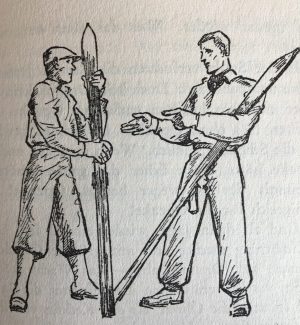
Two Skiers

Ask The Expert: Old Bindings, New Skis?

Repurposing Bindings Not A Good Idea.

A Question From Reader Mike Goldman:

I have the Marker IPT Wideride bindings mounted on a pair of Vokyl RTM 80. Can these bindings be re-mounted and used on something like a Nordica Soul Rider 97?  Thanks.

Response From Jackson Hogan, ski industry veteran and publisher of realskiers.com.

My answer to Mike is no. System skis usually have a unique hole pattern on the binding interface and may have other compatibility issues with a ski that is not its mate. It’s generally not possible to transfer a system binding to a non-system ski. Also, I would not devalue a new ski by mounting it with an old binding if I could avoid it. 


statue

Mystery Glimpse: Turning Point

What’s The Story Behind This Statue?

Why is it so important to the Colorado Snowsports Museum?  Who is the artist?

Last Week

The Fountain Mountain at Mt. Snow, VT was the subject of last week’s mystery. According to Mt. Snow’s Jamie Storrs, the Fountain was switched on for the first time on January 18, 1965

When Mount Snow’s founder, Walt Schoenknecht, saw something he simply must have, he built it. In this case, it was the fountain that shoots out of Lake Geneva in Switzerland. From that seed, Fountain Mountain is born.

Fountain Mountain, a 350-foot geyser out of Snow Lake, is powered by twin Westinghouse 600-horsepower pumps that shoot 3,000 gallons of water per minute straight up through three Worthington centrifugal pumps.  It was said to be the largest man-made geyser ever built.  Back in the day, Governor Phil Hoff was on hand to launch Fountain Mountain.

During the winter, Fountain Mountain erupts 24/7 and as the water freezes, a giant ski hill is formed. The hill is large enough to hold races; a rope tow transports skiers to the top. Fountain Mountain lasts into the summer months and, since 1969,  is the site for summer race camps in June.

Alas, the Fountain Mountain was shut down when the energy crisis of the early 70s drove the costs of running it out of sight.

Swimming at the foot of Fountain Mountain, circa 1964. Credit: Mt. Snow