A New Yorker Discovers New Mexico Resorts

A Veteran Skier Can’t Find Ice On His Visit To Taos, Angel Fire, Ski Santa Fe.

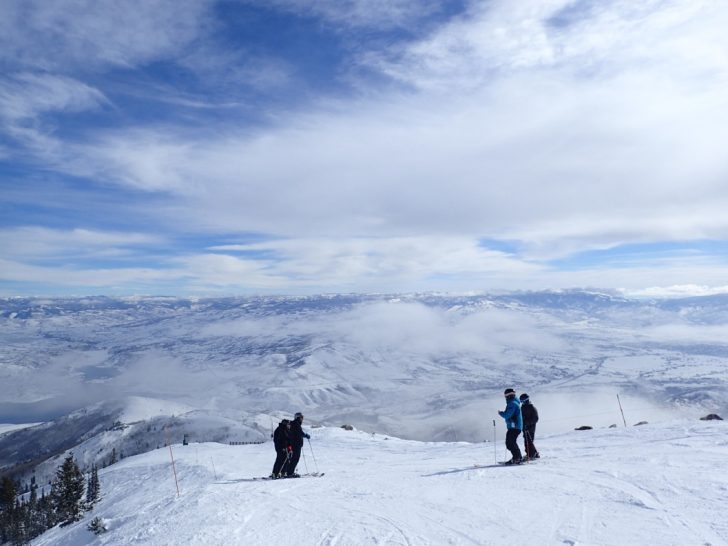
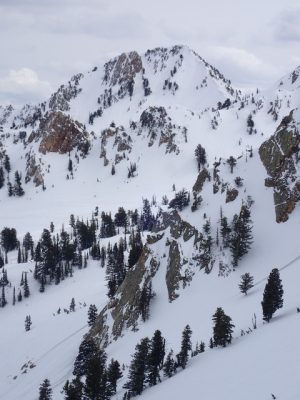
Taos Kachina Peak is at 12,481 where the snow stays cold. Credit: Taos

The past three times I skied here in the East the skiing was good.  That means the trails were all skiable but every run you would encounter different conditions.  Most mornings after a cold night, you will find nice groomed corduroy which had set up overnight due to the cold temperatures.  We have not received much snow but thank God for snow making.  After a run or two the firm corduroy changes to loose large granular pieces. Then after a couple more runs that will change to a fine granulated sugar, again very skiable.  As the day progresses that sugar finds its way to the sides of the trails and the rest of the trail, especially the slightly steeper spots get scrappy and eventually Boiler plate.  Time to go home!

Now once in awhile you will hit a day when it was snowing or had just snowed.  Here in the Northeast this seems to be happening less and less and I am convinced that it is a product of global warming.

As Eastern Skiers we can usually ski any condition as it changes throughout the day and lately that has been the norm.  I still love it but it can get frustrating.

Compare that to skiing out West. West, as in New Mexico. Mountains? You bet.

Here’s what I discovered on a recent trip. The New Mexico ski areas are much higher than the Northeast and as you climb up you get colder and receive more major snowstorms.  Skiing at Taos, Red River and Santa Fe you will be skiing approximately from 9,000 ft. to 12,000 feet, that’s 6,000 feet higher than the tallest mountain in the Northeastern United States which is mount Washington in New Hampshire (6288″). 

The average snowfall in Taos is around 300″ per year of very dry fluffy powder due to the high elevation.    It’s 220″ at Ski Santa Fe, 214″ at Red River. With the higher elevations the temps are lower and the snow sits longer. Compared that to the Eastern ski areas where the elevations are below 4,000 feet.  Whiteface is the highest ski area at 4,650′ with average snowfall of just over 100″. Altitude, acreage, the snow and  weather is all the difference.

In the East we fight icy weather conditions up to 4,000 ft., whereas the higher and drier climate of the Rockies are well above 10,000 feet above sea level.

In the East there are wind chills that are very, very cold, where out West it is sunny during the day with Blue Bird sunny skiers. (Most of the time, it seems.)

Moguls are hard and icy here in the East but in the West they are constantly soft snow. No matter how big the moguls may be they are usually always soft so you actually can be a hero out West while in the East you battle the ice on the downside of almost every one. 

Length of trails at all the New Mexico areas were substantial, open Bowls compared to dense trees of the Eastern trails.  Bigger vertical gets plenty of skiing in the West compared to skiing shorter lifts in the East and more runs. 

Taos has the most expert terrain especially now that you don’t have to hike Kachina peak with 1294 acres 51% expert 25% intermediate and 21% beginner. There was only one main lift that gets you to the numerous other fixed grip lifts on the mountain.

Angel Fire has some two mile runs, and best of all 70-75 seniors pay $29, 75+ pay zero. Credit: Angel Fire

Angel Fire has 560 acres of skiing  with 23% expert 56% intermediate and 21% beginner with  their main Chile Express lift over 2 miles long so all the runs down are very long. Their two main lifts are hi speed and you get plenty of skiing in a day. And Angel Fire loves seniors: 70-74 pay $29 a day, over 75 free. 

SkiSantaFe has super senior (72+) tickets for $0. Thanks guys.

Ski Santa Fe was the smallest in skiable acres with 660 acres 40% expert 40% intermediate and 20% beginner but still had plusses. One of which is that you can stay in Santa Fe and drive to the ski area and enjoy the culture. And seniors 72 plus ski free at this resort. Thanks, Ski Santa Fe.

Bottom Line: New Mexico Ski Resorts enjoy low humidity, consistently low temperatures due to elevation and enough snowfall that ice doesn’t form.  It is consistently packed powder from top to bottom
The Daly Chutes At Deer Valley

[Editor Note: SeniorsSkiing.com is asking our readers to contribute to support our online magazine. Yes, we have grown in the number of subscribers and advertisers. But our expenses have also grown. You can help us defray some of these expenses by helping us out with a donation.]

Support SeniorsSkiing.com by clicking here.

______________________________________________________

Want Steep? Chute 4 Has Steep.

Chute 4 from the cornice. You ready? Credit: FeedTheHabit

Deer Valley Resort in Park City, UT has a reputation for catering to its clientele.  Aside from the great food and fabulous customer service, it pampers skiers with groomed perfection and valet service, Yet, the resort is often dismissed by hard core skiers who feel that there is nothing on the mountain that would interest them.   

To those folks I simply say, ”Go to the Daly Chutes off the Empire Express Chair.” Riding the chair, the chutes are visible to your left.  As you exit the chair to your left, you make your way down the Orion Trail until you see the signs for The Daly Bowl and then an upward climb/traverse to the cornice on top of the Daly Chutes area. 

Depending on the weather and the condition of the snow that is blown into the bowl area, the openings can be varied.  Sometimes only a few chutes (which are numbered) are open and you must choose the correct ones as you stand at the top of the windblown and steep cornice. 

Last week I chose Chute 4 twice, and, as I dropped in to the windblown snow, I immediately began a series of steep jump turns down the throat of the chute.  Coming up on an exposed rock section, I veered to the right and finished in a wide open bowl area that was strewn with debris from avalanche blasting the day before. 

After weaving through the large snow chunks and into the trees, the chicane of seldom used tight trails eventually brought me out in plain view of the Empire Lodge. 

The chutes are all skiable and if you can manage the roller coaster trail through the woods on the way over to the bowl area and eventually to the top of the cornice, you will be treated to a selection of some steep but manageable terrain that definitely quiets the naysayers. 

In addition to the challenging terrain of the Daly Bowl and Chute area, if you make your way all the way over to skier’s left of the resort, you can access the Sultan, Wasatch, and Mayflower chairs and experience some fast and steep groomers. 

The signature run is Stein’s Run named after the legendary Stein Eriksen who was the Director of Skiing at Deer Valley for many years and an Olympic and World Championship medalist.  Usually this area is quiet, and you have free rein to rip GS turns to your heart’s content,  another plus for those who think that Deer Valley is not challenging. 

All in all, a word to advanced skiers would be that although the terrain at Deer Valley does not rival Jackson Hole, Alta, or other areas with challenging expert terrain, the Daly Chutes will not bore you, and you definitely have to pay attention on your way down any of the selections. 

Don’t knock it until you have tried it.  Seniors get the benefit of a $125.00 lift ticket on certain days compared to the usual $209.00 tab.  And of course the Ikon Pass is accepted at Deer Valley.  

Check out a video trip down Chute 4 from Deer Valley.

Powder Mountain

Uncrowded Powder Mountain

[Editor Note: SeniorsSkiing.com is asking our readers to contribute to support our online magazine. Yes, we have grown in the number of subscribers and advertisers. But our expenses have also grown. You can help us defray some of these expenses by helping us out with a donation.]

Support SeniorsSkiing.com by clicking here.

______________________________________________________

500 Inches Of Snow, 8,000+ Acres, And No Crowds.

Uncrowded on a holiday weekend. Powder has plenty of room. Credit: Harriet Wallis

A Mountain Host greeted us with memorable words. “The snow here is all natural. Mother Nature makes all of it,” she said. “And it’s GMO-free,” she quipped.

We skied Powder Mountain during a recent holiday weekend when other resorts near Salt Lake City were packed to the gills, “PowMow’s” trails were not only uncrowded, they were sometimes absolutely empty. It was wonderfully relaxing. I didn’t need eyes in the back of my head. Nobody was going to run over me. And there was still patches of untracked snow from a storm nearly a week earlier.

To ensure a good experience, the mountain caps adult season passes at 3,000 and daily lift tickets to 1,500. It doesn’t accept the Ikon or other multi-resort passes. Do the math. At max capacity, every skier gets about 2 acres.

Seniors 75 and older get a free lift ticket or a season pass for $20. 

Good snow, uncrowded slopes and affordable senior prices  are just part of the equation. Powder Mountain is old school. It doesn’t do glitz. That’s it’s charm. There’s even an old fashioned blackboard where the list of upcoming bands to play in the Powder Keg bar are written in colored chalk.

Powder base lodge is unpretentious. Credit: Harriet Wallis

The day lodge is modest, the bathrooms are adequate, the cafeteria tables are set in long rows so everyone eats family style and gets acquainted with whoever sits down next to them. The lodge on the summit is similar, just smaller.

Six chairlifts serve 8,464 acres that include white knuckle slopes, aspen forests, and treeless snowfields. And in old school style, there’s a Poma. It hauls skiers up a short pitch that’s a gateway to vast terrain. Riding a Poma is a skill that older skiers remember well but younger skiers struggle to learn. After a few they get to experience what the good old days of skiing were like.

We chanced to meet Bob Leaverton, a veteran ski patroller, who has skied Powder Mountain for 35+ years. His three favorite things are: “the road, the people, and the snow.”

The last several miles up to the resort are steep, and that climb often deters visitors, he said. The people are friendly, and the snow is wonderful. Take it from a local.

For adrenaline junkies, Powder Mountain offers specialty adventures: in- and out-of bounds backcountry skiing, skin & ski, snowcat, and heli-skiing.

Historically, Frederick Cobabe accumulated the vast acreage as range for his herd of sheep. His son eventually purchased the livestock company and the land and turned it into a ski resort in 1972.

It’s currently owned by private investors who are developing an upscale community of Bauhaus-style homes set in the far reaches of the resort and linked by a network of trails and lifts that sprawl across that rolling, not steep, terrain. It can take most of the day to ski a circuit all around the resort.

But if its a powder day, do what the mountain resort is named for: Ski the powder.

Yes, that’s the lift line. Where is everyone? Credit: Harriet Wallis

Have You Been Drinking? It’s Time To Start!

Hydration and Stretching: Two Things You Must NEVER forget to do before you hit the slopes.

If you’ve taken to heart the advice in a previous seniorssking.com article of Paul Petersen, president of Bear Valley Cross-Country in California, on the best way for seniors to get in shape for skiing, you’ve developed and faithfully followed a fitness regimen focusing on balance, strength, flexibility, and cardio. But the 56-year-old certified alpine and cross-

Bear Valley Cross Country's Paul Petersen swigs water, something we should all remember to do. Credit: Paul Petersen

Bear Valley Cross Country’s Paul Petersen swigs water, something we should all remember to do.
Credit: Paul Petersen

country ski instructor will quickly tell you that this is not enough. What you do in the days before and right up to the minute that you put ski or board to snow is just as important as all the pre-season conditioning you’ve done.

One of the most overlooked factors in preparing for a day on the slopes is hydration. When your body is well-hydrated, your body temperature and heart rate are more stable, your joints and muscles function better, and you have more stamina. Conversely, if you’re dehydrated, which can happen more quickly at elevations above 5,000 feet—especially to flatlanders, you won’t be able to perform well for any length of time, you’ll tire more easily, and you may experience dizziness, headaches, or shortness of breath. Says Petersen, “When it comes to hydration, you have to think ahead. You can’t properly hydrate for athletic activities the day before; you need to begin several days beforehand. Remember, you’re not trying to hydrate your stomach, but rather your joints and muscles and that takes a while.”

If you’re a typical skier, before you head out for the slopes, you probably have a cup of piping hot coffee or tea in the lodge (this may be in addition to the glass or two of wine you had at dinner the night before). This is a total recipe for dehydration! “Any liquids with caffeine or sugar, including sodas,” says Petersen, “are NOT a net positive in the hydration department!” For every cup of coffee or other caffeinated beverage you drink in the morning or while on the mountain, Petersen insists that you drink an equivalent amount of water.

Noting that senior wintersports participants schedule longer trips and thus ski more consecutive days than the average skier, Petersen emphasizes the importance of recovery for seniors after a day on the slats and boards. “Right after you’re done on the slopes and before you hit the bar, hit the protein bar,” he strongly advises. “For me, the magic bullet is protein powder in water. Either helps you recover from that day and helps your body get ready for the next day.”

An equally important factor in ensuring a safe, fun day on the slopes is adequately stretching your muscles right before you start out. We’ve all done those cursory arms over our heads while stretching our waists and quick calf stretches, right? Not good enough per Petersen! “You can’t just touch your toes, grab your ankles, stretch your thighs, and then walk out the door,” he warns. “The night before, put aside a few minutes to stretch your hips, calves, and thighs, and again the next morning before you put your boots on, either in the parking lot or at your locker.”

In sum, make “water, stretch, go” your wintersports mantra if a perfect day “doin’ it” is what you’re after!

Deer Valley: Win-Win For Two Generations

Convincing Reasons Why Two Generations Love Deer Valley.

Blue skies, top of the world at Deer Valley. Credit: Tamsin Venn

We recently returned from our annual January family trip to Utah, with our 20-somethings joining us. Utah is currently experiencing record snowfall with more than 300 inches and more on the way. Aside from snow, here are reasons why two generations love Deer Valley, ranked consistently as one of the top ten resorts in the country.

  • Utah powder gets dried out and fluffed up on its way over from the Pacific Ocean, so it’s easy turning for both old and young knees.
  • Free valets greet you and put your skis in ski racks, more energy for powder skiing.
  • Free overnight boot and ski check, less schlepping, even more energy saved for skiing.
  • The number of feet you have to walk from a base lodge door to a lift might be written into the area’s mission statement. See previous energy statements.
  • Truly varied and sophisticated food, always with a few extra special ingredients for the piece de resistance, fosters lingering, providing rare commodity of uninterrupted family time. WiFi is available.
  • The Rossignol High Performance Test Center located next to the Empire Canyon Lodge gives you two hours of free ski trials, as many as you want. Match your boards to conditions and try out new Rossignol technology. Both old and young stretch comfort zones in moguls and powder.
  • At the posted trail maps, very upbeat, green-uniformed hosts tell “guests” where they are and where to go. You never have to be lost on the area’s six mountains, six bowls, and 2,000 acres

Young, really young, and seniors love the DV. Credit: Tamsin Venn

  • Stein’s Way, a black diamond off Bald Mountain’s right shoulder, overlooks Jordanelle Reservoir and is a popular first run groomer with the senior set. And the 20-year-olds, who will do a couple of warm-up runs on Stein’s then switch to the more gnarly Mayflower Bowl.
  • The less expensive IKON base pass gives you five days at DV, plenty of time to play out the equation between willing spirit but flagging body. If you still have vacay time, the IKON base pass lets you ski five days at Alta/Snowbird, five at Brighton and unlimited at Solitude. Blackout dates apply.
  • No snowboarders. Yup, even the 20-something-year-olds who ski with us do not like the sound of a thundering snowboarder coming up from behind. That rule does preclude skiing with some of our favorite people.
  • The sharing economy. Our AirBnB in Park City was roomy and tucked away, but just steps from a stop on the free town bus system. Millennials support public transportation.
  • Ski instructors are everywhere leading their charges, often in semi private lessons. Eavesdrop to pick up a few pointers on powder days.
  • Limited ticket sales —7,500 a day—ensure quick moving lift lines, enhanced by 21 chairlifts (12 are high speed detachable quads,) and one gondola.
  • A well protected, well staffed learning area with magic carpets helps make DV one of the best places for the little guys, generation 3 TK.

Why go anywhere else?

Lift Ticket Rates: Senior (65 plus) Daily Lift Ticket Rates start at $120 when prepaid online. Senior Season Pass: $1,236. IKON pass no longer available for 2019-20:  Check prices here. https://www.deervalley.com/plan-your-trip/tickets-and-passes

Find Out More: Click Here For the Deer Valley website

Trail Map: Click here

Web Cams: Click Here

So far this season, the snow has been abundant.
Credit: Tamsin Venn


Alta’s Wild Flowers in Full Bloom


Alta’s slopes are blooming! Credit: Judy Calhoun

Any one living in or visiting Salt Lake City can escape the heat and enjoy the remarkable wildflowers at Alta. Contributor Harriet Wllis reports that the Alta’s wildflowers are blooming like crazy right now. The meadows and slopes are like Persian carpets — covered with color!

Non-Snow Activities: Dude Ranchin’

From Yodeling To Yippee-ing, Yvette Rides The Range.

Riding the foothills of the Tucson Range. Credit: White Stallion Ranch

 I’m not sure if skiing gets you into shape for horseback riding or vice versa, but, yes, a lot of the same muscles are at play. 

Either way, both take strong legs.

I confirmed all of this at White Stallion Ranch just outside Tucson, AZ at the end of last ski season. 

I packed my schedule full because I wanted to do EVERYthing. 

So on my first day, I went on the slow mountain horseback ride. We left the main ranch compound and sauntered leisurely across the valley, following a well worn path through the cactus.

Fast ride. Credit: White Stallion Ranch

At the foot of the volcanic, granite hills of the Tucson Range, we headed up via a rocky trail, passed the tall fingers of saguaro cactus and all sorts of blooming brush: yellow, purple, violet flowers. All in all, a great intro to the ranch rides.

There are also breakfast rides, wine and cheese rides, and a beer and Cheetos ride. Yum.

Such is life at one of the two remaining guest (aka dude) ranches in the Tucson area. Not that many years ago there were a hundred but population growth and development swallowed them one by one.

The White Stallion Ranch has been around since the turn of the 20th Century, first as a cattle ranch, and later home to 30,000 chickens.  In 1945, it became a guest ranch. The True family bought it in 1965, and. when they saw that the area guest ranches had already dwindled to about 30, they started buying land and adding rooms. Today, the 3,000 acre ranch has 43 rooms, a five bedroom hacienda, 160 horses, 120 cows, and wranglers on hand to lead rides, teach, tend to the livestock, cook and all the rest.

 For me, it wasn’t all riding. A couple of mornings I went shooting. I’ve only touched a gun once before in my life, but Bob and Sharon Callan will talk you through everything, how to aim, how to cock the guns, how not to accidentally blow your head off.

They’ve run the firearms training program for the Tucson police department, so they’re used to teaching.

You get to use a six shooter and a rifle, and there’s a set of steel plate targets.

“Consider all guns loaded and don’t point at anything you don’t want to shoot,” Sharon said. And added, “You can shoot the pistol one handed, but if you want to hit something, use two.”

All those cowboy movies where folks at a gallop shooting one-handed pick off the bad guys? Not on your life.

Western star Loop Rawlins does rope tricks during evening entertainment at White Stallion Ranch. Credit: Yvette Cardozo

I also did the movie tour by van. 

The ranch has been a popular site for movies since the 1930s. And for good reason. It’s literally around the corner from Tucson. You leave the ranch, climb a low hill and there, on the other side are the outskirts of the city. Talk about convenient.

Marty Freese, the ranch’s history guy, took us to all the popular sites where dozens of movies, TV shows, and commercials have been filmed,  including High Chaparral, a Lone Ranger movie and enough others to fill a two-page list.

 Each night there an activity. Bill Ganz sang cowboy songs by a campfire. Phil and Hector brought tarantulas and scorpions and a bearded dragon named Stumpy that attached itself to Phil’s chest like velcro, along with a Burmese python so long, it took nine kids to hold it. 

But the star of the week was Loop Rawlins who is an artist with gun and rope. He kept the Spring Break crowd of kids spellbound as he twirled guns, flipping them into his holster, skipped rope with his lariat and did a finale that involved a flaming, twirling lasso. 

On one of my last days, the ranch held its once-a-week rodeo. It’s sort of Rodeo 101, which is great if you’re like me and have never been to one. Russell True, who was five when his folks bought the place and now pretty much runs it, explained barrel racing, bulldogging, where you ride alongside a steer and jump astride it to bring it down (as bone rattling and dusty as you imagine) and team roping which Russell says he calls “cowboy judo” and is even more frenetic than bulldogging.

I also took a horse riding lesson and discovered all the things I was doing wrong. 

So maybe next time, I can actually get my horse to canter.

For more information on the White Stallion Ranch, click here.

Guests leave the breakfast corral on horseback during a breakfast ride. Blooming hedgehog cactus in foreground. Credit: Yvette Cardozo

Snowbasin Goes Epic

Uncrowded, Beautiful Views, Variety Of Terrain, No Hotels.

Most of the trails at Snowbasin wind up at the Needles Gondola. Credit: Tamsin Venn

Older skiers would really like Snowbasin outside Ogden, UT. You have nearly 3,000 acres in which to avoid other skiers and 3,000 vertical feet to get some rhythm going. A remotish location keeps lines short midweek. Lifts whisk you up to the top of six scenic, craggy peaks: two high-speed gondolas, three high-speed chairlifts. You can dine on really good food at a choice of three swank lodges, all glass and timber, wall-to-wall carpeting, stone fireplaces, and chandeliers. Locals think about skiing elsewhere, but why bother?

“You ski on a Tuesday here, even on the biggest powder day, and you’re looking for somebody to ride the lift with,” says new General Manager Davy Ratchford, quoted in Powder Magazine.

The layout is easy to follow. Most of the 106 tree-dotted trails end up at the base of the Needles Gondola. The mostly intermediate and expert trails include a fun variety: wide groomed boulevards, low angle chutes to dip into, hikes to cirques and chutes close to lifts, such as the popular Lone Tree. Typically the area gets 300 inches of snow a year.

Stop at the top to view four states: Utah, Wyoming, Colorado, Nevada. At the Strawberry Gondola, take the longest Elk Ridge trail at 3.5 miles. Flat light can be a problem up top on weather days, but low visibility markers lead you back to the base area.

Snowbasin hosted the downhill at the 2002 Olympics. You can hurl down the course if you like. Credit: Tamsin Venn

Snowbasin hosted the men’s and women’s downhill in the 2002 Olympics. Take the 15-passenger tram up to Allen Peak (9,465 feet), stare in awe over the precipice looking down at Ogden’s grid and Great Salt Lake. Then heart in throat, hurl yourself down The Grizzly, start of the men’s downhill. The less ambitious can take the tram back down to the newly widened and graded Mt. Ogden Bowl Road, a lower-angled return.

Snowbasin is not new. About 50 minutes north of Salt Lake City, it opened in 1939, and is one of the oldest continually operating ski resorts in the U.S. Utah native Earl Holding (of Sun Valley) bought it in 1984, made a large investment in lifts and snowmaking over the years, then pulled out all the stops for the 2002 Winter Olympics.

Snowbasin has no lodging. In nearby Huntsville, the newly opened Compass Rose Lodge, run by skiers Jeff and Bonnie Hyde has 15 bedrooms and its own observatory to take advantage of nearby North Fork dark-sky park. Grab a beer and burger at the No Name Saloon, oldest bar in Utah.

Or stay in Ogden, 30 minutes away, once a key stop on the transcontinental railroad. It has historic hotels like The Roosevelt, many ethnic restaurants, craft beer breweries like Roosters Brewing Company, and Social Axe where you can throw axes with your friends for fun. UTA public buses run up Ogden Canyon to Snowbasin and nearby Powder Mountain.

The Facts

Snowbasin has gone Epic. The 2019-20 Epic Pass provides seven days of skiing each at Snowbasin and Sun Valley, no blackout dates, and 50 percent off lift tickets once days are used.

Day pass senior at window (65-74) $89. 75 plus is $45. Midweek season pass (all ages) $439. 75 plus is $49. Snowbasin will close this year on April 21.

Click here for Snowbasin Trail Map.

Click here for Snowbasin Webcam.

Not too crowded big mountain skiing at Snowbasin. Credit: Tamsin Venn


SeniorsSkiing Guide: Mammoth Update

Spring Skiing Paradise

First run of the morning from top of Lift 5. Credit: Marc Liebman

Editor Note: As of April 12, even more snow has fallen on the Sierra Nevada since this report was written.

Mammoth is known for its late closings, generally after Memorial Day, but this year, closing is scheduled for July 4th!  On April 1st, the snow depth at the top of the 11,059 ft. mountain was a 230 inches, about 20 feet. At the McCoy Station, it drops to 195 ft. and at the base, it’s 160 ft.  Temperature at the top is in the high teens and at the base, in the low 20s.  It will feel warmer due to the bright sun, but the high may not reach 30 so bring your suntan lotion because you’ll need it.

Conditions vary from packed powder to packed powder.  There’s a few slightly slushy (on April 2nd) spots near the base, places where there is lots of sun, the conditions make it soft, but for 95% of the trails, the conditions are near perfect.  And, by the way, it still snows a lot in April.

Every night, trails are groomed and black diamond runs have a smooth path through the moguls.  Frozen granular exists in a few places, bare spots are non-existent, and it will be weeks before they appear.

So here’s what lots of snow does for you.  Off Lifts 9 and 25, there are glades.  In February, there’s 15 to 20 feet between the trees.  Now, with 200+ inches on the ground, there’s 50 feet between the trees because you’re skiing among the treetops.  It makes glade skiing a joy.

Mammoth is a mecca for snowboarders.  It has eight, count’em eight, terrain parks for boarders.

For seniors, 40% of the runs are listed as intermediate (all of which are groomed daily) and 35% expert.  Better yet, on every level of the Canyon, Main, Eagle Lodges, and the McCoy Station, there are bathrooms on every level so there’s no stairs to climb.  At the Canyon, Main and Eagle, there are also many banks of lockers.  When you enter Canyon Lodge, you are greeted by an escalator that takes you up a floor, walk another 20 feet to a second escalator and then its about 100 feet to where you put your skis on to pick up Canyon Express (Lift 17).

Parking is limited at all of the base areas that offer vehicle access.  My recommendation is take a hotel shuttle or local bus that drops you off at the lodge of your choice so you don’t have to walk to/from your parked car.

Mammoth was purchased by Alterra Corporation (Aspen Ski Corporation and a private equity firm called KSL Partners) in 2017 and is in the midst of a $100 million upgrade.  Buy your tickets in advance because they are really pricey if you walk up to the window.  Grandkids under 12 ski free.

Lifts open at the base at 8:30 a.m.  Two are six-seaters, 11 are high-speed quads, five are triples and three are old-fashioned doubles.  The Village Gondola takes skiers from Mammoth Village opens first and takes skiers to the Canyon Lodge complex.  Stay off Lift 25 that is high on the upgrade list.  It is a slow triple with no safety bar or footrest.

Ski during the week because on weekends, Southern Californians flock to Mammoth.  Lift lines ebb and flow and most, except for the mid-station, were less than five minutes when I was there in late March, early April.  You’ll have to ski the area to figure out what lifts you like based on the terrain you like skiing.  I gravitated to Lift 5 (High Five Express), Lift 10 (Gold Rush Express), where there’s a healthy mix of thigh burners and cruising runs and Lift 9 (Cloud Nine) for access to the glades.

Click here for Mammoth Mountain Trail Map

Click here for Mammoth Mountain Webcam

Looking up from Lift 5. Credit: Marc Liebman

Spring Skiing And Gaping At Jackson Hole

The First Week Of April Brings “Gapers” To JH And A Different Skiing Experience

Weirdness prevails on Gaper’s Day (April 1) at Jackson Hole. Credit: Buckrail.com

Editor Note: We are quite pleased when readers submit articles for publication in SeniorsSkiing.com.  David Barnes is a long-time reader who sent us this account of a yearly ritual at the venerable Jackson Hole.  Thanks David.


Jackson Hole.  Two words that strike double-black-diamond terror in the hearts of many skiers, young and old alike.  But, it shouldn’t.  Sure, half of the runs are black diamonds, including one called Corbet’s Couloir that’s more akin to a cliff than a ski run.  But the other 50% of the mountain’s runs are blue and green, making for a welcome ski experience for any senior skier. 

I first skied Jackson Hole in the late 80’s, with my new wife whose great aunt and uncle lived at the base of Rendezvous Mountain in Teton Village.  At 72 years old, Uncle Warren took me on the old aerial tram, up 4,139 vertical feet to the 10,450’ summit.  The wind was howling, the air was thin, and the run was steep.  “Ready?” grinned Uncle Warren?  I swallowed hard, clicked into my bindings, squeezed the poles hard, and nodded like a rodeo cowboy on a wild bull, waiting for the gate to open and release the snorting, bucking beast.  I was 30 years old and quickly realized I was being out-skied by a 72 year old.  When we’d reached the bottom, I declared I wanted to be like Warren when I grew up. 

Since then, we’ve had the privilege of visiting Jackson Hole a dozen times or so, including the last week of skiing (first week of April) for the last three years.  This is thanks to my mother-in-law, who owns a fraction of the Teton Club, a beautiful and massive log structure near the base of the Tram.  Does this make me an expert on spring skiing at the Hole?  Not exactly.  But I’ve learned enough to understand that skiing the Hole in early April makes for a different experience.  Generally, the weather is warm, sometimes too warm at the lower elevations; later in the week, the snow conditions at or near the bottom can be mashed potatoes.  But the upper elevations typically provide good snow conditions. 

In addition, there’s a fun day.  April 1st is Gaper Day at the Hole.  What’s Gaper Day?  If you have to ask, you are one.  I had to ask.  Gaper Day is a chance for locals to poke fun at tourists by dressing up in kooky outfits on April Fools’ Day.  You’ll see everyone from Uncle Sam, girls in bikinis and dudes in shorts and Hawaiian shirts with old film cameras hanging around their necks.  And for some reason on this particular day, and, only this day, every chairlift spouts a prominent sign reading, “Absolutely no Alcohol on Lifts.”  The signs didn’t seem to be 100% effective…

Loose Moose. Credit: David Barnes

Finally, the moose.  Jackson Hole Mountain Resort is just south of the Grand Teton National Park, which in turn is just south of Yellowstone.  Hence, wildlife is abundant in the area, including moose.  We saw a number of them this year, some on the mountain and some right in Teton Village at the base of the mountain.  Most people are wise enough to keep their distance from the moose.  Some don’t, either deliberately or by accident. My wife, for example, took a walk around the village one morning.  As she turned a corner, she saw the back-end of a large brown animal close by.  As she approached what she assumed was a cute stuffed moose, it slowly turned its big head and looked at her.  Wide-eyed, my wife slowly backed away and then hot-footed it back around the corner, where she nearly ran into a Jackson Hole Mountain Resort employee.  “It’s REAL!” stammered my wife.  The employee gave her a dispassionate look.  “Oh no,” thought my wife as she watched the employee amble away.  “I’m a Gaper…”

Editor Note: The video below is from 2013, but it shows the “spirits” of Gaper Day, honoring April 1, a day for foolishness.

Silver Star Mountain village

SeniorsSkiing Guide: Silver Star Update

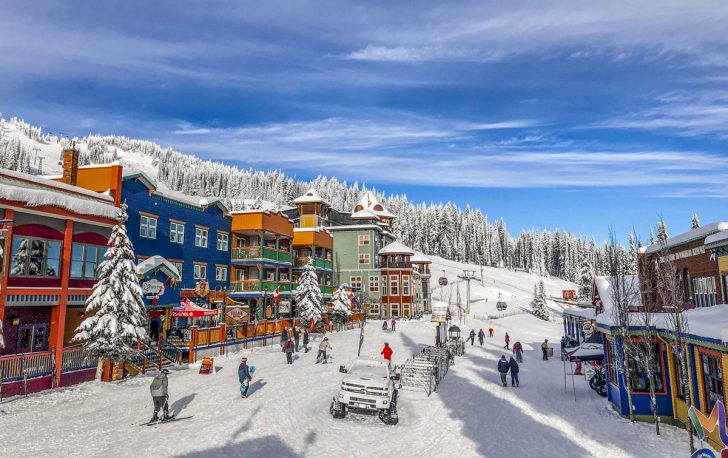
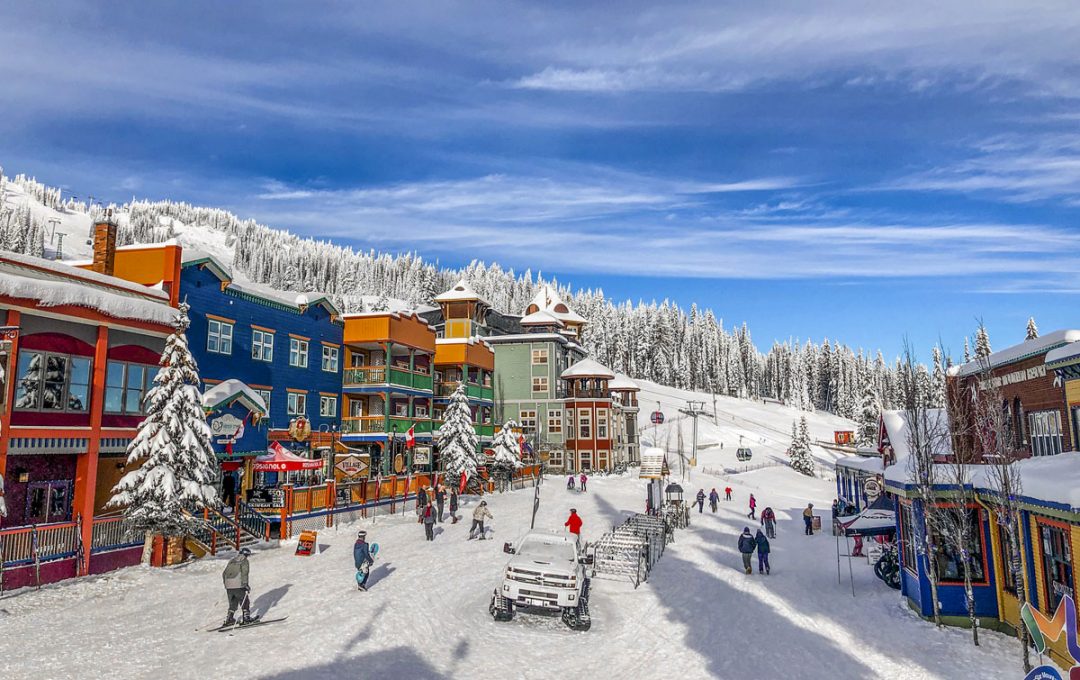
Silver Star’s village with its gondola in view. Credit: Silver Star Mountain.

I hadn’t been to Silver Star Mountain in probably two decades. I remembered a mellow, family resort with an Old West theme and very easy runs.

Boy, has Silver Star in British Columbia, Canada’s interior grown up.

Yes, the main street still has a bit of Old West, 1900s mining town vibe. But that’s where the original Silver Star ends.

There’s now a backside with decidedly expert runs. And a brand new gondola that had its first winter this season. It provides quicker access from the main village to Alpine Meadows, Vance Creek and Powder Gulch. And also gives improved access for beginners, and warm access to the upper XC Trails for nordic skiers so they don’t have to ride open lifts.

What many folks don’t realize is how large this place is. It’s BC’s third largest ski area with 3,282 skiable acres, four mountain faces and 132 runs. This includes the back side with 1,900 acres of steep and deep. Mid mountain is a mile high (5,280 feet) with plenty of ski in-ski out lodging.

As for that Nordic terrain, the 55 km of groomed trails that link to another 50 km at nearby Sovereign Lake make it the largest Nordic network in Canada. And this January, USA Today ranked the SilverStar/Sovereign Lake trail network in the Top Ten Cross-country ski destinations in North America, the only Canadian Resort to make the list. 

Nordic skiiing at Silver Star Mountain, which has the biggest Nordic network in North America. Credit: Silver Star Mountain.

For Seniors

* A two-day Masters Clinic,

* Masters’ Mondays

* A yearly Over the Hill Downhill race where folks dig out their ancient skis and old one piece ski suits.

* A run named Over The Hill.

Fast Facts:

* Silver Star’s ski season runs late November to early April.

*  Nine on-mountain hotels with 5,600 pillows and a seriously vibrant collection of building colors that can include yellow, blue, green, bronze and bright red in sections of the same building. Yes, it all stands out, positively glistening against the snow.

Fat tire biking on snow at Silver Star Mountain. Credit:Silver Star Mountain.

* Sixteen places to eat including two on-mountain and a cabin reached via sleigh, along with a grocery store in the main village. Do NOT miss the Red Antler’s world class chili which, for some inexplicable reason, is called “meat and potatoes soup.” It’s chock full of meat, not too many beans, and set in a thick, spicy base. And for a good show, there’s the Smoked Old Fashioned drink at the Den Bar & Bistro. Watching the bar guy torch wood chips and infuse the mellow whisky drink with smoke is a night’s entertainment by itself.

* Total vertical drop of 2,500 feet with 15% beginner, 40% intermediate, 35% difficult and, yes, 10% extreme. Ten lifts with total capacity of 14,000 skiers per hour.

* Annual snowfall of 275 inches, average daytime temperature of 23 degrees.

* Non-ski activities include snowshoeing, fat cycling snowy trails on bikes with super wide tires, ice skating on the local pond, Tube Town with lift access to inner tube runs and riding a fenced track on Arctic Cat FireCat F120 mini snowmobiles for the 12 and under set.         

To Get There:

Silver star is an hour’s drive north from Kelowna International Airport and the ski area runs shuttles to the resort. The nearest town is Vernon, 20 minutes down the road.

Bottom Line:

Daily pass (for 65+): $82 – $94 Canadian + 5% GST

Season Pass: Senior (65-80) $509 – $579, Young @ Heart (81+) $289.50 Canadian + 5% GST

Great cruiser runs. Great signage. Easily accessed terrain.

Many condo rooms at Snowbird Lodge include generously sized hot tubs.

YouTube: https://www.youtube.com/user/silverstarmymountain

Click Here For Silver Star Trail Map

Click Here For Silver Star Web Cam

Main village of Silver Star Mountain at night in British Columbia. Credit: Yvette Cardozo

A Banner Winter Through The Camera Of An Average Skier

Harriet’s Album Of Deep, Deep Snow Pics At Brighton.

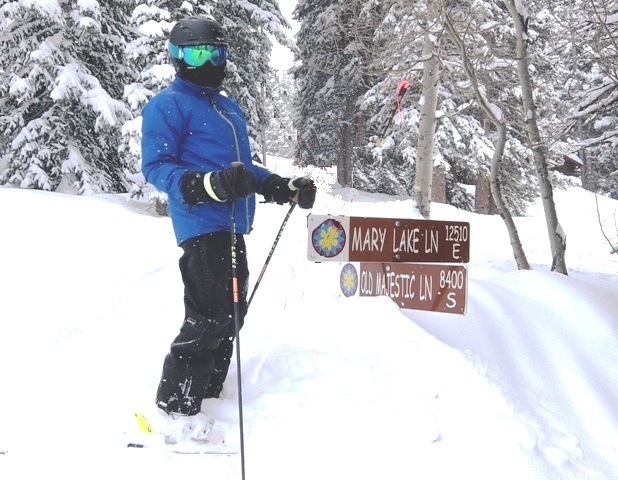
Beware of the buried street signs at the corner of Mary Lake Lane and Old Majestic Lane. The summer road became a deep snow ski trail. Credit: Harriet Wallis

At my home resort Brighton, the snowfall has topped 500 inches—about 41 feet—and the snow keeps coming. Brighton is a down home, low key resort near Salt Lake City that’s favored by families and snowboarders.

This two-story trailside cabin has an access problem. Must dig down deep to find the door. Credit: Harriet Wallis

One more snowstorm and this cabin will disappear. Bamboo poles and a rope line keep skiers off the roof. Credit: Harriet Wallis

Plentiful snow is crucial because It’s our drinking water supply, and there have been several years of low snowfall. When Spring runoff starts, every drop of melting mountain snow is captured. It takes just 24 hours from stream to faucet. Dogs are banned from the canyon watersheds to help keep the pure water free from transmittable diseases.

Just before one of those plentiful snowstorms, my friend and I booked a room at the slope-side Brighton Lodge so we could be first on the mountain in the morning.

Inside the cozy Brighton Lodge. Credit: Harriet Wallis

It snowed all night. We skied all day. Then we had to cope with the car.

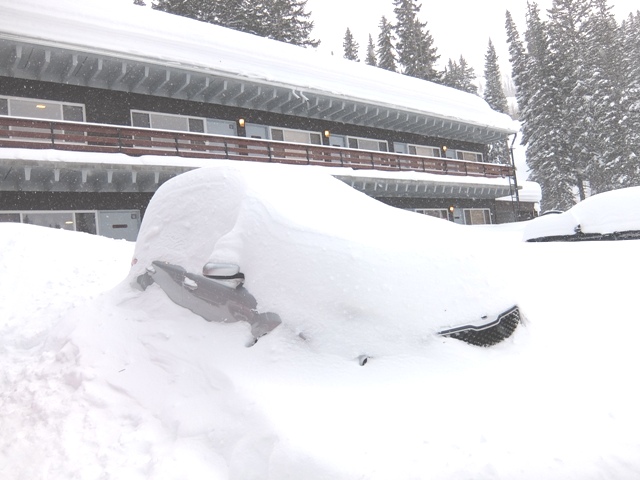
Outside the Brighton Lodge. Deep snow is fun until it buries the car. Credit: Harriet Wallis


Snowboarders dug it out. Credit: Harriet Wallis

The ample winter also creates some other quirks at Brighton.

While the snow keeps falling, these father and son skiers pitch in to help dig out the gates. Credit: Harriet Wallis


The children’s warming yurt looks more like an igloo. Credit: Harriet Wallis


The parking lot is walled by snow. Where will they put the next storm’s dump? Credit: Harriet Wallis 

Even the ride down the canyon toward home has rewards. Deep snow drives the peak-loving mountain goats down to lower elevations. It’s a treat to see them so close.

Shaggy coats and quizzical looks. Credit: Harriet Wallis

To read more from Harriet click here for her stories on SkiUtah.

SeniorsSkiing Guide: June Is A Pleasant Surprise

In The Shadow Of Mammoth, June Mt. Features Dramatic Views.

June Mt has the views, plenty of groomed blues, and lots to choose. Credit: June Mt.

One of the most beautiful drives in ski country is from Carson City, NV down Rt 395 to Mammoth Lakes, CA.  Passing Mono Lake and making your way through the passes that are open in the winter yields some of the most breathtaking views in the country. 

As we made our way down 395 this year, we called an audible to swing on to the June Lake Loop on Highway 158 through June Lake to the June Mountain Ski Resort owned by Mammoth Mountain.

We had never skied June before, and stopping there gave me my 110th different area on my list. Providing  wide open, groomed  intermediate terrain with some nice glade skiing due to ample snow fall this season in the Sierras, it was a delightful pause to our tour of Tahoe ski areas, finishing at Mammoth Mountain.  Not every day needs to be a hammer fest with maximum vertical feet quests and skiing the tough chutes and cornice drops that are typical with our hard charging senior group.  The day at June was a welcome break to ski some delightfully groomed runs with low angle glade skiing mixed in.  

June has a seven lifts, 41 trails, and about half are rated advanced, the other half blues and greens. The resort boasts 70 percent sunny days during the season. Rainbow Summit is at 10,ooo feet and views are spectacular. From there, you can run down Silverado, June’s longest run (two miles), to the mid-mountain chalet.

June has a mid-mountain “base” chalet as well as a base at the base. Credit: June Mt.

Perhaps the most visible benefit of  the visit to June was the incredible scenery.  Sitting at the enclosed deck for lunch, we were treated to vistas that reminded me of the great views of the Alps.  The sharpness of the clear day vistas were enhanced by what seemed to be a close up and personal look at the most dramatic mountain peaks  in the Sierras.  As beautiful as the Minarets are from the top of Mammoth, the vistas from the top of June rivaled their big brother.  Although there are no senior lift ticket discounts per se, the schedule of ticket rates are similar to Mammoth with a base price of 119.00 per day at June versus the 182.00 tab at Mammoth.  If you order on line, you can receive up to 20% off for one day tickets and as much as 40% off for visits and purchases of 5 days or more. June and Mammoth are also on the Ikon Pass. 

The town of June Lake is a little sleepy in the winter with the exception of the June Lake Brewing Company on main drag of Crawford Ave. Exceptional IPAs and other selections that are a staple for the outdoor set in the June Lake area. During the week, you basically have the place to yourself with no lift lines and quiet, scenic relaxing runs.  We always make the Mammoth Lakes area a staple on our visits to the Sierras and the detour to June Mountain should not be missed by any skier venturing down 395. 

Click here for June Mt. trail map.

Click here for June Mt. webcam.

June Lake provides a view as well as plenty of summer activities. Credit: June Mt.

SeniorsSkiing Guide: Solitude

New England Trails With Western Snow.

Solitude management loves seniors as reflected in ticket prices and lodge access.

I love skiing Solitude Mountain Resort for its wide range of trails for all levels and ages of skiers ranging from wide-open trails to steep, narrow trails that remind me of skiing Stowe, Mad River Glen, and Sugarbush. All the parking is right out front of the Moonbeam Lodge or Solitude Village.

Management loves senior skiers, and it starts with when you arrive. Mid-week senior lift tickets are $75 and much cheaper if you buy on-line.

Solitude opened in 1957 and is roughly 30 miles up Big Cottonwood Canyon from the heart of Salt Lake City. Like many ski areas, it has had its share of ownership changes. Deer Valley bought it in 2014 and in 2017, Deer Valley and Solitude were acquired by Alterra Mountain Company. Alterra owns 14 resorts including Aspen/Snowmass, Mammoth, Tremblant, Snowshoe, Steamboat, Stratton, and Squaw Valley.

Nice blue groomers as well as steep glades. Credit: Solitude

Mother Nature dumps 500 inches of snow on its 79 named runs on 1,200 skiable acres. The top is 10,488 feet and the base is 7,994 which give one 2,494 vertical feet accessible by 10 lifts. It is easy to find your way around the mountain, and you never have to climb or walk between lifts. Forty percent of the terrain is intermediate and 50 percent is rated for experts. There are two base areas—Solitude Village and Moonbeam—and, if you are a day skier, park at Moonbeam so you can walk up about twenty-five easy steps or take an elevator in the lodge.

From the Moonbeam lift, you can yo-yo off on beginner and intermediate trails or ski to Eagle Express. It opens up glades that take you to the Powderhorn lift. Or, you can ski Inspiration, Rumble, Grumble, Stumble, Serenity, and Challenger and enjoy the steep rolling contours that both challenge and keep you smiling all the way down. I’ve skied all of them in knee-deep powder and frozen granular. No matter the conditions, after each run down you want to hurry up for more.

If you like steep slopes through the trees, take Summit Express to the top. It gives you access to the far side of Honeycomb Canyon as well as a long, wonderful combination of intermediate runs called Dynamite and Mine. Or, you can traverse along the ridge and ski Parachute (you may think you need one, but you don’t) and Milk Run (i’ts not).

On the mountain, the Roundhouse has a restaurant and bathrooms on entry level and upstairs. accessed by elevator. No stairs! The same for the Moonbeam base area. The menu at both Roundhouse and Moonbeam is typical ski area fare, reasonably priced (for a ski area) and tasty (trust me, I’m picky). There are restaurants in the small Solitude Village along with condos to rent.

So let me repeat what I said in the beginning, I love Solitude. Every time I ski in the Salt Lake area, I spend at least two or three days there.

Click Here For Solitude Trail Map

Click Here For Solitude Webcam

Author Marc Liebman makes Solitude a regular stop when in Utah. Credit: Solitude

SeniorsSkiing Guide: Powderhorn Mountain Resort

The Grand Mesa in western Colorado is the world’s largest flat-topped mountain. Six-thousand feet higher than surrounding terrain. In places, it ascends to 11,000’. You drive through high desert, ranchland, tiny villages. Then you climb to the heights of Powderhorn Mountain Resort. 

Powderhorn on Colorado’s Grand Mesa

Many of you have expressed interest in lesser-known ski areas. To those not in the neighborhood, Powderhorn qualifies as “lesser-known,” and it deserves your attention.

Powderhorn’s three chairs provide access to 1600 acres of trails and trees. The day I skied there, snow quality was outstanding, but snow depth prevented extensive exploration. At one point this winter, it should reach its average 250”.

At 1650’, the vertical is adequate. Unlike some other areas with more vert, Powderhorn’s trials offer a nice continuous pitch. Mountain stats claim 50% blue/30% black. The blacks I skied were more blue. Nonetheless, everything I was on provided an interesting skiing experience. Some mountains have that advantage over other more developed places: they’re interesting. Maybe it’s the fall line; maybe the layout. Whatever it is, Powderhorn has it. And on that particular day, through ever-changing clouds, Powderhorn offered up spectacular panoramas of distant desert landscapes.

The base lodge looks more ‘70s suburban bank building than ski lodge, but once inside, there’s a remarkably friendly and old-fashioned vibe. Not a lot of people around that Tuesday, but it seemed like everyone there came up to greet us and ask where we were from.

Instead of on-mountain lodges, Powderhorn opens its patrol shelters to the public. In addition to a few things to nibble and drink, they, too, have an uncommon feeling of gemütlichkeit. I felt like I was time warping into a kinder, gentler, less-commercial ski era.

Every Thursday, the 50+ “Young At Heart” program meets for guided skiing, lunch, and après ski. Regardless of when you visit, for those 75+, lift tickets are $38, season passes $179. The season pass includes benefits at 25 other areas. The under 75 rates  also are attractive.

Slopeside lodging is limited. We chose to stay in Palisade, a scenic 28-mile ride. Palisade, adjacent to I-70, is known for wineries and peaches, and Wine Country Inn. For several years we’ve been driving by this attractive hostelry. This time we gave it a try. Our room was modern, spacious, and well appointed. What came as a surprise was the delicious food! We dined in both restaurant and bar. Breakfast, included, was a scrumptious buffet of freshly made everything, even a creative selection of home-baked goodies.  We’ll definitely return.

Wine Country Inn

Here’s an idea for seniors seeking a varied ski adventure: Fly into Salt Lake City, ski at a few of those great areas, then head out to Colorado. Assuming the roads are in good shape, you’ll be in Palisade in 4.5 hours. Check in at Wine Country Inn, ski a few days at Powderhorn, then head east toward Aspen, Vail, Breckenridge, Loveland, or Arapahoe Basin. Drop off the car at Denver International and be on your way. Other routes will take you to Telluride and Crested Butte, or down to Las Vegas

Alternatively, if you want a hassle-free, laid back ski vacation, with good prices, uncrowded slopes, outstanding food, and uncompromising friendliness, simply fly into Grand Junction, rent a car, stay at Wine Country Inn, and enjoy the skiing and scenery at Powderhorn. It’s a winning combination. 

Click here for Powderhorn trail map

Click here for Powderhorn webcam.


SeniorsSkiing Guide: Wolf Creek—The Snowiest Surprise

This Resort Has All The Characteristics Senior Skiers Love.

Skiing off the top of Wolf Creek, with Alberta Peak in the distance. Credit: Samual Bricker courtesy of Wolf Creek Ski Area.

It was a powder day at Colorado’s snowiest resort when we pulled in.

Where were the crowds? Not here, they were in places like Aspen, Vail, and Winter Park.

“There are maybe 500 people here,” said our shuttle driver. “Have fun!”

The unassuming base area at Wolf Creek Ski Area is a throwback, with no developed village. Credit: Samual Bricker courtesy of Wolf Creek Ski Area.

Wolf Creek Ski Area is a delightful throwback situated on the Continental Divide in the southern part of the state. And if you’re shocked at the price of skiing in Colorado’s glitzy mountain enclaves, you’ll be pleasantly surprised at how they hold the affordability line at Wolf Creek.

“We’re not out to squeeze every last dime out of our customers,” said Rosanne Haidorfer-Pitcher, vice president of marketing and sales at the resort.

Walk-up ticket prices are $72 for adults, and just $43 for seniors 65-79. If you’re 80, congratulations, your ticket is free.

The skiing is phenomenal, especially if you can hit Wolf Creek on a powder day, which is often. Rocky Mountain storms drop more snow here than anywhere else in Colorado—430 inches a year.

Tree-Skiing Paradise

A skier gets ready to drop in off of Knife Ridge, a short hike into double-diamond powder terrain. Credit: John Nelson

Wolf Creek has a vast array of tree-skiing runs scattered over its 1,600 acres. Topping out at 11,900 feet, its 10 lifts serve a long ridge line that is steep at the top, but rolls into intermediate pitches for most of the area. All in all, 55 percent of the mountain is rated as beginner and intermediate.

If you’re an advanced skier, hiking along the ridge line will deliver you into double-diamond alpine drops. Some of the best are off the Alberta Lift, where a 10-minute climb puts skiers into rare territory of steep untracked lines.

You’ll find great powder elsewhere at Wolf Creek, particularly in the resort’s vast maze of tree-skiing. During my visit in February, I skied powder all day.

Transportation, Where To Stay

Wolf Creek has no on-mountain village. It’s an unassuming collection of old-school lodges, with accommodations 23 miles to the west in Pagosa Springs and 18 miles east in South Fork. If you don’t want to drive, shuttle service is offered by Wilderness Journeys in Pagosa Springs.

Pagosa Springs offers the biggest variety of lodging and restaurants, and it’s also home to several hot springs establishments where you can soak your quads after spending the day skiing powder.

After our big powder day, we spent the shuttle ride down talking about how much we loved the skiing at Wolf Creek.

“This is my new favorite resort in Colorado,” said Jan Mosman, who was visiting from Minnesota with her husband, Mark. “I love the tree skiing.”

The Mosmans had just come from Winter Park, where they had done battle with 15,000 other skiers.

“What did you like best about Wolf Creek?” I asked them.

“No lift lines,” Mark said.

Food, Travel

For a small ski area, Wolf Creek has some surprising amenities. On mountain, there are eight places to eat.

The main Wolf Creek Lodge has daily hot specials and homemade soups, along with burgers served on the sundeck. Don’t miss the Continental Espresso Bar at the top of the Treasure Stoke lift, surely one of the highest places to get a coffee buzz in the Rockies.

The closest major airports to Wolf Creek are in Denver (246 miles away) and Albuquerque (237 miles away).

Click here for Wolf Creek Web Cam

Click here for Trail Map

Skiers make the 10-minute climb off the top of the Alberta Lift to access advanced terrain at Wolf Creek Ski Area. Credit: John Nelson.


SeniorsSkiing Guide: Steamboat

At first glance, Steamboat is the ideal senior skier resort. It’s big. It’s predominantly intermediate. It’s anchored by a substantial town with hot springs, shops and many good restaurants. There are lodging options, galore. But Steamboat also has its challenges. If you’re not part of the IKON Pass, a day ticket can cost $129-159 (advance online). And reaching the lift from where you’re dropped off is always a hike.

Many of you associate Steamboat with two of the great mid-century names in the sport: Buddy Werner and Billy Kidd. Werner was raised there. He competed in the 1956, ’60, and ’64 Winter Olympics and died soon after in a Swiss avalanche. Part of the area is named in his memory. Kidd won silver and bronze in the 1964 Olympics and bronze and Gold in the 1970 FIS World Chamipionships. Now 75, Billy Kidd has been Steamboat’s Director of Skiing for almost 50 years. Most days at 1PM, he’s available for a run with the guests.

The resort is expansive: 2965 skiable acres spread across two mountains and offering 3668 vertical feet. At 6900’, the base is good for breathing. The lift-serviced part of the mountain tops out at 10,384’. Storm Peak has the most steeps. Sunshine Peak has more greens and blues than blacks. Morningside Park, the backside bowl, is mostly blues and blacks.

I was there on two particularly cold days, but enjoyed the effects of the inversion that produces warmer air at higher elevations. Unlike the smoggy inversions in the Salt Lake Valley, in Steamboat cold valley air stays clear.

The resort is in the northwest corner of the state. The most efficient way to get there is by flying into nearby Hayden which receives non-stops from most major airports via Alaska Airlines, American, Delta, and United.

First day on the mountain, I was fortunate to ride up the gondola with an instructor on his day off. He volunteered to show me around. Greg Lambert knows his stuff.

We started at what locals call Wally’s World (aka Sunshine Peak). From there radiate numerous trails and glade runs. One set is named for breakfast foods (Cowboy Coffee, Hot Cakes, Biscuits, Gravy); another set for their sundial effect (High Noon, where the sun is directly overhead at noon; One O’Clock, Two O’Clock, and Three O’Clock).

We worked our way toward Storm Peak, where there’s generally steeper terrain and almost endless opportunities to duck into the trees. A bit fatigued, I left Greg and worked my way over to Thunderhead Lodge, then down a long wide run called Valley View. The panoramas of Yampa Valley and distant ranges are spectacular.

Yours truly tapping Buddy for good luck.

Day Two, I was back on Storm Peak. At the top there’s a bronze bust of Buddy Werner. Local lore says tapping his noggin with a pole brings good luck. I tapped and felt fortunate to be there.

One night we dined at Low Country, which serves authentic (and outstanding) Southern style cuisine. The morning before heading out, we had a terrific breakfast at Creekside Cafe.


Steamboat is big and beautiful. It legitimately prides itself for friendly cowboy cuture and its legendary “Champagne Powder.” The town has everything you’ll need during your stay. Free shuttles are available to take you everywhere.

But to get to a lift, you need to carry your gear through Gondola Square and numerous short sets of stairs. Yes, we saw a storage facility and wagons to pull things, but negotiating the journey was tiring.  Eight or ten years ago it wouldn’t have been an issue, but at three-quarters of a century, I felt it. At one point, I’d like to return to Steamboat. By then, maybe they’ll have a moving sidewalk or a team of sherpas to ease the burden.


World Championships 101

[Editor Note: As the new year begins, SeniorsSkiing.com is again asking our readers to contribute to support our online magazine. Yes, we have grown in the number of subscribers and advertisers. But our expenses have also grown. You can help us defray some of these expenses by helping us out with a donation.  This year, we have a mix of premiums for different level of donations, including stickers, sew-on patches, our new SeniorsSkiing.com ball cap. All donors will be entered into a drawing for a pair of bamboo Polar Poles to be drawn in late March.  You can donate by clicking here.]

Here’s An Inside Look At What Goes On Behind The Scenes.

This championship course is watchable from Solitude’s base area. Credit: Harriet Wallis

When I covered my first World Cup ski race many years ago, I was really naive. I thought the winner would be awarded a huge silver trophy. I was disappointed to learn that racers earn points. No trophy.

But my race stupidity gave me an idea that I’ve pursued ever since. Maybe readers would enjoy an inside look at what goes on around a major race venue. Not just the champions. Not just results. Other stuff. Here we go.

Background Facts

For 10 days in early February, 1,400 elite amateur athletes from 40 countries come to Utah to compete in the World Snowboard and Freeski World Championships at three Utah resorts: Deer Valley Resort, Park City Mountain, and Solitude Mountain Resort.

Practice Day At Solitude

Skicross and snowboardcross take place at Solitude where a special rolly-poly course was built for the competition. As explanation, four athletes start at the same time and race for the finish. It’s similar to the Kentucky Derby where all horses start at the same time. Good luck getting in front.

I was at the snowboardcross training day at Solitude. All racers could take run after run to get used to the course. There was no timing. There was no winner. It was a day for individual practice.

Walk Right Up To The Course

While the words “World Championship” sounds lofty, most courses are usually super spectator friendly. I walked right up to the course, and race spectators can also. It’s like being on the 50 yard line for the Super Bowl. 

A ski patroller watches the course just in case. Credit: Harriet Wallis

Snowboarders careened down the course, jumped the rollers, and headed for the finish. Repeat, repeat, repeat. I got bored, so I moved along to take other photos.

With her little mittens flying, #8 gives the victory sign as she heads back to the lift for another practice run. I don’t know who she is or from what country, but she’s happy. Credit: Harriet Wallis

Inside The Press Room

Off to the press room to get out of the blazing sun. The press room is the sanctuary for writers and photographers from around the world. They munch on snacks, tap away on laptops, and jabber into their phones in foreign languages.

Then there’s a press conference.

International camera people jockey for position before the press conference. Credit: Harriet Wallis
2018 Olympic champion Michaela Moioli of Italy and U.S. snowboarder Anna Miller at the press conference. Credit: Harriet Wallis

These are the faces of BoarderCross athletes — 2018 Olympic champion Michaela Moioli of Italy and U.S. snowboarder Anna Miller. They tell the press conference what it’s like out there on the course.  Moioli likes the straight stretches where she can pick up speed. And Miller says she’s “ready to get the job done.” Women to watch.

Going Back Into My Files. Meet An Athlete

Several years ago, I happened to ski at Deer Valley on a similar World Championship training day. I stopped to watch athletes launch themselves off the “kicker” to soar, flip and spin then hope to land right side up. Their athleticism was amazing. But I’m not heavy-duty into aerials, so I went for lunch.

There was a guy gobbling down a big bowl of Deer Valley’s signature turkey chili. He was wearing a race ID, so I asked if he was an athlete. He introduced himself as Jon Lillis. He was fueling up before going back onto the aerial course to flip and spin upside down. Holy cow! Right after lunch!

Now, at Solitude, I bumped into Jon Lillis (Rochester, N.Y.) again. He is the reigning aerial World Champion. He’s a force to watch.

Jon Lillis fueled up with a bowl of chili before practicing more upside down spins and flips. Credit: Harriet Wallis

Watch At Home

With 10 days of world class competition, tune-in and watch as history is made. NBC Sports will showcase more than 25 hours of 2019 FIS Snowboard, Freestyle and Freeski World Championship programming, including more than 10 hours of live coverage, on NBC and the NBC Sports networks.

Additional coverage will also be available on NBC Sports Gold – NBC Sports’ direct-to-consumer live streaming product – and the OlympicChannel.com digital platform. A full broadcast schedule will be available on both USSkiandSnowboard.org and 2019WorldChamps.com.

To read more from Harriet click here for her stories on SkiUtah.

SeniorsSkiing Guide: Sundance

[Editor Note: As the new year begins, SeniorsSkiing.com is again asking our readers to contribute to support our online magazine. Yes, we have grown in the number of subscribers and advertisers. But our expenses have also grown. You can help us defray some of these expenses by helping us out with a donation.  This year, we have a mix of premiums for different level of donations, including stickers, sew-on patches, our new SeniorsSkiing.com ball cap. All donors will be entered into a drawing for a pair of bamboo Polar Poles to be drawn in late March.  You can donate by clicking here.]

If your Western ski vacation takes to Salt Lake City, save a day for Robert Redford’s Sundance.

SeniorsSkiing.com correspondent soaks up the beneficial rays of the sun on the Bearclaw sun deck at Sundance. Credit: Harriet Wallis

It’s about an hour from the airport, but it’s off the beaten track, and it’s laid back. It’s the only resort where you can ski—and then create jewelry, make wheel-thrown pottery, or do printmaking all in the same day.

While Robert Redford was still a young actor, he was drawn to the wilderness. He bought two acres in secluded North Fork Canyon and built a small home, doing much of the work himself.

Ski the shoulder of towering Mt. Timpanogos. Credit: Harriet Wallis

Then in 1969, he bought the entire pristine canyon to protect it from developers who might dice it into small lots, sell it off for homes, and destroy it. He saw the perpetual tug-of-war between developers and environmentalists.  Redford lives his beliefs, saying don’t squander the wilderness for short term gains.

Ski the wide open spaces. Credit: Harriet Wallis

Sundance is a 5,000 acre environmental preserve on the shoulder of towering 11,700 foot Mount Timpanogos. It  encompasses the 450 acre ski area with four chairs, 44 trails, two terrain parks and a 2,150 foot elevation drop.

The window ticket price for those 65 and over is $30.

And it’s a resort with a twist.

Creativity is good for the soul

The famous Sundance Film Festival was born here, and it celebrates the creativity of independent film makers. Redford believes that creativity and new ideas are good for the soul. Everyone’s soul.

So you can ski in the morning, create silver jewelry in the afternoon, and then wear it home. In just two hours in an Art Studio workshop you can create your own memory of Sundance even if you think you don’t have a creative bone in your body.

Workshops are especially appealing to those who want to enjoy the intimate resort but not ski all day.

Here’s where you can make your unique creation at the art studio workshop. Credit: Harriet Wallis

There are workshops in jewelry, soap making, journal binding, drawing, painting, wheel-thrown pottery, and print making. Classes are very small or it’s likely the session will be one-on-one with your instructor.

Relax and unwind

“We don’t try to compete with other resorts,” said Sundance Director of Skiing Jerry Warren. “You’re here for a different reason. There’s a greater sense of peace here.”

“Take a person from a busy city. They race to catch a plane, they fly, they land, they jump back into the fast lane. We’re going to slow them down a little bit and let them savor the mountains and the experience,” he said.

Sundance’s active senior group —it’s called the Senior Ski Group—meets and skis together weekly accompanied by a ski school instructor who skis along and gives tips.

There’s also snowshoeing, cross-country skiing, and night skiing.

From brownies to relaxed dining

The Bearclaw cabin on the summit offers 360 degree views.  It serves soups and sandwiches and brownies that are to die for. On warm days, skiers lie back in deck chairs and soak up the high mountain sunshine.

Plank floor, roaring fire, and lunch at the Foundry Grill. Credit: Harriet Wallis

In the base area, there’s Creekside for a quick bite. The  Foundry Grill has an earlier times atmosphere with farm implement decor, rough hewn wood floors and a roaring fireplace. The Tree Room is built around the live native pine tree and has a romantic atmosphere. And there’s a country store with more of those brownies.

Low key is special

But what really distinguishes Sundance is its low key ambiance and relaxed atmosphere that have disappeared from many mega resorts.

Sundance is located 56 miles south of the Salt Lake International Airport. The trip takes a little over an hour. You can reserve a luxurious, secluded Sundance cabin, or there’s ample lodging in Provo about 13 miles away.

For Sundance webcam, click here.

For Sundance trail map, click here.

Base area buildings are tucked into the trees, and…”a river runs through it.” Credit: Harriet Wallis

To read more from Harriet click here for her stories on SkiUtah.

Here’s a typical morning in the base lift area. Credit: Harriet Wallis

SeniorsSkiing Guide: Brian Head Resort

Brian Head is Utah’s southernmost ski resort. But its base elevation is the highest. At 9600’, the bottom of Brian Head is higher than the top of Deer Valley. It took about a day before I got acclimated.

In terms of Utah ski resorts, Brian Head is relatively small: 650 acres and a 1320’ vertical. It’s possible to add another 300’, but that would require a steep out-of-bounds climb. 

Because of its location, Brian Head can be a snow magnet, especially when southern storms are prevalent. I skied the resort after a modest but windy storm. Every now and then the clouds lifted to reveal glimpses of the dramatic red rock countryside. On a bluebird day, the views must be magnificent.

The resort got going in the mid-60s when Alta’s Alf Engen was invited down by the first of several owners to help lay out the trail system. The place has developed significantly over the years. 

Today, there here are two mountains connected by a ski bridge. Navajo Mountain is gentle; Giant Steps Mountain, a bit more challenging. Eight chairs are available. The #7 chair and the black diamond area it serves were closed during my visit. My impression is that Brian Head’s blacks would be considered blues at other resorts, 

Getting from parking lot to lifts is effortless. We only visited Giant Steps Lodge where we booted up in the lower level (coin-operated lockers available for storage) but needed to exit and walk a short slope to get to cafeteria and restrooms…a minor detail unless you have the urge.

Senior pricing is good: If you’re 65+, weekday tickets are $30; weekend tickets are $43. Holidays, the price climbs to $57. Season passes are available to 62-69 year olds for $329; 70+ for $219. Season pass holders also get three days at each of 15 other smallish areas in Arizona, California, Colorado, Idaho, Michigan, New Mexico, Utah, and Wyoming. It might be worth the purchase for that benefit alone!

Another Brian Head price advantage is the low cost of its ski school. A weekend lesson is $75. The resort has other attractive instructional offerings as well.

Lodging options are limited to two hotels and a whole lot of condos. We stayed in a pleasant one bedroom in one of the hotels, Cedar Breaks Lodge. It has underground parking and easy elevator access to all floors. The first night we ordered pizza and wings in its restaurant. All I can report is that the beer was good and the hamburgers delivered to other guests looked edible.

The other hotel is the Best Western Premier. It’s nice looking, serves a respectable sit-down breakfast, and features a basic-menu steakhouse.

Other than the day lodges there are only two non-hotel restaurants: Pizanos Pizzeria (which we didn’t try) and Sook Jai Thai Cuisine, a Thai home-kitchen with acceptable dishes and a lack of central heating. 

Contemplating a stay of more than a few days? Investigate the many condo offerings and stock up on food in Parowan (at the bottom of the 13 mile access canyon) or in the larger community of Cedar City, 32 miles away.

Brian Head is a 3-hour drive, from Las Vegas, where winter flights often cost less than flying in and out of Salt Lake City, 4½-hours north. The resort would pair well with a visit to Vegas or one to nearby Zion National Park and/or Bryce Canyon National Park

If I wanted a laid-back, inexpensive, Western ski vacation, perhaps with grandkids learning to ski or board, I’d look into the southern comfort of Brian Head. 

For Brian Head Trail Map Click Here.

For Brian Head Giant Steps Webcam Click Here.


How Deer Valley Prepares For Worst Case Scenario: Wildfire

Laying pipe with heavy equipment. A hot engine can quickly spark a blaze. Credit: Deer Valley

Fires continue to rage throughout the western states. It’s an annual phenomenon: drought, dry grass, tinder-dry forests killed by bark beetles. Lightning strikes. Human carelessness. Just one spark can set an entire mountain ablaze.

For Deer Valley, it’s a normal summer. Hikers and mountain bikers enjoy the trails, and they dine outdoors on the patios. Aspen leaves ripple in the cool mountain breezes. Everything is right.

But the threat of wildfire is always there. And Deer Valley is prepared to fight back.

The resort keeps its extensive snowmaking system operational and ready throughout the entire off-season. Water for the system comes from the 20 million gallon reservoir high up on the mountain, and gravity feeds the network of snowmaking pipes that span the vast resort.

In addition, every mountain vehicle carries fire-suppression equipment. An errant spark from construction, maintenance or welding could start a catastrophic blaze.

Deer Valley is prepared to be its own first line of defense.

“But we’re not trained or prepared for a full wildfire battle. We’re back up for the professionals,” said Steve Graff, Deer Valley’s Director of Mountain Operations.

“We work closely with the Park City Fire Department. They have access to the mountain, they know the gate codes, and they know water is available for their attack,” he said.

Being ready to squelch a fire sounds straight forward, but there are intricacies.

If snow melt doesn’t fill the 20 million gallon reservoir, water is pumped uphill to fill it so it’s ready.

“And, every summer we work on the snowmaking system,” said Graff. “We make capital improvements, we repair hydrants, and we systematically replace pipes. That means some pipes are drained and temporarily out of service. Crucial weekly staff meetings inform everyone where water is available that week and where it is not—just in case.

Winter comes once a year, but “We start working on next season the day we close,” said Graff, and that includes preparing for the worst case scenario: wildfire.

He added: All ski areas do so much work behind the scenes and during the off-season that skiers never know about and never see. But it’s a testament to the dedication and hard work of everyone in the ski industry.

To read more from Harriet click here for her stories on SkiUtah.

Summer Adventures At Mammoth Mountain

Non-Snow Activities Make Mammoth A Family Summer Vacation Stop.

Climbing the Via Ferrata at Mammoth Mountain Ski Area.Credit: Peter Morning, Mammoth Mountain Ski Area.

Ok, picture yourself, flat on your belly in “Superman” position, hurtling in the air down a mountain at 60 mph.

No wonder Mammoth Mountain Ski Resort calls this the Mega-Zip. It’s billed as the “most vertical in the USA” (some 2,100 feet from the top of the ski resort at 11,053 feet) to the bottom.

Definitely not for the faint of heart. Adrenalin junkies, line up here.

The mountain is aiming to open the zipline by late summer, before all these non-snow goodies have to close for the winter season (and skiing!). And it’s got three more adventures, one in the works and two others already operating. The “taste of climbing” wall called Via Feratta is being built. The ropes course for kids 12 and under (gotta grab ‘em early) is already open, as is the Woolly’s Mining Co, a gem mining adventure for kids.

The zipline starts at Mammoth’s top, 11,053 feet and plunges over what some locals call “Oh S*%t Cliffs,” heading down at speeds billed at “over 55mph.” The run is more than a mile long from top of mountain to the base, and you will be able to descend side by side with other folks on parallel cables.

The whole ride is actually in two stages, starting from the very top and going on a somewhat sideways path to the mountain’s Chair One, where people exit and get on a second line all the way to the bottom.

Mammoth hopes to open it by early September, which would give about a month before winter snows start.

The Via Ferrata, which translates to “Iron Path” is a mid mountain mostly horizontal traverse along a cliff face. Rebar is being secured into the cliff face and the adventure will include ladders, suspended bridges and iron rungs, among other things. There will be six different routes that progress in difficulty.

“We think of it as an intro to climbing,” said Justin Romero of the mountain’s marketing department. “The idea is to give people who have never thought of climbing an idea of what it’s like.”

You go with a guide, he added, you are clipped in at all times and the total vertical is about 180 feet as you follow a set trail for 300 feet more or less horizontally across the rock.

The website says “perfect for families, groups or individuals. No previous climbing experience required.”

Photos of what it might look like show folks in full climbing gear … helmet, harness and the rest.

Kids’ Ropes Course at Mammoth Mountain Ski Area. Credit: Peter Morning, Mammoth Mountain Ski Area.

Then, for those kids you found climbing the kitchen cabinets while still in diapers, there’s the kids ropes course for children 12 and under. The site says, “Climb, stretch, balance and crawl your way through 10 different elements that include a climbing net, log walk, planks, swings and more before you rappel back to the ground to finish.”

But for the parents, it’s nice to see all this isn’t THAT high off the ground, and the final rappel drops a fairly tame 15 feet.

A lot of these improvements come courtesy of Alterra Mountain Co., which now has interest in a dozen ski destinations, including CMH (heli skiing). The company, which recently merged with Intrawest, pumped serious money into Mammoth. Some $10 million is being used this summer on the zipline, the cliff climb and both children’s adventures along with improvements to Canyon Lodge.

Besides the zip and climbing route, folks in summer can mountain bike, hike, just ride the gondola for the view and in the greater Mammoth Lakes area, fish, kayak and more.

Summer season is usually early June through end of September when the snows arrive.

For more information: https://www.mammothmountain.com/

People enjoy and photograph the view of lakes from the top of the gondola at Mammoth Mountain Ski Area. This viewpoint is a short hike from the gondola top. Credit: Yvette Cardozo

Grazing cows

Summer Trail Prep: How It’s Done

What Happens When the Snow Disappears Along With The Crowds?

Grazing cows in summer help cut grass on ski runs. Part of summer prep. Credit: Sun Peaks Resort.

Bet you’ve never thought about how your favorite ski runs get cared for when there’s no snow on the ground.

Yes, they have to be prepped each summer.

Seth Worthen, slopes manager at Sun Peaks Resort in British Columbia, Canada, explained how his 11 person trail crew works. And it’s a seven-day-a-week job.

Willow and alder trees, for instance, can grow four to six feet over the summer—the height of an average person. You might think of willows as bushes, but if left alone, they can become 20-foot trees, fast.

“We use a flail mower,” said Worthen. “It practically makes the willow into chips. Even the larger ones can be laid down flat.”

Summer flowers and hiking at Sun Peaks Resort. Summer prep of ski runs will include cutting the grass after the flower bloom. Credit: Sun Peaks Resort.

The crew starts low on the ski mountain in May as soon as the snow clears. But they often can’t get to the tops of runs until July because of lingering snow.

Early grooming years at Sun Peaks Resort were spent removing stumps and rocks. So now, most runs are just grass.

“We mow ‘em with an off road mowing machine, making stripes up and down. Sundance almost looks like a golf course. When you mow two or three feet of grass growth, it lies down and insulates the ground so we need only 25 – 30 cm (about a foot) of snow to open.”

And then, there are the cattle.

Four farms in the area have grazing rights on Crown recreation land. That means the nice, smooth, grassy ski slopes get help with grass cutting from the bovines. Some years, it’s only a few hundred cattle, but it theoretically could be thousands.

So another job here is setting up electric fences to keep the cattle out of the core village. There are gates so people can access hiking trails.

Among the other jobs, there’s cutting some trees along the edges of existing trails each summer to widen them a bit. Also choosing and marking winch cat trees. These are the trees the grooming cats attach cables to so they can manicure steep ski runs in winter.

“We bore into the trees to make sure there’s no decay,” said Worthen.

That’s a smart move when you are expecting to have a cable on a tree keep an eight ton snow cat from sliding uncontrollably down the mountain.

Summer prep is not exactly a hazard free job. One recent summer, one worker was herding a bull (yes, there are bulls among the grazing cattle) when she stepped wrong off a log and broke her ankle. We know she healed just fine because this winter, she was helping run dogsled tours.

At least a third of the runs are prepped each summer, though there are north facing runs on Mt. Morrisey that get more water so the willows grow faster and have to be dealt with yearly.

Thanks to the fact most runs are now just grassy trails that are skiable with a fairly thin layer of snow and are helped by snow making on major green runs, the resort is usually ready to open for skiing each year by the second week of November.

https://www.sunpeaksresort.com/

Summer flowers and hiking at Sun Peaks Resort. Summer prep of ski runs will include cutting the grass after the flower bloom. Credit: Sun Peaks Resort.

Ridin’ With The Cats

What’s It Like To Groom Trails At Night?

Snow cat groomer making the ski run smooth for skiers the next day. Sun Peaks Resort, BC.

They come out at night and do their job. You can see their lights progressing across the ski slope and occasionally hear their roar. And the next morning, they’ve left this delicious set of corduroy tracks across the ski hill.

I’d always wanted to go on-slope with a snowcat groomer. And so, at Sun Peaks Resort in British Columbia, Canada, I did. And it’s a tour anyone can sign up for.

Snow cat groomer makes its way down a ski slope at Sun Peaks Resort, BC.

It’s astonishing how much damage skiers can do to a run in a single day. If the snow is soft, bumps form, and the middle gets dug out because that’s where folks prefer to ski.

Enter the snowcat groomers. These are powerful cabs—Piston Bully 400s with 320 hp diesel engines— atop tank treads with a blade on front and a tiller on the back. The blade knocks down bumps and that nasty looking tiller, which rotates at over 1,000 rpm, can turn even ice into something resembling powder, which is then smoothed flat into that hero corduroy.

Of Sun Peaks’ 24 operators, two are women.

“Honestly, the women do a better job. They are more detail oriented,” admitted my guide for the night, Leo.

It takes three years for a groomer to really learn how to do this well, he added.

It was one of the women running the winch cat that night. Picture eight tons of growling machine attached by a line to a tree to keep from sliding downslope uncontrollably. This is how the really steep runs get groomed. Back in the day, these runs got so bumped and carved out, they were barely skiable.

It takes three years to become an expert groomer. Sun Peaks, BC.

Rob Gayman, grooming manager at Mt. Hood Meadows resort in Oregon, once described operating a winch cat this way: “It’s somewhat like dropping off a cliff. At the top break-over as the machine teeters above the brink, your heart starts to palpitate, and your natural survival instinct pushes you back into your seat.

“As the machine creeps forward and the operator adjusts the winch tension, the cat tilts forward into the darkness. The cat’s lights don’t shine down low enough; you can’t see what lies below. It tilts more and more. You start to fall forward out of your seat. Now you’re standing on the floor; surely this can’t be right? But then the cat finishes its forward tilt and the ground below you comes back into sight. It wasn’t a cliff after all. Snow rolls and tumbles down in front of the cat as the operator blades and tills his way downhill.”

For me, as dusk fell, the whole scene took on a surreal feel. Our headlights shining on the ridges of snow, leaving them glowing with weird shadows, along with the blinding headlights of an oncoming behemoth.

On an average night, more than a third of Sun Peaks Resort’s ski runs will be groomed. But among those, will be every green (beginner) trail.

And if you are lucky, your favorite black run will have been groomed early, then covered with ankle deep powder overnight, making for a run that feels, well, like skiing a glacier.

There are two women groomers at Sun Peak, BC, said to be more detail-oriented than the men.

Spring Is The Time To Play Games

Try This New Game: It’s A Cross Between Where’s Waldo And A Scavenger Hunt.

Find the Bear. Credit: Harriet Wallis

I was skiing at Deer Valley, and I was taking photos. I’m always taking photos. It’s what I do. I never know when I’ll need a certain shot to illustrate a story.

Find the flamingo (?!) Credit: Harriet Wallis

The next time I skied Deer Valley, I was with a friend. I showed her eight photos including the carved bear skiing on a roof, a flamingo wearing a white cross outside one of the ski patrol buildings, and a bronze Native American sculpture. I challenged her to find the real things as we skied around the mountain.

We covered a lot of trails that day. Deer Valley has more than 2,000 acres of skiing, six bowls and 101 ski runs. The hunt forced us to ski a trail once, so she could look for an item, and then move on rather than sticking to one trail over and over. It was a whole new angle on having fun.

Bingo! She found everything shown in my photos. And we were thoroughly tuckered out.

Find the mountain goat. Credit: Harriet Wallis

How To Play

If you are used to taking photos only at scenic spots, try snapping photos of things you see around your favorite mountain, such as a certain trail sign or an unusual weathered tree. Then show the photos to your friends (if they’re whacky enough) or to your grandkids. Challenge them to find those things. You can even offer rewards.

If the springtime slopes start to become ho hum, silliness will add new zest.

To read more from Harriet click here for her stories on SkiUtah.


Find the warrior. Credit: Harriet Wallis