It’s Birthday Party Time at Alta.

Hip, Hip, Hooray! Skier Bob Turns 94!

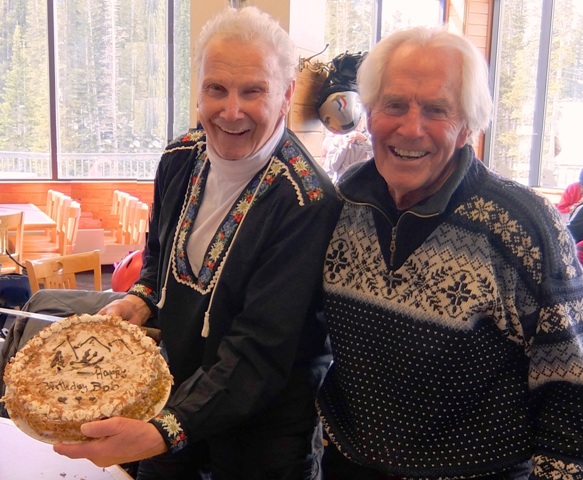
Bob Murdoch celebrates his 94th on skis at Alta. Credit: Harriet Wallis

You might say that 94-year-old Bob Murdoch is a “senior’s senior” skier. He represents many skiers across the country who are skiing into their 90s and enjoying their mountain friendships as much as the slopes.

Ski friends matter. Skiers gave Bob a birthday card that said: Count your age in how many friends you have, not in years.

Bob’s pal, Nick Looser, baked two special cakes
for the party at Alta. Credit: Harriet Wallis

At Alta, Bob is following in the footsteps—in the ski tracks—of 100 year old George Jedenoff who celebrated his milestone birthday on skis in July. Alta’s snow had melted by July, but its neighbor, Snowbird, gathered enough snow to groom a long swath so George could ski on his 100th birthday.

Next to George, Bob is the oldest skiing member of Alta’s senior group, the Wild Old Bunch—and the Wild Old Bunch threw an on-mountain party to honor him. And what a party it was!

Age has its rewards.

Bob, a retired hydro engineer, skis with his good friend Nick Looser, a retired culinary artist, who baked two specialty cakes for the event. He knew there would be a big crowd to celebrate Bob’s 94th birthday.

Bob currently skis three days every week, and his love affair with Alta goes back a long way. He skied the mountain in the 1930s before it was a resort and before it had lifts. He hiked up to ski down.

Skiing has changed a lot since the days of ungroomed snow and long uphill hikes, but we’re lucky we can celebrate with those hardy, early skiers, and we hope we can grow up to be like them.

To read more from Harriet click here for her stories on SkiUtah.

Pebble Creek: A Locals Area That Deserves A Visit

Many readers have expressed interest in learning about lesser-known areas.

When I mentioned that to a representative of Visit Idaho, he suggested visiting Pebble Creek and Pomerelle, both in the southern part of the state.

First stop was Pebble Creek, 2,200′ of impressive vertical not far from Pocatello. I skied there two days and stayed nearby in Lava Hot Springs, at the Aura Soma Lava.

Pebble Creek has about 1,100 acres of green, blue, and black in the Caribou National Forest. The base sits at 6360′. It’s a wonderful place with terrific trail, bowl, and glade skiing served by three chairs. I was fortunate to visit right after a dump, because at the time, the area, like others in the region, was behind reaching its typical 250″ total.

For almost seven decades (2018-19 will be its 70th season), Pebble Creek has been the teaching and gathering place for residents of Pocatello and the surrounding area. It has a friendly vibe. I was there on a Friday and Saturday. Friday is when kids from far and wide arrive in school busses for a day of instruction. Under the guidance of Mary Reichman, longtime owner and GM, the program has introduced skiing to children of all economic backgrounds. Because of the area’s generosity, many children from challenging circumstances have learned how to ski or board.

On the road to Pebble Creek near Pocatello

A new owner recently entered the scene. Shay Carl is a 38 year old who made a bundle in an Internet venture, returned and bought his hometown area. He has the resources and plans to introduce upgrades. His brother-in-law, Mike Dixon, is the new GM.

I have a recommendation for readers who want a low key, off the beaten path experience: Fly into Pocatello (flights from Salt Lake City and elsewhere), rent a car, stay at Lava Hot Springs or Pocatello (I tried both), and ski a few days at Pebble Creek. It’s a real bargain. If you’re 66, the day pass is $32. Stay at any hotel in Lava, and you’re entitled to two passes for the price of one!

Lava Hot Springs at night


Lava has a state park with multiple odorless mineral water pools, one hotter than the other. Sit there for 20 minutes and any ache or pain you brought from home or hill disappears. If the pools don’t do it, the massage services at Aura Soma Lava or other places in town will. While there, dine at Port Neuf Restaurant or River Walk Thai. For breakfast, the Chuckwagon is outstanding. Pocatello is bigger and with more lodging and restaurant options (the new Fairfield Inn and Suites sits on a hill overlooking the city). It’s also the home of the Museum of Clean, a 75,000 square foot facility dedicated to the history of cleaning. A quirky idea, well worth the visit.

Outside its Pocatello fan base, Pebble Creek is not well-known It has terrific terrain and, except on Fridays when the kids descend, you’ll have the place to yourselves.

I’ll cover Pomerelle Mountain Resort next week.

Eating Salt Lake City

Staying in Salt Lake City (or Valley) is an excellent option to explore Alta, Snowbird, Solitude and Brighton. Ski City USA offers good value (many hotels include a Super Pass with the room), public transportation to the resorts, and a broad range of restaurants and entertainment venues.

Here are some favorites. Check websites for hours and addresses.

Breakfast

For a quickie on the way to the mountain, Tulie Bakery or Eva’s Bakery, downtown serve excellent baked goods.

Sweet Lake Biscuits and Limeade is more leisurely. Egg dishes with house made biscuits and gravy are worth the visit.

Lunch and/or Dinner

Spitz serves fresh and substantial salads and first-rate doner kebab.

Most repeat SLC visitors head for Red Iguana, the venerable and superb Mexican not far from downtown. The downside is no reservations for small parties and long waits. Go around 8:00PM to avoid crowds.

On weekends Dim Sum House serves dim sum that stands up to similar places in San Francisco and New York. It’s large, loud and delicious.

For Vietanmese pho and banh mi sandwiches try one of the Oh Mai locations. One of the better Thai places is Skewered Thai.

Scattered around the valley are numerous local counter-service fast food hamburger places with names like Hires and Astro Burger. A favorite is Crown Burgers.

No one leaves The Copper Onion unhappy, unless they had an overly long wait. Avoid the line with a reservation. The American cuisine is consistently excellent. A block away is Taqueria 27 serving gourmet Latin street food and tequilas.

Several Japanese restaurants are available. My favorite is Kyoto. It has a friendly and fresh sushi bar.

For wonderful Indian or Nepalese food in an attractive location visit Himalayan Kitchen.

Among the pizza places, Settebello is within walking distance of most downtown locations. The Pie near the University of Utah requires a car. It is underground and abuzz with students.

If you’re in the mood for a beer and burger, Lucky 13 is one of several options. It’s a dive bar where you’ll get a glimpse of a colorful segment of locals. The Garage is a set on the edge of the gasworks on the north edge of town. Interesting bar food and live music.

Entertainment

There’s a lot of it in SLC, a stop for most touring groups. When checking listings for downtown venues, don’t overlook free Thursday evening concerts at Gallivan Center. The Excellence in the Community series showcases local talent. I’ve never been disappointed.

There’s Silver In Them Thar Hills!

Park City: Visit Silver Mining Museum Sites On Skis.

California-Comstock mine shaft entrance
is on the tour. Credit: Tamsin Venn

Led by Utah’s Park City Mountain Resort guides, the new Silver to Slopes tour skis you to various relics of the mining history scattered throughout beautiful scenery. More than 1,000 miles of tunnels lie beneath the slopes here.

We ride up the McConkey Express with our amiable guide Jim Brown. He notes the tunnels buried beneath the lift once served to drain water from mining operations. Yikes.

“There are some things that can go wrong when you are skiing Park City, Utah, but falling down a mine shaft is not one of them,” says Jim reassuringly. (They are all capped. EPA tests the tailings every summer.)

Brown, an effortless skier and keen historian, has brought along a briefcase of old photos to further illustrate the tour. He is one of those transplants (from Florida) who skied Park City on vacay and never left. Ditto our sweep, Debrinne Ferguson from Los Gatos, Calif.,

In 1963, United Park City Mines, the last active operation in Park City, opened Treasure Mountain Resort on the 3,700 acres it owned. Relying on mining engineering know-how, it put up J-bars, a gondola, and even a Skier’s Subway. The segue from silver mining to ski mecca is evident all around you.

First stop is the Silver King Mine’s Head Frame Building, at the base of the Bonanza Express, closed in only 1953. Miners started digging the 1,450-foot-deep shaft in 1890. The only female mine owner, socialite Susanna Bransford, alias the Silver Queen, made her fortune here. You can ski her nearby namesake trail.

Next stop the King Con Mine Ore Bin sitting to one side of Claimjumper. The Silver King Consolidated Mine, not to be confused with Silver King Mine, built the 1,800-foot deep Bogan Shaft here. The nearby King Con lift serves an intermediate’s paradise and is named for the mining company, not the giant gorilla, as many think.

We ride the Silverlode Express past the Quicksilver Gondola, which has linked Park City to The Canyons as part of Vail Resort’s recent $57 million upgrade. At the new Miner’s Camp restaurant here, The Pickaxe Pub displays authentic ore picks, in keeping with the general theme.

Next we ride McConkey’s Express to access the Georgeanna trail that follows the ridge past one of the best views on the mountain: Mt. Timpanogos (11,753 feet), Heber Valley, the town of Park City, the Uinta Mountains, and the top of Deer Valley’s Lady Morgan chairlift.

Mid-Mountain Lodge was once a boarding house for miners (1897) and relocated from the bottom of the mountain to save it from demolition.
Credit: Tamsin Venn

We stop at Mid Mountain Lodge, once a boarding house for Silver King miners (1897), next used by the U.S. Ski Team (1973-75), now a popular lunch spot. Scheduled for demolition, a group of locals had it hauled up the mountain to this spot in 1987. Hurray for recycling.

At the bottom of Thaynes lift is the famous California-Comstock Mine and 1,700 feet below via the Thaynes Shaft is the West End Tunnel where skiers used to ride the Skier Subway to access the Thaynes lift in the early days of Treasure Mountain. The ride took about 25 minutes. Most skiers did it once for the novelty, once for the kids, and that was it, notes Brown. Here’s a video of what has to have been the most unusual lift in ski country.

https://www.youtube.com/watch?v=K1aUSYfvehE

The two-hour tour takes place on intermediate trails and departs daily from the Eagle statue in Park City Mountain Village at 10 a.m. and from the Bonanza Summit trail map at 1 p.m. Just show up. The tour also helps you get oriented at this mega resort. Donate to preservation efforts at  Friends of Ski Mining History.

For more information, ParkCityMountain.com

The Pickaxe Pub with display of vintage tools is a good place to wrap up the tour.
Credit: Tamsin Venn


SeniorsSkiing Guide: Taos—High, Dry, And Full Of Culture

Some People Say The Best Four Letter Word About Skiing Is “Taos.”

Big, high, dry, up in the sky: That’s Taos. Credit: Val E.

When I looked up at the main slope, I was speechless, then the words came—steep, moguls, trees. Wow. At 12,000 ft, Taos’ Mt. Kachina is close to the top of the World.

The resort is located in northern New Mexico, which one seasoned skier described as “a mix of a desert and mountains, unusual and beautiful.” The Blake family discovered, founded, developed, and an Taos Ski Resort since the mid fifties.

In 2013, new management built new lifts, hotels, and other facilities. The result is a cute, small, Euro-style village with an obvious French-Swiss touch and a huge mountain with well groomed slopes, moguls, cornices, glades, and trees almost up to the very top. Snow is quite dry there because of the altitude. Taos is a breathtaking resort in more ways than one; the town is the highest municipality in the US.

Secret Knowledge

Note single chair on left. Credit: Val E.

Kachina Peak is the highest peak reachable by a triple chair in the North American Continent.

Resort lodging options include hotels, condominiums, and bed and breakfasts. The new jewel of Taos is the luxury Hotel Blake, named for the resort founders. The interior is elegant, the restaurant is high-end, and the rental area looks like a high tech lab.

The Ernie Blake Snowsports School is one of the highest rated ski schools in North America. Ski instructing services for groups, especially for ski clubs, were quite reasonably priced.

One of the best parts, besides the slopes and snow, is super friendly employees. Ski lift operators and ski patrol people were waving and smiling like old friends. One ski resort host kindly ride with me just to introduce to the mountain.

Community

During my week stay at the resort, I talked to a few local skiers, some of them were from the 50+ category.

Here is what an expert skier, originally from Hollywood, said: “I moved to Taos after 16 years in Los Angeles in the film business. Taos is a ski town which has world class skiing and an ancient cultural heritage—one of the oldest in the US. It’s also an artist’s town and has dozens of galleries. Taos gives you access to a wider choice of restaurants and apres ski activities. It is great for couples where one doesn’t ski or who like cultural activities.”

A very confident female skier shared: “We came to live in Taos from NYC after years of skiing here. My husband doesn’t ski anymore. He wanted to retire in a friendly community with a synagogue. Now I ski Kachina peak almost every day.”

Another young looking retiree told me: “I am from St. Louis, flat country. I ski in winter and hike in summer. People come to Taos because you can be whoever you want to be, and nobody is asking questions here.”

Taos Ski Valley is a rugged mountain, pioneered by people who put skiing first and all else second. If Virginia is for lovers, then Taos is for skiers!

Taos By The Numbers

2.5 hours by car/bus from Albuquerque International airport

4 espresso bars, including one ski in, ski out

15 lifts

25 miles to Colorado

$105—one day adult ski ticket (18-64); $85—one day senior ski ticket (65-79); 80+ year old – ski free

$408 ski pass for 6 days (65-79); shorter day pass combinations are available

110 trails 55 for beginner/intermediate and 55 for advanced/expert skiers.

305 in—average annual snowfall

7,000 ft—Taos city altitude

9,207 ft—Taos Ski Resort

12,481 ft—Kachina Peak

Click here for Trail Map

Click here for Taos Ski Resort Website

Trees up to the top are a trademark of Taos. Credit: Val E.


Salt Lake City

Salt Lake City: Ideal Base for Skiing the Wasatch

For many Western resorts this is the season when it’s best to stay on the groomed. There just hasn’t been enough natural snow to enter the woods with confidence.

The trail skiing I’ve done at the four resorts closest to Salt Lake City — Alta and Snowbird in Little Cottonwood Canyon and Brighton and Solitude in Big Cottonwood Canyon — have more than enough snow coverage to keep most skiers well-entertained, especially those who decide to stay downtown or somewhere in Salt Lake Valley.

Staying at a single resort when conditions confine you to the groomed and semi-groomed can get redundant. Being centrally located and visiting different resorts each day can be a more interesting option. Downtown has a lot going on. For those not wanting to deal with a car, there’s inexpensive public transportation to each of the areas.

Salt Lake City markets itself as Ski City U.S.A. Other municipalities use “ski city” when promoting themselves as Winter destinations. Salt Lake City is the real deal. A Delta hub. At the base of the mountains. Thirty, forty minutes from downtown hotels to 36 lifts serving almost 7000 highly skiable acres. Not to mention the state’s license plate slogan, “Greatest Snow on Earth.” This season being the rare exception to that P.T. Barnum knockoff.

Since I lived in Salt Lake City for the past decade and frequented the four areas, I thought that readers considering a Salt Lake City-based ski trip would benefit from some local guidance, which I’ll dole out in this and another article next week.

Super Pass and Alternatives

If you plan to stay in town or in the valley and ski Alta, Brighton, Snowbird and Solitude, consider purchasing a Super Pass or staying in a hotel participating in the Super Pass promotion. The Super Pass provides good savings on lift tickets and is flexible as far as number of days you choose to ski. The Ski City U.S.A. website shows numerous hotels that include a Super Pass in the price of lodging. Residence Inn Downtown, for example, charges $129.50 per person for a suite with kitchen and living room. The price includes two Super Passes.

You’ll need to do the math, but If you’re 80, you’ll ski free at Alta and enjoy deep discounts at each of the other areas.

What to expect if visiting at the right time. Photo: Steve Griffin

If you’re 70, you’ll pay $104 at Alta ($88-$99, if purchased in advance online) and $59 at Snowbird (mid-week). Brighton and Solitude discount their tickets starting at age 65. Brighton costs $52 – $57, and Solitude costs $61. Go online a day in advance and you may find better bargains.

Every Super Pass comes with free public transportation to the resorts. Depending on where you’re located it may be by bus alone or bus in combination with light rail. These are good options if you’re on a budget or don’t want to be hassled with a rental car.

Waterfall House in Salt Lake City

And there’s always airbnb. A search for arrival on Saturday and departure on Wednesday for two people produced results starting under $50 a night. If you have a smallish group, one of the city’s most remarkable rental homes is Waterfall House, which sleeps 7 and averages about $330 a night. It’s filled with entertaining and beautiful features.


Next article will give food and entertainment choices.

SeniorsSkiing Guide: Vail—Luxury Colorado Skiing At Its Best

[Many expenses for technicians, designers, and others are associated with delivering SeniorsSkiing.com free each week and developing and publishing Subscriber-Only content. Please help by making a modest donation by clicking here.]

Vail was magnificent the day I skied there a few weeks ago.

We had bluebird skies, and despite Winter’s temporary retreat the snow was surprisingly good. The resort is vast and if my friend David hadn’t volunteered to guide, I would not have been able to see and ski as much of the place in a single day. He’s lived there several decades and knows it well.

Vail Resorts’ Goldola One
Shot by: Jack Affleck

We started at Vail Village on Gondola One and worked our way to Two Elk Lodge on the ridge separating The Front Side from Vail’s celebrated Back Bowls. Eventually, we skied and rode our way to Vail’s highest elevation: 11,570′ at the top of Blue Sky Basin.

Because of marginal conditions we chose not to go off-piste. From a few past visits, I know that powder in those bowls is great fun. But, vast as Vail is — 5289 acres and 31 lifts — powder gets tracked out by late morning. Secret stashes remain. David pointed out his favorites from the chair.

The resort is a top choice for senior skiers because of its long expanses of blue and single black terrain, chair lifts with foot rests, comfortable gondolas, and ample on-hill day lodges serving excellent fare. The few johns I visited were comfortable and clean.

It’s also home of the Ski Younger Now, hosted by the Vail Ski and Snowboard School. It’s a retraining program for older skiers and those returning to the sport after recovering from injury (see Ski Younger Now tips in Subscriber Only Content). After this weekend, remaining dates for the three-day workshop are March 13-15 and April 3-5.

Like other large Colorado resorts, parking can be an issue. In past visits, I’ve had to park in remote locations and bus it to the lifts; one of my least favorite experiences. This time the car never left David’s driveway. A shuttle picked us up at his house and took us a few blocks to the hill.

As can be expected, Vail Village and surrounding areas have a variety of high end lodging, restaurants, and retail, but reasonably priced options are available. A few years ago we found a nice, well-priced condo with indoor parking in nearby Avon.

As long as conditions are good and the light’s not flat, I’ll ski any terrain. But I prefer to do it at my own pace. David, on the other hand, gets down the hill quickly. Throughout the day he waited patiently for my arrival.

Game Creek Club
Shot by: Kimberly Gavin

At one point we headed for Game Creek Club, a private dining facility in Game Creek Bowl. It is beautiful and accessible only via snow in winter. Game Creek is open to the public for dinner (night access via cat).

Following lunch we made a few more runs. I began to feel wobbly. Some readers are accustomed to a lot of daily vertical, but this was my fourth day of the season, and having booked 20,000 vertical, I needed to go home.

Because it has been a major destination for so long, many of you have had the pleasure of skiing Vail. If not, add it to the list. If you haven’t been there for a while, go back. Vail is luxury Colorado skiing at its best.

SeniorsSkiing Guide: Beaver Mountain—Utah’s Least Known Is A Delightful Surprise

The “Beav” Has All The Goods But No Crowds And No Fanfare.

Cozy lodge is friendly and down home. Look elsewhere for fancy.
Credit: Harriet Wallis

For most vacation-seekers, Beaver Mountain falls off the radar because it’s farther than the 10 resorts that are within an hour’s drive from the Salt Lake City International Airport. Beaver is about 100 miles—less than 2 hours from the airport.

Nobody knows about Beaver Mountain. Actually, lots of people know about Beaver Mountain, but they aren’t telling. They enjoy having the 8,600 foot high mountain with its 400 inches of average snowfall. Its skiers and snowboarders come mostly from nearby Logan and the Utah State University.

I’ve lived here for 25 years, and I’m embarrassed to admit I’d never skied Beaver until last week. A day there shattered all my stereotypes about it. Now I know it’s a gem of a mountain, and it’s very uncrowded. Repeat: Beaver is uncrowded.

And it’s an easy shot to get there: Take I-15 north, turn right to Logan, turn right up Logan Canyon, and you’re at Beaver Mountain.

What’s more, it has a friendly, down-home feel. For example: The sunny base lodge has a roaring fire stove and easy chairs for the ski-weary. That’s a touch that’s disappeared from most mega-resorts.

The cafeteria cooks up very good food at very reasonable prices. I loved the Reuben. But it was hard to resist the finger-likin’ ribs.

Corduroy courtesy of veteran grooming crew.
Credit: Beaver Mountain.

The mountain has a northeast exposure and gets the warming morning sun. Grooming is superb. I learned that the grooming crew is seasoned veterans who have groomed the mountain for years. It has plenty of challenging pitch. There’s an equal dose of mogul fields and off-piste tree skiing, a terrain park, and a magic carpet. The longest runs are 2 miles long. An adult day ticket is $50, seniors (70+) are $40. Seniors can also get a half-day ticket for $35.

I chatted with a couple that I presumed were locals. They weren’t. They live in Florida and travel and ski extensively. They’ve done the big name resorts and were thoroughly enjoying Beaver for the week.

I rode up the lift with Mountain Operations Manager Travis Seeholzer. He pointed to the ridgeline and said: “That’s the Idaho border.” Beaver is high in the northern-most corner of the Wasatch Mountain Range.

Because of its location, Beaver has a marketing problem. Lodging and big city amenities are 27 miles back to Logan or 13 miles ahead in Garden City, a popular summer destination on the shore of Bear Lake.

The flatlands surrounding the mountains are known as Cache Valley because mountain men and trappers cached their furs in secret places. Beaver Mountain is also a secret. Discover the secret mountain for yourself. Do what the locals do. Go “Ski the Beav.”

Other things you should know:

  • There’s no cell phone service at Beaver. People actually talk with each other.
  • Logan has tons of restaurants, car dealers, theaters, shopping, grocery stores, two hospitals, and more.
  • Garden City is primarily a summer resort area and has very little open in winter. There are several time share facilities, and that’s where the couple I talked with was staying. They bought their groceries in Logan as they passed through, and that’s what they recommend.

Click here for Trail Map.

Click here for Webcams.

To read more from Harriet click here for her stories on SkiUtah.

This is uncrowded. Nice.
Credit: Harriet Wallis


In Praise Of Urban Wilderness

Find Winter Activity Opportunities Close To Home.

Let’s define what we mean by Urban Wilderness:

  • Open space – wetland, meadow, and/or forested land.
  • Owned by a public entity
  • No parking or entrance fees
  • No visual pollution
  • Offers “peace and quiet”
  • Accessible by either car or public transportation from the nearby urban center
  • Offers a variety of activities (year-round)

Urban Wildernesses can be found in or close to many city centers. The point is that you don’t have to venture into the mountains to find winter recreation; it’s often just a short ride away. All you have to do is find them.

Here are two examples, one from the Boston Area, the other from Portland, OR.  What are your favorite Urban Wildernesses?

Around Boston

Hard to believe this view of Middlesex Fells Reservation is only a few miles from downtown Boston.
Credit: Commonwealth of Mass

Near Boston, MA is the Middlesex Fells Reservation. “The Fells” has borders in four near Boston suburbs; Medford, Winchester, Stoneham and Melrose. It’s 2,575 acres bisected by Interstate I-93. The east side of I-93 is more developed. The west side of I-93 is less developed with a border road and some homes along the road on the opposite side from the Fells. Nevertheless, the west side provides more of a wilderness feel.

Several ponds act as a water supply to the town of Winchester. The Fells have a good number of trails for mountain biking, hiking, snowshoeing, x-c skiing (ungroomed) and trail running including:

Skyline Trail

The 6.9 mile Skyline Trail follows the outer perimeter of the western Fells. There are spectacular views of Boston and the surrounding area. Most of the Skyline trail is in wooded landscape, with several steep ascents to rocky outcrops.

Reservoir Trail

The 5.2 mile Reservoir Trail encircles the north, middle and south reservoirs, and the open water can be seen from many sites (the reservoirs are for drinking water, so access to them is prohibited).

Cross Fells Trail

Beginning in the western Fells near the Medford High School, the 4.5 mile Cross Fells Trail gives a good sampling of the features of the Reservation, from wetlands at Whitmore Brook to open water at Quarter Mile Pond in the eastern Fells, to views at Cairn Hill. Use caution crossing South Border Road, Route 28, Woodland Road and the Fellsway.

For more information about Middlesex Fells Reservation, click here.

In the Boston area, there’s also Walden Pond, site of Thoreau’s cabin, in Concord, and Appleton Farms, a 900 plus acre working farm established in 1638, in Ipswich.

Here’s a brief description of a ski tour around Walden Pond.

And here’s what it’s like cross-country skiing at Appleton Farms.

Around Portland, OR

Forest Park is practically in downtown Portland, OR.
Credit: Forest Park Conservancy

At 5,157 acres, Forest Park in Portland, Oregon is one of the largest urban forests in the United States. With more than 80 miles of trails, Forest Park stretches for more than seven miles along the eastern slope of the Tualatin Mountains, at the convergence of the Columbia and Willamette Rivers. As stated in the park’s website, “Forest Park offers an unparalleled opportunity for visitors to experience a true Northwest forest without leaving the Portland city limits.” Forest Park immediately came to mind as an archetypical urban wilderness.

Activities along the 80 miles of trails include:

  • Horseback riding
  • Hiking
  • Cycling/mountain biking
  • Running – trail and road
  • X-C Skiing, Snow Shoeing (when and if it snows)*

Among the park’s trails are:

Ridge Trail

Trailhead access for the Ridge Trail, which is only open to pedestrian use. To find the trailhead, park at the obvious pullout on the way down Bridge Ave (heading toward Portland). You will then need to walk back up Bridge Ave roughly .2 mile to find the actual trailhead.

The Wildwood Trail

30.2 breathtaking miles, from the southern end of the trail at the Vietnam Veterans Memorial in Washington Park to the Northwest terminus of the trail at Newberry Road.

*The city of Portland averages only 4.3 inches of snow a year, so winter activities are the often same as activities the rest of the year. But, what a place to get you in shape for skiing on Mt. Hood only 50 miles from downtown Portland!

For more information about Forest Park, click here:

Please tell us your favorite urban wilderness. What makes it special to you?

Wonderful Winter Walk With Wolves

Why Wait When Wolves Want Wise Well-Wishers.

Wolves walk with visitors during a guided wolf walk in the forest and play in the snow near Golden BC. Credit: Yvette Cardozo

Okay, in the picture, it looks like she’s being licked by a dog. But trust me, that’s NO dog. It’s a real grey wolf. In the woods. Walking with my friends and me.

Woman meets Scrappy Dave, one of the wolves on a guided wolf walk through the forest with Northern Lights Wolf Centre, a wolf rescue and education center in Golden, BC.
Credit: Yvette Cardozo

It was part of our morning at Northern Lights Wolf Centre just outside Golden, BC, Canada, where we learned about wolves and definitely got close and personal.

Shelley Black and her husband Casey have been raising wolves for nearly two decades. Their aim is not only rescuing abandoned wolf cubs but educating the public.

“There’s so many misconceptions about wolves,” Casey told us.

For one, they really don’t lurk around woods just waiting to eat people. They’d rather avoid people. But thanks to a lot of fiction where hapless folk are forever being devoured or myths that are really morality tales warning women of attacks by men (Little Red Riding Hood, for one), there is an ingrained public fear of wolves.

There are many wolf rescue/education centers around North America but only a handful that let you actually walk with the wolves and interact with them.

And so, we gathered one late winter morning at Northern Lights Wildlife Wolf Centre to learn, prepare, and walk.

The wolves have been exposed to people from birth and are used to walking with visitors.
Credit: Yvette Cardozo

Scrappy Dave and Flora, our wolves that day, had come from a zoo that had too many wolves. They were brought to the center in Golden when only a few days old. So, like all the wolves here, they are totally used to people.

“They lived in the house with us for the first several months,” said Shelley. “We treated them like human babies, fed them and slept with them.”

When not out in the woods on wolf walks, the wolves live in acre enclosures, two each to an enclosure.

But these ARE wild animals. For that reason, Shelley and Casey explained, the walk is totally on the wolf’s terms.

“We don’t approach them but if they come up to you, you can touch them.” (um, more about that later).

More Wolf Walk Rules:

  • If you don’t want the wolf to jump up on you like a friendly dog, hold your hands together and down in front of you, push him down and say “Stop!”
  • Don’t spin away because they see that as a game.
  • Don’t kneel down. Kneeling is a sign of aggressive behavior in the Canidae family.
  • Keep your hat on and if you take your gloves off don’t think you can just hold them. Scrappy Dave will grab them. And they’re gone, lost in the woods. Forever. Best to just keep them on.

One of the more interesting facts is that wolves don’t need to run; they aren’t sled dogs. They’re actually quite lazy, which in the wild is a survival tactic to conserve energy.

With all this in mind, we headed for the woods.

We walked down a logging road a few hundred yards when suddenly, Flora, all 60 pounds of her, trotted up to me and raised up on her hind legs. She was almost as tall as me as she leaned in, put her huge, muddy paws on my shoulders and sniffed my face.

She was saying hello in wolf talk. She did that to one of my friends, though on her back, leaving muddy paw prints that looked like a painted design. And I’ve got the pictures to prove it.

At this point, it was time for our “wolf moment,” which involved standing next to a tree stump while Scrappy came up from behind and did his best to lick us into oblivion. All I can say is, who knew wolf tongues were soooo soft and warm.

One could point out that this whole adventure was staged and quite artificial. But the purpose, Casey and Shelley said, is to let people know the wolfs’ place in the environment and, especially, to let people know wolves don’t have to be universally feared.

Northern Lights Wildlife Wolf Centre is a 15 minute drive from Golden, BC. The programs are open year round. There’s a talk led by a guide where people walk around the edge of a fenced wolf enclosure. It is open to all ages.

The Wolf Walk age limit is 16 and above, lasts most of a morning or afternoon and costs $335 CDN for two people. The interpretive talk at the center is $12 CDN for adults, $35 CDN for a family of four.

The wolves have been socialized to people from birth and are used to walking with visitors
Credit: Yvette Cardozo

Lift Maintenance 101

The Whole Summer Was Spent Getting Ready For Winter.

Reassembling parts takes time and patience.
Credit: Harriet Wallis

It’s 80 degrees at Deer Valley. Mountain snow melted long ago. A summer breeze rustles leaves on the aspen trees and wafts through the open doors of the maintenance shop. The crew wears shorts and T-shirts. It’s mid-July.

Gears and gizmos cover the work benches, and the crew is meticulously polishing, calibrating and lubricating the parts. It’s virtually open heart surgery on the inner workings of a ski lift.

“We work eight months to be open for four months of skiing,” said Deer Valley’s Lift Maintenance Manager Jeffrey Miller. “All of us in this industry do a great job. We’re well aware of how many bottoms are in the air.”

Maintenance also deals with rubber parts that get worn, such as belts. Weather, wind and temperature can affect alignments. Even identical lifts can wear differently. Lift maintenance is complicated. It’s part science, part skill and part art.

It takes a lot of work to refurbish parts.
Credit: Harriet Wallis

Deer Valley’s talented crew keeps the resort’s 25 lifts running smoothly.

But there’s more. Just like your car gets its 60,000 mile service, lift components must be inspected, reconditioned and rebuilt at various frequencies, Miller said.

“For example, certain lift manufacturers require that sheave assemblies be rebuilt every six years. Brakes should be completely torn down, inspected and rebuilt every four years. Gearboxes and final drives get reconditioned on an hour basis, right around the 12,000 hours.”

Got that? It’s a complex schedule.

In spite of all the tedious maintenance, a breakdown can happen. The needed part — many of which are huge — might not be in storage. But a nearby resort might have that part. “We’re a tight-knit group much like a family. We reciprocate by sharing parts,” Miller said.

This is a job for four hands.
Credit: Harriet Wallis.

All this so you can enjoy your ski day.

But the work doesn’t stop when summer ends. When we ski, we’re always looking up – looking at the lift mechanisms, he said. And we periodically sample the oil to see what’s in it and we check tension adjustments.

Get ready to ski. Deer Valley’s lifts and the lifts at your favorite resort had their summer work outs.

To read more from Harriet click here for her stories on SkiUtah.


Mammoth Memories: See Ya!!!

In the winter of 1993, I was in my 29th season, age 55 and still in that happy state of benign self-deception when I believed I skied better each season than the season before.

On the Gon at Mammoth.
Credit: Sarah Sherman/ MMSA

A lifelong wage slave, despite passionate longings to the contrary, I had never given myself the luxury of a ski-bum year. As a weekend-warrior, a good year would be 20-25 days.

It was late May and all of my usual Tahoe destinations closed. I decided to take a solo road trip to Mammoth to close the season. The sun was warm and the slopes covered with corn. I quickly racked up formidable verts and boarded the old Gondola at mid-station for what was to be one last run. Three 20-somethings joined me in the cab, regaling each other with boasts of what a fine day they had all had. “Good show!” I offered, “Now we can all relax and coast down on that good old last run.”

“Oh? Why last run? I can handle more,” one guy responded.

“Yeah, well, I don’t think so,” I said.

“Why not?”

“Well, it’s 2:20, now,” I began to explain. “Lifts stop running today at 2:30. We’re still at least five minutes from the top, and it’s a long way down, so… hey!”

“Yeah, well, whatever,” the guy said. “I suppose if I were your age, I’d see it that way, too.”

That smarted. Damn whippersnappers, can’t they show a little more respect… then I thought how I must look to these guys… gray hair, faded parka, scuffed-up red boots… Ah, hell, they’re just kids, who cares, anyway? Still…

At the top, we exited and quickly descended the stairs. I clicked into my skis as fast as I could, and checked my watch – exactly 2:27. No way… BUT… I glanced over my shoulder to see the three guys ready to shove off; they hollered, “See ya!” Then, rather than my usual cautious chicken-slow entry onto the slope, I launched straight out into the air, off the cornice, into the most direct route down.

What the hell am I doing? flashed through my mind. But, to my mild surprise, I nailed the landing, then hauled ass through those soft steep moguls all the way down to the wide groomed outrun. Already flying, I tucked all the way. A hundred yards ahead, the attendant had already started to pull the “CLOSED” rope across the entrance. I waved my poles and shouted, “HEY! HOLD ON!” By the time he looked up, I had scooted through the gate. “Oh, OK,” he smiled. “You’re the last one.” Grateful as hell, and breathing hard, I proceeded to the loading platform and boarded the last gondola of the season.

As the car left the station, I looked down, and saw the three youngsters from the last ride, approaching the now-closed lift entrance. Unable to do otherwise, I opened the window, stuck out my head, and hollered, “SEE YA!”

At the top, I exited slowly, took a long time drinking in that glorious view of the Minarets, Mono Lake, the whole beautiful scene, then coasted down, easy, stopping every few turns to admire all that grandeur, one last time, in all my quiet solitude.

2017-2018 will be my 54th season. I turned 80, last week. It’s been quite a few years now since I last believed I skied better every year. But that passion is still there, and I have no plans to quit, any time soon.

Mammoth’s season goes past Memorial Day in snowy years.
Credit: Peter Morning/ MMSA

Five Tips For Sierra Summer Skiing

[Editor Note: This article by Correspondent Rose Marie Cleese first appeared in Liftopia’s The Blog.  We thank Liftopia for allowing us to pass it along to the readers of SeniorsSkiing.com.]

Even though summer has officially arrived and temperatures are reaching triple-digits across the country, are you still nostalgic about winter and wish you had gotten in a couple more days of skiing or boarding?

You’re in luck. Ski season is alive and well in the Sierra, at Squaw Valley near Lake Tahoe for at least two more weekends and at Mammoth Mountain off State Route 395 east of Yosemite daily into August.

See California lift tickets.

Summertime, when the vibe is chill and the air is hot…

So how different is it to ski and board in the summer? When’s the last time you spotted a marmot basking in the sun next to a ski tower? Or had a flurry of ladybugs alight on your table while lunching on the lodge deck. Everyone on the slopes is happy and laid back because we all know we shouldn’t be able to be doing this at this point on the calendar. Below are 5 tips if you’re headed to the slopes this summer.

1. Enjoy the soft, easy-to-ski corn snow.

Corn refers to the snow during the time window when it has become soft and forgiving, but not too wet and slushy.

At Squaw Valley, after you leave the green, grassy terrain around the base of the mountain, it’s a bit of a shock to find yourself a few minutes later on the snow-covered slopes of Squaw Valley’s upper mountain, currently boasting a snow depth of up to 131 inches (that’s nearly 11 feet, folks!).

Now, over the long 4th of July weekend, July 1–4, and on Saturdays thereafter “as long as we can provide a safe skiable surface,” says Squaw Valley spokesperson Sam Kieckhefer, you can enjoy a full four hours of skiing on corn snow, from 8:30 AM to 12:30 PM.

The surfaces of most runs are easily skiable corn snow, kept nice and crisp due to the deep snowpack. The only places you’ll find full-blown heavy slush are on the wide, flat runs that feed into the Gold Coast Lodge area. Last weekend, the temperature on the upper mountain was 60 degrees and the resort had four lifts running: Gold Coast, Big Blue, Siberia and Shirley. Skiers could also traverse and hike up to ski the runs on Headwall.

2. Check out Squaw Valley’s poolside party at High Camp.

PHOTO CREDIT: Katie Cleese Photography

After you shed your skis, be sure to check out the lively scene at Squaw Valley’s pool and hot tub at its High Camp location, open from 11 AM to 4 PM. For the price of admission ($15), you get a locker, towel, and access to an 8,200-foot-elevation alpine party, complete with a poolside dj spinning house music and scantily clad 20-somethings cavorting and splashing around the big pool wearing ski goggles.

Catch the shuttle back to the Resort at Squaw Creek where you’ll have the options of sunbathing by its more mellow pool sipping a margarita, soaking in a hot tub, playing a round of golf, hiking, or playing a game of tetherball, corn hole, or giant chess. The best of summer and winter all in a single day.

See Squaw Valley lift tickets.

3. Defy winter and ski well into summer at Mammoth Mountain.

PHOTO CREDIT: Mammoth Mountain

On the eastern side of the Sierra, Mammoth Mountain, the queen of ski resorts staying open past April, is experiencing three to four times the number of skiers and boarders they usually get this time of year, according to Mammoth Mountain’s communication manager, Lauren Burke. “We’re committed to daily operations into August,” she says. “In the last 50 years, we’ve stayed open into July some 15 times. Our longest season on record was 1994–95 when we closed on August 14th.”

Hours of operation at Mammoth are 7:30 AM to 2 PM, with 6 lifts, 57 trails and 2 terrain parks available midweek, and 7 to 8 lifts and 70 trails available on weekends. Currently, Mammoth has 45 inches at its base and 180 inches, or 15 feet, at its 11,000-foot-high summit.

For Bay Area skiers, the quickest way to reach Mammoth right now by car is via I-80 through Reno and south on SR 395. The faster route via Highway 120 over Tioga Pass, which closed for the winter season last November 16th, is still closed with no projected opening date. In the last 80-plus years, the latest Tioga Pass opening was July 1st, so it looks like that record is soon to be toast!

See Mammoth Mountain lift tickets.

4. Garb up or garb down… Whatever you prefer, just don’t forget the sunscreen!

PHOTO CREDIT: Katie Cleese Photography

If you NEVER fall, wear whatever or how little you want. We saw a pair of skiers in flowing Batman and Superman capes, a boarder wearing a Speedo®, plus a plethora of cut-offs, tank tops, no tops (guys only!), and streamlined helmets. So wearing apparel is whatever strikes your fancy, but there are a few “musts” when you hit those corn-fed slopes:

Before you go out, cover every bit of exposed skin with a high-SPF waterproof sunscreen (including ears, napes of necks, hands if you’re going gloveless, etc.) and reapply as needed. The summer sun is intense at these high elevations, plus you’ll be skiing in mostly sunny weather. Also be sure to entirely cover your lips well with a good lip sunscreen.

Wear goggles or make sure that your sunglasses are completely protecting your eyeballs. Never, never, never head out to the slopes without one or the other. Snow blindness (when you burn your cornea from overexposure to the sun’s UV rays) is incredibly painful and can take a couple of days to recover from.

5. Stay hydrated.

PHOTO CREDIT: Katie Cleese Photography

Drink lots of water throughout the day or you’ll find yourself getting parched pretty quickly. Squaw Valley had water stations set up both outside and inside the Gold Coast Lodge, with plastic water cups stacked up behind the water fountains. Save the alcohol imbibing for après ski!

Provided that the winter snows come on schedule next December, it’s nice to know that all those happy campers up at Squaw’s High Camp last weekend have to wait only five months to ski and board again—but it certainly won’t be as much fun as skiing in workout pants!

Rose Marie Cleese is a correspondent for SeniorsSkiing.com, an e-magazine devoted to wintersports enthusiasts aged 50 and up.

June Skiing At Alta: The Never-Ending Season Goes On

Where Is Everyone? There’s Pow At Alta.

Thanks to Snowbrains for passing this along.  June 13, 2017 run at Alta.

Alta’s GM Onno Wieringa Retires

He’s Loved And Will Be Missed.

Credit: Harriet Wallis

Onno Wieringa has a passion for snow and for the soul of Alta. They have been his love and his career for 45 years.

He arrived at Alta Ski Area in 1972 and landed a job as ski patroller. That was his day job. At night, he was a bartender at Rustler Lodge.

After five years on patrol, Onno was promoted to snow safety director and served under Alta’s second GM, Chic Morton. In 1988 Chic was ready to retire and called on Onno to take the reins. Onno leaves a legacy for Alta to emulate for years to come.

Click for videos of Alta and Onno. http://www.alta.com/snow-and#

To read more from Harriet click here for her stories on SkiUtah.

Master’s Week At Big White: Senior Focused Lessons And Activities

Big White Found The Right Formula To Attract Seniors For A Special Week Just For Them.

Ski lift with view of condos. Credit: Big White Ski Resort.

Like so many things of yesteryear, ski weeks are making a comeback.

And not surprisingly, they’re aimed at the same folks who went ski trips back during the ski week heyday in the 1970s and early ‘80s—the Boomers.

The original ski week hit when the baby boomers were yesterday’s millennials. They had money, they were skiing, they wanted a fun social experience.

Then boomers started having families and taking an entire week no longer worked. So short, specific clinics (racing, bumps, women’s) that lasted only a long weekend, took over.

But why have ski weeks returned?

Women in Big White Ski Resort Masters ski program show off their green hair helmet decorations. The program runs a week with lessons in the morning and social programs at night. Kelowna, BC.
Credit: Yvette Cardozo

Because the kids have grown up, the money is available and so is the option of taking a week. Plus, it’s, well, your own age group. No trying to keep up with someone 30 years younger.

“It started as 50 Plus in 2011,” said Katie Balkwill, regional sales manager for Big White Ski Resort. “We ran it that way with very small numbers until 2013. Then we changed the name to Seniors Ski Club—and no one came the following week.

“So we changed the name to Masters Monday and had 30 participants the next week. We average 45 people every Monday for most of the season now.

“It truly is all in a name.”

As for Masters Week, it has grown steadily from 23 participants the first year (19 of whom have returned) to 59, then 109, then last year, 229 split between into two weeks, and after the second session, a third was added for the end of the season.

 And so, I signed up. We would ski together each morning and have a variety of social programs in the afternoons or evenings.

Since we had all filled out forms suggesting our ski level, we separated into skill groups the first morning ranging from novice to expert. After a bit of shuffling, we were set for the week.

Instructor at Big White ski resort shows an exaggerated proper stance for skiing.
Credit: Yvette Cardozo

Our group, Level 4 of 6, was perfecting its stance, getting more aggressive on our turns, and playing a bit in the year’s epic powder.

Anthony, our instructor, tailored exercises to each of the five in our class.

For Sandy, it was ski down holding poles horizontally in her hands which, Anthony said, helps you lead the turn with your lower body. Her upper body was turning into the hill, which throws you off balance.

For Norm, it was a “prayer stance” holding his hands together in front of his chest. This balances you and helps you lead with your legs, rather than your upper body.

For me, it was making sure I looked downhill when turning, not to the side—again, helping with balance.

And for all of us, there was a maddening exercise where we dragged our downhill pole along the snow, which truly is not intuitive. This gets you onto your downhill ski throughout the turn, Anthony insisted.

And, well, it did.

It snowed every day but on two mornings, fog settled in.

We all gulped, shrugged, and took off for lessons on how to deal with a whiteout.

We headed for the Black Forest chair whose medium width trails were lined with trees heavily frosted in Christmas card snow.

Ski along the trees, Andrew said. And sure enough, there magically was definition in the snow at our feet.

Don’t look at your skis, he added. Yes, it’s scary to peer into the white void, but find something ahead—another skier, a line of trees, a pole, a lift, and keep your eyes on that.

It absolutely helps avoid vertigo and, of course, falls.

I had truly hoped that last day we could find some steep cruisers along one of the outlying chairs and some untracked powder but the fog and near blizzard conditions squelched that.

Instead, I took the lessons home where, yes, it all made a huge difference.

Information

Big White Ski Resort’s Masters Week is actually five days, Monday through Friday. There are on-slope lessons each morning, then social activities in afternoon or evenings.

For 2018, Big White is planning at least two Masters ski week programs, Jan. 29 – Feb. 2 and Feb. 26 – Mar. 2, plus possibly a third at the end of the season.

Price for the week (lessons, clinics and most social activities) will be $278 Canadian. Canadian dollars have run about .75 per US dollar for a few years meaning $278 CDN works out to about $208 US.

There are also Masters Monday classes, held each Monday morning, for people who don’t want to commit to an entire week.

Early morning view of Big White Ski Resort village ski runout on a sunny day. Credit: Yvette Cardozo


Master’s Week At Big White: The Social Side For Seniors

There’s More Than Ski Clinics For Seniors That Make Big White’s Master’s Week Unique.

Sleigh ride at Big White Ski Resort. One of many non ski winter activities.
Credit: Big White Ski Resort

[Editor Note: Correspondent Yvette Cardozo also reported on Big White’s Master’s Week focusing on the ski instruction elements.  Here, she shows us the social side which really looks like a lot of fun.]

The social part of the Big White Ski Resort Masters Week is what made the experience different.

Those of a certain age who skied in the ‘70s and ‘80s will remember the original ski weeks. Some were run like summer camp and at least one (Gray Rocks in Quebec) came off like a cruise ship.

Jolly time at Masters Week apres ski party at Big White Ski Resort. The Masters program is aimed at skiers of all levels over the age of 50.
Credit: Yvette Cardozo

You skied together, you ate together, you made long term friends.

And now, the old fashioned ski week is back and aimed squarely at the folks who made it a success decades ago—the Boomers.

Okay, the ski weeks I remember from yesterday had us on the slope ALL day with a brief break for lunch. My knees are long past that.

 Instead, the Big White Ski Resort (Kelowna, BC) Master’s Week has on-slope work in the morning, then social stuff in the afternoons or evenings. There is also a Masters Monday, aimed more at locals but also including folks who don’t want to commit for an entire week.

And this certainly has hit a chord with people

The first day of my week, when we were joined by the Monday only groups, the resort was expecting perhaps 130 for lunch. Nearly 200 came (many signing up just that morning). There was quite a scramble for food, but nobody went hungry.

Dizzy of Dizzy’s boot fitting shop at Big White ski resort shows off an early 1970s ski boot that boasted fantastic ski technology that, sadly, was ahead of the boot’s ability to support it. The boots famously would come apart during skiing.
Credit: Yvette Cardozo

This reflected what has been happening with the five-day ski weeks, which grew from 23 people a few years ago to 229 last year spread across two sessions before adding a third session at the end of the season.

Each day after class, there was something—a clinic, apres ski, a sleigh ride.

One night, we met for beer and pizza at Dizzy’s Ski & Board Shop where Lindsay Bennett (aka Dizzy) talked about ski gear.

Along shelves in the shop sat hundreds of old boots, some from the 1940s, each representing a tech breakthrough. His fav is an early 1970s orange Scott boot that was truly revolutionary … and fell apart when the plastic couldn’t keep up with tech.

 Boots are, Dizzy said, the single most important piece of equipment you can own. A decent boot will last for 200 days of skiing. And custom foot beds are perhaps the most important thing you can have in a boot, he added.

No one knows that better than me. Slower than most to catch on, I spent a decade trying to figure out how to turn at all. Then someone noticed my board flat feet. I splurged on custom footbeds, headed for a lift and in the space of 30 seconds went from struggling novice to solid intermediate. I had been making the right moves all along but my feet weren’t connecting with the boots.

 A few tips—get ski socks. They’re a blend that keeps you warm without being too bulky. Don’t pull the liner out of your boot each night. Electric boot dryers will do a better job. And park your boots up high for the night (where air in your room is warmer).

 I went into the shop the next day and an added thin innersole and heel lifts helped my aging boots fit snug again with the added benefit of tipping me forward just a bit more.

The next night, my friend Kay and I went on the dinner sleigh ride, riding in a large sled pulled by two beautiful Clydesdale horses through a magic scene of snowy trees and swirling flakes. Dinner was both gourmet and rustic—chicken cassoulet and bison ribs. We bonded with our seat mates, who produced bottles of good red wine and topped it all off with mini cheesecakes.

 Our final gathering was apres ski at an Irish pub with good munchies, great beer and wonderful memories.

Information

Big White Ski Resort’s Masters Week is actually five days, Monday through Friday. There are on-slope lessons each morning, then social activities in afternoon or evenings.

For 2018, Big White is planning at least two Masters ski week programs, Jan. 29 – Feb. 2 and Feb. 26 – Mar. 2, plus possibly a third at the end of the season.

Price for the week (lessons, clinics and most social activities) will be $278 Canadian. Canadian dollars have run about .75 per US dollar for a few years meaning $278 Cdn works out to about $208 US.

There are also Masters Monday classes, held each Monday morning, for people who don’t want to commit to an entire week.

Big White ski resort base village.
Credit: Big White Ski Resort

Snow Pack In California: This Says It All

Lots And Lots And Lots Of Snow.

PBS posted a Plant Labs video comparing the snow cover from 2015 to 2017.

And we understand there is more snow coming this weekend to the High Sierra.  It’s April, folks.


Ski Areas Versus Ski Resorts

There Is A Clear And Distinct Difference. Which Is For You?

Hangmans at Mammoth. Pat calls the big mountain a hybrid between corporate and local.
Credit: Pat McCloskey

Just returned from my annual ski adventure with my group of guys from all over the country.  We all converge on our friend in Tahoe and enjoy the Tahoe areas and then head to Mammoth to end the week.  Have to tell you folks, there is a lot of snow left out in the Sierra.  Most likely skiing at least until Memorial Day for many Tahoe areas and Mammoth is reputed to be skiing well into July.  We had a lot of interesting conversations on the lift about our experiences at the corporate ski areas (Northstar at Tahoe), the local community supported ski areas( Mt. Rose, Nevada), and the hybrid – Mammoth Mountain, which has the feel of a ski area even though it has a large village which has that corporate resort feel.

No doubt about it. Snowpack in the Sierra is 160% of normal.
Credit: Pat McCloskey

We love Mt. Rose.  It is definitely the local area for the skiers of Reno and they take pride in the fact that it is there primarily to service the day skier.  Where else do you get 25% discount on food if you are a season pass holder?  They have specials on daily lift tickets like “Two fer Tuesdays”—two lift tickets for the price of one.  Ladies day is Thursday, and they also offer a discounted ticket if you show up the day you flew in.  I came in from Denver and was on the chair by 11:30 with a $59.00 ticket.  Pretty reasonable.  Good skiers at Rose, and most of them are either local Reno skiers, retired folks who ski there regularly, and visitors who stop to ski there on the way to Tahoe’s other areas.  The Chutes are pretty special, too, with challenging runs serviced by a chair that brings you back to the main Slide area.

When you ski Northstar at Tahoe,  you can definitely sense that corporate-ish Vail feeling.  Very chic, lots of shops and restaurants in the base village which is surrounded by well developed condo complexes. Bring your wallet because most things like food, lift tickets, and lessons, are pretty pricey as per the corporate ski resort theme.  There is a lot to be said for the ambiance created by Vail and the logistical expertise to bring good food, grooming, and snowmaking to a mountain for all to enjoy.  But a different feel altogether.

Finally, Mammoth is what I call a hybrid.  My friend always parks early in the lot by Chair 2, where we change into our boots. My father in law would call us “trunk slammers” –like the guys changing their golf shoes in the parking lot. Heading up to McCoy Station and ultimately to the Summit, we avoid most of the village rush by parking in this removed location. Most of the people are regulars.  Like Mt. Rose, there are enthusiastic Mammoth loyalists who ride the gondola all day long reveling in the epic conditions.  Again, more of a locals area than the more corporate resort areas.  People drive five hours plus from the LA area and also from the Bay Area to get there.  Ticket deals and lodging are best located on line. A little tip if you go, we ate at Giovanni’s Pizza in the Timber Ridge Resorts property—437 Old Mammoth Road.  Really good Italian food and reasonably priced.  We liked it so much, we ate there every night.  Typical senior skier behavior.

So, all in all, when visiting the Sierra as a senior skier, you have a lot of choices.  But we tend to like the ones that cater to the skier rather than the resort dweller.  But that is just us.  Go and enjoy it.

Pat (second left) and his mates who take an annual trek to the Sierra. This year they found big snow.
Credit: Pat McCloskey

SeniorsSkiing Guide: Bogus Basin Not Your Usual Local Ski Hill

This Non-Profit Ski Area Is Community Owned And Prices Reflect It.

View from the top at Bogus Basin, the ski resort outside Boise, ID
Credit: Yvette Cardozo

Bogus Basin outside Boise, ID, is the local ski hill. But it’s not your usual tiny, rustic, over run local hill.

“What you get here is destination skiing at local prices,” said General Manager Brad Wilson. “Our lift tickets are $59, our ski rental package $30, our burgers are $7. We’re able to do that because we are non-profit. It’s community owned.”

Skiing couple takes a selfie at Bogus Basin outside Boise, ID.
Credit: Yvette Cardozo

Indeed, the size might make it a destination hill in many places. It is second largest in Idaho after Schweitzer. But the vibe is definitely local, families doing box lunches, school buses loaded with local kids, night skiing seven days a week.

“We see people from Texas, from Florida but this is not our focus because we have so many local people to draw from.

“The quality of our skiing is equal to destination areas but there’s no granite in the bathrooms, and our chefs aren’t wearing tall hats.” Wilson added.

Why, then ski Bogus as a visitor?  Because it’s 40 minutes from Boise. If you are flying in to ski elsewhere, say, Brundage and Tamarack near McCall, or Sun Valley, odds are you come through Boise, a vibrant, fresh new city. So it makes sense to spend a day or two, and also perhaps a day skiing Bogus.

Snow, Terrain And More

Location: Bogus Basin is 16 miles north of Boise, ID, which is towards the southwest end of the state. It’s about a 40 minute drive from downtown. The city is in the midst of a construction boom with 800 new hotel rooms expected by next summer. The ski area draws from the entire “Treasure Valley,” some 700,000 people from Boise and surrounding towns.

Snowfall: 200 – 250 inches a year.  Four “fan guns” fill in where snow is sparse in early season.

Terrain, lifts: Three detatchable high-speed quads, a triple chair and three doubles, along with  a conveyer belt for beginners, serve the 2,600 skiable acres. There are 78 named runs. Eighteen percent are easiest, 42 percent intermediate, 40 percent expert. Free mountain tours are offered weekends at 10:30am and 1:30pm.

Vertical: 5,800 feet at the base, 7,582 at the top, resulting in just shy of an 1,800 foot vertical drop.

Nordic & more: 37 km of groomed Nordic trails for day skiing, 7 km for night, 12 km for winter fat bikes and snowshoes. Frontier Point Nordic Lodge has a gas fireplace, equipment rental, ticketing office and waxing bench.

Lot to Lift Access:  Seven parking lots with ski in-ski out access, more with shuttle service.

Public transportation: Roundtrip buses with stops in Caldwell, Nampa, Middleton, Star, Eagle, Meridian, Boise State and various Boise locations through bogusbasin.org or Caldwell Transportation Co. (208) 459-6612

Accommodations: No on slope lodging.

Culture:

The Vibe: This is a local hill on steroids. Not wild and crazy but, rather, casual, friendly, but much larger than you expect. Since most skiers here are locals, they ski well and know the mountain. Ride a lift with one, and he/she will give you tips on getting good snow.

Dining: Of the three lodges, two have grills, bars or some sort of food. These include the J.R. Simplot Lodge at the base and Pioneer Lodge on the upper mountain.

Mountain Life: Snow, snow and more snow. Alpine and nordic skiing, fat tire cycling. You don’t come here to lounge in front of a fireplace in expensive duds. You get out and go, then come in to rest, then get out and go some more.

Trail Map click here

Webcam and Conditions click here

SeniorsSkiing Guide:Tamarack’s Cruising Ground Is Wide Open

Almost Down And Out, This Resurrected Resort Returns As A Bargain For Senior Skiers.

The base at Tamarack Resort with sports and cafe domes and a snow rainbow.
Credit: Tamarack Resort

Tamarack is the original comeback kid.

It opened in 2004 to great fanfare and serious celebrity cred, the first new ski resort in the US since Beaver Creek in 1980. With tennis star Andre Agassi and wife Steffi Graf at their publicity helm, the idea was to focus on real estate. 
And for four years, this worked.

Skiing powder at Tamarack, Donnelly, ID., near McCall.
Credit:Tamarack Resort

Then came the recession; the resort was forced to close for a year and one ski lift was repossessed (a helicopter actually carried it away). 
  It took years to sort out the financial problems, which finally, were laid to rest in 2014.

And now, the homeowners have taken over, the lifts are running, the grooming could be mistaken for Deer Valley manicuring, and you can ski on a budget ($69 adult, $44 senior) while feeling like the place belongs to you and you alone.

Today, the resort remains in a somewhat half finished state. The original village was never completed (you can see uncovered Tyvek on the side of the unfinished lodge), and the base lodge consists of “temporary” domes covering the sports shop and restaurants.

And while powder hounds are not disappointed, what truly makes this place shine is cruising that will never, ever, put you to sleep. No straight down the fall line, yawn stuff, the cruisers here twist and turn, drop over unexpected humps, sift through widely spaced trees and, heck, are adrenaline fun.


Snow, Terrain and More

Location: Tamarack is in Tamarack, ID, close to Donnelly, ID, about 20 miles south of McCall, and 100 miles north of Boise, in west central Idaho.

Snowfall: 300 inches average.

Terrain, lifts: 42 runs and 6 lifts, including 2 high-speed quads across 1,000 acres of lift- served terrain. 17 percent novice, 45 percent intermediate, 38 percent advanced terrain. Ski season is usually early December to early April. 25 percent of terrain is covered by snowmaking.

Vertical: 2800 feet, top at 7,700 feet, base at 4,900 feet.

Skiing powder at Tamarack Resort.
Credit: Tamarack Resort.

Nordic and more: The Tamarack Nordic Trail system offers a variety of trails that wind through open meadows and forested paths. Choose your own adventure through the groves of Aspen, fir, pine and Tamarack trees on classic or skate skis, fat tire bike or snowshoes.

Lot to lift access: One main parking lot about 100 feet from the Sports Dome that serves as Tamarack’s base lodge. On the rare occasion this fills, there’s a second lot near the unfinished village along the main entrance road. You can also easily walk to the lifts from this lot.

Public transportation: None. You really need a rental car.

Accomodations: Options at Tamarack Resort are numerous and reasonably priced. Hotel rooms during regular season this year were running $150 a night and a four bedroom chalet could be had for $309 (though fees and taxes are extra). These run from the Lodge at Osprey Meadows to cottages, chalets, town homes and estate homes, all located in the resort. For lodging, click here.

Culture

The vibe: Do you want a resort with killer slopes, grooming and powder all to yourself? This IS the place. Sometimes, it’s a bit lonely out there. But, except on school ski days, you don’t have to worry if some out of control boarder is going to take out your shoulder blades. While the “temporary” domes give the place an incongruously rough and ready feel, the service, the food and, yes, the accommodations, are closer to Deer Valley than Bogus Basin.

Dining: Five options for dining running the gamut from burgers and pizza at Canoe Grill to a nice selection at Seven Devil’s Pub at the resort base (don’t miss the stuffed chicken breast).

Mountain life: As with other area ski resorts from Brundage in McCall to Bogus Basin in Boise, you don’t come here to lounge around a fireplace. It’s snow. More snow. Even more snow. You ski downhill. You ski nordic. You snowshoe. You fat tire bike. You don’t sit.

Trail Map click here

Webcam and Conditions click here


SeniorsSkiing Guide: At Steamboat Let Mountain Masters Be Your Guide

Popular Program For Seniors Offers Guided Skiing All Day. For Free.

Mountain Master Guide Steve Cozette (red jacket) herds his charges down Two O’Clock.
Credit: Tamsin Venn

On one of those perfect bluebird Colorado days, I rode up the Gondola at Steamboat (www.Steamboat.com) with a group of women from the Indianapolis Ski Club (www.indyskiclub.org), who thought I was one of them. All us skiers look alike in our goggles and helmets.

They were spending a week here and were on their way to join Mountain Masters, a program at Steamboat for skiers and riders 50 years and over that meets daily at 9 a.m. and 12:30 p.m. right outside Thunderhead Lodge at the top of the Gondola. Mountain Masters replaced the long-standing Over the Hill Gang when Steamboat wished to consolidate senior programs.

Mountain Masters is the only program of its kind in the U.S. that offers free all-day, guided skiing for seniors, according to one guide. You just need to sign a waiver, then head out and join a group: The “mellows” ski intermediate groomed runs, the middle group, the groomed blues and blacks, and the top group, bumps and powder. My new friends, Janet and Marilyn, with whom I buddied up, had been skiing groomed blue all week and wanted to up their game with someone leading the way.

Guide Steve Cozette briefs his charges before a run.
Credit: Tamsin Venn

For fledgling Steamboaters, Mountain Masters takes the guesswork out of where to ski on this mountain with 168 trails and 16 lifts spread over nearly 3,000 acres. But the program is also very popular with locals and many vacationers actually return to Steamboat because of it.

Take Anne Keddie from Dundee, Scotland. Each year, she and her husband spend four weeks at Steamboat, in part because of the program. He snowboards on the gnarly tree runs like Closets and Shadows, while she likes to rip down the groomed blacks.

Why is this so wildly popular?

As one participant said, no one wants to ski alone. Whether you’ve skied the mountain before or haven’t, it’s nice to have someone lead you to the uncrowded spots according to the day’s traffic, plus follow the grooming and sun across the mountain.

And the anecdotes and tips are fun and useful. Don’t try to outrun a moose you see on the trail (“Moose Don’t Shoo”). A bear hibernates off the Hurricane trail. Here’s where the champagne powder is stashed. Get up speed for the connector ahead. Use the Burgess Creek lift when Storm Peak Express is too crowded. Head for the Pony Express first thing in the morning to rip the groomed blacks, or else sunny Sunshine Peak. The north facing Norther keeps good snow on its bumps. Cyclone is the easiest black on the mountain. Four Points has the best food. For luck, touch the shoulder of Buddy Werner’s bust before jetting down Buddy’s Run. That is all invaluable for the first time and regular Steamboat skier alike.

Steve Cozette is our guide today, a very personable, experienced, and knowledgeable skier. He leads our large group with the assurance of a cowboy taking his herd to pasture.

No reservations needed. Just show up. You should be able to comfortably ski blue runs. Group size varies from one or two people to eight or more. Rest breaks for hot chocolate and stops to enjoy the scenery, or to perhaps hear a little local history, are all part of the experience.

Mountain Stats

Base: 6,900 feet

Mt. Werner Elevation: 10,568 feet
Vertical Rise: 3,668 feet

Permitted Acres: 2,965 acres
Trails: 165 named trails
Trail Classification: 14% Beginner 42% Intermediate 44% Advanced
Total Lifts: 16

Annual Snowfall: 349
Snowmaking: 375 acres

Trail Map: Click Here

Web Cams: Click Here

Indie Ski Club members get ready to ski Mountain Masters: left to right:
Anne Kelvin, Laryn Peterson, Marilyn Rader, Janet Zusman, Sue Johnson
Credit: Tamsin Venn


Ski Idaho – Snowmobile To Hot Springs

Idaho has the most usable hot springs in the entire US: 130 springs out of the state’s 340 are “soakable.”

Yes, it’s warm down there underground. The state apparently sits above a massive hot spot that fuels not only this but the springs and geysers of Yellowstone National Park.

So, locals have their pick from rustic pools that are run like swimming holes of the 1950s to private (sneak in spots) to elaborate places that have been visited for well over a century.

In winter, many rent a snowmobile and thrash their way around … something that could be risky if you don’t know where you’re going or how to get there.

Snowmobiling to Burgdorf Hot Springs near McCall, ID. Photo: Mark Schneider.

A new option is the guided snowmobile trek out of Brundage Mountain ski resort through Brundage Snowmobile Adventures ($295 per person per day).

My friends and I met our guide, climbed aboard 800 cc Skidoos and took off.

That machine could climb a wall. It took a bit to figure it out, but soon enough, we were motoring along, cutting into a forest thick with pine, fir and Tamarack.

It was snowing lightly, giving the landscape an ethereal glow. We traveling through a Christmas card during the snowiest winter in 30 years.

The trail took us up foothills, where we stopped at an overlook, then down, finally, to an old pioneer trail. I got my machine up to 50mph on an open stretch, but kept wondering what would happen if I got bounced off.

Thirty-five miles after leaving Brundage, we turned into Burgdorf Hot Springs.

This place is a legend, owned by a local family and operating since 1865. It’s rustic, but has amenities. You can rent a cabin overnight for $40 per person, and there’s a simple cafe for food.

In winter,  Burgdorf Hot Springs looks like a Hallmark scene. Rustic cabins sit picturesquely scattered around the rolling property and in the middle is the spring … a large, rectangular pool with gravel bottom and two smaller, VERY hot pools.

Inside the main building, caretaker Caroline Huntley chatted about the springs’ history… how Fred Burgdorf built a simple hotel in the l800s and people would come by horseback to stay and soak.

In summer, you arrive by car, but in winter, the only way in is by snowmobile.

We removed our travel duds and hit the water.

Main pool at Burgdorf Hot Springs during a light snowfall.

The main pool is a soothing 100 degrees. The two small pools at the end hit 108 degrees or so; good for maybe five minutes while peering through icicles at the snowy landscape.

Lose as a noodle, we climbed back into our snowmobile suits, took off and returned to Brundage.

As one last adventure on the final stretch of road, four skiers and a snowboarder came freefalling down the mountainside, cutting between trees through powder and entered the road before us.

We waved as we sped past. A few minutes later we were back at the resort’s main lodge.


Something Different For The Grandkids: Idaho Elk Feed

When It’s Time For A Diversion Excursion, Visit The Elk Herd.

Sleigh pulled by Percheron horses takes people out to help feed elk in Donnelly, ID, near McCall. Light snowfall speckles the scene. The Points family has been feeding wild elk on their land to help them survive winter for three generations.
Credit: Yvette Cardozo

Yes, Idaho has some delicious skiing. Yes, some people want to do something else. In winter. In the snow.

And so, in the McCall area, there’s the elk feeding trip.

Back in 1983, Lyle Points’ pop, Vernon, started to worry about the elk on his land. These were wild animals. And in harsh winters, they were doing badly.

“No elk is going to starve on my place,” he declared.

Why not give them a bit of help?

Hungry elk come in to eat from hay bales on a sled which takes people out to watch the elk feeding.
Credit: Yvette Cardozo

So he started dragging bags of hay out, sometimes breaking trail through five feet of snow, to give the elk a bit more food when food was REALLY hard to find.

Thus started a family legacy which has now stretched to three generations.

These days, the public helps. For $20 (less for kids) you climb into a sleigh, sit on bales of hay and go out to the nearby woods where the herd of Rocky Mountain Elk are patiently waiting.

They, meaning the elk, not Lyle, have worked out a system. They actually take turns, some coming to nibble the hay from right under your rump, others sitting a few yards away until the next sleigh comes along.

Sometimes, it’s three sleigh loads a day. Sometimes only one. Sometimes none. But they still don’t go hungry because, as Lyle explained, “This is just the appetizer. Later, I will go out with more bales, cut them into chunks and drop them in a line.”

Like crumbs on the floor.

This winter was the snowiest, the coldest, the harshest in 30 years. Food was even harder to find than normal. And there are the wolves.

“I figure giving the elk some extra food is an extra bit of help to survive,” Lyle explained.

As it is, the herd is down to 180 elk from previous years when it could sometimes reach 300.

And so, my friends and I climbed into Lyle’s sleigh, pulled by his two handsome, coal black Percheron horses and headed for the nearby woods.

We all sat on fresh bales of hay and it didn’t take long for the elk to come over.

It’s the cows (females) and young males with tiny antlers that nudge in. There ARE bulls, some with seven point antlers (yes, that’s a LARGE rack). But the bulls just sit there, keeping watch.

Okay, it is truly a bit strange to have a large wild animal nibble eagerly at something your rump is resting on. You can actually feel them chew. And certainly hear them as they crunch.

There’s a temptation to reach out and pet their furry heads, maybe stroke the small antlers of “teenage” males. But don’t.

Lyle has rules. You don’t touch. You don’t get up. You certainly don’t feed them if you brought snacks for the kids.

Meanwhile, during the ride, Lyle talked about elk, about how they eat and digest in their four-part stomach, what they eat on their own (any plant they can find), how many bales he takes out a day (16 – 20) and how his family got into the elk feeding thing because, well, they couldn’t bear so see such beautiful animals suffer.

We were out there for more than an hour. Plenty of time for everyone to take a LOT of pictures and videos.

Click here for the website.  Or call 208-325-8783. It’s $20 for adults, less for children. This is strictly winter. You ride out on a sleigh, sitting on hay bales. Grandkids LOVE it.

Visitors sit on hay bales while elk come in to feed on the hay. Kids know Lyle’s rule: Don’t touch.
Credit: Yvette Cardozo

Sierra Nevada Blowout Version 2.0

And The Snow Just Keeps Piling Up!

Credit: Homewood Mountain Resort

A month ago I wrote that, barring a barrage of rainstorms, 2016–17 would be going down as an epic ski season in the Sierra Nevada.

What’s a word that’s greater than “epic”?! Stupendous? Mammoth? Ginormous?

Credit: Squaw Valley Alpine Meadows

All apply to the Sierra’s burgeoning snowpack that just keeps growing, thanks to another string of snowstorms in February. This last Wednesday ski resort operators could stick their heads out the window for the first time in weeks and not see snow falling. The respite will last only until the weekend, however, when another storm is forecast to hit the mountain range. In the meantime, resorts will have a couple of days to dig out buried chairlifts and clear the decks before it starts snowing again.


Like the snow itself, snowfall records across the Sierra keep falling.

To get an idea of just how, uh, stupendous this season has been, consider the snowfall statistics to date at Squaw Valley Alpine Meadows. As of Wednesday, the resort has surpassed its annual average snowfall of 450 inches by an additional 115 inches—and this a week before March! Since last Friday, more than seven

Credit: Mammoth Mountain Resort

FEET of snow have fallen on top of the already prodigious snowpack, bringing the season’s total snowfall to the aforementioned 565 inches. As of today, the base clocks in at 138 inches (11.5 feet) and the top of the mountain has 243 inches (20 feet).

The statistics are no less impressive across the Sierra. In the past week, most resorts around the Tahoe basin have received six to seven feet of new snow and have already gone past their snowfall averages for the entire season. Even Homewood Mountain Resort, which sits on the western shore of weather-moderating Lake Tahoe, accumulated five-and-a-half feet of snow in the last week and now has an impressive 95 inches at its base and 201 inches on top. In the central Sierra, Dodge Ridge

Credit: Homewood Mountain Resort

added another five feet of snow to its pack in the last week and now has 83 inches at its base and 132 inches on the summit. Most importantly, temperatures have stayed low, so fluffy light powder is currently ruling the day throughout the Sierra.

Ski and snowboard until the Fourth of July!

Although many Sierra resorts have yet to post a closing date (Easter weekend, this year April 15–16, is usually when most resorts wrap things up), a few have already extended their mountain operations well past that. Squaw Valley Alpine Meadows, for instance, plans to stay open well into June and then crank up the lifts on July 4th, conditions permitting. Mammoth Mountain, which currently has 200 inches at its base and 350 inches on top, plans to stay open through the 4th of July weekend and beyond, if possible. As of today, Heavenly

Credit: Sugar Bowl Ski Resort

and Northstar plan to extend their operations one week past the Easter weekend. As long as temperatures stay cool through the spring, other resorts will likely join the ranks of resorts remaining open beyond Easter. For Northern California skiers and riders, who have suffered through a five-year string of utterly abysmal ski seasons, this record-breaking season has been a long-overdue gift from the heavens.

Now, if there was only a way to save snow!

Credit: Northstar California