SeniorsSkiing Guide: Stevens Pass—Low, Low Prices For Seniors

It Is Hard To Beat These Lift Ticket Prices For 70+.

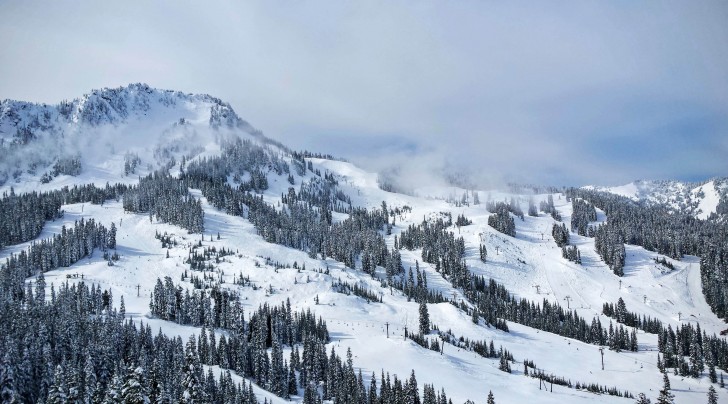
Clearing skies over Cowboy Mountain at Stevens Pass. Credit: John Nelson

Clearing skies over Cowboy Mountain at Stevens Pass.
Credit: John Nelson

I learned how to ski at Stevens Pass, so whenever I return, it feels a little like a trip back in time.

The lifts are updated, of course, but I can’t help reminiscing about those days more than a half-century ago as I learned how to make a parallel turn on the rugged slopes. For many skiers of a certain age who grew up in Seattle, Stevens Pass served the same purpose.

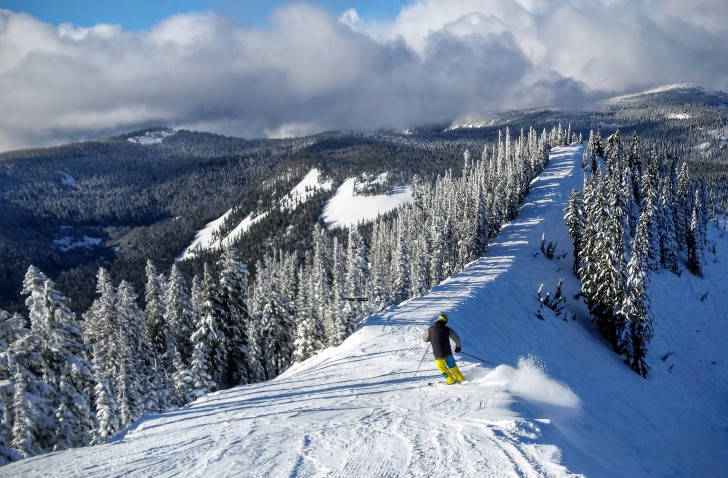
Skiers enjoy the soft snow on Hog Heaven, an intermediate run on the frontside of Stevens Pass. Credit: John Nelson

Skiers enjoy the soft snow on Hog Heaven, an intermediate run on the frontside of Stevens Pass.
Credit: John Nelson

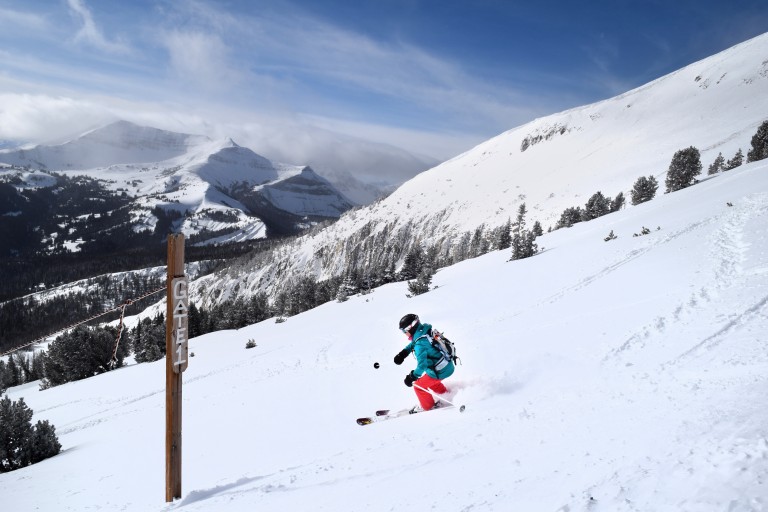
On this trip, I arrived to a classic late-winter storm that brought 10 inches overnight. Instead of the narrow wooden skis of my youth, it was a day for rockered powder planks. As the morning progressed, the skies cleared, revealing Stevens’ dramatic scenery.

If I can hang on for a few more years, Stevens will offer another reason to return: exceptionally low pricing for 70-and-older skiers.

Snow, Terrain and More

  • Location: The ski area is 75 miles east of Seattle on U.S. Highway 2, a major east-west route through Washington state. It takes about 1½ hours to drive to the ski area on good roads.
  • Snowfall: More than 450 inches fall annually on Stevens’ 1,200 acres. The pass is often in the stormtrack for Pacific systems that hit Washington, with major dumps a common occurrence.
  • Terrain: The “frontside” is dominated by two peaks rising from a base of 4,061 feet: Cowboy Mountain (5,845’) and Big Chief Mountain (5,600’). The “backside” is called Mill Valley and drops from the top of Big Chief Mountain into a south-facing basin that bottoms out at 3,821 feet. About 35 percent is rated advanced, with 65 percent rated beginner and intermediate. A large and popular terrain park is located on the Brooks Chair, keeping the boarding tricksters in one location.
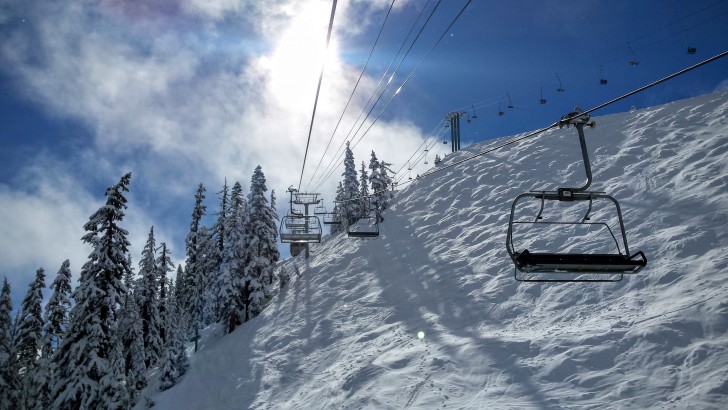
  • Lifts, lights: Stevens is designed to handle large crowds. Three high-speed quads ferry passengers, along with four triple chairs and and three doubles. Much of the frontside terrain is lighted for Stevens’ popular night-skiing.

Lot to lift access

  • Parking is a problem on busy weekends and holidays. Arrive early. On weekdays, it’s much better, but you still may need to park some distance from the base area. A passenger and gear unloading zone is available near the lodges.
  • Bus and shuttle services bring passengers from Seattle to the sometimes-busy area.
  • Accommodations: Stevens is an easy day trip from Seattle. The best option for overnight lodging is Leavenworth, Wash., a tourist hub 37 miles to the east.

Culture

  • The vibe: Stevens is a big resort, but it’s much less tony than rival Crystal Mountain. A fun-loving party scene occurs during night-skiing.
  • Dining: The base area has three lodges with busy bars and restaurants and the best coffee (T-Bar Market) of any ski area in the Northwest.

Bottom line

  • If you’re 70 and older, your ski day is a bargain: Just $15. Regular adult passes (ages 16-69) are $69 during peak days and $64 for off-peak days.
  • Grooming is exceptional on the area’s lower slopes. Upper-elevation lifts take skiers into a challenging world of powder and steeps.
  • The south-facing Mill Valley side offers sunny-day exposure in an open bowl.

Trail Map Click Here

Stevens Pass Webcam Click Here

Sunny side of the mountain: South-facing Mill Valley. Credit: John Nelson

Sunny side of the mountain: South-facing Mill Valley.
Credit: John Nelson


SeniorsSkiing Guide: Sugar Bowl And Royal Gorge—A Winning Combination!

Do a little downhill, then a little cross-country at these history-rich neighbors near Donner Summit.

Pow-ing down to the Sugar Bowl village. Always lots of snow for playing. Credit: Sugar Bowl

Pow-ing down to the Sugar Bowl village. Always lots of snow for playing.
Credit: Sugar Bowl

Sugar Bowl, the venerable ski resort that sits majestically atop Donner Summit, is as steeped in history as it is endowed with famously steep runs. In December, 1939, the Tahoe region saw the beginnings of its first major ski area when a small village with a Tyrolean-style lodge opened its doors and the one-person Disney chair (California’s first chairlift and named after one of the area’s early investors, the Walt Disney) started carrying ski enthusiasts up the mountain. The operation was the brainchild of the Austrian ski racer, Hannes Schroll, who had been heading up the Yosemite Ski School at Badger Pass, but was drawn to this cluster of Donner Summit peaks and its location in the path of the Sierra Nevada’s most prodigious snowfalls.

In the 77 years since, the privately held Sugar Bowl has managed to retain its old-world charm, pristine mountain atmosphere, and overriding commitment to a quality ski and board experience, thanks to the members of the Sugar Bowl Corporation, some of whom are fourth- and fifth-generation descendants of the original founders. The members’ surnames are a “who’s who” of prominent San Francisco and Bay Area families, many of whom have owned cabins in and around the village for decades.

Correspondent Rose Marie Cleese practices her balance at Royal George's practice track. Credit: Dave Eastwood, director Royal Gorge x-c ski school

Correspondent Rose Marie Cleese practices her balance at Royal George’s practice track.
Credit: Dave Eastwood, director Royal Gorge x-c ski school

In 1953, Sugar Bowl launched its gondola, the West Coast’s first aerial tramway, that carried skiers from the highway to the village, touted as “America’s only snowbound village”—which today still exudes its original early-days-of-skiing ambience, and where Schroll’s Tyrolean lodge, extensively updated and enlarged, still stands as the village’s focal point. In 1983, the gondola was replaced with a faster gondola with more cars, and in 1998, Sugar Bowl opened Judah Lodge, a day lodge and parking lot half a mile east of the gondola parking area and situated at the base of Mt. Judah. In 2012, Sugar Bowl entered into an agreement with the Tahoe Donner Land Trust to lease and operate Royal Gorge, the largest nordic ski area in North America. Begun by Jon Slouber in 1971, Royal Gorge has more than 200 kilometers of set-track trails spread out over some 6,000 acres of spectacular high-mountain terrain. Although there are cross-country trails linking the two resorts, unless you’re an advanced nordic skier, some climbing and side-stepping is involved; it’s easier to drive between the two.

Senior X-C skiers gliding along with Royal Gorge behind their right shoulders. Credit: Snow Bowl/Royal Gorge

Senior X-C skiers gliding along with Royal Gorge behind their right shoulders.
Credit: Sugar Bowl/Royal Gorge

I first skied at Sugar Bowl back in the late 1960s when the gondola was called “The Magic Carpet” (wonder if Walt had a hand in giving it that name!) and triple and quad and high-speed chairs were not even dreamed of. Returning recently after an absence of many years, I was thrilled to see that Sugar Bowl is sweeter than ever, succeeding in transporting me back to the past while at the same time very carefully and thoughtfully bringing the historic resort into the 21st century.

Snow and Terrain (Sugar Bowl)

  • Snow, snow, and more snow! Sugar Bowl has the highest average annual snowfall—500”—of any Northern California ski resort. (Remember the Donner Party famously snowed in during the winter of 1846–47? They were trapped at the bottom of the summit just a few miles east of Sugar Bowl.) Powder hounds have a better chance of finding the fluffy stuff here than at most other wintersports resorts in the region. Location, location, location!
  • Vertical/Elevation: Sugar Bowl’s 1,500-foot vertical offers more skiing and boarding than that vertical rise would suggest. The resort’s runs snake down to a 6,883′ base at the village from the tops of four peaks: Crow’s Nest Peak (elev. 7,954′), Mt. Disney (7,953′), Mt. Lincoln (8,383′), and Mt. Judah (8,238′).
  • Terrain: 1,650 skiable acres; 103 trails; 17% beginner, 45% intermediate, and 38% advanced.
  • Lifts: 5 high-speed quads; fixed grip lifts: 3 quads, 1 triple, and 2 doubles; 1 surface lift.
  • A trail runs through it: The 2,650-mile-long Pacific Crest Trail that goes from Mexico to Canada passes through Sugar Bowl, crossing several runs on Mount Judah before it drops over Sugar Bowl’s ridge near a ski run at the top of Mt. Lincoln.

Snow and Terrain (Royal Gorge)

  • Snowfall: Awesome.
  • Terrain: 200-plus kilometers of groomed terrain spread across 6,000 acres.
  • Trails: 34% beginner, 42% intermediate, and 24% advanced; extensive network of “snowshoers only” trails; several “dogs allowed” cross-country trails between Sugar Bowl and Royal Gorge in the Lake Van Norden area.

Lot-to-Lift Access (Sugar Bowl)

  • If you’re heading for the lifts at the village base, go three miles up Highway 40 from the I-80 Norden/Soda Springs exit and park at Sugar Bowl’s Village Gondola parking lot. If you’re staying at the Lodge, you can park in the covered garage. Once parked, head to the gondola for the seven-minute ride to the village. If you’re heading for Judah Lodge and the Mt. Judah runs, continue one-half mile past the Gondola lot, and park at the main lot for Judah Lodge.

Lot-to-Trails Access (Royal Gorge)

  • Take the Norden/Soda Springs exit off I-80 and proceed up Highway 40 approximately 1/2 mile, turn right at the Soda Springs Station, then right on Pahatsi to reach the parking lot in front of Royal Gorge Summit Station.

Culture

  • The ambience at Sugar Bowl is unlike that of any other resort in Northern California: dripping with history (walls in the Lodge are covered with old photos going back to when Hollywood stars would bend elbows at the Lodge’s famous bar, as well as original European ski resort posters from the 1930s)…a relaxed atmosphere (no cars, no crowds, short lift lines)…and an incredibly polite and genuinely friendly staff—from the lift operators to the wait staff in the Lodge.

Amenities (Sugar Bowl)

  • Dining: The legendary Belt Room Bar in the Lodge, which was recently remodeled for the first time in decades, offers casual dining, a full bar and is open daily from 11 AM to 10 PM; the Lodge’s comfortable Dining Room serves dinner nightly, featuring French-inspired California cuisine and beautiful views of the mountain. The Nob Hill Café serves breakfast and lunch fare on weekends and holidays and the Sierra Vista Bar & Grill in Mt. Judah Lodge is open daily from 7 AM to 4 PM and serves breakfast and lunch items.
  • Lodging: The beautifully refurbished rooms in the Lodge look out onto the slopes and the Disney Express chair. Guests at the Lodge are given a locker for their equipment. From Sundays through Thursdays except holiday periods, several rooms are available for $199 a night.
  • Working out and kicking back: The new Sporthaus adjacent to the Lodge offers Lodge guests a lap pool, hot tubs, spa, sauna, yoga studio, and a roomful of cardio and weight training equipment.

Amenities (Royal Gorge)

  • The café in the Summit Lodge serves breakfast and lunch delectables and draws discerning café goers from miles around—everything is fresh, all-natural, homemade, and delicious. Trailside, Royal Gorge has one café and nine warming huts for when skinny ski skiers need to cool their heels.

Bottom Line

  • Sugar Bowl: Seniors get a little break on daily lift ticket prices: seniors 65–74, $84; super seniors 75+, $60; afternoon (12:30–4 PM) ticket prices: seniors 65–74, $72; super seniors 75+, $51. (The regular adult all-day lift ticket price is $103.) Online ticket prices: seniors 65-74, $71; super seniors, 75+ $51.
  • Royal Gorge: Senior nordic skiers fare a little better on trail passes—skiers 75 years of age and older ski free! All-day: seniors 65–74, $28; super seniors 75+, free; half day: seniors 65–74, $22; super seniors 75+, free. (The regular adult all-day trail pass is $33.) The adult rental package (skis, poles, boots) is $28. Royal Gorge has a terrific ski school with two pairs of practice tracks. When it comes to getting proficient on cross-country skis, ski school director Dave Eastwood has two words for you—timing and balance, and one image—be a tall Norwegian. He almost broke me of looking down at my skis!

Sugar Bowl trail map click here

Royal Gorge trail map click here

Sugar Bowl web cam click here

Royal Gorge web cam click here 

Yes, the West Coast and Royal Gorge have had lots of snow. Snow shoeing in fluffly snow is great exercise and outdoor adventure. Credit: Snow Bowl/Royal Gorge

Yes, the West Coast and Royal Gorge have had lots of snow. Snow shoeing in fluffly snow is great exercise and outdoor adventure.
Credit: Sugar Bowl/Royal Gorge

Skiing With Life-Long Pals: Annual Trips, Memories, Friendship

Do You Have Skiing Buddies From Way-Back When?

SeniorsSkiing.com polls show that most seniors like to ski with their friends. Our ski group of seniors has banded together for decades, getting together in March each year for epic skiing in Tahoe or Utah depending on the conditions. The common denominator in our group is our fearless leader Eric Durfee, Incline Village, NV. In the group picture, Eric is seen as second from left flanked by Mark Hutchinson of Vermont and Proctor Reid formerly of Vermont and now D.C. These guys grew up together and raced together as juniors.

Pat McCloskey's gang of life-long ski buddies. This lucky bunch of seniors meets yearly for Big Skiing. Credit: Pat McCloskey

Pat McCloskey’s gang of life-long ski buddies. This lucky bunch of seniors meets yearly for Big Skiing out west.
Credit: Pat McCloskey

The balance of the group on the right is yours truly and Bart Smith, formerly of Seattle and now residing in Utah. Bart was a college racing pal of Eric’s, and Eric’s wife Helen is an old friend of mine from skiing as a kid. I met Eric at his wedding, and we have had a lifetime of adventures ever since. Missing is our friend John Ingwersen who rounds out the group as a former college racing friend of Eric’s from Cornell. That was a long time ago.

Aside from Eric being the glue to this fun loving group, what makes a group like this stick together for those many, many years? Hutch says it best when he states , “We love the fresh air, the scenery, the exercise, the chats on the lifts, and dinners together.” He goes on to say, “We are lucky to have a leader who affords us a nice place to stay in Nevada. He does the planning of where we are to go and does a

Skiing pals at the top of Northstar where you can see forever. Credit: Pat McCloskey

Skiing pals at the top of Northstar where you can see forever.
Credit: Pat McCloskey

fantastic job of organizing us. He has taken a few individual, devoted, ski loving guys and provided them with an ideal situation to enjoy what we enjoy most.” Bart provides an alternative landing spot in Utah if Tahoe conditions aren’t terrific. Finally, Hutch states, “We have a wonderful mix of his (Eric’s) friends who have become great friends to each other.”

Between hip replacements, torn rotator cuffs, bad backs, and various worn out parts, this group of old guys managed to break an iPhone app record a couple of years ago when we logged on and managed 57,000 vertical feet of skiing at Northstar in one day. The next day, we each logged 52,000 at Mt. Rose. The app developer contacted me and asked who we were since we had broken the individual day record, and I recounted to him that we were just a bunch of old guys in their 60s who love to ski together and enjoy each other’s company. He was astounded.

The saying goes, if you finish your life with a handful of friends, you are a lucky man. This is our handful.

[Editor Note: Pat McCloskey is lucky to be skiing with friends he met many, many years ago.  Do you have a group of stalwart skiing companions?  Let us know your group’s story.]

SeniorsSkiing Guide: White Pass, WA, Free For 73+!

Kudos To Senior-Friendly Ski Resort Three Hours From Seattle.

A skier heads off the top of Great White Express at White Pass. Credit: John Nelson

A skier heads off the top of Great White Express at White Pass.
Credit: John Nelson

As I got ready for a day of skiing at White Pass, I ran into a gregarious septuagenarian with a big smile on his face.

“It should be a great day,” he said to me happily as we crossed paths.

Fresh snow had fallen on the empty weekday slopes. And if you happen to be of a certain age like my lodge acquaintance (73 and older), your day at White Pass just got better: You ski for free.

West Ridge at the top of Paradise Basin leads skiers into gladed off-piste powder runs. Credit: John Nelson

West Ridge at the top of Paradise Basin leads skiers into gladed off-piste powder runs.
Credit: John Nelson

Besides that benefit, White Pass has many other great qualities: Beautiful scenery, vast terrain, reasonable pricing and ample lodging options nearby.

During my visit, two inches new had fallen on top of meticulously groomed slopes, yielding buttery smooth turns and fresh tracks all day long.

Snow, terrain and more

  • Location: The ski area is on the White Pass Scenic Byway section of U.S. Highway 12, one of the major east-west routes in Washington state. The byway has fantastic views of 14,410-foot Mount Rainier to the north and is a jumping off point to explore the volcanoes Mount St. Helens and Mount Adams to the south. It takes about three hours to drive to White Pass from Seattle.
  • Snowfall: More than 350 inches fall annually, and snowmaking keeps the mountain covered when Mother Nature doesn’t cooperate.
  • Terrain: White Pass feels like two mountains on its 1,500 acres. The “frontside” has the area’s only steeps and also has a variety of intermediate runs. The “backside,” known as Paradise Basin, offers intermediate skiing on its higher-elevation slopes. About 20 percent is rated advanced; 80 percent is beginner and intermediate.
  • Vertical: 2,000 feet from base (4,500”) to the top of Paradise Basin (6,500”).
  • Lifts: Two high-speed quads (Great White Express on the frontside) and (Couloir Express in Paradise Basin) do most of the people-moving at White Pass; the ski area has four additional chairlifts.
  • Views: On clear days, Mount Rainier is the big dog on the skyline to the north; the Goat Rocks Wilderness and Mount Adams to the south are also visible.
  • Olympics connection: Medal-winners Phil and Steve Mahre grew up skiing at White Pass and still drop in now and again.

Lot to lift access

  • Weekends and holidays can be busy, but for the most part, parking is easy. A passenger unloading zone is available next to the day lodge and regular shuttles ferry skiers from distant parking. On weekdays, parking is a breeze; I pulled in 10 minutes before opening and parked right next to the lodge.
  • Accommodations: Options are plentiful along U.S. 12, including the on-mountain White Pass Village Inn. The tourist-friendly towns of Packwood and Naches are short drives from the ski area, and Yakima, a center for many of Washington’s wineries, is about an hour’s drive to the east.

Culture

  • The vibe: Everyone seems to know everyone at White Pass, and visitors are welcomed. I met some friendly retirees who treated me like an old friend as the day progressed.
  • Dining: The best option is the cozy High Camp Lodge in Paradise Basin, with a variety of menu options, exceptional craft brews and wine. The day lodge has cafeteria food and the Sitzmark Lounge.

Bottom line

  • If you’re 73 and older, it’s $5 for your initial ticket; after that, reloads are free. Adult tickets (ages 16-72) are $63 (reloads are $58).
  • Grooming is exceptional on the ski area’s many intermediate runs, and when it’s clear, you’ll have commanding views of Mount Rainier.
  • The upper-elevation Paradise Basin offers rolling groomers and gladed off-piste powder.

Trail Map Click Here

Webcam Click Here

The Great White Express on the frontside of White Pass accesses the area's steepest terrain. Credit: John Nelson

The Great White Express on the frontside of White Pass accesses the area’s steepest terrain.
Credit: John Nelson


SeniorsSkiing Guide: Winter Park, CO—Almost Denver

Close to Denver, This Venerable and Varied Ski Resort Can Get Crowded On Weekends.

Lots of folks lining up at Winter Park. Holiday weekend was busy. Credit: Susan Winthrop

Lots of folks lining up at Winter Park. Holiday weekend was busy.
Credit: Susan Winthrop

One of the oldest ski areas in Colorado, Winter Park is only 67 miles from Denver (about a 90 minute drive). It has excellent terrain for all levels of skiers and snowboarders. I was there with my daughter and her 12 year old twins who couldn’t wait to ski Mary Jane—one of the four mountains included in the area. We were there over a holiday week-end, and we can attest to what a popular ski area this is.

Susie and grandkids point out high points on WP trail map. Credit: Susie Winthrop

Susie and grandkids point out high points on WP trail map.
Credit: Susie Winthrop

Conditions were excellent with a few inches of new powder and a huge base. As I’d come from New England, I was looking for some ice but found none. It was Martin Luther King holiday weekend—late January—and the crowds (15,000 people) were there, but we still discovered powder stashes in the trees. Plenty of full-on moguls fields kept the kids happy and when my old knees started to protest, I found some lovely blue trails which deposited me at the same lift as my more ambitious (and far younger) family members.

In spite of the throngs milling around the base and the hour-long lift line at the bottom, once we were on the slopes we quickly found our way to mostly unoccupied lifts and never had to wait again.

Snow and Terrain

With 3,081 acres of skiable terrain and 24 lifts, Winter Park had something for everyone. The average snowfall of 320 inches is impressive. The elevation of 11,220 feet is exhausting for those who come from sea-level. It was overcast and a bit windy when we were there so I can’t comment on the views or on the Parson Bowl, an area which was closed due to poor visibility. But there’s more the WP than the front slope.  Click here for a description of the “Seven Territories”, something for everyone.

Lot to Lift Access

On a busy weekend, you would have to get to the area by 7:30 a.m. to get a good parking spot in one of the designated lots. Those who slept in had a long trek uphill after parking alongside the access road. Once in the village, you can grab a red wagon provided by the ski area to tote your gear or your kids to the ticket office, the cafeteria, the restrooms or to Starbucks. At the end of the day, you might want someone to put you in a cart and pull you back to your car.

Ski Meisters

Ski Meisters whooping it up at Winter Park provides year-round activities for active seniors. Credit: Susie Winthrop

Ski Meisters whooping it up at Winter Park provides year-round activities for active seniors.
Credit: Susie Winthrop

If I lived nearby and skied here often, I would definitely join the Ski Meisters club. It’s a friendly, fun loving, hard skiing group of 55-plus seniors who enjoy discounted tickets, lockers and gorgeous jackets. They ski together at Winter Park on Sundays, Wednesdays and Thursdays when the crowds dwindle. They enjoy eating lunch together upstairs in the Stow Asis Lounge and often get together for after ski fun. They also cycle, bike, hike and take trips together to other ski areas. Currently there are 400 members, and there’s a wait list to get in. But I’m sure it would be worth the wait.

Culture

The “Guest Services” at Winter Park are friendly hosts in yellow jackets helping everyone to navigate the base area. It wasn’t immediately clear which line was the ticket line and which one was for the lift, but there was always some nice person to set us straight. I spent time at the end of the day at the tea room which turned out to have a small but popular bar. The people there were also very friendly!

Bottom Line

Day pass for senior (65+): $114; online, seven days in advance can be as little as $83. Senior pass (70+) in 2015-16 was $509.

Trail Map Click Here

Web Cams Click Here

SeniorsSkiing Guide: SnowBasin

Great Skiing. Terrific Views. America’s Fanciest Loos.

The Needles Lodge and Gondola at SnowBasin on a bluebird day. Credit: Jon Weisberg

The Needles Lodge and Gondola at SnowBasin on a bluebird day.
Credit: Jon Weisberg

SnowBasin is the expansive, exceptionally beautiful Utah area that most out-of-staters never get to ski. They’re attracted to the bigger name resorts just 45 minutes east of the airport. Head north, add 10 minutes, and you’re at MAGNIFICENT, SnowBasin—site of the 2002 Olympic Downhill events.

At the top, looking over its 3,300 acres, the cliffs and outcroppings suggest Europe. The vertical is 2,950 feet.

From this reviewer’s perspective, it ranks high for older skiers.

Snow and Terrain

  • There is much here for every ability: trails, bowls, glades. On powder or post-powder days, freshies await.
  • Lifts are fast and modern, including two gondolas and a short tram serving a vast black diamond area.
  • Ample snowmaking assures good coverage while nature sleeps. Elevation can be an issue. Its base is 6400 feet. Alta’s is 8530 feet, meaning more snow. But when conditions are good, Snow Basin is great.
  • Visibility is another issue. When it’s not bright and bluebird, its vast, treeless spaces produce unusually flat light; disorienting to anyone with compromised visual acuity.

Lot-to-Lift

  • Easy to reach lodge and lifts: The resort runs a frequent shuttle service delivering skiers a short distance from base lodge and lifts.
  • Parking is well organized: lots of personnel guiding you to your spot.
  • A fleet of large plastic garden carts is available to transport equipment and grandkids.

Day Lodges

Taking a break at Snow Basin

Taking a break at SnowBasin

These are not your typical lodges. They’re every bit as luxurious as Four Seasons hotels. Finishings. Furnishings. Flooring. You name it. No expense was spared, either at the base (Earl’s Lodge) or on the mountain (John Paul Lodge and Needles Lodge), where the luxe interiors and glass enclosed patios have spectacular views.

Food is several steps up from most resorts. House-made soups can stand up to most big city eateries. Look for Snow Basin’s Dining Discovery Series with sustainable farm-to-table selections. More on that on the resort website under “Events”.

Loo Review

Clean, classy luxury in every lodge! Men’s Rooms have a foyer with upholstered furniture, a washroom with gold-plated fixtures, and fully-enclosed commodes. Every place you go has shelving and hooks for gloves, helmets, and parkas.

Culture and Practicalities

From parking attendant to ticket window to liftee, there’s a culture of friendliness and helpfulness. Some areas don’t seem to care or have personnel who don’t even bother to sweep snow from chair. Snow Basin has trained its people to make the interaction truly enjoyable.

Unfortunately, there’s no onsite lodging. Condo rentals are available at nearby Pineview Reservoir. Many hotel/motel/other options are available in the city of Ogden, 20 – 25 minutes away.

Best to get there by auto although inexpensive public busses run three times a day between Ogden and the resort.

Bottom Line

Click here for more SnowBasin information

Trail Map Click Here 

Webcams

SeniorsSkiing Guide: Mission Ridge On A Snowy Day

Day Trip-able Area From Seattle Offers Senior Bargains and “Uncrowds.”

Skiers enjoy the soft snow on Chair 3 at Mission Ridge on a snowy day. Credit: John Nelson
Skiers enjoy the soft snow on Chair 3 at Mission Ridge on a snowy day.
Credit: John Nelson
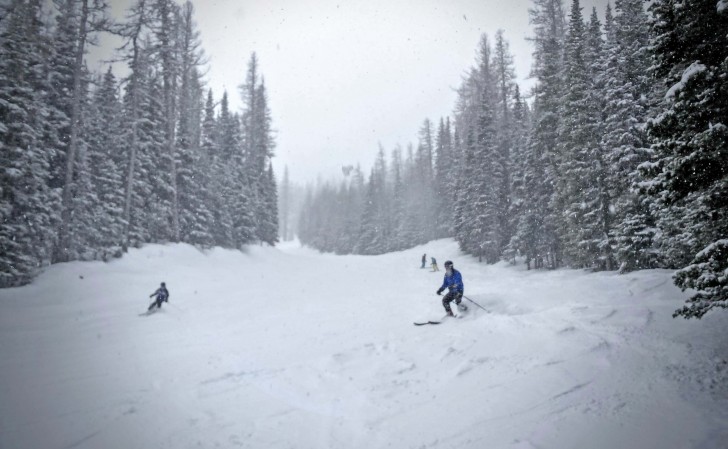
“My wife and I are retiring and moving here this year,” the skier from the Seattle area said as we rode the chairlift at Mission Ridge. “We love it here.”

I could see the attraction of this gem on the eastern slope of the Cascade Mountains. Mission has bargain pricing, and beautiful, uncrowded terrain far from the busy ski areas nearer to Seattle.

During my visit, a major blizzard dumped all day, turning the open slopes of Mission into a playground of powder. With a sparse midweek crowd, I skied untracked lines all day in what felt like my own, private ski area.

The best of the best was Bomber Bowl, where swirling storm winds dumped more soft powder amid the gladed slopes.

Snow, terrain and more

  • Location: Mission is located just 12 miles from Wenatchee, Wash., an agricultural hub on the Columbia River known as the apple capital of Washington state. The bustling town also has a growing number of wineries to attract visitors, along with ample dining and lodging options. It takes about three hours to drive to Mission from Seattle.
  • Snowfall: This is the “dry” side of the Cascades, so less snow falls here than on the western slopes of the mountains. It also means more sunny skies. Ample snowmaking keeps the mountain slopes covered during early season and lean snow years.
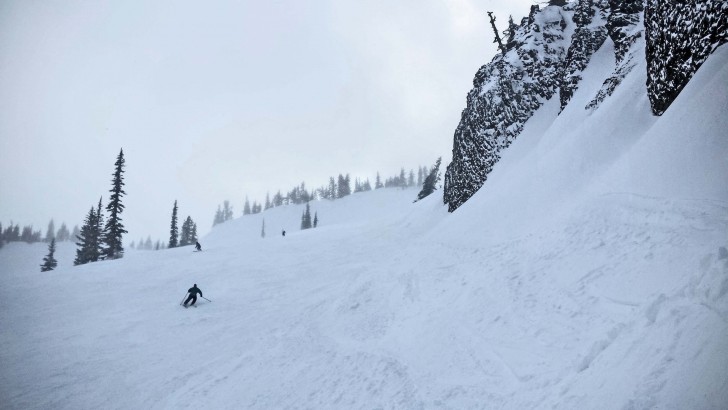
  • Terrain: About 2,000 acres of rolling terrain drops off the top of the ridge, with a great deal more of easily accessed side country. About 30 percent of the terrain is rated advanced; 70 percent is beginner and intermediate. Gladed tree skiing and bowls are situated off a high ridge with dramatic cliffs, giving the area an appealing, open feeling.
  • Vertical: 2,250 feet from base (4,570) to ridge-top (6,820).
  • Lifts: Four chairlifts serve the basin; one is a high-speed quad taking skiers from mid-mountain to the top of Mission Ridge.
  • Views: 14,410-foot Mount Rainier and the Cascade Range are visible from the top. The ski area faces the Columbia Plateau to the east.
  • History and legend: In 1944, a B-24 Liberator heavy bomber crashed on the ridge during a training flight. A piece of the wing is on display at Bomber Bowl, one of the signature runs at Mission Ridge. Legend has it that if you touch the wing, you’ll bring fresh powder to the ski area; consequently, riders stop by often to work the mountain mojo.
Touch the bomber wing at Mission Ridge and legend has it you'll bring a new storm. Credit: John Nelson
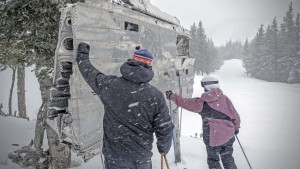
Touch the bomber wing at Mission Ridge and legend has it you’ll bring a new storm.
Credit: John Nelson
Lot to lift access

  • Mission has two main parking lots. Drivers may drop-off passengers and gear near the lodge and ticket kiosk. On weekends during the height of the season, the lots can fill up early.
  • An inexpensive bus service operates from Wenatchee. A regional airport serves the town, as does Amtrak.
  • Accommodations are plentiful in Wenatchee. A little farther away (about a one-hour drive) is the tourist hub of Leavenworth, Wash., with many more hotels and restaurants.

Culture

  • The vibe: Small-town friendly. Locals will talk with pride about their ski area, but you’re also likely to run into refugees from Seattle who come here to escape the west-side crowds.
  • Dining: The Hampton Lodge at the base of the mountain offers a cafeteria and restaurant/pub. On the mountain is Midway Lodge, a cozy dining and drinking hut.

Bottom line

  • Adult tickets are $55; seniors 70 and older pay just $15. Season passes for 70+ seniors are just $125.
  • Lots of uncrowded, gladed skiing in an area that averages more than 300 sunny days a year. Touch the bomber wing for luck (and you might bring a new storm).
  • Parking is limited on weekends in high season; midweek is empty.

Trail Map click here

Mission Ridge Webcam click here

Skiers drop under the cliffs on Bomber Bowl, one of Mission Ridge's signature runs. Credit: John Nelson

Skiers drop under the cliffs on Bomber Bowl, one of Mission Ridge’s signature runs.
Credit: John Nelson


SeniorsSkiing Guide: Mt. Baker, Snow Catcher

Hey Seniors, Low Ticket Prices In The Northwest!

With Mount Shuksan looming behind, a snowboarder shreds soft snow at Mt. Baker Ski Area. Credit: John Nelson

With Mount Shuksan looming behind, a snowboarder shreds soft snow at Mt. Baker Ski Area.

Mt. Baker is a storm factory.

This North Cascades ski area holds the world record for snowfall in a season—an incredible 95 feet dumped here in 1998-99!

I arrived in mid-January to a modest three inches new, but that was on top of a foot that had fallen the previous day. The snow was soft; the scenery stunning.

The Canyon, one of Mt. Baker's signature runs, takes skiers and boarders into a narrow drop between mountain walls. Credit: John Nelson
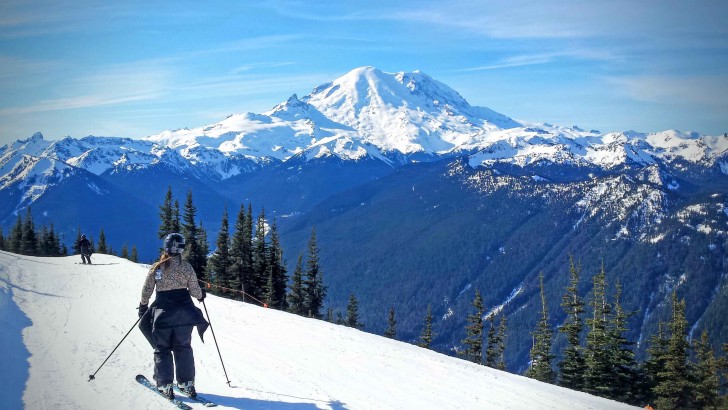
The Canyon, one of Mt. Baker’s signature runs, takes skiers and boarders into a narrow drop between mountain walls.

I immediately took a few runs down The Canyon, one of Baker’s signature drops. Skiing between these towering mountain walls is a rush.

But best of all was Pan Face, a wide-open powder shot into a lovely mountain basin. Empty slopes meant fresh lines all day.

To top it all off, Mt. Baker is an incredible bargain for senior skiers, with some of the lowest ticket prices in the Northwest.

Snow, terrain, and more

  • Location: Baker is 52 miles from Bellingham, Wash., on State Route 542. It is the northernmost ski area in Washington and is closer to the Vancouver, British Columbia, metropolitan area (about a two-hour drive) than it is to Seattle (two and a half hours).
  • Snowfall: Pacific winter storms seem converge on Mt. Baker; it averages 640 inches annually, far more than any ski area in the state.
  • Terrain: About 1,000 acres are lift-served with 31 percent rated as advanced and 69 percent rated as beginner and intermediate. The Mt. Baker backcountry is enormous with huge, avalanche-prone big-mountain drops. You’ll need a partner, transceiver, shovel and probe to go out of bounds.
  • Vertical: 1,589 feet (the base is 3,500 feet; chairlift access to 5,089 feet).
  • Lifts: Eight chairlifts (none high-speed) operate out of two base areas: White Salmon (open every day) and Heather Meadows (open weekends and holidays only).
  • Views: If you’re lucky enough to visit between storms, you’ll have a commanding view of 9,131-foot Mount Shuksan to the north, a stunning, glaciated wall of rock and ice. Mount Baker (the volcano) stands at 10,781 feet to the south and is visible from certain locations of the ski area.

Lot to lift access

  • Parking on a weekday at Mt. Baker is a breeze; I arrived 10 minutes before opening and parked in the front row next to the ticket window at White Salmon Lodge. Weekend parking is busier and skiers might find closer lift access at the Heather Meadows base.
  • Bus service operates daily out of Bellingham.
  • Closest lodging options (motels and condominiums) are in Glacier, Wash., a foothills town about a half-hour from Mt. Baker. Bellingham (population 82,000 and counting) is a lovely port city about 75 minutes away with top-notch dining and accommodation options.

Culture

  • The Vibe: Old-school friendly. Everywhere I went, I was talked up by locals who were happy to share their knowledge and pride in Mt. Baker.
  • Dining: Lodges operate out of the two base areas, but the best option is the cozy Raven Hut, a mid-mountain lodge at the base of Chairs 4, 5 and 6.

Bottom line

  • Baker is a true bargain. Weekend and holiday tickets are $58 for adults; seniors 60-69 pay $50, and those 70 and older pay $39. Weekdays are even cheaper: $53 for adults; seniors 60-69 pay $41.
  • Big powder dumps are common, and locals are happy to share their advice.
  • Snowboarders love Mt. Baker for its rough features and natural half-pipe; out-of-bounds, big-mountain terrain attracts hard-cores.

Trail Map Click Here

The open, powdery slopes of Pan Face drop into the Heather Meadows side of Mt. Baker Ski Area. Credit: John Nelson
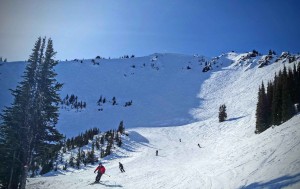
The open, powdery slopes of Pan Face drop into the Heather Meadows side of Mt. Baker Ski Area.
Credit: John Nelson
SeniorsSkiing Guide: It’s Hard To Beat Crystal Mountain On A Sunny Day

Pacific Northwest Resort Is Largest Plus Reasonably Priced For 70+ Seniors.

ASunnyRainier__

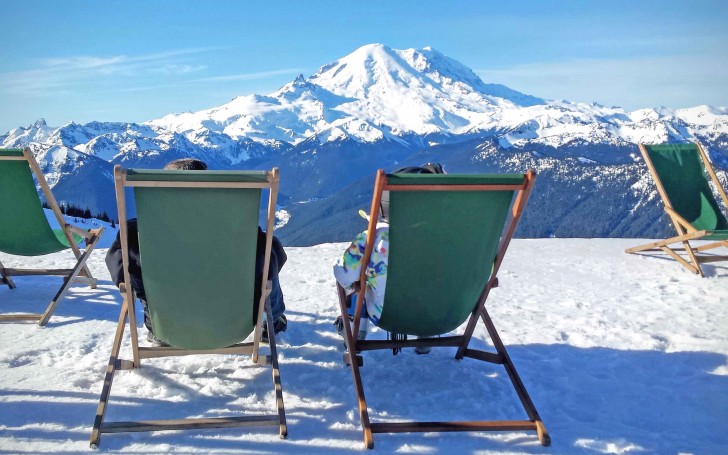
Pausing to take in a stunning view of Mt. Rainier from trailside at Crystal Mt. WA. Credit: John Nelson
When I stepped off the resort’s gondola, I was treated to a stunning view of 14,410-foot Mount Rainier just 12 miles to the south. Not a bad way to begin a spring-like February day at Washington’s largest ski area.

I clicked in and started with some of Crystal’s cruisers. Many of these intermediate runs funnel into a high basin known as Green Valley, served by its own high-speed quad. The skiing was fast and fun.

Besides cruisers, Crystal has some truly thrilling drops on Northway and Chair 6 in the Campbell Basin. These two double chairs deliver skiers into the best of Crystal Mountain’s cliff-strewn double-diamond runs.

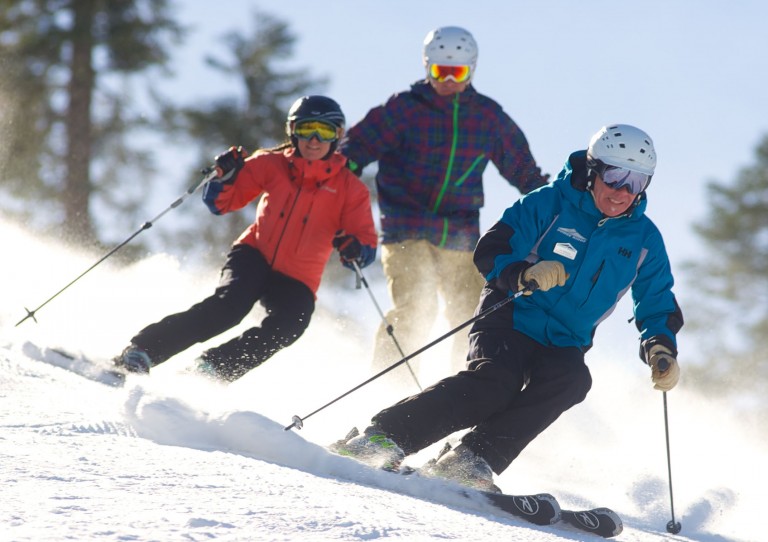
Skiers cruise down the intermediate run Lucky Shot at Crystal Mountain. Credit: John Nelson
Skiers cruise down the intermediate run Lucky Shot at Crystal Mountain.
Credit: John Nelson

Snow, terrain and more

  • Location: Crystal is situated off of State Highway 410, 39 miles from Enumclaw, Wash., a small town at the base of the Cascade foothills. The ski area is about a two-hour drive from downtown Seattle.
  • Snowfall: Nearly 500 inches a year fall here annually. Snowmaking was upgraded on the lower mountain following the drought year of 2015, and additional snowmaking improvements are planned for the mid-mountain.
  • Terrain: About 2,600 acres are spread over several lift-served basins. About 35 percent of the terrain is rated advanced; 65 percent is beginner and intermediate.
  • Vertical: Lift-served vertical is 2,602 feet (the base is 4,400 feet; chairlift access goes to 7,002 feet) but those willing to do a little hiking can stretch the vertical to more than 3,000 feet.
  • Lifts: One eight-passenger gondola, two high-speed detachable six-passenger lifts, two high speed quads, one fixed-grip quad, two triples, two doubles and one children’s surface lift.
  • Views: On clear days, Mount Rainier dominates the skyline, but you’ll see much more. The Olympic Mountains are visible to the west, as are most major peaks in the Cascade Range from the Canadian border to Oregon.

Lot to lift access

  • Crystal has five parking lots. The lower lots are served by free shuttles to ferry skiers to the base area. In addition, drivers can drop off equipment and passengers next to the ticket kiosk before parking.
  • Private bus and van services operate from Bellevue, Seattle and Tacoma bringing skiers to the mountain. Information is here.
  • Several private lodging options are available on the mountain. Three lodges and two condominiums operate at the base area; another lodge is about 15 minutes away on Highway 410.

Culture

  • Apres Ski: Washington’s best après ski bar, the cozy Snorting Elk, is located in the old-school Alpine Lodge just across a wooden bridge next to the top parking lot. You’ll find a well-oiled group of hard-core skiers swapping tall tales here at all hours.
  • Dining: On the mountain, there are two day lodges, one in base area, the other in Campbell Basin. The upscale Summit House restaurant at the top of the gondola offers sit-down dining with views of Mount Rainier.
  • Vibe: Because it’s Washington’s largest ski area, Crystal has a “resort-y” feel. While a great many hard-core skiers of all income levels come here, you’ll also run into some very rich folks.

Bottom line

  • Tickets are $72 for an adult all-day pass; $48 for 70 and older. When available, seniors 70-plus can get Five-Pack lift tickets for $215. Mid-week season passes for 70-plus are from $450 to $700, depending on dates.
  • Highest-elevation, biggest ski area in Washington.
  • Can be crowded on weekends; weekdays are empty.

Trail Map

Webcam

Skiers take in the view of Mount Rainier from the Summit House area of Crystal Mountain. Credit: John Nelson

Skiers take in the view of Mount Rainier from the Summit House area of Crystal Mountain.
Credit: John Nelson


Master’s Clinic: Fabulous Idea For Senior Skiers

The Secret To Breaking Decades-old Bad Habits: Attending A Master’s Clinic At Dodge Ridge.

Jon Mahanna, creator of the Master’s Clinics, has class members follow his every move down the slopes. Credit: Dodge Ridge

Jon Mahanna, creator of the Master’s Clinics, has class members follow his every move down the slopes.
Credit: Dodge Ridge

I hadn’t skied at Dodge Ridge, the closest ski area to the San Francisco Bay Area, in years. But as soon as I arrived at the base area a couple of Thursdays ago for one of its Master’s Clinics, a four-hour-long freeski instructional program designed for intermediate and advanced skiers over 50 years of age, the memories flooded back. It was the first place I had ever put skis to slopes back in the ’50s, unwittingly grabbing on to a rope tow and finding my 12-year-old self being flung into the nearest snowbank. In the ’60s, it was the area my friends and I headed to when classes were over for the day at San Jose State College, taking a hit of blackberry brandy from our bota bags each time we headed down the rudimentarily “groomed” slopes on our brakeless wooden skis with bear-trap bindings and with long leather straps bound around our leather boots.

Now a saner, much older me was back to do things right! My friends and I were going to get this ski season headed in the right direction: by letting a seniors-certified PSIA instructor spend a few hours with us, helping us to break bad habits we’d acquired over the years and showing us how to adapt our skiing styles to today’s more-efficient shaped skis.
We met up with our group of nine other fellow seniors, ranging in age from 58 to 79, at the base promptly at 10 AM and headed up the mountain to do a ski-off for our two instructors: Bryan Jarratt, 61, an Aussie who’s been with the resort for 15 years, and Jenny Matkin, 64, who has deep roots in the region and has been teaching for decades. As we all did our “exhibition” run down the hill, I could instantly tell when my fellow participants had learned to ski. Yep, those two guys standing tall and stately over their skis with their ankles seemingly tied together were from the Arlberg “reverse-shoulder” method days. And that guy making the quick turns probably learned during the “short skis” phase. Our instructors split us into two groups, those itching for some “black diamond, off-piste” skiing and we more-timid ones who still had some cobwebs to dust off our skis before going full-out.

After three-and-a-half hours of skiing with frequent instructional breaks, we learned at least four or five specific things from Jenny that we could take away and work on the rest of the season in order to ski with much more ease and efficiency and not be exhausted after a full day of skiing.

DodgeRidge3A

Dodge Ridge’s Jon Mahanna saw the need to help senior skiers adapt to the new, shaped skis. “Let the skis do the work,” he says. Courtesy of Jon Mahanna

Jon Mahanna, 68, explains the strategy behind the Master’s Clinics best. He, along with Dodge Ridge’s current owners, Frank and Sally Helm, came up with the concept three years ago. Jon had been Dodge Ridge’s ski school director for 15 years in the ’80s and ’90s, and after serving in various capacities at ski areas in Colorado, New Mexico, and back in California, the “retired” Mahanna saw a need for older skiers, Level 5 and higher, to improve their skiing technique, especially with the advent of all the new equipment. Says Mahanna, “I saw that a lot of older skiers, especially those returning to the sport, needed to work on creating a balanced, ‘stacked’ stance so that there’s the least amount of resistance on their skeletal frame and muscle groups. This open, athletic stance gives them better lateral stability and is easier on their knees and backs. Balance is the key to everything.”

The instruction focuses on medium-radius turns on groomed slopes. “The modern equipment out there lets you stand there and go for the ride while you let the skis do the work,” avows Mahanna. “The idea is to have fun and to be able to ski all day, where your knees and muscles don’t give out on you.”

When we all met up at the lodge afterwards for lunch (which is included in the clinic package), the participants, to a person, were Master’s Clinic converts, and most were planning to sign up for more. One of them, Ralph Purdy, 75, happened to be the son of Dodge Ridge founder Earl Purdy, who opened the resort back in 1950. Said Purdy, “This is the first lesson I’ve had in many years. I thought that there’s gotta be something I’m missing. I saw this as a drill, and today I learned about unweighting and keeping my legs apart a little.” Another clinic attendee, Mark Sahines, 58, skied a lot in his 20s and 30s, then kids and work put skiing on a back burner. “I want to get to an advanced level, and my goal is to be skiing at 75 or 80. A lot of the guys older than me in today’s class ski a lot better than I do. Today I learned to do a hockey stop, something I could never do before.” My friends, Jim, 65, and Kathy, 70, Clarke, have a cabin near Dodge and are season ticket holders. They’ll definitely be back for more Master’s Clinics. Kathy called her teacher “one of the best” and appreciated Jenny’s focus on older skiers and the different techniques required with the new equipment. Jim shared that “every year I fret about being ‘ready’ to hit the slopes. Will my legs hold up? Will my funky right knee start giving me problems? Jenny, our wonderful instructor, brought my focus back to the skills and techniques needed to get the most out of my fancy, red shaped skis. By the end of our class, I was able to remember and use several of Jenny’s methods for getting the most out of my skis. In the end, there’s no reason I can’t learn this stuff if I keep a positive attitude, pay attention, and practice, practice, practice.”

To learn more about Dodge Ridge’s Master’s Clinic program or sign up for one of its Thursday or Sunday clinics, click here.  Tell them Rose Marie sent you! And if you love uncrowded slopes, sign up for a Thursday clinic.

[Editor Note:  SeniorsSkiing.com salutes Dodge Ridge and Jon Mahanna for creating a program focused on helping seniors optimize their technique and continuing to enjoy skiing.  If you, our readers, think this is a good idea, please forward a link with this story to your local ski area to show them how easy it is to support seniors skiing.  Or, if you’re in the Bay Area, enroll in Dodge Ridge’s Masters’s Clinic. We hope to see the idea of focused events for seniors—especially mid-week— growing in the ski resort industry.]

SeniorsSkiing Guide: Deer Valley Sets The Gold Standard

It’s the Deer Valley Difference.

Deer Valley at the top with a view of Jordanelle Reservoir. Credit: Harriet Wallis

Deer Valley at the top with a view of Jordanelle Reservoir.
Credit: Harriet Wallis

When Deer Valley opened 35 years ago, it was a novel concept to commit to top notch service in skiing, dining and lodging. Today it’s the gold standard.

The resort is known for its impeccable grooming, incredible dining and attention to every detail. Senior skiers really like that.

How to start your day right. Uniformed valets will unload your equipment at slope side. No need to schlep it.

Ride the open air shuttle to the day lodge. Save your energy for the slopes.

Enjoy secure basket checking with unlimited access so you can change layers throughout the day.

You’ve been pampered, and you haven’t even reached the slopes yet. Little things really do mean a lot.

“We’re committed to excellence in everything we do,” says Bob Wheaton, resort president and general manager.

Where should I start? It’s a big resort with four peaks and 101 trails. If you’re an intermediate or advanced skier, you can take a complimentary ski tour with a Mountain Host and find new runs and learn about the resort’s history. You’ll discover powder stashes that you’d never find on your own.

Outdoor patio dining in high altitude sunshine at one of 12 DR restaurants. Credit: Harriet Wallis

Outdoor patio dining in high altitude sunshine at one of 12 DR restaurants.
Credit: Harriet Wallis

Lunch time. Deer Valley has 12 restaurants, including outdoor dining patios, plus five evening restaurants right at the resort. A lunch favorite is the signature Deer Valley turkey chili. I especially love the Natural Buffet with its exotic salads and hearty breads.

Terrain. Deer Valley’s manicures more than 60 trails nightly from gentle slopes to its long steep runs. But it also has gnarly mogul fields, glades and ungroomed powder. Take your pick.

When your legs fall off, check your skis at a complimentary ski check station. Then relax in a beach chair on McHenry’s sunny “beach”.

Don’t miss this. When you’re ready to wind down the day, take the Last Chance beginner trail to the base and enjoy the trailside sculptures at homes along the way. They’re absolute must-sees.

One of the many raccoon sculptures along the trail side houses near the base run out. Credit: Harriet Wallis

One of the many raccoon sculptures along the trail side houses near the base run out.
Credit: Harriet Wallis

One home is plagued by mischievous raccoons. They ski off the roof, snooze on the railing and look uphill through binoculars. My favorite skiing raccoon is the one that went splat when he hit the house.

A family of life-size bronze elk stand trailside at another home. There’s also a bear house, a totem pole house and a mountain goat house. The charming critters add a bonus to a great day on Deer Valley’s slopes.

Just the facts

  1. Easy access. Just 40 minutes from Salt Lake International Airport.
  2. Skiers only. Deer Valley is for skiers only. It does not allow snowboards.
  3. Dining: 12 restaurants including five evening restaurants right at the resort. My favorite is the Seafood Buffet.
  4. Limited lift tickets. To enhance your experience, Deer Valley caps lift ticket sales to limit lift lines and lodge lunch lines ,and it opens up lunch seating.
  5. Grooming. The resort has 101 runs from four mountain peaks. Over 60 runs are groomed nightly.

2015-16 Bottom Line

A day ticket is $85 for those 65+, but on holidays it’s $92. A season pass is $1,195 for those 65-71, and it’s $1,085 for those 72+. However, mid week season passes are $1,085 for all who are 65+. There’s a pre-season discount for those who buy season passes early. And locals are eligible for reduced prices. Click here for more Deer Valley information.

Trail Map

Web Cam

McHenry's sunny "beach", absorbing the bennies and waiting for the surf to come up. Credit: Harriet Wallis

McHenry’s sunny “beach”, absorbing the bennies and waiting for the surf to come up.
Credit: Harriet Wallis

First Run: From The Top Of Jackson Hole At Dawn

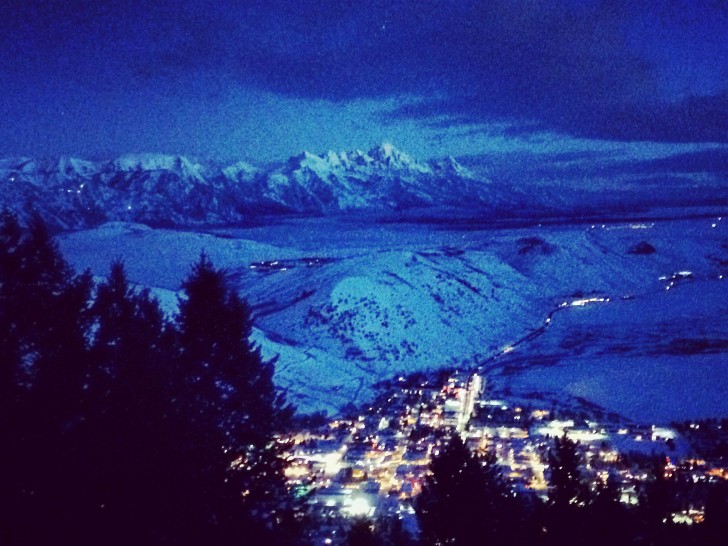
From the top of Snow King, looking at the Grand Teton and Jackson Hole. Credit: Patrick Kearney

Snow King at 6:30 am, looking at Grand Teton and Jackson.
Credit: Patrick Kearney

[Editor Note: Contributing Photographer Patrick Kearney has been working in outdoor education through the National Outdoor Leadership School (NOLS) for over a decade. Most recently he’s been working in education at the elementary, middle school and college level and will soon transition to helping to protect the Greater Yellowstone Ecosystem. When he’s not teaching or working in conservation he goes backcountry skiing in the Tetons, mountain bike, kayak and adventure with my girlfriend and her dog “Peter.”]


American Airlines Introduces Direct Flights to Big Sky

Now It Is Easier To Get To A Montana Destination Resort.

Now you can get a direct flight from Dallas to Bozeman. Welcome to Big Sky Country. Credit:Michel Tallichet

Now you can get a direct flight from Dallas to Bozeman. Welcome to Big Sky Country.
Credit:Michel Tallichet

American Airlines now has direct service between Dallas/Ft Worth and Bozeman Yellowstone International Airport (BZN), 40 miles from Big Sky Ski Resort. The once a day flights are scheduled through April.

Big Sky is one of America’s most spectacular resorts. It has 5800 acres spread over four peaks and sports a vertical of 4,350′, making it the longest drop in the lower 48.

It is a snow magnet, attracting on average 400″. Best of all, it’s vacant. If a few people are ahead of you in line, you’ll be talking about it that evening at one of Big Sky’s terrific lodging options.

Karst Stage provides shuttle service to the resort. Multiple car rental options are available.

Legendary Over-The-Hill-Gang A Model For Seniors

Started at Copper in ’76, OHG Now Around the Globe.

[Editor Note:  This report on the Over The Hill Gang was written by Steve Lipsher and originally posted on the Copper Mountain Blog. Here is a link to the original article.]

Over The Hill Gang poses on Copper Mountain. Not exactly a club, OHG is open to anyone 50+ and has spread around the globe. Credit: Copper Mt.

Over The Hill Gang poses on Copper Mountain. Not exactly a club, OHG is open to anyone 50+ and has spread around the globe.
Credit: Copper Mt.

It’s easy to spot members of Copper Mountain’s Over the Hill Gang: sexagenarians, septuagenarians and octogenarians blasting down the slopes – often hooting and hollering – decidedly not acting their age.

The Over the Hill Gang was created at Copper Mountain in 1976 by part time instructors Moe Mosley, Bill Magill and Tom Stein. Their vision was simple; encourage skiing as a lifelong sport for skiers over the age of 50 and share their passion of the sport.

“If it wasn’t for the OHG, I probably wouldn’t be skiing,” said Dyann Gray, explaining that for lack of companionship on the slopes many seniors simply give up skiing when spouses lose interest or physical abilities.

OHG member Norman Crawford said he probably was lucky to get in four to six days of skiing a season before joining the group. Last year he skied 50+.

Each group of eight to 10 skiers is accompanied by a certified Copper Mountain ski instructor, who serves as guide, cheerleader and low-key instructor.

“They help members improve, either when asked or when they see something that needs a little tweaking,” said Jennifer Walker, who coordinates the classes and instructors on behalf of the Copper Mountain ski school.

On a recent day with the “Club Decline” group – skiers who could ski anywhere on the mountain but who are deliberately toning it down – OHG guide Steve Hultquist offered general group guidance about technique and specific tips to individuals.

Given the suggestion to look at the spaces between the pointy moguls, for example, Gray bragged that she had “slithered” down a slope that previously had given her nightmares.

OHG member Mary Goodwin said the pro advice and gentle peer pressure/examples set by fellow skiers have produced positive results for her.

“I ski better now than I did 20 years ago because of these guys,” she said.

Many participants take delight in discussing pacemakers and replacement joints. “If you took a metal detector around here, it’d go ‘ding, ding, ding,’” Swain laughed.

The group gathers 52 days a season – Saturdays, Sundays, Tuesdays and Wednesdays – and members can take advantage of special instruction, such as a two-day bump clinic, women’s workshops, and ski-school lift-line privileges.

Part ski club, part social group and all fun, the club has spawned chapters and associated groups at ski resorts around the world over its 39 years of existence. Last year OHG received the Colorado Ski and Snowboard Hall of Fame’s “Top of the Hill” award.

OHG is open to anyone 50 or older. Membership is $400 for the season ($200 for those 80+). Four-day mini-memberships and a one-day trial are available with cost applied to full membership to those who inevitably are hooked.

To learn more about the Over the Hill Gang, e-mail ohg@coppercolorado.com or call (970) 968-3059.


SeniorsSkiing Guide: Alta, Skiers’ Paradise

Alta is all about open slopes and big vistas. Here is Big Dipper, a beautiful "blue" level run. Credit: Harriet Wallis

Alta is all about open slopes and big vistas. Here is Big Dipper, a beautiful “blue” level run.
Credit: Harriet Wallis

It’s Vast Open Space And Powder.

Alta is the granddaddy of powder skiing. It averages 500 inches of snow a year which earns it the nickname: Skiers’ Paradise. It has wide, wide open bowls with groomed trails, but everywhere you look slopes are left au natural and full of powder. That’s ample for most senior skiers. But it also has tough, gnarly in-bounds chutes and cols that can only be reached by serious hikes.

As the day begins. Come early and park at the Albion Grill day lodge that’s just steps from your car. The sun pours in making it a cheery gathering place, and it’s the first place where seniors meet. They enjoy conversation as they boot up and fuel up with a hearty breakfast. Introduce yourself, and you’ll have instant ski friends.

Why does Alta have such wide open skiing? Ancient glaciers carved Alta. Fast forward to the days of pioneers and silver miners. They cut down the trees and hauled off the timber to shore up the mines and to build early Salt Lake City. The only thing left was stubble, and hungry sheep overgrazed it right down to the ground. Alta was a wasteland.

The U.S. Forest Service had domain over the vast area but had no clue what to do with it. That’s when it hired iconic ski jumper and legendary ski pioneer Alf Engen to check it out and see if the area had any value. Engen envisioned it as perfect for skiing – and Alta was born

Alta skiers, and especially senior skiers, are avid about the uniquely vast terrain with its wide open slopes. Watch this 95 year old senior ski Alta.

Lunch time. After a few laps on Supreme and Sugarloaf lifts, drop into Alf’s mid-mountain restaurant about 11 a.m. That’s when members of Alta’s Wild Old Bunch gather at the restaurant’s only round table. They’ll be having coffee or lunch and exchanging notes on their morning of skiing. It’s the second place where you can make more senior friends.

Buy a hot beverage at Alf’s and enjoy a free refill. My personal favorite is hot chocolate topped with a mound of whipped cream.

While at Alf’s, go to the farthest corner,  and you’ll find fascinating photos of Alta’s past.

What else can I do?  Alta has extensive rentals and demos, so check out some of the latest gear, especially if it’s a powder day.

On weekends and holidays meet trained naturalists at 1:30 p.m. at the top of the Sunnyside lift and take a tour to learn about the area’s environment, animals, and history. A Tour With a Ranger will not disappoint.

SeniorsSkiing.com's correspondent Harriet Wallis and friend have a cuppa java at the end of the day. Credit: Harriet Wallis

SeniorsSkiing.com’s correspondent Harriet Wallis and friend have a cuppa java at the end of the day.
Credit: Harriet Wallis

Wrap up the day with a specialty brew at Alta Java, an outdoor coffee bar at snow level just beneath the Albion Grill where you started.

I want to stay. Alta is within a national forest, so there are no shopping centers or high rise hotels. There are several lovely slopeside hotels that blend into the landscape and are scarcely noticeable. But book early if you want to stay there because they’re very popular.

Evening activities include fireside history talks and other local events. Alta is eat, sleep, ski. Repeat.

Bare bones facts.

1) Skiers only. Alta does not allow snowboards. 

2) Convenient. Alta is just 45 minutes from Salt Lake City International Airport. If you stay in the city you can take a frequent UTA ski bus to the mountain.

3) Stats. 2,200 acres, 116 named runs, 7 chair lifts, and a surface rope tow that’s a hoot. You can ride both directions across the flat base area. Of course you don’t need to use it because you can ski all around the mountain. But it’s a novelty that you’ll find only at Alta.

4) Eat. Mid-mountain and base area restaurants.

5) Orion and the dippers. Enjoy the stars in the night sky because there are no interfering lights.

6) The Wild Old Bunch. If you missed Alta’s senior skiers at lunch, join them at Sweet Tomatoes, a soup and salad buffet restaurant on Union Park Avenue in Midvale. They gather every Wednesday night year round for dinner and conversation.

Bottom Line:

Alta has a $699 season pass for 65 to 79.  It’s $50 for 80 plus.  During the season, there are no senior discounts, but you can get reduced prices online, especially if you buy four days ahead of your visit.  Weekdays passes can be bought for about $73 online if you plan ahead, otherwise it’s about $89.  Multi-day discounts are also offered, the more days you buy, the lower the per day rate.  See the Alta website for details.

Alta Trail Map

Another view of Big Dipper. Alta is known as "Skier's Paradise". Credit: Harriet Wallis

Another view of Big Dipper. Alta is known as “Skiers’ Paradise”.
Credit: Harriet Wallis

Dine On A Local Cow—Or Lamb—Or Carrot

Locally Sourced Foods Are Catching On.

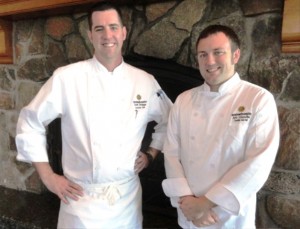
Snowbasin Executive Chef Scott Sniggs (l) with Executive Sous Chef Aric Glanville. Credit: Harriet Wallis

Snowbasin Executive Chef Scott Sniggs (l) with Executive Sous Chef Aric Glanville.
Credit: Harriet Wallis

At Snowbasin, Utah, chefs have embraced locally sourced meats including beef, lamb and elk, vegetables, cheeses and honey. Their dinner creations get rave reviews. Every bite comes from less than 50 miles away.

Other resorts also find that local fare makes sense. Ask around in your area to learn which resort restaurants are going local. It’s a win-win for all: the farmer, rancher, restaurant, and you ,the diner.

For Snowbasin, it’s an environmental decision. The resort concentrates on working hand in hand with local suppliers throughout the year. “If I can find it locally, I source it there,” said Executive Chef Scott Sniggs.  ” I want to support and showcase what’s around us.”

Local resident John Borski is a Julliard-trained ballet dancer turned organic farmer who supplies the resort with garden fresh vegetables.

“When I lived in New York City, I paid a fortune for fresh produce. But apples fell off my grandmother’s tree here in Utah, and she threw them away,” he said. “I was looking for something that wouldn’t require an entire ballet company!” He’s passionate about working his four-acre organic farm. “I’m out before daylight digging up potatoes by flashlight to deliver them fresh,”  he said.

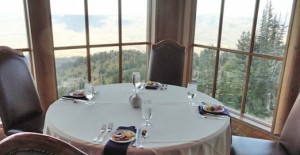
Dinner with a view at Snowbasin's mid-mountain restaurant. Credit: Harriet Wallis

Dinner with a view at Snowbasin’s mid-mountain restaurant.
Credit: Harriet Wallis

Likewise, Wes Crandall, a young rancher in a plaid shirt and cowboy hat, raises the locally famous Morgan Valley lambs. They’re also organic—open range, grass fed with no steroids, no hormones, and no antibiotics.

Restaurants that use locally sourced foods might offer you a new experience for your dining pleasure. Bon appetite.

Snowbasin, located near Ogden, was the 2002 Winter Olympics venue for the men’s and women’s downhill, super G and combined ski races. It offers specialty dining events throughout the year.


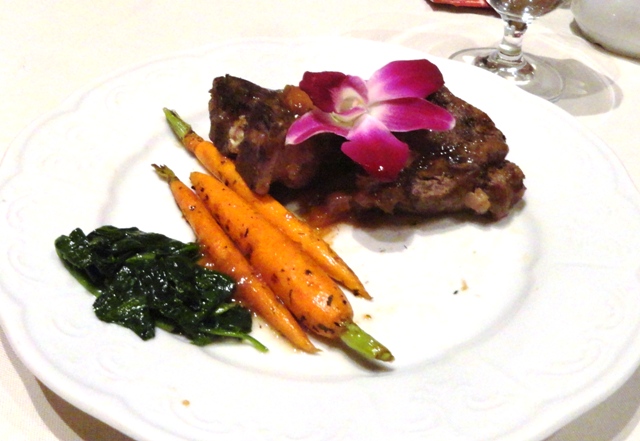
Organic spinach, carrots and lamb topped with a wildflower. Credit: Harriet Wallis

Organic spinach, carrots and lamb topped with a wildflower.
Credit: Harriet Wallis

It’s Snow Sport Heaven This Season In The Sierra Nevada!

All Systems Go As The Snow Keeps Falling On Sierra Resorts.

"There's no comparison to last season" at Dodge Ridge. Everyone is happy! Credit: Dodge Ridge

“There’s no comparison to last season” at Dodge Ridge. Everyone is happy! Almost 180 inches so far this year.  Check the mounds of “cold gold” on the trees.
Credit: Dodge Ridge

As the East Coast got a taste the last couple of months of what’s it like when the inclement winter weather fails to show up, the situation has been quite different on the West Coast. After four years of a crippling drought, the rains have returned to the flatlands and the snow to the Sierra Nevada mountains. Although California is not home-free yet drought-wise, things were looking good when the California Department of Water Resources did its December 30th water content survey off Highway 50 near Sierra-at-Tahoe ski resort. The snow depth this year was 54.7” or 136 percent of the January 1st average. A year ago, the snowpack state-wide was at just 50 percent of normal.

After barely being able to open the last two ski seasons, Homewood Mountain Resort is no longer suffering from its location right above the shores of Lake Tahoe, finally enjoying a bumper crop of snow and a five-foot-deep base. Credit: Homewood

After barely being able to open the last two ski seasons, Homewood Mountain Resort is no longer suffering from its location right above the shores of Lake Tahoe, finally enjoying a bumper crop of snow and a five-foot-deep base.
Credit: Homewood

Although there haven’t yet been any of the legendary Sierra storms that can dump up to eight feet of snow in a couple of days, the small yet persistent stream of snowfalls thus far this winter has resulted in a gangbuster season. Every single ski resort in the Sierra is open (some opened as early as Thanksgiving), with all or most lifts operating. And the base and peak numbers for the high-altitude resorts are impressive (as of January 13): Mammoth, 75”–115”; Kirkwood, 76”–80”; Sugar Bowl, 57”–96”; Mt. Rose, 63”–92”, as are the stats at resorts that struggled mightily to open last year: Homewood, 60”–76”; Dodge Ridge, 50”–72”; Badger Pass (Yosemite), 60”–72”.

“There’s no comparison to last season; it’s been night and day,” says Jeff Hauff, marketing and sales director at Dodge Ridge. “It’s phenomenal. Everybody’s happy! We’ve had a total of 179” of snowfall so far this winter, with 38” in just this last week. It’s been staying really cold, in the teens and 20s.” That would be “California cold” to our Midwest and East Coast readers!

Those cold temperatures are giving Sierra Nevada skiers an experience they don’t often have: day after day of FLUFFY white stuff to fly through rather than having to deal with “Sierra cement.” Plus the combination of smaller storms with spaces in between them has made the trip “up to the mountains” much less of an ordeal than it often is.

The San Francisco Chronicle’s outdoors writer, Tom Stienstra, headed to the Sierra recently and observed in his latest column that he had run into “dozens of people who said they had not skied in years, and some said they had been away for more than 10 years.” Nothing like a four-year drought to make people long for those idyllic days on the slopes! If  El Niño continues to deliver like it has been for the first two weeks of January, Californians will have ample opportunities to get their ski and board on this season…and on powder if temperatures continue to stay low!

Editor Note:  Here’s a cool video from Sugar Bowl about the El Ninuary experience in the Sierra.

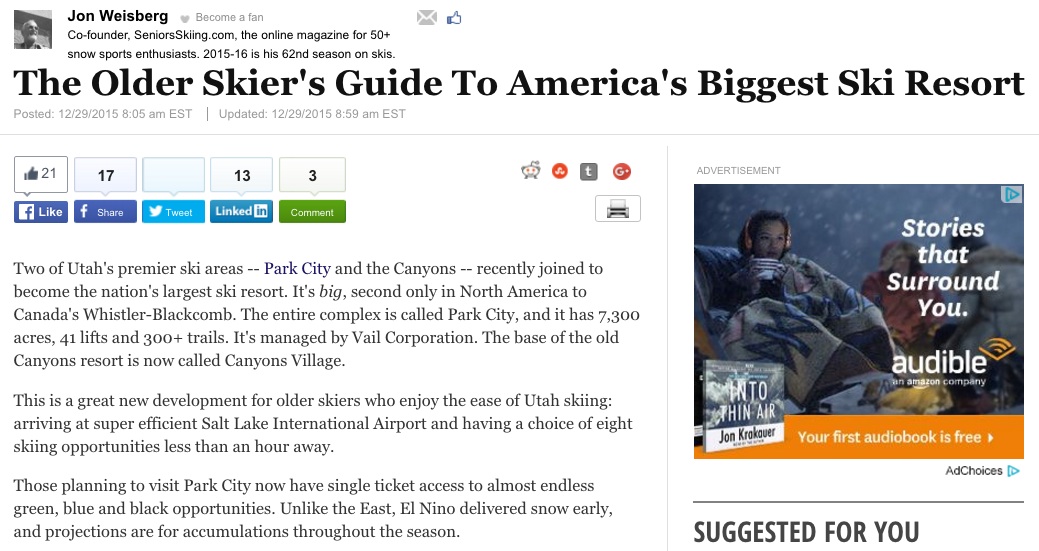
Huff Post: Older Skier’s Guide To America’s Biggest Ski Resort

SeniorsSkiing.com’s Co-Publisher Reviews The Newly-Combined Park City-Canyons Resort.

Salt Lake City-based Jon Weisberg has been waiting all summer to explore the biggest ski resort in America. With this season’s huge—and apparently ongoing—dump of snow on the Wasatch Mountains, he makes his first visit and has some senior-focused suggestions for getting the most out of your visit.  Here’s his report from the powder fields of Park City, recently published in Huffington Post’s Huff 50. If you’ve been to the new mega-resort, what’s your advice? Is bigger better?

ParkCity2_


New Senior Deal Site For Tahoe Area

Up Pops A New Senior Ski Site Out West. Well Done!

We are pleased to see that Michael Warner started a website for senior deals in the Tahoe area.  We like to think seniorsskiing.com stimulated his venture to some degree.  We now have an ally in trying to promote the needs and interests of senior snow enthusiasts by targeting a specific geographic area.

Michael Warner has launched a new ski deal site for seniors focusing on the Tahoe area. Credit: Tahoe Senior Ski Deal

Michael Warner has launched a new ski deal site for seniors focusing on the Tahoe area.
Credit: Tahoe Senior Ski Deal

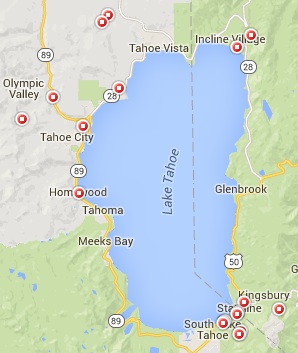
Tahoe Senior Ski Deals keeps tabs on lift pricing rates at 16 resorts throughout the Tahoe Donner region.  As we have learned in SeniorsSkiing.com’s Annual Ski Area Surveys, the best deals are always at the smaller areas like Boreal Mountain ($54, 65-69; $29, 70+) and Homewood ($47, 65-69; $20, 70+) for just two examples.  We were glad to see Tahoe Donner, a SeniorsSkiing.com Senior-Friendly Award Winner, on the list of deals ($22, 60-69, free, 70+).  In fact, Tahoe Senior Ski Deals calls Tahoe Donner the “Best Senior Prices”.

Tahoe Senior Ski Deals focuses on 16 resorts ringing the big lake. Credit: Google Maps

Tahoe Senior Ski Deals focuses on 16 resorts ringing the big lake.
Credit: Google Maps

The site also advises that seniors buy online at least three days before coming to the mountain.  There are always better deals online. The site also lists ski clubs and, notably, a link to SeniorsSkiing.com.  Thanks, Michael.

It shows that seniors can ski and enjoy the outdoors without having a hedge-fund account.  If you know of other sites that report ski or cross-country ski deals, clothing or gear discounts, please let us know.


West: Snow Falls, Lots Of Snow

White Christmas Ahead For Utah and The Rockies.

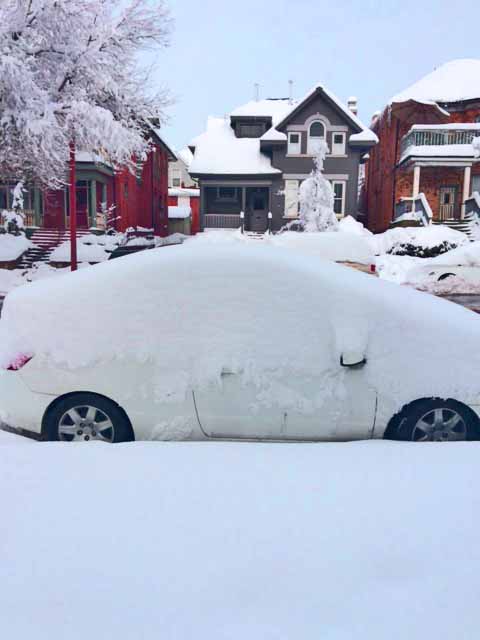
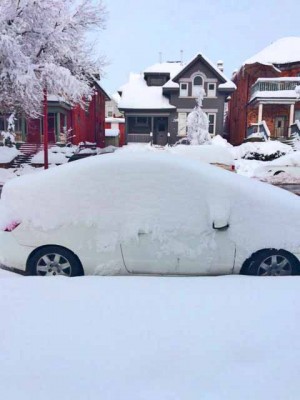
Snow-covered Prius shows depth from one-day storm in SLC.

Snow-covered Prius shows depth from one-day storm in SLC.

Salt Lake City-based SeniorsSkiing.com Co-Publisher Jon Weisberg Reports:

The biggest single dump since 2011 is how some observers characterize the mid-December storm that blanketed Utah’s Wasatch range with almost two feet over the past few days.  Snowfall extended into Colorado, Wyoming, and Montana.

Individual resorts report impressive numbers. Brian Head, the state’s most southern resort got 38″ over 48 hours. Eagle Point, another southern area on the high slopes of the Tushar Mountains collected 20″, Alta, 24″ and Snowbird, 23″.

But the base depths at most of these and other areas hovers around 45″, much less than the base needed to feel comfortable skiing off-trail fresh powder. Sorry to deliver this news to Eastern skiers, but we’re expecting more deliveries—snow, not UPS—through Christmas.

I decided not to head up the canyon today; possibly tomorrow. Instead, I walked Lucy (the mutt) around our neighborhood, one of the oldest in Salt Lake City. At about 4300′, we’re almost 3/4 mile lower than the base of Alta.


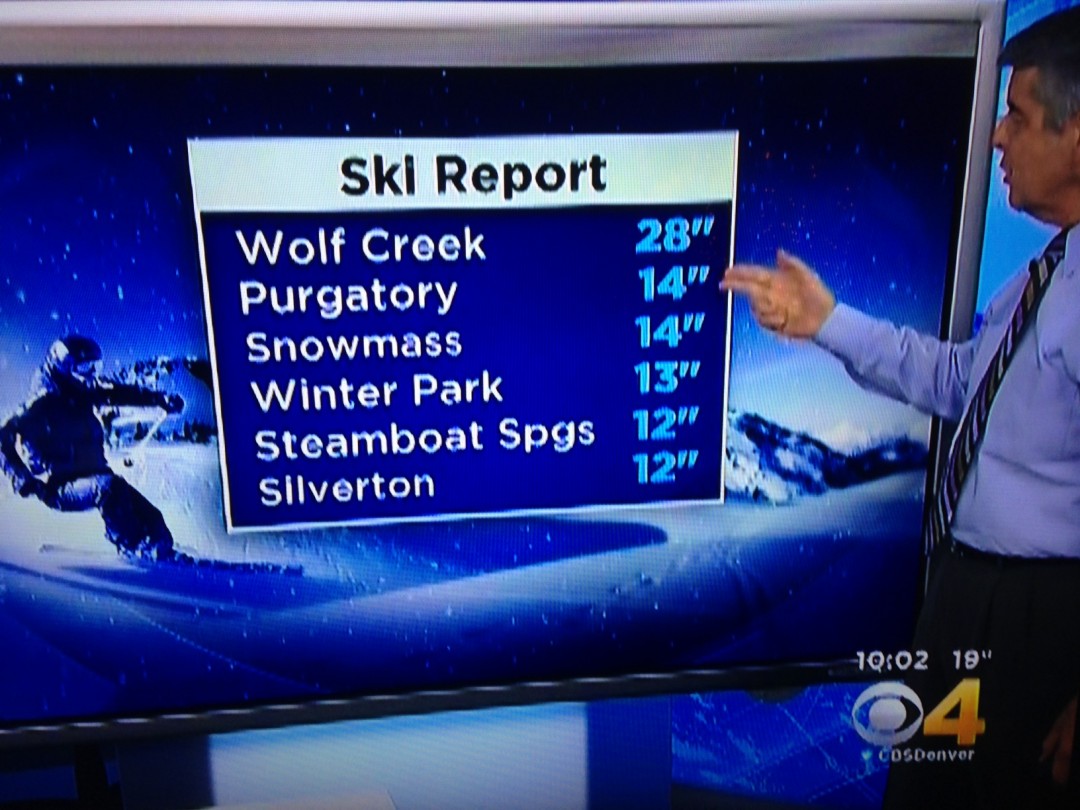
[Editor’s Note:  A contributor in Denver submitted the following picture of his television screen.  Lots of snow out west.]

Denver weatherman reports snow depth from recent big fall. Credit: Joe Durzo

Denver weatherman reports snow depth from recent big fall.
Credit: Joe Durzo


Down Corbet’s Couloir At Jackson Hole

If You Over-Think This, It Won’t Happen.

From the folks at Jackson Hole and Teton Gravity Research, here’s what happened last spring on top of the famous Corbet’s Couloir.


Sierra Resorts Give Thanks

Forget the Turkey! Sierra Skiers And Snowboarders Are Getting To Carve Up The Slopes This Holiday Weekend.

First turns of a hopefully long season at Heavenly Valley. Credit: Rachel Woods

First turns of a hopefully long season at Heavenly Valley with beautiful Lake Tahoe on the horizon.
Credit: Rachel Woods

pgoto1

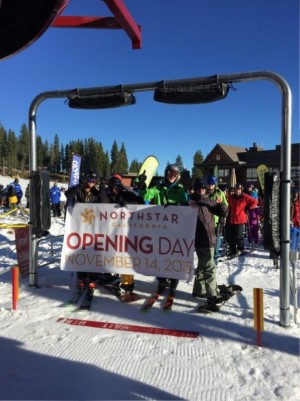
Celebratory mood on the lift line at Northstar in the California Sierra as the 2015-16 season opens with lots of snow, boding well for a great year. Credit: Paul Plaza

California wintersports lovers have a lot to be happy about this Thanksgiving holiday weekend, and they—and the industry—are hoping that this earlier-than-normal start to the ski season is a harbinger of things to come. Nearly every major resort in the Sierra has at least a few runs operating this holiday weekend (Squaw Valley opened for business on Thanksgiving Day andSugar Bowl the weekend before). Snowpacks this week grew to an average depth of two feet after the latest in a string of quick storms added several more inches to resorts’ bases. Two feet of snow on the ground is not all that impressive in a mountain range where up to eight feet of snow in a single storm has not been uncommon in years past, but, when coupled with cold temperatures allowing resorts to make snow, these little snow dumps have been enough to get the lifts rolling.

Several major areas in the Sierra opened way ahead of Turkey Day. Leading the pack was Boreal Mountain Resort, which opened even before Halloween, on October 28th. Next to open was Mt. Rose on November 4th. Mammoth Mountain’s opening day was November 11th, and Vail Resorts’ Tahoe triumvirate—Heavenly, Northstar, and Kirkwood—followed suit a few days later, on November 14th. Sierra-at-Tahoe cranked up its lifts on November 20th. Says General Manager John Rice, “The last time we opened this early was 11 years ago. A November opening is giving us a great outlook for the rest of the season, as, in a similar year, we logged as much as a total of 499 inches of snowfall!”

The existence of actual skiable snowpacks in the Sierra has had a ripple effect in the flatlands, where some shops selling gear and clothing for skiers and boarders have seen sales double over the same time period last year.

Of course, the frequent mini-storms could become infrequent, and the temperatures could rise, obliterating this happy scene. But everyone connected to the California wintersports scene is counting on the growing prospect that the strong El Niño forming in the equatorial Pacific Ocean will bring normal precipitation to Northern California and above-normal precipitation to Southern California, starting around late December and early January. If the weather scientists at NOAA are right, who knows—skiing at Big Bear on Memorial Day?


Big Sky, Big Win For 3 Gens

Can Mom (74) Adapt To Big Sky Skiing?

Heather, her son, and mom have a knock-out three-gen ski vacation at Big Sky. Credit: Greg Burke www.luxuryskitrips.com

Correspondent Heather Burke, her son, and mom have a knock-out three-gen ski vacation at Big Sky.
Credit: Greg Burke www.luxuryskitrips.com


SeniorsSkiing.com welcomes Correspondent Heather Burke, Ski Journalist LuxurySkiTrips.com and FamilySkiTrips.com

Big Sky is just as massive and scenic as it sounds, with over 5,750-acres and a skiable summit soaring to 11,166’ and dropping 4,350’ vertical feet to the base village. Boom. This Montana ski resort is as intimidating as it sounds, or at least it was to my 74 year old mom. She wanted to join us on a family ski trip, but she had serious alpine anxiety. Would she be able to keep up with us, my husband and me, and our 21 year old son? Would she remember all her skiing skills? Would it be like the proverbial bike after missing a season or two of alpine skiing?

She flew from Florida, a reverse snowbird, to meet us in beautiful Montana. Our first ski day together, I could tell she was wound up, and a bit winded from the elevation (Florida’s highest point doesn’t acclimate you to Big Sky country). As we walked to the Swifty high-speed quad (I carried her skis), I assured mom she had done this thousands of times before, and taught me to ski four decades ago.

As I made those first few gentle turns in sparkling soft snow on Mr K under brilliant blue sky, she followed. I looked over my shoulder to see her skiing fluidly, in perfect form, a pretty big smile on her face. She was feeling the elation of skiing, at 74, and I was feeling pride (and relief). To think that she’d been apprehensive seemed silly now. But her Florida friends had warned her, “don’t break a leg,” and “you’d better come back in one piece.”

Many senior skiers like wide groomers. Big Sky has some beauts. Credit: Greg Burke www.luxuryskitrips.com

Many senior skiers like wide groomers and big turns. Big Sky has some beauts.
Credit: Greg Burke www.luxuryskitrips.com

We skied four fantastic days on Big Sky’s gorgeous groomers—Elk Park Ridge to Calamity Jane.  Mom had her faves—Sacajawea and Ambush. We skied with my son and husband on Big Sky’s Moonlight Basin terrain, three generations sharing comfy quads. Over lunch in the spectacular Moonlight Basin Lodge, we laughed about how our gear and technique had revolutionized during our three generations, and told crazy ski instructor stories – all of us had taught skiing at some point. Mostly we had a blast. I can’t think of another sport than can span 50 years age difference. Senior skiing sure has changed, so has age… 70 is the new 40 for skiers.

The other change, now I’m the over-protective parent, of my mother. I controlled my mom’s ski environment during our week in Montana, leading her down ego-pleasing, beautifully groomed boulevards—Big Sky has many. Our last day brought soft glittery powder and she skied it like a champ. “I have never skied such amazing powder,” she said. I’m pretty sure she had in her six decades, this woman skied on barrel stave skis with trap bindings after all. But who am I to correct my mom though.

Big Sky was the best venue for our three generations, big mountain terrain for the boys, big blues for mom and me, and a compact village at the base – so she could ski back to the slopeside condo mid-day and I could catch up with my guys for tram laps and steep chutes. At après ski, with well-earned scotch in hand at Big Sky’s Carabiner Bar, mom toasted to our skiing legacy.

We returned her rental ski equipment and returned her on a plane safely back to her cynical Florida friends (in one piece, no broken leg). Big Sky made a big impression on these three generations of skiers.


Ski Younger Now: Retraining Program At Vail

Ski Younger Now is a retraining program for older skiers, and skiers returning to the sport after recovering from an injury. Developed by veteran instructor, Seth Masia (Seth is on the SeniorsSkiing.com Advisory Board), Ski Younger Now teaches low-impact, low-torque techniques to enable efficient skiing in all kinds of terrain.

Veteran Instructor and SeniorsSkiing.com Advisory Board Member Seth Masia re-teaches seniors to ski at Vail.

Veteran Instructor and SeniorsSkiing.com Advisory Board Member Seth Masia re-teaches seniors to ski at Vail.

The approach works for anyone recovering from an injury and for those getting back on hill after a long absence.

The program is available as a three-day workshop through the Vail Village Ski School (see dates/contact info below). Seth specializes in the 60+ crowd, including grandparents seeking the skills and confidence to ski with the kids. Seth helps them with those skills, including some they can pass on to the youngsters.

His clientele often face similar physical challenges: slowed reactions, weaker muscles, fragile joints. His goal—and theirs—is that retraining will give them another ten or twenty years on the hill.

He gets people skiing smoothly, using ski shape instead of muscle to start turns, guide skis and control speed. One area of focus is reducing torque on knees, hips and lower back. He does this by emphasizing edging as facilitated by shaped skis.

He starts his “retrainees” with the “patience turn.”  It’s simply an exercise of flattening shaped skis on the snow, allowing the tip to find the fall line. The process requires a slight upper body motion in the correct direction. Some of us simply move our hands in the direction of the new pole plant. It works!

He teaches simple lateral motions that flatten and edge the ski and remove both steering torque and body unweighting from the act of skiing. It saves muscle energy and leads to a longer, more relaxed day. These skills and other useful exercises don’t produce heavy breathing, even at higher elevations.

The workshops are scheduled for December 15-17, 2015; January 12-14, 2016; February 16-18; and March 8-10.

 To schedule or learn more, email sethmasia@gmail.com or call Vail Village Private Lesson Desk (800) 475-4543 and ask for Seth Masia.

Let There Be Snow: Early Signs Of White

There Is Indeed Snow In Those Hills, And It Is Still Summer!

OpenSnow is forecasting snow in the Northwest. Credit: OpenSnow

OpenSnow is forecasting snow in the Northwest.
Credit: OpenSnow

Our very favorite meteorological, snow forecast website is OpenSnow.  If you haven’t visited them, please do: It provides clear explanations about what is happening in the atmosphere and provides snow depth information for most ski hills in North America.  Definitely worth a bookmark in your browser.

A recent posting was a round-up of snow falls in the Northwest.  It’s a dusting but, yes, snow in the summer.  Follow the link and you can peek at web cam images from a dozen or so resorts.  So far, so good.  Let’s see what happens as El Nino continues to heat up.

Lake Louise webcam reveals a dusting. More webcams can be found on OpenSnow.com Credit: OpenSnow

Lake Louise webcam reveals a dusting. More webcams can be found on OpenSnow.com
Credit: OpenSnow