Cycling And Skiing Similarities
Both Require Looking Down The Trail, Pressurizing To The Outside Of The Turn.
I was out the other night riding with my pals and noticed that I was starting to look at the front of my wheel in sketchy terrain, and my balance was starting to be compromised.

Looking down the trail, not over the wheel.
I thought to myself, “Pat, keep your eyes focused down the trail and not on what is right in front of you.” I know this. I always do this skiing: look down the trail three turns or more to allow efficient skiing and don’t look at what is right in front of your ski tips. Sometimes you lose focus on what you are doing and let the terrain dictate your visual field. The solution is something that I always tell skiers looking to improve. Don’t let the terrain ski you, you ski the terrain. And the best way to do that is relax and look down the trail or slope. When you allow your field of vision to open up by looking ahead, you have much more time to react to the terrain changes that will come before you, often at a rapid pace in skiing or riding a mountain bike. When you focus on your ski tips or your front wheel, that reaction time is severely compromised. Momentum is your friend and if you look ahead, you can handle any terrain changes much better and in plenty of time to react. Look at the rider in the picture here. Looking ahead and down the trail. He is focused and able to react to the technical challenges ahead.
Another similarity between skiing and mountain biking is the position of the pedals during a turn. The picture above shows an extreme example of a sharp turn on a mountain bike. Look at where the inside leg is allowing full pressure on the outside pedal in the down position.

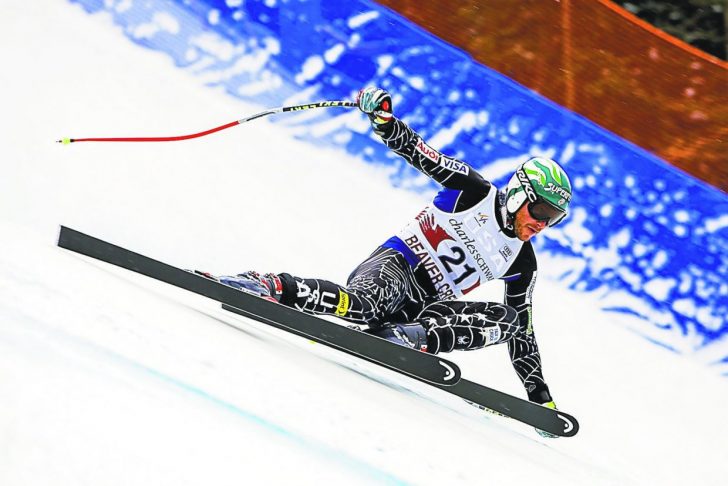
Bode Miller putting weight on outside ski.
If you look at Bode Miller here, you will see a similar leg position in his downhill race turn at Beaver Creek Birds of Prey World Cup. As soon as his outside ski makes contact, he will have it fully pressurized because of his leg and hip position. This is very similar to the cyclist who is able to execute a steep turn on his mountain bike by allowing his outside pedal to be fully pressured in the turn. Oftentimes when I ride, I can even feel a slightly countered position on my bike allowing the outside pedal to be fully under pressure and my inside pedal in the up position and stable in the turn. I learned how efficient this is when I used to race on my road bike. Those high speed turns have to be executed with the outside pedal fully under pressure, otherwise you cannot execute a tight high speed turn in the corners of a criterium race. Racers who could not commit were often off the back or crashed out because of a poorly balanced turn.
So, if you are longing for skiing during the off season, think about those turns during your bike rides. Whether on the road or trail, the movements are very similar and can give you the feeling of a ski turn when it is 80 degrees outside. Enjoy the summer and the riding.





 Co-publisher Jon Weisberg continues his reporting on the





 Jan Brunvand shares an interesting accounting of a one





 From the world of inspired ideas turned into unusual products comes the WhiSki pole for your consideration. This product is a ski pole that is also an eight-ounce flask for a liquid. From the name, you’d assume whiskey. Think of the whiskey pole as serving the same function as that brandy barrel around the neck of the classic St. Bernard. We would have surely loved to have been at the time and place where this idea came out of the firmament. Must have been a fun time. The WhiSki pole has a screw-top in the handle where your choice of beverage is poured in as well as where you, um, drink from. There is a clear warning label in fluorescent orange that admonishes you not to drink and ski, but there are other times when the WhiSki Pole comes in handy. See the video below for examples.



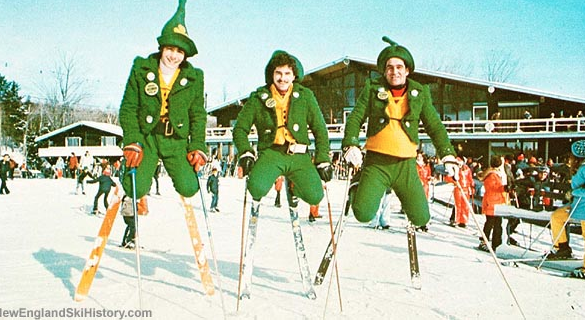


 If you recall, Brodie Mt was nicknamed “The Irish Alps”, because on St. Paddy’s Day it was definitely the place for skiers to be. It was also the domain of a creative, ingenious, leprechaun-like operator who invented a why-didn’t-I-think-of-that machine.


 Co-publisher Jon Weisberg reviews a number of ski-assist devices. These tools can help you extend your sporting life and are worth exploring.

 This is the famous Al Johnson, ski legend of the Rockies. According to the
 A reader asks:




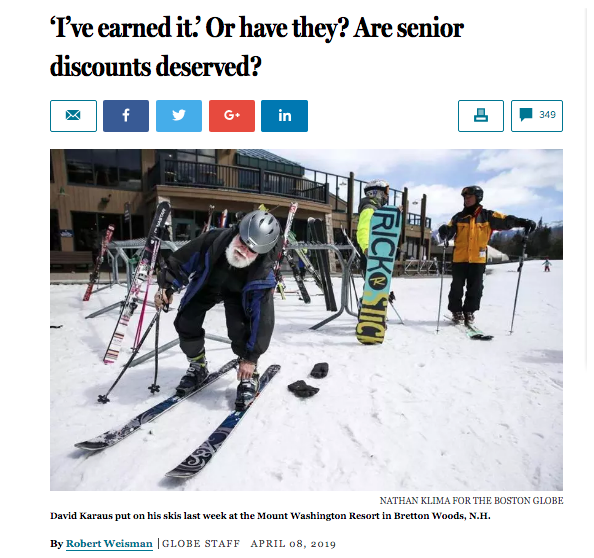
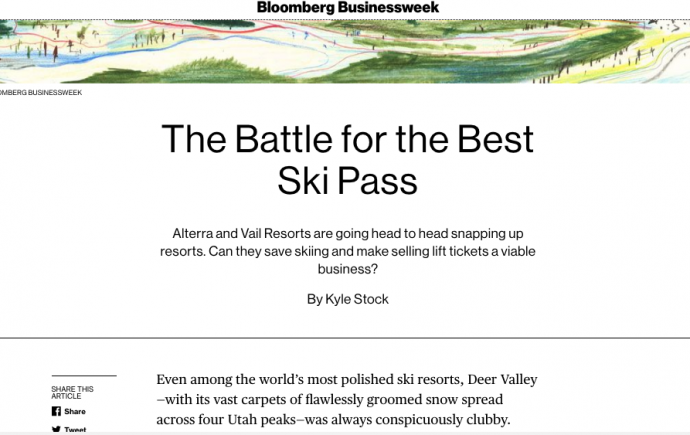
 NSAA is the National Ski Areas Association, publishing the NSAA Journal six times a year. The publication’s audience, along with its competitor, the independent Ski Area Management, are those who manage and market ski areas. A growing topic of interest is the senior skier and how to bring them to their area.
 One of the marketing themes of this year’s NSAA’s East and West Regional events was bringing back the lapsed skier who is defined as someone who skied at an early age but has dropped out of the sport for family, economic, geographic and/or professional reasons. Seniors can be lapsed skiers; areas now see us as a way to increase the number of skiers by introducing their grandchildren to the sport as well as bringing friends.
 Ski areas realize their facilitates are not senior friendly. The top three areas to improve, which are not limited to seniors are 1) Need to use stairs to get to bathrooms, 2) Long walks from the parking lot or drop off point to the lifts, and 3) Need to climb from lift exit to another.