We’ll Have What They’re Having

Skiing En Masse Down A Mountain In The Buff Must Have Seemed Like A Good Idea At The Time.

We’d like to have at the conference table when the idea for this video came to up.  Not sure where or when this took place, but thanks to Mountain Life magazine for bringing it the world and for Sweetgrass Productions for the flick.  It is from their feature-length film, Valhalla.  If you took part, tell us what possessed you.  Thanks anyway to the, ahem, streaking skiers.  Probably NSFW.

Straight Down: Cody Townsend and Gravity

Now This Should Tighten You Up.

Cody Townsend, professional free skier and athlete, takes on the most improbable ski run we’ve ever seen.  The scene is a near vertical chute in Alaska’s Tordrillo Mountains, more like a elevator shaft than a ski run.  This scene is a clip from Red Bull’s documentary, “Days of My Youth.”  We are certain that the legendary Dick Buek, winner of the 1952 Olympics downhill and probably the original extreme skier, would approve.   This stunt is reminiscent of Dick’s daredevil runs; he was the first person to schuss Exhibition at Sun Valley, something that French skiing pioneer Emile Allais said could never be done.  And, of course, there’s another legend Toni Matt whose run down the Headwall at Tuckerman’s Ravine to win the 1939 Inferno Race still echoes through the White Mountains.  All of these guys like to go straight down.  Fearless.

Cody, you’re following some pretty impressive skiing heroes.  Be careful out there.  Or is that not the point?


Huff Post: Essential Gear Senior Skiers Need To Carry

Huffington Post Features SeniorsSkiing.com’s Co-Founder Jon Weisberg On Necessary Accessories

SeniorsSkiing.com’s co-founder Jon Weisberg has been skiing for 60 years and clearly gotten his equipment kit down pat.  In this Huffington Post Post-50 Blog entry, Jon describes the eight vital pieces of gear seniors will find most useful to put in their cars, packs, or pockets.  What do you think?  Tell us what you find indispensable to carry along and how that became essential for you.

HuffPost3

GoPro Flipping Out On Mt. Cook

Free-skier Tom Wallisch corks it on New Zealand’s Tallest Mountain

Some say skiing is flying with different expectations.  Take a look at this short video from GoPro with professional free-skier Tom Wallisch down in En-Zed.  Aside from the corkscrew flip, the view of these snow fields is breathtaking.   By the way, winter in New Zealand is summer in the Northern Hemisphere.  And the South Island is one of the most beautiful places on earth. So, if you want a unique July Fourth party, off you go.

Flash: Colder, Snowier Winter 2015 Forecast For New England

Latest Prediction from WBZ-TV Meteorologist Forecasts Cold and Snow

With the season just getting started, we’ve been diligently watching snow forecasts as we know know you have as well.  As we reported in an earlier post, Joel Gratz, our favorite snow meteorologist who prognosticates at OpenSnow, has been compared a number of weather models and found a consensus for dry in the Northwest, snowy in the Far West, and uncertain from the Rockies to New England.  But, then he says, don’t trust long range forecasts.

2015 Snowfall Predictions for New England Credit: WBZ-TV Graphic

2015 Snowfall Predictions for New England
Credit: WBZ-TV Graphic

With a couple of more months of data and many models to contemplate, Barry Burbank, Boston’s WBZ-TV meteorologist, has just put a new winter prediction in play.  Barry says that he’s “relatively confident of a cold and snow winter overall.”  He is calling for more snow in the New England area, 10-20 inches above average, for a total forecast of 55-65 in Boston.  That places 2014-15 as the third consecutive year above average.  He also is calling for cold, speculating that the Polar Vortex that vexed the Midwest last winter will be moving eastward.  Below average temperatures should reign especially in January when he expects an “outbreak of arctic air.”

So, New England senior snow enthusiasts, this is good news.  It also means you have to dress for the weather, prepare your equipment your car, and your self.  As the old Swedish expression says: “There is no such thing as bad weather, just bad clothing.”  Get ready.

Here’s Barry.  Click here for WBZ’s Winter 2015 video report.


Huff Post: What Senior Skiers Must Remember

Huffington Post Highlight’s SeniorSkiing’s Co-Founder: Is there something outdated about your equipment?

SeniorsSkiing.com’s Co-Founder Jon Weisberg has a new article on Huffington Post’s Post 50 blog, this time about the potential risks of skiing with old equipment and a lack of reasonable fitness in senior skiers.  Click here for the Huffington Post blog about what seniors should think about before heading downhill with those long, skinny skis, rear-entry boots and untoned muscles. 

Huff2

Huff Post: Second Thoughts On Returning To The Hill?

Huffington Post features SeniorsSkiing.com’s Co-Founder encouraging seniors to come back to skiing.

We get around.  SeniorsSkiing.com’s Co-Founder Jon Weisberg has posted an article on Huffington Post’s Post 50 blog about the concerns seniors have about either continuing to ski or returning to skiing and how the sport has changed to help accommodate them.  Click the Huffington Post Post 50 Blog to read more.  What are your thoughts?  What advice do you have for seniors who are thinking of leaving the wonderful world of winter sports?

HuffPost__


Watch for more Huffington Post Post 50 comments from Jon on senior snow enthusiasts.

Afterglow: Visual Night Skiing Poetry

When Was The Last Time You Skied In The Dark?  We bet it wasn’t like this.

Credit: Sweetgrass Productions

Credit: Sweetgrass Productions

So far, this year’s pre-snow-season has seen at least two new dazzling ski movies hit the screens. First, we couldn’t help but notice Warren Miller’s 65th ski movie, No Turning Back, which we reviewed here and concluded it was the best yet. That movie is working its way around the country, showing in schools, colleges, theatres and even ski lodges. Click here for show times and locations near you.

Now, we have Afterglow, a short but incredible visual feast featuring night skiing in light suits over dramatic Alaskan wilderness terrain. Think about that for a second. Night skiing. Light suits. Alaskan wilderness. Think of the logistics. And you have troubles getting your grandkids booted up for the day.

Credit: Sweetgrass Productions

Credit: Sweetgrass Productions

This is a creative cinematic experience that goes into places we guarantee you’ve never seen before. Big time ski pros Pep Fujas, Eric Hjorleifson, Daron Rahives, and Chris Benchetler take slo-mo runs down night-time chutes and powder pillows with dramatic big lights capturing the flying snow. The best part is when they wear LED-light suits and head down into the darkness. The effect is otherworldly and quite beautiful. We had instant flashbacks to our college skiing nights at Song Mountain in Tully, NY, where the dark skies and arc lighting made us lose our sense of space and proportion. This movie brought those impressions back, leaving us wondering where, when and if we should try that sort of skiing again.

The film is presented by lighting manufacturer Phillips, Atomic and produced by Sweetgrass Productions, a far-edge filmmaker which is out to “capture the indescribable”. You can watch this one online; it’s just about 10 minutes. We bet you will be forwarding it to your skiing buddies.

All of this visual spaghetti adds to the building psyche-up for the coming season, a season which has already started in some places in Colorado and Maine.

Warren Miller’s Newest: “No Turning Back”

This one is not to be missed.

Flipping out: Lofoten, Norway Credit: Oystein Aasheim

Flipping out: Lofoten, Norway
Credit: Oystein Aasheim

My first Warren Miller film was in the early 50’s. That was when the Master, himself, was present to narrate each showing. You knew the season was

Chute running: Mt. Olympus, Greece Credit: Josh Bibby

Chute running: Mt. Olympus, Greece
Credit: Josh Bibby

starting when Warren rolled into town.

I’ve seen many ski films over the years. After a while, despite camera tricks, ski gymnastics, and the latest soundtrack, they took on a boring sameness. How many times can you watch a daredevil huck the big cliff?

But I just watched Miller’s newest production, “No Turning Back”, and I’ve gotta tell you, this is not to be missed. It is a beautifully shot travelogue of some magnificent lines carved through some of the world’s best terrain.

For the SeniorsSkiing.com crowd, there’s a segment shot in Chamonix featuring a few 50+ skiers (52 and 60) and filled with wisdom about aging and skiing. One line sums it up: “When skiers say 50 is the new 40 (I’d make that 70 is the new 60), what they’re really saying is, Thank you, fat skis!”

“No Turning Back,” Miller’s 65th film, is narrated by Jonny Moseley, who, in his own way, channels the Warren Miller feeling with artful script laced with philosophy and humor. Interspersed throughout are great snippets of skiing history, including a northern Norway search for a ski that was carbon-dated to 3200 BC.

There’s a beautifully shot segment in steep powder runs in Cordova, Alaska, boarding in the bottomless powder of   Hokkaido, Japan, and a piece on skiing in Greece, where there’s more than 20 areas less than two hours from the Aegean.

Two skiers hike and ski Mount Olympus while the narrator links it to Daedelus and Icarus.

A few hundred miles west, we’re introduced to two “speed riders” in Switzerland, guys skiing with paragliding kites, which allow them to huck enormous cliffs, touch down on a stretch of snow and get airborne within seconds.

Throughout, the film pays homage to female skiers, featuring several carving great turns on incredibly steep terrain.

Powder running: Chamonix, France Credit: Mike Hatrup

Powder running: Chamonix, France
Credit: Mike Hatrup

For me, the most enjoyable segment was shot in Montana with big mountain skiers Julian Carr and the charming Sierra Quitiquit. (Julian has done any number on mind-boggling cliff jumps, including a 210′ front flip in Engleberg.) Montana has many smaller areas known for steeps and deeps. And their towns, unaffected by contemporary ski culture, remain time-warped, non-commercial, and down-home friendly.

“No Turning Back” is being shown around the country (locations and schedule). If ski films are your thing, or if you’ve been away from that genre for a while, find a hall where it’s playing. Regardless of age, it will make you want to be on the hill.

Special Edition: First SeniorsSkiing Ski Area Survey Results

Free Skiing, Deep Discounts For Senior Skiers Plus “Senior Friendly” Awards

oldfashionedskierWhich areas are truly trying to accommodate 50-plus skiers? To find out, we surveyed 85 North American resorts. Several resorts stand out for giving senior skiers special attention and deals. They received the new SeniorsSkiing Skier Friendly Award. Those with the deepest discounts and best amenities received Gold awards. Those with better than average discounts received Silver Awards.

The survey had a 34 percent response and will be conducted annually. We hope that by asking the right questions for our readers, SeniorsSkiing.com will help drive greater recognition, discounts and amenities for senior snow sports enthusiasts.

SeniorsSkiing “Senior Friendly” Gold AwardsGold_Waterville_Valley_Resort

Of all respondents, six stand out with the best discounts and amenities.

  • Whitefish Mountain Resort, MT — Free skiing for 70-plus skiers
  • Hood Ski Bowl, OR — Free skiing for 71-plus skiers
  • Ski Whitewater, BC — Free skiing for 75-plus skiers
  • Alta, UT — Free skiing for 80-plus skiers
  • Lake Louise, AB — $20 season pass for 80-plus skiers
  • Waterville Valley, NH — Hosts Silver Streaks, the country’s longest running senior ski program. “We provide the structure and facilities; the members organize their own events,” explains Peter Sununu, Waterville spokesman. Members gather daily for coffee and pastries in a designated meeting area; enjoy mid-week NASTAR races, complimentary clinics, preferred parking, après-ski parties, awards banquets, other amenities.

Free skiing as a strategy to introduce the next generation

The percentage of all midweek senior skiers at resorts which offer free lift tickets for seniors is estimated to be about 50 percent. Mt. Hood Ski Bowl’s Hans Wipper explains the value of providing free skiing to the older customer, “We want to reward loyal skiers, and we want them to bring their extended families.”

SeniorsSkiing “Senior Friendly” Silver Award

Silver_Copper_MountainThese respondents had great discounts for seniors:

  • Sutton, QUE — 55 percent off tickets Tuesdays, January – mid February.
  • Okemo, VT — pre-December season pass purchase (includes Mt. Sunapee, Pico Peak, Killington, Crested Butte): 45 percent off for 65-plus; 70 percent off for 70-plus.
  • Ski Butternut, MA — pre-December season pass purchase: $125 for 65-plus
  • Sugarbush, VT — $199 for Mid-Week Boomer Pass for 65+ (was $99 before Sept 9).

Other Silver Awards went to:

  • Alpine Meadows, CA
  • Copper Mountain, CO
  • Vail, CO
  • Hunter Mountain, NY
  • Windham Mountain, NY
  • Deer Valley, UT
  • Snow Basin, UT
  • Snowbird, UT
  • Red Mountain Resort, BC
  • Whistler Blackcomb, BC
  • Mont Tremblant, QUE

Takeaways: Lift ticket deals are out there, especially for the early-bird, pre-season buyer. So are discounts in restaurants, rentals and other amenities. Look and ask.

We also encourage ski area management to consider the business benefits of catering to the interests of the senior skier: increased mid-week traffic, younger “tag along” full paying clients, and a loyal and vocal clientele.

CADS: How to Add Years to Your Skiing

An ingenious invention extends your ability to ski well on not-so-great knees

On the high side of usefulness for seniors, we find CADS, a remarkable body weight suspension system for skiers and riders that reportedly helps relieve knee pressure by acting as a spring between your butt and your knees.  Instead of

Strut from butt to boot Credit: Dan Leeth

Strut from butt to boot
Credit: Dan Leeth

gravity relentlessly pressing down—using your knees as a fulcrum—CADS is said to relieve the pressure.  Less pressure, less muscle tension, less fatigue and more skiing.

CADS stands for Constant-force Articulated Dynamic Struts—think of your car’s shock absorbers, and you have an analogous idea.  The skier wears a harness around the waist and under ski pants. Thin pole-like struts attach to the waist belt and to a fitting in the back of the ski boot.  The struts are detached on the lift and remounted at the top of the hill.

CADS inventor Walter Dandy said in a January, 2013 Dallas Morning News article, “It’s like sitting on a bedspring.  It pushes down on the ski.  It pushes up on the skier.”  He claims, “You don’t get tired, and your knees don’t hurt.”

“CADs does a novel thing,” said Walter in a SeniorsSkiing phone interview.  “In addition to weight bypass, CADs replicates what the thigh muscles do, so you’re reducing the strength requirements of your own muscles.”  CADS also puts downward pressure on your ski, allowing the ski to be in more continuous contact with the snow.  “That reduces muscle tension and fatigue,” said Walter.  “One senior skier held a tuck position from the top of one Vail ski run to the bottom without burning his thighs.  He said he couldn’t even do that when he was 25!”

Walter said that people whose knees hurt when they are skiing are prime prospects for the CADs system.  “Our customers are typically life-long skiers—engineers, physicists, surgeons, dentists and the like.  These people are self-reliant, knowledgeable, but they have a knee issue that is threatening their skiing experience.  So, instead of quitting, they try CADs.  These are not fashion-sensitive people, and they want to keep skiing.”

Struts and Bands Supply the Force Credit: CADs.com

Struts and Bands Supply the Force
Credit: CADs.com

The CADS website has lots of videos of regular folks skiing with the device.  The hard-data medical research and testimonials collected over the past twenty-four years are impressive.

If you happen to be in Vail, you can get a free on-slope demo from Walter using trial equipment.  If Vail isn’t in your plans, you can order by mail.  Walter will ask you to send your boots and ski pants so he can fit them out before sending you back your new CADS.  Or, you can install the devices yourself.  Walter is also happy to advise prospective buyers curious about the technology and whether it could be potentially helpful for them.

Yes, it looks very different, but according to the testimonials on the CADS website, this really works.  And if you can keep skiing and skiing well, who cares about stares?  “The change in attitude in people from before trying CADs to after is remarkable,” said Walter.

We like the idea of CADs because it gives senior skiers a choice where there wasn’t any before.  We plan to try CADS this season and post a review.

Have you seen or used CADs?  Tell us your story.


We haven’t yet tried CADs and can’t officially endorse it until we do.  But it certainly is worth a look if you are thinking of quitting because of bad knees.  Here’s the official promotional video.

Need to See to Ski?

 Check Your Assumptions: Physical Obstacles Don’t Have To End Your Runs.

The first time I witnessed blind skiers I was blown away.  I assumed vision was a prerequisite for being on the slopes, but was I wrong!

That was years ago. Today, adaptive sports programs around the country train both specialized instructors and the visually impaired. The National Ability Center in Park City is the preeminent program for people with physical and mental impairments. It serves as a model for similar efforts around the globe. And groups like the American Blind Skiing Foundation help train instructors to work with the visually impaired. By learning how to ski—or adapt to their visual impairments—people with compromised vision get a sense of independence and are able to gain confidence that can lead to taking on other life challenges. Getting on the slopes also leads to greater contact with friends and families. Then there are the awe-inspiring visually impaired athletes competing in a broad range of Alpine and Nordic events. Visually-impaired Paralympic athlete Danelle D’Aquanni Umstead explains it this way:

“It is a ‘visually impaired team,’ not an athlete and their guide. Guiding is not something just anyone can do. As a guide, you have to be just as committed, ski faster and also be able to turn around at any given moment to look behind you at the other athlete when at high speeds. This is not an easy task, and takes a lot of training as a team. Finding the right guide is definitely the hardest part for a visually impaired skier. To be able to trust in that person one hundred percent, and find a guide who has the same goals as you.”

 Which brings me to a spirit-lifting tale told in an April 2014 segment on WBUR, Boston’s Public Radio station.  Dick Perkins, 78, and Tony Carleton, 80, Dartmouth Ski Team chums from the 1950s, found a way to keep doing the sport they loved despite encroaching disabilities.  Twenty years ago, Tony was hit with a neurological condition that compromised his upper body strength. But, he could still ski!  Then, Age Related Macular Degeneration (AMD) made his old friend Dick legally blind.

Tony Carleton guides his old pal Dick Perkins.  Credit: Sharon Brody/WBUR

Tony Carleton guides his old pal Dick Perkins.
Credit: Sharon Brody/WBUR

Giving new meaning to the expression “lean on me,” Tony, even with his neurological condition, learned to become a ski guide for his legally blind buddy. The two of them now carve graceful patterns together at Wachusett Mountain Ski Area, a 110 acre/1000′ vertical area not far from Boston. “That lifelong identity as a skier is something that’s really sustaining as we age,” said Dick in the WBUR story.  “It’s a great feeling to say ‘By gosh, I can do that, and I can do it pretty darn well’.” The story of their skiing partnership and a video can be seen at Skiing Together, Old Friends Conquer Uphill.

When Going Up Was Half The Fun

Early New England Tows We Still Miss.

Susan, second left, with her family in the late 50s.  Note chic attire.  Dad has spats; Susan's in a loden coat and white jeans.

Susan, second left, with her family in the late 50s. Note chic attire. Dad has spats; Susan’s in a loden coat and white jeans.

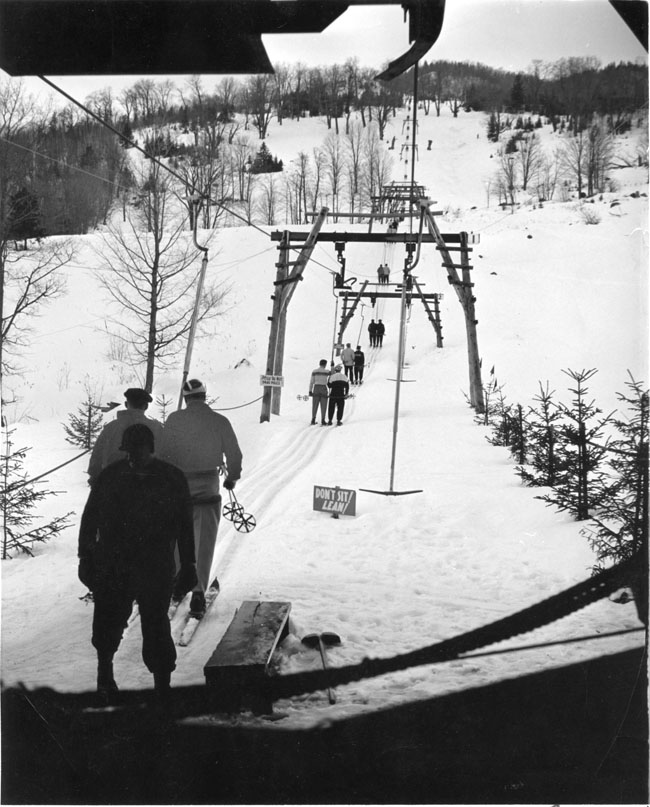
I’ve been skiing for 65 years, grown and raised in Concord MA.  I made my first turns on Punkatasset Hill, a no-lift neighborhood ski hill. That’s where I side-stepped to the top to pack the snow before picking my way down through the labyrinth of slalom poles my dad had set for me and many other local kids.  In the late 1920s, the Norwegian National Team used the jump at the short, steep hill for practice.

When I was seven or eight, Dad took me to Suicide Six in Woodstock, VT, where going up meant tackling a big, ferocious rope tow. Standing in line, I prayed that no one tall would step in behind me; I hoped that the person in front would hold on tight, lift the rope off the snow and stay in the track. Garnering all my courage, I’d try to grab the rope quickly, one hand in front and the other wrapped behind my back – ski poles dangling from each wrist. When I first caught hold of the tow, clutching hard with my leading hand, my arm felt as if it had been jerked out of its socket. If no one was in front of me, I was dragged along the snow, squatting in order to keep my body over my skis. If, as I had
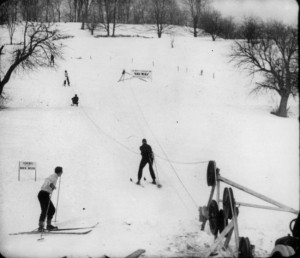
Rope Tow at Woodstock, VT. Credit: New England Ski Museum

Rope Tow at Woodstock, VT. Credit: New England Ski Museum

dreaded, a taller person loaded on the tow behind me, I was lifted off the track into the air, hanging from the rope all the way to the top. When a skier in front lifted the weight of the monstrous rope for me, I was happy until that person unloaded and dropped the rope to ski off, leaving me again dragging along the track, hands soaking in my leather mittens and determined to make it to the top.

But the worst menace of all were the teenage boys. I quivered when one of them was up front for I knew what they did for fun. When dismounting, those boys deliberately snapped the tow as hard as they could, sending rippling waves of rope down the track. Yanked up and down, I was soon dislodged. Skiing down the hill covered in snow and disgrace, I slid to the bottom to get in line and start the ascent all over again.

I miss the old T-bar which took me to the top of Cannon Mountain in Franconia, NH. It was magically quiet gliding up through the hoar-frosted evergreens with the sun shimmering off the clear ice which encased the very tops of the

T-Bar at Black Mountain, NH.  Credit: New England Ski Museum

T-Bar at Black Mountain, NH.
Credit: New England Ski Museum

trees. Of course, it was uncomfortable when my side of the T-bar was in the middle of my back with my father riding beside me, struggling to help me, leaning down to hold his side of the bar behind his knees. What a relief when I was old enough to ride the lift with kids my own height or go up on my own holding the T-bar out in front of me, making “S turns” in and out of the track. I danced the whole way to the top.

And then there was Burke, in the “Northeast Kingdom” of Vermont that had a Poma lift running from the bottom to the very top of the Mountain. Here, I bumped off the growing mounds of snow which got larger with every run until I catapulted right to the top of the spring, hurled high into the air – boing, boing, boing.  Going up was half the fun.

For more about Suicide Six’s 75th Anniversary.

For more about Gunstock’s old Rope Tow, another favorite.


Susan Winthrop is a long-time skier with memories of the sport extending back more than seven decades.  A contributor to SeniorsSkiing.com, she currently lives in Ipswich, MA, enthusiastically skiing in and around New England whenever she can.
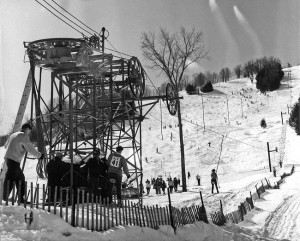
Suicide Six also had a Poma lift Credit: New England Ski Museum

Suicide Six also had a Poma lift
Credit: New England Ski Museum


Special Thanks to the New England Ski Museum, Franconia, NH.



Why Seniors Still Ski

A celebration of senior skiers, including American deep powder legend, Junior Bounous describing his descent of Snowbird’s Pipeline when he was 80 years young (he’s about to turn 89). Why does he still do it?

Snowbird’s Pipeline Conquered By Junior Bounous at 80 (Taken March 8, 2014)

DSC04514

Snowbird’s Pipeline (the top to bottom ravine in center of picture) : One of North America’s toughest ski routes, descends from Twin peaks above Snowbird. First skied by Junior Bounous in the early 70s. He skied it again during his 80th year. Junior is an inspiration to senior skiers everywhere.
&nbsp