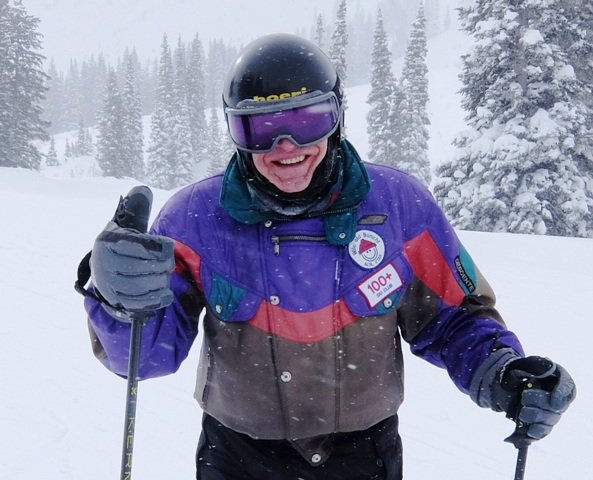
Big bargains await older skiers this season at 157 North American ski areas. Fifty-two allow them to ski free. The rest have heavily discounted the cost of skiing.
But it all depends on your age.
The comprehensive list includes season pass prices, age requirements, and links to each area’s website. To access, click “Community” on the menu bar, then click “Subscriber-Only Content” in the drop down box.
The areas are in 30 states and five Canadian provinces. Many are large and well-known.
It you’ve reached 70, there are 101 areas offering free or extremely low cost season passes and lift tickets. If you’re 75, there are 122 areas. If you’re 80, the same privileges are available at virtually all listed areas. A few extend the benefit to skiers in their 50s and 60s.
The states/provinces with five or more listed areas are:
California (6)
Colorado (7)
Idaho (10)
Maine (5)
Michigan (11)
Montana (9)
New Hampshire (9)
New Mexico (6)
New York (6)
Pennsylvania(7)
Utah (6)
Vermont (6)
Washington (5)
Alberta (15)
British Columbia (6)
Ontario (5)
Quebec (5)
The list was researched on line and will be updated throughout the season as readers report new information. SeniorsSkiing.com first published the list for the 2015-16 season.
https://seniorsskiing.com/wp-content/uploads/2019/10/Screen-Shot-2019-10-24-at-1.33.33-PM.png188205Jon Weisberg/wp-content/uploads/2014/04/Seniors-Skiing-since2013-Logo@2x-300x68.pngJon Weisberg2019-10-24 14:22:592019-10-24 14:22:59Big Bargains For Older Skiers at 157 North American Ski Areas
A Reply From Meegan Moszynski, Executive Director, National Ski Patrol
[Editor Note: On Oct 1, SeniorsSkiing.com published an article by correspondent Roger Lohr recounting his hit-and-run collision that left him with a nagging back problem. Many readers responded to that article by citing their own on-hill incidents with speeding or out-of-control skiers/boards. The question emerged: Who is actually responsible for lifting ski tickets from people who are discourteous, unsafe, or just acting dangerously? The ski patrol, right? No, said some; yes, said others. So, SeniorsSkiing.com asked Meegan Mosynskyi, the executive director of the National Ski Patrol, to clarify what the NSP’s role is in controlling dangerous skiers/boarders. Here is her response:]
Thank you for reaching out and inviting NSP to provide some input to this important topic.
The Responsibility Code is a courtesy code that all areas and guests are encouraged to follow. The Code was developed by NSAA and is supported by many other leading organizations in the ski industry, including NSP. As an education and training organization, NSP provides the standard of training. The standard of care and the actual roles and responsibilities of patrollers who work or volunteer on the hill is up to area management. Some areas ask patrollers to regulate and react to skiing speeds and other on-hill behavior to the best of their ability, and some do not.
We are always interested in working to promote safety in skiing. We work closely with NSAA and others to do this, and to ensure that we are meeting the needs of the skiing public and the areas that host them. Any communication that can be shared with the skiing public via your channels would be greatly appreciated.
Thank you for all you do. Let’s hope it’s another great winter!
https://seniorsskiing.com/wp-content/uploads/2019/10/Screen-Shot-2019-10-21-at-9.40.30-AM.png480525seniorsskiing/wp-content/uploads/2014/04/Seniors-Skiing-since2013-Logo@2x-300x68.pngseniorsskiing2019-10-24 09:10:252019-10-24 09:10:27NSP On Role Of Patrol Re: Speedsters
The Typhoon Rule Can Predict Chilly Wet Air In North America.
In an age where computer models are believed to be the only viable long range weather forecasting tool, there remains a very effective technique for looking ahead a couple of weeks that had its roots in World War Two.
It is called the “Typhoon Rule”. When the far western Pacific is active in terms of tropical disturbances, it is a great way to determine what the jet stream pattern will look like over the US with a lead time of one to two weeks.
Military forecasters in the Pacific theatre dealt with typhoons pretty much year round, due to the persistence of water warm enough to form and sustain such storms in that part of the ocean. One of the meteorologists noted that after a typhoon either re-curved over or east of Japan or tracked straight west into mainland Asia, a change in the weather would result in a week or two in Washington, D.C. and thus the correlations were born. Here is how the Typhoon Rule works:
All tropical disturbances across the globe act like a cork in a stream. They are warm systems without the warm and cold fronts that drive mid-latitude low pressure systems, and are therefore more influenced by jet stream level winds in terms of where they will move. When a typhoon in the southwest Pacific encounters an upper ridge to the north—centered over Korea and Japan—the clockwise circulation around the ridge directs the storm westward, often through the Philippines and into Asia.
A ridge in that position correlates with an upper level ridge and tranquil weather over central and eastern North America with a lead time of one to two weeks. However, when the axis of the Pacific ridge is set up further east by several hundred miles or more, over the waters well east of Japan, the typhoons tend to run around the perimeter of the circulation, leading to a track that heads for Japan before turning north and then northeastward.
This happens in a fashion similar to Atlantic storms threatening the east coast before turning around the perimeter of the Bermuda high as they head for New England and the Maritimes—when the ridge is far enough to the east, the storms miss the U.S. A re-curving Pacific typhoon around a ridge well east of Japan correlates with a central/eastern North American trough, often leading to colder and stormy weather.
As we wait anxiously for the new season to start, the Typhoon Rule can give us a hint as to when colder air masses will be available for early season snowmaking or natural snow. As I write this on Oct. 22, the Typhoon Rule is set up for a cold air mass to dive into the center of the country later in the week of the 28th. The cold will also spread into the East, though in modified form. Take a look:
This October typhoon is re-curving to the north east, transporting its heat to a trough in the Gulf of Alaska. Result: an early cold shot that will get snow guns going.
There are nuances to the rule, and one of them comes into play here. This strong October 22 storm will not make a dramatic turn to the northeast toward the Aleutians, but it will turn north of east. This track suggests that the trough/cold shot will be centered in the middle of the country with the chilly air eventually spreading east.
The Killington Women’s World Cup is about five weeks away, and it looks as though the snowmakers will be able to get started there around Halloween. The Typhoon Rule that an observant WWII forecaster discovered says so.
https://seniorsskiing.com/wp-content/uploads/2019/10/typhoon2.png714718Herb Stevens/wp-content/uploads/2014/04/Seniors-Skiing-since2013-Logo@2x-300x68.pngHerb Stevens2019-10-24 08:09:412019-10-24 08:28:04The Skiing Weatherman: How Do Pacific Cyclones Dictate US Weather?
You know, as you age, little things creep into your mind like, “Can I still ski that?” “Am I too old to keep trying this pitch?” But, one of the things that keeps our minds in check is the familiarity with the terrain after years of experience.
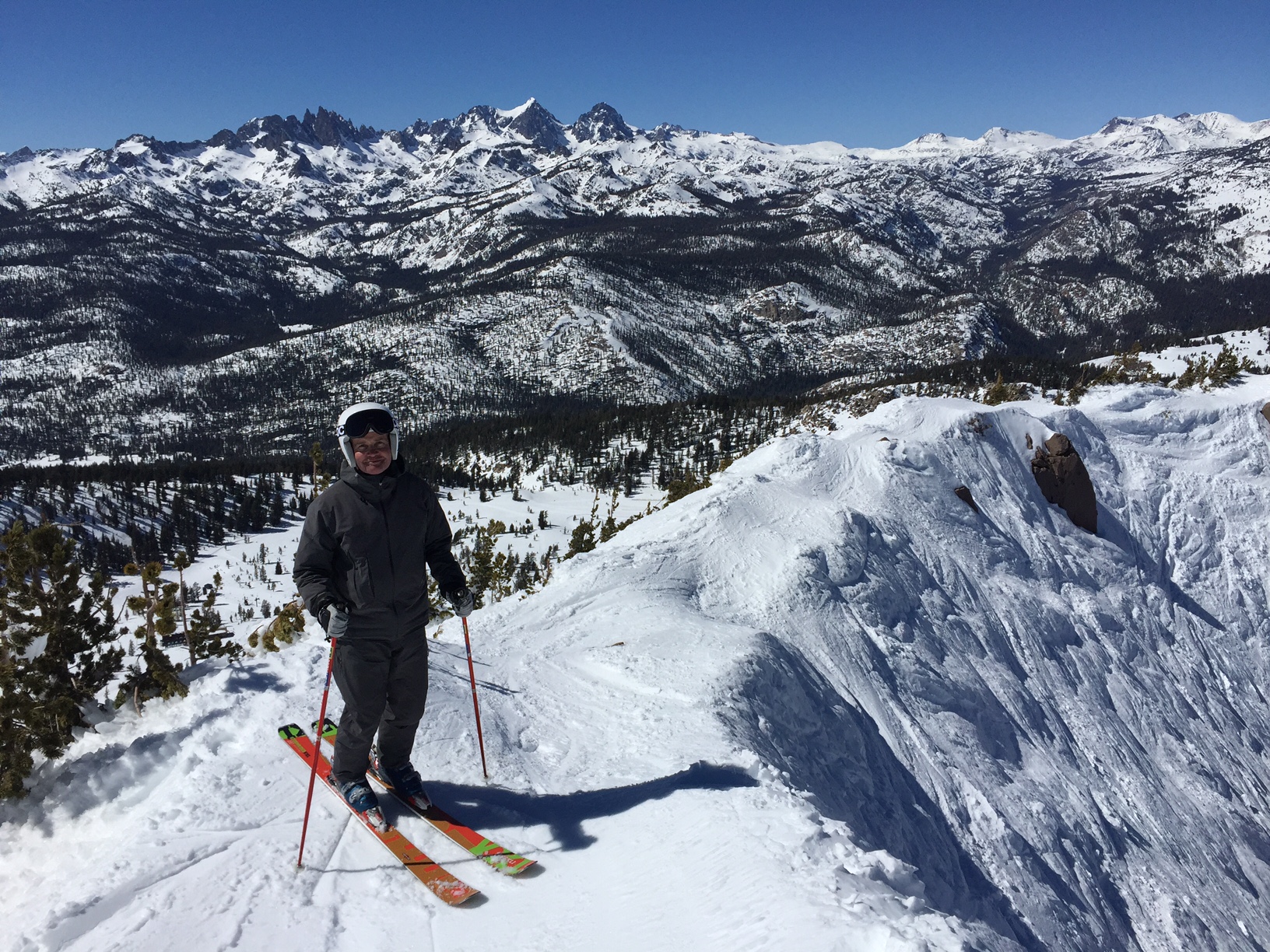
For instance, every year, I travel to Mammoth Mountain, CA. with my posse of friends All of us have skied that mountain for years. After exiting the gondola at the top , we ski off the famous pitches and faces up there with confidence. Why? Because we know the terrain.
This last year was no exception. I made several runs down the cat track off the tram relaxed and tucking to the top of Paranoid Flats and skied right off the top with no trepidation. I have become very familiar with that terrain and know that I can ski it. Now there are pitches and couloirs there that I have not skied and for me, the consequence factor is too high with the surrounding rock walls that will suck in unsuspecting skiers who have made the error of skiing above their ability.
I take Coumadin and my doc always says, “Pat, you are the only patient I have who skis and mountain bikes on Coumadin.” But I have done those sports for years and know my limitations. And, I know how to ski safely over a familiar cornice, even though I am now 65 years old.
We all do this one way or another. Confidence occurs because of repetition over certain terrain. I have a friend who I ski with, who not only skis the same runs all the time at our local area, but he skis the same lines. He becomes so familiar with the lines that he is confident and tries to make the perfect turn over and over. I ride my local trails a lot on my mountain bike and am so familiar with the layout of our trail system that I can confidently ride them with speed.
The flip side of the coin is that if you keep yourself in shape and have the confidence that you can ski or ride most anything within reason, you are not adverse to challenging yourself on new terrain. The more familiar you become, the more confident you are. This is especially important as a senior skier.
There is nothing wrong with using a little caution, but for the most part, years of experience on the slopes will give you confidence. You know how to ski ice, you know how to ski powder and have that centered position and not sit back. You have seen rain soaked snow before and know that it is consistent. Why? Because you have been there before. When the young dudes see an older guy confidently ski a sketchy line, they are amazed. But really, we know that confidence and experience rule the day.
One day, a few years ago, my friend Eric and I saw a guy rocketing GS turns down Strawberry Express at Snowbasin, UT. His effortless turns goaded us on to stay with him and when we got to the Strawberry Gondola, he took off his helmet and exposed a gray beard with a grizzled, leathery face, and a full shock of gray hair. I politely asked him how old he was and he said he was 75 years old. We asked his secret and he stated that he skied or hiked every day, and he is confident in his turns because he keeps himself in shape. He knows every trail intimately.
So, the lesson for all of us is stay in shape, keep skiing, and there is nothing wrong with picking lines and sticking to them. The more confident you are, the more fun you will have.
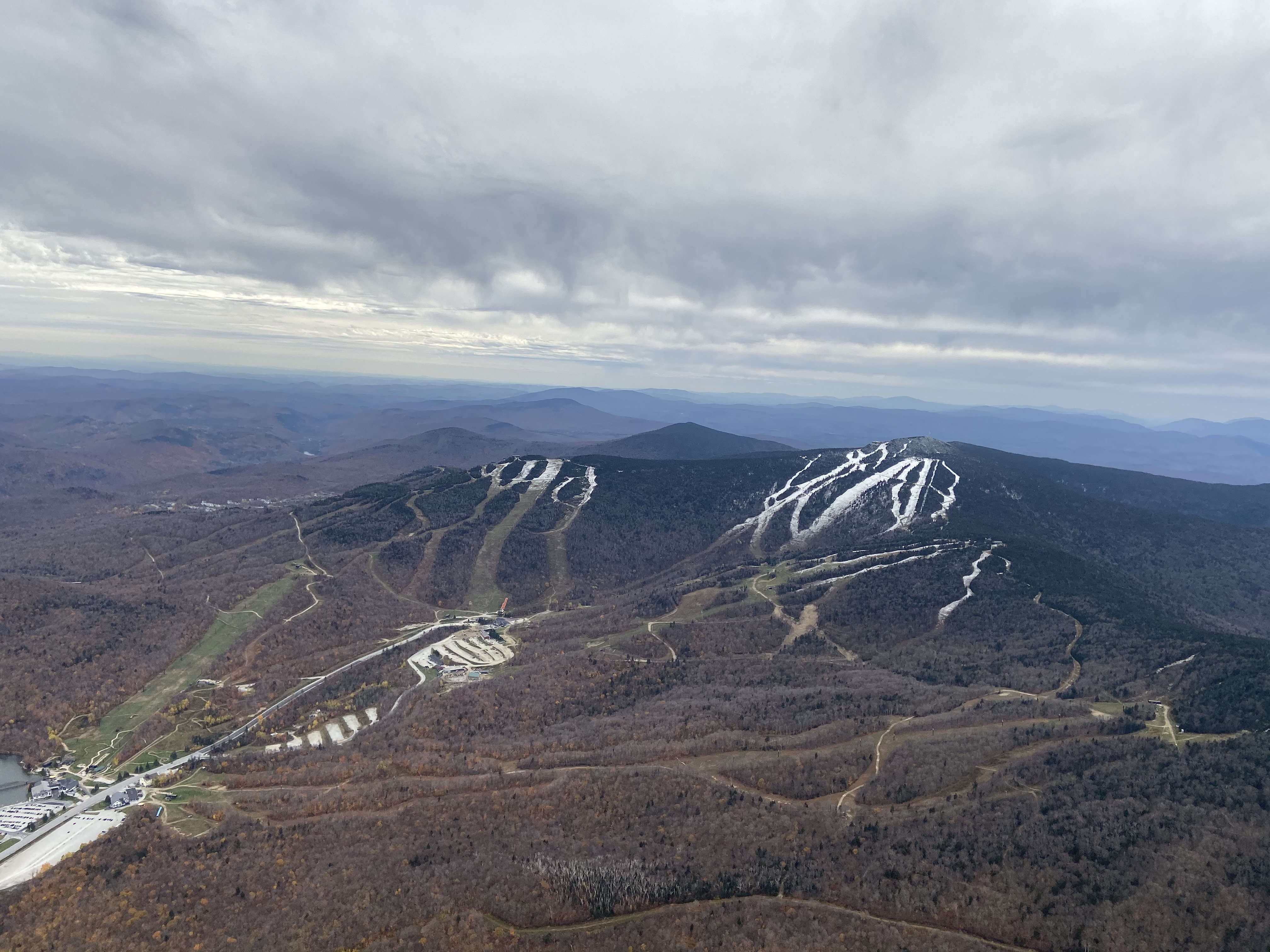
Here’s a photo taken on Oct. 20th this year, right after a wicked Nor’Easter hit the East Coast. Obviously, the top of this resort got a dose of white. But, where is it? What resort? Why is this especially good news for the operators?
This one should be easy for lots of SeniorsSkiing.com readers. Thanks to a friendly pilot for passing this along.
Last Week: Dancing, Where?
Some excellent guesses. There’s probably a good story behind each one, harkening back to the days of disco lights, beer, and bands. Ah yes, memories.
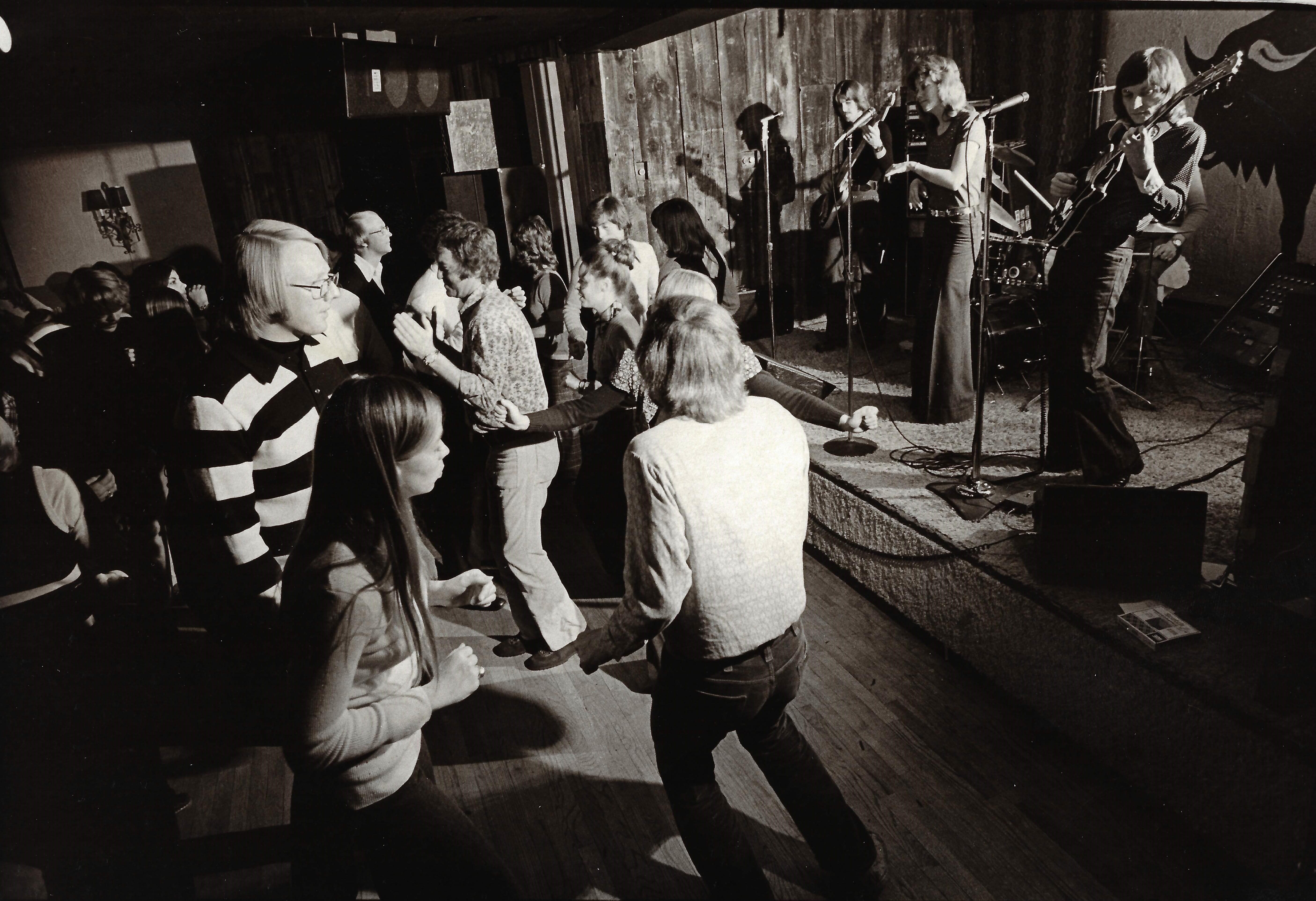
You might say one ski resort bar/dance floor looks like all other ski resort bar/dance floors. This one, however, is unique.
Nu Gnu, Vail, CO, circa late 1960s/
This is the Nu Gnu which opened during the late 1960s as one of Vail Village’s first rock ‘n’ roll bars and one of Vail’s original iconic libation locations. In 1967, Paul Ross Johnston moved to Vail and founded the Nu Gnu. Paul, former mayor of Vail and owner of the Christiania Lodge, manned the door every night with a handlebar mustache and a fishnet shirt or a feather boa and a painted head, explains the Vail Daily. The Nu Gnu was a perfect apres-ski night spot.
Thanks to the Colorado Snowsports Museum for the picture and Dana Mathios, Curator and Director of Collections, for the description. Consider supporting our precious ski and snow sports museums as they are the only stewards of the winter sports history.
Rock and roll is here to stay!
https://seniorsskiing.com/wp-content/uploads/2019/10/IMG-0275-1.jpg30244032mikemaginn/wp-content/uploads/2014/04/Seniors-Skiing-since2013-Logo@2x-300x68.pngmikemaginn2019-10-23 11:34:592019-10-23 11:35:01Mystery Glimpse: October Snow
Stirring The Pot: Reaction To Ski Collision Article Signals Concern From Senior Skiers.
We get letters. Do we! Well, not letters, but comments. A couple of weeks ago, we published an article by SeniorsSkiing.com correspondent and XCSkiResorts.com publisher Roger Lohr recounting a hit-and-run collision that left him with ongoing back pain. Obviously, that article struck a sore point: Our readers had a lot of passion about on-slope safety.
Based on the energy expressed in your responses, we decided to ask the National Ski Patrol what the official policy was regarding speeding skiers. At press-time, we have learned the NPS and NSAA are coordinating to respond. We will publish their response as soon as we receive it. On the other hand, we did hear from some readers who were in fact current or former NSP patrollers. The general drift of their comments was: We warn when we can, we can’t be everywhere, policing is not a primary role. So, role clarity is apparently missing here; many readers expressed that they expected the NPS to lift tickets. Clearly, clarity is needed.
On the other hand, our readers had many interesting and novel ideas for controlling the inconsiderate and rude skier. Here is a loose summary of some of those ideas:
Put up signs warning against speeding and its consequences
Indoctrinate new skiers to rules in ski lessons
Update the Skier’s Code of Responsibility
Bring the issue to resort owners at the NSAA (National Ski Areas Association)
Put in speed bumps at run-outs and trail intersections
Practice personal situation awareness; check your six
Enforce the rules
Sue until it hurts
Meanwhile, SeniorsSkiing.com co-publisher Jon Weisberg has connected with Dr. Dan Gregoire, head of the SnowSport Safety Foundation, a non-profit whose mission is to encourage concerned skiers to advocate for skiing safety. The organization issues safety report cards for selected resorts. See Jon’s Short Swings article this week for more details.
We have some other ideas about raising consciousness about this issue in the ski industry. One of those is asking our readers to share their experiences with others in a new feature tentatively called “Incidents and Accidents”. We will keep you in the loop as this develops.
This Week
Last time you skied?
We hear from UK-based Bob Trueman about his advice for seniors returning to skiing after a hiatus. We know there are many newly retired seniors who want to get back to the sport they loved before career and family drained away their time. With new and open calendars, they are checking out what’s new. Bob’s advice is most interesting, different, and useful.
Co-publisher Jon Weisberg reviews the Apex boot, an innovative change to the classic ski boot. The Apex is proving very popular with seniors because it is comfortable. But how does it ski? Check out his thoughts here.
Our Mystery Glimpse this week goes apres ski. Check out the picture and the answer to last week’s mystery. We told you those guys shooting M1s in the snow wasn’t what you thought. Find out here.
John, Where’s Your Helmet?
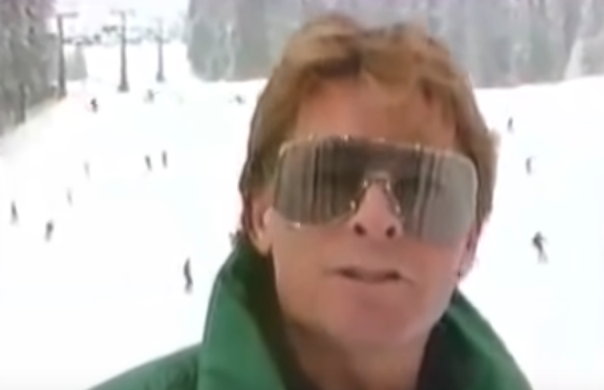
Thanks to SnowBrains.com for pointing this next one out. We are publishing a retro music video of John Denver singing and skiing “Dancing To The Mountains”. Check out his groove as he skis what we think is Aspen, sans helmet but with a lot of hair spray.
Thanks again for reading SeniorsSkiing.com. Get ready to head to ski shows and grab some bargains: gear, clothing, ticket deals.
Please tell your friends, and remember there are more of us every day, and we aren’t going away.
Apex Boots
https://seniorsskiing.com/wp-content/uploads/2019/10/Screen-Shot-2019-10-15-at-3.51.47-PM.png390604seniorsskiing/wp-content/uploads/2014/04/Seniors-Skiing-since2013-Logo@2x-300x68.pngseniorsskiing2019-10-18 00:40:272019-10-17 11:21:51This Week In SeniorsSkiing.com (Oct. 18)
It Was A Famous Apres Ski Hangout Back In The Day.
Hint: Think Colorado. What place? What year? Thanks to the Colorado Snowsports Museum for this blast from the past.
Last Week: Bang, Bang
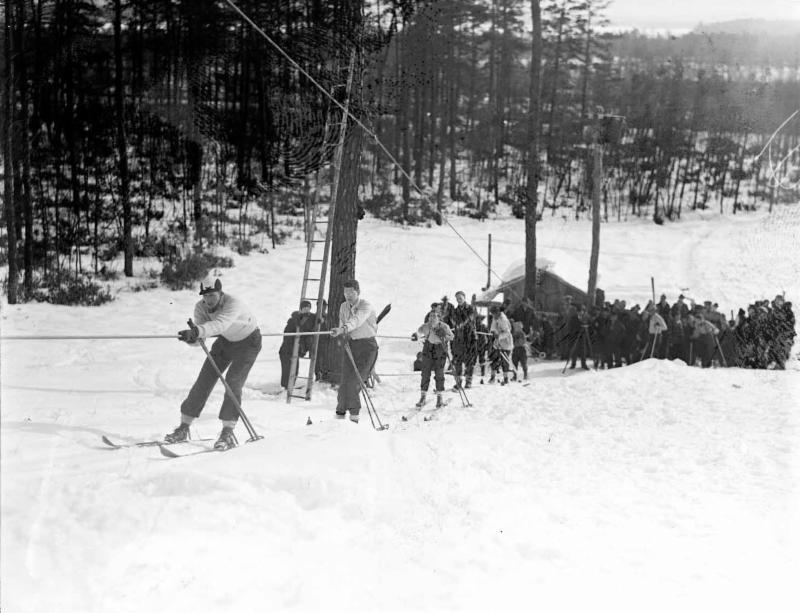
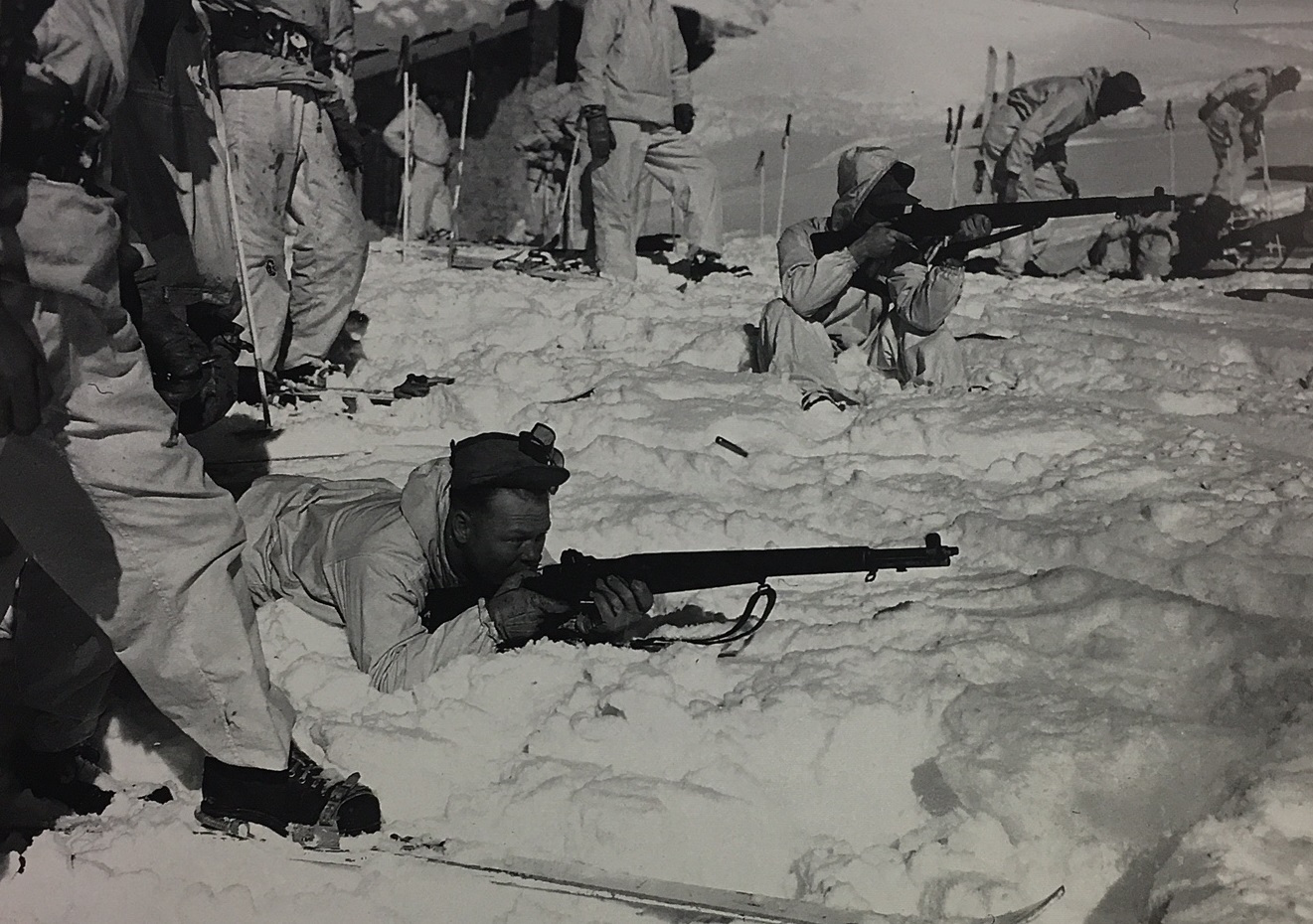
As we said last week, it’s not what you think. It sure looks like the 10th Mountain in training at Camp Hale, as several readers have guessed.
Here’s the story of the photo, taken from the library archives of the Alf Engen Museum, Park City, as explained by Jon Green, the museum’s operations manager.
Taken around 1942, this image shows paratroopers from Fort Benning, GA, who were sent to Alta to learn how to ski and fight in the snow.
From the book, Dick Durrance: The Man On The Medal, The Life And Times Of America’s First Great Ski Racer, as told by the inimitable John Jerome:
“In the fall of 1941, a few months before the Japanese bombed Pearl Harbor, [the 17-time national championship ski racer] Dick Durrance got a call from a Jack Tappan, an army colonel, who asked if he was interested in training paratroopers for ski warfare. Washington had determined that the U.S. would probably soon be involved in a war in Europe, and part of it might be fought in the Alps in the winter.” At the end of that winter, Dick and his fellow instructors determined that “maybe a third of the troopers would become pretty good skiers, the middle third could get by, but the other third had better stay in the paratroopers and forget it.”
Just after Pearl Harbor, early elements of what became the 10th Mountain were activated. The planners decided to recruit active skiers and outdoorsmen who actually knew mountain sports, rather than convert standing regiments of troops, even highly trained paratroopers. Perhaps the lessons learned by Dick Durrance at Alta led to that wise decision.
If You Have Been Away From The Sport For A Few Decades, Welcome Back and SURPRISE!
If this is what you remember about your last time skiing, you have some catching up to do.
Remember the old days? Long stiff skis? Weighed a ton. Wearing yourself out to jump them into the air to change direction? It didn’t matter back then because we were young and fit. Now look at us.
Well, the good news is EVERYTHING has gotten better. Praise be, I don’t need to be the man I was, because I’m not.
The lifts are better, the slopes are better groomed, the clothing keeps you warmer. Boots are more comfortable. And this is key: Skis are lighter, bendier, and much easier to ski on. They really want to make arcs for you.
Five Essential Tips For Returning Skiers
Be brave. You did it before, you can do it again.
But be cautious, not reckless. No matter what you skied before, spend more time than you might think is needed, on very gentle slopes.
Aim to start slow and easy, and work up as appropriate.
Of course you’ll be excited, you’ll want to “git started”, but don’t do too much on days one and two – you’ll get tired, your muscles will object, your control will slip away and you’ll wind up on a low, instead of a high. Picture a rising graph, not a falling one.
After the years away it will matter more HOW you ski, than WHAT you ski.
Get Your Mind Back In The Groove.
Don’t wait until you’re standing on the snow before you begin training your mind. Read some good ski improvement book, it won’t take long, and it’ll add to your anticipation, like having an extra holiday. You might consider my own book “Ski In Control: How To Ski ANY Piste Anywhere In Full Control”. There are many more. Get an understanding of how a ski turn works by your fireside. It is incredibly helpful to have the concept down before you go.
Four More Useful Tips.
Avoid buying new skis or boots before you go. Wait until you get to the ski hill and visit the rental shop. Tell them what kind of skiing you hope to do. Be careful not to let them “up-sell” you, using skis that are too advanced won’t help you. Tell them you will want to try numerous different pairs during the week, if you have a week. If you find a pair you like, say you’ll buy them if they deduct the hire fee.
Boots: Whatever else you do, avoid too-stiff boots like the plague. They may make you feel more secure, but you won’t be. You must be able to flex your ankles.
Boots are different in the shop than on the mountain. They’re thermo-plastic, they’ll get much stiffer when they get cold. Take that into account.
The shop will offer you poles and will be insistent that they have judged their length correctly for you. Ask them for shorter ones – even 4” shorter. Just for a day. Then exchange them later for a pair 2” longer than those. Keep going until you find a length that a) you like, and b) don’t make you ski upright.
One More Thing: Lessons
If you plan to take lessons, never a bad idea, take care about private lessons, at least to begin with. Why? Because one-on-one gives you far less rest. Private lessons are much more intense and tiring. It also means you won’t get a chance to get or give any feedback from or to others. Try to find teaching in small groups. You’ll get more out of it.
You’ll find a lots more useful information on bobski.com, or soon you’ll be able to subscribe to my new Youtube channel for a free online coaching course.
https://seniorsskiing.com/wp-content/uploads/2019/10/MysteryGlimpse.jpg613800Bob Trueman/wp-content/uploads/2014/04/Seniors-Skiing-since2013-Logo@2x-300x68.pngBob Trueman2019-10-17 10:58:572024-08-21 10:50:19Coming Back To Skiing
One of the most popular features on SeniorsSkiing.com is our annual listing of resorts that offer free or almost free skiing for seniors. “Almost” free means a lift ticket or a season pass that can be had for a token amount, usually a processing fee or relatively small cost.
For the past several weeks, the lights have been burning late at SeniorsSkiing.com Headquarters. We’ve been waiting for resorts to post their 2019-20 rates, and many started appearing in September and late August. In a couple of weeks, after we’ve verified the final outliers and settled on a new format, we’ll publish our 2019-20 listing of free or almost free skiing in the US and Canada as Subscriber-Only Content. [Subscriptions to SeniorsSkiing.com are free, by the way.)
The process of finding and verifying senior rates is time-consuming. We have to go to each resort’s website, find the lift ticket and season pass rates, search for the senior eligibility age, and note it all on our spreadsheet. Some resorts have clear and easy to navigate sites, others have sites that are clearly amateurish. Others have one website for combined winter and summer activities, adding another layer or two of clicking.
But in going through the process of finding each resort’s pricing plan, we’ve noticed something of a trend. Call these observations rather than findings.
Many of the destination or big, brand name resorts offer free or almost free skiing for seniors beginning at 80 years of age. Those same resorts may or may not offer a discount for 65-79, varying from 10 percent off a regular adult pass to 40 percent, mid-week being the most cost-effective offering.
And many of those big resorts do not make it easy to find the offer of free skiing for 80+ on their websites. In fact, when we saw a separate price for, say, 65-79 year olds, that was a tip that there was something going on for 80+. We had to confirm many of those with an email to the resort. In other words, the free skiing for seniors 80+ option is not clearly obvious on many big resorts’ websites.
On the other hand, when we went to small and mid-sized resorts, the rates for seniors was more likely to be upfront and clearly displayed. These rates were usually found on a table where prices for kids, adults, military, college students, and seniors were immediately accessible. And there are great deals,
For example, Michigan’s Mt. Holiday has free skiing starting at 65. Monarch Mountain in Colorado has free lift tickets for 69 year olds and a $20 fee for a season pass. McIntyre Ski Area in New Hampshire offers a free lift ticket for 65 + and a $30 season pass. For many small or mid-sized resorts, the discounts or free skiing start to kick in at 70.
A couple of observations to share;
You have to ask about discounts at big resorts, regardless of what you find on the website. Call and talk to a person.
Generally, small and medium-sized resorts are the ones that have big discounts and free skiing for seniors. While not necessarily glamorous destination resorts, they are the first line of affordability for seniors. For those who are complaining they are being priced out of the sport, look for those kinds of resorts.
Update: Unsafe Skiers
Last week, we published an article by SeniorsSkiing.com correspondent and XCSkiResorts publisher Roger Lohr, recounting his hit-and-run collision with another skier. That story plus our survey question about “What Pisses You Off?” got a lot of comments from readers. So, we are pursuing some of the questions raised about whose responsibility it is to monitor and control on-slope speeding. We have some inquiries being made to the National Ski Patrol, and we’ll let you know what we hear.
This Week
George Is Da Man. Credit: Harriet Wallis
An inspiration to us all, George Jedenoff is the senior-most senior skier. At 102, he still enjoys the outdoor winter at Alta. Harriet Wallis has alerted us to his autobiography which is available and accessible by download for free. Check out his story here.
We are launching our first Mystery Glimpse of the season.
Thanks to the many wonderful ski museums around the US and Canada, each week, we publish an historic photo of a person, place, or thing that they contribute, and you have to guess what it represents. As for this week’s pictures, it’s really not what you think.
Also, co-publisher Jon Weisberg adds an appreciation of Doug Coombs, daredevil, risk-taker, celebrated skier of the steep and deep. Jon found Tracking The Wild Coomba, a biography of an extraordinary outdoors man and adventurer, in a book store on Cape Cod this summer. Click here to read his tribute.
SeniorsSkiing.com correspondent Don Burch offers another fun puzzle about skiing, this time a word puzzle. Give it a try.
Ben White skied the NH 48 as a teen.
Finally, we are posting an interesting article by Ben White, who, as a teenager, managed to ski New Hampshire’s famous 48 peaks over 4,000 feet in one season. He is sharing what he learned about skiing off-piste, lessons he learned the hard way. If you’re a backcountry skier, see what you can learn from his experience.
Thanks for reading SeniorsSkiing.com. Please tell your friends. Remember, folks, there are more of us every day, and we aren’t going away.
https://seniorsskiing.com/wp-content/uploads/2019/10/Excel2-1.jpg223568seniorsskiing/wp-content/uploads/2014/04/Seniors-Skiing-since2013-Logo@2x-300x68.pngseniorsskiing2019-10-11 00:50:232019-10-10 19:01:49This Week In SeniorsSkiing.com (Oct. 11)
The First Glimpse Challenge This Season Is Not What You Think.
When, Where, What, How, Who?
This Mystery Glimpse photo comes from the archives of the Alf Engen Ski Museum in Park City, UT. Take a virtual tour of the museum’s collection by clicking here.
The Mystery Glimpse feature posts a photo from one of the ski industry’s wonderful museums. Often these museums are located at or near ski resorts. They preserve and maintain unique assortments of ski history memorabilia, artifacts, documents, publications, and photographs. We are very grateful that so many ski museums are sharing photographs with our readers.
Do you know what’s going on in the picture? Take a guess in the Comment Box below. We’ll reveal the story behind the photo next week.
https://seniorsskiing.com/wp-content/uploads/2019/10/MysteryGlimpse_1012.jpg9301321mikemaginn/wp-content/uploads/2014/04/Seniors-Skiing-since2013-Logo@2x-300x68.pngmikemaginn2019-10-10 10:07:432019-10-10 10:07:46Mystery Glimpse: Bang, Bang
Last spring, we asked a provocative question in our annual SeniorsSkiing.com Subscriber Survey. We asked, “Thinking back on the 2018-19 season, tell us what pissed you off the most about the following…” Then we listed “On the slopes”, “In the lodge”, “Tickets and passes,” “Restaurant”, “Other skiers”. We also asked what delighted skiers the most, but let’s look at the opposite first. Based on the language in the responses, it is certainly where the passion lies.
We were surprised that so many respondents made comments like the following sample of many more:
Rude and dangerous skiers and boarders Inconsiderate skiers and snowboarders Lack of ski etiquette Out of control skiers Dangerous skiers Beginners on advanced trails Careless riding and skiing Skiing too fast and too close to other skiers Not skiing in control Some are dangerously fast and reckless Skiing and riding too fast A few jerks skiing dangerously Not following safe skiing rules Risk takers who don’t turn on groomers Straight-lining on easy slopes Complete disregard for slower skiers
Respondents also mentioned high lift and pass prices, lousy cafeteria food, long walks from parking lots, and other grievances. However, the out-of-control skier situation is the most disturbing. Why? Because you probably thought that the Ski Patrol would be enforcing the Skier’s Code of Responsibility. Or that the resort’s Ski Ambassadors would be chiding characters acting dangerously. As we have learned from your comments, that apparently isn’t happening much.
Let’s be clear. There is a difference between skiing fast in control and skiing fast out of control. We know many of our readers like the former, but, as we have seen, many are intimidated by the latter.
As a result, SeniorsSkiing.com believes we have shone a light on a key area of ski resort management that needs improvement. The chain of consequences that dangerous, out-of-control skiers brings is significant: the risk of injury from collisions, turning off beginners, seniors returning to skiing, or the occasional skier who spends several hundred dollars for a once-a-season ski weekend, and creating anxiety in grandparents who fear for their grandchildren.
Let’s hear from you. What can be done to slow down the jerks who can potentially ruin a senior skier’s season? What can we do to influence the industry?
Also This Week
SeniorsSkiing.com correspondent Don Burch offers a clever “Analogy Test”, that challenges your skiing knowledge and your ability to figure out analogies. Be advised, this is not a creme puff test; pay attention.
Finally, we are reprising the third in a series of articles on shaping up for the season. This final set of exercises raises the challenge level. Remember, the key to fitness is a consistent routine. Dashing around the gym once a week, pumping as much iron as you can ain’t gonna do it.
Next week look for our first Mystery Glimpse feature of the new season. If you have story ideas or would like to comment, please scroll to the bottom of the page and enter your thoughts in the comment box.
We hope you’re getting ready to go to the ski shows. We know we are. See the discount for SeniorsSkiing.com subscribers at the top banner ad or click below.
Remember to please tell your friends about SeniorsSkiing.com. As usual, there are more of us every day, and we aren’t going away.
https://seniorsskiing.com/wp-content/uploads/2019/10/OutOfControl.png490368seniorsskiing/wp-content/uploads/2014/04/Seniors-Skiing-since2013-Logo@2x-300x68.pngseniorsskiing2019-10-04 02:00:502019-10-03 09:02:55This Week In SeniorsSkiing.com (Oct. 4)
[Editor Note: This summer, we published a little play about the speeding, out of control skier and what the ski patrol can do about it. You can read it here. Bottom line: It’s not their job, at least, that’s the party line. They are there to maintain the lines, help injured people, sweep the slopes. They are not trained nor prepared to confront unruly or out of line customers who are not complying with the Skier’s Code of Responsibility. What to do? Here’s SeniorsSkiing.com XC editor and publisher of XCSkiResorts.com publisher Roger Lohr’s story about his collision and consequences.]
This year, I was one of the many skiers and riders who got blind-sided and body-slammed by someone on the slopes. After seeing me bounce into the snow a couple of times and violently twist my lower body, the “guy in orange” who plowed into me said nothing and skied away. No apology, no asking if I needed help.
I got up slowly after the collision and immediately thought about how effective my new MIPS helmet worked. Just afterward, I felt shooting pain in my lower back.
Out of the corner of my eye I saw the guy in orange about 40 yards away. He had stopped and was looking across the terrain at me while I was taking stock of my bruises and sprains associated with the collision. Then he took off.
I stopped in at the patrollers’ cabin and saw six guys sitting at a table. I requested some kind of heat compress or rub for my pain and was told that they are not allowed to distribute anything like that.
This incident was in fact, the third collision that I’ve had in recent years. What can the industry do to deal with the increasing number of slope collisions?
Can we blame lack of skill in the kind of collision I experienced? It might have been a miscalculation of his line, his ability to change course, his maintenance of too much speed, inattention, an obstruction, etc.
The collision occurred near the bottom of the slope, so was there a chance that I cut him off? Would more patrollers on the slopes talking to people about control, speed, where they stop, and so on, make a difference?
I often ride the chair with patrollers but I don’t remember the last time I heard from a patroller out on the slopes. I can’t say that I’ve seen many of them speaking with skiers and riders about unsafe situations. Would a broad skier/rider education campaign about speed and skiing in control make a difference for safety purposes and curtail the collisions?
As I’ve aged I’ve become much more cautious keeping an eye on the slopes around me. In my collision situation, I was heading to the lift line and did not look up the slope for five seconds on a day when there were very few people skiing. I paid for those seconds with medical bills and three weeks of pain.
The statistics on ski area collisions are mounting and this past spring’s SeniorsSkiing.com reader survey showed a serious concern among site visitors about these incidents. And we all know parents who have freaked out watching their child get steamrolled and mangled on the slopes. It is not only older skiers who have cause to worry about collisions.
What happened after I was hit was significant. The speedster took off, offering no help and no curiosity as to whether I was injured.
There are seven points in the Skier’s Responsibility Code about staying in control, avoiding others, stopping in places that do not obstruct, and the like. There is no suggestion in the code that there is any responsibility to help a victim or check that the subject who’s been hit is able to ski away after the incident. Yeah, you’d think it was common courtesy for the slammer to apologize and see if aid is required but in my experience and other incidents that I’ve heard about, this is not the case; this is not standard protocol.
I understand the ski area operators’ perspective: no one wants a “patroller policeman” yelling at guests, but can we develop a more robust educational campaign to curtail slope collisions and incorporate a new tenet for courtesy when such incidents occur? Can we amend the Skier’s Responsibility Code to include helping people who are hit?
https://seniorsskiing.com/wp-content/uploads/2019/10/Screen-Shot-2019-10-01-at-2.27.36-PM.png577533Roger Lohr/wp-content/uploads/2014/04/Seniors-Skiing-since2013-Logo@2x-300x68.pngRoger Lohr2019-10-01 14:38:272019-10-03 18:46:22Blind-Sided And Body-Slammed
How is it that a storm can produce a four foot snowfall before the first week of the new season is over!? That is exactly what happened last weekend as portions of Montana got absolutely buried. Parts of Idaho, Washington, California, Oregon, Wyoming, and Colorado also saw snow, which undoubtedly got skiers in those states really fired up, as well.
How does a storm of that magnitude happen in September? Well, first, you need a dynamic jet stream pattern, with plenty of amplitude in the troughs and ridges strung out across the hemisphere. Here is the jet stream map from Saturday morning.
Jet Stream Last Saturday
Notice the strong ridge in the Gulf of Alaska. That feature is consistent with the warm pool of water discussed in last week’s article. The ridge’s clockwise circulation helps to tap colder air from the high latitudes of the northwest corner of the continent, and that cold air flows directly into the trough as it strengthens over the Northwest on the map.
The trough is where rising air is found, and the stronger the trough, the more effective it is at drawing cold air southward. Rising air cools, and in this fashion, strong troughs can actually “manufacture” their own cold air, which helps fight off the more seasonable air found away from the center of the circulation. Everything has to be just about perfect to create the cold for a snow producer like last weekend’s storm, and it pretty much was a perfect setup. Here is a look at the anomalies of air found in the mid-levels at the same time stamp.
Temperature Anomaly: Deviations From Normal
You can see that the deviations from normal were on the order of 8 to as much as 18 degrees below normal (Centigrade) when the trough was at its strongest, plenty cold enough to support early season snow, even in the relatively lower elevations. Not surprisingly, if you follow the bulge of the coldest air southward from the core that is located in southern Canada, it points right at Browning and Cut Bank, Montana, two spots that saw some of the deepest snow. In order to produce four feet of snow, you need plenty of moisture, and the broad fetch off the Pacific delivered the goods.
While the storm was a record breaker in many locations, you might be surprised to know that autumn snowfall in North America has shown an increasing trend in recent years, as this chart clearly shows.
Autumn Snowfalls Since 1997
Early season snow across Canada and the northern U.S. helps refrigerate autumn air masses before they spread out and move further south, so I interpret this snowfall as a positive sign for the early stages of the upcoming season. If you are looking for the next early season dump, keep your eyes open for the next trough to dig into the Northwest/northern Rockies.
We had just finished another strenuous exercise class at the local Y. Along with 20 or so others, John S. and I had been going to that same instructor’s—her name is Sarah—Monday night 6:30 hour-long routine for four or so years; we called it “Sarah’s House Of Pain.” Squats, light weight thrusts and lifts, stair step-ups, push-ups, bicycles, curls, burpees, and, oh boy, more.
John S. was about my age, early-mid 70s, and he was a regular, not only in Sarah’s class but in kickboxing and yoga classes at the same Y. “Why do you do all this, John?”, I asked as we walked out of the fitness room while the next class of Pilates students poured in.
“It’s our job description. We’re seniors, right? We HAVE to exercise,” he said.
We have to. We have to remain strong, flexible, and robust. Clearly, —and as much research has revealed—that, plus a good diet, are the keys to aging well.
We are pretty confident readers of SeniorsSkiing.com agree with John S. and the research. From our many surveys of our readership, we know that you not only enjoy snow sports, but also many other kinds of activities including “fitness”.
If you are not a regular at the gym, you may want to reflect. We hope you start and develop a routine. That’s the key to success at the gym: routine. Not one routine, but several different ones. You will find you need to focus on building and maintaining muscle strength. You will also need to exercise your heart with cardiac workouts. Often overlooked is the third aspect of conditioning for seniors: flexibility. Regularly practicing Yoga with an instructor who gives clear cues can make an exponential difference in range of motion and muscle suppleness.
Our personal routine involves muscle conditioning classes with trained instructors (“Sarah’s House Of Pain”), individual rotations around the gym with light weights, lifting machines, and cardio steps, treadmills, and ellipticals. We also take yoga classes once a week, sometimes twice. And we try to go at least five days a week, sometimes in the evening, sometimes in the morning. Sometimes, we just go for a walk. Variety.
We know other seniors swim every day, bike, run, climb, hike, walk around the block, and pump iron. Every day. Routine. It’s our job.
Our question to our readers: What’s your routine? Why does it work for you? Please respond in the comments section below. We’d like to learn how you approach your “job”.
In the spirit of pursuing our fitness theme, this week we reprise our Shape Up exercise series with a set of exercises that build intensity. Time to start and get with it.
This Week
In addition to our ongoing Shape Up series, we are introducing two new contributors to SeniorsSkiing.com. Please welcome them to our pages.
Herb Stevens has been known on television as “The Skiing Weatherman”. He’s been reporting on snow and ski conditions in major Eastern markets since the late 80s. He knows his snow. He’ll be providing weekly updates on how the weather is effecting snow sports across the country. This week, he places his bet on this winter’s forecast. Here it is.
Weight forward, tips loaded, good.
Bob True is a UK-based ski coach and instructor. From time to time, he will write about technique specifically focused on seniors. We look forward to seeing his thoughts on confidence and skill-building. His first article is a general view on gaining control. Check it out here.
Once again, thanks so much for reading SeniorsSkiing.com. Tell your friends and remember, there are more of us everyday, and we aren’t going away.
https://seniorsskiing.com/wp-content/uploads/2019/09/Screen-Shot-2019-09-26-at-10.56.21-AM.png425703seniorsskiing/wp-content/uploads/2014/04/Seniors-Skiing-since2013-Logo@2x-300x68.pngseniorsskiing2019-09-27 00:15:572024-08-21 10:53:13This Week In SeniorsSkiing.com (Sept. 27)
Sharpen Your Skills To Get The Most Out Of Your Skiing.
[Editor Note: UK-based Bob Trueman is a long-time ski coach and instructor who will contribute occasional articles on technique for the older skier. He is the author of Ski In Control where he describes the skills needed to master “any piste”. He will soon be publishing a series of YouTube videos to demonstrate control skills. SeniorsSkiing.com welcomes him to our pages.]
What’s the best way to keep getting the most fun out of skiing as we get older? As a coach, I suggest that it’s the exercise of skill. This doesn’t preclude the great company, good food, and all the rest. Nor does it demand big, physical challenges. It’s a mind-set change.
Look around any piste, and everyone finds some way of negotiating it, but very often not nicely. Some folk don’t care how they ski, only what or where they ski. My clients do care, and it’s exercising precision skill that my pupils get the most out of.
Let’s define skill:
Skill is the learned ability to bring about pre-determined goals with maximal certainty, often with minimal effort. This has implications – “learned” = not instinctive: “pre-determined” = goal oriented; “maximal certainty” = demonstrated skill. It never fails to satisfy and is little related to physical strength or capacity.
Here are some ideas.
Unloaded tips, weight back = bad.
Look at the slope with a keener eye. Does the slope go exactly where the piste goes? Often it
Weight forward, tips loaded = good.
doesn’t; often it is canted. If you were to pour a bucket of red ink onto the slope, it may well go somewhat across the piste. You may see this and recognize that left and right arcs will not be symmetrical; they’ll be quick one way and slow and drawn-out the other. The skillful skier will be ready for this, and change rhythm. There’s satisfaction in that.
View the slope and decide if you will control your speed by applying some skid by pivoting your ski. If you do, be aware that the line you take down the slope will be nearer to a straight line—it won’t be straight, but it’ll be straighter. Take satisfaction out of knowing that and ski the line you predicted. How close did you get? That’s an exercise of skill.
Or choose to descend by having the ski carve. You still want to control your speed of descent but with a higher linear speed. So you can choose before you set off what radius of arcs you’ll do and how many arcs you’ll do. You will control your path down the mountain by the line you draw down it. That’s another exercise of skill, and very satisfying.
Anyone can ski a gentle slope fast, only skillful skiers can descend a steep one slowly. What do you need to do to achieve that? You can do it by drawing a straight line diagonally across it until you have no room left and then do an “Oh-s**t” turn. Or you can execute more arcs, tighter arcs, taking a more direct line of descent. This requires greater skill as well as pre-planning and determination.
So what would you need to DO to achieve these skills? Here’s a tip – THE TIPS!Concentrate your mind on the inside edge of your outer ski’s tip. Think of it as a wood carver would think of his chisel/gouge – you’re going to carve it into the snow, have it cut in. Mother Earth will then see to it that it gets pushed round ‘sharpish’.
You’ll need to load that edge more. So you’ll need to flex your ankle more, and probably faster. If you tuck your tummy in and lean forward, you’ll load it. You’ll unload if you do the opposite. It helps to keep your hands low and wide. That helps. And keep looking down the slope to where you intend to go, not where you’re going.
Just doing one of these elements, and especially if you know you pre-planned it, is an exercise of skill that you can take pride in and enjoy the memory of on that next visit to the restaurant. Do a bit of boasting!
https://seniorsskiing.com/wp-content/uploads/2019/09/Screen-Shot-2019-09-25-at-10.13.46-AM.png346233Bob Trueman/wp-content/uploads/2014/04/Seniors-Skiing-since2013-Logo@2x-300x68.pngBob Trueman2019-09-25 10:30:242019-09-25 10:39:10Technique Tips For The Senior Skier
SeniorsSkiing.com’s New Columnist Places His Bet on 2019-20.
[Editor Note: Herb Stevens is a veteran meteorologist and television weatherman. SeniorsSkiing.com is very proud to introduce his new column which will appear weekly throughout the season.]
When a long range weather forecaster starts to put together a winter forecast, the first element that has to be assessed is the state of the water temperatures in the Pacific, especially the tropical region. The oceans hold 1,000 times the heat content of the atmosphere, so changes in water temperature anomalies can produce major influences in the sensible weather, not only in the Pacific, but also downwind of the ocean. El Nino and La Nina are major players in the winter weather over North America and have to be accounted for.
Last winter,
a weak El Nino was in place but now the tropical waters have cooled to a
neutral level, creating what a forecasting friend of mine refers to as “La
Nada”. However, the waters of the
northeastern Pacific are much above normal, as the following map
indicates.
The warm waters support a ridge at the jet stream level over the Gulf of Alaska and western Canada and the clockwise circulation around the ridge can deliver cold air masses into the central and eastern U.S., some with origins in Siberia. Once the ridge forms, you typically see a complementary trough set up over the eastern U.S. Recently, the winters of ‘13-‘14 and ‘14-‘15 had a similar warm pool and jet couplet, and both of those seasons were cold and snowy from the Great Lakes to New England. I rely more on identifying analogs for forecasts rather than leaning on computer models, and the northeast Pacific warm pool creates an impressive lineup of previous winters. Over the past century many of the coldest, snowiest winters over the eastern half of the country have fed off such a warm pool.
Another factor in play this winter is the solar cycle. In terms of sunspots, we are very close to “solar minimum”, when solar output bottoms out which happens roughly every 11 years. This graph illustrates the cycle.
There is a significant correlation between solar minimum and blocking patterns at the jet stream level. With an eastern Pacific upper ridge and eastern North American trough, wavelength considerations would suggest another ridge taking shape over the North Atlantic close to Greenland. With above normal temperature waters also sitting between Labrador and Greenland in the Davis Strait, there would be support for a ridge there. Solar min also correlates with one other weather factor: persistence of a pattern. That is, once established, upper air patterns tend to hang around longer than they do at solar max.
So, based on analog methods, I tend to think that this winter will be favorable for skiing and riding from the center of the country eastward. A possible exception could be the southern Appalachians, where ridging could form and lead to more variability in temperatures at times. The West should be solid for the most part. The northern and central Rockies will be targeted by disturbances sliding down the eastern flank of the offshore ridge. The southern Rockies will benefit from the warmth of the water off of northern Mexico—storms in the southern branch of the jet will have ample moisture, but the ridging along the coast will likely limit the number of storms to an extent. If there is a region that I am concerned about, it would be the Northwest and the resorts of British Columbia, due to the proximity of the anticipated ridge.
That’s my first look at winter. I look forward to providing forecast guidance for your time on the slopes on a weekly basis through the season. I will take another shot at winter in about a month. let’s see what happens to the water temps in by then.
https://seniorsskiing.com/wp-content/uploads/2019/09/ssts-e1569508950838.png401728Herb Stevens/wp-content/uploads/2014/04/Seniors-Skiing-since2013-Logo@2x-300x68.pngHerb Stevens2019-09-25 09:59:322019-09-25 09:59:35The Skiing Weatherman: Predicting This Winter
Winter Predictions: Place Your Bets; The Exercise Imperative
Squint hard and you can see a dusting of August snow at Arapahoe Basin. First of the 2019-20 season. Credit: Arapahoe Basin
The cusp of summer’s end is upon us. We’re not quite there, but back to school, shortening days, last concerts in the park, tennis tournaments, and thinking about hauling the boat after a couple of more weekends away, are all pointing to a winding down of summer. After Labor Day, the whole gestalt changes, and we are basically all back at work or fall regimen, regardless that there are three more weeks of actual summer to go before the Autumnal Equinox.
It is time, therefore, for predictions of what kind of winter lies ahead to emerge from official sources as well as unofficial observers of winters past. who stir their secret formulas and produce a forecast. If, however, you believe in regression to the mean—a statistical phenomenon that says there is high probability an extreme instance will be followed by a more moderate instance—then after last season’s snowgazilla, we should be predicting a meh to moderate season ahead. Let’s see.
But first, let’s look back at what the experts said the 2018-19 would be and see if they came close and what they see as the cause that produced the effect.
Our friends at NOAA’s Climate Prediction Centerforecast a warmer-than-average winter just about everywhere except the East Coast and the South East. The reality was just the opposite, temperature-wise. It was colder everywhere, except the South East where it was warmer. According to the CPC’s own internal indexing scoreboard, this was the biggest prediction miss in over six years.
On the precipitation side, CPC forecasters said it would be wetter-than-average across the southern swath of the country and drier-than-average more northward. The reality was it was in fact wetter across a broader band in the country, so points for getting the wet right.
The big surprise was February’s temperatures. That’s when, if you recall, the bottom dropped out of the thermometer in the West and maintained normal in the East. It was a bifurcated temperature system; cold as the frozen hinges of the Martian Outback in the West combined with precipitation, and you get the monumental snowfalls we saw. That’s what threw off the CPC predictions, and what brought a record year to many ski resorts.
Why the February freeze? It was a random anomaly in the atmospheric pattern over western Alaska that brought down cold area and planted it. The key word here is “anomaly”; it was unexpected, hence, an aberration, an unexpected fillip, a black swan, a…surprise. And we got an unbelievable season for the record books.
So, can an anomaly repeat? Remember regression the mean, everyone.
Normal-ish in the West, cold, snowy in the Midwest, a “Polar Coaster” as the venerable publication calls it, in the East. Wintry Mix=miserable.
Now the Old Farmer’s Almanac, a different and still venerable publication, calls it like this:
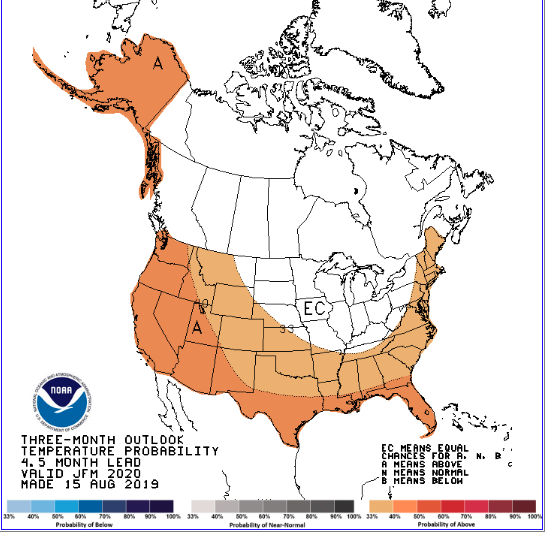
And from NOAA’s Climate Prediction Center, looking ahead to January-February-March 2020. [Two maps, one for temperature, the other precip.]
We’ll leave it to you to compare and contrast. One thing is certain, these predictions do not reflect the snow-a-rama we had last year. But neither did last year’s predictions. So, place your bets.
Meanwhile, it snowed 30 inches in Pink Mountain, British Columbia. So it begins.
Pink Mountain’s August 19th dump.
The Exercise Imperative
All readers of SeniorsSkiing.com report they are active in summer, non-snow activities, from hiking and tennis, to golf and fishing. With the season coming into view on the horizon, it would be wise for all hands to start thinking about toning up with whole body exercises.
Why? Biking strengthens quads and back, not so much arms and hamstrings. Kayaking goes for arms and abs, not so much legs. Pick your sport, the chances are some muscle groups are over-used, some under.
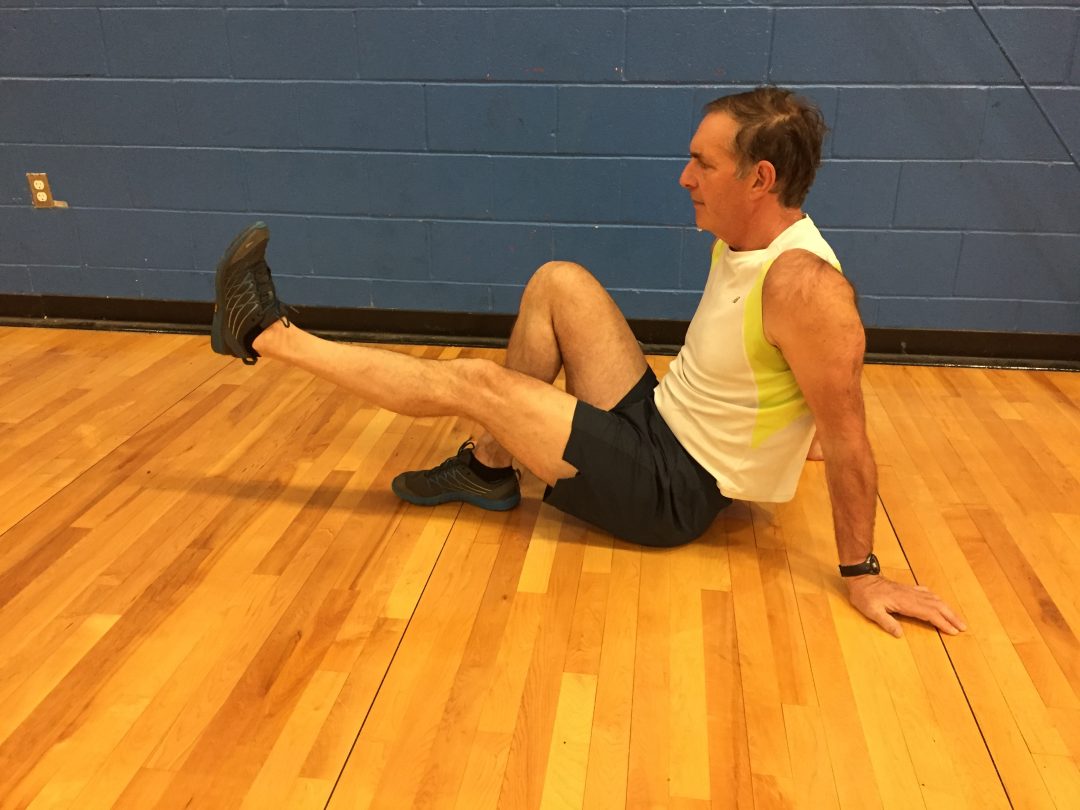
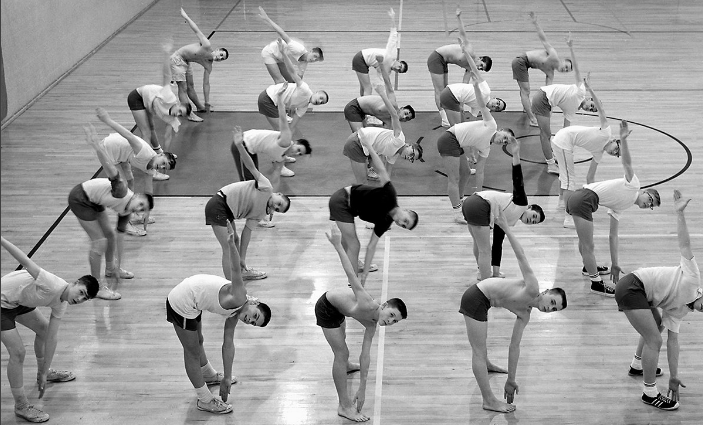
Hence, the pre-season workout. We are reprising a series of progressive exercises demonstrated by Physical Therapist and Exercise Guru, Rick Silverman of Ipswich, MA. We have three “flights” of these basic exercises from easy to more strenuous, and we’ll be re-publishing each flight over the next few editions.
One of five get-started exercises demonstrated by PT Rick Silverman.
If you are in a rush, you can find them—and many other exercise articles—in our archive under Health>Conditioning.
Happy Labor Day! Thanks for hanging with us through the summer. We’ll see you on the other side, and, remember there are more of us every day, and we aren’t going away.
https://seniorsskiing.com/wp-content/uploads/2019/08/Screen-Shot-2019-08-27-at-7.02.58-PM.png591716seniorsskiing/wp-content/uploads/2014/04/Seniors-Skiing-since2013-Logo@2x-300x68.pngseniorsskiing2019-08-30 00:47:572019-08-29 20:18:34This Week In SeniorsSkiing.com (Aug. 30)
In case you haven’t noticed, ageism hasn’t gone away. The only difference is that over the years we’ve become the object of this form of cultural disdain.
That’s why I thought it would be good to pay respect to some really old timers.
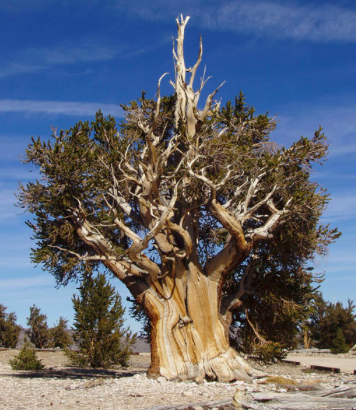
Last month, we hiked to a grove of Bristlecone Pines, the oldest trees on the planet. The ones we visited have been around for about 3,500 years. They’re in Great Basin National Park, at the eastern edge of Nevada. One bristlecone, in California’s White Mountains, is almost 5,000+ years old!
The hike required some effort on rocky but well-marked 10,000’+ terrain.
Gnarled. Tortured. Grotesque. They’re good words to describe Bristlecones. Many look dead except for the greenery coming from some twisted branches. These trees are ancient and thrive in the harshest and rockiest conditions. They deserve respect.
Pando at Fish Lake, Utah
Not far from where I spend summers near Capitol Reef National Park, is the Pando, a massive Aspen tree clone reported to be one of the largest organisms on Earth. Aspen trunks spring up from underground runners. An entire grove has the same genetic markers. In the Spring, when one develops leaves, they all develop leaves. In the Fall, the entire grove turns color simultaneously. Observe an aspen forest when the leaves are changing and you’ll witness one entire section changing its leaf color one day; another section changing a few days later. I mention the Pando near Fish Lake, Utah, because researchers have identified its root system as 80,000 years old! Unfortunately, they also tell us human activity is leading to its demise.
What does this have to do with senior skiers?
Many of you, responding to the Spring survey question asking what pissed you off most during last season, indicated two major irritants: 1) loss of discounts and high ticket and food prices and 2) rude, out-of-control skiers and boarders. (We’ll have more on the survey in upcoming issues.)
Your responses reflect a shift in the US ski industry’s business model which is systematically eliminating discount benefits many came to expect. That could be viewed as disregarding the interests of Boomer skiers. They also reflect a general lack of regard from other skiers/boarders. It’s surprising how many of you wrote that you or someone you know was hit by a young, out-of-control person.
We older skiers and boarders have been around a while. Maybe not as long as Bristlecones and the Pando, but we, as they, deserve respect.
Ski Pass Developments
$60 Squaw Valley Alpine Meadows Season Pass for Military Vets : The resort will issue up to 6000 passes toactive duty, reserve, veteran, and retired members of the military. Click here for details. Congratulations, Squaw Valley Alpine Meadows!!!!!
$99 Angel Fire Season Pass for all US K-12 teachers: Price increases to $199 when the season starts. Bravo Angel Fire!!!!!
New $199 INDY Pass: 68 Days at 34 Resorts: A new, multi-resort ski pass, called Indy Pass, is now on sale for the 2019-2020 season. It provides two lift tickets each – 68 total days – at 34 independently owned resorts for just $199.
A-Basin Joins IKON and Mountain Collective: Arapahoe Basin, which last season decided to drop out of the Epic Pass, has joined both the IKON and Mountain Collective passes. It’s a terrific area and these are terrific decisions.
IKON Adds Zermatt: IKON also added Zermatt in Switzerland with either seven or five days (no blackouts) depending on the IKON product owned. It is IKON’s first Euro resort.
China is World’s Largest Beginner Ski Market
A new report shows that as of 2018 there were 742 ski areas in China. The number includes indoor areas. Last season China had 21.1million skier visits. Between 2017 and 2018, thirty-nine new facilities were built. Three percent of the total are identified as destination resorts with a vertical of 1000’ or more. The longest vertical is slightly more than 2900’. The report concludes that China is the world’s largest beginner ski market.
12-Story Indoor Area To Open in Meadowlands (NJ)
Big SNOW America at American Dream is the Meadowlands (NJ) indoor ski and snowboard park. It is scheduled to open October 25. The 12-story, 180,000 square foot structure will be operated by Mountain Creek, also in New Jersey.
102 Year Old Skier Publishes Autobiography
George Jedenoff, 101 1/2 and still skiing!
George Jedenoff, now 102, has just published his autobiography. George celebrated his 100 birthday skiing at Snowbird. He returns annually to Little Cottonwood Canyon to ski Alta. The book, titled My Centenarian Odyssey, recounts fleeing the Russian Revolution as an infant with his parents, graduating Stanford University with honors, serving in WW II, entering the steel industry, and eventually becoming president of Kaiser Steel. It can be accessed through Apple Books (and through Windows systems) at no charge.
Videos Worth Watching
For a quick hot day chuckle, watch this vintage shortabout rollerskating, amusingly narrated by Warren Miller.
Or try this trailer for the Timeless, the new Warren Miller feature.
Scene: Curtain rises on an evening outdoor dinner party under a tent. Several guests are gathered around a table with a variety of appetizers: shrimp, cheese and crackers, fruit. Bottles of wine, beer, and booze are at another table. A couple of dozen guests are mingling and getting to know one another. Two characters, an Online Magazine Publisher (OMP) and A Volunteer Ski Patrolman (VSP), continue their discussion.
How many speeders can you spot? Credit: Jean-Yves Bruel
OMP: We’ve just completed our Spring Survey a couple of weeks ago. We asked an unusual question of our readers, What Pisses You Off The Most About Ski Resorts? Can you guess what the number one winner was?
VSP: Easy, speeding skiers.
OMP: Give that man a kewpie doll! Out-of-control, wild, dangerous skiers who ski with abandon and no sense of safety. How’d you guess?
VSP: We hear it all the time. People are always asking us to nail these air-heads, pull their tickets, and banish them from the mountain. (Note: This ski patrolman volunteers at a Very Big Vermont Resort.)
OMP: And?
VSP: We have to explain it’s not our job. We’re there to provide aid to injured skiers, keep the fences up, sweep the trails. You know, safety.
OMP: Really?
VSP: We’re not cops, and we are not trained to be enforcers. Besides, we’re understaffed. We need two guys at the top, a guy on the phone, and a spare on patrol. That’s all we’ve got.
OMP: So who’s supposed to…
VSP: The resorts Ambassadors. They are the people on the hill who can pull tickets, if they do. But often even they don’t. The management doesn’t want to alienate customers by pulling tickets.
OMP: Alienate customers? But what about the senior who goes out five times a year and who just spent $140 on a lift ticket and gets terrorized by schuss boomers, and no one does anything about it?
VSP: Yeah, that’s a problem. The day lift ticket guy probably isn’t coming back, especially if he’s new to the resort or the sport.
OMP: So, speeding, out of control skiers, the number one thing that seniors in our survey find that pisses them off about ski resorts, is an intractable problem?
VSP: I guess so.
OMP: (Walking away): I think I’ll have another couple of shrimp.
[Curtain]
[Editor Note: We know a lot of our readers are either active or former ski patrollers. Please let us know what you think of our play. We want to take it to Broadway, but before we do, we need to hear your opinion. Is VSP correct? What can a resort do to chill the hotshots? A complete report of Spring Survey results will be coming out in the Fall.]
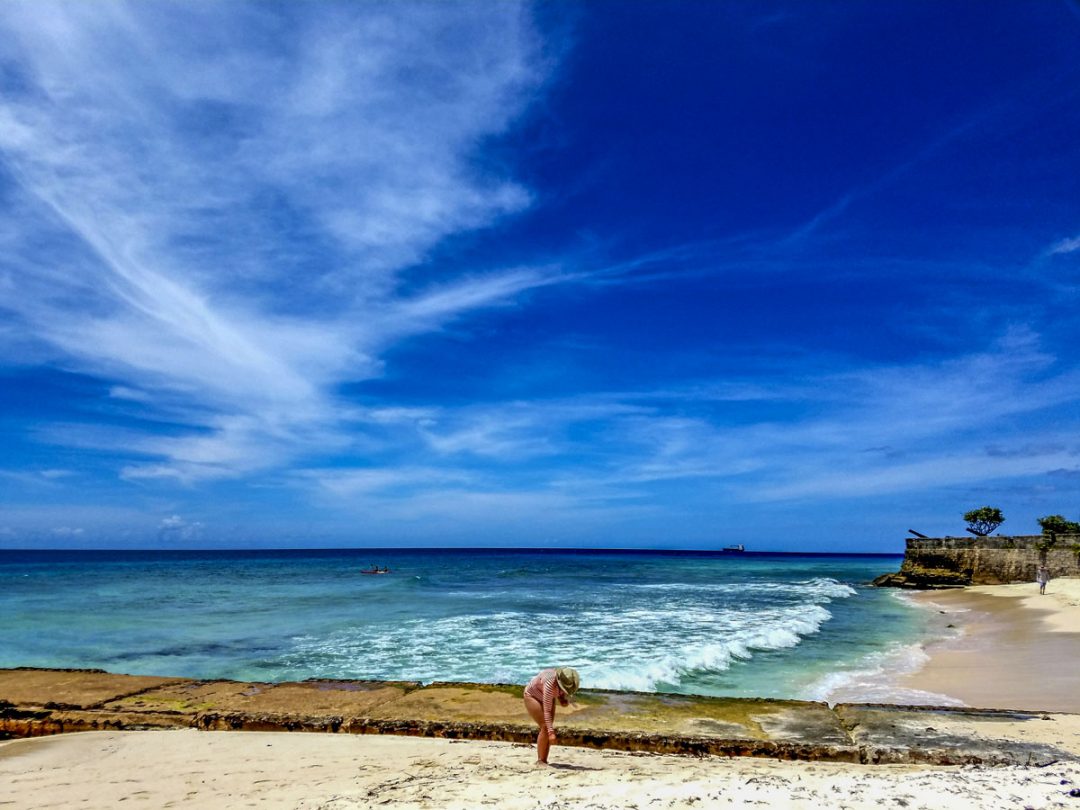
Looking for shells, early morning on the beach at the Hilton Barbados. Credit: Yvette Cardozo
In our ongoing Non-Snow activities series, Yvette Cardozo shows us that scuba diving in Barbados can be as refreshing as a run down a wide blue trail. Well, at least it’s cool. If you haven’t snorkled on a reef or scuba-dived in the Caribbean, you might want to revise your bucket list.
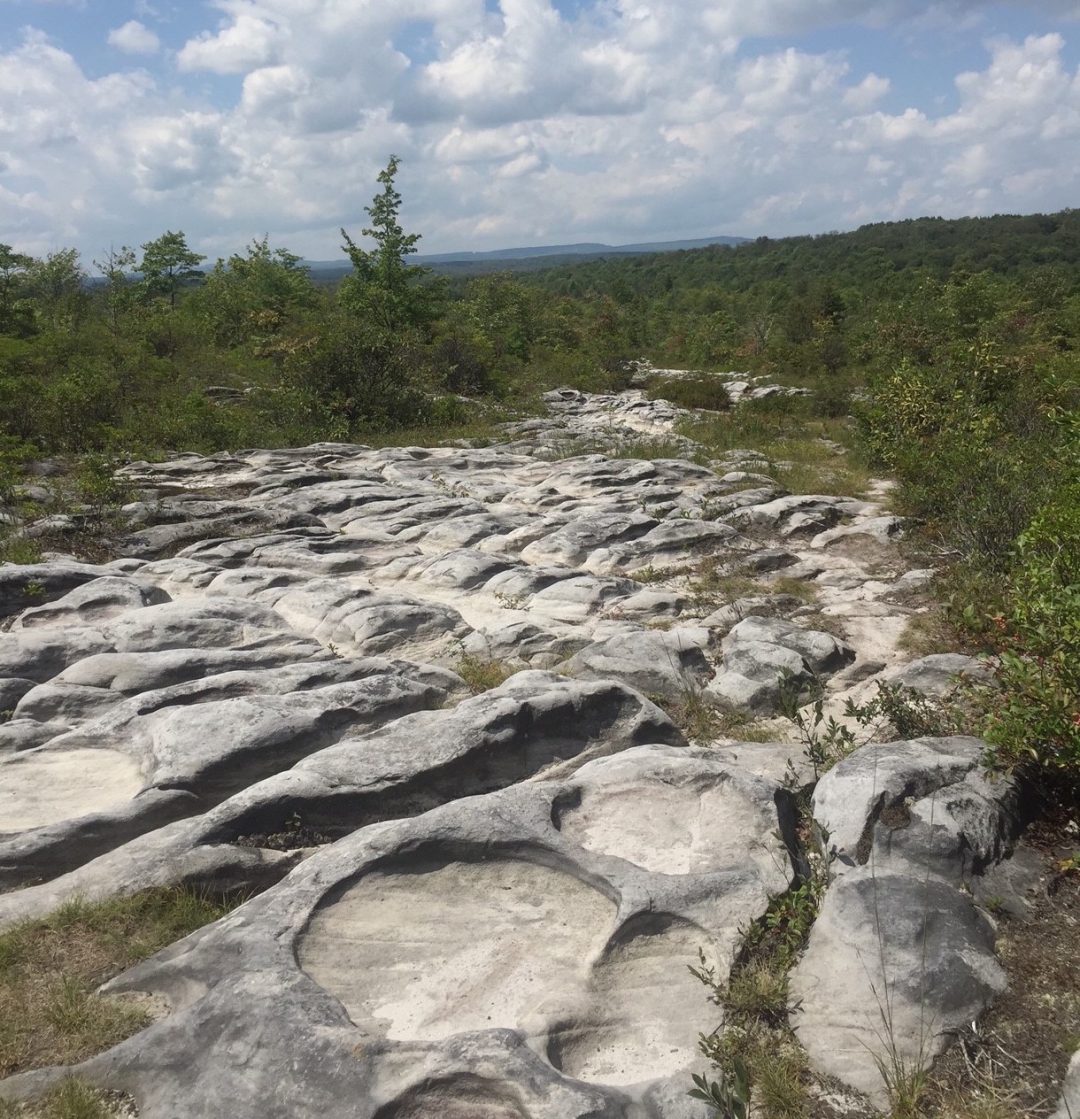
Moon Rocks, Davis, WV. Credit: Pat McCloskey
Pat McCloskey continues our Summer Cycling Series with a visit to Davis, WV, which is becoming the Moab of the East for mountain biking. Ride with him over the famous Moon Rocks, an apt adventure considering we’re celebrating the 50th of Apollo 11.
Finally, Murray Sandman, a new SeniorsSkiing.com correspondent from New Zealand, explains how he created a DIY, three-week tour of the Dolomiti Superski in Northern Italy.
On to August, and summer sailing for us. Thanks so much for reading SeniorsSkiing.com. Tell your friends, and remember, there are more of us every day and we aren’t going away.
https://seniorsskiing.com/wp-content/uploads/2019/07/CrowdedSlopes.jpg300450seniorsskiing/wp-content/uploads/2014/04/Seniors-Skiing-since2013-Logo@2x-300x68.pngseniorsskiing2019-07-26 00:39:132019-07-24 06:37:27This Week In SeniorsSkiing.com (July 26)
Steamboat gets a summer snow dump. Thanks to SnowBrains.
Isn’t It Time For You To Go Home?
We’ve all hosted house parties where one or more guests have decided to hang around long after everyone else has gone. Perhaps the table has been cleared, dishes stacked, and the corks put back in bottles. Perhaps the hostess has gone to bed with a telling backward look. Yet, here they are, discussing with vigor something about something.
Is this not the case with this year’s never-ending ski season? At last look, there were at least four areas still operating, some on weekends, but nevertheless. SnowBrains reports the summer skiing is “unbelievable” at Mammoth. Snowbird is winging. A-basin is open, too, with snow STILL falling in Colorado. Always a late closer, Timberline Lodge is going to end end of August. Although it is closed, Steamboat got a 20″ dump last weekend. Something happening here.
La Parva, Chile, sunset through the icicles. Credit: Casey Earle
Amazingly, this “season” appears to have no end, now running consecutively with resorts in Australia, New Zealand, and South America whose season has just started.
And so we wonder, gentle readers, is it time to call it a season? Or not. Please tell us if you are still out there. More importantly, what keeps you going into the summer? Curious minds want to know. Drop a comment down below in the Comment Box.
Speaking of Latin America, our Chile-based correspondent Casey Earle offers a resort review of La Parva,right outside of Santiago. Check out the webcam links in the story. Lotsa snow there, too.
Riding the foothills of the Tucson Range. Credit: White Stallion Ranch
Even if the snow season refuses to shift, this week we are on to different topics. Pat McCloskey discovers a brand of ultra great maple syrupfrom Vermont’s famous Cochran ski-racing family that he simply has to write about. Our ever-traveling correspondent Yvette Cardozo visits a dude ranch…er, guest ranch…giving us a snapshot of yet another non-snow season activity. Did you know legs strong from skiing help you stay on a horse?
Finally, we’re publishing a season summer video diary by correspondent Don Burch. He’s taken the time to document this season with pictures and videos (some taken by ski journalist Peter Hines). Perhaps the idea of a video journal of the season is something that might catch on. At least, watching it might keep you a bit cooler in July.
Off we go into summer. We’re going sailing. What about you? Thanks for reading SeniorsSkiing.com . Wherever you go, remember, there are more of us every day, and we aren’t going away.
https://seniorsskiing.com/wp-content/uploads/2019/06/Screen-Shot-2019-06-26-at-9.23.40-AM.png305545seniorsskiing/wp-content/uploads/2014/04/Seniors-Skiing-since2013-Logo@2x-300x68.pngseniorsskiing2019-06-28 01:30:252019-06-27 08:06:18This Week In SeniorsSkiing.com (June 28)
Perhaps this will keep you cool in July. If you have videos of this past season, please let us know at info@seniorsskiing.com.
(Some videos by Peter Hines)
https://seniorsskiing.com/wp-content/uploads/2019/06/Screen-Shot-2019-06-24-at-5.19.34-PM.png390693seniorsskiing/wp-content/uploads/2014/04/Seniors-Skiing-since2013-Logo@2x-300x68.pngseniorsskiing2019-06-27 08:00:102019-06-27 08:00:13Correspondent Don Burch Wraps the Season
Advice From The Marketing Head of Powder Mountain.
Reader Ellin Jaffe asks:
I’m curious about Powder Mountain near Eden, Utah, and wonder if there are any ski-in ski-out condos there?
Here’s the reply from J. P. Goulet, Director of Marketing, Powder Mountain:
Powder Mountain has ski-in ski-out luxury homes for rent. There also are many condos available in Eden only four miles from the resort and on the public transportation route. All info can be found at www.powdermountaingetaways.com.
Powder Ridge Condos and Columbine Inn are other lodging options on mountain.
Have a question about technique, gear, destinations, travel, or any other aspect of winter sports? Send it to mike@seniorsskiing.com, and we’ll do our best to find an expert to respond.
https://seniorsskiing.com/wp-content/uploads/2020/01/TwoSkiers-300x325-1.jpg325300seniorsskiing/wp-content/uploads/2014/04/Seniors-Skiing-since2013-Logo@2x-300x68.pngseniorsskiing2019-06-24 18:41:142024-08-21 10:55:08Ask an Expert: Lodging at Powder Mountain, Utah
In 1816, incessant cold throughout the year drove New Englanders to despair.
In 1816, there was no summer in New England. Six inches of snow fell in June, and it was as low as 40 degrees in Connecticut in July and August. There was frost every month of the year, and, in May, strong, freezing winds from Canada wiped out tree buds, and frozen birds dropped from the trees. One 74 degree day in Salem, MA, was followed by a 21 degree day. Crops didn’t grow, and people went a little crazy. Contemporary observer Samuel Goodrich described the impact of the errant weather on the people of New Hampshire: “At last a kind of despair seized upon the people. In the pressure of adversity, many persons lost their judgment, and thousands feared or felt that New England was destined, henceforth, to become part of the frigid zone.”
Some pointed to the eruption of Mt. Tambora in Indonesia that ejected massive amounts of ash and debris into the atmosphere as the root cause. Other scientists say 1816 was part of a mini-ice age lasting from around 1400 to the 1860s. Click here for more on this fascinating event in meteorological history.
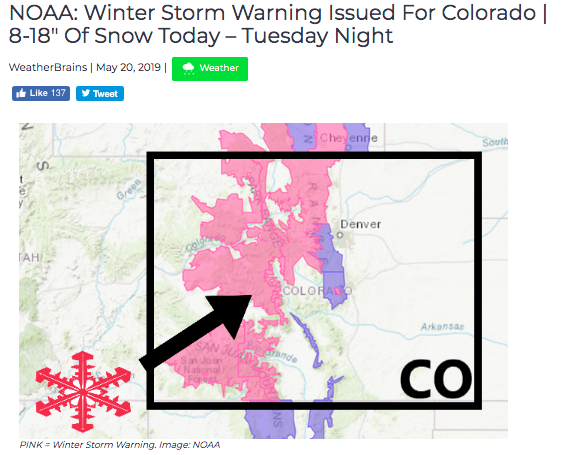
Whatever the cause, New England, and dare we say, a large number of mountain states are experiencing an extension of Winter 2018-19 that is eerily similar to 1816. To wit: It is snowing in mid-May in Colorado.
Credit: WeatherBrains
A new 10-inches in Breckinridge.
Credit: Breckinridge Ski Resort
This was Killington on May 14th.
Killington in mid-May.
Here’s a video from Killington from May 14. Killington is extending the season to at least June 2. It has been 20 years since Killington has been open in June.
And, in the Sierra.
Credit: WeatherBrains.
And Mammoth is going to AUGUST!
Credit: Snowbrains
And so it goes. A highly unusual year for snowfall and an extended winter. Have you seen closing days like these in recent years? These resorts are the late-closers for the 2018-19 season.
Mt. Hood Meadows Memorial Day
Aspen Memorial Day
Crystal Mountain Memorial Day
Snowbird Weekends until it lasts
Whistler Memorial Day
Heavenly Weekends
Mt. Bachelor Memorial Day
Arapahoe Weekends to June 23
Breckenridge Weekends to June 9
Killington June 2
Squaw Valley June 7
Mammoth August
Timberline Lodge August 31
The question to our readers: If the resorts are still open, and the snow is still falling, are you still skiing? If so, please tell us your story. What’s it like out there? Who else is skiing this time of the year? Please let us know in Comments below.
This Week
Our first non-snow issue features an interesting comparison of skiing and cyclingby correspondent Pat McCloskey. Also, we hear from a reader who had a successful experience with a stem cell treatment for bad knees. This may be alternative for some seniors, but it’s important to understand what you are getting into. Finally, we hear from another reader who has some philosophical thoughts his last run on a pretty gnarly day when most folks would rather have put another log on the fire.
Onwards to summer. Please send us you story ideas. We love submissions by our readers.
Remember, dear readers, there are more of us every day and we aren’t going away.
https://seniorsskiing.com/wp-content/uploads/2019/05/Screen-Shot-2019-05-23-at-10.28.08-AM.png364529seniorsskiing/wp-content/uploads/2014/04/Seniors-Skiing-since2013-Logo@2x-300x68.pngseniorsskiing2019-05-31 00:30:482019-05-30 13:23:43This Week In SeniorsSkiing.com (May 31)