[Editor note: SeniorsSkiing.com is collecting stories from readers about incidents and accidents that they have experienced. We intend to review these for patterns and themes and use that data to influence the safety policies of resorts and other stakeholders. The following is the second article submitted by a reader in our new feature “Incidents and Accidents”. If you have a story to tell, please follow the format used below and send to INFO@seniorsskiing.com]
Jon Weisberg, Teasdale, UT.
Where: Deer Valley, Park City, UT
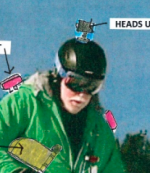
What Happened: I was skiing the left edge of a wide slope, about three quarters of the way down. The bottom of the lift was visible. A skier in a green parka came from behind and passed within an inch or two. His skis crossed mine. I stopped and watched as the ugly green parka made its way clumsily to the bottom. Taking chase, I caught up with him and his friend in the lift line and confronted him. He was in his late teens or early 20s and denied that he was the skier in question. I pressed the issue. “You’re the only person wearing that ugly green jacket.” He still didn’t admit that he skied so close and almost knocked me down. “You did it, and you know you did,” I persisted. His buddy then spoke up and admitted that his friend had done it. They were about to get on the chair. I gave him a short lecture. “If you got hit at your age, you’d get up or spend a few days sidelined and be back on the hill. I’m in my seventies, and you almost knocked me down. I’ve been skiing more than 60 years. If you hit me, I might have been out for the season or for the rest of my life.” Maybe it registered, maybe not. He got on the chair and, fortunately, I never saw the twerp again.
Role of the Ski Patrol: Had Patrol been nearby, I would have reported the kid. They were not, and I did not.
Lessons Learned: I like to ski the fall line which is what I was doing when this happened. I deliberately ski slowly and in control. But many others don’t ski with the same level of control. It’s important to redouble looking around and upslope when skiing.
Advice: The incident made me realize that regardless of how well I conduct myself on the hill, I need to expect the unexpected.
https://seniorsskiing.com/wp-content/uploads/2019/11/historic6-e1582739799348.jpg546728seniorsskiing/wp-content/uploads/2014/04/Seniors-Skiing-since2013-Logo@2x-300x68.pngseniorsskiing2019-12-04 12:39:052019-12-05 15:13:39Incidents And Accidents:3
Instructor Pat McCloskey Recommends An Approach To Early Days.
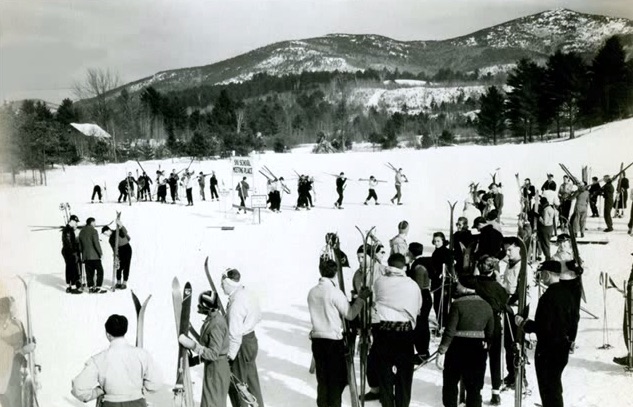
Opening Day, Cranmore, NH, 1938.
I had an interesting discussion with my lift mate this weekend at our local ski area.
I asked the fellow beside me how his day was going. He remarked, “Well, the hill is fighting me back a little today.” I chuckled because the guy was a certified PSIA instructor but was feeling a little uneasy with the current conditions. After all, it is early days for the season, and the snowmaking can bring terrain to life but can also provide less than adequate conditions if you are not prepared.
What did he mean the hill was fighting him back? As I exited the chair, I began to think about how to tackle ice, scraped snow, and the inevitable sand-like conditions that occur with a big crowd on not so big terrain. If you started out too fast, you ended up defensive in your stance, and the timing of turns was compromised by too much speed too early, resulting in a skid for life.
So, my recommendation to anyone starting out on their first run on limited terrain and icy conditions is to begin slowly and finish your turns. Make a series of turns by finishing them and reducing your speed by the radius of your turn. Your timing will come back to you and you can eventually increase your speed.
If you start out slowly and allow the cadence of finished turns to happen at a lower speed, you can eventually ski with a faster cadence once a comfortable series of turns are made. Be aware of your ankles and make them flex in the bottom of the turn to assist the ski in making a finished, rounded turn.
I did this for a while and really concentrated on rounded turns and feeling my edges grip the ice. Then I became more aggressive and said, “Come on Pat, you’ve got this” and increased my cadence and speed but didn’t compromise my turn. I was able to do this because of starting the run conservatively and making rounded turns.
I end up doing this all season long. If you can start slowly and make the first couple of turns correctly and rounded, you can ski any terrain anywhere.
My favorite condition for my first run on my first day of skiing on any trip is freshly raked frozen granular. Why? Because I can feel the edges of the ski carve in the snow.
Early enough in the season, even if one skis out west, you’ll see more hard packed snow than powder which works. But, only on frozen granular can you can hear the skis cut through the snow. The crunching and scraping sound of skis on frozen granular is unique and it sends a confirming message to my brain that I am skiing again. On hard packed powder, you have to listen for the singing sound of the skis cutting through the snow. It is there, just hard to hear above the ambient noise.
For each first run, I follow the same drill that puts the racer, the rec skier, the instructor and the ski tester in me in instant conflict.
The racer in me wants to go fast, straight down the fall line. At my advanced age, I still like to ski fast but force myself to ski slower because can at 74, my bones don’t break, they shatter.
The rec skier wants to charge off, get to the bottom and up before the lift lines build.
The instructor part of my brain says make the perfect turn in, of course, perfect form, but not in the Final Forms that PSIA pushed in the 70s. Body position – square over the skis, knees flexed, back straight, arms out and bent, ready to plant the pole – is important to enable one to control the skis and speed.
Since I rent skis, I’m back being a ski tester. How does the ski carve? How easy are they to turn?
My technique is the same for my first turn. Pick-up some speed and as the skis come through the fall line, press forward with my knees and edge the ski. Plant the pole, unweight, roll my knees …. Yeah, yeah, yeah, I’m old fashioned. After three or four turns, I stop and look at my tracks.
Why? Because on frozen granular the tracks tell me where I unweighted and where I finished each turn. There edges should make straight lines and there should be a bit of feather at the end of the turn where I set the edge to build a platform for the next turn.
It is about muscle memory. My last turns were in April, eight long months ago. Technique is important because it is how one controls one’s speed on a steep pitch and how one navigates through any condition. And, I’m a year older.
First four turns examined, I make another set and look back. The snow tells me how good my technique is. Sometimes, it takes three or four segments to convince me that my turns are O.K., other years, it has taken only one or two. It just depends on the snow, the skis and me. But the joy is back because I’m turning skis on a mountain.
/wp-content/uploads/2014/04/Seniors-Skiing-since2013-Logo@2x-300x68.png00Marc Liebman/wp-content/uploads/2014/04/Seniors-Skiing-since2013-Logo@2x-300x68.pngMarc Liebman2019-12-04 11:03:002024-08-21 10:44:34My First Run
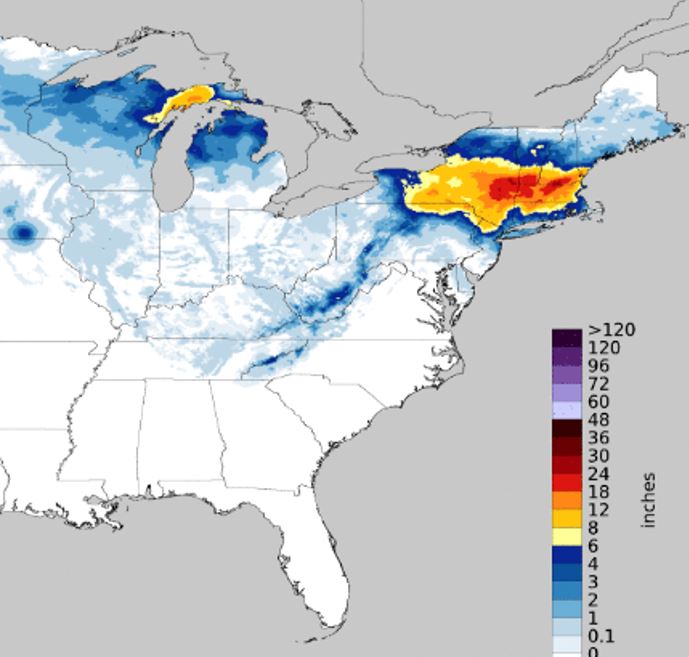
By the time this piece is posted, I will have enjoyed my first turns of this season, at Jiminy Peak in the Berkshires. The skiing should be superb after more than two feet of new snow from the early week storm. It was a slow mover and got stretched out from west to east due to a blocking pattern to the north, and the axis of the heaviest snow shows that dramatically…take a look.
It was a major shot in the arm from the Catskills and
upstate New York eastward through Massachusetts as well as in southern VT and
NH, but further north in New York and New England, amounts were much
lighter.
The Midwest has benefitted from a parade of Alberta Clipper systems and some lake effect snow in the past two weeks, and trail counts have been slowly climbing in the center of the country. The West benefitted from a series of storms in late November that hit the southern Sierra and southern and central Rockies, (Five+ FEET at Mammoth and Alta). We all know that it takes more than one healthy storm to get things really rolling in that part of the country but recent storms have certainly helped. The Cascades and northern Rockies have been in a quiet pattern for the most part, due to the influence of an upper level ridge that has been persistent over the western edge of the continent from Oregon northward to Alaska. That jet stream ridge will likely be dominant this winter, due to the large pool of anomalously warm water that is present in the northeast Pacific, as we have discussed in a previous post.
So, with less than three weeks to the holiday period, every
winter sports region in the country could use fresh snow, or at least
consistent cold and dry weather for snowmaking.
Here are the prospects for the next couple of weeks, broken down by
region.
Northwest
U.S./Western Canada: Recent snows
have helped in the coastal ranges of B.C. with interior B.C. and Alberta
getting some help, too. However, the
ridge looks like the dominant player the next couple of weeks but systems that
weaken as they approach the coast should produce some light to moderate snow on
at least a couple of occasions.
Cascades and Sierra: A weekend storm will produce one to three feet in the Sierra, with the storm bypassing Oregon and Washington, where the ridge will hang tough. The southern extent of heavy snow should reach Mammoth, but taper off quickly further south. Any system that reaches the southern ranges next week will not be nearly as dynamic.
Rockies: The northern Rockies will see some light
to moderate snow at times, but no major storms, as the ridge will knock down
the strength of any systems that fight their way inland after most of the
moisture is wrung out by the coastal ranges.
A new, deep trough will take shape over the eastern half of the country
next week and disturbances sliding down the western edge of the trough could
produce some snow in WY and CO. The
southern Rockies will have to wait for another batch of southern stream systems
but overall, the southern branch does not look too busy going forward.
Midwest: After a mild, wet start to next week, this
region will see a more favorable pattern develop. A new, cold trough will take shape and
deliver arctic air by midweek. That air
mass will set off widespread lake effect snow, Alberta Clipper systems will cut
across the Lakes in the days to follow, and temps will be conducive to very
productive snowmaking much of the time in the next two weeks.
Northeast: Pretty much the same as the Midwest,
with a one day delay for the arctic air.
Snowmaking, snow showers, and grooming will rehab the surfaces by next
weekend and cold and occasionally snowy weather will dominate the next two
weeks of holiday prep.
For reasons not fully understood, the persistence of weather patterns is enhanced during times of low solar activity, especially blocking patterns. We are very close to the bottom of the 11 year solar cycle, as shown here.
Working together with the northeast Pacific warm pool,
persistence and blocking will favor the eastern half of the country this
winter.
Big Changes Are Underway This Season. Will They Help Solve The Problem?
Little Cottonwood Canyon last winter.
Flashback To Last Winter
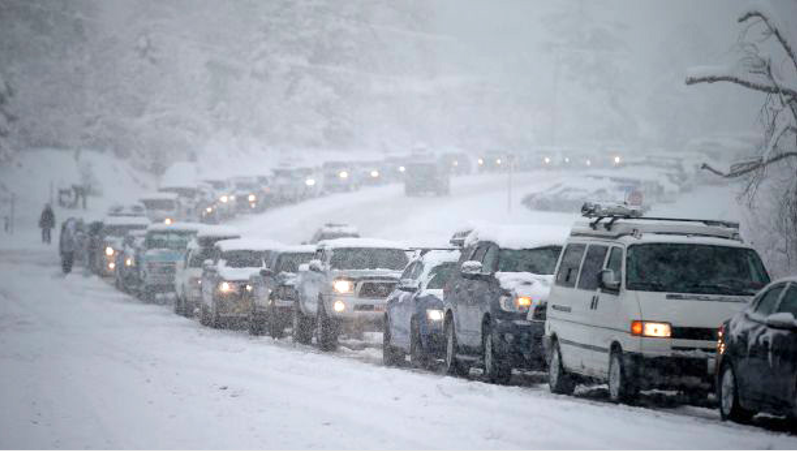
Bumper to bumper traffic creeps up Little and Big Cottonwood Canyons toward Alta and Snowbird, Brighton, and Solitude. But resort parking lots are already full.
It’s mid-morning on a typical weekend.
Rabid skiers ignore the parkies. And they ignore One Way signs. They drive the wrong way and create blockades. They ram their cars onto berms and they jam up fire lanes.
Every parking spot is taken. There’s no place to park. Cops turn cars around and head them back down the canyon.
Outraged skiers then park along the 2-lane road — further and further away from their resort. They park on both sides of the narrow, twisting road.
Car doors hang wide open into the traffic lanes while skiers sit to put on boots. High snowbanks force skiers to trudge on the car-clogged road toward their resort, hauling their equipment, kids and coolers. The 2-lane road becomes a 1-lane obstacle course.
Some cars that park along the road sink into the deep snow and must call a wrecker to get pulled out. Other cars that park sloppily and threaten safety are often ticketed and are sometimes towed away.
That was last winter. It wasn’t pretty.
Why All The Mayhem?
Salt Lake City’s economy sizzles. Home and apartment construction booms, and that spikes the local skier population.
More than 300 flights arrive daily at Salt Lake International Airport, and 10 resorts are within an hour’s drive. Skiers with a multi-resort pass, such as the Ikon pass, flow unpredictably from resort to resort.
The only way up each canyon is by two-lane road. Resorts on national forest land must comply with regulations and cannot make changes on a whim.
Last winter topped the charts with 711 inches of snow, and, like a magnet, it sucked skiers up the canyons. Just add up all those issues. The net result was humongous traffic jams.
Partners For Solutions
Canyon roads have been a concern for more than 30 years. Solutions have been proposed, and some have been tinkered with. But last winter’s traffic nightmare pushed the hot button.
This winter, it’s all hands on deck. Ski resorts plus Save Our Canyons, Wasatch Backcountry Alliance, the Central Wasatch Commission and the Utah Transit Authority (UTA) are stepping up efforts to change skier behavior and solve the traffic issue.
What’s Up For This Winter?
UTA added more ski buses in both canyons. It removed the inside ski/board bins to provide more standing room. And it eliminated some bus stops to speed up transit times, Skiers with a resort-specific season pass or an Ikon season pass can ride the UTA ski bus free.
Snowbird expanded its R.I.D.E. program—an Uber-type ride share app so skiers can carpool. (R.I.D.E. is the acronym for Reducing Individual Driving for the Environment. Download the iOS Snowbird R.I.D.E. app or the Android Snowbird R.I.D.E. app.)
In addition, Snowbird skiers who carpool or take the UTA ski bus earn R.I.D. E points toward sweet rewards. And carpools with three+ people get VIP parking.
This year, Alta, Brighton and Solitude implement the R.I.D.E. app.
At Alta, there are ride share vans for employees, and it dedicates 25 percent of the Wildcat parking lot for carpools with 3 or more.
Solitude takes a bold step and will charge for parking. Daily fees range from $5 for cars with four passengers to $20 for just one or two passengers. Those with a Solitude or Ikon season pass can buy a season parking permit for $150. The permit will cost $225 for non-season pass skiers.
More To Come
The question remains: What will it take to change skier behavior and eliminate the traffic jams? Stay tuned. The 2019-2020 ski season is arriving right now.
https://seniorsskiing.com/wp-content/uploads/2019/12/Screen-Shot-2019-12-02-at-9.28.22-AM.png451797Harriet Wallis/wp-content/uploads/2014/04/Seniors-Skiing-since2013-Logo@2x-300x68.pngHarriet Wallis2019-12-02 09:31:372024-08-21 10:45:23Monster Traffic Jams Overwhelm Canyon Roads At Four Salt Lake Resorts Last Winter
SeniorsSkiing.com is taking the holiday week off to spend time with family and friends. We are definitely thankful for our diverse and engaged readers who continue to inspire us with their insights and resolute allegiance to snow sports of all kinds. We are also thankful for our talented correspondents who have offered ideas, creativity, coverage that resonates with our readers. All is good as we approach our sixth Thanksgiving.
CAPTION CONTEST
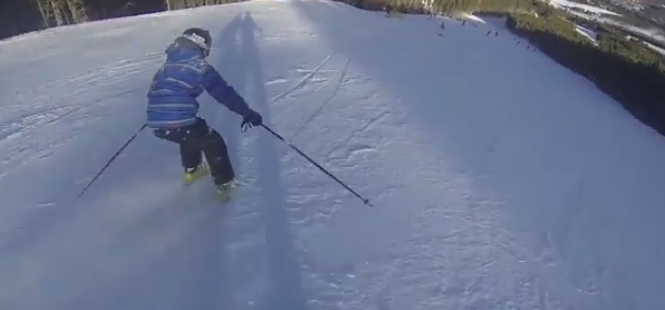
We were searching the internet for a fitting Thanksgiving video we could post as a holiday treat for our readers. Instead of happy skiers making tracks in Pilgrim costumes, we discovered this…odd…video. It shows a guy skiing down a groomer at Breckenridge on Thanksgiving in 2013. But there is something…ah…missing.
We thought it would be fun to ask our readers to come up with a caption for this video. Just put your entry in the Leave A Reply section below. Hey, you may win a coveted SeniorsSkiing.com sticker…
https://seniorsskiing.com/wp-content/uploads/2019/11/Screen-Shot-2019-11-26-at-11.34.05-AM.png310665seniorsskiing/wp-content/uploads/2014/04/Seniors-Skiing-since2013-Logo@2x-300x68.pngseniorsskiing2019-11-26 11:45:442019-11-26 11:50:05Happy Thanksgiving From SeniorsSkiing.com!
DIN You Know?, Incidents And Accidents 2, XC Stereotypes, Skier Code Review, First T-Bar Pic.
On The DIN List? Credit: Pirates of Powder
We dropped our skis and new boots off at the Sports Stop in Wenham, MA, the other day. We wanted to make sure our new boots and bindings worked in harmony. And to generally slick up the skis for the season.
Imagine our surprise when the ski tech said, “You only have one year left on these bindings.”
“What?” says I.
“Bindings are good for 10 years,” he patiently replied to my confusion. “Springs aren’t reliable. And ski shops won’t work on them if they are on the DIN List.”
Several thoughts popped up: Has it really been 10 years since I bought those skis? Wow. This is a cash-cow for the binding/ski/boot business. Wow. Wait a minute, wasn’t there just a ski-skate-board swap down at the high school gym? Wowser again. Those obsolete skis and bindings are probably unusable, if not unsafe, and lots of kids are going to ski on them. And, what is this DIN List?
Here’s the point: Do you know if your bindings are on the DIN List? What have you done about that if they are? Are you the kind of sportsman who holds on to equipment as long as possible? Are you aware that might/might not be a terrific idea?
After all, we still have wooden XC skis that we treat with pine tar and old-fashioned wax like the old days.
Time to buy new equipment for the season? You may have to.
This Week
We have another reader-submitted report on ski hill Incidents and Accidents. This time, it was a self-inflicted injury, stemming from improperly adjusted bindings. Interesting how we forget to adjust to changing physical capabilities as well as our DIN settings. If you have a story to tell, please try to follow the suggested format and send to INFO@seniorsskiing.com
Veteran journalist Mike Roth helps us remember to make a loud announcement of intent when we passing downhill skiers. It’s a way of being safe; why don’t we hear “On Your Right” more often? He review the Skier’s Code of Responsibility here.
Finally, we have a mystery photo this week of a very early T-bar, the very first in this particular state. Name the state, name the ski area.
That’s it. Thanks for reading SeniorsSkiing.com. Please tell your friends and remember, there are more of us every day and we aren’t going away.
https://seniorsskiing.com/wp-content/uploads/2019/11/Screen-Shot-2019-11-21-at-9.41.21-AM.png448701seniorsskiing/wp-content/uploads/2014/04/Seniors-Skiing-since2013-Logo@2x-300x68.pngseniorsskiing2019-11-22 00:50:002019-11-21 10:29:57This Week In SeniorsSkiing.com (Nov. 22)
[Editor note: SeniorsSkiing.com is collecting stories from readers about incidents and accidents that they have experienced. We intend to review these for patterns and themes and use that data to influence the safety policies of resorts and other stakeholders. The following is the second article submitted by a reader in our new feature “Incidents and Accidents. If you have a story to tell, please follow the format used below and send to INFO@seniorsskiing.com]
Carol Goodman, New Hartford, NY
Where: Gore Mountain North Creek, NY
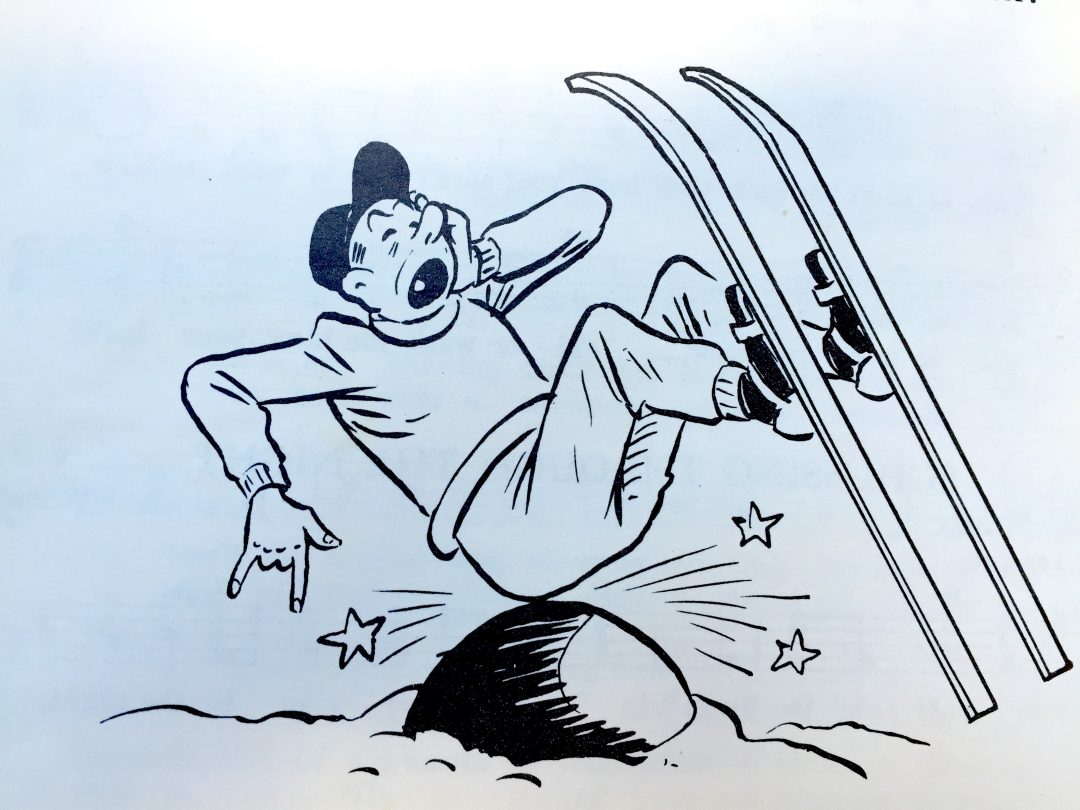
What Happened: It was a beautiful powder day in the Northeast. The snow was coming down heavily and close to 18 inches of new snow had accumulated overnight. The trails were virtually ungroomed. Exciting for a seasoned skier looking for the feel of western skiing. Unfortunately, the stars did not align for me that day. It was my first day out for the season, and my second run down the mountain when I took a header; a forward twisting fall into deep snow with no release of my right binding.
As a result, I suffered a comminuted fracture of both my tibia and fibula. Fortunately the accident occurred underneath a chairlift so I was able to summon for help immediately. I was reached by a ski ambassador first, who was able to release my binding, as I was in excruciating pain. It was a very long process getting me off the mountain and into medical. The accident ended my 2018/19 ski season, as the surgical repair, with a rod and screws, required me being non-weight bearing for 10 weeks.
Role of the Ski Patrol: The goal of the ski patrol is to attend to the immediate needs of the skier and to keep the skier comfortable until the proper splint and sled arrives. This was my experience, although I spent almost an hour on the mountain in the snow. I would hope that this amount of time is not the norm. Once I was down the mountain and was warmed up, the next ordeal was getting my ski boot off, which they insisted had to take place before I could be transported to a hospital. Lucky for me, there was an MD available at ski patrol who was able to administer ketamine, a dissociative anesthetic, so that I would not feel the pain of boot removal.
Lessons Learned: Always be certain that your bindings are in good working order and that you have had a relatively recent Vermont Binding Release test done. Even though I have been skiing for many years at an advanced level, the effects of aging and loss of strength should have prompted me to have my DIN settings checked and lowered.
Advice: Keep your equipment in tip-top shape, have a binding release check done, and keep skiing, even if you have a setback! Follow a strict rehabilitation program, followed by strengthening and conditioning so that you are in the best physical shape possible for the ski season. The benefits of participating in an activity you love, far outweighs giving it up.
https://seniorsskiing.com/wp-content/uploads/2019/11/historic6-e1582739799348.jpg546728seniorsskiing/wp-content/uploads/2014/04/Seniors-Skiing-since2013-Logo@2x-300x68.pngseniorsskiing2019-11-20 10:53:592019-11-20 11:25:09Incidents And Accidents: 2
Grooming is more complicated and expensive than most people think.
There are at least three unfortunate stereotypes that are really important to the cross country ski world:
“If you can walk, you
can cross country ski”
“Oh, it looks like so
much work!”
“It’s free, right?” Meaning: Well, I heard it was free, so I expect it to be free.
Okay, a lot of cross country skiers and not-yet-skiers take all three for gospel, but here is an xc ski area operator’s view of these stereotypical views:
First, if you can walk, you can ski. But “it takes time – and at least one lesson – to really improve, glide, and enjoy skiing more.”
Second, it’s a lot of work. “Well, it’s a lot of work if you ski a marathon, but what most people do is ski at their own pace for a couple of hours and still have tremendous fun and get some exercise and fitness while they’re doing it.” New cross country ski equipment performs better (glide easier, get better grip on uphills, and have better overall control) and allow skiers to be more efficient and save their energy.
Third, it’s free right? A response to the trail fee question is that there’s no free lunch. This answer is more complex than the others because there are a lot of groomed trails maintained by clubs, communities, states, provinces, federal agencies, etc. where there’s no formal fee. Also, skiers have the option of breaking their own trails.
Appreciating Trail Grooming
Grooming is something that’s not only misunderstood by the public but also sometimes goes unrecognized. Lo! Pristine tracks and corduroy appear in the morning because grooming occurs mostly at night. What you didn’t see happen, you may not appreciate.
First, grooming has huge value, makes skiing—and especially learning— easier than breaking your own path. Grooming is expensive, and running an over-snow vehicle is just the most visible part of the cost. Even “no-fee” groomed trails aren’t free. They cost someone time and money.
Groomed trails typically aren’t just old logging roads through the woods and usually don’t just follow golf course cart paths. Area operators can tell you that it can be expensive to develop the best routes, create trails, and keep them in great shape for the public to enjoy. Selecting the best paths at golf courses without damaging grass isn’t simple either. More than 230 golf courses in North America now have machine-groomed trails.
The cost of trail grooming
includes machinery (purchase, maintenance, fuel, storage, payroll,
depreciation, replacement), land use fees (purchase, lease, taxes), signage and
marking, insurance, parking lot construction and snow clearance, perhaps
warming huts or yurts, ski patrol, lighting, snowmaking , etc. Ah yes, and there’s
the cost of creating some trails.
Methow Trails Example
According MethowValleyNews.com, grooming at Washington’s Methow Trails—cited as the largest XC ski area in North America—is estimated to cost $6,400 for an average night of work. Think about clearing trails, trimming trees to make a wider canopy to allow snow to land, minimize debris on the trails, and to help skiers to avoid branches, angling the surface to complement the sunshine or avoid the wind and so on. Maintaining trails covered in wet snow is very different from dry snow. Icy conditions present a completely different challenge of grinding the surface and setting tracks.
It takes about a
gallon of diesel fuel to groom one mile of trail according to Methow Trails.
The snowcat blade allows a skilled operator to harvest snow moving it around so
it covers the trail where needed. The operators could also use a bucket on the
snowcat to collect snow and deposit it to uncovered spots.
Trail groomers can be responsible for maximizing every inch of snow, provide more consistent conditions and deliver more skiable days. As you can see, it’s not a simple task. But it’s one that is often unrecognized and under appreciated.
So hats off to the trail groomer and their cross country ski trails.It’s certainly worth the cost of the trail pass!
Beautifully groomed trails make the xc experience accessible and easy for all, especially beginners.
Mike Roth with new safety add-ons for the modern skier.
[Editor Note: This article by ski journalist Mike Roth originally appeared in the Albany Times Union. It has been edited slightly from the original.]
On Monday the 19th of March, I skied Mount Snow which was fantastic. Since the week before they had received over five feet of snow. The trail conditions were packed powder over the entire mountain and could not have asked for better conditions aside from fresh ungroomed powder.
There was a decent crowd at the Bluebird bubble six pack chair but that was mainly because it was the only main face lift operating. There was no reason to run any of the others due to the lack of people. Even though the lift line took a few minutes to get through there basically was no one on the trails as you skied down to the base.
While I was on the mountain there were various posters with the Skier’s Code of Responsibility so I will repeat them here for the record.
It’s YOUR responsibility 1. Know your ability and always stay in control and be able to stop and avoid other people or objects. It is your responsibility to stay in control on the ground and in the air. 2. Take lessons from qualified professional instructors, to learn and progress. 3. As you proceed downhill or overtake another person, you must avoid the people below and beside you. 4. Do not stop where you obstruct a trail or run, or are not visible from above. 5. When entering a trail or run or starting downhill, look uphill and give way to others. 6. When riding a chairlifts use the restraining devices. Always use suitable restraints to prevent runaway skiing/boarding equipment. Ensure your equipment is in good condition. 7. Observe and obey all signs and warnings. Keep off closed trails or runs and out of closed areas. 8. Before using any lift you must have the knowledge and ability to load, ride and unload safely. 9. Do not ski, snowboard, ride a lift or undertake any other alpine activity if your ability is impaired by drugs or alcohol. 10. If you are involved in, or witness an accident, alert Ski Patrol, remain at the scene and identify yourself to the Ski Patrol.
To me, Item Three above is the most important!
This is my biggest gripe while on the mountain. When people pass you, they just fly by, many very close to you and without notification. How hard would it be to say “on your right or on your left”? Almost no one says that anymore. What a shame. I say no one, but I do and on Monday one other person said it to me. And I thanked him.
Every time I ski, I am increasingly conscious of the fact that I will be passed by someone behind me and almost always without notification. It is a rule on the Skier’s Code, but it should be a law. It is a law to use your directional in a car when you are going to change lanes or turn. It should be illegal to pass someone without notification.
When skiing I cannot tell you how many near misses I have had by individuals passing me without notification. “On your right or on your left” must not be in anyone’s vocabulary. I am not sure how we can instill this in skiers. Maybe these notifications should be taught through repetition. In that way the repetitive knowledge might sink in. It should start in the ski school levels. It should also be conspicuously posted on all the lifts and in the lodges.
Mount Snow has done some of this. On the trail markers there are signs on the mountain that say “Go With The Flow; People Ahead = Right Of Way” also the codes of skiing are posted on the TV next to the menu in the food court. This can’t be missed.
Our objective in publishing these reader submitted stories is to gather a portfolio of unsafe encounters that we can analyze and perhaps make sense of. That might be a starting point for influencing change in how resort management and industry organizations approach on-trail safety.
The Boston Ski and Snowboard Expo is opening this week (Nov. 14-17) at the World Trade Center. The show’s impresario for the past four decades is Bernie Weichsel, an industry legend, US Ski Hall of Famer, and a SeniorsSkiing.com adviser.
Bernie has mixed feelings about the recent changes in the ski industry and the impact of multi-resort passes. “On one level, these multi-area passes are fantastic for the existing skier. Great value, you can’t go wrong. I buy both,” he said. “But I don’t think it does anything to grow the sport.”
Our Pointy Peak Mystery Glimpse photo from last week is revealed and explained with an interesting account of Dick and Miggs Durrance’s arrival at Alta.
Our clever SeniorsSkiing.com correspondent Don Burch offers a Fact or Fiction puzzler that is not as easy as it might look.
Finally Harriet Wallis reports on the Ski History Gala sponsored by the Utah Ski Archives at the University of Utah. The organization honored Alf Engen for his life-long contributions to the snow sports industry as well as the Wasatch Mountain Club.
It is snowing in the East. Resorts are opening. It’s happening. If you’re not getting ready or excited yet, then go to the Ski and Snowboard Expo. Come on down.
Thanks for reading SeniorsSkiing.com. Remember, there are more of us every day, and there are more of us every day.
https://seniorsskiing.com/wp-content/uploads/2019/11/Mount-Superior-copy.jpeg1280960seniorsskiing/wp-content/uploads/2014/04/Seniors-Skiing-since2013-Logo@2x-300x68.pngseniorsskiing2019-11-15 00:30:512024-08-21 10:47:29This Week In SeniorsSkiing.com (Nov. 15)
Editor Note: Here’s our first contribution from a reader about an incident she was involved with. To submit your story, try to follow the same format. Send to INFO@seniorsskiing.com
Where: Sun Valley
What Happened: Uphill skier heading fast towards a ridge to jump it. I was heading along the ridge towards a congested area to load on the lift. He tried to stop but hit me anyway, sending me into another skier while skidding along, flat on my back with skis still attached. The uphill skier came out of his skis. No one was seriously injured (but no apology from the guy who hit me). I took time off in the lodge to collect myself and did notice a previous meniscus injury was again compromised. This was at my home base of Sun Valley, and this particular run has always needed a slow down sign or better traffic control.
Role of the Ski Patrol: I’ve suggested a slow down sign to a ski patroller, and he did agree its been needed but nothing has been done.
Lessons Learned: I rather “panic” when I hear a skier or boarder behind me. I try to set a definite rhythm to my turns so they can judge where I’m going. I’ve gotten hit by them too many times over the years. One time, I did go to the emergency room with a huge hematoma on my arm (which I stuck up to protect myself as a boarder slammed into me while I was standing still).
Advice: Uphill skiers/boarders need to be reminded of their obligation to be able to safely pass those below them. I do agree that all mountains need more staff or volunteers to slow down the “indestructible” younger skiers. Resorts seem to be hesitant about ruining their good time.
https://seniorsskiing.com/wp-content/uploads/2019/11/historic6-e1582739799348.jpg546728seniorsskiing/wp-content/uploads/2014/04/Seniors-Skiing-since2013-Logo@2x-300x68.pngseniorsskiing2019-11-12 16:02:372019-11-12 16:02:39Incidents And Accidents: 1
The most ancient ski in existence was found well preserved in a peat bog in China, dating from about 450 AD.
The furthest anyone has Nordic skied in a 24 hour period is nearly 300 miles.
In 1918 Denmark had the first “ski army”.
With about 472, the US has the most ski reports of any country.
Skiing is available in nearly half the countries of the world.
The longest ski ever used was over 1,800 feet long.
The fastest anyone has skied backwards is over 80 mph.
The most vertical skied in one season is over 6 million feet.
The longest T-bar in the world is nearly four miles long.
Though attempted many times, no one has successfully run a marathon in ski boots.
Don’t Peek Yet. Answers Below.
Fiction: The oldest ski was found in a peat bog but it was in Norway and dates from 2500 BC.
Fact: Hans Maenpaa of Finland skied 293 miles in 24 hours.
Fiction: Norway had the first “ski army” in the 1700s.
Fiction: Japan has the most with about 500.
Fact: Of the roughly 196 countries in the world about 97 offer skiing.
Fact: At an event in Norway 170 skiers skied 44 feet on a pair of 1,800 foot long skis.
Fact: Elias Ambüehl of Switzerland skied backwards at over 80 mph.
Fact: In the 2014 – 15 ski season Canadian Pierre Marc Jette skied 6,025,751 vertical feet at Whistler Blackcomb. In doing so he raised money for Alzheimer’s treatment and research.
Fiction: The longest T-bar is at Murray Ridge, BC, Canada. At just under 2.5 miles long it runs at a speed of about 12 mph. To put that in perspective, that’s about the same speed as detachable chairlifts.
Fiction: Dr. Paul Harnett holds the record; he ran a marathon in ski boots in five and a half hours. Check out this video about his accomplishment:
https://seniorsskiing.com/wp-content/uploads/2019/11/OldNESkier.jpg182300Don Burch/wp-content/uploads/2014/04/Seniors-Skiing-since2013-Logo@2x-300x68.pngDon Burch2019-11-11 09:02:062019-11-11 09:02:08Fact Or Fiction
Alta Icon Alan Engen and Wasatch Mountain Club Earn Top Honors At Ski History gala
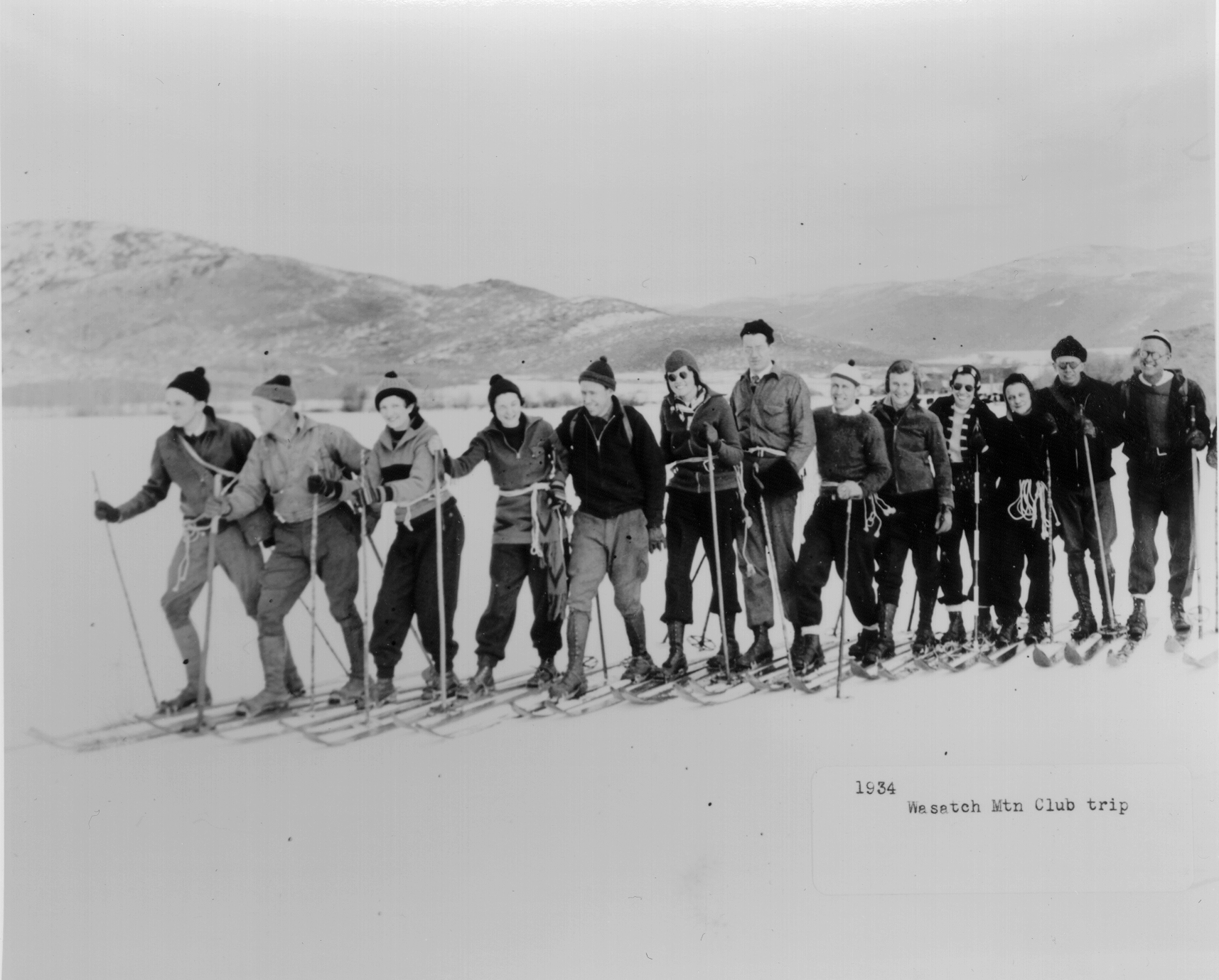
Ski fun in 1934 with the Wasatch Mountain Club. Credit: Special Collections J. Willard Marriott Library, University of Utah.
Every year, the country’s largest ski history research organization, the Utah Ski Archives, awards honors to movers and shakers in the ski industry.
This year the Wasatch Mountain Club earns the History Maker award for offering outdoor recreation for 100 years. It was founded with just 13 enthusiasts who enjoyed hiking, ski touring, and snowshoeing. A few years later it played a key role in the growth of skiing by offering “ski trains.”
Today it has about 1,000 members, and outdoor activities have changed with the times. The club’s non-competitive, muscle-powered offerings now include river running, mountain biking, back packing, and more. It also focuses on conservation and education.
The coveted S. J. Quinney award goes to Alta’s iconic Alan Engen for his life-long influence on skiing. Engen began as an award winning national and international ski champion, and his dedication to the sport continues to evolve today. He became the Director of Skiing at Alta, he’s in the U.S. Ski & Snowboard Hall of Fame, he’s a ski historian, and he’s authored several in-depth books about skiing. Then he found the Alf Engen Ski Museum in Park City, UT. It’s an interactive, must-see for everyone who visits here.
About the Utah Ski Archives
The Archives collection currently contains 500,000 images, 250 manuscripts and 6,000 audio, video and films. The collection is open to the public and is located in the University of Utah campus library in Salt Lake City. Every year, it holds a gala fundraiser to help support its mission of preserving ski history. And the gala honors individuals and organizations that are a major influence on ski industry.
Award winner Alan Engen smiles next to the photo of him at about age 2 wearing a diaper and ski boots and gleefully holding his first pair of skis. Credit: Harriet Wallis
https://seniorsskiing.com/wp-content/uploads/2019/11/WMC.png13791715Harriet Wallis/wp-content/uploads/2014/04/Seniors-Skiing-since2013-Logo@2x-300x68.pngHarriet Wallis2019-11-11 08:39:082019-11-11 08:52:52Archives Honors Ski Club And Life-Long Influencer
Last week I wrote about the “haves and have nots” in terms of favorable early season winter weather. The East was very cold with occasional snow while the West was warm and dry. For the most part, that is still the case, as the eastern Great Lakes and Northeast are in line for a reinforcing shot of arctic air this weekend. Temperatures will be suitable for significant snowmaking Saturday and Sunday. About a half dozen resorts are open in the Northeast, and several more are planning on turning lifts for the first time on Saturday.
The Great Lakes region has had the most consistently cold weather the past couple of weeks. At least a couple of Michigan resorts, Crystal Mountain and Boyne Highlands, will be in operation.
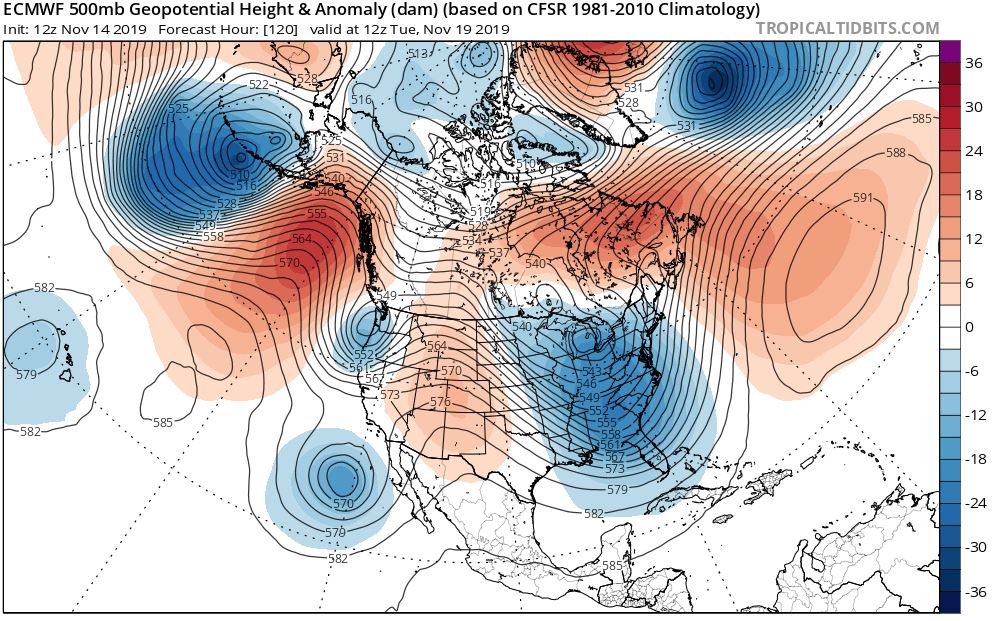
The push of arctic air will be the last for a while, due to some changes in the jet stream configuration over the continent later next week, over the western U.S. in particular. It’s not necessarily bad news in the East, but it certainly is good news for the West. Here is a jet stream forecast map for next Tuesday that helps illustrates the change.
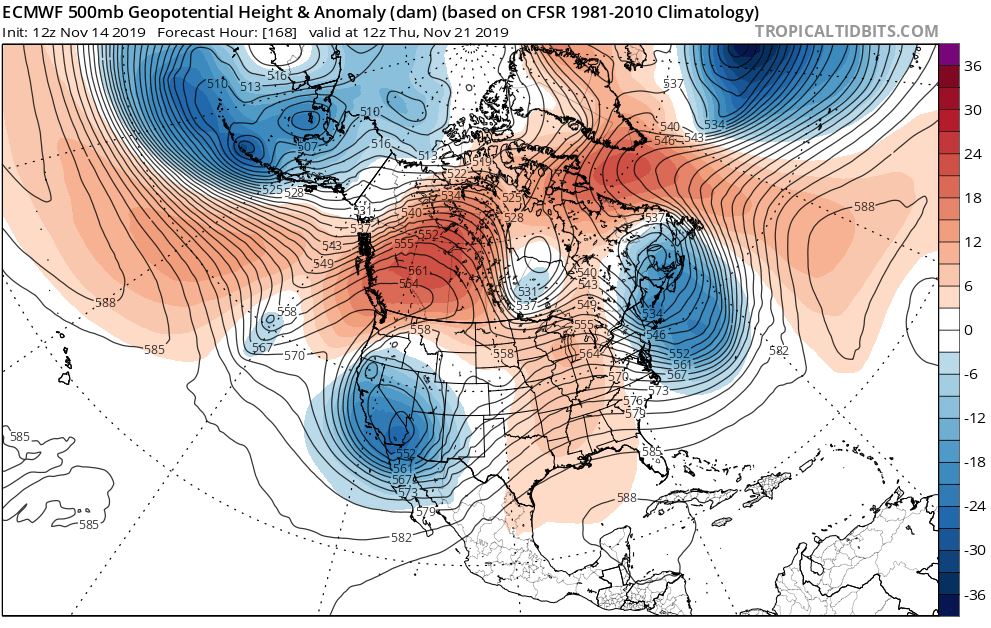
While a deep trough covers the eastern half of the country. I will get to that feature shortly. Notice a shorter wavelength trough along the Washington/Oregon coast. That system will bring snow to the mountains of Alberta and British Columbia, but it looks as though snow levels will be very high in the Cascades of Oregon and Washington. Remember, the waters of the northeast Pacific are quite a bit warmer than normal. That will help the eastern half of the country as we work through winter, but that warm water will tend to elevate snow levels in the Northwest. Now, the other trough along the west coast—west of Baja—will play a role in snow production later next week as the northern and southern branch jet stream features consolidate into a larger trough by next Thursday. Take a look.
The more organized trough will have both the strength and the moisture to bring a meaningful snowfall to the mountains of the Southwest and the southern and perhaps central Rockies late next week into next weekend.
This map also shows us the subtle changes that will cause the extreme November cold that we have seen in the Lakes and Northeast to back down somewhat as we head toward Thanksgiving. If you recall, last week’s discussion made note of the direct discharge of arctic air from the high latitudes, the product of the combined circulation around a Gulf of Alaska ridge and an eastern trough. That couplet combined for a straight shot from the arctic to the mid latitudes. Look at that flow now on the second map. Start in New York and head west along one of the lines. You will see several changes in direction and eventually you will end up over those temperate waters of the northeast Pacific. Yes, there is still some very cold air involved in the pattern, but Pacific air is blended in, cutting back on the intensity of the cold.
Fear not. The pattern is not going to turn noticeably warmer over the eastern half of the country, but it will turn “less cold”. Temps will still be favorable for nighttime snowmaking, and a storm that works its way up the coast on Tuesday/Wednesday will likely produce some snow in the mountains of New York and northern New England. Meanwhile, after a mild start to November, parts of the West will see some bonafide winter weather in the next week.
https://seniorsskiing.com/wp-content/uploads/2019/11/seniorski1.jpg621995Herb Stevens/wp-content/uploads/2014/04/Seniors-Skiing-since2013-Logo@2x-300x68.pngHerb Stevens2019-11-11 07:39:592019-11-14 19:41:52Skiing Weatherman: Good News Goes West
Incidents and Accidents New Feature, Joe Pete Memory, Have A Banana, Pointy Mystery Peak, Weather Haves/Have Nots.
Based on the significant response to recent articles on out-of-control skiers, the responsibilities of the National Ski Patrol, and the role of ski resort management in managing high-risk skiers and boarders, SeniorsSkiing.com is starting a new feature.
If you are a pilot or a mariner/sailor, you know that it is standard good practice to analyze accidents or incidents to learn from them and become a better practitioner. We are going to use the same approach with “Incidents and Accidents,” a feature where our readers can submit their stories about collisions, accidents, near-misses, screw-ups of different kinds and what can be learned from them.
Here’s how it will work.
We are asking our readers to share their stories following a clear format so we can eventually analyze these submissions to see what can be learned from your collective experiences and to provide the SeniorsSkiing.com community with important feedback. That analysis also may be influential in creating change in the ski industry.
Here’s the outline to follow:
Briefly describe yourself, (i.e. male weekend skier), age, years of skiing, and if you’re a regular at the resort where the incident happened.
Describe what happened. Who did what to whom? What were conditions? Who were you with? Where you moving or stationary? Try to be succinct, objective, and clear.
If the NSP was involved, what did they do? If management was involved, what did it do?
If you were injured, how severely? Were you able to return to skiing? How long were you sidelined?
What lessons can be learned from the incident? What did you learn? What did or should resort management learn?
Send your story in a Word attachment or include it in an email message. Try to keep the length to 500-600 words. Remember, there are always two sides to a story; write a balanced, fair accounting. We’ll review each and edit, if necessary. Not all stories will be published, but all submitted information will play a role in helping us provide feedback to the community. Send submissions to: INFO@SeniorsSkiing.com.
We plan to edit and publish stories on a regular basis.
This Week
Joe Pete Wilson
Correspondent Roger Lohr shares a memory of Joe Pete Wilson, a legend in the cross-country skiing world who spent his entire career in some aspect of the snow sports industry.
Perhaps you have an old copy of Joe Pete’s book on learning how to cross-country ski?
We reprise a short article about bananas, of all things, and why you should include a couple in your ski bag. Don’t laugh; bananas are an excellent fuel food for senior skiers.
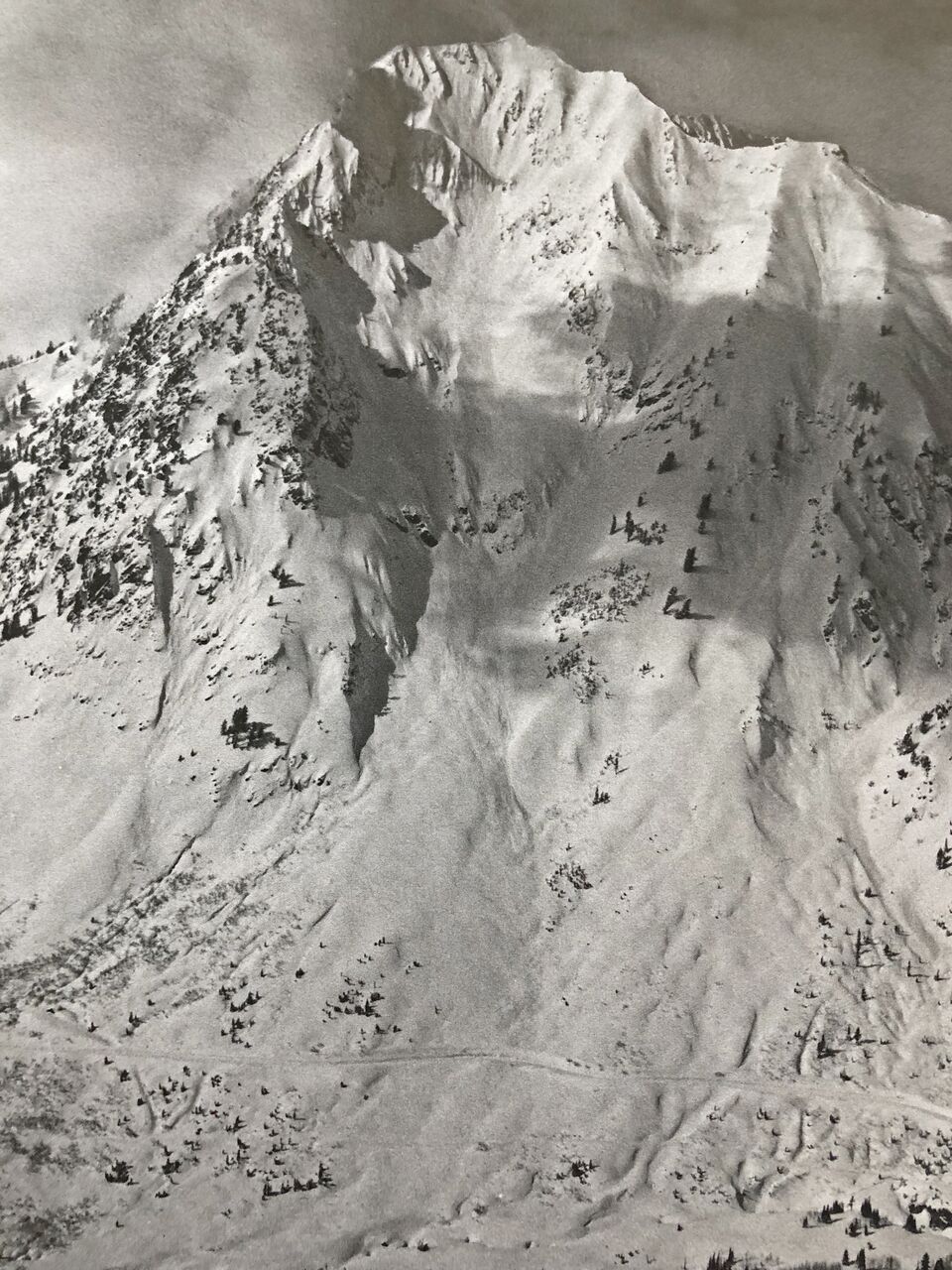
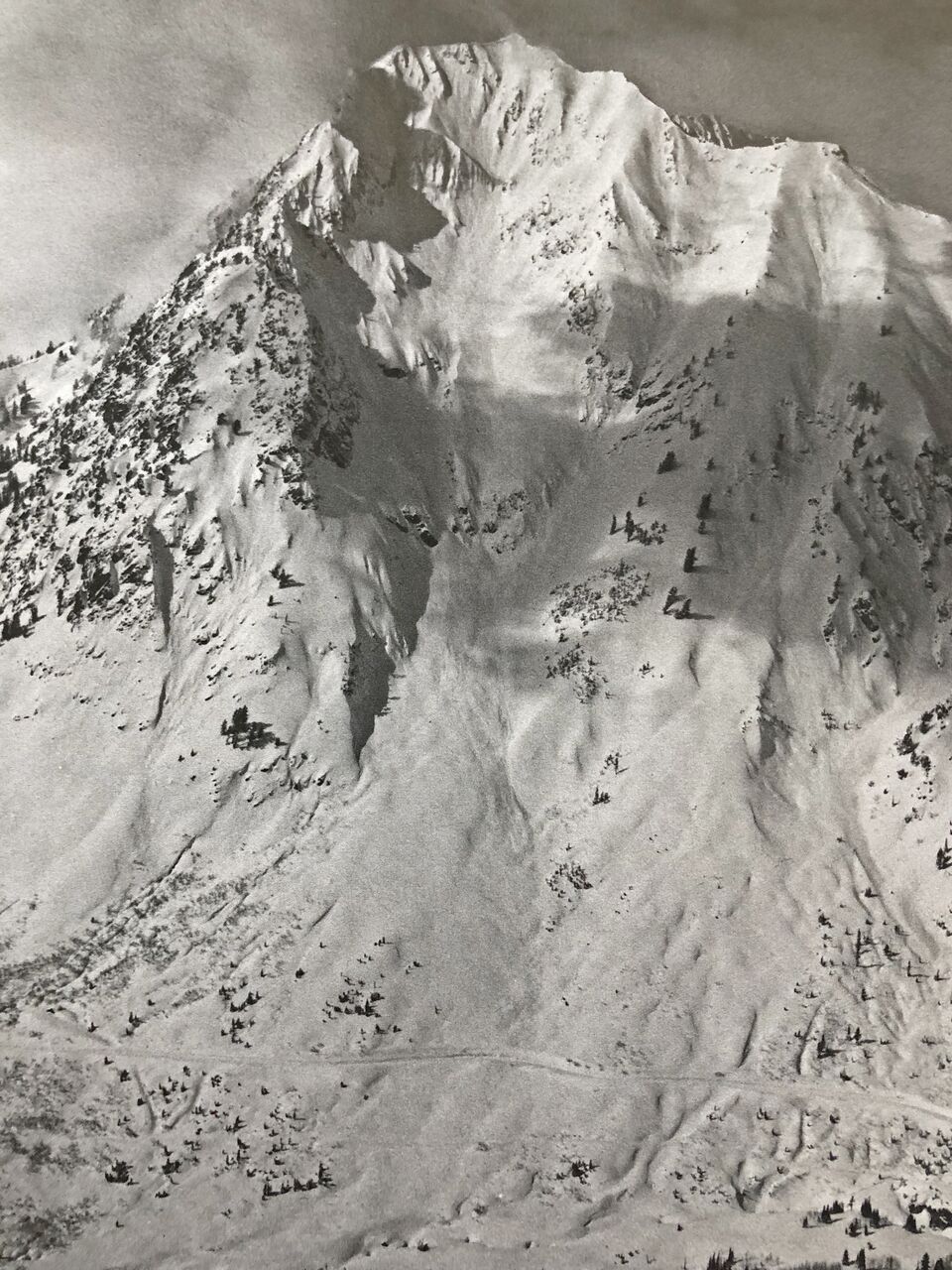
Our Mystery Glimpse goes out west again, this time a familiar mountain near a familiar ski resort.Do you know its name?
Thanks for reading SeniorsSkiing.com. Tell your friends. We’re heading to the ski show next week in Boston. If you haven’t gotten a ticket yet, click on the Boston Ski/Snowboard Expo for a discount. See you there.
Remember, there are more of us everyday, and we aren’t going away.
https://seniorsskiing.com/wp-content/uploads/2019/11/historic6-e1582739799348.jpg546728seniorsskiing/wp-content/uploads/2014/04/Seniors-Skiing-since2013-Logo@2x-300x68.pngseniorsskiing2019-11-08 00:31:232024-08-21 10:47:53This Week In SeniorsSkiing.com (Nov. 8)
Joe Pete Wilson recently passed away at age 84. He will be remembered as a pioneer and endless promoter in the snow sports world.
Wilson hailed from Lake Placid, NY where he spent years as the innkeeper at the Bark Eater Inn in nearby Keene. His tireless work to promote cross country skiing was recognized by the former Ski Trax Magazine as one of the top 10 promoters of cross country skiing in the US.
Wilson competed in the 30 km race at the 1960 Winter Olympics in Squaw Valley, CA. In 1972 he directed operations at Trapp Family Lodge in Stowe, VT which was one of the first cross country ski area resorts in the US.
Wilson’s history is like a guide to snow sports guide. He led the Vermont Ski Areas Association and was the general manager of Burke Mountain in 1966-69. Later he sold real estate at Glen Ellen. Drawing on his experience on the four-man bobsleigh team that competed in St. Moritz in 1965, Wilson later became the venue manager for bobsled and luge for the Lake Placid Olympics in 1977-78.
In cross country skiing, Joe Pete was honored by the Professional Ski Instructors Association for developing the teaching system for cross country skiing. He was also involved with setting up the original Eastern Professional Ski Touring Instructors organization (EPSTI). Additionally, Wilson had a hand in organizing the Northeast Ski Touring Operators Association, which became the National Ski Touring Operators Association, where he was the organization’s first president 1973-77. Today this North American organization is known as the Cross Country Ski Areas Association.
Wilson has a place in the St. Lawrence University Hall of Fame and in 2001 he was elected to the Lake Placid Hall of Fame. In 2014, Wilson was given the Founders Award by the Cross Country Ski Areas Association. During his life he also coached local high school cross country skiers as well as the US Biathlon Team.
Along the way, Wilson built a polo field at the Bark Eater Inn on a hillside farm in 1981. He also built a trail system in the Keene area while his stable grew to 85 horses. In 1977, Wilson co-wrote the book Complete Cross-Country Skiing & Ski Touring, and later in 1986 he helped to produce the coffee table book Cross Country Ski Inns of the Northeastern US and Canada.
In his later years, I exchanged emails with Joe Pete and discussed his XC ski-snowshoe invention that he wanted to manufacture and market. He shared his invention drawings and strategies with me, but mostly it was laughing and remembering old times. During his many years at the Cross Country Ski Area Association meetings, he would stand up to share old fashioned stories that usually had a humorous punchline at the end. If cross country skiing had its own hall of fame and museum in the US, Joe Pete Wilson would be among the first to be honored.
https://seniorsskiing.com/wp-content/uploads/2019/11/Screen-Shot-2019-11-05-at-11.44.34-AM.png377421Roger Lohr/wp-content/uploads/2014/04/Seniors-Skiing-since2013-Logo@2x-300x68.pngRoger Lohr2019-11-06 09:15:502019-11-06 09:15:52Remembering Joe Pete Wilson
Early days at Steamboat Springs. Each of two sleds held ten skiers. This unusual lift served Howelsen Hill in the mid 1940s. If anyone knows the back story of this “lift”, please let us know.
The Difference Between East and West Is Remarkable.
Over the past few weeks, I have shared with you some of my winter forecasting tricks of the trade but now it is time to get down to business and do some actual forecasting.
The pattern change that was foretold a couple of weeks ago by the re-curvature of a typhoon east of Japan is well underway (The “Typhoon Rule”). By this weekend an unseasonably cold upper trough will cover the eastern half of the country. The air that the trough delivers will be of arctic origin, and, although it travels over ground that is not yet covered with snow, it will still be cold enough for some productive snowmaking in the taller mountains of the Northeast and as far south as resorts in the central Appalachians.
Better yet, the cold air will rush in on the heels of a low pressure system that will generate a swath of snow from the Great Lakes eastward to the interior Northeast. Lake effect snow will kick in downwind of Erie and Ontario for a short time, but because the system will be progressive, that backside snow won’t last very long. This looks like a three- to six- inch event from the Adirondacks eastward through the Greens and Whites and on into the mountains of Maine. That may not seem like much, but that first inch of machine made snow is laid down a lot faster when it lands on crystals and not leaves and dirt. The cold temps this weekend will help to chill the soil, too.
On a broader scale, the developing pattern will be one of the “haves” and the “have nots” with respect to cold weather and prospects for snow. Here is what the jet stream pattern is likely to resemble late next week
The deep trough will cover much of the eastern half of the country, with a strong ridge covering the waters of the eastern Pacific. Clockwise flow around the ridge will combine with counterclockwise flow around the trough to tap into air masses from far to the north. This setup is ideal for the delivery of cold to the Midwest and East. This next map shows the expected temperature anomalies at the five thousand foot level in a week from now. That altitude level is a proxy for forecasting surface temps.
The purple shading tells me that the air will be plenty cold for snowmaking and natural snow opportunities from the upper Midwest through the Northeast. That takes us to the middle of the month, but my sense is that the same general pattern will persist until after the 20th or so, and perhaps close to Thanksgiving. From time to time, smaller scale disturbances embedded in the flow around the trough will spin through the Lakes and into the East, and those systems will represent the best shots at natural snow over the next couple of weeks.
That is the good news. While eastern North America will be unseasonably cold for the foreseeable future, thanks to the trough, the not-so-good news is that the ridge over the Pacific will keep temps above normal for the most part from the Continental Divide westward, as the temperature anomaly map suggests.
Some snowmaking will be possible at times in the higher elevations of the West, but natural snow will be hard to come by in this pattern. In the heart of winter, there is enough cold air around for both the West and the East to be cold simultaneously, but we are still six weeks away from the START of winter, so we are playing the game of “haves” and “have nots”. For now, it is “advantage Midwest and East”.
https://seniorsskiing.com/wp-content/uploads/2019/11/slide-2.jpg629995Herb Stevens/wp-content/uploads/2014/04/Seniors-Skiing-since2013-Logo@2x-300x68.pngHerb Stevens2019-11-04 10:05:202019-11-07 10:07:56The Skiing Weatherman: Haves And Have Nots
And as you have probably read in last week’s edition, the National Ski Patrol has stated the responsibility for enforcing the Skier’s Code of Responsibility is up to the resorts. Although some readers were disappointed with that response, when you think about it, it makes sense. NSP are volunteers at a resort, and the resort usually maintains a paid staff of patrollers who administer safety policy. However, as we have heard from the comments, some resorts are good at this, and some aren’t.
The answer to that question is partly taking form through the work of the Snow Sports Safety Foundation which was featured in last week’s Short Swings. This non-profit provides safety ratings for ski resorts, currently displaying “Resort Scores” for some California, Nevada, and Colorado resorts.
The question now turns to who among the many and diverse resorts are serious about lifting the tickets and passes of out-of-control, hit-and-run, high-risk skiers and boarders and who is, well, less serious.
Some resorts understand the value of enforcing the Skier’s Code of Responsibility. For instance, Vail Resorts, at Vail in Colorado, displays an electronic scoreboard of how many season passes or tickets have been lifted for reckless or dangerous skiing or boarding. So, this is a serious issue being addressed by some resorts. Emphasis on “some”.
SeniorsSkiing.com is planning to collaborate with Snow Sports Safety Foundation in the coming months on its efforts to bring skier and boarder safety into focus. Watch this space for upcoming developments.
This Week
We know that many SeniorsSkiing.com readers are veterans of the armed forces. This week, correspondent and XCSkiResorts.com publisher Roger Lohr reports on a number of programs that bring disabled vets into the outdoors for therapy. Click here.
Our Mystery Glimpse presents an odd vehicle for getting skiers up and around a ski resort somewhere out West. And yes, the snow-dusted mountain top photo from last week was indeed Killington. Our thanks to a friendly pilot who happened to snap a great aerial shot of the mountain.
Our UK-based ski coach correspondent Bob Trueman has a really interesting article on the five things he’s learned about teaching seniors. Bob has a unique approach to ski “coaching”, based on a cognitive understanding of what the body is being asked to do.
The Skiing Weatherman, Herb Stevens, introduces us to a meteorological concept: The NAO or North Atlantic Oscillation. The strength and relative position of the NAO between the Iceland Low and the Azores High determines the kind of weather we will be getting on the east coast. Fascinating stuff. Click here.
If you have any updates and/or corrections to our listing of 157 Ski Resorts in North America that offer free or really big bargain discounts for seniors, please send to info@seniorsskiing.com. To locate the listing of Free or Big Bargain Resorts, go to COMMUNITY>SUBSCRIBER-ONLY CONTENT and scroll down.
Once again, thanks for reading SeniorsSkiing.com. Tell your friends and remember there are more of us every day, and we aren’t going away.
https://seniorsskiing.com/wp-content/uploads/2019/10/Screen-Shot-2019-10-31-at-10.24.17-AM.png347224seniorsskiing/wp-content/uploads/2014/04/Seniors-Skiing-since2013-Logo@2x-300x68.pngseniorsskiing2019-11-01 00:31:122024-08-21 10:48:48This Week In SeniorsSkiing.com (Nov. 1)
A Negative NAO IS Friendly To Skiers. Right Now, It’s Smiling.
During the upcoming winter I will be producing condensed regional forecasts on a weekly basis, hopefully providing readers with another nugget of info before they pick a destination for time on the slopes. I will refer to a number of different reasons for forecasts that you will probably not hear from other sources. Things like the Typhoon Rule that I wrote about last week and SSW (Sudden Stratospheric Warming) episodes. In addition, I will use a number of “teleconnections” around the northern hemisphere.
A teleconnection is a relationship between surface and/or jet stream level features located thousands of miles apart both west to east and north to south. Each one has a correlation to different types of winter weather in different parts of the country. Examples are the SOI (Southern Oscillation Index), AO (Arctic Oscillation), EPO (Eastern Pacific Oscillation), and MJO (Madden Julian Oscillation). One of the most significant winter teleconnections for snow lovers east of the Rockies is the NAO (North Atlantic Oscillation), which I would like to explain today.
The components of the NAO are found over the waters of the North Atlantic and the teleconnection is based on the difference in sea level pressure between two persistent features: the Icelandic low and an Azores high. The relative positions and comparative strengths of these features determine the sign (positive or negative) of the NAO.
When the two systems are relatively strong, the interactive circulation between them (counterclockwise around the low to the north and clockwise around the high to the south) speeds up, which results in more of a zonal, or west to east flow across the Atlantic. That setup makes it easier for cold outbreaks from Canada to be ushered offshore after only a brief visit to the central and eastern U.S. This is an example of a positive NAO.
When the two systems are weaker, the flow can buckle more easily, not only at the surface but also aloft. When that happens, upper troughs are favored over central and eastern North America and blocking ridges can be found in the vicinity of Iceland and Greenland. This is the configuration when the NAO is negative.
Jet stream patterns are more persistent when there is greater amplitude of troughs and ridges. When the NAO goes negative, the trough acts as a receptacle for cold air from Canada. The development of such troughs often spawns surface storms, many of which bring snow to the Lakes, mid-Atlantic, and Northeast, often in the form of a disturbance that becomes a coastal “Nor’easter”. It is worth noting that a correlation exists between low solar activity (we are now very near the minimum of the 11 year solar cycle) and North Atlantic blocking patterns that support a persistent negative NAO. So, there is reason to believe that the NAO will be in a mode friendly to skiers and riders at least a fair amount of the time this winter.
Here are depictions of the two modes of the NAO…
Now that November is here I know that many or you are starting to get as revved up about the season as I am and you are looking for snow, or at least temperatures cold enough for productive snowmaking. The Rockies have gotten off a fast start and the first shot of true cold air has reached the Great Lakes this week and will spread into the Northeast over the upcoming weekend. The first half of the new month, at least, looks good for cold and some natural snow roughly north of I-80 from the Midwest into the Northeast. It won’t be long now.
https://seniorsskiing.com/wp-content/uploads/2019/10/nao.jpg4401019Herb Stevens/wp-content/uploads/2014/04/Seniors-Skiing-since2013-Logo@2x-300x68.pngHerb Stevens2019-10-31 15:15:542019-10-31 15:15:55The Skiing Weatherman: Knowing The NAO
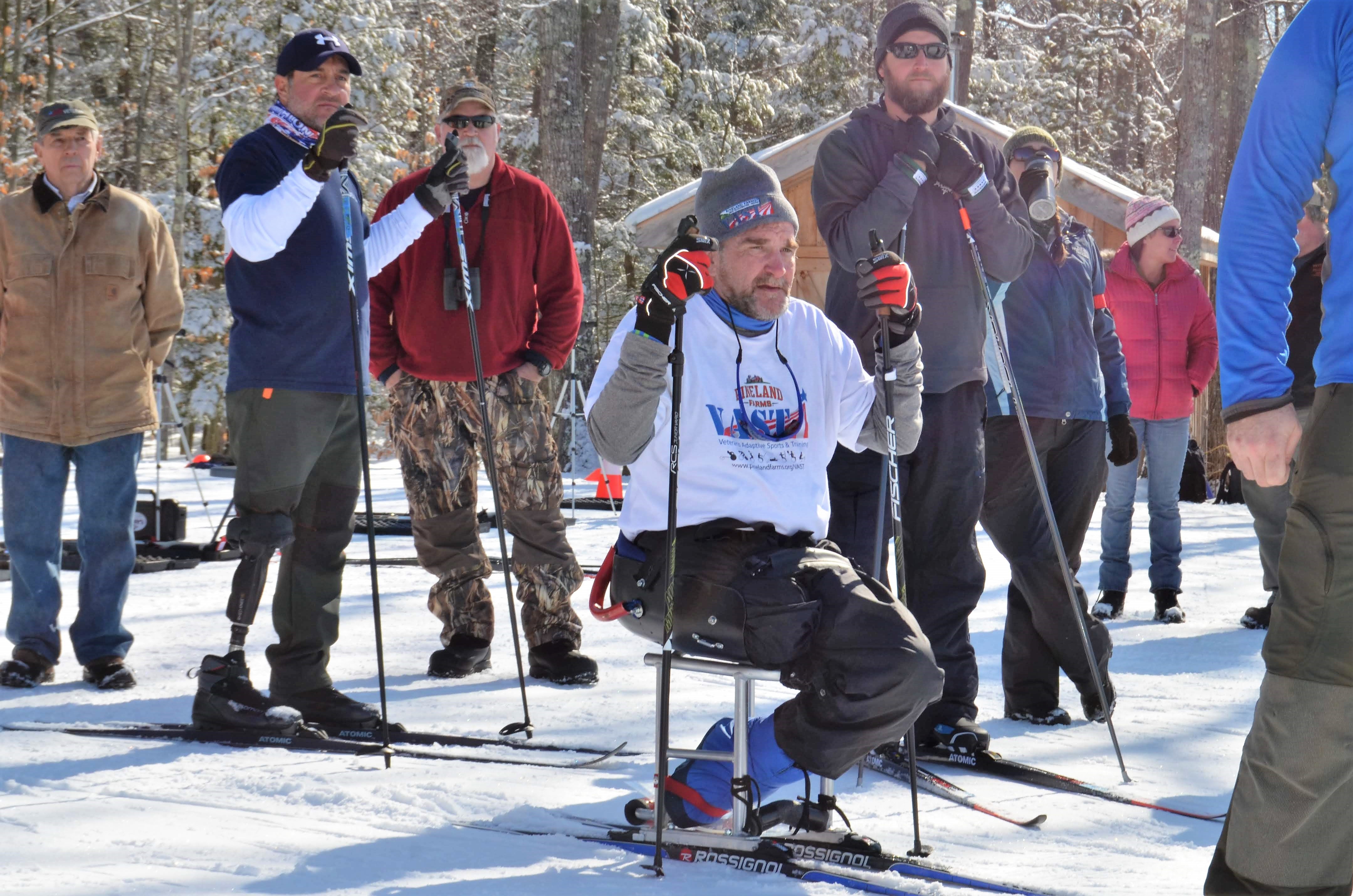
Pineland Farms Veterans Adaptive Sports and Training in action.
More doctors may be prescribing outdoor recreational therapy instead of Xanax if the proposed Federal legislation entitled the Outdoor Recreation Therapy for Veterans Act (HR 2435) passes. Studies are showing evidence that outdoor recreational activities can be therapeutic. I met Veterans Ray Gilmore and David Binford recently at a ski industry meeting, and they were engaging anyone who would talk with them about the Azimuth Check Foundation, which provides injured veterans and first responders challenging year-round athletic activities to create wellness in an atmosphere of camaraderie.
“Whether these vets have seen or unseen injuries, they can find peace in the outdoors,” they said. They feel that participation in activities such as alpine and Nordic skiing, snowboarding, kayaking, hiking, fishing, cycling, indoor rock climbing, wood carving and art, aquatics, golf, water skiing, stand up paddle-boarding, archery, and even bowling will build self-esteem and accomplishment.
Some veterans and first responders who have experienced visual impairments, amputations, and other physical and mental challenges have discovered organizations that orchestrate recreational activities, which can positively impact their well-being through adaptive recreation programs. Azimuth partners with other organizations such as the Veterans Adaptive Sports and Training, Adaptive Sports of the North Country, Ability Plus Adaptive Sports, Vermont Adaptive Ski & Sports, and Northeast Passage.
Misha Pemble-Belkin of Vermont Adaptive Ski & Sports’ Veterans Ventures program commented, “I’ve taken anti-depressants and done talk therapy but nothing I tried has worked. It was like my brain was still at war.” Different than working with healthcare providers in an office setting, this real world/real time approach to creating solutions for active and engaged living takes the guess work out of what happens when you go home or are discharged from care.
Gilmore talked about difficulty “shutting the motor off whereby the adrenaline remains and has become toxic.” The recreational activities help to create new memories and meaningful relationships. Beside physical challenges, many vets are faced with post traumatic stress (PTSD). While a stigma may remain about this condition, more veterans are now acknowledging it and seeking help.
Some of these program participants express that they’ve have had enough of meds and therapy Recreational programs can stimulate problem solving, collaboration, camaraderie, relevant and meaningful goals, as well as develop sustainable healthy behavior.
One vet referred to taking “meds” which made him feel like a “zombie” and took away the passion and joy of life. That vet commented that participating in recreational programs and outdoor activities such as skiing, hiking, rock climbing has helped to re-instill periods of passion and joy in his life.
How does it work?
At Northeast Passage, a recreation therapist (RT) meets with an individual to complete an initial assessment. The RT talks about health conditions, interests, personal strengths, and local resources. They will also use standardized assessment tools as part of a collaborative process to identify goals, and a plan for achieving them, while working together.
In follow up appointments, the vet and RT are in the community actively engaged in recreation. At the same time, they’ll likely be creating community connections, learning about equipment, developing skills, and aspects of themselves that support continued active participation and a healthier experience.
Kristina Sabasteansk,i an Army Veteran, runs programs at Pineland Farms’ Veterans Adaptive Sports & Training in southern Maine, which offers year-round programming for vets with disabilities. She said, “Last year we took veterans and volunteers to Maine Huts and Trails in Kingsfield, ME. It was -9 F the day we left to go home, and there wasn’t a single complaint among the group. Sometimes the vets crave challenges similar to what they experienced in the military such as harsh winter conditions and strenuous activities.
Pineland Farm’s yearly Biathlon Camp had 16 Veterans with disabilities – ranging from SCI, amputations, TBI, blindness, PTSD and TBI, and other orthopedic issues. “Many had never even seen snow before the camp and by the last day they cross country skied and competed in a biathlon race against each other. These trips and activities with fellow Vets allow them to share their experiences in the military and they realize they are not alone in their struggles.”
Retired SSG Misha Pemble-Belkin of Vermont Adaptive Veteran had 170 vet participants for more than a thousand activities including winter sports such as skiing, XC skiing, and snowboarding. “It’s vets helping vets to learn these sports.” According to Pemble-Belkin, “There was a study of 1,200 Vets who were split into a group taking three of the major meds and a group taking a placebo, and it showed similar results. While the war experience was stored in your brain, outdoor recreation can provide some joy and passion that is a relief to the miserable times being home alone or unengaged.”
This Strange Device Held 10 Skiers. Hint: Western resort. Many thanks to the Tread Of Pioneers Museum for this contribution.
Last Week
October Snow.
Of course, Killington. We took advantage of a picture of the resort a day or two after a major pair of Nor’Easters in New England taken by a pilot friend of ours. The snow dusting bodes well for Killington. The resort is hosting the 2019 Audi Women’s World Cup on Nov. 29th, that’s just four weeks away!
https://seniorsskiing.com/wp-content/uploads/2019/10/Screen-Shot-2019-10-28-at-11.00.08-AM.png443302mikemaginn/wp-content/uploads/2014/04/Seniors-Skiing-since2013-Logo@2x-300x68.pngmikemaginn2019-10-30 11:42:272019-10-30 12:13:26Mystery Glimpse: Tow Boat
Ski Coach Bob Trueman shows how to assume a proper stance.
The
hardest challenge for me is convincing older skiers that you can change
your skiing dramatically for the better no matter your age or gender. Not everyone wants to, but if you do, you
can.
That’s the key to advancing your skiing as a senior skier.
Lesson One: The Key Is Belief In Change.
My most recent pupil—a man of 80—has powerful imagery skill, considerable confidence, and knows how to relax and reduce anxiety. He’s fit for his age. He also has years of skiing behind him: but not quality skiing, just “getting down things”.
But he
didn’t know what to DO. In our first
session he found two small actions that reaped big changes. In all those years no instructor had ever
told him how to hold his hands for best results! From that moment on his self-belief, his
hopes for the future, took off. He ain’t
done yet!
Lesson Two: You Will Improve Faster If You Ski Slower.
Provided you know what you intend to do—what movement you will make and you know how you will know what you actually do, do. Don’t try to “ski”. Decide to make one movement only.
If you ski fast, you’ll have too much to think about. You won’t be able to focus, and you’ll be back to “getting down things”. Ski slower, improve faster.
Lesson Three: Patience Pays.
Be non-judgmental. The more patient you are, the sooner you’ll reach your goal. Being in a hurry slows you down. So does cussing yourself. Even older skiers with years of life experience still call themselves names.
Lesson Four: Your Learning Curve Will Be Steeper When The Slope Isn’t.
Once I have convinced my older skier that it isn’t “baby-ish” to work on changes on beginner slopes, we make faster progress. It’s an intelligent approach to do so; it’s not smart to work on new things on steep ones.
Learn your new techniques and become skillful with them on the easy slopes, where you have less to think about and “survival” is not an issue, and only then head up the hill.
Lesson Five: Work On The “Intention/Attention Feedback Loop”.
What has worked best in every instance for over 25 years has been what we ski coaches call the “Intention/Attention Feedback Loop”.
It works for everyone, but for my older skiers who for the most part are higher educated, mature, and thoughtful, it has worked even better. It has been a revelation for them.
It goes like this.
Decide before you set off precisely what movement you will practice. Decide which of your senses will give you the best feedback. Will you feel it, see it, smell it, etc.? When you stop, after only say 50 yards, mentally review it. Ski only very short distances at a time when you’re training.
The results all my older skiers get is the sheer satisfaction of finding they’re not washed up, and they are becoming more controlled skillful skiers than they ever believed they could. It pays huge dividends.
[Editor Note: You can read more in Bob Trueman’s books. Search Amazon here. And even more explanation on his new, free Youtube Channel “Ski In Control With Bobski” where you’ll also find some the movements to make.]
https://seniorsskiing.com/wp-content/uploads/2019/10/Screen-Shot-2019-10-30-at-9.40.13-AM.png299512Bob Trueman/wp-content/uploads/2014/04/Seniors-Skiing-since2013-Logo@2x-300x68.pngBob Trueman2019-10-30 09:51:002019-10-31 07:24:45Lessons Learned From 25 Years Of Coaching Seniors
The consumer ski shows are on! The Denver Ski and Snowboard Expo is on today!
The ski shows are a special time for all stakeholders. The resort industry gets a chance to strut its stuff, announcing new trails, lifts, amenities, and bargain price passes. Resort staff are there to answer questions, convivalize with familiar customers, gossip, and generally accentuate the positive about new and old features at the resort.
Some shows have clothing and gear retailers on site, lots of discounts in a bargain basement atmosphere. And clothing and gear manufacturers are showing their latest.
And then there’s the hodge-podge of other exhibitors who have miscellaneous products related to snow sports. Easy chair made of old skis? Check. Ski club? Check. Artisanal ski manufacturer? Yes. And publications and media companies, non-profits (museums, adaptive skiing groups), tour companies, discount ticket vendors, and many others.
For the consumer, it’s a time not unlike the coming of Labor Day is to a high school student. There’s a shift that’s been coming for a while, away from the remnants of summer activities, and toward winter, which is just around the calendar corner. Or which has already arrived in many places.
Get excited, pick up those Hersey Kisses, lollipops and free pens, trail maps, and ski magazines; every exhibitor has something to hand out. Put those in that big plastic bag and spend your evenings checking out and anticipating.
The shows are part of the rhythm of snow sports. Enjoy the official start of the season.
You can get a $3 discount if you get tickets through SeniorsSkiing.com by clicking on the banner ad in the top right of the home screen.
For a schedule of consumer ski/snowboard shows around the country, click here. Thanks to Mary Jo Tarallo of SunAndSnowAdventures.com for sharing her article.
This Week
The role of ski patrolman on monitoring out-of-control skiers and boarders has been an open question since SeniorsSkiing.com and readers have started questioning who is responsible for lifting tickets.
So, we asked Meegan Moszynski, Executive Director of the National Ski Patrol, for clarity. Click here for her response. Your thoughts?
How does a typhoon in the western Pacific ocean impact weather in the US and Canada? As with most things related to the weather, all phenomena are connected. The Skiing Weatherman Herb Stevens explains “The Typhoon Rule” which is one of the few reliable long range (two weeks) predictors of weather. Interesting stuff. Click here.
Correspondent Pat McCloskey explains how familiarity with terrain and trails can lead to confidence. Even gnarly, challenging terrain. If you could do it before, you can most likely do it again. Here’s his story.
Where?
Our Mystery Glimpse this week shows us an aerial view taken just this week of a notable resort dusted with beautiful covering of October snow. Tell us where it is. You’ll also learn where that apres-ski disco from last week is located. Here’s the picture.
Thanks again for reading SeniorsSkiing.com. Tell your friends! Remember, there are more of us every day and we aren’t going away.
https://seniorsskiing.com/wp-content/uploads/2019/10/Screen-Shot-2019-10-23-at-12.55.39-PM.png401534seniorsskiing/wp-content/uploads/2014/04/Seniors-Skiing-since2013-Logo@2x-300x68.pngseniorsskiing2019-10-25 00:45:172019-10-24 10:43:28This Week In SeniorsSkiing.com (Oct. 25)