Skiing Weatherman: Something For Everone

Snow For All.

Often when I write this piece, I have good news for one region of the country and not-so good news for other areas of ski country. Such is the nature of winter weather across a country that stretches 3,000 miles from coast to coast and with so many and varied climate zones. However, just as there are times in the middle of the summer when much of the country is warmer than normal, occasionally we see a pattern in winter where most or all of the skiing regions get lined up for significant snowfall at roughly the same time. We are entering just such a period.

In order for a favorable pattern to set up for such a large area of the country we obviously need an ample supply of cold air. From mid-December until just recently, most of the air flowing across the country was of Pacific origin, not the prime source region for winter weather. The jet stream configuration now in place is tapping cold air from the northwestern corner of the continent. There is still a risk that we could see an intrusion of severely cold arctic air by the end of the month, but at a minimum, enough cold has showed up to make even southern regions cold enough to be on the lookout for fresh snow. It certainly helps that this is the time of year when normal temps in most areas are right at their climatological minimums for the year. To illustrate the extent of the cold air, here is a look at the forecasted 5,000 foot level for Friday, Jan. 29th

The area shaded in hues of blue indicate where temps will be below freezing. Sub-freezing temps at that level are a proxy for where the column of air overhead is cold enough to support snow, even the southern Appalachians look sufficiently cold.

The other ingredient for widespread snow is a favorable jet stream configuration. Here is a forecast for the jet stream for late next week that I agree with, showing three key components to a snowy pattern from coast to coast.
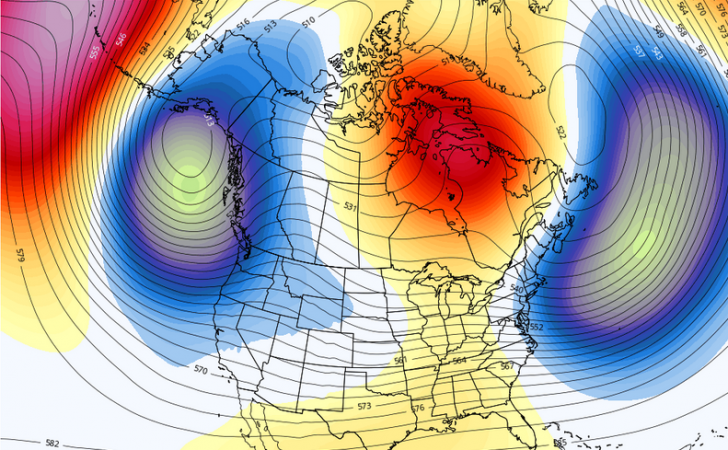
The trough along the west coast will produce fresh snow from Alaska down to the southern Sierra, and inland to AZ and NM as well. Storms from the southern end of that trough will traverse the country and bring the opportunity for snow to the central and southern Appalachians. The red ridge over northeastern Canada will remain in place and help keep storms from cutting through the Great Lakes, which would produce rain to the east of the track. Northern disturbances will come out of the Gulf of Alaska, move along the U.S./Canadian border, and produce snow in the Great Lakes and Northeast from time to time. Those systems are often called Alberta Clippers because they typically move through that province. If the impulses in the northern and southern branches of the jet combine forces, the trough off the east coast will be pulled westward and potentially lead to a blockbuster coastal storm for the mid-Atlantic and Northeast. The potential is high nationwide. Let’s hope the pattern delivers the goods!!!

Regional Details

Northwest U.S./Western Canada: The trough along the coast produces multiple rounds of meaningful snow over the next couple of weeks. No issues with snow levels due to input of arctic air.

Sierra: Trough extends far enough south to produce a much more active storm pattern to this region.

Rockies: Full length of the mountain range will have frequent snow events into early February.

Midwest: Clipper systems keep coming every two-three days into next month. Each one will produce light snow with backside lake effect, as well.

Mid Atlantic/Southeast:  Cold enough for snowmaking; southern storm track could generate natural snow at times.

Northeast/QB: Clipper systems help northern resorts with light snow at times. Ridge over Canada likely to suppress major storm track too much UNLESS two jet branches combine for coastal storm.
Make More Tracks: Beginning Cross-Country

Looking For Alternatives? Here’s A Starter Kit For XC.

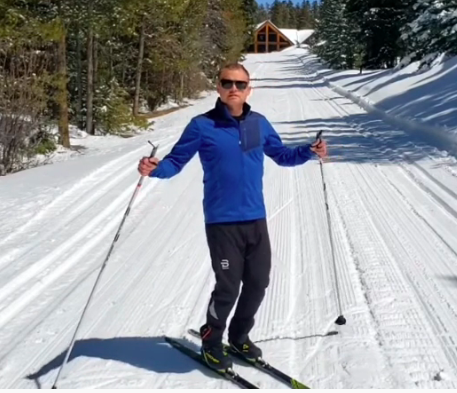
SeniorsSkiing.com has published several articles on getting started in cross-country skiing.  Here’s another view from Breckenridge Nordic Center. We watched all nine minutes and picked up lots of new tips, despite our many years of xc skiing.  Get going!

Instructional Advice: Don’t Do Turns

Words Matter. Why “Arcs” Works Better Than “Turns”. 

Arc thinking makes a difference. Perhaps.

Recently I wrote a small piece on how to handle tough skiing situations and used the word “arcs” where most folk would use the word “turn”. My insistence on using the word “arc’”raised an eyebrow or two on the grounds that it was perhaps mere semantics or even nit-picking. Believe me, it isn’t.

Every single ski instructor I have ever met only uses the word “turn(s)”. You are admonished to “do turns”.  Even worse, you are recommended by some to “turn your skis”. It  tells you nothing at all about what movements you need to make with your legs/feet/body while in motion. 

What on earth is it supposed to mean? Is that how skis work, by “turning” them?  Is that a route to understanding, and to excellent skiing? No. Most of the movements you make should be in response to the skis, very little to do with making them do things.

What Is Really Happening When A Ski Changes Direction ?

The objection I have to using the lazy word “turn” is that it does not describe what happens.  It tells you nothing about how a ski changes direction and carries you with it.  It suggests that you do the “turn”.  You can “turn” a lot of things—a quick buck;  you can turn to the person on your left; you can turn a screwdriver; you can turn a triumph into a disaster. There is no end to the things you can turn.

An arc is a segment of a circle.

But let’s talk about skiing.  When you or an instructor refer to a “turn” in skiing, that is becomes something you think you do. But it is not what happens.

A change of direction may occur, (it may not) but that is an outcome of things you do, and of things that happen at the interface of the snow and the ski; it is not what you do.  If you haven’t already, then buy my top selling, incredibly inexpensive and value-for-money book “Ski In Control”

If you think you do turns, you are highly likely to also think that in order to do it, you will need to “turn your skis” (or worse, your body!)  Let’s substitute the word “pivot” for “turn” in this instance; it’s more descriptive.  There are times when pivoting your skis may be appropriate to achieving some outcome you desire.  Somewhat regrettably it may, though not necessarily, induce a change of direction. 

I say regrettably because if and when that happens it is likely to reinforce the idea in your head that you did it.  You didn’t.  Only very indirectly did the rotation of your ski (your foot) induce a deflection of your ski.  An outside force deflected your skis, and because you are attached, you went with them.  In a sense, they “turned” you, not the other way about.

Sometimes I allude to Tiger Woods and his golf.  If you think you have seen Woods “do” a 300 yard drive, you are mistaken.  What you have seen is Woods doing a complex of minute behaviors (many too difficult to observe) the outcome of which is a 300 yard drive.

Does My Insistence Matter? 

Yes, it does, because as long as you retain the word “turn” and as long as that affects your understanding, then it will in equal part inhibit your learning and hence your skiing skill development. My dislike of the word “turn” (in a skiing context) is not pedantry, nor semantic nit-picking—it has had singular importance in helping them my pupils to become significantly better skiers.

What Happens Between Skiing “Turns”?

Another issue of faulty perceptions about ski “turns” is the issue of what happens in between them. Probably when you were in the early stages of ski school, you will have been told that there is this type of turn (say a “snowplow”);  later, if you are old enough, you may have been admonished to do a “stem turn”; and then if you are good student on the fourth day of your week you might be allowed to try a “parallel” “turn”.

All of this is rubbish. It’ll get you down the hill maybe, but not much more. I accept that there has been a small (far too small) change in some ski schools, but nothing like enough, and I am personally more concerned about folk who learned their skiing quite a long while back.  Once learned, poor habits are extremely hard to change/eliminate.  I’m advocating good habits and understanding from the start.

A problem that the out-dated, and regrettably still extant, process creates is the idea that you “do a turn”, then a little later on as you ski, you “do another turn”. This process is repeated.

What is not clarified is what happens between “turn” one, and “turn” two. Presumably something, but what?  Unfortunately it is commonly a straight line. This is a pity in many circumstances because skis pick up speed when they are describing a straight line if they’re pointing to any extent downhill; and you may not particularly want that.  Fine, if you do.

Let’s say that a time of just two seconds passes between “turns” one and two.  (Try counting them now, in your head – “ thousand one, thousand two  …” ). If you are skiing at 15 mph, hardly excessive—about the speed you’d ride your bike—then in that two seconds you will traverse 44 feet, just under 15 yards. Fifteen yards of potential added speed. Fifteen yards perhaps past the spot you intended to change direction. Downhill racers love it; they attempt to draw the straightest line down the mountain that they can.

A Conclusion: Linked Arcs

Finally this leads us to a conclusion:  Since outside forces induce skis to deflect, and perhaps describe arcs, and you don’t “do turns”  and arcs are segments (would have been better to say “sections”) of circles or parabolas, then the objective for your skiing skill development is to make movements while in motion (our equivalent of Tiger Woods’ minute behaviors) that lead to continuously linked (and rounded) arcs. Not “turns”.

Leave a comment below or email me (bobski@bobski.com) if you want to continue this investigation.

[Editor Note: Ski Coach Bob Trueman has a series of 19 YouTube videos on different aspects of skiing in control.  Enter “BobSki” into the YouTube search.]


Instructional Advice: Slow Start, Good Turns

Easy Does It And Find The Rhythm.

If you look at Henrik Kristoffersen here in the blue Norwegian National Team uniform doing slow turns, you will see the value of mechanics at a basic level.   

The important thing that I realized in watching Kristoffersen executing basic turn maneuvers at a very slow pace is that we all can work on basics at this speed.  It is important from time to time to practice the basics like this on gentle terrain. 

Another thing about turn speed is that it is a good idea to start each run with a slow series of turns.  When you start out too fast, and the terrain becomes more difficult, the turns are compromised.  It is better to start out slowly and make a series of good turns, then you can develop a rhythm which will take you smoothly through the run and not end up hitting the brakes to find your rhythm. 

Good smooth carved turns are executed when one starts out a run with deliberate slow turns.   Oftentimes I ski behind my wife and have her start out slowly.  I tell her to concentrate on the uphill edge which will become the downhill edge.   I call out the appropriate edge and she makes nice rounded turns with edge pressure control throughout the radius of her turns.  Try it sometime with someone  whom you are trying to move to the next level. 

Snow In Literature: Brown’s Descent

Or the Willy-Nilly Slide

Credit: M. Maginn

By Robert Frost (1916)

Brown lived at such a lofty farm
That everyone for miles could see
His lantern when he did his chores
In winter after half-past three.
And many must have seen him make
His wild descent from there one night,
’Cross lots, ’cross walls, ’cross everything,
Describing rings of lantern light.
Between the house and barn the gale
Got him by something he had on
And blew him out on the icy crust
That cased the world, and he was gone!
Walls were all buried, trees were few:
He saw no stay unless he stove
A hole in somewhere with his heel.
But though repeatedly he strove
And stamped and said things to himself,
And sometimes something seemed to yield,
He gained no foothold, but pursued
His journey down from field to field.
Sometimes he came with arms outspread
Like wings, revolving in the scene
Upon his longer axis, and
With no small dignity of mien.
Faster or slower as he chanced,
Sitting or standing as he chose,
According as he feared to risk
His neck, or thought to spare his clothes,
He never let the lantern drop.
And some exclaimed who saw afar
The figures he described with it,
”I wonder what those signals are
Brown makes at such an hour of night!
He’s celebrating something strange.
I wonder if he’s sold his farm,
Or been made Master of the Grange.”
He reeled, he lurched, he bobbed, he checked;
He fell and made the lantern rattle
(But saved the light from going out.)
So half-way down he fought the battle
Incredulous of his own bad luck.
And then becoming reconciled
To everything, he gave it up
And came down like a coasting child.
“Well—I—be—” that was all he said,
As standing in the river road,
He looked back up the slippery slope
(Two miles it was) to his abode.
Sometimes as an authority
On motor-cars, I’m asked if I
Should say our stock was petered out,
And this is my sincere reply:
Yankees are what they always were.
Don’t think Brown ever gave up hope
Of getting home again because
He couldn’t climb that slippery slope;
Or even thought of standing there
Until the January thaw
Should take the polish off the crust.
He bowed with grace to natural law,
And then went round it on his feet,
After the manner of our stock;
Not much concerned for those to whom,
At that particular time o’clock,
It must have looked as if the course
He steered was really straight away
From that which he was headed for—
Not much concerned for them, I say:
No more so than became a man—
And politician at odd seasons.
I’ve kept Brown standing in the cold
While I invested him with reasons;
But now he snapped his eyes three times;
Then shook his lantern, saying, “Ile’s
’Bout out!” and took the long way home
By road, a matter of several miles.

This Week In SeniorsSkiing.com (Jan. 15)

Don’t Let The Old Man In, Vortex Coming, More Poetry, Luxury XC Resort, Ski World Art, Season Pass Value, Ski Boot For Seniors, Norway .

Don’t Let The Old Man In. From “The Mule.”

My self-image has always been as an active, healthy, strong, relatively athletic person who also happened to be 76 years old.  Friends were frequently impressed when they learned my age. “Really? You certainly don’t look it,” was the usual reaction. I am willing to bet that the vast majority of SeniorsSkiing,com readers have the same self-image and have had the same reactions from friends.

So, when I had a hip replaced last week, I had a snapshot of what the opposite of that self-image could be. One week post-op, I am (temporarily) disabled, I hobble, I lean on a cane, I depend on others, I don’t sleep, I take lots of drugs. Despite knowing that this is at least a six-week journey back to normalcy, it was bringing me down. I became antsy, reluctant to do my therapeutic walking, a little pissy-and-moany.

I was getting a view of what it might like to be “old”.

On a Zoom call with an good friend, I unloaded my frustration at being tossed into this debilitated state.  Then he said something that flipped my attitude on the spot: “Don’t let the old man in.”

He said that’s what I was doing. The Old Man was in, and I had opened the door.

I am sure that most of SeniorsSkiing.com readers are keeping the Old Man out every day, even if they don’t call it that.

Where did this stunningly inspirational phrase come from?

Turns out that country singer and songwriter Toby Keith was playing golf with Clint Eastwood then 88 at a charity event.  Toby asked Clint how he managed to keep up his energy, interest, and engagement at his age. Clint said, “Every morning I get up and say to myself, don’t let the old man it.”  The phrase struck the songwriter. Eventually he wrote a song about the keeping the old man at bay.  Eastwood included it in his latest movie, “The Mule.”

Here it is with scenes from the movie.

This Week

The Skiing Weatherman Herb Stevens brings news about ongoing change in the snow weather.  The Polar Vortex is on the way.  Eastern skiers, hang in there.

We have another poem in our ongoing Snow In Literature series, the first time we’ve had two poems in a row in our weekly editions. This time, it’s Interlude, by Linda Pastan.

Credit: MD Maginn

Our Make More Tracks series continues with a resort review of The Lodge and Spa at Three Forks Ranch, WY, a luxury inn just north of Steamboat, catering to the outdoor sports including cross-country crowd. This place is really classy.

Correspondent videographer Don Burch has submitted a very interesting video which is essentially a portfolio of artistic images of our ski world. Some of these are “frame-worthy”.  If you think so, too, let Don know.

Our Question For You this week asks if you’re happy you bought a season pass.  Any regrets? Buyer’s remorse? Or, are you getting more than the value you expected?

Correspondent Jan Brunvand takes a nostalgic look back at his family’s ski roots in Norway.

Finally, co-publisher Jon Weisberg reviews the Swiss Dahu ski boot which is designed for comfort.  Read his review and discover what the fitting process is all about.

Remember, tell your friends about us. And there are more of us every day, and we aren’t going away.

Jan and brother, Tor


Skiing Weatherman: Pattern Change Continues

The Vortex Is Coming.

Last week I discussed a major pattern change that would unfold over North America this month. As we hit the midpoint of January, those changes are well underway. An episode of stratospheric warming over the far northern reaches of the hemisphere has matured in typical fashion, leading to the displacement of the polar vortex away from the North Pole. One chunk of the vortex’ cold air has descended into Asia, with another pushing into Europe, causing a 20 inch snowfall in Madrid! North America is next in line as the jet stream reshapes itself and changes the prime source region of air for the U.S. from the Pacific to the Yukon and Arctic regions. Here is the current jet stream set up…

If you start in the eastern Pacific and head inland you will see that all the way from British Columbia to the Baja, the air flowing onto the continent is of Pacific origin. Maritime air masses can be cold across the far north, but overall, they are not friends of winter sports. Yes, they provide moisture but the relative warmth of the underlying body of water ensures that their chill is limited. This is the configuration that has dominated for several weeks and while the high elevations of the West have been able to convert most of the moisture to snow, further East, each storm of late has been battle for every snowflake. The deep trough that you see over the Midwest on this map has just enough cold air directed into its’ circulation from the north to promise some fresh snow this weekend from the northern Great Lakes eastward to New York and much of New England. Due to the presence of the blocking ridge over Quebec and Labrador, this system will linger into next week, leading to additional accumulations over the mountains of the Northeast.

Next week, a series of additional troughs will spin out of the trough over Alaska, crest the ridge that is building in western Canada, and track southeastward through the Lakes and into the East. One of those systems will split, with one piece continuing southeastward and another piece turning into the Southwest. Each successive disturbance will bring with it increasingly cold air masses. By the time we reach the 23rd or so, the jet stream pattern will look something like this:

Now, if you start on the peak of the ridge north of Alaska and head south, you will see that the prime source region will be very different, and potentially very cold. With a trough covering much of the country AND with plenty of cold air involved, we will enter a stretch of weather when snows are frequent. The block over northeastern Canada will help to suppress the storm track enough so that the risk of lows that cut through the Great Lakes and bring mixed precip/rain to the Northeast will be limited. With the possible exception of the southern Appalachians, where the ridge over Cuba will push milder air northward, we are heading toward a pattern favorable for snow nationwide. Bring it!

Regional Details

Northwest U.S./Western Canada: Parade of storms resumes late next week as ridge axis eases offshore.

Sierra: West coast ridge keeps it mild and dry for a week. As ridge axis moves offshore, snow prospects improve late month.

Rockies: Northern resorts pick up fresh snow every few days. Fresh snow for central and southern resorts as upper air disturbance settles/develops over region.

Midwest: Pattern turns progressively colder and Clipper systems bring snow every few days. Lake effect snow supplements the Clippers.

Mid Atlantic/Southeast:  Northern resorts benefit from colder, snowier pattern. SW Atlantic ridge turns ii milder in southern Appalachians.

Northeast/QB: Weekend storm brings meaningful mountain snow. Pattern turns colder late next week, likely with new snow threat. Great conditions a solid bet by late month.

Make More Tracks: “Tasty” Three Forks Ranch

Luxury Ranch Includes Gourmet Food And Outdoor Sports.

I’m a winter guest (or “dude”) ranch specialist – ski at them, write about them, consult with them, love them. Which is a little ironic because when you think “ranch,” you probably also think “horses!” – but I’m a wondrously inept horseman, whatever the season.

I’ve been lucky enough to visit maybe 50 guest ranches in the West, including a bunch near downhill resorts in Colorado, Wyoming, Idaho, and Montana. So it was intriguing but not a huge novelty some time ago to get a writing assignment about Three Forks Ranch, some forty miles northwest of Steamboat Springs, Colorado, along challenging narrow roads.

I came home gushing, totally out of character for a reserved New Englander. Here’s a whole string of adjectives about Three Forks that might sound ludicrous but are absolutely true—“vast,” “majestic,” “exquisite,” “tasty,” and on and on.

“Tasty”? Ohh yes, when there were multiple professional chefs (head, sous, pastry…? – I’m a gourmand, not a gourmet) under the command of an Executive Chef. The ranch serves no more than 30 guests (probably fewer in winter) – something better than a 3:1 ratio of staff to guests.

The majestic but graceful 35,000 square foot lodge, which opened in 2008, offers not just fabulous dining – my experience was three or four dinner entrées, vegetarian options, two desserts (you can have both; I did) – but also wine tasting and cooking classes in making delicacies such as chocolate truffles. In fact, the chocolates set on your pillow are made in-house. It’s pricey (from $1,695/person/night); it’s worth it.

The lodge-and-spa is the centerpiece of the more than 200,000 (no typo!)-acre getaway, in the midst of the Sierra Madre mountains. You can fly to airports in Wyoming and Colorado and take a guided snowmobile tour on 100 miles of private groomed trails the same day. Other options are guided trips on 50 kilometers of groomed cross-country ski trails – starting virtually outside your door – as well as snowshoeing, dog sledding, and sleigh rides where you’re wrapped in warm furs and can sip hot toddies.

I didn’t try them but there’s also private snowcat skiing and ’boarding (1,100’ vertical), tubing, snowshoeing, and ice fishing – no lift lines, no crowds

The bar with art work. Three Forks has been called “A Ritz with an art collection”

St. Louis businessman David Pratt bought the spread in 1999. Pratt out-bid developers who wanted to subdivide the working cattle ranch, and then he commissioned restoration of 16 miles of the Little Snake River – a huge project that has made it into one of the most productive fisheries in the Rockies. Three Forks as evolved into a world-famous fishing and hunting destination. As a former manager told me, “There’s just not more that you can do outside in Colorado on one property.”

There’s really no typical winter day at the ranch – instead they’re tailored to your wishes. Judging by my experience (after visiting more than 200 resorts in North America), Three Forks is an off-the-charts winter attraction, with superb recreation, setting, facilities, and staff. And did I mention the food? Sumptuous accommodations? Super-nice people?

The lodge is the ranch signature piece, the epitome of elegance. At the same time, it’s an imposing building, starting with the high-roofed porte-cochere and leading to the Great Room, with a 40’ ceiling. There you’ll find an autographed 1866 Steinway grand piano built of silky polished woods – one of the two in the world of this model. (No, I didn’t bang on them keys. Now if they’d had a house Stradivarius, as an ex-violinist…)

The lodge interior is a marvel. Walls are paneled with flawless American cherry wood and imported Russian Pine, a rare knotless wood. The 6,000-square-foot spa downstairs offers massage, body treatments, and an indoor/outdoor swimming pool. There are 15 luxurious bedrooms and suites, dining, conference space, and a fitness room.

I heard one visitor call the place “Ritz-Carlton on a ranch, with an art collection” – a fun summation. The art collection was a unique melding of dominant Western with Oriental, including some pieces from the Ming dynasty. Among the more recognizable artists were Charlie Russell and Frederic Remington, though there were also paintings and bronzes by almost -contemporary artists.

Outside the lodge you’ll often see elk grazing among life-size bronzes of fishermen and Ute Indians, adding still another dimension to the remarkable winter experience that’s Three Forks Ranch.


Question For You: Was Your Investment In A Pass Worth It?

Or, Do You Regret Shelling Out The Bucks?

Here we are in mid-January.  The Northwest has seen abundant snowfall, the West needs more, the East, well, there’s been some uneven days, and trail counts are down. And we have COVID restrictions in place, changing the experience for lots of visitors from getting to resorts to the hill experience. Even Pitkin County, CO, —home to Aspen—has just cancelled indoor dining and moved to 50 percent capacity on lodging due to a high incidence rate of the virus. Out of state visitors need to quarantine and/or show a recent negative test for traveling to Vermont, and New Hampshire, for example.

We know that many SeniorsSkiing.com readers have bought season passes.  Ikon, Epic, resort specific, etc., there are myriad options available, all not inexpensive (unless you’re a veteran who can get awesome deals).  And here we are: An okay snow year, constraints and restrictions, and about three-four months to go for this season, depending on where you are.

Question For You: Are You Glad You Bought A Season Pass?

Are you getting the value you expected? Do you anticipate getting more use out of your pass as the season goes on? Please write your comments in Leave A Reply below.


Snow In Literature: Interlude

By Linda Pastan

Credit: MD Maginn

We are waiting for snow
the way we might wait for a train
to arrive with its cold cargo—
it is late already, but surely
it will come.
We are waiting for snow
the way we might wait
for permission
to breathe again.

For only the snow
will release us, only the snow
will be a letting go, a blind falling
towards the body of earth
and towards each other.

And while we wait at this window
whose sheer transparency
is clouded already
with our mutual breath,

it is as if our whole lives depended
on the freezing color
of the sky, on the white
soon to be fractured

Excerpted from Queen of a Rainy Country by Linda Pastan. Copyright © by Linda Pastan. Used with permission of the publisher, W. W. Norton & Company, Inc. All rights reserved. Buy Now.


Ski World Art

Don Burch Produces A Stunning Portfolio Of Images From Snow Country.

Many of these images are really beautiful,  frame-worthy.  Thanks Don for this. Please let him know what your reaction is in Leave A Reply below.

This Week In SeniorsSkiing.com (Jan. 8)

Happy New Year, It’s January. The Year Has Flipped.

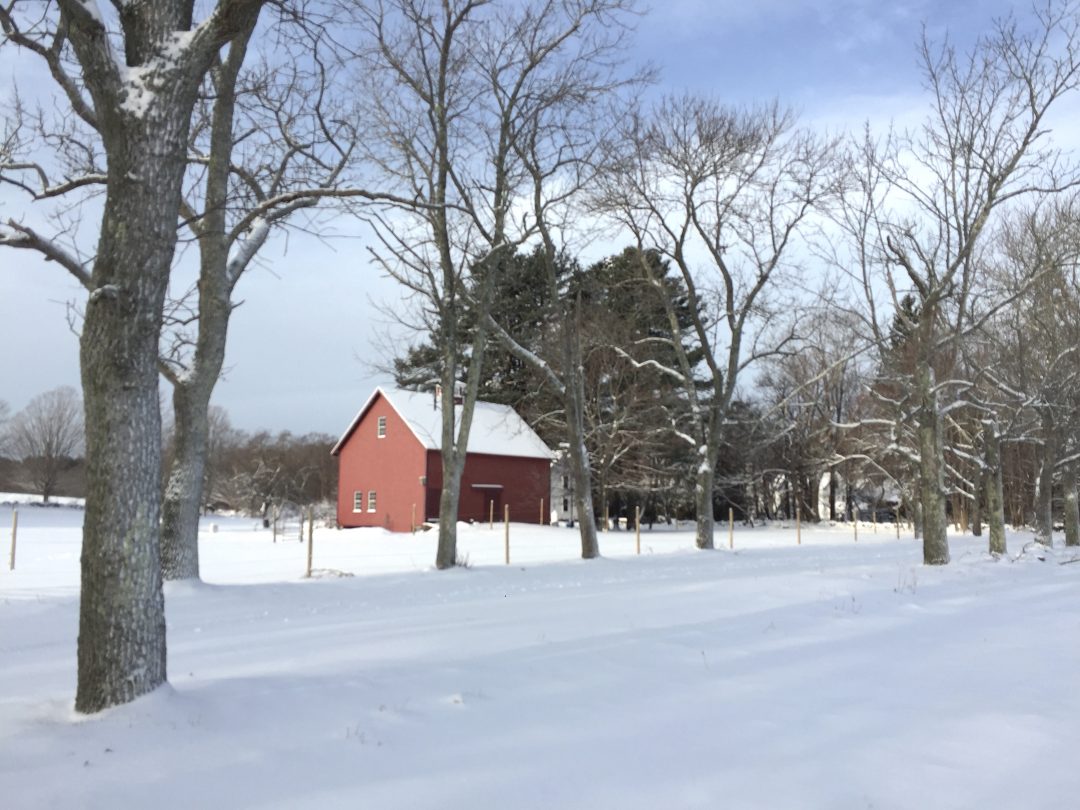
There’s a groomed trail, but lots of folks just went their own way across the pasture at Appleton Farms. Credit: A. Maginn

We launch into 2021 with the notion that positive change is just over the horizon, on the other side of the hill, beyond that copse of trees, around the next turn, and down the road.  The vaccine is coming, and, eventually, we will get out from the shadow of this miserable virus. That’s the good news.

The other side of the coin is that there is no timetable for lifting the restrictions and precautions put in place. Chances are, the entire North American ski season will be under COVID rules, perhaps loosening up in late spring when and if the cases go down.  Who knows? We don’t even have a schedule for when shots are coming our way. It’s early days, and we are hung up between the optimism of the vaccine and the uncertainty of how implementation will work.

Because of the uncertainty and changes in ski area operations due to virus restrictions, many readers have said they are putting their Alpine ambitions away for a while, taking up skinny skis and making the most of winter that way.

In any case, if you are an outdoor winter lover of snow and cold, you’ve probably already thought of making some snow shoe or cross-country tracks whenever the snow flies. We’ve been promoting the benefits of these other ways of enjoying the snow in our season long series Make More Tracks, highlighting cross-country and snow shoe stories from our correspondents.

Just the other day after a 15 inch snow fall–the first major one of the year—, a contractor came over to look at a leak in our roof. Wrapping up his visit, he looked across the road to Appleton Farms where he could see people XC skiing through the trees.  Lots of people.  “That looks like fun,” he said.  “Easy to do and inexpensive to get into,” says I. “And it’s good for you. Aerobic, full body workout. Kids can do it. Try it.” “Maybe I will,” he said getting into his truck.

Never tried it, probably will. That’s the theme this year when it comes to snow sports.  Yes, there are those devotees who will ski at their local resort, others who will venture to destination resorts, some will head to back country (be careful) and a whole bunch of people who will be trying cross-country, snow shoeing and fat biking for the first time. In fact, last week’s big snowfall here in the Boston area brought the biggest crowd we’ve even seen skiing in Appleton Farms, the 900-acre Trustees of Reservations land we are lucky to live across the road from. Cars were overflowing the regular parking lots and parked on side roads. Our local volunteer non-profit North Shore Nordic Association prepared the trails the night before, grooming with their snowmobile, creating a corduroy skating tracks as well as tracks for classic striders. It was encouraging to see so many people coming out.

Have you Made More Tracks this season? Tell us.

This Week

Reminders are everywhere. Credit: Evelyn Kanter

Correspondent Evelyn Kanter made a pre-holiday visit to Aspen and she reports on how a big destination resort is implementing its COVID plans.  Check out her “report card” here.

One of our frequent correspondents Marc Liebman has been contemplating how he will get to those big destination resorts in lieu of flying. He can’t wait to get back to skiing after a long convalescence, and he has his doubts about getting on an airplane. Here’s his story.

Back country skiing is one of the alternatives to resort based skiing that is seeing a huge surge of interest.  Correspondent Tamsin Venn overviews some resources for educating yourself about keeping out of trouble in remote areas. This is an important article to read if you have any interest in going “under the ropes” or farther afield. Read this important article here.

We have a poem for January that fits the mood.  Here’s Wallace Steven’s The Snow Man. Let us know what you think.

Ski the TOA. Race? Fun? Both? Up to you. Credit: Anchorage Daily News

Correspondent Don Burch has been producing some great videos this season. Here’s one that proves a you-are-there experience of skiing the classic New England trails at Killington, Okemo, Mt. Snow. Western skiers, this is Eastern Skiing at it’s best.  Thanks Don.

Our Question For You this week pings off Evelyn Kantor’s report card on how well COVID precautions are being implement in a big destination resort.  How say you?  Are resorts delivering on the plans they made to keep visitors and staff safe? Tell us your experience.

The next article in our Make More Tracks series tells correspondent Jonathan Wiesel’s story of his Tour of Anchorage XC race. Ill-prepared, slightly out of shape, jet-lagged, he signed up for the 50km because it seemed like a good idea at the time.  Find out what happened when his favorite candy bar saved the day.

Thanks for reading SeniorsSkiing.com.  Tell your friends and remember, there are more of us every day, and we aren’t going away.


Skiing Weatherman: Ch-Ch-Ch-Changes

For the title of this piece I chose a line from David Bowie’s classic song. The jet stream pattern that ultimately determines the snowfall haves and the have-nots is undergoing change and, ultimately, it will be dramatic.

As a lifelong skier and weather nerd, my step gets a little lighter and I tend to have a song in my mind when the weather pattern is soon to become more favorable for cold and snow.  I’m an Easterner and guilty of a provincial bias. So far, the East is at the short end of the weather stick. Other regions (i.e. Southwest, Wasatch, and Tahoe) also are struggling to attract snow. But much of the East remains significantly below typical trail counts for early January, largely due to the massive Christmas rainstorm.  

In my last report, filed a week before Christmas, it looked like the holiday storm could be a major snow producer.  Alas, there wasn’t enough cold air available to make that happen, and that has been the case much of the time since.  Pacific air has been flowing across the country, leading to heavy snow in the Pacific Northwest, with lighter, but still significant amounts across the northern Rockies.  Further downstream, plenty of disturbances have tracked through the Midwest and East, but without cold air from Canada, those disturbances have produced mixed precip events. 

So, what is going to change?  It’s the jet stream, the hand that moves the pieces on the weather chess board.  Here is picture of the current set up… 

The red blob over northeastern Canada is a blocking ridge slowly migrating west.  It will end up over far northwestern Canada by mid-month, where it will tap a growing supply of cold air.  The blue area over the Southeast is a trough that is delivering a late week snowfall to the southern Appalachians.  That storm is suppressed by the ridge to the north and until it the ridge moves northwestward, it will be tough for any storm to turn the corner into the Northeast.  But I do think that will happen within the next week, and likely several times in the following weeks.  Also of note, if you look over the eastern Pacific and follow the lines from west to east, you can see that the prime source of air masses is the Pacific, not the Arctic.  

Now take a look at a jet stream forecast for the 18th, one that I agree with.


The changes are substantial.  The ridge is stretched out across the far northern latitudes, with an extension over the northeast Pacific.  The clockwise circulation around the ridge will help access cold in the Yukon.  A deep trough over eastern North America is poised to receive the cold and spawn surface storms.  

Better times are ahead for skiers and boarders east of the Mississippi.  At the same time, rather quiet weather will develop out West.  This pattern, once established, will persist into February.                  

Regional details…         

Northwest U.S./Western Canada:  Occasional Pacific systems will bring snow next week…slowing down after,  as western ridge builds.  

Sierra:  Storm track to the north for the foreseeable future.  

Rockies:  Moderate snow events across the north in the next week…weaker systems fight through the ridge after that.  Central and southern Rockies pick up occasional light snowfalls.       

Midwest:  Cold starts pushing late next week, Alberta Clippers and lake effect snows will become frequent events for the second half of the month…and beyond.

Mid Atlantic/Southeast:   Fresh snow in NC mountains late this week.  Entire region in line for mountain snows and great snowmaking as the cold air deepens after mid-month.     

Northeast/QB:  Cold, but with suppressed storm track through next week.  Extended cold, snowy pattern develops thereafter.    

The How-Do-I-Get-There Conundrum

What If Driving Is An Undesirable Or A Non-Option?

Some planes are full; others are half empty. Credit: Picture Alliance

The world’s COVID hangover is going to continue well into 2021 so obviously ongoing precautions are needed to keep from contracting the disease. For those who live within three to four hours by car of a ski area, you’ve got options. Your car becomes your transportation bubble and then while skiing, just stay away from people and wear a mask under your scarf.

However, for those of us who live a long way from a ski area, getting to a ski area is, at best, a one day trek each way. So three days of skiing turn into five, five days of skiing, needs seven, etc.

Ski Apache is the closest to my place in Texas, 560 miles straight west and an eight or nine-hour drive.

Taos is 650 miles from my front door. Plan on 10 hours. I’ve made the drive in eight, but….

Ski Durango, a.k.a. Purgatory and one of my all-time favorite places to ski, is 860 miles away. Plan on 13 hours in a car unless you want a ticket or two.

Conditions are already very good in the Rockies and Sierra Nevada. I can feel the slopes beckoning. So, how do you get to a ski area if you don’t like driving long distance?

If you own a plane or can afford to charter one you can fly in your own bubble. For the rest of us, unless you can take a train or bus, the only other practical way is sitting in an airline seat with 150 or more of ‘your closest friends.’ The airlines have done a yeoman’s job of sanitizing the planes, updating the cabin filtration systems as well as trying to convince the traveling public that sitting in one of their aluminum tubes won’t lead to becoming infected. I’m not convinced.

The risk doesn’t come from just the plane ride. There are the people in the terminals and who knows if they’ve been exposed. Throughout the trip, you touch all kinds of things so latex gloves become the order to the day. Net net, the CDC says the risk of catching COVID is increased if you travel by plane.

When you actually receive the COVID vaccine should be factored into the decision to go skiing. For example, I’m in category 1B (over 75, compromised immune system) which means early this year, I should have the first dose injected. Second dose comes, depending on which flavor you receive, about a month later. Full efficacy of the vaccine occurs about a month after the second injection.

The vaccine gives me choices. There are non-stop flights from DFW Airport to airports a short drive from almost any ski area in the country. In a COIVD-vaccinated world, flying on airlines again becomes the best option for those of us who don’t live near a ski area.

So here’s the timeline that’s rattling around in my head. Mid-January, first dose. Mid-February, second does. Mid-March, full efficacy. That’s when I am going skiing!

Snow In Literature: The Snow Man

By Wallace Stevens

One must have a mind of winter
To regard the frost and the boughs
Of the pine-trees crusted with snow;

And have been cold a long time
To behold the junipers shagged with ice,
The spruces rough in the distant glitter

Of the January sun; and not to think
Of any misery in the sound of the wind,
In the sound of a few leaves,

Which is the sound of the land
Full of the same wind
That is blowing in the same bare place

For the listener, who listens in the snow,
And, nothing himself, beholds
Nothing that is not there and the nothing that is.

Make More Tracks: Nutter Butters And The Tour Of Anchorage

Joining A Race Without Training? Hey, It Could Be Fun.

Ski the TOA. Race? Fun? Both? Up to you. Credit: Anchorage Daily News

In this strangest of times, I think back to the great and diverse and sometimes unorthodox adventures I’ve had cross-country skiing. And although I haven’t competed often, there was this one time, some years ago…

As I understand it, you’re supposed to train for a major race. Seems sensible, right? But sometimes it just doesn’t work out that way.

Chalk it up to an uninspiring winter in the Rockies or maybe just a lazy streak, but I didn’t bother to prepare for the Tour of Anchorage. Didn’t train, hardly skied, ate too well; then flew up to Alaska at the end of February, did a little track skiing. Lay awake the night before the race, thinking: “Hey, my first marathon! I’ve never done anything longer than 25 kilometers. I’ve skied three times since prepping skis. What am I doing?”

As it turned out, what I did was have the time of my life. First, you can’t help but love Anchorage—150 km of groomed trails, maybe a quarter lit, eight mountain ranges visible on a good day, and incredible hospitality. There’s a large and dedicated racing community, from kids to Masters, represented by the Nordic Skiing Association of Anchorage is one of the most active XC clubs in North America. Their Alaska Ski for Women (held on Super Bowl Sunday) is the most popular all-women XC event in North America.

The Tour of Anchorage rings the city with a choice of distances.

The Tour of Anchorage is actually four point-to-point races, 25 km classical and 25 km, 40 km, or 50 km freestyle. The longer distances begin on one side of the city and go through the center of town—strange and wonderful to pass through birch and spruce forest, over roads streaming with traffic, and along the ice floes of Cook Inlet.

I chose the 50 km (don’t ask). Luckily the day was perfect, starting off cool with great snow, air crystalline, so we had great views of Denali.

I was saved by four things. First, at home I lived at 8,500 feet, so Anchorage’s altitude was an oxygen-rich dream. (Highest point on the trails is around 1,000 feet, lowest is four feet below sea level.) I got tired enough to do several face plants in the last 15 km, usually at conspicuous spots (why does that happen?), but never ran out of breath.

Second, friends who’d skied the race said to take it easy on the first ten kilometers because that’s where the hills are. Right! They’re not very prolonged, but a lot of up and down. You finish the Tour with a longish uphill in Kincaid Park (weirdly wonderful to see moose on these trails and jets flying low overhead).

Racing fuel.

Third, I carried several packages of Nutter Butters. They tasted good from the beginning, better as I got more tired. 

And last, people made all the difference between dropping out (which was a definite possibility) and finishing—not graceful but grinning. Race volunteers kept us hydrated and full of cookies and enthusiasm; spectators yelled us on; other skiers were inspirational, like the guy who broke a pole in the first series of hills and just kept going. (We passed one another at least a half-dozen times; I stuck around the finish area to give him an exhausted cheer.)

Best of all, I talked with two people who’d skied the Tour before, and they slowed down to give me an emotional lift. Without that, they’d probably have finished in the middle of the pack instead of waaay back. (My time was 4:04:20.6, 276th out of 292 male finishers. My pre-race fantasy had been 3:45.)

So what do you do when you’ve finished a 50 km, are staggering around beaming groggily, and one of your kind hosts takes you back to your hotel? I’d hoped to attend the awards banquet but slept through it; grabbed a late dinner; headed back to bed, and flew home the next morning, stiff but not hurting.

I’d love to ski the Tour again, with a few changes. Like about two consecutive months on skis, distance training, a much higher general fitness level, and hotter skis. But there’ll still be Nutter Butters.     

Anchorage Convention & Visitors Bureau is a great resource on the region. My favorite place to stay is Copper Whale Inn, a snowball’s throw from the Tony Knowles Coastal Trail and with 80 mile views over Cook Inlet.

The Tour of Anchorage is scheduled to be held on Sunday, March 7, 2021.  Plenty of time to train.

Choice of 25, 40, and 50 km and classic or skate races at the TOA. Credit: Anchorage Daily News

Get Smart About Back Country Skiing

It’s Socially Distanced For Sure. And Could Be Dangerous.

If you go under the rope, you have to know what you are doing. Credit: Tamsin Venn

The number of skiers and split boarders heading into the backcountry is skyrocketing as we search for ways to avoid ski areas’ confusing restrictions on lift capacity and parking plus social distance. Sales of skis, boots, skins, probes, and shovels are up (137 percent in the past three years). Trailheads are packed.

Those in the search and rescue fields are understandably concerned about our—and their—well being.

In-person avalanche safety courses, the norm, are full with waiting lists. The good news is that there is a ton of great online free education content out there. That could be a good entry point for those of us wanting to give skinning and skiing a try, now that gear, clothing, and navigation technology have improved so much.

BRASS Foundation offers a 90-minute intro webinair from certified avalanche safety instructors. It includes a harrowing 13-minute video Off Piste about two up-and-coming U.S. Ski Team members Ronnie Berlack, 21, and Bryce Astle, 20, killed in an avalanche in Soelden, Austria, when caught in a massive slide in January 2015. Ronnie’s Dad Steve Berlack spearheaded BRASS to raise awareness about what he felt was a preventable accident with the right knowledge.

The Utah Avalanche Center created Know Before You Go (KBYG), a free hour-long online course with five simple modules: Get the Gear, Get the Training, Get the Forecast, and while out in the snow, Get the Picture, Get Out of Harm’s Way. UAC Director Mark Staples says once out there you are your own avalanche forecaster and first aid provider. “You gotta take the classes,” he says.

The legacy of heli-skiing operations in the Canadian Rockies has generated much online guidance. Matthew Smith, a Whistler ski patroller and flight paramedic, stresses four things to do to prep: Take an avalanche safety course. Take a wilderness first aid course for your specific activity from a professional with real-world paramedic experience. Learn technical knowledge such as weather and gear. Practice Leave No Trace.

Avalanche Canada posts weather and avalanche reports and offers a free intro online tutorial. AC is partially funded by federal funds. Prime minister Justin Trudeau’s younger brother Michel Trudeau died in an avalanche in 1998 in British Columbia.

Meanwhile, the Canadian Avalanche Assn. supports guides with professional training and info exchange but also offers recreational courses for non-guides.

Across the U.S., find help from two dozen regional avalanche forecast centers that provide “geo-targeted” reports on snow conditions through local authorities and U.S. Forest experts.

Recognizing the rise in backcountry sales, Nick Sargent, president and CEO of Snowsports Industries America (SIA) points out that SIA now provides a “one-stop shop” of resources for backcountry safety.

The American Avalanche Institute offers an avalanche fundamentals course (cost $30) covering all the basics.

Mark Smiley’s Mountain Sense has produced “A Comprehensive Guide to Avalanche Safety” (cost $249) available online. Smiley is a Certified Mountain Guide with the Swiss-based IFMGA (International Federation of Mountain Guides Associations).

“Take the risks but get the training,” sums up patroller Matt Smith.


This Week In SeniorsSkiing.com (Dec. 18)

Once in a year, it is not thought amiss

To visit our neighbors and sing out like this:

We wish you a Merry Christmas

We wish you a Merry Chanukah

We wish you a Merry Holiday

And a Happy New Year!


More Music And Snow Sports

Here’s another holiday treat. The Colorado Snowsports Museum has compiled a YouTube music collection with Colorado as a theme. Many of those videos are involved with skiing and snow sports. Here’s a timely tune from none other than the Nitty Gritty Dirt Band.  As you will see, the whole playlist of additional tunes of Colorado and snow country music can be found in the right column when you play this video. Enjoy!

This Week

Skiing Weatherman Herb Stevens nailed the Nor’easter that blasted up the east coast this week.  Now, he’s looking at another honker of a storm for Christmas Day in the east. See his predictions for all regions.  Bottom Line: Game on snow-wise.

We hear once again from David Chambers, the Traveling Australian, who visits Revelstoke, Silver Star and little towns in  the Kootenay region of British Columbia, meeting some extraordinary characters along the way.  Take a visit with him

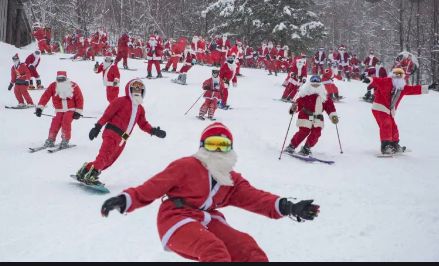
We reveal the location of last week’s Mystery Glimpse photo along with a history written by the historian of the Ski Museum of Maine. And there’s a new picture puzzle to figure out. Where did all those Santas come from?

Cross Country editor Roger Lohr traces the major modern milestones of XC skiing. The point is that there has been a huge evolution of XC skis, equipment, and infrastructure in just the last 50 years from wood to high tech. Roger’s article is the latest in our Make More Tracks series, focusing on alternative winter sports that our readers may find attractive in this unusual season.

Our Question For You asks what’s on your list for Santa. It will be interesting to see what our readers would like to see under their trees this year.

Ski world notable and SeniorsSkiing.com Advisory Board member Seth Masia adds more tips for taking lessons in COVID times. He’s building on last week’s article by Keller Minton on what makes sense in taking a lesson.

Correspondent Pat McCloskey brings us a view of carving the “modern” turn, or “arc” as some ski coaches call it. Watch the sl0w-motion video of instructor Paul Lorenz as he demos the carve on GS and slalom skis.

We’ll be taking a couple of weeks off our publishing schedule to celebrate the holidays. See you next year!

And thanks for reading SeniorsSkiing.com. Tell your friends, and, remember, there are more of us every day, and we aren’t going away.


Skiing Weatherman: The Beat Goes On

The Busy Pattern Continues.

Last week’s installment headlined a progressive pattern that has been sending ridges and troughs west to east across the continent at a dizzying pace.  That pattern produced some meaningful snow in the West earlier this week and then unloaded a blockbuster on the mid-Atlantic and much of the Northeast midweek, jumpstarting the season at dozens of resorts in the East as a result.  The heavy snow did not extend to far northern New England, but snowmaking temps have been in place all this week so trail counts are on the rise.

For the foreseeable future, the fast moving pattern will continue with a tendency for upper level troughs to spend more time in the East then they did earlier in the season.  Why the change?  It has a lot to do with the phase of the NAO, or North Atlantic Oscillation.  When the NAO is negative, we typically see an upper level ridge over Greenland and the waters to the south.  In that position, it tends to slow down troughs as they move into eastern North America, giving them a chance to strengthen, spawn surface lows near the coast, and tap more in the way of cold air from Canada.  That scenario unfolded this week during the current Nor’easter, and another storm could be in the cards again around Christmas Day.  Here is a jet stream forecast for Christmas night that illustrates a classic negative NAO.

Christmas Day Jet Stream snapshot.

Prior to the arrival of the trough you see in the East, it will bring some snow to the upper Midwest on Christmas Eve, but in that position, a milder southwesterly flow will be in place further east.  We could see one storm cut up through the Lakes, with a second storm then forming along the coast as the trough (and its cold air) tracks eastward.  That could result in a rain to snow sequence playing out in the East on Christmas Day.  Cold air will flow then into the Midwest and East early in the holiday week as the NAO will remain negative.

In the West, most of the action will continue to be focused in WA, OR, and BC, where shorter wavelength troughs keep rolling in from the Pacific Ocean.  This weekend will bring a juicy system that originates further south, so it will lead to higher snow levels in the Cascades—as high as six-seven thousand feet.  Snow levels will drop later Sunday into midweek, however, with fresh snow continuing through that period.  Further inland, lighter snows will be common for the first half of next week in ID, MT, and WY.  South of there, fresh snow will be scarce next week due to the presence of a flat ridge that doesn’t want to give way to systems from the north.  Now, if you take a look at the jet stream map again, you will notice a large blue blob just off the west coast around Christmas Day.  That trough will likely move toward the coast and perhaps bodily move inland early in the holiday week.  That could turn into a very productive storm across a wide swath of the West.  So, COVID restrictions aside, the holiday period is starting to shape up. Better late than never.

Regional Details

Northwest U.S./Western Canada:  Plenty of snow in the next week, but with bouncing snow levels in the Cascades.  A snowy, colder trough arrives just after Christmas.

Sierra:  A quiet week leading up to Christmas. Prospects for snow improve after that.     

Rockies:  Light to moderate snows across the north leading up to the holiday keep surfaces soft and boost trail counts.  Central and southern resorts waiting for the post-Christmas trough.       

Midwest:  Light snow early next week, more significant snow looking good for Christmas Eve.  Good snowmaking temps much of the time.

Mid Atlantic/Southeast:   Nice weekend on the slopes after fresh midweek snow.  Milder next week.  Colder after Christmas.    

Northeast/QB:  Quiet until Christmas storm that brings rain to snow.  Wintry pattern during holiday week.     

santas

Question For You: What’s Santa Bringing?

What Snow Sports Stuff Do You Have On Your List?

He’s coming to town. What’s in his bag for you?

It’s not too late to write to Santa to request that single, elusive item you crave for your ski kit. What would make a nice present for you? A new knit hat? Expensively warm gloves? New boots?

Our own research into reader wants reveals that underwear and layers are at the top of the list. Gloves and goggles aren’t far behind. As are skis and boots.

Perhaps this year you want a cool handheld satellite phone or a rescue beacon. Or cell phone holders, buffalo fur socks, battery-powered foot warmers, a hot, new Go Pro, multi-tools for outback survivalists, boot dryers, beef jerky, the list goes on.

If you’ve been a good senior skier all year, Santa might bring you what you wish for. Tell us: What’s on your list?

Click here for gift ideas from REI.

Click here for gift ideas from Gear Patrol


Carve Turns On Opening Day

Master Making Those Modern Arcs.

Ski instructor Paul Lorenz has a great instructional series on You Tube showing how to carve on skis.  To properly execute this type of turn, it is important to consider the basics of balance. 

Those of us who have skied for a while know that it is most important to stand on the new downhill ski during a turn and make sure that most of your weight powers that ski through the radius of the turn.  For some of us coming from a traditional background with longer skis, that also meant lifting the inside ski a little  to aid in the execution of the turn and to make sure that most of the weight was on that downhill ski. 

With the advent of the modern ski with shorter lengths and more dramatic side cut, the up-unweighting that we all utilized is not that necessary any more.  Sure there are times when you need to up- unweight ( powder, crud, etc).  But for the most part, the modern turn is executed by moving the center of mass across the skis and towards the next turn.  Think of it as moving your belly button towards the next turn.  This way, the turn is more lateral than vertical. 

Look at the video and you will see a balanced, wider track stance, with lateral movement and flexion to execute the modern turn on groomed conditions.  If you watch the World Cup on the Olympic Channel or NBC Peacock, watch the racers and their stance.  GS turns today are very much like Paul’s.  Lateral movement with very little vertical movement.  Downhill and Super G are similar with the exception being slalom, where sometimes vertical movement is crucial to get the skis in position for a tight turn. 

At the beginning of each season, I try to make my first turns rounded and executed with both feet on the ground throughout the turn.  I make a conscious effort to be flexed, in a lower position (I cut my pole length this season to accommodate), and move across the skis instead of utilizing vertical movement.    We are not skiing on longer skis anymore and to really appreciate the value of the modern ski, we need to study and practice the modern turn.  Try it on your first outing.  Nice rounded turns. 

Make More Tracks: Milestones In XC Skiing

From Wooden Skis, Wax, And Pine Tar Bases To High Tech Equipment in 50 years.

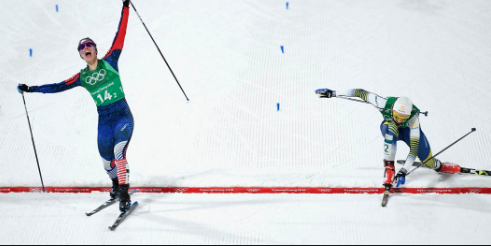
Jessica Diggins with  Kikkan Randall win first Gold Medal for US XC in 2018, making Americans serious competitors on the international racing scene.

Since the time that wooden skis were found in a peat bog in Sweden dating to 2,000 BC, there have been many milestones that brought XC skiing to where it is today. In the USA, the forefathers of cross-country skiing include people like Snowshoe Thompson, who delivered the mail in the Sierra Mountains of California and Jack Rabbit Johannsen, who XC skied in northern New York.

Before around 1970 or so, XC skis were wooden, required the right wax combination to work on the snow, and bases had to be prepared with pine tar “melted” in. Since then, the XC world has experienced enormous growth and change.  The editors of XCSkiResorts.com, using various sources, considered this recent history and development of the sport and created this list of the Milestones of Modern XC Skiing in the USA in rank order of significance:

Waxless skis with fish
scale bottoms made skiing simpler. (Credit: Tahoe Trail Guide)

1. Development of synthetic XC skis in 1974.

2. Development of the waxless based ski in the early 1970’s, most notably the Trak ski with synthetic fish scales on the ski base to eliminate the need for ski waxes. The waxless base gave the recreational skier grip on uphill travel while also allowing gliding downhill.

3. Integrated XC ski binding systems, which provided substantial improvements in simplicity of boot/binding interface and control in the mid 70’s.


Bill Koch started skating on XC skis in the Olympics and changed the sport. Credit: ISHA

4. Olympic and World Cup successes, like Bill Koch who won the Olympic silver medal in 1976 and World Cup in 1982, the first American to ever win at that level. The Nordic Trak exerciser used the Koch image as a fitness icon in advertisements for years. In 2010, there was US Olympic medalists in Nordic Combined, and in 2012 there was a World Cup winner in women’s sprint.

5. The onset of the commercial XC ski area concept began in 1968-69 at Trapp Family Lodge. This brought designed, groomed, and maintained trails making XC skiing easier and safer for the average person.

6. The skating technique proliferated, creating a faster paced and higher performance form of recreation.

7. Revolution Skis developed by Fischer led the way to shorter skis which were easier to use and consolidated ski sizing and simplified ski selection.

Vintage Mother Karen XC jacket made of synthetics came out in the 80s.

8. New lighter clothing with synthetic and breathable materials was more conducive to XC skiing comfortably; company brands such as Mother Karen led the way in the late 1970’s.

9. Other technological advances such as the 2 Wax System that offered one wax for cold temperatures and one for warm temperatures simplified ski waxing, while the BackCountry binding systems provided a beefed up boot/binding system that provided substantially more support and control for backcountry recreation.

10. The Nordic Integrated System (NIS) developed in 2005 has changed the ski/binding interface.  This system combines the ski and binding at manufacture rather than at the retail store. NIS plates were affixed to the ski by the manufacturer and the binding was slid onto the plate rather than screwed directly into the ski.

The changes in XC skiing in the last 50 years has been explosive and exponential, compared to the 4000 prior years. What’s next? Better binding-ski-boot systems, warmer-adaptable clothing, improved grooming, and more resorts catering to the sport.


More On Taking A Lesson With COVID

Things Are Different. More Ideas For Successful Lessons.

Protect yourself and others. Be prepared. Credit: Marketwatch

Correspondent Keller Minton’s article last week on taking a lesson in COVID times was praised by a ski world notable. Seth Masia, president of the International Ski History Association, long time ski journalist, active ski instructor at Aspen/Snowmass, and member of SeniorsSkiing.com’ Board of Advisors, wrote to us with some additional comments.  Here are his observations:

Based on early-season experience at Snowmass, here are some points to bear in mind:

Stay warm! Indoor facilities may be limited, which limits opportunities to warm up over a hot chocolate. You may be out in the cold all day, so dress appropriately. Take measures to keep boots and gloves warm. This factor alone is reason enough to wear a mask, or a proper double-layer neck gaiter.

Lunch may be a problem. Many on-mountain restaurants sell take-out only, and some require you to order food in advance with a smart-phone app. Your instructor should be able to help set up lunch. Time indoors is limited, and you may wind up eating outdoors, on a patio or in a tent.

A mask may fog your goggles or sunglasses. In general you can ski with the mask down, but need to wear it on the lift or when the class stops to talk on the hill. When you mask up, consider lifting your goggles to prevent fogging. Invest in a no-fog cloth for sunglasses and prescription lenses.

Lift capacity may be limited. In a group lesson, where you’ll mix with strangers, you may be asked to ride lifts alone, or limited to two passengers on a triple or four-pack lift. This goes double for gondolas and trams.

Consider a private lesson, which opens the possibility of skiing as a family. This simplifies lift loading because members of a household can ride together. Some resorts that limit the number of people on the hill may give ticket-sales priority to private-lesson clients.

Prove you are negative. Some jurisdictions require proof of a negative COVID test for entry or overnight stays. Be prepared.

Go all online. Expect to make all reservations online, for rental gear, lessons, lodging and parking. Call centers are universally overloaded. 

Seth Masia teaches in the Aspen/Snowmass ski school, and is based at Snowmass. See his website skiyoungernow.com


This Week In SeniorsSkiing.com (Dec. 11)

More Music And Skiing, Jackson Nordic, John Denver, Storms On Parade, Difficult Moments, Question: Handling Clutch Situations, Early Season Videos, COVID Lesson Advice, Old Maine Hotel.

After last week’s discovery of the two musical events that are held in the middle of the ski world, we thought we’d explore the intersection between snow sports and the music world one more time.

Last week, we highlighted the highly unusual and kinda cool “Gondola Sessions” where a band or sub-set of a band rides in gondola while performing and recording tunes. Just writing that sentence makes it sound nuts, but it seems to work. Kind of. There are a host of different bands riding gondolas at various resorts; we focused on our fav, Elephant Revival, singing on a Telluride gondie. Search YouTube for “Gondola Sessions”.

We also found WinterWonderGrass, blues and root music festivals held at snow country resorts in the winter. Indoors and outdoors. Senior music lovers, the idea for these gatherings goes back to Woodstock. Obviously, this season’s events are postponed.

SeniorsSkiing.com also has an interest in ski music, too.  A couple of years ago, we re-published the music of Ray Conrad and his 1970 ski song album, The Cotton-Pickin’ Lift Tower and Other Ski Songs.  Ray’s tunes are funny and sentimental.  Here’s a sample.

This week, we were reminded of another great ski song performer.  Correspondent LuAnn Snyder reminds us that John Denver composed “Annie’s Song” on a chairlift at Aspen. And, he performed one of the first pre-Go Pro ski music videos, skiing and singing “Dancing In The Mountains.” Check out her story here.

This Week
Skiing Weatherman Herb Stevens forecasts a parade of storms across the US. Finally, we are getting the snow and the cold to hold it on the ground, especially in New England. Click Here.

Could this be Nordic Heaven? Credit: Teton Pines

We have a great story  in our Make More Tracks series from correspondent Jonathan Wiesel about nordic skiing in the magnificent Jackson Hole area. He says the snow conditions are beyond great, they’re “superb”. And check out the scenery. Click Here.

This might have been do-able last week, but, hmmm, today you can’t handle “it.” Rambo at Crested Butte. Credit: Chris Segal

Ski coach and correspondent Bob Trueman offers an article on what to do when you’re in a difficult situation, when you feel you can’t make it down, when you tense up. It has happened to all of us. His advice is useful and insightful. Click Here.

And our Question For You this week asks for your advice in handling those tense situations.  What do you do when you freeze? We’d like to hear your experiences and its outcomes. Click Here. 

Correspondent Don Burch has compiled a short video of an early season ski day at Okemo, VT.  If you haven’t been out yet, this might get you moving. Click Here. 

A new contributor Keller Minton, an instructor at Vail, offers some tips on taking a lesson during COVID. As you know, a lesson at the beginning of the season can make a big difference for the rest of your year. We know a lot of our readers do take an early season lesson. Here’s how it might be different this year. Click Here.

The old Model T can be seen at the head of the lift line. Credit: Ski History.

Mystery Glimpse this week reveals the site and date of that picture of the rope tow powered by a Model T Ford. And there’s a new picture of an old hotel. Can you identify where it was? Click Here.


Meanwhile, In The Seemed-Like-A-Good-Idea-At-The-Time Department.

If anyone knows the back story of this video, please let us know.

Thanks for reading SeniorsSkiing.com. Tell your friends and remember, there are more of us every day, and we aren’t going away.

Make More Tracks: Jackson Hole Nordic

States Of Euphoria

More than great, these are superb conditions. Credit: Teton Pines

The week before Christmas, 1980, I drove west from Cody, WY, through the rugged Absarokas, over Togwotee Pass, dropping into the northeast corner of Jackson Hole, then south to the town of Jackson. Deep fresh snow covered the landscape, with occasional bison, moose, and coyote tracks crossing broad meadows. The road parallels the Snake River. So do the Tetons, which tower about 7,000’ above the river, with maybe the most spectacular skyline of any mountains in the Lower 48

For the next ten years, I skied, hiked, ran, and biked on both sides of the Tetons on the western edge of the valley (“hole” in frontier lingo), the Absarokas, and the Gros Ventre and Hoback ranges to the east. It was a fantastic time to live there, working as one of the world’s first Nordic ski area consultants.

Watching Jackson’s explosive transition from a cow town to a resort region was a little alarming. Happily the surrounding country stayed pretty much unchanged because almost 97 percent of the region is federal land that won’t be developed. Yellowstone National Park is just north of the valley.

Jackson Hole is a special place for winter lovers. Part of that’s the beauty and the pristine quality of Grand Teton National Park; some of it’s the amount and quality of snow. But for Nordic skiers, maybe the main draw is diversity in that stunning setting. It doesn’t matter whether you’re a track aficionado or skater, tourer or telemarker, loner or family skier —there’s not just that sad cliché, “something for everyone,” but a lot that’s absolutely superb quality. Today you can find an online resource that introduces you to all things Nordic (including snowshoeing and fatbiking) in the Jackson Hole area: click here for JH Nordic. You can figure on 300 km of groomed trails in total regionally.

Movin’ and Shakin’

Perhaps the most influential XC player around Jackson has been a specialty shop, Skinny Skis, which provides high quality rental gear, retail equipment, and clothing.

There’s also a core of friendly long-time locals in town who’ve played a huge role in popularizing Nordic skiing. They’ve been coaches and racers, backcountry guides and Olympians, as well as people who ski non-competitively, just delighting in the outdoors in such a beautiful place. A lot of them are members of the Jackson Hole Ski & Snowboard Club, whose Nordic division has been grooming at Trail Creek Ranch since the late 1960s, at the base of Teton Pass.

Private Tracks

Teton Pines has 16 km of gentle golf course skiing, complemented by instruction, rentals, and guided tours with affable Nordic director Cody Downard.  (You’ll often find his photos in Cross County Skier magazine).

Grand Targhee Nordic Center, on the western slope of the Tetons, has 15 swooping kilometers of groomed trails. The resort is about a 75 minute drive from Jackson.

Open since 2014, Turpin Meadow Ranch is a relative newcomer locally but already has a national reputation. Anchoring the north end of the 50-mile Hole, they’re a complete destination—cabins and chalets, great food (check out the Bob Dylan photo in the lodge, taken at the ranch in the 1980s), amiable staff, and 20 km of groomed trails. The ranch is a little higher than most other regional skiing, but generally routes are on the gentle side in meadows and forest, though there are some climbs and thrills too, starting right behind the lodge. Dogs, snowshoes, and fat bikes are all welcome.

Public Trails

Jackson Hole doesn’t have interconnected trails on the scale of Sun Valley, Idaho, or the Methow Valley, Washington, but public trails are immensely popular locally—and they’re free.

As much as 30 km (and growing) of the Jackson Hole Community Pathways and Trails are groomed, some very close to town. Teton Valley Trails and Pathways, at multiple locations on the west (Idaho) side of the Tetons, is rapidly evolving into a destination. And Grand Teton National Park grooms almost 25 km of summertime road, with wonderful profiles of the Tetons to the west and no snowmobiles within sight or sound.

When you visit

Plan a week’s stay, or you’re depriving yourself of grand exploration. There’s also world-famous downhill skiing, dog sledding, the fabulous National Museum of Wildlife Art, sleigh rides on the National Elk Refuge, and recreational eating at dozens of restaurants (try Fish Creek Inn in Wilson for breakfast and The Blue Lion in Jackson for dinner).

My favorite lodging is the Alpine House,  a 22 room B & B that’s owned and run by Nancy and Hans Johnstone, both former Olympians. They’re still avid skiers with great stories about everything from international competition to climbing in the Tetons.

Could this be Nordic Heaven? Credit: Teton Pines