Question For You: Preparing

What’s On Your Agenda?

Last week, we noted that Warren Miller’s new movie Future Retro has hit the internet. For many, the premier of a Warren Miller film has been the starting gun of the season. Which got us to thinking about routines we have developed to start our own personal snow sports season. As we mentioned, perhaps it’s something like: Watch the Warren Miller movie, go to the ski show, get your gear cleaned up, visit the ski shop for a sharpening, watch the weather, etc.

Maybe you have a ritual that you follow every year. Buy a new hat or gloves? Put on snow tires? Start working out? Put away the summer toys? What is it? Share with your fellow senior snow sports enthusiasts.

How do you prepare for the upcoming winter snow sports season? Is there a set of activities you follow yearly? Something special you buy? Let us know.

Write your comments in Leave A Reply below.

Snow In Literature: Dust of Snow

By Robert Frost

Credit:Creasy Mahan Nature Preserve

 
The way a crow
Shook down on me
The dust of snow
From a hemlock tree
 
Has given my heart
A change of mood
And saved some part
Of a day I had rued.
 

This Week In SeniorsSkiing.com (Nov.6)

Warren Miller’s Latest, Skis For Senior Recommendations, Rent Your Ski House, COVID Rules, Sun Valley XC, Mystery Instructor, Early Visitor Question.

November 7 marks the Eastern premiere of the new Warren Miller ski-a-rama movie, Future Retro. This year, the crew of extreme skier-athletes and videographers tackle remote mountain settings in Antarctica, Iceland, Alaska, Montana, Switzerland, and more, all blue sky, magnificent vistas, and incredible skiing marked by flips, chute-running, and dare-devilry.

For many years, the arrival of the new Warren Miller movie has marked the official beginning of the ski season. The routine usually is: watch Warren’s latest, head to the November ski shows, start gathering your gear, wait for the first flakes, and make plans for your first outing. It’s a classic calendar marker, like September is back to school, and July is the beginning of summer.

Streaming on three different nights in three different regions of North America, Warren Miller’s 71st feature film will premiere on the East Coast on Saturday, November 7th, Mountain/Central regions on Saturday, November 14th, and on the West Coast on Saturday, November 21st. Each event features regional sponsors and unique prize giveaways. Each ticket includes deals, prize entries and the live event for up to four people.  The trailer is below. And Click Here to order tickets for the virtual tour. 

But here’s a thought. When we first went to ski movies, probably back in the late 60s, we were enchanted and lured into the sport by a distinctly different kind of Warren Miller film.  The characteristic features then, we recall, were beautiful slow motion shots of skiers carving down slopes or doing ballet-like flips with grace, rhythm, and a lightness that made it look easy, accessible, and enticing. Sure, many Warren Miller films also featured hokey jokes and silly skiing, but there were always those slo-mos that were beautiful. We thought we could see ourselves doing those moves. Well, maybe not the flips, but the graceful turns, sure.

Clearly, contemporary ski films are emphasizing the other end of the thrill spectrum: More edgy, athletic, and dangerous-looking skiing. Compare this trailer from Warren Miller’s 1972 film Winter People to this year’s Future Retro Notice the difference?  If you think of these films as recruiting tools for the sport of alpine skiing, which one appeals to the average Joe or Jane who came to the flick to see what skiing was all about. Could they see themselves straight-lining a narrow, rock-bound chute in the back of the beyond?

Okay, if you’re an aficionado and have been doing this for a long time, the extreme skiing films are eye candy and a psych-up tool for the season. But does the skiing they present appeal to the curious neophyte? What do you think?

https://www.youtube.com/watch?v=L6ZdZgdj8Wc

This Week.

The latest crop of Ski for Seniors recommendations is available. Created with realskier.com, the list includes a variety of ski types.  For us guys and gals, it’s a good place to start the search for new boards.  Bear in mind, inventory might be short this season so check around.

This is an online message from Mt. Hotham, a popular Australian ski resort the eventually closed for a good portion of the season this year. Could we be seeing these messages here?

Correspondent Tamsin Venn summarizes the restrictions and constraints facing Alpine skiers at resorts this season. You may have heard this information before, but it’s important stuff.  Know before you go, well before you go.

Correspondent Jonathan Wiesel reports on a glamor spot for Nordic Skiing, Sun Valley’s Nordic Center. Consider cross-country skiing a viable and accessible alternative this year. As we are learning, interest in the sport is spiking.  What better place to give it a try than Sun Valley?  It’s naturally socially distanced, healthy, outdoors, and all that beautiful scenery.

This week’s Question For You asks those readers who have already visited an early-opening resort to report their experience. We are all facing unknown circumstances and advice from the first wave of senior skiers will be helpful to all of our readers.

Contributor Steve Bell offers his advice on how to rent a portion of your ski house.  It’s an interesting idea that will definitely help pay the mortgage, especially if you’re in a popular area for both winter and summer activities.  This is the first of a series of articles on finding and operating a rental property in your own ski house.

Finally, this week’s Mystery Glimpse features a photograph of one of our ski idols as a very young man.  A noted instructor, and pioneer in the teaching of the sport, this person is a celebrity in the ski industry.  And Happy Birthday to him.  We also reveal the identity of the flying saucer-like gondola from Mt. Snow.

Thanks for reading SeniorsSkiing.com.  Tell your friends, please, and be careful out there.  Remember there are more of us every day and we aren’t going away.


Make More Tracks: Sun Valley Sabbatical

Classy And Classic, Sun Valley Has Magnetism And Charm.

Sun Valley Nordic Center has beautiful vistas and trails. Credit: Visit Sun Valley

I’m a total sucker for romance, and Sun Valley, ID, radiates charisma, beauty, diversity, skiing history— the whole shebang. Known as “America’s First Destination Ski Resort,” it’s 2.5 hours from Boise. Happily, there’s a jet airport only a dozen miles away.

Set in the rugged Sawtooth Mountains, Sun Valley Nordic & Snowshoe Center was one of the first cross-country areas in North America, chronologically just after Vermont’s Trapp Family Lodge and just before California’s Royal Gorge. It’s complemented by a series of trail networks, mostly maintained by the Blaine County Recreation District.

Snowshoeing can also bring you out into the scenery. Credit: Visit Sun Valley

I’ve visited many times in winter and skied maybe a quarter of the trails. That’s actually not negligible, since we’re talking about a cumulative 200 km. There’s tremendous diversity in everything from terrain to snowfall to surroundings—some trails on the edge of Sun Valley Resort and the neighboring town of Ketchum, some higher and far from sight of any structure or even a road.

So here’s my take on skiing the two centerpieces of the region. It feels like a long and affectionate shared history.

The Resort: Sun Valley Nordic & Snowshoe Center


The Sun Valley Nordic & Snowshoe Center  has easier trails diverging from the trailhead, leading to more difficult routes, and thence to the challenging stuff. Set at around 6,000’, it’s mostly delightful beginner-to-intermediate terrain, totaling 40 km. Much of this is on golf course grass, a lot winds through sage, with some aspen and pine, with great mountain views, including alpine skiing on famous Bald Mountain (aka “Baldy,” 9,150’).

Almost everything is groomed daily. Sun Valley is a recreation-crazy region, so you see a lot of ski-skaters, including local folk of mature years who are tearing along the trails. Steve Haims, a Sun Valley fixture who runs the Center and is former owner/operator of Galena Lodge, says that most visitors, skiers and snowshoers are women, and a typical skier is 50+ years old.

You can also enjoy 14 km of snowshoeing and 16 km of fat bike routes. A typical season starts a bit before Christmas and runs through March, with 100” of snow in a good winter.

The Center itself is a 58,000 square foot golf clubhouse in the off-seasons, though I suspect summer visitors don’t think of it in quite those terms. You can rent skis, snowshoes, or fat bike rental, and arrange instruction.

The County

Galena Lodge

Historic Galena Lodge is the region’s other Nordic kingpin. At 7,865’, it’s a snow magnet. If you’re coming from sea level, it’s smart to acclimate down below, and then drive up to Galena, where you can overnight in one of their yurts.

Yurt will welcome you.

The lodge is owned by Blaine County Recreation District, which does the grooming. Erin Zell and Don Shepler are the concessionaires and have been running the lodge since 2006. Erin says, “We make all of our food from scratch and have wonderful house-made soups, sandwiches, salads and sandwiches.”  In addition to restaurant and bar, you’ll find ski and snowshoe rentals, instruction, and many happy dogs.

Galena is the centerpiece of 50 km of groomed ski trails, along with 25 km of snowshoe trails. There’s not much that’s truly flat, since terrain near the lodge is rolling, while it gets hillier as you get farther away. The landscape is dominated by lodgepole pine forest, with lots of meadows, and populated by wolves, coyotes, elk, and smaller critters.

For a personal touch, “Psycho” is a humbling black diamond route. I managed to stay upright until the final downhill, did a face plant in front of a bunch of other skiers right at the junction with Gladiator Creek Loop. At least I didn’t lose my glasses.

Accommodations

I’ve stayed at Sun Valley/Ketchum motels, inns, and B&BS and crashed with friends, but the most elegant and opulent visits have been at Sun Valley Lodge.  

Question For You: Early Birders

Yes, It’s Early Days, But How Is It Out There?

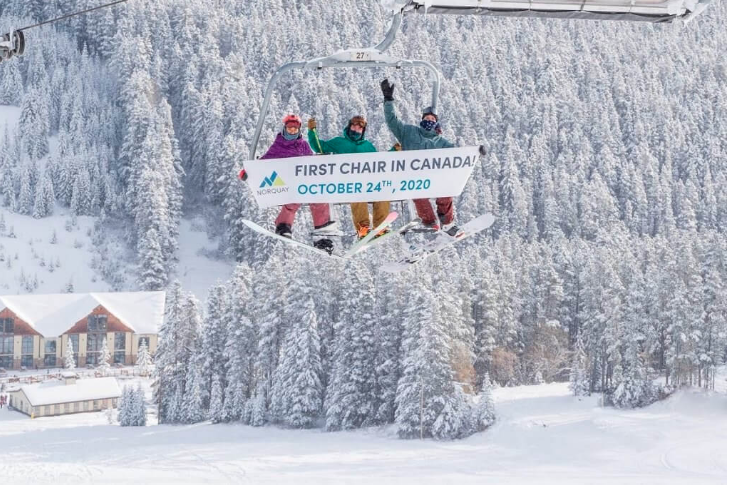
Wild Mountain is open in Minnesota (Oct. 19). So is Mt. Norquay (Oct 24) and Lake Louise (Oct. 29) in Alberta. And Wolf Creek, (Oct. 28) Arapahoe Basin, (Oct. 9th!), Killington, VT (Nov. 6th), and perhaps a few others are spinning lifts by the time you read this. Perhaps we are pushing this a little, but inquiring minds want to know how it goes in resort-ville?

Mt. Norquay early birders on opening day.

If you’ve been out for a run or two, please let us know what your personal opening day was like. Was anyone there besides you? How about COVID rules; did they help or hinder?  Could you detect karmic differences between this year’s first run and other years? If you skinned uphill at a not-quite-open-yet resort, what was that like?

You early adapters are canaries in the cage for the rest of us.  Okay, bad metaphor, but you’re ahead of a lot of us, so do tell.  What’s happening?

Write your comments in the Leave A Reply box below.


Ski Areas Ready For 2020-21 Season

This is an online message from Mt. Hotham, a popular Australian ski resort, that eventually closed for a good portion of the season this year. Could we be seeing these messages here?

This Is Probably Not The Year To Try To Ski Your Age.

Precautions may reduce the number of days you ski, but rest assured that resort managers have been huddling on defensive plays. They got a head start this summer when we all flocked outdoors to bike, hike, paddle, and golf.

“We feel there is going to be a strong demand for skiing, similar to outdoor recreation we saw this summer… Everything will be in record numbers,” said Vernon Greco of Pacific Group Resorts, which includes Ragged Mountain, New Hampshire, and Powderhorn Mountain Resort, Colorado.

Here is some of what ski areas have planned.

Standard Precautions

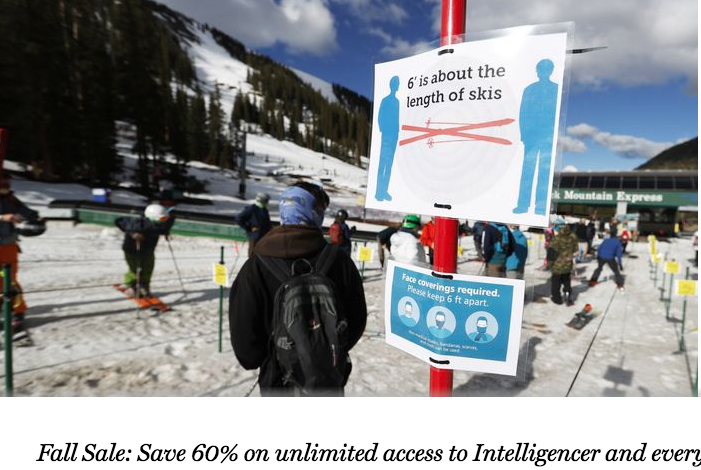
Following state, regional, city and CDC regulations, areas will uniformly require face masks, social distancing, requesting ill skiers to stay home, and hand sanitizing stations. They will use same-party lift loading, online lift ticket reservations and purchase, parking reservations, and limit ski school class sizes. Signs will abound as reminders. Lift lines will be delineated for six-foot distance on all sides. Many ski area operators feel happy that ski slopes make for social distancing, but will face challenges managing indoor space. The well-loved parking lot schlep? Booting up in the car, and carrying essential items with you skiing is part of the scenario.

Don’t Just Show Up

Adam White of Ski Vermont advised, “Go online and do research. This is not the season for an impromptu ski trip or powder chasing and walk-up-to-the-ski window to buy your ticket. Educate yourself ahead of time, so we can all continue to have a season.” White explained Vermont currently has some of the strictest interstate travel restrictions in ski country.

Trying to make it Predictable

“The exciting thing is that we are going to have a season. We are striving for consistency across the resorts to provide as much predictability as possible,” says Jody Churich, General Manager of Keystone, Colo., which opens Nov. 6 for its 50th season.

“We believe that the majority of skiers will be able to ski and ride on the days they want,” she said of the 37 areas that make up Vail Resorts.

State Quarantines

These are out of the ski areas’ control. In New England, New Hampshire is open to all New England skiers. Utah and Idaho have no travel restrictions.

The Canadian border is closed.

This is the season to try Nordic. Backcountry skiing will also be popular. If you go remote, get some training in First Aid and Avalanche skills.

Outdoor Dining

Ski areas will rely on our outdoor hardiness and business. Spruce Peak base area at Stowe, Vt., comes to mind. Expect outdoor heaters, fire pits, picnic tables, heated benches, ticket kiosks, pop-up tents, family group lessons, and food trucks. Drinking fountains will be closed.

Nordic Skiing Will be Very Popular

Ditto backcountry and uphill access. Nordic saw a run on purchase of season passes and package equipment over the summer, many by first-time skiers. Nordic areas feel confident that inside space won’t be a problem because Nordic skiers tend to buy a ticket and head for the trails and don’t crowd up.

Ready? Let it snow.

Finding A Ski House With Rentable Space: Part 1

A Rental Apartment Can Pay For Your Ski House.

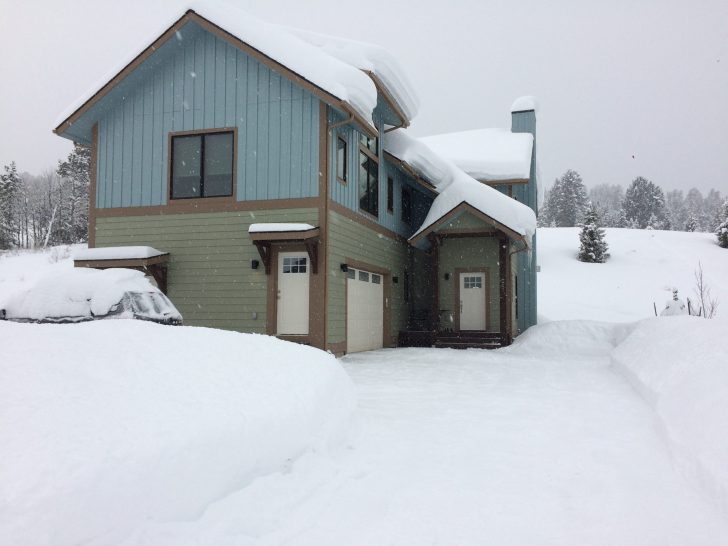
The author’s ski house has a rental apartment over the garage.

Perhaps you have daydreamed about buying your own ski house in a great resort, but dismissed it as out of your reach financially.  But don’t give up your dream!  In July 2018, my wife and I took the leap and we landed happily with a ski house in beautiful mountain country.  The central notion that works of us and for you to consider is to buy a property that doubles as an easily managed business, in the form of a home plus a rental unit. 

In this article, I’ll discuss finding a property.  In the coming weeks, you’ll be reading about marketing a rental property as well as other ideas for making this idea work.

The Right Property For An Owner-Rental Business.

Most resort houses do not have a rental unit, detached or attached, as a part of the layout.  But if you can find a house that does have a rental unit, or a house that you can easily alter to create one, you have the opportunity for income that subsidizes your mortgage payments.  You have to shop with caution.  Not all municipalities or HOAs (Homeowner’s Association) permit rentals, or they permit rentals only under certain conditions, so you have to do your due diligence. 

Easier said than done, you say, that kind of property can’t be so easy to find.  They exist.  Before you leave on a ski vacation, search for a real estate agent and call ahead.  Use realtor.com or trulia.com, or any of the many real estate websites to look for houses yourself.  Look for a property that suits you best and that is most likely to include an apartment that an owner is permitted to rent, then connect with the listing agent. 

Tell the agent you are looking for a property that includes an apartment which the owner is permitted to rent.  Add that you are willing to look at properties that are similar to the one that you identified.  Don’t be disheartened by list prices, because you will be eventually be generating rental and other revenue to subsidize your mortgage payments.

Won’t a house with a potential rental apartment have a higher price?   As a homeowner in Big Sky and a long-time house shopper before that, I can tell you that houses with apartments are not usually more expensive.  How can that be?  Most resort house buyers are not looking for a rental apartment.  They have neither the time nor the desire to manage a small business.  So if they see an attached rental apartment, they regard it as just another bedroom/bath suite and are usually not willing to pay a premium for the fact that it is a separate apartment.  To look at it another way, we are famously told that adding a swimming pool to the average house will not get a good return on investment.  Why not? Because most people do not want to own a swimming pool (the possible headaches and maintenance costs) and will not pay more for a house that has one.

What To Look For?

A basic studio furnished with simple but stylish furniture from Ikea or Wayfair.

I’ll start by describing the rental apartment in our house, a well-insulated studio tucked over our attached two-car garage.  It has an off-road parking space,  a separate thermostat, a fully equipped kitchen, a full bath, a queen size bed, a television, vaulted ceilings, many windows providing views of the surrounding mountains, and a separate entrance.  (To see a listing for our apartment, simply type “airbnb 36134350“ or “vrbo 1695325 “ into your browser.)

Having rented to guests during both winter and summer, what do we find is good about our apartment, and what is not ideal?  We have found that a studio is plenty big enough for a single or couple which is a good percentage of potential guests.  Of course, if you have a larger space, your revenue will be greater. In Big Sky, off road parking is vital because parking on the street is not permitted, so off street parking is essential.  A separate thermostat?  My wife and I agree that separate thermostats are indispensable.  We would never want to be awakened by a guest request to turn up the heat, and we want our guests to feel snug and cozy.

The kitchen includes a range (cooktop with stove), but no dishwasher.  Is a dishwasher necessary?  We have found that most guests, when they do not dine at restaurants, keep their meals simple.  A dishwasher for cleanup might be overkill. An oven?  We regret having an oven, because it is rarely used.  A cooktop or dual hot plate would be adequate, particularly if you provide a microwave

Isn’t furniture expensive?   We did not pay a fortune for furniture.  We installed inexpensive (but stylish!) items from Wayside and Ikea.  For the bed, since people crave a good night sleep, we did pay a premium for a very comfortable mattress.  We have received a number of compliments on the quality. 

And you have to have a separate entrance.  A separate entrance is very, very important.  I will explain why in next in this series.

This Week In SeniorsSkiing.com (Oct. 30)

Snow On Halloween! Skiing Weatherman Predicts, Resort Options Question, Mystery Air Ride, Nordic Exercisers.

Lots of Black Swans this year. Enough already!

This year is unprecedented in many ways. Perhaps another oddity to add to how unusual things have become is that we have snow forecast for the Boston area on Halloween. Well, the evening before Halloween, but still. If you know anything about statistics, you have probably heard of a “Black Swan” event, something that happens that goes beyond so-called normal variances and which has heavy consequences.  This year, we have a bevy of black swans.

What will the early snow mean? It’s that old “Go” signal to skiers everywhere, but with a new direction, scurrying people to buy any new gear they can find in their local ski shops.

Why?

Last spring, when the hammer came down, retailers saw a rush of last minute buyers for end of season, on sale stuff.  Kind of like the toilet paper phenomenon but with skis, boots, and gear. This fall, according to Freeskier, backcountry gear is currently selling out. Uphill traffic is predicted to explode. Expect to see a new emphasis on avalanche awareness and condition reporting, guide services and instruction, and new back country ski packages hard to find in retail outlets. In that mix is the cross-country ski and boot you can use at your local golf course.  Hot cakes, they are. If you want some, “Go” now!

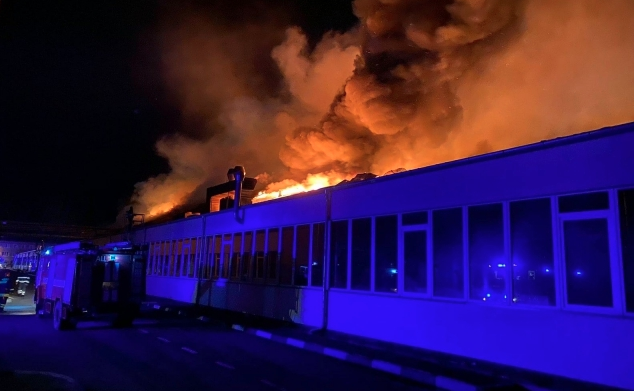
Fischer factory in Ukraine burns Oct 19, made many brands of skis.

In the Alpine world, the virus hit just as retailers were about to place orders for the upcoming season’s equipment.  Factories shut down, orders were cancelled.  With on the shelf inventory depleted and a recent fire in the largest ski factory in Europe, according to Pugski, you’ve got to buy it now or not this season. Forget about demos and consults with shop experts about what choices you might have. It’s a different swan this year. 

Classified Hints

You can post a classified ad  for 30 days for only $1 until Nov 12th. It’s easy. Tips:

  1. Post a picture with your ad.  You can actually post a “gallery”, or number of pics. It really helps.
  2. Include details of the deal, including payment options, shipping, who pays for what, etc. in the description.
  3. Your headline will make readers click on your ad. Think about how to frame your wording.

This Week

Skiing Weatherman Herb Stevens returns with his prediction for the upcoming snow season.  Herb has looked at that La Nina out in the Pacific, cooling the atmosphere above the west coast of South America. Find out what kind of weather he says that will bring to your favorite ski resort.

Our Mystery Glimpse this week shows us a really different and, thankfully, quick-passing fad in ski gondolas. Tell us what this is, where it was in operation, and what you think?  Would you like to ride up a mountain in a flying saucer look-alike?

Our Question For You takes a serious tone this week.  We ask what you would do if ski resort management and a goodly portion of your staff turns up positive for COVID. Not a pleasant thought, but one has to plan. What would you do?

We had a lot of responses to our previous question for you about advice re: joint replacements. Many responses were well-thought out and extremely useful to anyone facing that kind of procedure. We decided to analyze the responses to see what bubbles up and forms a clear message.  We want to thank all our readers for responding so conscientiously. 

Finally, there are still several months to go before the snow starts to build up into serious accumulation. You can continue to get into shape using a variety of Nordic exercise equipment for both inside and outside use.  Check correspondent Steve Hine’s advice on what is available.

Thanks for reading SeniorsSkiing.com.  Tell your friends, and remember, there are more if us every day, and we aren’t going away.


What You Said About Joint Replacement

“Not a day goes by that I don’t marvel at my pain-free knees and thank my luck stars I had this technology available.” Nancy P.

Take it easy, wait for perfect conditions, think positive. Credit: Liftopia

We had a number of comprehensive, well thought out, and even emphatic responses to our Question For You last week. Recall, we asked for advice about getting joint replacement as an active snow sports-loving senior. We don’t usually analyze the array of responses we get to the QFY feature, but in this case, there are some findings that are worth highlighting.

Here’s what you said:

  1. Some descriptive stats: The average time between surgery and returning to skiing was 8.46 months. Most of the respondents were in their 70s, fewer in their 60s, and one 80. Most respondents reported knee replacements, about a quarter of those double knee replacements. Fewer respondents reported hip replacements.
  2. “Prehab”, exercise before surgery, and Rehab are the key to success. Many responses endorsed the need to strengthen muscles and stretch ligaments under the guidance of a PT and/or on your own. Post operative exercise brings back functionality faster and safer, but overdoing it—which can be a problem for some committed exercisers—can lead to setbacks.

“The value of pre-op therapy for strength and flexibility cannot be over stated.” Mark M., PT

“Go in strong, come out strong.” Donald M.

“Be religious about rehab.” Sherm W.

“Work your tail off.” John W.

“Strengthen, strengthen, strengthen.” Jack M.

  1. Ongoing exercise after rehab PT was a frequent mention. You said these activities kept you going: Swimming, cycling/mountain biking, walking/hiking, elliptical machine, pickleball, Boot Camp fitness. Note: no running, jumping off the backs of pickup trucks, mogul skiing, or icy slopes.
  2. Several readers offered advice about easing back to downhill skiing. This included doing snowplows, sticking with greens, waiting for perfect conditions, avoiding too much, too soon, i.e., glades, blacks. Interestingly, one person mentioned heading back to cross-country skiing before going to the mountains to gain confidence. Bottom line: Take it easy.
  3. What helped getting back into skiing? There were several mentions of having a good surgeon and good appliance replacing the joint in the first place. Other readers mentioned enablers: New equipment, Knee bindings that release from the heel as well as the toe, Ski Mojo, a supportive device that relieves pressure on hips and knees. Another reader mentioned a positive mental attitude. Can’t argue with that.
  4. Curiously, a number of readers mentioned alternatives to surgery including a variety of therapeutics including different drugs and stem cell treatments. Obviously, they are out there and worthy of inquiry. However, most respondents opted for surgery, some after years of a pain.
  5. As far as outcomes are concerned, several readers reported they’ve never skied better. Clearly there is a transformation from pre- to post- joint replacement.

“It was the first time in 30 years that I didn’t have at least twinges of pain from that knee.” Nancy P.


resort card

Question For You 16: The Right Thing To Do

Let’s Do Some Scenario Planning.

We all realize that the snow season we are about to enter—or which has already started in some places—is going to be the most remarkable in our entire lives.  We’ve asked what you were going to do about heading or not heading to resorts, and it’s clear everyone has a plan or at least an opinion.

But, here’s a different slant. Let’s take a situation that you can bet is gonna be happening out there. Based on the situation, you game out the best moves.  Yes, it’s scenario planning and the stuff of off-site meetings and consulting gigs. But, we can do it in our online community.  All you have to do is think of the optimal response, optimal meaning the best that can be done, given the situation. Optimal doesn’t mean ideal, it’s the best possible in a particular situation.

So here you go. The season has been progressing nicely at a moderately-sized mountain resort. Skiers are cooperating with the various restrictions, and the snow has been fab for great skiing.  Mid-week crowds are up, everyone is having a manageable time, getting good runs in and coping in general with the changes. Then, ka-boom. We learn that 20 of the core staff—instructors, lifties, food service people, maintenance—have been infected by the virus.

Credit: David Zalubowski

What should happen now? What should management do? What are the options? What is the most likely, optimal outcome?

Write your thoughts in Leave A Reply below.

Note: several readers have written to us about their entries being labelled as SPAM. When that happens, you can bet our very robust SPAM filter has caught a word or phrase that is typically used in SPAM messages.  If your post gets rejected as SPAM, check your verbiage for SPAM-like language, edit it, and re-submit.


Make More Tracks: No Snow? No Problem

Training Tools Are Worthy Substitutes.

“… In winter in the woods alone

Against the trees I go.

I mark a maple for my own

And lay the maple low. …

…I link a line of shadowy tracks

Across the tinted snow …”

Robert Frost

Those of us in the Northern Tier of the U.S. always hope for a snowy winter but as we all know our winters aren’t as wintery as they once were. So cross-country skiing can be often hard to find here in the Northeast. But we can still ski. You can have it two ways, indoors or outdoors.

Indoors

THE Ski Machine

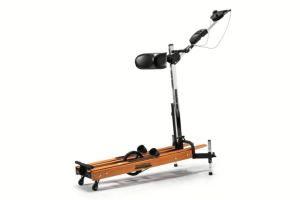
The best ski machine, bar none, is the NordicTrack Classic (NT). The NordicTrack is a stationary machine that recreates the motion of skiing in the classic stride/style. I’ve used a number of competitors and none compare to the NT. The Classic model is a completely manual machine—no electronics. When starting out on the NT set the platform level with the floor it sits on. Then, as you gain familiarity and confidence raise the front legs for increased intensity. Resistance is increased using a strap system the creates drag on the fly wheel. The cushion at the top of the stem supports and works the abdominals (and makes the machine more comfortable).

Newer models have an electronic monitor. The monitor is not related to how the machine works but with this gauge you can track pulse, time, speed, calories and distance. Using the NT requires at least beginner’s skier skill. If you get out of position or your fore foot is too far forward the NT basically stops.

For overall fitness, a ski machine like the NordicTrack Classic offers a year-round option. So, No snow, no problem.

Outdoors

Roller Skis

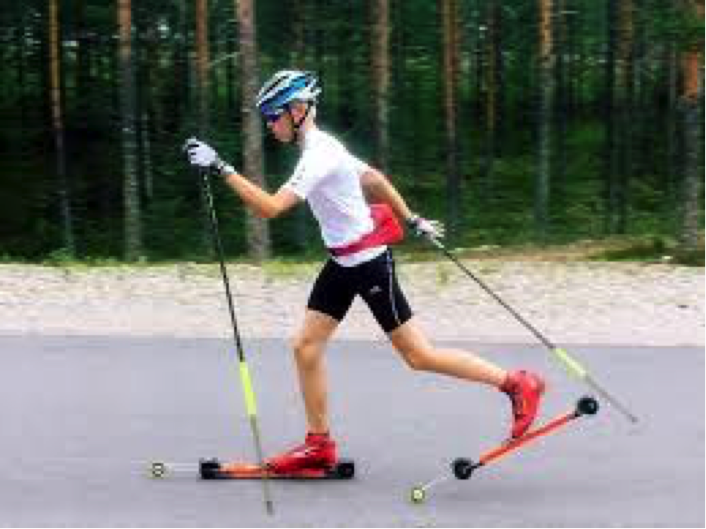
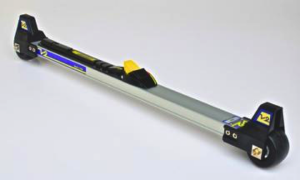
Roller skis are interesting contraptions that allow you to ski year-round outdoors. Brands won’t be reviewed here because the market has exploded with brands and styles. According to Xcskiworld.com the differences between the brands primarily have to do with wheel speed, smooth ride, cost, weight, ability to handle rough pavement or dirt roads, tire wear and skate v. classic stride.

For beginners, aluminum frame roller skis are the best choice. They provide a less expensive first experiences. Also, a wider “roller” or caster provides easier balance .

Advanced skiers might like carbon frames with wheels for greater speed and agility for skate skiing and ski racers who use the roller ski for summer training should use carbon frames.

Many roller ski sets are sold a la cart. Once you choose your ski you will need:

  • Boots
  • Bindings
  • Poles

Buying the same bindings you have on your snow skis has some savings and buying rubber tips for your existing poles saves purchasing additional poles.

Some safety equipment is needed for roller skiing including:

  • Helmet (a cycling helmet will work)
  • Knee and elbow pads
  • Wrist/palm pads

As Mark Vosburgh of Fasterskier.com quipped, “I’ve found roller skis to be a great ski training tool, which I expected.   There’s really no better way to train up all those balance stabilizers, arm, back, core and leg muscles you use when Nordic skiing.

What I didn’t expect, was that my roller skis are so enjoyable to ski on that I love to do it on its own merits.  Cruising along on a quiet country road on a crisp fall day is a blast. I highly recommend them for people who love to ski.”

So, just because there’s no snow on the ground or on the trails, cross-country skiing can still be a part of your active life style.

Skiing Weatherman: Winter Weigh-In Time

What Does A La Nina Winter Mean For Snow Sports?

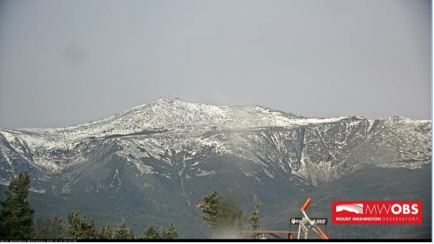
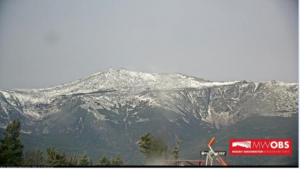
View of Mt Washington from Wildcat, Oct 18

After seeing a web cam shot of snow-covered Mt. Washington, NH this past weekend, I quickly contracted a case of “calendar shock”, realizing that it was time to submit some ideas on where I think this winter is headed, weatherwise.  Co-Publisher Mike Maginn wrote a nice piece on La Nina earlier this month and indeed, this will be a La Nina winter.  La Nina is the cold water cousin of El Nino, with the waters of the equatorial Pacific Ocean running below normal now and likely to remain that way through much of the upcoming winter.  What does that mean in terms of sensible weather downstream over the U.S. and Canada?  Well, there are different flavors of La Nina, based largely on how cool, relative to normal, those tropical waters are.  This looks to be a weak to moderate La Nina, and in general, the storm tracks during a La Nina winter look like this:

You will notice that most of the storm tracks are over the northern half of the country, closer to the source of cold air that makes those systems productive in terms of snow.  La Ninas are not as friendly as El Ninos to skiers and riders over the southwestern quadrant of the country, thus, the lack of an established tendency.   Well before the first turns of any season, friends and clients often ask me for guidance on where to head in the West for a winter trip.  During a La Nina, I steer them north of I-70, where the busier storm tracks lead to more snow and more consistent conditions.  There are exceptions, but the resort snowfall data that Mike included in his article supports that idea. 

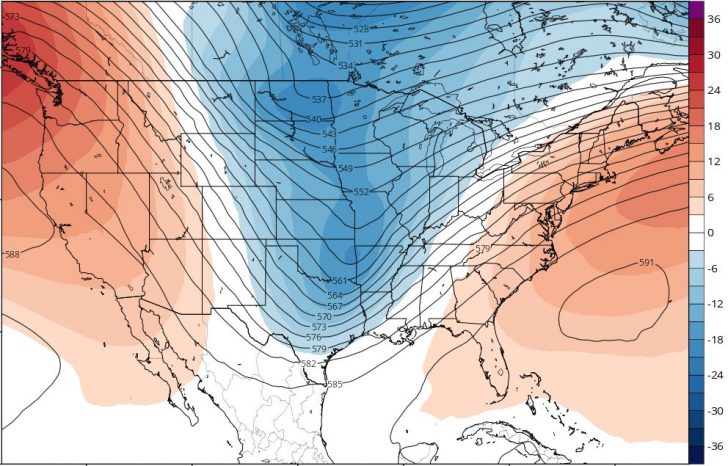
As far as La Nina winters over the Midwest and East are concerned, we often see a battle between a cold jet stream level trough over the center of the continent and a warm southeastern ridge.  A preview of that set up will develop during the last week of this month.  Take a look at this forecast for the jet stream valid on 10/28.

During winter, large dips in the middle of the country will act as a receptacle for cold air moving southward out of Canada.  As troughs interact with warmer air along the Gulf and in the Southeast, storms often take shape and then move northeastward along the western slopes of the Appalachians, as you can see on the storm track map above.  These storms bring snow to resorts in the Great Lakes, both from the low pressure center, and from backlash lake effect snow once the low move up into Canada.  The storm track that you see east of the Appalachians comes from systems that redevelop east of the mountains as the upper trough moves toward the coast.  These are known as “secondary” low pressure centers, formed as the upper level support translates over the mountains and taps into energy from the waters of the Atlantic.  These secondary storms represent the best opportunities for meaningful snowfall at the resorts of the mid-Atlantic and Northeast during a La Nina.

There are other factors that are correlated with subtle but potentially significant changes in these storm tracks, one of which is the solar cycle, and I will discuss those factors in the coming weeks.  For now, though, I am most bullish on the prospects for the West, north of I-7o and the upper Midwest.  I am guardedly optimistic about the Northeast, where temperatures should work out slightly milder than normal but with above normal snowfall via some sizable storms.  The anticipated southeastern ridge will likely pose some problems for the Mid-Atlantic and especially for the Southeast.           

This Week In SeniorsSkiing.com (Oct. 23)

Classified Launch, Response, and Advice,  Chile Season Review, Serious Question For You, Mystery, Maine Guide Advice, How To Ski With COVID.

Last week, we launched our new Classified Ad feature with a special introductory $1 for 30 days offer.  We are happy that there are readers who are posting their ads and hopefully getting some responses. 

Here’s what Bill Cohen, San Jose, CA, had to say about his ad posting experience.  Boy, did that make us smile.

Hey, just wanted to thank you guys for setting up a classified listing program.  I just posted my first ad (CHRISTIE LODGE ROOM AVAILABLE) and wanted to let you know it was EASY, FAST, covered all the bases, and hopefully will get my extra room filled!  So thanks for providing this and I hope others will take advantage of both POSTING and READING the classifieds – GREAT EXTRA SERVICE to the Senior Skiing community.  Bill Cohen in San Jose, CA

Based on what we’ve seen so far, here is some advice:

  1. Post a picture with your ad.  It is easy to upload a .jpeg or .png photo. In fact, you can post more than one, a gallery if you wish.
  2. Be sure to include any details re: shipments or transactions.  Many readers are using PayPal as a payment method. It is simple and easy to setup.
  3. Think about your headline.  Make it short and get to the point. 

If you want to view classified ads already posted, click on the blue menu bar, second box from the left.

As more hikers explore the White Mountains, calls for help climb, too.

 
As a result, SeniorsSkiing.com is asking readers to think about their day hiking plans and review what to bring along.  A great source is expert advice provided by REI, the outdoor equipment company.  You may think some of these recommendations of what to bring are a bit over the top, but if you need, say, a compass, and you’re stuck in the woods without one, you’ll quickly find out how valuable it is.
 

REI’s checklist of equipment to bring for day hikes is definitely worth bookmarking.

Finally, we’re reprising an fantastic resource for those heading to the woods. It’s a valuable document you can download and print out,  published by the State of Maine, by Maine guides. Alone In The Woods is a homespun collection of advice for surviving in the woods if you get lost. With more hikers headed out leaf peeping and conditioning-walking, this is an important source of information. The illustrations may be a bit cartoon-ish, but the information is valuable and might save your life. Click here to read and download.

This Week

Our Question For You this week takes a personal bend as our editor asks readers who have experienced a joint replacement how they returned to the sport.  Why personal?  He’s facing a hip replacement in January.  Gulp.

Correspondent Don Burch offers some basic advice for getting ready for the season of skiing with COVID. As Henry V said in Shakespeare’s play, “All things be ready of our minds be so.”

Correspondent Casey Earle provides a summary of the ski season in Chile in the times of COVID. As we have seen from reports from Australia, the virus has had a heavy hand in how the resorts operated this past season. Those constraints and a lousy snow season made for a fair to middling snow season. What can we learn from both these south of the Ecuador experiences?

Mystery Glimpse is trying something different this week.  Correspondent Don Burch has curated a video of some vintage home movies taken in the 50s and 60s.  Can you spot the locations? 

Thanks for reading SeniorsSkiing.com. Tell your friends and remember there are more of us every day and we aren’t going away.


Question For You 15: Returning With New Joints

What Does It Take To Come Back With Artificial Parts?

Here’s a question for a subset of our readership. This question is being posed by your faithful editor because he is facing the prospect of a hip replacement.  Assured by our capable and competent orthopedic surgeon that skiing and other athletic activities (not running or impact sports) are in the offing, we wonder how others have fared after getting a new shoulder, knee, or hip.

If you’ve had a joint replacement, please share what it was like to come back to your sports regimen? What was that first ski run like? How did you muster the gumption to give it a try? What did you do to prep? What helped? What hindered? What advice do you have for those facing replacements?

From what we’ve heard, joint replacements have become the most common surgery in North America. Since osteoarthritis seems to be the reason for that surgery and since OA is most likely found in older folks, we have a suspicion that a good proportion of our readers have been down that path.

Please share your thoughts in the Leave A Reply box below.


2020-21 Survival Guide

Buckle Up, Bundle Up And Buck It Up.

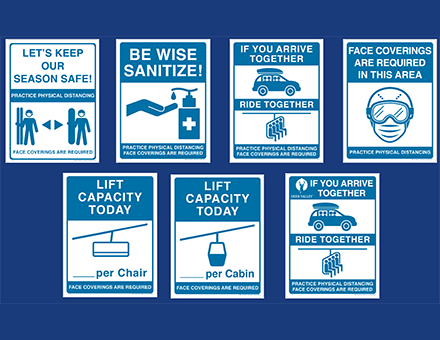
NSAA recommended signage for this season. Credit: NSAA

Never before has there been as much trepidation about a ski season as for this one.  Given all the tumult that occurred during this year, it’s no surprise we’re anxious.  What follows are some insights that will help us get the most out of what will be a most unique season.

Above all, we need to go into this season with realistic expectations.  Things are not going to be the same as ski resorts strive to provide us the best possible experience in the midst of the pandemic.  Be prepared for limits on the number of skiers allowed at resorts each day and in many instances we’ll have to reserve these days in advance online.  The result is that we will likely not get to ski each and every day that we would want to, and we will likely not get to ski as many total days as we’d like. 

As resorts work to ensure social distancing across all phases of our visits, we can expect changes to how day tickets are purchased, how food and beverages are purchased and where they are consumed.  There will be changes to how lift lines are organized, rules about who can ride lifts together and how many people unfamiliar with one another can ride together.  Because resorts will be limiting the number of people allowed in lodges, we need to be prepared to boot up, warm up, and eat in our cars.

It will behoove each and every one of us to be as self-reliant as possible.

There are a number of stakeholders in skiing, and it helps to understand that we all share the same goal: to make skiing as fun as possible for as many people as possible and to keep everyone safe. We are all in this together and the 2020 ski season will be th ebest possible if we recognize our interdependence. If people choose not to follow the rules, it could lead to further restrictions.

In addition to the demanding tasks involved in reopening each year, resort operators are facing a daunting array of challenges including redesigning how services are delivered, complying with federal, state and local mandates, financial challenges, acquiring an adequate work force and doing all this amidst tremendous uncertainty.

As a result, resorts are not going to get everything righ,t and we should expect things will not always run smoothly. In essence, we need to be understanding and patient.

Because the impact of the pandemic is so fluid, resorts will likely change policies throughout the season. So, know before you go. Staying up to date on information regarding a resort’s policies will help us avoid unwanted events.

Now the lemonade: The thing we love most about ski trips is the actual skiing, and this season time on the slopes will be just as much fun as ever. Additionally, we may come to like some of the changes.  Strategies for more “low-touch” interaction with guests may lead to smoother and more efficient ticket sales, use of passes and quicker access to food and beverages. Resorts are considering some very creative options for dining such as food trucks, other satellite food stations and take-out.

So, buckle up, bundle up and buck it up.

Alone In The Woods Maine Guide Survival Manual

Whether You Day Hike Or Trek, There Is Some Woodsy Wisdom You Need To Know.

[Editor Note: We are reprising this article from July 2014 to remind our readers that there are definite skills and knowledge needed when heading into the woods. As noted elsewhere this week, people are going into state and national parks without proper preparation, some getting into trouble. This guide, as eccentric as it appears, has worthy information to take on board.]

Folksy but wise advice from Maine Guides.

Several years ago, we stumbled on a unique resource to surviving in the woods if you become lost.  Now you might think that is probably something that won’t happen to you because you are either experienced, well-equipped, cautious about where you wander, or just lucky.

Well, getting lost out there happens all too often in the woods, even with prepared, expert hikers and campers. Unexpected stuff comes down: GPS batteries die, injuries happen, weather changes, equipment fails, that luck of yours runs out, and knowing how to make it out is a critical set of skills.

The State of Maine has published a truly valuable guide for surviving in the woods if you are lost.  It’s called, “You Alone In The Maine Woods,” and it is billed as a practical guide to woods comfort, safety, and survival.  It’s been updated frequently since the original 1972 edition by various authors from the Maine Warden Service and Search and Rescue from the Department of Inland Fisheries and Wildlife.

We offer it here as a PDF download for you and your friends and family for all readers who visit SeniorsSkiing.com. Notice its whimsical but clear illustrations and straight-forward advice.  Typical Maine.

Click the image below to download the 72-page guide.

CLICK HERE TO DOWNLOAD Alone-in-the-Maine-Woods


ClassifiedPic

This Week In SeniorsSkiing.com (Oct. 16)

Gala Classified Launch!, Mystery Glimpse Returns, Question About Buying Decisions, Rendezvous Ski Trails, MT, Early Season Quiz, Book Review: Staying With It, Prepping Your Mind.

SeniorsSkiing new Classified feature is active and ready to accept ads!

Readers Said It Would Be A Good Idea. And Here It Is.
 

Since we started SeniorsSkiing seven years ago, we’ve received many emails from you asking about where to find ski clubs, equipment suggestions, and places to stay in different parts of ski country. We have also received an extraordinary number emails from people looking for ski buddies.

From all those emails, the comment sections of our many surveys, most recently, our test-the-water Question For You last spring, we sensed that you wanted to get in touch with each other, to buddy-up, to exchange information, to sell stuff, and to rent vacation spots.   We believe that Classifieds would further contribute to the sense of community our readers share by encouraging person-to-person interactions.

Over the summer, we developed a Classified Ad section, trying various versions to try to make the posting and responding process as simple as possible.

Introductory Offer: $1 Ad Expiring Nov 13

From Oct 16 until Nov 13, you can post a 30-day ad for $1.  It’s our introductory offer, and it is a way for you to help us shake down our new feature.  Just place an ad on or after Oct. 16 for $1 and before Nov. 13, the ad will expire automatically after 30 days from your posting date. On Nov 14, our regular pricing rate card will be in effect.

Interesting Categories And Affordable Prices

We asked our readers what categories they thought were most relevant to our audience of, active, outdoor sports oriented seniors might be.  Here’s the resulting category list, most of which are organized by region:

  • Alpine and Nordic equipment for sale
  • Accessories, Gizmos, Electronic equipment for sale
  • Guides/Instructor Services
  • Seasonal/Weekly Rentals By Owner/Agent
  • In Search Of
  • Looking For Ski Buddies/Rides To Share
  • Ski Club Trips Open to com Readers
  • Vintage Equipment, Collectibles, Antiques For Sale

We’ve priced ads to make them affordable.  Here’s the pricing schedule that goes into effect on Nov. 14th.

  • $10 for One Week Posting (7 days)
  • $25 for Three Week Posting (21 days)
  • $30 for Five Week Posting (35 days)
  • $50 for Ten Week Posting (70 days)

Post and Pay

You can securely pay for your classified by credit card when you post your ad. We use a reliable third party app for processing payments. Pictures of your product or service can also be posted with the ad. Any shipping instructions and or additional costs can be explained when you describe your offering.

Buyers can contact sellers directly as contact information is provided to interested parties.  Once connected, buyers and sellers can sort out the details of their transaction, like shipping, payments, returns, etc.

There are clear step-by-step instructions on how to post an ad under FEATURES>CLASSIFIEDS>POST AN AD.  You can also click on the SeniorsSkiing Classified House ad in the right column. There are important Terms of Participation for you to consider when either posting or responding to an ad.

It’s important to use common sense and a healthy degree of caution dealing with people you are doing transactions with. 

Please be patient with our new feature.  We’ve tested it through several versions, but you never know what might happen.  If you run into trouble, please contact us at advertising@seniorsskiing.com.

This Week

In addition to all the excitement above, we have a nice collection of articles to stimulate your thinking about the season ahead.

Credit: Ski History Magazine

SeniorsSkiing’s popular feature, Mystery Glimpse, is back with an intriguing photo of a venerable legend of ski history.  Can you recognize him? And there’s extra points for identifying the photographer. Click here.

This week’s Question For You focuses on how you making buying decisions.  If you’re in the market for new gear or clothing, what’s your search, find, and buy strategy? What or who do you rely on? Share you thoughts with your fellow readers. Click here. 

Jonathan Wiesel contributes a resort profile for our Make More Track series.  This time, he writes about Rendezvous Ski Trails, a mecca for Nordic events, located near the majestic Yellowstone National Park. Obviously, there’s more to XC than skiing on your local golf course.  Read and learn about a bustling center of Nordic activity. Click here.

Correspondent Don Burch offers his annual early season quiz, this time focusing on ski trails in the Northeast.  Accompanying the quiz are a couple of Don’s highly stylized photographs which we think are pretty stunning. Click here. 

Yellowstone Ski Festival has racing, but there’s a lot more including Pilates, kids activities, clinics, classes, demos. YSF is cancelled for this year but back again in 2021

We are reprising a review of a favorite book of ours that we reviewed in 2014.  It’s the venerable ski writer John Jerome’s Staying With Ithis tale of how he decided to rejuvenate his athleticism at age 50.

Credit: Don Burch

His experiment was based on the theory you can slow the aging process with fitness. See what he learned in his journey from bystander to competitor.  His sport was swimming, but principles apply to any athletic activity. Click here.

Finally, correspondent Steve Hines reminds us that getting ready for the season involves getting your head squared away in addition to your body.  He cites three books that are the source of inspiration for him, slipping him into training gear for the season ahead. Click here. 

Thanks for reading SeniorsSkiing.com.  Please tell your friends.  And remember, there are more of us every day, and we aren’t going away.


Question For You 14: How Do You Decide What To Buy?

Shopping For New Stuff?

Now is the time of the year when thoughts of pulling out the plastic and splurging on gear and clothing permeate our waking hours. After all, those old bindings are past their sell-buy date, and those cracked boots don’t quite fit the way they did seven years ago. And that dirty parka is simply falling apart.

And retailers are hanging out the discount signs.  Although there won’t be ski shows this year, there might be some online versions thereof to entice those with a hole in their pockets.

Bob Skinner’s Ski And Sports, Newbury, NH.

We’ve often wondered how you, dear reader, makes decisions about what to buy. Do you look for articles in the magazines and blogs to guide you? Are they helpful? Do skiing friends tell you about what works for them? Do retail sales specialists guide you through choices? How do you judge? Do you know what you’re looking for at the start of your search? Or, are you working from some impressions gathered on last year’s lift lines? Share your thoughts.  We’d really like to know.

As you know, we’ve been publishing ski and boot recommendations for since we started SeniorsSkiing. Has that made a difference in your buying decisions?


If  you are considering buying new gear for the new season, how do you decide what to buy?

Please respond in the Leave A Reply box below.


Make More Tracks: Rendezvous Ski Trails

Catch Early Snow in West Yellowstone.

West Yellowstone Rendezvous Trails might be the center of XC in North America.

If you head to West Yellowstone, MT, in late November, you can visit the early winter cross-country ski epicenter of North America: the Rendezvous Ski Trails.

There are a bunch of fall camps in the Rockies – including Silver Star, BC, Crested Butte and Steamboat Springs, CO, plus Mt. Bachelor in Oregon – but the Yellowstone version is the oldest, largest, and incredibly convenient: literally right beside town (http://www.skirunbikemt.com/yellowstone-ski-festival.html). You can fly into Bozeman, MT, and stop to downhill at Big Sky Resort on the way to or from the Rendezvous Trails.

For decades, West Yellowstone was known as Snowmobile Capital of the World, partly because Yellowstone National Park is right next door (geysers! wolves! bison!). These days, the winter economy is also driven by cross-country skiing. (The Park isn’t open to over-snow traffic until December 15th this year, but you can ski from town before that onto snow-packed roads inside Yellowstone.) XC has changed from a handful of locals who thought XC was cool to a community where skiing is a life-style for a lot of residents.

A Lovely Trail System.

“West” has as lovely and lilting a trail system as anywhere in North America. What’s remarkable is that the roughly 35 km are loved by racers (like the Norwegian, Latvian, and German national teams, who trained there for the 2002 Salt Lake City Olympics) and recreational skiers. Perhaps the favorite recreational trail is the Rendezvous Loop, which passes by the biathlon course. A lot of competitors like a good long workout on Dead Dog and Windy Loop, on the far end of the network.

The Rendezvous Trails routes can hone your technique but aren’t a survival challenge (there’s only about 200’ of vertical change). And while they’re full of free-skiers and Fall Training Camp participants around Thanksgiving, the rest of the winter (especially non-holiday weekdays) they can be so peaceful that you can be out for an hour and see only a dozen people.

The trail system is a cooperative venture on U.S. Forest Service land, managed by the Forest Service, the West Yellowstone Chamber of Commerce, and the non-profit West Yellowstone Ski Education Foundation. A WYSEF Director once told me, “I would personally love to see West Yellowstone known as the Cross-country Ski Capital of the World. Our proximity to the trails inside Yellowstone National Park, our lengthy ski season, and competition-worthy grooming lend themselves to this possibility.” 

Several thousand skiers, from beginners to families to elite athletes, flock to “West” in November for the marvelous skiing, moderate altitude (around 6,700’), superb grooming, and reliable snow. In rare years when the white stuff arrives a little late in town, groomed skiing begins on a higher plateau, accessible by four wheel drive vehicles.

Yellowstone Ski Festival.

YSF has racing, but there’s a lot more including Pilates, kids activities, clinics, classes, demos. YSF is modified for this year but may be back full strength again in 2021

Before the upcoming “interesting” winter, the Fall Training Camp was known as the Yellowstone Ski Festival. It included natural science programs for kids, Pilates, backcountry films, indoor equipment expo and clinics, beer tasting, on-snow ski demo, and an end-of-week party. While the indoor component has been reined back – thanks, COVID-19! – there’s still a wide-ranging array of XC clinics with outstanding coaches, biathlon, and an FIS race (Ma Nature cooperating). Winter 2021-‘22 may be back to full-scale festivities.

Post-Festival, there’s still plenty of activity, with the winter schedule getting nailed down as I write this in early October. There are plans for ski races, biathlon (ski-and-shoot) competitions, and fun events, perhaps including the annual “Taste of the Trails.”

West Yellowstone has a daily trail fee (probably $12). Amenities along the trail are pretty limited (there’s a trailhead building with bathrooms and a communal room), but you can rent skis at several locations in town. Freeheel and Wheel (www.freeheelandwheel.com) has instructors, clothing for sale, and equipment rental and retail – plus they’ve got great coffee and a sense of humor!

There’s a mix of hotels and motels in “West”—check http://www.skirunbikemt.com/sleep.html for recommended lodging.

Rendezvous Trail System. Something for everyone.

Early Season Quiz

Place That Northeast Trail In The Right Resort. 

Credit: Don Burch

Ski The East? Here’s a chance to show you’ve been around.

1, White Cap is a part of __________?

     A. Attitash B. Sunday River C. Whiteface D. Loon

2. Mittersill is a part of __________?

     A. Ski Butternut B. Stratton C. Sugarloaf D. Cannon

3. Spruce Peak is a part of __________?

     A. Berkshire East B. Mad River Glen C. Stowe D. Burke

4. Wilderness Peak is part of _________?

     A. Bolton Valley B. Mohawk C. Cranmore D. Wachusett

5. Mt. Ellen is a part of __________?

     A. Suicide Six B. Crotched C. Saddleback D. Sugarbush

6. Mt. Stickney is a part of __________?

     A. Loon B. Pat’s Peak C. Catamount D.Bretton Woods

7. Burnt Ridge Mountain is a part of __________?

     A. Wildcat B. Gore C. Ski Sundown D. Gunstock

8. Sterling Mountain is a part of __________?

     A. Smugglers’ Notch B. Shawnee Peak C. Sunapee D. Waterville Valley

9. Jackson Gore is a part of __________?

     A. Windham B. Okemo C. Bromley D. Hunter

10. Carinthia is a part of __________?

     A. Mount Snow B. Jiminy Peak C. Ragged D. King Pine

Credit: Don Burch

ANSWERS:

1. Sunday River, 2. Cannon, 3. Stowe, 4. Bolton Valley 5. Sugarbush, 6. Bretton Woods, 7. Gore, 8. Smugglers’ Notch, 9. Okemo, 10. Mount Snow


Prepping Your Mind

Adjusting Your Attitude Is Important, Too,

As I think about preparations for the upcoming Nordic ski season, lots of details come to mind. Fitness of course tops the list. Stepping up my walking and cycling regimen is a must.  Making small incremental increases in intensity and duration and taking appropriate rest days are essential to the senior cross-country skier.

I once read that perfecting one’s XC stride is a lifetime’s pursuit. Now seventy, I still call myself the eternal intermediate skier, and equip and prepare myself accordingly.  

I also try to prepare mentally. These readings help me prepare intellectually and emotionally for a long and lustrous winter. Here’s three:

Cross-Country Cat by Mary Calhoun (1979) with Illustrations by Erick Ingraham.

This charming story follows the adventures of Henry, the lovable, mischievous Siamese cat. He is accidentally left behind at a ski lodge by his human family. Now, he must figure out how to get back to them through deep snow and raging blizzards.  This funny, cute tale which has tickled every child I have ever read it to should be read by every senior skier to their grandchildren.

About Erick Ingraham’s illustrations, Publisher’s Weekly wrote, “Competing with the author’s tale in verve and artistry are Ingraham’s snowy scenes in exactly the right shades of blue, sepia and gray, set off by glaring white.”

Henry’s message of persistence in the face of difficulties and challenges spoke to both me and my children but in a quaint and amusing way.  His “stupid cat” chant as he kicked and glided toward his home and human family continues to inspire me when I’m on a long ski trek in the Maine woods, for example. It also inspired our children at the end of a long ski day to stow gear, take showers and finish their dinners before collapsing for the night.  Memories I cherish.

Some of Calhoun’s other titles about the intrepid Henry include:

  • Hot Air Henry
  • High Wire Henry
  • Henry the Sailor Cat
  • Blue Ribbon Henry
  • Henry the Christmas Cat

I strongly recommend as many “Henry” stories on your grandchild book shelf as possible

Cross-Country Skiing: A Complete Guide by Brian Cazeneuve (1995).

The range of topics in this book dazzles.  Through Brian’s work, I first became interested in back-country skiing. He covers basics, gear, weather, technique and more in this thorough work. 

Cazeneuve intersperses his sage advice with lyrical, humorous bits about the sport itself. “Cross-Country skiing, unlike hang gliding, cattle rustling and iambic Swahili, is disproportionately more difficult to perfect than it is to learn.” (p.10).  This tongue-in-cheek advice has helped me laugh at myself when I take a fall and helped me get back up.

Chapter 11, “Going Farther”, promotes taking the kids (and grandkids) on Nordic adventures as well as teaching seniors who may be considering getting back into xc skiing or trying it for the first time.  This book is a must.

Self Renewal by John W. Gardner (1964). 

A psychologist and head of the department of Health, Education and Welfare in the Johnson administration is a personal hero of mine. In this insightful work, Gardner asserts a society’s ability to renew itself hinges upon its individuals. It is the waning of the heart and spirit—not a lack of material might—that threatens American society. He states that “all humans have several key commonalities: They are flexible, eager, open, curious, unafraid, and willing to take risks.” 

With age comes some wisdom. We seniors who continue hit the trails and slopes each winter probably agree with Gardner, “…even the self-renewing person has fixed habits and attitudes, but they are not the sort that interferes with continuous renewal. If the scientist changed his (sic) pipe weekly but never his theories, he would be in serious difficulty. The moral is clear. If we must have continuity in our lives—and we must—let it be of the sort that does not prevent renewal.” (p.130). I know my cross-country ski goals and ambitions must change as I age but the continuity is each winter to renew and go skiing again.

Renewing the heart, mind and spirit are critical to me as the seasons change and we transition to and hope for a snowy winter for kicking and gliding during these incredibly difficult times.

This week

This Week In SeniorSkiing.com (Oct. 9)

A Community Of Senior Snowsports Enthusiasts, Boot Buying Guide, Questions For You, Nordic Being Noticed, October Frost Poem.

We are starting our seventh publishing year this October.  Frankly, we never thought we’d go this long. After all, how many seniors who like to play in the snow would be interested in an online magazine? Well, it turns out lots.  We have almost 17,000 readers, some of whom have been with us from the very beginning. We are extremely grateful for the ongoing readership and for your support through the years.

After thinking about what was next for SeniorsSkiing.com, we realized a kind of epiphany, if you will, that we had convened a community of senior snow sport lovers around this weekly magazine. This is a community, we have learned through our surveys, that really would like to connect to one another. So, we started our Question For You series as a way for our readers to react to important or provocative questions about their winter experiences.  Sometimes, those questions have hit a nerve, like when we asked you to tell us about accidents on ski trails and what to do about it.

Next week, we’ll be launching our new Classified Ad section, an initiative that will provide another way for the readership community to connect. Readers will be able post ads in a variety of categories from used Alpine and Nordic equipment to collectibles and antiques to requests for ski buddies and ride sharing. We have worked hard to make this a simple, inexpensive process, making it easy on those who are even a little technically challenged.  You’ll be able to post items for sale, upload pictures, describe items and terms of shipping, etc., all in a simple form. And, payment is via a secure app that takes your credit card.  Yes, it is inexpensive: You can post one week ad for $10 to 10 weeks for $50. And, to get the Classifieds rolling,  we’ll be announcing an introductory offer next week where you can post an ad for $1 for 30 days.

Here is a high level view of categories you can post to.  These will be broken down by region as well:

  • Alpine Equipment For Sale
  • Nordic Equipment For Sale
  • Accessories For Sale
  • Non-Winter Sport Gear For Sale
  • Guide and Instructor Services
  • Seasonal/Weekly Rentals By Agent and By Owner
  • In Search Of
  • Looking For Ski Buddies/Ride Shares
  • Ski Club Trips Open To SeniorsSkiing.com Readers
  • Vintage Equipment, Antiques, Collectibles For Sale

As with all online transactions, please use common sense and caution using our Classifieds.  When you post your ad, read our Terms for Participation.

Look for our announcements coming next week about where to find the Classified menu and how to post an ad.

This Week

We take a closer look at the equipment market this year with a review of 2021 MasterFit Buying Guide.  It is filled with articles with advice on how to buy skis, boots, children’s gear, and other helpful topics. Click Here to read a review.

We ask two Questions For You this week.  How are you personally going to change your habit this upcoming season, given the restrictions and constraints facing ski resort customers? and What’s your experience with CBD, the cannibis derivative that claims to mitigate pain and relieve a wide variety of physical ailments? Click Here for the Change question and Click Here for the CBD question.

Nordic editor Roger Lohr explore the impact of the virus on the cross-country market.  The ski industry is looking at a potential boost in Nordic skiing and other snow sports besides Alpine skiing.  It’s an interesting fall-on effect from the virus that might be the best thing to happen to XC since Jessie Diggins and Kikkan Randall won gold in Pyeongchang at the 2018 Winter Games. Click Here.

Sunday River, mid-October.

Our Snow In Literature series has a poem about October by Robert Frost.  It’s not about snow or skiing, but it does fit the season.  And we love Robert Frost so here it is.  Click Here.

Finally, now it the usual start of the get-fit-for winter sports season. Even though many readers report they’ve been working out all spring and summer, it’s wise to take stock of where you are physically and to come up with a fitness plan for the next few months.  Here’s is an article reprised from 2014 about maintaining muscle mass as you age that might get you in the spirit. Click Here.

Thanks for reading SeniorsSkiing.com. Please tell your friends.  Remember there are more of us every day and we aren’t going away.


private group scheduling app for sharing a ski house or other co-owned or jointly-owned property

Using a Scheduling App for Co-ordinating Ski House or Club Stays

The Challenges of Shared Vacation Property.

I’m connected to a group that has access to a special piece of real estate. It’s not grand or luxurious, but it’s in an epic location and holds years of memories of celebrations, vacations and good times with family and friends. It’s a privilege to be able to go there, and the co-owners work hard to maintain it, to enable fair use, and to share expenses evenly.

The upsides of sharing a vacation property are obvious, but there are challenges. Some of these can be made easier by judicious use of technology. Software can’t repair damaged relationships or solve every problem, but it can go some way to reducing friction and making a shared property easier to manage. 

Scheduling Use

transitioning from a paper calendar to an online reservation system for shared propertyThe first issue that typically arises in group sharing is how to plan use. In our case situation, there was just one person who managed a paper calendar, and you had ask her about availability by phone 9-5 Monday-Friday. 

This was difficult for a number of reasons:

  1. On a particularly good weather weekend, people would be unsure if the place was in use or not and sometimes they would just show up in case no one was there. This didn’t always go over well with people who had called in advance and were already in residence.

  2. Some people found it awkward and uncomfortable to call and potentially disturb the calendar manager. 

  3. It often took more than one call to make a reservation. Playing telephone tennis to establish whether the place was available on a particular date felt like work.

  4. People don’t always make plans 9-5 M-F. Waiting till the next business day to check availability dragged the process out.

Making It Fair

lady justice's scales showing that sharing should be fairThe second issue that we commonly see, and that was the case in our group too, is making use feel fair.

Some members of the group live out of state and might only visit once per season. Others live a short drive away and visit often, when conditions are good.

If everyone is sharing expenses, this lopsided usage is clearly unfair and can prompt bad feelings. We planned to tally up everyone’s use and charge an additional use fee, so infrequent visitors would feel fairly treated.

Building A Website

I’ve been building websites since 2005 (including SeniorsSkiing.com) so it seemed obvious to me that these problems could be solved by a shared online calendar with multiple users.

Rather than build one from scratch, I researched off-the-shelf options. My criteria were:

  1. Group members should be able to see the live calendar.

  2. Group members should be able to make reservations.

  3. The calendar should be private because no-one wants to broadcast when a property is empty.

  4. The available time slots should be customizable so that it’s simple to book a day or overnight, or multi-night stay.

  5. There should be a way to specify use types for example: member, guest or rental. This so different use rates can be calculated.

It seemed simple but I struggled to find something I could adjust to meet our needs. Google Calendar was an obvious option but there was no way to share a calendar without making the link public even if it was unlikely anyone would find it.

There was also too much flexibility—group members could book 10 mins, overlapping stays, and edit the past. We had no way to standardize use and simplify the options.

I must have demoed at least 30 promising apps over the years, systems designed for inns, campsites, rentals management, hair salons, gyms, yoga studios, and even shared workspaces, but all of them had some blocking feature. 

In the end, I became resigned to building a website from scratch. Each owner had a login, you could check the live month-view calendar, see who was going and what days or weeks were available. Reservations were made by clicking on a date and picking from a few simple options and you didn’t need to re-enter your details each time.

The effect was liberating. Everyone had access to the calendar 24/7. There was no need to call a third party. Options and time slots were standardized, it was easy to understand. Members paid extra according to use. We had more money to cover capital expenditures. A big chunk of stressful communication was removed. Sharing felt easier.

Turning It Into A Web App

A few years later the group had a wish list of additions for the site, and there was interest from others wanting a website for their ski house, boat or beach house. It seemed that this was a tool that could potentially do good and maybe generate some income.

I realized that if I created an app that could help groups share with less stress that would feel good, and if special places were kept intact rather than split up and developed there would be a land conservation benefit, too.

Fast forward to 2020 and I contracted with a developer to turn the website I had built into a web application. A web app is essentially one codebase that can be used by multiple separate accounts instead of many separately coded websites. For web apps think Gmail, AirBnB, Shopify etc. I called the app Resercal because it was the most simple and descriptive short .com name I could find.

private group scheduling app for sharing a ski house or other co-owned or jointly-owned property

The new features added by popular demand were:

  1. Annual report of use. Our group’s manager had been tasked with manually tallying visits each year by referring to the original website. It was a time consuming task that had to be correct. Now that’s automated by the app.
  2. Editable Rules page. We had a rules page on the original site but any changes had to made by me as the code had to be edited. Now a manager can easily add to or edit text on the account’s rules page without worrying about code.
  3. Cancellation window. Managers (an admin role) can edit the cancellation window and members (regular users) cannot change their reservation once it’s within X hours of the start date. They also can’t edit dates in the past. We had no bad behavior in our group but it was trust-building to know that no one could edit their past use to reduce their contribution; or block off a date and then cancel on the day to avoid being charged the use fee.
  4. Temporary member suspension. There haven’t been any transgressions in our group but one common issue is that there is no consequence for egregious behavior like not paying your share or constantly breaking agreed upon rules. Now managers can temporarily suspend a member so they can’t see the calendar or book use until they are re-instated. This feature can be used or not according to a group’s bylaws, rules or customs.
  5. Waitlisting. We found that out-of-towners sometimes got blocked out by local members who reserved a date and didn’t know it was the only weekend the member from Florida was able to visit. Now, with waitlisting, you can signal your eagerness to jump in if the original reserver is less invested in that date, or if they are going to cancel anyway. In our group the locals would quickly stand aside for a less frequent visitor if they saw them appear on the waitlist.

shared calendar for groups with waitlisting feature

Launched In 2020

Now Resercal, the scheduling web application for sharing groups, is available for an annual subscription

For the original group that I am connected to, the annual subscription cost is a line item in the budget along with accounting fees and utilities. When we calculate the hours of “busy work” saved at an hourly rate it easily makes sense.

2020 has been a strange year so far. We hope that Resercal can make it easier to manage shared use. We’ve already used it for a summer pool club that needed to separate visitors by “pod”. In that case, use was reserved hourly.

As winter approaches we are gearing up for the ski season, helping clients manage scheduling when dealing with multiple pods, high risk users, work-from-home skiers, and kids who are remote-learning.

Features In Development

We also have some new features in the pipeline:

  1. To-do list where members can easily write notes or post photos communicating repairs needed or low supplies and mark issues as resolved.

  2. “Multiple reservables” so you can have several cabins or main house/guest house etc. in one account and show/hide them in the calendar.

  3. Manager moderation turns member-initiated reservations into requests that are received by the group’s designated scheduling manager. The manager can then edit/confirm or deny the request based on the rules and customs of the group.

  4. Invoicing so managers can bill members for use and/or for their share of expenses.

  5. Payments so members can pay invoices online via ACH or credit card.

How To Get Resercal

If you would like to learn more about how Resercal could work for your ski house, cabin or club please contact us. We’d be glad to schedule a call and learn about your needs, we can also send you a demo link.

If you have features you would like to see developed please let us know. We are keen to hear what ski cabin sharers or ski club members need.

The Resercal shared property scheduling and management app is available on an annual subscription basis from Resercal.com.


Question For You 13: CBD?

Fad Or Fabulous? Does The Cannibis Derivative Work For You?

Getting high is not the point of CBD.

We are curious about the emergence of CBD as a medicinal potion for a variety of ailments. Surely, we bet most of you remember the furtive days with Mary Jane back in college. Actually, let’s not go there.

CBD is different.  Cannabidiol or CBD has rapidly become the celebrity ointment or additive for everything from sore joints to anxiety. Although CBD has been around for over 70 years, it’s only in the past three or four years that it has a become ubiquitous on the retail market.

Our question for you. Have you tried CBD? What condition were you using it for? How has it worked out? Would you recommend it?


Make More Tracks: XC Boost Coming?

Is This A Surge Season For Nordic?

Will more people head to skinny skis this season?

Will the upcoming cross country (XC) season fulfill the hoped-for surge projected by many in the industry? The COVID pandemic has some projecting a coming boom similar to the bicycle industry, which saw such a surge of sales and activity last spring. The kids were not in school, people were looking to get out of the house, and there are many other factors resulting in packed bike trails and sold out bike racks at many retail outlets across the world.

XC skiing is similar to bicycling but it is also different in some significant ways. Most people know how to use a bike and many already own one, but few own XC skis or know about using them. You can take a bike out of the garage and go out on the road, while XC skiing requires cold weather and snow cover.

In the US, XC ski sales that once reached a high of 800,000 pairs annually in the 1980s have been on a plateau for decades to fewer than 200,000 pairs sold annually. The Olympic gold medal earned by Americans Diggins and Randall infected us with enthusiasm but it has not resulted in substantial increases in the number of XC skiers or XC ski sales. And now as ridiculous as it sounds, the pandemic offers another anticipated bull market for XC skiing.


In association with the pandemic, XC skiing (and snowshoeing, too) is a recreation that has everything going for it, and it is just what the doctor ordered. The benefits of XC skiing include wellness associated with getting outdoors in nature and exercise. Social distancing is a key element of the sport and last spring during the shutdown, people showed an increased enthusiasm for learning something new.

XC ski dealers (retail shops) are anticipating the upcoming season. According to content in FasterSkier.com, Nathan Schultz founder of Boulder Nordic Sport said, “Everybody started riding bikes because that was all they could do. It went from zero to 500 percent. It seems like more and more people are coming to us saying they want to get into XC skiing this year. They are coming in at the end of August instead of October and November when they usually show up.”

XC resorts like Great Glen Trails in NH offer groomed trails, lodge, instruction.

The word from product suppliers like Fischer, Rossignol, and Salomon, which sell both alpine and XC ski products, is that their alpine ski shop dealers are building their XC ski equipment inventories. They are anticipating the XC ski surge and they’re also concerned about restrictions at alpine ski areas and the projected decrease in travel. How many people are planning to get on a plane to go on a ski trip this coming year? Ski areas that have traditionally relied on travelers are expecting a much larger visitation from locals this year.

The FasterSkier.com article also covered the supply side of the XC ski industry referencing sourcing for raw materials, manufacturing, lead time for orders, and plans to fill mid-season reorders from ski dealers. The ski industry has had time to anticipate this and they think that dealers are expecting a big year and may run out of products to sell. This of course, is a balancing act for retailers because they want to be able to maximize sales while ending the season with minimal inventory.

How much the projected XC ski surge will help XC ski area operators or be limited to retailers will depend on the allocation of XC ski outings. People who want to go XC skiing can go to a XC ski area to enjoy groomed ski trails or they can go out locally on nearby ungroomed public trails, parks or golf courses. The benefits of XC ski areas are multifold, but factors for the equation include awareness of recreationalists about XC skiing, the perception about travel safety, paying for XC skiing, and the relative extensive volume of local places to ski when covered with snow. People appear to be accustomed to the virus mitigation protocols (masks, distancing), so that should not be such a big deal with regard to visiting a XC ski area. One of the biggest tips for newcomers to XC skiing is to get a lesson from a pro.

In a typical year, XC skiers pray for snow but now snowsports industry professionals and XC skiers are on the same page hoping that the pandemic slows while XC skiing surges!

Skating is a racing technique on Nordic skis. Credit: John Lazenby