Skiing Weatherman: Parade Of Storms Coming

Progressive Storm Threats Gets Underway

Although it’s likely that the holiday period will be a Covid-induced quiet one across the country, it is now crunch time for opening terrain that will create adequate social distancing to fend off further operating restrictions.

The past week brought about a pattern change that delivered snow to many resorts that had seen very little. Of late, storms have moved into the West, across the continent, and through the East and that trend will continue. Canada has been milder than normal for many weeks, but cold air is now building and becoming available for the storms further south so the potential for more snow in more spots is on the rise. In addition, I am a little less concerned about a holiday eastern warmup than I was last week.

In weather geek language, we are in a “progressive” pattern, meaning jet stream ridges and troughs are moving along from west to east without locking in for an extended stay. That produces changeable weather, but with more cold air becoming available from Canada, we are now talking more about snow and less about rain. There are still forecast challenges with respect to storm tracks, but overall, things are looking up.

In the near term, storms will move southeastward from the Gulf of Alaska and dump on the coastal ranges of British Columbia, Washington, and Oregon. Much of the moisture will get wrung out before the systems reach the northern Rockies, but there will be “topdressing” snow further inland most mornings through next week. The central and northern Sierra will pick up snow later this weekend and early next week with the prospects not as good further south due to the systems tracking too far to the east. Northern Utah and Colorado will cash in on the passage of these quick hitting systems next week but a lack of deep moisture will keep amounts light. The southern Rockies will see little new snow in the next week.

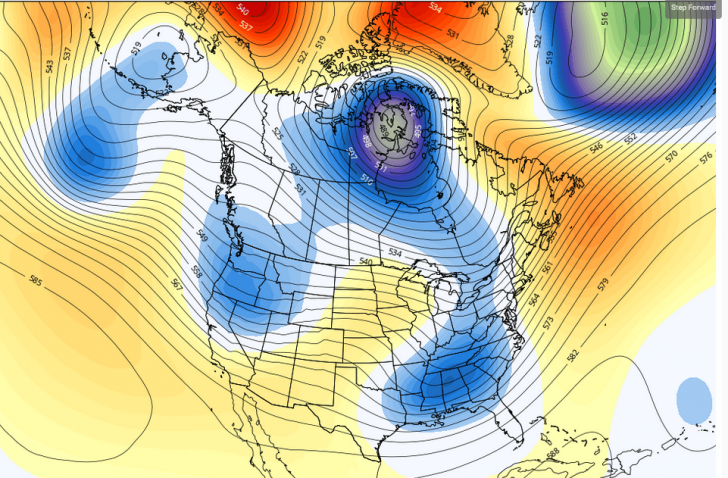
Over the eastern half of the country, disturbances will approach in both the northern and southern branches of the jet stream. Cold air will still be a little scarce in the short term, so the track of any storm will determine where it snows. But the potential is clearly there, as this jet stream forecast for Monday, December 14 clearly illustrates.

On this map we see a trough over the South, with an extension northward to Canada, a combination that could easily produce snow from the mid-Atlantic resorts up through New England. Notice also the trough along the Pacific Northwest coast and the next in line south of the Aleutians. The deeper trough over northern Canada acts as the center of the wheel, with the other features effectively rotating around it. The orange over Greenland plays an important role for the East in this pattern. That’s an upper level ridge that makes it easier for eastern troughs to strengthen as they approach the Atlantic. Indications are that the ridge will remain in the same general area until late month, so storm threats will be fairly frequent. Each trough that passes by will deliver a chunk of colder air from Canada, so the snowmakers will have ample opportunities as we approach the holidays.

Regional Details

Northwest U.S./Western Canada: Frequent storms from the Gulf of Alaska bring heavy snows every two-three days. Snow levels bounce a bit in Oregon Cascades.

Sierra: Periodic light snows from Tahoe northward until further notice. Minimal snow in southern Sierra.

Rockies: Northern resorts get frequent light to moderate snows.   Occasional light snows Wasatch and central resorts. Limited snow prospects further south.

Midwest: Clipper system brings light snow Tuesday and delivers good snowmaking temps and modest lake effect snows.

Mid Atlantic/Southeast:  Colder weather arrives Monday. Potential snowfall Tuesday. Good snowmaking week.

Northeast/QB: Mixed precip Sunday. Mountain snow showers Monday. Good snowmaking week with additional storm threats.

How To Handle Difficult Moments

What To Do When Things Go Pear Shaped.

This might have been do-able last week, but, hmmm, today you can’t handle “it.” Rambo at Crested Butte. Credit: Chris Segal

Consider a ski run you’ve done before and which you found perfectly do-able with your present level of technical skiing skill. But conditions have changed, and the snow is less easy to ski; perhaps the temperature has fallen and the surface is now more crisp. Or the light has gone totally flat.  Or the cold is really distracting. All of a sudden you find yourself getting scared.

The most likely reason for this is you probably don’t have the skills that will make you feel confident you have total control of your skis. In the longer term, it is clear that you need to improve your level of skiing skill. Right now, however, you are not certain you will able to handle the situation.

Shouting “Be Confident” won’t work. Having someone else shout “Just do it” also won’t work. “Go on, you’ll be okay” won’t work, unless you find it immediately believable. Being able to ski better is the single thing that would give you more confidence, but it is not available to you in the moment, now, when you really need it. What you need now are a few self control techniques to help you get down safely in control of the situation.

Getting Focused Is The Key.

Here are a few “emergency situation” tricks that may help you get out of a bit of trouble, so you can get down safely, without too much psychological damage, and begin a plan of action to improve your skiing and the number of situations you can conquer.

• When things begin to “go pear-shaped”, we need to bring your focus to the situation, not think “expansively”. 

• First of all, even if there seems to be a shortage of time, STOP.  Stop and reassess.  Don’t be afraid to actually shout “STOP!”  You need to get your brain waves smoothed out. Stopping still will help. Be prepared to do it repeatedly as you descend; it’s likely not to be a one-off job.

• Ask yourself—and take care answering—”Is this the end of the world, or something less? What single small thing can I do that will help?”  Remember, whatever that is, it doesn’t have to be a complete cure;  it only has to get you through the next few seconds. They will in turn lead you to the following few seconds.

• The general rule of thumb is: The more dire the situation seems to you, the shorter should be your attention span.

• Don’t think big: think small. Don’t think “long distance”, think “the next ten yards”.

• Don’t think long term: think the next ten seconds or even less. “Can I get through and survive the next two minutes / ten seconds / the next one second? What do I have to do to hang on?

• Don’t think “skiing down to the bottom”: think the next single arc. Only one. Then stop again. Pull that one off, and it will give you confidence for the next one. (Successes lead to successes) Give yourself a few seconds at least, to take your single-arc success on board. Recognize it.

• Stop after each arc until something in your head says, “Hey, we could link a couple together now”.

• Finally, for now, do not blame yourself. Resist the temptation to call yourself names. Avoid belittling your self. Being scared is natural, commonplace, and surmountable. It is a strong emotion, and your best defense is anything at all that helps you not to be emotional. Do your best to be rational, and content with that “best”.

Get used to these ideas before you head to the piste. In the quiet of your study, spend some time sitting and imagining situations where you may use them. Those imagination sessions will serve you well next time you need one of these, in earnest. When you are imagining, get deeply into it, “see” more than you normally see, make slopes steeper than they really are, imagine the slope more polished, hear snow-boarders scraping the snow right behind you;  enlarge the whole situation. See the colors brighter. Hear the sound around you louder. Imagine yourself lifting one ski off the ground and sense what it feels like. You are completely safe, it’s only imagination. 

Define “It”.

Anytime we feel fear or apprehension, our perceptions are telling us that “we may not be able to handle it”. So, STOP and define what “it” is.

If for example “handling it” involves skiing with linked arcs down something you don’t like the look of, then how about redefining “it”. Call “it”, “Getting down the next 20 yards safely,” and the picture will look different, because you have now taken skis out of the equation. You could even take them off, carry them, and walk based on your definition.  Or you might perhaps side-skid if you know how. 

When you have taken control, you will have done it by defining the problem. No one would blame you or call you names (except you, if you let yourself). In fact probably no one would even notice; most folk on ski slopes, especially tricky bits, don’t notice anything, except their own situation.

Never be ashamed of being apprehensive or scared; just realize there are ways to handle difficult moments.
Editor Note: Bob Trueman has a free self-coaching guide called My Performance Review that has helped hundreds of skiers re-set their psychology after a difficult day.  It’s simple to use and powerful.  Click here to visit Bob’s website Bobski.com, then go to Contact Us and send him an email.  He’ll send My Performance Review to you via email.


Music And Skiing: Annie’s Song And Dancing With The Mountains

John Denver Composed The Lyrics On A Chairlift.

John Denver filling up our senses. He wrote the lyrics to Annie’s Song on a chairlift.

[Editor Note: Correspondent LuAnn Snyder, a director of the Baltimore Ski Club and a big John Denver fan, contributed to this article.] 

Did you know that John Denver was an avid skier?  John Denver wrote his classic song “Annie’s Song“, while riding a chairlift to the top of Ajax Mountain in Aspen as an ode to his then wife Annie Martell.  John spoke about the making of Annie’s Song” and what the song meant to him.

“Annie’s Song” was written after we had been through a particularly difficult time and had come together again, in many ways closer than ever before.  We really felt together and much closer from the experiences we had been through. 

One day I was skiing, and I had just finished a run that was totally exhilarating.  I skied down to the lift, got on the chair, and was off and up the mountains again, my thighs burning and still in the process of catching my breath.  I looked out at the mountains I love, and the Colorado sky was a blue color you can only see from this altitude, my favorite color I might add.  The deep green of the trees against the white of the snow, the colorful outfits the people were wearing, the sounds if life as it goes over each tower, and birds singing, and laughter, and the smell of the clean, fresh air out there in the wilderness-all those things were going through my mind and it was all beautiful. It filled me completely.

I began thinking about other things that are like that for me, and my first thought was of the woman I had fallen in love with again, and how she filled me so completely.  Then I started thinking of other things—things in nature. And in the ten minutes it takes to go from the bottom of Bell Mountain lift to the top, I had written “Annie’s Song.” I had the melody in my head, and I knew the chords on the guitar. I skied down to the bottom, of the hill, raced home, picked up my guitar, and played it.

You fill up my senses, like a night in a forest
Like the mountains in springtime, like a walk in the rain
Like a storm in the desert, like a sleepy blue ocean
You fill up my senses, come fill me again

Come let me love you, let me give my life to you
Let me drown in your laughter, let me die in your arms
Let me lay down beside you, let me always be with you
Come let me love you, come love me again

Let me give my life to you
Come let me love you, come love me again

Annie’s Song sold more than a million copies staying at number one in the US pop charts for two weeks and three weeks in the US adult contemporary charts in the summer of 1974.  Since then it has graced many a wedding, though it did not cement Denver’s marriage. He and Anne were divorced in 1983.

Dancing With The Mountains

Back in 1980, John Denver also filmed a music video production at Aspen, featuring his Dancing With The Mountains tune.  Note his form, the sunglasses, the one-piece ski suits, the free-stylers, the Go-Pro like shots–classic early 80s ski scene. Hugely popular, this music video had apparently faded into obscurity until it was unearthed and posted on YouTube. We miss you, John Denver.

Some skiers are Alta took at shot at re-creating the original 1980 Dancing In The Mountains video to celebrate the end of the 2017 season. The dude doing the John Denver part has the green parka and cool shades down. Check it out below.


Question For You: Difficult Situations

How Do You Manage Your…Apprehensions?

Ugh, tensed up and clutching happens to everyone.

Yesterday, you did fine on Wild Thing, that steep, narrow trail on the shady side of the mountain. Today, Wild Thing is crusty, heavy, or worse, boilerplate, and it’s the only way down. Or, the afternoon light has gone totally flat, you’re at the top of the mountain, heading through the trees to the bottom.  Or, you took the wrong lift at a resort new to you, and you’re in double black diamond territory. Or, you’re really, really cold. Or, it’s the last run of a long day, you’ve pushed it a bit too far, and you’re whipped. Or, you’ve had a fall that came out of nowhere, and you’re spooked, perhaps sore.

Uh-oh, the mojo ain’t working today. Credit: AlexanderTT

We have all been there: In a difficult situation, tensed up, and wondering why people put sticks on their feet to slide down mountains in the first place. Where’s the hot tub? Where’s the fireplace? Where’s the Heineken? Gotta get down and outta here!

Ski coach and SeniorsSkiing.com correspondent Bob Trueman has an interesting article elsewhere in this edition. He provides some guidelines for dealing with difficult situations like these, where the world suddenly goes pear-shaped and fear narrows your perspective.  

But we’re curious what you do in those tense, scary moments. 

What rules of thumb do you follow to get down when you are in a tough situation? How did you learn those rules? Where were you taught? Figure it out? How do they work? Give us some examples, and we’ll all learn from your experience.

Write your comments in Leave A Reply below.


covid lessons

Taking A Lesson During COVID

Yes, Take A Lesson To Tune Up Or Re-Connect, But Be Prepared.

Yes, take a lesson, and be ready to follow instructor’s guidelines.
Credit: Canadian Press

A good ski lesson especially at the beginning of the season not only makes for a good day, but many more good days ahead. Refining technique, snuffing out bad habits, and discovering new ways to explore the mountain help make future ski days that much more enjoyable. Here’s how to get the most from your lesson, even during the limitations of pandemic skiing.

Allow time in your ski itinerary for flexibility. If renting your gear typically takes 45 minutes, plan for double that amount of time. If possible, pick up your gear the day before your lesson; nothing dampens a ski trip like waiting in line for two hours to rent your skis the morning of your lesson. Because of the many pandemic precautions mountains are taking, rescheduling your lesson may not be possible, leaving you wanting more from an abbreviated lesson you paid full price for.

Expect spacing and possibly masks during your lesson.

Establish boundaries and objectives with your Instructor.  The good news is that the presence of COVID has not changed how to ski, and it hasn’t changed your instructors willingness to help. Communicate early and often with them about what you are comfortable with during a lesson. If you’re comfortable with the small amount of physical contact with your instructor that may come with a lesson, speak up. If not, let your instructor know so they can accommodate your needs. Masks will probably be required during the lesson, so be ready to comply. 

Know your risk profile. Be aware Instructors will be working with a wide variety of people and will be exposed to numerous individuals directly and indirectly over the course of the season. Regardless of the precautions taken by you and your instructor, you may not be able to completely eliminate your risk of contraction. If you consider yourself high risk and are worried about contracting COVID19, it may be a good idea to forgo a lesson if you’re concerned about being exposed. Even the most safety conscious instructors are at risk of exposure.

For this year’s ski trip, the only thing certain is uncertainty. As resorts, towns, and mountains across the nation scramble to provide an enjoyable and stress skiing experience, they must navigate federal, state, and county guidelines issued to help stop the spread of infectious disease. The latest surge in COVID outbreaks has some ski states requiring specific quarantine periods for visitors from out state. This may or may not put your ski holiday or weekend away on hold.  “Know Before You Go” is especially good advice this year. 

Skiing down a mountain remains one of the few activities that is almost unchanged by our current pandemic affected world.  While all the other extras associated with a ski vacation have significantly changed, the actual physical act of ripping around your favorite mountain remains largely unaltered.  Come prepared, be flexible with your schedule, and have open dialogue with your instructor to get the most out of your lessons this year.

Things will be a little different. Be flexible, be patient, be safe.


This Week In SeniorsSkiing.com (Dec. 4)

Music In The Mountains, Question For You Redux, Snow Coming, Aosta Trattoria Interlude, XC Starter Kit, Mystery Tow, Dispatch From Wolf Creek, Rental Apartment Advice, Inspiration For Recovery, Utah Resort COVID Summary.

Imagine our surprise when we were searching YouTube for tunes from one of our favorite bands when we found, wait for it, the “Gondola Sessions.”

We love the Colorado band Elephant Revival; they have creative, evocative tunes played with expert musicality. So when we saw them playing ensemble in a gondola going up a mountain in winter, we were stopped cold. What the heck is going on? A band playing music in a gondola? Don’t believe me?  Click below.

Yes, that’s an ER-er Bonnie Paine playing the saw in a gondola along with the other members of Elephant Revival heading up at Telluride.

It seems there are “Gondola Sessions” filmed at ski resorts from New England to New Zealand.  It all started when producer John Austin was inspired by “unplugged” music—videos of artists playing acoustic instruments in relaxed settings—and the intimate feeling those created.  Austin started booking bands to play at Aspen’s Silver Queen gondola, recording them during the 15 minute ride up.  Since then, you can find more than 80 different gondola sessions with widely-diverse bands and solo artists on YouTube, recorded in summer as well as winter sessions.  Just search for “Gondola Sessions” in YouTube.

Wait, There’s More.

Along with our initial YouTube search for Elephant Revival tunes, we discovered another musical happening at ski resorts that we never knew about. Have you heard of WinterWonderGrass? For 10 years, music impresarios have staged winter music festivals in Steamboat, Squaw Valley, and Stratton Mountain. The days-long festivals feature bluegrass and roots music from very cool bands along with craft beer and merch from a variety of sustainable, environment-friendly vendors. Performances are sometimes indoors and, yes, sometimes outdoors. The motto of the producers is Music, Brews, Mountains. Click here for more information about WinterWonderGrass.  As you can imagine, this season’s festivals are adapting to the pandemic.

What is it like?  Here’s a full Elephant Revival set at the 2015 WinterWonderGrass festival at Steamboat. Enjoy.

Note: Elephant Revival is a terrific band and has a number of excellent videos on YouTube. Unfortunately the band has suspended performing indefinitely. 

So, there is music in the mountains. Innovative, energetic, embedded into the resort environment. No, you don’t have to be under 35 to enjoy these musicians and their music. You just have to love music.

Have any of our readers been to a WonderWinterGrass festival? Let us know. Leave a comment in the reply box below.

This Week.

Dreamcatcher at The Canyons. Plenty of snow already for the new season.

Skiing Weatherman Herb Stevens reports that winter snow is finally coming to the Northeast. Consider how lucky Killington was last year; the Women’s World Cup was held on 11/30-12/1/19 with the help of some expert snowmaking. This year, not much cold to make the stuff until now, that is.  Click here.

We are asking a Question For You that we asked before: What is the experience of your first visit to a ski resort like in COVID times? When we asked a couple of weeks ago, we didn’t get many comments because it was way too early. Let’s see what happens this week. Let us know. Click here.

We do have a report from John Farley on his first outing at Wolf Creek, CO, the first resort in North America to open this season. His strategy for dealing with parking is interesting.  Click here.

Correspondent Tamsin Venn summarizes the pandemic preparations and regulations at big Utah resorts. Know before you go. Click here.

Stephen Bell’s series on renting an apartment in your ski house concludes with some advice on operating the rental as well as financing a purchase. Steve seems to have made a small business pay for his new residence in Big Sky. Click here.

Hirsch Stube in the summer. Small, friendly, perfect for a day of rest from skiing.

New correspondent Dave Chambers writes about a charming incident in a tiny trattoria in the Aosta Valley.  Dave is an Australian who spends time skiing the Alps when he’s not skiing the scene in OZ. Click here.

Long time correspondent Marc Liebman tells us about is recuperation from a debilitating infection. It is interesting he was inspired by an ultra cheap season pass for veterans, and he’s determined to use it somewhere this season. Click here.

As part of our Make More Tracks series on alternative snow sports, Cross country editor Roger Lohr summarizes what you have to know to get started in Cross Country skiing. We believe the xc option makes a lot of sense for seniors who want to get outside this weird winter. Click here.

Finally, our Mystery Glimpse picture this week is one that goes back to the start of skiing in New England. And we tell the remarkable career of Bjorn Daehlie, the fantastically Greatest Of All Time Nordic racer. Read about his VO2 max and and how that made him a very special human specimen. Click here.

Thanks for reading SeniorsSkiing.com. Tell your friends, and remember, there are more of us every day, and we aren’t going away.

Note: From time to time, SeniorsSkiing.com will send our readers a special email from one of our advertisers.  You will be getting one from us soon.  Please know we will never sell our list of subscribers to a third party, and we hope you support the vendors who are advertising with us.

Restrictions: Help, hinder, hopeless? What is your experience? Credit: USNews&WorldReport


Question For You: Dispatches From The Snow Frontier

Let’s Try Again: What Is Your First Visit To A Ski Resort In COVID Times Like?

Restrictions: Help, hinder, hopeless? What is your experience? Credit: USNews&WorldReport

A few weeks ago, we asked our readers to tell us how their first visits to a ski resort went in this unusual year.  We wanted to hear reactions to constraints, regulations, and policies designed to keep visitors and staff safe.

Unfortunately, we didn’t get many responses, presumably because it was a bit too early for resorts to open and our readers to visit.

When we received a detailed report from a reader on a visit to Wolf Creek, CO, we decided to ask our question again. Reader John Farley described his visit to the moderate-size Colorado area—the first in North America to open—and how his strategy for parking and getting to the lifts worked out for him. Click here to read his dispatch.

Take two: If you’ve been out for your first day of skiing this year, how did it go? How did you manage the COVID rules? Were there karmic differences between this year’s first run and other years? More important, how will lessons learned on your first day impact how you approach the rest of the season?

Please write your comments in the Leave A Reply box below.


Skiing Weatherman: Here Comes The Snow!

The Weather Worm Is Turning, Especially In The East.

If the optimist in all of us considers November 1 the start of the winter sports season, then the first month of this season was a dud in the eastern half of the country. Cold air masses were infrequent visitors, and natural snow was even harder to find.

A persistent jet stream pattern brought early snow to the West while the East was stuck in mid-autumn weather much of the month. A western trough/eastern ridge couplet was common and kept any early winter weather bottled up over the West, especially in the Northwest, closer to the source of cold air. The ridge kept it unseasonably mild in the Midwest and East, with only passing chunks of cold air that supported brief snowmaking windows.

Well, the weather worm has turned, and it is now the eastern half of the country where an upper trough is promoting cold and snow while the West sits under a strong, quiet, ridge. Now, the air across Canada is milder than normal pretty much from coast to coast, but as it flows into the lower 48, it is just cold enough to lead to snowfall. Much of Ohio as well as western New York and far western Pennsylvania got tagged with a moderate snowfall early this week. Another storm will be on the weather maps this weekend.  Because the axis of the upper trough that supports it will be further east than it was several days ago, the track of the surface storm will also be displaced eastward to the coast where it can tap deep moisture as it tracks toward southeastern New England.

Here is a look at how the jet stream will look early Saturday.

The axis is just east of the Appalachians and a surface storm that forms along the mid-Atlantic coast will be ushered up toward southeastern New England, a nice track for snow for the mountains of the Northeast. Cold air will be limited with this storm so elevation will play a big role in the battle of snow vs. rain.

If all the pieces come together, this storm has the potential to produce moderate to heavy amounts from the Catskills and Adirondacks through the mountains of western and northern New England. In addition, sufficiently cold air will move in behind the storm to allow productive snowmaking in the Upper Midwest and Northeast early next week. Full disclosure: If the northern and southern branches of the jet don’t work together to form the system you see on the map, then the storm will be a dud. But I am an optimist; first turns look plausible next week!!!

Looking further down the road, it looks like the eastern trough will dominate for about two weeks and additional opportunities for snow will develop. After that, the pattern is likely to revert to the western ridge/eastern trough combo, which is more favored in La Nina winters like this one.

Here are the regional details:

Northwest U.S./Western Canada: A storm will try to dent the ridge late this weekend/early next week and lead to high elevation snow from Washington into B.C. Better pattern evolves mid-month.

Sierra: Dry for at least the next week; pattern change mid-month is next good chance at snow.

Rockies: The upper ridge keeps it dry for the next week. This region will also be waiting for the western ridge to break down.

Midwest: Seasonably cold for the next week and likely longer. Decent snowmaking temps most nights. Alberta Clipper systems will bring light snow every few days.

Northeast/QB: Favorable pattern for snow and snowmaking temps for next 12-14 days. Potential for significant mountain snow this weekend. Pattern change to milder

Make More Tracks: Tips For Getting Started In XC Skiing

This Might Be The Season To Get On Skinny Skis.

[Editor Note: This article first appeared in XCSkiResorts.com.]

XC in Mammoth Lakes, CA. Beautiful vistas are included free of charge.

Getting outdoors, going at your own pace, enjoying and sharing an outing with a friend or family member of any age, and getting some winter exercise are all good reasons for older folks to try XC skiing. You can have a purpose (fitness or reaching a destination) or a goal (getting out a few times a week, or attaining a number of times on skis a year) with your XC skiing. The sport is known to provide a level of calorie burning but it also is very helpful to combat various ailments including mental health such as depression and anxiety.

Tips for alpine skiers to have a positive introduction to XC skiing include:

  1. Go to a XC ski area with machine groomed trails (packed with tracks) for a consistent trail condition and introduction to XC. Refrain from starting to XC at the local park, trail, or golf course in your neighborhood.
  2. Use good light weight rental equipment. Boots should be comfortable and skis should allow good balance. Make sure it is not old equipment because the new gear makes it easier.
  3. Get a few clinics or lessons from a professional instructor. Don’t expect a friend or relative to know how to teach you how to XC ski. Basic skills include weighting one ski at a time, good body position, making the skis glide, and controlling speed when going downhill. They’ll also show you how to hold the poles correctly if the grips have straps which makes a big difference.
  4. Dress in layers with a synthetic base layer (underwear top and bottom), light gloves (not alpine ski gloves because they are too hot), shirt and overpants, light jacket (not alpine ski jacket and pants). Bring a bottle of water, headband, heavier gloves, etc.
  5. Go for a ski tour or outing less than 10 kilometers (5 miles) on a nice day (sunny and not too cold), which should be less than 2 hours.

There are some major differences between XC skiing and downhill skiing that include:

Skis are much narrower and the boots offer much less support compared to alpine skis. This requires more reliance on balance and weighting the skis rather than leaning on a big plastic ski boot.

The clothing issues are also significantly different as noted in the above tips. XC skiing creates heat for the skier and you don’t go as fast so there is less wind involved that makes you feel cold. You also do not sit on the chair lift, so less insulation is needed.

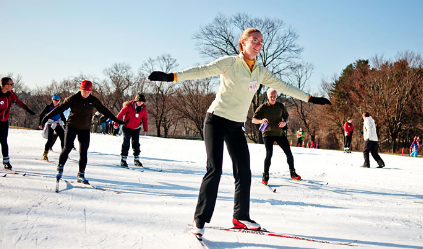
Take a lesson from a pro. Here’s balance practice. Credit: Weston Ski Track

On downhills, XC skis require an even weighting technique when snow plowing and it is recommended that you dominate the skis by making sure that weight is distributed to both your heel and the front of your foot. Rolling the ankles inward really helps to push the skis out in the snow plow (weighting the central part of the ski) so it slows down and allows control. Flimsy XC ski boots makes this more difficult but stiff boot should give more control. Twist the boot sole to compare the stiffness of different pairs of boots. On XC skis it is possible to go faster and out of control. In untracked snow you can burrow into soft snow and fall forward if too much weight is on the toes when snow plowing.

Longer poles have a different purpose in XC skiing as they should provide about 20 percent of forward momentum and are more than a turning cue as in alpine skiing except when you are turning the skis while going down hill.

The best suggestion is to avoid overdoing it—bring some chocolate treats, take in nature and winter scenery, and make it about more than skiing, and it can give you a quality experience and great memories. 

Personal Note: Sources Of Inspiration And Frustration

A Military Epic Pass Discount Special Became A Big Motivator To Get Back In Shape.

Marc—The Inspired Biker—Liebman

Last winter and spring, like many others, I watched the ski season melt away. For those who went before the big shut down, good on you. For, me, the only hopes I had of skiing was in late April or May or June at Mammoth.  And, poof, that was gone.

Slowly, I had been building back the stamina I had from a persistent infection I was fighting since the previous summer, but at 74 and more than a half, what was gone was gone, never to return.

Yet, I had hope.

Hope came from several sources. One was that medically I knew I was beating the bug. Another was from the emails from ski areas saying they just received X inches of new snow. Snow wasn’t going away. That was comforting.

Another inspiration came from an odd source. One morning, my inbox has an email from the people who run Epic Pass offering a steep discount for an unlimited pass assuming I could prove that I was a member—active, reserve or retired—of the U.S. military. I read the fine print, called and then had a long online chat with the online person before I plunked down my credit card data for an Epic Pass that cost about what I would spend for two days of skiing! The purchase was a no brainer.

So, with that in hand, so to speak, I was even more inspired to regain as much as I could the way of fitness for the season to come. At the end of June, I was finally off the medications and cleared to start exercising more “vigorously” than walking.  Since Covid had shut down all gyms and even when they re-opened, they were considered high-risk for a septuagenarian.

What was left? Summer in North Texas was here, and I pulled my bike down from the rack. The tires were flat and when I tried to pump them up, I popped both tubes. Since it hadn’t been ridden in a year, I took it to a bike shop which recommended that I replace the brake pads, (cracked and split and soon wouldn’t work) and the chain which was showing some signs of wear.

How long to fix? Six weeks! Egads! Everyone was rehabbing their bikes, it seems. So it was back to walking.

But, beginning in August, I was on the bike four or five times a week. The goal, get back to 20 miles a ride. Now, before you are impressed, the elevation change of the route I take is a whopping 94 feet. I’m averaging about 10.6 miles per hour so I am not riding like a bat out of hell. Eleven miles takes roughly an hour.

The most important thing is that I am riding and am, as of this writing, doing about 12 miles a ride. Still working on getting to 20. Next challenge is figuring out how to get to the slopes to make use of my Epic Pass.

Now that’s an inspiration.

apartment

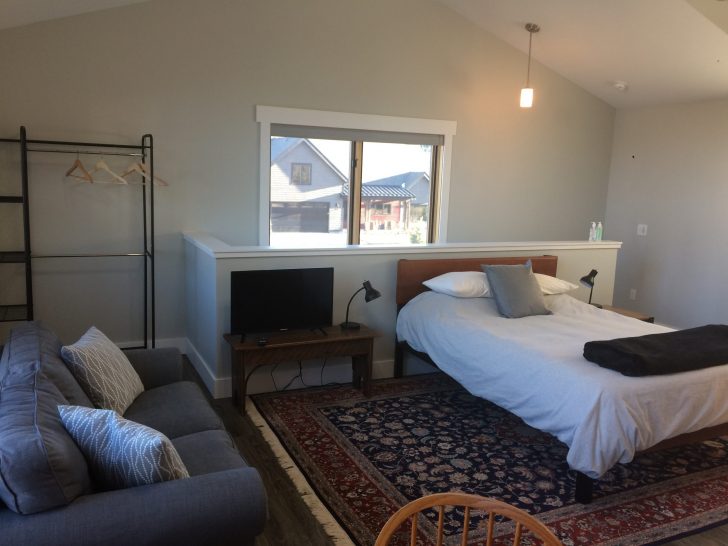
Managing A Rental Unit In Your Ski House: Part 3

Tips On Running A Rental And Finding Financing.

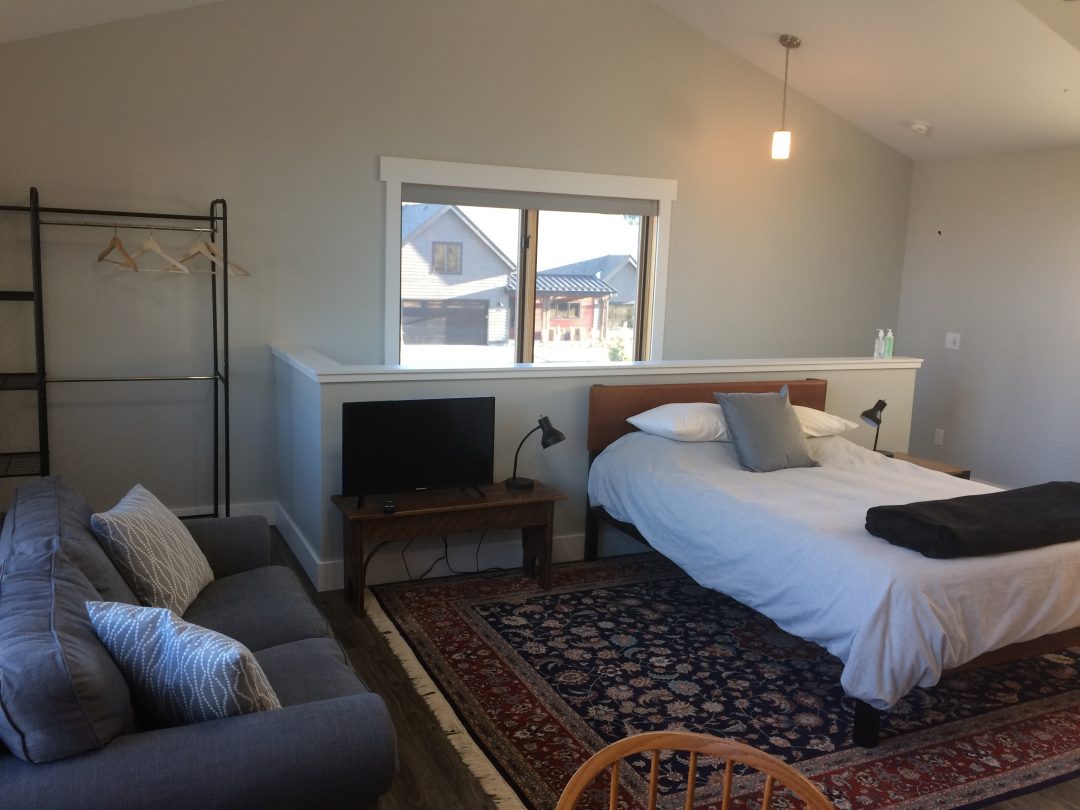
A modest one-bedroom apartment in your ski house can easily be rented. Credit: Steve Bell

Once you have reservations coming in, you have to manage the flow of people coming and going. Here are a few ideas we have found useful in making it easy and efficient for everyone.

We could easily hire a cleaning service, but we do the cleaning ourselves to earn money in addition to the nightly price.  Both websites we use for booking rentals, Airbnb.com and Vrbo.com, provide the opportunity to charge guests a cleaning fee. The high fee we set does not seem to discourage demand.  We find that we do not want to ski every single day, so we don’t mind spending an occasional morning as cleaners (who wear very good safety equipment).

If, during the COVID era, the thought of cleaning an apartment makes you queasy, hire a professional cleaning company.   They have experience in keeping their workers safe, and towns around ski resorts have a number of cleaning vendors.  The cleaning fee that we charge would be more than sufficient to cover the expense. 

Our overall feeling about visitors is extremely positive.  They have proven themselves to be consistently neat, quiet, friendly, considerate, enthusiastic, and polite.  We know that a less-than-wonderful encounter is one day inevitable, but we are confident that the memory of many fine guests will help us to forbear with grace.  And guests help us to improve our apartment, because we ask for recommendations, which they constructively provide.

We have strict rules.  No pets, no children, no smoking, no wild parties, no candles.  We hope to keep everything clean, simple, and safe.  There are facilities for all these alternatives at other venues at the resort.  In the beginning, we were concerned that all these prohibitions would suppress demand, but we are filling our unit with happy guests.

Here’s a creative idea that is not for all, but might be perfect for some.  We have found that the months of high demand are end-of-December, January, February, March, June, July, August, and September.  During some or all of the months of high demand, you can move to the apartment and rent out the (larger) home.  The larger the space, the greater the rental revenue.  You can implement methods to streamline the switch-over.  For example, you can have a lock installed on your largest closet, and use it to conveniently store all the possessions in your house that you choose to keep private, when you are living in the apartment.  Remember, you crafted your apartment to be a nice place to live.  Why not enjoy it yourselves for a while?  My wife and I are considering this switch for some of the summer months because summer life does not require winter gear such as layers of clothes and ski equipment.  And we are outside hiking and biking a lot anyway.   So a smaller home base should not present a problem.

Financing Advice

 Financing the property could be the most difficult issue for some people.  An unfortunate aspect of buying a house with a rental unit is that most mortgage lenders will not allow prospective revenue from a rental unit to be used as income on a mortgage application. You can try to find a mortgage lender who would consider that revenue.  My guess is that a bank that knows the local market well, a bank in the municipality in which you intend to buy, would be most sympathetic to such a request.

At the time of purchase, my wife was retired, and I was close to retirement, so financing was fairly straight-forward. We had both saved for retirement, mostly in the form of  401Ks.  We applied for the maximum mortgage that we could afford, intending to finance the remainder of the purchase price with a down payment from our savings.  But in order to maximize our mortgage size, we took steps to increase our income. 

First, we both applied for social security.  Second, I had a small pension that I elected to take early.  In both cases, the trade off for the early payout start is a modest reduction in the monthly benefit. Third, instead of retiring, I worked part-time for one more year in Big Sky.  This also boosted my income and thereby our mortgage size.  

In the first few years of ownership, you might want to work full-time, part-time, or seasonally to firm up your financial position. We have learned that people who live in resorts are very resourceful.  They can find the perfect part-time employment that keeps them happy and that pays bills.  Or they can start a business that suits their immediate needs and that they can later sell. 

My wife and I feel that we have lucked into a happy place.  We have a small business that is fun to manage and that helps pay the bills.  And we live in a beautiful and enormous natural playground.

This Week In SeniorsSkiing.com (Nov. 20)

SPECIAL EDITION: MAKE MORE TRACKS!

Credit: Trapp Family Lodge

Focus On Nordic, Snowshoeing, Fat Biking: Rationale, The Market Forecast, Videos: How To XC, Snowshoe, Fat Bike, Hidden Gem XC Resorts, Lesson Advice, Mystery Nordic Star, Trail Preferences.

There’s more to winter besides downhill skiing. This issue will explore additional ways you can Make More Tracks.

Let’s be clear at the top: We love Alpine skiing, the thrill, the speed, the grace, and all that. We always will, so don’t think this Special Edition of SeniorsSkiing.com devoted to alternative winter snow sports is an abandonment of the mainstay that almost all of our readers have been participating in for years.

However, this year, we anticipate that while our readers will at first enthusiastically head to Alpine resorts, reserve online, gear up in their cars, mask up, social distance, eat a bag lunch, and all the rest, many will grow weary of those restrictions. Or become frustrated. Or not bother going at all.

But, since we know our readers love winter and snow, we also anticipate that they might be open to alternative snow sports that might be new to them or to which they may be returning. Like cross-country skiing and snowshoeing.  These are accessible, easy to learn the basics, affordable, safe (social distance built in), and good for body and soul.

Since the beginning of October we have been publishing a series of articles named Make More Tracks. These include instruction, resort reports, clothing advice, and the like.  In addition, we’ve compiled a Make More Tracks Resource Guide with a compendium of articles about the alternative winter snow sports, covering gear, destinations, technique, and how to dress, and much more.

Co-Publisher Mike Maginn on wooden skis, circa 1970.

We are dedicating this entire issue to Nordic skiing, snowshoeing, and Fat Biking. Hopefully, you will read something that might stir you to think about getting into other winter sports. We’ve been loving cross-country skiing since the early 70s. So much so that we still (occasionally) get out our wooden skis, wax, four-pin bindings, and take a loop around the farm across the street. On a bluebird day with perfect snow, the right wax combo, and a Heineken in your backpack, there is nothing like it.

ANNOUNCEMENTS

We are extending our special introductory classified ad offer until Dec. 4th. That means you can post a classified ad for 30 days from the date you post for just $1. We’re hoping you take advantage of this opportunity to find ski buddies, share rides, rent condos or apartments, and sell gear and collectibles.

We’ve been contacted by several readers who are frustrated by having to re-enter their name and email on the subscription pop-up. We know this can be frustrating. Here’s what you can do to eliminate the problem: TURN ON “ENABLE COOKIES” IN YOUR BROWSER ON EACH DEVICE YOU USE TO ACCESS SENIORSSKIING.COM. We’re working with our IT resource to make enabling cookies more clear as a way to avoid constantly re-entering name and email.

This Week

SeniorsSkiing.com’s cross-country editor and publisher of XCSkiResorts.com  Roger Lohr explains what XC means to him. Our thanks to him and cross-country journalist and consultant Jonathan Wiesel for their support and contributions to the Make More Tracks series. Click here.

Our Mystery Glimpse picture this week is a Nordic competitor who may be the greatest xc racer of all time. We predict some of our readers will get this one right away; others will have no clue. Such is the fate of Nordic celebrity in the snow sport world.  You will also learn the name of that odd parka from last week. Click here. 

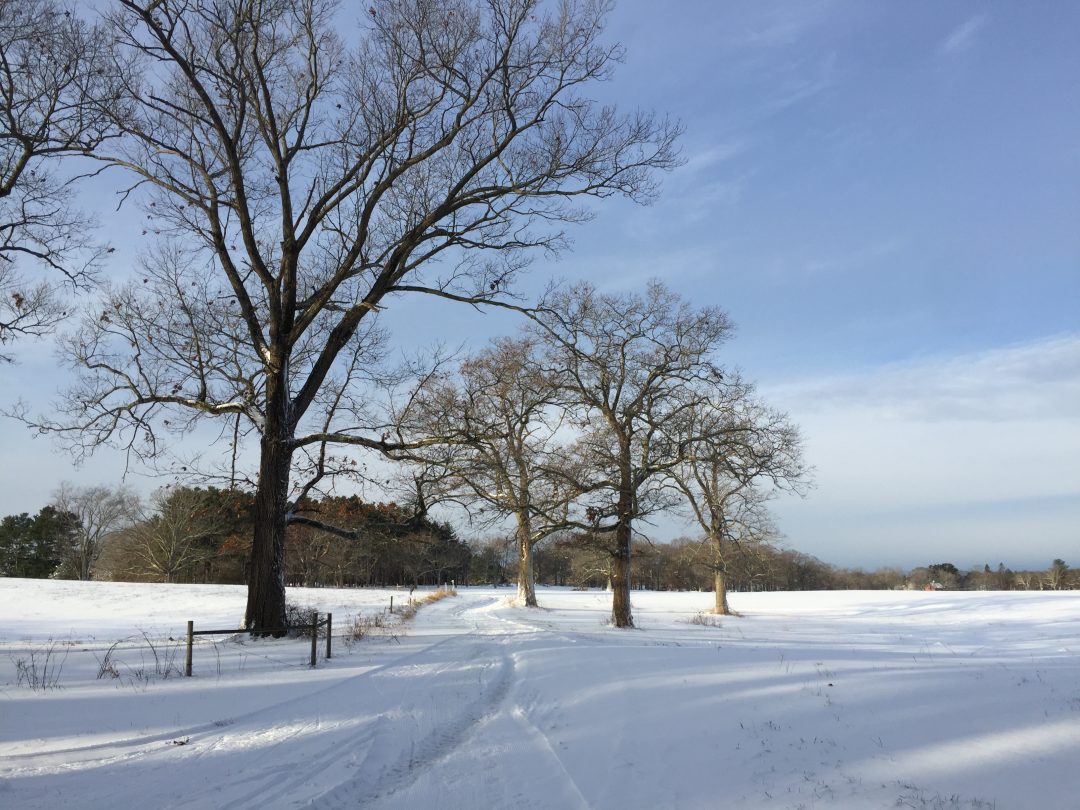
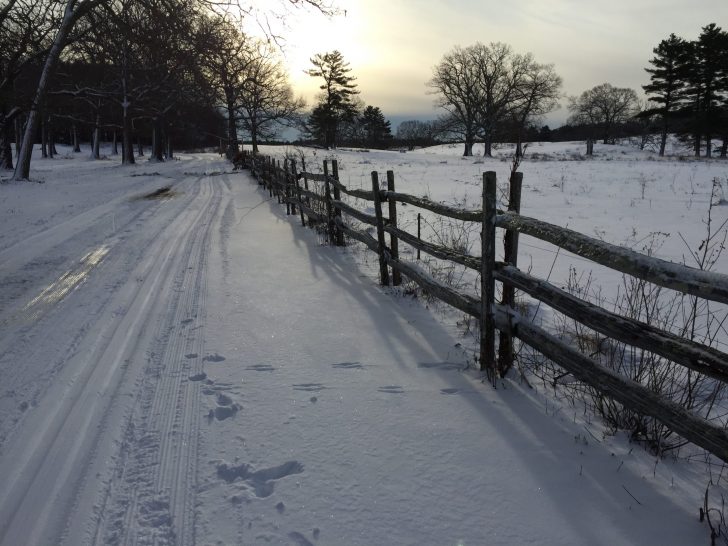
“Au naturel” trail across Appleton Farms field. Credit: SeniorsSkiing.com

This week’s Question For You asks our reader’s preference for what kind of XC ski trail they like best: groomed and groovy or no grooming. Our choice is actually a little of both. Click here.

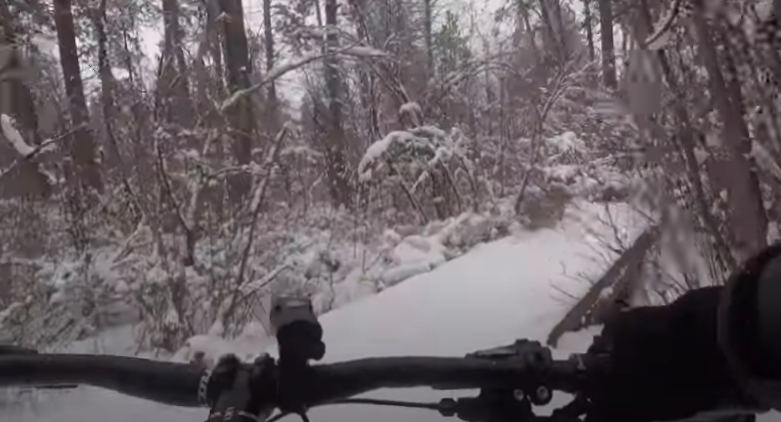
We have a short video about a cyclist making his first fat bike ride on a chilly day. We learned that keeping toes warm is a project. Click here.

Kelly Davis is a noted snow sports industry market researcher. We met her several years ago when she was director of research at SIA, the industry trade group. Currently, she runs Snow Sports Insights, a consulting company that brings information to decision-makers about the changing market place. Here’s her view of what’s happening this year in the Nordic/Snowshoe market space. Interesting stuff, and thanks to Kelly for allowing us to reproduce this article which first appeared on the Cross Country Ski Area Association website. Click here.

Credit: LL Bean group lessons

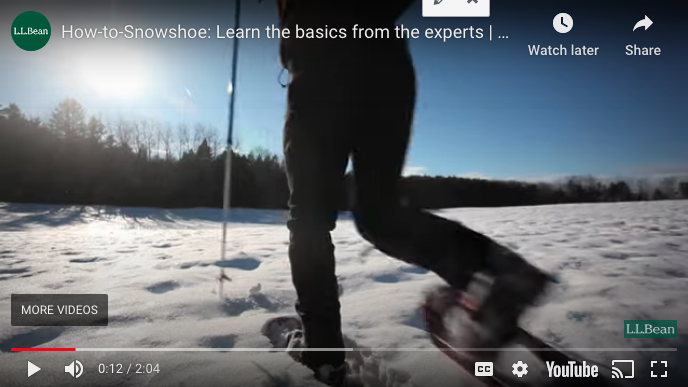
Snowshoeing is the easiest alternative for those who want to get outdoors in the winter without a learning curve or significant outlay of cash. It is also the most grandchild-friendly choice. Here’s a short video that explains the basics of How To Snowshoe from LL Bean. Click here.

Cross-country editor Roger Lohr offers his inventory of XC ski resorts that he considers “hidden gems”, tucked away from hustle and big areas. These resorts offer extraordinary opportunities to enjoy a socially-distanced vacation in snow country. Yes, you can! Click here.

Methow resort has lots of ways to make more tracks. Credit: XCSkiResorts.com

Cross-country journalist and consultant Jonathan Wiesel expounds on when and how you might take XC lessons: Group or private.  Trust us, we’ve been xc skiing since the 70s and we took a brief lesson last winter from a former Olympian and US Ski Team member Sue Wemyss at the Great Glens Trails Outdoor Center in Gorham, NH. Amazing how quickly you can improve your stride with a few simple moves. Click here.

For those readers who have never tried to cross-country ski or who might have tried to learn on their own, here’s a short video from REI that is a clear and really helpful guide on How To Cross-Country Ski. Click here

Finally, the Skiing Weatherman Herb Stevens explains how the winds of November will favor some regions and not others. Click here. 

Thank you for reading SeniorsSkiing.com.  Please tell your friends, and remember, there are more of us every day and we aren’t going away.

Appleton Farms, Ipswich, MA. Trails are groomed by a volunteer group. Credit: SeniorsSkiing.com

Editorial: Why Cross-Country Skiing?

[Editor Note: Roger Lohr is SeniorsSkiing.com’s Nordic Editor and publisher of XCSkiResorts.com]

The Older I Get, The More I Love Cross Country Skiing.

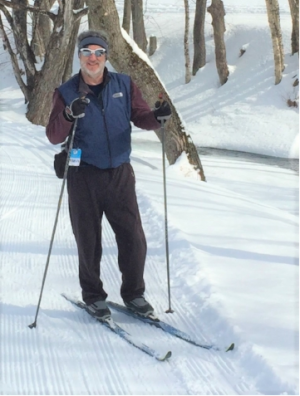
Roger Lohr in the grooves. Credit: XCSkiResorts.com

I love the sensation of gliding on the snow through the forest, being outdoors in nature. I can smell the fragrance of the trees. I can hear the bubbling brook and the sound of a bird in the distance, or the screech of my ski bases on the snow.

Groomed trails make it so easy to pass through the woods without worrying about the snow condition or getting tripped up by a hidden branch. But there is also something ethereal about skiing between the trees backcountry down the hill avoiding obstacles and picking my way to the destination. Even on a local trail network, being out in the forest seems like in the words of author Anders Morley (This Land of Snow), where wilderness and civilization meet to negotiate their differences. Even if you can hear cars on a nearby road, that negotiation allows a meditative state in the here and now.

Most skiers are encouraged to go skiing by their family or friends, or they personally always wanted to do it. Getting outdoors is among the list of reasons for people getting into XC skiing, and exercise is most likely an important reason for people to try it. The well-being factor goes beyond exercise as psychological and emotional benefits may very well be the cross beams of XC skiing that buttress the soul.

I love XC skiing in my light jacket and pants over a lightweight base layer, taking my small backpack with all my necessities. Barriers to XC skiing are low. For example, you can XC ski where ever there is snow so it is very accessible in parks and on local trails. While the sport admittedly takes time and practice to master, XC skiing is easy to do at beginner levels. It is also rather inexpensive compared to many other recreational activities. Additionally, people can ski at their own pace and go to a local park to get some outdoor exercise or enjoy the winter scenery.

On the other hand, there are issues that make XC skiing a challenge to people who’ve not tried it. Beginning XC is easy, but if you want to get proficient you have to work at it. Proficiency to higher levels only comes with time, experience, and practice. Specific equipment is important for the different types of XC skiing such as on track, off track, beginner, backcountry with heavy or light weight gear, skating, etc. Struggling on skating skis up a hill exemplifies the need for learning the right technique, skiing on proper equipment, and practice. The different segments of XC skiing may be perplexing to some people. Another factor is that experienced skiers are a tight-knit group, and it maybe a little while before the uninitiated feel accepted.

Why people quit cross country skiing is similar to why people quit any activity. People get tired of traveling or take the time to get to the trails or ski area. Time commitment can be an issue to some. Responsibilities such as work or family are also a significant reason for people deciding to reduce or eliminate time for skiing.

There are few injuries suffered by XC skiers, well, beyond being sore on the next morning because of muscles that are unaccustomed to being used. For XC skiing, proficiency is a factor when learning to glide, go uphill without backsliding, or control the skis on steep downhills.

The reasons why people start or quit skiing have been understood for decades and developing programs and incentives to address concerns is a great challenge for the snow sports industry. But personally I begin longing for the snow as spring time flourishes and am exultant the next time the ground is covered come November or December. Valhalla.

Question For You: Groomed Or Au Naturel?

What Is Your Preference? 

Appleton Farms, Ipswich, MA. Trails are groomed by a volunteer group. Credit: SeniorsSkiing.com

We live across a little country road from a 900-acre conservation property. For years, we’d walk across the road, stumble over the stone wall bordering the street, and plod our way about 20 feet through tree-falls and heavy brush to a trail where we’d put on our xc skis. And then we’d break trail around our favorite loop, eventually meeting up with trails already made by skiers who made it out earlier than us.  Then we’d follow those.

In recent years, North Shore Nordic, a local, volunteer-run non-profit, regularly runs a trail-maker snow mobile around the property, creating perfect, groomed grooves for classic skiing and a corduroy path for xc skaters.  Now, we have the best of both worlds.  To get to the groomed track, we break trail from a remote corner of the property to the main area. We like the groomed trails.  But then, there are the walkers who are enjoying the beautiful snow-filled fields by walking on—and disturbing—the groom. So, hmmm.

And, here’s our question for you:

Do you favor going to a cross country ski area with groomed trails or on a local trail that is not maintained? Do you have a place that is cross country skiing close to home? Is it au naturel or groomed?

“Au naturel” trail across Appleton Farms field. Credit: SeniorsSkiing.com

Make More Tracks: Fat Bike Experience

Another Way To Go In The Snow: Fat Bikes.

If you’re a cyclist, you will love the fat bike experience. You will most likely want to head out on a cold day so the snow is firm but not icy. Many xc ski resorts have groomed tracks for Fat Bikes as well as skiing. Deep snow: Fat Bikes don’t work, maybe downhill, but it’s much more pleasant on a track. Soft snow: Fat Bikes work, but so will you. Alot.  Weather makes a difference.

Here’s a short video on what the Fat Bike experience is like.  Click on the image below.


Make More Tracks: Predicting Participation In XC/Snowshoeing

[Editor Note: The following article was written by Kelly Davis, Snow Sports Insights. Kelly is a veteran snow sports industry researcher and a consult to the Cross Country Ski Area Association.]

Alternatives To Alpine Skiing Are Expected To Blossom This Season.

Participation in cross country skiing and snowshoeing is expected to increase significantly this winter for the second season in a row. Since late March, when the COVID-19 pandemic sent many Americans home, participation in many outdoor activities has spiked, including hiking, cycling, and paddling. Trailheads across the country were full, many on trails were there for the first time looking for activities that offered safe, socially distanced activity outside of the home and away from the gym. Some areas reported more than double the usual traffic on local trails.

The numbers that we’re seeing are greatly higher than we’ve ever seen before. We’re seeing it across all of the forest, in our places where we’ve kind of labeled as quieter places. They’re at capacity and spilling out as well. Tiffany Brenna U.S. Forest Service

As the weather turns colder, sending many indoors and driving up COVID-19 infection rates, Americans will again look for ways to get outdoors and participate in healthy and physically distanced activities. In addition to offering a refuge from COVID, cross country skiing and snowshoeing are some of the most accessible and economical activities available.

Participation

XC/Snowshoe participation numbers are up. Credit: Snow Sport Insights

Last season, despite the abrupt end of skiing at downhill resorts in March, cross country skiing and snowshoeing saw participation grow. More than 5.2 M Americans participated in cross country skiing, a 6 percent increase over 2018/2019. Snowshoe participation grew more than 12 percent last season to 3.6M participants.

Cross country skiing and snowshoeing are far more accessible than downhill skiing for most participants. Skiers and snowshoers participate at many different locations including cross country ski areas that offer miles of groomed trails, groomed municipal properties, golf courses, parks, frozen lakes, and even on snow covered roads and sidewalks in their neighborhoods. In fact, many participants can find trails within a few miles of their home.

According to an SIA study on barriers to participation, downhill skiers typically need to travel at least 45 minutes to get to the nearest lift-served resort and they can expect to pay about $100 for a weekend lift ticket. By comparison, cross country skiing trail day passes average $15 and season passes range from $25 for the Great Minnesota Pass to $212 at the Trapp Family Lodge located in Stowe, VT, to $280 at Devil’s Thumb Ranch in Frasier, CO. [Editor note: Local parks, golf courses, and conservation areas are often free or ask a small fee] .Once on the skis, remaining physically distanced from others on trails that frequently are 12-18 feet wide is a non-issue.

Retail

In speaking with retailers across North America, many are saying August and September sales of cross country gear are up as much as 300 percent.  Several retailers are saying the gear being sold is entry level packages, indicating beginner skiers are thinking very far out about the coming winter and what activities they will be doing.

I’ve already increased all my orders exponentially—quite a bit for cross-country skiing.  It’s going crazy now. I’ve never had the (ski) wall up so early. I’ve never had so much interest. We’ve never sold so many packages this early in the season. It’s pretty incredible. Trevor Norgan Canadian Retailer, Regina Sports

The 2020/2021 season projections are positive. Increased participation will drive hard goods sales that typically total about $40 M according to NPD. Participants will also need winter apparel but most who participate in other outdoor activities won’t need to spend thousands on a new kit. Cross country skiing doesn’t require a helmet, or goggles and not everyone chooses to deck themselves out in spandex (although wicking fabric is helpful).

The Experience

Cross country skiing and snowshoeing are fun to learn, healthy, family friendly, accessible, affordable, and offer great variety. Participants can hike their favorite trails on snowshoes, find amazing winter scenery on groomed cross country ski trails, or wait for snow to fall in their neighborhoods and ski around town. Cross country skiing uses natural movements; it doesn’t require special skills to get started and has a short learning curve. Snowshoeing may be more difficult than walking but most people can start snowshoeing within minutes of strapping on their snowshoes. As an added bonus, many areas that cater to cross country skiers and snowshoers offer fine food and craft beverages.

An important factor likely to drive increased participation on trails this winter is the obvious social distancing advantage these activities have over lift-served downhill skiing. The two largest alpine resort operators have announced that there will be capacity limitations at their resorts and season pass holders will have priority. Casual skiers, those that only ski a few times each season, may find themselves blocked out of weekend skiing at lift served resorts. Social distancing is far easier when skiers and snowshoers have miles of trails to explore away from crowds.

The financial bottom line on cross country skiing and snowshoeing tends to be small, making these winter activities an excellent option for anyone that wants to experience a true winter wonderland.

Weather

Finally, weather is always a factor in winter sports, and cross country skiing and snowshoeing depend on snowfall.  The forecast for this winter is promising. This season, La Niña conditions are projected, the northern states and Canada will be colder and wetter than normal.  According to the National Oceanic and Atmospheric Administration, “La Niña favors increased snowfall over the Northwest and northern Rockies, as well as in the upper Midwest Great Lakes region. Reduced snowfall is observed over parts of the central-southern Plains, Southwest, and mid-Atlantic.” Many downhill ski resorts have snowmaking equipment that can compensate for natural snow, but fewer than 20 percent of cross country trail systems have snowmaking capability. This season’s weather looks promising for most cross country ski areas.


Make More Tracks: How To Snowshoe

Snowshoeing Is A Highly Accessible and Easy Way To Enjoy The Winter.

Now here’s a winter outdoor sport that brings you in to the vibrant , snow-filled landscape and fresh air with a minimum of hassle and expense. From our surveys, we’ve noticed that those who snowshoe often bring spouses and grandchildren along into an easy way to walk in the woods.

How easy is it to get started?  Here’s a short instructional video from LL Bean. Click on the image to view.

Make More Tracks: Hidden Gems Of Nordic Skiing

[Editor Note: This article first appeared in XCSkiResorts.com.]

Less Known, Excellent XC Destinations To Explore.

Comfortable going along the river behind the Woodstock Inn. Credit: XCSkiResorts.com

With torrent of people hitting the trails and the outdoors across the country, XCSkiResorts.com wanted to give a shout out to hidden gem destinations for cross country (XC) skiing this winter. There may very well be an overflow of skiers at the most popular XC ski trails, so this guide will share some of the lesser known but excellent destinations.

In the east, the Woodstock Nordic Center https://www.xcskiresorts.com/woodstock-nordic-center offers more than 45 km of skiing right in the town of Woodstock, VT on two trail systems. The Mt. Peg trails begin on the golf course at the Woodstock Country Club and climb to the summit overlooking the village below. On nearby Mt. Tom, the Center grooms more than 20 km of trails on old carriage roads in the midst of Vermont’s first tree farm and Marsh-Billings-Rockefeller National Historical Park. The Woodstock Inn & Resort, which operates the Nordic Center is a 142 room AAA four Diamond Resort in the heart of Woodstock, a town that is the quintessential New England town with a wonderful collection of restaurants and shops.

Lapland Lake XC Ski & Vacation Center http://www.xcskiresorts.com/lapland-lake/ in Northville, NY features a touch of Finland in the Adirondacks from the food and the resident reindeer to the Finnish woodburning sauna and children’s games. They’ve got 38 km groomed for classic and skate skiing and 12 km of mapped snowshoe trails. The resort is located adjacent to the famed 133-mile Northville-Lake Placid Trail for limitless wilderness ski and snowshoe opportunities. Known for its courteous staff, this year-round family resort features a two-story warming lodge with a wax room, restrooms, changing room, and shower along snack bar, and eleven housekeeping cottages known as “tupas” that have fully equipped kitchens, living room, up to 4 bedrooms, electric heat, woodstoves, and a bath with showers.

Crystal Lake Ski & Outdoor Center https://www.xcskiresorts.com/crystal-lake-ski-center in Hughesville, PA (central PA near Williamsport) is in a snowbowl location that often has snow when the rest of the region is bare, and the trail system is second to none. There is varied terrain to please beginners, intermediates and advanced skiers. This is a full service area with rentals, ski instruction, and a cozy fireplace lounge.

Yes, West Virginia. Almost heaven. Credit: XCSkiResorts.omc

The White Grass Touring Center http://www.xcskiresorts.com/white-grass-touring-center/ is in the Canaan Valley and high Allegheny Mountains in West Virginia. It is a one-of-a-kind place to XC ski that gets 150 inches of snow annually. There’s 50 km of trails that are groomed or maintained and the area has 1,200 vertical feet with slopes and glades for backcountry skiers, too. Established in the late 1970’s the “fleece and flannel” scene at White Grass is alive with a popular natural foods café.

XC ski destinations in the central regions include Cross Country Ski Headquarters http://www.xcskiresorts.com/cross-country-ski-headquarters/ in Roscommon, MI which is a leading XC ski outfitter and ski area in the Higgins Lake area. Since 1974 this has been a premier destination for XC skiing in Midwest in

XC HQ in Roscommon, MI. Credit: XCSkiResorts.omc

the heart of Michigan, with 19 km of trails groomed for classic and skate skiing for skiers of all abilities and there are also miles of trails all around the region. The Cross Country Ski HQ is known for its friendly and experienced staff and retail operation. Trails are groomed for classic and skate skiing characterized as 10% hilly, 50% moderate, and 40% flat.

The Golden Eagle Lodge https://www.xcskiresorts.com/golden-eagle-lodge in Grand Marais, is a family owned year-round resort located on Flour Lake sitting at the Height of the Laurentian Divide in MN. It has 70 km groomed trails for classic skiing and 60 percent of the trails are groomed for skating in the Superior National Forest. The Baumann family owns the Golden Eagle Lodge, and they are the only residents on the lake, welcoming skiers to enjoy 120 inches of snow annually and the tranquility and solitude of the surrounding ancient forests. The lodge is also amidst the Gunflint Trail 100-mile system, which is a mecca for Midwestern cross country skiers.

Maplelag Resort http://www.xcskiresorts.com/maplelag-resort/ in Callaway, MN is located in the northwest region of MN and is within an hour of Fargo, ND. Maplelag has 70 km groomed for skiing, snowshoeing, and fat biking. Family style meals are known to feed the camaraderie at Maplelag and the lodge is a treasury of Norwegian Folk Art with nooks and crannies to enjoy together or get away to relax and read a book. The bottomless cookie jar policy provides endless sweets. The Richards family is the host that will guarantee you a memorable time.

Further west is XC skiers can visit Enchanted Forest XC Ski & Snowshoe Area http://www.xcskiresorts.com/enchanted-forest/ in Red River, NM, which has 33 km of trails groomed for classic and skate skiing, 15 km for snowshoeing, and 5 km that allow dogs. Enchanted Forest is known for the entertaining events and the great scenic views with 500 acres of ancient forests, aspen groves, and sweeping meadows in the Carson National Forest (that’s Kit Carson for you history buffs) There’s a day lodge at the base area for a snack and the Midway warming yurt and three rental yurts are available for overnight winter accommodations.

Crosscut Mountain Sports Center https://www.xcskiresorts.com/crosscut-mountain-sports-center is in Bozeman, MT next to the alpine ski area Bridger Bowl is a popular XC ski day area only 16 miles from Bozeman. This non-profit organization is a year round recreational sports training and educational facility providing human powered outdoor activities with 50 km of groomed trails for classic and skate skiing. Located in the Bridger Mountains, the center includes a biathlon range and includes a wide 15-foot trail width and narrow gauge trails for fat biking, snowshoeing and classic skiing with impeccable trail grooming. At 6,100 foot elevation there are no altitude problems at Crosscut.

Methow has lots of ways to make more tracks. Credit: XCSkiResorts.com

Methow Trails http://www.xcskiresorts.com/methow-trails/ is located in north-central Washington just below the Canadian border and anchored by the towns of Winthrop, Mazama and Twisp. It has more than 220 km (136 miles) of perfectly groomed skate and classic ski trails. Kids 17 and under ski free everyday in the Methow Valley. Many of the trails also welcome fat bikers, snowshoers and dogs. Methow Trails is a non-profit organization dedicated to connect people, nature and community through world class trail systems.

The Bear Valley Adventure Company http://www.xcskiresorts.com/bear-valley-cross-country/ is in Bear Valley, CA on Highway 4 on the west slope of the Sierra Nevada Mountains in the land of giant Sequoia trees. Bear Valley is perfect for new or experienced XC skiers with a trailhead meadow surrounded by hills and ridges. It is at 7,000 – 7,800 foot elevation and boasts substantial annual snow depths making it in most years the first to open and last to close among the Sierra XC ski centers. There are 70 km on 38 trails groomed for classic and skate skiing with 2 kids trails, a popular sledding and tubing hill, the Snowbound Café and 3 trailside huts There’s a groomed downhill ski area nearby, too.


Group lesson

Make More Tracks: Private vs Group Lessons

Groups For Beginners, Private To Refine Technique.

Group lessons: Fun and affordable. Credit: SkiNH

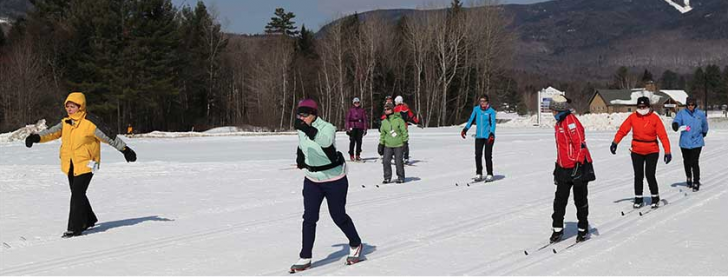
Let’s say you want to learn how to cross-country ski relatively quickly and easily – how to move with grace and minimal effort, develop endurance, and enjoy what you’re doing from the git-go. The surest shortcut to becoming a good skier is to take multiple lessons with a professional instructor.

I’ve often wondered what’s the simplest way to speed up the learning-and-fun process for people of any age, not just us “perennials”: group lessons or private instruction. Figuring that it would help to ask the pros, I contacted three renowned Nordic instructors/coaches/ski school directors. They all have long strings of credentials, but a quick overview: JoJo Toeppner ran two of the best-known XC areas in North America, California’s Royal Gorge and Tahoe Donner; Emily Lovett has long been co-Director of the famous Yellowstone Fall Training Camp in Montana;and Scotty McGee is a celebrated cross country, telemark, and alpine instructor, trainer, and examiner.  They’re experts not just at technique but also at communication and accelerating your learning curve.

There can be a bunch of factors involved in your choice, ranging from expense to self-consciousness.

Credit: LL Bean group lessons

All three experts agree that cost can be a factor. Scotty comments, “When your goals are specific enough, or price difference isn’t an issue, private lessons give you the tailored experience that’s most likely to meet your goals and be targeted at your abilities.” JoJo feels that “It’s much more expensive to take a one-hour private where everything is charged separately (ticket, rental, and lesson, as opposed to a 75-minute discounted package). Privates can be customized to what the student wants if there’s a specific need, such as hills, corners, or stopping, while groups cover a little of everything.”

Emily makes the point that group lessons can be really fun and meaningful as you learn from each other and bond through a shared experience. She adds that group instruction involves some willingness to be open to others’ abilities, questions, and learning styles, which can be fun and interesting.

Scotty says that for newer skiers, group lessons are a great way to meet people and easier to book than privates. He says, “Nordic centers most likely have a beginner lesson once or twice a day. As skiers progress, up through intermediate level, there are many undiscovered breakthroughs waiting to happen. Small improvements to efficiency and effectiveness take time to integrate into technique. So multiple group lessons at a beginner-ish level can provide great value as long as repetition (‘Here’s how you put a ski on’) is not an issue.”

Private lessons provide focus. Credit: Peak Performance

It sounds like if a resort offers intermediate group lessons, they’re likely to provide two instructors when there’s a medley of ability levels. Above intermediate level, the likelihood that a group lesson will meet your goals decreases. One exception to this is the organized “camp” with multiple ability levels (Yellowstone; Silver Star, BC; Bend, OR; Crested Butte, CO) which can see dozens of perennials during multi-day clinics.

Maybe you prefer to have a lesson based on your personal learning styles and goals, in which case a private lesson’s tailored attention and feedback may be more valuable. One-on-one instruction can also include video analysis on a phone. Group lessons can be especially fun if they’re on-going sessions (for instance, a weekly lesson or training), where you progress together over multiple sessions.

One filter you can use to help find the highest quality instruction is to inquire about certification with the Professional Ski Instructors of America (PSIA) or Canadian Association of Nordic Ski Instructors (CANSI). Qualifications include both skiing and teaching ability, and a mechanical understanding that helps frame the journey from where you are now and where you want to go. 

Make More Tracks: How To XC

The Basics Of Cross-Country Skiing Demonstrated.

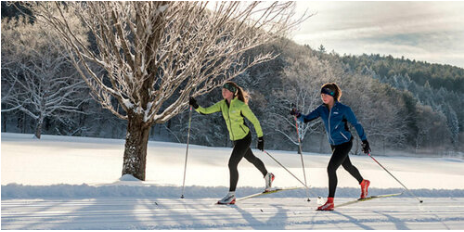
The benefits of cross-country skiing are many. Clearly, it’s a full-body exercise that you can dial up or down depending on your mood, conditioning, and terrain. And, it’s easy. You can learn the basics in an hour and feel confident on your first outing. Advanced techniques are rather simple, too, so the learning curve is quite flat. Also, it’s accessible, all you need is snow.  You can head to your local public park, golf course, or conservation wood lands. Or, if you like groomed (grooved and corduroy) trails, find a xc center with retails, lessons, hot chocolate and the like.  And then there’s nature: animal tracks, the silence of the woods, snow-sun-sky tableaux, your own ruminations. Another benefit is that your companion might find it easy and accessible, too, so you can have the company of your mate in the winter wonderland.

Here’s a great video from PSIA and REI showing the basics. Click on the image below.

Skiing Weatherman: Fast Movers

In last week’s first installment of my weekly discussion, the Pac Northwest and northern Rockies were enjoying a parade of early season snow events while skiers and riders in the Midwest and East had to be content with tuning gear and digesting the state-by-state Covid restrictions rolling out recently.

The storms have continued to hit the same general areas that were hit in the West recently, and dozens of resorts with scheduled openings between this weekend and early December could probably open now on plenty of terrain with the snow they have picked up already. By the way, those same regions are in line for more snow in the next week!

In the Midwest and East, a fast moving trough passed through earlier this week, and the air was cold enough for snowmakers from the upper Midwest into the Northeast to get started building bases. In a transient jet stream pattern like the one we are in right now, where troughs and ridges keep marching around the northern hemisphere, making snow in these areas is a gamble.

Resorts would love to open in time for Thanksgiving, but at this time of year, seldom is there enough cold air around to keep it cold enough for snowmaking for more than a couple of days. Only if a blocking pattern develops, when an upper level ridge parks near Greenland, which then allows a cold trough to come to a halt over eastern North America, do we see appreciable early season snow or extended snowmaking windows. Blocking is not in place, so cold shots will only come along every three or four days. Luckily, when it does turn milder, the short days and low sun angle will help limit the melting of the snow that falls or is made.

A modest cool shot will produce a minor amount of snow and enable a minor shot of snowmaking across the northern Great Lakes, Adirondacks, and northern New England later this weekend. The snow will be confined to higher elevations in the East. The next shot at cold and perhaps snow will come just prior to Thanksgiving Day, when another trough will move through the Midwest and Northeast. Right now it looks promising for snow in the northern Lakes, but in the Northeast, the best we can hope for is backside snow after rain on the front end of that event. So for now, any skiing/riding over Thanksgiving in the East looks very limited, prospects in the upper Midwest look a little better. Your best bet? In the Pac NW and northern Rockies. Here is a snowfall forecast for the next ten days that says it all.

Here are the regional details…

Northwest U.S./Western Canada: Strong troughs from the Gulf of Alaska continue to pinwheel into this region, leading to snow events every few days. Cascades and coastal ranges of B.C. will be the big winners.     

Sierra: After a productive storm midweek, this region will be south of the action for the next week as the northern branch of the jet stream dominates.

Rockies: Northern Rockies pick up a couple of additional rounds of snow early to midweek. Resort opening prospects in ID, MT, and WY look positive near-term.

Midwest: Northern resorts in MN, WI, and MI will have nighttime snowmaking opportunities through this weekend, along with some natural snow. Fast moving trough will bring light to perhaps moderate snow Tuesday/Wednesday of next week. Some limited Thanksgiving weekend skiing/riding is possible.

Northeast/QB: After two nights of snowmaking this week, another nighttime opportunity will be present Saturday and Monday nights. Two messy events could “net” higher elevation snow late weekend and Wednesday into Thursday. Lower elevation resorts on hold, waiting for cold.

This Week In SeniorsSkiing.com (Nov. 13)

Classified Bonus, Skiing Weatherman, Volcano Snowshoeing, Renting Your Ski House Apt., Dust Of Snow Poem, Prep Advice, Strange Parka, Holiday Valley Review, COVID Rules Example.

So we had  six inches of snow on Halloween and two weeks later we have 70 degree weather all week around the Boston outpost of SeniorsSkiing.com. And it’s Friday the 13th. And it’s a La Nina year. And it’s COVID time. And it’s 2020. What’s going on?

We’ll stop there. We’ve run out of synonyms for “unprecedented”. 

One thing we know for sure is that our readers are beginning to discover our new Classifieds section.  Reader ads are populating that page with some interesting offers from condo rentals and requests for ski buddies to ski club trips and offers of used gear. 

We started the Classified section because we felt there was some kinetic interest in our readership for connecting with other readers. Comments in various Question For You features revealed there was some back and forth between respondents. Responses to our annual reader surveys revealed ideas for connecting with others.  So, we thought a Classifieds section would be low-hanging fruit.

Our original plan was to offer readers the opportunity to post an ad for 30 days for $1.  The offer was to end today, Nov. 13. But, because we started publishing kind of early in the season, and because this Fall as been so…um…unprecedented, we thought we’d extend our offer of a $1 classified ad for 30 days until Dec. 4th. Our regular, reasonable, affordable rates will begin after that date.

As a reminder, here are the categories:

Just click here to view Classifieds or post an ad:

This Week

SeniorsSkiing.com correspondent Herb Stevens, the Skiing Weatherman, points out there will be snowfall this week in some places and not others. Surprised? Find out where and why and what the prospects are for the near future. Click here.

Beautiful snowshoeing and XC skiing on a volcano. Credit: NPS

Make More Tracks correspondent Jonathan Wiesel writes about a visit to Craters of the Moon National Monument, a unusual park in south central Idaho where you can ski and snowshoe on top of a volcano.  Extinct, but maybe not. Click here.

We hear from Steve Bell about how to market your ski house apartment, what online services to use, and how to prep your apartment for visitors. He has guidelines for dealing with COVID and guests. Part 2 of a three part series. Click here.

Our Question For You asks how you prepare for the season.  What’s the ritual you fall into year after year, consciously or unconsciously? Click here.

Our Mystery Glimpse feature presents a photo of an old timer in an odd parka.  We also reveal the identity of the instructor in comma position. Click here.

Correspondent Yvette Cardozo forwarded an interesting web page from Summit at Snowsqualmie which we are publishing as an example of what you can expect at almost any ski resort in the upcoming weeks.  Be prepared.  It’s unprecedented. Click here.

Reader Craig Scott sends in a report about Holiday Valley, a western NY powder catcher. We believe small resorts like Holiday Valley will benefit from increased traffic as customers will seek accessible, uncrowded areas this year. Click here.

Finally, we have a poem by Robert Frost as part of our Snow In Literature series.  The message is uplifting and frankly we need an uplift. Enjoy. Click here.

Thanks for reading SeniorsSkiing.com. Tell your friends and remember, there are more of us every day and we aren’t going away.

Credit:Creasy Mahan Nature Preserve


house in summer

Marketing A Rental Unit In Your Ski House: Part 2

Attracting Renters Using Online Booking Tools.

Steve’s rental unit is full most of the year. Here’s a summer view of the property. Credit: Steve Bell.

So, once you purchase the right house, how do you rent out the guest unit?  You could rent on a long-term basis, but we found that to be a problem.   A long-term lease gives the tenant a lot of time to mistreat the apartment.  In the past, we rented to a long-term tenant.  She was sweet, but she was busy.  Over time she neglected cleaning, so she left us with a lot of work at the end of the lease.  As a landlord, you can write security agreements into a lease, as well as periodic inspections, but these too can be problematic.  In any case, we have found that short-term renting is much better.  During short stays, even guests with less-than-ideal neatness (we have only hosted a very few of these) do not have enough time to create much extra work. 

For advertising purposes, we started by listing on airbnb.com and vrbo.com, both of which get tremendous traffic.  We rented our apartment most nights.  If, for some reason, demand starts to fall, we can explore other sites and other advertising media beyond website listing.  We created an entry on airbnb and vrbo without any professional help.  The sites include cell phone photos that we took ourselves.  To see our apartment, simply type “airbnb 36134350“ or “vrbo 1695325 “ into your browser. (Each website assigns its own unique identifying number to every listing.  The preceding numbers are ours.)

Since December 2019 through the end of September 2020, except for a stretch when we stopped accepting guests due to COVID, we rented out our attached apartment for the majority of nights.  We have been amazed by the demand, and especially delighted by the strong interest of summer visitors.   We don’t spend that much time managing reservations, because the websites nicely facilitate the rental process.  They provide a simple channel of internet communication, descriptions of the property and community, delivery of owner established rules, reservation management with calendars, seamless payment processing, renters’ reviews of their stay, and many other services.  As an added bonus, we can invite friends and family to the apartment when we want to as it is simple to black out the calendars on airbnb and vrbo.  

Supply The Basics

The apartment must be fully equipped with towels, bath mats, down-filled comforters, duvets for the comforters, fluffy pillows, hotel style soaps and shampoos, first aid kit, fire extinguishers, smoke alarms, etc.  And for the kitchen: silverware, plates, bowls, napkins, wine bottle openers, cutting boards, pasta strainer, coffee grinder, coffee maker, etc.  All-in-all, a lot of stuff to promote a blissful stay (buying on amazon.com saves us trips to Bozeman).  Guests want to save money by preparing many of their own meals rather than paying hotel room service or resort restaurant prices.  There is a good grocery store, nearby.

As mentioned above, the apartment has a separate entrance.  Check-in and check-out are self-service.  We leave the door unlocked before guest arrival, and airbnb or vrbo has already collected all monies before the departure day.  The combined effect is that we often never see the guests.  It’s not that we don’t love them, but due to COVID risk, separation is best for everyone.  Guests are appreciative of this, too.  Many resort visitors prefer an alternative to the common spaces of hotels, elevator buttons, shared door handles, and other opportunities to get sick.  All communication is over the internet by email, cell phone conversations, or texting. 

Before COVID was a concern,  we would often invite guests for a drink to chitchat around our fireplace.  Guests come from all over the U.S. and the world. They share fascinating experience and knowledge.  The company enriched our lives and we looked forward to it.  When the COVID pestilence is a fading thought,  we expect to accept invitations to visit our new friends. And very soon, we hope to be able to resume hosting friendly fireside visits. 

One final note about your rental unit: clean really, really well.  We try to make everything squeaky clean or better.  We have been thanked for this by our guests, who frequently indicate that cleanliness is very important to them. We are hoping that they will remember and return many times.

Editor Note: In Part 3 of this series, Steve will describe tips on operating a rental.  If you have questions, just leave a comment below.

The North Crater

Make More Tracks: Craters Of Moon

Ocean Of Volcanic Lava Offers Awesome XC/Snowshoe Experience.

“[It is an] area of about 60 miles in diameter, where nothing meets the eye but a desolate and awful waste, where no grass grows nor water runs, and where nothing is to be seen but lava.” (Washington Irving, The Adventures of Captain Bonneville, 1868 )

The North Crater shows the jagged lava outcrops. Credit: NPS

Some things leave a lasting impression. I flunked geology my freshman year of college—just couldn’t figure out technical things like how to measure a geosyncline or why it matters—and consequently rejected the whole science for years. And then I found that in the right context, absorbing geology can be amazing fun. Aside from Yellowstone National Park, the place that’s had the most volcanic effect on my geologic viewpoint is Craters of the Moon National Monument and Preserve  in south-central Idaho.

I used to pass the entrance a couple of times a year, driving between Jackson Hole and Sun Valley, at 5,900 feet in the middle of high-desert seeming-nothingness. Hummocks, ridges, cones, lava and cinders don’t create an inviting landscape; in fact, formations are so moon-like that the Apollo astronauts studied geology there prior to their lunar landing.

Craters isn’t exactly a winter destination. There’s not a whole lot of temptation to stop because there’s not much sign of human activity; there’s no on-site lodging; the nearest restaurants, motels, and gas stations are some miles away.

Beautiful snowshoeing and XC skiing on a volcano. Credit: NPS

Man doesn’t seem to have had much impact on the Craters locale. Oh, there’s more air pollution drifting through than a few decades ago, so you’re not as likely to see the high mountain ranges along the Snake River Plain; and larger animals like grizzlies and big-horn sheep disappeared a century ago—but overall, there’s not a lot of visible change.

The region began erupting around 15,000 years ago and stopped around 2,000 years ago. There’s a school of thought that another eruption is due in the next few centuries; but it’s expected to again be flowing lava rather than an explosion like Mount St. Helens in 1980.

There are no streams and few water holes, but the ecosystem is home to 2,000 species of insect, almost 200 bird species, 59 species of mammals, plus reptiles, amphibians, and a remarkably diverse plant population. Of course, you don’t see a whole lot of any of them in winter – primarily shrubs and limber pine.

It’s a unique land of tremendous extremes that an early visitor called “the strangest 75 square miles on the North American continent.” My first visit was in mid-summer with a geologist-friend who was ecstatic to see both aa lava (a Hawaiian name that’s spelled at least three different ways, meaning a jagged surface best avoided) and pahoehoe lava (smooth and ropey-looking). The heat was stifling – air temperatures may only reach the 90s in July, but surface temperature on that black rock can reach 170 degrees Fahrenheit. That’s more than hot enough to fry an egg – if you can find a flat surface.

I remember the physical shock of following a trail into a lava tube that’s perpetually chilly. We lost perhaps a dozen feet in elevation, started to shiver, and came across ice.

Snow covered spatter cone arises from the landscape. This is a place for other-worldy exploration. Credit: NPS

Winter Landscape: Milk And Vanilla Ice Cream.

Snow can bring a gentler face to Craters, or as one guide told me, a “Sahara arctic flavor.” He added, “It’s an entirely different experience from what you can have in any other area because of the brilliant white snow and the black basalt rock. It kind of looks like cookies and cream ice cream out there.”

Explore the snow-covered lava on snowshoes with a guide. Credit: NPS

Winter conditions can see -30 degrees Fahrenheit at night, with the wind rising to 30 miles per hour and not much tree-cover. It’s a great time to have the right clothing and good judgment on how far to venture from your car. There’s usually about a four-month season for skiing and snowshoeing.

The Park Service grooms up to seven miles of two-way trail along a summertime scenic loop drive. When I visited it was double-tracked, with a skate lane shared by snowshoers plus a separate snowshoe trail. There’s no fee, no dogs, no bikes, no snowmobiles. It’s easier to ski clockwise if you’re a beginner in order to avoid a downhill on the southwest edge of Inferno Cone.

In some ways, snowshoeing around the Monument is more fun than skiing because you get more flotation so can do more off-track exploring. But if you enjoy downhills, it’s a blast to make some turns on the open-sloped cinder cones, which can give you 400-500 feet of vertical drop.  

You can climb to the summit of Mt. Paisley for grand views before heading back to the Visitor Center. As a guide once noted to me, “How many places can people say, ‘Ya know, I went out Saturday and snowshoed to the top of a volcano?’”

At 6,000 feet, snow dominates the landscape from November to April. Credit: NPS


Skiing Weatherman: Haves and Have Nots

So It Begins, Unevenly.

As is often the case at the start of the ski season, the weather pattern is designating “haves” and “have nots” in terms of sufficiently cold air for snowmaking and natural snow.  Consistent with first year La Ninas, as this season will be, November has brought winter weather to the West while the eastern half of the country has been basking in Indian Summer warmth for the most part.   The jet stream has been set up in a western trough/eastern ridge configuration since the start of the month, allowing cold air to spill out of Canada into the Rockies, Cascades, and northern Sierra.  In addition to supporting a good amount of snowmaking, the western trough has also be productive in terms of natural snow and that has allowed a small number of resorts to kick off the season.  From Banff Norquay and Lake Louise in the north to Wolf Creek in southern Colorado, turns are now being made.  Wolf Creek, a legendary snow magnet, has all but six of their 133 runs skiable already.  Don’t believe me?  Check out their web cams!

In the short run, the western trough will remain in place, and additional snow will fall into this weekend in the B.C. coastal ranges, the Cascades, northern Rockies, and the peaks of NoCal.  Yet another system will move in from the Pacific late in the weekend, but that one will lift more northeastward, leading to more snow in the Northwest, but also a rise in snow levels.  Early next week, a ridge will pop up in the west, while a trough dives through the Great Lakes and into the Northeast. The air will be cold enough for at least a couple of nights of snowmaking across the northern Lakes as well as northern New York and New England.  It will be a gamble to make the snow, because the cold is not ready to settle into the eastern half of the country.  By next weekend, the jet stream will flatten out across the country, allowing mild Pacific air to move from west to east.  This jet stream forecast for next Saturday illustrates.

Although the flow looks pretty flat and dull, a look at the temperature anomalies at 5,000 feet, a forecasting proxy for surface temps. There will be some modestly cold air along the Canadian border, so there is potential for some additional snowmaking late next week in the Lakes and Northeast.  Here’s that map. 

It’s still early, so we’ll take potential where we can find it!          

Here are the regional details…         

Northwest U.S./Western Canada:  Two additional early season snowfall are coming, the first late this week, with a storm right on its heels about 48 hours later. The second storm will have higher snow levels.  

Cascades and Sierra:  The same two systems will bring snow to the Cascades with the snow extending down to the northern mountains of California.  

Rockies: Northern Rockies pick up two additional snowfalls by early next week.  First system reaches Wasatch, second stays further north.  Central and southern Rockies miss most of the action…some light snow will reach Colorado late this week, though. 

Midwest:  Resorts in far northern MN and MI will be able to make snow late this weekend/early next week and again late next week.  The early week cold will trigger some lake effect snow in the Upper Peninsula.        

Northeast/QB:  Northern New York and New England will have a couple of snowmaking nights early next week and again late in the week.  Longer term, CONSISTENT cold is not happening until a major pattern change, not likely until very late in the month at the earliest.

Patience.