Tag Archive for: jan brunvand

Fifty-Five Years (So Far) of “The Greatest Snow on Earth”

Part Six: Jan and Judy Become Senior Skiers.

We moved to Utah in 1966 when we were in our early thirties. We retired in 1996 in our early sixties, and now we are in our eighties, still skiing what is hyped as “The Greatest Snow on Earth.”  It’s a catchy slogan and mostly true.

Many of our best skiing memories are of powder days, bluebird days, and especially Bluebird powder days, but there are also memories of less-ideal days.

Like the time Judy and I were evacuated from a quad at Solitude on a cold blustery morning. Some essential part failed, leaving us along with about one hundred other skiers stuck half say up. It’s an interesting experience to be lowered from a dangling chair by rope and pulley.

Or the time I lost our granddaughter Rosalie at Deer Valley when she was eight years old. I was half way down a trail before I realized that she had not followed me. I headed to the nearest lift, while Rosalie appealed to a host for help. When I returned to the summit I found her in the ski patrol cabin petting the rescue dogs and having a snack.

From the same year here is Rosalie leading Grandpa and Grandma down a run at Brighton. She’s wearing her trademark panda helmet cover.

Then there was the time when I got lost in thick fog at Snowbasin guiding a visiting friend. After twice failing to find the fog poles to lead us back to the main base area, ending up at Strawberry base instead, we appealed to the patrol. The sent over two snowmobiles, and the hair-raising ride to safety at top speed was almost as scary as skiing in the fog.

I got to ski with my brother Tor again in the Rockies when he came out for visits.

Not all of our skiing has been in Utah. From 1999 through 2016 Judy and I did a dozen downhill skiing Elderhostel trips (aka Road Scholar), including Schweitzer Mountain, Sun Valley, Big Sky, Smugglers’ Notch, Steamboat, Grand Targhee, Crested Butte, and Telluride. We drove to all the western sites except for Lake Tahoe North and Winter Park which we reached via Amtrak.

After joining the International Skiing History Association we attended several of their annual gatherings, including Sun Valley, Aspen, and Vail. At the ISHS event at Park City in 2014 I met Jon Weisberg and learned about SeniorsSkiing.com.

Our ISHA connection led to a couple of group ski trips to Europe led by Penny Pitou, 1960 Squaw Valley Olympian. We went with her to Chamonix (2007) and to Zermatt (2009). Here is the obligatory tourist photo from the second trip.

In August 2008 Judy and I fulfilled a lifelong dream by skiing at Portillo. And then, finally, in 2015, we qualified for free skiing at Alta when we had both passed 80 years old. Here we are celebrating the occasion, now on modern fat skis but still using bamboo poles, retro creations by Soul Poles in Park City.

Becoming Alta senior skiers also required joining the notorious Wild Old Bunch. I’m posing here with two fellow WOB members, all in our Salt Lake City 2002 Olympic volunteer jackets. That’s George Ramjoue in blue and Larry Weir in yellow. We never did find anyone in the fourth color, red, to pose with us.

That brings us up to the curtailed season of 2019-20 and the COVID-diminished present season. Last season I managed 55 days, closing out at Powder Mountain on March 16, 2019, after which all local areas shut down. This season I had a bout with gout, so have skied only sixteen days before seeking treatment and laying off sports. Meanwhile, Judy has knee issues and is not skiing this season. But we did get to Alta one sunny day to picnic in the parking lot and talk to other skiers, and we hope to ski into our 90s. I’ve already renewed one of our season passes, and more will follow.

No more reports, though. Thanks for reading.

Return To The Rockies

Part Five: Jan and Judy Move To Utah

Our residence in Illinois proved to be similar to grad school in Indiana. I progressed in my academic career, we had another baby, and (sigh) there was no skiing. But a phone call changed everything.

At SIU-Edwardsville, we were renting from a colleague on sabbatical, and we had just started looking for a house to accommodate our growing family. Karen, our last child, was born in February, 1966.  Then a call came from folklorist Barre Toelken in Salt Lake City. He was leaving, and he sought someone to apply for his position at the University of  Utah.

I responded, “Barre, you don’t ski do you?” My interview trip was an eye-opener. I assumed that the season had wound down by late March, but the department chairman assured me. “We’ll have skiing through April.” So it was an easy decision to leave the Midwest again after just one year.

We arrived in Utah at the cusp of the development of major skiing there. Alta and Brighton had been in business since the late 1930’s; Snowbasin opened in 1940, and Timp Haven (later Sundance) started in the mid 1940’s. Park City’s ski resort, then called Treasure Mountains, was in its third season and had its trademark gondola pictured on a patch. You could still buy little houses used by former silver miners for a pittance, and skiers could park within a few yards of the gondola base.
None of the local resorts had much in the way of base facilities or housing at that time. Solitude opened in 1957, then underwent a couple of name changes and at least one closed season before prospering. Park City West opened in 1968, then had several name changes before eventually being acquired by Vail and merging with Park City. Snowbird opened in 1971.

This photo of Judy and me at Alta was taken in 1967. The old Snow Pine Lodge is seen just off Judy’s right shoulder. A luxury hotel replaced it last season.

This was the year we finally got modern skis. I know the exact date (October 31—Halloween—1967). Stein was in the shop representing Head skis, and he signed and dated a poster for us.

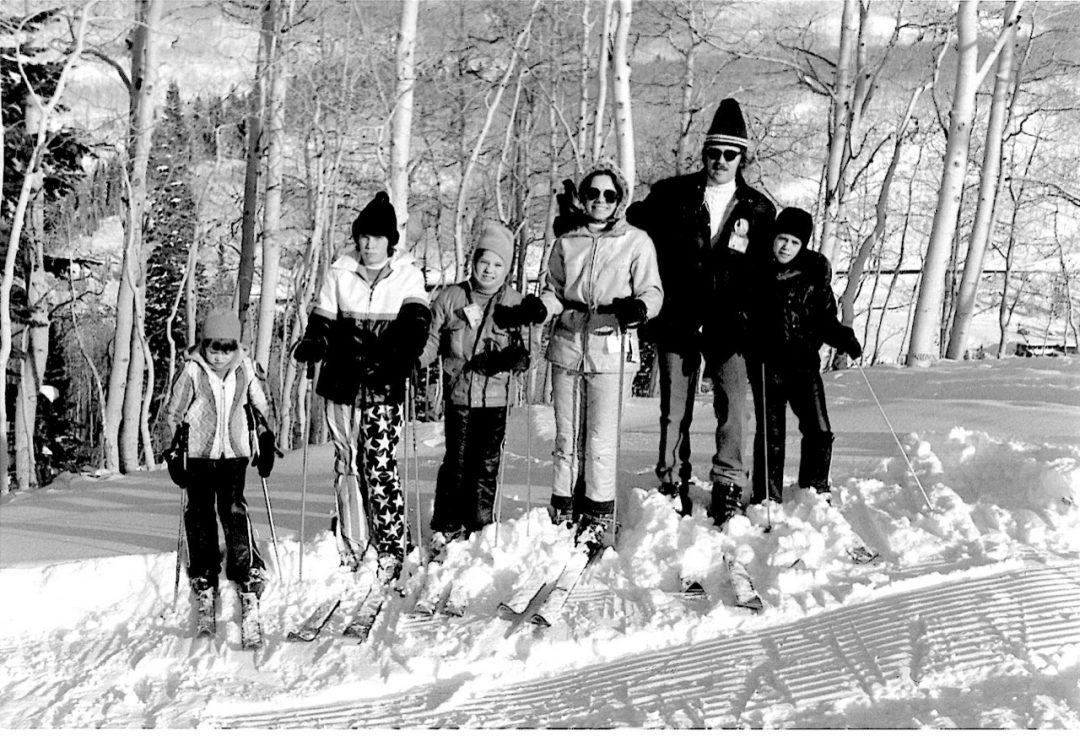
As the kids grew up, we shopped for the best family season pass deals. Here’s a photo of us at Solitude in 1972. Left to right: Karen, Erik, Amy, Judy, Jan, and Dana. After the photo was taken I stepped forward to retrieve my camera, leaving Dana without support. She slipped backwards into the trees and had to be rescued.

In 1981 we skied in Austria with two of our daughters. I had developed an interest in the folklore of Romania, and we had all been there twice in the ‘70s. In 1981 I received a grant to return from January through the summer. We brought Amy and Karen with us.

Erik was in college then and stayed in our house. Dana was on an exchange in New Zealand. Both were able to ski, so why not the rest of us? We each packed one ski outfit and hoped for the best.

As we drove south from Salzburg into the mountains in our Renault Le Car, I parked in front of a sports shop in the town of Wagrain. I asked a clerk in my best college German whether there was any skiing nearby. He grinned and pointed to a map on the wall, explaining that we were right in the middle of  “The Three Valleys,” a major ski center. There were 45 lifts linking Wagrain with the towns of St. Johann and Flachau.

We rented gear, found a B&B, and had a delightful weekend skiing the Alps. Here are Judy and the girls waiting for the ski bus. Wherever you ended up at the end of the day there was a free bus to take you back “home.” I almost gave up on Romania and switched to Austrian folklore.

Although we never managed to ski in Romania, the weekend in Wagrain made up for it. When we returned to Utah in the fall we learned that Deer Valley was opening that season. Modern skiing had arrived in the Beehive State, and we kept on enjoying it through our middle age and into senior status.

To be concluded . . .

Moving To Indiana Then Idaho

Part Four: Jan and Judy Find Lots Of Places To Ski.

We returned from Norway in 1957 and headed to Indiana University. We skied Caberfae near Cadillac, MI, a couple of times, but otherwise, our four years at IU were devoted to my studies and having Bloomington’s New Year’s Baby in January 1960. Where and when would we ever start little Erik on skis?

When I graduated in June 1961 we had a second child on the way, and I had a job offer from the University of Florida. Then came a call from Moscow, Idaho. The chair of the Humanities Department wanted to expand offerings in American Studies, and he had contacted the well-known IU program to see whether any newly-minted folklorist was interested.

This was the only job I ever took without a site visit and a personal interview. Everything was done by telephone and letters. The offer came as a telegram. It worked out perfectly: Moscow was a pleasant small town, the university was solid, my colleagues were smart and friendly, and—best of all—there was a nice little ski area just north of town.

The North-South Ski Bowl had a couple of rope tows and a log warming house. Here is a photo of Judy and me with toddler Erik ready to ski. His baby sister Amy, was with a sitter. Yes, I’m still wearing that old Norwegian sweater.

Jan, Judy, Erk, 1962.

Besides our local area, we visited other ski resorts in our region. We skied Mt. Spokane a couple of times, and returning from a meeting in Seattle I skied Snoqualmie Pass. When I gave a lecture for an extension course in Boise I brought my skis and had a day at Brundage Mountain near McCall, a place Judy and I also skied together. By then we had replaced the front clip on our Norwegian skis with first-generation “safety bindings.”

In early 1962 I was surprised by orders to join the US Army and fulfill my ROTC obligation. Even this led to some  skiing.

On my way to join my class at Ft. Gordon, Georgia, I visited my parents in Lansing. My dad suggested that we go skiing. But was there time to drive up north? Not a problem. A new little area called Mt. Brighton was on I-96 down towards Detroit. In my dad’s garage I found some gear that fit, and thus I had what turned out to be my last ski day in my home state. Hard to believe that little old Mt. Brighton is now part of the Vail empire.

I was assigned to Fort Monmouth, New Jersey, for a year. Judy and the two kids joined me, and we found a local ski club that met in a neighborhood bar. Their meetings were the last time either of us were carded to buy drinks. We never took a ski trip with the club, but we did get to some eastern ski areas on our own.

Judy’s aunt lived in upstate New York, so we could leave the kids with her and go skiing. Here’s Judy in 1963 at the now-defunct Petersburg Pass. It’s not clear whether she was planning to ski an expert or a novice trail.

Judy checks trail map at Petersburg Pass, 1963

Back in Idaho a major new area opened in the mountains above Sandpoint: Schweitzer Basin, now Schweitzer Mountain. We skied it in January 1964 when Judy was pregnant with our second daughter, Dana, born in Moscow in June. The views from the mountain looking past the frosted trees to Lake Pend Oreille were stunning.

Lake Pend Oreille from Schweitzer.

In spring 1965 opportunity knocked in the form of an offer from the Edwardsville campus of  Southern Illinois University. I felt I should not pass up a chance for a promotion to Associate Professor and time off for folklore fieldwork. So back we went to the Midwest with our three little kids, hoping that eventually we would be able to teach them skiing.

To be continued . . .

Skiing In Norway: 1956-57

Jan and Judy Get New Ski Gear, New Snow Adventures In A Land That Loves Skiing.

After breaking her leg on our disastrous first ski date in Michigan, my wife Judy was still a bit stiff  in the left leg when we arrived in Norway in late June 1956 to begin my Fulbright-student year studying Norwegian folklore.  But we had all summer to get in shape—walking around Oslo, hiking in the forests and mountains, and taking some long bike trips.

In the fall, we bought ski gear: wooden skis, cable bindings, leather boots, and bamboo poles. State of the art stuff. I had my favorite ski clothes, including the Norwegian striped cardigan I had been using since 1953; Judy bought a spiffy new outfit (maroon ski pants and grey jacket) that she occasionally still uses.

Oslo was a great place to practice. The tram lines run right up to the edge of Nordmarka, the vast wooded park above the city, and there were ski racks integrated into the sides of the old wooden cars. (I assume they have metal tram cars by now.) This photo of Judy loading her skis was taken on a weekday; on weekends and holidays the whole side of the car would be covered with skis.

Judy racks skis and boards tram to suburbs of Oslo.

I believe the only ski lift we rode all year was a T-bar in Nordmarka; the rest was cross country. After touring up there we could glide right back down to the area where we lived via ski tracks maintained between houses and businesses.

Early in the winter we took a train to Lillehammer, stayed in the youth hostel, and skied both in town around the open-air folk museum and in the surrounding countryside.

Next we did a weeklong trip with some friends to Numedalen, staying in a rented cabin (hytte) above the treeline. The snow was great, and we got lots of practice and exercise climbing up hills and sliding down. Judy, only in her second season as a skier, got pretty good, despite having little coaching beyond “Follow me!” Here she is enjoying some powder.

Judy in powder on her new skis and outfit.

One day on that trip I skied down to a village to buy some food, expecting a long slog back up with a heavy rucksack. But just as I was starting up, a group of Norwegian army men came along in a tracked vehicle. They tossed me a rope and pulled me back to the level of our cabin. Sweet!

In March we attended the annual jumping meet at Holmenkollen with my uncle and his family. It was a foggy day, and the jumpers came sailing out of the murk, most of them sticking the landing as if it had been a clear day.

Easter was late in 1957  (April 21st) so when we made another mountain trip, this time to a cabin in Telemark, the weather was balmy and snow was thin except in the shadows. Here we are enjoying the traditional Norwegian Easter ski trip, me still in that favorite sweater.

Jan and Judy, Easter ’57.

In June when we returned to the States we had enjoyed a great year of study and skiing in my ancestral home, so to speak. I brought back an article that got published in the Journal of American Folklore, kicking off my academic career. And, of course, we kept our Norwegian ski gear.

But would there be much skiing in our immediate future? After all, we were headed to Bloomington for my graduate work at Indiana University. Not exactly in a major ski zone, but who knows?

To be continued . . .


Growing Up Norwegian-American on Skis

A classic ski poster shows a blonde baby in a quaint wooden cradle, one outstretched hand holding ski poles, with a pair of skis protruding from the other side. The caption is “Norway. The Cradle of  Ski-ing.” This poster reminds me of my roots.

Jan Brunvand, age 3

I was on skis from before I can remember. An undated snapshot in the family album proves this. I appear to be about three years old.

I suspect that my parents posed me on adult skis, as those boards are super long, even for the late ‘30s. ( I was born in 1933.) My mother surely knit that hat, while those fancy mittens were from Norway. I’m holding one long ski pole, but I don’t seem to be going anywhere.

In a second childhood photo I’m posing with my brother Tor in what could be about my seventh year. Tor was born in 1935, and we had matching ski jackets. The snow sticking to my pants hints that I must have fallen on the run before the shutter clicked.

Jan and brother, Tor

My parents came from Kristiansand, Norway. They were married in 1929 in Windsor, Canada, then moved to Northern Michigan. I was born in Cadillac. By the time Tor arrived we had moved to Lansing.

I have one slightly damaged photo of my dad on a ski trip in the old country, captioned “Easter 1925.” He’s on the right with his hand on the railing. Check out those vintage skis!

Jan’s father

As Tor and I grew up Dad would take us to parks or golf courses to climb up and slide down on skis. Before we gained some proficiency with “snow plow” and “stem” turns he would hold his poles out horizontally for us to cling to for balance as we schussed the gentle slopes. 

We climbed either by traversing and kick-turning, or using the herringbone method. When our skis got sticky, we rubbed on a mix of graphite and paraffin.

In 1948 realtor Rollie Stebbins convened a group of skiers to form the Lansing Ski Club with my dad as a charter member. A portable rope tow in Stebbins’ backyard was my first experience with motorized uphill ski travel. After the club bought rural property and installed a real rope tow we enjoyed many days there working on our turns. We also made occasional trips north to ski Caberfae near Cadillac.

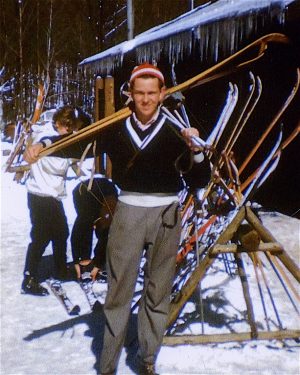
In photos of me in those days I am usually wearing  a dark blue or red V-neck ski-jumper’s sweater sent to me by my maternal grandfather in Norway.

My Dad carved a graceful Telemark turn, and Tor soon got the hang of it. I never mastered Telemarking, but instead worked on my stem-Christies and eventually achieved a more-or-less full Christiania turn. It was gratifying to learn that both these turns were named from places in Norway. Never mind that the Christie was part of the Austrian-inspired Arlberg system.

Starting college at in 1951 I joined the Michigan State Ski Club and entered a new world of skiing with friends who had actually taken lessons and learned from pros. This led to further trips to Caberfae, and eventually to skiing in the Rockies..

At college I met my non-Norwegian non-skiing future wife and converted her to the sport after a disastrous first experience.

To be continued . . .  

Short Swings!

This season will favor those living close to the mountain. Older skiers who aren’t a short walk or reasonable drive away probably will avoid the hassle and risk of commercial flights to get there. They’ll spend more time on local slopes. 

Currently, we’re in our place several miles north of New York City. The closest reasonable skiing is about 2.5 hours to the north where there are several areas with vertical drops ranging from 1,100’ to 1.600’. 

Which got me thinking: how much vertical feet is needed for a satisfying day of skiing?

I posed the question to several skiing friends around the country. Their responses offer insight into what makes us happy about the sport.

Travel Writer Roger Toll, 75, lived in Park City and Santa Fe and has been skiing for 60 years. In his 60s his daily diet ranged from 20k’ to 40k’. When he moved from Park City to New Mexico, he was lured by free skiing at Ski Santa Fe, an area with about 1,200’. Enjoyable as he found some parts of the mountain, its 1,200’ vertical entertained him for about 10 runs or 12k’; “…enough to have a great day, especially when it’s free.”

At the other end of the country, Howard Vipler finds skiing Hunter Mountain’s 1,600’ satisfying but generally calls it quits by noon. He retired from Hunter’s Ski Patrol after 40 seasons there, so he knows where to find fewer people and better conditions. Even so, for him, 1600’ has it limitations.

Back to the west, where Dick Chapman,  retired pain researcher of international renown, skis Wolf Creek in Southwestern Colorado. Dick was 58 when he started. He’s now 76.  Wolf Creek has about the same vertical as Hunter Mountain, but far more snow. Its tagline: “The Most Snow in Colorado.” Dick’s measure for a satisfying day on the hill isn’t vertical. He writes, “Fun is skiing at the edge of my ability and successfully meeting little challenges.”

Now to Colorado’s I-70 corridor and Vail, where David Orlinsky books a minimum of 10 runs and/or 15,000’ to qualify for a satisfying day on the hill. Having skied with him, I know that’s an understatement. Over the past two decades, the retired businessman has averaged one million vertical feet per season!

One state over, in Utah, Jan Brunvand and Harriet Wallace have different takes on what it means to have a satisfying day. Their names often appear with their SeniorsSkiing.com articles.

Jan, professor emeritus of English at the University of Utah and widely recognized as popularizing the concept of the “urban legend,” doesn’t count daily vert. At 87, he requires skiing a minimum of five runs in order to log the day. Usually he’s in the 7-10 run range. I’ve taken a few runs with Jan and hope I’ll be as graceful and having as much fun when I’m 87.

I’ve also skied with Harriet, 80, whose optimistic outlook is infectious. As she explains it, “It’s not about vertical. It’s about being outdoors…dancing down the slope…blue skies and whiteouts. It’s all about friends, no app needed.”

There were several other responses which I’ll try to include in a future column. I’d like to hear what you think makes for a satisfying day on the hill. Please post a comment or drop me a line: jon@seniorsskiing.com.

Your Six Words About This Season

Hemingway may have started this form. Six words that express a thought. What six words express this season? Send your entries to jon@seniorsskiing.com, please. Planning to select some good ones. Author credits will appear with each. Reminder: six words about this season. I came up with the following. “Escaping Covid. Skiing in my mind.”

Covid Victim: Ski Patroller Beards

Before/After: Arapahoe Basin Patroller, Thomas Olsen, Credit…Ian Zinner/Arapahoe Basin Ski Area

It’s all about getting a proper fit for masks, and it’s changing the traditional face of male ski patrollers. As this recent New York Times article explains, patrollers’ beards are going, going, gone!

Big White Ski Resort, BC Pulling Anti-Maskers’ Passes

British Columbia’s third-largest ski resort is ending skiing privileges for pass holders refusing to wear masks. First offenders lose a week; second offenders, a month. “It’s pretty simple, if they don’t wear their mask, we pull their pass. Once we told them they lose their skiing privileges, the argument stopped pretty quick,” said  Michael Ballingall, senior vice president, Big White Ski Resort.

Crans Montana HotelPass

Here’s a Swiss lift ticket concept, US areas might consider: Crans Montana, the large, seniors and family-friendly Swiss ski resort has a new HotelPass allowing those lodging in participating hotels to purchase last minute lift passes at deep discounts. No advance reservations. Total flexibility of when to use. Click here for more info on the HotelPass. Participating Crans Montana hotels also have new, highly flexible cancellation policies.

Final Laps on the Covid Track

We’re taking the final laps before crossing the vaccine finish line. Do what you need to do to avoid getting infected. If you already have been or are, do whatever you can to get well. Above all: Think positive. Test negative.

One Of The Best Short Ski Films…

The Chairlift is one of the best short ski films to date. A little over 12 minutes, it’s an homage to the chairlift and it’s unique culture. A production of Salomon, which released it a few days ago. 

SeniorsSkiing.com Email Blasts

You’ll start receiving occasional emails from some of our advertisers. Each will be relevant to skiing and related topics. SeniorsSkiing.com will distribute the emails; we don’t sell our list or your email addresses to third parties. We hope you’ll find them of interest.


Incidents And Accidents: 4

Things Get Rocky On Bullwinkle

[Editor note: SeniorsSkiing.com is collecting stories from readers about incidents and accidents that they have experienced. We intend to review these for patterns and themes and use that data to influence the safety policies of resorts and other stakeholders. The following is the fourth article submitted by a reader in our new feature “Incidents and Accidents”. If you have a story to tell, please follow the format used below and send to INFO@seniorsskiing.com]

Jan Brunvand, Snowbasin, UT

What Happened

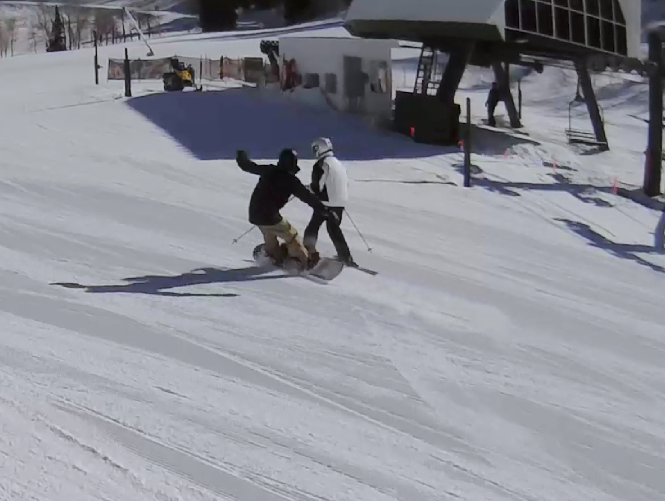
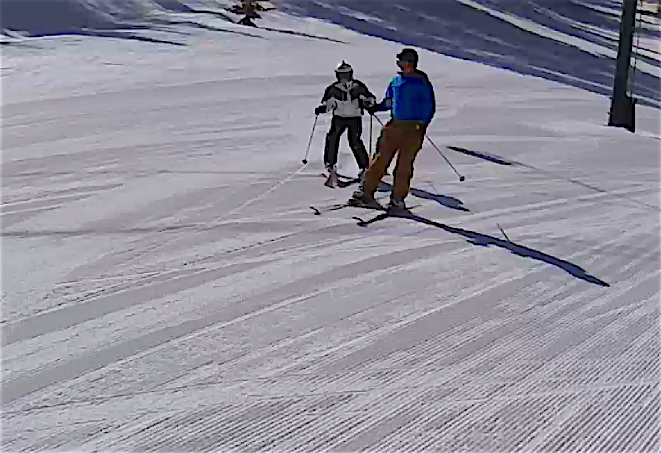
My wife Judy and I, both octogenarians, were skiing a blue run called Bullwinkle at Snowbasin, UT, on a nice clear midweek day with smooth groomed snow and few other skiers or riders. I had my helmet cam turned on, and I skied down first in order to get a video of Judy’s run. Looking back up the slope I noticed a skier and two snowboarders entering the run at the top, but Judy was on skier’s right, and they were on the left. What could possibly go wrong?

Skier veers toward Judy. Credit: Jan Brunvand

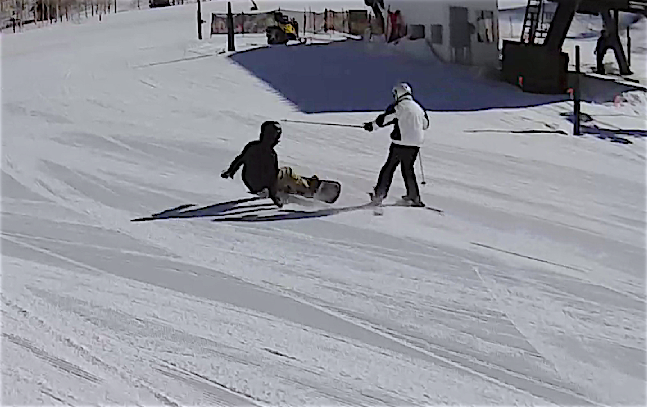
When Judy was about three quarters of the way down, suddenly the skier veered towards her and barely missed cutting her off. Then, just as she reached the run-out at the bottom, one of the boarder dudes cut straight across the hill towards her and ran over the back of her skis. The kid toppled, but Judy managed to stay upright by waving her poles to offset the collision.

Boarder crosses Judy’s skis. Credit: Jan Brunvand

The boarder, probably noting Judy’s white hair sticking out from under her helmet, apologized profusely. Judy checked her skis, and they had remained solidly attached. We proceeded to the base, keeping careful eyes on the others around us.

Boards goes down, Judy is waving her pole for balance, not repelling boarders. Credit Jan Brunvand

Back home I checked the video and saw again what close calls these had been. I took screen shots of three frames showing the two near misses plus the aftermath. In the last one it looks like Judy is poking the boarder dude with her ski pole—fighting him off. Not true, but it all happened too fast for us to realize how it might have appeared to a bystander.

Role of the Ski Patrol

No patrollers in sight

Lessons Learned

Danger can come from anywhere, no matter how much you try to stay in your lane and watch out for others on the hill. Not all skiers and riders are out of control or aggressive, but neither are they necessarily aware of their surroundings, so YOU have to be the aware one.

Advice

As in photo 3 above: Don’t Mess With Grandma!

Snow In Literature: Lesson #1

Utah Poet Offers Instruction And Advice For Beginners In Sonnet.

The following loosely-rhymed sonnet is by Utah skier and writer Emma Lou Thayne (1924-2014). It appeared in her 1971 book Spaces in the Sage and was once printed on a ski poster sent nationwide to advertise Utah’s “Greatest Snow on Earth.”

Emma Lou Thayne.

Thayne earned a master’s degree in creative writing from the University of Utah after having already established herself as a published writer. For a time she coached the UU women’s tennis team. She was an activist for women, peace, AIDS awareness, and mental health issues, and she was a much-beloved Utah personality and writer.

Her love of skiing Utah powder and her penchant for off-piste adventure is beautifully expressed in this poetic piece of advice to a young beginner. Growing up with three brothers, and raising five daughters, Emma Lou had plenty of opportunities to observe, advise and instruct youngsters in skiing.

Lesson #1

Alta. Credit: SkiUtah

Ski here, my child, not on gentle slopes

where the snow is packed and the trail is wide.

Instead, cut through the trees where no one’s tried

the powder. Push toward the hill and rotate

as you rise. No, the snow-plow holds you back;

it’s slow and makes you frightened of your turn.

Think parallel. Stay all in one, then learn

to ski the fall line, always down: Switchback

skiers in their caution never know how

dropping with the mountain keeps the balance

right and rhythm smooth. Don’t watch your tips at

all. Look past them at the deep white snow,

virgin as light, and yours. Just bend, release:

You, gravity, and white, will make your peace.

Powder Mountain. Credit: Ian Matteson


My Career As A Folk Singer

An Undergraduate’s Parody Ski Song Led To An Academic Achievement.

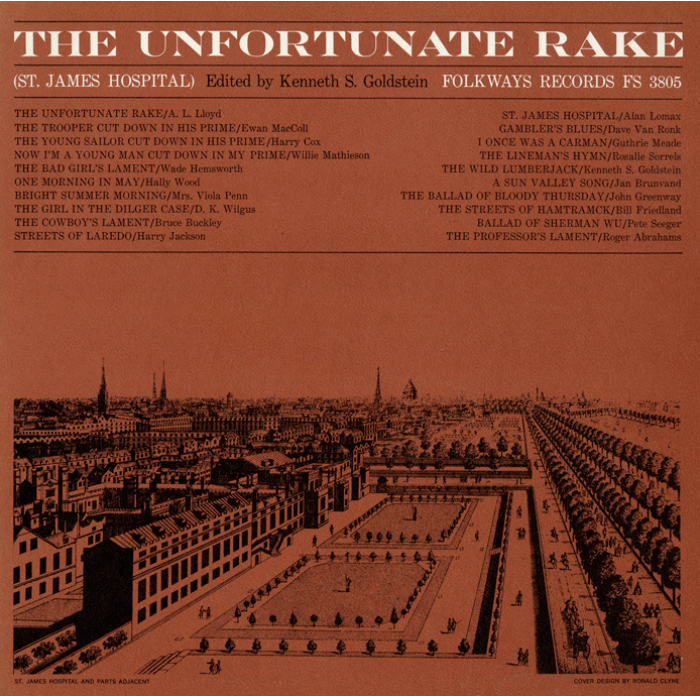
How did a ski silly ski song to the tune of a classic melody wind up on a Folkways record which became a classroom classic?


As an undergraduate at Michigan State University in the early 1950s I joined the ski club, and I learned, among other things (like how to kick turn), a bunch of ski songs. We sang them driving up to Caberfae resort near Cadillac and apres ski in a local joint, The Pine Gardens.

These songs—passed from person to person—were often parodies. A takeoff on “The Battle Hymn of the Republic” told the sad tale of an injured ski racer with the chorus “Gory, gory, what a Hell of a way to die!”

Another disaster-themed favorite re-worded the cowboy ballad “Streets of Laredo.”

When I was a-skiing the hills of Sun Valley,

As I was a-skiing Old Baldy one day,

I spied a young skier all wrapped in alpaca,

All wrapped in alpaca, and cold as der Schnee.

This lugubrious piece went on to quote the injured skier who “Once upon Baldy used to ski gaily” but then “caught a right edge, and I’m dying today.”

Later as a graduate student in folklore at Indiana University I took a course on British ballads and learned that our Sun Valley song was part of a much older cycle of variations on the theme of “The Unfortunate Rake.” That’s “rake” in the archaic sense of a dissolute person, a libertine.

Author Jan Brunvand, occasional singer of ski songs, in the 50s.

In the original Irish and English versions the victim was a young soldier, dying from an STD, who describes his sad condition and requests a funeral: “Get six young soldiers to carry my coffin,/ Six young girls to sing me a song.”

In the cowboy song the funeral request became “Beat your drums slowly and play your fife lowly, /Get six of them gamblers to carry me along.” Our skiers’ parody called for “Six from the ski school to carry my coffin,/ Six little bunnies to sing me a song.”

One of my classmates, a rising star in folksong studies, was compiling a record of versions and variants of the “Rake” cycle. He enlisted me to sing the skiers’ version. Trouble was, I couldn’t sing worth a darn.

So we got another fellow student who performed in a local folksong group to plunk guitar chords to keep me more-or-less on key, and I managed to lay down a decent track, as we say in the business.

The LP was issued by Folkways Records in 1960, and there I was earnestly chirping my “Sun Valley Song” on the same disk as nineteen real folk singers, including Alan Lomax and Pete Seeger.

“The Unfortunate Rake: A Study in the Evolution of a Ballad” became a classroom classic used to illustrate how texts change as they are transmitted via oral tradition.

And you can listen to a sample of the “Sun Valley” song by clicking here. 

Even though this was my sole appearance as a folksinger, I make up in longevity what I lack in numbers. The Smithsonian Institution bought out Folkways and kept the entire catalog in print. Their website offers “The Unfortunate Rake “ by “various artists” as a CD or a download.

Or you can check it out on Amazon by clicking here.

I still like to sing an occasional ski song, to myself, usually while cruising western slopes, including a few times even those at Sun Valley.


My Search For Stein’s Studebaker

Having A Studebaker In Common With A Legend Prompts A Sherlockian Pursuit.

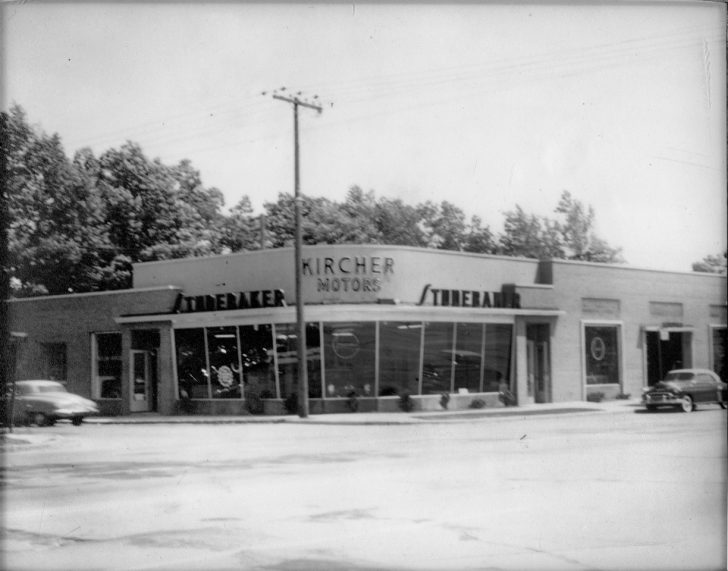
The Kircher Studebaker dealership in Detroit in the early 1950s. The car on the left is clearly a ’50 or ’51 bullet nose model, even though only the back of the car shows here. Those are the only years this model was made.

Stein Eriksen bought a new Studebaker in April 1953. That much is certain. I’d like to know which model Stein bought, what happened to it, and if there is a photo of Stein with the car.

Why? Because my father-in-law bought a Studebaker that same spring, and my wife Judy and I have had it restored. Is it possible that we own a close match to Stein’s Studebaker?

Stein bought his in Detroit from the dealership owned by Everett Kircher, founder of Michigan’s Boyne Mountain ski resort. Judy’s dad bought his from a dealer in Benton Harbor on the other side of the state. Studebakers, seniors may recall, were manufactured in South Bend, Indiana. The company folded in 1966.

Car salesman Don Thomas, also a weekend ski patroller at Boyne, met Stein through mutual Norwegian friends when he attended the 1952 Oslo Winter Olympics. When Stein came through Detroit en route from Sun Valley where he had been training. Thomas invited him to dinner and introduced him to his boss.

Everett Kircher offered Stein a job at Boyne, but Stein wanted to compete in the 1954 FIS World Championships before turning pro. He took the job the next year and spent two seasons at Boyne before moving on, ending up at Deer Valley. But he did buy that Studebaker in 1953.

Various sources describe the car as a “sports car,” a “sports coupe“ and a “graceful 1953 Studebaker coupe.” These ’53’s were a sleek breakthrough concept by the Raymond Loewy design team at Studebaker, coming between the “bullet nose” models and the later Hawk series.

A 1953 model might be the hardtop “Starliner” version or the “Starlight” coupe (our car) which has a pillar supporting the roof. Either version came as either a 6-cylinder “Champion” or a V8 “Commander.”

In an interview, Don Thomas described the car as a “five-passenger coupe,” which could fit either model, although it seems likely a salesman would refer to a hardtop by its proper term.

Once at Deer Valley, I was able to ask Stein about his Studebaker. I was in the singles line at the Northside quad when Stein approached the lift with a couple of celebrity guests. He gestured for me to join them.

I had met Stein a couple of times before, so I used the typical Norwegian greeting for acquaintances, “Goddag, og takk for sist.” Then I asked him about his Studebaker. “Ja,” said Stein, “that was the one that looked like an Italian sports car. I took it with me to Oslo and sold it.”

That’s all I learned straight from the source. But Stein remarked as we got off the lift, “Brunvand, you should speak better Norwegian!”

Since then. I have queried Stein’s son Bjorn, Kircher’s daughter-in-law Molly Clark Kircher, and a Norwegian Studebaker club member, hoping to unearth more information.

The closest I’ve come is finding a 1950’s-era photo of Kircher Motors in the Boyne archive at the Bentley Historical Library in Ann Arbor. Oh, how I wish someone had posed Stein there with his new car for another picture.

Likely Stein’s Studebaker was eventually junked, but it’s barely possible that someone somewhere has the car, perhaps unaware of its past connection with skiing royalty. I plan to keep on searching.

Correspondent Jan Brunvand with his 1953 Studebaker Starlight coupe. In the background, early snow on the Wasatch mountains. Credit: Jan Brunvand

Short Swings!

And Then, I’ll Take Off My Skis.

That’s the punch line of a joke I heard in college. Many of you will know it.

Two Russian soldiers are called home from their post in Siberia. They pack their belongings and start their long ski trek across the snowy steppe.

They talk about what they’ll do when they arrive home.

Boris says, “First I’ll embrace my wife at the door.”

And Ivan asks, “And then?”

“I’ll drink a tall glass of vodka.”

“And then?”

“My wife and I will make passionate love.”

Once more, Ivan asks the question.

Enter punch line above.

Even as I write this, the joke makes me smile. Not a bad feat for something I’ve known for a half-century or more.

I tried to find other jokes about skiing. The stuff online takes aim at snowboarders, instructors, beginners, etc. (e.g. What do you call a ski instructor without a girlfriend/boyfriend? Homeless.). Amusing but not funny.

I’m confident that members of our rapidly growing community know some good ski jokes. If you do, please write them up. We’ll publish the best as a collection and post it in the Subscriber Only Content section. Contributors will be named, and if we can find some interesting swag, there will be rewards.


Even though Jan Brunvand reported he’s on his 14th day of the season, many of us have yet to even see snow. I hope to change that this weekend at Solitude, an outstanding area in Big Cottonwood Canyon, adjacent to Brighton, another good place to play in the snow. For those not familiar with BCC, it’s just outside of Salt Lake City, a few miles north of Little Cottonwood Canyon, home to Snowbird and Alta. Snow patterns often favor Brighton and Solitude.

One of the reader surveys indicated interest in learning more about lesser known resorts. Weather-permitting, I have January plans in to visit three in Idaho (Soldier Mountain, Pomerelle, and Pebble Creek) and two in Montana (Maverick Mountain and Discovery Mountain). I’ll review each from the perspective of the older skier including things such as lot to lift access, terrain, ambiancetoilet facilities, food, lodging, etc. Several contributors have written about the places they ski. All area reviews can be found by going to the menu bar at the top of the page, click “Destinations,” and then clicking “Resort Reviews.”  Let us know if you’d like to submit an area review.


Here’s a brief non-ski report from last weekend in Bluff, Utah. Bluff is a pretty flyspeck near the Four Corners. It is an entry point for Bears Ears, the national monument with recently changed status. Three things from Bluff:

  • The one and only restaurant that’s open this time of year is better than good. Twin Rocks Cafe took on a new chef, and she is producing some nice selections. If you’re there for breakfast order the blue corn flour pancakes. Wonderful.

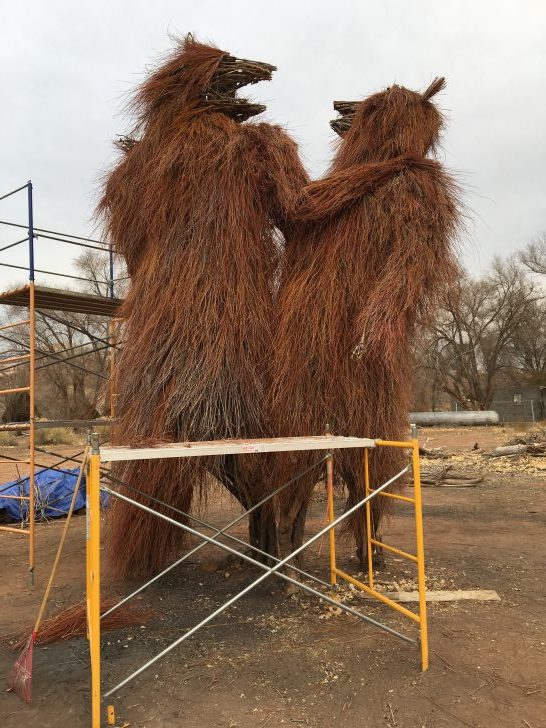
Dancing Bears—pre-conflagration—in tiny Bluff, UT.

  • Each year, Joe Pachak, a local artist, constructs a giant wooden sculpture in the middle of town. It’s set ablaze on the Winter Solstice. This year, in recognition of Bears Ears and the Navajo culture, he created two dancing bears covered in willow twigs.
  • This is perfect hiking weather and just a few miles from town there are hikes to Anasazi ruins and rock art. High on Comb Ridge up a fairly steep incline is Procession Panel, discovered in 1989 and considered one of the most interesting in the entire Southwest. It was not easy to find, but once we did, WOW. It depicts processions of small human figures, some carrying crooks, walking toward a circle. One line extends for 60 or 70 feet. Sandstone Spine (David Roberts, The Mountaineers Books, 2006), an interesting account of the first traverse of 125 mile Comb Ridge, suggests that the panel was created in the first millennium BCE. If you take the hike and find the panel, the experience will be a keeper.

Not enough new information arrived on screen to do my weekly report of ski activity. A few standouts are snow pix submitted by Squaw Valley Alpine Meadows, Lookout Pass, and Big Sky Resort. BSR’s deep pow video shot within the past week shows nice depths and terrific turns.

We’re taking next week off. I wish you good heath, warm reunions , and wonderful skiing.


Novice Skier Loses It On The Slopes

An Urban Legend From The World Of Skiing.

Editor’s Note: Jan Harold Brunvand is a frequent contributor to SeniorsSkiing.com. An avid skier, he is a retired American folklorist, researcher, writer, public speaker, and professor emeritus of English at the University of Utah. Jan is best known for popularizing the concept of the urban legend, a form of modern folklore or story telling. Urban Legends are “too good to be true” stories that travel by word of mouth, by print or the internet and are attributed to an FOAF: friend of a friend. “Urban Legends,” Brunvand says, “have a persistent hold on the imagination because they have an element of suspense or humor, they are plausible and they have a moral.”  We asked him if there are any skiing urban legends, and he submitted the following. 

In all my years of collecting and researching urban legends I’ve encountered only one story that involves skiing, but it’s a doozy.

I first heard it at Snowbird during the winter of 1979-80, but it’s probably older.

A young woman from California after taking a couple of lessons on the bunny slopes felt ready to try a run from the top of the mountain. But as she got off the tram, Mother Nature called, and she didn’t see any restroom or lodge up there.

So she skied behind a clump of trees, jabbed her poles into the snow, and began to unzip. Just as she pulled down her ski pants and thermal underwear, she began to slide down the slope. In an instant, she was swooshing down the mountain backward, her pants around her ankles, trying to stop, until she collided with a tree.

She was rescued by the ski patrol who brought her to the base for medical care. As she was leaving the patrol first aid room, her arm in a sling, a man wearing an instructor’s parka was carried in, his leg in a splint.

“What happened?” she asked him. “I mean, you’re an instructor!”

“You’re not going to believe this,” he explained, “but I was riding the lift when I saw this woman roaring down the run backwards with her pants down; I leaned over for a better look, and fell off the lift. So, what happened to you?”

***************************************

I have an inch-thick file of letters, clippings, and notes re-telling different versions of this story. Typical of folklore, there are countless variations in detail while always preserving the core yarn of the hapless novice skier. She may be an Iowan at Aspen, an Oklahoman at Vail, an Atlantan at Squaw Valley, A Chicagoan at Alta, a Missourian at Sun Valley, an Ohioan at an Upstate New York resort, etc. etc. etc.

The same story is also told about skiers from Canada, England, and New Zealand on ski holidays either at home or abroad. In a version from Australia the injured lady who has been skiing in the Snowy Mountains is flying home to Sydney when she finds herself seated next to a young man with his leg in a cast. “What happened to you . . . ?”

For years a photocopied version circulated bearing the title “How’d You Break Your Arm?” Now you can find it on the Internet. It’s also a favorite story for after-dinner speakers.

The December 1983 issue of Ski magazine quoted the story from a Montreal newspaper with the variation that the half-dressed snow bunny was skiing frontwards, and she crashed “under a fully loaded chairlift.” This publication as well as one from a Swedish magazine had a cartoon illustration.

I have two questions for SeniorsSkiing.com readers: First, what version of The Ski Accident have you heard? And second, aren’t there some other urban legends about our favorite winter pastime?


Fly Fishing: Three Ideas For Getting Started

There Are Parallels Between Skiing And Fly-Fishing.

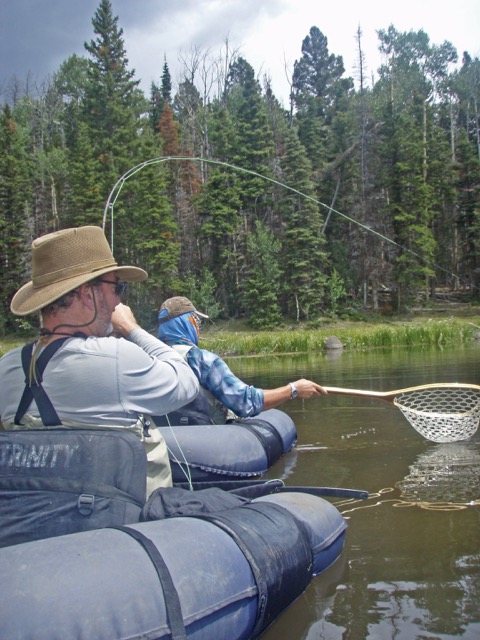
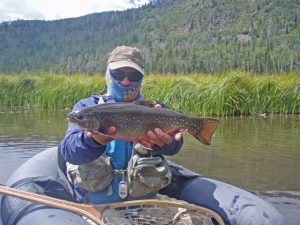
Skiers are attracted to fly-fishing because of the skills, the outdoors, and the lore. Credit: Jan Brunvand

Skiers are attracted to fly-fishing because of the skills, the outdoors, and the lore.
Credit: Jan Brunvand

Ski season is over; what now? Some turn to hiking, biking, tennis, or pickle ball. For me it’s fly fishing.

The pursuit of wily trout with fake insects has things in common with skiing. Both involve exercising in beautiful places, both are great family activities, and both offer satisfying complications of gear and technique.

The daunting details of fly fishing, however, deter many from trying it. How to navigate the complex world of equipment, casting, fish behavior, and aquatic etymology? The challenges are part of the fun, but they erect a barrier for beginners.

You can sample fly fishing without too much frustration. I offer three suggestions.

First, go with a pro, if you can possibly afford it. Nobody learns to ski from the pal who takes you to the top of a run and says “Follow me.” Similarly, you usually won’t get the best introduction to fly fishing from a friend or partner. Hire a guide for your first time out.

Step One: Hire a guide to show you the basics. Credit: Jan Brunvand

Step One: Hire a guide to show you the basics.
Credit: Jan Brunvand

A guide provides gear, lunch, flies, and coaching. Explain that you are entry-level. Guides know where and when to go, and they want you to catch fish. A day of guided fly fishing is costly, but you’ll get a good start, have fun, and learn if you want to lay out cash on rods, reels, waders, etc.

Even after years of fly fishing, if I’m on new waters or trying a different approach I like to hire a guide the first day.

Second, find a local support system. If there’s a chapter of Trout Unlimited or the Federation of Fly Fishers near you, join. Look for fly fishing classes taught by community colleges or local sports shops. Go fishing and chat up others you meet on the stream.

Third, start to read about the traditions and subtleties of fly fishing. I say “start” because you’ll never finish. For basic information, get The Orvis Fly-Fishing Guide by Tom Rosenbauer. Someday you may acquire top-of-the-line Orvis gear, but for starters buy this affordable paperback.

Even cheaper in its comic-book format is Sheridan Anderson’s The Curtis Creek Manifesto which offers excellent advice in a rib-tickling style. Published in 1976, it’s outdated as to gear, but the fish-catching techniques, including “The Curtis Creek Sneak,” are priceless.

Beyond facts, you want inspiration, so watch the 1992 film A River Runs Through It, and read Norman Maclean’s story that inspired it. Forget about the fancy “Shadow Casting,” though; that’s more Hollywood than realistic.

There’s much wonderful writing about fly fishing, but let’s keep it simple. Google Robert Traver’s “Testament of a Fisherman” and print a copy to ponder. This classic statement consists of one extended sentence less than a page long; it’s packed with emotion, whimsy, and poetry. Traver concludes that he loves the sport, “ . . . not because I regard fishing as being so terribly important but because I suspect that so many of the other concerns of men are equally unimportant—and not nearly so much fun.”

Amen!

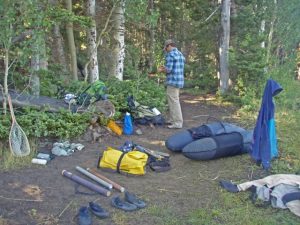
Like skiing, there's more to fly fishing than just fishing. Credit: Jan Brunvand

Like skiing, there’s more to fly fishing than just fishing. Traditions, literature and lore abound.
Credit: Jan Brunvand