Tag Archive for: senior skiers

The Ski Diva Focuses On Senior Skiers

Women’s Ski Site Offers Advice To Seniors

SeniorsSkiing.com’s favorite online resource for women skiers is The Ski Diva, a one-stop shop for interesting ideas, information and a meet-up forum for like-minded women.  In this recent article, The Ski Diva explores how a senior woman approaches skiing at 72.  She also describes how the senior segment in snow sports is growing and quotes SeniorsSkiing.com’s co-founder on how the industry can be more accommodating to seniors returning to the sport after a hiatus.  Click to read the article, Age Is Just A Number, Right?

SkiDiva_2


SuperSeniorSpotlight: George Jedenoff Shreds Alta At 97

SeniorsSkiing Honors A Legend Who’s Skied Alta For 55 Years.

SeniorsSkiing.com is proud to spotlight George Jedenhoff, 97,  who skis Alta every year. Credit: Ski Utah

SeniorsSkiing.com is proud to spotlight George Jedenoff, 97, who skis Alta every year.
Credit: Ski Utah

How’s the spring in your legs?  Here’s George Jedenoff, a 97-year old from Oakland, CA, who has been skiing Alta, UT, since 1960.  With a lifetime season pass and a healthy lifestyle, George shows us that skiing can be a part of any stage of life.

Here’s a short video of George has he sweeps down the slopes in February 2015.  Thanks, George, you are an inspiration to all of us.  And thanks to Ski Utah for documenting George’s return to the slopes for the past three years.  You can see additional videos of George from 2013 here and from 2014 here.


Huff Post: Essential Gear Senior Skiers Need To Carry

Huffington Post Features SeniorsSkiing.com’s Co-Founder Jon Weisberg On Necessary Accessories

SeniorsSkiing.com’s co-founder Jon Weisberg has been skiing for 60 years and clearly gotten his equipment kit down pat.  In this Huffington Post Post-50 Blog entry, Jon describes the eight vital pieces of gear seniors will find most useful to put in their cars, packs, or pockets.  What do you think?  Tell us what you find indispensable to carry along and how that became essential for you.

HuffPost3

Huff Post: What Senior Skiers Must Remember

Huffington Post Highlight’s SeniorSkiing’s Co-Founder: Is there something outdated about your equipment?

SeniorsSkiing.com’s Co-Founder Jon Weisberg has a new article on Huffington Post’s Post 50 blog, this time about the potential risks of skiing with old equipment and a lack of reasonable fitness in senior skiers.  Click here for the Huffington Post blog about what seniors should think about before heading downhill with those long, skinny skis, rear-entry boots and untoned muscles. 

Huff2

Fogless, Wide-Screen View While Wearing Glasses From Osbe Helmet

How To Look Like A Skiing Top Gun

Like many seniors dependent on glasses and contact lens-phobic, I’ve always searched for a way to keep my specs from fogging up while skiing.  I overheat easily and goggles steam up so none of the usual tricks (rubbing dry soap on the lenses, etc.) help for long. I tried different goggles with a tiny built-in fan, but those have other drawbacks. A very good solution is
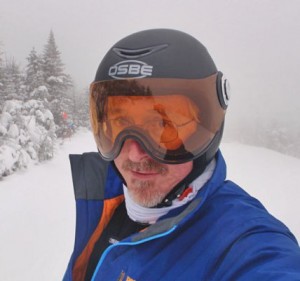
The Osbe's visor allows a flow of air to evaporate fog. Credit:  Michael Conley

The Osbe’s visor allows a flow of air to evaporate fog.
Credit: Michael Conley

the Osbe Proton Senior, a helmet featuring an integral pivoting visor that covers your face— but not your nose—from the cheeks up. I’ve used mine for a few years now in a variety of conditions, and I’m quite happy with it. There are several advantages to this visored helmet over the traditional helmet/goggle combo.

Most important for me, no fogging of my glasses at all!  The visor doesn’t actually contact your face to form a seal like a typical goggle. There is an “air dam” of foam rubber on the inside lower edge to minimize the gap, but a small amount of air can circulate through the inside of the visor. This is necessary to continually clear away any buildup of humidity, and it works very well. Occasionally on the lift a bit of fogging can occur depending on the wind but never while skiing.  Another important benefit is a greatly increased field of vision. The Osbe visor, unlike goggles, does not make a frame around your face with thick foam that restricts peripheral vision; this helps avoid what I consider the biggest danger on the slopes:  other skiers.

Since the visor does not touch your face there is no pressure to restrict breathing through the nose. Goggles tended to press my glasses into my face, and occasionally I almost pulled my glasses off when removing them. It’s a simple
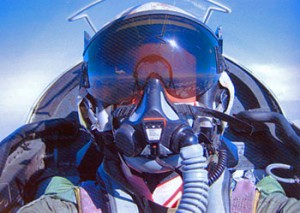
Admit it.  Navy pilot helmets are cool.  Check that visor. Credit: Andrea Salimbeti

Admit it. Navy pilot helmets are cool. Check that visor.
Credit: Andrea Salimbeti

matter to pivot the well-made, distortion-free visor up or down as needed.  Since the visor is very light, it doesn’t affect the balance of the helmet.

Visors are available in clear, mirrored, smoke and orange and can be easily changed in a few minutes. One minor problem is a small loose part that can fall off in the visor-changing process, so be careful. I just leave the orange visor on at all times and use clip-on shades when needed.

Osbe is an Italian maker of motorcycle helmets with years of experience in helmet design. Maybe being European-designed the sizing seems to run small. I’ve always worn a large in helmets, but the sizing chart on the Osbe website indicated I should wear a medium (my head is about 23-1/2″ around). I ordered a large anyway, and it was definitely too tight, so I ended up with an XL which fits fine.

The Osbe tends to start conversations on the chair—some say it looks odd. I’m 58, and I couldn’t care less at this point in my life if it does. Seeing clearly at all times is key. If I make someone smile, hey, what’s bad about that?

For more information: check Osbe Ski Helmets

What’s your experience been with Osbe?

SeniorsSkiing Contributor Michael Conley re-discovered skiing in his late 40’s when his daughter took up snowboarding. A Brooklyn, NY-based artist and furniture maker, he skis as often as possible (not nearly enough…) in upstate New York and New England, with excursions to Montana where that now grown-up daughter is in college. In warmer weather he kayaks and hikes and bikes with his cold-phobic wife.

Editor’s Curiosity Corner:  According to the NSAA, 77% of skiers 55-64 and 81% of skiers 65 and over wear helmets.  If you do, what’s your rationale?  If you don’t, what’s up?  Let us know.

 

CADS: How to Add Years to Your Skiing

An ingenious invention extends your ability to ski well on not-so-great knees

On the high side of usefulness for seniors, we find CADS, a remarkable body weight suspension system for skiers and riders that reportedly helps relieve knee pressure by acting as a spring between your butt and your knees.  Instead of

Strut from butt to boot Credit: Dan Leeth

Strut from butt to boot
Credit: Dan Leeth

gravity relentlessly pressing down—using your knees as a fulcrum—CADS is said to relieve the pressure.  Less pressure, less muscle tension, less fatigue and more skiing.

CADS stands for Constant-force Articulated Dynamic Struts—think of your car’s shock absorbers, and you have an analogous idea.  The skier wears a harness around the waist and under ski pants. Thin pole-like struts attach to the waist belt and to a fitting in the back of the ski boot.  The struts are detached on the lift and remounted at the top of the hill.

CADS inventor Walter Dandy said in a January, 2013 Dallas Morning News article, “It’s like sitting on a bedspring.  It pushes down on the ski.  It pushes up on the skier.”  He claims, “You don’t get tired, and your knees don’t hurt.”

“CADs does a novel thing,” said Walter in a SeniorsSkiing phone interview.  “In addition to weight bypass, CADs replicates what the thigh muscles do, so you’re reducing the strength requirements of your own muscles.”  CADS also puts downward pressure on your ski, allowing the ski to be in more continuous contact with the snow.  “That reduces muscle tension and fatigue,” said Walter.  “One senior skier held a tuck position from the top of one Vail ski run to the bottom without burning his thighs.  He said he couldn’t even do that when he was 25!”

Walter said that people whose knees hurt when they are skiing are prime prospects for the CADs system.  “Our customers are typically life-long skiers—engineers, physicists, surgeons, dentists and the like.  These people are self-reliant, knowledgeable, but they have a knee issue that is threatening their skiing experience.  So, instead of quitting, they try CADs.  These are not fashion-sensitive people, and they want to keep skiing.”

Struts and Bands Supply the Force Credit: CADs.com

Struts and Bands Supply the Force
Credit: CADs.com

The CADS website has lots of videos of regular folks skiing with the device.  The hard-data medical research and testimonials collected over the past twenty-four years are impressive.

If you happen to be in Vail, you can get a free on-slope demo from Walter using trial equipment.  If Vail isn’t in your plans, you can order by mail.  Walter will ask you to send your boots and ski pants so he can fit them out before sending you back your new CADS.  Or, you can install the devices yourself.  Walter is also happy to advise prospective buyers curious about the technology and whether it could be potentially helpful for them.

Yes, it looks very different, but according to the testimonials on the CADS website, this really works.  And if you can keep skiing and skiing well, who cares about stares?  “The change in attitude in people from before trying CADs to after is remarkable,” said Walter.

We like the idea of CADs because it gives senior skiers a choice where there wasn’t any before.  We plan to try CADS this season and post a review.

Have you seen or used CADs?  Tell us your story.


We haven’t yet tried CADs and can’t officially endorse it until we do.  But it certainly is worth a look if you are thinking of quitting because of bad knees.  Here’s the official promotional video.

This Bubble Is Heating Up

What is hot, orange and headed uphill?

Okemo recently announced installation of its Orange Bubble, a heated-seat, six-pack chair, the first of its kind in New England.  And, Canyons Resort in Park City installed its Orange Bubble Quad a few years ago. I’ve taken that lift, and the warmth and orange-filtered view are nice‑especially on a bitter day.

Like riding up in a ski goggle Credit: Rob Bossi/Canyons

Like riding up in a ski goggle
Credit: Rob Bossi/Canyons

The technology gives the seats a fast charge when the chair passes through the lift terminals. Fannies and spirits are in a good mood on the way up. These seats have been popular throughout Europe for the past decade and recently started migrating to North America. Vail installed the seats on its Number One gondola about three years ago.

Heated seats on a bubble chair are a vast improvement over the heavy wool blankets worn from the 40’s to the 70’s to fight cold at Stowe, Killington, Mad River, Bromley, Aspen, Gore and Holiday Valley.  Under certain conditions, they froze cardboard stiff.  Under all conditions, they were pleasantly musty. Under no condition was your butt comfy and warm.

Scott Pierpont, SVP Sales, Doppelmayr USA, explains this emerging North American trend as providing another level of comfort beyond the bubble. His company built the lift at Canyons Resort.

Credit: Rob Bossi/Canyons

Keeping Tushies Happy Credit: Rob Bossi/Canyons

Both he and Rick Speer, president, Leitner-Poma of America, the company that built the new Okemo lift, believe that we’ll be riding on many more heated seats over the coming years.

“It’s all about skier comfort,” Speer explains. “The older you are, the more you’re going to like it.”

Why orange?  We have our theories, but what do you think?

Here’s how it looks and feels.  The spiel from the Canyons…