A Skier’s Journey: Pushing The Envelope

A Senior Skier Reflects On The Thinking Part of The Sport.

Since I was five I’ve been on a voyage of self discovery through skiing that started at the ski areas of the Laurentian Mountains of Quebec, Canada and grew to be an integral part of my life the older I became. Initially learning to ski on riverbank in Winnipeg wasn’t the most auspicious start to any skier’s career but the passion for the sport of those around me left an indelible impression. Certainly I picked this up from my father, a local and eventually nationally recognised builder of the sport in Canada. It probably meant that skiing and not hockey would become the central sport of my life but I was under no pressure to do this. Instead I was attracted for its own merits to this activity that rewarded individual effort yet was always way more fun in the company of others. And then there was the connection with nature and the fact that skill wasn’t just about the size or sex of the participant. It appealed to me on an intellectual level too. The best skiers always seemed to me to be aware and afterwards reflective of what they were trying to accomplish yet in the moment of performance instinctively connected to the snow. They were and are my inspiration.

As I gained more experience it became obvious to me that I would want to pass this joy on to others so at the age of 14 I became an instructor. I also realised that one of the best ways to understand the sport that was rewarding in so many ways was to never stop trying to learn yourself. In 1986 a close friend invited me to enter the sport from a different angle and coach. Along the way I made a career in the retail sporting goods field and still strive to learn everything I can about the impact of equipment on performance as a professional boot fitter, technician and ski shop manager since 1974. All of which led to jumping off points in my life which I was completely oblivious to at the time. It was never just the destination but the journey that with hind sight mattered most. Like having a great run where sometimes a moment of reflection at the end when you realise what you just accomplished. Now I’m not saying that skiing is somehow always a metaphor for life but it was for me.

So here I am 55 years later from that little boy in Montreal and still learning and pushing the envelope. It’s a fascinating period of time in the evolution of the sport for any of us that have experienced the full range of changes in the last 60 years. Thanks to this website for allowing me to share some of the ride.

Contributor Glenn Allen is an “employee athlete” at Sport Chek, Canada’s largest retail chain of sports equipment.  Thanks for letting us use the video clip.
Happy 90th Junior Bounous!

Still Doing Pow And Inspiring The Rest of Us

As Junior Bounous celebrates his ninth decade, we salute his love of the sport and his motivation.  His message to the rest of us is simple: “Keep moving!”  Check.  Thanks, Junior and have a great birthday.

Here’s a short documentary produced by Snowbird that chronicles Junior’s trip down the Pipeline at age 80.

Credit: Snowbird Resort

Winter 2015-16 Forecast Update: El Nino Rises

This Just In: The Sea Surface Temperature Off Ecuador Exceeds Records.

In its August update, NOAA’s National Weather Service reports this year’s El Nino is roaring along to record highs. NWS predicts that sea surface temperatures in the eastern Pacific will peak in the late fall/early winter near or exceeding 2 degrees C/ 3.2 degrees F above normal.  “If this forecast comes true, it will place the 2015 event among the strongest El Niños in the (admittedly short) 1950-2015 historical record.

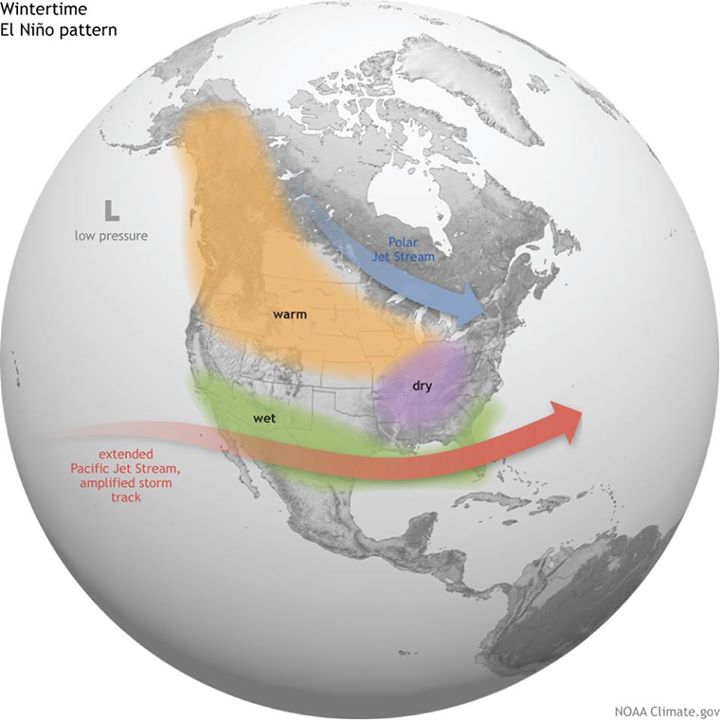
What this means is that forecasters can be assured the odds are growing that El Nino will play a role in various parts of the US as far as winter climate is concerned. As we reported earlier, a strong El Nino event brings wet and cool winter from the West Coast across the lower half of the US,  drier and warmer in the Northern Rockies, Ohio Valley, Great Lakes and Northeast.

Winter forecast 2015-16 shows how the jet stream funnels warm air across the southern US. Credit: NOAA/NWS

Winter forecast 2015-16 shows how the jet stream funnels warm air across the southern US.
Credit: NOAA/NWS

So, we will most likely have a very different winter than we had last year, especially in the northeast where the snow depth and temperature will not come close to the near-Armageddon experience of last season.

To brush up on El Nino meteorology basics, click here. 


Adding Life To Your Years With A Better Grip

Who Knew Grip Strength Was A Diagnostic Measure of Aging?

Over the past few ski seasons, I’ve noticed times when my wrists are weak, especially when rocking my poles. Arthritis? Age? Don’t know. A few days off slope or wearing an elastic wristband, and it goes away.

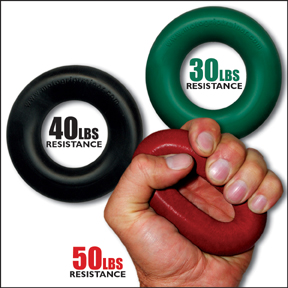
Three different bagels can help you strengthen your grip. Credit: GripProTrainer

Three different bagels can help you strengthen your grip.
Credit: GripProTrainer

Now I’m trying another approach. I have a little exercise device that looks like a rubber bagel, and you squeeze it as part of a grip-improving, hand and forearm workout. It comes in three colors, each calibrated to different strength abilities. I’ve started with green, which gives 30 pounds of resistance. The product website says it’s for “lighter weight people,” which is hardly my profile. But for now it’s enough. Black has 40 pounds resistance and red, 50 pounds. I doubt I’ll graduate beyond green.

But something about it feels very good. It’s compact, portable, and in a design/function way has a simple elegance. I’ve started to pick it up and use it unconsciously.

Studies suggest that grip strength is related to aging. An interview with one researcher published in The New York Times states “…an adult’s hand grip can distinguish different rates of aging in people with different levels of education.”

Some people use a tennis ball or one of those spring-loaded devices, but based on my experience, the green rubber bagel feels good and keeps me going back for more. It’s called the GripPro Trainer. Online, they’re $7.95 each or $19.95 for all three.

It’s too early to know if using it will help my skier’s wrist. I’ll figure that out during the season. But if you golf, fish, water ski, play tennis, or engage in any activity where grip strength is an issue, it’s worth looking into. Who knows? Maybe it will add years to your life…and life to your years.

More Hot Products From SLC’s Outdoor Retailers Show

Gee Whiz, Seniors, Here’s What’s Coming to a Store Near You!!

Shoes whose laces tighten without your needing to bend down to tie them.

Wireless heating insoles controlled with a smart phone app.

A small device that communicates your whereabouts and whether or not you need help when there’s no cell service— nywhere on the globe.

These are just a few of an endless array of products exhibited at the summer edition of the semi-annual Outdoor Retailers Show in Salt Lake City.

Every August, thousands of manufacturers and merchants—from mom and pop to big box—converge on the Salt Palace Convention Center in Salt Lake City to see and place orders for products to be sold a year from now. They return in January, this time focusing on winter sports.

Exhibitors are organized by product category. Paddle board, surf boards, water accessories, etc. in one section. Footwear, socks, foot beds, etc. in another. Yoga equipment here; camping gear there.

handsfree_heel_wheel

Treksta’s hands free lacing system works by sliding the heel back for lace up. Credit: Treksta

Back to those self tying shoes. You can look for them under the name Treksta Hands Free Shoes. It’s an athletic shoe (quite comfortable) with a foot-activated lacing system. Even the most active person will enjoy not having to bend down to tie or tighten shoe laces.

Digisole is a French import that will be in stores in a year. A programmable, heatable insole for ski and other cold weather boots, the insoles can reach 120 degrees F, a bit too toasty for most tootsies. The great thing about Digisoles is that they’re fully adjustable using an app on your Smartphone. Same phone app tells you how many steps that day, what the weather is, etc., etc. The soles are charged via USB connection, and, for most heat levels and in most conditions, will keep your feet comfy for 5-8 hours. Can’t wait to try it on the hill.

SPOT Gen3 will find you almost anywhere on the globe. Credit: SPOT GlobalStar

SPOT Gen3 will find you almost anywhere on the globe.
Credit: SPOT GlobalStar

Spot is a reasonably priced, pocket-sized, personal tracking device that, with the push of a button, lets family and friends know you’re ok or sends emergency responders your GPS location. It’s all about providing you and loved ones peace of mind when you’re out of cell range. Using satellite technology, it works from land, air and sea, anywhere on the globe. The unit, itself, can be purchased for about $75, and the satellite subscription is about $150 per year. A small price to pay for peace of mind. It’s a valuable and necessary addition to every pack or parka.

Outdoor Retailers Show: Harriet’s Three Hot Product Picks

It’s Like Christmas In August.

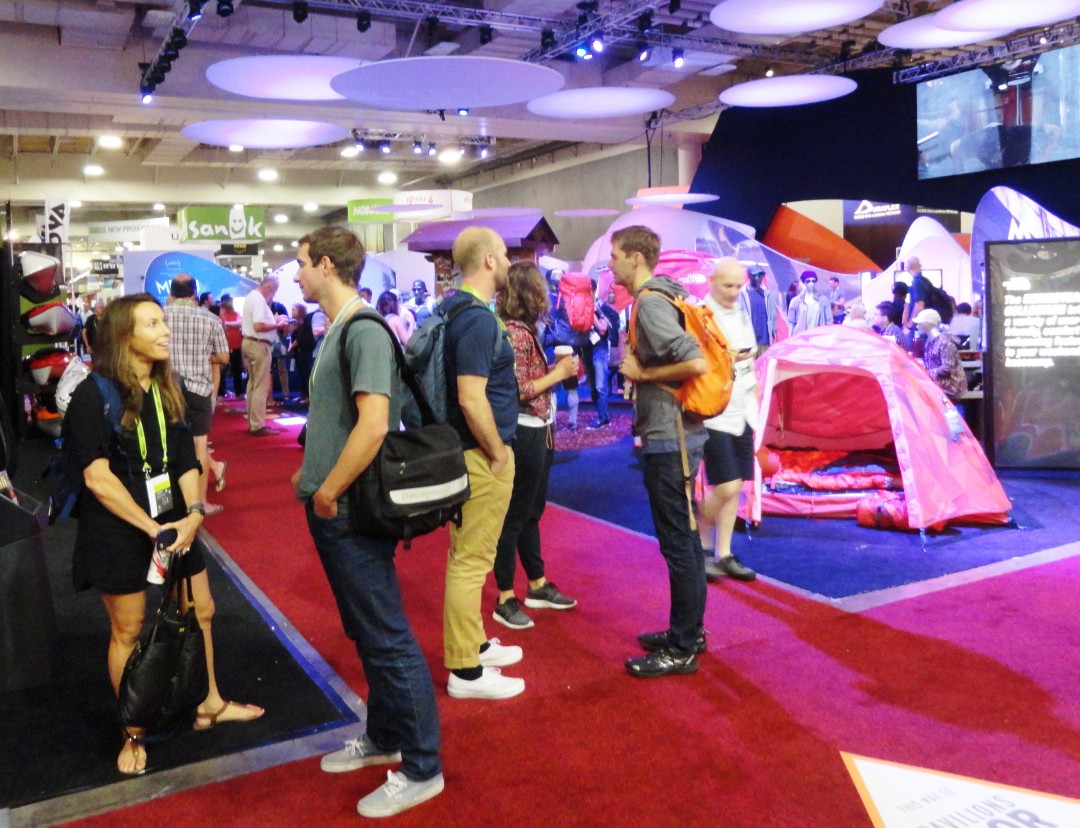
Outdoor Retailers Show in Salt Lake is the largest outdoor sports show of its kind. Credit: Harriet Wallis

Outdoor Retailers Show in Salt Lake is the largest outdoor sports show of its kind.
Credit: Harriet Wallis

The annual Outdoor Retailers Show is going on in Salt Lake City right now (August 5-8), and it showcases gear for all outdoor enthusiasts. It’s a sneak peek at brand new innovative products as well a upgrades in existing products.

The massive trade show has more than 1,500 exhibitors from around the world. Some exhibitors are well known outdoor recreation companies while others are little companies that strut a single creative product. The show brings buyers together with the sellers and it sets the stage for what you’ll soon see in your favorite recreation store.

I attended the show for SeniorsSkiing.com to search for products that would appeal to our readers. I walked miles to see the show takes up every square inch of the Salt Palace, the city’s convention center, and then it spills outside into three, block-long tents.

Here are my top picks:

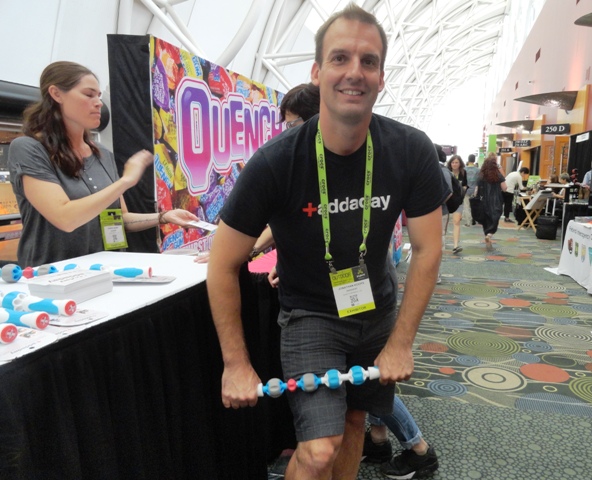
Harriet's Pick #1: Addaday Rollers. Credit: Harriet Wallis

Harriet’s Pick #1: Addaday Rollers.
Credit: Harriet Wallis

Addaday rollers for soothing sore muscles. Apply a lot or a little pressure on what hurts. It’s less bulky than traditional foam rollers so you can pack it in your suitcase and take it with you on vacation. www.addaday.com

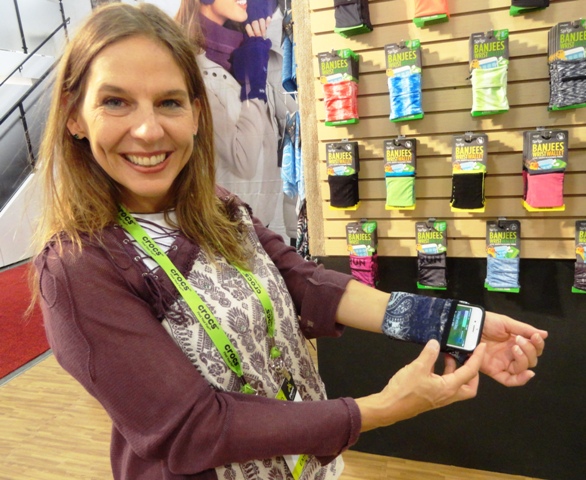
Harriet's Pick #2: Spriggs Wrist Wallet Credit: Harriet Wallis

Harriet’s Pick #2: Sprigs Wrist Wallet
Credit: Harriet Wallis

Sprigs wrist wallet is a comfy cuff that’s safer than your coat pocket. Each wrist wallet has a hidden pocket, a zipper pocket and room for your cell phone too. Stash all your important items — credit card, money, room key and phone – and you’ll always have them with you. Lightweight and lots of patterns. “I invented it in 2004 after my sister came back from a trip to Morocco and said there were lots of thieves,” said Sprigs owner Valerie Ciptak Vierra. www.sprigs.com  

Harriet's Pick #3: ExOfficio undwear Credit: Harriet Wallis

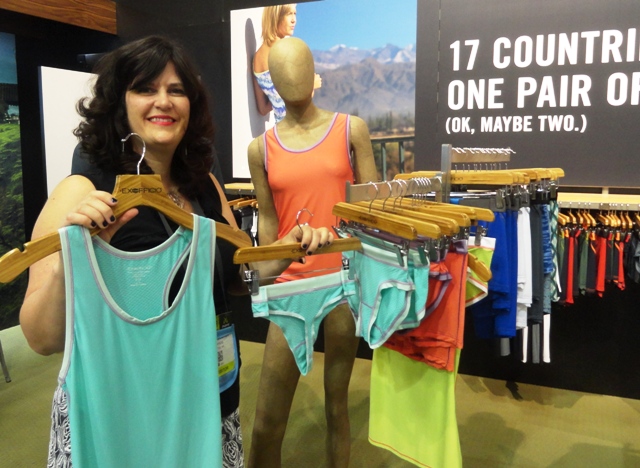
Harriet’s Pick #3: ExOfficio sports underwear
Credit: Harriet Wallis

ExOfficio Give-N-Go Sports Mesh underwear. ExOfficio is already known for it’s lightweight, breathable, quick wicking and quick drying fabrics that are perfect for travel. It’s women’s underwear line now includes the extra-breathable diamond weave sports mesh fabric that will breathe beneath your base layer. Next year, look for the boy shorts style and the fancier lace collection. There are new styles for men too. www.exofficio.com.


Rediscovering John Jerome: Looking Closely At Everyday Things

Leafing Through An Old Magazine Reminds Us Of A Great Writer

Back in the early 70s, as assistant editor at SKIING Magazine, then located at One Park Avenue in New York, we would occasionally watch a typescript from John Jerome arrive in the mail and work its way through the editorial process. After reading a couple of paragraphs, it became clear that these words were not the usual ski article patter. John was a skilled observer, first requirement of an essayist extraordinaire, and was able to tell stories and administer advice about simple things in a way that revealed a writer was at work.

CarSkier


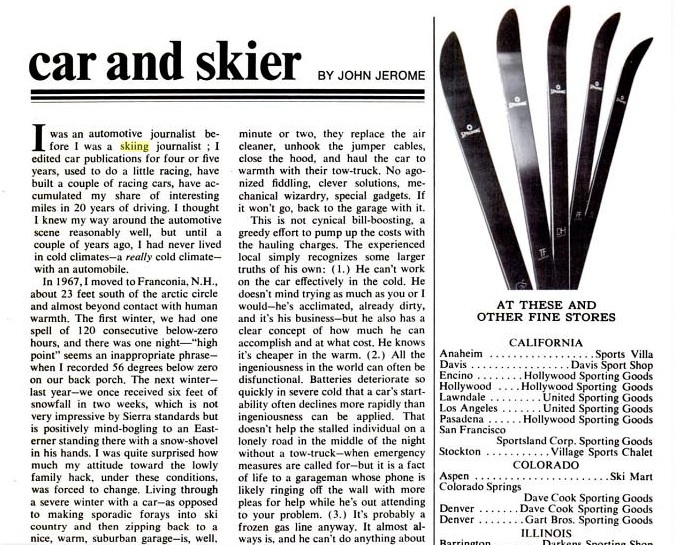
John Jerome was a polymath; he started in automotive journalism (he was editor at Car and Driver), became a skiing savant (he was editor at SKIING), re-located from the “city, working for magazines, wrestling with words and paper in tall buildings under fluorescent lights” to New England. There, as a freelance, he wrote books and many articles about running, building stone walls, becoming an aging athlete, mountains, the value of stretching, and, yes, skiing. And the halo of subjects around skiing, like cars and winter. Here’s an excerpt we just re-discovered by glancing through a November, 1969, SKIING article, “Car and Skier”. He’s talking about one of the two main problems of winter driving he learned by living in cold-winter New Hampshire, getting unstuck:

“Getting unstuck, or not getting stuck, is a much more diffuse problem, against which logical, ordered stops are not so effective. I hate and despise snow tires, but I put ‘em on, and they saved me a lot of grief. My prejudice was based on their noisiness and feel at highway speeds; what I didn’t realize is that a large part of the process of not getting stuck is a kind of metaphorical shifting of gears that takes place when you are a severe-winter resident. You simply slow down. When winter closes in, you bank your metabolism and your frustrations, and settle down into a calm and bumping 25-mile-per hour way of life. It does wonders for keeping you out of snow banks, and it also overcomes a lot of prejudices about snow tires. You can spot winter tourists by how fast they drive more quickly than by their plates. So can the cops.”

The first problem of winter driving, if you’re wondering, is getting started.  Solution: Bring car battery into house at night.

JohnJerome

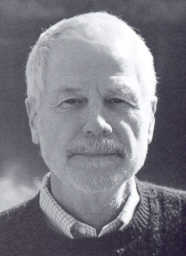
John Jerome, prolific writer, observer, athlete, contemplator of things.

Good writers see connections between things in the world that others either don’t see, or don’t see until the writer points them out. John Jerome was good at that. Here—in this excerpt from his book Stone Work— he makes a link between the rhythm of placing stones on a wall and making linked turns in skiing. On finishing the placement of a stone—the last step of the cycle: start, the move, the finish—he says:

“Sometimes, there is more difficulty in finishing moves than in starting them. I first ran across this principle in downhill skiing, where great instructional emphasis is placed on completing one turn in order to get the next one started right. This didn’t make a whole lot of sense to me: you have to stop turning in one direction if you’re going to start turning in the other, don’t you? I flailed and flummoxed my way through a lot of awkward moments before the significance of the advice sank in. Finishing is a positive act. A ski turn carried to its logical physical conclusion ends with an edge-set that make a stable platform from which to start the next turn. ‘Finished’ means your weight is in the right place, your body and skis prepared for whatever comes next. Without it, you’re in trouble. You have no ‘timing’.’

John Jerome was contemplative writer who wrote in a way that made you feel you were talking with a very interesting friend over a very good drink.

His books are still available on Amazon.com. Have you read Truck, Staying With It, or Staying Supple?