John Henry Auran: Ski Journalist Extraordinaire, Dies At 90

The Creative, Intense, Funny, Unique Journalist Will Be Remembered As One-Of-A-Kind.

John Henry Auran, journalist, raconteur, skier, sailor, innovator, enthusiast.

Ski journalist John Henry Auran was the kind of person you could never forget. I worked for John Henry, or JHA, as he was known to some, in the early 70s at SKIING Magazine, then located at One Park Avenue in New York City. Despite different life paths since then, we kept in touch, even as his declining health brought him farther and farther away from the sports he loved.

John Henry was always interested in delving into new products, new racing results, new personalities on the ski scene, new ideas for connecting the reading public with the outdoor winter sports industry. His enthusiasm was uncontainable for finding, thinking, analyzing, reporting, and watching the world for news.

I will never forget when he and I went to a ski boot manufacturer somewhere in New Jersey who promised to show us a then new development in boot fitting. This was the first foam-fitting demonstration ever, as far as I know, in the business. Since John Henry was SKIING’s boot expert, he went for a sneak preview, and I tagged along to take pictures.

At the manufacturer’s “plant”, John Henry was seated in a high chair, like the shoe polishing chairs you see at airports or train stations.  His foot was placed in a plastic bladder which was gradually filled with foam and placed in a boot shell. I distinctly recall him reporting all the sensations that involved: “It’s getting warmer, I feel some pressure,” while a big smile crossed his face. “I’m getting foamed!”

After that, John Henry couldn’t resist asking people if they’ve been “foamed”.  Since no one had, that gave him license to launch into describing the experience complete with gestures and enthusiastic and dramatic commentary. “Everyone should try it.”

He was also an innovator in what created a new genre: the industry show newsletter. At the time, the ski business had three regional shows for equipment and clothing manufacturers and wholesalers to meet retailers run by Ski Industries America. John Henry had a terrific idea: Publish a daily newsletter at each show that reported news, gossip, personnel moves and the like every morning of the show. Sounded like a great idea.

JHA enlisted the staff of SKIING to do some reporting, bring it to us in our editorial corner where he and I would create columns by typing copy into an IBM Selectric. We then pasted the columns to a piece of oaktag with a pre-designed masthead and logo and brought it to a printer where we waited until the job was done. We picked up the edition and distributed it throughout the show venue. Did I mention this process took almost all day AND all night? Trial and error was the name of the game. Despite being exhausted, we knew we had a hit when we saw the show people reading the Show News over coffee. That was true journalism.

John Henry always had a story ready whenever we talked over the years. One of his favorites was about his hometown where he was born in Germany. As a young boy, he was a witness to Kristallnacht in November 1938.  A few years ago, the town government had a commemorative event marking that dark past and invited JHA to come back to join the few other surviving town residents to bear witness and tell their stories of what happened.  Despite his disability, he went all the way back to Germany with a companion, all sponsored by the town. It was a remarkable and touching journey.

John Henry was also an enthusiastic member of SeniorsSkiing.com’s Advisory Board.

John Henry lived in a nursing home in upstate New York for the past decade or so. When I called, the nursing staff would chat while John got to the phone. They would tell me he enjoyed being taken to nearby Hunter Mountain where he would sit in the base lodge watching the skiers and the lift traffic. I can see him there, in my mind’s eye, reminiscing to himself about the equipment, the racers, the dramatic places, the deadlines, and the great writers he knew. Watching the lift go around and around.

Rest in peace, John Henry.

This Week In SeniorsSkiing.com (April 20)

Discount Reminders, Season Thanks, Washing Down, Stowing Gear, Abandoned Ski Area Movie, -30-

Killington is still open. Also Sugarloaf, Sunday River, Wildcat, Jay Peak, Okemo, Mt. Snow, Sugarbush. May is possible! Credit: Jamie Frankel

This amazing season hangs on. Even as we write this on April 19 snow is falling in New England, in fact, right outside our window on Boston’s North Shore. We know that the Sierras and Rockies are also seeing spring snowfalls. It will be the last weekend for some, but it’s been years since we even contemplated skiing in May in Maine.

Fourth Season Into The Archives

With this week’s edition, the fourth publishing season of SeniorsSkiing.com is fading into the archives. We will be shifting gears in the next month, bringing articles that reflect our readers’ non-snow season activities on a less frequent basis. We’ll be picking up the pace with new ideas, articles, and offers on the other side of summer.

Bear in mind, the almost 900 articles that we’ve been publishing since 2014 are still and will always be available.  Just check the drop down menus in the blue bar above.

Our Publishing Season In Retrospect

Looking back, we’ve accomplished a lot and worked hard to create value for our leaders. Those initiatives marked SOC can be found under Subscriber-Only Content in the top menu bar. The initiatives we’ve developed in partnership with others include:

  • Mystery Glimpse photos from US ski museums
  • Our Donations to Defray Expenses Campaign
  • Making available 60s Ski Songs from Ray Conrad
  • Arranging exclusive Discounts For Seniors from 20 vendors
  • Publishing Best Skis For Seniors and Best Boots For Seniors (SOC)
  • Creating a directory of  resorts Where Seniors Ski Free (or almost free) (SOC)
  • Offering a free subscription to SKI magazine (SOC)
  • Making available a free digital subscription to Ski History magazine

We also have available on under Subscriber Only Content our first information asset we developed for our readers, complied with the cooperation of the International Ski History Association.

  • Free eBook Collection Historic Ski Posters (SOC)

Early Survey Results: We DO Have Lists Of Discounts.

A quick glance at the survey responses currently rolling in reveals that some readers are wondering when and if we will be offering advice where to get discounts on skiing. We’ve already got you covered.

One of our major early season efforts for the past couple of years has been to identify those ski areas which offer free skiing, or nearly free skiing, for seniors.  We want to point out that information is available under the Subscriber-Only Content menu that is above the blue menu bar. If you are already a subscriber, you will have to confirm your name and email address to get access to that directory. We think confirming your email address is much better alternative than having you create a username and password. We hope you agree.

Spring Survey 2018 Is Still Open.

Responses to our Spring Survey 2018 are still coming in. Thanks to those who have taken the time to give us some valuable input. If you haven’t taken our survey, just click here.  It will take you three minutes, and your advice is important to making SeniorsSkiing.com work for you.

https://www.surveymonkey.com/r/G7YBNCK

Thanks To Our Correspondents: You Are The Best.

SeniorsSkiing.com can’t publish every week during the season without articles submitted by our stalwart correspondents.  You should be familiar with their names by now. Each is a professional, some are active journalists, and each “gets” what SeniorsSkiing.com’s mission is all about: Promoting the interests of senior snow sport enthusiasts.

A tip of the ski pole to:

  • Jan Brunvand
  • Don Burch
  • Yvette Cardozo
  • Rose Marie Cleese
  • Val E.
  • Steve Hines
  • Marc Liebman
  • Roger Lohr (SeniorsSkiing.com XC editor)
  • Pat McCloskey
  • John Nelson
  • Tamsin Venn
  • Joan Wallen
  • Harriet Wallis
  • Jonathan Wiesel

And Thanks To Our Reader Opinion Writers.

This year, our readers have submitted more articles to us for publication than ever. We’d like to acknowledge those who were inspired to put pen to paper to write something for our readers. They made an effort to share their opinions, humor, stories, memories, and advice with you.  Thank you to all.

  • Torry Hack
  • John Farley
  • Bill Emerson
  • Brad Noren
  • Roger Monty
  • Bernie Weichsel

Paying Attention to Gear.

With the season winding down, it’s time to clean and stow your gear. We have two articles with advice for doing same. Val E. gives us 10 steps to cleaning that funky down jacket. And, we reprise Don Burch’s article from last year on putting away your equipment.

Flipping out at the US Ski & Snowboard Hall of Fame Induction Ceremony at Squaw Valley. Credit: Charlie Shaeffer.

US Ski & Snowboard Hall Of Fame 2018 Inductees

The US Ski & Snowboard Association has just inducted its 2018 class of new members at Squaw Valley.  We salute the following ski celebrities:  Airborne Eddie Ferguson, Hermann Gollner, Marty Hall, Mike and Steve Marolt, Thom Weisel, Steve McKinney, and Shaun Palmer.

Abandoned Ski Areas In Colorado Documentary

Here’s a short documentary from a production company called The Road West Traveled about ski areas that disappeared from the Colorado landscape. In the 60s and 70s at the height of the ski craze, there were 200 ski areas in the state.  There are currently 30. “Abandoned” tells the story of just one, Geneva Basin, which closed in 1984 with some nice drone shots. But what’s with the dog running down the piste with the skiers?  Thanks to Outside magazine for sharing this.

CLICK THE IMAGE TO SEE THE DOCUMENTARY

Or, Click Here for “Abandoned”. 

Look For Us This Summer And Fall.

We’ll be publishing articles on fitness, summer sports, fun things, and skiing in the Southern Hemisphere all with a senior slant for the next few months. Please tell your friends, and remember, there are more of us every day, and we aren’t going away.

-30-

Short Swings!

The Kindness of (Young) Strangers

Last weekend Pam and I went canyoneering in Grand Staircase-Escalante National Monument, the vast expanse of public land between Capitol Reef National Park and Bryce Canyon National Park.

Canyoneering may not be the correct term, as it generally describes the exploration of remote canyons requiring technical equipment and skills.

Leaving Peek A Boo slot canyon.

Our destination was two popular slot canyons, Peek A Boo and Spooky, cut deep in sandstone bluffs a little over a mile’s hike down a fairly steep slickrock slope and across flat desert. Reaching the parking area required driving 26 bumpy miles through a classic Western landscape of sagebrush and rolling hills; cliffs in the endless distance.

I forgot my rule about doing strenuous things in the morning. It took two hours to get there, and we didn’t leave home until 10AM.

A lot of young families were there. As it turned out, that was a very good thing.

People tend to be friendly in the wilderness: a gemütlichkeit not dissimilar to what skiers experience on snow. Different generations attached through a common thread.

Those who had been there before were happy to explain what to expect in the slots.

Yours truly slithering through Spooky.

Website references describe Peek A Boo and Spooky as among the world’s most spectacular slots. They also characterize them as relatively easy. Peek A Boo is a series of sculpted terraces, requiring use of shallow foot and handholds to heft yourself from one level to the next.

Both of us needed assistance, and the other hikers, mostly in their 20s and early 30s, were more than willing to help. Thighs became steps, strong arms became hoists. They were strangers to us and to each other, and they took the time and effort — without our asking — to help and encourage these two older adventurers.

We should not have been there. Mid-way in, I was exhausted and we decided to turn around. A few young families scrambled down the steep rocks with ease.

Not us. We struggled, and when we reached the final descent, another stranger, this time a muscular 40 year old calmly talked us down the steep face. He literally carried Pam off the cliff.

It took a few minutes to collect ourselves, before hiking to Spooky, an adjacent slot. Except for the fixed rope assisted climb at the end of Spooky — we didn’t get that far — the primary requirement to explore it is not to be too overweight. It’s a deep, narrow, sinuous fissure. Even for the thinnest person, it is navigated with front and back to the walls.

On the way home, exhausted from the experience, we made a pact: no more attempts to go beyond our physical limits. Ten years ago — which doesn’t seem that long — Peek-A-Boo would have been a breeze. As septuagenarians, it is no longer for us. That said, we both know highly-fit and agile contemporaries who would have conquered the canyons with ease.

For the future we plan to choose hikes that will not overly tax us or place us in danger. Age-appropriate hikes where, as much as we appreciate it, we won’t need to rely on the kindness of young strangers.


If you haven’t already done so, please complete the SeniorsSkiing.com Reader Survey. It takes 2-3 minutes.

Squaw Valley Alpine Meadows topped 400″ for the season. Almost 19′ fell in March. Last day is scheduled for Memorial Day.

It’s been five months since I took a New York City public bus. Yesterday, I noticed that the signs advising younger passengers to give their seats to seniors had been replaced. The signs now advise giving some seats to those in wheelchairs and other seats to the disabled.

Jackson Hogen, realskiers.com

RealSkiers.com is the superb ski review website available to SeniorsSkiing.com subscribers for less than $10. It’s published by Jackson Hogen, ski industry raconteur and all-around good-guy. His periodic “Revelations” (sent free to those on his list) are personal insights into all things skiing. Since last Labor Day, he published 33 Revelations.

Jake Burton, of snowboarding fame, recently received a custom knee implant made with 3D printing technology. He returned to the hill 3 weeks post-op. His surgeon accompanied him for his first ride.

The lifetime National Parks and Federal Recreational Lands Senior Pass now costs $80, a significant increase from the $10 I paid years ago. But it’s still one of the best bargains around, providing unlimited entrance to more than 2,000 federal recreation areas, including all national parks that normally charge a fee. Park entrance fees are being waived April 21, the kickoff date for National Park Week. If you’re sans Senior Pass and near a park, the visit will be free.

Mystery Glimpse: First US Winter Olympic Medalist Was A Ski Jumper

Only Two Guesses, One Was Correct.

Apparently, our last Mystery Glimpse of the season was fairly esoteric. We salute reader Patricia Gottshalk for identifying Anders Olsen Haugen, the US Ski Team member who was the first American to win a Winter Olympics medal. He won medals in the 1924 Olympics in Chamonix and the 1928 games in St. Moritz. In fact, he remains the only American to ever win an Olympic medal in ski jumping. But there is much more to Anders’s story.
It seems that he originally came in fourth in the 1924 Olympics.  The third place went to a Norwegian, Thorleif Haug, who had already won a gold and a silver. However, in 1974, Norway held a 50th anniversary of the games. A ski history buff had scrutinized the scores from those long ago games and determined there was an arithmetic error in adding the results.  Anders had actually won the Bronze by several hundredths of a point. So, at 83 years old, Anders Olsen Haugen, a long-retired brick layer, was awarded the medal by Haug’s daughter at a special ceremony sanctioned by the IOC.

Here’s a snapshot of Anders and Haug’s daughter.  Quite a story, eh?

And with that, we are pausing our Mystery Glimpse series for the non-snow season. This feature could not have been possible without the incredible cooperation of several ski museums across the country. Each museum mentioned below contributed more than one photo from their archives. We thank them for their support and willingness to participate.

Ski museums are quite precious to us. They are typically small, even tiny, with exhibits made from contributions by skiing enthusiasts who want their souvenirs and memorabilia to live on. If you have some interesting relics from the early days of skiing, considering making a donation to a museum near you.  Here are the museums that participated in this year’s Mystery Glimpse. Thanks to all.

Colorado Ski and Snowboard Museum

Vermont Ski and Snowboard Museum

Ski Museum of Maine

New England Ski Museum

US Ski and Snowboard Hall of Fame and Museum

Alf Engen Ski Museum

Museum of Sierra Ski History


Down Care

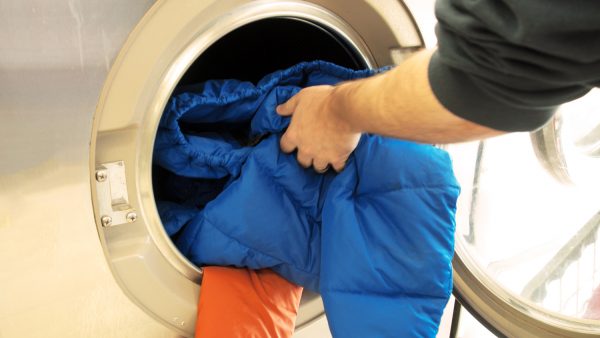
How To Wash Your Down Jacket At Home

Season’s Over; Isn’t It About Time You Get That Puffy Back To Clean?

Front loader needed for washing down. Credit: REI

Not only are your season-dirty down jackets, vests, and even sleeping bag dirty and smelly, if you left them that way, they would lose their heat-insulating properties. It is easy to destroy your down gear if you don’t follow some basic rules when washing them at home. It’s not difficult, but it does take some time and know-how.

You will need:

  •  a front load washing machine and a dryer (Top load machines are not recommended.)
  • a bucket
  • special down liquid detergent
  • three-four new tennis balls or reusable drying balls
  • a new sponge (for washing dishes)
  • a clean toothbrush (or something similar)
  • three hours of free time.

10 How To Steps

  1. Purchase a liquid detergent specially designed for down.  Try either Granger’s or Nikwax. You will need about a cap (50 ml) for a jacket.
  2. Inspect the jacket and find especially dirty spots. A bright light really helps. Close all pockets, velcro, and zippers. Turn your jacket inside out.
  3. Soak your jacket in cold water in a clean bucket. Drip a bit of detergent on a sponge and create some foam. Apply foam on wet, dirty areas. Let foam to penetrate the fabric for five to 10 minutes. Brush the really dirty areas with toothbrush. Let it soak for 20 more minutes.
  4. Pull out the detergent dispensing tray of your washing machine, clean it thoroughly. Even a small amount of a wrong detergent or a softener can negatively affect the condition of the down.
  5. Tennis Balls or Dryer Balls are needed to keep the fluff up. Credit: REI

    Take the bucket right next to the washer and gently dump your jacket inside the washer. Add three-four new tennis balls or reusable drying balls. Hint: no balls, no worries. Roll balls out of your heavy cotton socks, wet them, and throw into the washer.

  6. Fill one cap of the detergent, (or the recommended amount in the instructions), into the receiver for the liquid medium. All washers are different, so ideally you need the lowest temperature, the slowest speed, and the longest time —one hour or more. Press the button and…take a break: have a cup of coffee or mow the lawn.
  7. After the machine stops, look at the contaminated zones. Again, a bright light is your friend.  If you still see dirt, repeat step three to five. Check again.
  8. Now, On to your dryer. Set the lowest temperature, the lowest speed, and the longest time . One and a half hours or more would be fine. Click the button and…take another break.

Pull out your clean, dry jacket and hang it on a wide hanger. Regardless of the price and the country of origin (China, Canada, Hungary) of a jacket, feathers may come out.  It is just a question of when. This is a natural process, don’t be surprised if it happens to you. Do not pull out the protruding feather because you will create a larger hole in the fabric and way more feathers will follow. Try to push the feather back inside.

9. Almost all down jackets are only water-repellent and not water-resistant (unless they have membrane fabric like Gore-tex). A few percent of all down jackets do not even have water repellent properties. Those are designed to be a mid layer, which goes under a water resistant shell jacket. All the rest have a water-repellent coating. A smart user should restore this coating after washing, otherwise the fabric will absorb and even let moisture go through in case of rain or wet snow. And water is bad for down. Use a product for water-repellent restoration, typically in a spray. Again Granger’s and Nikwax are very reliable. Apply it according to the instructions. Let it dry.

10. Done! It is time to use your downy friend.

Nixwax and Grangers are specially formulated for Down. Credit: Mountain Equipment Coop


This Week In SeniorsSkiing.com (April 13)

Looking Back, Mystery Glimpse, Spring XC Skiing, Riding With The Cats.

Spring in Appleton Farms, Ipswich, MA. Credit: Mike Maginn

It’s hard not to get a bit philosophical at the end of a season. And yes, we know that there are those who are still finding newly fallen snow out there, but we are done. Highlights for us: We re-discovered our interest in ski history, launching the Mystery Glimpse series this year with the cooperation and contributions of many fantastic ski museums around the country. And re-publishing Ray Conrad’s collection of ski songs from the 60s, a technical challenge, but we hope it is worth it for our readers.

We managed to become comfortable with our emerging carved turn, not yet there, but closer than before. We also realized that skiing on broad, green trails was perfect for us, even skiing the same damn trail all day long was okay.  Such is the lesson from listening to your body. We have new-found Alpine skiing enjoyment by approaching the hills with a whole new mindset. In a nutshell: Slow, poised and in control.

We also revived much appreciation for the joys of cross country skiing and the pleasure it brings on a beautiful, blue-sky, brilliantly cold day with new fallen snow. Nothing can beat the silence of the woods with the only sound your breath and perhaps your heart beating in your ears. Stopping and listening. Even better in your knickers and on your wooden skis. Perhaps a can of beer in your knapsack. Good for what ails you.

We loved mid-week discounts for seniors are major resorts, we loved the empty lift lines, the pleasant cashiers in the cafeteria, the pretzels in the bar apres-ski, the hot tubs at hotels.  And of course, the snow that finally showed up in earnest here in New England just a month or so ago.

As we said, there is still skiing out there, some of the best we are told. But now, we find ourselves heading to the boat store for bottom paint and sandpaper. Weekends have suddenly become nautically oriented. Happy Spring.

Please BOLO For Our Spring Survey. COMING SOON.

Our survey will be heading your way very shortly. We’ve had impressive response rates in our past surveys, and we really hope our readers respond like that again.  This time, we’re trying to pin down the role grandparents have in introducing snow sports to their grandkids. We’re also trying to find this year’s collection of Trail Master, those skiers who have skied the equivalent of their age in days. We know you are out there.

PLEASE RESPOND TO OUR SURVEY WHEN YOU SEE IT IN YOUR INBOX.


Mysterious Pics

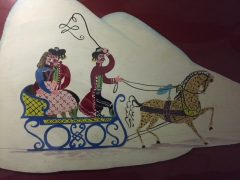
In February, we found a curious set of pictures on the walls at the Mittersill Mountain Inn in Franconia, NH, an iconic, venerable hotel with roots going back the the 40s. The staff did not know the provenance, but these are so idiosyncratic and distinctive, we thought one of our readers might know where these came from.  Of the dozen or so, here is a sample:

Exquisite, aren’t they?  Anyone know the story behind these?

This Week

We reveal the identity of the Mystery Glimpse ski train, its history, and its recent fate.  And we introduce another ski hero we bet very few people will know but should.  Check it out there.

We hear from our cross-country ski editor Roger Lohr, who also publishes XCSkiResorts.com, on spring XC skiing.  It’s out there, and it is glorious. Yvette Cardozo, our correspondent in the Northwest, managed to get herself booked on a ride in a grooming cat at Sun Peaks Resort, BC. She has a really interesting report on how they do it and what it’s like to be on a massive steep in a boxed-in machine.

Onwards

Thanks for reading SeniorsSkiing.com. Remember there are more of us every day and we aren’t going away.

Enjoy Spring Skiing when you can.


Short Swings!

IKON changed its Mammoth Mountain benefits package. Purchasers of the $599 Ikon Base Pass now have full access with the exception of certain blackout dates.

When originally offered, full access (no blackouts) was available only with the $899 Ikon Pass. Purchasers of the $599 Base Pass were entitled to 5 days at Mammoth. Alterra, the resort company offering the IKON pass, did not respond to our question asking why the policy changed. Not explaining the policy change, Alterra leaves the door open for speculation. Was it in response to pressure from vocal older skiers who were unhappy with the elimination of Mammoth’s season pass and it’s senior discounts? We don’t know. But if that were the case, seniors at other Ikon resorts which have eliminated local season passes might want to take note and express their dissatisfaction. Personally, I think Ikon, like Epic and Mountain Collective, offers excellent value, IF you travel to ski and are not committed or confined to a single area. For those who are, let’s say grandparents who like to ski with family during holidays, Ikon forces them to buy in at a steeper price than in the past.

Vail’s Acquisition of Whistler “Has Canadians Seething”

An article this week in Bloomberg News reports on Canadian dissatisfaction with Vail Resorts’ $1 billion acquisition of Whistler Blackcomb. Among the reasons: the resort’s tickets are priced with a base rate in US dollars. “The exchange rate for the two currencies is published above the ticket prices, which fluctuate daily.” Vail eliminated Whistler’s one and three day prepaid lift tickets, discounted for Canadians and State of Washington residents. Locals and others fear that these and other changes are benefitting “…jetsetters at the expense of locals,” who have established the hashtag: #FailVail.

Springtime in the Rockies

As I write this, the northern Utah mountains are expecting 6″-12″ with the Cottonwood Canyons receiving 12″-24″. Here’s the realistic rub: Powder snow is ephemeral and requires being there when the lifts open. Typically, the snow is trashed within an hour or so, and, if the spring temps rise, powder quickly turns to cement.

Springtime in Massachusetts

Wachusett Mountain will be skiing through Sunday, April 15, one of it’s latest closings ever.

Delicious, Self-Heating Meals in a Pouch

At first I was skeptical of a self-heating “homestyle meal” in a pouch. Then I tasted a few OMEALS dishes. They could rightfully be called OH! MEALS. A game-changer for campers, hikers, boaters, or anyone who wants a nutritious, good tasting hot dish with zero prep. I bought some for the car and my pack. Inside the pouch are sealed bags with food, heating element (similar to a hand warmer), and utensil with napkin. The heating element and sealed food bag are placed in the pouch, a few ounces of H2O added and the pouch sealed. In a few minutes the pouch becomes a steam-spouting mini-Vesuvius. When the seam subsides, open the bag and enjoy! OMEAL products are available at REI and other retailers. A free sample is available by clicking on the OMEALS ad on the SeniorsSkiing.com’s Discounts for Seniors page. The company is offering 20% off first orders. Strong recommendation: stock up for the summer while the discount is available.


Watch for SeniorsSkiing.com Reader Survey

In a few days you’ll receive a short online reader survey about how often you ski/board/snowshoe, how much you spend on winter sports, and, if you’re a grandparent, your role introducing grandkids to winter sports. People who skied their age will have the opportunity to be listed as Trail Masters. The survey has 13 questions and should take 2-3 minutes to complete.

Please LIKE us on the SeniorsSkiing.com Facebook Page!

Mystery Glimpse: He Was The First

This Well-Dressed Athlete Was The First Of Many.

Thanks to the Colorado Ski And Snowboard Museum for sending this picture along. We’re reaching deep here, dear readers, and if you can get this one, we will be really impressed.  Who is he and what did he do that gave him a place in ski history?

Last Week

This is a glimpse of the famous Winter Park ski train that has recently shut down after 69 years of service.  Ski trains were very popular with skiers from metropolitan areas on both coasts and the Rockies during the 30s and 40s.  But, with roads and interstates, the trains became unprofitable. According to the Colorado Ski and Snowboard Museum, the ski train that brought Denver citizens to the mountains was one of the few that survived.

You can only now imagine how convenient and almost luxurious it must have been to take a train to a station near a ski area and get picked up by a bus or horse-drawn sleigh to be taken to a mountain hotel or base lodge. Must have been some fun times on those trains going back and forth.

Anyone remember taking a ski train to and from the mountains?  What was it like?

To read more about the history of the Winter Park ski train, click here.

Visit A Ski Museum

SeniorsSkiing.com salutes the many ski museums who have contributed to the Mystery Glimpse series this season. Our readers should be aware that these often very small museum carry the stories and pictures of the past years of snow sports, going back to the early renderings of hunters and warriors on skis and ski-like gear. If you have a ski history museum near you, visit and support their efforts.

Colorado Ski and Snowboard Museum

Vermont Ski and Snowboard Museum

Ski Museum of Maine

New England Ski Museum

National Ski and Snowboard Hall of Fame

Alf Engen Ski Museum

Museum of Sierra Ski History

We very much appreciate the contributions these ski museums made to SeniorsSkiing.com’s Mystery Glimpse.  It was our way of keeping ski history and heroes alive and in front of an audience who appreciates the value of nostalgia. Next season, we hope to expand our list of contributors.


XC Skiing In The Spring Is The BEST!

Even In Mid-April You Can XC Ski; You Just Have To Find The Snow.

Spring cross country skiing can be found in high country and xc resorts. Credit: Mike Maginn

As the cross country (XC) ski season winds down, most XC ski areas close because of lack of skiers rather than lack of snow on the trails. The sun comes out, the temperature rises, and the XC skiers quit. Why? Are we infected with winter fatigue? Is the lure of spring time recreation too strong to ignore?

XCSkiResorts.com spoke with some ski area operators around the nation to get their take on spring skiing. Many areas host springtime season pass holder parties and offer big discounts for purchasers of season passes for next year. Lapland Lake in Northville, NY, commented that their trails are compacted on a daily basis so the snow does not disappear like in the city or open areas in suburbia. Lapland’s Kathy Zahray encourages skiers and snowshoers to “get out and enjoy this weather and these great spring conditions!”

Zahray admits that “the reality is that in the spring it costs more for grooming and staffing than the amount of income earned from the diminishing number of skiing patrons, however this is one of the most fun times of the year to enjoy the outdoors. The milder temperatures and discounted rates are terrific for everyone, and it is fun to ski in shorts and t-shirts.” Lapland Lake is offering special lodging prices through March.

Carters XC Ski Centers  in Bethel and Orford, ME, have been very busy this spring renting cabins and selling equipment. Carter’s hosted the Burger, Beer & Bike Festival for their patrons to try fat bikes and enjoy the area.

In Minnesota at Maplelag Resort, proprietor Jay Richards concurs “that people want to get on the snow early but get tired of winter and ready for warm spring days.” He feels that “skiers in the Midwest are conditioned to colder and drier snow compared to skiers in other regions who are more accustomed to a wider variety of snow conditions.”

At Cross Country Ski Headquarters in Roscommon, MI, they run spring events on machine-made snow such as the Hawaiian Barbecue where they have locally raised pork hocks, along with island style veggies and of course fresh grilled pineapple. Proprietor Lynne Frye invites everyone to celebrate all that is great about spring: long, sunny days of great cross country skiing in MI!

Skier Brenda Winkler, who is a regular at Izaak Walton Inn said, “There is nothing like skiing on Piston Bully groomed trails at Izaak Walton Inn. I skied yesterday and then enjoyed the best Buffalo burger in the restaurant. Izaak Walton Inn has had great grooming all season and there is a lot of winter left at the Inn!”

The Breckenridge Nordic Center  in CO has skiers who are enjoying the patio and lounging around with a glass of beer or wine. They’ve held some well-attended fundraising events this spring and expect to remain open through April 22. Owner Josh Dayton said “We’re having really warm days but our snow holds up very well.”

The folks at Methow Trails in Winthrop, WA, stated, “This season has been another fantastic snow year!   We have no shortage of snow but people stop skiing in the spring which is really too bad because we often find the best skiing of the season comes in the spring. The trails are well packed, and the days are lighter and warmer making it much more comfortable to ski. We’re seeing that in the Methow right now there’s some of the best ski conditions we’ve had all year!

Ridin’ With The Cats

What’s It Like To Groom Trails At Night?

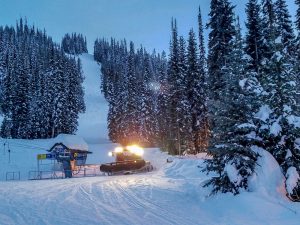
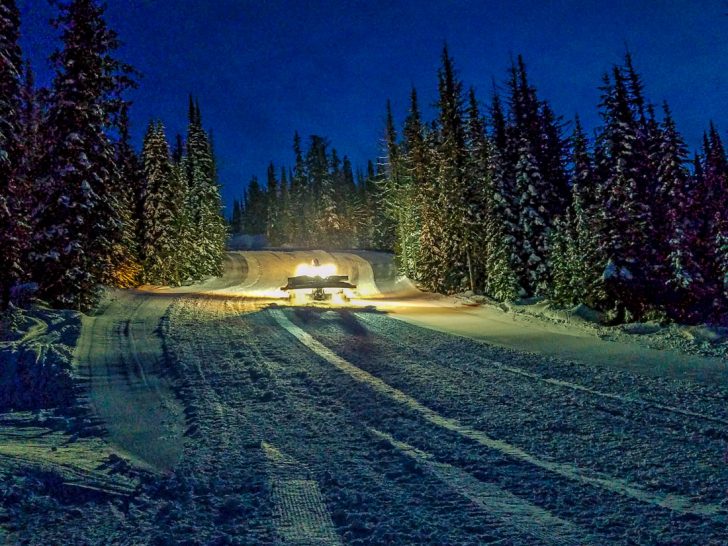
Snow cat groomer making the ski run smooth for skiers the next day. Sun Peaks Resort, BC.

They come out at night and do their job. You can see their lights progressing across the ski slope and occasionally hear their roar. And the next morning, they’ve left this delicious set of corduroy tracks across the ski hill.

I’d always wanted to go on-slope with a snowcat groomer. And so, at Sun Peaks Resort in British Columbia, Canada, I did. And it’s a tour anyone can sign up for.

Snow cat groomer makes its way down a ski slope at Sun Peaks Resort, BC.

It’s astonishing how much damage skiers can do to a run in a single day. If the snow is soft, bumps form, and the middle gets dug out because that’s where folks prefer to ski.

Enter the snowcat groomers. These are powerful cabs—Piston Bully 400s with 320 hp diesel engines— atop tank treads with a blade on front and a tiller on the back. The blade knocks down bumps and that nasty looking tiller, which rotates at over 1,000 rpm, can turn even ice into something resembling powder, which is then smoothed flat into that hero corduroy.

Of Sun Peaks’ 24 operators, two are women.

“Honestly, the women do a better job. They are more detail oriented,” admitted my guide for the night, Leo.

It takes three years for a groomer to really learn how to do this well, he added.

It was one of the women running the winch cat that night. Picture eight tons of growling machine attached by a line to a tree to keep from sliding downslope uncontrollably. This is how the really steep runs get groomed. Back in the day, these runs got so bumped and carved out, they were barely skiable.

It takes three years to become an expert groomer. Sun Peaks, BC.

Rob Gayman, grooming manager at Mt. Hood Meadows resort in Oregon, once described operating a winch cat this way: “It’s somewhat like dropping off a cliff. At the top break-over as the machine teeters above the brink, your heart starts to palpitate, and your natural survival instinct pushes you back into your seat.

“As the machine creeps forward and the operator adjusts the winch tension, the cat tilts forward into the darkness. The cat’s lights don’t shine down low enough; you can’t see what lies below. It tilts more and more. You start to fall forward out of your seat. Now you’re standing on the floor; surely this can’t be right? But then the cat finishes its forward tilt and the ground below you comes back into sight. It wasn’t a cliff after all. Snow rolls and tumbles down in front of the cat as the operator blades and tills his way downhill.”

For me, as dusk fell, the whole scene took on a surreal feel. Our headlights shining on the ridges of snow, leaving them glowing with weird shadows, along with the blinding headlights of an oncoming behemoth.

On an average night, more than a third of Sun Peaks Resort’s ski runs will be groomed. But among those, will be every green (beginner) trail.

And if you are lucky, your favorite black run will have been groomed early, then covered with ankle deep powder overnight, making for a run that feels, well, like skiing a glacier.

There are two women groomers at Sun Peak, BC, said to be more detail-oriented than the men.

This Week In SeniorsSkiing.com (April 6)

Season Hangs On, Cross-Country Lessons, Apex Boot Highlights, Bob Beattie, Fun & Games, Mystery Train.

Where it snowed in 2017-18 and how much. Snow accumulation data from the National Operational Hydrologic Remote Sensing Center. NOAA GOES-16 satellite imagery via the University of Chicago Research Computing Center

Click Here To See Where Snow Fell Day By Day From Oct 5th to March 26th. 

A glance at the map shows where the season’s snow accumulated and where it didn’t. Clearly, the Far West, Upper Rockies, (and Canadian Rockies not shown), parts of the Wasatch, and the Northeast received more than enough snow this season. Midwest, mid-Atlantic and Arizona resorts not so much.

The incredible graphic produced by the NOAA Goes-16 satellite of daily snowfall accumulation reveals most of heavy snow came sometime in March. So now we have spring skiing breaking out and ski resorts extending their seasons to make up for the phlegmatic January and February.

We have friends who have skied in the rain at Stowe this weekend and others who are planning to keep it up until Memorial Day and beyond out in Mammoth Mountain. This might be dubbed the “shifted season” where winter was re-set a month into the year. In any case, the challenge for resorts is to keep customers coming when most folks are taking boat covers off, spending Spring Break in the sun, or otherwise moving on from snow sports. Owning a ski resort is not for the faint of heart.

Mammoth Mountain extended the season after 16 FEET of snow in March. Credit: Unofficial Networks

This Week

This week’s Mystery Glimpse may be tough, showing a train somewhere out in the mountains. See if you can guess what’s going on.  On the other hand, we’ve been surprised by the depth of knowledge and history that comes out of our reader base. Last week’s handsome, California-stylin’ ski instructor’s identity is revealed along with a video clip of this charming gentleman.

We also have some advice on taking Cross-Country lessons from correspondent Jonathan Wiesel, insights into the growingly popular and “disruptive” Apex boot by Marc Liebman, a new game to play this spring with skiing friends by Harriet Wallis, and industry news and comments by co-publisher Jon in Short Swings. And there’s an interesting piece about the patron saint of skiers, mountaineers, and climbers. Do you know who that might be? Hint: Big dog.

This week’s was also marked by the passing of Bob Beattie, a popular, creative, entrepreneurial competitor, and television commentator. You can link to his obituary here.

The SeniorsSkiing.com Spring Survey Is Coming Soon

Please be on the look out for our Spring Survey. You will receive it as an email, and we promise it will take very few moments to complete. The purpose of these surveys is to understand your needs and to get to know who you are. We have had extraordinarily high response rates in the past which makes us think our readers are engaged and interested in supporting the our mission of boosting the profile of the senior snow sport enthusiast to the outdoor recreation community. So, BOLO.

Ski Songs Available

The response from our readers to Ray Conrad’s album of ski songs from the 60s has been remarkable.  It’s easy to download from CDBaby. If in doubt, ask your grandchild. You can go here to listen to some song snippets. Wonder why no one writes ski songs these days?  Or do they?  Know any “modern” ski songs?

Thanks for reading SeniorsSkiing.com.  Tell your friends to tell their friends.  Remember, there are more of us every day, and we aren’t going away.


sa;das


Short Swings!

Sunday at Snowbasin was the last day of my season.

The end-of-season emergence of earth shedding its winter coat is bittersweet. The joy of Winter is being replaced by the joy of Spring. Every year on my last run, I say a prayer of thanks for having completed another season and a prayer of hope for the next. Having reached that certain age, who knows what awaits between now and the next time my skis touch snow? About midway down, there was a long stretch of perfect corn. I made slow arcs, dancing; snow and gravity my partners. The last run of this season; a hopeful memory of what waits for the next.

Tuckerman’s Ravine

Skiing the New Hampshire bowl on Mt Washington is a Spring ritual for Eastern college kids. Many of you have climbed the Fire Trail on Memorial Day weekend to camp, ski, and party. This video from April 1 shows two skiers falling down the Headwall. Apparently, they walked away.

Most Decorated Male Winter Olympic Athlete Retires at 44

Norwegian biathlete, Ole Einar Bjoerndalen, 44, is retiring. He won 13 medals (eight gold, four silver, one bronze) over the course of six Winter Olympics.

Epic Water Filters

Epic Water Filters are essential gear for anyone seeking peace of mind about the water they drink. The company makes lightweight, portable products that are perfect for hiking, traveling, taking you places where the quality of water may be questionable. It also makes easy-to-install under-the-sink units. As a participant in the discount code program, Epic is providing SeniorsSkiing.com readers with a 25% discount off its already reasonable prices. For more information or to order, visit https://www.epicwaterfilters.com and enter promo code SKI25 at checkout.


Mountain Collective

The $409 pass gives you 2 days each at 16 major resorts. Twelve are in the US and Canadian West, one in Vermont, two in New Zealand, and one in Australia. Subsequent days are 50% off. Passes for kids 12 and under are $1. Visit https://mountaincollective.com.

Experticity is Now Expert Voice

For subscribers who registered to participate in the Experticity product discount program, the company has changed the name to Expert Voice. The program is not open to recent SeniorsSkiing.com subscribers.

“Like” SeniorsSkiing.com on Facebook

Each week we post articles on Facebook. If you use Facebook, please “Like” us. If you know others who you think would like SeniorsSkiing.com, please let them know.

Mystery Glimpse: Choo-Choo!

Where Are We And What’s Happening?

Thanks to the Colorado Ski & Snowboard Museum for providing this picture from ski history.  The CS&SM is in the process of undergoing a $2.4 million renovation. The first of several exhibits, “Climb To Glory”, featuring the story of the 10th Mountain Division is now open. Other exhibits will be open at the end of April this year.  The museum is located in Vail Village, CO.

Last Week

This is another ski history legend.  Nic Fiore was an influential ski instructor and director of the ski school at Yosemite’s Badger Pass for 50 years. His friendly smile and charming French-Canadian accent attracted skiers who came to Badger Pass every year to learn from and ski with Nic.
He was an early member of the California Ski Instructors Association in the late 40s. At the time, he was concerned about the quality and consistency of ski instruction, becoming a voice for a national ski instruction organization. When the Professional Ski Instructors of America was founded in 1961, Nic remained committed to high standards for instructor certification.

Nic Fiore was an active skier well into his 80s. He continued to hit the slopes nearly every day and teach an occasional ski lesson into the 2003-04 season. Nic passed away at 88 in 2009.

Here’s Nic on the lift at Badger Pass. Note his enthusiasm and magnetic personality.

https://vimeo.com/3111117

Thanks again to the Museum of  Sierra Ski History for sending Nic’s photo.  The MSSH is located at the Gateway Museum at Lake Tahoe, CA.

Grand Targhee: Deep Powder and a Friendly Vibe

It had been snowing three days when I arrived at Grand Targhee. By morning the new snow total was 55″.

A guy from Denver suggested signing up for Early Tracks. For $89 members of the ski school guide you at 8AM, an hour head start on the public.

Next morning, I skied 1 1/2 hours on untracked terrain, guided by B-Rad, Wall Street derivatives trader turned ski instructor. The snow was mid-thigh. Grand Targhee is known for its deep, natural snow, and the day I was there, the resort lived up to its reputation.

Like many other skiers, my previous experience with the area was taking a day trip from Jackson Hole, the mega resort about 25 miles away. Grand Targhee’s 2,600 acres sit in the Teton mountain range, its 2270′ of vertical served by five chairs.

Parking lot at Grand Targhee

At 7851′, the base can present a breathing challenge to flatlanders. But it’s worth the short time to acclimate. On clear days, you can almost reach across the valley and touch Grand Teton Mountain in its 13,770′ glory.

Lodges, restaurants, retail, pool and hot tub cluster at the base; each a short walk from the other. The lot is an easy walk to the lifts and decent restrooms are located at the top of each chair.

From past visits, I know that super-steep is not part of Grand Targhee’s DNA. This time, two hours of early morning super-deep left me wiped out. The rest of my day was at the bottom.

There are three places to eat and a small general store. The first evening I ate at Branding Iron Grill, the resort’s fine dining option. A nice space, with good food, and a generous pour. Powder morning I chose something light and delicious at Snorkels, the breakfast and lunch eatery. That afternoon I sat in the very full Trap Bar and Grill, sipping a beer and enjoying friendly conversation against a background of live bluegrass.

Grand Targhee’s senior pass pricing starts at age 65 and is humane. Lodging at the resort also is reasonable: a slope-side room, midweek next February is less than $200 per night. Other options are available in nearby Alta, Wyoming and in Driggs and Victor, Idaho.

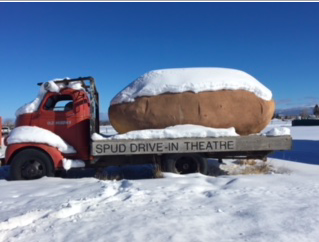
Grand Targhee is located high above Idaho potato country

The vibe is friendly, with friends and strangers of all ages in easy conversation. Older locals refer to themselves as Targeezers.

The mountain, reliable snow, and reasonable prices keep people returning season after season. One couple I met was visiting from Hawaii for the second time in a few months. The guy from Denver was on his second trip of the year. A couple from Australia had driven over from Jackson for the day. Next time they plan to spend to use Targhee as their base.

Leaving Grand Targhee, Teton Range in background

At one point the clouds lifted and Idaho’s flat potato fields came into view. Access to this area of Wyoming is through Idaho. B-Rad pointed out some of the distant ranges while I caught my breath. Then our attention focused on what was in our immediate future: a long expanse of light, untouched deep powder waiting quietly for us to leave our lines.


Cross-Country: Lessons Are The Best Way To Out-Think Your Feet

To Make The Switch To Cross-Country, Please Start With A Lesson And These Tips.

In the early 1970s, in a visionary but totally wrong-headed move, the fledgling Nordic ski industry declared that, “If you can walk, you can cross-country ski.”

It would have been a lot more helpful to say, “If you can walk, you can learn to cross-country ski. And it takes only one lesson from a professional to learn how to glide.”

Those were times when an alpine resort manager pigeonholed skinny skiers as, “Guys who head into the woods Friday night, and come out Sunday without having changed either their underwear or their $5 bill.” We were on the defensive—and dang, it’s tough to fight clever stereotypes!

Those were also the days that New Englander John Frado, who designed a lot of the best trails in North America, coined the hilarious phrase that’s the title of this article. And boy, was he right, because you’re going to become a better skier, use less energy, go further faster, and have more fun sooner if you start the sport with instruction. (And by that I mean ideally not just a single lesson, but one, followed by practice, then another lesson. And so on.)

Cross-country can be filled with grace—not just the dynamism, self-discipline, and athleticism you see at the Olympics, but true beauty. Or it can be an awkward downer.

So here are half-a-dozen tips to make skiing euphoric, quickly.

Credit: Ski Museum Of Maine

First, please do something the Nordic business has never been able to and come up with more endearing descriptions than “lesson,” “instruction,” “teaching,” and “ski school.” Who wants to go back to studies when you’re out to have winter fun?

Next, don’t even think of learning from a loved one—instead, learn from a ski professional. There’s always an uncomfortable level of stress and self-consciousness if your instructor is also a relative, or your sweetie. Too distracting; and incidentally, your kids or grandkids are likely to absorb everything depressingly faster than us oldies. But once you can glide, that’s the moment you discover that cross-country is incredibly social, skiing side by side with friends and family.

Third, learn to ski at a cross-country area or club with machinegroomed trails, where the compressed tracks will guide your skis. (More on this in a future article—promise!) A good resource on places to go is www.xcski.org and  www.xcskiresorts.com.

Fourth, your ski pro needs to explain, early-on, how and why to hold your poles properly (my cliché: reach for the sky along the shaft, then shake hands through the grip). Grabbing the poles tightly means you’ll be upright, stiff, walking rather than gliding, and a lot more fall-prone.

Fifth, if you’re renting equipment, check to see if your instructor uses the same skis you do. It kinda levels the playing field.

And finally, think about a second lesson—or a private lesson—that concentrates on the whole range of descent techniques on these narrow skis that don’t have metal edges or heels held down, while you’re using footwear akin to sneakers. Wedge turns, step and skate turns, parallels, telemarking, traversing with kick turns, side stepping—they’ll all get you down that hill.

And as I found even in my prideful youth, sometimes you just have to take your skis off and walk down. It’s all legit!

APEX Ski Boot System: Rethinking Ski Boot Design

History Suggests That Designing A New Boot Is A Multi-Million Dollar Gamble.

Just the molds for a plastic shell boot cost a million dollars, and that doesn’t include engineering costs and other expenses. Then there is the need to make it profitable when annual manufacturing runs are in the thousands, not hundreds of thousands or millions.

APEX Ski Boot combines a removable Open Chassis with a walkable boot.

These and other factors make starting with a clean sheet a risky proposition unless the new boot idea doesn’t require huge investment in molds and boot making equipment. When Apex began designing its new boot, it had two goals: 1) optimize the boot for the modern shaped ski; 2) minimize the investment needed to bring the boot to market.

According to Roger Neiley, Co-Founder and VP of Product for Apex, the company created a chassis optimized for lateral stiffness. When buckled, it provides enough forward resistance (stiffness) to help control the tips of the ski. Laterally (edge to edge), the material is much stiffer than conventional boots.

Apex’s second innovation is a separate inner ‘walking boot’ designed to fit snugly into the chassis. The advantage is that the wearer can unbuckle the walking boot from the chassis while it is still in the binding. The bottom of the walking boot has a Vibram sole that allows sure-footed walking. As a senior skier, think about how much easier it will be to walk up and down the stairs to the restroom that is inevitably on a different floor!

From a manufacturing standpoint, Apex has three advantages. First, it can easily upgrade or redesign the walking boot. Second, the chassis can be modified separately from the walking boot. Third, only one element (a structural ‘bridge’) has to be molded in each size.

Net net, the chassis and the walking boot are two different designs that become integrated when the boot is in the chassis and the buckles tightened.

I haven’t skied the Apex boot, but from reading reviews, those who like the premium priced boot, like it a lot. If you want to know more about the Apex Ski Boot, visit the company website – www.apexskiboots.com. You’ll find that  the boot is widely available at ski shops around the country.

APEX SKI BOOT SYSTEM DEMO CENTERS


Better yet, if you’re near one of the company’s fourteen demo centers stop in and tell them you’re a SeniorsSkiing.com subscriber. They’ll waive the $25 per day demo fee. For a list of demo centers, click on this link https://www.apexskiboots.com/where-to-try-buy/demo-centers.

Bob Beattie, Legendary US Ski Team Coach, Dies At 85

Beattie, Who Coached The US Team For Nine Seasons, Was A Ski Competition Innovator.

Bob Beattie, the coach who put the US Ski Team on the world stage in the 60s, has died on Easter Sunday in Aspen, according to his son, Zeno. For details, click here for the news story from The Aspen Times. 

Bob Beattie, 85, was a colorful leader, coach, and sports commentator.

Spring Is The Time To Play Games

Try This New Game: It’s A Cross Between Where’s Waldo And A Scavenger Hunt.

Find the Bear. Credit: Harriet Wallis

I was skiing at Deer Valley, and I was taking photos. I’m always taking photos. It’s what I do. I never know when I’ll need a certain shot to illustrate a story.

Find the flamingo (?!) Credit: Harriet Wallis

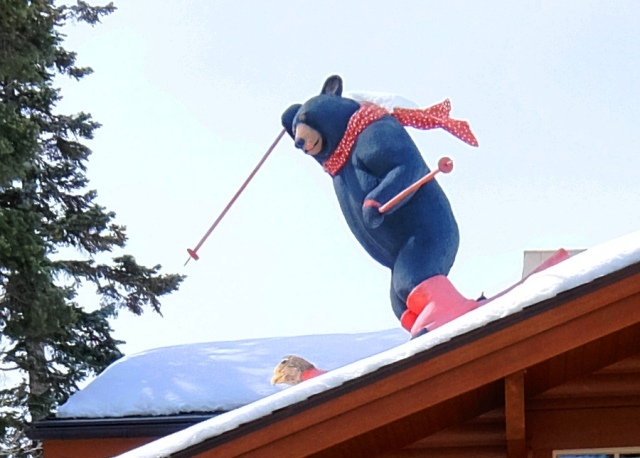
The next time I skied Deer Valley, I was with a friend. I showed her eight photos including the carved bear skiing on a roof, a flamingo wearing a white cross outside one of the ski patrol buildings, and a bronze Native American sculpture. I challenged her to find the real things as we skied around the mountain.

We covered a lot of trails that day. Deer Valley has more than 2,000 acres of skiing, six bowls and 101 ski runs. The hunt forced us to ski a trail once, so she could look for an item, and then move on rather than sticking to one trail over and over. It was a whole new angle on having fun.

Bingo! She found everything shown in my photos. And we were thoroughly tuckered out.

Find the mountain goat. Credit: Harriet Wallis

How To Play

If you are used to taking photos only at scenic spots, try snapping photos of things you see around your favorite mountain, such as a certain trail sign or an unusual weathered tree. Then show the photos to your friends (if they’re whacky enough) or to your grandkids. Challenge them to find those things. You can even offer rewards.

If the springtime slopes start to become ho hum, silliness will add new zest.

To read more from Harriet click here for her stories on SkiUtah.


Find the warrior. Credit: Harriet Wallis

Senior Skiers: St. Bernard Is Watching O’er

St. Bernard, The Doggie’s Namesake, Is An Actual Saint.

St. B points the way to an Alpine mountain hut. Credit: Bri-Tri.

[Editor Note: This tidbit was submitted by LuAnn Snyder, a freelance writer from Maryland.]

Here’s a bit of trivia about the Patron Saint and Protector of Skiers: St. Bernard of Montjoux.

Little is known for certain about St. Bernard of Montjoux who was probably born in Italy, c. 996 and died at Novara, Lombardy, Italy in 1081 at the age of 85.

He was proclaimed the Patron Saint and protector of skiers, alpinists, and mountain climbers by Pope Innocent XI in 1681 and confirmed by Pope Pius XI (himself a mountaineer) in 1923 because Bernard spent more than four decades conducting missionary work in the Alps by ministering to the welfare of the scattered inhabitants. His Feast day is celebrated on May 28.

St. B has his own flag.

He is said to have been ordained a priest, made vicar general of Aosta and built schools and churches in the diocese. He is especially remembered for two hostels he built to aid and save the lives of pilgrims on their way to Rome who were lost in the mountain passes or who had fallen victims to avalanche, exposure, and other mountain hazards. The mountaintop on which he’d build his monastery in the Alps, between Switzerland and Italy, is named for him: Great and Little Bernard.

He was further honored in the late 1800’s when European dog breeders renamed the Alpine Mastiff, the St. Bernard. The St. Bernard dogs were formerly used by the heroic monks who were accompanied by their well-trained dogs to go out in search of victims who may have succumbed to the severity of the weather. The Saint Bernard dog was especially breed to assist travelers in this mountainous region.

His image appears in the flag of some detachments of the Tyrolean Alpine Guard. He is also the patron saint of skiing, snowboarding, hiking, backpacking, mountaineering.

You may want to keep St. Bernard in mind if you unexpectedly find yourself on top of a double-black diamond.  You never know..

If you’re stuck, St. Bernard will send his pups.