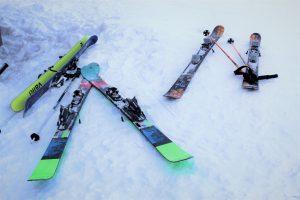
ICYMI March 2023

Photo by Holly Mandarich on Unsplashh

The days are getting longer and warmer, which means more sunlight to enjoy skiing and riding, and fewer layers.  If you are a fan of spring skiing – and who isn’t – put these slopeside and downtown events on your calendar in March.

Here’s our monthly ICYMI (in case you missed it) collection of this and that.

Extended Hours at Aspen/Snowmass/Highlands

 Ski and ride all major lifts until 4pm, including –

  • Aspen – Silver Queen Gondola and Ajax Express
  • Snowmass – Big Burn, Village Express and Elk Camp Gondola
  • Highlands – Exhibition
  • Buttermilk – Summit Express

Toyota Takeover Weekend at Park City

March 3-5 – There will be Toyota trucks and other models everywhere, including on the slopes, racing to the Waffle Hut at the Mid-Mountain Lodge, and a terrain park contest.  Weekend events also include concerts and an on-mountain scavenger hunt on the Canyons Village side of the sprawling resort.

Remember that parking reservations are required for the 2022/2023 season.

See our recent article on this season’s parking rules at Utah resorts, including prices.

https://seniorsskiing.com/new-parking-policies-and-prices-at-utah-resorts/

Toyota US Freestyle Championships at Waterville Valley, NH

March 25-26 – Athletes are competing for $3,000 first prize money in moguls and dual moguls.

Watching the events in person is FREE.  So is watching the Livestream via Twitch.

https://www.twitch.tv/usskiteam

Resort parking is free in lots 1-9.

Mardi Gras at Stratton, Vt.

 March 25 – Here it’s called Marchdi Gras, Stratton Mountain’s annual outdoors village block party. It’s an annual celebration of the seasons to ring in spring and enjoy live music, specialty food, drink and more in the Village.

Swing through the Village to receive Marchdi Gras beads and get ready for crafts and live New Orleans style performers in the Village from 2pm to 6pm.

https://www.stratton.com/things-to-do/events/marchdi-gras

Sun Valley Film Festival

March 29-April 2 – Returning for its 12th year, SVFF is five days of films, coffee talks, parties and more

SVFF supports independent film and the magic of storytelling. It’s mission to celebrate and award filmmakers who are established and emerging has earned the Festival accolades by the film industry, film festival goers, film lovers, and filmmakers.

The year-round Sun Valley Film Initiative develops professionals and illuminates the process of filmmaking, propelling emerging voices with grants and education.

Since 2012, SVFF has invited fans and filmmakers to America’s first ski resort to celebrate the magic of storytelling. Past Festival guests include such Hollywood legends as Gwyneth Paltrow, Clint Eastwood, Jodie Foster, Geena Davis and Oliver Stone, as well as avant-garde writers and filmmakers like Stephen Gaghan and Mark and Jay Duplass.

https://sunvalleyfilmfestival.org/event2/sun-valley-film-festival-2023/

Rendezvous Spring Festival at Jackson Hole

March 31-April 1 – The annual two-day music festival features a variety of FREE concerts in two locations – at Teton Village at the base of the resort and in the historic downtown Town Square.

Bands include the world-famous Preservation Hall Jazz Band from New Orleans, Ryan Bingham with The Texas Gentlemen, Grammy nominee Elle King and more.

Free tickets are required to some events to manage space.

https://www.jacksonhole.com/rendezvous

Slopeside Oxygen Bar

Adjust in style to alpine elevation with the new “Elevate” slope-side oxygen bar at the Four Seasons Jackson Hole. There’s also a menu of IV drip therapies offered in The Spa (open to non-guests) or your guest room, all in partnership with Housecall Hydration.

The new Elevate slope-side oxygen bar shares space with the popular Fahrenheit Forty-Seven Champagne bar.

The Skiing Weatherman February 24, 2023 

By the time you read this, a significant snow and ice event will have moved through the Northeast, signaling the start of the pattern change that I alluded to in my last installment. The stratospheric warming event that I discussed in my last installment has matured and now it is time for us to reap the benefits.  The polar vortex has been distorted by increasing pressure from the warming above and the cold air contained in the vortex has started to spread out to the mid-latitudes in several parts of the globe.

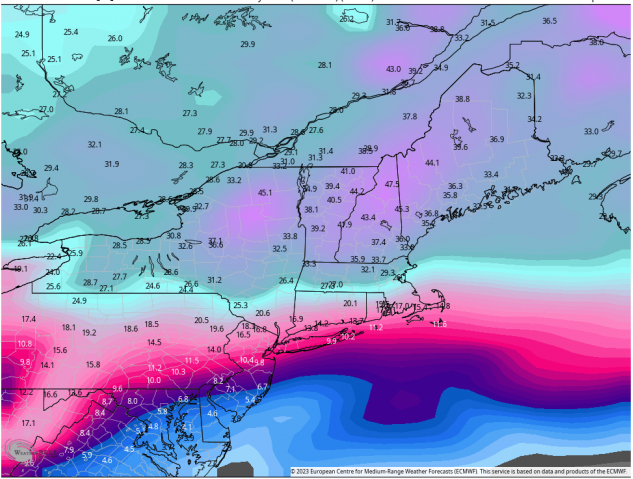
Colder air has already built up over much of Canada, as you can see from this map of surface temp anomalies from this morning.

Although the core of the colder air is located over the western half of the continent, that cold air will be progressing eastward as we head toward March.  In addition, the cold over eastern Canada is poised to be pulled south by the circulation around any sort of low-pressure center that moves through the Northeast.  There are two other things I want you to notice about this map.  First, the zone that separates the colder than normal from the milder/warmer than normal air masses stretches from Oklahoma to central New England.  This “baroclinic zone” is the likely storm track in the near term as low pressure systems feed off the thermal contrast available for energy to support the storm.  So, there will still be rain/snow lines to be concerned with, but that zone will be sinking southward as we head into March.  Lastly, notice the current warm anomalies over Greenland…those suggest the presence of an upper level ridge overhead and indeed, if we look at this snapshot of jet stream features for the same time we see an upper ridge poking its way into Greenland from the East.

If that ridge strengthens and expands westward over the next couple of weeks, an active storm track will develop underneath it…right through the eastern United States.  If we take a look at a jet stream forecast for the end of the first weekend in March, we will see that there is model support for this idea.

The ridge will extend west into northeast Canada with a broad trough covering much of the Lower 48.  Energy will come out of the piece of the trough in the Pac Northwest, traverse the country from west to east and feed off the thermal contrast that will still exist from the Ohio Valley to the east coast…that thermal ribbon will be further south, though, and that will mean opportunities for late season snow in the central Appalachians.

Here is a very interesting frame that shows the surface pressure tendencies for the 30 day period following the maturation of a stratwarm event…

The orange area shows high pressure anomalies over Greenland and the polar regions and the blue shows a tendency for low pressure areas along the eastern seaboard…can you say “late season Nor’easter”?  A jet stream set up like the ones shown for early March is one that is very favorable for eastern snowstorms.  Furthermore, with a strong ridge over Greenland and Canada effectively blocking the progression of systems around the northern hemisphere, the pattern is likely to remain in place for an extended period…perhaps much of next month.  Last…and certainly not least, here is a forecast for bountiful snowfall through the first week in April…

Based on a multitude of factors, some of which I have laid out in this piece, I think that the amounts you see are feasible, if not likely.  Better late than never, eh?

Low Key Skiing at Monetier les Bains, France

On the recommendation of a dear French friend who lives in Grenoble, we booked two weeks at Monetier les Bains in the Serre Chevalier Valley, between Grenoble and Turin in Italy.  It is less well-known and less crowded than such mega-resorts as Chamonix and Val d’Isere, which also makes them more low key.

The Serre Chevalier Valley ski resorts are spread over four small towns boasting 250 kms (200 miles) of pistes over 1,000 acres.

Monetierles Bains is the smallest of these towns and most authentically French. It’s well known in France for its aquatic spa center featuring geothermal spring water, which comes out of the ground at 110 degrees Fahrenheit and is cooled down to 97 degrees in a variety of settings including an outdoor pool.

After skiing, or on a day with poor weather, it’s a real treat to relax and enjoy the gentle feeling of the naturally heated water.

The town itself is one main street with a variety of shops selling local French delicacies, ski shops, and a few restaurants. While there are a few hotels, most  accommodations are apartment rentals, which can be booked through the local tourist office.

January is their low season, and February is the busiest month. There is a shuttle that runs every twenty minutes between the town center and the ski lifts, but it’s less than a ten minute walk.

It snowed the first few days we were there in January 2023, so it took me two or three days to find the pistes that were best for me. The lifts run from the village at 1,550 meters up to 2,850, with the mid-station at 2,176 meters, from where there are several tree-lined pistes down to the village.

Normally, I prefer to ski on open slopes above the tree line, but here I found that I preferred the variety of the pistes going back to the village. On snowy days I skied in the new snow until it got skied out, and on the sunny days I enjoyed the long runs on the groomed trails with hardly another skier in sight.

I never encountered a lift line, and if I had younger legs I could have skied more and more. The area serves mostly local folks and, on the weekends, families from Grenoble and its surrounding regions come to ski and enjoy the outdoors.

The base lodge was large enough to accommodate everyone and we never had to wait for a table. The food was tasty and reasonably priced. Since we were there for two weeks the waiters remembered us and were quick to bring us our favorite beer during our mid-day breaks. On the mountain, there are several quaint mountain restaurants with more limited menus at higher prices.

Monetier les Bains is a low-key ski area: in low season no crowds, no stress, everything easy and, of course, a free ski pass for seniors 75+.

People were friendly and everyone spoke good English, except for our landlord… my wife’s French saved the day.

Health Tips for Spring Skiing

Protecting your exposed skin, your eyes, and the rest of your body on the slopes in the strong spring sun is important at any age, and especially for us seniors who are more vulnerable to skin cancers, cataracts and dehydration.

These tips and reminders are from the University of Utah Health Services.

Snow can reflect up to 90% of sunlight and UV rays, increasing your exposure to damage.  Since UV exposure increases at altitude, at the top of the mountain your UV exposure could be up to 50% greater than a day at the beach.

This is true even on cloudy days, because sunlight can still filter through the cloud layers.

Any exposed skin needs sunscreen of SPF 40 or higher.  Zinc-based sunscreens provide the best protection since they reflect the sunlight.

  • Re-apply sunscreen every 2-3 hours.

Women should avoid high-gloss lipsticks or balms in favor of a product with SPF.

  • Re-apply every 1-2 hours to prevent dryness, chapping and sunburn.

Opt for a thin neck gaitor for added sun protection of the face and neck.

If you do find yourself sunburned, try calamine lotion, aloe or Vaseline to reduce pain and irritation.

  • It’s a good idea to plan ahead, and pack a small bottle, jar or tube of one of these sunburn treatments in your toiletry kit.

Eye Care

Up to 90% of the sun’s ultraviolet rays can bounce off the brilliant white snow surface back into your eyes. This means skiers and boarders – especially seniors – are at a greater risk for snow blindness, corneal sunburn, eye cancers and macular degeneration.

Long-term overexposure to UV radiation has also been linked to an increase in developing cataracts. And UV rays can prematurely wrinkle and damage the delicate skin around the eyes, and who needs more wrinkles!

Since prolonged exposure to snow reflection can cause lasting and permanent damage to your eyes, it is critical to always wear sunglasses or goggles on the mountain, including apres ski.

Wear tinted goggles, or sunglasses that completely wrap around the face.

Use polarized lenses with a UV400 rating, which filters out 99.9% of harmful UVA and UVB rays.

Don’t be fooled by cloudy days. UV rays can penetrate through clouds and haze, even on overcast days, when it’s difficult to see in the dreaded “flat light”.

Hydration

You work up a sweat in spring skiing/riding, so staying hydrated is even more important than in zero-degree downhill days.

Carry a small, flexible water bottle in your parka for hydration on the go. Even a few sips mid-run will help.

Polish off a glass of water at lunch or during a snack break.

Never pass a drinking fountain without using it.

Have a glass of water for each alcoholic drink you consume, and one more before bed.

This article was adapted from one on the Ski Utah website.

https://www.skiutah.com/blog/authors/lexi/spring-break-beyond-safety-tips-for

Cross Country Skiing in New Hampshire

Bretton Woods Nordic Ctr

In the winter, the snow-covered hills and mountains in New Hampshire beckon cross country (XC) skiing families, couples, and individuals aged five to 95. Each year thousands of recreational XC skiers make the sojourn to the Granite State for the beauty and serenity of winter outdoor recreation and rewarding wellness associated with cross country skiing.

New Hampshire’s XC ski areas range from packed trails heading out from a barn that offer stunning views to top notch facilities with trails maintained by snowcats and covered by snowmaking. Many resorts offer equipment rentals, clinics and lessons, and retail goods for what cross country skiers need to get started. Some XC ski resorts have guided tours and luxurious overnight accommodations. Here is a sampling of XC ski resorts in New Hampshire:

Across the grounds of the historic Omni Mount Washington Resort in the White Mountain National Forest, the Bretton Woods Nordic Center is one of the largest cross country ski areas on the East Coast. The 100 kilometer trail network crosses open fields, meanders through woods of spruce and fir, passes beaver ponds and mountain streams, and traverses open hardwood stands. There are many outstanding vistas of Mt. Washington from the trails for taking photos.

There is classical and skate skiing as well as snowshoeing on trails prepared with state-of-the-art grooming machines. Visit on-trail destinations including a warming cabin on Porcupine Trail and the lift-served Mount Stickney Cabin.

At the base of the Mt. Washington Auto Road on the Pinkham Notch side you’ll discover the magnificent setting of Great Glen Trails Outdoor Center. With 45 kilometers of cross country skiing, snowshoeing plus an old fashioned tubing hill, Great Glen offers everything needed for a full day of winter fun.

Great Glen’s scenic trail system offers an enjoyable combination of well-protected spruce and fir-lined trails plus wide open options offering breathtaking views into the Great Gulf Wilderness and surrounding peaks of the Northern Presidential range. Two warming huts are available throughout the network, including the scenic Great Angel Cabin with its stunning views into the Great Gulf.

With an average base elevation of 1,600 feet, plus one of the few Nordic snowmaking systems in the region, elevation really does make a difference at Great Glen, often allowing earlier skiing plus a deeper snow base throughout the season.

For even more adventure, guests of all ages will enjoy a comfortable winter tour on the 9-passenger Mt. Washington SnowCoach. This van with snow treads transports guests (weather permitting) to tree line (approximately 4,200 feet) on Mt. Washington into a sub-arctic world for a truly unforgettable adventure.

Great Glen is affiliated with the Glen House, which has 68 guest rooms that are reflective of the simplicity of Shaker design while its lobby embraces the history of the Mt. Washington Auto Road. Great Glen skiers can stop and visit the Notch Grille pub inside the Glen House, which has various seating options and a full service bar with drinks, full meals or lighter fare, a fireplace, and breathtaking views of Mount Washington out the back windows.

Jackson XC, on Rte. 16A in Jackson, NH, is a bucket list entry for Nordic skiers whether the preference is quiet striding through New England forests or all out skate skiing on an international race course. This 100 kilometer trail network through forest and farmland is woven into the fabric of this classic New England ski village with a heritage of skier hospitality. The JacksonXC ski trails are suitable for all ability levels and there are miles of dedicated snowshoe trails. This is the quintessential Nordic or xc skiing experience with the covered bridge, white steepled church, brookside trails, and the accompanying New England village with all of the trappings. JacksonXC operates under a Special-Use Permit with the White Mountain National Forest and with the cooperation of 76 private landowners and the town of Jackson. There’s a courtesy patrol to assist skiers on the trails if needed and a rescue service staff is trained and certified with the National Ski Patrol System. The maintained xc ski trails in and about the village of Jackson pass many country inns that are spaced throughout the region and the trails often lead right to the door of local inns, shops, and restaurants.

The Adventure Center at Waterville Valley has approximately 70 km of trails, which are groomed and tracked for skating and classic skiing and is known for its wide trails, which are dependably well groomed. Waterville is nestled in a high valley within a ring of mountains in the White Mountain National Forest. The town is a planned community where everything is at a skier’s fingertips. There are the great trails, a fitness center, indoor skating rink, and the Town Square (where the Adventure Center is located), which features a variety of restaurants and shops. But most significantly, Waterville Valley and its services and amenities make it great for families.

Waterville has two separate trail networks including the South End and the North End, which can be accessed by skis or by driving. Snowshoers are welcome to trek along the edge of the trails. Trails lead to easily accessible points of wonder including Greeley Ponds, Snow’s Mountain, Cascade Brook, and the Big Pines. Ask for assistance at the Adventure Center to reach these destinations.

Mt. Washington Valley Ski Touring & Snowshoe Center has more than 45 km of inn-to-inn trails, plus ski school and rentals. Trails connect the towns of Intervale, Kearsarge and North Conway offering views of the Saco River and Mt. Washington. Explore trails winding through riverside hayfields, mountainside spruce and hemlock forests offering a diverse selection of terrain for all abilities from easy rolling hills to more challenging intermediate and back country trails. Guided star-gazing tours and animal-tracking clinics are offered. In February, trailside businesses prepare a variety of goodies from hundreds of pounds of chocolate! Chocoholics xc ski or snowshoe the trails to enjoy chocolate prepared every way imaginable returning year after year to enjoy the Chocolate Festival, now in its 33rd year!

Gunstock Mountain Resort Outdoor Center is in Gilford, NH. The 27 km of trails are groomed for classic and skate skiing. Lessons and equipment rentals for xc ski, snowshoe, and fat biking are available at the Outdoor Center which also employs snowmaking to guarantee skiing as much as possible. Evening snowshoe ridge tour hikes are offered at night with a chairlift ride up the mountain and use of headlamps and snowshoes. Gunstock also offers a unique experience for XC skiers to accompany their dog to enjoy skiing out on the trails. Skijoring as it is known, is a hands-free skiing experience with Gunstock Outdoor Center XC supplying the tools and techniques needed to have a great day with your furry friend.

On the west side of New Hampshire is the Dartmouth Cross-Country Ski Center, located at Dartmouth College in Hanover, NH. The area maintains 30 km of groomed trails for classic and skate skiing in 3 areas at Oak Hill/Storrs Pond, Garipay Field and the former Dartmouth Golf Course. Trail tickets to these trails can be purchased in the Dartmouth Outing Club House near Occum Pond, which is on Rope Ferry Road or at the Oak Hill Ticket Booth and Warming Hut, which is located in the Oak Hill parking lot. There is ice skating on Occom Pond when it is frozen and the center has rental equipment including XC skis, snowshoes and ice skates.

Eastman Cross Country Center in Grantham, NH is on a golf course and residential community convenient to Route 89 at Exit 13. Situated on a golf course, Eastman has 36 km of groomed trails with 16 km of skate skiing and it is a Rossignol XC demo center. There are lessons and xc ski and snowshoe equipment rentals available. Destinations include the Troll House and John’s Glen Hut. Starting in January on Tuesdays the Snowshoe and Soup includes soup and bread after the group snowshoe outing.  After an outing in the clean, brisk air of Eastman’s hills, enjoy an après ski bite or brew at Forbes Tavern also located at The Center at Eastman.

Nordic Skier Wolfeboro XC is a XC ski trail network run by a nonprofit ski club now celebrating 50 years on the eastern shore of Lake Winnipesaukee in Wolfeboro, NH. Get trail passes at 47 North Main Street in Wolfeboro. There are 30 km of groomed trails for classic and skate skiing and 35 km of snowshoe trails. Nordic Skier has one of the best retail outlets for XC skiers including rental gear for XC skiing, snowshoeing, and ice skating. The Nordic Skier focuses on trail grooming and has plenty of testimony to verify the quality of their trails. They’ve acquired a low-snow grooming machine to offer the best trail conditions with the least amount of snow cover.

Some of the New Hampshire areas incorporate sustainability into their operations. The Glen House Hotel has a geothermal system that provides heating and cooling and offsite energy-generating projects harnessing hydro and solar power. There are at least two XC ski facilities in New Hampshire that offer EV charging stations including the Glen House hotel at the base of prestigious Mt. Washington and Eagle Mountain House in Jackson near Black Mountain.

Many people who tried the sport for the first time during the pandemic are returning to the trails and are bringing their friends and families with them. Cross country skiing brings people together, and gets them in touch with nature while doing something healthy, simple, and fun.

Many of the XC ski areas offer their season pass holders at participating cross country areas a one-time, complimentary, or discounted trail pass for a single day of cross country skiing or snowshoeing at other  cross country ski areas in NH. Click for a list of ski area season passholders that receive 50% off a one-day trail pass at the following XC ski areas at https://www.skinh.com/deals/season-passes

New Hampshire has more cross country ski areas across the state and for contact information at the SkiNH cross country ski areas click https://www.skinh.com/resorts


Seeking the Snow in Tahoe

View of Lake Tahoe (credit M. Roth)

After an early start to the ski season here in the East that I would describe as less than stellar, I went west, to Reno, Nevada to seek better conditions. My goal was the smaller ski areas within a short drive from Reno, not the larger and well-known ones on the side of Lake Tahoe in California.

Our the first day driving up the Mount Rose Highway, there were snowbanks as high as that 8’-0” high as we increased in elevation – a very encouraging sign of things to come.

The smaller ski areas in the Reno area are certainly not the magnitude of Heavenly or Kirkwood, Northstar or Palisades Tahoe.  But since you can ski just one trail at a time,  and these areas have the elevation to have and keep snow and they are much bigger than one would expect, they stack up well compared to an eastern“small area”.

Mount Rose Ski area, which you can see the slides from Reno, is the largest of the three areas we visited, with 2,000 feet of elevation and starting at 8,250 ft. Beautiful views of the Reno Valley, of course continual blue bird skies, without a cloud in site. There was plenty of snow on the mountain and the trails were groomed perfectly.

The surfaces at times were very much like Eastern skiing from groomed corduroy and as the day progressed some hard packed showed up. Now if the temperature was above 32 degrees, all that hard pack snow would have been soft packed powder because there was a very deep base below of 200-300 inches of snow.

In fact, one of the skiers with us, who was from California, commented that us easterners must love these conditions (which although he didn’t come out directly saying it, I don’t think he liked the surface). For me, wherever I can get on the snow, I am happy with the surface, unless of course it is boilerplate and to be honest , I have not encountered that in a very long time. Ski areas have made great advances in snow making and grooming to provide a good skiing surface most of the time.

Diamond Peak, just 27 miles from Reno, also the way to Lake Tahoe, offers great views of the lake as you ski down that you must stop and take a photo. This area is smaller than Mount Rose with the base at 6,700 feet and topping out at 8,540, with 1,500 feet of vertical and an  average annual snowfall 300 plus inches.

There are 28 trails marked and plenty of glades, with 655 acres of skiing. Great terrain to ski. Don’t forget to checkout their senior pass rates ($225 for years 70-79, Free 80+, and no blackout dates).

The third area, which was the smallest but not the least important, was Sky Tavern, a strange name for a ski area but with a history that ages way back into the late 50’s.  The area probably has the most meaning for skiing and promotion of skiing with the youth of the Reno Valley. This area is the oldest and largest non-profit ski and snowboard learning area.

Owned by the City of Reno, this ski area is devoted to teaching and training the city’s youth who want to learn to ski as well as aspire to skiing as a high school / college / olympic goals. The area staff is devoted) to this project. Founder Marcie Herz established the program in 1948, and her remaining family is still involved with the area.

This area’s learning and training staff can be compared with programs at Stratton Mountain School and other eastern ski schools and high school programs which don’t spend pots of money to train their children to become aspiring ski athletes.

Sky Tavern has 7,583 feet of base and 8,238 at the top, with about 800 feet in elevation, so they receive plenty of snow due to the high base elevation. On the weekends you can expect lots of training and families participating in this unique venue. They train in ski racing, terrain parks, aerials, and the park is striving to be a year-round training facility.

While staying in Reno, there are plenty of venues with a reasonable nightly cost as compared to staying on a mountain. We stayed at Circus Circus Hotel and Casino which gets you plenty to eat and play after skiing.

Rentals were also as easy as 1, 2, 3, at the base of the Mount Rose Highway, at Blue Zone Sports. The ski’s we rented were excellent and the staff were more than accommodating. You can get all your skiing gear at a one-stop rental/purchase shop.

I certainly recommend skiing these areas in lieu of the big boys on the other side of the highway.

Tina Basich medals_Basich archives

First Female Snowboarders Being Inducted to Us Ski and Snowboard Hall of Fame

Tina Basich

This year marks the first-ever induction of female snowboarder athletes to the US Ski and Snowboard Hall of Fame.  The honors go to to Shannon Dunn-Downing and Tina Basich, both icons and pioneers of women’s snowboarding.

The induction is at the annual awards event at Big Sky in April.  Both SeniorsSkiing Publisher Richard Lambert and Editor Evelyn Kanter are attending.

Few athletes have had as much impact in paving the way for women in Snowboarding as Tina Basich and Shannon Dunn.

Both experienced the challenges of being women competitors early in the sport, competing together from 1991-1996 on the World Cup Tour.

Sponsor support and contest prize money was nominal, and the norm of the day was that girls were equipped with men’s clothing and boards. Getting any magazine coverage was equally challenging. Together, these two women made it their goal to be the agents of change for women in the sport.

Both were chosen by their respective board companies to launch a Pro Model board, launched in 1994. At the time, the women’s snowboarding market was unproven, and few companies would take the risk to support it.

Shannon’s model, the ‘S.Dunn 150’, with its Sunflower graphics, had a huge appeal to the market and was launched by Sims Snowboards, and by no coincidence, had a female Marketing Director behind it. The ‘S.Dunn 150’ was the most successful selling women’s Pro Model of its time, reaching numbers equivalent to the Sims men’s Pro Model, the ‘Shaun Palmer’.

Shannon-Dunn

Gaylene Nagel, Sims Marketing Director at the time says, “It was so exciting to see the sales numbers come in so far above our expectations! But even more rewarding was to give Shannon a check that rivaled what the top pro men were making.” This was a landmark event as the women’s place in Snowboarding had been established.

Tina’s first Pro Model was launched by Kemper Snowboards, also in 1994. The following year, Tina moved to Sims, where she had two Pro Model designs and her boards were equally well received.

With the success of their Pro Model boards, Tina and Shannon joined the ranks of the top earners in the sport. Their worldwide visibility expanded their sponsorship opportunities, as well as their influence, opening the door for future pro women snowboarders.

Shannon and Tina took the opportunity of having these successful women’s boards under their feet as a springboard to actively push even more boundaries – which absolutely existed in the early days of the sport – like magazine and film coverage, contests, and clothing!

Tina and Shannon became iconic ambassadors for female Snowboarders, promoting and welcoming women through interviews, personal appearances and by working with all of their sponsors to design new products for women.

They joined creative forces with snowboard clothing company Swag, to start a women’s line of outerwear and street wear, calling it Prom. Sales/Marketing Director Lisa Hudson recalls, “The girls weren’t afraid to make a statement – from wearing pink to posing in the first Prom ads in prom dresses! They certainly got everyone’s attention – making the Prom launch a huge success and establishing women’s outerwear as a viable category.

On the competition front, Tina and Shannon together challenged the organizers at an International Air + Style event that would not allow women to compete in the Big Air, citing it was too dangerous for girls. Risk aside, they seized the opportunity to make a change for the future.

After doing a practice run with the boys, they convinced the organizers to allow them to compete. They both stuck their landings at the big event, for a cheering crowd and a stunned announcer. History was made that day for women in Big Air events. They raised the bar on the perception of what women could do – paving the way for future aspiring athletes like Jamie Anderson and Chloe Kim.

The board launches of 1994 were only the beginning for these two champions.

Shannon Dunn went on to win Olympic Bronze in Women’s Halfpipe in Nagano Japan (1998). Tina Basich was the first woman to land a 720 in competition, winning X Games Gold in 1998. Both of these events were internationally televised, further solidifying a place for women in competitive snowboarding for future generations.

Today the legacy continues.

Tina Basich recently launched a Pro Model with Capita Snowboards in 2021, for which she designed all of the graphics And now, almost 30 years later, they are celebrating being inducted into the US Ski and Snowboard Hall of Fame together, and being the first female Snowboarder athletes to do so.

Shannon Dunn recalls, “What a gift it has been to have a friend like Tina to share the journey through this male dominated sport– I feel like we were able to achieve much more by working together. Instead of being competitive with one another, we complimented each other, wanting the other to succeed. It was always, “Let’s do this!

Congratulations to these two trend-setting athletes.

How Alta Has Changed in the Past Fifty Years. Or Not.

Connie Marshall

I am often asked how Alta has changed in the past 40 or 50 years. This question always excites me, as my career began at Alta in 1974, so my personal journey weaves into the larger tapestry of the Alta story.  That includes several decades as the resort’s public relations manager, working with the media.

In a November 1970 article for Holiday Magazine, David Thomas wrote, “Alta is for skiing. A little-known resort in Utah has the simple claim to fame…. probably the world’s best skiing. Alta’s popularity has been limited by its relatively restricted accommodations and the relative absence of the sort of frantic ski life that draws winter vacationers to the Alps and some of the more social western resorts.”

What would a journalist muse about today? From my perspective, she would begin by penning, “Alta is for skiing. A well-known resort in Utah has this simple claim to fame…. the world’s best skiing. Alta’s popularity has grown as skiers have come to seek out and cherish authentic experiences both on and off the slopes.”

Skiers from the 1970’s returning today would feel immediately as though not much has changed. The lift system, while modernized – including the brand new Sunnyside lift on the Albion side – still respects the desire for every skier to find his own way around the mountain. Many of the buildings on and off the mountain surely are recognizable, albeit most have been remodeled to satisfy the changing needs of skiers and their families.

While Alta has embraced evolving lift technology, best practices in snow and avalanche management, progressive ski school philosophies for all skiers, convenient RFID lift access and management of the ski experience in a world that is ever growing in population that has led to required parking reservations on Fridays, Saturdays, Sundays and holidays, the vistas and uncomplicated layout of the mountain remain steadfast.

#Altamagic has evolved as a popular hashtag for all things in the social media world.

Those who stay on-mountain cherish their experiences in lodges that harken back to the culture of the elegant simplicity of the early romance of skiing. Most lodging has been independently owned and operated by the same linage of family members since they were built, creating a sense of family the moment one walks in the door.

Many lodges have a guest return rate of 70% percent who return year after year, with emerging generations of family and friends to spend time with other guests who they have grown over time to know. Few resorts or individual hotels or lodges can match that, anywhere in the world.

From my perspective, after a 44- year career with Alta Ski Area, I would like to speak about the community of employees and the skiers, both local and all who come from places all over the world. While this menagerie of humans has changed over the years, the same pull that brought all of us together to experience the insatiable thirst for the magic that befalls us and for the spirit of the mountain itself has not changed.

Not one bit.

Editor’s Note –

A visit to a cousin who had grown up in Alta led to a job as a ticket seller, with Connie advancing quickly to sales manager, then to decades as the resort’s first Marketing and Public Relations manager.  Along the way, she married, raised three children, and inspired and mentored scores of people – especially women – to influential careers in the world of winter sports. Connie also was a pioneer in forging bridges between the sometimes-contentious relationship between some resort managements and their local communities, and is widely respected throughout the ski industry.

Before her recent retirement, Connie received the Lifetime Achievement Award from the North American Snowsports Association (NASJA), nominated by SeniorsSkiing editor Evelyn Kanter. Connie continues to live close to Alta, volunteers for local and regional community groups, and still skis often at Alta.

The Connection between Diet and Longevity Skiing/Riding

Photo by amoon ra on Unsplash

Congratulations, your passion for skiing/riding has rewarded you. If you are reading this, you are a quinquagenarian, sexagenarian, septuagenarian, octogenarian, nonagenarian, or even a centenarian.  That’s a lot of “-genarians”, and a question we all face is how long we want to or intend to ski or ride.

A few seasons ago, I met a 91-year-old man who skis 120-130 days per season. He told me the Grim Reaper will need better skis than his to find and catch him.  The comment attests to his positive attitude and upbeat personality, both important to longevity, on the slopes and off.

If you distill the research on longevity, three factors stand out – genetics, attitude and lifestyle.  You are your genetics, so reading this checkmarks attitude.  That leaves lifestyle, diet and exercise.

More and more longevity research shows that social connections with family, friends and a community such as the community of skiers/riders, are among the most significant indicators of longevity.  We navigate the hill as individuals, however, choosing to do so with family, friends, and other skiers makes us an integral part of the mountain community.

Your doctor probably has told you the same thing as mine, that “your running days are over, so swim or walk.”  We all know aerobic capacity is essential for skiing, and recent research has shown that muscle mass and strength are much more a factor in longevity than previously.

So go take a walk or for a swim or to the gym.  Not crazy about the gym?  Use your ski boot to exercise at home or in your hotel room or condo. Raise a ski boot from the floor to over your head, first with one arm, then with the other; use both boots for a two-arm press, together or one at a time; hold the boot in front of you and do squats.

Diet is perhaps the most confounding factor in longevity.  Unfortunately, government dietary guidance over the last fifty years has been confusing, misleading, and in some cases flat-out wrong.  We lived through the low-fat years eating unsatisfying baked cardboard.  Now we know that fats are dietary essentials, but the right kind of fats – the unsaturated ones found in fruits, vegetables and nuts.

Many of us switched to diet drinks and “diet” foods in the belief that artificial sweeteners contribute zero calories, which is mostly true.  Consequently, we think we can eat more low-cal whatever because each one contributes fewer calories; we end up consuming even more total calories.  As that old advertising slogan goes – “Bet you can’t eat just one ….”

Now we know that artificial sweeteners stimulate appetite and promote weight gain.  We also now know that they make us crave sweeter food by overstimulating our sweet taste receptors.  Plus, they affect our gut biome, which can trigger even more serious health consequences.

What should a longevity skier do about diet?  It’s easy to be overwhelmed by all of the diet recommendations and their justification.  But most research, and your physician, still point to the benefits of the Mediterranean diet – fresh, minimally processed, seasonal, local vegetables and fruits; meats and fish in moderation; olive oil as the primary fat; and most importantly, wine in moderation.

Your guidepost is easy – don’t eat anything your great-grandmother would not recognize as food.  Sadly, the industrial agriculture-based food supply and distribution system makes it hard to do that, to eat for longevity.

So here’s your test – how much time do you spend in the center aisles of the grocery store?  The center aisles are where you find industrially-processed foods, so-called Frankenfoods, that do not contribute to longevity. The fresh foods you seek are on the peripheries. Also, grocery store shelves are stacked with the most appealing packages at eye level, so bend down or reach up for the better choices.

Walking around the outside of the supermarket, and reaching up and bending down is good exercise, too.

Virginia’s First Ski Area Restores the Nation’s Oldest Spa

Omni Homestead Snowman

The Homestead in Hot Springs, Virginia, is not the biggest ski area in the South, but it’s the oldest. When snowmaking was installed on new slopes in 1959, the historic hotel appended the words “ski” and “spa” to its self-description.

The hotel has been hosting guests “taking the waters” at local hot springs since 1766, a decade before the American Revolution. Today, its upscale offerings continue to make it a posh, even exclusive destination – one with its own ski hill.

It’s the perfect place where not-so-crowded slopes and not-too-difficult terrain for senior skiers to introduce the family, including the grandkids, to skiing and a rarefied escape to a newly refurbished hotel and spa facilities.

https://www.omnihotels.com/hotels/homestead-virginia/things-to-do/resort-activities/winter-activities

The Homestead’s Ski Area

Omni Homestead Ski Slope

A free shuttle links the hotel and the modest slope layout, which is open Sunday to Thursday this season.

Back in 1959 when Austrian immigrant and southern ski legend Sepp Kober designed and built the ski area, it included a “skimobile” trestle lift similar to one then in use at Mount Canmore in New Hampshire.  Also, it was the first are anywhere to rely solely on snowmaking, setting an example for the region and world.

His ski school was staffed by young Europeans whose accents became the norm at southern slopes, as well as in ski areas in the North and West. Sepp and his Austrian instructors are no longer with us, but his ski school still offers a family-friendly setting that makes skiers and boarders out of beginners from 4 years up. A Little Penguins Program focuses on children ages 5 to 11.

The Homestead’s 10 slopes, up from 5 in the 1980s, drop 700 vertical feet. The main double chairlift tops out at 3,200 feet. Two blue runs leave the top of the chair, Escape and Upper Main, and merge with Upper Main continuing along the chair to mid-station. There’s also a short, steep black run, Nose Dive, from the top of Upper Main, and a pair of blues, Upper and Lower Glades.

At mid-station, green Yonder-Weigh leads beginners off the lift back down to the lodge on a longer green run, Lower Main. Another green, Briar Patch, slips by the resort’s tubing park, Penguin Slides. Also from mid-station, a terrain park comes back to the main slope above the tubing runs. Absolute beginners have a learning area served by three surface lifts, and kids can ride mini-snowmobiles.

The base lodge has large picture windows and an outdoor deck backed by plexiglass to break the wind. On a spring ski weekends, white-coated chefs from the hotel flip gourmet burgers. An upstairs grill, Kober’s, serves lunch and dinner amid extensive memorabilia of the life and legend of Sepp Kober.

Alternatives to skiing and riding include The Homestead’s Allegheny Springs, an ice skating facility with rentals, and a spring-fed, two-acre water park where a steaming outdoor pool and hot tub are perfect for soothing sore legs.

Homestead Re-Opens After Major Makeover

Omni Homestead Outdoor Pool

The grande dame hotel reopened for lodging on Feb. 2, 2023, after a massive

$121+ million makeover, the most significant investment in the resort in more than a century. The resort is a member of the Historic Hotels of America, a nationwide collection of legendary lodging spots organized by the National Trust for Historic Preservation.

www.historichotels.org

The impressive Great Hall, five hundred guest rooms and suites, and numerous dining destinations were fully refurbished and ready to carry the venerable resort’s luxurious reputation well into the 21st century. Given The Homestead’s singular historical status, the work involved a painstaking preservation process that included restoring 978 original wood windows and hundreds of doors and repair of interior and exterior stucco, terracotta, limestone and brick masonry.

For many, the real “wow” is the complete restoration and reopening of the nation’s oldest historic spa structures.  Once called “the Jefferson Pools,” after Thomas Jefferson’s early 1800s visits, the restored Warm Springs Pools include buildings that always reminded me of what a nuclear power plant might look like if they’d been in use in the 19th century, including the plume of steam emerging from the top of the dome-shaped roofs. Restoration included preserving and/or replacing the historic wood structure, windows, doors, siding and roofing.

The restoration effort involved the Virginia Department of Historic Resources and

notable preservationists to be sure the project adhered to The Secretary of the Interior’s Standards for the Treatment of Historic Properties.

Head Back in Time

At the newly restored spring buildings, there are adult and family times for spa visits, and sex-segregated clothing optional sessions. But unlike back in Jefferson’s day, guests no longer hang from ropes in the warm mineral waters. Today foam noodle floats do the job without the upper body workout.

The Homestead’s slopes and snowmaking gave birth to the now bullish Southern ski market, but back in 1761, when the stone basin of the 1820s Gentlemen’s Bathhouse was first constructed, it became the oldest spa resort structure in the country. No wonder The Homestead’s 2,300 acres are today surrounded by aptly named “Bath” County.

With its impressive recent improvements, the entire Homestead experience is a fitting tribute to Kober, often called the “Father of Southern Skiing” for his decades-long efforts to nurture the active Southern ski market. Kober was inducted into the U.S. National Ski and Snowboard Hall of Fame in 2009.

anne-nygard

New Ikon Pass Resort Member in California

Photo by Anne Nygård on Unsplash

Add Snow Valley Mountain Resort in Southern California to the growing list of Ikon Pass members.

Alterra Mountain Company has closed on the purchase of the iconic destination, which has been in operation since 1924, making it one of the oldest ski resorts in the USA.  Snow Valley joins the operations of Big Bear Mountain Resort in Big Bear Lake, including Bear Mountain and Snow Summit, creating expanded access in Southern California and opening up new terrain to skiers and riders who call one of the three mountains home.

Located just 11 miles from Big Bear Lake, Snow Valley Mountain Resort is easily accessible from Pasadena, Santa Monica, Los Angeles and San Diego. The new three-mountain experience will offer skiers and riders a variety of terrain from beginner to expert, and the ability to progress from greens to blues to blacks.

With a focus on the beginning of that progression, Snow Valley features some of the region’s best beginner terrain, with award-winning learning centers and a shared dedication to exceptional guest service. The addition of the resort also means that skiers and riders will have access to Southern California’s only chairlift serviced sledding area for enhanced snow play during the winter season.

The Ikon Pass and Big Bear Mountain Resort season passes will be accepted at Snow Valley starting Monday, February 20, 2023.

About Snow Valley

Home of Southern California’s only six-person chairlift, Snow Valley is in the San Bernardino Mountains in Running Springs, CA.

Snow Valley is Southern California’s most versatile ski area and has been rated as Southern California’s #1 Family-Friendly Resort, and Least Crowded Resort.

Advanced skiers and snowboarders love Snow Valley’s Slide Peak, a legendary Southern California slope with a 35-degree pitch.

The resort also offers night sessions and lift-served Snow Play (sledding).

Snow Valley is one of the largest resorts in the San Bernardino National Forest, with 1,041 feet of vertical drop, a summit of 7,841 feet and base at 6,800 feet -all spread across 240 acres of skiable terrain. Its longest run is one mile.

About Alterra Mountain Company

Alterra now owns and operates 16 premium ski, snowboard, and all-season destinations in six states and three Canadian provinces.  They include:

  • Steamboat and Winter Park in Colorado;
  • Palisades Tahoe, Mammoth Mountain, June Mountain, Big Bear Mountain Resort and Snow Valley Mountain Resort in California;
  • Stratton and Sugarbush in Vermont;
  • Snowshoe in West Virginia;
  • Tremblant in Quebec, Blue Mountain in Ontario;
  • Crystal Mountain in Washington; Deer Valley Resort and Solitude Mountain Resort in Utah;
  • CMH Heli-Skiing & Summer Adventures in British Columbia.

Alterra Mountain Company introduced the Ikon Pass for winter 2018/2019, which today offers skiers and riders access to more than 50 mountain destinations throughout the Americas, Europe, Australia, New Zealand, and Japan.

“Snow Valley Mountain Resort has been a treasured destination since 1924 and together we will continue its incredible legacy,” said Kevin Somes, Vice President and General Manager of Snow Valley Mountain Resort. “By becoming a member of the Alterra Mountain Company family of destinations, Snow Valley will continue to deliver exceptional guest experiences to ski and snow enthusiasts in Southern California, and beyond.”

“The acquisition of Snow Valley Mountain Resort is a continuation of our ongoing mission to build a premier portfolio of great mountains in robust markets,” said Jared Smith, President & CEO, Alterra Mountain Company. “As we do with all our destinations, we are excited to invest essential capital to enhance the on-site employee and guest experience to further strengthen our offerings to skiers and riders in Southern California.”

Snowshoeing in the Adirondacks

Snowshoeing Visit Adirondacks

One of the easiest ways to enjoy fresh mountain snow is by snowshoeing. If you can walk, you can snowshoe. It’s a great activity for an off-slope rest day, or any day, along established, well-groomed trails or making your own tracks through the woods.

Here’s how and where to snowshoe in the Adirondacks:

Adirondack Park comprises 6.2 million protected acres in upstate New York, nearly half of which is state-owned land, accessible to everyone. There are flat trails, lower-elevation hikes, cross country ski trails, golf courses, mountain bike trails, along with trails that skirt local villages, all with convenient snowshoe opportunities throughout the region.

Trails are often multi-purpose, allowing visitors to snowshoe, walk, hike, or XC ski. There also are challenging trails throughout the Adirondacks for those who prefer to test their skills; and snowshoes are recommended, if not required, for those hiking many of the region’s mountains.

One well-known and popular trail in the region, the Jackrabbit Trail, is a 50-kilometer gem.  It begins in Keene and meanders through Lake Placid and Saranac Lake to Paul Smiths, connecting with four ski centers and several backcountry routes along the way.

There are many other trails throughout the region, along lakes, climbing low-elevation mountains, and through charming and historic towns and villages. The CATS trails, on the eastern edge of the Adirondacks, allows visitors to take in breathtaking views of the high peaks to the west and Lake Champlain to the east.

Some hotels and resorts have snowshoes available for guests’ use on their own trails, or on nearby trails. Lapland Lake Vacation Center in Northville has 12 kilometers of trails specifically designated for snowshoeing, with equipment available for guests. Lake Clear Lodge is a 25 acre property with miles of groomed trails that lead to the Jackrabbit Trail and other backcountry adventures.

The Dewey Mountain Recreation Center in Saranac Lake, Mt. Van Hoevenberg in Lake Placid, and the Cascade Welcome Center in Lake Placid, offer snowshoe rentals, as do many local outdoor sports outfitters.  The Adirondack Interpretive Centers in Newcomb and Paul Smiths and The Wild Center in Tupper Lake offer snowshoes for visitors. Even some local town libraries offer snowshoes as part of a program to encourage outdoor adventure.

Check out these snowshoe events throughout the region in February and March:

Feb. 4th – The Adirondack Mountain Club offers an introductory program entitled Backcountry Snowshoeing for Beginners in Lake Placid for those who want to take their skills into the Adirondack wilderness. The course enhances participants’ understanding of equipment, techniques and safety considerations needed to snowshoe on any terrain.

Feb. 19th – The Adirondack Snowshoe Fest in Saranac Lake builds on the success of the World Snowshoe Championships in 2017. Festivities are throughout Saranac Lake, with 5k, 10k and 15k snowshoe races at Paul Smith’s Visitors Interpretive Center and Dewey Mountain.

Feb. 25th –  In Tupper Lake, visitors can take part in one of the community’s most popular events – the Tupper Lake BrewSki. Participants can ski or snowshoe along the beautifully maintained James C. Frenette Sr. Recreational Trails to different stations along the route. Breweries from around the region will be on hand to pour samples as participants gather and mingle by fire pits located at each brew station. Noon to 4 p.m.

Also, Great Camp Santanoni in Newcomb is hosting “winter weekends” in February and March, offering group snowshoeing or cross-country skiing to the great camp where participants can enjoy and learn more about its history.

Taking part in any winter outdoor activity in the Adirondacks requires preparation, no matter your physical ability, activity or destination, for an enjoyable and safe experience. Learn more about winter preparedness, including some important tips, on the official New York State Department of Conservation website.

See also the Seniors Skiing article on what’s new this season at New York State ski/snowboard resorts.  https://seniorsskiing.com/whats-new-this-season-new-york-state/

The Adirondack Mountains offer some of the best opportunities for outdoor recreation in a beautiful, natural setting, all within a day’s drive for 25% of the entire North American population. Winter weather, spectacular scenery, a snowy backdrop, the love of winter, and taking part in a new outdoor activity is enough to make anyone an outdoor enthusiast in the Adirondacks. Whether snowshoeing along the region’s trails, along a lake or taking part in a regional event, the region offers many opportunities to embrace snowshoeing in the Adirondacks.

The Regional Office of Sustainable Tourism is the destination marketing and management organization for Hamilton and Essex counties, including the communities of Lake Placid, Tupper Lake and Saranac Lake, all located within the Adirondacks in New York state.

The Skiing Weatherman February 10, 2023

In spite of last weekend’s dramatic cold outbreak over the Northeast, one that was muted at resorts further south in the mid-Atlantic states, milder than normal temperatures continue to dominate the pattern.  Not to the extent that they did in a very mild January, but enough to make every disturbance, big or small, that comes along a real nail biter in terms of rain vs. snow.  For the most part, natural snow has been confined to areas north of Interstate 90 in New York and New England, although the Catskills have cashed in a few times here in there before seeing mild air turn the precip over to something other than flakes.  There is no short-term change in sight, but all is not lost.  An infrequent event at the top of the atmosphere over the high (polar) latitudes is underway, and I believe that this phenomenon may well provide the Northeast with its most consistent snow conditions of this season from late this month through at least a good portion of March.

What’s going on high above the arctic regions is known as a Sudden Stratospheric Warming, or SSW.  At the top 1 to 3 per cent of the atmosphere, at roughly 30 miles above the surface, the air is warming rapidly, and as pressure levels grow aloft, the effect is gradually pressing down on the polar vortex that is swirling around closer to the surface at a level known as the troposphere.  Here is a graphic that illustrates the potential “before and after” of the process…

You can see the tight, symmetrical circulation over the North Pole, which is essentially what the vortex looks like right now.  The squiggly darkest blue line is what the vortex will look if the warming fully matures, spreads to the lower levels and breaks it up.  As the warming continues to descend, the vortex is attacked by the warmth at the top of the atmosphere.  Here is a graphic showing the attack at the top for the 17th

A strong bubble of warmth has pushed and distorted the vortex to the east…off its polar perch.  This next map shows the stratospheric temperatures the next day at well above normal levels…

As the process continues, the smooth and nearly circular flow of the vortex will get disrupted, so instead of having most of the cold air in the northern hemisphere bottled up near the North Pole, some of that air will get redistributed to the lower latitudes.  One of the key indicators if the warming and vortex disruption is enough to bring the Northeast a spell of consistently cold and snowy weather will be a change in direction of the flow around the pole.  Modeling does indeed forecast that change, and if it does occur, studies of prior SSWs tell us that although the main thrust of the coldest air will move into Siberia, an upper-level trough will form over eastern North America for an extended stay.  In that position, the trough will be poised to receive several shots of cold air from Siberia via a track up and over the Pole.  Here is a look at where the jet stream set up is headed toward the end of this month and beyond…

The most recent February SSW event of consequence was in 2018, and it is worth looking at the temperature anomalies at the surface that occurred in March and April of that year…

Typically, the cold effects of an SSW event last several weeks, and when combined with a dying La Nina, even longer.

An SSW is a very complex event and I hope I have been able to adequately describe it in the space available.  With another week of marginal temps about to unfold in the Northeast and the specter of yet another messy “cutter” storm moving up to the west of the region late next week, I chose to discuss the SSW today because I believe that there will be outstanding conditions to enjoy before this season is over.  The SSW that is underway is the meteorological mechanism that will get us there.