socks-1

From Socks to Scarves in Sixty Minutes

A Terrific DIY Gift Idea!

Ski season is winding down, and some of us may be returning to other activities. Suzy Z.* will be doing needlework. Suzy, a seniorsskiing.com subscriber, had this terrific idea for sock-scarves while shopping last fall for ski hose. It uses ski or knee socks to create a scarf for your winter jacket or turtleneck.

Relatives, grandkids, and friends will be receiving a different gift this Holiday Season.

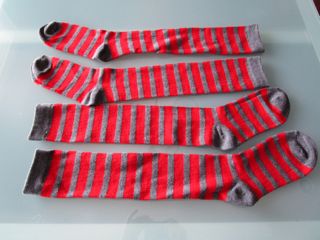
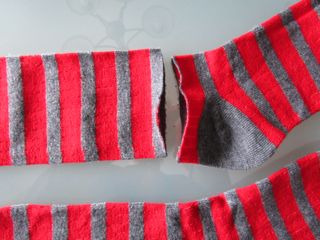
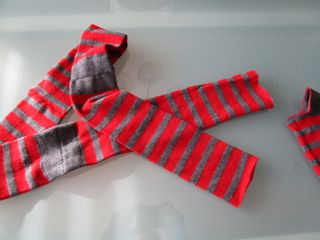
Photo 1. You’ll need two pairs of socks, matching, if possible, or with compatible colors and prints.

socks 1

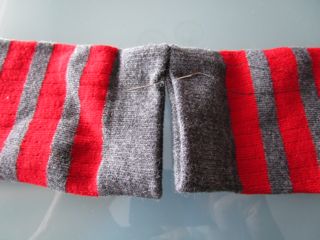
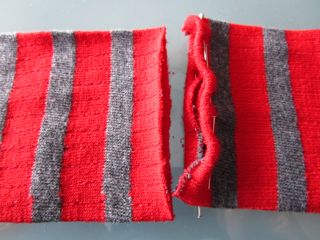
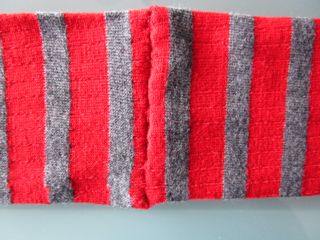
Photos 2, 3 and 4. Join each pair of socks by sewing the tops of the socks to each other.

socks 2 socks 3

socks 4

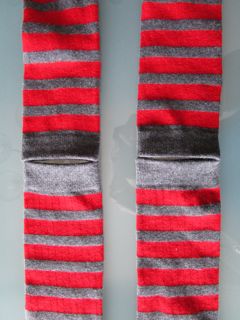
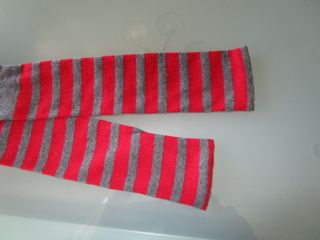
Photo 5. Cut the foot off one sock in each pair.

socks 5

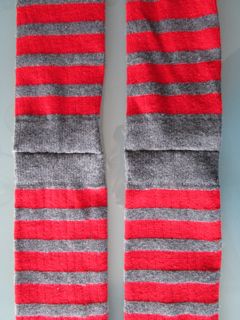
Photos 6 and 7. Turn the just-cut ends under, and sew them to each other.

socks 6 socks 7

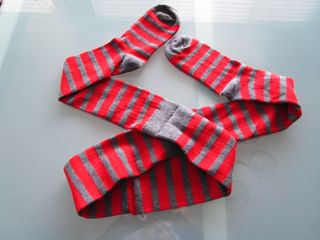
Photo 8. Now you should have four socks, end to end, with a foot on each end. (If you want to be really funky, you could stop here.)

socks 8

Photo 9. Cut the foot off each end of the scarf.

socks 9

Photo 10. Turn the just-cut ends under, and sew them shut.

socks 10

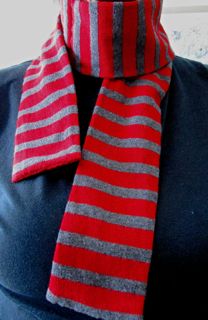
Photo 11. Here’s your scarf!

socks 11


SueZ

Suzy Z., the Alta sock stitcher.

*Sue Z., born in Brooklyn, is now a senior skier who likes to spend her time at Alta. When she is not skiing, she likes to paint in acrylics, plays the piano, and has taken several years of drum lessons. The “sock to scarf” idea came about while she was looking for a scarf for her new ski jacket; she came across knee socks in fun colors, and thought she could sew them together to create just what she was looking for.

Product Review: Socks That Rock From Injinji

New Performance Toe Socks Are Super Comfortable and Supportive.

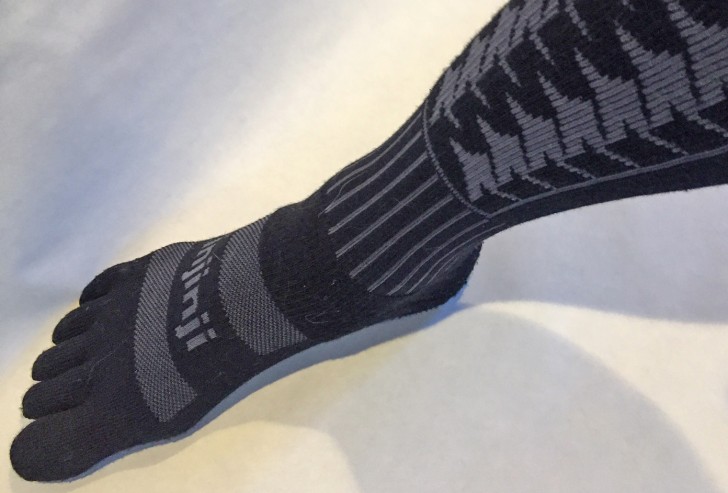
Injinji's Performance 2.0 Snow toe socks are fun to wear and feel terrific. Credit: SeniorsSkiing

Injinji’s Performance 2.0 Snow toe socks are fun to wear and feel terrific.
Credit: SeniorsSkiing

It’s March, and close to the end of the season for a lot of folks. If you think your gear is starting to look a little tattered, now is the time to contemplate a new way of thinking about your socks.

Injinji, the toe sock company, has introduced a new line of performance wear for snow sports. Toe socks, you say? Yes, we were quizzical, too, until we tried them on. The Performance 2.0 Snow socks are designed with graduated compression that does a fantastic job of supporting your muscles in your whole lower leg. These over-the-calf socks are also padded in strategic places for extra cushion. And they are made of NuWool, a combination of Merino wool, nylon and lyrca. And of course, there are the little toe “sleeping bags” that we found to be surprisingly comfortable.

Toe socks have been around for a while, and they are very popular with distance runners. The basic idea is to align your little piggies properly for better balance and blister prevention. When we tried a test pair, we were amazed at how different these socks felt from the usual. The toe feature was just—how to describe it—fun and remarkably different. Injini claims that proper “toe splay” distributes your weight evenly and allows better engagement for your feet. We can testify that the compression feature also gives you the feeling of significantly more support than regular socks.

We have two quibbles about the model we tested. Putting them on takes a bit of technique. Each toe has to be guided into its sleeve, so it does take a bit of concentration and a bit more time. No big deal. If you’re used to wearing an inner sock for extra warmth, you will need to get liners from Injinji that provide a base layer. You won’t be able to use your standard liners with these.

We continue to wear our Injinjis around the office as well as the gym and plan to take them to our next ski trip.

Injinji Performance 2.0 Snow medium weight socks come small, medium and large and in different colors. Suggested retail price is $30; shop around online.

Toe socks feel gooooodd! Credit: SeniorsSkiing

Toe socks feel gooooodd!
Credit: SeniorsSkiing

Product Review: Are Seniors Ready For High Tech Goggles and Sunglasses?

Better Than $20 Off-The-Rack Sunglasses?

Sunglasses from Red Bull Racing uses high tech material for toughness and style. Credit: Red Bull Racing

Sunglasses from Red Bull Racing uses high tech material for toughness and style.
Credit: Red Bull Racing

Inspired by Red Bull Racing, the four time Formula One Auto Racing Champions, Red Bull Racing is introducing new eyewear that uses high-tech, cutting edge technology in sunglasses and goggles. Formula One racing cars use the lightweight XMP material to reinforce carbon fiber and Kevlar in principal components.  Red Bull Racing thought it would be a good idea to transfer XMP technology into lightweight sunglass frames. The result are lightweight, tough sunglass frames and polarized lenses. And you thought Red Bull was an energy drink.

Red Bull has also introduced a high end ski goggle to the market utilizing a matte black carbon fiber frame  with a flash polycarbonate polarized lens. The Parabolica 010, which was used in the review, is another example of a sporty and race oriented look that provides maximum visual performance along with comfort with the lightweight frame.

These cool looking goggles flip up and they're made of the same super tough material. Credit: Red Bull Racing

These cool looking goggles flip up and they’re made of the same super tough material.
Credit: Red Bull Racing

Personal Observations:

I really liked the weight and visual acuity of the lenses in the RBR series sunglasses. They utilize a wide frame and large lens which provide comfort and vision benefits versus most sunglasses which tend to ride small on the face. There are varied choices in lens flash color as well as frame color and design.

A really neat feature on the goggle is a swivel built into each side of the frame which allows the frame to be flipped up without compromising the band fit on a hat or helmet. The lens acuity is sharp and the peripheral vision design is such that your field of vision is maximized with equal protection for the eyes both physically and with the built in Polarized vision protection. Also, based on use in different conditions including skiing while the snowmaking system was on, these goggles resisted fogging. One of my pet peeves with goggles: if you pay a good price for goggles, you want to make sure that the vision is not compromised. An anti-fog cloth is provided.

The price range is comparable to current products on the market. Retail price on these goggles runs from $89.00 to $339.00. The Parabolica is the high end goggle which I was able to test. The sunglasses retail pricing is from $125.00 – $219.00.  I tested the high end sunglasses.

It’s pretty amazing that the technology from materials used in the construction of a Formula One Race Car is now being used in sunglass frames for strength and weight considerations. Good for someone like me who tends to sit on sunglasses and break them. Senior moments.

For more information visit www.madvision.com and also www.spectacular-eyewear.com. This is a new product line. The US market is coming on board as we speak and the retail locator will be available in the next few weeks.

Product Review: Goodbye, Water Bottle. Hello Hydrapak.

Dehydration Comes Easy When Skiing: Collapsible Water Bottle Is An Answer.

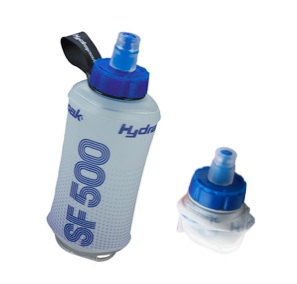
Staying hydrated on the slopes is important, but rigid plastic water bottles are a pain to carry in a parka. Hydrapak makes soft and pliable water bottles that fit comfortably in the pocket.

Paul tested the SoftFlask. Fits in a parka pocket. Credit: Hydrapak

Paul tested the SoftFlask. Fits in a parka pocket.
Credit: Hydrapak

We tested Hydrapak’s half-liter SoftFlask sports bottle over a few days on the hill. The 500-ml version held enough water without crowding a chest pocket, and it fit the palm securely. Made of BP-free thermoplastic polyurethane, it had no noticeable off-taste for some users. The company says it’s developing “no-taste” containers for sensitive palates.

The plastic cap is a bit unwieldy, and it took some practice to twist the valve open and closed. But it seals tightly with no leaks. A rubber nipple makes it easy to take a swig when the valve is open. The flask collapses to a small fraction of its size when empty. It retails for $20.

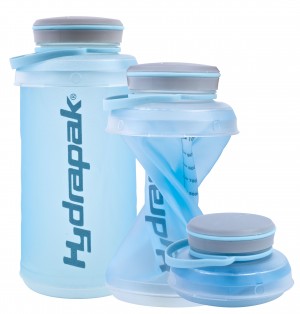
Hydrapak sells larger flexible water bottles with an ingenious design. These 750-ml and 1-liter Stash bottles resemble a Nalgene bottle but don’t take up valuable real estate inside pack or pocket when drained. They stand up full or empty, thanks to a rigid top and bottom, yet can be twisted and folded into a small disk when empty. The 1-liter retails for $23.

Most of Hydrapak’s business is with brand partners, notably Osprey Packs, which

Here's the Stash. Notice it collapses down into a hockey puck. Many colors available. Credit: Hydrapak

Here’s the Stash. Notice it collapses down into a hockey puck. Many colors available.
Credit: Hydrapak

incorporates the company’s reversible water reservoirs into backpacks with drinking tubes. The smaller flasks are for runners, skiers and anyone looking for a compact water container. Dishwasher-safe, they’re just as easy to hand-wash with mild soap.

Hydrapak claims its sports bottles are rugged enough to survive being run-over by a car. These portable, collapsible reservoirs work well. Now there’s no reason for not hydrating throughout an active ski day.

Comparing Five XC Ski Bindings for “Ease of Use”

SeniorsSkiing Correspondent and Cross Country Expert Rates The Big Five Bindings.

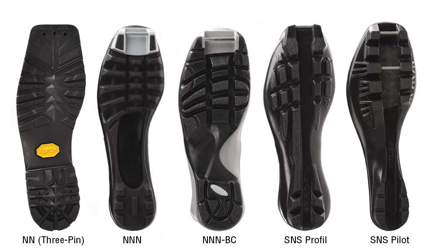
You’ve paid for your trail pass and are ready to head out on the trails at your favorite xc ski touring center. How easy is it to put your skis? In this review, I discuss five common binding types, the key features of each, and I rate them on a scale from 1-5 on its “ease of use” (1 being easiest and 5 most difficult).

Unless you’re a ski racer or have some other unique requirement, five types of cross country are available.

Untitled1

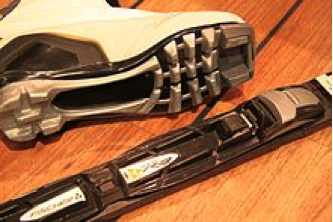
Five types of common XC bindings shown on their respective boots.

NN (Three Pin)

The three pin is the oldest of the five bindings and still used by some skiers. (Editor Note: We have a pair of wooden skis and leather boots to match with four pin bindings we still use; these relics are pre-three pin.) But for most touring purposes it has been replaced by more modern designs. When putting your skis on you must be careful to align the three pins on the binding with the three holes in the toe of the boot before closing the clamp (as shown below).

Untitled2

NN or 3-pin Binding and Boot.

NN EASE OF USE SCORE = 3

NNN and NNN-BC

This is the binding used by most ski touring centers for their rental skis. The pivot bar is close to the toe of the boot (as shown below); with the idea being you can almost see where to align it with the clip on the binding. I’ve been to a lot of ski touring centers and observed beginners, recreational and occasional skiers using the NNN binding. Many struggle mightily to get clipped into the ski. I also find that if any ice or dirt gets in the binding, the binding spring gets jammed.

NNN Binding and Boot

NNN Binding and Boot

NNN EASE OF USE SCORE = 4

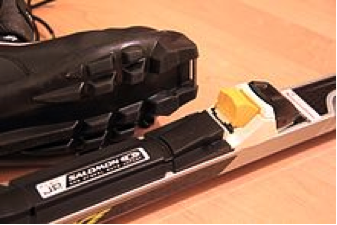
The Salomon SNS Profil

The SNS Profil works like the NNN and NNN-BC bindings (see illustration below). They are a little easier to use because the pivot point is even closer to the toe so you have a chance of seeing what you’re doing. Overall, though, the experience is frustratingly similar to the NNNs.

Salomon SNS Profil

Salomon SNS Profil Binding and Boot

SALOMON SNS PROFIL EASE OF USE SCORE = 4

The Salomon SNS Pilot

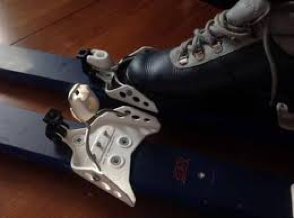
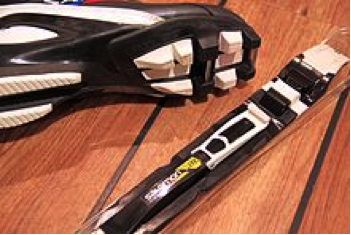
Originally designed for ski racers, the Salomon SNS Pilot has two pivot bars on the boot and clips on the binding which provides additional control. This is also a great binding if you wish to take up skate skiing. In an experiment, I attached the SNS Pilot bindings to a pair of touring skis. The result was surprising. Stepping into these bindings was incredibly easy. The rear pivot bar is used as a guide and the front pivot aligns with the clip. Then with a simple press of the forefoot the binding snaps on. This is a great package for the traditional or classic ski strider like me.

Salomon SNS Pilot

Salomon SNS Pilot Binding and Boot

SALOMON SNS PILOT EASE OF USE SCORE = 1

Bottom Line: My experiment with the SNS Pilot binding worked the best for the ease of use criteria. Clicking in and out of this binding with recreational (touring) skis was a snap. I feel like I have very good control of my skis when on the snow and turning is a breeze.

What’s your XC binding of choice?  How does it work for you?

Five Senior-Favored Products

I found them at the Outdoor Retailers Winter Market.

"Come into my office and let's talk business." A buyer and seller seal a deal while sitting in the OR Show's prime office space—a tent. Credit: Harriet Wallis

“Come into my office and let’s talk business.” A buyer and seller seal a deal while sitting in the OR Show’s prime office space—a tent.
Credit: Harriet Wallis

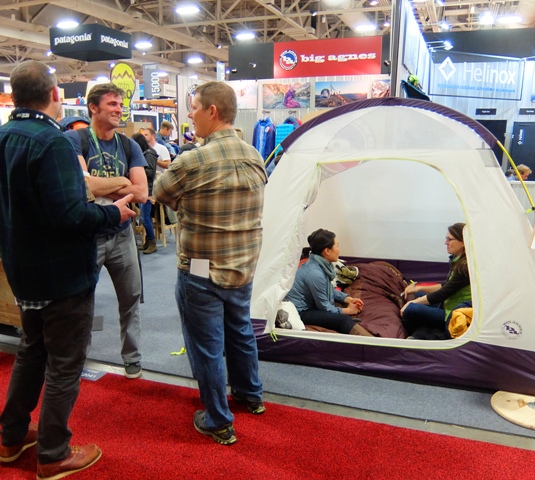
It’s the largest show of its kind in the U.S., and it’s where manufacturers strut their stuff and retailers place orders for next year. The show is the launch pad for innovative products as well as redos of existing products.

I was on the hunt for products that would appeal to senior skiers. After walking down aisle after aisle, my eyes glazed over with too many socks, boots, jackets, snowshoes, and gadgets.

The show covers acres within Salt Lake City’s convention center. A limited number of passes are issued for media writers and photographers – such as SeniorSkiing.com. That’s how I got there.

I kept asking myself: “What would seniors like?” Here’s what I found:

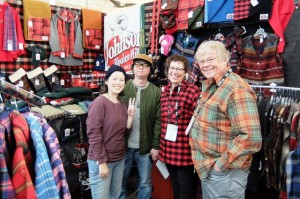
alg Woolen MillsWool. This natural material regains popularity. The Johnson Woolen Mills in Johnson, Vermont, has produced American made wool products for 173 years. It’s a 4th generation company.


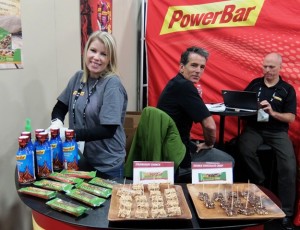
alg Power BarRefuel. Power Bar just launched a gluten free protein shake. Drink it to refuel at lunchtime or as a recovering drink as you head home. I tried it and like it. Currently available in convenience stores and bike shops.


alg NuunRehydrate with electrolytes. Drop a Nuun tablet into your water bottle and hydrate with electrolytes and without calories. New and improved with many subtle flavors. Nunn was invented about 11 years ago by a triathlete who wanted just water and electrolytes. I learned of Nuun when I did a story about the U.S. Ski Team’s executive chef and his recommendations for just regular athletes like us.


alg SOLSun protection. Sol is a highly effective sunscreen compounded from rub-in zinc and pharmaceutical-grade ingredients. Testing shows it doesn’t sting eyes or destroy fabrics and it stays on until you wash it off with soap and water. Available at dermatologists, some resorts and online. I tried the lip protector and it really stays on.


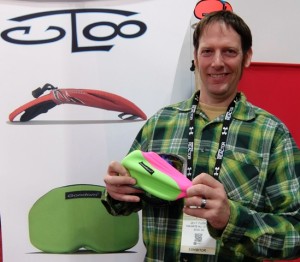
alg gogglesGoggle saver. It’s hard to stuff your expensive goggles into their snazzy bag to protect them. This elasticized cover does the job quickly.


 All photos—Credit: Harriet Wallis

Product Review: Shake It With TomTom Bandit

Action Camera Comes With Instant Editing.

It’s good to have a rival—Macy’s has Gimbel’s, the Red Sox have the Yankees, Holmes has his match in Moriarty. Everyone gets much sharper with a decent competitor. And so it is with action cameras.

TomTom Bandit Action Camera has a 4-way navigation button on top. The camera has many attachment devices. Credit: SeniorsSkiing.com

TomTom Bandit Action Camera has a 4-way navigation button on top. The camera has many attachment devices.
Credit: SeniorsSkiing.com

The ubiquitous GoPro, the current market leader, has almost become a verb, as in “I GoPro-ed my last run, and I can’t wait to see it.” Enter a new rival in the action camera market—the TomTom Bandit from the company that made its mark in GPS technologies, bringing navigation features to running and golf watches, car dashboards, motorcycle handle bars, fitness devices and more. Now, the TomTom Bandit has not only quality optics and a variety of choices for video or photo making, but a unique way to get your clips spliced together and posted to social media.

You’d expect a competitive action camera to have a high standard for video and photo quality; it’s the price of admission for this kind of product. And the Bandit certainly looks terrific on a cell phone display. TomTom Bandit has slow-mo, time-lapse, standard video and stills, with options for wide angle or normal lens, and different speeds.

Key Feature: Shaking the phone assembles a collection of clips into a video. Add music and viola.

Key Feature: Shaking your SmartPhone assembles a collection of clips into a video. Add music and viola.

Here come the differentiators. When on your skis (bike, sky-dive, etc.), the Bandit uses built-in motion sensors to tag clips that mark action segments, based on your speed, rotation, g-force, vertical descent and acceleration (and optionally, your heart rate). You can also mark these manually as they happen by hitting a button on the camera or using a remote button linked to the device.

When you combine these highlights, you get a video that can be instantly available for sending into cyberspace. How? The TomTom Bandit connects wirelessly to your SmartPhone which has an awaiting, free TomTom Bandit app . Now get this. When you shake your phone (like a Martini, kind of), the highlight reel shows up on your phone. The app actually edits together a collection of six-second snips from your clip collection. You can add a music track (from your music library on your SmartPhone), audio narration and then blast it to whatever destination you choose from Facebook to Instant Message to email or whatever.  A key benefit of all this is rapid and simple dissemination of your exciting moments.

We had a chance to give the Bandit a test flight. Because of the snow drought here in New England, we went for a walk around Appleton Farm, just across the street instead of cross-country skiing which was the original plan. Here is what we learned about using the TomTom Bandit.

It is good to have a tech-savvy son, daughter or son-in-law handy to give you the big picture instructions before you get going. The instruction manual that comes with the packaging is limited to the very basics. Only after doing some online searching did we find the main, down-loadable reference/instruction manual. That was thoughtfully done and thorough.

Pairing my SmartPhone (iPhone 6) with the camera took some trials; referencing the steps to take in the online reference manual helped. The controls aren’t intuitive; you do have to find and follow the instructions.

When we went for our trial walk, we tried to walk fast (to simulate exciting moments), pressed the Highlight button on the camera several times. (Note: You can use your SmartPhone as a view finder for the camera.) Back in the office, we followed instructions on the SmartPhone app to “Create a Story”, shook our phone, (that felt a little odd, but it worked) added a sound track from our iTunes library and sent it to family via instant message. We repeated the process with a series of videos around the office, but we couldn’t immediately lock on to the wireless connection to our phone; it eventually did pair up, though.

We also found the On-Off buttons—they are separately mounted on the camera—were a little hard to press with gloves in. Having a remote control would most likely help a lot.

The TomTom Bandit comes with various devices that allow you to attach it to helmets or poles. There’s also a waterproof lens; the Bandit is waterproof to 50 meters.  The camera retails for about $396.99 on Amazon.  There’s a premium pack with remote control, various mounts and waterproof lens cover for $496.99.

Bottom Line:  TomTom Bandit has some nice features like shake-and-edit-then-send, but it does take some fiddling and diddling to get comfortable in operating them.  Video quality is excellent which makes all that learning worth it.  In all, a camera for seniors who want to show their grandkids the thrills and beauty of the outdoors.

Stocking Stuffer: Low Temperature Windshield Washer Fluid

Okay. It’s too big for a stocking, but it doesn’t need wrapped.

Practical and inexpensive, this De-Icer Windshield Washer can save your day. Credit: Harriet Wallis

Practical and inexpensive, this De-Icer Windshield Washer can save your day.
Credit: Harriet Wallis

A cheap but practical gift is a jug of low temperature windshield washer fluid with de-icer. Look on the label for a temperature rating that is -25 or -30 or lower. A gallon jug costs less than $5.

There are some days when a certain mix of temperature and humidity can cause windshields to glaze over as you climb in elevation or go over a pass. The “blue stuff” that’s usually in the your car reservoir will not defrost the windshield. Using low temperature windshield fluid will likely save your ski day.

There are several brands of low temperature windshield fluid. Different brands are different colors – orange, purple or pink. But none are blue. Stick a bow on the jug, and it’s wrapped!

You might want to buy a turkey baster too. Use it to suck the blue stuff out of the car’s reservoir and then replace it with the low temperature washer fluid.

It’s the little things that make a difference.

Are Heated Gloves Worth It?

Some Things To Consider Before You Buy.

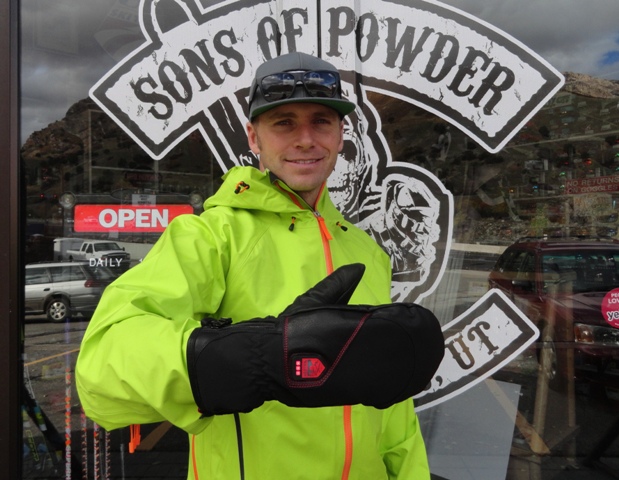
Luke Larsen, owner of the Lift House in Salt Lake City, demonstrates the Hestra brand of heated mittens. Hestra also makes heated gloves. Credit: Harriet Wallis

Luke Larsen, owner of the Lift House in Salt Lake City, demonstrates the Hestra brand of heated mittens. Hestra also makes heated gloves.
Credit: Harriet Wallis

If you google “heated gloves”, you’ll find two dozen brands in all price ranges. And more brands are advertised in ski magazines. It seems that many companies have jumped into the heated glove market. To make matters confusing, the descriptions all sound alike.

“Heated gloves that work well cost about $300 – $400” said Luke Larsen, owner of the Lift House, a premier Salt Lake City ski shop. “It’s the same technology as heated ski boots.”

Consider these tips before you invest in heated gloves.

  • What about batteries? The battery should be located on top of the palm/wrist area and well covered by the glove’s insulation. Why? Batteries are heavy so it’s the best place to put them. And it’s also a good place for you to see the heat setting light. Be sure the battery in the brand you consider is well protected by glove material and not close to the surface. Batteries and wires must stay warm to work well. And check how long the battery should run between charges.
  • How’s the plug? The battery recharger plug should be stout and easy to grasp. Plugs that you have to wiggle with can break with wear.
  • Do these gloves make my hands look fat? Many women’s gloves boast a slim profile. That means less insulation. The battery and the wires must be kept warm to keep you warm.
  • Try them on. Check how the gloves work with your jacket sleeve. Some gloves are slightly curved to make grasping a ski pole easier. Check your grasp. Heated mittens are warmer than heated gloves.
  • Talk to other skiers. Look for skiers with a light on their gloves. It’s the give-away that they’re wearing heated gloves. Pick their brains.
  • Buy from a ski shop with great service. A quality ski shop will go to bat for you if you have any problems.
  • Follow the directions precisely. If you want the gloves to last, do exactly what the directions tell you about recharging, transporting and storing them off season. If they come with a case, use it. Heated gloves aren’t fragile, but they don’t deserve having a ski boot dropped onto the wires.

Here’s what skiers are saying about their heated gloves:

“Last year was the first year I used battery powered gloves for skiing, and they are the best. If my hands are warm, I am warm all over,” says Arlene Maginn of Hamilton, MA. “On medium setting, they last all day! They are Core Heat Snow Gloves, and I recommend them for all kinds of winter activities.”

Salt Lake City skier Laurie O’Connor agrees. She can stay toasty all day. However, instead of heated gloves, she opted for heated Thermo Gloves liners. That way she can wear different outer gloves.

Todd Reynolds, a commercial fisherman from sunny Florida, has heated Hestra gloves. “I love them” he said. “I’d freeze without them.”

Gorsuch. Too Much?

Buy Stuff If You Can.

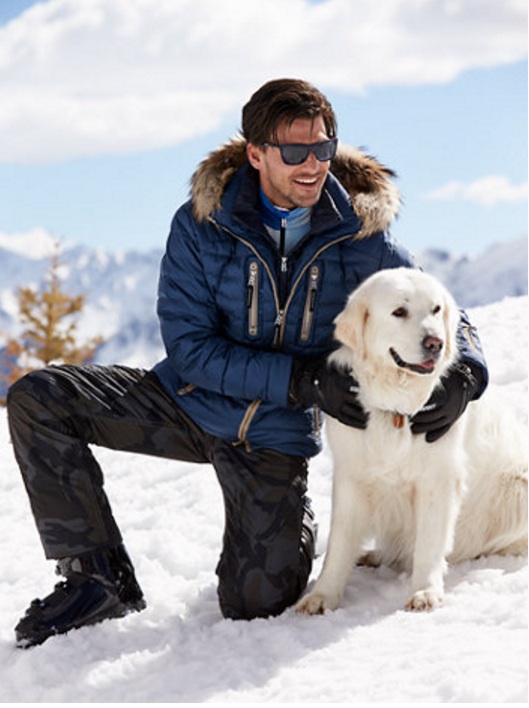
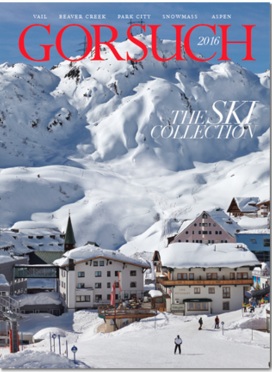
The 2016 Gorsuch catalog just landed on our desk with a cover model wearing  $4,487 worth of ski outerwear. Inside are pictures of parkas costing in the thousands and a four-way stretch insulated “ski jean” for $2,399.

Fur hood parka by Bogner: $2,108. Doggie: Priceless. Credit: Gorsuch

Fur hood parka by Bogner: $2,108. Doggie: Priceless.
Credit: Gorsuch

Choices for guys are pricey, but nothing like the trophy garments which, based on the Barbie-looking models, must be targeted at trophy wives.

It’s fun to thumb through the catalog and see how the tippy-top of the one percent is outfitting itself for the coming season. A knit neck warmer to stuff the stocking? $250. A black and grey zipper fleece? $498.

The 2016 Gorsuch has many luxury items for the carriage trade. Credit: Gorsuch.

The 2016 Gorsuch has many luxury items for the carriage trade.
Credit: Gorsuch.

Photographed in Aspen, this is the 39th Gorsuch catalog. The company was founded by Renie and David Gorsuch who were members of the 1960 US Olympic Ski Team. According to their website, they fell in love, married, settled in Colorado and had three sons. Today, they have 13 stores at all the right addresses in Aspen, Beaver Creek, Keystone, Park City and Vail (one of which, appropriately, is on Wall Street).

Like most of the lifts at these areas, Gorsuch’s offerings are over the top.

To request a hard copy of the Gorsuch catalog, visit them here.  Oh, by the way, it’s free.

Women-Only Snowshoes: Vive La Difference!

Special Thanks to Roger Lohr, Editor and Publisher of XCSkiResorts.com for allowing us to post this article which first appeared on that site.

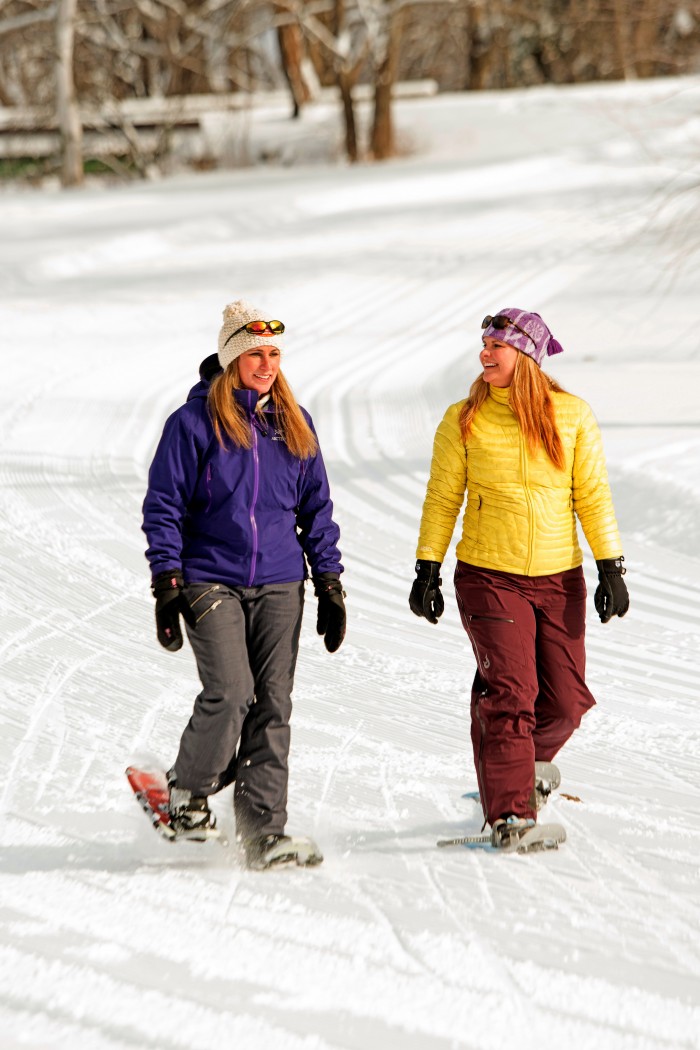
About half of all snowshoers are women, who snowshoe to experience nature, to exercise with friends and family, for backcountry access, and to have outdoor fun throughout the winter. The various snowshoe companies have been catering to this market by offering a broad selection of women’s-specific snowshoe technologies recreation and fitness, but do the women’s snowshoes go beyond just a change in cosmetics?

Woodstock Inn attracts women snowshoers who can step along in women-only gear. Credit: Woodstock Inn

Woodstock Inn attracts women snowshoers who can step along in women-only gear.
Credit: Woodstock Inn

Tubbs Snowshoes pioneered the development of women’s-specific snowshoes by offering patented binding technologies that custom fit women’s boot sizes and by ergonomically engineering frames that are tapered at the tip and tail to accommodate women’s shorter strides. The result was lightweight, comfortable, high-performance snowshoes and many of the other brands have followed suit.

There are a few differences between Tubbs’ men’s and women’s snowshoes. On average, women have a narrower stance and shorter gait, so women’s snowshoes are narrower in width. Women’s average weight range is both more light weight and a smaller range than men’s, so they provide snowshoes in a shorter size for women, longer for men. The Tubbs men’s and women’s bindings differ, providing the optimal fit for the average women’s boot size and volume range, versus a larger average men’s boot size and volume range. Foot size also affects the optimal position for the heel lift, so the placement of the heel lift on men’s snowshoes varies from the placement on women’s snowshoes.

The Atlas Snowshoes Company conducted gait studies and biomechanics research to create snowshoes that enable women to hike and run with the most natural stride possible, while making the snowshoes both comfortable and lightweight. The research revealed that women have a greater Q-angle (at the knee where the thigh bone angles in from a woman’s wider hips) and abducted gait that create specific issues when snowshoeing. Women also tend to pronate (collapsing arches) pointing to the need for bindings to support the arch of the foot.

MSR snowshoes for women balance a naturally narrower gait and the need to “float” on the snow. Credit: MSR

According to the people at MSR, the studies conducted by Tubbs clearly showed male/female anatomical differences. However, when these differences are translated into physical products the design changes are not as noticeable. For example, women generally walk with a narrower gait than men. Therefore, a very narrow snowshoe would suit women better, but the snowshoe width has a direct impact on flotation so the final design can’t be too narrow. The ideal width snowshoe for women is a balance between very narrow to accommodate gait and wider for adequate flotation.

MSR believes that it is important to look beyond the measurements and understand how the snowshoes feel. Thousands of hours of field testing showed that subtle differences are noticeable. The major male/female differences with men’s and women’s versions of MSR are with decks and bindings. The women’s deck shape is optimized for snowshoe performance (traction & flotation) and a female gait. The bindings are sized to meet the proportions of a women’s footwear. There is also specific MSR technology such as Axis™ Gait Technology (Women’s Lightning Ascent Snowshoes), which allows women to compensate for varying degrees of toe-out or toe-in. This technology provides laterally adjusting the bindings independently of the frame, ensuring efficient, parallel-tracking snowshoes regardless of a women’s natural toe-out or toe-in stance. This means that the binding itself can swivel on the snowshoe to adjust for varying degrees of natural toe direction allowing binding alignment with your natural stance rather than forcing you to point your feet directly ahead.

Yukon Charlies Snowshoes has the YC Pro II Series women’s snowshoes, which are designed with features specific to the needs of the female snowshoe enthusiast. The rockered V shape tail enhances performance and allows for a more natural stride. These snowshoes are lighter, stronger and more reactive than any of the company’s other women’s snowshoes.

Yukon Charlies’s Advanced Series for women is a feature-packed “go anywhere” snowshoe is designed by women, for women. The rocker V tail allows for a natural stride from a walk to an aerobic sprint, while the integrated heel lift and the axle system makes Yukon Charlie tout them as their best women’s snowshoe ever.

Redfeather Snowshoes has three styles of Hike snowshoes with the SV2 pull handle binding. There’s also a choice to get the snowshoes in a kit with poles and a bag. The Redfeather Hike has sizes of 22, 25, 30 (inches) for women up to 150, 175, and 200 lbs.

Tubbs Snowshoes and Atlas Snowshoes have shown the greatest commitment to women’s snowshoe products and they are probably the largest snowshoeing product brands. Tubbs Snowshoes has 11 models for women (in seemingly every snowshoe category) including Flex ESC, Flex TRK, Flex ALP, Flex RDG, Flex Vrt, Wilderness, Mountaineer, Frontier, XPlore, and Xpedition.

Atlas Snowshoes has six options for women including the Electra 8 and 9, Endeavor, Fitness, Race, and Run.

Few of the snowshoe companies invest in marketing directly to women but the Tubbs Snowshoe event “Romp to Stomp Out Breast Cancer” Series, is very popular focused on women. This year’s event at Frisco Nordic Center in Colorado was attended by more than a thousand people! The series, which has been hosted at sites across North America has raised funds and awareness since 2003 bringing in more than $2.8 million for the fight for a cancer cure.

Whether the trail conditions are light fresh snow, crust, slush or ice, women want to trust their snowshoes for all-condition durability, excellent traction, flex for control, and comfort. Women are coming to expect that their snowshoes are specific to their needs and built to withstand frequent use offering many seasons of recreation, fitness and adventure.


A Better Wine Bottle: Growlers

A Good Idea For Apres-Ski Tailgating.


750mL-fiftyfifty-vacuum-insulated-wine-growler

fifty-fifty wine growlers are perfect for picnics and parties. Be the one with the shiny Chardonnay. Credit: fifty-fifty

When we picnic or party, we usually carry glass wine bottles like most people do. Well, the people at fiftyfifty have come up with a better way to transport wine. It’s a double-wall, vacuum-insulated stainless steel bottle that keeps wine at the perfect temperature—all day long. What’s unusual about the container is its terrific style and its 750 mL capacity. You read that correctly. It’s the same volume as a bottle of wine, hence its name, Wine Growler. Available in tasty wine colors (Chardonnay Silver, Shiraz Red, Champaign Gold, etc.), Wine Growler starts the conversation going as soon as it makes an appearance. Ours has worked out more the past several months than I have. It will be part of the après ski kit this season when we tailgate at Alta and Snowbird. Come January, it will carry something warm. But as soon as those comfortable, sunny days enter the scene, it will be filled with something to be passed around in style. We won’t be the only ones carrying: at about $25 each (less online), they’ll be this year’s Holiday gift to family and friends. The company makes other high quality insulated stainless steel bottles, as well. fiftyfifty Wine Growlers.

Editor’s Note: This is not a paid ad nor a sponsored post.  It’s just Jon’s enthusiastic discovery of a cool product. Enjoy.

Adding Life To Your Years With A Better Grip

Who Knew Grip Strength Was A Diagnostic Measure of Aging?

Over the past few ski seasons, I’ve noticed times when my wrists are weak, especially when rocking my poles. Arthritis? Age? Don’t know. A few days off slope or wearing an elastic wristband, and it goes away.

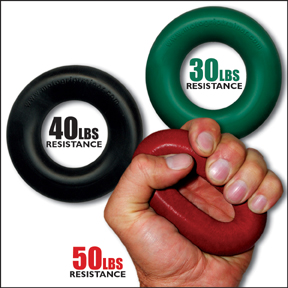
Three different bagels can help you strengthen your grip. Credit: GripProTrainer

Three different bagels can help you strengthen your grip.
Credit: GripProTrainer

Now I’m trying another approach. I have a little exercise device that looks like a rubber bagel, and you squeeze it as part of a grip-improving, hand and forearm workout. It comes in three colors, each calibrated to different strength abilities. I’ve started with green, which gives 30 pounds of resistance. The product website says it’s for “lighter weight people,” which is hardly my profile. But for now it’s enough. Black has 40 pounds resistance and red, 50 pounds. I doubt I’ll graduate beyond green.

But something about it feels very good. It’s compact, portable, and in a design/function way has a simple elegance. I’ve started to pick it up and use it unconsciously.

Studies suggest that grip strength is related to aging. An interview with one researcher published in The New York Times states “…an adult’s hand grip can distinguish different rates of aging in people with different levels of education.”

Some people use a tennis ball or one of those spring-loaded devices, but based on my experience, the green rubber bagel feels good and keeps me going back for more. It’s called the GripPro Trainer. Online, they’re $7.95 each or $19.95 for all three.

It’s too early to know if using it will help my skier’s wrist. I’ll figure that out during the season. But if you golf, fish, water ski, play tennis, or engage in any activity where grip strength is an issue, it’s worth looking into. Who knows? Maybe it will add years to your life…and life to your years.

More Hot Products From SLC’s Outdoor Retailers Show

Gee Whiz, Seniors, Here’s What’s Coming to a Store Near You!!

Shoes whose laces tighten without your needing to bend down to tie them.

Wireless heating insoles controlled with a smart phone app.

A small device that communicates your whereabouts and whether or not you need help when there’s no cell service— nywhere on the globe.

These are just a few of an endless array of products exhibited at the summer edition of the semi-annual Outdoor Retailers Show in Salt Lake City.

Every August, thousands of manufacturers and merchants—from mom and pop to big box—converge on the Salt Palace Convention Center in Salt Lake City to see and place orders for products to be sold a year from now. They return in January, this time focusing on winter sports.

Exhibitors are organized by product category. Paddle board, surf boards, water accessories, etc. in one section. Footwear, socks, foot beds, etc. in another. Yoga equipment here; camping gear there.

handsfree_heel_wheel

Treksta’s hands free lacing system works by sliding the heel back for lace up. Credit: Treksta

Back to those self tying shoes. You can look for them under the name Treksta Hands Free Shoes. It’s an athletic shoe (quite comfortable) with a foot-activated lacing system. Even the most active person will enjoy not having to bend down to tie or tighten shoe laces.

Digisole is a French import that will be in stores in a year. A programmable, heatable insole for ski and other cold weather boots, the insoles can reach 120 degrees F, a bit too toasty for most tootsies. The great thing about Digisoles is that they’re fully adjustable using an app on your Smartphone. Same phone app tells you how many steps that day, what the weather is, etc., etc. The soles are charged via USB connection, and, for most heat levels and in most conditions, will keep your feet comfy for 5-8 hours. Can’t wait to try it on the hill.

SPOT Gen3 will find you almost anywhere on the globe. Credit: SPOT GlobalStar

SPOT Gen3 will find you almost anywhere on the globe.
Credit: SPOT GlobalStar

Spot is a reasonably priced, pocket-sized, personal tracking device that, with the push of a button, lets family and friends know you’re ok or sends emergency responders your GPS location. It’s all about providing you and loved ones peace of mind when you’re out of cell range. Using satellite technology, it works from land, air and sea, anywhere on the globe. The unit, itself, can be purchased for about $75, and the satellite subscription is about $150 per year. A small price to pay for peace of mind. It’s a valuable and necessary addition to every pack or parka.

Outdoor Retailers Show: Harriet’s Three Hot Product Picks

It’s Like Christmas In August.

Outdoor Retailers Show in Salt Lake is the largest outdoor sports show of its kind. Credit: Harriet Wallis

Outdoor Retailers Show in Salt Lake is the largest outdoor sports show of its kind.
Credit: Harriet Wallis

The annual Outdoor Retailers Show is going on in Salt Lake City right now (August 5-8), and it showcases gear for all outdoor enthusiasts. It’s a sneak peek at brand new innovative products as well a upgrades in existing products.

The massive trade show has more than 1,500 exhibitors from around the world. Some exhibitors are well known outdoor recreation companies while others are little companies that strut a single creative product. The show brings buyers together with the sellers and it sets the stage for what you’ll soon see in your favorite recreation store.

I attended the show for SeniorsSkiing.com to search for products that would appeal to our readers. I walked miles to see the show takes up every square inch of the Salt Palace, the city’s convention center, and then it spills outside into three, block-long tents.

Here are my top picks:

Harriet's Pick #1: Addaday Rollers. Credit: Harriet Wallis

Harriet’s Pick #1: Addaday Rollers.
Credit: Harriet Wallis

Addaday rollers for soothing sore muscles. Apply a lot or a little pressure on what hurts. It’s less bulky than traditional foam rollers so you can pack it in your suitcase and take it with you on vacation. www.addaday.com

Harriet's Pick #2: Spriggs Wrist Wallet Credit: Harriet Wallis

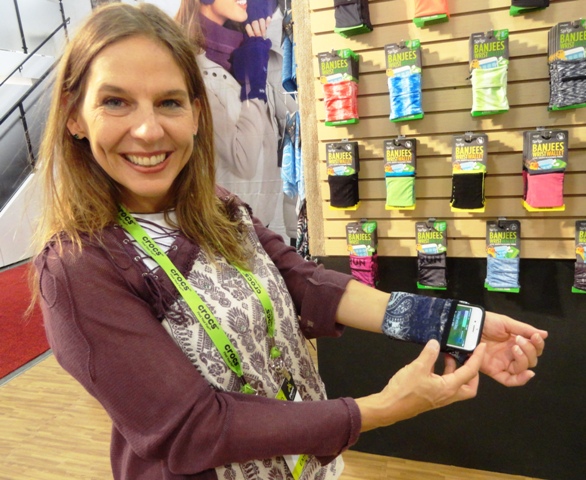
Harriet’s Pick #2: Sprigs Wrist Wallet
Credit: Harriet Wallis

Sprigs wrist wallet is a comfy cuff that’s safer than your coat pocket. Each wrist wallet has a hidden pocket, a zipper pocket and room for your cell phone too. Stash all your important items — credit card, money, room key and phone – and you’ll always have them with you. Lightweight and lots of patterns. “I invented it in 2004 after my sister came back from a trip to Morocco and said there were lots of thieves,” said Sprigs owner Valerie Ciptak Vierra. www.sprigs.com  

Harriet's Pick #3: ExOfficio undwear Credit: Harriet Wallis

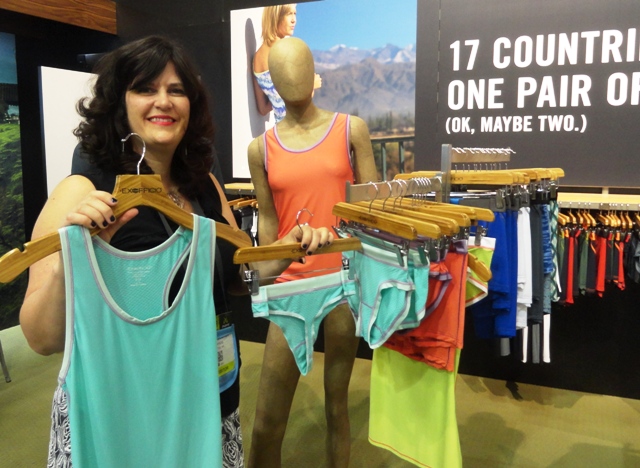
Harriet’s Pick #3: ExOfficio sports underwear
Credit: Harriet Wallis

ExOfficio Give-N-Go Sports Mesh underwear. ExOfficio is already known for it’s lightweight, breathable, quick wicking and quick drying fabrics that are perfect for travel. It’s women’s underwear line now includes the extra-breathable diamond weave sports mesh fabric that will breathe beneath your base layer. Next year, look for the boy shorts style and the fancier lace collection. There are new styles for men too. www.exofficio.com.


Rehab Friend: A Little Assist From Your eBike

An Electric Bike Offers A Friendly Boost To New Knees and Hips

Polaris NordicBike__edited-1 

We all remember “With a Little Help from My Friends” by The Beatles.

My, how things have changed in the 48 years since its release, especially for those boomers who want to come back to the slopes after major surgery on hips and knees and rotator cuffs, among other parts.

Well, here’s some good news:

One of my friends is recovering from hip replacement surgery. His surgeon prescribed riding a bike for exercise, muscle rehabilitation and re- building confidence. How about skiing? Why not!

That’s where an electric bicycle is giving him the confidence to get back on the boards after major surgery. And go uphill at 20+ mph, or faster than your average quad lift!

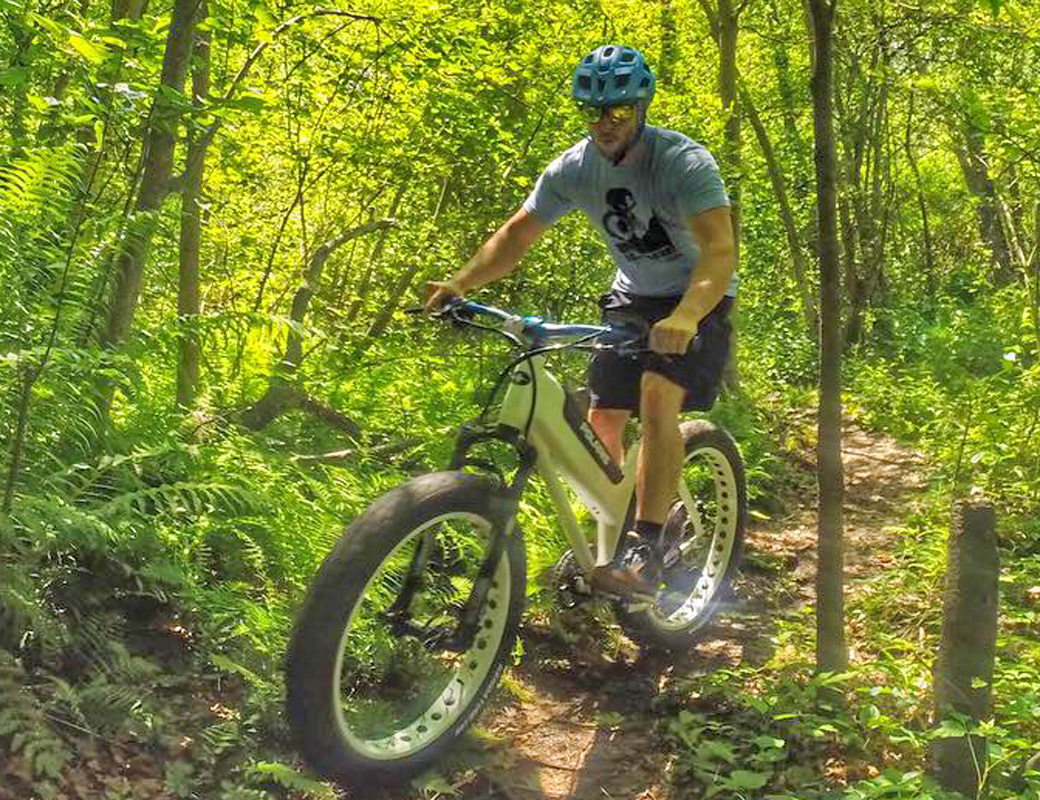
At the New Hampshire ski area where my friend has spent many a winter, the electric bike with fat tires is ideal for going up the main road from the village to the lodge and beyond. Fat-tire bikes are now common for off-roading. One of the challenges of an electric bicycle design is to configure the entire frame, power and control system and accessories to be as light as possible. Lightness and controllability are among the advantages of the Polaris®eBike.

On unimproved trails and dirt roads, the fat-tire configuration gives my pal stability that helps build his confidence as he builds strength.

Advanced technology now available in electric bicycles is a major factor in getting my pal back on skis. In his case, the Polaris Gear Speed Technology features 8 gear speeds.

As the terrain rises, power kicks in—controllable with paddle shifters like a sports car— and “… a little help. . .” from the electric assist turns into up to fifty miles of riding.

How does he get a fifty mile ride? Polaris technology allows regeneration of the battery by braking and reverse pedaling. Active Trail Mode™ regenerates the bike’s battery during pedaling with automatic incline sensors to deliver power for uphill riding. Operation of this mode extends battery life. A four-hour charge can deliver fifty miles of performance.   Regeneration gives the rider unlimited power—my friend said his bum gave out before the bike needed to be re-charged.

As senior skiers, we’re all adopting new equipment, better outdoor clothing, improved diets and exercise routine.  With a little help from an eBike, we can take advantage of bike riding for fun and exercise.

Ski Dolly: At Last, An Easier Way To Carry Gear

Why-Didn’t-We-Think-Of-This-Department: A Gear Toting Assistant

Tip and roll the Ski Dolly away with some help from physics and gravity. Credit: Ski Dolly

Tip and roll the Ski Dolly away with some help from physics and gravity.
Credit: Ski Dolly

You might say, it’s about time someone came up with the Ski Dolly (TM). After schlepping backpacks, boot bags, skis (bagged or loosely tied) from car to base lodge too, too many times, we celebrate the arrival of this good-idea product.  Imagine:  Your favorite ski area has a reserved area for senior skiers (yes, many areas do have these and many more are thinking about it).  At that reserved parking area, you unload, pick up a Ski Dolly (TM) from a super-market-like shopping cart collection point, pile on your kit and roll away.  Arrive at base lodge, drop off Ski-Dolly (TM), don your equipage and go. End of day, reverse process, drop off Ski-Dolly in parking lot.  Pretty simple. Especially helpful when you are hosting your ski club or a cluster of grandchildren.

Ski Dolly is made of welded steel. Credit: Ski Dolly

Ski Dolly is made of welded steel.
Credit: Ski Dolly

Ski-Dolly (TM) is the patent-pending invention of two single parents whose struggles carrying a family-load of gear from car to lodge was the stimulus for this bright idea.  According to the company, the Ski-Dolly(TM) itself can tote up to eight pairs of skis or four or five snowboards, plus helmets.  From the photos, it looks as if you can latch on gear and boot bags, too.

Action Item:  Ask your ski area’s  guest services people to look into providing Ski-Dollys (TM) for the seniors-only parking area.  Or for everyone.  If you are in a ski club, order some for the bus and put your private-label logo on them. Why not?

Is Your Down Jacket Responsible?

Contributor Steve Hines’ Explainer On Humane Goose Down Harvesting.

Harvesting goose down in humane conditions is a movement in the outdoor clothing industry.

Harvesting goose down in humane conditions is a movement in the outdoor clothing industry.

If you ski or do any winter outdoor sport you probably have or have had a down jacket. Now is a good time to evaluate what you have and will need for next winter.  If down is truly the answer, then you have to know there are choices between vendors who provide humanely harvested down and those who don’t, at least not yet.

Down consists of the small protective feathers from the chest and bellies of geese. And, while the geese are raised by farmers in Europe and China for this purpose (and for food), many geese are badly mistreated during their lives.

Among the most egregious abuses of these birds are:

  • Being kept in small coops where they cannot move around or change position
  • Being force fed to gain weight rather than eating at what would be their regular intervals
  • Being live plucked – having their feathers pulled off while they are still alive (the farmer hoping that the feathers will grow back so they can pluck them again).

Geese are sentient beings and feel pain. However, efforts are underway to correct these abuses by some of the largest retailers in the outdoor industry.

For good advice about the best down jacket for you, see Chris Simrell’s article on Outdoor Gear Lab.

Most manufacturers contract with suppliers who buy down feathers from farmers. So, the supply chain can be long and convoluted. The abuses happen at the farms themselves. Animal rights groups have spent time and resources documenting these abuses.

When the controversy first broke in late 2013, the first company to respond was Fjallraven, a Swedish clothing and gear company. Their response was to send teams to Europe and China to find and purchase goose farms that were already acting responsibly or which they could convert to responsible practices.

Quickly following was Patagonia, an American company founded by the famous mountaineer Yvon Chouinard. Patagonia has certified that all down suppliers for their garments come from farms that act responsibly. They hang a tag on their jackets carrying the term “Traceable Down”, which means that they know exactly which farms the down came from.

Look for this label when buying down-filled outerwear.

Look for this label when buying down-filled outerwear.

According to Leon Kaye at greengopost.com, Down & Feather Co., Down Linens, Helly-Hansen, Mammut, Marmot, Montane, Nau and Outdoor Research are all following the lead set by Fjallraven and Patagonia.

While researching this story, at least three conflicting articles about The North Face’s (TNF) standards were uncovered. But, the most convincing article said TNF was working on it and the majority of their down garments will be using Responsible Down Standard (RDS) by fall 2015. So, this fall start looking for the tag that claims the product is certified as “Responsible Down”.

As of this writing, Columbia Sportswear claims they have demanded all suppliers adhere to RDS but have made no plans to certify or inspect. Your retailer should be able to provide this information.

Let’s applaud the efforts of companies who are acting responsibly.

Try Nordic Walking: Many Benefits By Adding Poles To Hike

Poling While Hiking Is An Exercise Multiplier

Roger Lohr is co-founder and editor of XCSkiResorts.com and a noted writer on all the varieties of Nordic skiing.

Walking a la Nordic raises efficiency of exercise by 40 percent. Credit: Leki

Walking a la Nordic raises efficiency of exercise by 40 percent.
Credit: Leki

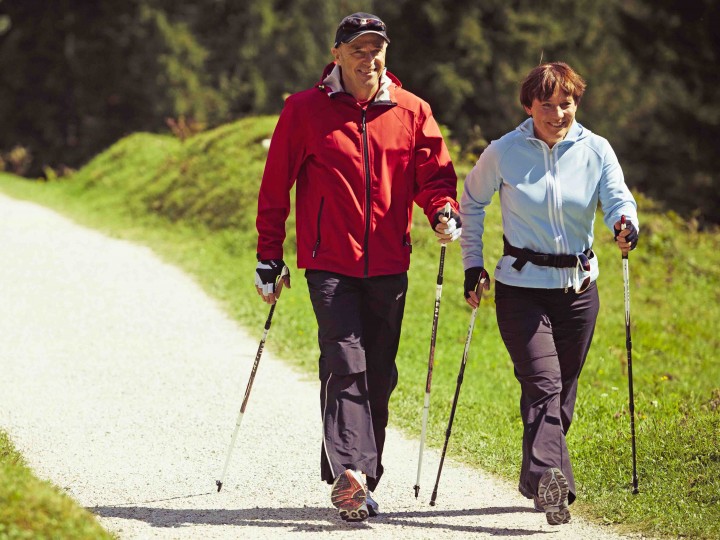
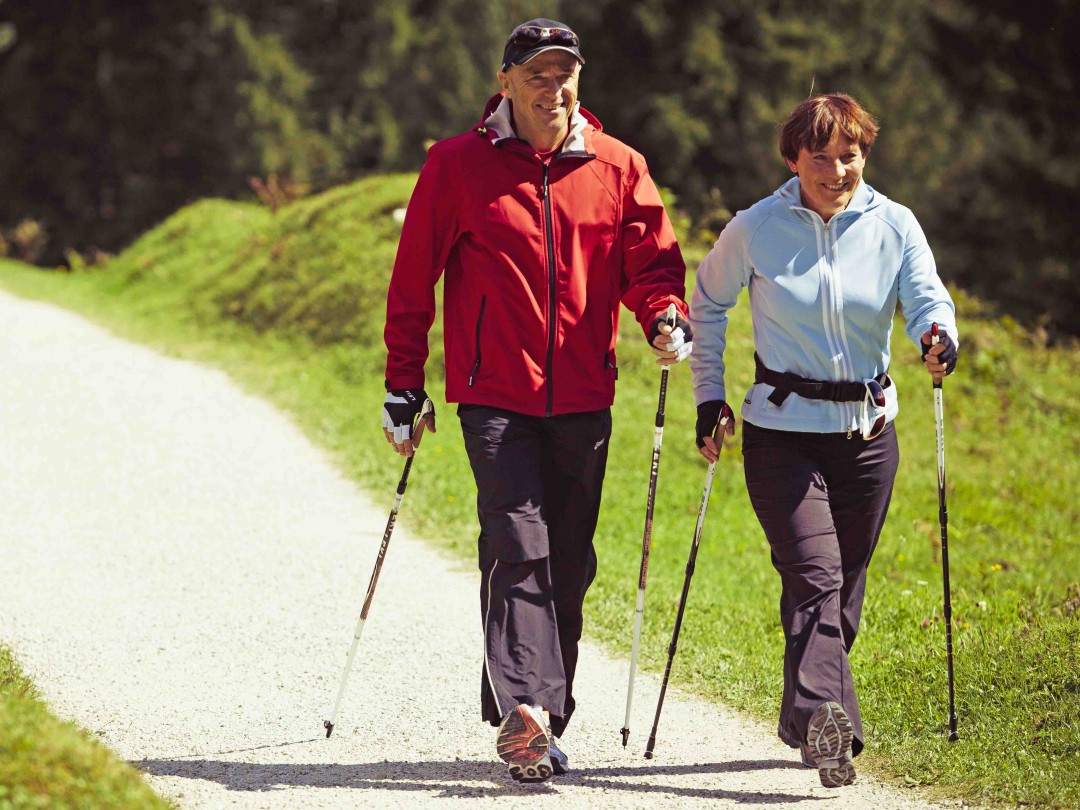
More than 10 million Europeans of all ages and fitness levels are Nordic Walking (also known as Ski Walking) with special Nordic Walking Poles. This new fitness activity turbo-charges the normal walking regimen burning as much as 40 percent more calories compared to regular walking.
For those who are unfamiliar, Nordic walking is a fitness activity that combines walking with specially designed poles to engage the upper body muscles.

Nordic Walking poles help individuals with balance issues, knee issues or new knees, hip issues or new hips, back issues (including those with rods in their back), weight issues, multiple sclerosis (MS), Parkinson’s Disease, neuropathy, arthritis, bursitis, scoliosis, lumbar stenosis, fibromyalgia, post polio, osteoporosis, stroke recovery, cancer recovery, and other limitations to walking. Nordic Walking is helping thousands of people get off the couch, get outside, start walking safely, and effectively launching much needed walking campaigns.

The Human Kinetics book entitled Nordic Walking for Total Fitness by Suzanne Nottingham and Alexandra Jurasin covers the topic. Trekking (hiking with poles) and Nordic walking are two different activities that use very different poles and techniques. It may sound silly, but perhaps “walking is not just walking.” The pole angle, weight, grip, and straps are different between the aforementioned modes of walking. The Nordic walking pole is designed to allow your hands to relax in order to target the larger wrapping muscles of the back. But using poles of any kind automatically stimulates your spine and all of the muscles around it, even with inefficient technique. When walking, the key postural muscles of the core and upper body are engaged.

The book also includes fitness assessments, sample workouts for varying levels of interests from first timer to cross training triathletes. There are also suggestions about customizing your program. Training program recommendations are offered for building distance, fluctuating daily intensity, and rest days.

I’ve been a Nordic Walker for a few years and found many of the claimed attributes in the book regarding posture and exercise to be true. I’ve always been in search of a way to decrease the amount of time spent exercising, so I was sold when I heard that using the poles increases caloric burning by 40 percent. Being a cross-country skier, it is easy to quickly master Nordic walking. After a summer of Nordic walking, I noticed a marked improvement in my cross-country ski poling in terms of strength and timing. It seemed that I increased the amount of forward momentum that was attributable to poling and I was able to pole stronger and longer when skiing.

Nordic Walking for Total Fitness provides a foundation for anyone, ranging from those just looking for an activity to lose weight to health aficionados interested in taking it to higher levels of fitness.

Nordic Walking for Total Fitness is available for $19.95 plus shipping from Human Kinetics at www.humankinetics.com or call 217-351-5076. 

Product Update: ThinOptics Now has Bold Colors, New Magnification

You’ll Always Have These Readers With You.

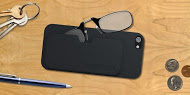
Finally, you can read your cell phone, trail maps and restaurant menus with ease because you can always have these very cool reading glasses with you. And the case snaps onto your Smartphone for ready access. Now isn’t that novel!

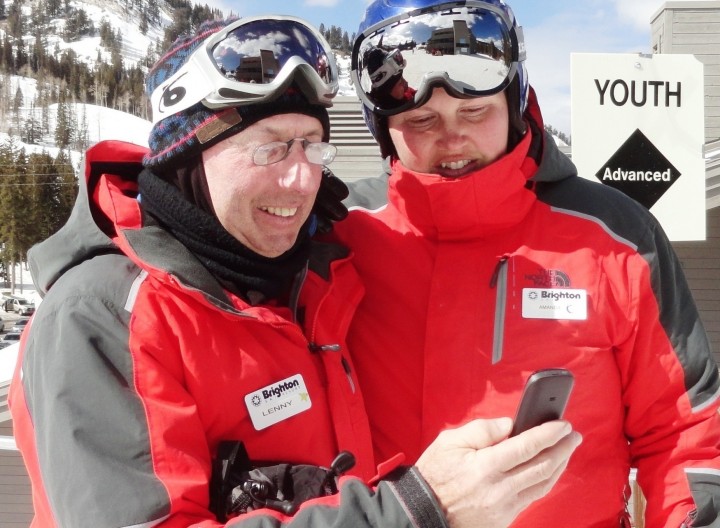
Brighton Resort ski instructors Lenny Bernstein and Amanda Cimini check the phone. Lenny is wearing ThinOptics. Credit: Harriet Wallis

Brighton Resort ski instructors Lenny Bernstein and Amanda Cimini check the phone. Lenny is wearing ThinOptics.
Credit: Harriet Wallis

ThinOptics readers solve the problem that has plagued seniors since Smartphones were invented. The phones are smart, but the info is too small to read. ThinOptics to the rescue. These tiny glasses perch comfortably on your nose then store away on your cell phone. No more fumbling for bulky reading glasses or passing glasses around.

After millions of dollars of research, these virtually indestructible readers were introduced last year, and they rocketed to popularity with seniors. Now they come in vivid frame colors as well as traditional black and clear. In addition. a new magnification level has been added.

Check our original review from October, 2014 here.

A Much Better Way To Boot-Up

Taking The Pull Out Of Pulling On Boots.

Every now and then I come across a product that makes a big difference in the comfort of older skiers. I’ll explain in a minute.

No more wrestling with boots. Ski Boot Horn makes a BIG difference. Credit: Ski Boot Horn

No more wrestling with boots. Ski Boot Horn makes a BIG difference.
Credit: Ski Boot Horn

I always boot-up in the parking lot. The difficulty of that process advances with age. Over the years, I’ve found that using boot warmers on the way to the mountain makes it easier to get boots on — especially on very cold days, when the shells are stiff and resistant. Because I find it easier to be seated, I carry a folding chair in the car.

Recently I learned about the Ski and Snowboard Boot Horn, and, WOW, does it make a difference! This specially-designed sheet of flexible and slippery plastic is placed in the boot and helps your foot slip into place. It is simple, effective, and costs less that $10, when purchased online.

In addition to letting your feet slip in easily, the boot horn helps avoid foot and ankle pain from earlier injuries, while putting on boots. It also protects hand and finger injury and discomfort that can occur in the frustration of trying to get boots on in very cold conditions.

The ski boot horn website features a few useful videos about ways to improve getting your boots on, including useful tips about boot liner care. For reasons I don’t understand, there’s even a video of a group of skiers dropping into Jackson Hole’s iconic Corbet’s Couloir. I checked that one off on a deep powder day almost 25 years ago.

I haven’t tried the boot horn with cowboy boots, fishing waders, skates, etc., but the makers claim it works well for them and for all types of shoes. I’ll try those as the seasons change, but for now, I treat my Ski and Snowboard Boot Horn like I treat my AMEX card. I don’t leave home without it.

Chic CP Visor Helmet Replaces Goggles

Hot-Looking Helmet Channels F-15 Pilot Look.

I’ve written previously about the Osbe Proton Senior, a clever helmet with an integral visor which replaces goggles, providing an effective solution to the problem of foggy eyeglasses. Swiss-based CP raises the bar with their Italian-made Camurai, which adds some significant tweaks to the pivoting visor concept.

 Both helmets feature a visor that allows a small, controlled airflow through the inside, which keeps your lenses from fogging. To achieve this flow, the Osbe’s visor does not actually seal against either your face or the helmet. Generally this works very well, but I have found
CP Camurai is a full visor helmet that eliminates googles and makes you look like an F-15 pilot. Credit: Mike Conley

CP Camurai full visor helmet gives you that Top Gun aura.
Credit: Mike Conley

that occasionally fine snow can find its way inside and collect atop the foam “air-dam”. On the other hand, when closed, the CP visor’s foam seal lightly contacts your face and a rubber strip seals against the helmet at the top. Three small vents at the bottom edge of the visor allow air to circulate inside, and this does the trick. After an entire season in varying conditions, I never had the slightest fogging, nor did the smallest snowflake find its way inside. At the end of a long day wearing the Osbe I’ve sometimes felt a bit dry-eyed, perhaps from circulating air, but I have not noticed this happening with the CP.

 Like Osbe, CP offers a range of UV-filtering visors which can be quickly changed, but the CP has no small loose parts to risk losing when you do so. CP will soon be offering a full-range, photochromic visor, which should be nice. They make an extensive line of sunglasses that translates to excellent visor quality. I’ve been using a mirrored yellow visor which is great in flat light. As I’ve done with the Osbe, I stick with that one visor and use my clip-on shades on bright days. Both helmets feature a retainer strap; so, you have to option of leaving the visor off and using goggles.

 The CP is more of a three-season helmet than the Osbe with removable leather-covered ear-pads and far more venting, including 12 slots in front and on top that can be opened or closed with a slider as needed. Another nice extra is a knob in back to fine-tune the fit. The inmolded CP has a higher, domed profile and features a thick Coolmax-covered liner. I prefer the look of the Camurai; I felt the Osbe had a certain “bowling ball” look which brought back painful childhood comparisons to Charlie Brown.

 Both helmets are priced similarly – around $300 – which is reasonable considering the cost of a helmet and goggles purchased separately. The Camurai is available in a pricier carbon-fiber version if your wallet needs slimming. Visit CP/Fashion/At/Sports website  to see the full range of choices.  For a US dealer, try contacting: CP SPORTS NORTH AMERICA365 Sinclair Rd, PO Box 5968, Snowmass Village CO 81615, Phone:+1 970 710 9633

All you need is an aircraft carrier to complete the ensemble.

Who Are You? The Ski Patrol Wants To Know

Carrying Identification Can Help The Ski Patrol Help You.

HIghly trained ski patrollers will be looking for your id. Credit: Deer Valley

Highly trained ski patrollers will be looking for your id.
Credit: Deer Valley

Accidents happen. And when they do, the ski patrol will likely be your savior. But the patrol needs your help. Here’s what you should have with you every time you ski or ride–just in case.

Carry identification. If you’re injured and can’t speak for yourself, the patrol will have to figure out who you are. Chris Erkkila, assistant ski patrol manager at Deer Valley resort in Utah, said: “We’re trained to look for ID and medical necklaces and bracelets.”

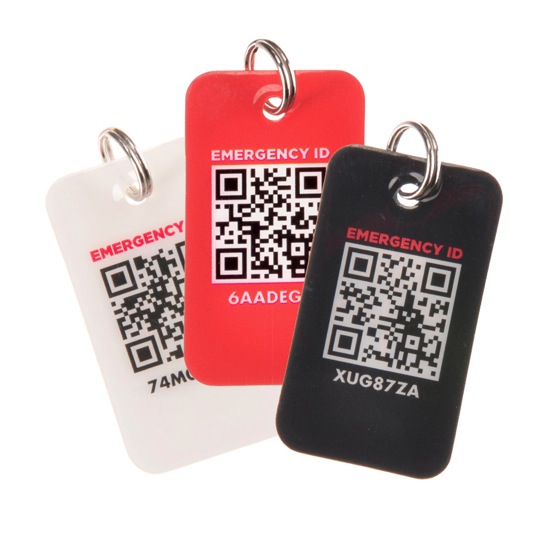
Emergency ID tags from Ecosperformance can be worn as bracelets, plastic tags or as stickers that can be applied to a helmet or even stuck on a phone.

EID Tags contain important profile information in case of emergency. Credit: Ecosperformance

EID Tags contain important profile information in case of emergency.
Credit: Ecosperformance

EIDs store identification, emergency contact and important medical information. When the QR code on the EID is scanned by a Ski Patroller’s smartphone, a skier’s Emergency Profile appears. A seven-digit EID number that can be entered into Ecosperformance website is a backup.

Other times patrollers have to be Sherlock Holmes to find even the most basic information about you—your name. They’ll look for a season pass that carries your name or look for your driver’s license. Sometimes they have to search your cell phone for information. “Often skiers don’t know each other very well, but a ski companion can tell us that the phone is in his injured friend’s right pocket,'” he said.

Carry a list of medications. “Seniors typically take more medications than others,” he said. Based on your condition, it might be vital for the patrol to know what prescriptions you’re taking. Same goes for allergies to medications

“Be sure to carry this information every time you go skiing,” Erkkila said. “Very basic things help us the most.”

And one more thing.

If you’re part of an accident, stay and identify yourself. And then there’s another aspect of accidents, he said. Sometimes there’s a collision between several skiers. Erkkila pointed out that the local city’s ordinance requires you to stay on the scene and identify yourself.  And, “We’re trying to educate the public about this,” he said. For those of us who are veteran skiers, staying on the scene after a collision seems to be common sense courtesy. But it’s also an official part of some resort areas’ regulations.

Seniors See Anywhere: ThinOptics Reading Glasses

Accessible reading glasses, even on a ski lift, make reading fine print do-able again.

You’ll love these reading glasses, because you’ll always have them with you. No more passing glasses around to read the trail map or the menu. You’ll have your very own glasses, and you’ll know exactly where they are—because their case is on your phone. Now that’s the coolest thing since sliced bread.

ThinOptics "cheaters" are handy wherever your phone goes. Credit: ThinOptics

ThinOptics “cheaters” are handy wherever your phone goes.
Credit: ThinOptics

Teddy Shalon, the inventor and CEO of ThinOptics, is a serial entrepreneur who spent many years innovating in the Life Sciences. He’s constantly looking for ways to help people enjoy healthy and active lifestyles.

The “ThinOptics moment” happened on a bike ride with his friend. When they stopped for a break, his friend handed Teddy his iPhone and asked him to read a text message from his son. “Is there something wrong with your son?” Teddy asked.

“No, I just don’t have my reading glasses, and I can’t read the message,” his friend said. That’s when Teddy realized that phones are useless if people don’t have their reading glasses. On the ride back, the idea of ThinOptics was born—glasses that are always with you, right there on your phone.

Here are some of the nitty-gritty details. ThinOptics are powerful, durable and fit virtually every nose. They’re made from thermo-injection molded

ThinOptics super-convenient reading glasses can be stowed with your phone! Credit: ThinOptics

ThinOptics super-convenient reading glasses can be stowed with your phone!
Credit: ThinOptics

optical grade Poly-Carbonate which is shatter-proof and often used in safety and ballistic eyewear. The lenses are made by one of the largest and most advanced optical lens manufacturers in the world. The bridge is made of Nitinol—an alloy of nickel and titanium— which is 10x more elastic than spring steel, and it’s encased in medical grade silicon tubing and anchored in an injection molded Poly-Carbonate frame. ThinOptics readers come in three optic strengths from +1.00 to +3.00 and case sizes that will fit on your phone.

The bottom line: You get all this technology and convenience for under $40. Click for details on ordering. And there’s a great referral program, too.

Still not convinced? Check out ThinOptics’ torture test on this video.


Toast Your Booties: Two Ways To Keep Feet Comfy On Cold Days

No more wrestling with cold, stiff boots on a crowded ski lodge bench.

A few years ago, I indulged in my version of the middle-aged cliche: Instead of a red sports car, I snagged some very nice new skis and a serious pair of custom-fit boots. All was glorious but for one problem—the boots were 120’s, so stiff that by the time I forced my feet into

Plug your boot bag in for pre-ski warm-ups.  Ahhhh. Credit: HotGear

Plug your boot bag in for pre-ski warm-ups. Ahhhh.
Credit: HotGear

them in the ski lodge, I was exhausted, bathed in sweat and ready for a break. To the rescue came the Hot Gear Bag, a thoughtfully-designed, electrically-heated boot bag. Plug it into the condo wall or your car for the ride to the mountain, toast your booties, and you can ease into a deliciously warm and pliable pair of boots. If you have trouble with your back or hands, you will greatly appreciate how rigid ski boots become like slippers and easier to buckle, too. Depending on your boots and the weather, your feet stay warm and comfy for a few hours.

Pair the heated boot bag with  Boot Gloves ($29.95) from DryGuy to retain the heat, and you have a comprehensive warm-foot strategy. The Boot Glove is, well, a

Boot gloves can make a difference on cold, cold days. Credit: DryGuy

Boot gloves can make a difference on cold, cold days.
Credit: DryGuy

neoprene glove for your boot. For more on boot gloves, click here.

Heating feature aside, Hot Gear has a great bag, well-designed and sturdy. Zippered or mesh pockets are everywhere! Carry it with the grab handle or the removable, padded shoulder strap, stowable in a zip side pocket. The other side pocket opens to reveal fleece-lined sleeves for goggles and spare lenses. Another zipper on the back reveals backpack straps for a balanced carry and also an integral cable and lock for security. A bungeed helmet carrier on top zips flat when not needed, and a padded plastic foot pad can be deployed from the underside to provide a clean place to stand.  Now, that’s a clever addition. The connection cords for house or car outlets hide behind their own zippers in front. Sturdy rubber feet protect the bottom of the bag.

The large main compartment is surrounded with an electric heating pad. Select one of three settings, and your boots, gloves and anything else you can fit in are nicely warmed and softened, or, at the end of the day thoroughly dried out. Velcro-ed in place, the heating pad is easily removed for replacement, if necessary. Velcro-tabbed compartments hold extra socks, neck gaiters or base layers, and there’s a generous mesh pocket for all those small doodads. I keep an old hand towel at the bottom of my bag to soak up melting slush at the end of the day. When traveling, besides my boots, I can put my helmet, gloves, and several pairs of socks in the bag, and it fits nicely in the overhead bin on a plane.

There's a variety of heated boot bag models from Hot Gear. Credit: Hot Gear

There’s a variety of heated boot bag models from Hot Gear.
Credit: Hot Gear

I own the Classic 110-volt model ($179). Other models include the somewhat larger Pro ($199), a double-size for two pairs of boots ($249), the smaller Ajax ($149) and the Classic Trolley ($239) with wheels and a telescoping handle, variously available in 110- and 220-volt versions.

I’ve used mine for several years now and consider it an essential piece of equipment. I love the heating feature and am currently working on a recipe for Boot Bag Baked Brownies.

To find a retailers near you, click here.  Not near you?  Click here to buy direct.