Now Available: List of Best 2019 Skis For Seniors

We just published the list of 2019 skis identified as the best for older skiers.

The 61 selected skis generally have a softer flex, which helps them engage snow with minimal exertion, allowing older skiers to turn more easily and to ski longer without tiring. Twenty-one women’s models are included.

The skis were selected during the annual national ski evaluation process organized by the renowned ski review site, Realskiers.com.

The recommended skis are grouped into six categories, each based on the ski’s width, which helps determine the terrain where its performance is optimized.

If you’re considering a purchase, we recommend first identifying the most suitable category, then skiing the selections using a demo program. This may be accomplished by working with a quality ski shop.

The categories and their characteristics follow:

  • Frontside (aka “Carving” skis)encompass the broadest range of skier abilities from entry-level to experienced. They are for use on groomed terrain. Wider models are usable off-trail.
  • All-Mountain East are versatile skis that work equally well in on-trail and off-trail conditions. This category is suitable for those who have not skied in a few years.
  • All-Mountain West are good for use in the West by high performance skiers. They are adapted for off-trail use but can be skied on-trail by skilled skiers.
  • Big Mountainare essentially more maneuverable powder skis. They are inadvisable for regular on-trail use.
  • Powder are specialty skis for use in deep powder only.
  • Technical skishave high performance race ski characteristics and are suitable for caving turns on hard-snow.

To access the list click here.

Realskiers.com is a first rate site for any skier interested in learning about equipment and being exposed to the expert perspectives of it’s publisher, Jackson Hogen. SeniorsSkiing.com subscribers can subscribe to Realskiers.com for $9.95, half of it’s normal rate. As a subscriber, you also have direct access to Jackson and his points of view about what equipment might be best for your needs. It’s a fantastic deal. To sign up, visit Realskiers.com. Scroll down to/click on “Subscribe Today!” Then click “Sign Up” in the “Annual Membership” box. Complete the form and enter SS18 in the field under “Coupon Code.”

Two Reasonably Priced Gifts That Solve Getting Ski Boots Off and On

Other than warmth and comfort, the two big boot issues as we age are getting them on in the morning and off at the end of the day. If your home is slopeside, it may not be so much of a problem, but for those of us who boot up or off in lodge or lot, it can be a struggle.

Here are two reasonably-priced products that solve those boot problems. If you’re looking for a different kind of gift for older skiers on your list, both will last longer and be far more appreciated than a tie, a mug, or a fifth.

Several years ago, I learned about DeBooter, the ski boot jack that helps remove boots fast and smoothly. It is a must-have device for every older skier who has struggled with end-of-day boot removal. DeBooter is an advertiser and gives SeniorsSkiing.com readers a 20% discount off the list price of $39.95. I carry one in my car and loan it generously to appreciative neighbors in the parking lot. A few friends tell me that their grandkids love to take their boots off using DeBooter.

More recently, I came across The Bootster, a well-designed compact device that simplifies getting into your ski boots. It incorporates a piece of slick material that allows the heel to slide easily into the boot. I’ve tried it with cold boots, and my foot slipped in with virtually no effort — a far cry from the discomfort of corkscrewing foot and ankle into that stiff chamber. I generally keep my boots on at lunch, but many older skiers prefer to remove theirs. Among the benefits of The Bootster is how well it fits in parka pocket, so it can be used as needed. The Bootster recently started to advertise. It costs $25.00.

In Your Quiver

Do You Know What Underfoot Measurement Is Best For Your Kind Of Skiing?

Pat’s ski collection from narrow to wide underfoot dimensions. Credit: Pat McCloskey

One of the hardest questions a seasoned skier has to answer is when someone new to skiing or maybe even a friend says, “So what kind of ski should I be on this year?”  Really a tough question to answer without delving into particulars like, athleticism, age, what kind of snow, what trails do you like, front side, back side?  There are so many choices today based on so many factors.  So let me try to make this as simple as possible for the new skier as well as the veteran.

Most of us veterans are using skis that are significantly shorter than the ones we used to use.  In the old days, skis anywhere from a 185 cm to 210 cm in length were used with little or no side cut resulting in significant vertical and rotational movement to execute a turn.  Today, the skis are much shorter, generally ranging from 152 to 185 cm.  The shape of the skis make it easier to turn—wider at the tip and tail and narrower under foot— which, when placed on edge and pressure is applied, results in an effortless turn.   We don’t have to work those 200 plus cm skis like the old days.  But what about the nuances of width under foot?  Where you want to ski and what kind of snow conditions will determine what width underfoot measurement is good. And that’s measured in millimeters and not centimeters like ski length.

Typically a front side ski to be used on groomers or hard pack will range under 85 mm width under foot, in most cases. Race skis have a slimmer profile but for the most part, anything under 85 mm is considered a “front side” ski and encourages a carved turn on groomed or hard pack snow.  There is a lot of interest these days in these profiles because of the lack of early and late snow due to global warming.  Snowmaking is essential, and when these man-made, groomed, hard pack conditions exist, a frontside ski is optimal.

Conversely, anything over 88 mm under foot  is moving into the all mountain range and can be used for most terrain.  Also, 95 mm and above are a must to include in your quiver if you ski out west and have varying conditions.  When you get over 100 mm, you are getting into the powder or loose snow area. Typically, 107mm and up is considered “big mountain” or powder skis.  These skis can perform on groomed snow but the float is optimal for loose snow or powder in the wider under foot measurements.

But what about rocker, early rise, etc?  We all have seen the guy who has rockered skis (tips and tails with an upturn) making turns on hard pack with minimal contact with the snow underfoot.  We don’t want to be that guy.  Wrong tool for the wrong conditions.  Rockers are used to facilitate the float needed to ski powder or loose snow.  You need surface area to ride the groomers, and rockers are not optimal.  However, the early rise tips can facilitate a turn in powder as well as make entry into a groomed turn better.  Personally, I see the advantage of an early rise ski for most skiing conditions.  Early rise referring to a slight upturn to the tip of the ski.

So, it probably makes sense for most skiers to have a quiver of skis for different conditions.  A new skier should really think about what conditions he or she will ski and get one pair based on those conditions.  A good ski shop can help in the selection. Veterans should have that front side ski, an all-mountain ski, and a loose snow or powder ski.  I have a pair of 107 under foot for loose or powder, but my 88 mm skis under foot are ideal in a lot of conditions. I personally think that measurement (88mm) is the optimal one for most conditions.

Be honest with yourself when you are selecting skis.  Think about your physical condition, where you like to ski, and the snow conditions that are optimal for you.  Skiing should be fun and not be like  work. The new equipment makes that happen if you are careful to select the right tools for the quiver.

Breaking News: Rottefella Introduces the Move Switch for Enhanced XC Ski Performance

New, Adjustable  XC Binding Concept Hits The Trails.

Rottefella Move Switch allows for adjustable weight distribution. Credit: Rottefells

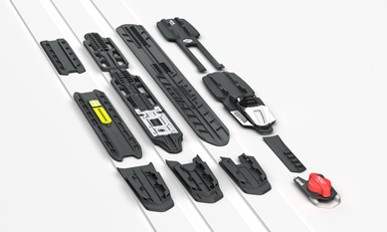
The Rottefella company has created the binding solution for waxless and skin cross country skis. The Move Switch is a dial on the front of the binding that will allow skiers to slide the binding forward or backwards without releasing the ski from the boots. That’s right, while you are on the ski trail, you can just bend over and turn the switch for the binding to slide and adjust to the desired weight distribution on each of the skis.

The intention of the Move Switch is for quick adjustment and better performance on flat or hilly terrain for recreational skiers who use waxless skis and particularly the quiet skin skis that have a mohair-type strip embedded in the ski base. If you want to glide better on a slow snow day on the flat trail, then stop and slide the bindings backwards to distribute your weight on the ski to provide more glide. If you need more grip to go up a hill, then slide the bindings forward to attain an enhanced grip to prevent slipping backwards on the snow.

Rottefella has created a moveable binding system that will be available for and can adapt to work with major existing ski plate systems at the other binding manufacturers including Rottefella NIS, Fischer, Rossignol, Salomon, and Atomic. There is also a binding, Rottefella Classic or Skate Quicklock plate that is moveable when skis are removed for those not expecting to move the bindings while skiing.

The Move Switch will make it easier to adjust the ski bindings as necessary correlating to the snow conditions or terrain. In the olden days, such changing required applying different waxes but with the new products, those days should be in the past for recreational cross country skiers. Using waxless skis eliminated the need for waxing the bases, but they worked differently in varying conditions or terrain – some grip well but are slow on the flats, while others glided well but did not hold when going up a hill. The retail price for a system or plate package will run between $69.99 and $149. Currently, the skin waxless skis may comprise about 25 percent of the new XC ski market as skiers are opting for the quiet base that provides good grip and glide in various ski conditions.

Spike Clayton at Skirack, a retail outlet in Burlington, VT, commented that he’s impressed that a Nordic company came out with a product that can be used universally on any ski brand for the ever expanding skin ski market.  “The product will give our customer a true choice to improve the performance of the skis easily.  The great thing about The Move system is it simple and effective for the skier to use.”

Rottefella Move Switch adapts to many brands of bindings. Credit: Rottefella

Short Swings!

My wife and I have a long-running gag. She’ll say, “Life is short,” to which I’ll respond, “So are you.”

Life IS short.  A brief opinion piece last week in The New York Times makes the point that we should squeeze as much out of our time as possible. The author writes: “…the appreciation of our own lives has much to do with the ever-increasing awareness of its relative brevity. It is this — an awareness and acceptance of our own mortality — that makes us human. And it is the impetus, I’d argue, for living our lives to the fullest.”

Those of us pursuing our passions live life to the fullest. Skiing is my passion and has been since I got the bug 65 years ago. As I’ll explain this week when presenting at the annual meeting of the National Ski Council Federation—the organizing body of ski club councils—older skiers are able to stay with their passion, in part, because of modern technology. Ski and boot technology make it easier to do more with good technique and less effort. Snow-making, grooming, and lift technology improve the process of getting up and down mountains. Medical advances—replacement joints included—give many of us the opportunity to continue to play in the snow.

Last season, I experienced a drop in stamina. I’m working at turning that around. I take a daily brisk 3-mile walk, half of it up a steady incline. I’m into a gym routine, guided by Dominick Juliano, my 85-year-old friend who in 1953 won the professional Mr. America competition. Around the same time, he appeared on stage as part of Mae West’s show in Vegas . For all his years and in the face of many challenges, Dominick has retained his good health, great physique, and his remarkably positive outlook. For seven years, he and wife, Carol, sailed with Carol’s then young son from the West Coast, through the Panama Canal, across the Caribbean and the Atlantic and around the Mediterranean. They met as croupiers in Vegas. His tells his story in The Essence of Being(Balboa Press, 2015).

At the end of next month we’ll return to our normal publishing schedule.

Helmet Tech: Worth the Cost

Helmet-wearing skiers/boarders have fewer head and other injuries according to a paper published in the June issue of Wilderness & Environmental Medicine. The research found that helmets protect more against cuts and bruises than concussions and that those wearing helmets are less likely to be injured. The authors mention three helmet technologies with brain-protecting technologies. They are D3O, MIPS, and EPS 4D. We at SeniorsSkiing.com believe the additional cost for a helmet with one of these technologies is worthwhile.

Rent Vermont’s Pico Peak for the Day

Pico Peak is available for private rental Tuesdays and Wednesdays January 8 – April 4. The cost is $6,500 for up to 250 guests. Food and beverage services are available for an additional fee. In recent years, other areas, including Utah’s remote Eagle Point, have introduced similar offers. If interested, contact groups@picomountain.com.

New York’s Hunter Mountain Expands

Hunter Mountain is investing $9 million to increase its skiable acreage by 25%. The expansion includes five new trails separated by four large glades. The areas will be accessed by a new high-speed six person chair. The upgrade includes an entrance, parking lots and lodge for Hunter North.

Deer Valley, Squaw Get New Management

  • Deer Valley‘s long time president and COO, Bob Wheaton, is stepping down following 38 years at the resort. He’ll take on an advisory role at Alterra Mountain Company, which recently acquired the resort. His replacement is Todd Shallan, a seasoned resort, hospitality and recreation executive. One of his earlier positions was Director of Asset Management for KSL Capital Partners, one of Alterra’s organizing entities.
  • Ron Cohen is the new President and Chief Operating Officer of Squaw Valley Alpine Meadows, another Alterra-owned resort. Cohen has been interim President & COO since April. An attorney, Cohen previously was Chief Administrative Officer and General Counsel of Mammoth Mountain.

Clever Device to Save Your Phone

Recently stumbled across this superb and inexpensive product. The Gear Beast  is a smartphone lanyard with a pocket for cash and/or cards. Worn around the neck, it prevents losing or dropping your phone. Gear Beast fits all size phones and retails for $9.99 direct from the company or from Amazon, Walmart, BestBuy and other online sources.

Fat Bikes Are A Boon For Senior Cyclists

New Technology In Mountain Bikes Can Keep Seniors On The Trails.

Here’s a Fat Tire bike; carbon frame has room for wider tires. Credit: Pat McCloskey

Remember when you first bought your first pair of “shaped” skis?  I do.  I jumped on them to take advantage of an easier turn and less work.  Fast forward, I have a nice quiver of skis now with some 107s under foot for powder, loose snow, and crud.  Just point and shoot with total confidence.  Equipment keeps senior skiers in the game.

Same thing with mountain biking.  For several years now, the rage has been “fat” bikes and plus size tires with lower pressures for traction and control. Recently, while watching some friends maneuver very easily over tombstone like rocks and greasy roots here in the East, I marveled at the control that the plus tires and full suspension give the rider.

For those of you who are not familiar with the plus tire revolution, the description of plus refers to any tire width that is basically 2.6 inches and wider in diameter.  Most mountain bike tires have traditionally been in the 1.95-2.3 inch diameter range.  But in recent years, the technological advances in mountain biking have developed carbon frames which are compatible with wider .35 mm rims that accept a wider width tire.  With lower tire pressures around the 12-psi to 15-psi range, the plus technology allows the rider to have a more plush ride with suspension that grips gnarly terrain like glue. For the senior rider who wants a challenge but wants to maneuver safely through rocky, rooty, terrain, the plus bikes are just like our wider width skis—just point and shoot.

Knobby Fatties grip any kind of trail and make the going smoother. Credit: Pat McCloskey.

While riding behind one of the best riders I know who happens to be in his late sixties, I noticed that he didn’t even pick his lines anymore on a technical trail.  He just points the 3-inch tire and rolls over everything.  So, I recently purchased a 29er plus, full suspension bike from Salsa and VOILA, I do the same.  I feel much more confident with the plus technology.  A definite “plus” for a senior rider who still wants the challenge.

Many of the current generation of the plus bikes now (either 27.5 or 29ers) come equipped with the SRAAM Eagle components.  Simply put, they have a wide range of gearing with a 50 tooth cog in the back that allows for easy climbing of virtually anything that is thrown at you on the trails.  Even though the plus 29ers, for instance, are a little heavier than the standard carbon full suspension bikes, the Eagle gearing makes it easier for a senior rider to maneuver the plus bikes up a steep, rock strewn trail.  Personally, I love the “old man” gear and even though my local bike shop employees say I don’t need it, I definitely want it, and I use it.  I will take every advantage I can—on the slopes or on the trails.

So, take a look at plus technology.  Those 3-inch width tires may be a little excessive for your local trails and you may want to scale back to 2.67 or 2.8, but the lower pressures, enabled by wider profile rims, make life a lot easier and more enjoyable on the trails for a senior rider.  Modern equipment keeps you in the game, folks.  Take advantage of it.

Here’s the big 50-tooth inside “old man” gear that provides mega leverage. Credit: Pat McCloskey


Down Care

How To Wash Your Down Jacket At Home

Season’s Over; Isn’t It About Time You Get That Puffy Back To Clean?

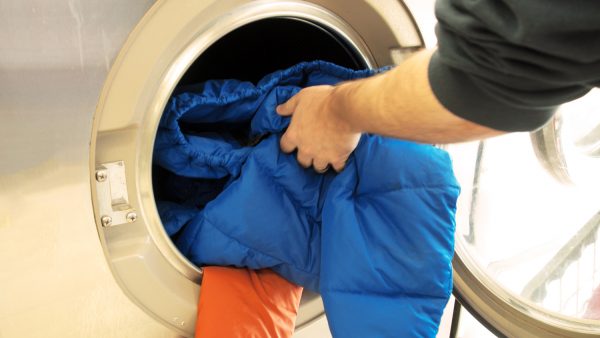
Front loader needed for washing down. Credit: REI

Not only are your season-dirty down jackets, vests, and even sleeping bag dirty and smelly, if you left them that way, they would lose their heat-insulating properties. It is easy to destroy your down gear if you don’t follow some basic rules when washing them at home. It’s not difficult, but it does take some time and know-how.

You will need:

  •  a front load washing machine and a dryer (Top load machines are not recommended.)
  • a bucket
  • special down liquid detergent
  • three-four new tennis balls or reusable drying balls
  • a new sponge (for washing dishes)
  • a clean toothbrush (or something similar)
  • three hours of free time.

10 How To Steps

  1. Purchase a liquid detergent specially designed for down.  Try either Granger’s or Nikwax. You will need about a cap (50 ml) for a jacket.
  2. Inspect the jacket and find especially dirty spots. A bright light really helps. Close all pockets, velcro, and zippers. Turn your jacket inside out.
  3. Soak your jacket in cold water in a clean bucket. Drip a bit of detergent on a sponge and create some foam. Apply foam on wet, dirty areas. Let foam to penetrate the fabric for five to 10 minutes. Brush the really dirty areas with toothbrush. Let it soak for 20 more minutes.
  4. Pull out the detergent dispensing tray of your washing machine, clean it thoroughly. Even a small amount of a wrong detergent or a softener can negatively affect the condition of the down.
  5. Tennis Balls or Dryer Balls are needed to keep the fluff up. Credit: REI

    Take the bucket right next to the washer and gently dump your jacket inside the washer. Add three-four new tennis balls or reusable drying balls. Hint: no balls, no worries. Roll balls out of your heavy cotton socks, wet them, and throw into the washer.

  6. Fill one cap of the detergent, (or the recommended amount in the instructions), into the receiver for the liquid medium. All washers are different, so ideally you need the lowest temperature, the slowest speed, and the longest time —one hour or more. Press the button and…take a break: have a cup of coffee or mow the lawn.
  7. After the machine stops, look at the contaminated zones. Again, a bright light is your friend.  If you still see dirt, repeat step three to five. Check again.
  8. Now, On to your dryer. Set the lowest temperature, the lowest speed, and the longest time . One and a half hours or more would be fine. Click the button and…take another break.

Pull out your clean, dry jacket and hang it on a wide hanger. Regardless of the price and the country of origin (China, Canada, Hungary) of a jacket, feathers may come out.  It is just a question of when. This is a natural process, don’t be surprised if it happens to you. Do not pull out the protruding feather because you will create a larger hole in the fabric and way more feathers will follow. Try to push the feather back inside.

9. Almost all down jackets are only water-repellent and not water-resistant (unless they have membrane fabric like Gore-tex). A few percent of all down jackets do not even have water repellent properties. Those are designed to be a mid layer, which goes under a water resistant shell jacket. All the rest have a water-repellent coating. A smart user should restore this coating after washing, otherwise the fabric will absorb and even let moisture go through in case of rain or wet snow. And water is bad for down. Use a product for water-repellent restoration, typically in a spray. Again Granger’s and Nikwax are very reliable. Apply it according to the instructions. Let it dry.

10. Done! It is time to use your downy friend.

Nixwax and Grangers are specially formulated for Down. Credit: Mountain Equipment Coop


APEX Ski Boot System: Rethinking Ski Boot Design

History Suggests That Designing A New Boot Is A Multi-Million Dollar Gamble.

Just the molds for a plastic shell boot cost a million dollars, and that doesn’t include engineering costs and other expenses. Then there is the need to make it profitable when annual manufacturing runs are in the thousands, not hundreds of thousands or millions.

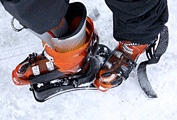
APEX Ski Boot combines a removable Open Chassis with a walkable boot.

These and other factors make starting with a clean sheet a risky proposition unless the new boot idea doesn’t require huge investment in molds and boot making equipment. When Apex began designing its new boot, it had two goals: 1) optimize the boot for the modern shaped ski; 2) minimize the investment needed to bring the boot to market.

According to Roger Neiley, Co-Founder and VP of Product for Apex, the company created a chassis optimized for lateral stiffness. When buckled, it provides enough forward resistance (stiffness) to help control the tips of the ski. Laterally (edge to edge), the material is much stiffer than conventional boots.

Apex’s second innovation is a separate inner ‘walking boot’ designed to fit snugly into the chassis. The advantage is that the wearer can unbuckle the walking boot from the chassis while it is still in the binding. The bottom of the walking boot has a Vibram sole that allows sure-footed walking. As a senior skier, think about how much easier it will be to walk up and down the stairs to the restroom that is inevitably on a different floor!

From a manufacturing standpoint, Apex has three advantages. First, it can easily upgrade or redesign the walking boot. Second, the chassis can be modified separately from the walking boot. Third, only one element (a structural ‘bridge’) has to be molded in each size.

Net net, the chassis and the walking boot are two different designs that become integrated when the boot is in the chassis and the buckles tightened.

I haven’t skied the Apex boot, but from reading reviews, those who like the premium priced boot, like it a lot. If you want to know more about the Apex Ski Boot, visit the company website – www.apexskiboots.com. You’ll find that  the boot is widely available at ski shops around the country.

APEX SKI BOOT SYSTEM DEMO CENTERS


Better yet, if you’re near one of the company’s fourteen demo centers stop in and tell them you’re a SeniorsSkiing.com subscriber. They’ll waive the $25 per day demo fee. For a list of demo centers, click on this link https://www.apexskiboots.com/where-to-try-buy/demo-centers.

brief history

A Brief History of Why There Aren’t More Innovative Ski Boots

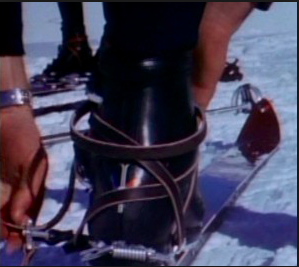
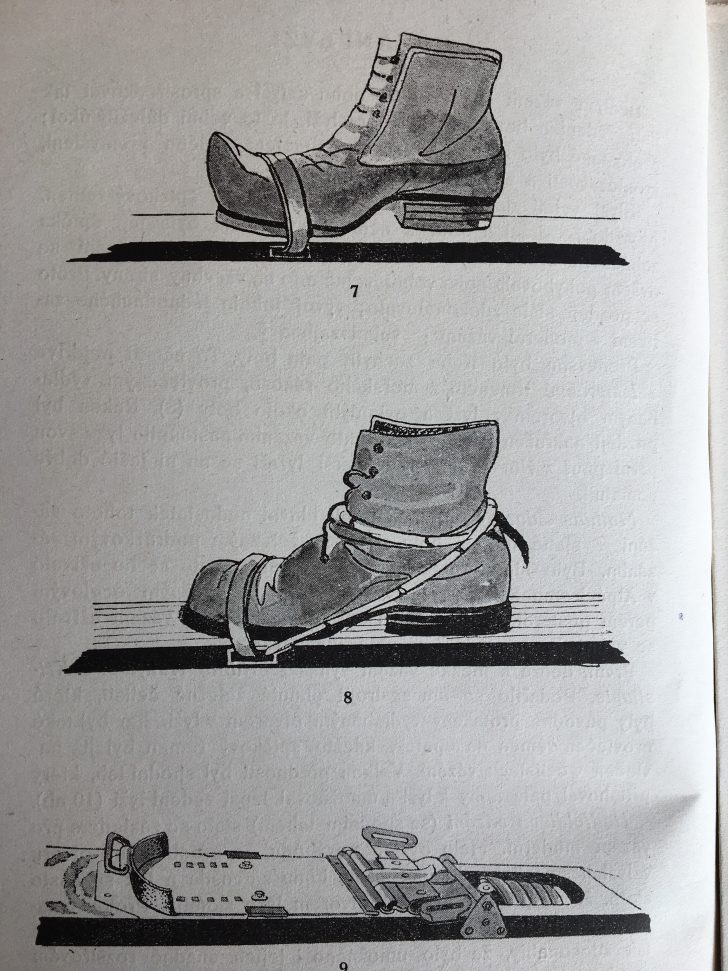
As a SeniorsSkiing.com reader, you may remember how much plastic inserts increased the lateral stiffness of your boots. Back in those days, if you were really cool, your boots were further stiffened when wrapped with a six-foot long thong.

Photo: Dick Barrymore

Then the plastic boot shell arrived, along with innovative designs from Rosemount, Scott and Hanson.

Hanson

Rosemount

Scott


The plastic boot made long skis easier to control and turn but hasn’t evolved much over the past fifty years. Liners made from foam, air, cork and other materials, coupled with adjustments for cant and forward lean, made them more comfortable. Standardized soles improved binding function.

What has changed the sport are shaped skis. They are lighter, easier to turn, and just as, if not more stable, than the 200+ centimeter skis of yesteryear.

The molded plastic boot was designed to optimize the amount of leverage a skier could apply to a long ski. Initiating a turn required unweighting the ski, rolling the knees and pressing forward to pressure the ski tips. A job for a stiff boot.

To turn a shaped ski, the skier rolls his knees back and forth across the fall line. The technique requires less forward pressure because of the skis’ greater side cut.


Back to boot design.

Most, if not all the boots on the market today are based on designs so old they’d qualify for a subscribsciption to SeniorsSkiing.com. Each boot size requires a separate mold and most boots come in nine sizes making a set of molds a million dollar investment. With manufacturing runs in the thousands, the amount the maker can recoup per boot is limited. ROI is one holdback to new boot design.

The second is flex. In the mid-70s, when I was running the ski equipment test programs for SKI Magazine, we thought measuring boot flex patterns and creating an objective way to measure ski boot performance would be relatively simple. It wasn’t.

Boot flex is determined by the:

  1. Mold design;
  2. Material from which the boot is made;
  3. Air temperature;
  4. Tightness of buckles;
  5. Fit;
  6. Foot volume; and
  7. Co-efficient of friction between the skier’s socks and the liner!

In an attempt to fill the “metrics void,” boot makers created flex indexes and measurements. Each boot maker has its own formula, so comparing one index to another is an apples-oranges affair. The only real way to test/compare ski boots is to ski on them. Even then, “normalizing” the test is difficult because each skier:

  1. Has a different foot;
  2. Doesn’t weigh the same;
  3. Skis differently;
  4. Has different leg strengths;
  5. Buckles them differently; and
  6. On and on, ad infinitum.

So now you know why new boot designs are few and far between.

Next week: How Apex is Rethinking Ski Boot Design

Lovin’ Snowshoes

‘Shoes Have Come A Long Way.  Have You Looked Lately?

Old: Good for decorating rustic cabins.

Back in 1971, when I transferred winter affections from downhill to Nordic skiing (due to a spectacular fall in Austria that racked up one knee and stripped off my ski suit—but that’s another story), I also tried snowshoeing. After all, cross-country skis and snowshoes were both made of wood and quite beautiful; they’re both ways to travel over snow rather than wade through it; they’re both very low-impact sports.

But cross-country evolved into my lifelong true love, while snowshoeing became merely the affably boring cousin you contact every few years. Too much work; bindings were crappy (now you’re in, now you’re not—and your fingers are gonna freeze putting the damn things back on); ‘shoes didn’t slide like skis, except sideways downhill on crust; wood frames cracked; rodents enjoyed chewing the rawhide webbing in summer storage.

Modern snowshoes confirm the theory of evolution. They’re clearly descendants of the woodies but virtually a new species in design, materials, flotation, and fun.

I found this out one January about a dozen years ago, laying out ski trails at a resort in Montana. (Sadly, I hadn’t visited that cousin in almost 30 years.) The snow was too deep, buried underbrush and deadfall too catchy to use Nordic skis. So since slogging through waist-deep powder on foot was out of the question, what to do? Happily, intuition had suggested bring my new aluminum snowshoes along to test the frozen waters. They behaved magnificently, though I dumped a couple of times trying to back up, sinking the tails of the ‘shoes. (My style of absorbing knowledge always seems to be “education through error.”)

Modern: Light, durable, inexpensive. Credit: Tubbs

So what’s new about this next generation (or two – more on that shortly) of snowshoes? It may seem minor at first, but bindings have improved incredibly; they’re easy to use, they stay on, and they don’t stretch. The ‘shoes themselves are durable and have no food value to rodents, since they’re generally made with aluminum frames and synthetic decking that’s durable and gives great flotation.  That combination is light weight, so there’s less effort. The addition of bottom cleats gives you much better grip on crust and even side-hills, though it’s still smart to avoid those when possible.

What else? Modern models definitely aren’t as pretty, but it’s a trade off of aesthetics for dependability, longevity, and convenience.

Snowshoes are nowhere near as pricey as Alpine or even Nordic gear, but it’s still smart to rent before you buy to see if you like the sport. You can use hiking or snow boots with today’s adjustable bindings, or even sneakers with neoprene booties.

There’s a new kind of ‘shoe that came on the market this fall ago from Crescent Moon Snowshoes, a Colorado company. They’re made of foam (!) but from my destructive testing are not just light but also sturdy, incredibly maneuverable.  I backed up in them, did a 180 degree jump-turn for no good reason.  They have great binding and are setting the snowshoe industry on its butt.

There are a thousand more subtleties to fun snowshoeing—using poles, running vs. walking, clothing, etiquette, and the like. They’re mostly unimportant. Snowshoeing has become easy, and easy on your bones and joints. And even if you don’t glide, just repeat too yourself, “600+ calories per hour!”, enjoy the burn, and head for the dessert tray.

Most Modern: Foam ‘shoes from Crescent Moon.

Ski Mojo

Short Swings!

The Excuse I Hear Most Often From Seniors Who Stopped Skiing Is That Their Knees Are Bad.

I can emphasize. At 74, I feel the occasional twinge forecasting a time when something medical is in my future. I know I’m not alone.

Which brings me to the Ski-mojo ad on the SeniorsSkiing.com homepage. It’s a British product for skiers with weak or bad knees. It also works for skiers without knee problems (I’ve been told there are some), by giving a power boost that helps them ski stronger and longer.

Full disclosure: I have not tried Ski-mojo, but I have spoken with skiers who have. They rave about it. Last year, I watched a skier get fitted for the device. It’s light and slim, and it fits easily underneath ski pants. Once on, the skier flicks a switch to activate or deactivate the springs.

In the US, Ski-mojo is endorsed by PSIA. In the UK it’s endorsed by BASI (British Association of Snowsports Instructors). The product can be ordered at www.skimojo.com and shipped virtually anywhere.

I prefer to be proactive about being able to continue to participate in the sport I love. If the twinge in my knees worsens, I’ll be ordering Ski-mojo. I want to stay in the game as long as I can.

January is Learn to Ski and Snowboard Month

Almost 70 U.S. areas are offering great deals on beginner packages for new skiers and boarders. Packages typically include lesson, lift ticket and rental gear. Depending on location, deals range from a single lesson to up to four. To learn about offerings in your area visit the Ski and Snowboard Month website.

California

Squaw Valley Alpine Meadows is now an Official Training Site of the U.S. Ski & Snowboard Team. Other sites are Mammoth Mountain, Deer Valley, Copper Mountain, and Timberline Lodge. Official Training Sites host U.S. team athletes for elite training sessions.

Quebec

Stoneham Mountain Resort dedicated its new Éclipse quad on December 23. The fixed grip quad replaces a double chair and T-Bar. Skiers use a conveyor belt to load the new lift. It has a capacity of 1900 skiers per hour and takes 8 1/2 minutes to reach the top.

Utah

Deer Valley hosts the world’s best aerial and mogul skiers during the 2018 Visa Freestyle International FIS World Cup, Wednesday, January 10 through Friday, January 12. DV has played host to international and world competitions for 20 consecutive years, including the 2002 Winter Olympic Games, two World Championships and 16 World Cups. If you’re in the vicinity, this is one exciting event to behold!

Powder Mountain Resort opened for the season on December 24. The resort has 8,464 acres. Powder now limits day pass sales to 1500.

Snowbasin opened its new Wildcat Express high-speed six-pack. It replaces a triple. The name “Wildcat” has been used for Snowbasin lifts serving the same part of the mountain since 1946, when it started as a single chair.

Soldier Hollow has Biathlon training for groups. Professional staff does the training and participants engage in a mini competition at the 2002 Olympic Range. Reservations required.

Solitude BrewSki Mountain Lager is a new German-style Pilsner created for Solitude Mountain Resort by Utah-based Bohemian Brewery.

Vermont

Vermont has 20 alpine resorts and 30 cross country centers. Ski Vermont is promoting an End-to-End Tour this season. Participants who visit different resorts each week and submit photos will be eligible to win tickets and prizes.

Molly Mahar is the new President of non-profit Vermont Ski Areas Association. She joins from Loon Mountain Resort where she was VP Marketing/Sales. Previously she held similar positions at Sugarbush and Bolton Valley.

Other

Black Diamond has a new short promotional video about backcountry skiing. Even if you stay in or around the resort, it’s well worth watching.

Liftopia announced its 2017-18 Best in Snow Awards. The results will surprise some. For all winners and how they were selected visit https://bestinsnow.liftopia.com/ – /

The Mountain Collective pass is back on sale for $519. With it you get 32 days at 16 iconic resorts. For more visit https://mountaincollective.com

Ski West Yellowstone

Cross Country Apparel: Recommendations From An Expert

Guidelines For What To Choose And Why.

[Editor Note: Thanks to Roger Lohr, publisher of XCSkiResorts.com, for this review of the latest in XC skiwear that was printed first on that site.]

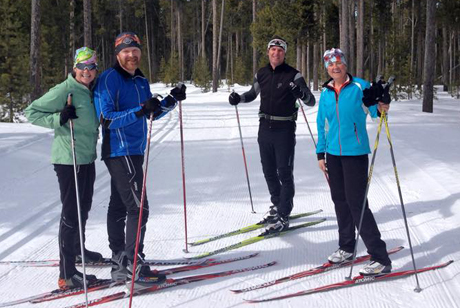
Wearing the right apparel for cross country skiing can keep you warm and comfortable.

I’ve often wondered why there isn’t more hoopla about cross country skiwear. I’m not talking about the suction suits worn by cross country ski racers; rather, I mean the recreational garb, which is versatile, functional, and fashionable.

Currently, I cross country ski wearing apparel from vendors like Craft, Sporthill, Swix, and others.  What is important is that the products that I select to ski in fit a number of personal parameter preferences.

Comfortable Pants For XC Skiing

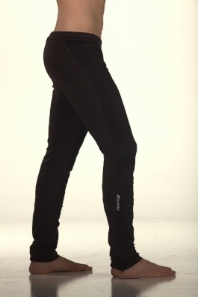
XC Ski pants with zipper all the way up the leg.

The Craft AXC Touring Pants (about $80) that I wear have zippers along the entire length of the legs, and, at the ankle, there is an elastic area closed with a zipper and a snap.

I feel that this pant ankle set-up is the most significant aspect of the pants. It tightly fits around the boot and keeps snow out of the boot top, avoiding wet socks while skiing.

And if you’re worried about losing your keys, the zippered side pockets are comforting to lock away your valuables.

The comfortably lined material of the Craft pants is also enough to stay warm with or without a base layer underneath.

Craft Cross Country Ski Jacket

Sporthill, Craft, and Swix jackets have most everything I want in a jacket, except few have pit zips to provide an extra way to cool off and transport perspiration away. These jackets have a mesh liner and material that is comfortable when you zip up the collar on a very cold day.

Look for jackets with cuffs and neck closures, mesh linings and, if you can find it, under arm zippers.

I’ve used the packable hood on the jacket quite a few times when it suddenly got cold out on the trail. The high-hip fit keeps you warm, and the zipper side pockets can be closed to avoid losing pocketed items. The jacket arms might have extended fleece cuffs, which are a nice touch to keep snow out of your glove. The inside chest pocket has a zipper and a hole for an earbud cable from my phone or iPod for the times that I want musical accompaniment on solo trail outings.

Socks And Gloves

Socks, gloves, shirts, and base layers are an entirely other matter that will need to be covered in a separate article. In short, parameters for selecting socks include thickness, space for your toes, and height of the sock on your leg. Expect to pay as much as $25 or more for quality socks these days.

I have a few different pairs of gloves so I can adjust to the temperature ranging from heavier, insulated, three-fingered gloves for the really cold days to lightweight gloves for springtime. I also have base layers in various thicknesses to correlate to warm and cold days. Moving perspiration away from the body is very important, and I use very lightweight underwear on those nice winter or spring days, but on the coldest days I use a heavier or thicker base layer pants and a top that has a turtleneck.

Problem: Limited Inventory In Stores

One of the challenges that confronts cross country skiing apparel availability is the fact that there is a limited inventory of these products in retail outlets. Because the cross country market is smaller than Alpine, there are relatively few sales in the stores. Retailers react by purchasing fewer items offering less selection in the following year. So let’s break this cycle. Go out and purchase more cross country skiing apparel!

Short Swings

Another SeniorsSkiing.com First: Best 2018 Boots for Senior Skiers

Finding a comfortable and good-fitting ski boot is an elusive goal for many older skiers.

Finding a comfortable and good-fitting ski boot is an elusive goal for many older skiers. According to responses to our reader surveys, 25% of you plan to purchase new boots in any given season. Reading the comments is revealing: “Want to find a painfree pair.” Looking for something that doesn’t hurt, Finally!” Hope to find a boot that helps my skiing AND is comfortable.”

We asked Steve Cohen and Mark Elling to help identify those boots most suitable for older skiers. They’re the ski boot authorities who organize America’s Best Bootfitters Boot Test, the annual evaluation of next season’s crop of new boots. Steve is a principal of Masterfit, the host company for the test. Mark is Test Director, responsible for organizing this highly complex and detailed event and writing the consolidated reports. Testers included bootfitters, retailers, instructors, coaches, patrollers, and other skiers;many of them seniors.

Last Spring, these men and women tested more than 100 models. They based evaluations on performance, value, easy on and off, warmth, and convenience of buckles and other adjustments. They also paid close attention to models with custom molding capabilities, which allow an experienced bootfitter to fit difficult foot anatomies.

Reading these reviews helps demystify confusion about boot selection. Regardless of how much you plan to invest in boots, work with a trained (preferably certified) bootfitter. Find one you like and stick with him or her.

Reviews are categorized as Men’s or Women’s, each according to foot width and All-Mountain (no “walk-mode”) or On-Off Area (with “walk-mode”). Men’s and Women’s listings each have 24 boot recommendations for seniors. The highest scoring models in each category appear at the top of that category. Abbreviated boot test results are available free to SeniorsSkiing.com subscribers. They appear under the Subscriber-Only Content box at the top of the Home Page.

In depth reviews are available at http://www.bootfitters.com/reviews, where the best boots for older skiers can be found by clicking on the Recommended for Seniors filter.

The Best 2018 Skis For Senior Skiers

One Might Say You Can Never Have Enough Skis.

My wife disagrees. She skis on a relatively old pair that she loves. They’re relatively soft in shovel and heel. For her, one pair is enough.

Mine is a completely different story; too long to get into at the moment.

Jackson Hogen, publisher of the ski review site realskiers.com, has been testing skis for decades. He works with testers from around the country, gathering their observations and consolidating them into pre-season evaluations of the upcoming season’s crop.

The complete list of the recommended 2018 skis for senior skiers is available free to SeniorsSkiing.com subscribers. Click on COMMUNITY (home page menu bar), then click on SUBSCRIBERS ONLY CONTENT in the drop down box.

(Free short reviews can be found at realskiers.com. The more complete evaluations require a subscription. Details on how SeniorsSkiing.com subscribers can subscribe to realskiers.com for 50% of the normal rate are at the end of this article.)

Recognizing that certain ski characteristics are more suitable for older skiers than others, last year, realskiers.com identified the best ones for older skiers. These skis generally have a soft flex, which allows the sidecut to engage with minimal exertion. When they’re used, the skier doesn’t work as hard. They’re easier to turn. They’re forgiving. You don’t have to be in peak shape to ski better or longer. The entire experience is more enjoyable.

Recommended skis are grouped into six categories, each based on skiing preference, location, and snow conditions. They follow:

Frontside (aka “Carving” skis)

  • These skis encompass the broadest range of skier abilities from entry-level to experienced and are for general use on groomed terrain. Wider models are usable off-trail.

All-Mountain East

  • Skis that are extremely versatile and for general use on groomed terrain. They also work off-trail.
  • This category is suitable for those who have not skied in a few years. 

All-Mountain West

  • These are good for use in the West by high performance skiers and are good both for groomed trails and for powder. 

Big Mountain

  • Skis for use on big mountains with selections for strong and for less strong skiers.

Powder

  • Specialty skis for use in deep powder.

Technical

  • These have high performance race ski characteristics and are suitable for carving turns on hard-snow.

While many consider skis to be unisex, some women prefer skis with weight and flex more suitable to their size and physique. The list also identifies preferred women’s skis.

Jackson advises approaching your next ski purchase by taking these three important steps:

  1. Identify the most suitable category.
  2. Work with a quality ski shop.
  3. If possible, demo selections to compare before purchasing.

To subscribe to realskiers.com: Visit site. Scroll down to/click on “Subscribe Today!” Click “Sign Up” in the “Annual Membership” box. Complete the form and enter SS17 in the field under “Coupon Code.”


Another Unique Gift: Buffalo Down Socks

We Took The Challenge And Wore Them For Five Days.  Here’s What Happened.

Bison down and Merino wool make a warm and durable combination.

We love buffalo, the distinctly American creature who has been denizen of the Great Plains since pre-history, who was deified by native Americans, who has captured our imagination in countless legends, songs, stories, novels, and movies, who has shown up in hamburgers, (bison burgers) and who now contributes to keeping our feet warm. Such a versatile critter, we hardly imagined that they had enough…what, fur?…to make things out of.

Apparently so. An enterprising company out of Kennedale, TX, makes a variety of clothing and accessory items from what they call “Bison Down”. Come to think of it, have you ever seen a buffalo shivering? Their undercoat of thick down is the insulating mechanism that keeps these huge mammals warm. Ron and Theresa Miskin, the good folks at The Buffalo Wool Co., were kind to send us a couple of pairs of buffalo down socks for testing.

In the letter accompanying the socks, they wrote: “If you’re feeling brave, wear them for two, three even four days…We think you’ll be impressed at how they hold up, keep your feet dry. and don’t get ‘stinky’ like cotton or synthetic socks.”

Well, we went for five days.  We were impressed with how they held up and how warm they were. We hiked in our hiking boots, sat through Thanksgiving, went to the store, and, truth be told, even slept in them on a couple of particularly cold nights. All for the sake of not exactly science but an honest product review for our readers.

At the end of five days, we gave them our personal sniff test. Not bad, we thought, but we need a second opinion to be statistically correct.  So, when our grown up son visiting for Thanksgiving was sitting on the couch one evening, focused on a football game, we asked him to do a sniff test.  In honesty, we didn’t really ask him. Rather we shoved our five-day ripe socks into his schnozola and said, “Smell this”. After an awkward discussion, he agreed they didn’t have the aroma of the bottom of long-abandoned gym locker.

And they really didn’t.  They were terrific.  We noticed these socks were nice and thick, the kind that is really comfy for hiking, cross-country skiing, snow-shoeing and outdoor activities in the cold weather whatever those might be.  The model we tested was made of 40 percent Bison Down, 40 percent Merino wool, 18 percent Nylon and two percent Spandex.  When we first opened the package, we noticed they were quite silky smooth and soft feeling.  They remained what way for the entire test period.

On the other hand, such thick socks might not be a choice for ski socks. SeniorsSkiing.com co-publisher Jon Weisberg, who also is testing a pair, says that some ski boots are so fitted to the foot that thick socks might get in the way, make the boots to tight and the feet too cold.

In any case, you can find a wide variety of different socks, hats, gloves, and even yarn at the Buffalo Wool Company site.  The model socks we tested were the Trekker Buffalo/Merino Wool for $38.  Other socks were as low as $32. Other products included different combos of Bison down with either silk or Merino wool.

And think of the fun you can have challenging your family members to a game of “how long can you wear your socks”.

The American Bison never shivers.
Credit: Brittanica

Holiday Gift Suggestion: DeBooter Easy-Off Ski Boot Jack

Other Than A Book, A Bottle, Or Some Meaningless Gewgaw, It’s Not Easy To Find A Reasonably Priced And Relevant Gift For The Older Skier.

DeBooter: Easy-to-use ski boot jack. Credit: OutDoor Logic Solutions

DeBooter solves that dilemma. It’s a clever ski boot jack that makes boot removal fast and easy.

SeniorsSkiing.com readers can purchase DeBooter for less than $32, a 20% discount from the $39.95 retail. (Enter SeniorsSkiing at checkout.)

It’s simple. Loosen your buckles (obviously!). Place DeBooter on a flat surface. Anchor it with the toe of one foot and place the other heel in the jack. Lift your foot, and you’re painlessly free!!!

Full disclosure: DeBooter is an advertiser, and I’ve written about the product in the past. But many of you are gift shopping, and I’d be remiss not remind you of this perfectly designed device.

On several occasions, I’ve shared my DeBooter with others in the parking lot. Some of them contemporaries, some older, some younger. The reaction to having their ski boots pop off painlessly is universally positive.

David Johnson, who invented and manufactures the product, reports that most of his sales are in the US, and that they are increasing abroad.

If you’re looking for the right gift for the skiers on your list, look at DeBooter.


Perfect Senior Gift: Tile Will Find Your Keys And Any Thing Else

The Amazing Device We’ve All Been Waiting For.

Attach Tile to keys, skis, bikes, cats, grand kids, wives, husbands, etc. Now they can be found, even when hiding.

You’ve probably had this experience.  You are rushing out the door, late for something or other, and you’ve grabbed everything except…wait a minute…”Where are my keys? (wallet, glasses, etc?)” And the frantic search begins, characterized by looking in several of the same places more than once (a sure sign of insanity) and then finally discovering them in your jacket pocket.

And in response you say to yourself, “Why doesn’t someone just invent something to stick on your keys that flashes or something?” Well, ta-da, someone did.

It’s called Tile, and it’s a little (1.5″ x 1.5″) square plastic device you can attach to keys, bicycles, backpacks, puppy dogs…just about anything you can think of that you can expect to go missing.

Here’s the app. Keys and iPhone are being tracked. There’s also a map; you can get a visual on where the hiding things are.

The version of Tile we tested is the Sport model, waterproof, bluetooth-enabled, loud (trust us on this) device that is very simple to set up and use.  All you have to do is download the Tile app to your Smartphone (Android or iOS), connect the device and you’re in business. It’s got a 200 foot range, so you can cover most places in a house or office.

To find your keys with Tile attached, simply open the phone app, tap the key logo, and you will hear the keys talking to you from their hiding place.  The other indispensable feature we really love is when you lose your phone, and your Tile will help you find it. Just tap the Tile device twice, and you will hear your phone peeping out from where you never thought to look for it.  You even have a choice of ring tones.

If there is a downside to finding your phone with Tile, it’s that your app on the phone has to be on. We haven’t experienced any major battery issues, but it is something to think about. Maybe you just activate the app when you take your phone out of your pocket and drop it on a desk or table.

If you lose your phone and your keys, well, bless your heart. Grandma used to say start looking where you saw them last.

It’s clear that once you see how Tile works you will want to tell other people about it.  Tile gives you 25  points for each person your refer and who buys. When you get 50 points, you get a free Tile.

The are four different models of Tile, from Tile Mate, to Sport, Style and Slim.  Prices range from $25 for the Mate to $35 for the Style. These prices are from the Tile website.  Click here to go there.

If you’re looking for stocking stuffer gifts for your family and friends, you can buy multi-packs of Tiles at a discount.  A four-pack of Sport Tiles is $100.

A perfect gift.  Every time one of those family members or friends finds their keys or lost eyeglasses, they will think of you!

Here’s the Tile video showing the Pro Series Sport Model which is the model we tested.

https://youtu.be/TPSUFq5FFMc


Putting Away Stuff: More Advice On Cleaning And Storage

Things You Can Do To Show How Much You Love Your Equipment.

[Editor Note: We received several comments about last week’s article by Don Burch about putting your skis away.  So, we asked retail expert and SeniorsSkiing.com correspondent Val E. offer some more advice.  Here you go.]

Ski Cleaning

Care for your equipment in the springtime pays off in the fall.

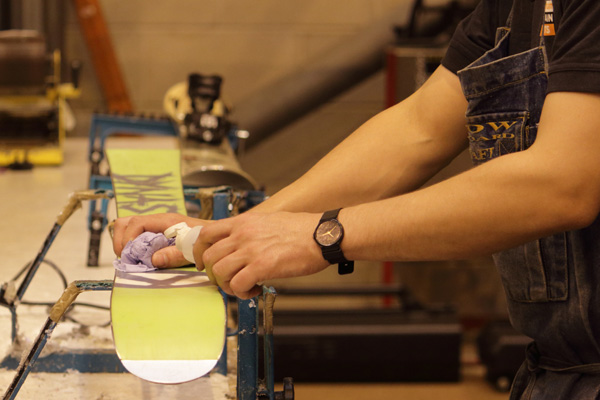
All ski bases are made out of polyethylene which is a chemically neutral and relatively durable material. You can’t ruin it with household chemicals, but you should keep in mind that the base material is porous.  So, clean dirt from the surface and from the pores (hot wax cleaning is for that). Acetone is a simple, cheap and easy option for base cleaning. Use rubber gloves.

To slow down oxidation of polyethylene (see any whitish areas?), seal the base with wax, that is why hot waxing is better than cold waxing. A thick layer covering the base and the edges doesn’t let oxygen infiltrate.

I would suggest you file down nicks on aluminum tail and tip inserts as well as round up the nicks on the top surface edge, especially in the areas where you grab your skis. The top layer and the sidewalls are often made out of ABS plastic which doesn’t like acetone, so to be on a safe side use household soap to clean these areas.

Binding Cleaning

Try to avoid getting liquids besides water and special lubricant into your bindings. A ski bag should protect your bindings from dust sticking to the internal parts. Don’t have a ski bag? Wrap the bindings or the entire skis in a plastic bag. Two big garbage bags will work.

Keeping skis in a shed or cold garage is even worse as driving with your skis on the car roof unprotected; be nice to your skis and you will be a happy camper…oops, skier!

Poles

If tips are rusty and dull, sand them and sharpen. Aluminum poles may bend and stay bent or break, while composite poles never stay bent, they just break in case of high load. Check the shafts: in case of aluminum poles—file any nicks if found. In case of composite poles (carbon or fiberglass), fill in deep cuts or delaminated areas with epoxy resin. Look at the baskets, they should not have any deep cuts.

Boots

Pull out the liner and wash the shell of your ski boots with soap and nylon brush. Dry out the liners and the shells.

Store your boots buckled up. You may want to fit them with newspapers or thick wrapping paper. It may sound very old school, but it will help your liners to stay in shape.

Clothing

Wash all your ski soft goods—pants, jackets, base and mid-layers, face masks, socks using the right detergent; read the tags first. Most dry cleaning companies will not accept your clothing made of membrane fabric. If your gloves are very dirty, hand wash them, carefully squeeze the water out, starting with the fingers, and hang the glovers with the fingers up to dry. If your gloves have membrane liners (Gore-Tex or similar), try to not mess with it, if your pull the liner out of the fingers, it would be very difficult to put them back.

Store your ski jacket on a “fat” plastic hanger, not wire or thin plastic or wood. This is especially important for a natural down jacket. I prefer my ski pants to spend the summer hanging on a belt loop, not folded. Fold it less and you will extend the life of a waterproof/breathable membrane!

Synthetic fleece pieces and mid-layers with synthetic insulation are very easy to wash and store. Some items can be used off season for biking, running or walking. A fleece sweater is my favorite item while traveling by airplane—light, easy, and comfortable. If you have wool layers (merino or regular wool), make sure they are protected from moth.

Helmet

The liner may need a wash, check for cracks, the buckle and adjustments should work well. Dry it out and put in a fabric bag, don’t keep in a direct sunlight or in a hot shed.

Electronics

If you use batteries in your ski gear (goggles, heated gloves, boot heaters, helmet camera, etc.) pull them out. Replace batteries at the beginning of next season.

Putting XC Skis Away

Nine Steps For Maintaining Your XC Equipment.

[Editor Note: SeniorsSkiing.com thanks Roger Lohr of XCSkiResorts.com and Andy Gerlach of SkiPost.com and StartSkiWax for this article.]

Preparing the base with hot wax.

The winter and snow cover are leaving us, so what do we do with your xc ski equipment?

1) Cleaning: Use wax remover and Fiber wipe, a chamois-like cloth, to clean the kick zone and the glide zone.

2) Use a fine steel or copper brush to clean excess dirt from base.

3) Apply layer of Start Base (Start is a brand of XC ski wax) or Service or soft non-fluoro glider like SG2 to glide zones.

4) While wax is still soft, use scraper with low pressure to “hot wipe” wax and further dirt away.

5) Follow with Fiber wipe and then a fine steel brush again to remove dirt while refreshing base further. Repeat steps 4 and 5 as necessary until no more dirt is seen coming from base.

6) If you suspect your skis have any base damage (i.e. base sealing), consider having the skis stone ground to reveal a fresh base in the spring before summer storage. A fresh base is the most import feature in a skis ability to hold wax and to glide. Ski shops in most every ski town offer great stone grinding services.

7) Once you have a clean and refreshed base, it is time to saturate the base with a summer storage wax. In the glide zones, melt in a thick layer of Start Base (or Service or soft non-fluoro glider like SG2) and let it cool. If all the wax has been absorbed into the base at any point add another layer on to. Let cool leave it on the ski all summer.

8) Skis should be stored in cool, dry place, out of sunlight and not near heating elements nor near a roof or attic where temperature can rise over 130 degrees F. Skis should be stored loosely strapped with no pressure on camber so that there is no risk that heat and pressure can alter any of the skis camber characteristics.

9) Better to do something than nothing. So at the very, very least crayon your softest glide onto your glide zones right now.

If you have questions, contact Andy Gerlach at SkiPost.com.

The Top All-Mountain Skis of All Time: Part II

This article completes the list of “iconic all-mountain” skis published last week.

One reader comment on last week’s list stated that better options are available today. In the interest of clarification, skis listed last week and in this article weren’t necessarily the most innovative or game changing. But, at the time they were introduced, they were the best at handling all conditions.

Völkl Mantra

One could make a strong case that the Völkl Mantra served as the primary prototype for the modern all-mountain ski genre. Like the Snow Ranger preceding it, the Mantra pulled no punches when it came to integrating first class construction into a modern shape. Any ski with decent surface area will work in powder, but it takes a stout ski to subdue crud. The Mantra, in all its incarnations, has been pulverizing crud since its inception.

Kästle MX83

Dimensionally, the MX83 falls just outside the current definition of an all-mountain shape, but temperamentally it’s predisposed to dominate in any condition. Rather than float over fluffy pow, the MX83 rips it out by the roots, tearing through whatever lies in its path. What makes it deliriously well suited to off-trail skiing is its unique ability to flow over irregular terrain as if it were made of mercury.

Atomic Nomad Crimson Ti

The Nomad series focused on Frontside performance, but top of the line Crimson Ti, had the moxie to travel anywhere with aplomb. The only system ski among our dandy dozen, the original Crimson Ti was so stable at speed it inspired the confidence to roam all over the mountain, where it revealed a capacity for decimating crud with the same power it applied to carving up the groom.

Nordica Hell & Back

Many skiers are under the illusion that it takes a slab or two of Titanal to make a strong, powerful ski. Nordica laid that notion to rest when it concocted the Hell & Back, an all-glass construction with the grip of Gorilla glue. A fall-line charger without fear, the Hell & Back had a big brother, the Patron, which set the benchmark for powder performance for several seasons.

 Rossignol Soul 7

Strictly speaking, the Soul 7 was a tad too wide to make our list, but one can’t overlook top-of-the-heap sales success. A follow-up to the already popular S7, the Soul 7 hit the sweet spot on a slew of trends: lightweight construction, tapered tips and tails, and eye-catching cosmetics. But the key to its powder performance lay in an Old School property: rebound of the kind that coined the term, “porpoising,” describing the way the Soul 7’s coiled power lifted the skier up after every turn.

Blizzard Bonafide

I’d skied 1,000’s of models before I first stepped into a pair of Bonafides. All it took was one run and I was in love. As with any true love, all other contenders for my affections faded into the background for the Bonafide demonstrated that it could do anything at any time in any condition. I hear the quibbles that it requires speed and expert technique to extract its charms but dismiss them as hollow carping. As this list makes clear, when has it not been true that better skis reward better skiing?

 Postscript: This highly unscientific exercise isn’t meant to identify the very best skis, nor the most popular and not necessarily the most innovative or influential. The common thread is that they epitomized versatility in their respective eras.

However you feel about these selections, I invite you to chime in on the Realskiers.com Facebook page, home of the discerning diatribe.

Get the Realskiers.com Revelations newsletter in your inbox all season long. Subscribe Today!


The Top All-Mountain Skis of All Time

Excerpted with permission from realskiers.com where the full article was published March 20, 2017.

All-mountain skis — those that purport to do everything reasonably well – started appearing in the mid-90’s. 

Following, listed roughly in order of their debut, are the iconic models that emerged since the term “all-mountain” came into common usage. My picks aren’t necessarily the most innovative or game changing, but they were, for a while, the best at handling any condition the mountain might dish out.

Völkl Snow Ranger

Völkl didn’t invent the fat ski – that distinction goes to Atomic – but they were the first to make an expert powder ski using elite construction. When fat skis were first making a dent in the market, no other model was as powerful and versatile as the original Snow Ranger, which still holds its own as an all-terrain ski today.

Volant Chubb

From today’s perspective, it’s hard to believe that the Chubb, born in the first generation of fat skis, had a 90mm waist. When Shane McConkey began to straight-line steep couloirs on the Chubb, any lingering resistance to fat skis as cheater sticks evaporated. Applying the Chubb’s construction to a water ski’s shape resulted in the Spatula, creating new dimensions in ski design that endure to this day.

K2 Four

K2 wasn’t an early adopter of shaped skis, but once the brand put their marketing prowess into promoting the concept, there was no turning back. A young Bode Miller started to win races on the funky red, white and blue skis, validating the technical capabilities of the deep sidecut. America followed suit, setting the table for K2’s run of dominance in the U.S. market.

Dynastar 4×4

Shaped skis were still by and large a carving club when Dynastar debuted the 4×4 as an unabashed off-road ski, inspiring comparisons to SUV’s for their all-terrain adaptability. Although absurdly narrow by today’s standards (a shade under 68mm underfoot), the first 4×4 would later morph into the 4×4 Big, one of the most popular fat skis of its era.

Salomon X-Scream

Like the 4×4, Salomon’s X-Scream was one of the first shaped skis that wasn’t intended as an on-piste carving tool but as an all-terrain implement. The first X-Scream earned instant acclaim when it rolled out in 2001, spawning a string of successors that made the X-Scream family the most popular in Salomon’s history.

Stöckli Stormrider XL

Stöckli tends to build all-terrain skis with DNA extracted from Super G race models, making their Stormrider series among of the burliest all-mountain skis. The Stormrider XL, sporting a waist of 75mm, was an ancestor of the current crop of Stormriders, which range in width from 83mm to 115mm. The one constant has been a stout, wood and metal lay-up that takes no prisoners as it slashes through any and all snow conditions.

NOTE: This highly unscientific exercise isn’t meant to identify the very best skis, nor the most popular and not necessarily the most innovative or influential. The common thread is that they epitomized versatility in their respective eras.

Six other picks will appear next week.

Subscribe to realskiers.com and receive newsletters, commentary, and expert advice all season long. 

Gear Review: K2 Pinnacle 105

Big-Mountain Lovers Won’t Find A Better Age-Busting Ski.

The K2 Pinnacle 105 has a big-mountain profile: 137-105-121.
Credit: K2 Skis

By age-busting, I mean the K2 Pinnacle 105. makes everything easier — and it made me feel about 20 years younger.

The Pinnacle 105 is on SeniorSkiing.com’s list of best Big Mountain skis for seniors in the West. If you’d like to receive the list, click on this link and subscribe on the form in the right column or the pop-up which will appear on the page. After confirming your subscription, you can access the list of senior ski recommendations in the Subscriber-Only menu under Community.

Stats on the ski

I tested the Pinnacle 105s in wildly different conditions in Washington state: during a huge powder dump at Crystal Mountain and on a crispy-firm groomer day at Stevens Pass. The skis crushed everything they came up against.

I took them everywhere—on steeps, chutes, bumps, at high speed, in funky avalanche debris—even a nasty rain crust. They offer a level of control I’ve never experienced on any other ski, and at the same time they felt lively, quick and fun.

The author after a day of shredding at Stevens Pass. Credit: John Nelson

The Pinnacle 105 (MSRP: $900) is part of K2’s freeride line for men. The profile for the ski is 137-105-121 with a pronounced rocker tip, and K2 promises this is your “go anywhere, do everything ski.” I’m 5 foot 11 inches, 150 pounds and skied the 177 centimeter length.

Even though this is a wide ski, it’s surprisingly light. K2 keeps the weight down with what it calls Konic Technology. Without getting too gear-nerdy, this involves reducing the weight of the ski where you don’t need it to be strong (the middle and extremities) and reinforcing the areas where you do need strength (the edges). The overall effect is to reduce what’s called “swing weight” from edge-to-edge.

I’ll admit I was dubious. I figured they would be great in powder, but I’d give up power and stability on firm snow. How wrong I was.

In powder

I hit perhaps the best day of the year at Crystal Mountain. Overnight, 12 inches had fallen on top of 40 inches the previous two days.

Talk about epic.

My first turns were amazing. The wide profile gave the ski incredible float and control. No need to stay back—I found myself charging all the time with ease, subtly controlling speed with simple edging and weight shifts.

On steeps, it was truly eye-opening. I could fly when I wanted, slow down to negotiate a chute or a drop, then turn on the gas and start flying again.

As slopes became skied out, broken snow was easily blasted away by these powder monsters. It was all too fun and easy.

Firm and fast

During a second day of testing at Stevens Pass, things couldn’t have been different. Rain had fallen several days previous, then frozen into a crust. On top of the rain crust, a little new snow had fallen and been skied off.

It was a groomer day for most skiers, but I took the Pinnacles off-piste into bumps and steeps. I’ll admit I was a bit nervous on my first turn over a crusty bump on a double-black diamond drop, but the 105s dug in with surprising power.

But it wasn’t all about the power — they could also be incredibly quick edge-to-edge. Whether I was carving wide-radius or fast, snappy turns, the overall feeling was of incredible control.

Next, I went for speed. Most of the freeride skis I’ve tried don’t track when you turn up the speed, but the 105s were nothing short of amazing. Arcing at high-speed or making short radius turns felt equally stable.

Bottom line: Who will love this ski?

The Pinnacle 105 excels for advanced skiers who spend most of their time off-piste in the west.

Ready to ride on a firm day at Stevens Pass. Credit: John Nelson

Making a Trail Map Boot Horn

I’d Be Surprised If Someone Else Didn’t Come Up With This Simple Trick Soon After The Printed Trail Map Made Its Debut.

But, necessity being the mother of invention, in a moment of need, I folded the first map I found, tucked it into the shaft, and, with surprising ease, slipped my foot inside.

Here’s how to do it on your own:

Place trail map against the rear boot cuff. and fold so one half is on outside of boot.

Put foot in boot as usual, letting heel slide down the map’s surface, while holding map with free hand.


Voila! Foot enters boot without struggle.

Note: Be sure to fold the map over the cuff. At first, I didn’t and the map went in with my foot. Folding prevents that from happening.


Demo Day: How To Participate And Enjoy

Here Are Some Tips For Taking Part. Don’t Be Shy.

Demo staff are knowledgable, helpful and welcoming to first-timers.
Credit: Val E.

Every season ski shops, ski manufacturers, and ski resorts organize events when anybody could try new ski equipment. Demos range from a local mom-and-pop ski shop get-together to major on-snow events run by SIA (Snowsports Industry America).

Why do you need to take part in it? Technical progress never stops, try new things; you may like them. At least you will have your own opinion. Picking a pair of skis or boots is as personal and as tricky as picking a life partner. Well, kind of.

Never think you are not qualified for a ski demo. The idea is to let “volks” try the “wagen” and to give them a clear reason to buy it later.

Setting bindings based on your experience and size has to be done accurately. Don’t exaggerate your skill level!
Credit: Val E.

  • Check the list of demos at your local resort, or before you go to a ski trip. State ski associations are good resources for finding resort events. (SkiNH, SkiUtah, etc.)
  • Come early, bring your boots, poles, ID, and a credit card. Bring your own skis to “calibrate a zero level” by taking a run or two before the demo.
  • Before starting the demo, you must fill in a form with your weight, height, skier type, age, and gender. Be honest with this info; it is used for adjusting your bindings.  A higher setting than needed may lead to non-release of a binding which is dangerous.
  • Prepare a list of announced brands and potential models to try on. Know before you go so your search can be focused. Have an objective for your try-outs.
  • Read some magazines or blogs about different ski types before you go. Think about types of skis you like and dislike, what you want to demo considering the snow conditions. For example, if you ski mostly in hard pack or ice, don’t spend much time on skis for powder/soft snow.
  • If time permits, talk to the staff working at the demo booths; they are knowledgeable about ski features and benefits.
  • It’s pretty obvious but don’t ruin the edges and bases of the demo skis. These aren’t your rock skis.
  • Unwritten rule is that a skier makes a couple of runs on one pair of demos and returns it. Someone else will be waiting for your demos.
  • Use your smart phone to take photos of ski reviews and demo skis. Record your audio and video comments about them while staying in line or riding a ski lift. A partner can record a video of you going down the hill on different skis to compare. You can share your recorded impressions with your less fortunate friends on Facebook or in real life.

Even if you are not really interested in purchasing a new pair of skis, you learn a lot about gear and the sport, and it’s fun!


How To Get Several Days From Your Shake-Em-Up Hand Warmers

Use These Two Sneaky Tips.

The air-activated hand warmers keep your fingers toasty while you ski. Even when your legs fall off, your hand warmers keep going.

Then what do you do with them? They have a lot of heat left.

I used to give them away in the locker room. People would snap them up for themselves or their kids.

Tip #1. Here’s how to save them.

Mummified hand warmers can be revived for another day.
Credit: Harriet Wallis

I discovered I can keep them until the next day and sometimes several days by wrapping them tightly in Saran wrap or other generic plastic wrap.

Mummy them up tightly in about 2 feet of plastic wrap until you can no longer feel the heat coming through.

The wrap cuts off the air, and they go dormant. Reactivate them by unwrapping them and shaking as usual. Roll the plastic wrap onto a tube and reuse it another day.

The up side is you can save and reuse hand warmers for several days. The down side is that sometimes it just doesn’t work.

Experiments 101

Plastic baggies don’t work. Even if you squish really well, there’s still too much air left inside. Aluminum foil doesn’t seem to work, but I don’t know why. Use plastic wrap.

Tip #2. Before you buy.

Check that expiration date. It should be several years out, not soon.
Credit: Harriet Wallis

Before you buy a stockpile of hand warmers, check the expiration date. It should be several years into the future—not next year. Hand warmers close to their expiration date often have less oomph.

On the other hand, you might discover hand warmers long past their expiration date that have been buried in your ski bag for years. And they might work very well. Just don’t count on it on a sub-zero day.

To read more from Harriet click here for her stories on SkiUtah.